


Community hub
Recent from talks
Contribute something
Nothing was collected or created yet.
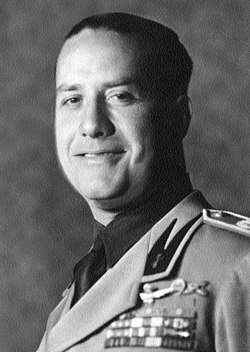
Galeazzo Ciano
View on Wikipedia
Gian Galeazzo Ciano, 2nd Count of Cortellazzo and Buccari (/ˈtʃɑːnoʊ/ CHAH-noh, Italian: [ɡaleˈattso ˈtʃaːno]; 18 March 1903 – 11 January 1944), was an Italian diplomat and politician who served as Foreign Minister of the Kingdom of Italy under the government of his father-in-law, Benito Mussolini, from 1936 until 1943. During this period, he was widely seen as Mussolini's most probable successor as head of government.[1][2]
Key Information


_-_Signature_of_Galeazzo_Ciano.jpg)
He was the son of Admiral Costanzo Ciano, a founding member of the National Fascist Party; father and son both took part in Mussolini's March on Rome in 1922. Ciano saw action in the Italo-Ethiopian War (1935–36) and was appointed Foreign Minister on his return. Following a series of Axis defeats in the Second World War, Ciano began pushing for Italy's exit, and he was dismissed from his post as a result. He then served as ambassador to the Vatican.
In July 1943, Ciano was among the members of the Grand Council of Fascism that forced Mussolini's ousting and subsequent arrest. Ciano proceeded to flee to Germany but was arrested and handed over to Mussolini's new regime based in Salò, the Italian Social Republic. Mussolini ordered Ciano's death, and in January 1944 he was executed by firing squad.[3]
Ciano wrote and left behind a diary[4] that has been used as a source by several historians, including William Shirer in his The Rise and Fall of the Third Reich (1960)[5] and in the four-hour HBO documentary-drama Mussolini and I (1985).[6]
Early life
[edit]Gian Galeazzo Ciano was born in Livorno, Italy, in 1903. He was the son of Costanzo Ciano and his wife Carolina Pini;[7] his father was an Admiral and World War I hero in the Royal Italian Navy (for which service he was given the aristocratic title of Count by Victor Emmanuel III).[8] The elder Ciano, nicknamed Ganascia ("The Jaw"), was a founding member of the National Fascist Party and re-organizer of the Italian merchant navy in the 1920s. Costanzo Ciano was not above extracting private profit from his public office.
He would use his influence to depress the stock of a company, after which he would buy a controlling interest, then increase his wealth after its value rebounded. Among other holdings, Costanzo Ciano owned a newspaper, farmland in Tuscany and other properties worth huge sums of money. As a result, his son Galeazzo was accustomed to living a high-profile and glamorous lifestyle, which he maintained almost until the end of his life. Father and son both took part in Mussolini's 1922 March on Rome.[9]
After studying Philosophy of Law at the University of Rome, Galeazzo Ciano worked briefly as a journalist before choosing a diplomatic career; soon, he served as an attaché in Rio de Janeiro.[10] According to Mrs. Milton E. Miles, in the 1920s in Beijing Ciano met Wallis Simpson, later the Duchess of Windsor, had an affair with her, and left her pregnant, leading to a botched abortion that left her infertile. The rumor was later widespread but never substantiated and Ciano's wife, Edda Mussolini, denied it.[11]
On 24 April 1930, when he was 27 years old, Ciano married Benito Mussolini's daughter Edda Mussolini,[3] and they had three children (Fabrizio, Raimonda and Marzio), though he was known to have had several affairs while married.[12] Soon after their marriage, Ciano left for Shanghai to serve as Italian consul,[13] where his wife had an affair with the Chinese warlord Zhang Xueliang.[14]
Political career
[edit]Minister of press and propaganda
[edit]On his return to Italy in 1935, Ciano became the minister of press and propaganda in the government of his father-in-law.[15][16] He volunteered for action in the Italian invasion of Ethiopia (1935–36) as a bomber squadron commander. He received two silver medals of valor and reached the rank of captain. His future opponent Alessandro Pavolini served in the same squadron as a lieutenant.
Foreign minister
[edit]
Upon his highly trumpeted return from the war as a "hero" in 1936, he was appointed by Mussolini as replacement Foreign Minister. Ciano began to keep a diary a short time after his appointment and kept it active up to his 1943 dismissal as foreign minister. In 1937, he was allegedly involved in planning the murder of the brothers Carlo and Nello Rosselli, two exiled anti-fascist activists killed in the French spa town of Bagnoles-de-l'Orne on 9 June. Also in 1937, prior to the Italian annexation in 1939, Gian Galeazzo Ciano was named an Honorary Citizen of Tirana, Albania.[17]
Before World War II, Mussolini may have been preparing Ciano to succeed him as Duce.[18] At the start of the war in 1939, Ciano did not agree with Mussolini's plans and knew that Italy's armed forces were ill-prepared for a major war. When Mussolini formally declared war on France in 1940, he wrote in his diary, "I am sad, very sad. The adventure begins. May God help Italy!"[19][20] Ciano became increasingly disenchanted with Nazi Germany and the course of World War II, although when the Italian regime embarked on an ill-advised "parallel war" alongside Germany, he went along, despite the terribly-executed Italian invasion of Greece and its subsequent setbacks. Prior to the German campaign in France in 1940, Ciano leaked a warning of imminent invasion to neutral Belgium.[21]
Throughout 1941 and thereafter, Ciano made derogatory and sarcastic comments about Mussolini behind his back and was surprised that these comments were reported to the Duce, who did not take them lightly; for his part, Ciano ignored well-meaning friends who advised moderation.[16] On top of that, friends and acquaintances sought his protection and aid on various matters not having to do with his official position, which in turn resulted in further caustic remarks. In addition, two relatively minor incidents wounded his overblown self-importance and vanity. One was his being excluded from a projected meeting between Mussolini and Franco. The other involved him being reprimanded for a rowdy celebration of an aviator in Bari; he wrote a letter to Mussolini stating that the Duce had "opened a wound in him which can never be closed." His own self-worth seemed to cloud his judgement, forgetting that he had acquired his position by marrying Mussolini's daughter.[22]
In late 1942 and early 1943, following the Axis defeat in North Africa, other major setbacks on the Eastern Front, and with an Anglo-American assault on Sicily looming, Ciano turned against the doomed war and actively pushed for Italy's exit from the conflict. He was silenced by being removed from his post as foreign minister. The rest of the cabinet was removed as well on 5 February 1943.[23]
Ambassador to the Holy See
[edit]Ciano was offered the post of ambassador to the Holy See, and presented his credentials to Pope Pius XII on 1 March.[23] In this role he remained in Rome, watched closely by Mussolini. The regime's position had become even more unstable by the coming summer, however, and court circles were already probing the Allied commands for some sort of agreement.[20][24]
On the afternoon of 24 July 1943, Mussolini summoned the Fascist Grand Council to its first meeting since 1939, prompted by the Allied invasion of Sicily. At that meeting, Mussolini announced that the Germans were thinking of evacuating the south. This led Dino Grandi to launch a blistering attack on his longtime comrade. Grandi put on the table a resolution asking King Victor Emmanuel III to resume his full constitutional powers – in effect, a vote leading to Mussolini's ousting from leadership. The motion won by an unexpectedly large margin, 19–8, with Ciano voting in favor. Mussolini's replacement was Pietro Badoglio, an Italian general in both World Wars.[25] Mussolini did not expect the vote to have substantive effect, and showed up for work the next morning as usual. That afternoon, the king summoned him to Villa Savoia and dismissed him from office. Upon leaving the villa, Mussolini was arrested.[26]
Exile, trial and death
[edit]
Ciano was dismissed from his ambassador's post by the new government of Italy put in place after his father-in-law was overthrown. Later he and Edda were put under home arrest. Fearing further prosecution by the new Italian government, Ciano and Edda secretly turned to the Germans for help, and after covertly fleeing their villa with their three children on 27 August 1943 were evacuated on a German military plane from Ciampino airport to Munich.
After they were evacuated to Germany and placed in a secluded villa near Munich, Ciano and Edda applied for permission to be transferred to neutral Spain where they hoped to wait till the war's end. The application was denied, and as the Germans were furious at Ciano for his anti-Mussolini vote at the 24 July Fascist Grand Council meeting, they turned Ciano over to Mussolini's new government, the Italian Social Republic formed on 23 September, agreeing with Mussolini that Ciano would be viewed as a traitor. Ciano was then formally arrested on charges of treason. Under German and Fascist pressure, Mussolini kept Ciano imprisoned before he was tried at court and found guilty.[26] After the Verona trial and sentence, on 11 January 1944, Ciano was executed by a firing squad along with four others (Emilio De Bono, Luciano Gottardi, Giovanni Marinelli and Carlo Pareschi) who had voted for Mussolini's ousting. As a further humiliation, the condemned men were tied to chairs and shot in the back, though, allegedly, Ciano managed to twist his chair around at the last minute to face the firing squad before uttering his final words, "Long live Italy!"[27]
Ciano is remembered for his Diaries 1937–1943,[28] a revealing daily record of his meetings with Mussolini, Hitler, Ribbentrop, foreign ambassadors and other political figures. Edda tried to barter his papers to the Germans in return for his life; Gestapo agents helped her confidant Emilio Pucci rescue some of them from Rome. Pucci was then a lieutenant in the Italian Air Force, but would find fame after the war as a fashion designer. When Hitler vetoed the plan, she hid the bulk of the papers at a clinic in Ramiola, near Medesano and on 9 January 1944, Pucci helped Edda escape to Switzerland with five diaries covering the war years which were then buried beneath a rose garden.[29] The diary was first published in English in London in 1946, edited by Malcolm Muggeridge, covering 1939 to 1943.[30] The complete English version was published in 2002.[4]
Children
[edit]Gian Galeazzo and Edda Ciano had three children:
- Fabrizio Ciano, 3rd Conte di Cortellazzo e Buccari (Shanghai, 1 October 1931 – San José, Costa Rica, 8 April 2008), married to Beatriz Uzcategui Jahn, without issue. Wrote a personal memoir entitled Quando il nonno fece fucilare papà (When Grandpa Had Daddy Shot).
- Raimonda Ciano (Rome, 12 December 1933 – Rome, 24 May 1998), married to Nobile Alessandro Giunta (born 1929), son of Nobile Francesco Giunta (Piero, 1887–1971) and wife (m. Rome, 1924) Zenaida del Gallo Marchesa di Roccagiovine (Rome, 1902 – São Paulo, Brazil, 1988)
- Marzio Ciano, (Rome, 18 December 1937 – 11 April 1974), married Gloria Lucchesi
In popular culture
[edit]- A number of films have depicted Ciano's life, including The Verona Trial (1962) by Carlo Lizzani, where he is played by Frank Wolff and Mussolini and I (1985) in which he was played by Anthony Hopkins.
- In Serbia there is a proverb: "Living like Count Ciano" – describing a flamboyant and luxurious life (Živi k'o grof Ćano/Живи к'о гроф Ћано).
- Ciano's diaries were published in 1946 and were used by the prosecution against Hitler's Foreign Minister, Joachim von Ribbentrop, during the post-war Nuremberg Trials.
References
[edit]Notes
[edit]- ^ d'Orsi, Angelo (10 April 2019). Flores d'Arcais, Paolo; Sciuto, Cinzia; Ruffolo, Giorgio (eds.). "Il genero del regime. Vita e morte di Galeazzo Ciano nel libro di Eugenio Di Rienzo". MicroMega (in Italian). Rome, Italy: Edito da Micromega Edizioni impresa sociale SRL (GEDI Gruppo Editoriale S.p.A.). ISSN 2282-121X. Archived from the original on 17 April 2019. Retrieved 25 July 2021.
- ^ Palla, Marco (10 January 1982). Rapone, Leonardo; Höbel, Alexander; Larussa, Alessandro (eds.). "Mussolini il fascista numero uno". Studi Storici (in Italian). 23 (1). Rome, Italy: Fondazione Istituto Gramsci: 23–49. ISSN 0039-3037. JSTOR 20565036. Retrieved 27 July 2021.
- ^ a b Moseley, Ray (2004) [1932]. "7. Galeazzo Ciano and Edda". Mussolini: The last 600 of il Duce (5th ed.). Dallas, TX: Taylor Trade Publishing. p. 79. ISBN 9781589790957. LCCN 2003026579. OCLC 1036749435 – via Internet Archive.
- ^ a b Ciano 2002.
- ^ Shirer, William L. (1960). The Rise and Fall of the Third Reich. New York: Simon & Schuster. p. 436. LCCN 60-6729.
- ^ Negrin, Alberto (director); Gallo, Mario (producer); Gulllioli, Emzo (producer) Haskins, Bob (actor); Hopkins, Anthony (actor); Sarandon, Susan (actor) (15 April 1985). Perpignani, Roberto; Macchi, Egisto (eds.). Mussolini and I (Mussolini: The Decline and Fall of Il Duce). HBO (motion picture). Italy: Rai Uno/HBO Premier Films.
- ^ Hof 2021, p. 4, Introduction.
- ^ Hof 2021, p. 5, Introduction.
- ^ Hof 2021, p. 92, 2. The Politician.
- ^ Hof 2021, pp. 137–213, Chapter 3. The Diplomat.
- ^ Moseley, Ray (1999), Mussolini's Shadow: The Double Life of Count Galeazzo Ciano, New Haven: Yale University Press, pp. 9–10, ISBN 978-0-300-07917-3
- ^ Di Rienzo, Eugenio (29 November 2018). Grossi, Davide; Mazzuchi, Andrea; Malato, Enrico; Spadaro, Cetty (eds.). Ciano: Vita pubblica e privata del 'genero di regime' nell'Italia del Ventennio nero. Profili (Salerno editrice) (in Italian). Rome, Italy: Salerno Editrice. ISBN 9788869733420.
- ^ Coco, Orazio (14 February 2024). Sino-Italian Political and Economic Relations: From the Treaty of Friendship to the Second World War. Abingdon: Routledge. p. 48. doi:10.4324/9781003143260. ISBN 978-1-003-14326-0.
- ^ Kristof, Nicholas D. (19 October 2001). Baquet, Dean; Louttit, Meghan; Corbett, Philip; Chang, Lian; Drake, Monica; Kahn, Joseph; Kingsbury, Kathleen; Sulzberger, A.G.; Levien, Meredith Kopit; Caputo, Roland A.; Bardeen, William; Dunbar-Johnson, Stephen; Brayton, Diane (eds.). "Zhang Xueliang, 100, Dies; Warlord and Hero of China". National news. The New York Times. Vol. CL, no. 210. p. C13. ISSN 0362-4331. OCLC 1645522. Archived from the original on 24 October 2009. Retrieved 25 July 2021.
- ^ Hof 2021, pp. 214–267, Chapter 4. The Successor.
- ^ a b D'Annibale, Elisa; Di Rienzo, Eugenio (1 May 2017). Rinaldi, Marcello; D'Annibale, Elisa; Rudi, Fabrizio; Xoxa, Ida (eds.). "Gli appunti circa il Reichsministerium für volksaufklärung und propaganda di Galeazzo Ciano e la nascita del ministerio per la stapma e propaganda" [Notes about Galeazzo Ciano's Royal Italian Ministry for Public Education and Propaganda and the birth of the ministry for printing and propaganda]. Nuova Rivista Storica (in Italian). 101 (2). Rome, Italy: Societa Editrice Dante Alighieri s.r.l./Dipartimento di Scienze Politiche di Università degli Studi di Roma – La Sapienza: 619–638. ISSN 0469-2462. Retrieved 27 July 2021.
- ^ Municipality of Tirana website Archived 12 October 2011 at the Wayback Machine, tirana.gov.al; accessed 5 January 2016.
- ^ Gunther, John (1940) [1919]. "XVI. Who Else in Italy?". Inside Europe (PDF) (8th ed.). New York: Harper & Brothers. pp. 257–258 – via Internet Archive.
- ^ Ciano 2002, pp. 308–408, Chapter 3. 1939.
- ^ a b Guida, Francesco (2016). Andreides, Gábor; Juhász, Balázs (eds.). "L'Ungheria, gli ungheresi e Galeazzo Ciano" [Hungary, the Hungarians and Galeazzo Ciano]. Öt Kontinens (in Italian). 13 (2). Budapest, Hungary: Eötvös Loránd Tudományegyetem, Új-és Jelenkori Egyetemes Történeti Tanszék (Eötvös Loránd University, Department of Modern and Contemporary Universal History): 75–85. ISSN 1589-3839. Retrieved 27 July 2021 – via Central and Eastern European Online Library GmbH (CEEOL).
- ^ Danisi, Francisco (2018). La figura di Galeazzo Ciano e la politica estera del fascismo: Un bilancio storiografico [The figure of Galeazzo Ciano and the foreign policy of fascism: A historiographical balance] (Master's thesis) (in Italian). Rome, Italy: Libera Università Internazionale degli Studi Sociali "Guido Carli". Retrieved 27 July 2021.
- ^ Alfieri, Dino (1967) [1950]. de Caralt, Luis (ed.). Dos dictadores frente a frente (in Spanish). Barcelona: Librería Pérez Galdós - El Galeón.
- ^ a b Pope Pius XII (1 March 1943). Al nuovo Ambasciatore Straordinario e Plenipotenziario d'Italia, S.E. il Conte Galeazzo Ciano di Cortellazzo, in occasione della presentazione delle Lettere Credenziali (1° marzo 1943) [To the new Extraordinary Ambassador and Plenipotentiary of Italy His Excellence the Count Galeazzo Ciano di Cortellazzo in the occasion of his presentation of his diplomatic credentials (1° marzo 1943)] (Report). Discorsi e Radiomessaggi di Sua Santità Pio XII (Quarto anno di Pontificato, 2 marzo 1942 - 1° marzo 1943) (in Italian). Vol. IV. Vatican City: Vatican polyglot typography. pp. 405–406. Archived from the original on 6 December 2019. Retrieved 27 July 2021 – via Libreria Editrice Vaticana.
- ^ Caprioli 2012, pp. 5–6, Introduction.
- ^ Heberlein, Wolf (1936). Bach, Maurizio; Goldschmidt, Nils (eds.). "Graf Galeazzo Ciano" [Count Galeazzo Ciano]. Zeitschrift für Politik (in German). 26 (1). Baden-Baden: Nomos Verlagsgesellschaft mbH: 649–651. ISSN 0044-3360. JSTOR 43527439. Retrieved 27 July 2021.
- ^ a b Palla, Marco (10 January 1982). Rapone, Leonardo; Höbel, Alexander; Larussa, Alessandro (eds.). "Mussolini il fascista numero uno". Studi Storici (in Italian). 23 (1). Rome, Italy: Fondazione Istituto Gramsci: 23–49. ISSN 0039-3037. JSTOR 20565036. Retrieved 27 July 2021.
- ^ Gallagher, Tony, ed. (17 April 2009). "Mussolini's daughter's affair with communist revealed in love letters". The Telegraph. London: Telegraph Media Group. Archived from the original on 22 April 2009. Retrieved 25 July 2021..
- ^ Durgin, Paige Y. (Spring 2012). Framed in Death: The Historical Memory of Galeazzo Ciano (PDF) (Bachelor of Arts thesis). Hartford, CT: Trinity College. Retrieved 27 July 2021.
- ^ Smyth & Ciano 1993, pp. 1–50.
- ^ Ciano 1947.
Bibliography
[edit]- Ciano, Galeazzo (1947) [1943]. Muggeridge, Malcolm (ed.). Ciano's Diary, 1939–1943. Translated by V. Umberto Coletti-Perucca (3rd ed.). London: William Heinemann Ltd.
- Ciano, Galeazzo (1948) [1943]. Muggeridge, Malcolm (ed.). Ciano's diplomatic papers: being a record of nearly 200 conversations held during the years 1936–42 with Hitler, Mussolini, Franco; together with important memoranda, letters, telegrams etc. Translated by Stuart Hood (1st ed.). London: Odhams Press. LCCN 49019765. OCLC 1085348.
- Ciano, Galeazzo (2002) [1943]. Pugliese, Stanislao G.; Miller, Robert Lawrence; Gibson, Hugh (eds.). Diary 1937–1943. Translated by Miller, Robert Lawrence; Coletti-Perucca, V. Umberto (2nd ed.). New York: Enigma Books. ISBN 9781929631025. LCCN 2004-266790. OCLC 49545875.
- Hof, Tobias (2021). Alford, Larry P.; Yates, John (eds.). Galeazzo Ciano: The Fascist Pretender. Toronto Italian studies (1st ed.). Toronto: University of Toronto Press/Gerda Henkel Foundation. ISBN 9781487507985 – via Google Books.
- Ciano, Galeazzo (2000) [1946]. Gibson, Hugh (ed.). The Ciano Diaries, 1939-1943: The Complete, Unabridged Diaries of Count Galeazzo Ciano, Italian Minister for Foreign Affairs, 1936-1943. Garden City, NY: Doubleday. ISBN 1-931313-74-1.
- Guerri, Giordano Bruno (2006) [2005]. Berlusconi, Marina (ed.). Un amore fascista. Benito, Edda e Galeazzo. Le scie (in Italian) (2nd ed.). Segrate, Italy: Arnoldo Mondadori Editore (Arnoldo Mondadori Editore S.p.A.). ISBN 9788804534679.
- Ciano, Galeazzo (2010). Дневник фашиста. 1939–1943 [The diary of a fascist. 1939–1943]. Primary sources of recent history (in Russian). Moscow: Platz. p. 676. ISBN 978-5-903514-02-1.
- Moseley, Ray (18 March 2014) [2000]. Berk, Adina Popescu (ed.). Mussolini's Shadow: The Double Life of Count Galeazzo Ciano (2nd ed.). New Haven, CT: Yale University Press. ISBN 978-0300209563. OCLC 41497106.
- Bosworth, Richard J.B. (2010) [2002]. Newton, Nigel; Lambert, Richard (eds.). Mussolini (2nd ed.). London: Bloomsbury Academic. ISBN 9781849660242. OCLC 731060695 – via Google Books.
- Salter, Michael; Charlesworth, Lorie (1 March 2006). Cassese, Antonio; Dé, Urmila (eds.). "Ribbentrop and the Ciano Diaries at the Nuremberg Trial". Journal of International Criminal Justice. 4 (1). Oxford, UK: Oxford University Press: 103–127. doi:10.1093/jicj/mqi095. ISSN 1478-1387. OCLC 52158126. Archived from the original on 3 January 2018. Retrieved 25 July 2021.
- Ciano, Fabrizio (1992) [1991]. Cimagalli, Dino; Mondadori, Leonardo (eds.). Quando il nonno fece fucilare papà [When Grandpa Had Daddy Shot] (in Italian) (5th ed.). Segrate, Italy: Arnoldo Mondadori Editore (Arnoldo Mondadori Editore S.p.A.). ISBN 9788804349945. OCLC 797756689.
- "Galeazzo Ciano's Last Reflections before Execution." World War II Today RSS. Accessed 25 March 2015.
- "Galeazzo Ciano – a Summary – History in an Hour." History in an Hour. 10 January 2014. Accessed 25 March 2015.
- "Gian Galeazzo Ciano – Comando Supremo." Comando Supremo. 14 February 2010. Accessed 25 March 2015.
- Smyth, Howard McGaw; Ciano, Galeazzo (22 September 1993) [1969]. Smyth, Howard McGaw (ed.). The Ciano Papers: Rose Garden (PDF). CIA Historical Review Program (Center for the Study of Intelligence) (Report). Vol. 13. Langley, VA: Central Intelligence Agency (CIA). pp. 1–50. Archived from the original (PDF) on 19 January 2021. Retrieved 25 July 2021.
- Caprioli, Fulvia Maria (23 March 2012). Cristofanelli, Pacifico (ed.). Scritture di gerarchi fascisti: Dal personaggio alla personalità (Thesis) (in Italian). Rome, Italy: Libera Università Maria SS. Assunta (LUMSA). Retrieved 27 July 2021 – via Tesionline.
External links
[edit] Quotations related to Galeazzo Ciano at Wikiquote
 Media related to Galeazzo Ciano at Wikimedia Commons
- Newspaper clippings about Galeazzo Ciano in the 20th Century Press Archives of the ZBW


.svg)

Members of the Mussolini Cabinet | ||
|---|---|---|
| Head of government and duce of Fascism |  | |
| Minister of Aeronautics (since 1925) | ||
| Minister of Foreign Affairs | ||
| Minister of Agriculture (abolished in 1923) | ||
| Minister of Agriculture and Forestry (since 1929) | ||
| Minister of the Colonies (abolished in 1937) | ||
| Minister of Italian Africa (since 1937) | ||
| Minister of Communications (since 1924) | ||
| Minister of Corporations (since 1926) | ||
| Ministry of Popular Culture (since 1937) | ||
| Minister of the Interior | ||
| Minister of Domestic Economy | ||
| Minister of Domestic Education | ||
| Minister of Finance | ||
| Minister of Justice and Affairs of Religion | ||
| Minister of Industry and Commerce | ||
| Minister of Public Works | ||
| Minister of War | ||
| Minister of Labour and Social Security | ||
| Minister of Posts and Telegraphs | ||
| Minister of War Production (since 6 February 1943) | ||
| Minister of Public Education | ||
| Minister of Trades and Currencies | ||
| Minister of Press and Propaganda | ||
| Minister of Freed Territories from Enemies (abolished on 5 February 1923) | ||
| Minister of Treasure (merged into Ministry of Finance on 31 December 1922) | ||
| International | |
|---|---|
| National | |
| Artists | |
| People | |
| Other | |

Galeazzo Ciano
View on GrokipediaEarly Life and Family
Birth, Upbringing, and Education
Gian Galeazzo Ciano was born on 18 March 1903 in Livorno, Italy, to Admiral Costanzo Ciano, a World War I naval hero who was later ennobled as Count di Cortellazzo for his service, and his wife Carolina Pini.[2] His father rose to prominence as an early supporter of Benito Mussolini, participating in the 1922 March on Rome alongside his son, which exposed the young Ciano to fascist politics from an early age. Ciano's upbringing occurred in a privileged environment marked by his family's naval and political connections, fostering an affinity for authoritarian nationalism inherited from his father's wartime exploits and fascist enthusiasm. The Ciano household benefited from Costanzo's post-war influence, including business ventures in shipping and aviation, which provided financial stability amid Italy's turbulent interwar period.[2] Ciano pursued higher education in law at the University of Rome, graduating in 1925 after focusing on the philosophy of law.[2] During his studies, he actively engaged in fascist activities, including the 1922 March on Rome, which aligned his academic path with emerging regime loyalties. This period laid the groundwork for his subsequent entry into journalism and diplomacy, though primary schooling details remain sparse in historical records, consistent with elite Italian families of the era emphasizing classical and legal preparation.[4]Military Service in World War I
Born on March 18, 1903, in Livorno, Italy, Galeazzo Ciano was only 11 years old when Italy entered World War I on May 24, 1915, and 15 when the conflict concluded with the Armistice of Villa Giusti on November 3, 1918.[2] Given his age, Ciano did not participate in any formal military service or combat operations during the war, as Italian mobilization standards required enlistees to be at least 18 for active duty, with limited roles for younger individuals confined to non-combat support under exceptional circumstances that do not apply to his documented biography.[2] Ciano's early exposure to military affairs stemmed primarily from his father, Costanzo Ciano, an admiral in the Royal Italian Navy who served with distinction throughout the war. Commissioned as a lieutenant commander in 1915, Costanzo participated in operations in Cyrenaica and Adriatic naval engagements, including commanding a squadron of MAS boats in the Beffa di Buccari (Bakar mockery) raid on 10–11 February 1918, for which he received the Gold Medal of Military Valor.[5] This paternal legacy, rather than personal involvement, shaped Ciano's initial affinity for naval and martial traditions, influencing his later pursuit of aviation and command roles in the 1930s.[2]Marriage and Early Fascist Connections
In 1920, Costanzo Ciano, Galeazzo's father and a rear admiral in the Italian Royal Navy, left active service and joined the Fascist movement shortly after its formation, becoming one of its early adherents.[6] Costanzo participated in Benito Mussolini's March on Rome in October 1922, the paramilitary action that pressured King Victor Emmanuel III to appoint Mussolini prime minister, solidifying Fascist control.[7] Galeazzo, then aged 19 and a recent law graduate from the University of Rome, also joined his father in the March on Rome, marking his initial direct engagement with Fascism despite lacking prior political experience.[8] Costanzo's loyalty earned him elevation to the hereditary title of Count of Cortellazzo in 1925, bestowed by King Victor Emmanuel III for his wartime naval exploits and subsequent Fascist service, which positioned the family within the emerging Fascist elite.[9] Galeazzo benefited from this status, entering the diplomatic corps in 1925, with his first posting as an attaché in Rio de Janeiro, though his early postings were modest and reflected nepotistic advantages rather than personal merit.[1] These familial ties provided Galeazzo access to Mussolini's inner circle, fostering ambitions beyond routine bureaucracy. Galeazzo's marriage to Edda Mussolini, the eldest daughter of Benito Mussolini, on April 24, 1930, in Rome's Chiesa di Santa Giuseppe a Nomentana, formalized and amplified his Fascist connections.[1] The ceremony, attended by approximately 4,000 guests including regime notables, followed a whirlwind courtship initiated in 1929 when Galeazzo impressed Edda during social encounters in Rome; she was 19, he 27.[10] The union, arranged with Mussolini's approval to bind a rising loyalist family to the Duce's own, propelled Galeazzo's career, leading to his appointment as consul in Shanghai mere months later and subsequent rapid promotions within Fascist institutions.[1] This alliance underscored how personal relationships drove advancement in the regime, where merit often yielded to kinship and allegiance.Rise Within the Fascist Regime
Journalistic Career and Propaganda Ministry
Following his graduation with a degree in law from the Sapienza University of Rome in 1925, Ciano pursued a brief journalistic career, working as a drama and arts critic for a Roman daily newspaper.[2][11] This role honed his writing skills, which later supported his involvement in fascist media control, though his tenure was short-lived amid his shift toward diplomacy and party apparatus.[2] In August 1933, Mussolini appointed Ciano as chief of the Press Office under the Presidency of the Council of Ministers, positioning him to manage state communications and initial propaganda efforts.[12][13] The office, upgraded in September 1934 to the Undersecretariat for Press and Propaganda with Ciano as undersecretary, centralized control over newspapers, radio, and publishing to align content with fascist ideology, censoring dissent and promoting regime narratives on economic achievements and anti-communism.[12][1] By June 1935, the undersecretariat evolved into the full Ministry of Press and Propaganda, with Ciano as minister, expanding his authority to orchestrate nationwide media campaigns, including those justifying Italy's invasion of Ethiopia that October.[14][7] In this capacity, he supervised the Istituto Luce for newsreels glorifying military exploits and enforced press conformity, though his direct oversight ended prematurely when he volunteered as a bomber pilot in the Ethiopian campaign later that year, returning in early 1936 before transitioning to foreign affairs.[14] The ministry's structure under Ciano laid groundwork for later expansions under successors like Dino Alfieri, emphasizing totalitarian media dominance modeled partly on Nazi precedents.[15]Initial Diplomatic Roles
In 1925, following his law degree from the University of Rome and a brief stint in journalism, Galeazzo Ciano entered the Italian diplomatic service as an attaché at the embassy in Rio de Janeiro, Brazil, marking his initial foreign posting.[1] This role involved routine consular duties amid Italy's efforts to expand commercial ties in South America under Fascist foreign policy.[16] Ciano's assignment shifted to Buenos Aires, Argentina, where he served as secretary of the Italian legation, handling administrative and political reporting tasks during a period of growing Italian emigration and trade interests in the region; this posting lasted until around 1930.[17] In 1930, shortly after his marriage to Edda Mussolini on April 24, he was appointed consul general in Shanghai, China, a strategic hub for Italian economic penetration in East Asia amid rising tensions over Japanese expansionism.[16][17] From Shanghai, Ciano advanced to Minister to the Republic of China in Peking (Beijing), where he engaged in diplomatic negotiations concerning the Manchurian crisis; in 1932, he presided over a League of Nations technical committee investigating the Japanese invasion, advocating positions aligned with Italian interests in maintaining balance against colonial rivals.[14] These experiences honed his expertise in Asian affairs and international organizations, though Italian influence there remained marginal.Tenure as Foreign Minister
Formation of the Axis Alliance
As Foreign Minister of Italy from June 9, 1936, Galeazzo Ciano actively pursued closer alignment with Nazi Germany following the League of Nations sanctions against Italy for its invasion of Ethiopia, viewing the partnership as a counterweight to British and French influence.[2] In October 1936, Ciano traveled to Berlin for discussions with Adolf Hitler, culminating in an informal agreement on October 25 that established the Rome-Berlin Axis, a political and ideological alignment between the two fascist regimes emphasizing mutual support against communism and Western democracies.[18] This pact, initially secret, was publicly announced by Benito Mussolini on November 1, 1936, as a "Rome-Berlin Axis" around which "Europe may revolve."[2] Ciano's diplomatic efforts extended the alliance's scope in 1937, when Italy adhered to the German-Japanese Anti-Comintern Pact on November 6, formalizing opposition to Soviet influence and marking Italy's first multilateral commitment alongside Germany.[19] Despite Ciano's acquiescence to Germany's Anschluss with Austria in March 1938—despite initial Italian reservations—he facilitated Mussolini's participation in the Munich Agreement in September 1938, which further solidified Axis coordination by allowing German expansion into Czechoslovakia without Italian objection.[2] The alliance reached its military formalization with the Pact of Steel, negotiated by Ciano and German Foreign Minister Joachim von Ribbentrop. On May 21, 1939, Ciano arrived in Berlin by train to finalize terms, leading to the signing on May 22, 1939, of a treaty committing Italy and Germany to mutual military assistance in the event of war, with secret protocols envisioning a unified European bloc under Axis dominance.[20] Ciano, representing Italy, emphasized the pact's defensive nature publicly, though private records later revealed his concerns over Italy's military unpreparedness for immediate conflict.[2] This agreement transformed the earlier axis into a binding offensive alliance, paving the way for joint Axis strategy at the onset of World War II.[19]Policies Toward the Outbreak of World War II
As Italian Foreign Minister, Galeazzo Ciano played a pivotal role in the Munich Conference of September 29–30, 1938, accompanying Benito Mussolini to mediate between Nazi Germany and the Western Allies. Italy proposed the conference following German threats against Czechoslovakia, resulting in the agreement that ceded the Sudetenland to Germany without war, which Ciano initially viewed as a diplomatic triumph strengthening the Rome-Berlin Axis while averting immediate conflict.[21] However, Ciano's private reservations emerged soon after, as the concessions emboldened Adolf Hitler, leading Ciano to urge Mussolini to accelerate Italian military preparations amid growing German assertiveness.[2] In the lead-up to broader war, Ciano negotiated and signed the Pact of Steel on May 22, 1939, in Berlin alongside German Foreign Minister Joachim von Ribbentrop, formalizing a military alliance that committed Italy and Germany to mutual support in case of war. Publicly presented as an offensive pact, it built on the 1936 Rome-Berlin Axis, but Ciano privately insisted on a secret understanding that war should be delayed for at least three years to allow Italy's rearmament, reflecting his assessment of Italy's economic and military unreadiness for immediate conflict. During an August 12–13, 1939, meeting with Hitler and Ribbentrop at Berchtesgaden and Salzburg, Ciano warned that Italy could not participate in a war over Poland, citing inadequate resources and the risk of a prolonged European conflict, though these cautions were dismissed as Germany finalized invasion plans.[22] When Germany invaded Poland on September 1, 1939, triggering British and French declarations of war, Ciano advocated restraint, successfully persuading Mussolini to issue Italy's declaration of non-belligerence on September 3, 1939, thereby postponing Italian entry into the war despite Axis obligations. This stance stemmed from Ciano's realist evaluation of Italy's strategic weaknesses, including outdated armaments and economic vulnerabilities, and his objection to Hitler's unilateral action without prior consultation as stipulated in alliance understandings.[4] Ciano's diaries later recorded his dismay at the rapid escalation, underscoring a policy tension between ideological alignment with Germany and pragmatic avoidance of premature belligerency.[23]