Hubbry Logo
Crime mappingCrime mappingMain
Open search
Crime mapping
Community hub
Crime mapping
logo
8 pages, 0 posts
0 subscribers
Be the first to start a discussion here.
Crime mapping
Crime mapping
from Wikipedia
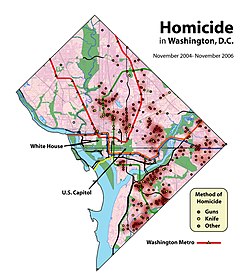
Mapping of homicides in Washington D.C.

Crime mapping is used by analysts in law enforcement agencies to map, visualize, and analyze crime incident patterns. It is a key component of crime analysis and the CompStat policing strategy. Mapping crime, using Geographic Information Systems (GIS), allows crime analysts to identify crime hot spots, along with other trends and patterns.

Overview

[edit]

Using GIS, crime analysts can overlay other datasets such as census demographics, locations of pawn shops, schools, etc., to better understand the underlying causes of crime and help law enforcement administrators to devise strategies to deal with the problem. GIS is also useful for law enforcement operations, such as allocating police officers and dispatching to emergencies.[1]

Underlying theories that help explain spatial behavior of criminals include environmental criminology, which was devised in the 1980s by Patricia and Paul Brantingham,[2] routine activity theory, developed by Lawrence Cohen and Marcus Felson and originally published in 1979,[3] and rational choice theory, developed by Ronald V. Clarke and Derek Cornish, originally published in 1986.[4] In recent years, crime mapping and analysis has incorporated spatial data analysis techniques that add statistical rigor and address inherent limitations of spatial data, including spatial autocorrelation and spatial heterogeneity. Spatial data analysis helps one analyze crime data and better understand why and not just where crime is occurring.

Research into computer-based crime mapping started in 1986, when the National Institute of Justice (NIJ) funded a project in the Chicago Police Department to explore crime mapping as an adjunct to community policing. That project was carried out by the CPD in conjunction with the Chicago Alliance for Neighborhood Safety, the University of Illinois at Chicago, and Northwestern University, reported on in the book, Mapping Crime in Its Community Setting: Event Geography Analysis.[5] The success of this project prompted NIJ to initiate the Drug Market Analysis Program (with the appropriate acronym D-MAP) in five cities, and the techniques these efforts developed led to the spread of crime mapping throughout the US and elsewhere, including the New York City Police Department's CompStat.

Applications

[edit]

Crime analysts use crime mapping and analysis to help law enforcement management (e.g. the police chief) to make better decisions, target resources, and formulate strategies, as well as for tactical analysis (e.g. crime forecasting, geographic profiling). New York City does this through the CompStat approach, though that way of thinking deals more with the short term. There are other, related approaches with terms including Information-led policing, Intelligence-led policing, Problem-oriented policing, and Community policing. In some law enforcement agencies, crime analysts work in civilian positions, while in other agencies, crime analysts are sworn officers.

From a research and policy perspective, crime mapping is used to understand patterns of incarceration and recidivism, help target resources and programs, evaluate crime prevention or crime reduction programs (e.g. Project Safe Neighborhoods, Weed & Seed and as proposed in Fixing Broken Windows[6]), and further understanding of causes of crime.

See also

[edit]

References

[edit]

Further reading

[edit]
Revisions and contributorsEdit on WikipediaRead on Wikipedia
from Grokipedia
Crime mapping is a method in and policing that uses geographic information systems (GIS) to visualize the of reported crimes, enabling the identification of patterns, hotspots, and environmental factors influencing criminal activity. Originating in the early with manual cartographic efforts by scholars like Adriano Balbi and Michel Guerry, who mapped crime correlates such as education levels in , the practice evolved significantly in the late 20th century through computerized GIS tools introduced in the 1990s by firms like and MapInfo. These advancements allow analysts to detect crime concentrations at micro-levels, such as street segments, where indicates up to half of incidents occur, supporting evidence-based strategies like hot spots policing that have demonstrated reductions in targeted crimes without displacement. In modern applications, crime mapping underpins algorithms, which forecast potential incidents to allocate resources, though such systems have sparked controversies over amplifying historical biases in arrest data, potentially leading to disproportionate in minority communities and self-fulfilling enforcement cycles. Despite these concerns, rigorous studies affirm the spatial concentration of crime as a robust driven by place-based factors, underscoring mapping's utility in over purely demographic attributions.

History

Origins in the 19th Century

The practice of crime mapping emerged in the early through the pioneering statistical analyses of French and Belgian scholars, who sought to visualize geographic patterns in criminal activity using empirical data from official records. In 1829, André-Michel Guerry, in collaboration with Adriano Balbi, produced some of the earliest thematic maps in their work Statistique Comparée de l'État de l'Instruction et du Nombre des Crimes dans les Divers Départements de la , employing choropleth shading to compare rates of violent crimes and s against levels of instruction across 's departments. These maps demonstrated spatial variations that defied simplistic explanations, such as higher in regions with greater wealth and education, challenging prevailing assumptions that crime stemmed solely from ignorance or poverty. Guerry advanced this approach in his 1833 publication Essai sur la Statistique Morale de la France, which featured 17 plates including shaded maps of crimes (e.g., personal vs. offenses, , and ), suicides, and rates, drawn from national judicial and data. The maps highlighted inconsistencies between expected correlates—like low in western and central not uniformly predicting high —and actual distributions, underscoring the need for multivariate to discern causal factors in social phenomena. This work represented the first systematic application of cartographic methods to "moral statistics," treating as a measurable, probabilistic aggregate rather than individual moral lapses. Concurrently, , a Belgian and , integrated mapping into his studies of crime's "" during the 1830s, as detailed in works like Recherches sur le Penchment au Crime au Divers Âges (1833). Quetelet overlaid on geographic features, revealing associations such as elevated criminality along major water transport routes and in urban centers, derived from French and broader European statistics. His approach emphasized the law-like regularities in crime rates across space and time, influencing the shift toward in and laying groundwork for later ecological theories by demonstrating that environmental and demographic factors exerted predictable influences on offense distributions. These 19th-century innovations, reliant on manual and rudimentary shading techniques, established crime mapping as a tool for hypothesis-testing grounded in verifiable aggregates, though limited by and the absence of controls for reporting biases.

20th-Century Sociological Foundations

The of Sociology, emerging at the in the 1920s, provided key theoretical groundwork for crime mapping through its ecological approach to urban phenomena. and Ernest W. Burgess developed the in their 1925 work The City, dividing urban areas into five radiating zones: the , a surrounding transitional zone of industry and deteriorating housing, working-class residential zones, middle-class suburbs, and commuter belts. This framework used spatial mapping to illustrate how social processes like , succession, and shaped city growth, with empirical data revealing elevated crime and delinquency rates in the transitional zone due to its instability and poverty concentration. Building directly on Park and Burgess, Clifford R. Shaw and Henry D. McKay advanced this spatial methodology in their studies of from the late 1920s onward. By geocoding thousands of delinquency cases from court records onto maps overlaid with the concentric zones, they quantified rates per sub-area, finding persistent high concentrations in disorganized inner-city neighborhoods marked by residential transience, low , and heterogeneous populations. Their seminal 1942 book Juvenile Delinquency and Urban Areas argued that these structural conditions eroded community controls, fostering delinquency independently of cultural traits among shifting ethnic groups, as rates remained stable over decades despite demographic changes. Shaw and McKay's mapping techniques emphasized causal links between neighborhood ecology and crime persistence, challenging individualistic explanations and promoting area-based interventions. This work established crime mapping as a tool for identifying "delinquency areas" where social disorganization—defined by weakened informal social ties—predictably generated higher offending, influencing subsequent criminological research on environmental factors over offender-centric views. Their findings, derived from longitudinal data spanning 1900–1933, demonstrated that fully 60% of originated from just 10% of Chicago's sub-areas, underscoring spatial clustering's role in causal realism for urban crime patterns.

Computerization and Institutional Adoption

The transition to computerized crime mapping began in the 1970s, when early agencies experimented with basic digital tools to plot incidents, moving beyond manual pin maps that had dominated since the . These initial systems were rudimentary, often limited to mainframe computers for aggregating data like arrests and warrants, as demonstrated by the New Orleans Police Department's use of an electronic machine in 1955 to summarize such records. By the , advancements in software enabled more dynamic mapping, though hardware constraints and data entry challenges restricted widespread application. A pivotal development occurred in the early 1990s, as personal computers became affordable and geographic information systems (GIS) software proliferated, allowing agencies to overlay crime data on digital maps for spatial analysis. The New York City Police Department (NYPD) formalized this approach in 1994 with CompStat, a computerized statistics system that integrated weekly crime mapping, statistical analysis, and command accountability meetings to identify patterns and deploy resources. CompStat's emphasis on real-time geospatial visualization—using tools to geocode incidents and generate heat maps—marked a shift from reactive to data-driven policing, contributing to a reported 10% reduction in overall crime rates in New York City through enhanced hot spot targeting. Institutional adoption accelerated post-CompStat, with larger U.S. police departments emulating the model; by the late , GIS integration had surged exponentially, enabling functions like precursors. A 2007 survey indicated that 81% of large agencies (serving populations over 1 million) utilized GIS for crime mapping, compared to 31% of smaller ones, reflecting resource disparities in implementation. Challenges persisted, including issues and resistance to accountability metrics, yet adoption spread internationally, with agencies in the UK and incorporating similar systems by the early for . This era established crime mapping as a core institutional tool, prioritizing empirical spatial evidence over anecdotal intelligence.

Technical Foundations

Core Technologies and Tools

Geographic Information Systems (GIS) constitute the primary technology underpinning crime mapping, facilitating the capture, storage, manipulation, analysis, and visualization of spatially referenced data to identify crime patterns and inform policing strategies. Developed initially for broader geographic applications, GIS integration into began in the late , enabling agencies to overlay incident locations with environmental, demographic, and infrastructural layers for enhanced spatial insight. Core GIS functionalities include geocoding—converting textual addresses to coordinates—buffer analysis for proximity assessments, and thematic mapping to highlight temporal and spatial crime distributions. Leading commercial GIS platforms, such as Esri's , dominate professional crime mapping applications, providing specialized toolsets like the Crime Analysis and Safety toolbox for incident selection, hot spot computation via , and strategic forecasting models. supports real-time data integration from (CAD) systems and software (RMS), allowing analysts to perform queries on variables including crime type, time, and suspect demographics. Open-source alternatives like offer comparable capabilities without licensing costs, making them viable for resource-constrained departments, though they may require more customization for advanced workflows. Specialized analytical software extends GIS by focusing on spatial statistics tailored to crime data. CrimeStat, a free program developed by statistician Ned Levine and distributed by the since 1996, interfaces with desktop GIS to execute functions such as spatial tests, journey-to-crime estimation, and simulations for pattern significance, aiding in the differentiation of random versus clustered events. Maptitude by Caliper Corporation provides integrated mapping and routing tools for crime visualization and , emphasizing affordability for smaller agencies with built-in geocoding and density mapping features. Hardware components, including (GPS) receivers, enable precise field data collection for incident verification and mobile mapping, reducing geocoding errors that can exceed 20% in manual address-based systems. Integration with relational databases like SQL Server or supports scalable data management, ensuring query efficiency for large incident volumes—often millions of records in major cities. These tools collectively enable of environmental factors influencing , such as street lighting or proximity to high-risk venues, though their effectiveness depends on and analyst expertise rather than technology alone.

Data Sources and Integration

Primary data sources for crime mapping consist of incident-level records from agencies, including police-reported crimes, arrests, and calls for service (CFS), which capture details such as offense type, location coordinates, date, time, and victim-offender information. In the United States, these are often standardized through the FBI's Uniform Crime Reporting (UCR) Program, which aggregates summary-level data on eight major categories from over 18,000 agencies, and the more detailed National Incident-Based Reporting System (NIBRS), covering 52 offenses since its full implementation in 2021, enabling finer-grained . Such records form the core because they provide verifiable, timestamped events tied to geographic points, though underreporting—estimated at 40-50% for violent crimes based on victim surveys—limits completeness, particularly for victimless or concealed offenses like drug crimes. Supplementary sources enhance contextual analysis by integrating non-crime data layers, such as U.S. Census Bureau demographics (e.g., , income levels), land-use records from local planning departments, and environmental factors like street lighting or proximity to transportation hubs, sourced from municipal GIS repositories. Emerging inputs include real-time feeds from 911 emergency systems, (CCTV) metadata, and data like for urban feature detection, which as of 2024, support dynamic mapping in resource-constrained agencies. Court records and victimization surveys, such as the (NCVS) with annual samples of 240,000 persons, fill gaps in police data by capturing unreported incidents, though NCVS lacks precise geocoding, necessitating probabilistic linkage techniques. Data integration occurs primarily through geographic information systems (GIS) platforms like , which enable spatial joining and overlay of heterogeneous datasets—e.g., aligning crime points with census blocks via , achieving 80-95% accuracy in urban areas with standardized address point files. Multi-layer techniques combine incident reports with CFS and judicial to mitigate single-source biases, such as over-reliance on reported arrests, using methods like ontology-based mapping for schema alignment or ETL () processes to handle format discrepancies across agencies. Challenges include data silos due to jurisdictional boundaries, inconsistent classification (e.g., varying definitions of "" pre-NIBRS), and constraints under laws like the EU's GDPR or U.S. HIPAA for linked health-crime , often requiring anonymization or aggregation to grid levels of 250x250 meters. Despite these, integrated systems have enabled agencies like the to correlate CFS spikes with demographic overlays, revealing causal links to transient populations since the early 2000s.

Mapping and Analytical Techniques

Crime mapping employs various visualization methods to represent spatial distributions of incidents. Point maps display individual events as discrete markers at their exact locations, enabling precise identification of incident clusters without aggregation bias. Choropleth maps, in contrast, aggregate crimes into predefined areal units such as census tracts or police beats and shade them proportionally to rates or counts, which can introduce the (MAUP) where patterns vary artificially with boundary definitions. Analytical techniques extend visualization to inferential spatial patterns. (KDE) transforms point data into a continuous surface by placing a kernel function around each incident and summing densities, with bandwidth selection critically affecting smoothness and delineation; narrower bandwidths highlight micro-scale clusters while wider ones reveal broader trends. KDE outperforms choropleth maps in avoiding aggregation artifacts for identification, though it assumes uniform unless adjusted. Spatial measures quantify clustering independence. Global assesses overall spatial dependence in areal data, with values near 1 indicating positive autocorrelation where high-crime areas adjoin similar ones, common in urban crime distributions due to causal factors like concentrated . Local indicators like Getis-Ord Gi* complement by statistically testing hot and cold spots, accounting for spatial weights to evaluate if observed clusters exceed random expectation. These methods, integrated in GIS software like , facilitate predictive applications but require validation against underreporting biases in incident data.

Applications in Law Enforcement

Hot Spot Identification and Analysis

Hot spot identification in crime mapping refers to the process of detecting geographic areas with disproportionately high concentrations of criminal incidents using spatial statistical techniques applied to incident data. These areas, often comprising just 1-5% of a jurisdiction's , account for 20-50% of crimes in empirical studies across various cities. Identification relies on aggregating point-level crime locations to reveal clusters, enabling to prioritize resources based on empirical patterns rather than intuition. Primary methods include (), a non-parametric technique that smooths point data into a continuous surface by placing a kernel function around each incident and summing contributions to estimate intensity at grid points. parameters, such as bandwidth, critically influence results; smaller bandwidths highlight micro-hotspots like street segments, while larger ones reveal broader patterns, with optimal selection often determined via cross-validation to minimize . Complementary approaches employ spatial statistics like for global clustering detection and local Getis-Ord Gi* for pinpointing significant hot spots where high values neighbor each other beyond chance. Analysis extends identification by dissecting hot spot attributes, incorporating temporal dimensions to uncover diurnal or seasonal variations—e.g., burglaries peaking midday—and multivariate factors like , nodes, or socioeconomic indicators to infer causal contributors. Spatio-temporal KDE variants adjust for cyclical patterns, enhancing predictive accuracy by weighting recent incidents more heavily. Software such as implements these via tools like Hot Spot Analysis, integrating call-for-service data with for robust outputs, though analysts must validate against underreporting biases in official records. Empirical applications, such as in , demonstrate 's utility in delineating violence-prone blocks, informing targeted interventions that reduced shootings by 20-30% in controlled evaluations.

Patrol and Resource Deployment

Crime mapping supports patrol and resource deployment by generating visual representations of crime incidents, enabling to prioritize high-density areas for increased officer presence and targeted interventions. Agencies use geographic information systems (GIS) to overlay incident data on maps, identifying hotspots—small geographic units such as street blocks or intersections accounting for disproportionate crime volumes—and directing routine patrols, foot beats, or vehicle assignments accordingly. This data-driven method shifts from uniform coverage to focused deterrence, with algorithms or analysts calculating optimal patrol routes based on temporal patterns, such as peak hours for burglaries or assaults. The New York Police Department's system, launched in 1994, illustrates a foundational application of this technique. Weekly meetings analyze mapped , compelling precinct commanders to devise and justify deployment strategies, including reallocating patrol shifts to emerging hotspots derived from recent reports. Core principles include accurate, timely intelligence from maps, effective tactics like in mapped zones, and rapid deployment of personnel to address identified vulnerabilities, with commanders evaluated on subsequent crime fluctuations in those areas. Beyond basic patrols, crime mapping informs broader , such as assigning specialized units—e.g., traffic enforcement or teams—to chronic hotspots revealed through integrated datasets like calls for service and officer observations. Real-time mapping tools allow dynamic adjustments, where supervisors monitor live feeds to redirect resources mid-shift toward spiking locations, enhancing responsiveness without expanding overall force size. Longitudinal analysis of mapped trends further guides budget decisions, prioritizing equipment or overtime for persistently high-crime precincts.

Investigative and Forensic Uses

Crime mapping aids criminal investigations by visualizing spatial patterns across incidents, enabling analysts to link related crimes through geographic clustering and similarities. Criminal investigative analysis uses mapping to identify serial offenses spanning jurisdictions by associating crime scenes, victim profiles, and offender behaviors. , a key technique, applies spatial algorithms to crime locations to predict offender anchor points, such as residences or bases, based on assumptions of least effort and routine activities. This method has been employed in cases involving serial homicides and arsons, where buffers and journey-to-crime models narrow suspect pools. In investigations, geospatial analysis examines distances between multiple crime scenes and correlates them with perpetrator-victim relationships, using metrics like chi-square tests to discern patterns in random versus targeted killings. Investigators overlay suspect alibis, vehicle tracks, and cellphone data on maps to verify timelines and exclude innocents. For , mapping integrates with locations to reveal networks, displaying associations between actors and venues. Forensic applications extend mapping to evidence reconstruction, where GIS models trajectories of projectiles, dispersal of biological traces, and environmental interactions at scenes. In search operations, probability heatmaps guide ground teams by prioritizing areas based on spatial probabilities derived from evidence vectors. Aerial GIS reconstructions provide overhead perspectives of complex scenes, enhancing documentation and courtroom presentations. These tools synthesize large datasets into actionable visuals, improving accuracy in associating people, places, and objects.

Empirical Evidence of Effectiveness

Key Studies on Crime Reduction

A and of 31 eligible studies, including 19 randomized controlled trials, on hot spots policing—facilitated by crime mapping to identify high- micro-locations—concluded that such interventions reduce overall in treatment areas without significant displacement to surrounding zones. The analysis reported an average 16% reduction in total at hot spots, with declining by approximately 21% and by 13%, based on pooled effect sizes from studies spanning 1985 to 2018 across multiple U.S. and international sites. In a in , from 2005 to 2006, police focused on 34 disorder hot spots identified via crime mapping, resulting in a 20% drop in total incident reports and a 26% decline in violent crimes compared to control areas, with no evidence of crime displacement. The study attributed these outcomes to increased police presence and problem-solving activities at mapped locations, though it noted potential spillover benefits to adjacent areas. An earlier randomized experiment in (1989–1990) tested preventive patrols in high-crime blocks identified through mapping, finding a 10–20% reduction in burglaries, thefts, and auto thefts in treatment segments relative to controls, supporting the efficacy of mapping-directed resource allocation for property s. Similarly, a 2019–2020 randomized trial in a mid-sized U.S. city targeting 13 hot spots via crime calls for service mapping reported a 23% decrease in crime-related calls during the first implementation year. Regarding CompStat, the New York Police Department's mapping-based accountability system implemented in 1994, evaluations have not established a causal link to the city's 1990s crime decline, with one econometric analysis finding no non-trivial effect on violent or property crime rates after controlling for national trends and other factors. While CompStat popularized crime mapping for performance monitoring, the absence of rigorous counterfactuals in early assessments limits attribution of reductions—such as New York's 56% drop in violent crime from 1990 to 2000—to the system itself.

Hot Spots Policing Meta-Analyses

A series of systematic reviews and meta-analyses by Anthony A. Braga and David L. Weisburd has established hot spots policing as an effective strategy for reducing crime at targeted microgeographic areas. Their 2010 meta-analysis of 10 studies found statistically significant crime reductions averaging 20% at hot spots, with no evidence of displacement to adjacent areas and some indications of diffusion of benefits. Updated in 2019 with 25 eligible studies, the review reported an overall 21% reduction in total crime calls for service at treatment hot spots compared to control areas, again without displacement and with crime reductions diffusing into surrounding zones. Subsequent reexaminations addressed potential underestimation of effect sizes in prior analyses using percentage change metrics, which can be biased by baseline crime volumes. In a 2020 critique incorporating 65 studies (78 independent tests), and Weisburd applied a logarithmic relative incident rate ratio (log RIRR) approach, yielding a 16% statistically significant reduction (Hedges' g = 0.24), described as substantively meaningful for given the low-cost of focused patrols. These findings held across violent and crimes, with quasi-experimental designs showing slightly larger effects than randomized trials, though both confirmed without increased community or procedural . A 2024 meta-analysis focused on violence outcomes across 13 studies reported significant reductions in at treated hot spots relative to comparisons, with effect sizes indicating 15-25% drops depending on the metric, reinforcing prior conclusions while noting limited on long-term sustainability. Collectively, these peer-reviewed syntheses, drawing from randomized and quasi-experimental evaluations primarily in U.S. urban settings, demonstrate consistent, albeit modest, control gains from hot spots policing, attributable to deterrence and increased perceived risk rather than arrest-driven incapacitation. Limitations include reliance on calls-for-service , which may undercount unreported crimes, and sparse evidence from non-Western contexts.

Predictive Forecasting Evaluations

Evaluations of predictive forecasting in mapping assess the ability of algorithms to anticipate locations, times, and types using historical data, often through metrics like the Predictive Accuracy Index (PAI), which compares in predicted hotspots to the broader study area, and hit rates adjusted for prediction coverage. These metrics account for 's low , where even effective models yield low absolute hit rates but outperform random or baseline forecasts like recent hotspots. A of 33 spatial crime forecasting studies from 2008 to 2019 found that methods such as Risk Terrain Modeling (RTM) and generally surpassed traditional hotspot mapping, with higher PAI values, F1-scores, and prediction accuracies in contexts like and forecasts. For instance, RTM applied to crimes showed superior spatial precision over kernel-based hotspots, while self-exciting point processes improved predictions in by incorporating temporal dependencies. approaches, including random forests and neural networks, demonstrated incremental gains over autoregressive baselines, though results varied by validation method (e.g., train-test splits versus rolling horizons) and data granularity, with street-network models edging out grid-based ones for urban accuracy. Operational evaluations of commercial tools reveal more tempered performance. An analysis of Geolitica's (formerly PredPol) predictions in , from February 25 to December 18, 2018, examined 23,631 forecasts against incident reports, excluding patrolled areas to isolate accuracy; the success rate—defined as matching crimes in predicted categories during 11-hour shifts—was under 0.5%, with only 0.6% for robberies/assaults and 0.1% for burglaries. Local police discontinued the tool, citing unreliable outputs better redirected to non-technological interventions. In contrast, academic prototypes, such as a graph-based for data, achieved approximately 90% accuracy in weekly crime forecasts by modeling relational patterns, though this incorporated police bias diagnostics and remains unscaled for routine use. Broader syntheses indicate that simple heuristics often rival complex algorithms in , with from added sophistication, particularly for smaller agencies. The Shreveport Predictive Policing Experiment (2016–2017) tested against static hotspots for property crimes, finding the predictive model reduced targeted offenses by up to 24% in intervention zones versus 7% for hotspots, attributed to dynamic adjustments but limited by short-term data and non-randomized design. These findings underscore that efficacy hinges on integration with interventions, yet persistent challenges include , to past patterns, and validation gaps, yielding modest net gains over established methods like near-repeat analysis.

Criticisms and Controversies

Claims of Algorithmic and Data

Critics of crime mapping and algorithms contend that these tools perpetuate racial and socioeconomic biases embedded in historical crime , which often reflect disparities in reporting, , and arrests rather than objective crime patterns. For instance, analyses of systems like PredPol have argued that predictions disproportionately target neighborhoods with higher concentrations of and residents, creating feedback loops of over-policing that exacerbate inequalities. Such claims frequently originate from advocacy organizations and media outlets, which may prioritize narrative over rigorous , though peer-reviewed examinations reveal mixed empirical support. A of PredPol conducted in from 2013 to 2016 compared predictive hot spot patrols to traditional methods across 102 grid cells, finding no statistically significant differences in the proportion of arrests by racial-ethnic group—, , or —between treatment and control areas. The study, involving over 60,000 patrols and 1,100 arrests, concluded that predictive allocations did not amplify racial bias in enforcement outcomes, attributing predictions to spatiotemporal crime patterns rather than demographic inputs, as PredPol explicitly excludes race, , or socioeconomic variables from its models. Broader reviews of hot spots policing, which underpins much of crime mapping, similarly find scant evidence linking the approach to increased racial bias or abusive practices. A 2015 analysis of implementations in cities like , Kansas City, and , showed crime reductions of 7-26% without corresponding rises in community complaints of bias or negative perceptions of police legitimacy. Meta-analyses confirm that hot spots account for up to 50% of crime in micro-geographic areas, suggesting concentrations driven by environmental and behavioral factors rather than algorithmic artifacts alone, though improper tactics like indiscriminate stops can introduce risks independent of mapping itself. Persistent concerns about persist, as underreporting in certain communities or could skew inputs, but causal tests rarely demonstrate that mapping tools generate disparate impacts beyond baseline crime distributions. Implementation guidelines emphasizing and oversight have mitigated potential issues in evaluated programs, underscoring that claims often conflate in historical with predictive unfairness.

Privacy and Civil Liberties Concerns

Precise geocoding in crime mapping, which assigns exact coordinates to reported incidents, can inadvertently expose sensitive personal information when data is shared or visualized publicly. Victims of low-incidence crimes, such as rapes, , or assaults, face risks of re-identification if maps reveal unique location patterns that, when combined with other like property ownership or news reports, pinpoint individuals. The has documented these hazards, noting that detailed spatial displays may lead to stigmatization, harassment, or compromised safety for those associated with crime sites. Such concerns prompted early discussions, including a 1999 Crime Mapping Research Centre roundtable, which identified potential breaches from online dissemination without aggregation. Civil liberties implications extend to the data sources underpinning maps, including feeds from fixed cameras, automated license plate readers, and mobile units, which enable persistent tracking across public spaces. Critics contend this facilitates de facto mass , eroding expectations of under the Fourth by justifying intensified patrols or stops in mapped "hot spots" with reduced thresholds for . Legal scholarship has examined how geospatial analytics redefine "high-crime areas," potentially broadening police authority to conduct warrantless observations or frisks based on probabilistic patterns rather than specific . Empirical instances of violations remain sparse, often tied to improper public releases rather than mapping technologies per se, but groups highlight disproportionate impacts on densely populated or minority neighborhoods where amplifies monitoring effects. Public surveys underscore perceptual risks, with respondents expressing unease over location dilution from accessible maps, even in aggregated forms. One study using a found that a majority viewed public displays as heightening personal exposure risks, with variations by demographics such as urban residency amplifying worries about retaliatory targeting. These apprehensions persist despite mitigation strategies like zonal aggregation over point-level detail and disclaimers on data limitations, which federal guides recommend to balance transparency with safeguards.

Accusations of Self-Fulfilling Prophecies

Critics of crime mapping have leveled accusations that the practice engenders self-fulfilling prophecies, whereby algorithms or analysts identify "hot spots" based on past incident , prompting disproportionate police deployments that yield elevated detections and arrests in those locales, which in turn bolster the datasets used for ongoing predictions. This purported cycle, they argue, entrenches focus on already scrutinized areas—often low-income or minority-concentrated neighborhoods—without proportionally addressing crime elsewhere, potentially manufacturing apparent risk through enforcement artifacts rather than intrinsic criminality. In the domain of predictive policing extensions of crime mapping, the objection manifests as algorithmic feedback loops: historical records skewed by prior policing patterns train models to forecast persistence in the same geographies or even individuals, leading to preemptive that generates self-confirming evidence. For example, analyses warn that designating juveniles as high-risk via predictive tools can trigger heightened monitoring and interventions, elevating the probability of recorded infractions and entrenching labels of criminal propensity. Such dynamics, attributed to undiversified training data reflecting enforcement legacies rather than uniform crime distributions, are cited as risking perpetual over-policing of disadvantaged groups. Empirical scrutiny, however, reveals scant substantiation for these prophecies dominating outcomes in practice. Systematic reviews and meta-analyses of hot spots policing—drawing from over 25 field experiments, including randomized controlled trials—consistently document modest yet statistically significant crime reductions, typically 10-26% in targeted zones, as gauged by independent indicators like citizen victimization surveys and non-police-reported calls for service, which mitigate biases from enforcement-driven detections. These evaluations, spanning implementations from the 1990s onward in cities like Newark and , show minimal spatial displacement to adjacent areas and no amplification of baseline crime concentrations attributable to mapping-induced loops; instead, deterrence from visible patrols appears to suppress incidents proactively. The persistence of accusations may stem from conflating theoretical vulnerabilities—such as unmitigated data feedbacks—with operational realities, where hot spots precede mapping ( clustering in micro-areas accounts for up to 50% of incidents in many urban settings) and interventions demonstrably attenuate rather than fabricate them. While safeguards like periodic data recalibration and outcome auditing are advisable to guard against subtle reinforcements, the evidentiary record prioritizes crime-suppressive gains over prophetic pitfalls.

Ethical and Policy Considerations

In the United States, crime mapping operates within frameworks emphasizing public access to government-held data under the Act (FOIA) of 1966, which mandates disclosure of agency records unless exempted for privacy, , or other statutory reasons. The FBI's Crime Data Explorer, launched in 2018, exemplifies this by providing aggregated, anonymized crime statistics from over 18,000 agencies, facilitating mapping without revealing individual-level details. However, exemptions under FOIA, particularly those protecting personal privacy under Exemption 6 and 7(C), often restrict the release of granular location data to prevent identification of victims or suspects, as outlined in Department of Justice guidelines. Key challenges arise from balancing transparency with privacy protections, including the risk of re-identification when mapping precise incident locations, prompting recommendations for aggregation or blurring in shared maps. The National Institute of Justice's 2001 guide stresses rights for privacy breaches and advises against displaying exact offense sites near residences to avoid stigmatization or doxxing. Additionally, some agencies have asserted over derived products, such as interactive maps, despite underlying records being , leading to disputes over and hindering inter-agency sharing, as documented in analyses of 94 U.S. cities where transparency varied widely. Fourth Amendment concerns further complicate deployment, as maps delineate "high-crime areas" that lower thresholds for in stops and frisks, potentially enabling over-policing without individualized articulable facts, per precedents like Illinois v. Wardlow (2000). In the , the General Data Protection Regulation (GDPR) of 2016 and the Directive (Directive (EU) 2016/680) provide the primary frameworks, requiring explicit legal bases for processing location data in crime mapping and mandating data minimization, , and impact assessments for high-risk activities like profiling. Article 10 of the GDPR prohibits processing criminal conviction data without official safeguards, while the Directive permits predictive mapping for but demands proportionality and human oversight to mitigate risks. Challenges include cross-border data transfers, which necessitate adequacy decisions or standard contractual clauses, and enforcement inconsistencies, as evidenced by fines totaling over €293 million for data breaches since 2018, some involving misuse. These regimes impose stricter and transparency obligations than U.S. laws, often delaying mapping initiatives in member states due to compliance costs and potential conflicts with investigative secrecy.

Implementation Guidelines and Best Practices

Effective implementation of crime mapping requires high-quality inputs, robust technological , and integration with evidence-based policing strategies. agencies should prioritize collecting geocoded incident from reliable sources such as (CAD) systems and records management systems (RMS), ensuring accuracy through regular audits and validation protocols to minimize errors in spatial representation. Best practices emphasize using validated GIS software like or open-source alternatives such as , configured with layers for crime types, temporal patterns, and environmental factors to generate actionable visualizations. Agencies must establish clear policies, including standardization of address matching and parameters, to avoid distortions from aggregation biases, as demonstrated in evaluations where improper led to misidentified hot spots. Training programs for analysts and officers are essential, focusing on spatial statistics and interpretation to prevent misuse of maps in decision-making. The recommends interdisciplinary teams comprising crime analysts, patrol officers, and statisticians to collaboratively develop mapping protocols that align with hot spots policing, incorporating feedback loops for iterative refinement based on post-deployment crime outcomes. safeguards, such as anonymizing individual-level data and limiting access to aggregated outputs, must comply with legal standards like the Fourth Amendment in the U.S., while avoiding over-reliance on predictive models without ground-truth validation. Successful implementations, such as those in the Police Department's system since 1994, highlight the value of real-time dashboards updated weekly with verified data, coupled with performance metrics tied to crime reductions rather than map aesthetics alone. To maximize effectiveness, agencies should conduct pilot testing in limited jurisdictions before scaling, evaluating maps against randomized controlled trials to confirm causal impacts on displacement or reduction. Integration with complementary tools, like near-repeat calculators for patterns, enhances predictive utility, but requires ongoing calibration to account for demographic shifts or reporting changes. Documentation of methodologies, including assumptions in spatial autocorrelation tests like , ensures reproducibility and transparency, mitigating risks of algorithmic opacity. Ultimately, best practices underscore resource allocation toward maintenance—allocating 10-15% of policing budgets to analytic units—as underfunding has correlated with diminished returns in meta-analyses of mapping initiatives.

Broader Societal Impacts

Crime mapping has facilitated more efficient allocation of resources, contributing to localized crime reductions that extend to adjacent areas without evidence of displacement, thereby enhancing overall community safety in targeted urban environments. Empirical meta-analyses indicate that hot spots policing, often informed by crime maps, yields a 24% reduction in relative to standard practices, with benefits persisting across diverse settings including high-crime micro-locations. These outcomes promote broader societal stability by freeing resources for preventive measures and reducing victimization rates, which in turn correlates with improved metrics such as reduced in mapped areas. However, the visualization techniques employed in crime mapping can influence perceptions of neighborhood and police efficacy, with dot-based maps often amplifying perceived disorder compared to maps, potentially heightening resident anxiety despite actual crime declines. Studies show that such perceptual distortions may undermine trust in police if maps emphasize raw incident counts without contextual aggregation, leading communities to view policing as reactive rather than proactive. In randomized experiments, hot spots interventions have not significantly eroded collective efficacy—community social cohesion and informal control—but sustained mapping transparency is required to align views with empirical gains. Economically, persistent identification of hot spots via mapping exerts downward pressure on property values, as buyers factor in visualized risks, with research estimating a 1.5% price drop per 1% increase and amplified effects in concentrated hot spots beyond general prevalence. This dynamic can perpetuate cycles of in affected areas, reducing homeowner equity and deterring business relocation, though successful mapping-led interventions that lower over time have been shown to reverse these trends by signaling improved viability. No robust evidence links mapping itself to systemic abusive practices, countering narratives of inherent inequity, but equitable interpretation remains essential to avoid reinforcing socioeconomic divides.

Recent Developments and Future Directions

Advances in AI and Machine Learning Integration

The integration of (AI) and (ML) into crime mapping has shifted from static, kernel-based hotspot visualizations to dynamic, predictive models that incorporate spatiotemporal data for forecasting crime locations. Traditional methods, reliant on historical aggregation, often overlook temporal dynamics and non-linear patterns; ML addresses this by training on features like , events, and socio-economic variables to generate probabilistic risk maps. For instance, and models have demonstrated superior accuracy over baseline statistical approaches in identifying emergent hotspots, with studies reporting up to 20% improvements in precision for tasks. Deep learning architectures, particularly convolutional neural networks (CNNs) and graph convolutional networks (GCNs) combined with (LSTM) units, represent a key advance in handling spatial dependencies and sequential crime data. The Ada-GCNLSTM model, introduced in 2025, adaptively fuses graph structures for neighborhood influences with recurrent layers for time-series forecasting, achieving lower mean absolute errors in multi-type crime predictions across diverse urban datasets compared to earlier LSTMs or models. Similarly, comprehensive evaluations of models in 2024 confirmed their edge in capturing non-stationary patterns, such as seasonal spikes or diffusion effects in crime waves, enabling real-time updates to mapping interfaces. Spatial clustering techniques enhanced by ML, such as density-based algorithms integrated with predictive regressors, facilitate automated hotspot delineation and future risk projection. The CHART framework, developed in 2024, employs clustering on followed by supervised to track hotspot evolution in near real-time, outperforming static GIS overlays by incorporating velocity metrics for crime trajectories. These methods leverage from sources like CCTV and mobile sensors, but their efficacy depends on data quality, with peer-reviewed analyses emphasizing the need for robust to mitigate in sparse rural mappings. Ongoing refinements include explainable AI (XAI) layers, such as SHAP values, to interpret model outputs—revealing, for example, that proximity to hubs often ranks highest in forecasts—thus aiding in beyond correlation.

Case Studies of Modern Deployments

In , the (LAPD) deployed , a algorithm, starting in 2011 to generate daily crime forecasts for 500-square-block areas based on historical data including crime type, location, and timing. The system directed patrols to predicted hot spots, with a evaluating its impact on property crimes such as and vehicle theft. Empirical analysis from the trial, rated as high-quality by the in 2024, found statistically significant reductions in daily crime volumes in treatment areas compared to controls, particularly for , car theft, and theft from vehicles. Despite these outcomes, the program faced scrutiny for potentially perpetuating over-policing in high-crime neighborhoods, leading to its discontinuation by 2022 amid public and activist concerns over data biases reflecting historical arrest patterns rather than predictive accuracy. The (NYPD) has sustained and modernized its system, originally launched in 1994, into CompStat 2.0 by the 2010s, incorporating interactive online crime mapping accessible to the public since at least 2014. This iteration features geospatial visualizations of weekly across precincts, including specifics on violent crimes, offenses, and seized firearms—such as 4,463 guns removed from streets as of early 2025—enabling real-time data-driven resource allocation and accountability in command meetings. CompStat 2.0 emphasizes transparency by disaggregating data beyond traditional Uniform Crime Reporting categories, allowing users to drill down into patterns like temporal and locational trends, which has supported sustained declines in citywide homicides and overall crime rates post-1990s peaks. Its ongoing deployment demonstrates crime mapping's role in operational policing without reliance on predictive algorithms, prioritizing empirical aggregation of reported incidents for tactical responses. In Metropolitan City, , a 2025 deployment integrated (XAI) with crime mapping to correlate urban environmental factors—such as , , and —with incident types including and violence. The system analyzed spatiotemporal data to identify risk zones, revealing causal links like higher crime in areas with poor lighting or high transient foot traffic, and informed targeted interventions that improved predictive granularity over traditional hot-spot methods. This case highlights modern advancements in non-Western contexts, where XAI enhances interpretability of mapping outputs, reducing opacity in algorithmic decisions while grounding forecasts in verifiable urban variables rather than solely historical crimes. Empirical validation in the study confirmed the model's utility for resource deployment, though scalability to denser megacities remains under evaluation.

Ongoing Debates and Policy Shifts

One ongoing debate centers on the empirical effectiveness of advanced crime mapping techniques, particularly those incorporating , in reducing crime rates without unintended consequences. Studies have shown that traditional hot-spot mapping, which identifies high-crime geographic areas based on historical incident data, can lead to statistically significant crime reductions of up to 20-30% in targeted zones when paired with focused policing, as evidenced by randomized controlled trials in cities like and . However, extensions into algorithmic prediction have yielded mixed results; a 2023 analysis of software like PredPol found prediction accuracy below 0.5% for specific crime categories, raising questions about resource misallocation and over-reliance on probabilistic forecasts rather than causal interventions. Proponents argue that these tools enable proactive deterrence grounded in spatial patterns, while skeptics, including researchers from the , contend that feedback loops from past arrests inflate future predictions in already surveilled areas, potentially undermining long-term efficacy. A parallel controversy involves accusations of inherent in crime mapping outputs, where historical data reflecting disproportionate enforcement in minority neighborhoods may perpetuate self-reinforcing cycles of targeted patrols. Advocacy organizations like the ACLU have highlighted how such maps, derived from arrest records rather than victim reports, correlate with higher stop rates in low-income communities, exacerbating perceptions of inequity despite controls for crime volume. Empirical audits, such as those in , reveal that predictive models overpredict crime in and Latino districts by factors of 1.5-2 times relative to actual incidents, though defenders note that unadjusted environmental factors like and reporting biases explain much of the variance, not algorithmic flaws per se. This tension underscores a broader causal realism debate: whether maps should prioritize raw incident data for deterrence or incorporate socioeconomic adjustments to avoid entrenching disparities, with peer-reviewed meta-analyses indicating that bias-mitigated hot-spot strategies maintain crime drops without displacement. Policy shifts reflect these debates, with a pivot toward hybrid AI-enhanced mapping systems emphasizing transparency and interoperability amid declining urban violence rates. In August 2025, the UK's launched an AI-backed national crime mapping initiative to consolidate fragmented local data, aiming to pinpoint emerging hotspots for and prevention, signaling a departure from siloed operations toward federated . Concurrently, U.S. jurisdictions like have expanded GIS-integrated dashboards post-2023 crime spikes, integrating real-time feeds to support evidence-based deployments, while mandating annual algorithmic audits to address efficacy concerns—evidenced by a 15% drop in mapped priority areas through mid-2025. Critics from groups advocate pausing predictive components until independent validations confirm neutrality, influencing guidelines like the DOJ's 2024 emphasis on human oversight in mapping protocols to balance innovation with accountability. These evolutions prioritize verifiable outcomes over ideological priors, with ongoing pilots testing causal interventions like environmental modifications in mapped zones to sustain reductions amid fiscal pressures.

References

Add your contribution
Related Hubs
User Avatar
No comments yet.