Hubbry Logo
Custom houseCustom houseMain
Open search
Custom house
Community hub
Custom house
logo
8 pages, 0 posts
0 subscribers
Be the first to start a discussion here.
Custom house
Custom house
from Wikipedia
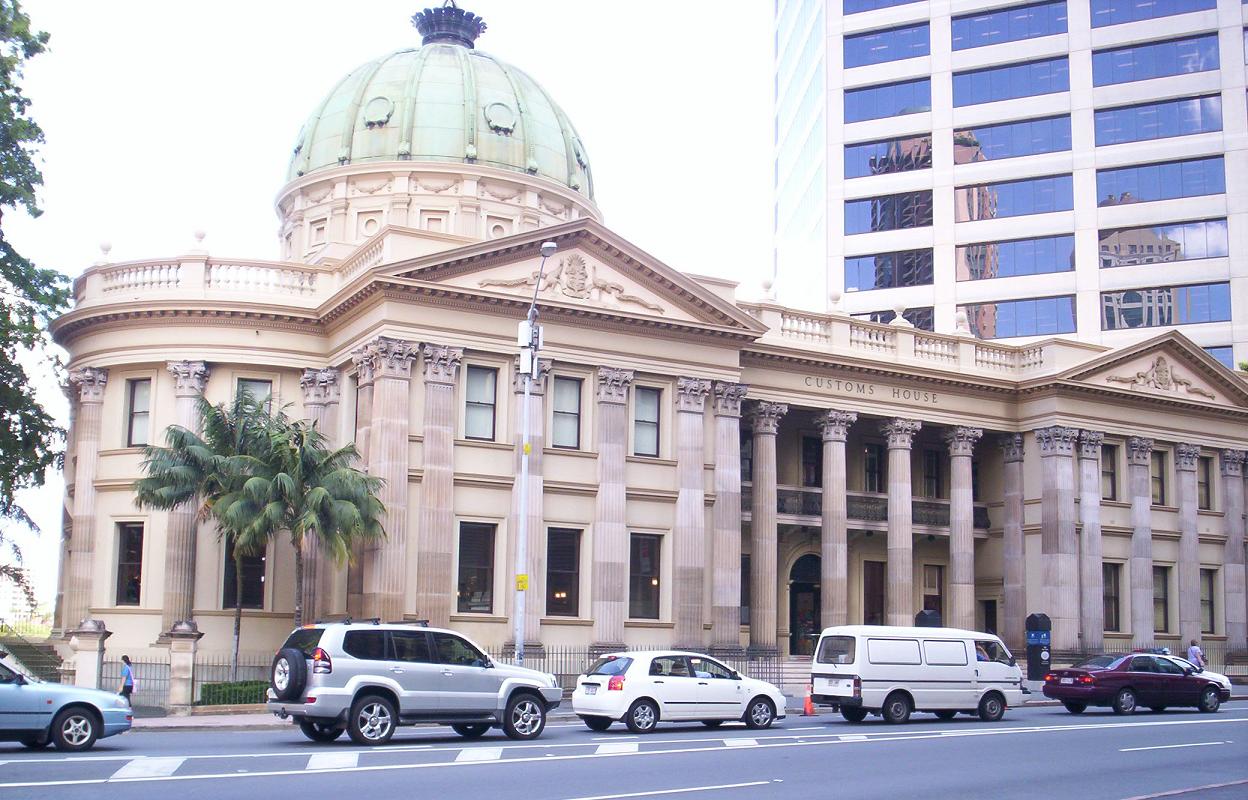
The Customs House in Brisbane, Australia
The Old Customs House in Tampere, Finland
The Custom House, Saint Petersburg

A custom house or customs house was traditionally a building housing the offices for a jurisdictional government whose officials oversaw the functions associated with importing and exporting goods into and out of a country, such as collecting customs duty on imported goods. A custom house was typically located in a seaport or in a city on a major river, with access to an ocean. These cities acted as ports of entry into a country.

Due to advances in electronic information systems, the increased volume of international trade, and the introduction of air travel, custom houses have largely become obsolete. Many custom houses around the world have since been converted for other uses, such as museums or civic buildings.

As examples, the former Alexander Hamilton U.S. Custom House in Manhattan, New York, (now the George Gustav Heye Center) presently houses a branch of the National Museum of the American Indian, the former U.S. Custom House in New Orleans, Louisiana, is now home to the Audubon Butterfly Garden and Insectarium, the former U.S. Custom House in San Francisco, California, now houses offices of the U.S. Customs and Border Protection and Social Security Administration and the former U.S. Custom House in Baltimore, Maryland, was in 1973 serving as a Selective Service office.[1] As of 2019, the Custom House of Valletta in Malta was still being used for its original purpose.[2]

History

[edit]

Custom Houses became a prominent feature of English ports after 1275, following the creation of a national system for collecting duties on overseas trade.[3]

The Custom-house upon the Back of Bristoll (1728)

In the United Kingdom, since 1386, the phrase "custom house" has been in use over the term "customs house". This was after the City of London's Custom House was erected at Wool Wharf in Tower Ward, to house just the officials overseeing the Great Custom on Wool and Woolfells. The singular form was used even though in later years the City of London's Custom House served as the workplace for other customs officials as well.[4]

See also

[edit]

References

[edit]
[edit]
Revisions and contributorsEdit on WikipediaRead on Wikipedia
from Grokipedia
A custom house is a building typically located at seaports or other points of entry, where officials collect duties on imported and exported , clear vessels for entry and departure, inspect , and enforce trade regulations. Historically, custom houses trace their origins to medieval , with the first recorded structure built in in 1275 on Wool Quay to levy duties on wool exports, a key revenue source for since duties were first imposed around AD 1000 under King Æthelred. In the colonial , such buildings emerged in the 17th century, like the one in , established in 1649 to collect taxes initially for the British and later for the independent . Following the , the U.S. Customs Service was created in 1789 as one of the nation's first federal agencies, with custom houses serving as vital hubs for collection that funded the until 1913 and symbolized civic pride through grand in major ports. Architecturally, custom houses often reflect the era's prominent styles, from neoclassical designs in to Beaux-Arts and Revival in the U.S., featuring secure vaults for revenue storage and spacious interiors for processing trade documents. Notable examples include London's , rebuilt multiple times after fires—including by after the 1666 Great Fire—and the U.S. Custom House in New York, a Beaux-Arts completed in that underscores the buildings' role in economic and . Today, while many have been repurposed for offices, museums, or hotels, they remain symbols of global trade's foundational infrastructure, with modern customs functions integrated into agencies like U.S. and .

Overview

Definition and Etymology

A is a building or where officials collect duties, taxes, and tariffs on imported and exported , process declarations, and enforce regulations. The term "" derives from "custom," referring to established practices or duties imposed on , with roots in the Latin consuetudo meaning "" or "custom." The phrase first appeared in English around the late , initially denoting sites for toll collection in ports or routes. Historically, custom houses were dedicated physical structures symbolizing state authority over , often prominently located at seaports to assert governmental control. In modern contexts, these functions have evolved into administrative offices within broader agencies, such as ports of entry managed by national customs services, though the term persists for legacy buildings.

Role in International Trade

Custom houses serve as pivotal institutions in regulating by overseeing the inspection, valuation, and classification of imported and exported goods. Customs officials examine shipments to determine their value for duty assessment, often using standardized methods such as transaction value or computed value, ensuring accurate taxation. Goods are classified according to international tariff schedules like the (HS), a developed by the comprising over 5,000 commodity groups identified by six-digit codes, which more than 200 countries use for uniform application of tariffs and trade statistics. Additionally, custom houses enforce trade restrictions, including quotas that limit import volumes to protect domestic markets, embargoes prohibiting trade with specific countries or entities, and anti-smuggling measures such as risk-based inspections and seizure of illicit goods to prevent revenue loss and security threats. Economically, custom houses generate significant through the collection of customs duties, which historically served as a primary income source in mercantilist economies where tariffs funded state activities and promoted exports over imports. For instance, in the early from 1789 to 1860, customs duties accounted for nearly all federal revenue, averaging 94.9% by 1860, while also shielding nascent industries from foreign . These duties help balance trade deficits by imposing tariffs on imports, thereby encouraging domestic production and reducing reliance on foreign goods, though modern applications also address unfair trade practices like dumping. Beyond revenue, custom houses contribute to by protecting domestic industries from subsidized or low-cost imports, fostering fair and supporting job preservation in key sectors. In facilitating trade, custom houses process essential documentation, including bills of lading that detail shipment contents and routes, certificates of origin verifying the producing country for preferential treatment, and approvals for temporary imports such as goods under instruments like the , which allows duty-free entry for up to one year. This processing aligns with international agreements, notably the World Trade Organization's (WTO) Facilitation Agreement, which mandates simplified procedures, transparency, and to expedite border crossings while maintaining controls. Over time, the role of custom houses has shifted from a primary focus on collection in the pre-20th century to a multifaceted emphasis on compliance, facilitation, and in the . This evolution, accelerated post-World War II and particularly after the 2001 terrorist attacks, integrates customs with global standards like the WTO's Revised Convention, which promotes efficient procedures and through tools such as programs. In contemporary operations, custom houses prioritize to minimize disruptions, balancing facilitation with against illicit , as seen in initiatives like the U.S. Container Initiative.

Historical Development

Origins in Ancient and Medieval Trade

The origins of custom houses trace back to ancient systems of toll collection designed to regulate and tax in burgeoning civilizations. In during the Early Dynastic and Sargonic periods (c. 2900–2000 BCE), records indicate early forms of taxation on resources and goods, with the term "addir" possibly referring to tolls or customs duties levied at city gates on incoming items such as barley and livestock, as suggested in scholarly analyses of sites like Fara and . Similarly, in , pharaonic administration imposed taxes on goods transported along the River, a vital for internal and external in commodities like grain, textiles, and timber, with royal scribes maintaining records to ensure compliance and revenue collection for state projects. The formalized these practices through portoria, customs duties of 2–5% applied to imports, exports, and transit goods, collected at dedicated stations in major ports such as Ostia, where publicani (tax farmers) operated to facilitate the empire's Mediterranean networks. During the medieval period, custom houses evolved from rudimentary toll booths into more structured institutions under feudal and mercantile authorities, driven by the expansion of European and Islamic trade routes. In early medieval , influenced by Byzantine models, tolls transitioned from collections at frontier ports like Quentovic and —where rulers levied a decima (10% ) on foreign merchants—to formalized systems by the 8th–9th centuries, as seen in Charlemagne's edicts restricting to designated markets and enforcing portura legitima for standardized fees. The , emerging in the 13th century, established dedicated posts (kontore) in northern European ports such as and , where member guilds managed toll exemptions and duties on Baltic goods like timber and fish, promoting reciprocity and reducing arbitrary levies among affiliated cities. In Italian city-states, Venice developed the dogana da mar by the early at , a sea that oversaw duties on luxury imports from spice and silk routes, channeling revenues from Eastern into the republic's maritime dominance. Parallel developments occurred in Islamic networks under the , where 8th-century served as a hub for transcontinental , imposing mukus ( duties, often around 10% or more for non-Muslims) on goods arriving via Silk Road caravans and river routes, administered through state-appointed overseers to fund the caliphate's economy. This progression from informal toll booths—often simple roadside or gate collections under local lords—to dedicated buildings reflected growing commercial complexity, yet early custom houses faced persistent challenges including among collectors, widespread to evade duties, and reliance on manual ledgers for recording transactions, which limited accuracy and enforcement. In 13th– , for instance, royal customs on exports suffered from official graft and illicit exports via coastal routes, prompting legislative responses like the 1353 Ordinance of the Staple to curb abuses. Such issues underscored the tension between revenue generation and in pre-modern systems.

Expansion During the Age of Exploration and Colonialism

During the Age of Exploration from the 16th to 18th centuries, European powers expanded their maritime trade networks, leading to the proliferation of custom houses as key institutions for enforcing mercantilist policies. In England, the establishment of the Board of Customs in 1671 under King Charles II marked a significant reorganization of customs administration, creating a centralized body to collect duties more efficiently and replace the earlier system of tax farming. This reform supported mercantilism by channeling revenue from colonial trade directly to the crown, with custom houses serving as enforcement points for the Navigation Acts passed between 1651 and 1696, which restricted colonial commerce to British ships and ports to maximize economic benefits for the metropole. Similarly, the Dutch Republic's Vereenigde Oost-Indische Compagnie (VOC), founded in 1602, operated fortified trading posts in Asia that functioned as de facto custom houses, imposing duties on spices and textiles to fund further expansion. The Spanish Crown, through the Casa de Contratación in Seville established in 1503, centralized oversight of transatlantic trade, with colonial outposts in the Americas collecting alcabala taxes on goods to sustain imperial fleets. Colonial expansion further institutionalized custom houses across the , , and , integrating them into imperial control over global commerce. In the British North American colonies, custom houses like the one in , operational since the late and central to 18th-century enforcement, became flashpoints for resistance; by the 1760s, they symbolized oppressive taxation under the , culminating in protests such as the of 1770 at the Custom House steps and the 1773 , which targeted duty collections on imported goods. Spanish viceroyalties in the , such as those in and , featured local aduanas (customs offices) to regulate silver and commodity flows back to , while in , Portuguese and Dutch enclaves like and Batavia imposed tariffs on intra-Asian trade routes. In , European powers established custom points at coastal forts, such as the British at from the , to tax slave and commodity exchanges supporting the Atlantic economy. These structures ensured that colonial revenues funded metropolitan wars and exploration, embedding custom houses in the fabric of empire. The —encompassing Europe, Africa, and the Americas—dramatically accelerated the growth of custom houses by increasing the volume of dutiable goods like , , and slaves, necessitating more ports and officials to process imports and enforce monopolies. Under British mercantilism, duties collected at colonial custom houses on cargoes formed a significant portion of revenue from the colonies, though less than 10% of total crown revenue by the mid-18th century, prompting reforms like the U.S. Customs Service's formation on July 31, 1789, via the Fifth Act of the First Congress, which established 59 collection districts to secure federal income post-independence. This event reflected a broader shift from colonial outposts to formalized systems, as seen in the Dutch VOC's expansion of duty stations in during the . Institutionally, the period saw custom houses evolve into centralized bureaucracies with appointed officers, replacing corruptible local agents and introducing innovations like bonded warehouses for duty deferral. In , early 18th-century practices allowed importers to store goods under bond without immediate payment, formalized later but originating in mercantilist efforts to encourage and avoid capital lockup; by the 1780s, similar systems emerged in American ports to facilitate . Officers, often tidewaiters and surveyors, were empowered to board ships and seize , aligning with Navigation Act enforcement and reducing , though tensions arose from their intrusive authority. This bureaucratic supported the era's imperial ambitions, transforming custom houses from mere tax points into pillars of economic .

Architectural and Operational Features

Design Characteristics

Custom house buildings underwent significant architectural evolution from the 18th to the 19th century, reflecting the growing importance of state authority in . In the 18th and early 19th centuries, many were constructed in the Neoclassical style, characterized by symmetrical facades, grand columns, and pediments that evoked classical ideals of order and , symbolizing the official power over . By the mid-to-late 19th century, influences from Victorian and Beaux-Arts styles emerged, incorporating more ornate detailing, such as elaborate cornices and sculptural elements, to convey grandeur and administrative prestige amid expanding colonial economies. Common design features emphasized functionality and durability, with buildings often sited prominently at ports or in city centers to facilitate oversight of maritime activity. Durable materials like , stone cladding, and were prevalent, chosen for their resistance to and , essential in environments handling flammable and records. These structures typically included secure vaults to safeguard cash reserves, documents, and valuables, integrated into the foundational for against . Symbolic elements were integral to custom house facades, reinforcing themes of trade and . Statues or reliefs depicting deities like Mercury (Hermes), the Roman of merchants, along with nautical motifs such as anchors and ships, underscored the buildings' role in economic exchange. National emblems, including coats of arms or flags, adorned entrances to assert sovereignty, while prominent clocks on towers or facades highlighted the time-sensitive nature of shipping schedules and duties. In colonial ports, designs adapted to local climates, particularly in tropical regions, by incorporating elevated foundations, wide verandas, and ventilation features like louvered shutters to combat humidity and heat. In terms of scale and layout, custom houses were generally multi-story structures, with ground floors dedicated to warehouses or inspection areas for handling , and upper levels reserved for administrative offices. This vertical optimized in bustling port districts, often spanning entire blocks for efficiency. Security was enhanced through features like barred or reinforced windows on lower levels, deterring unauthorized access while maintaining an imposing public presence.

Internal Organization and Functions

Custom houses were typically organized into distinct internal divisions to facilitate efficient processing of imports and exports, including declaration rooms for initial filings, appraisal areas for valuation, secure storage vaults for bonded goods, and administrative for oversight. In the New York Custom House, for example, the handled public transactions such as vessel entries, while upper floors accommodated bureaucratic functions like the appraiser's , divided into ten specialized sections for assessment, and the surveyor's , structured into five divisions for inspecting, weighing, and measuring goods. Similarly, the Custom House featured a hierarchical layout with the first floor dedicated to public lobbies, the second to the grand Customs Hall for main operations, the third to the Collector's Suite, upper floors for staff and agencies, and an for storage. Staffing in custom houses consisted of a mix of political appointees and career civil servants, with key roles including the collector—who oversaw overall administration and was often a presidential appointee—the naval officer for vessel documentation, the surveyor for measurement and inspection, the appraiser for valuation, customs officers for enforcement, clerks for record-keeping, and enforcement agents for seizures. These personnel, numbering over 3,000 in major ports like New York by the early , received specialized training in tariff classification under laws like the Tariff Act of 1930 and fraud detection techniques to combat . Day-to-day operations followed a structured sequence for goods clearance: upon vessel arrival, captains submitted manifests detailing to the declaration room; officials then conducted inspections and appraisals to determine duties, often involving physical weighing and sampling in dedicated areas; importers paid tariffs based on valuations, with audits verifying compliance; and cleared goods were released, while violations led to seizures under emergency protocols enforced by agents. This process relied on records such as manifests, entry invoices, and reports to track entrances, clearances, and payments, ensuring adherence to trade regulations. Technological advancements transformed these operations from manual methods to automated systems, beginning with the introduction of typewriters in the for faster documentation, followed by desk calculators before 1980 for duty computations, and evolving in the post-1970s era to computerized systems like the Automated Commercial System (ACS) for electronic filing of manifests and entries. By the late , computers enabled risk-based audits and faster clearance, reducing processing times from days to hours, while contemporary shifts incorporate AI for automated in high-volume ports.

Notable Examples and Legacy

Prominent Custom Houses Worldwide

In , the U.S. Custom House in stands as a pivotal structure in the nation's maritime trade history, designed by architect in the Beaux-Arts style and constructed between 1900 and 1907 on the site of . This seven-story granite building, with its grand colonnades and sculptural elements inspired by classical antiquity, served as the primary facility for collecting customs duties on imports arriving via , the busiest port in the United States during the early , and played a key role in processing goods and documents for millions of immigrants and traders entering the country. Its location at the foot of Broadway underscored New York's emergence as a global commercial hub, where it facilitated through efficient enforcement amid the influx of European and Asian cargo. Further south, the Old Custom House in exemplifies early American , built between 1819 and 1824 in the Greek Revival style by architect William Strickland, following designs initially proposed by . Situated at the intersection of Second and Streets, this structure with its Doric columns and pedimented replaced an earlier facility and became central to Philadelphia's role as a major Atlantic port, handling duties on , textiles, and other exports that fueled the young republic's economy. During its operational peak in the , it supported local events tied to trade disputes and maritime law enforcement, including the oversight of shipments during the aftermath, reinforcing the city's status as a cradle of American commerce. In Europe, the Custom House in London, rebuilt between 1813 and 1817 to neoclassical designs by architect David Laing with later modifications by Robert Smirke in 1825, occupies a site with roots in 14th-century trade administration along the Thames. This imposing structure, featuring a rusticated facade and Corinthian pilasters, centralized the collection of import duties for the British Empire's vast mercantile network, processing goods from colonies worldwide and playing a crucial role in events like the enforcement of the Navigation Acts that shaped imperial economics in the early 19th century. Its position near the Pool of London facilitated rapid assessment of cargoes such as spices, silks, and timber, contributing to London's dominance as the world's leading port during the Industrial Revolution. Across the , in represents a pinnacle of , constructed from 1781 to 1791 under the direction of English architect James Gandon, who was commissioned by the British administration to create a grand edifice symbolizing colonial authority. This neoclassical masterpiece, measuring 325 feet in length with a central dome and river-facing facade adorned by allegorical sculptures, handled customs revenues from Ireland's burgeoning trade in , provisions, and whiskey, while its construction amid political tensions highlighted its role in local events, including protests against Anglo-Irish trade policies in the late . Gandon's design, incorporating and intricate detailing, not only streamlined duty collection but also integrated with Dublin's urban quays, enhancing the port's efficiency for transatlantic and European exchanges. In other regions, the Custom House in , , traces its origins to British colonial expansion in the , with its foundation laid on February 12, 1819, by Lord Hastings to consolidate duties on shipments at the Hugli River port. Renovated in 1899 on the original site, this utilitarian structure with Victorian influences managed the influx of opium, tea, and indigo exports, pivotal to Britain's imperial economy, and was involved in key local events such as the regulation of trade during the Bengal Famine of 1770's aftermath and the ' logistical support. Its operations underscored 's transformation into a colonial , where customs officials oversaw the taxation of goods that linked to global markets under rule. Similarly, the Old Granary in , , originally built between 1808 and 1813 and functioning as a from around 1814, reflects early 19th-century Dutch and British with its simple gabled facade and robust construction for harbor use. Designed by French-born architect Louis Michel Thibault, this building on Buitenkant Street processed duties on wine, wool, and slave-trade-related cargoes arriving at , contributing to local events like the enforcement of abolition laws post-1807 and the facilitation of British supply lines during the . As a multifunctional site later repurposed as a granary and police station, it embodied Cape Town's strategic importance as a refreshment station and trade nexus on the route to .

Preservation and Cultural Significance

The decline of traditional physical custom houses accelerated after , as customs operations underwent centralization and modernization to handle growing volumes more efficiently. This shift was further propelled by the adoption of digital systems, such as the European Union's Import Control System 2 (ICS2), which mandates electronic pre-arrival declarations for cargo, reducing the need for on-site inspections and paperwork at physical facilities. Consequently, many historic custom house buildings have been repurposed; for instance, the Alexander Hamilton U.S. Custom House in now serves as the of the National Museum of the American Indian, while Melbourne's Old Customs House has been transformed into the Immigration Museum, focusing on trade and migration history. Preservation efforts have played a crucial role in safeguarding these structures, with numerous custom houses recognized through national and international initiatives. , buildings like the U.S. Custom House in , and , are listed on the for their architectural and historical value, ensuring protections against demolition or inappropriate alterations. Internationally, historic port districts incorporating custom houses, such as Liverpool's Maritime Mercantile City—home to the neoclassical —received World Heritage status from 2004 until its delisting in 2021 due to urban development pressures, highlighting ongoing challenges in balancing preservation with modern needs. Recent restoration projects, including the multi-phase rehabilitation of the U.S. Custom House in New Orleans to enhance functionality while preserving its 19th-century features, demonstrate 21st-century commitments to adaptive conservation. Custom houses hold enduring cultural significance as symbols of global trade and connectivity, often depicted in art and to evoke themes of economic exchange and . For example, Claude Monet's series of paintings, The Customs House at Varengeville (1882 and 1897), captures the coastal structure as an emblem of maritime commerce amid Impressionist landscapes. Their legacy extends to educational roles in museums, where repurposed sites like Melbourne's Immigration Museum use exhibits to illustrate the history of and tariffs, fostering public understanding of globalization's impacts. In contemporary contexts, some custom houses remain operational in developing ports, supporting in regions with less advanced digital infrastructure, while others contribute to heritage economies through . These sites attract visitors seeking architectural and historical insights, generating economic benefits; for instance, preserved federal buildings like the U.S. Custom House draw heritage tourists, bolstering local revitalization and revenues.

References

Add your contribution
Related Hubs
User Avatar
No comments yet.