


Community hub
Recent from talks
Contribute something
Nothing was collected or created yet.
Mfecane
View on Wikipedia

The Mfecane, also known by the Sesotho names Difaqane or Lifaqane (all meaning "crushing," "scattering," "forced dispersal," or "forced migration"),[1] was a historical period of heightened military conflict and migration associated with state formation and expansion in Southern Africa. The exact range of dates that comprise the Mfecane varies between sources. At its broadest, the period lasted from the late eighteenth century to the mid-nineteenth century, but scholars often focus on an intensive period from the 1810s to the 1840s.[2]
Traditional estimates for the death toll range from 1 million to 2 million;[3][page needed][4][page needed][5] however, these numbers are controversial, and some recent scholars revise the mortality figure significantly downwards and attribute the root causes to complex political, economic, and environmental developments.[2][6][7][8] The Mfecane is significant in that it saw the formation of new states, institutions, and ethnic identities in southeastern Africa.
The Mfecane's historiography itself is also historically significant, with different versions having been employed to serve a range of political purposes since its inception as a historical concept.[9][10][11] The label first emerged in the 1830s and blamed the disruption on the actions of King Shaka, who was alleged to have waged near-genocidal wars that depopulated the land and sparked a chain reaction of violence as fleeing groups sought to conquer new lands.[9][10] Since the latter half of the 20th century, this interpretation has fallen out of favour among scholars due to a lack of historical evidence.[12][13]
Causes
[edit]The Mfecane resulted from the complex interplay of pre-existing trends of political centralization with the effects of international trade, environmental instability, and European colonization. State formation and expansion had already been intensifying in Southeastern Africa as of at least the late 1700s, but these processes were greatly accelerated after the international ivory trade opened.[14] The trade allowed leaders to amass unprecedented amounts of wealth, which they could then use to cultivate greater political power. Wealth and power became mutually reinforcing, as wealth enabled leaders to develop state instruments of control and expropriation, which they used to extract further wealth through taxation and military action.[15] The consequence of this cycle was an increasing political and wealth disparity within and between polities, particularly in concern to productive land and food stores.[16]
Political centralization became problematic in the early 1800s when deep drought (aggravated by the atmospheric effects of volcanic eruptions in 1809 and 1815)[17] struck Southeastern Africa. Whereas previous droughts hadn't caused serious famine, the unequal distribution of land and food stores lessened the ability of average people to meet their needs.[15] Though far less susceptible to famine, leaders faced threats to their power as (taxable) agricultural production dropped and ivory became scarcer due to overhunting.[15] Faced with the challenges of fighting famine and maintaining wealth flows, leaders were incentivized to turn to raiding and conquest. Conquest protected conquering peoples against famine by providing immediate access to the conquered peoples' livestock and grain stores and, in the long term, by securing arable land and the people (particularly women) to farm it at greater intensities than before.[16] Here another self-reinforcing cycle set in as famine and warfare promoted insecurity and militarism, which promoted political centralization and more warfare as strong leaders expanded their authority by offering a desperately-needed escape from famine to loyal followers.[18]
A second stage of turmoil from the 1820s to the 1830s was driven in large part by slave and cattle raiding by Griqua, Basters, and other Khoekhoe-European groups armed and mounted by European settlers, who benefitted from trading their plunder.[19] The increasing economic pull of the international slave trade also incentivized greater warfare and disruption between polities close to international ports such as Delagoa Bay.[20]
The Mfecane in the East
[edit]The Mfecane began in eastern Southern Africa with increasing competition and political consolidation as chiefdoms vied for control over trade routes and grazing land.
Delagoa Bay and its international port saw increasing regional conflict in the mid-to-late 1700s. The local Tembe and Mabhudu-Tembe competed for control, absorbing or expelling some of their neighbouring polities. The abakwaDlamini, who would later form the Swazi Kingdom, were one such group put to flight by the conflict.[21]
The mid-to-late 1700s also saw the rise of the Nxumalo and Nyambose chiefdoms between the Phongolo and Thukela rivers, which would eventually become the Ndwandwe Paramountcy and Mthethwa Paramountcy respectively.[22] On the borders of their spheres of influence were the amaHlubi of the upper Mzinyathi, the abakwaDlamini north of the Phongolo, and the abakwaQwabe of the lower Thukela. The latter's rise displaced elements of the abakwaCele and amaThuli further south. The amaThuli managed to secure a sizable chiefdom between the lower Mngeni and Mkhomazi Rivers, which displaced local groups across the Mzimkhulu River. This in turn contributed to the rise of the Mpondo Kingdom.[23]
The 1810s saw the continued expansion of the Ndwandwe and Mthethwa Paramountcies, as well as the Portuguese Delagoa Bay slave trade.[24] The Ndwandwe Paramountcy came to blows with the Mthethwa in the late 1810s, ultimately defeating and slaying their leader Dingiswayo kaJobe. The Mthethwa promptly collapsed as its subjects reasserted independence. The Ndwandwe king Zwide kaLanga went to war with one of these breakaway polities, the amaZulu of Shaka kaSenzangakhona. Their raids and counterraids proved costly and indecisive, contributing to the breakup of the Ndandwe Paramountcy. Groups broke away under Soshangane and Zwangendaba who settled their followers in the Delagoa Bay region, while Msane did the same in what is now eastern Eswatini. King Zwide, now in a position of weakness, withdrew to his territories north of the Phongolo to rebuild. Shaka took advantage of the power vacuum to expand the Zulu state to the Mkhuze River. The 1810s also saw the expansion of British colonial rule in southeastern southern Africa, with Xhosa polities displaced northwards by the Fourth and Fifth Xhosa Wars.[25]
Meanwhile, between the Mzimkhulu and Mzimvubu Rivers, some groups fleeing the upheavals further north joined Faku kaNgqungqushe's Mpondo Kingdom, while most others instead vied for dominance just outside of its reach.
By the 1820s, Shoshangane's Gaza Kingdom and Shaka's Zulu kingdom had established themselves (alongside the remains of the Ndwandwe Paramountcy) as the major players in the Northeast of Southern Africa. After relocating once again to the Nkomati River region, Zwide' Ndwandwe successfully raided and recruited their way back to prominence. By the time of his death in 1825 the Ndwandwe had muscled into the interior, possibly sundering the Pedi Kingdom and certainly dominating the region between the Olifants and Phongolo Rivers.[26] Msane, Zwangendaba, and the followers of Nxaba, for their part, were displaced farther north. The Gaza Kingdom expanded to the northeast, heavily raiding small Tsonga polities. Slave trading expanded at Delagoa Bay, and the Portuguese worked to expand their regional sphere of influence.[27]
In 1826, the expansion of the Ndwandwe Paramountcy under Sikhunyana began to threaten the Zulu Kingdom's borders. In response, Shaka marched his army (and allied British traders) to the Izindololwane Hills and put Sikhunyana to flight. Their victory was so total that the Ndwandwe state collapsed shortly thereafter, with some constituent polities fleeing south or joining the Zulu, the Gaza Kingdom, or Mzilikazi's Matabele/Ndebele Kingdom.[28] The collapse of the Ndwandwe allowed Sekwati to rebuild the sundered Pedi Kingdom around a fortified hilltop base near the Steelpoort River. From this stronghold, he soon gathered a large following by offering protection to refugees.[29]
In 1827, Shoshangane relocated the Gaza Kingdom from the lower Nkomati to the lower Limpopo River area. The Gaza defeated a Zulu army in 1828 and developed economic and political ties with the Portuguese.[30]
In May of 1828, Shaka launched a successful cattle raid against the Bomvana and the Mpondo Kingdom, following up with another raid north of Delagoa Bay before the first expeditionary force had returned home. Sensing political weakness, his brothers Dingane and Mhlangana assassinated him in September. Dingane subsequently purged Mhlangana and other political rivals, establishing himself as the new Zulu king. These chaotic events prompted the secession of a segment of the subject abakwaQwabe nation, though they were dispersed in late 1829 by a Mpondo attack south of the Mzimkhulu.[31]
By the late 1820s the power struggles between the Mzimkhulu and Mzimvubu Rivers had produced two victors: the Mpondo Kingdom and the Bhaca Chiefdom. Several weaker polities again relocated, with some moving north, others moving south, and yet others to the Zulu Kingdom.[32] 1828 saw a further advance of colonial power as a combined British-Boer force marched far beyond the colonial borders and destroyed Matiwane's amaNgwane at Mbholompo.[33]
Benefitting from the fall of the Ndwandwe and Shaka, Sobhuza's Swazi Kingdom expanded from the core of modern Eswatini to the Sabie River by the early 1830s.[34] In an 1833 trade dispute, Zulu forces briefly captured Delagoa Bay and executed the Portuguese governor.[35] In an attempt to solidify their control over inland trade, the Portuguese launched a failed attack on the Gaza Kingdom in 1834, leaving Gaza dominant over Delagoa Bay and the territories to its north. By the late 1830s, the Kingdom's sphere of influence reached as far as the Zambezi River.[30]
In 1836, the Swazi Kingdom weathered a joint attack by Zulu forces and British adventurers.[34] Sometime in the late 1830s the Swazi launched a raid against the Pedi Kingdom, which repelled them.[29]
The Mfecane in the Interior
[edit]The Mfecane began in the interior regions of Central Southern Africa in the late 18th century with the displacement of Khoekhoe and San peoples by slave and cattle raiders from the expanding Dutch Cape Colony. Arriving in the middle and lower Orange River regions, they competed with local Batswana, beginning a period of social breakdown and recombination. Bolstered in number by escaped slaves, bandits, and people of all ethnicities from the Cape Colony, some of these peoples would eventually become the Korana. Their power increased as trade with and raids upon colonists provided guns and horses, and by the 1780s they began raiding northwards against Tswana polities.[36]
From the 1780s to the turn of the century, the southern Tswana chiefdoms underwent fragmentations and consolidations as raids and counter-raids proliferated. The powerful Bahurutshe Chiefdom of the upper Marico River region had their control of the lucrative trade with the Cape Colony eroded by the Bangwaketse to the northwest, the Batlhaping to the southwest, and the emerging Pedi Kingdom to the east.[37] The latter, helmed by the Maroteng clan, also came into conflict with the amaNdzundza Ndebele, Masemola, Magakala, Bamphahlele, and Balobedu polities.[21] Meanwhile, the region of the modern north and central Free State was increasingly coming under the control of the Bataung.[38]
In the late 1790s, expansion by the Cape Colony to the lower Orange River region displaced the mixed-race Griqua peoples to the confluence of the Vaal and Orange River. There, they absorbed some of their San and Korana neighbors as clients. The Griqua, like other ethnic groups, were not politically unified and differed in their livelihood strategies, which ranged from raiding to agriculture to controlling trade between Batswana and the Cape Colony.[39]
By the turn of the century amaXhosa groups also began arriving in the middle Orange River region, fleeing instability along the eastern Cape Colony frontier. There they absorbed Korana, San, and others and engaged in extensive raiding along the Orange and lower Vaal rivers. This proved particularly damaging to the trade activities of their Batlhaping victims.[40]
By the 1810s, Boer expansion brought increasing destabilization to the middle Orange River region, not least in that it increased the flow of firearms. The Caledon Valley was now sustaining raids by Boer, Griqua, and Korana parties.[38] By the early 1820s the instability spread north of the Orange River.[33]
In 1822 AmaHlubi under the command of Mpangazita crossed the Drakensberg mountains and attacked Queen MmaNthatisi's Batlôkwa people. Put to flight, MmaNthatisi's followers survived off of pillage before resettling west of the Caledon River in 1824. The Sotho polities of this area sometimes held conflictual relations with these Batlôkwa newcomers, and they began coalescing in 1824 under the leadership of Moshoeshoe.[41]
Separately, facing violence and starvation, Sebetwane's BaFokeng, Tsooane's MaPhuting, and Nkarahanye's BaHlakoana fled their homes. The three joined forces in 1823 to take the BaThlaping town of Dithakong, whose access to water kept it rich in grain and cattle despite the overall drought.[42] The BaThlaping repelled the invasion on 24 June with the aid of a mounted force of Griqua, inflicting heavy casualties and killing Tsooane and Nkarahanye.[43]
In 1825, Mpangazita's followers dispersed after he was killed in a war against Matiwane's amaNgwane. The amaNgwane proceeded to control much of the Caledon River environs, raiding and displacing Sotho and Tswana neighbors.[41]
The mid-1820s saw Sebetwane dominate the upper Molopo region and Moletsane's Bataung people heavily raid the Vaal River. The eastern interior, however, was coming under the domination of Mzilikazi's Ndebele Kingdom.[44] His forces raided the Venda Kingdom to the north, the Maroteng, amaNdzundza, and Balodebu to the northeast, the Bangwaketse to the far west, and Matiwane's nation in the Caledon Valley. Sebetwane and Moletsane's nations, for their part, were outright put to flight.[45]
Between 1827 and 1828 Matiwane's amaNgwane launched a failed attack on Moshoeshoe and, after suffering a major raid (likely perpetrated by the Ndebele), relocated to abaThembu territory in 1828, where they were destroyed by British, Boer, amaGcaleka, amaMpondo, and abaThembu forces.[46] Though Matiwane was repelled, Moshoeshoe's forces successfully raided the abaThembu in 1829, greatly enriching his kingdom and allowing it to recruit large numbers of followers from returning refugees.[47] To the south of Moshoeshoe's territory, small San polities eked out independent livelihoods, while others joined Morosi's Phuthi polity to raid abaThembu, Cape Colonists, and others. Notably, San groups developed new styles of rock art during this period of change.[48]
Also between 1827 and 1828, Mzilikazi's Ndebele relocated to the Magaliesberg mountains, where he subjugated the Bahurutshe, Bakwena, and Bakgatla and regularly raided the Bangwaketse and southern Batswana peoples.[49] A multi-ethnic force under the Kora leader Jan Bloem sought to profit from the Ndebele's wealth with a mid-1828 raid, which proved only a partial success as his Kora and Griqua parties were destroyed before they could escape. By 1830, the Ndebele had extended their political influence over the western Tswana polities. Mzilikazi suffered another major raid from the Griqua leader Berend Berends in 1831, but again managed to decimate the loot-laden attackers. In 1832 it was the Zulu Kingdom's turn to raid the Ndebele, but for the most part they were successfully repelled.[45] Mzilikazi relocated after the Zulu attack, settling in the Bahurutshe's upper Marico territory. The Bahurutshe response was divided, with some submitting to Ndebele rule and others relocating to Bathlaping and Griqua territory. In 1834 Jan Bloem launched a second raid against the Ndebele, which ended similarly to his first attack. Mzilikazi responded by maintaining the southern reaches of his domain as an unpopulated buffer zone.[50]
Consequences for Nguni societies
[edit]
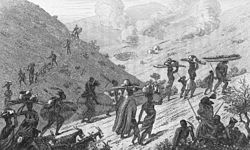
Around 1821, the Zulu general Mzilikazi of the Khumalo clan defied Shaka, and set up his own kingdom. He quickly made many enemies: not only the Zulu king, but also the Boers, and the Griqua and Tswana. Defeats in several clashes convinced Mzilikazi to move north towards Swaziland. Going north and then inland westward along the watershed between the Vaal and the Limpopo rivers, Mzilikazi and his followers, the AmaNdebele, (called Matebele in English) established a Ndebele state northwest of the city of Pretoria.
During this period, the Matebele left a trail of destruction in their wake.[51] From 1837 to 1838, the arrival of Boer settlers and the subsequent battles of Vegtkop and Mosega, drove the Matebele north of the Limpopo. They settled in the area now known as Matabeleland, in present-day southern Zimbabwe. Mzilikazi set up his new capital in Bulawayo.[52] The AmaNdebele drove the MaShona of the region northward and forced them to pay tribute. This caused resentment that has continued to the current day in modern Zimbabwe.
At the Battle of Mhlatuze River in 1818, the Ndwandwe were defeated by a Zulu force under the direct command of Shaka. Soshangane, one of Zwide's generals, fled to Mozambique with the remainder of the Ndwandwe. There, they established the Gaza kingdom. They oppressed the Tsonga people living there, some of whom fled over the Lebombo Mountains into the Northern Transvaal. In 1833, Soshangane invaded various Portuguese settlements, and was initially successful. But a combination of internal disputes and war against the Swazi caused the downfall of the Gaza kingdom.[52]
The Ngwane people lived in present-day Eswatini (Swaziland), where they had settled in the southwest. They warred periodically with the Ndwandwe.
Zwangendaba, a commander of the Ndwandwe army, fled north with Soshangane after his defeat in 1819. Zwangendaba's followers were henceforth called Ngoni. Continuing north of the Zambezi River, they formed a state in the region between lakes Malawi and Tanganyika. Maseko, who led another part of the Ngoni people, founded another state to the east of Zwangendaba's kingdom.[52]
To the east, refugee clans and tribes from the Mfecane fled to the lands of the Xhosa people. Some of them such as the amaNgwane were driven back by force and defeated. Those who were accepted were obliged to be tributary to the Xhosas and lived under their protection. They were assimilated into the Xhosa cultural way of life, becoming part of the Xhosa people. After years of oppression by the Xhosas, they later formed an alliance with the Cape Colony.
Consequences for the Sotho-Tswana peoples
[edit]Southern Tswana populations had experienced an increase in conflict as early as the 1780s. There was significant population growth in the region which lead to more competition for resources. There was an increasing amount of trade with the Cape colony and the Portuguese; this had the consequence of separate chiefdoms becoming more eager to conquer land for themselves in order to control trade routes. Dutch settlers from the Cape Colony encroaching upon the Khoikhoi and San into regions where Tswana people live resulted in the formation of the Korana who started to launch raids on other communities by the 1780s. The fact that many of them had access to firearms and horses likely exacerbated the devastation caused by their raiders. Xhosa who were escaping the already violent region of the Eastern Cape often launched their own raids as well. All of these events led to making the region progressively more unstable. Missionary interference, internal politics, and raids by Dutch settlers also impacted the region. By the start of the 19th century, the most powerful Tswana chiefdom, the Bahurutse, were increasingly being challenged by the Bangwaketse.[52]
Moshoeshoe I gathered the mountain clans together in an alliance against the Zulus. Fortifying the easily defended hills and expanding his reach with cavalry raids, he fought against his enemies with some success, despite not adopting the Zulu tactics, as many clans had done. The territory of Moshoeshoe I became the kingdom of Lesotho.[52]
The Tswana were pillaged by two large invading forces set on the move by the Mfecane. Sebetwane gathered the Bafokeng of Patsa, who are part of the Basotho and were later to be called Kololo ethnic groups near modern Lesotho and wandered north across what is now Botswana, plundering and killing many of the Tswana people in the way. They also took large numbers of captives north with them,[53] finally settling north of the Zambezi River in Barotseland, where they conquered the Lozi people.[54] The next force was the Mzilikazi and the Matebele who moved across Tswana territory in 1837. Both of these invading forces continued to travel north across Tswana territory without establishing any sort of state.[54] In addition to these major kingdoms, a number of smaller groups also moved north into Tswana territory, where they met with defeat and ultimately vanished from history.[53] Among those involved in these invasions were European adventurers such as Nathaniel Isaacs (who was later accused of slave trading).[55]
Controversy
[edit]In 1988, Rhodes University professor Julian Cobbing advanced a different hypothesis on the rise of the Zulu state; he contended the accounts of the Mfecane were a self-serving, constructed product of apartheid-era politicians and historians. According to Cobbing, apartheid-era historians had mischaracterised the Mfecane as a period of internally induced Black-on-Black destruction. Instead, Cobbing argued that the roots of the conflicts lay in the labour needs of Portuguese slave traders operating out of Delagoa Bay, Mozambique and European settlers in the Cape Colony. The resulting pressures led to forced displacement, famine, and war in the interior, allowing waves of Afrikaner settlers to colonise large swaths of the region.[56] Cobbing's views were echoed by historian Dan Wylie, who argued that colonial-era white writers such as Isaacs had exaggerated the brutality of the Mfecane to justify European colonialism.[57]
Cobbing's hypothesis generated an immense volume of polemics among historians; the discussions were termed the "Cobbing Controversy". While historians had already embarked upon new approaches to the study of the Mfecane in the 1970s and 1980s, Cobbing's paper was the first major source that overtly defied the hegemonic "Zulu-centric" explanation at the time.[58] This was followed by fierce discourse in the early 1990s prompted by Cobbing's hypothesis. Many agree that Cobbing's analysis offered several key breakthroughs and insights into the nature of early Zulu society.[59]
The historian Elizabeth Eldredge challenged Cobbing's thesis on the grounds that there is scant evidence of the resumption of the Portuguese slave trade out of Delagoa Bay before 1823, a finding that undermines Cobbing's thesis that Shaka's early military activities were a response to slave raids. Moreover, Eldredge argues that the Griqua and other groups (rather than European missionaries as asserted by Cobbing) were primarily responsible for the slave raids coming from the Cape. Eldredge also asserts that Cobbing downplays the importance of the ivory trade in Delagoa Bay, and the extent to which African groups and leaders sought to establish more centralised and complex state formations to control ivory routes and the wealth associated with the trade. She suggests these pressures created internal movements, as well as reactions against European activity, that drove the state formations and concomitant violence and displacement.[60] She still agreed with Cobbing's overall sentiment in that the Zulu-centric explanation for the Mfecane is not reliable.[61] By the early 2000s, a new historical consensus had emerged,[52] recognizing the Mfecane to be not simply a series of events resulting from the founding of the Zulu Kingdom but rather a multitude of factors caused before and after Shaka Zulu came into power.[59][61][58]
The debate and controversy within Southern African historiography over the Mfecane has been compared to similar debates about the Beaver Wars of the seventeenth century in northeastern North America, due to the alleged similarity of the narratives of indigenous "self-vanishing" that were propagated by apologists for European colonialism about the Mfecane and the Beaver Wars.[62]
References
[edit]- ^ "General South African History Timeline: 1800s". South African History Online. Archived from the original on 21 April 2019. Retrieved 12 September 2014.
- ^ a b Epprecht 1994.
- ^ Hanson, Victor (2007). Carnage and Culture: Landmark Battles in the Rise to Western Power. Knopf Doubleday Publishing Group. ISBN 978-0-307-42518-8.
- ^ Walter, Eugene Victor (1969). Terror and resistance: a study of political violence, with case studies of some primitive African communities. Oxford University Press.
- ^ Wright, John; Cobbing, Julian (12 September 1988). "The Mfecane: Beginning the inquest". Wits Institutional Repository African Studies Institute – Seminar Papers. Archived from the original on 24 December 2019. Retrieved 6 March 2018.
- ^ Omer-Cooper, J. D. (June 1993). "Has the Mfecane a future? a response to the Cobbing critique". Journal of Southern African Studies. 19 (2): 273–294. doi:10.1080/03057079308708360.
- ^ Saunders, Christopher (1 December 1991). "Conference report: Mfecane afterthoughts". Social Dynamics. 17 (2): 171–177. doi:10.1080/02533959108458518. ISSN 0253-3952.
- ^ Eldredge 1992.
- ^ a b Epprecht 1994, p. 114.
- ^ a b Wright 1989, p. 286.
- ^ Etherington, Norman (2004). "A False Emptiness: How Historians May Have Been Misled by Early Nineteenth Century Maps of South-Eastern Africa". Imago Mundi. 56 (1): 68. doi:10.1080/0308569032000172969. JSTOR 40233902. S2CID 128461624.
- ^ Epprecht 1994, p. 115.
- ^ Wright 1989, p. 287.
- ^ Eldredge 1992, p. 28.
- ^ a b c Eldredge 1992, p. 29.
- ^ a b Eldredge 1992, pp. 30–31.
- ^ Garstang, Michael; Coleman, Anthony; Therrell, Matthew (2014). "Climate and the mfecane". South African Journal of Science. 110 (5–6): 110. doi:10.1590/sajs.2014/20130239 – via EBSCOhost.
- ^ Eldredge 1992, p. 30.
- ^ Eldredge 1992, pp. 15–16, 34.
- ^ Eldredge 1992, p. 15.
- ^ a b Wright 2009, p. 220.
- ^ Wright 2009, p. 250.
- ^ Wright 2009, p. 221.
- ^ Wright 2009, pp. 224–225.
- ^ Wright 2009, pp. 233, 225–226.
- ^ Wright 2009, p. 227.
- ^ Wright 2009, p. 228.
- ^ Wright 2009, p. 231.
- ^ a b Wright 2009, p. 248.
- ^ a b Wright 2009, p. 249.
- ^ Wright 2009, p. 237.
- ^ Wright 2009, p. 233.
- ^ a b Wright 2009, p. 234.
- ^ a b Wright 2009, pp. 247–248.
- ^ Wright 2009, p. 239.
- ^ Wright 2009, pp. 214–215.
- ^ Wright 2009, p. 216.
- ^ a b Wright 2009, p. 217.
- ^ Wright 2009, p. 215.
- ^ Wright 2009, pp. 215–216.
- ^ a b Eldredge 1992, p. 17.
- ^ Eldredge 1992, p. 22, 34.
- ^ Eldredge 1992, p. 18.
- ^ Wright 2009, p. 235.
- ^ a b Wright 2009, p. 240.
- ^ Wright 2009, pp. 243–245.
- ^ Wright 2009, p. 245.
- ^ Wright 2009, pp. 246–247.
- ^ Wright 2009, pp. 240, 243.
- ^ Wright 2009, pp. 240–241.
- ^ Becker, Peter (1979). Path of Blood: The Rise and Conquests of Mzilikazi, Founder of the Matebele ethnic group of Southern Africa. Penguin. ISBN 978-0-14-004978-7.
- ^ a b c d e f Wright 2009, pp. 249, 212–213, 215–217.
- ^ a b Segolodi, Moanaphuti (1940). "Ditso Tsa Batawana". Archived from the original on 6 March 2023. Retrieved 1 May 2015.
- ^ a b Tlou, Thomas (1985). A History of Ngamiland, 1750 to 1906: The Formation of an African State. Macmillan Botswana. ISBN 9780333396353.
- ^ Herrman, Louis (December 1974). "Nathaniel Isaacs" (PDF). Natalia (4). Pietermartizburg: The Natal Society Foundation: 19–22. Archived (PDF) from the original on 8 March 2012. Retrieved 10 August 2010.
- ^ Cobbing, Julian (1988). "The Mfecane as Alibi: Thoughts on Dithakong and Mbolompo". The Journal of African History. 29 (3): 487–519. doi:10.1017/s0021853700030590.
- ^ Carroll, Rory (22 May 2006). "Shaka Zulu's brutality was exaggerated, says new book". The Guardian. Archived from the original on 7 April 2023. Retrieved 25 June 2010.
- ^ a b Wright 2009, pp. 211–212.
- ^ a b Etherington, Norman (2004). "A Tempest in a Teapot? Nineteenth-Century Contests For Land in South Africa's Caledon Valley and the Invention of the Mfecane". The Journal of African History. 45 (2): 203–219. doi:10.1017/S0021853703008624. ISSN 0021-8537. S2CID 162838180.
- ^ Eldredge, Elizabeth (1995). "Sources of Conflict in Southern Africa c. 1800–1830: the 'Mfecane' Reconsidered". In Hamilton, Carolyn (ed.). The Mfecane Aftermath: Reconstructive Debates in Southern African History. Pietermaritzburg: University of Natal Press. pp. 122–161. ISBN 978-1-86814-252-1.
- ^ a b Eldredge, Elizabeth (2014). The Creation of the Zulu Kingdom, 1815–1828. Cambridge University Press. p. 9.
- ^ Dowd, Gregory Evans (July 2022). "Indigenous Self-Vanishing? Relating the North American 'Iroquois Wars' and the Southern African Mfecane". The William and Mary Quarterly. 79 (3): 393–424. doi:10.1353/wmq.2022.0030. Retrieved 27 January 2023.
Sources
[edit]- Eldredge, Elizabeth A. (1992). "Sources of Conflict in Southern Africa, c. 1800–30: The 'Mfecane' Reconsidered". The Journal of African History. 33 (1): 1–35. doi:10.1017/S0021853700031832. ISSN 0021-8537. JSTOR 182273. S2CID 153554467. Archived from the original on 3 February 2022. Retrieved 3 February 2022.
- Epprecht, Marc (June 1994). "The Mfecane as Teaching Aid: History, Politics, and Pedagogy in Southern Africa". Journal of Historical Sociology. 7 (2): 113–130. doi:10.1111/j.1467-6443.1994.tb00164.x.
- Wright, John (1989). "Political Mythology and the Making of Natal's Mfecane". Canadian Journal of African Studies. 23 (2). doi:10.2307/485525. hdl:10539/10253. JSTOR 485525.
- Wright, John (2009). "Turbulent Times: Political Transformations in the North and East, 1760s–1830s". In Mbenga, Bernard K.; Hamilton, Carolyn; Ross, Robert (eds.). The Cambridge History of South Africa. Cambridge History of South Africa. Vol. 1: From Early Times to 1885. Cambridge: Cambridge University Press. pp. 211–252. ISBN 978-0-521-51794-2. Retrieved 4 November 2024.
Further resources
[edit]- J. D. Omer-Cooper, The Zulu Aftermath: A Nineteenth-Century Revolution in Bantu Africa, Longmans, 1978: ISBN 0-582-64531-X
- Norman Etherington, The Great Treks: The Transformation of Southern Africa, 1815–1854, Longman, 2001: ISBN 0-582-31567-0
- Carolyn Hamilton, The Mfecane Aftermath: Reconstructive Debates in Southern African History, Pietermaritzburg: University of Natal Press, 1995: ISBN 1-86814-252-3

| National | |
|---|---|
| Other | |

Mfecane
View on GrokipediaTerminology and Scope
Etymology and Definitions
The term mfecane originates from the Zulu language, where it denotes "crushing," "scattering," or "forced dispersal," reflecting the violent fragmentation and displacement of communities during the early 19th century.[6] [7] In related Nguni languages such as Xhosa, etymological roots trace to concepts of starvation and intrusion, including ukufaca ("to become thin from hunger") and fetcani ("starving intruders"), underscoring the famine and raiding dynamics involved.[7] The earliest recorded English usage of "Mfecane" appears in the late 1920s, as documented in historical scholarship.[8] In Sotho languages, equivalent terms include difaqane or lifaqane, translating to "hammering," "forced migration," or "uprooting," which similarly evoke the era's disruptive raids and relocations.[9] [10] These Nguni and Sotho designations collectively describe a historical phase rather than a singular event, emphasizing internal African dynamics over external impositions, though some modern critiques question the term's uniformity as potentially oversimplifying diverse regional conflicts.[9] The Mfecane is defined as a period of widespread warfare, state formation, and mass migrations among Bantu-speaking peoples in southern Africa, spanning roughly 1815 to 1840, triggered by intensified competition for resources and power.[9] [7] It involved the expansion of militarized kingdoms, notably the Zulu under Shaka, leading to the dispersal of groups like the Ndebele and Ngwane, depopulation in the highveld regions, and the emergence of new polities such as Lesotho and Swaziland.[9] Historians delineate it temporally from the late 1810s consolidations in Zululand to the 1830s stabilizations, distinguishing it from prior localized conflicts by its scale and cascading effects across modern-day South Africa, Zimbabwe, and Mozambique.[11] While traditionally framed as Zulu-initiated "crushing," empirical analyses highlight multifaceted causes including ecological pressures and trade disruptions, rejecting monolithic attributions.[7]Geographical and Temporal Extent
The Mfecane, encompassing a series of interconnected wars, conquests, and forced migrations, unfolded primarily between approximately 1818 and 1840 across southeastern Africa. This temporal scope aligns with the rise and expansion of the Zulu kingdom under Shaka from the late 1810s, intensifying through the 1820s, and tapering as new polities stabilized by the early 1840s amid ongoing disruptions.[12][13] Scholarly assessments often pinpoint the core period of upheaval to the 1820s, when cascading conflicts displaced populations on a regional scale, though precursors trace to environmental stresses and chiefly competitions from around 1815.[3] Geographically, the events centered on the coastal and inland zones of present-day KwaZulu-Natal, radiating outward to encompass the highveld regions of Mpumalanga, Gauteng, and the Free State; Lesotho; Eswatini; and the hinterland of Delagoa Bay in southern Mozambique.[14] Migrations triggered by these conflicts extended influences westward into eastern Botswana, southward toward the eastern Cape Colony frontier, and northward into southern Zimbabwe, where groups like the Ndebele established new domains.[15] Further afield, splinter groups such as the Ngoni pushed into central and eastern Africa, reaching as far as present-day Malawi and Tanzania, though these represent peripheral extensions rather than the Mfecane's primary locus.[16] Historiographical debates highlight variations in delineating the extent, with some analyses emphasizing the Zulu epicenter and immediate ripple effects within a 500-800 km radius, while others critique broader attributions of depopulation or causation to European factors, advocating for indigenous dynamics as the principal drivers across this delimited theater.[3] Empirical evidence from oral traditions and early traveler accounts corroborates widespread but uneven impacts, concentrated in fertile valleys and pastoral corridors rather than uniformly across the subcontinent.[14]Historical Context
Pre-Mfecane Southern African Societies
Southern African societies prior to the early 19th-century upheavals were dominated by Bantu-speaking agro-pastoralist communities, who had migrated southward over centuries, establishing themselves across the region from the highveld interior to the eastern seaboard by around 500–1000 CE. These groups, primarily Nguni in the southeast and Sotho-Tswana further inland, maintained economies centered on cattle herding and cultivation of crops such as sorghum and millet, with livestock serving as the primary measure of wealth, status, and exchange in systems like bridewealth (lobola). Political organization revolved around small chiefdoms or lineages, typically numbering from a few hundred to several thousand individuals, where authority derived from kinship ties, military prowess, and resource control rather than centralized bureaucracies. Conflicts were generally localized raids for cattle and grazing lands, lacking the scale of conquest warfare that characterized later periods.[15][17] Nguni societies, inhabiting areas from Delagoa Bay southward to the Fish River, featured dispersed homesteads (kraal) organized around patrilineal clans, with households including kin, dependents, and sometimes indentured laborers granted cattle for loyalty. Chiefs (inkosi) were selected through descent, personal achievement, or alliances, demanding tribute while rewarding followers; loyalty was fluid, allowing individuals to shift allegiances between chiefdoms. Settlements lacked nucleated villages, emphasizing individual homestead autonomy, and warfare involved opportunistic conquests by larger groups over smaller ones, though sustained hegemony seldom endured beyond a generation. Age-sets existed informally for social roles but not as formalized military regiments until later innovations.[18][15] In contrast, Sotho-Tswana groups on the highveld formed more clustered villages for defense and resource sharing, with homesteads grouped into wards under hereditary chiefs who appointed subordinates and oversaw courts enforcing stricter legal codes than among Nguni. Social structure incorporated totemic clans (e.g., associated with lions or elephants) and age-sets assigning gendered duties—men to herding and warfare, women to farming—while absorbing outsiders through mechanisms like cattle-lending (mafisa). Villages like Kaditshwene, a Hurutshe Tswana capital settled by the 15th century, grew to support 16,000–20,000 residents by the early 19th century through agriculture, iron smelting, and trade in metals and ivory, highlighting localized stratification and craft specialization. Lineages were often endogamous, differing from Nguni exogamy, and inter-group relations involved both alliances and raids over territory and tribute.[19][17]Environmental and Demographic Pressures
In the late eighteenth century, Nguni societies in southeastern Africa experienced population growth driven by the adoption of New World crops like maize, which enhanced agricultural productivity and supported denser settlements.[11] This expansion strained limited arable land and pastoral resources, fostering closer proximity among chiefdoms and heightening competition for grazing areas and water sources, particularly in the fertile but ecologically fragile regions of present-day KwaZulu-Natal.[11] Pre-existing ecological degradation, including overgrazing by expanding cattle herds, further exacerbated these demographic pressures, creating conditions of resource scarcity that undermined traditional homestead-based economies.[20] Environmental stressors intensified these challenges through recurrent drought cycles during the early nineteenth century. Paleoclimatic reconstructions indicate a prolonged dry period from approximately 1800 to 1820, with a particularly severe episode spanning 1809 to 1823, during which precipitation levels dropped significantly, leading to widespread crop failures and livestock losses.[20] These droughts were amplified by volcanic eruptions, including an unidentified event in 1809 and the massive Tambora eruption on April 15, 1815 (Volcanic Explosivity Index 7), which injected sulfate aerosols into the stratosphere, reducing regional rainfall by up to 20% for several years and causing colder winters.[20] Nguni oral traditions refer to this era as madlathule ("time of eating up everything"), marked by acute famine that triggered initial social breakdowns, forced migrations, and intensified inter-chiefdom raids for food and cattle.[20] The convergence of demographic expansion and climatic adversity created a feedback loop of instability, where famine and resource depletion prompted aggressive expansion by stronger chiefdoms to secure viable territories.[20] Tree-ring data from Zimbabwe and climate modeling corroborate these patterns, showing that southern Africa's inherent variability in rainfall—punctuated by multi-year dry spells—was sufficient to destabilize agro-pastoral systems already under strain from human population densities.[20] While internal political dynamics played a role, these environmental and demographic factors provided the underlying impetus for the widespread disruptions associated with the Mfecane, compelling societies toward militarization and territorial conquest to mitigate ecological collapse.[20]Causes
Internal Competition and State-Building Dynamics
In the late eighteenth century, southern African societies, particularly among the Nguni-speaking chiefdoms along the eastern seaboard, were characterized by numerous small, autonomous polities engaged in persistent competition for limited resources, including arable land, grazing pastures, water sources, and cattle herds essential for social and economic status. This rivalry was intensified by environmental stressors, such as the severe drought around 1800 and subsequent famines like the Mahlatule, which reduced agricultural yields and prompted heightened raiding for livestock and grain to sustain populations. Cattle raiding, a longstanding cultural practice embedded in kinship and prestige systems, escalated as a primary mechanism of wealth accumulation and power assertion, with successful raids enabling chiefs to reward followers, expand herds, and assert dominance over neighbors, thereby fostering cycles of retaliation and alliance formation.[11][21][4] Competition also extended to control over trade networks, notably the ivory trade with Portuguese merchants at Delagoa Bay, where chiefdoms vied for access to lucrative routes connecting the interior to coastal ports, prompting military buildup and strategic absorptions of weaker groups to secure advantages. Among Sotho-Tswana polities on the highveld, similar dynamics unfolded, with chiefdoms like the Pedi consolidating influence over inland trade paths from the mid-eighteenth century onward, leading to enlarged political units capable of projecting power through organized warfare. These internal pressures, rooted in demographic growth from innovations like maize cultivation—which supported denser settlements but strained land resources—drove processes of political centralization, as ambitious leaders exploited rivalries to forge hierarchical structures with standing armies and tributary systems.[11][22][10] State-building accelerated as victorious chiefs incorporated defeated polities, either through assimilation or subjugation, transforming fragmented lineages into more cohesive kingdoms; for instance, leaders such as Dingiswayo of the Mthethwa and Zwide of the Ndwandwe expanded by integrating subordinate groups, setting precedents for larger-scale formations like the Zulu under Shaka, who by the 1820s had unified approximately 100 chiefdoms via regimental reforms and conquests. This consolidation was not merely aggressive expansion but a response to the instability of inter-chiefdom warfare, where failure to innovate militarily—such as developing age-grade regiments for disciplined campaigns—resulted in absorption or dispersal, thereby selecting for centralized authority amid escalating conflicts. Such dynamics, independent of external impositions, generated a feedback loop of militarization and migration that underpinned the broader disruptions of the Mfecane period.[11][4][23]Zulu Expansion and Military Innovations
Shaka kaSenzangakona became chief of the Zulu around 1816, following the death of his father Senzangakona, with initial support from the neighboring Mthethwa paramountcy under Dingiswayo.[24] After Dingiswayo's death circa 1818, Shaka absorbed the Mthethwa and launched campaigns of conquest, transforming the small Zulu clan into a centralized kingdom through military dominance.[24] By the mid-1820s, Zulu forces had subdued over 100 chiefdoms, extending control from the Pongola River southward beyond the Tugela River and establishing capitals such as KwaBulawayo and later Dukuza in 1826.[24] Shaka's military reforms emphasized close-quarters combat and disciplined organization, crediting him with introducing the short-handled stabbing assegai (iklwa) for thrusting attacks, complemented by larger cowhide shields that enabled tight formations.[24] Warriors underwent intensive training, including barefoot marches to build endurance and strict regimental discipline, forming a standing army of approximately 40,000 by the 1820s, divided into age-based units called amabutho.[24] [25] Tactical innovations included the "buffalo horns" formation, featuring a central "chest" to pin enemies and flanking "horns" for encirclement, which maximized Zulu numerical superiority in battles.[24] These innovations proved decisive in key victories, such as the defeat of the Ndwandwe kingdom under Zwide at the Mhlatuze River in April 1818, which eliminated a major rival and accelerated Zulu expansion.[24] [25] The resulting displacements of defeated groups, including the Hlubi and Ngwane, triggered cascading migrations and conflicts across southern Africa, contributing substantially to the regional upheavals of the Mfecane from 1818 to 1828.[24] Shaka's assassination by his half-brothers on 24 September 1828 curtailed further personal conquests but perpetuated the kingdom's aggressive posture under successors.[24]External Trade and European Influences
The expansion of trade networks with European merchants, particularly Portuguese traders at Delagoa Bay (modern Maputo Bay), introduced economic incentives that amplified internal rivalries in southeastern Africa during the early 19th century. By the late 18th century, demand for ivory from European markets prompted African polities to organize hunts and impose taxation systems on hunters and porters, fostering competition over access to elephant herds in regions like the Pongola River valley. This trade, peaking with exports of thousands of tons of ivory annually by the 1820s, indirectly fueled raiding as chiefdoms sought to control trade routes and labor for transporting tusks to coastal ports.[4][26] Slave trading via Delagoa Bay further destabilized hinterland societies, with exports surging to several thousand captives per year by the late 1820s, sourced through intensified local wars and kidnappings. Portuguese records indicate that interdunal chiefdoms around the bay supplied slaves to Brazilian markets, often captured from Nguni and Tsonga groups amid expanding conflicts; this removal of populations—estimated at up to 10,000 annually in peak years—disrupted social structures and prompted preemptive migrations and alliances. While direct causation of the Mfecane's scale remains debated, the trade's reliance on warfare for captives created feedback loops of violence, as groups like the Gaza under Soshangane raided interiors to meet Portuguese demands.[27][28] The influx of firearms through these exchanges escalated the lethality of conflicts, with traders bartering muskets for ivory and slaves, enabling chiefdoms to conduct more aggressive campaigns. Northern Nguni groups, including precursors to the Zulu, acquired guns via Delagoa Bay intermediaries as early as the 1790s, though adoption was limited until the 1810s due to powder shortages and maintenance issues; by Shaka's reign (c. 1816–1828), Zulu forces integrated firearms sporadically alongside assegai innovations, enhancing their dominance in raids that secured trade goods. Scholarly assessments, however, emphasize that firearms' impact was marginal compared to internal military reforms, as ammunition scarcity constrained their role in core Mfecane battles, with trade volumes insufficient to arm large armies en masse.[29][30] European influences extended beyond commerce to indirect geopolitical pressures, as British abolitionist patrols after 1807 redirected some slave flows but heightened Portuguese competition at Delagoa Bay, sustaining demand until Mozambique's treaty limits in 1810 proved ineffective. Minimal missionary or settler penetration inland—confined largely to Cape Colony frontiers—meant influences were predominantly economic, accentuating rather than initiating the era's turmoil; analyses rooted in resource competition overstate trade's primacy, viewing it as a catalyst amid endogenous demographic and ecological strains like rinderpest cycles and land scarcity.[31][4]Course of Events
Early Disruptions and Zulu Campaigns (1810s)
In the early 1810s, escalating inter-chieftainship conflicts among northern Nguni groups, including raids between the expanding Mthethwa paramountcy under Dingiswayo and the Ndwandwe under Zwide, marked the onset of significant disruptions in the region north of the Tugela River.[32] These clashes, fueled by competition over cattle herds and arable land amid population pressures, involved approximately 1,000 to 2,000 warriors per side in typical engagements and resulted in the absorption or displacement of smaller chiefdoms like the Qwabe and Nyambose.[33] Shaka, having served in Dingiswayo's forces, seized control of the Zulu chieftaincy in 1816 upon the death of his father, Senzangakhona, by eliminating rivals including his half-brother Sigujana.[34] He rapidly reformed Zulu military organization, introducing the short stabbing spear (iklwa), regiment-based amabutho age-sets for both men and women, and bull-horn encirclement tactics, increasing the Zulu fighting force from a few hundred to several thousand warriors within two years.[35] The pivotal Ndwandwe-Zulu War erupted in 1817 when Ndwandwe forces, estimated at 10,000 strong, overran the Mthethwa, capturing and executing Dingiswayo, which left Shaka's Zulu as the primary opponent to Zwide's expansion.[10] In 1818, Shaka's forces achieved a key victory at Gqokli Hill, where Zulu regiments feigned retreat to lure and envelop Ndwandwe units, killing thousands and seizing vast cattle herds.[36] The decisive Battle of Mhlatuze River in January 1819 saw Zulu impis, numbering around 15,000, trap Zwide's divided army in the riverbed, resulting in heavy Ndwandwe losses—possibly 10,000 dead—and the flight of Zwide northward, fragmenting his kingdom into splinter groups like the Swazi and Gaza.[10] [37] These Zulu campaigns directly precipitated early Mfecane migrations, as defeated groups such as the Hlubi and Ngwane fled inland and northward, raiding and destabilizing adjacent societies while incorporating refugees into Zulu structures through tribute and assimilation.[25] Oral traditions, corroborated by early European trader accounts like those of Henry Francis Fynn from 1824, attribute over 1,000 chiefdoms disrupted by these initial expansions, though archaeological evidence suggests localized rather than total depopulation.[32]Regional Wars and Migrations in the East
The Ndwandwe-Zulu War of 1817–1819 marked a pivotal escalation in eastern regional conflicts, as Shaka's Zulu forces decisively defeated the Ndwandwe under Zwide, including key victories such as the Battle of Gqokli Hill in April 1818.[36] This war shattered Ndwandwe cohesion, prompting the flight of approximately 20,000–30,000 followers and initiating cascading migrations eastward toward the Indian Ocean coast and Delagoa Bay.[38] Defeated Ndwandwe factions initially sought refuge near Delagoa Bay, where intensified warfare supplied slaves—predominantly Nguni women and children—to Portuguese traders, exacerbating local instability through raids and counter-raids.[39] Soshangane, a prominent Ndwandwe general and son-in-law of Zwide, led one major splinter group northeastward starting around 1820, crossing the Phongolo River and entering southern Mozambique by the mid-1820s.[40] En route, his forces clashed with Tsonga-speaking communities, including the Ronga, Bitonga, and Hlengwe, subjugating them through systematic conquests that incorporated refugees and established regimental structures modeled on Zulu innovations.[41] By the 1830s, Soshangane had founded the Gaza kingdom along the middle Sabi River highlands, controlling trade routes and extracting tribute from coastal polities, which stabilized his rule but perpetuated cycles of displacement and low-level warfare against Portuguese outposts and inland groups.[40] In the northeastern interior, the Swazi under Sobhuza I responded to Zulu pressures from circa 1815 by consolidating disparate Nguni and Sotho elements into a defensive polity, expanding northward into the Lowveld to buffer against incursions.[10] This state-building involved absorbing refugees and conducting preemptive raids, enabling the Swazi to repel a major Zulu invasion in 1836 led by Dingane's forces.[10] These eastern dynamics resulted in fragmented settlements along the Lebombo Mountains and coastal plains, with smaller Nguni bands integrating into or fleeing further toward Portuguese territories, contributing to demographic vacuums exploited by later European traders.[38]Highveld and Interior Conflicts
In the early 1820s, the Highveld and interior regions of present-day South Africa, encompassing areas like the Transvaal and Orange Free State, became arenas of widespread disruption as Nguni-speaking groups displaced by Zulu expansion under Shaka invaded Sotho-Tswana territories. Mzilikazi, having broken from Zulu authority in 1821 after refusing to remit cattle raided from Sotho chief Ranisi, led his Ndebele followers northward into the Highveld, where they established a base after defeating the Pedi in 1822 and seizing their cattle and lands.[11][42] This incursion initiated systematic raids against fragmented Sotho-Tswana chiefdoms, which lacked centralized military structures comparable to Nguni impis, resulting in the conquest and incorporation of local populations for labor and military service.[11] By 1825, Ndebele forces under Mzilikazi had extended their raids westward, defeating the Ngwaketse Tswana and extracting tribute in cattle and captives, which fueled further expansion along the Vaal and Apies Rivers.[11] These operations continued into the late 1820s, clashing with Taung and Kora-Griqua groups between 1827 and 1829, where Ndebele warriors repelled counterattacks using superior tactics adapted from Zulu methods, such as encirclement and short stabbing spears.[11] In 1830–1831, intensified raiding targeted broader Tswana communities, culminating in an unsuccessful assault on Moshoeshoe I's stronghold at Thaba Bosiu, where defensive terrain and consolidated Basotho defenses inflicted heavy Ndebele losses, marking a rare check on their dominance.[11] Concurrently, other migrant bands, including elements under Sebetwane (later of the Kololo), traversed the interior, engaging Sotho groups in skirmishes while migrating northward, exacerbating local instability through cattle rustling and village burnings.[11] These conflicts, often termed Difaqane in Sotho languages, displaced tens of thousands, depopulating fertile Highveld valleys as survivors fled to mountainous refuges or scattered into smaller bands, fostering conditions for new polities like the Basotho under Moshoeshoe, who absorbed refugees and innovated defensive strategies.[11] Ndebele raids incorporated thousands of Sotho-Tswana into their society, either as vassals or warriors, while destroying agricultural infrastructure and herds, leading to famine and secondary migrations.[11] By 1832, Zulu pursuit forces clashed with Ndebele near the Highveld, inflicting mutual casualties before Mzilikazi relocated northward in 1834 following Boer commando attacks near Mosega, temporarily alleviating pressure but leaving enduring patterns of militarization and ethnic reconfiguration in the interior.[11]Immediate Consequences
Impacts on Nguni Groups
The Zulu expansion under Shaka from 1816 to 1828 resulted in the conquest and partial absorption of numerous Nguni chiefdoms, such as the AmaNyuswa, AmaNtshali, and elements of the AmaNdwandwe, with leaders like Mgudhlana submitting and chiefs like Kondhlo ka Magalela killed during campaigns.[43] Conquered populations were integrated into Zulu regimental systems through a process of assimilation, including groups like the AmaNgcobo, AmaCele, and AmaHlubi into units such as Iziyendane, swelling the Zulu kingdom's population to an estimated 250,000 by 1828 and extending control over approximately 80,000 square miles from Delagoa Bay to the St. John’s River.[43] Defeat of the Ndwandwe in 1818 triggered widespread dispersal among Nguni clans, with remnants splintering into migratory groups adopting militarized structures modeled on Zulu innovations.[11] Mzilikazi, breaking from Ndwandwe forces in 1821, led the Ndebele northward to the Transvaal and eventually southwest Zimbabwe by 1838–1839, establishing a hierarchical polity divided into Zansi, Enhla, and Holi classes.[11] Similarly, Zwangendaba's group migrated from the 1819 Mhlatuze River defeat, reaching as far as Lake Tanganyika, while Shoshangane formed the Gaza kingdom in Mozambique after regrouping Ndwandwe elements defeated again in 1826.[11] [43] Other Nguni groups faced displacement westward or southward; the AmaNgwane under Sobhuza fled Zulu pressure, crossing the Drakensberg and consolidating into the Swazi kingdom in present-day Eswatini.[11] The AmaHlubi scattered after cattle raids and defeats, with some integrating among Xhosa and Thembu as Mfengu, fostering tensions due to their growing autonomy, while the AmaNgidi relocated approximately 300 km to the Orange River.[43] These migrations created buffer zones around Zululand and depopulated regions, with contemporary estimates suggesting up to 1,000,000 Nguni and others affected or killed amid raids and conflicts from 1818 onward.[43] The resultant "Zulu successor states" like Ndebele, Gaza, and Swazi perpetuated Nguni militarism, incorporating cattle raiding and age-grade regiments, but at the cost of social disruption, economic strain from livestock losses, and ethnic reconfiguration through conquest and amalgamation during the 1820s and 1830s.[11] [43]Effects on Sotho-Tswana Societies
The Lifaqane, the Sotho-Tswana equivalent of the Mfecane, brought devastating raids by displaced Nguni groups into the Highveld and western interior during the 1820s, profoundly disrupting established chiefdoms. Ndebele warriors under Mzilikazi, having fled Zulu expansion around 1822, conducted systematic incursions against Tswana polities from approximately 1823 onward, targeting cattle herds and settlements for plunder and enslavement. These attacks contributed to the abandonment of major stone-built towns, such as those of the Hurutshe and Kgatlha chiefdoms near Rustenburg, where populations had previously numbered in the thousands; archaeological evidence indicates widespread dispersal and destruction of these pre-1820 urban centers by the mid-1820s.[44][10] Raids exacerbated pre-existing internal conflicts among Sotho-Tswana groups, including competition over resources and cattle raiding, leading to further fragmentation and demographic losses estimated in the tens of thousands through direct violence, famine, and flight. Northern and western Tswana societies, such as the Rolong and southern Pedi, suffered heavy casualties and loss of economic base, with survivors often resorting to fortified hilltops or dispersal into less arable regions like the Kalahari fringes. In the southeastern Highveld, Ngwane and Hlubi incursions against southern Sotho communities intensified internecine warfare, scattering clans and prompting mass migrations northward or into mountainous refuges.[4][45] Amid the chaos, adaptive responses emerged, particularly under leaders like Moshoeshoe I of the Bamokoteli lineage, who from around 1820 began consolidating refugees from disparate Sotho clans and even Nguni fugitives at Thaba Bosiu, a defensible plateau in present-day Lesotho. By incorporating vanquished groups and allocating land, Moshoeshoe fostered a multi-ethnic Basotho polity that grew resilient against further assaults, emphasizing diplomacy and defensive strategies over expansionism. This process of state-building amid disruption contrasted with the collapse elsewhere, highlighting how Lifaqane pressures catalyzed centralized authority in southern Sotho society while underscoring the era's selective survival of cohesive leadership structures.[46]Demographic Shifts and Depopulation
The wars and raids of the early 19th century triggered widespread population displacements in southeastern Africa, as communities sought refuge from Zulu expansions, subsequent chain migrations, and intensified slave raiding. Nguni groups' military campaigns displaced weaker polities, propelling refugees westward into Sotho-Tswana territories on the Highveld, where local chiefdoms fragmented under pressure from invaders like the Ndebele under Mzilikazi. These movements, compounded by droughts in 1816–1818 and 1823–1826, forced survivors into remote mountainous areas or toward European frontiers, fostering the coalescence of new ethnic identities such as the Basotho under Moshoeshoe I.[4] Depopulation in affected regions stemmed from direct warfare casualties, famine-induced starvation, and losses to enslavement, though precise figures are elusive and debated among historians. Battles like Dithakong in 1823 claimed 200–500 lives, with additional captives—over 90 in that instance—sold or indentured, contributing to male population reductions estimated at 25–50% in some frontier zones by proponents of external causation theses. Slave exports from ports like Delagoa Bay surged post-1823, reaching over 1,000 annually by the late 1820s and peaking at 2,800 from Lourenço Marques and Inhambane to Réunion in 1827–1828 alone, exacerbating demographic voids through external demand rather than purely endogenous conflict.[47][48] In the interior Highveld, particularly the Caledon River valley, successive raids left kraals abandoned and arable lands fallow, creating expanses of underpopulated territory observable by European missionaries and traders in the 1820s. Environmental degradation from overgrazing and locust plagues amplified famine, while disrupted cattle economies hindered recovery, resulting in sustained low densities that persisted into the 1830s. Revisionist analyses, emphasizing European frontier raiding for labor and slaves, challenge traditional attributions of massive internal death tolls (often cited as 1–2 million regionally), arguing instead for exaggerated narratives that obscured colonial complicity in the turmoil. Empirical evidence from oral traditions and early settler accounts supports notable but localized depopulation, with broader shifts reflecting adaptive migrations over wholesale annihilation.[4][48]Long-Term Outcomes
Formation of New Polities
The disruptions of the Mfecane prompted the aggregation of dispersed refugees, conquered subjects, and opportunistic leaders into novel centralized states, often militarized for survival and expansion amid ongoing raids and scarcity. These entities emerged primarily from 1820 onward as smaller chiefdoms dissolved, with followers coalescing around charismatic figures who imposed hierarchical authority, incorporated Zulu-style regimental systems, and controlled resources like cattle and arable land. By the 1840s, this reconfiguration had yielded polities spanning from modern Mozambique to Tanzania, reshaping ethnic boundaries and governance structures in the absence of prior overarching empires.[49][50] The Ndebele Kingdom exemplifies this pattern, established by Mzilikazi Khumalo, a Zulu induna who defected with about 500 warriors around 1821–1822 after clashing with Shaka over tribute. Migrating northwest, his forces subjugated Tswana groups, amassing up to 20,000 adherents by the late 1820s and settling in the Marico region (western Transvaal) where they imposed tributary relations on local Sotho-Tswana societies. Adopting Zulu military tactics like age-grade regiments and short stabbing spears, the Ndebele raided for cattle and women, sustaining a conquest economy until Boer incursions prompted a further migration northward in 1837–1840, culminating in the establishment of a kingdom in southwestern Zimbabwe by 1840 with an estimated population of 25,000–30,000.[25][49][51] Similarly, Swaziland (Eswatini) consolidated under Sobhuza I of the Ngwane, who from the early 1820s repelled Zulu incursions while absorbing refugees and expanding from the Pongola River eastward. By Sobhuza's death in 1836, the kingdom encompassed roughly 18,000 square kilometers, integrating diverse Nguni and Sotho elements through royal praise-poetry ties and a standing army of 6,000–8,000, which enabled control over trade routes and ivory hunting. This polity endured as one of the few to resist full Zulu dominance, leveraging defensive terrain and alliances.[49][25][50] In the Caledon Valley, Lesotho formed under Moshoeshoe I, who from 1824 sheltered disparate Sotho-Tswana remnants fleeing Ndebele and Griqua raids atop Thaba Bosiu mountain, growing from a few hundred to over 25,000 followers by 1830 through diplomacy, fortified settlements, and selective incorporation of Nguni military expertise. Moshoeshoe's regime emphasized cattle loans (mafisa) for loyalty and crop fortification against famine, establishing a kingdom of approximately 20,000 square kilometers by the 1840s that withstood Boer pressures via strategic European alliances.[49][50][11] Further afield, Ndwandwe remnants under Soshangane founded the Gaza Empire in southern Mozambique circa 1825, conquering Tsonga groups and dominating the coastal trade in slaves and ivory with an army exceeding 10,000, while Zwangendaba's splinter group evolved into the Ngoni kingdoms in present-day Malawi and Tanzania after northward treks from 1825–1835, fragmenting into militarized chiefdoms that disrupted local societies through raiding. In the interior, Sebetwane's Kololo polity arose from Highveld Sotho-Tswana fusions around 1823, migrating northwest to conquer the Lozi in Barotseland (western Zambia) by 1838, imposing Nguni governance on a population of about 10,000. These formations, totaling at least seven major states, reflected adaptive responses to demographic upheaval, with centralized kingship enabling resource extraction and defense in depopulated zones.[49][25][51]Facilitation of European Settlement
The Mfecane's extensive warfare and migrations led to substantial depopulation in regions such as the Highveld, eastern Cape frontier, and Natal, creating sparsely inhabited areas that European settlers later utilized for expansion. By the early 1830s, these disruptions had displaced numerous chiefdoms, reducing organized resistance and leaving fertile grazing lands underpopulated, which provided both practical opportunities and ideological justification for Boer and British incursions into the interior.[51][3] This power vacuum directly influenced the Great Trek, as approximately 12,000 to 15,000 Dutch-speaking Voortrekkers migrated northward from the Cape Colony starting in 1835, establishing settlements in territories weakened by prior conflicts. Trek leaders like Piet Retief and Andries Pretorius navigated fragmented polities, including remnants of Sotho-Tswana and Nguni groups, enabling the rapid formation of Boer republics such as Natalia (1839) and the Orange Free State (1854) with comparatively limited large-scale opposition. The Battle of Blood River on December 16, 1838, where 464 Boers defeated an estimated 10,000 Zulu warriors, exemplified how Mfecane-induced instability—coupled with Boer firepower—tipped balances in favor of settler dominance.[52][53][54] Mfecane refugees, particularly the Mfengu (Fingo) people fleeing Zulu expansion, further aided European settlement by allying with colonial authorities. In 1835–1840, British officials resettled thousands of Mfengu between the Fish and Keiskamma Rivers in the eastern Cape, granting them lands confiscated from Xhosa groups and integrating them as a loyal buffer population against frontier wars. This arrangement strengthened British administrative control, provided labor and military support to settlers, and facilitated the extension of colonial boundaries eastward, with Mfengu numbers estimated at over 20,000 by the 1840s contributing to the stabilization of settler economies through agriculture and trade.[3][51]Social and Economic Reconfigurations
The Mfecane accelerated the centralization of authority in surviving polities, fostering militarized social structures modeled on innovations from the Zulu kingdom, such as the amabutho age-regiment system. This system conscripted young men into permanent military and labor units, enabling rulers to mobilize larger forces for defense and expansion while organizing agricultural production and infrastructure projects under royal oversight.[11] Groups like the Ndebele under Mzilikazi and the Swazi under Sobhuza I incorporated displaced refugees, blending Nguni military tactics with local customs to form hierarchical kingdoms where loyalty to the monarch superseded traditional clan ties, thus redefining kinship and allegiance networks.[55] Settlement patterns underwent profound shifts, with populations concentrating in defensible highland or fortified sites for protection against raids, leading to overcrowded strongholds and abandoned lowlands. This reconfiguration promoted defensive alliances and amalgamations of disparate groups, altering gender roles as women assumed greater responsibilities in food production to support standing armies, while male youth were regimented away from homesteads.[56] In Sotho-Tswana societies, such as the emerging Basotho under Moshoeshoe I, social cohesion emphasized communal defense through mafisa cattle-lending systems and fortified difaqane-era villages, embedding militarism into daily governance.[11] Economically, the widespread slaughter and raiding of cattle—central to pre-Mfecane wealth, bridewealth, and subsistence—devastated pastoral economies, forcing survivors into opportunistic hunting and foraging.[56] In response, northern migrant groups like the Ndebele engaged in ivory procurement for export via Delagoa Bay, integrating into pre-existing trade networks with Portuguese merchants and accumulating wealth through tribute extraction from subjugated communities.[57] This shift supplemented raiding with commodity production, as rulers redistributed ivory proceeds and captured labor to rebuild herds and fields, laying foundations for stratified economies where royal courts controlled resource flows.[26] Over time, depopulated grasslands recovered, enabling pastoral resurgence in the 1840s, though persistent insecurity favored mobile, conquest-oriented systems over decentralized farming chiefdoms.[11]Historiographical Debate
Traditional Zulu-Centric Narrative
The traditional Zulu-centric narrative portrays the Mfecane as a cataclysmic chain of events triggered by the consolidation and aggressive expansion of the Zulu kingdom under Shaka Zulu, who ascended to power around 1816 following the assassination of his half-brother Sigujana with support from the allied Mthethwa paramountcy.[10] Shaka's regime transformed a minor chiefdom into a centralized militarized state through innovations such as the iklwa short-stabbing spear, which replaced throwing spears for close-quarters combat; the abandonment of sandals to improve mobility; and the organization of warriors into age-based regiments (amabutho) trained in encirclement tactics known as the "buffalo horns" formation, enabling smaller Zulu forces to defeat numerically superior enemies.[58] [51] These reforms, building on earlier Nguni developments under leaders like Dingiswayo of the Mthethwa, allowed the Zulu to conquer rival polities, including the Ndwandwe kingdom under Zwide in battles circa 1817–1819, during which Zulu forces destroyed Zwide's capital and fragmented his realm.[10] [51] This Zulu dominance is depicted as the epicenter of disruption, propelling defeated groups and refugees outward in waves of migration and predation that radiated across southeastern Africa from the 1820s onward.[51] Ndwandwe remnants under leaders like Mzilikazi formed the Ndebele polity and migrated northwest, while others such as Zwangendaba's Ngoni pushed northward toward modern Tanzania, raiding and destabilizing Sotho-Tswana and other interior societies in a domino effect of violence and displacement.[10] [51] The narrative emphasizes how Zulu raids incorporated captives into the kingdom—swelling its population to approximately 250,000 by 1828 with a standing army of up to 50,000 warriors—and compelled surviving groups to militarize or flee, resulting in widespread depopulation, famine, and reports of cannibalism in affected regions like the Highveld.[51] Proponents, including historians seeking to underscore pre-colonial African agency, frame Shaka's conquests not merely as destructive but as a revolutionary process that reshaped political structures, though acknowledging the human cost in terms of mass casualties and societal collapse.[51] Historians such as John D. Omer-Cooper advanced this interpretation in works like The Zulu Aftermath (1966), arguing that Zulu expansion initiated a dynamic reconfiguration of southern African societies, countering earlier colonial depictions of the era as random barbarism by highlighting internal African drivers like population pressures, resource competition, and innovative state-building.[59] The narrative culminates with Shaka's assassination in 1828 by his half-brothers Dingane and Mhlangana, which fragmented Zulu hegemony but perpetuated instability as successor regimes continued expansionist policies, facilitating the emergence of new entities like the Swazi kingdom under Sobhuza.[10] This view prioritizes Zulu military success as the causal fulcrum, attributing the Mfecane's scope—encompassing wars, migrations, and state formations from the Cape frontier to Delagoa Bay—over alternative factors like environmental stressors or early European trade influences.[51]Revisionist Critiques and European-Causation Thesis
Revisionist historiography of the Mfecane emerged prominently in the 1980s, challenging the dominant narrative that portrayed Zulu military innovations under Shaka kaSenzangakhona as the primary catalyst for region-wide upheaval between approximately 1818 and 1840. Historians such as Julian Cobbing argued that the concept of a singular "crushing" wave of destruction originating from Zululand was overstated, serving instead as an ideological construct to rationalize European territorial expansion into ostensibly depopulated areas.[48] This critique highlighted how early 19th-century missionary accounts and colonial chroniclers, including figures like John Philip, amplified tales of African self-inflicted chaos to deflect scrutiny from settler violence and land dispossession.[3] Central to the European-causation thesis, advanced by Cobbing in works like his 1988 paper "The Mfecane as Alibi," is the assertion that disruptions stemmed chiefly from intensified European labor demands, particularly the Portuguese slave trade via Delagoa Bay (modern Maputo), which exported tens of thousands of individuals from Mozambique and the eastern interior starting in the late 1810s. Cobbing contended that raids by Griqua and Kololo groups, armed and encouraged by Cape Colony commandos seeking commando labor and cattle, precipitated chain reactions of displacement and conflict, predating and overshadowing Zulu expansions.[60] He estimated that slave exports from Delagoa Bay alone reached 5,000–10,000 per year by the 1820s, destabilizing chieftaincies and forcing migrations that were retroactively attributed to internal African dynamics.[48] This thesis posits that the Mfecane narrative functioned as an "alibi" for colonial aggression, aligning with apartheid-era justifications for unequal land distribution by implying Africans had vacated fertile highveld regions through their own wars.[61] Critics of Cobbing's framework, including John Omer-Cooper and Carolyn Hamilton, have rebutted the near-total external causation by pointing to empirical indicators of pre-1820 internal pressures, such as population growth from expanded maize cultivation and competition over ivory trade routes in the late 18th century, which fueled state-building among Nguni groups independent of European intrusion.[62] Oral histories and archaeological findings, like fortified settlements (amagqokozweni) in Zululand dating to the 1810s, document militarization and conquests under leaders like Zwide of the Ndwandwe before significant Portuguese slave raids escalated.[63] Hamilton's analysis of praise poems and regimental structures reveals Shaka's reforms as responses to endogenous rivalries, not mere artifacts of European myth-making, though she acknowledges narrative inflation by European observers biased toward portraying African polities as inherently unstable.[64] Methodological flaws in Cobbing's approach, such as imprecise chronologies conflating 1790s Griqua raids with 1820s events, have been noted, alongside underutilization of Africanist linguistics and ethnohistory that affirm localized warfare patterns.[65] Subsequent scholarship, including contributions from John Wright, integrates revisionist insights without discarding African agency, proposing a multifactor model where ecological strains, like the Little Ice Age's droughts around 1800–1820, intersected with both internal consolidation (e.g., Mthethwa and Ndwandwe expansions) and external slave-hunting to amplify migrations.[2] Demographic reconstructions challenge blanket depopulation claims, with highveld Sotho-Tswana continuity evidenced by 1830s traveler accounts showing occupied villages rather than voids, suggesting displacements were more circulatory than annihilatory.[66] These critiques underscore that while European economic incursions—evidenced by Cape Colony's 1820 commando expeditions yielding 1,000+ captives—exacerbated instability, causal primacy lies in a confluence of factors, with overreliance on any monocausal thesis risking ideological distortion akin to the Zulu-centric original.[5][3]Empirical Evidence and Methodological Rebuttals
Empirical studies of demographic patterns in southeastern Africa during the early 19th century reveal population densities exceeding sustainable levels in key Nguni heartlands, with estimates indicating up to 50-100 persons per square kilometer in fertile regions by 1800, fostering competition for arable land and cattle resources that predated significant European frontier expansion.[4] Oral traditions corroborated by missionary records from the 1810s document escalating inter-chiefdom raids among groups like the Ndwandwe and Mthethwa, driven by these pressures, with conflicts intensifying around 1817-1818 independent of external slave demand.[60] Archaeological evidence from sites in the Thukela basin shows layers of destruction and abandonment dating to circa 1810-1820, attributable to internal warfare rather than external incursions, as evidenced by the absence of European trade goods in early conflict strata.[13] Quantitative analyses of highveld refugee movements, drawing from Sotho oral accounts and traveler logs, indicate cumulative displacements of tens of thousands by 1822, triggered by chain reactions of conquest originating in Zulu-Ndwandwe rivalries, not contemporaneous Cape commando raids which archival tallies limit to fewer than 5,000 captives before 1824.[2] Methodological critiques of revisionist theses, such as Julian Cobbing's attribution of disruptions primarily to European-sponsored slave trading via Delagoa Bay and the Cape frontier, highlight their reliance on extrapolated export figures without matching primary import records; Portuguese customs data from Lourenço Marques record only sporadic shipments of under 1,000 slaves annually prior to 1820, insufficient to account for regional-scale migrations.[67] Cobbing's framework also overlooks chronological mismatches, as Zulu military innovations and territorial consolidations under Shaka from 1816 onward preceded peak Griqua-Bergenaar raiding networks, which empirical timelines place as reactive rather than causal.[68] Rebuttals emphasize the selective dismissal of African agency in revisionist interpretations, which undervalue indigenous socio-political dynamics like age-grade regiments and cattle-based economies as autonomous drivers of expansion, supported by cross-verified ethnohistorical data from multiple Nguni and Sotho lineages.[69] While acknowledging peripheral European influences, such as indirect arms diffusion, peer-reviewed reconstructions affirm that core mfecane cascades—encompassing the dispersal of groups like the Ndebele and Hlubi—stemmed from endogenous escalations, with revisionist overemphasis on external factors reflecting interpretive biases toward exogenous determinism rather than multi-causal integration of available evidence.[70]Contemporary Assessments and Unresolved Questions
Recent scholarship on the Mfecane integrates empirical evidence from archaeology, oral traditions, and environmental data to advocate a multi-causal framework, emphasizing internal African dynamics such as population pressures from expanding chiefdoms, ecological stresses including droughts around 1800–1820, and competition over ivory trade routes alongside limited external influences like Portuguese and Griqua slave raiding at Delagoa Bay.[4] [60] This view rebuts extreme revisionist claims—exemplified by Julian Cobbing's 1988 thesis attributing disruptions primarily to European-orchestrated slave trades as a cover for colonial expansion—by highlighting methodological flaws, such as overreliance on selective missionary accounts and underestimation of pre-existing African warfare patterns documented in Nguni oral histories.[66] [61] Assessments since the 2000s increasingly favor causal realism, positing that Zulu military innovations under Shaka kaSenzangakhona, including the iklwa spear and encircling tactics, amplified but did not solely initiate regional chain reactions, as evidenced by parallel state formations among Ndwandwe and Swazi groups and migrations tracked via linguistic shifts in Sotho-Tswana dialects.[60] Quantitative analyses of settlement patterns from 19th-century traveler logs and modern GIS mapping indicate depopulation in the Natal interior was severe but localized, with refugee concentrations forming entities like the Basotho under Moshoeshoe I, rather than continent-wide annihilation.[4] Critics of the Zulu-centric narrative, while noting its origins in biased colonial ethnographies, acknowledge that denying African agency risks mirroring earlier apologetics for European intrusion, with peer-reviewed rebuttals stressing verifiable warrior raiding cycles predating intensified Euro-African contacts.[66] Unresolved questions persist regarding the precise scale of mortality, estimated variably from 1–2 million displaced (based on inflated missionary reports) to under 100,000 direct war deaths when cross-referenced with skeletal evidence from sites like Mbolompo, where trauma indicators suggest opportunistic rather than systematic genocide.[61] Debates continue on the relative weights of climatic triggers—such as the 1810s arid phase documented in tree-ring data—versus endogenous factors like cattle accumulation driving chiefdom rivalries, with limited pre-1820 archaeological baselines hindering definitive chronologies.[60] Furthermore, the terminus of the Mfecane around 1835–1840 remains contested, as lingering instability intertwined with Voortrekker incursions, complicating attributions of causality in polity formations like Lesotho and Swaziland.[4] Ongoing research calls for integrated datasets from genetics and paleoclimatology to resolve these gaps, cautioning against narratives that privilege ideological priors over primary-source triangulation.[66]References
- https://en.wiktionary.org/wiki/Mfecane