Hubbry Logo
DigambaraDigambaraMain
Open search
Digambara
Community hub
Digambara
logo
8 pages, 0 posts
0 subscribers
Be the first to start a discussion here.
Digambara
Digambara
from Wikipedia

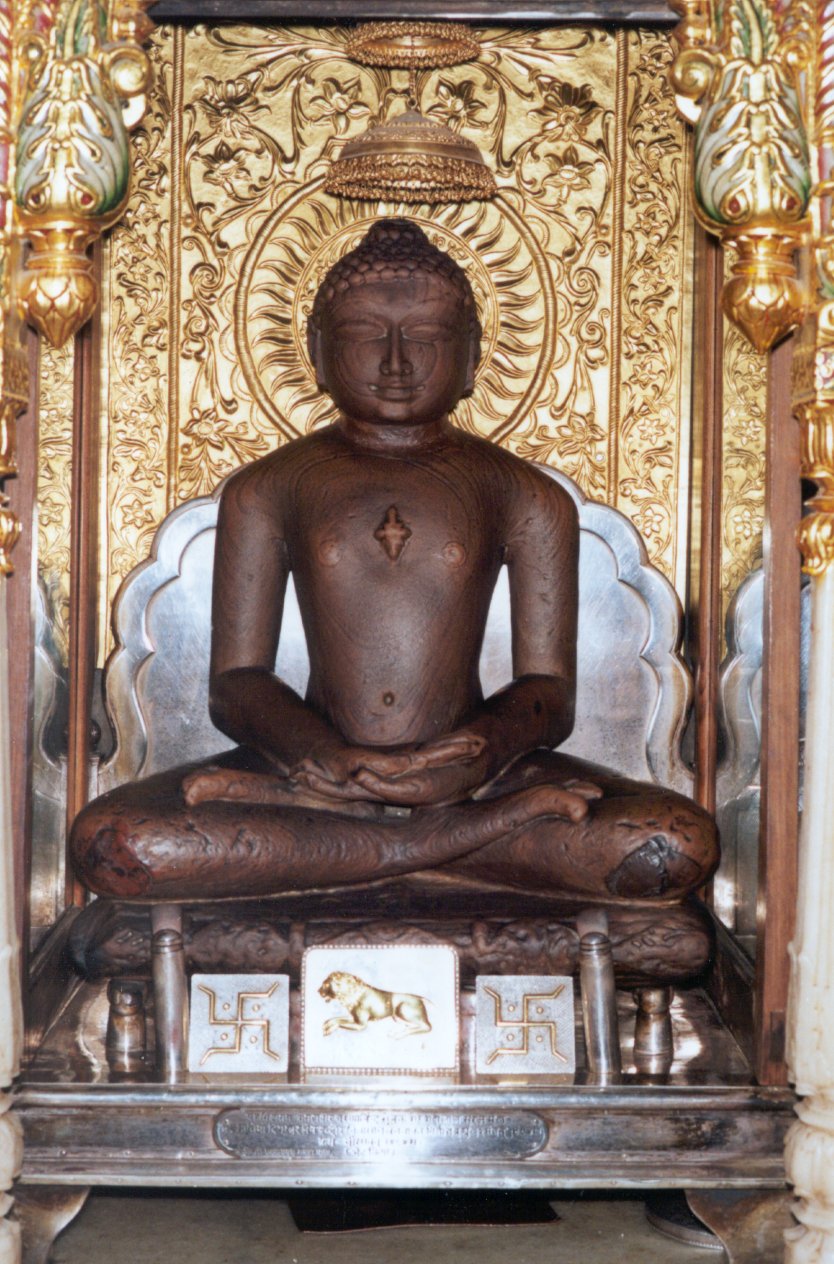
The famous idol of Shree Mahavir Swami at Shri Digambar Jain Atishay Kshetra, Shri Mahavir Ji depicting Digambar Iconography.

Image depicting Acharya Kundakunda

Digambara (/dɪˈɡʌmbərə/; "sky-clad") is one of the two major schools of Jainism, the other being Śvetāmbara (white-clad). The Sanskrit word Digambara means "sky-clad", referring to their traditional monastic practice of neither possessing nor wearing any clothes.[1] Nakedness was the ideal practice of lord Mahavira and his immediate followers.[2] Mahavira emphasised the importance of nakedness for monks.[3] It symbolizes complete detachment and is an ideal form of conduct.[4] Mahavira believed that renouncing clothes made the body immune to external influences like heat and cold, increasing resilience. Without clothes, a monk would avoid the distractions of acquiring, maintaining, and washing garments, allowing him to focus on spiritual growth and self-discipline.[3]

Digambara and Śvetāmbara traditions have had historical differences ranging from their dress code, their temples and iconography, attitude towards female monastics, their legends, and the texts they consider as important. Digambaras maintain that women cannot attain nirvana. However, Śvetāmbaras differ and maintain that women as well as eunuchs can attain nirvana, having more inclusivity.[5][6][7]

Digambara monks believe in the virtue of non-attachment and non-possession of any material goods. Monks carry a community-owned picchi, which is a broom made of fallen peacock feathers for removing and thus saving the life of insects in their path or before they sit.[1]

The Digambara literature can be traced only to the first millennium, with its oldest surviving sacred text being the mid-second century Ṣaṭkhaṅḍāgama ("Scripture in Six Parts") of Dharasena (the Moodabidri manuscripts).[8] One of the most important scholar-monks of the Digambara tradition was Kundakunda.

Digambara Jain communities are currently found in most parts of India like Rajasthan, Uttar Pradesh, Delhi, Bihar, Jharkhand, Madhya Pradesh, Maharashtra, Karnataka and Tamil Nadu.[7][9] According to Jeffery D. Long, a scholar of Hindu and Jain studies, less than one fifth of all Jains in India have a Digambara heritage.

Nomenclature

[edit]

According to Heinrich Zimmer, the word Digambara is a combination of two Sanskrit words: dik (दिक्) (space, sky) and ambara (अम्बर) (garment), referring to those whose garments are of the element that fills the four quarters of space.[10]

Origin in traditional accounts

[edit]

The Digambaras and Śvetāmbara disagree on how the Digambara subtradition started in Jainism.[11] According to Digambaras, they are the original followers of Mahavira and Śvetāmbara branched off later in the time of Bhadrabahu when their forecast twelve-year famine triggered their migration from central India.[11] One group of Jain monks headed west and north towards Rajasthan], while the second group headed south towards Karnataka. The former became Śvetāmbara and retained their "heretic" beliefs and practices such as wearing "white clothes" they adopted there, say the Digambaras.[11]

In contrast, according to Śvetāmbara, they are the original followers, and Digambaras arose 609 years after the death of Mahavira (about 1st century CE) because of an arrogant man named Sivabhuti who became a Jain monk in a fit of pique after a fight at home.[11] However, according to Jinabhadra Gaṇi Kshamashramana, in his work Viśeṣāvaśyaka Bhāṣya, from which this account of the sect's creation is derived, he explicitly states that Sivabhuti was the eighth heretic who is regarded as the founder 'Bodiya ditthi' or Botika sect, also known as the Digambara sect.[12][13][14] He is accused of starting the Digambara tradition with what Śvetāmbara call as "eight concealments", of rejecting Jain texts preserved by the Śvetāmbara tradition, and misunderstanding the Jain ideology including those related to nuns and clothes.[11]

The earliest version of this Digambara story appears in the 10th century CE, while the earliest version of the Śvetāmbara story appears in the 5th century CE.[15]

History

[edit]

Oldest archeological evidence of Digambara Jains dates to the Mangalam Jain inscriptions which mention that workers of Neṭuñceḻiyaṉ I, a Pandyan king of Sangam period, (c. 270 BCE) made stone beds for Digambara Jain monks. It further details the name of the workers who made the stone beds. For example, an inscription shows that Kaṭalaṉ Vaḻuti, a worker (பணஅன் - accountant; he was also a relative) of Neṭuñceḻiyaṉ, made a stone bed for the Jain monk Nanta-siri Kuvaṉ.[16]

In 1943, Heinrich Zimmer proposed that the Greek records of 4th-century BCE mention gymnosophists (naked philosophers) which may have links to the tradition of "naked ascetics" or Digambara.[10] In 2011, Patrick Olivelle stated that the context in which the Greek records mention gymnosophists include ritual suicide by cremation traceable to ancient Brahmanism, rather than the traditional Jain ritual of embracing death by starvation and taking samadhi by voluntarily sacrificing everything including food and water (sallekhana).[17] Tirthankara statues found in Mathura and dated to 2nd-century CE or after are naked.[18] The oldest Tirthankara statue wearing a cloth is dated to the 5th century CE.[19] Digamabara statues of Tirthankara belonging to Gupta period feature half-closed eyes.[20]

In 17th-century, adhyatma movement in Agra led to rise of terapanthi and bisapanthi sub-sects based on the differences over acceptance of authority of bhattarakas.[21][22][23][24] King Jai Singh II (1688–1743) of Amer kingdom built separate temples for the two sub-sects in his newly established capital of Jaipur.[21] Terapanthis, led by scholars like Pandit Todarmal and Banarasidas, rejected the authority of bhattarakas.[21][25][26]

Early Jain images from Mathura depict Digambara iconography until late fifth century CE where Śvetāmbara iconography starts appearing.[27]

Lineage

[edit]
Stela at Marhiaji, Jabalpur, showing the transmission of the oral tradition, erected on the 2500th anniversary of Mahavira's nirvana

According to Digambara texts, after liberation of Mahavira, three Anubaddha Kevalīs attained Kevalajñāna (omniscience) sequentially – Gautama Gaņadhara, Acharya Sudharma Swami, and Jambusvami in next 62 years.[28] During the next hundred years, five Āchāryas had complete knowledge of the scriptures, as such, called Śruta Kevalīs, the last of them being Āchārya Bhadrabahu.[29][30] Spiritual lineage of heads of monastic orders is known as Pattavali.[31] Digambara tradition consider Dharasena to be the 33rd teacher in succession of Gautama, 683 years after the nirvana of Mahavira.[32]

In the Digambara tradition, the following lineage of teachers is revered: Mahavira, Gautama, Kundakunda,[33] Bhadrabahu, Umaswami, Samantabhadra, Siddhasena Divakara, Pujyapada, Manatunga, Virasena,[34] Jinasena, and Nemichandra.[citation needed] Kundakunda is considered the most significant scholar monk of the Digambara tradition of Jainism. He authored Prakrit texts such as the Samayasāra and the Pravacanasāra. Other prominent Acharyas of this tradition were, Virasena (author of a commentary on the Dhavala), Samantabhadra and Siddhasena Divakara. The Satkhandagama and Kasayapahuda have major significance in the Digambara tradition.[citation needed]

There have been several Digambara monastic lineages that all trace their descent to Mahavira. The historical lineages included Mula Sangha (further divided into Nandi, Sena, Simha and Deva Sanghas) and now largely extinct Kashtha Sangha (which included Mathura sangha, ""Lat-Vagad" etc.), Dravida Sangh.[35] The text Darshana-Sara of Devasena discusses the supposed differences among the orders.[36] The Mula sangha orders include Deshiya Gana (Bhattarakas of Shravanabelgola etc.) and Balatkara Gana (Bhattarakas of Humcha, and numerous lineages of North/Central India) traditions.[37] The Bhattarakas of Shravanabelagola and Mudbidri belong to Deshiya Gana and the Bhattaraka of Humbaj belongs to the Balatkara Gana.[38]

Scripture and literature

[edit]

The Digambara sect of Jainism rejects the texts and canonical literature of the Śvetāmbara sect.[39][40] They believe that the words of Mahavira neither survive nor could be recorded. The original teachings went through a rapid period of decline, state the Digambaras, and Śvetāmbara claims of preserving the sacred knowledge and ancient angas is false.[39]

According to the Digambaras, their 33rd achārya was Dharasena who knew portions 12th Anga, the Drṣṭivada,[41] that contained material from the Purvas that dealt with karma theory. Dharasena (ca. 137 C.E.) taught what he remembered from this text to his disciples, Puspadanta and Bhutabali, who wrote the Ṣaṭkhaṅḍāgama ("Scripture in Six Parts").[41] Dharasena's teachings that have survived are Satkhaṇḍāgama and Kasayapahuda (Treatise on the Passions), which were written on palm leaves near a cave in Mount Girnar (Gujarat) and a copy of which with a 12th-century commentary came to Tulu Nadu (south Karnataka).[42] This has survived as the Mudbidri manuscripts, which were used by regional Jains not for reading and study, but as an object of devotional worship for centuries.[42] In the 19th century, the fragile and decaying manuscript was copied and portions of it leaked to scholars between 1896 and 1922 despite objections of Digambara monks. It is considered to be the oldest known Digambara text ultimately traceable to the 2nd-century.[42]

These two oldest known Digambara tradition texts – Satkhandagama and Kasayapahuda – are predominantly a treatise about the soul and Karma theory, written in Prakrit language. Philologically, the text belongs to about the 2nd-century, and has nothing that suggests it is of "immemorial antiquity".[42] In details, the text is quite similar in its teachings to those found in Prajnapana – the 4th upanga – of Śvetāmbaras.[39] Between the two, the poetic meter of Satkhandagama suggests it was composed after the Śvetāmbara text.[39]

Digambaras, unlike Śvetāmbaras, do not have a canon. They do have a quasi-canonical literature grouped into four literary categories called anuyoga (exposition) since the time of the Digambara scholar Rakshita.[43] The prathmanuyoga (first exposition) contains the universal history, the karananuyoga (calculation exposition) contains works on cosmology, the charananuyoga (behaviour exposition) includes texts about proper behaviour for monks and lay people, while the dravyanuyoga (entity exposition) contains metaphysical discussions.[43] In the Digambara tradition, it is not the oldest texts that have survived in its temples and monasteries that attract the most study or reverence, but the late 9th-century Mahapurana (universal history) of Jinasena that is the most revered and cherished.[44] The Mahapurana includes not only religious history, but also the sociological history of the Jaina people – including the Jain caste system and its origins as formulated by Rishabhanatha – from the Digambara Jaina perspective.[45] The Digamabara tradition maintains a long list of revered teachers, and this list includes Kundakunda, Samantabhadra, Pujyapada, Jinasena, Akalanka, Vidyanandi, Somadeva and Asadhara.[46]

The Digambara scriptures consist of post-canonical texts authored by various mendicant leaders, categorized into four sections known as Anuyogas ("Expositions"). These holy scriptures where written by great acharyas from 100 to 800 AD and are established on the original agam sutras.[47][48][49] Notable works from each category are listed below.[41]

  • Prathamanuyoga ("Primary Expositions"). Biographies of the Tirthankaras and famous mythological figures.
  1. Padmapurāṇa of Ravisena (7th century).
  2. Adipurāṇa of Jinasena (8th century).
  3. Harivamsapurāna of Jinasena (8th century).
  4. Uttarapurāna of Gunabhadra (9th century).
  • Karaṇānuyoga ("Expositions on Technical Matters"). Texts on cosmology, astronomy, karma, and mathematics.
  1. Trilokaprajñapti (Tiloyapaṇṇatti) of Yativṛşabha (ca. 6th- 7th centuries).
  2. Dhavala and Mahādhavalā of Virasena, commentaries on the Şatkhaṇḍāgama (9th century).
  3. Jayadhavala of Virasena and Jinasena, commentary on the Kaşayaprabhṛta (9th century).
  4. Gommatasära and Trilokasära of Nemicandra-Siddhantacakravarti (11th century).
  • Carananuyoga ("Expositions on Conduct"). Texts on mendicant and lay conduct.
  1. Mülăcăra of Vaṭṭakera (ca. 2nd century).
  2. Bhagavati Ārādhanā of Śivārya (ca. 2nd century).
  3. Niyamasära of Kundakunda (ca. 2nd or 3rd century).
  4. Pravacanasăra of Kundakunda (ca. 2nd or 3rd century).
  5. Samayasara of Kundakunda (ca. 2nd or 3rd century).
  6. Ratnakaranda-Śrāvakācāra of Samantabhadra (2th century).
  • Dravyanuyoga ("Expositions on Substances"). Texts on philosophy and logic.
  1. Tattvärthädhigama Sutra/Tattvärtha Sutra of Umǎsvāmī (ca. 2nd century).
  2. Pañcāstikāyasāra of Kundakunda (ca. 2nd or 3rd century).
  3. Nyāyāvatāra and Sanmatisūtra of Siddhasena Divakara (5th century).
  4. Aptamimāmsā of Samantabhadra (5th century).
  5. Various works by later authors, such as Akalanka (8th centu- ry) and Vidyananda (9th century).

Practices

[edit]

Monasticism

[edit]

The lifestyle and behavioral conduct of a Digambara monk is guided by a code called mulacara (mulachara). This includes 28 mūla guņas (primary attributes) for the monk.[50] The oldest text containing these norms is the 2nd-century Mulachara attributed to Vattekara, that probably originated in the Mathura region.[43]

These are: 5 mahāvratas (great vows); 5 samitis (restraints); 5 indriya nirodha (control of the five senses); 6 āvaśyakas (essential observations); and 7 niyamas (rules).[51]

No. Guna
(attribute)
Remarks
Mahavratas-
Five Great Vows[52][53]
1. Ahimsa Neither injure, nor ask, nor encourage another to injure any living being through actions, words or thoughts. This includes injury caused by cooking, starting a fire to cook, plucking a fruit, or any conduct that harms living beings[54]
2. Satya To speak the truth, to remain silent if his speaking the truth will lead to injury to living beings[55]
3. Asteya Not to take anything unless given, and not accepting anything more than what is necessary and needed[56]
4. Brahmacharya No sex, no natural or unnatural sexual gratification through action (viewing, participating, encouraging), words (hearing, reciting, reading, writing), or thoughts[57]
5. Aparigraha Renunciation of all worldly things, property, want, and all possessions external to soul[58]
Samiti-
Regulations[59][60]
6. irya Walk carefully on much trodden paths, after viewing land to the extent of four cubits (2 yards). Do not walk in the dark or on the grass to avoid accidental injury to other living beings.[61] He should not run to save himself if charged by a wild animal or if a violent person is about to injure him, as running can cause injury to other living beings.[61]
7. bhasha Avoid slander, back-biting, false speech. He must avoid intentionally long or short statements that mislead or help create misunderstanding, doubts, misinformation, hypocrisy, bad blood or conceit in his audience.[62]
8. esana To never accept objectionable food nor eat more palatable items from those received.[63]
9. adana-nikshepana Carefulness in the handling the pichchi (feather bundle to remove insects in his path) and kamandalu (hollow vegetable gourd to filter water)
10. pratishṭapan To excrete body waste after carefully brushing aside insects and other living beings.[64]
Indrinirodha[51] 11–15. Control of the five senses Shedding all attachment and aversion towards the sense objects pertaining to touch (sparśana), taste (rasana), smell (ghrāṇa), sight (cakśu), and hearing (śrotra). The sadhu (monk) must eradicate all desires and activities that please the mind through his senses.[65] He must end all ties, relationships and entanglements with his family and friends before he renounced.[65]
Avasyakas
Essential observations[66][51]
16. Sāmāyika Practice equanimous dispassion towards everything for eighteen ghari a day (1 ghari = about 24 minutes)[65]
17. stuti Salute the divine (Tirthankaras)
18. vandana Medidate upon and adore acharyas, gurus, idols and images of gods[67][68][69]
19. Pratikramana Confession, repentance and self-censure for having violated any vows and rules of conduct;[70] dissociate one's soul from any virtuous or evil karmas, in the current or past lives.
20. Pratikhayan Recite mantra that lists and promises future renunciation of food, drink and comforts and to forfend future faults[71]
21. Kayotsarga Giving up attachment to the body for a limited period of time.[71] Typically, this is a standing naked and motionless posture of a form common in Bahubali iconography.[72]
Niyama-
Rules[51][73]
22. adantdhavan Never clean teeth[74]
23. bhushayan Sleep on hard ground
24. asnāna Never bathe[73]
25. stithi-bhojan Eat food in standing posture, accept food in open palms (no utensils)[74]
26. ahara Eat food once a day,[75] drink water only when eating meal[76]
27. keśa-lonch To periodically pluck all hair on his body by his own hand.[77]
28. nudity Remain completely nude all the time (digambara)[78]

Digambara monks do not wear any clothes as it is considered to be parigraha (possession), which ultimately leads to attachment.[79] The monks carry picchi, a broom made up of fallen peacock feathers for removing small insects to avoid causing injury and Kamandalu (the gourd for carrying pure, sterilized water).[80][76] The head of all monastics is called Āchārya, while the saintly preceptor of saints is the upādhyāya.[81] The Āchārya has 36 primary attributes (mūla guņa) in addition to the 28 mentioned above.[51]

The monks perform kayotsarga daily, in a rigid and immobile posture, with the arms held stiffly down, knees straight, and toes directed forward.[10]

Nuns

[edit]

Female monastics in Digambara tradition are known as aryikas.[82] Digambara nuns, unlike the monks in their tradition, wear clothes. Given their beliefs such as non-attachment and non-possession, the Digambara tradition has held that women cannot achieve salvation (moksha) as men can, and the best a nun can achieve is to be reborn as a man in the next rebirth.[1] The monks are held to be of higher status than nuns in Digambara monasteries, states Jeffery Long.[1] From the Digambara monk's perspective, both Digambara nuns and Śvetāmbara monastic community are simply more pious Jain laypeople, who do not or are unable to fully practice the Jain monastic vows.[83]

Digambara nuns are relatively rare in comparison to the nuns found in Śvetāmbara traditions. According to a 1970s and 1980s survey of Jain subtraditions, there were about 125 Digambara monks in India and 50 Digambara nuns.[84] This compared to 3,400 nuns and 1,200 monks in the Śvetāmbara tradition.[84]

Digambar akhara

[edit]

The Digambar Akhara, which along with other akharas, also participates in various inter-sectarian (sampradaya) religious activities including Kumbh Melas, is completely unrelated to Digambar Jain tradition, even though they also practice nudity.[85]

Worship

[edit]
Adinatha image (Badami caves)

The Digambara Jains worship completely nude idols of tirthankaras (omniscient beings) and siddha (liberated souls). The tirthankara is represented either seated in yoga posture or standing in the Kayotsarga posture.[86]

The truly "sky-clad" (digambara) Jaina statue expresses the perfect isolation of the one who has stripped off every bond. His is an absolute "abiding in itself," a strange but perfect aloofness, a nudity of chilling majesty, in its stony simplicity, rigid contours, and abstraction.[87]

Sub-sects

[edit]
Jain Digambara Sects[88]
Acharya Vidyasagar, a prominent Digambara monk

Modern Digambara community is divided into various sub-sects viz. Terapanthi, Bispanthi, Taranpanthi (or Samayiapanthi), Gumanapanthi, Totapanthi and Kanjipanthi.[89] Both the terapanthis and bisapanthis worship with ashta-dravya which includes jal (water), chandan (sandal), akshata (sacred rice), pushp (yellow rice), deep (yellow dry coconut), dhup (kapoor or cloves) and phal (almonds).[90] Bisapanthi religious practices include aarti and offerings of flowers, fruits and prasad whereas terapanthis don't use them.[90] Bispanthis worship minor gods and goddesses like Yaksha and Yakshini like Bhairava and Kshetrapala whereas terapanthis do not.[90] Bisapanthis accept bhattarakas as their religious leaders but terapanthis do not.[90] Terapanthis occur in large numbers in Rajasthan, Uttar Pradesh and Madhya Pradesh.[90] Bisapanthis are concentrated in Rajasthan, Gujarat, Maharastra and South India.[90]

Debate Between Śvetāmbara Ācārya Vādidevasūri and Digambara Ācārya Kumudcandra

[edit]

In 1124 CE, a fierce debate between Śvetāmbaras and Digambaras happened. The background of the debate goes back to the 1124 CE cāturmāsya of Ācārya Vādidevasūri, a celebrated disciple of Ācārya Municandrasūri, a Śvetāmbara monk. Vādidevasūri was popular for winning debates against several philosophers in Western and North-Western India. Vādidevasūri was in Karnavati (modern-day Ahmedabad's old city) for his 4 months-long stay during the rainy season. During the same time, Kumudcandra, a Digambara monk and the preceptor of Jayakeśi, a Kadamba ruler, was also in the city for his 4 months-long stay during the rainy season. As per medieval Digambara records, Kumudcandra was of formidable intellect and very popular in the Digambara community.[91][92][93][94] As described in Ācārya Prabhācandrasūri's Prabhāvakacarita, Kumudcandra and his disciples tried creating several problems in Vādidevasūri's sangha there. This was probably because the former could not digest the popularity of Vādidevasūri in the Śvetāmbara sangha there. The latter, however, maintained equanimity and did not retaliate. The situation got serious when Kumudcandra and some of his disciples harassed Sādhvī Sarasvatīśrījī, a senior nun in Vādidevasūri's sangha, while she was walking on the road. After mocking her, some disciples and palanquin-bearers of Kumudcandra demanded she dance if she wanted to pass. After the humiliation, she requested Vādidevasūri to take appropriate action and that if this went unanswered, the entire Jaina sangha would crumble.[91][92] Vādidevasūri wrote to Kumudcandra and informed him that he would have a debate with him in the court of Jayasimha Siddharaja, in Patan. Vādidevasūri wrote to the Jaina sangha at Patan, seeking permission to hold an open public debate between the Śvetāmbaras and the Digambaras. The sangha accepted his letter and wrote back that they would be highly honored to host the debate and that 300 male devotees and 700 female devotees would hold āyaṃbila fast until the day of the debate, praying for his victory.[91][92]

Vādidevasūri reached Patan, and was soon followed by Kumudcandra. The situation was heavily influenced by politics. Rājamātā Minaladevi was in unconditional support of Kumudcandra.[95] Apart from her, Kumudcandra was also supported by several courtiers and laymen. Prabhāvakacarita names Keśava as one of his supporters, while it names poet Śrīpāla and Bhānu as Vādidevasūri's supporters. Thāhaḍ and Nāgadeva, two Śrāvakas of Vādidevasūri's sangha expressed their wish to spend as much wealth as required for this event. However, Vādidevasūri informed them that spending of any wealth was not required for this event. Thāhaḍ informed him that Kumudcandra's disciples had offered bribe to Gāngila, a minister in Jayasimha Siddharaja's court. Vādidevasūri did not pay attention to it and told him that it would surely be won by the one who has the blessings of God and his preceptor.[96] The terms set by Rājamātā Minaladevi were unfair. If Vādidevasūri lost, all Śvetāmbaras would have convert to the Digambara sect. If Kumudcandra lost, the Digambaras would have to leave Jayasimha Siddharaja's kingdom.[97][98]

On Vaiśākha Pūrṇimā of 1124 CE, the debate began. Kumudcandra mocked a young Hemacandrasūri, who was accompanying Vādidevasūri, by calling him an infant and unfit for this debate. A witty Hemacandrasūri responded by saying that he was dressed, while an infant is one who is naked, aiming at Kumudcandra's Digambara lifestyle (staying nude) and that Kumudcandra, and not he, was an infant.[98][99][100] Several exchanges took place between both Vādidevasūri and Kumudcandra. The former was very well-versed with Jaina scriptures and tenets and made sure that no possibility was left unexplored during the debate. Within mere 16 days of the debate's conception, and several instances where Kumudcandra and his disciples faltered, the debate moved towards the subject of women's emancipation which Śvetāmbaras firmly believe in, while Digambaras don't. Digambaras, unable to provide a strong reason to support their heretical belief that women could not achieve emancipation, lost.[101][102] Similar faults were observed when the subject of kevalins' hunger came up.[103] Vādidevasūri was well-learned and astute and eventually, he triumphed.[93][98][104][105][106] Vādidevasūri reminded Jayasimha Siddharaja that it was his duty to ensure no one insulted the defeated. The king ordered all Digambaras to immediately leave his kingdom and carried a royal procession to a nearby temple. Śvetāmbaras celebrated this victory and several devotees donated lakhs of gold coins in the temple. As a mark of respect, the ceremonial parasol over Vādidevasūri was carried by the king himself. This record is accepted as historically true, due to its narration found in Prabhāvakacarita, a historical text. While Vādidevasūri went on to write several scriptures and consecrate several major pilgrimage sites, Digambaras, once again, lost all presence in the kingdom of Gujarat.[107][98][105][108][109][110] Previously, Digambaras had lost another debate against Ācārya Bappabhattisuri over the ownership of Girnar Jain temples.[111][112][113]

Criticism of Digambara sect

[edit]

Padmanabh Jaini

[edit]

Padmanabh Jaini, a renowned Jain scholar, after researching the scriptures of the Digambara sect described several points of critique: -[114]

  1. Rituals and ascetic practices: Jaini points out that an emphasis on extreme ascetic practices such as public nudity and rejection of all possessions leads to a diminished focus on spiritual growth and a greater focus on the less important ritualistic practices.[114]
  2. Layperson-ascetic dichotomy: Jaini critiques the sharp distinction between the ascetics and laypeople which leads to a lack of spiritual agency among people.[115]
  3. Scriptural authority: Jaini questions the Digambara reliance on a highly limited set of scriptures that do not fully represent Jain principles and teachings as followed by the Svetambara sect. Jaini questions the Digambara rejection of the Śvētāmbara canonical scriptures. He argues that this rejection leads to a lack of unity and a fragmentation within Jainism. He also points out that the Digambaras' reliance on later texts as authentic scriptures might lack historical and textual rigor.[116]
  4. Gender and nudity: Jaini strongly argues that the practice of public nudity may reinforce patriarchal attitude and limit female spiritual agency. Digambaras hold that women must be reborn as men to attain salvation, which Jaini criticizes for its gender exclusivity and inequality.[117] He argues that female nudity is not equally valued or allowed in the Digambara tradition which greatly limits female spiritual agency as Digambara belief states that moksha cannot be attained without nudity. Further, he states that male nudity leads to masculinization of spirituality. Jaini also mentions that the Digambara sect has historically been male-dominated with women facing several barriers in the path to spirituality and its evolution.[114] His views are seconded by Paul Dundas who states that Digambara rejection of clothing could also signify their rejection of female bodily experience, as clothing is often associated with female modesty and domesticity.[118]
  5. Historical development: Jaini also deliberates that the Digambara tradition may have arisen in response to Hinduism, Ājīvikas, and Buddhism, rather than purely from within Jainism.[116]

Nalini Balbir

[edit]

Nalini Balbir, another renowned scholar of Jainism, has criticised the Digambara views on liberation of women and advocates for a more inclusive and gender-equal interpretation of the scriptures. She lists her criticism in the following manner: -

  1. Gender bias: Balbir sees the Digambara belief of women not being capable of attaining liberation in their current birth as gender discrimination.
  2. Biological determinism: Digambara scriptures attribute spiritual limitations of women to their biology and consider them as unholy. Balbir criticizes this view as narrow and outdated perspective.
  3. Lack of scriptural basis: Balbir argues that the narrative describing women not being able to attain liberation is not supported by ancient Jain scriptures (Śvetāmbara canon) and is based on later commentaries.
  4. Contradiction with Jain principles: Balbir points out that this view is in contradiction to the fundamental Jain principle of equality and the potential for all living beings to attain liberation.

Balbir states that:[119]

The Digambara sect's view that women cannot achieve liberation in their present birth is a 'biological determinism' that is not supported by Jain scriptures. This view is a 'patriarchal interpretation' that has been 'superimposed' on the original teachings of Mahavira.

— Nalini Balbir, Women in Jainism (2005)

Kristi L. Wiley

[edit]

Kristi L. Wiley, a scholar of Jainism, has also criticized the Digambara sect's views on liberation of women. Specifically, she highlights the following points of critique:[120]

  1. Exclusionary practices and patriarchal interpretations: Women are excluded from the highest spiritual status in Jainism (achieving liberation) by Digambara sect's scriptures. Wiley sees Digambara interpretations of Jain scriptures as patriarchal and biased against women.
  2. Lack of agency: Digambaras deny the fundamental agency of achieving liberation (the highest status in Jain spirituality) through their own efforts, instead requiring them to rely on male intermediaries.
  3. Inconsistencies with Jain principles: Wiley points out that these views are inconsistent with the fundamental principle of 'equal potential of all living beings to achieve liberation'. She adds that such views may constitute to 'symbolic violence' against women.
  4. Textual manipulation: She alleges that the male-dominated Digambara sect has selectively interpreted and manipulated existing and ancient Jain texts to support their views by ignoring passages that highlight women's spiritual potential.

Other religions

[edit]

Scriptures of other religions and schools of thought such as Buddhism, Islam, and Sikhism also criticize and condemn public nudity followed by Digambara monks.[121][122][123]

Differences with Śvetāmbara sect

[edit]

Other than rejecting or accepting different ancient Jain texts, Digambaras and Śvetāmbara differ in other significant ways such as:

  • Śvetāmbaras believe that Parshvanatha, the 23rd tirthankara, taught only Four restraints (a claim, scholars say is confirmed by the ancient Buddhist texts that discuss Jain monastic life).

These are as follows 1. Ahimsa - nonviolence, non-injury, and absence of desire to harm any life forms. 2. Satya - truthful in one's thoughts, speech and action. 3. Asteya - non-stealing". One must not steal, nor have the intent to steal, another's property through action, speech, and thoughts. 4. Aparigraha - the virtue of non-possessiveness or non-greediness.

Mahavira inserted 5th vow ie Brahmacharya - sexual restraint or practice of celibacy. Renunciation of sex and marriage. This was thought to be understood to within 4th vow of Aparigraha, but was more specified as 5th vow of Brahmacharya.

Mahāvīra taught Five vows.[124][125][126] The Digambara sect disagrees with the Śvetāmbara interpretations,[127] and reject the theory of difference in Parshvanatha and Mahāvīra's teachings.[125] However, Digambaras as well as Śvetāmbaras follow Five vows as taught by Mahavira. The difference is only that Śvetāmbaras believe Parshvanatha taught one vow less (the Four vows except Brahmacharya) than Mahavira. However, monks of Śvetāmbara sect also follow all 5 vows as stated in the Ācārāṅga Sūtra.[128]

  • Digambaras believe that both Parshvanatha and Mahāvīra remained unmarried, whereas Śvetāmbara believe the 23rd and 24th tirthankar did indeed marry. According to the Śvetāmbara version, Parshvanāth married Prabhavati,[129] and Mahāvīraswāmi married Yashoda who bore him a daughter named Priyadarshana.[130][131] The two sects also differ on the origin of Trishala, Mahāvīra's mother,[130] as well as the details of Tirthankara's biographies such as how many auspicious dreams their mothers had when they were in the wombs.[132]
  • Digambara believe Rishabha, Vasupujya and Neminatha were the three tirthankaras who reached omniscience while in sitting posture and other tirthankaras were in standing ascetic posture. In contrast, Śvetāmbaras believe it was Rishabha, Nemi and Mahāvīra who were the three in sitting posture.[133]
  • According to Śvetāmbara Jain texts, from Kalpasūtras onwards, its monastic community has had more sadhvis than sadhus (female than male mendicants). In Tapa Gacch of the modern era, the ratio of sadhvis to sadhus (nuns to monks) is about 3.5 to 1.[134] In contrast to Śvetāmbara, the Digambara sect monastic community has been predominantly male.[135]
  • In the Digambara tradition, a male human being is considered closest to the apex with the potential to achieve his soul's liberation from rebirths through asceticism. Women must gain karmic merit, to be reborn as man, and only then can they achieve spiritual liberation in the Digambara sect of Jainism.[136][137] The Śvetāmbaras disagree with the Digambaras, believing that women can also achieve liberation from saṃsāra through ascetic practices.[137][138]
  • The Śvetāmbaras state the 19th Tirthankara Māllīnātha was female.[139] However, Digambara reject this, and worship Mallinatha as a male.[140]
  • According to Digambara texts, after attaining Kevala Jnana (omniscience), arihant (omniscient beings) are free from human needs like hunger, thirst, and sleep.[141] In contrast, Śvetāmbara texts preach that it is not so.

See also

[edit]

Notes

[edit]
[edit]
Revisions and contributorsEdit on WikipediaRead on Wikipedia
from Grokipedia
Digambara, meaning "sky-clad" in Sanskrit, is one of the two major sects of Jainism, distinguished by its insistence that male monks practice complete nudity as the authentic expression of ascetic renunciation and detachment from all possessions. This nudity symbolizes the ultimate rejection of material attachments, contrasting with the Śvetāmbara sect's allowance of white garments for monastics. Digambara doctrine holds that true liberation (mokṣa) requires this total renunciation, and the sect rejects the Śvetāmbara canon while maintaining its own scriptural traditions derived from early teachers like Kundakunda. A key doctrinal difference is the Digambara view that women cannot achieve spiritual liberation in their current female birth, necessitating rebirth as males for salvation, unlike the Śvetāmbara acceptance of female attainability. The sect's origins trace to a schism around the 3rd century BCE, possibly triggered by a famine prompting divergent migrations and practices among Jains. Digambara monasticism emphasizes extreme austerity, including fasting, silence, and meditation, with renowned centers like Shravanabelagola hosting massive statues such as the Gommateshwara monolith commemorating ascetic ideals. Sectarian tensions have historically arisen over practices like nudity and scriptural authority, leading to debates and occasional conflicts with Śvetāmbaras.

Nomenclature

Etymology

The term Digambara originates from digambara, a compound of diḡ (or dik, denoting "," "," or "direction") and ambara (meaning "garment," "apparel," or "covering"), literally translating to "sky-clad" or "clothed in the directions/space." This semantic construction appears in classical glossaries and reflects a conceptual emphasis on as the ultimate form of detachment from worldly attachments. In Prakrit, the linguistic medium of many early Jain scriptures, the term manifests as diaṃbara, a direct phonetic adaptation preserving the Sanskrit roots and used in canonical texts to designate the monastic ideal of renunciation without material coverings. Etymologically, Digambara contrasts with Śvetāmbara, derived from Sanskrit śveta ("white") and ambara ("garment"), yielding "white-clad," which denotes the use of white robes as symbolic of purity while permitting minimal attire. This divergence in nomenclature highlights fundamental interpretive differences in ascetic praxis encoded linguistically from antiquity.

Key Terminology

In the Digambara tradition, muni designates a male or sage who embodies total detachment by forgoing all possessions, including , to align with the principle of sky-clad . specifically denotes nuns within Digambara , who adopt rigorous vows of but retain simple white robes, as the holds that absolute liberation demands the male physiology and nudity unattainable in female form. Kevala refers to perfect, infinite , the culminating knowledge that eradicates karmic veils, enabling the soul's isolation from matter and realization as a liberated being or . Digambara distinguishes nischaya naya, the absolute or nonconventional viewpoint apprehending , from vyavahara naya, the empirical or practical perspective governing conventional conduct; the former predominates in doctrinal interpretations to affirm conditions like for , while the latter accommodates provisional practices. Anuvratas comprise the five partial vows for lay adherents—abstention from injury, falsehood, theft, sexual misconduct, and acquisitiveness—scaling down monastic mahavratas to feasible worldly observance while fostering gradual karmic purification.

Origins

Traditional Accounts

Traditional Digambara narratives trace the sect's origins to the ascetic practices of , the 24th , who renounced all possessions, including clothing, approximately 12.5 years into his mendicancy to achieve complete non-attachment, attaining (omniscience) in a naked state that persisted until his nirvana around 527 BCE. His eleven chief disciples, the Ganadharas headed by Indrabhuti Gautama, adhered strictly to this digambara (sky-clad) discipline, orally compiling his teachings into the foundational Angas and establishing the monastic lineage as the authentic embodiment of Jain sramana ideals. This lineage, regarded as unbroken and authoritative within Digambara tradition, proceeds from through Gautama to early acharyas such as , a pivotal figure circa CE whose works, including the Samayasara, articulated the introspective realization of the soul's purity, thereby consolidating doctrinal emphasis on absolute detachment and the supremacy of the liberated perspective over conventional viewpoints. A defining consolidation occurred under Bhadrabahu, the final shrutakevali (possessor of all scriptural knowledge post-Ganadharas), who prophesied a 12-year circa 310 BCE and migrated southward with faithful ascetics, including , to uphold and rigorous vows amid adversity; in contrast, the northern group under relaxed monastic due to hardships, precipitating the that birthed the Svetambara as an aberrant offshoot, while Digambaras preserved Mahavira's original path.

Historical and Archaeological Evidence

Archaeological findings from , dating to the 2nd century BCE, include terracotta figurines and stone reliefs depicting nude ascetics in posture, a meditative stance unique to that underscores practices aligned with sky-clad . These artifacts, excavated alongside inscriptions referencing donors and tirthankaras, indicate as a major center of early activity where nudity symbolized complete detachment, predating clear sectarian divisions. The Udayagiri and Khandagiri caves near , carved in the 1st century BCE under the patronage of the Jain king , feature inscriptions and architectural elements designed for ascetic habitation, such as simple cells and water channels suited to austere, mobile monks. details 's support for Jain , linking these sites to organized communities practicing rigorous consistent with Digambara emphases on and environmental adaptation. Pre-sectarian Jain iconography across these and contemporaneous sites uniformly represents tirthankaras and as nude, with loincloths absent until around the 5th century CE, providing no material counter-evidence to as the normative early practice before the emergence of clothed monastic orders. This continuity in artifacts supports the view that sky-clad characterized foundational , grounded in empirical depictions rather than later textual disputes.

Historical Development

Ancient Period (Pre-Common Era to 3rd Century CE)

The formation of the Digambara sect as distinct from the Svetambara branch occurred around the 3rd century BCE, according to Digambara tradition, stemming from disagreements over monastic conduct amid a prolonged famine in Magadha. Bhadrabahu I, revered as the last shruta-kevali (omniscient scriptural knower), foresaw the crisis and enforced the original Jain rule of nudity for male ascetics, prompting a southward migration of adherent monks to sustain uncompromised discipline, while northern Jains under Sthulabhadra reportedly adopted white robes for practicality. This schism, per Digambara accounts, preserved the sect's emphasis on absolute renunciation, contrasting with what they view as Svetambara innovations. Bhadrabahu's exodus to the Deccan region, accompanied by approximately 12,000 disciples, established foundational Digambara centers in southern , particularly in modern . Tradition holds that , founder of the (r. c. 321–297 BCE), converted to under Bhadrabahu's guidance, abdicated his throne around 297 BCE, and joined the migration, ultimately practicing (ritual fasting to death) at . While Svetambara sources dispute this timeline and Chandragupta's direct involvement, placing Bhadrabahu elsewhere, the narrative underscores early royal sympathy toward Digambara asceticism during the late Mauryan era. Archaeological evidence corroborates an early Jain monastic presence in southern India from the 3rd–2nd centuries BCE, aligning with post-migration consolidation. Tamil-Brahmi inscriptions, such as those at Mangulam in Madurai district, record Pandya king Neṭuñceḻiyaṉ's donation of a monastery to the Jain monk Nanta-siri Kuvaṉ around this period, indicating institutional support for ascetic communities likely adhering to Digambara practices prevalent in the region. Rock shelters and natural caverns in sites like Vallimalai served as abodes for Digambara monks migrating from the north, facilitating the sect's entrenchment amid post-Mauryan polities. By the early centuries CE, Digambara Jainism had flourished under regional patronage in the Deccan and Tamil lands, with evidence of cave adaptations and lay donations reflecting growing institutionalization. This era saw the sect's resilience against northern doctrinal drifts, laying groundwork for enduring southern strongholds up to the 3rd century CE, prior to later medieval expansions.

Medieval Period (4th to 18th Century CE)

The medieval era witnessed the zenith of Digambara influence in southern , particularly through royal patronage from dynasties including the Chalukyas, Rashtrakutas, and Western Gangas, which spurred temple architecture and institutional growth between the 8th and 10th centuries CE. These rulers, such as Rashtrakuta monarch I (reigned 814–878 CE), who adhered to Jain principles, extended grants and protections to Digambara monasteries, enabling expansions in and adjacent regions. This support contrasted with northern declines, fostering a network of basadis (Jain temples) that integrated intricate carvings of Tirthankaras and cosmological motifs. A literary renaissance paralleled this architectural patronage, highlighted by the works of Virasena, an 8th-century Digambara acharya and associated with the Rashtrakuta court. Virasena's Dhavala and Jayadhavala, multi-volume commentaries on texts like the Shatkhandagama and Kashayaprahrita, systematically expounded , , and , with the latter detailing the three worlds (Triloka) through mathematical precision. These treatises, completed around 780 CE, preserved and refined doctrinal interpretations amid sectarian debates, influencing subsequent Digambara scholarship. Monumental projects underscored the sect's prestige, such as the erection of the 57-foot (17 m) monolithic Gommateshwara () statue at in 981 CE by Western Ganga king Rachamalla IV (Permanatha), symbolizing ascetic triumph and attracting pilgrims. Similarly, enhancements to Badami's Jain caves (7th–12th centuries) under Chalukya and Rashtrakuta oversight featured reliefs of and other Tirthankaras, blending rock-cut and structural elements. Such constructions not only disseminated Digambara but also reinforced monastic lineages through endowments. Amid Hindu movements and encroaching Islamic polities from the , Digambara communities demonstrated doctrinal tenacity, upholding nudity as a non-negotiable for ascetics despite urban sensitivities and occasional royal edicts favoring clothed mendicants. In strongholds, this adherence sustained purity claims over Svetambara counterparts, though northern centers like faced attrition from conversions and iconoclasm under pressures (13th–16th centuries). By the 18th century, and Maratha patronage revived some traditions, yet overall vitality shifted southward, preserving core practices against assimilation.

Modern and Contemporary Era (19th Century Onward)

During the British colonial period, Digambara Jain traditions were documented through surveys and collections of religious manuscripts, including palm-leaf texts from preserved in the Mackenzie Collection at the , which highlight the sect's scriptural heritage from the early . Official records from late 19th-century British administration in regions like South and captured Digambara community practices and identity formations, aiding in the preservation of historical continuity amid colonial governance. Following India's independence in 1947, Digambara institutions experienced institutional strengthening, particularly at key pilgrimage sites. The initiated regular chemical washes and treatments for the at starting post-independence to combat weathering and ensure longevity. Bhattaraka leaders, such as Charukirti at , oversaw local developments including school construction, drinking water facilities, and village infrastructure enhancements in the surrounding ten villages from the mid-20th century onward. In the independence era, Digambara monastic lineages persisted through bhattaraka traditions, with figures like Charukeerthi Bhattaraka (1947–1969) maintaining the dharmapeetha at , fostering continuity in ascetic oversight and community patronage. To address , Digambara mathas adapted by emphasizing the role of clothed bhattarakas in urban settings to bridge lay devotees and ascetic ideals, while nude monks largely confined practices to rural or secluded temple vicinities to align with modern public norms. Diaspora communities established supportive networks, though limited in scale compared to other Jain sects, focusing on scriptural study and temple maintenance abroad.

Doctrinal Foundations

Core Philosophical Principles

The Digambara tradition upholds a metaphysical dualism positing the eternal coexistence of jīva (sentient souls) and ajīva (non-sentient substances), with the universe comprising six fundamental categories: souls, matter (pudgala), space (ākāśa), the mediums of motion (dharma) and rest (adharma), and time (kāla). Souls are inherently conscious and active entities, distinct from non-sentient matter, which includes karmic particles that interact causally with the soul to obscure its innate qualities. This framework rejects any creator deity, viewing the cosmos as uncreated and eternal, governed solely by intrinsic causal laws without external intervention or divine origination. Epistemologically, Digambara philosophy employs anekāntavāda, the doctrine of the multifaceted nature of , asserting that entities possess infinite qualities and thus viewpoints on them are inherently partial yet point toward an absolute, objective truth rather than mere subjective relativism. Complementing this is syādvāda, which prescribes conditional assertions (e.g., "in some respect, it is; in some respect, it is not") to acknowledge epistemic limitations while affirming the knowability of through comprehensive analysis, avoiding dogmatic absolutism. These principles underscore a commitment to causal realism, where interactions between and follow deterministic, non-illusory mechanisms observable in empirical patterns of bondage and fruition. Central to this realism is the conception of karma as fine material particles (karma-pudgala) that adhere to the via volitional activities, producing tangible effects on and embodiment through influx (āsrava), bondage (bandha), and maturation (udaya). Unlike metaphorical interpretations, karma operates as a physical causal agent, with eight varieties—four obfuscating (e.g., knowledge-deluding) and four non-obfuscating (e.g., lifespan-determining)—mechanically influencing the 's states without violating the soul's essential independence from . This material ensures accountability for actions, as karmic effects arise predictably from prior causes, aligning with first-principles observation of perpetual soul-matter entanglement since .

Ontology and Cosmology

In Digambara , reality consists of six eternal, uncreated substances known as dravyas, which are the fundamental categories of : jīva (living ), pudgala (matter), (principle of motion), (principle of rest), ākāśa (space), and (time). These substances are indestructible and independent, possessing inherent qualities (guṇas) and modes (pareyattās) that allow for change without altering their essence. Jīva represents conscious entities capable of and karma accumulation, while ajīva encompasses the non-conscious dravyas, with pudgala manifesting as gross and subtle forms, including karmic particles that bind to the through atomic aggregation. This framework derives from analytical reasoning on permanence and change, positing substances as the substrate for all phenomena, observable through logical from sensory experience and the behavior of composite entities. Digambara cosmology describes the loka (cosmos) as an eternal, uncreated structure without beginning or end, self-sustaining through natural laws of karma rather than divine agency. The loka occupies a finite portion of infinite ākāśa, divided into three vertical realms: ūrdhva-loka (upper world of celestial beings), madhya-loka (middle world inhabited by humans, animals, plants, and sidelining entities), and adha-loka (lower world of infernal beings). These realms form a symmetrical, non-expanding architecture where souls transmigrate based on karmic merit, with no external creator intervening, as evidenced by the observed cyclical patterns of birth and suffering attributable to material karma rather than supernatural design. Karma operates as subtle pudgala particles—microscopic atoms attracted to jīva via vibrational affinities generated by volitional actions—providing a explanation for bondage and fruition grounded in the particulate nature of . This atomistic view aligns with first-principles decomposition of observable physical interactions, such as attraction and aggregation in gross , extended to explain ethical causation without invoking immaterial forces. Digambara texts emphasize the quantifiable and duration of these karmic atoms, calculated in precise units to model their effects, underscoring an empirical realism derived from dissecting experiential sequences of cause and effect.

Soteriology and Path to Moksha

![The 57 feet (17 m) high Gommateshwara statue, Shravanabelagola][float-right] In Digambara soteriology, moksha represents the complete liberation of the jiva (soul) from the bondage of karma, enabling its ascent to Siddhashila, the realm of perfected souls, where it experiences infinite knowledge, perception, bliss, and energy devoid of rebirth. This state is attained through the dual processes of samvara, the cessation of new karmic influx via ethical conduct and restraint, and nirjara, the active shedding of existing karmas primarily through rigorous tapas (austerities) that burn away karmic particles. Right knowledge (samyak jnana) discerns the true nature of reality, guiding the soul's purification, while right faith and conduct align actions to prevent karmic adhesion. The path to unfolds across fourteen gunasthanas, sequential stages marking the soul's progressive detachment from deluding influences and karmic veils. The first four stages address misconceptions and partial right faith: mithyatva (), sasvadana (taste of truth), (mixed faith), and avirata samyagdrishti (vowless right faith). Stages five through eleven involve partial vows and the mixed presence of right knowledge amid subsiding deluding karmas, culminating in the higher phases where deluding karmas subside (12th: avirati samyagdrishti with subsidence), are destroyed (13th: with destruction), and cease to exist (14th: , full liberation). , absolute omniscience, emerges in the 12th stage, enabling final nirjara and upon death. Digambara texts emphasize absolute as a causal prerequisite for traversing the advanced gunasthanas, positing that any remnant attachment, including , perpetuates subtle karmic bonds that obstruct total detachment. This symbolizes and enacts complete , essential for the intensive required to eradicate the final karmic layers, as exemplified by the twenty-four Tirthankaras who realized solely in male, sky-clad form.

Scriptures and Literature

Canonical and Agamic Texts

The Digambara sect holds that the original Agamas, comprising the teachings of and the Ganadharas, were composed in Ardhamagadhi but lost following historical disruptions, including a 12-year in the region around 300 BCE that scattered monastic lineages. This loss, attributed to the inability to preserve oral traditions amid schisms and invasions, led Digambaras to reject the Svetambara canon of 12 Angas as inauthentic, asserting that these texts underwent , omission of key doctrines like ascetic , and fabrication of narratives incompatible with original . In response, Digambara tradition emphasizes pratisthapana, the re-establishment of canonical knowledge through scholarly reconstruction by subsequent acharyas drawing on residual oral and fragmentary sources. The resulting Agamas, considered the closest approximations to lost originals, form the core of Digambara scriptural authority, prioritizing direct transmission over Svetambara recensions. Foremost among these is the Kasayapahuda (also Kāsāyaprabhṛta), attributed to the monk Bhutabali around the 2nd century CE, which systematically delineates the four kasayas ()—anger, , deceit, and —as causal agents binding the to karmic influx, offering ethical prescriptions for their attenuation through vows and restraint. Complementing it, the Satkhandagama (Ṣaṭkhaṅḍāgama), composed by in the mid-2nd century CE, structures metaphysical inquiry into six khandas (sections) exploring (), ajiva (non-soul), karma's mechanics, and the path to liberation, emphasizing as integral to total . These texts, totaling over 40,000 verses combined, underpin Digambara ethics and ontology, reconstructed to preserve undiluted first principles absent in rival canons.

Major Commentaries and Works

Ācārya Kundakunda, a prominent likely active in the 2nd or CE, authored the Samayasāra, a foundational text emphasizing the intrinsic purity of the soul (jīva) and the primacy of direct, non-dualistic knowledge (samyak darśana) for attaining liberation over external rituals or scriptural literalism. This work critiques reliance on conventional practices, advocating an inward-focused realization of the self's eternal nature unbound by karma. In the 8th century CE, Ācārya Vīrasena composed the Dhavalā (Dhavala-tīkā), a voluminous commentary on the first five books of the Ṣaṭkhaṇḍāgama, comprising over 72,000 verses that systematically expound Digambara cosmology, , and through detailed analysis of ancient agamas. Accompanied by the Jayadhavalā from his disciple Jaya-sena, this preserved endangered scriptural traditions amid medieval challenges, influencing subsequent Digambara scholarship by clarifying doctrinal nuances such as the nature of (tattvas) and ascetic conduct. Later commentaries, such as those by Ācārya Amṛtasāgara in the medieval period, further elaborated on core texts like the Tattvārthasūtra, integrating Digambara perspectives on and ethical praxis while reinforcing the sect's rejection of clothed mendicancy. These works collectively shaped interpretive lineages, prioritizing experiential authenticity and scriptural fidelity in Digambara .

Debates on Canonicity

The Digambara tradition asserts that the original Jain Agamas, including the 14 foundational Purvas and the 12 Angas derived from them, were irrevocably lost due to successive famines and monastic disruptions beginning shortly after Mahavira's nirvana in approximately 510 BCE, with complete extinction by the 1st to 2nd century CE. This loss, attributed to the death of knowledgeable monks during events like the 12-year famine in Magadha, severed the authentic transmission line, rendering any subsequent compilations suspect. Consequently, Digambara authorities deem the Svetambara canon, formalized at councils such as Valabhi in the 5th century CE, apocryphal and adulterated with interpolations that deviate from pristine doctrines, particularly regarding monastic nudity and women's spiritual capacity. They argue these texts lack the unadulterated content of Mahavira's discourses as recited by his Ganadharas, citing inconsistencies such as endorsements of clothed ascetics that contradict the principle of total renunciation. In response, Digambaras validate their scriptural corpus through works composed by later acharyas—such as in the 1st–3rd century CE—who purportedly reconstructed core teachings via or advanced cognition, bypassing corrupted lineages. Texts like the Shatkhandagama, attributed to acharyas and Bhutabali around the 2nd century CE, exemplify this revival, prioritized for their alignment with empirical markers of doctrinal purity, including non-possession and karmic causation. Textual criticism in Digambara debates favors internal coherence and fidelity to first-order principles over Svetambara claims of partial preservation, with scholars like Virasena (8th century CE) in commentaries such as Jayadhavala demonstrating how revived texts resolve logical paradoxes absent in rival canons. This approach underscores a causal chain wherein oral mastery by unbroken lineages of munis safeguarded essentials against , evidenced by uniform adherence to ascetic in early Digambara despite scriptural gaps.

Monastic Practices

Ascetic Renunciation and Nudity

In the Digambara tradition, ascetic renunciation demands the total relinquishment of possessions, with nudity serving as the definitive indicator of this non-attachment. Monks, upon reaching the highest of mendicancy, adopt digambara—literally "sky-clad"—eschewing all to embody complete detachment from material objects, which are viewed as sources of karmic bondage. This practice aligns with the doctrinal principle of aparigraha (non-possessiveness), where even cloth is rejected as an impediment to spiritual purity, requiring rigorous parikarma—circumspect examination of actions to avoid inadvertent karma accrual. Nudity is deemed indispensable for attaining , mirroring the precedent of the 24 Tirthankaras, who achieved liberation in a sky-clad state without possessions. Digambara texts assert that clothed ascetics cannot eradicate subtle attachments, thus barring the path to omniscience and final ; this stance differentiates them from the Svetambara , which permits garments. Historically, full has been the ideal, practiced by senior munis in secluded settings like forests or temples to emulate the Jinas' example. Junior ascetics in preparatory stages, such as ellakas, may wear a single , but advanced monks discard it entirely upon full initiation. In medieval and later periods, societal norms and legal constraints in public spaces prompted occasional minimal coverings, though these represent pragmatic deviations from the absolute standard, not doctrinal approval.

Vows, Disciplines, and Daily Conduct

Digambara munis undertake the five mahā-vratas, or great vows, as lifelong commitments central to their ascetic discipline: ahiṃsā (non-violence toward all life forms in thought, word, and deed), satya (absolute truthfulness, avoiding false speech or deception), asteya (non-stealing, refraining from taking anything not freely given), brahmacarya (complete celibacy, eschewing all sexual activity), and aparigraha (non-possession, relinquishing all attachments to material objects). These vows demand unyielding observance, extending beyond physical actions to mental and verbal realms, with violations incurring severe karmic consequences that impede liberation. The daily routine of a Digambara muni emphasizes rigorous self-discipline and spiritual focus, commencing at dawn with sāmāyika, a meditative rite of and typically lasting 2.5 ghaṭikās (about 48-60 minutes minimum, often extended). This is followed by , intensive study of canonical texts to deepen doctrinal understanding and reinforce vow adherence. Mid-morning involves gochārī, the silent quest for at select lay households, where food is accepted only if offered voluntarily and consumed immediately from the hands without utensils, limited to one meal to minimize to microorganisms. Afternoon and evening incorporate further sāmāyika, pratikramaṇa (ritual repentance for inadvertent lapses), kāyotsarga (postural meditation releasing bodily attachments), and the six āvaśyakas (essential duties), alongside minimal sleep of 3-5 hours. Advanced penances supplement daily conduct to accelerate karma purification, including voluntary fasts and culminating in , a supervised fast unto death adopted by terminally ill or enlightened ascetics to exhaust residual karmas without self-harm intent. Notable examples include Acharya Shantisagar, a prominent 20th-century Digambara leader who undertook in 1955 after decades of monastic rigor, attaining final liberation as per tradition. This practice, distinct from suicide, requires guru approval and communal oversight, underscoring the sect's emphasis on controlled detachment over impulsive cessation.

Monastic Lineages and Organization

The Digambara monastic tradition maintains continuity through guru-shishya paramparas, lineages of teacher-disciple succession that emphasize direct transmission of ascetic disciplines and scriptural interpretations. These paramparas originated in the early centuries CE, branching into primary organizational units known as ganas or , which oversee groups of monks adhering to orthodox practices such as complete , non-possession, and rigorous vows. The two principal are the Mula Sangha, encompassing ganas like Sena, Deshiya, and Balatkara, and the Kashtha Sangha, which includes the Kasharpura gana; these structures facilitate the preservation of doctrinal purity amid historical challenges from external influences and internal laxity. Bhattarakas, as heads of mathas (monastic centers), hold administrative and scholarly authority in southern regions, managing temple complexes and initiating disciples while upholding the parampara; prominent examples include the Bhattaraka of (Deshiya gana) and Moodbidri (also Deshiya), alongside Humbaj (Balatkara gana). Acharyas, functioning as supreme spiritual leaders within these lineages, enforce by correcting deviations, such as accommodations to clothing or property that contradict core Digambara tenets, thereby safeguarding the tradition's emphasis on absolute renunciation against dilutions observed in some historical matha administrations. In the early , Digambara monastic numbers in totaled around 610 monks and 350 nuns, reflecting a small but dedicated cadre sustained by these lineages despite urbanization pressures; this contrasts with larger Svetambara orders but underscores the sect's commitment to stringent over expansion. Monks typically wander in small groups under an acharya's guidance, with mathas serving as temporary bases for scholarly discourse and disciple training rather than permanent residences.

Lay Practices and Community Life

Lay Vows and Ethical Conduct

In Digambara Jainism, lay adherents, known as śrāvakas and śrāvikās, undertake anuvratas, or minor vows, which adapt the five mahavratas of monastic asceticism to the demands of household life, enabling partial restraint while pursuing worldly duties. These vows emphasize ethical discipline to minimize karmic bondage, fostering gradual purification of the soul (jīva) through reduced influx of negative karma particles. The five anuvratas consist of ahiṃsā (non-violence), in which householders vow to abstain from intentional to living beings through thought, word, or deed, extending to cautious occupational choices like avoiding that risks uprooting plants and careful daily movements to prevent injury to microorganisms. anuvrata requires truthfulness in speech, avoiding falsehoods that could cause , while permitting tactful communication that does not deceive or injure others. Asteya anuvrata prohibits stealing or wrongful acquisition, encompassing respect for others' and honest dealings in or . Brahmacarya anuvrata mandates to one's , refraining from extramarital relations or sensual excesses that bind the with attachment. Aparigraha anuvrata limits possessions and desires, encouraging contentment with necessities to curb greed and the karmic weight of hoarding. Complementing these, Digambara lay ethics include supplementary vows such as three guṇavratas (intensifying restraints, e.g., further limiting travel or food intake) and four śikṣāvratas (disciplinary practices like periodic fasting or study), totaling twelve vows that deepen ethical observance without full renunciation. Dietary conduct reinforces ahiṃsā by prohibiting root vegetables (e.g., potatoes, onions, garlic), as their extraction destroys the plant and innumerable one-sensed jīvas within, alongside avoidance of meat, alcohol, and honey to uphold sattvic purity and minimize violence. Observance of these vows causally diminishes karmic adhesion, promoting rebirth in higher realms (e.g., human or celestial) with greater spiritual capacity, rather than lower forms burdened by heavy karma, thereby advancing toward eventual mokṣa.

Worship, Temples, and Iconography

Digambara iconography prominently features nude statues of s, reflecting the sect's doctrine of complete ascetic renunciation through sky-clad nudity. These images typically depict the figures in the posture, a rigid standing meditation pose with arms at the sides, symbolizing detachment from the body and worldly attachments. The nudity underscores the liberated state of the , free from possessions, and contrasts with clothed Svetambara depictions. Worship in Digambara tradition includes both ritualistic puja to idols and abstract bhavapuja, emphasizing internal devotion to the Tirthankara's virtues without reliance on physical images. Ritual offerings comprise (incense), dip (lamps), and naivedya (symbolic food presentations), performed without implying possession or consumption by the idol, as Tirthankaras are beyond material needs. This practice aligns with aniconic tendencies in , where devotion targets the abstract qualities of and liberation rather than anthropomorphic . Prominent Digambara temples house these icons, such as the monolithic Gommateshwara () statue at , , erected in 983 CE from a single block, standing 17 meters tall and serving as a major site for meditation on renunciation. Another key center is (Hombuja) in , featuring ancient basadis from the 7th century CE onward, including the Padmavati Devi temple with a 4-foot Parshwanatha idol in padmasana posture flanked by attendants. These temples exemplify Digambara , integrating with architectural complexes dedicated to worship.

Festivals and Pilgrimages

Digambara Jains participate in Mahavir Jayanti, marking the birth of the 24th in 599 BCE, observed annually in the month of (March or April in the ) with processions, recitations of sacred texts, and charitable acts to honor his teachings on non-violence and . The sect's principal annual is Dasalakshana Parva, a ten-day event dedicated to the ten cardinal virtues (Dashlakshana Dharma)—forgiveness, charity, simplicity, contentment, truthfulness, self-restraint, penance, renunciation, non-attachment, and celibacy—conducted through fasting, meditation, and lectures to cultivate moral discipline and karmic merit. This observance, distinct from the Svetambara eight-day , typically falls in Bhadrapada (August-September) or Magha (January-February), drawing lay communities for collective atonement and vows renewal. Fasting practices during Dasalakshana, such as (complete ) or ekasana (one meal), correlate with empirical health outcomes including reduced body weight (average 2-3 kg loss), lowered BMI, improved lipid profiles, and stabilized blood glucose, as evidenced in controlled studies of Jain participants, reflecting causal links to caloric restriction and metabolic reset akin to protocols. Pilgrimages (tirth yatras) to Siddhakshetras—sites of historical soul liberations—form a core cyclical practice for karmic purification, involving arduous travel, temple worship, and temporary asceticism to accrue punya (merit) by emulating detachment. Key destinations include in , where the 57-foot (17 m) monolithic of undergoes anointing every 12 years, ritually bathing the icon in , , and precious substances to symbolize conquest over ego. Other prominent Siddhakshetras are Nainagiri in , associated with ancient Digambara lineages, and Mandargiri in , revered for multiple salvations including those of Chakravartins. These journeys reinforce communal bonds and doctrinal emphasis on detachment, with participants often undertaking vows of silence or minimalism en route.

Role of Women

Nuns (Aryikas) and Their Practices

In the Digambara , female ascetics designated as aryikās pursue a mendicant existence marked by the donning of plain white saris, setting them apart from the nudity observed among male munis. This attire aligns with a modified observance of the vow of (aparigraha), allowing retention of while still emphasizing detachment from material goods. Aryikās commit to the five great vows (mahāvratas)—non-violence (ahiṃsā), truth (satya), non-stealing (asteya), celibacy (brahmacarya), and non-attachment—in adapted forms suited to their circumstances, with daily routines centered on alms begging (gochari), scriptural recitation, meditation, and fasting regimens that typically limit intake to one meal per day from permissible sources. These practices enforce meticulous avoidance of harm, including sweeping paths to prevent injuring insects and speaking minimally to uphold truthfulness. They also engage in the six essential daily duties (āvaśyakas), such as equanimity (samayika) and homage to teachers (guru-pūjā), though adapted to their status. Within the monastic order, aryikās maintain a lower rank relative to male ascetics and are barred from conducting select rituals, including certain initiations or authoritative scriptural expositions reserved for munis. Their regimen functions as an intermediate discipline, often involving supervised wandering in groups under male oversight to ensure adherence. Demographically, Digambara aryikās have historically comprised a minority of the ascetic population. In 1999, female renunciants numbered around 350 amid a total Digambara community of approximately 960. Figures from earlier 20th-century surveys, such as one recording 130 aryikās out of 355 total ascetics, indicate persistently small cohorts tied to recruitment challenges and doctrinal emphases on male . Aryikās have played roles in , particularly instructing laywomen in ethical conduct and doctrine through discourses and texts. Notable examples include Aryika Jñānamati, who has produced translations of Digambara scriptures to disseminate teachings. Such contributions extend to community propagation, though constrained by hierarchical norms limiting independent authority.

Doctrinal Views on Female Liberation

In Digambara doctrine, the path to —omniscience essential for (liberation)—demands total renunciation of possessions, culminating in nudity as the final eradication of attachment and shame. This practice symbolizes the destruction of all karmic bonds, including the subtlest coverings that perpetuate dualistic perceptions. Women are held incapable of this in their female embodiment due to inherent physiological traits and associated shame (lajja), which compel attachment to clothing and hinder the "adamantine body and rigid will" required for uncompromised asceticism. The empirical precedent reinforces this: all 24 Tīrthaṅkaras, who causally exemplify liberation across cosmic cycles, manifested as males, underscoring that female biology precludes the equanimity needed for omniscience. Doctrinally, strīveeratā—inherent attachments tied to femininity—sustains karmic veils incompatible with the path's culmination, necessitating rebirth as a male for the nudity-renunciation phase. Female ascetics advance through vows and merit accumulation but achieve moksha only post-rebirth, prioritizing causal efficacy over abstract equality.

Historical and Contemporary Status

In medieval southern Indian kingdoms, particularly under the Western Ganga, Hoysala, and Chola dynasties in and , Digambara women held prominent roles as patrons and religious actors, supporting monastic institutions through donations and construction. Queens such as Santala Devi commissioned the Savatigandhavarana Basti at in 1123 CE, while lay women and nuns like Kanakavira Kurattiyar and Pattini Kuratti Adigal granted land and built caverns and temples as early as the 1st century BCE. Digambara nuns, termed kurattis or kavundis, organized exclusive monasteries, conducted missionary activities, and numbered significantly in regions like and , with at least 27 such figures recorded in inscriptions. This era of active female participation declined alongside the broader contraction of Digambara monastic lineages from the late medieval period onward, influenced by socio-political shifts including the challenges of maintaining nudity in increasingly urbanized and regulated environments. By the , Digambara nuns (aryikas) formed a small fraction of the ascetic order, with 1970s-1980s surveys documenting approximately 50 nuns compared to 125 monks, reflecting a persistently male-dominated monastic . In contemporary times, Digambara nuns remain fewer in number than , with recent trackers estimating around 172 aryikas amid a total of over 400 male mendicants, underscoring limited growth in female renunciation. Lay Digambara women, however, demonstrate robust involvement in community life, achieving a 90.6% rate as of the 2011 Indian —the highest among religious groups—and channeling resources into such as funding , health facilities, and programs. Figures like Mathrushree Ratnamma Heggade exemplify this through endowments for medical and educational initiatives, while women lead organizations promoting Jain values. Adaptations to modern contexts include expanded lay female scholarship, with women authoring texts, participating in cultural conferences like the 2017 Shravanabelagola event, and advancing Jain studies through urban professional networks, compensating for constrained monastic roles.

Sub-sects and Internal Variations

Major Sub-sects

The Digambara sect of features internal divisions primarily along ritual and organizational lines, while preserving doctrinal unity on essentials such as the requirement of for male ascetics, the impossibility of female liberation in the current birth, and the non-authoritativeness of Śvetāmbara scriptures. These sub-sects emerged largely as responses to perceived excesses in temple-centric practices or institutional authority, particularly from the medieval period onward, but all adhere to the core Digambara canon derived from texts like the Ṣaṭkhaṇḍāgama and Kṣapaṇaka-ghaṭṭa. The majority sub-sect, known as Mūrtipūjaka or Bisapanthī, constitutes the bulk of Digambara adherents and supports the institution of Bhattarakas—hereditary or appointed monastic heads who administer temples and lineages. This group predominates in southern regions, especially and , where it maintains extensive temple networks under gachchas like the Balātkāra Gaṇa. In contrast, the Terapantha sub-sect, founded in 1626 CE (1683 Vikrama Era) in as a reform movement against Bhattarakas, emphasizes stricter ascetic oversight and simplified worship; it holds sway in northern areas including , , and . A smaller non-image-worshipping faction, the Tārapantha or Samaiyapantha, originated with Tāraṇasvāmin (1448–1515 CE) in and rejects idol veneration in favor of scriptural devotion, reflecting aniconic tendencies while centered in and parts of . These regional distinctions—southern temple-oriented structures versus northern reformist independence—underscore organizational variances but do not fracture the shared rejection of Śvetāmbara texts or commitment to Digambara . Minor groups like Gumanapantha (18th-century Rajasthan origin, focused on ritual purity) exist but lack widespread influence.

Distinctive Beliefs and Practices

The Digambara tradition encompasses several sub-sects, each characterized by variations in practices, monastic authority, and approaches to worship, while adhering to core tenets such as monastic nudity and the rejection of possessions. The primary sub-sects—Bisapantha, Terapantha, and Taranpantha—emerged historically as responses to perceived deviations from scriptural purity, with differences centered on idol worship, elaboration, and institutional . Bisapantha, regarded as the foundational branch, maintains traditional elaborate worship of idols alongside attendant deities such as Ksetrapala and Padmavati, involving offerings of , flowers, fruits, and , followed by arati ceremonies and distribution of to devotees, who typically sit during rituals. This sub-sect supports the institution of Bhattarakas, hereditary or appointed monastic heads overseeing mathas (monastic centers), which has facilitated its prevalence in regions like , , southern , , and . In contrast, Terapantha arose in 1626 CE (1683 Vikram ) in northern as a reform movement against perceived laxity under Bhattarakas, limiting worship to idols alone using simple items like aksata (unbroken rice), cloves, and sandalwood paste, while prohibiting flowers, fruits, arati, and prasada; devotees stand during these austere ceremonies to emphasize discipline. Rejecting Bhattarakas' centralized authority in favor of stricter adherence to Digambara monastic codes, it gained followers in , , and . Taranpantha, founded by Taran Svami (1448–1515 CE) in , , distinctly rejects all idol worship in favor of venerating sacred texts known as —primarily Taran Svami's 14 purvas (ancient treatises)—housed in temples without offerings of fruits or flowers, prioritizing internal spiritual cultivation over external rituals and explicitly opposing caste-based distinctions among adherents. This non-iconic approach, emphasizing scriptural study and ethical purity, limits its community to areas like Malharagarh, , , and . Minor sub-sects include Gumanapantha, initiated by Gumani Rama in 18th-century , which bans lighting lamps or candles in temples to uphold non-violence toward , advocating image without offerings and rigorous self-discipline, though now confined to select pockets; and Totapantha, a syncretic effort blending Bisapantha and Terapantha elements (termed Sadhesolaha Pantha), with sparse adherents in . These variations reflect ongoing tensions between ritualism and ascetic rigor within Digambara , without altering foundational doctrines on karma, , or liberation.

Inter-Sect Relations and Debates

Historical Debates with Svetambara

The between Digambara and Svetambara sects emerged around 300 BCE, rooted in disagreements over core ascetic requirements, including the necessity of for male and the impossibility of female liberation without prior rebirth as a male. Digambaras maintained that complete symbolized detachment from possessions and was indispensable for attaining (), a view they traced to Mahavira's original teachings; Svetambaras, conversely, permitted white garments, arguing that clothing did not inherently obstruct spiritual progress. These differences intensified during a severe 12-year famine following Mahavira's nirvana, prompting Bhadrabahu I to lead a southern migration of who preserved , while northern under adapted by adopting robes for survival. The Council of , held circa 300 BCE and presided over by , marked a pivotal divergence, as Svetambara participants sought to codify oral teachings into scriptural form amid fears of loss. Digambara monks, committed to southern ascetic rigor, abstained from the proceedings, rejecting the council's outcomes as tainted by compromises on and property possession, which they deemed violations of non-attachment. This non-participation solidified the sects' separation, with Digambaras asserting that authentic scriptures had been irretrievably lost in the north due to these lapses, relying instead on southern oral lineages later formalized in texts like the commentaries. Medieval polemics further entrenched these positions, as Digambara scholars composed treatises to safeguard doctrinal purity against Svetambara encroachments, emphasizing nudity's causal role in eradicating karmic veils and women's inherent bodily limitations barring direct . Works from this era critiqued Svetambara allowances for images in worship and female as dilutions of first-generation practices, substantiated by appeals to early commentaries attributing such views to figures like Bhadrabahu. These exchanges, while preserving sect identity, rarely resolved core contentions, reflecting entrenched causal interpretations of ascetic causality over empirical concessions to environmental pressures.

Specific Disputes (e.g., Vādidevasūri vs. Kumudcandra)

In 1125 CE, a prominent inter-sect debate occurred at Anahillapatana (modern Patan, Gujarat) between the Śvetāmbara ācārya Vādidevasūri (also known as Devasūri) and the Digambara ācārya Kumudacandra, under the patronage of the Cāḷukya king Kumārapāla. The central contention revolved around the nature of the kevalin (omniscient being) and the permissibility of clothing for ascetics, with Kumudacandra defending the Digambara doctrine of absolute possessionlessness (nirgranthatva), asserting that a true mendicant must renounce all possessions, including garments, to achieve liberation. Vādidevasūri countered with Śvetāmbara scriptural references permitting white robes for monks, arguing that such attire does not impede spiritual progress. Digambara arguments emphasized first-principles detachment: since Mahāvīra, the 24th Tīrthaṅkara, practiced nudity after his renunciation around 527 BCE, empirical adherence to his example precludes possessions like cloth, rendering Śvetāmbara texts—composed centuries later—as unreliable interpolations lacking the authority of original āgamas. Possessionlessness logic refutes clothed omniscience, as any attachment, however minimal, contradicts the causal chain of karma dissociation required for kevalajñāna; early inscriptions and , such as naked Tīrthaṅkara depictions from the 1st century BCE, corroborate antiquity of nudity over robed variants emerging post-schism around 300 CE. Śvetāmbara reliance on disputed canon, potentially influenced by regional adaptations in northern , fails causal realism, prioritizing textual claims over observable precedents of Tīrthaṅkaras' practices. Śvetāmbara records attribute victory to Vādidevasūri, claiming judicial affirmation and subsequent Digambara concessions, such as temporary adoption of robes in ; however, these accounts, emanating from the proponent sect, exhibit inherent bias toward self-validation, akin to partisan in sectarian disputes. Digambara traditions, while not conceding defeat, underscore the debate's merit-based refutation of scriptural primacy without empirical grounding, preserving doctrinal purity through adherence to Mahāvīra's unadorned path; neutral analysis favors Digambara reasoning, as clothed introduces causal inconsistencies in detachment, unsupported by pre-schism artifacts.

Philosophical and Scriptural Contentions

Digambaras contend that the nudity of Tirthankaras represents the absolute renunciation required for , as any implies possession and attachment to the body, contradicting the core vow of aparigraha. This philosophical position holds that perfect liberation demands complete detachment, rendering clothed depictions—prevalent in Svetambara —as doctrinally erroneous and a dilution of ascetic rigor. Svetambaras counter that monastic does not constitute true possession for mendicants and that loincloths in images are symbolic rather than literal, allowing for attainment of without nudity. On scriptural authenticity, Digambaras assert that Mahavira's original Agamas were lost by the 2nd century CE due to historical disruptions like famines, with only fragments preserved orally and later compiled into their canon, such as the Shatkhandagama by acharyas Pushpadanta and Bhutabali around that era. They reject the Svetambara canon outright as inauthentic, arguing it stems from later recitations and councils (e.g., Valabhi in the 5th century CE) that introduced amendments without Digambara participation, thus failing to transmit undiluted teachings. While some Digambara scholars like Pujyapada and Akalanka referenced portions of Svetambara texts (e.g., certain Angas) for debate, this familiarity does not confer full validity, as the core substance is deemed corrupted or incomplete compared to revived Digambara works. Anekantavada, emphasizing manifold viewpoints, permits recognition of partial truths in inter-sect differences, yet Digambaras apply it to affirm their position as more comprehensive, given that ascetic nudity causally enables the total non-attachment essential for transcending karmic bonds— a rigor absent in clothed practices, which they view as conditionally valid for lesser stages but insufficient for ultimate realization. This resolves apparent contradictions by subordinating Svetambara perspectives to the fuller empirical demands of , where syadvada conditions (e.g., nudity "is" necessary from the standpoint of perfect jnana) prioritize causal efficacy over accommodation.

Criticisms and Doctrinal Defenses

External and Scholarly Critiques

External scholarly critiques of Digambara doctrine primarily target its stance on female liberation, portraying the requirement of nudity for male monastics—and its extension to deem women incapable of in their current birth—as reflective of bias and . Padmanabh S. Jaini, in examining historical Jaina debates, notes that Digambaras argue the female body inherently engenders upon , preventing the detachment necessary for kevalajnana (), a state essential for ; this, critics contend, essentializes physiological differences as spiritually disqualifying, with women required to reincarnate as men for liberation. Jaini further suggests that such practices may perpetuate patriarchal attitudes by symbolically linking female embodiment to impurity and attachment, thereby constraining women's spiritual autonomy. Colette Balbir characterizes the Digambara prohibition on female as overt gender discrimination, embedded in scriptural traditions that prioritize male physiology for ascetic perfection while sidelining women to subordinate roles like lay devotion or nunhood without full soteriological access. Kristi L. Wiley extends this by critiquing the doctrine's attribution of greater innate passions and desires to women's bodies—due to supposed anatomical features like the or breasts—as a deterministic framework that undermines claims of gender-neutral karma, effectively biologizing spiritual incapacity and mirroring broader patriarchal biases in religious . Contemporary external analyses often highlight the nudity mandate's impracticality amid modern legal and social realities, such as India's public indecency laws (e.g., Section 294 of the , prohibiting obscene acts in public) and global norms against exposure, rendering Digambara monasticism selectively viable only for men and thus discriminatory in application. Some comparativists draw parallels to Hindu or Buddhist ascetic traditions, where (as in certain Naga sadhus or early Buddhist monks) is optional or phased out without denying soteriological parity to women, critiquing Digambara rigidity as an outlier that amplifies exclusion rather than universalizing renunciation.

Internal Responses and Rationales

Digambara responses to external critiques emphasize the inseparability of nudity from karmic purification, arguing that any possession, including cloth, sustains attachment and obstructs the soul's disentanglement from karmic matter, as per the doctrine of non-possession (aparigraha). This aligns with causal mechanisms of karma, where incomplete perpetuates subtle bonds that delay , a view reinforced by scriptural precedents of the Tirthankaras achieving liberation solely through sky-clad . Critics overlooking these precedents are seen as diverging from first-order Jain metaphysics, where embodies the rejection of all dualistic coverings between soul and . On the spiritual eligibility of women, Digambara rationale posits that the female form's inherent physiological traits—such as and associated shame—preclude , rendering full impossible in that embodiment and necessitating karmic progression toward male rebirth for ultimate liberation. This is not deemed discriminatory but a of karma's individuating effects, with women capable of significant karmic reduction through vows and rebirth cycles, though not in female birth. Such positions counter accusations of exclusion by invoking empirical observations of gender-specific karmic residues, observable in persistent attachments across embodiments, which monastic in males empirically mitigates by eradicating bodily identification. Historical critiques alleging post-schism invention of nudity are rebutted through continuity with pre-sectarian evidence, including early iconographic nudity in from the Common Era onward and inscriptions linking Digambara practices to ancient southern Indian without reference to . No or epigraphic records depict clothed Tirthankaras or early munis, underscoring that deviations arose later amid societal pressures, not foundational teaching. Empirically, Digambara justifies its rigor by the observed in karmic , as stricter correlates with documented instances of advanced meditative states and reduced worldly entanglements among nude ascetics, contrasting with possession-laden paths that prolong samsara. holds that this yields higher rates of internal purification, evidenced by the sect's sustained production of acharyas attaining near-omniscient , validating nudity's role in transcending empirical hindrances to soul realization.

Empirical and First-Principles Justifications

Digambara doctrine posits that absolute renunciation, or aparigraha, necessitates the complete absence of possessions, including clothing, as any material covering constitutes a form of attachment that hinders the eradication of karmic influx. This principle derives from the causal mechanism wherein possessions, even minimal ones like garments, perpetuate subtle bonds to sensory comfort and social identity, thereby sustaining karmic bondage rather than enabling its dissolution. Empirical observation of Digambara monastic practice supports this, as sky-clad ascetics endure environmental extremes—such as India's variable climates—without recourse to protective layers, demonstrating verifiable detachment through sustained physical resilience and absence of complaint, which contrasts with clothed practitioners who retain potential for material reliance. Critiques framing nudity as archaic or exhibitionistic often impose contemporary egalitarian norms, overlooking the causal realism that true non-attachment requires verifiable divestment observable in monastic survival and mental , unmediated by societal accommodations for . Digambara texts emphasize that clothing manufacture inherently involves hiṃsā () through resource extraction and labor, further binding the wearer karmically, a chain broken only by 's uncompromising standard. Regarding the spiritual path for women, Digambara reasoning holds that biological and karmic realities preclude full renunciation in a body, as societal constraints and physiological factors—such as ingrained modesty imperatives and potential for additional karmic accrual via adornment norms—prevent the essential for kevala jñāna (). This assessment rests on first-principles analysis: liberation demands total detachment verifiable by the absence of any possession, which women cannot achieve without rebirth in a form capable of unencumbered asceticism. Empirical precedent aligns with the absence of recorded female tīrthaṅkaras or liberated souls in Digambara accounts, reflecting observable karmic barriers rather than prescriptive bias. Modern egalitarian objections, frequently rooted in institutional assumptions of uniform spiritual access across biological forms, disregard causal differences in karmic encumbrance, where female embodiment carries inherent attachments incompatible with absolute ; this is not devaluation but recognition that mokṣa emerges from overcoming specific, body-dependent obstacles through rebirth cycles.

Key Differences with Svetambara

Doctrinal Disagreements

Digambara doctrine mandates nudity for Tirthankaras, representing absolute (aparigraha), as prescribed in their ascetic codes like the Mulachara, which equate sky-clad existence with the prerequisite for ultimate spiritual purity. This extends to the attainment of (kevala jnana), which Digambaras posit occurs only after the aspirant embraces nudity as the final , succeeding 12.5 years of preparatory ascetic stages marked by partial knowledge. Svetambaras, by contrast, regard nudity as non-essential, allowing white garments for monks and depicting Tirthankaras clothed, on the grounds that material coverings do not inherently impede enlightenment. Central to the schism is the feasibility of women's liberation (). Digambaras maintain it is impossible in a body, as women cannot fulfill the vow due to biological dependencies like for and periodic impurities that disrupt the requisite total detachment and regimens for muni status. Svetambaras counter that gender poses no barrier, enabling women to progress through all ascetic stages to and nirvana in their current form, as evidenced by their recognition of figures like the ninth Mallinath as . Disagreement persists over the scriptural canon. Digambaras assert the original 14 Purvas and 12 Angas were irretrievably lost during a circa 300 BCE under , rendering Svetambara texts inauthentic and relying instead on later canonical summaries like the Shatkhandagama for doctrinal essence. Svetambaras uphold the preservation of 11 Angas and ancillary texts via unbroken oral transmission until their redaction in the CE at the Valabhi council.
Doctrinal AspectDigambara PositionSvetambara Position
Tirthankara NudityMandatory, symbolizing complete ; idols always nude.Optional; idols typically clothed in white.
Omniscience TimingAchieved post-nudity adoption, after initial ascetic phases.Not contingent on nudity; realizable with garments.
Women's MokshaImpossible in female form; requires male rebirth for .Attainable directly from female body.
Canonical AgamasOriginals lost ~300 BCE; later texts reconstruct essence.11 Angas preserved orally, redacted ~5th century CE.

Practical and Ritual Distinctions


Digambara monks adhere strictly to , renouncing all forms of to embody complete detachment from material possessions, a practice symbolizing their "sky-clad" (digambara) ideal derived from the conduct of Tirthankaras like . In observable terms, this contrasts with Svetambara monks, who wear simple white robes as part of their ascetic discipline. Digambara nuns, referred to as aryikas, wear modest robes—typically or white—and do not practice , maintaining a distinction in ascetic rigor between male and female monastics within the sect. Svetambara nuns similarly don white robes, aligning their attire closely with that of monks and reflecting greater parity in monastic presentation.
In temple worship, Digambara rituals center on nude icons of Tirthankaras, representing their liberated state free from all coverings, with no depictions or of living or deceased monks in sacred spaces. Svetambara practices, by comparison, feature clothed images of Tirthankaras and occasionally include representations of monastic figures or gurus, emphasizing a broader iconographic that accommodates post-liberation symbolism with minimal attire. This distinction extends to ritual purity, where Digambara adherents avoid any form of monastic imagery to prevent attachment, focusing solely on the eternal Tirthankaras during puja and . Digambara communities observe Dasalakshana Parva, a ten-day festival emphasizing the ten universal virtues (such as forbearance and non-attachment), typically held in the month of (August-September) for self-purification and atonement. This corresponds to but differs from the Svetambara Parva, an eight-day observance in Bhadrapada centered on similar themes of reflection and forgiveness, with variations in scriptural recitations and the number of days reflecting distinct canonical emphases. Both festivals involve fasting, sermons, and Pratikraman rituals, but the Digambara version uniquely highlights the decennial virtues through dedicated daily focuses, underscoring practical divergences in communal observance.

Cultural Impact and Legacy

Contributions to Indian Philosophy and Science

Digambara philosophers advanced Indian ontology through systematic expositions of anekāntavāda, the doctrine asserting reality's manifold aspects, which provided a framework for pluralism in epistemological debates across Indian schools. This approach, rooted in conditional assertions (syādvāda), enabled nuanced analyses of truth, influencing subsequent logical traditions by prioritizing multifaceted causal explanations over absolutism. Acharya Kundakunda (circa 2nd–3rd century CE), a foundational Digambara thinker, contributed to and in works like Pravacanasāra, distinguishing conventional (vyavahāra) from absolute (niścaya) perspectives on reality and self. His dual-truth framework, adapting yet diverging from Buddhist influences, emphasized direct intuitive knowledge (kevala jñāna) as the ultimate epistemic goal, laying groundwork for Jain realist metaphysics. In logic, Digambara scholars such as Samantabhadra (circa 2nd century CE) and later Manikyanandi (8th century CE) refined pramāṇa theory in texts like Aptamīmāṃsā and Pramāṇanayatattvaloka, debating , , and against and Buddhist rivals, thereby enriching Indian syllogistic methods with relativistic qualifiers. Digambara incorporated (paramāṇuvāda), positing eternal, indivisible atoms as causal building blocks of extended matter, aggregated without creation or destruction, integrated with karmic influx models for empirical realism in physics and . This prefigured quantitative causal analyses, differing from Vedic substantialism by stressing and non-absolutist aggregation. In , the Digambara developed symbolic-algebraic techniques, as evidenced by Vīrasena's 8th-century Dhavalā commentary on Ṣaṭkhaṇḍāgama, where he computed the geometric volume of the Jain using vast numerical scales—equivalent to 10^140 units—to critique Svetambara spatial models, showcasing advanced handling of infinities and proportions. This algebraic proficiency, distinct from arithmetic-dominant Svetambara methods, facilitated precise cosmological simulations and contributed to Indian computational traditions. These intellectual legacies fostered causal realism in Indian thought, linking micro-level atomic interactions to macro-ethical outcomes via karma mechanics, promoting observational rigor in both philosophical inquiry and proto-scientific modeling.

Artistic and Architectural Influence

Digambara influence manifests prominently in monumental sculptures, such as the 17-meter-high monolithic granite statue of Bahubali at Shravanabelagola, Karnataka, erected in 981 CE under the patronage of Ganga dynasty minister Chavundaraya. This colossal figure, known as Gommateshwara, depicts the ascetic in meditative posture with vines entwining its body, symbolizing 12 years of kevala jnana pursuit, and draws thousands of Digambara pilgrims periodically for the Mahamastakabhisheka anointing ritual every 12 years. In , Digambara motifs appear in the Jain caves at Ellora, , specifically caves 32 to 34, excavated between the 9th and 10th centuries CE during the Rashtrakuta period. These caves feature detailed carvings of nude Tirthankaras, Yakshas, and narrative panels aligned with Digambara textual traditions, including eight-armed deities consistent with sect-specific , demonstrating advanced chisel work in compact spaces compared to adjacent Hindu and Buddhist caves. The temple complex at , preserves over 30 Jain structures spanning the 8th to 17th centuries CE, with more than 400 inscriptions and 2,000 carvings reflecting Digambara stylistic variety in and . These include ornate pillars, sanctums housing nude Jina images, and friezes emphasizing ascetic , underscoring Deogarh's role as a medieval Digambara center. Central to Digambara artistic expression is the iconographic insistence on nudity for Tirthankaras and , portraying sky-clad forms to convey spiritual purity and total detachment from possessions, a doctrinal marker distinguishing Digambara works from clothed Svetambara counterparts across southern and central Indian sites. This , evident in Deccan sculptures from the 5th century onward, reinforces the sect's material heritage through enduring stone representations of monastic ideals.

Social and Ethical Contributions

Digambara adherence to (non-violence) extends beyond interpersonal conduct to , manifesting in practices that minimize harm to microorganisms and ecosystems, such as ' use of brooms to clear paths and avoidance of root vegetables that disrupt soil life. This ethical framework has empirically contributed to lower ecological footprints among adherents, as Jain vegetarian diets—prevalent in Digambara communities—emit approximately 35% fewer greenhouse gases compared to omnivorous diets, primarily through reduced reliance on animal . In , where Digambara Jains have historically favored non-harmful professions like over , these practices have supported sustainable economic activities, though direct causal links to broader regional environmental outcomes remain understudied. The sect's promotion of strict lacto-vegetarianism aligns with of health benefits, including lowered risks of ischemic heart disease, , and improved lipid profiles, as documented in meta-analyses of vegetarian populations akin to Jains. Among Asian Indians, including Jain subgroups, such diets correlate with reduced incidence, attributing to lower caloric and effects from plant-based foods excluding tubers and bulbs. These outcomes underscore a practical ethical contribution: fostering without compromising non-violence principles, evident in Digambara lay support for initiatives that echo monastic ideals. While Digambara instills rigorous moral discipline—causally linked to ethical and in lay communities, as seen in historical of temples and —the emphasis on extreme , including for monks, invites criticism for , potentially alienating broader societal engagement by prioritizing individual liberation over collective reform. Nonetheless, this focus yields tangible benefits, such as reinforced integrity in business practices that avoid exploitation, contributing to Jain mercantile success in regions like without reliance on coercive labor. The tradition's insistence on uncompromised thus provides a model for causal self-regulation, tempering potential insularity with verifiable societal stability.

Contemporary Status

Demographics and Global Distribution

The Digambara sect's lay adherents are estimated at 1 to 2 million, representing roughly one-third of India's total Jain population of about 4.5 million as per recent analyses of census data. These followers are predominantly located in central and southern , with significant concentrations in (1,396,730 Jains in 2011, where Digambara traditions prevail), (1,400,349 Jains), and (567,028 Jains). Smaller numbers reside in , , and other states, reflecting historical regional strengths in Digambara monastic lineages. Monastic communities consist of approximately 610 (munis) and 350 (aryikas), based on surveys of Jain ascetic orders conducted in the early . These figures indicate a smaller monastic base compared to Śvetāmbara orders, with nuns outnumbering historical precedents but remaining fewer than monks due to doctrinal emphases on full for male ascetics, which limits female participation in the highest ascetic stages. Globally, Digambara presence outside India is minimal, comprising small diaspora pockets in the United States, United Kingdom, Canada, and Kenya, often integrated into broader Jain associations rather than sect-specific groups. Adherents in these locations total fewer than 50,000 collectively, driven by post-1960s Indian migration but lacking the institutional density of Śvetāmbara communities abroad. Demographically, Digambara populations exhibit urban professional concentrations in cities like Mumbai, Bangalore, and Delhi, alongside rural bases around pilgrimage centers such as Shravanabelagola in Karnataka. Census trends from 2001 to 2011 reveal slower growth rates for Jains overall (growth of 5.4% versus India's 17.7%), with monastic numbers similarly static or declining amid urbanization and low birth rates.

Modern Challenges and Adaptations

In contemporary , rapid has significantly eroded recruitment into Digambara monastic orders, as young adherents increasingly prioritize , professional careers, and family obligations over the demands of ascetic renunciation. Demographic analyses indicate a broader decline in Jaina , with Digambara sects particularly affected due to the sect's stringent requirements for and detachment, which clash with urban lifestyles and social norms. This trend is exacerbated by smaller family sizes and higher living costs, reducing the pool of potential initiates from traditional concentrated in cities like and Bangalore. The doctrinal insistence on nudity as a symbol of complete poses ongoing legal challenges in public spaces, where Section 294 criminalizes acts deemed obscene. Notable incidents include a 2015 Goa court directive to file an against a for appearing naked during travel, highlighting tensions between religious custom and modern public decency laws, despite historical exemptions for ascetic practices. Orthodox Digambara leaders critique any doctrinal compromises, such as donning minimal in urban or legal contexts, as dilutions of core tenets, arguing that even partial covering undermines the causal link between nudity and spiritual liberation from possessions. To address these pressures, Digambara communities have adapted through lay-led online outreach, leveraging digital platforms to propagate teachings and monastic ideals without direct mendicant involvement, which vows prohibit. Initiatives include virtual lectures and apps disseminating Digambara texts, aiming to sustain doctrinal fidelity amid secular influences. Interfaith dialogues, while fostering broader ethical exchanges on non-violence, test orthodoxy by exposing monks to diverse views that challenge exclusive Jain , prompting internal debates on engagement without .

Recent Scholarly and Institutional Developments

In recent scholarship, researchers have examined the practices and historical roles of Digambara renouncers, particularly through ethnographic and textual analyses of monastic lineages and bhaṭṭārakas, as explored in Tillo Detige's studies on early modern Digambara saṅgha dynamics and manuscript patronage. Detige's 2018 analysis highlights how lay intellectuals under bhaṭṭārakas contributed to textual preservation, underscoring the sect's adaptive institutional structures without doctrinal alteration. Similarly, post-2000 works in the International Journal of Jaina Studies have addressed demographic trends in Digambara , noting stable but declining numbers of initiates amid modern pressures. Ongoing debates center on key figures like , with a 2023 study questioning his chronological placement in the fourth or fifth century CE and analyzing inconsistencies in his use of syādvāda (relativity) across texts like the Pañcāstikāyasāra and Pravacanasāra, reflecting unresolved tensions in canon authentication. These discussions, grounded in philological evidence, affirm Digambara adherence to traditional interpretations without yielding to revisionist pressures. Institutionally, the Digambara Jain Sangh of (DJSNA) has expanded outreach since the early 2000s, organizing events to sustain monastic training and community engagement among diaspora populations. The Federation of Jain Associations in (JAINA) has hosted conferences incorporating Digambara perspectives, such as panels on sectarian plurality in , fostering dialogue while preserving doctrinal distinctives. No significant matha expansions have occurred, but existing centers like those in maintain scholarly activities, emphasizing textual over innovation. The sect demonstrates resilience through uninterrupted festival observance, with Das Lakṣaṇa Parva scheduled for August 28 to September 6, 2025, focusing on the ten like and non-attachment, attended by communities worldwide without adaptation to contemporary secular influences. This continuity underscores the absence of major doctrinal shifts, prioritizing empirical fidelity to canonical practices amid scholarly scrutiny.

References

  1. https://en.wiktionary.org/wiki/Digambara
  2. https://digjainwiki.org/wiki/shri-bhattaraka-charukirti/
Add your contribution
Related Hubs
User Avatar
No comments yet.