


Community hub
Recent from talks
Contribute something
Nothing was collected or created yet.
John Dillinger
View on Wikipedia | This article may have too many section headers. (October 2024) |
John Herbert Dillinger (/ˈdɪlɪndʒər/;[1] June 22, 1903 – July 22, 1934) was an American gangster during the Great Depression. He commanded the Dillinger Gang, which was accused of robbing twenty-four banks and four police stations. Dillinger was imprisoned several times and escaped twice. He was charged with but not convicted of the murder of East Chicago, Indiana, police officer William O'Malley, who shot Dillinger in his bulletproof vest during a shootout;[2] it was the only time Dillinger was charged with homicide.[3]
Key Information


Dillinger courted publicity. The media printed exaggerated accounts of his bravado and colorful personality, and described him as a Robin Hood–type figure.[4][5][6] In response, J. Edgar Hoover, director of the Bureau of Investigation (BOI), used Dillinger as justification to evolve the BOI into the Federal Bureau of Investigation (FBI), developing more sophisticated investigative techniques as weapons against organized crime.[4]
After evading police in four states for almost a year, Dillinger was wounded in a gunfight and went to his father's home to recover. His Michigan hideout was in Charlevoix, Michigan. He returned to Chicago in July 1934 and sought refuge in a brothel owned by Ana Cumpănaș, who later informed authorities of his whereabouts. On July 22, 1934, local and federal law-enforcement officers closed in on the Biograph Theater.[7] When BOI agents moved to arrest Dillinger as he left the theater, he attempted to flee but was fatally shot; the lethal use of force by the agents would eventually be ruled justifiable homicide.[8][9]
Early life
[edit]Family and background
[edit]John Dillinger was born on June 22, 1903, at 2053 Cooper Street, Indianapolis, Indiana,[10] the younger of two children born to John Wilson Dillinger (1864–1943) and Mary Ellen "Mollie" Lancaster (1870–1907).[11][pages needed] His paternal grandfather, Mathias Dillinger, immigrated to the U.S. in 1854 from Gisingen, a village of Wallerfangen in the Saar Region of Prussia due to poverty and fears of conscription.[12][13]
Dillinger's parents had married on August 23, 1887. His father was a grocer by trade and, reportedly, a harsh man.[11] In an interview with reporters, Dillinger said that his father was firm in his discipline and believed in the adage "spare the rod and spoil the child".[11] His mother died in 1907, just before his fourth birthday.[11][14] That same year, Dillinger's older sister Audrey married Emmett "Fred" Hancock, in a marriage that produced seven children. She cared for her brother for several years until their father remarried in 1912 to Elizabeth "Lizzie" Fields (1878–1933); they had three children.[14][15]
Formative years and marriage
[edit]As a teenager, Dillinger was frequently in trouble for fighting and petty theft; he was also noted for his "bewildering personality" and bullying of smaller children.[11] He quit school to work in an Indianapolis machine shop. Fearing that the city was corrupting his son, Dillinger's father relocated the family to Mooresville, Indiana, in 1921.[11]: 15 Despite his new rural life, however, Dillinger's wild and rebellious behavior was unchanged. In 1922 he was arrested for auto theft, and his relationship with his father deteriorated.[11]: 16–17
In 1923, Dillinger's troubles resulted in him enlisting in the United States Navy, where he was a petty officer third class machinery repairman assigned aboard the battleship USS Utah.[16] He deserted when his ship was docked in Boston a few months into his service, and was eventually dishonorably discharged.[11]
Dillinger returned to Mooresville, where he met Beryl Ethel Hovious.[17] The two married on April 12, 1924. Despite Dillinger's attempts to settle down, he found it difficult finding a job.[4] He subsequently began planning a robbery with his friend, ex-convict Ed Singleton.[11][18]
Dillinger and Singleton robbed a Mooresville grocery store, stealing $50 (about $917 in 2024).[11] During the robbery, Dillinger struck a victim on the head with a machine bolt wrapped in a cloth, and carried a gun which, although it discharged, hit no one. While leaving the scene, the criminals were seen by a minister who recognized the two men and reported them to the police. They were arrested the next day. Singleton pleaded not guilty, but after Dillinger's father (the local Mooresville deacon) discussed the matter with Morgan County prosecutor Omar O'Harrow, his father convinced Dillinger to confess to the crime and plead guilty without retaining a defense attorney.[11]
Dillinger was convicted of assault and battery with intent to rob, and conspiracy to commit a felony. He expected a lenient sentence of probation as a result of his father's discussion with O'Harrow but was sentenced instead to ten to twenty years in prison.[14] Dillinger's father told reporters he regretted his advice and was appalled by the sentence, pleading with the judge to shorten the sentence without success.[11]: 25 En route to Mooresville to testify against Singleton, Dillinger briefly escaped his captors but was apprehended within a few minutes.[11]: 27 Singleton had a change of venue and was sentenced to a jail term of two to fourteen years. He was killed on September 2, 1937, when he fell asleep on railroad tracks while drunk.[19]
Prison time
[edit]
Incarcerated at Indiana Reformatory and Indiana State Prison between 1924 and 1933, Dillinger developed a criminal lifestyle. Upon being admitted to prison, he was quoted as saying, "I will be the meanest bastard you ever saw when I get out of here."[11] His physical examination at the prison showed that he had gonorrhea, treatment of which at the time was painful.[11] He became resentful against society because of his long prison sentence and befriended other criminals, including seasoned bank robbers Harry "Pete" Pierpont, Charles Makley, Russell Clark and Homer Van Meter, who taught Dillinger how to be a successful criminal. The men planned heists that they would commit soon after they were released.[11]: 32 Dillinger also studied Herman Lamm's meticulous bank-robbing system and used it extensively throughout his criminal career.[20]
Dillinger's father began a public campaign to have him released and was able to obtain 188 signatures on a petition. On May 10, 1933, after serving nine and a half years, Dillinger was paroled.[11] Released at the depths of the Great Depression, Dillinger, with little prospect of finding employment,[11]: 35 immediately returned to crime.[11]: 39
On June 21, 1933, Dillinger committed his first bank robbery, stealing $10,000 ($241,000 in 2024) from a bank in New Carlisle, Ohio.[21] On August 14 he robbed a bank in Bluffton, Ohio. Tracked by police from Dayton, he was captured and later transferred to Allen County jail in Lima to be indicted in connection to the Bluffton robbery. After searching him before putting him into the prison, the police discovered a document which appeared to be a prison escape plan. They demanded Dillinger tell them what the document meant, but he refused.[14]
Earlier, Dillinger had helped conceive a plan to enable the escape of Pierpont, Clark and six other prison acquaintances. He had friends smuggle guns into their cells, which they used to escape four days after Dillinger's capture. The group that formed, known as "the First Dillinger Gang", consisted of Pierpont, Clark, Makley, Ed Shouse, Harry Copeland and John "Red" Hamilton, a member of the Herman Lamm Gang.[citation needed] Pierpont, Clark and Makley arrived in Lima on October 12, 1933, where they impersonated Indiana State Police officers, claiming they had come to extradite Dillinger to Indiana. When the sheriff, Jess Sarber, asked for their credentials, Pierpont shot Sarber dead, then released Dillinger from his house. The four men escaped back to Indiana, where they joined the rest of the gang.[14]
Bank robberies
[edit]Dillinger is known to have participated with the Dillinger Gang in twelve bank robberies, between June 21, 1933, and June 30, 1934.[22]
Evelyn Frechette
[edit]


Evelyn "Billie" Frechette met Dillinger in October 1933, and they began a relationship the following month.[23] After Dillinger's death, Billie was offered money[quantify] for her story and wrote a memoir for the Chicago Herald- Examiner in August 1934.[24]
Escape from Crown Point, Indiana
[edit]

On January 25, 1934, Dillinger and his gang were captured in Tucson, Arizona.[25][26] Dillinger was extradited to Indiana and escorted back by Matt Leach,[27] the Chief of the Indiana State Police. He was taken to Lake County jail in Crown Point, Indiana, and jailed for charges for the murder of police officer William O'Malley, who was killed during a Dillinger gang bank robbery in East Chicago on January 15, 1934.
Local police boasted to area newspapers that the jail was escape-proof and had posted extra guards as a precaution. However, on Saturday, March 3, 1934, Dillinger was able to escape during morning exercises with fifteen other inmates. Dillinger produced a pistol, catching deputies and guards by surprise, and was able to leave the premises without firing a shot. Almost immediately afterwards conjecture began whether the gun Dillinger displayed was real or not. According to Deputy Ernest Blunk, Dillinger had escaped using a real pistol. FBI files, on the other hand, indicate that Dillinger used a carved fake pistol. Sam Cahoon, a trustee whom Dillinger took hostage in the jail, also believed Dillinger had carved the gun, using a razor and some shelving in his cell. In another version, according to an unpublished interview with Dillinger's attorney, Louis Piquett, investigator Art O'Leary claimed to have snuck the gun in himself.[28]
On March 16, Herbert Youngblood, who escaped from Crown Point alongside Dillinger, was shot dead by police in Port Huron, Michigan.[29] Deputy Sheriff Charles Cavanaugh was mortally wounded in the gunfight and later died. Before his death, Youngblood told officers Dillinger was in Port Huron, and officers immediately began a fruitless search for the escaped man. An Indiana newspaper reported that Youngblood later retracted the story and said he did not know where Dillinger was at that time, as he had parted with him soon after their escape.[30]
Dillinger was indicted by a grand jury, and the Bureau of Investigation (a precursor of the Federal Bureau of Investigation)[7] organized a nationwide manhunt for him.[31] Just hours after his escape from Lake County jail, Dillinger reunited with his girlfriend, Billie Frechette.[32][33]
According to Frechette's trial testimony, Dillinger stayed with her for "almost two weeks". However, the two had actually traveled to the Twin Cities and taken lodgings at the Santa Monica Apartments in Minneapolis, Minnesota, where they stayed for fifteen days.[34][35] Dillinger then met Hamilton, and the two mustered a new gang consisting of Baby Face Nelson's gang, including Nelson, Homer Van Meter, Tommy Carroll and Eddie Green.
Three days after Dillinger's escape from Crown Point, the second Gang robbed a bank in Sioux Falls, South Dakota. A week later they robbed First National Bank in Mason City, Iowa.[36]
Lincoln Court Apartments shootout
[edit]Setting
[edit]On Tuesday, March 20, 1934, Dillinger and Frechette relocated into the Lincoln Court Apartments in St. Paul, Minnesota, using the aliases "Mr. & Mrs. Carl T. Hellman" in Apartment 303.[37][38][39] Daisy Coffey, the landlord, testified at Frechette's trial that she spent most evenings during Dillinger's stay observing what was happening. On March 30, Coffey went to the FBI's St. Paul field office to file a report, including information about the couple's new Hudson sedan parked in the garage behind the apartments.
Surveillance
[edit]As a result of Coffey's tip, the building was surveilled by two agents, Rufus Coulter and Rusty Nalls, but they saw nothing unusual because the blinds were drawn.[40] The next morning, at approximately 10:15 a.m., Nalls circled around the block looking for the Hudson but observed nothing. He parked, first on Lincoln Avenue (the north side of the apartments), then on the west side of Lexington Avenue, at the northwest corner of Lexington and Lincoln, and remained in his car while watching Coulter and St. Paul Police detective Henry Cummings pull up, park and enter the building.[41] Ten minutes later, by Nalls's estimate, Van Meter parked a green Ford coupe on the north side of the apartment building.[42]
Shootout
[edit]Meanwhile, Coulter and Cummings knocked on the door of Apartment 303. Frechette answered, opening the door two to three inches. She said she was not dressed and to come back. Coulter told her they would wait. After waiting two to three minutes, Coulter went to the basement apartment of the caretakers, Louis and Margaret Meidlinger, and asked to use the telephone to call the Bureau. He quickly returned to Cummings, and the two of them waited for Frechette to open the door. Van Meter then appeared in the hall and asked Coulter if his name was Johnson. Coulter said it was not, and as Van Meter passed on to the landing of the third floor, Coulter asked him for a name. Van Meter replied, "I am a soap salesman." Asked where his samples were, Van Meter said they were in his car. Coulter asked if he had any credentials. Van Meter said "no", and continued down the stairs. Coulter waited ten to twenty seconds, then followed Van Meter. As Coulter reached the lobby on the ground floor, Van Meter began shooting at him.[43] Coulter hastily fled outside, chased by Van Meter. Van Meter ran back into the front entrance.
Recognizing Van Meter, Nalls pointed out the Ford to Coulter and told him to disable it. Coulter shot out the rear left tire. While Coulter stayed with Van Meter's Ford, Nalls went to the corner drugstore and telephoned the local police, then the Bureau's St. Paul office, but could not get through because both lines were busy.[44][45] Van Meter, meanwhile, escaped by hopping on a passing coal truck.[46]
Frechette, in her harboring trial testimony, said that she told Dillinger that the police had shown up after speaking to Cummings. Upon hearing Van Meter firing at Coulter, Dillinger began shooting through the door with a Thompson submachine gun, sending Cummings scrambling for cover. Dillinger then stepped out and fired another burst at Cummings. Cummings shot back with a revolver, but quickly ran out of ammunition. He hit Dillinger in the left calf with one of his five shots. He then hastily retreated down the stairs to the front entrance.[47] Once Cummings retreated, Dillinger and Frechette hurried down the stairs, exited through the back door and drove away in the Hudson.[10][48]
Aftermath
[edit]After the shootout, Dillinger and Frechette drove to Eddie Green's apartment in Minneapolis. Green telephoned his associate Dr. Clayton E. May at his office at 712 Masonic Temple in downtown Minneapolis (still extant). With Green, his wife Beth and Frechette following in Green's car, the doctor drove Dillinger to an apartment belonging to Augusta Salt, who had been providing nursing services and a bed for May's illicit patients, whom he could not risk seeing at his regular office, for several years. May treated Dillinger's wound with antiseptics. Green visited Dillinger on Monday, April 2, just hours before Green was mortally wounded by the Bureau in St. Paul. Dillinger convalesced at May's until Wednesday, April 4. May was promised $500 for his services but received nothing.[49][50]
Return to Mooresville
[edit]After the events in Minneapolis, Dillinger and Frechette traveled to Mooresville to visit Dillinger's father. Friday, April 6, 1934, was spent contacting family members, particularly his half-brother Hubert Dillinger. On April 6, Hubert and Dillinger left Mooresville at about 8:00 p.m. and proceeded to Leipsic, Ohio (approximately 210 miles away), to see Joseph and Lena Pierpont, parents of Prohibition Era gangster, Harry Pierpont. The Pierponts were not home, so the two headed back to Mooresville around midnight.[51]
On April 7 at approximately 3:30 a.m., they rammed a car driven by Mr. and Mrs. Joseph Manning near Noblesville, Indiana, after Hubert fell asleep behind the wheel. They crashed through a farm fence and about 200 feet into the woods. Both men made it back to the Mooresville farm. Swarms of police showed up at the accident scene within hours. Found in the car were maps, a machine gun magazine, a length of rope, and a bullwhip. According to Hubert, his brother planned to pay a visit with the bullwhip to his former one-armed "shyster" lawyer at Crown Point, Joseph Ryan, who had run off with his retainer after being replaced by Louis Piquett. At about 10:30 a.m. on April 7, Billie, Hubert and Hubert's wife purchased a black four-door Ford V8,[52] registering it in the name of Mrs. Fred Penfield (Billie Frechette). At 2:30 p.m., Billie and Hubert picked up the V8 and returned to Mooresville.
On Sunday, April 8, the Dillingers enjoyed a family picnic while the FBI had the farm under surveillance nearby.[51] Later in the afternoon, suspecting they were being watched (agents J. L. Geraghty and T. J. Donegan were cruising in the vicinity in their car), the group left in separate cars. Billie drove the new Ford V8, with two of Dillinger's nieces, Mary Hancock in the front seat and Alberta Hancock in the back. Dillinger was on the floor of the car. He was later seen, but not recognized, by Donegan and Geraghty. Eventually, Norman, driving the V8, proceeded with Dillinger and Billie to Chicago, where they separated from Norman.[51]
The next afternoon, Monday, April 9, Dillinger had an appointment at a tavern at 416 North State Street. Sensing trouble, Billie went in first. She was promptly arrested by agents, but refused to reveal Dillinger's whereabouts. Dillinger was waiting in his car outside the tavern and then drove off unnoticed.[53] The two never saw each other again.[54]
Dillinger reportedly became despondent after Billie was arrested. The other gang members tried to talk him out of rescuing her, but Van Meter encouraged him by saying that he knew where they could find bulletproof vests. That Friday morning, late at night, Dillinger and Van Meter took a hostage, Warsaw, Indiana police officer Judd Pittenger. They marched Pittenger at gunpoint into the police station, where they stole several more guns and bulletproof vests. After separating, Dillinger picked up Hamilton, who was recovering from the Mason City robbery. The two then traveled to the Upper Peninsula of Michigan, where they visited Hamilton's sister Anna Steve.[55]
Escape at Little Bohemia
[edit]The Bureau received a telephone call Sunday morning, April 22 that John Dillinger and several of his confederates were hiding out at a small vacation lodge called Little Bohemia near present-day Manitowish Waters, Wisconsin.[56]
Dillinger and some of the gang were upstairs in the lodge and began shooting out the windows. While the BOI agents ducked for cover, Dillinger and his men fled from the back of the building.[57]
Hiding in Chicago
[edit]By July 1934, Dillinger had absconded, and the federal agents did not have any information about his whereabouts. He had, in fact, gone to Chicago where he used the alias of Jimmy Lawrence, a petty criminal from Wisconsin who bore a close resemblance to Dillinger. Working as a clerk, Dillinger found that, in a large metropolis like Chicago, he was able to live an anonymous existence for a while. What he did not realize was that the federal agents' dragnet happened to be based at Chicago. When the authorities found Dillinger's blood-spattered getaway car on a Chicago side street, they were positive that he was in the city.[14]
Plastic surgery
[edit] | This section needs additional citations for verification. (February 2017) |
According to Art O'Leary, as early as March 1934, Dillinger expressed an interest in plastic surgery and had asked O'Leary to check with Piquett on such matters. At the end of April, Piquett paid a visit to his old friend Dr. Wilhelm Loeser. Loeser had practiced in Chicago for 27 years before being convicted under the Harrison Narcotic Act in 1931. He was sentenced to three years at Leavenworth, but was paroled early on December 7, 1932, with Piquett's help.[citation needed] He later testified that he performed facial surgery on himself and obliterated the fingerprint impressions on the tips of his fingers by the application of a caustic soda preparation. Piquett said Dillinger would have to pay $5,000 for the plastic surgery: $4,400 split between Piquett, Loeser and O'Leary, and $600 to Dr. Harold Cassidy, who would administer the anaesthetic. The procedure would be done at the home of Piquett's longtime friend, 67-year-old James Probasco, at the end of May.[citation needed]
On May 28, Loeser was picked up at his home at 7:30 p.m. by O'Leary and Cassidy. The three of them then drove to Probasco's place. Dillinger chose to have a general anaesthetic. Loeser later testified:
I asked him what work he wanted done. He wanted two warts (moles) removed on the right lower forehead between the eyes and one at the left angle, outer angle of the left eye; wanted a depression of the nose filled in; a scar; a large one to the left of the median line of the upper lip excised, wanted his dimples removed and wanted the angle of the mouth drawn up. He didn't say anything about the fingers that day to me.[58]
Cassidy administered an overdose of ether, which caused Dillinger to suffocate. He began to turn blue and stopped breathing. Loeser pulled Dillinger's tongue out of his mouth with a pair of forceps, and at the same time forced both elbows into his ribs. Dillinger gasped and resumed breathing. The procedure continued with only a local anesthetic. Loeser removed several moles on Dillinger's forehead, made an incision in his nose and an incision in his chin and tied back both cheeks.[citation needed]
Loeser met with Piquett again on Saturday, June 2, with Piquett saying that more work was needed on Dillinger and that Van Meter now wanted the same work done to him. Also, both now wanted work done on their fingertips. The price for the fingerprint procedure would be $500 per hand or $100 a finger. Loeser used a mixture of nitric and hydrochloric acid—known commonly as aqua regia.[59][page needed]
Loeser met O'Leary the next night at Clark and Wright at 8:30, and they once again drove to Probasco's. Present this evening were Dillinger, Van Meter, Probasco, Piquett, Cassidy, and Peggy Doyle, Probasco's girlfriend. Loeser testified that he worked for only about 30 minutes before O'Leary and Piquett left.
Loeser testified:
Cassidy and I worked on Dillinger and Van Meter simultaneously on June 3. While the work was being done, Dillinger and Van Meter changed off. The work that could be done while the patient was sitting up, that patient was in the sitting-room. The work that had to be done while the man was lying down, that patient was on the couch in the bedroom. They were changed back and forth according to the work to be done. The hands were sterilized, made aseptic with antiseptics, thoroughly washed with soap and water and used sterile gauze afterwards to keep them clean. Next, cutting instrument, knife was used to expose the lower skin ... in other words, take off the epidermis and expose the derma, then alternately the acid and the alkaloid was applied as was necessary to produce the desired results.[60]
Minor work was done two nights later, Tuesday, June 5. Loeser made some small corrections first on Van Meter, then Dillinger. Loeser stated:
A man came in before I left, who I found out later was Baby Face Nelson. He came in with a drum of machine gun bullets under his arm, threw them on the bed or the couch in the bedroom, and started to talk to Van Meter. The two then motioned for Dillinger to come over and the three went back into the kitchen.
Peggy Doyle later told agents:
Dillinger and Van Meter resided at Probasco's home until the last week of June 1934; that on some occasions they would be away for a day or two, sometimes leaving separately, and on other occasions together; that at this time Van Meter usually parked his car in the rear of Probasco's residence outside the back fence; that she gathered that Dillinger was keeping company with a young woman who lived on the north side of Chicago, inasmuch as he would state upon leaving Probasco's home that he was going in the direction of Diversey Boulevard; that Van Meter apparently was not acquainted with Dillinger's friend, and she heard him warning Dillinger to be careful about striking up acquaintances with girls he knew nothing about; that Dillinger and Van Meter usually kept a machine gun in an open case under the piano in the parlor; that they also kept a shotgun under the parlor table.[61]
O'Leary stated that Dillinger expressed dissatisfaction with the facial work that Loeser had performed on him. O'Leary said that, on another occasion, "that Probasco told him, 'the son of a bitch has gone out for one of his walks'; that he did not know when he would return; that Probasco raved about the craziness of Dillinger, stating that he was always going for walks and was likely to cause the authorities to locate the place where he was staying; that Probasco stated frankly on this occasion that he was afraid to have the man around".[citation needed]
Agents arrested Loeser at 1127 South Harvey, Oak Park, Illinois, on Tuesday, July 24. O'Leary returned from a family fishing trip on July 24, the day of Loeser's arrest, and had read in the newspapers that the Department of Justice was looking for two doctors and another man in connection with some plastic surgery that had been done on Dillinger. O'Leary left Chicago immediately, but returned two weeks later, learned that Loeser and others had been arrested, telephoned Piquett, who assured him everything was all right, then left again. He returned from St. Louis on August 25 and was promptly taken into custody.[62]
On Friday, July 27, Probasco fell to his death from the 19th floor of the Bankers' Building in Chicago while in custody. On Thursday, August 23, Homer Van Meter was shot and killed in a dead-end alley in St. Paul by Tom Brown, former St. Paul police chief, and then-current chief Frank Cullen.[citation needed]
Polly Hamilton
[edit]Rita "Polly" Hamilton was a teenage runaway from Fargo, North Dakota.[11] She met Ana Ivanova Akalieva (Ana Cumpănaș; a.k.a. Ana Sage or "The Woman in Red") in Gary, Indiana, and worked periodically as a prostitute in Ana's brothel until marrying Gary police officer Roy O. Keele in 1929. They divorced in March 1933.[11]
In the summer of 1934, the now 26-year-old[4] Hamilton was a waitress in Chicago at the S&S Sandwich Shop located at 1209½ Wilson Avenue. She had remained friends with Sage and was sharing living space with Sage and Sage's 24-year-old son, Steve, at 2858 Clark Street.[11]
Dillinger and Hamilton, a Billie Frechette look-alike,[4][11] met in June 1934 at the Barrel of Fun night club located at 4541 Wilson Avenue. Dillinger introduced himself as Jimmy Lawrence and said he was a clerk at the Board of Trade. They dated until Dillinger's death at the Biograph Theater in July 1934.[4][11]
Betrayal
[edit]Division of Investigations chief J. Edgar Hoover created a special task force headquartered in Chicago to locate Dillinger. On July 21, Ana Cumpănaș contacted the FBI,[63] offering agents information on Dillinger in exchange for their help in preventing her deportation to Romania due to Cumpănaș' status as an "alien of low moral character". The FBI agreed to her terms, but she was later deported nonetheless. Cumpănaș revealed that Dillinger was spending time with another prostitute, Polly Hamilton, and that she and the couple were going to see a movie together on the next day. She agreed to wear an orange dress,[64] so police could easily identify her. She was unsure which of two theaters they would attend, the Biograph or the Marbro.[14]
On December 15, 1934, pardons were issued by Indiana Governor Harry G. Leslie for the offenses of which Ana Cumpănaș was convicted.[65]
Cumpănaș stated that on Sunday afternoon, July 22, Dillinger asked her whether she wanted to go to the show with them (Polly and him).
She asked him what show was he going to see, and he said he would 'like to see the theater around the corner,' meaning the Biograph Theater. She stated she was unable to leave the house to inform Purvis or Martin about Dillinger's plans to attend the Biograph, but as they were going to have fried chicken for the evening meal, she told Polly she had nothing in which to fry the chicken and was going to the store to get some butter; that while at the store she called Mr. Purvis and informed him of Dillinger's plans to attend the Biograph that evening, at the same time obtaining the butter. She then returned to the house so Polly would not be suspicious that she went out to call anyone.

A team of federal agents and officers from police forces from outside of Chicago was formed, along with a very small number of Chicago police officers. Among them was East Chicago Police Department Sergeant Martin Zarkovich, the officer to whom Cumpănaș had acted as a criminal informant. At the time, federal officials felt that the Chicago Police Department was thoroughly corrupt and could not be trusted; Hoover and Purvis also wanted more of the credit.[64] Not wanting to take the risk of another embarrassing escape of Dillinger, the police were divided into two groups. On Sunday, one team was sent to the Marbro Theater on the city's west side, while another team surrounded the Biograph Theater at 2433 N. Lincoln Avenue on the north side.[14]
Shooting at the Biograph Theater and death
[edit]


At approximately 8:30 p.m., Sage, Hamilton, and Dillinger were observed entering the Biograph Theater,[9][65][68] which was showing the crime drama Manhattan Melodrama, featuring Clark Gable, Myrna Loy, and William Powell. During the stakeout, the Biograph's manager thought the agents were criminals preparing for a robbery. He called the Chicago police, who responded but then had to be waved off by the federal agents, who told them that they were on a stakeout for an important target.[14]
When the movie ended, Purvis[69] stood by the front door and signaled Dillinger's exit by lighting a cigar. Both he and the other agents reported that Dillinger turned his head and looked directly at the agent as he walked by, glanced across the street, then moved ahead of his female companions, reached into his pocket but failed to extract his Colt M1903,[11]: 353 and ran into a nearby alley.[64] Other accounts stated Dillinger ignored a command to surrender, whipped out his gun, then headed for the alley. Agents already had the alley closed off.[70]
Three men pursued Dillinger into the alley and fired. Clarence Hurt shot twice, Charles Winstead three times, and Herman Hollis once. Dillinger was hit from behind and fell face first to the ground.[71]
Dillinger was struck four times, with two bullets grazing him and one causing a superficial wound to the right side. The fatal bullet entered through the back of his neck, severed the spinal cord, passed into his brain and exited just under the right eye, severing two sets of veins and arteries.[8] An ambulance was summoned, although it was soon apparent Dillinger had died from the gunshot wounds; he was officially pronounced dead at Alexian Brothers Hospital.[14][71] According to investigators, Dillinger died without saying a word.[72] Winstead was later thought to have fired the fatal shot, and as a consequence received a personal letter of commendation[specify] from J. Edgar Hoover.[64]
Two female bystanders, Theresa Paulas and Etta Natalsky, were wounded. Dillinger bumped into Natalsky just as the shooting started.[51][64] Natalsky was shot and was taken to Columbus Hospital.[73]
Dillinger was shot and killed by the special agents on July 22, 1934,[9][74][75] at approximately 10:40 p.m, according to a New York Times report the next day.[68] Dillinger's death came only two months after the deaths of fellow notorious criminals Bonnie and Clyde. There were reports of people dipping their handkerchiefs and skirts into the pool of blood that had formed, as Dillinger lay in the alley, as keepsakes: "Souvenir hunters madly dipped newspapers in the blood that stained the pavement. Handkerchiefs were whipped out and used to mop up the blood."[76]
Funeral
[edit]Dillinger's body was available for public display at the Cook County morgue.[77] An estimated 15,000 people viewed the corpse over a day and a half. As many as four death masks were also made.[78]
Dillinger is buried at Crown Hill Cemetery in Indianapolis. Dillinger's gravestone has been replaced several times because of vandalism by people chipping off pieces as souvenirs.[79] Hilton Crouch (1903–1976), an associate of Dillinger's on some early heists, is buried only a few yards to the west.[80]
Popular culture
[edit]Literature
[edit]- "The Shooting of John Dillinger Outside the Biograph Theater, July 22, 1934"[81] a narrative poem by David Wagoner published in his collection Staying Alive (1966). The poet postulates some underlying reasons for the unfolding chain of events, significantly from Dillinger's perspective.
- John Dillinger is frequently referred to in the work of William S. Burroughs. An example is the poem "Thanksgiving Prayer" that is dedicated to Dillinger "in hopes he is still alive".[82]
- John Dillinger is featured as a character in The Illuminatus Trilogy by Robert Shea and Robert Anton Wilson.
- John Dillinger is frequently alluded to in the works of Thomas Pynchon[specify].[full citation needed]
- John Dillinger is the main character in Jack Higgins Thunder at Noon.
- John Dillinger is referenced in one of Robert Indiana's 'Column' sculptures[which?][specify](c.1960)[full citation needed]
Movie depictions
[edit] | This section possibly contains original research. (April 2017) |
- 1935: The MGM crime movie Public Hero No. 1 incorporates fictionalized details from Dillinger's narrative, including a gun battle at a Wisconsin roadhouse and the killing of the fugitive gangster (Joseph Calleia) as he leaves a theater.[83]
- 1941: Humphrey Bogart played a Dillinger-like role in High Sierra, a movie based loosely on research into Dillinger's life by W. R. Burnett.[84]
- 1945: Lawrence Tierney played the title role in the first movie dramatization of Dillinger's career; Dillinger.[85]
- 1957: Director Don Siegel's movie Baby Face Nelson, featured Mickey Rooney as Nelson and Leo Gordon as Dillinger.[86]
- 1965: Young Dillinger, featuring Nick Adams as John Dillinger, and Robert Conrad as "Pretty Boy" Floyd.
- 1969: Director Marco Ferreri's movie Dillinger Is Dead includes documentary footage of real John Dillinger as well as newspaper clips.
- 1971: Appointment with Destiny; The Last Days of John Dillinger, narrated by Rod Serling, 52 minutes. Shot in newsreel style, very accurate for its time. The late Joseph Pinkston served as technical advisor. Pinkston himself makes an uncredited cameo in the Biograph sequence, playing an agent.
- 1973: Dillinger, directed and written by John Milius with Warren Oates in the title role, presents the gang sympathetically, in keeping with the anti-hero theme popular in movies after Bonnie and Clyde (1967).
- 1979: Lewis Teague directed the movie The Lady in Red, featuring Pamela Sue Martin as the eponymous lady in the red dress. However, in this movie, it is Dillinger's girlfriend Polly in red, not the Romanian informant Ana Sage (Louise Fletcher). Sage tricks Polly into wearing red so that FBI agents can identify Dillinger (Robert Conrad) as he emerges from the cinema.[87][88]
- 1991: A TV movie Dillinger, featuring Mark Harmon
- 1995: Roger Corman produced the fictional movie Dillinger and Capone, featuring Martin Sheen as Dillinger and F. Murray Abraham as Al Capone. Dillinger survives the theater stakeout when the FBI mistakenly guns down his brother and is then blackmailed by Capone into retrieving $15 million from his secret vault.
- 2004: Teargas and Tommyguns; Dillinger Robs the First National Bank, DVD, Mason City Public Library, 38 minutes. Documentary regarding the bank robbery, including contemporary interviews with still-living witnesses; also contains the H.C. Kunkleman movie in its entirety.
- 2009: Director Michael Mann's movie Public Enemies is an adaptation of Bryan Burrough's book Public Enemies: America's Greatest Crime Wave and the Birth of the FBI, 1933–34.[89] The movie features Johnny Depp as John Dillinger, Marion Cotillard as Billie Frechette, and Christian Bale as FBI agent Melvin Purvis. Although the movie has accurate portrayals of several major moments in Dillinger's life—- such as his death and dialogue at his arraignment hearing—- it is inaccurate in some major historical details, such as the timeline (and location) of deaths of major criminals including Pretty Boy Floyd, Baby Face Nelson, and Homer Van Meter.[5][90]
- 2012: British actor Alexander Ellis portrayed Dillinger in the first Dollar Baby screen adaptation of Stephen King's short story, "The Death of Jack Hamilton".[91]
Other references
[edit]- The experimental metalcore musical band The Dillinger Escape Plan is named after Dillinger.
- A tavern in the Greenbelt 3 shopping mall, in Makati in the Philippine Islands, is named "Dillinger 1903", referencing his name and year of birth.
- Dillinger is mentioned in Elton John's song "The Ballad of Danny Bailey (1909–34)" from his 1973 album Goodbye Yellow Brick Road.
- In The Simpsons episode "Treehouse of Horror IV", Dillinger appears as a member of the Jury of the Damned.
- Woody Allen's character's failed prison escape in the movie Take the Money and Run is a parody of Dillinger's 1934 escape.
- In the movie High Fidelity the main character Rob references the shooting at the Biograph movie theater, but gets several details wrong, including who tipped off the federal agents.
- The song, "Reverie", by Protest the Hero (Palimpsest, 2020) depicts Dillinger's hardening into "the meanest bastard you've ever seen" during incarceration.
- Headie One references Dillinger in his 2021 single "Siberia".
- In the Seinfeld episode "The Handicap Spot", Jerry mentions Dillinger after a woman in a wheelchair is hurt from being unable to park in a handicap spot taken by George.
- Dillinger's capture and death are referenced in the episodes "The Genoa Tip" from The Newsroom and "Stealth" from The Americans.
- Saul Goodman mentions Dillinger in Breaking Bad Season 5, Episode 15, "Granite State".
- The pseudonym for American rapper and producer Daz Dillinger was named after him.
- Team Fortress 2 features a cosmetic for the Scout called the "Dillinger's Duffel"[92]
Gallery of Dillinger Gang members
[edit]-

-

-

-

-
 Lester Joseph Gillis ("Baby Face Nelson")
 -

-
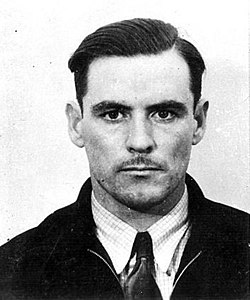
-
 Ed Shouse


See also
[edit]
References
[edit]- ^ "Edgar and Melvin and John".Coopertoon website; "John Herbert Dillinger was born in Indianapolis, Indiana on June 22, 1903. Today the name is inevitably pronounced "DILL-in-jer" with a soft "g". However, some newscasters of the time pronounced the name with a hard "g" as in "grrrrr" which seems to have been the preference of Johnnie's ancestors."
- ^ Quilligan, Kathleen (April 6, 2008). "Family remembers "true hero" of Dillinger's story". The Times of Northwest Indiana. Retrieved April 15, 2025.
- ^ "John Dillinger's body to be exhumed to confirm identity". CBC News. July 30, 2019. Retrieved September 13, 2025.
- ^ a b c d e f Elliott J. Gorn, Dillinger's Wild Ride: The Year That Made America's Public Enemy Number One (2009), p 101.
- ^ a b Reynolds, Dean (June 21, 2009). "On the trail of John Dillinger". CBS News. Retrieved June 28, 2018.
Dillinger's robberies netted more than $300,000 (equal to $4 million today). To many, though, he was more Robin Hood than robber. 'Middle Americans were so angry at the bankers and businessmen who had taken their money, their home, their jobs, hundreds of thousands of Middle Americans especially were cheering on Dillinger,' said Burrough.
- ^ Goodwin, Christopher (June 28, 2009). "America's own Robin Hood The Dillinger legend". The Sunday Times. Retrieved June 28, 2018.
Dillinger's audacious string of robberies and prison escapes in the early 1930s turned him into an American folk hero, a Depression-era Robin Hood. His gang robbed more than a dozen banks between May 1933 and July 1934, stealing over $300,000. He also destroyed thousands of mortgage records during the robberies, helping many poor people escape payments to banks.
- ^ a b "A Byte Out of History – How The FBI Got Its Name". Federal Bureau of Investigation. March 24, 2006. Retrieved February 17, 2011.
- ^ a b J. J. Kearns's autopsy report
- ^ a b c "Kill Dillinger here". Chicago Daily Tribune. July 23, 1934. p. 1. Archived from the original on June 17, 2016. Retrieved June 3, 2017.
- ^ a b "Famous Cases & Criminals – John Dillinger". Fbi.gov. Retrieved April 21, 2017.
- ^ a b c d e f g h i j k l m n o p q r s t u v w x y Matera, Dary (2005). John Dillinger: The Life and Death of America's First Celebrity Criminal. Carroll & Graf Publishers. ISBN 0-7867-1558-8.[pages needed]
- ^ Darimont, Rainer. "Der Staatsfeind Nr. 1 von Amerika: John Herbert Dillinger; Sein Großvater lebte in Gisingen". Verein für Heimatforschung Wallerfangen e.V.
- ^ Grein, Erhard (September 2, 2010). "Heimat-Zeitschrift auf den Spuren eines Kriminellen". Saarbrücker Zeitung.
- ^ a b c d e f g h i j "Famous Cases: John Dillinger". Federal Bureau of Investigation. Archived from the original on September 19, 2009. Retrieved June 26, 2009.
- ^ "Depression-era gangster John Dillinger's sister dies in Mooresville at 92". WTHR. January 15, 2015. Archived from the original on January 19, 2015. Retrieved January 16, 2015.
- ^ "Shadow box". navy.togetherweserved.com. Retrieved February 19, 2018.
- ^ "Certificate of Birth: Beryl Hovious" Morgan County Health Department, Martinsville, Indiana. Filed 9-1923.
- ^ Landers, Chris. "Dillinger played ball before he robbed banks". MLB. MLB Advanced Media. Archived from the original on April 26, 2020. Retrieved April 26, 2020.
- ^ "Dillinger's Partner In First Crime Killed". Reading Eagle. September 2, 1937. p. 14. Retrieved August 10, 2018 – via Google News.
- ^ Helmer, pp. 165–166
- ^ "Bandits Bind Cashier, Clerk and Assistant", Dayton Daily News, June 21, 1933, pp, 1, 5.
- ^ "John Dillinger". FBI. Retrieved July 19, 2019.
- ^ Gressinger, James (January 7, 2019). "Tucson Police Capture The Dillinger Gang: No Shots Fired!". Southern Arizona Guide. Retrieved September 13, 2025.
- ^ Defining Documents in American History: The 1930s (1930–1939). Ipswich, Massachusetts: Salem Press. 2014. p. 269. ISBN 978-1-61925-4954.
- ^ PimaLib_LibrarianFiles (February 10, 2015). "Dillinger Captured in Tucson". Pima County Public Library. Archived from the original on December 17, 2017. Retrieved January 15, 2018.
- ^ Raines, Elaine (January 22, 2016). "1934: Dillinger captured in Tucson". tucson.com. Retrieved January 15, 2018.
- ^ "ISP: The Pursuit of Public Enemy #1". www.in.gov. May 28, 2021.
- ^ Girardin/Helmer, Dillinger: The Untold Story
- ^ "Indianapolis Recorder 24 March 1934 — Body Of Youngblood; Slain Dillinger Pal – Returned To Family And Buried In Gary". newspapers.library.in.gov. Retrieved May 20, 2025.
- ^ "YOUNGBLOOD IS SLAIN IN BATTLE". Lowell Tribune. Lowell, Indiana. March 22, 1934. Retrieved February 24, 2016.
- ^ "FBI History – Famous Cases, John Dillinger". FBI. Archived from the original on September 2, 2011. Retrieved September 8, 2011.
- ^ "Evelyn "Billie" Frechette (1907-1969) | American Experience". www.pbs.org. Retrieved May 18, 2024.
- ^ "John Dillinger". rolandanderson.se. Retrieved May 18, 2024.
- ^ U.S. District Court, District of MN, USA vs. Evelyn Frechette, et al., pp. 590–92
- ^ Girardin/Helmer, "Dillinger: The Untold Story", p. 274
- ^ "Plenty of folks still remember infamous Dillinger bank robbery". Globe Gazette. September 19, 2008. Retrieved October 1, 2018.
- ^ Millett, Larry, AIA Guide to St. Paul's Summit Avenue & Hill District (2009), p. 68
- ^ USA vs. May/Frechette, et al, p.35
- ^ USA vs May/Frechette, Cutting's testimony, pp. 75–80
- ^ USA vs May, Frechette, et al., testimony from Coffey and Nalls
- ^ Dillinger File 62-29777, Nalls report
- ^ USA vs. May/Frechette, et al. Nalls's testimony, p. 90
- ^ USA vs. May/Frechette, Coulter's testimony, pp. 178–79
- ^ Dillinger File, 62-29777, Nalls report
- ^ USA vs. May/Frechette, Nalls' testimony, p. 90
- ^ Girardin/Helmer, p. 134
- ^ USA vs. May/Frechette, et al., Cummings' testimony, pp. 97–98
- ^ "1934-03-31". Historic Twin Cities. Retrieved May 18, 2024.
- ^ Cromie and Pinkston, "Dillinger: A Short and Violent Life, p. 189
- ^ USA vs. May/Frechette, Clayton May's testimony, pp. 473–87, 501.
- ^ a b c d FBI Dillinger File 62-29777
- ^ "The V That Changed the Game". cityworldford.net. June 15, 2025. Retrieved September 13, 2025.
- ^ Cromie and Pinkston, p. 196
- ^ "Evelyn Frechette---"Billie"---Johnny's true love".DillingersWomen.com website; The last illustration on Billie Frechette's arrest read in part, "The location of the storefront bar at 416 N. State Street, Chicago, called the Austin-State Tavern, where Evelyn Frechette was arrested by the FBI on April 9, 1934. While she was brought out to an awaiting car, Dillinger watched, helpless. They never saw each other again. "
- ^ Glen Young. "'Gangsters Up North' shows how myth and history mix". Petoskey News-Review. Retrieved May 18, 2024.
- ^ "17 timeless lessons learned from the 'Little Bohemia' shootout". June 20, 2023.
- ^ "Lessons at Little Bohemia". Federal Bureau of Investigation. Retrieved March 23, 2019.
- ^ Piquett vs USA, Loeser's testimony, pp. 154–55
- ^ Piquett vs USA, Loeser's testimony
- ^ Piquett vs USA, Loeser's testimony, pp. 152–62
- ^ FBI Dillinger File 62-29777, Peggy Doyle statement
- ^ Helmer/Mattix, "The Complete Public Enemy Almanac"
- ^ Purvis, Alston W.; Alex Tresinowski (2005). The Vendetta. PublicAffairs. pp. 155–56. ISBN 9781586483012.
vendetta+purvis+ana sage+prostitute.
- ^ a b c d e Massad Ayoob (July–August 2008), "The death of John Dillinger", American Handgunner, archived from the original on January 19, 2012
- ^ a b FBI Dillinger File 62-29777, S.P. Cowley report, August 1, 1934.
- ^ Chicago Daily Tribune, 7-15-34 through 8-1-34 movie section
- ^ Seidel, Jon (August 1, 2019). "Dillinger descendants drop bombshell: they have 'evidence' he was not killed outside the Biograph". Chicago Sun-Times. Retrieved September 13, 2025.
- ^ a b "On This Day (front page)". The New York Times. July 23, 1934. Retrieved June 28, 2015.
- ^ "FBI History – Famous Cases, John Dillinger". FBI. Archived from the original on September 19, 2009. Retrieved July 18, 2009.
- ^ The Story of the FBI, E.P. Dutton and Co., Inc. New York, 1947, p. 195.
- ^ a b "Dillinger Slain in Chicago; Shot Dead by Federal Men in Front of Movie Theater". The New York Times. Retrieved February 4, 2013.
- ^ May, Allan, and Marilyn Bardsley. "Biograph Encounter" Archived 2009-03-11 at the Wayback Machine, John Dillinger: Bank Robber or Robin Hood? – Crime Library; accessed July 14, 2017.
- ^ "A-57405, OCTOBER 10, 1934, 14 COMP. GEN. 300". gao.gov (A-57405). October 10, 1934. Archived from the original on February 25, 2021.
- ^ agents' communiqués of a set prior classified documents of the Federal Bureau of Investigation of the United States of America (2007). John Dillinger: The FBI Files. Filiquarian Publishing, LLC., 2007. ISBN 978-1599862460. Retrieved June 27, 2015. [permanent dead link] (ed. doc. refers to the document number)
- ^ doc. F.B.I. comm. July 24, 1934.
- ^ Associated Press, "Most Feared Killer of Decade Reaches Trail's End in Hail of Shots", The San Bernardino Daily Sun, San Bernardino, California, Monday 23 July 1934, Volume 40, page 2.
- ^ "In Grave Condition – John H. Dillinger". Archived from the original on July 19, 2012. Retrieved October 13, 2009.
- ^ Girardin, Helmer, p. 313
- ^ "Dillinger's grave attracting crowds due to Public Enemies movie". Wkowtv.com. June 29, 2009. Archived from the original on September 18, 2012. Retrieved February 4, 2013.
- ^ Girardin/Helmer, p. 280
- ^ Poets, Academy of American. "The Shooting of John Dillinger Outside the Biograph Theater, July 22, 1934 by David Wagoner – Poems | Academy of American Poets". poets.org.
- ^ Burroughs, William. "Thanksgiving Prayer". City University of New York.
- ^ Sennwald, Andre (June 8, 1935). "Movie Review: Public Hero No. 1". The New York Times. Retrieved November 22, 2015.
- ^ Behlmer, Rudy. "High Sierra". Classic Film Scores by Adolph Deutsch. Archived from the original on April 28, 2017. Retrieved August 9, 2018 – via The Film Noir 'net.
- ^ "Dillinger". Variety. March 14, 1945. p. 16. Retrieved August 9, 2018 – via Internet Archive.
- ^ "Baby Face Nelson", IMDb, retrieved October 11, 2017
- ^ "Film wrong! Dillinger not killed by FBI! Fact: Hoover coverup! | Roger Ebert | Roger Ebert". www.rogerebert.com. December 19, 2012. Retrieved September 13, 2025.
- ^ "Vintage Chicago Tribune: John Dillinger's final days — and the 'Lady in red' who helped trap him". Chicago Tribune. July 18, 2024. Retrieved September 13, 2025.
- ^ Costello, Mark (August 1, 2004). "Public Enemies Review". The New York Times Book Review. Retrieved February 7, 2009.
- ^ Gorn, Elliott (July 2009). "The Real John Dillinger: Is Public Enemies historically accurate?". Slate.com. Retrieved May 1, 2012.
- ^ "The Death of Jack Hamilton official movie website". Archived from the original on May 7, 2013. Retrieved May 7, 2012.
- ^ "Dillinger's Duffel – Official TF2 Wiki | Official Team Fortress Wiki". wiki.teamfortress.com.
Further reading
[edit]- Beverly, William. On the Lam: Narratives of Flight in J. Edgar Hoover's America. Jackson, Mississippi: University Press of Mississippi. 2003. ISBN 1-57806-537-2.
- Burrough, Bryan. Public Enemies: America's Greatest Crime Wave and the Birth of the FBI, 1933–34 Archived 2012-09-24 at the Wayback Machine. New York: Penguin Press. 2004. ISBN 1-59420-021-1.
- Cromie, Robert and Pinkston, Joseph. Dillinger: A Short and Violent Life (1962)
- DeBartolo, Anthony. "Dillinger's Dupes: Town Seeks To Preserve A Jail Yet Escape A Dastardly Deed". Chicago Tribune.
- Erickson, Matt and Bill Thornbro. John Dillinger: A Year in the Life. The Times of Northwest Indiana.
- Girardin, G. Russell, Helmer, William J., Mattix, Rick. Dillinger: The Untold Story.
- Gorn, Elliott J. Dillinger's Wild Ride: The Year That Made America's Public Enemy Number One (New York, OUP USA, 2009).
- Helmer, William J.; Mattix, Rick (1998). Public Enemies: America's Criminal Past, 1919–1940. New York City: Facts on File. p. 17. ISBN 0-8160-3160-6.
- Peters, Robert. What Dillinger Meant to Me Seahorse Press 1983 (with link to complete text online)
- Toland, John. The Dillinger Days. Random House 1963
External links
[edit]

John Dillinger
View on GrokipediaJohn Herbert Dillinger Jr. (June 22, 1903 – July 22, 1934) was an American criminal active during the Great Depression, infamous for leading a gang in a violent spree of bank robberies, auto thefts, and murders across the Midwest from September 1933 to July 1934.[1] Born in Indianapolis, Indiana, to a grocer father, Dillinger began with petty crimes but escalated after imprisonment, where he associated with seasoned offenders and honed criminal skills.[2] Paroled in May 1933, he quickly orchestrated multiple heists netting significant sums, escaped custody twice—including a daring breakout from the "escape-proof" Crown Point jail using a carved wooden pistol—and was named Public Enemy Number One by law enforcement for evading capture amid widespread publicity.[1] His gang killed at least ten men, wounded seven others, and raided police arsenals, contributing to his status as a symbol of Depression-era defiance against banks, though his actions involved direct violence rather than mere redistribution.[1] Dillinger met his end outside Chicago's Biograph Theater, gunned down by FBI agents in a coordinated ambush based on a tip from an associate.[1]