



Community hub
Recent from talks
Contribute something
Nothing was collected or created yet.
Distortion
View on WikipediaIn signal processing, distortion is the alteration of the original shape (or other characteristic) of a signal. In communications and electronics it means the alteration of the waveform of an information-bearing signal, such as an audio signal representing sound or a video signal representing images, in an electronic device or communication channel.
Distortion is usually unwanted, and so engineers strive to eliminate or minimize it. In some situations, however, distortion may be desirable. For example, in noise reduction systems like the Dolby system, an audio signal is deliberately distorted in ways that emphasize aspects of the signal that are subject to electrical noise, then it is symmetrically "undistorted" after passing through a noisy communication channel, reducing the noise in the received signal. Distortion is also used as a musical effect, particularly with electric guitars.
The addition of noise or other outside signals (hum, interference) is not considered distortion, though the effects of quantization distortion are sometimes included in noise. Quality measures that reflect both noise and distortion include the signal-to-noise and distortion (SINAD) ratio and total harmonic distortion plus noise (THD+N).
Electronic signals
[edit]In telecommunications and signal processing, a noise-free system can be characterised by a transfer function, such that the output can be written as a function of the input as


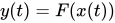
When the transfer function comprises only a perfect gain constant A and perfect delay T

the output is undistorted. Distortion occurs when the transfer function F is more complicated than this. If F is a linear function, for instance a filter whose gain and/or delay varies with frequency, the signal suffers linear distortion. Linear distortion does not introduce new frequency components to a signal but does alter the balance of existing ones.

This diagram shows the behaviour of a signal (made up of a square wave followed by a sine wave) as it is passed through various distorting functions.
- The first trace (in black) shows the input. It also shows the output from a non-distorting transfer function (straight line).
- A high-pass filter (green trace) distorts the shape of a square wave by reducing its low frequency components. This is the cause of the "droop" seen on the top of the pulses. This "pulse distortion" can be very significant when a train of pulses must pass through an AC-coupled (high-pass filtered) amplifier. As the sine wave contains only one frequency, its shape is unaltered.
- A low-pass filter (blue trace) rounds the pulses by removing the high frequency components. All systems are low pass to some extent. Note that the phase of the sine wave is different for the lowpass and the highpass cases, due to the phase distortion of the filters.
- A slightly non-linear transfer function (purple), this one gently compresses the peaks of the sine wave, as may be typical of a tube audio amplifier. This generates small amounts of low order harmonics.
- A hard-clipping transfer function (red) generates high order harmonics. Parts of the transfer function are flat, which indicates that all information about the input signal has been lost in this region.
The transfer function of an ideal amplifier, with perfect gain and delay, is only an approximation. The true behavior of the system is usually different. Nonlinearities in the transfer function of an active device (such as vacuum tubes, transistors, and operational amplifiers) are a common source of non-linear distortion; in passive components (such as a coaxial cable or optical fiber), linear distortion can be caused by inhomogeneities, reflections, and so on in the propagation path.
Amplitude distortion
[edit]Amplitude distortion is distortion occurring in a system, subsystem, or device when the output amplitude is not a linear function of the input amplitude under specified conditions.
Harmonic distortion
[edit]Harmonic distortion adds overtones that are whole number multiples of a sound wave's frequencies.[1] Nonlinearities that give rise to amplitude distortion in audio systems are most often measured in terms of the harmonics (overtones) added to a pure sinewave fed to the system. Harmonic distortion may be expressed in terms of the relative strength of individual components, in decibels, or the root mean square of all harmonic components: Total harmonic distortion (THD), as a percentage. The level at which harmonic distortion becomes audible depends on the exact nature of the distortion. Different types of distortion (like crossover distortion) are more audible than others (like soft clipping) even if the THD measurements are identical. Harmonic distortion in radio frequency applications is rarely expressed as THD.
Frequency response distortion
[edit]Non-flat frequency response is a form of distortion that occurs when different frequencies are amplified by different amounts in a filter. For example, the non-uniform frequency response curve of AC-coupled cascade amplifier is an example of frequency distortion. In the audio case, this is mainly caused by room acoustics, poor loudspeakers and microphones, long loudspeaker cables in combination with frequency dependent loudspeaker impedance, etc.
Phase distortion
[edit]This form of distortion mostly occurs due to electrical reactance. Here, all the components of the input signal are not amplified with the same phase shift, hence making some parts of the output signal out of phase with the rest of the output.
Group delay distortion
[edit]Can be found only in dispersive media. In a waveguide, phase velocity varies with frequency. In a filter, group delay tends to peak near the cut-off frequency, resulting in pulse distortion. When analog long distance trunks were commonplace, for example in 12 channel carrier, group delay distortion had to be corrected in repeaters.
Correction of distortion
[edit]As the system output is given by y(t) = F(x(t)), then if the inverse function F−1 can be found, and used intentionally to distort either the input or the output of the system, then the distortion is corrected.
An example of a similar correction is where LP/vinyl recordings or FM audio transmissions are deliberately pre-emphasised by a linear filter, the reproducing system applies an inverse filter to make the overall system undistorted.
Correction is not possible if the inverse does not exist—for instance if the transfer function has flat spots (the inverse would map multiple input points to a single output point). This produces an uncorrectable loss of information. Such a situation can occur when an amplifier is overdriven—causing clipping or slew rate distortion when, for a moment, the amplifier characteristics alone and not the input signal determine the output.
Cancellation of even-order harmonic distortion
[edit]Many symmetrical electronic circuits reduce the magnitude of even harmonics generated by the non-linearities of the amplifier's components, by combining two signals from opposite halves of the circuit where distortion components that are roughly the same magnitude but out of phase. Examples include push-pull amplifiers and long-tailed pairs.
Teletypewriter or modem signaling
[edit]In binary signaling such as FSK, distortion is the shifting of the significant instants of the signal pulses from their proper positions relative to the beginning of the start pulse. The magnitude of the distortion is expressed in percent of an ideal unit pulse length. This is sometimes called bias distortion.
Telegraphic distortion is a similar and older problem, distorting the ratio between mark and space intervals.[2]
Audio distortion
[edit]

With respect to audio, distortion refers to any kind of deformation of an output waveform compared to its input, usually clipping, harmonic distortion, or intermodulation distortion (mixing phenomena) caused by non-linear behavior of electronic components and power supply limitations.[3] Terms for specific types of nonlinear audio distortion include: crossover distortion and slew-induced distortion (SID).
Other forms of audio distortion are non-flat frequency response, compression, modulation, aliasing, quantization noise, wow and flutter from analog media such as vinyl records and magnetic tape. The human ear cannot hear phase distortion, except that it may affect the stereo imaging.
In most fields, distortion is characterized as unwanted change to a signal. Distortion in music is often intentionally used as an effect when applied to an electric guitar signal in styles of rock music such as heavy metal and punk rock.
Distortion in art
[edit]In the visual arts a distortion is any change made by an artist to the size, shape or visual character of a form in order to express an idea, convey a feeling, or enhance visual impact. Such distortions or "abstractions" primarily refer to purposeful deviations from photorealistic perspective or from realistic proportionality. Examples include "The Weeping Woman" by Picasso and "The Adoration of the Shepherds" by El Greco, whose human subject matters are irregularly and (as is often with physical distortions) asymmetrically proportioned in a way that is not possible in standard perspective.
Optics
[edit]In optics, image/optical distortion is a divergence from rectilinear projection caused by a change in magnification with increasing distance from the optical axis of an optical system.
Map projections
[edit]In cartography, a distortion is the misrepresentation of the area or shape of a feature. The Mercator projection, for example, distorts by exaggerating the size of regions at high latitude.
See also
[edit]References
[edit]- ^ Moscal, Tony (1994). Sound Check: The Basics of Sound and Sound Systems. Hal Leonard. p. 55. ISBN 9780793535590.
- ^ "Telegraphic Type Services Standard Interface Specifications" (PDF). The Mindway. July 1970. Archived (PDF) from the original on 2016-02-28.
- ^ Audio Electronics by John Linsley Hood; page 162
 This article incorporates public domain material from Federal Standard 1037C. General Services Administration. Archived from the original on 2022-01-22. (in support of MIL-STD-188).
External links
[edit] Media related to Distortion at Wikimedia Commons

Distortion
View on GrokipediaDistortions in Electronic Signals
Amplitude distortion
Amplitude distortion refers to the phenomenon in electronic systems where the gain varies with the amplitude of the input signal, resulting in an output that is not a proportional replica of the input. This nonlinearity causes the signal magnitude to be altered differently at various levels, leading to compression for large amplitudes or expansion for small ones, independent of frequency-dependent effects.[11] In amplifiers, amplitude distortion primarily arises from inherent nonlinearities in active devices, such as saturation in vacuum tube circuits or deviations in transistor transfer characteristics under high signal swings. Vacuum tube amplifiers, widely used in early telephony, exhibited significant amplitude distortion due to grid saturation and anode current limitations when handling multi-stage cascaded signals. These issues were prominently observed in the 1920s at Bell Laboratories, where repeated amplification over long-distance lines compounded distortion and instability, prompting innovations like negative feedback to mitigate them. Transistor-based amplifiers similarly suffer from nonlinearity in their base-emitter or gate-source junctions, particularly when operating near cutoff or saturation regions.[12][13] Mathematically, amplitude distortion is represented by a nonlinear transfer function, where the output voltage is not equal to a constant gain times the input , but rather , with exhibiting curvature such as compression at higher inputs. A common effect is clipping, occurring when the input exceeds the amplifier's linear range, flattening the waveform peaks and introducing asymmetry that reduces overall signal fidelity and efficiency.[14][13] Measurement of amplitude distortion often involves determining the 1 dB compression point (P1dB), the input power level at which the gain decreases by 1 dB from its small-signal value, providing a quantitative indicator of the onset of nonlinearity. Indirect assessment can use intermodulation distortion products generated by two-tone inputs, where the amplitude of these products correlates with the degree of gain compression.[13][15]Harmonic distortion
Harmonic distortion refers to the generation of unwanted frequency components that are integer multiples of the fundamental frequency in the output spectrum of a nonlinear system, altering the shape of the original signal waveform.[16] This distortion arises primarily from quadratic or higher-order nonlinearities in electronic devices such as amplifiers and mixers, where the output is not a proportional replica of the input due to the device's transfer characteristic deviating from linearity.[17] Non-linear loads and components, including rectifiers, switching circuits, and saturated amplifiers, introduce these effects by drawing or producing non-sinusoidal currents and voltages.[16] The mathematical basis for harmonic generation stems from the Taylor series expansion of the system's output voltage in terms of the input voltage : where , , and are coefficients representing linear, quadratic, and cubic nonlinearities, respectively.[17] For a sinusoidal input , the quadratic term produces a second harmonic at along with a DC component, while the cubic term generates a third harmonic at and modifies the fundamental amplitude, leading to gain compression.[18] Even-order harmonics (e.g., 2nd, 4th) originate from even-order nonlinearities like the quadratic term and often result in DC offsets that can bias amplifiers or cause thermal issues in system design, whereas odd-order harmonics (e.g., 3rd, 5th) from odd-order terms like cubic nonlinearity contribute to harsher distortion profiles and are more prominent in single-ended configurations, necessitating differential designs to suppress even orders for improved linearity.[18][19] Harmonic distortion is quantified using the total harmonic distortion (THD) metric, defined as where is the amplitude of the -th harmonic and is the fundamental amplitude, typically expressed as a percentage.[18] In audio systems, these harmonics manifest as unwanted tones that degrade sound fidelity, while in RF signals, they cause spectral regrowth and interference with adjacent channels.[17] Intermodulation distortion represents a related extension, occurring when multiple input tones interact via the same nonlinearities to produce sum and difference frequencies, distinct from pure harmonics but similarly detrimental to signal integrity.[20]Frequency response distortion
Frequency response distortion refers to the deviation from a flat magnitude response in the passband of an electronic system, where the gain is not constant across frequencies, leading to unequal attenuation or amplification of different frequency components in the input signal.[2] This linear distortion alters the spectral balance of the signal without introducing new frequencies, distinguishing it from nonlinear effects. Common causes include imperfections in filter designs, variations due to component tolerances in resistors, capacitors, and inductors, and environmental influences such as temperature changes that shift component values and thereby affect the overall transfer function.[21][22] For instance, capacitor value drifts with temperature can modify the cutoff frequencies in RC or RLC circuits, resulting in unintended roll-off or peaking. This distortion is typically represented using a Bode plot, which graphs the magnitude of the transfer function |H(f)| in decibels versus frequency on a logarithmic scale; an ideal flat response would show a horizontal line, but distortion appears as deviations where |H(f)| ≠ constant.[23] Such plots highlight bandwidth limitations and resonant behaviors in amplifiers or filters. The effects manifest as alterations to the signal's timbre or fidelity, such as high-frequency roll-off in audio amplifiers that dulls transients or low-frequency emphasis in graphic equalizers to boost bass response intentionally.[2] In non-minimum phase systems, magnitude distortions may accompany phase shifts, though the primary impact here is on amplitude balance.[24] Measurement involves applying a swept sine wave across the frequency range and analyzing the output amplitude variation, or using fast Fourier transform (FFT) on broadband excitations like white noise to compute the magnitude response and quantify deviation from flatness, often expressed as the maximum ripple in dB within the passband.[25][26] In filter design applications, engineers aim to minimize this distortion by selecting components with tight tolerances and compensating via active equalization to achieve a desired passband flatness, such as ±0.5 dB over audio frequencies.[23] In digital signal processing (DSP), frequency response distortion arises from finite impulse response (FIR) or infinite impulse response (IIR) filter approximations, where quantization and coefficient precision limit the flatness; techniques like windowing in FIR design help mitigate this for applications in audio processing or communications.[24][27]Phase distortion
Phase distortion arises when the phase response of a system, denoted as , is not linearly proportional to the angular frequency , resulting in different frequency components of a signal experiencing unequal time delays.[28] In an ideal distortionless system, the phase shift should follow for some constant , which corresponds to a uniform time delay across all frequencies and preserves the original waveform shape up to scaling and shifting.[28] This nonlinearity disrupts the relative timing of signal components, altering the overall waveform without changing the magnitude spectrum significantly.[29] Common causes of phase distortion include reactive components such as inductors and capacitors in electronic networks, which introduce frequency-dependent phase shifts, and all-pass filters designed for phase adjustment but capable of nonlinear responses if not carefully engineered.[28] In signal processing, imperfect transmission paths or filter implementations can exacerbate this issue, leading to deviations from the desired linear phase.[29] The ideal linear phase response is crucial for maintaining signal integrity, as any deviation quantifies the distortion; a common metric is the maximum absolute deviation over the frequency band of interest, where is chosen to minimize this value, providing a measure of phase nonlinearity.[30] Effects manifest as ringing, preshoot, or smearing in pulse-like signals, where high-frequency components arrive out of sync with lower ones, distorting the time-domain shape.[29] In audio applications, this can be perceived as changes in timbre, with nonlinear phase altering the harmonic alignment and thus the tonal quality.[31] In modern digital signal processing (DSP), phase distortion is a key trade-off in filter design: finite impulse response (FIR) filters can achieve exact linear phase, avoiding distortion and preserving waveform shape, while infinite impulse response (IIR) filters often exhibit nonlinear phase due to their recursive nature, introducing distortion but offering computational efficiency.[32] This distinction is critical in applications like data modems or audio processing, where FIR filters are preferred for phase-sensitive tasks despite higher resource demands.[33]Group delay distortion
Group delay distortion occurs when the group delay, defined as , where is the phase shift as a function of angular frequency , is not constant across the frequency band of interest, leading to differential delays in the propagation of signal components and subsequent envelope distortion.[34][35] This type of distortion is a consequence of nonlinear phase responses in transmission systems.[7] In electronic systems, group delay distortion arises from frequency-dependent phase characteristics in components such as cables, where dispersion causes varying delays; filters, particularly those with sharp transitions like diplex or low-pass designs; and amplifiers, including class D types that introduce latency through modulation processes.[36][37][38] For broadband signals, such as modulated carriers, variations in envelope delay result in intersymbol interference, where symbols overlap due to unequal propagation times of their frequency components, degrading signal integrity.[39][35] The effects are particularly pronounced in pulse-based communications, causing pulse broadening that reduces bit rates and increases error rates, while in audio applications, it leads to transient smearing, where sharp attacks in percussive sounds become blurred.[40][41] Measurement of group delay distortion typically involves test signals like linear frequency-modulated chirps to sweep the frequency response, from which the variation in is computed via phase derivative analysis or time-domain pulse response evaluation.[42][43] This phenomenon shares an analogy with chromatic dispersion in optical fibers, where group delay dispersion alters pulse shapes in ultrafast laser signals due to wavelength-dependent delays.[44] In emerging 5G and 6G systems, group delay distortion from terahertz components poses unique challenges to high-data-rate links, necessitating advanced mitigation strategies like waveform optimization and equalization to preserve performance.[45]Correction of Electronic Distortion
Cancellation of even-order harmonic distortion
Even-order harmonic distortion, such as the second and fourth harmonics, typically originates from symmetric nonlinearities in electronic circuits, where the transfer function exhibits even-powered terms that produce distortion components in phase with the input signal's polarity.[46] These distortions can be systematically canceled through push-pull configurations, which employ two symmetrical amplifier stages driven by complementary signals—one handling the positive half-cycle and the other the negative—resulting in even-order terms subtracting at the output.[47] This approach leverages the inherent symmetry to suppress even harmonics while preserving odd-order terms, thereby improving overall linearity without affecting the fundamental signal.[46] In a push-pull or fully differential amplifier, the cancellation arises from the differential output, which is the difference between the two stage outputs. Consider a nonlinear transfer function expanded as a power series:for the positive path, and
for the inverted path. The differential output is then
where even-order terms like cancel due to their identical polarity in both paths.[46] This principle applies to balanced amplifiers and differential pairs, common in integrated circuits, where device matching further enhances suppression—laboratory tests on devices like the THS4141 operational amplifier demonstrate a roughly 6 dB reduction in second-harmonic distortion when measured differentially compared to single-ended operation at 1 MHz.[46] A classic example is the Class B push-pull amplifier, where complementary transistors or tubes conduct alternately, inherently reducing the second harmonic by over an order of magnitude in symmetrical designs, as seen in early audio applications.[47] In modern implementations, operational amplifier-based differential stages, such as those in fully differential op-amps, achieve similar cancellation, balancing odd and even harmonics to minimize total harmonic distortion in high-fidelity audio and RF systems.[46] This technique, developed in post-World War II audio amplifiers like vacuum tube push-pull designs from the late 1940s, revolutionized power amplification by providing efficient even-harmonic rejection without additional complexity.[47]