
.gif/250px-One_positive_frequency_component,_cosine_and_sine,_from_rotating_vector_(fast_animation).gif)


.gif)
Community hub
Recent from talks
Contribute something
Nothing was collected or created yet.
Sine wave
View on Wikipedia | This article relies largely or entirely on a single source. (January 2024) |

A sine wave, sinusoidal wave, or sinusoid (symbol: ∿) is a periodic wave whose waveform (shape) is the trigonometric sine function. In mechanics, as a linear motion over time, this is simple harmonic motion; as rotation, it corresponds to uniform circular motion. Sine waves occur often in physics, including wind waves, sound waves, and light waves, such as monochromatic radiation. In engineering, signal processing, and mathematics, Fourier analysis decomposes general functions into a sum of sine waves of various frequencies, relative phases, and magnitudes.
When any two sine waves of the same frequency (but arbitrary phase) are linearly combined, the result is another sine wave of the same frequency; this property is unique among periodic waves. Conversely, if some phase is chosen as a zero reference, a sine wave of arbitrary phase can be written as the linear combination of two sine waves with phases of zero and a quarter cycle, the sine and cosine components, respectively.
Audio example
[edit]
A sine wave represents a single frequency with no harmonics and is considered an acoustically pure tone. Adding sine waves of different frequencies results in a different waveform. Presence of higher harmonics in addition to the fundamental causes variation in the timbre, which is the reason why the same musical pitch played on different instruments sounds different.
Sinusoid form
[edit]Sine waves of arbitrary phase and amplitude are called sinusoids and have the general form:[1] where:

- , amplitude, the peak deviation of the function from zero.
- , the real independent variable, usually representing time in seconds.
- , angular frequency, the rate of change of the function argument in units of radians per second.
- , ordinary frequency, the number of oscillations (cycles) that occur each second of time.
- , phase, specifies (in radians) where in its cycle the oscillation is at t = 0.
- When is non-zero, the entire waveform appears to be shifted backwards in time by the amount seconds. A negative value represents a delay, and a positive value represents an advance.
- Adding or subtracting (one cycle) to the phase results in an equivalent wave.


As a function of both position and time
[edit]
Sinusoids that exist in both position and time also have:
- a spatial variable that represents the position on the dimension on which the wave propagates.
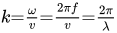
- a wave number (or angular wave number) , which represents the proportionality between the angular frequency and the linear speed (speed of propagation) :
- wavenumber is related to the angular frequency by where (lambda) is the wavelength.



Depending on their direction of travel, they can take the form:
- , if the wave is moving to the right, or
- , if the wave is moving to the left.


Since sine waves propagate without changing form in distributed linear systems,[definition needed] they are often used to analyze wave propagation.
Standing waves
[edit]When two waves with the same amplitude and frequency traveling in opposite directions superpose each other, then a standing wave pattern is created.
On a plucked string, the superimposing waves are the waves reflected from the fixed endpoints of the string. The string's resonant frequencies are the string's only possible standing waves, which only occur for wavelengths that are twice the string's length (corresponding to the fundamental frequency) and integer divisions of that (corresponding to higher harmonics).
Multiple spatial dimensions
[edit]The earlier equation gives the displacement of the wave at a position at time along a single line. This could, for example, be considered the value of a wave along a wire.

In two or three spatial dimensions, the same equation describes a travelling plane wave if position and wavenumber are interpreted as vectors, and their product as a dot product. For more complex waves such as the height of a water wave in a pond after a stone has been dropped in, more complex equations are needed.
Sinusoidal plane wave
[edit]Fourier analysis
[edit]French mathematician Joseph Fourier discovered that sinusoidal waves can be summed as simple building blocks to approximate any periodic waveform, including square waves. These Fourier series are frequently used in signal processing and the statistical analysis of time series. The Fourier transform then extended Fourier series to handle general functions, and birthed the field of Fourier analysis.
Differentiation and integration
[edit]Differentiation
[edit]Differentiating any sinusoid with respect to time can be viewed as multiplying its amplitude by its angular frequency and advancing it by a quarter cycle:
![{\displaystyle {\begin{aligned}{\frac {d}{dt}}[A\sin(\omega t+\varphi )]&=A\omega \cos(\omega t+\varphi )\\&=A\omega \sin(\omega t+\varphi +{\tfrac {\pi }{2}})\,.\end{aligned}}}](https://wikimedia.org/api/rest_v1/media/math/render/svg/ef1d774c1775716120ab0ded159150b63b8c4a2c)
A differentiator has a zero at the origin of the complex frequency plane. The gain of its frequency response increases at a rate of +20 dB per decade of frequency (for root-power quantities), the same positive slope as a 1st order high-pass filter's stopband, although a differentiator does not have a cutoff frequency or a flat passband. A nth-order high-pass filter approximately applies the nth time derivative of signals whose frequency band is significantly lower than the filter's cutoff frequency.
Integration
[edit]Integrating any sinusoid with respect to time can be viewed as dividing its amplitude by its angular frequency and delaying it a quarter cycle:
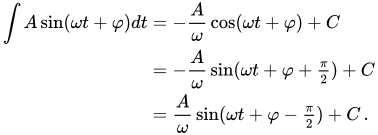
The constant of integration will be zero if the bounds of integration is an integer multiple of the sinusoid's period.

An integrator has a pole at the origin of the complex frequency plane. The gain of its frequency response falls off at a rate of -20 dB per decade of frequency (for root-power quantities), the same negative slope as a 1st order low-pass filter's stopband, although an integrator does not have a cutoff frequency or a flat passband. A nth-order low-pass filter approximately performs the nth time integral of signals whose frequency band is significantly higher than the filter's cutoff frequency.
See also
[edit]- Crest (physics)
- Complex exponential
- Damped sine wave
- Euler's formula
- Fourier transform
- Harmonic analysis
- Harmonic series (mathematics)
- Harmonic series (music)
- Helmholtz equation
- Instantaneous phase
- In-phase and quadrature components
- Least-squares spectral analysis
- Oscilloscope
- Phasor
- Pure tone
- Simple harmonic motion
- Sinusoidal model
- Wave (physics)
- Wave equation
- ∿ the sine wave symbol (U+223F)
References
[edit]- ^ Smith, Julius Orion. "Sinusoids". ccrma.stanford.edu. Retrieved 2024-01-05.
External links
[edit]- "Sine Wave". Mathematical Mysteries. 2021-11-17. Retrieved 2022-09-30.
Sine wave
View on GrokipediaFundamentals
Definition and Characteristics
A sine wave, also known as a sinusoid, is the graph of the sine function or any function exhibiting sinusoidal variation, characterized by its smooth, continuous, and repetitive oscillatory pattern that alternates symmetrically above and below a central axis.[10] This waveform represents a fundamental type of periodic function in mathematics, where the curve traces a series of identical cycles without abrupt changes in direction.[9] Key characteristics of a sine wave include its periodicity, which describes the repetition of the waveform every fixed interval called the period; for the standard sine function, this occurs every 2π radians. The amplitude denotes the maximum displacement from the central axis, measuring the height of the peaks and depth of the troughs.[9] Frequency quantifies the number of complete cycles occurring per unit of time or space, inversely related to the period.[9] In spatial contexts, the wavelength represents the distance over which the wave completes one full cycle.[10] Additionally, a phase shift introduces a horizontal offset, altering the starting point of the cycle relative to a reference waveform.[10] Visually, the sine wave forms a graceful, undulating curve that rises from the origin to a peak, descends through the origin to a trough, and returns, exhibiting point symmetry about the origin as an odd function where the waveform mirrors itself across both axes. It is orthogonal to the cosine wave, meaning their overlap over one complete period results in zero net correlation, a property essential for decomposing complex periodic functions.[11] Sine waves also emerge as solutions to the differential equations governing simple harmonic motion, describing ideal oscillatory behavior.[12]Historical Development
The concept of the sine function originated in ancient Indian mathematics, where it was developed as the "jya" or half-chord length in trigonometric calculations for astronomical purposes.[13] In the 5th century CE, the mathematician Aryabhata introduced this function in his work Aryabhatiya, compiling the first known sine table with values computed for angles in increments of 3°45', facilitating precise predictions of planetary positions and eclipses.[14] This innovation marked a significant advancement in trigonometry, shifting from geometric chord methods to a more versatile sinusoidal approach tailored to celestial modeling. The sine function reached Europe through Arabic scholars who translated and expanded upon Indian texts during the Islamic Golden Age. In the 9th century, Al-Battani refined trigonometric tables and introduced the use of sine and cosine as distinct functions, replacing earlier chord-based systems with these ratios for improved accuracy in astronomical computations.[15] His work, documented in Zij al-Sabi, provided highly precise sine values that influenced subsequent generations.[16] By the Renaissance in the 15th century, European mathematicians like Regiomontanus further advanced the field; in his treatise On Triangles (completed around 1464 but published posthumously), he systematized plane and spherical trigonometry, incorporating sine laws and extensive tables that bridged ancient and modern applications in navigation and surveying.[17] Advancements in the 17th and 18th centuries linked the sine function more deeply to exponential and periodic phenomena. Leonhard Euler, in his 1748 publication Introductio in analysin infinitorum, derived the connection between sines and complex exponentials, expressing sine as the imaginary part of , which unified trigonometric identities with circular motion and laid groundwork for analytic extensions.[18] Building on this, Joseph Fourier's 1822 Théorie analytique de la chaleur introduced Fourier series, decomposing arbitrary periodic functions into sums of sines and cosines, revolutionizing heat transfer analysis and enabling broader applications in wave decomposition.[19] In the 19th and early 20th centuries, the sine wave gained prominence in electrical engineering through alternating current (AC) systems. Nikola Tesla's development of polyphase AC motors and generators in the late 1880s produced inherently sinusoidal waveforms from rotating magnetic fields, enabling efficient long-distance power transmission and powering the "War of the Currents" against direct current advocates.[20] This culminated in practical implementations like the 1895 Niagara Falls hydroelectric plant. Later, in signal theory, Harry Nyquist's 1928 paper on telegraph transmission limits and Claude Shannon's 1949 formulation established the Nyquist-Shannon sampling theorem, specifying that signals with sinusoidal components up to a certain frequency could be reconstructed from discrete samples at twice that rate, foundational for telecommunications.[21] Since the 1960s, sine waves have become ubiquitous in digital signal processing (DSP) with the advent of accessible computers. Early DSP research at institutions like MIT in the mid-1960s applied Fourier-based sine decompositions to filter and analyze signals digitally, transitioning from analog to computational methods and enabling modern applications in audio, imaging, and communications.[22]Mathematical Representation
General Sinusoidal Form
The general sinusoidal form describes a sine wave as a function of time , expressed mathematically as where represents the amplitude, the maximum deviation from the equilibrium position; is the angular frequency, related to the frequency by ; and is the phase shift, which determines the starting point of the oscillation.[23] This form captures the periodic oscillation inherent to sine waves, with the sine function ensuring the waveform repeats smoothly between and .[24] An equivalent alternative expression substitutes the angular frequency directly in terms of frequency: This version emphasizes the role of , measured in hertz (cycles per second), in determining how many complete cycles occur per unit time.[6] Both forms are interchangeable, with the choice depending on whether angular measure in radians or linear frequency is more convenient for the context.[25] The sine wave arises geometrically from the projection of uniform circular motion onto a straight line. Consider a point moving counterclockwise around the unit circle, parameterized by the angle as and . The vertical component traces a sine wave as increases linearly with time, effectively projecting the circular path onto the y-axis.[26] If the angular speed is , then , yielding the general form above when scaled by amplitude .[27] The period of the sine wave, the time for one complete cycle, is given by , or equivalently .[24] Variations in parameters alter the waveform predictably: increasing vertically scales the height of the peaks and troughs without affecting the cycle duration; adjusting shifts the entire wave horizontally along the time axis; higher or compresses the waveform, shortening the period and increasing the number of oscillations per unit time.[25] A key property of the sinusoidal form is its orthogonality with the cosine function of the same frequency. Over one full period, the integral holds, reflecting that sine and cosine are perpendicular basis functions in the space of periodic signals.[11] This orthogonality underpins many analytical techniques involving sine waves.[28]Dependence on Time and Position
To describe a sine wave that propagates through space as well as varies with time, the function is extended to depend on both position and time , forming a traveling wave. The general form for a sinusoidal traveling wave propagating in the positive -direction is where is the amplitude, is the wave number with denoting the wavelength, is the angular frequency with the frequency, and is the phase constant.[29] The phase velocity represents the speed at which the wave propagates, linking spatial and temporal periodicity.[30] This form accounts for waves traveling in either direction along the -axis: the argument yields a right-propagating (positive ) wave, while describes a left-propagating (negative ) wave, with the sign determining the direction of energy transport.[31] In both cases, the wave maintains its sinusoidal shape but shifts position over time, illustrating how changes in and interact through the phase . Such traveling sine waves are exact solutions to the one-dimensional wave equation, where is the wave speed, derived from the medium's properties; substituting the sinusoidal form verifies it satisfies the equation for constant .[29] This connection underscores the sine wave's role in modeling linear wave propagation in strings, sound, or electromagnetic media. Wavefronts are surfaces (or lines in one dimension) of constant phase, such as the crests or troughs of the sine wave, which advance at the phase velocity, demarcating regions of synchronized oscillation as the disturbance propagates.[32] For wave packets formed by superposing sine waves of nearby frequencies, the phase velocity describes the motion of individual crests, whereas the group velocity—the speed of the packet's envelope—governs the propagation of the overall energy or information, often differing from the phase velocity in dispersive media.[33]Wave Phenomena
Standing Waves
A standing wave arises from the linear superposition of two counter-propagating traveling waves of identical frequency and amplitude, such as those on a taut string.[34] This interference pattern produces a stationary wave profile that oscillates in time without net propagation of energy along the medium.[34] The mathematical form of such a standing wave, derived from adding a right-going wave and a left-going wave , is given by: where is the amplitude, is the wavenumber, is the angular frequency, is the wavelength, and is the frequency.[34] The spatial part determines fixed positions of zero displacement known as nodes, occurring where (e.g., at for integer ), and positions of maximum displacement called antinodes, where . Nodes and antinodes are separated by , with consecutive nodes spaced apart.[34] In practical setups, such as a vibrating string fixed at both ends (e.g., length ), boundary conditions enforce nodes at and , quantizing the allowed wavenumbers to for positive integers .[34] This yields discrete modes or harmonics with wavelengths and frequencies , where is the wave speed, is the tension, and is the linear mass density.[34] These modes are excited when the driving frequency matches one of the resonant frequencies, as in musical instruments like guitars.[35] Standing waves exhibit no net energy transport, but the energy is stored as mechanical energy within the medium, oscillating between kinetic and potential forms over each half-cycle of the wave's temporal variation.[36] The kinetic energy density is , maximized at antinodes when displacement is zero (maximum velocity), while the potential energy density is , maximized when velocity is zero (maximum stretch).[37] Overall, the total energy remains constant and is distributed such that it is zero at nodes but peaks between them, with the interchange occurring at twice the wave frequency due to the squared terms in the energy expressions.[36] In real-world scenarios, standing waves form when an incident wave reflects off a boundary, such as the fixed end of a string, and interferes constructively with the oncoming wave at resonant conditions, without requiring detailed phase shifts beyond the basic opposition.[35] This setup is fundamental to phenomena like resonance in enclosed systems, where sustained oscillations build up at specific frequencies.[34]Multi-Dimensional Extensions
The wave equation in two and three dimensions generalizes the one-dimensional form to describe propagation in higher spatial dimensions, given by where is the Laplacian operator, is the wave displacement, and is the wave speed.[38] This partial differential equation admits sinusoidal solutions that extend the basic sine wave to multi-dimensional contexts, such as sound or electromagnetic waves in space.[39] Planar waves, or plane waves, represent a fundamental sinusoidal solution in higher dimensions, propagating uniformly in a specific direction without amplitude variation. The general form is where is the position vector, is the wave vector determining the direction and magnitude of propagation (with ), is the angular frequency, is the amplitude, and is the phase.[38] These solutions satisfy the dispersion relation , ensuring the wave travels at speed .[39] Superpositions of plane waves in various directions form more complex fields, as the equation's linearity permits arbitrary combinations.[39] Spherical waves extend sinusoidal propagation to radially symmetric forms, common for waves emanating from a point source. For outgoing spherical waves in three dimensions, the solution is where is the radial distance from the source, is the wave number, and the factor accounts for amplitude decay due to geometric spreading of energy over an expanding spherical surface.[40] This form approximates the far-field behavior, where intensity falls as , distinct from the constant amplitude of plane waves.[41] In transverse waves, such as electromagnetic or shear waves in solids, polarization refers to the orientation of the oscillation plane perpendicular to the propagation direction. For plane waves, the displacement vector oscillates in a direction orthogonal to , allowing linear, circular, or elliptical polarization states.[42] This perpendicularity arises from the wave equation's structure for transverse modes, where longitudinal components would violate the solution form.[43] Propagation can be isotropic, radiating equally in all directions like spherical waves from a point source, or directional, as in plane waves approximating far-field behavior from a focused emitter. For example, sound waves in a large room from a central speaker exhibit isotropic spherical propagation, with amplitude decreasing as due to uniform spreading.[40] In contrast, directional sound beams, such as those from a horn, mimic plane wave characteristics for targeted energy delivery.[43]Analytical Properties
Differentiation and Integration
The differentiation of a sine wave , where is the amplitude, is the angular frequency, is time, and is the phase shift, yields .[44] This result follows from the chain rule applied to the basic derivative , scaled by the frequency factor .[45] Geometrically, this derivative represents the instantaneous rate of change of the wave, corresponding to velocity in the context of simple harmonic motion (SHM). The second time derivative is .[46] This equation is the defining differential equation for the simple harmonic oscillator.[47] For wave forms depending on both position and time, such as where is the wave number, the chain rule gives the partial derivative with respect to position as .[48] The indefinite integral of the sine wave is , where is the constant of integration.[45] Geometrically, this integral accumulates the signed area under the curve, representing net displacement over time in SHM interpretations.[49] For a definite integral over one full period , , due to the equal positive and negative areas canceling out.[50] In wave propagation contexts, sine functions serve as eigenfunctions of the Laplacian operator, satisfying , where is the wave vector and .[51] This property underscores their role as fundamental solutions to the wave equation.[52]Fourier Analysis
Fourier analysis decomposes periodic functions into sums of sine and cosine waves, revealing their frequency components. The Fourier series represents a periodic function with period as where is the fundamental angular frequency.[53] The coefficients are given by and [54] This expansion relies on the orthogonality of the set over one period , meaning their integrals against each other vanish except when identical, allowing unique determination of the coefficients.[11] Sine and cosine functions serve as basis functions in this orthogonal expansion, enabling the unique decomposition of any square-integrable periodic function into these harmonics.[55] Parseval's theorem quantifies the energy preservation in this representation: for a function with Fourier series as above, confirming that the total energy in the time domain equals the sum of the energies of its frequency components.[56] For non-periodic functions, the Fourier series extends to the Fourier transform, which analyzes the continuous frequency spectrum: [57] This integral form arises by allowing the period to approach infinity, replacing discrete harmonics with a continuum of frequencies. Euler's formula underpins the complex exponential representation: , which justifies expressing the sine function as [58] This connection facilitates the shift from trigonometric to exponential forms in Fourier analysis.Applications
In Audio and Signal Processing
In audio engineering, sine waves serve as the fundamental building blocks for generating pure tones, which are single-frequency sinusoidal signals within the human audible range of approximately 20 Hz to 20 kHz. These pure tones lack harmonics and produce a smooth, whistle-like sound, making them ideal for testing audio equipment and creating basic waveforms in synthesizers. Oscillators in analog and digital synthesizers generate sine waves using techniques such as phase accumulation or direct digital synthesis, where a low-distortion sine wave oscillator forms the core of many subtractive synthesis designs to provide a clean starting point for further waveform shaping.[59][60] Complex musical sounds and instrument timbres arise from the superposition of multiple sine waves at harmonic frequencies, as described by Fourier analysis, where the fundamental frequency and its integer multiples (overtones) determine the unique tonal quality of instruments like violins or flutes. For instance, a clarinet's reedy timbre results from odd harmonics dominating the even ones in the sine wave sum, while brass instruments emphasize higher harmonics for a brighter sound. This additive synthesis approach allows sound designers to recreate realistic instrument timbres by adjusting the amplitudes and phases of these sine components.[61] In signal processing applications, sine waves are central to modulation techniques used in radio broadcasting, such as amplitude modulation (AM), where a high-frequency carrier sine wave is varied in amplitude by an audio signal, and frequency modulation (FM), where the carrier's frequency deviates proportionally to the modulating audio sine wave or complex signal. Low-pass filters, often implemented as RC circuits or digital FIR/IIR designs, attenuate higher-frequency components of a signal while preserving lower ones, effectively smoothing distorted sine waves or removing noise above a cutoff frequency to maintain audio fidelity. The Nyquist-Shannon sampling theorem dictates that to accurately capture an audio sine wave up to 20 kHz without distortion, the sampling rate must exceed twice the highest frequency (typically 44.1 kHz for CD audio), ensuring faithful reconstruction via sinc interpolation.[62][63] Distortion effects, such as clipping, occur when a sine wave exceeds the dynamic range of an amplifier or processor, flattening the peaks and introducing unwanted odd and even harmonics that alter the original pure tone. Total harmonic distortion (THD) quantifies this degradation as the ratio of the root-sum-square of harmonic amplitudes to the fundamental sine wave amplitude, with professional audio systems targeting THD below 0.1% for transparency.[64] In digital audio, digital-to-analog converters (DACs) approximate continuous sine waves from discrete samples, but undersampling leads to aliasing, where high-frequency components fold back into the audible band as spurious lower frequencies, necessitating anti-aliasing filters in the reconstruction process.In Physics and Engineering
In physics, sine waves fundamentally describe simple harmonic motion (SHM), which models oscillatory systems where the restoring force is proportional to displacement. For a mass-spring system, the position of the mass as a function of time is given bywhere is the amplitude, is the angular frequency, and is the phase constant. The angular frequency depends on the system's properties as , with the spring constant and the mass.[12] This form arises from solving the differential equation , reflecting the balance between inertial and elastic forces. In such systems, mechanical energy is conserved, oscillating between kinetic energy and potential energy , with total energy remaining constant absent damping.[65][66] Sine waves also characterize mechanical waves, where displacement of medium particles follows sinusoidal patterns. In transverse mechanical waves, such as those on a stretched string, particle displacement is perpendicular to the propagation direction and described by , with the wave number.[67] Longitudinal mechanical waves, like sound waves in air, involve particle displacement parallel to propagation, yet the pressure or density variation still follows a sine function, .[68] The distinction arises from the medium's response: solids support both types due to shear and compressional forces, while fluids only propagate longitudinal waves.[69] In electromagnetism, sine waves model plane electromagnetic waves propagating through vacuum, embodying Maxwell's equations. The electric field component is expressed as , with the magnetic field , where and .[70] These waves are transverse, with , , and propagation direction mutually perpendicular, and travel at speed , approximately m/s.[71] This sinusoidal form ensures energy propagation via the Poynting vector, with no longitudinal components due to the divergence-free nature of and in free space.[72] Engineering applications leverage sine waves in alternating current (AC) circuits, where voltage varies as . Circuit analysis employs phasors—complex representations of sinusoids—to simplify calculations, treating voltage and current as rotating vectors in the complex plane. Impedance , defined as in phasor form, generalizes resistance for reactive components: , , and . Phasor diagrams reveal phase shifts, enabling efficient design of power systems and filters by combining impedances in series or parallel.[73] In quantum mechanics, sine waves appear in the wave functions of bound particles, such as in the particle-in-a-box model, where the stationary states are for a box of length and quantum number . This sinusoidal form satisfies boundary conditions of zero probability at the walls, leading to quantized energy levels .[74] The probability density exhibits nodal patterns akin to standing waves. As of 2025, sine waves play a critical role in quantum computing signals and 5G/6G modulation schemes. In quantum systems, multi-tone generators sum sine waves to achieve precise flux modulation for qubit control, enabling high-fidelity gates in superconducting processors.[75] For 5G and emerging 6G networks, sinusoidal carriers form the basis of modulation techniques like QAM, where data is encoded onto continuous-wave sine signals at millimeter-wave frequencies, supporting data rates exceeding 100 Gbps through adaptive beamforming and massive MIMO.[76] These carriers ensure efficient spectrum use and low-latency transmission in integrated sensing and communication paradigms.