Hubbry Logo
Door handleDoor handleMain
Open search
Door handle
Community hub
Door handle
logo
8 pages, 0 posts
0 subscribers
Be the first to start a discussion here.
Door handle
Door handle
from Wikipedia

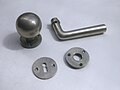
Various examples of door handles throughout history

A door handle or doorknob is a handle used to open or close a door. Door handles can be found on all types of doors including: exterior doors of residential and commercial buildings, internal doors, cupboard doors and vehicle doors. There are many designs of door handle, depending on the appropriate use. A large number of handles, particularly for commercial and residential doors, incorporate latching or locking mechanisms or are manufactured to fit to standardised door locking or latching mechanisms.

The most common types of door handle are the lever handle and the doorknob. Door handles can be made out of a plethora of materials. Examples include brass, porcelain, cut glass, wood, and bronze.[1] Door handles have been in existence for at least 5000 years, and its design has evolved since, with more advanced mechanism, types, and designs made.

Some door handles are also arm- or foot-operated to reduce transmission of contagious illnesses.

Types

[edit]
Pull handle
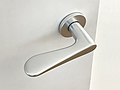
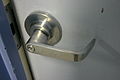
  • The most common type of door handle is the Lever latch or Latch door handle, often found in residential houses and commercial and public buildings. Doors fitted with this handle have a latch that keeps the door shut. The door handle has only a lever handle or knob which operates this latch. Pushing the handle down rotates the spindle, operating the tubular latch mechanism inside the door, allowing it to be opened.[2] This type of door handle is used on interior doors that do not need to be locked. The doorknob has a spindle running through it that sits just above a cylinder, to which the spindle is connected. Pushing the lever or turning the knob pulls the cylinder in the direction of the turn. The end of the cylinder is the "latch bolt" (more simply known as the "latch"), which protrudes into a space carved out of the door frame, and which prevents the door from being opened if the knob is not turned. A spring or similar mechanism causes the latch to return to its protruding state whenever the knob is not being turned.
  • The Lever lock door handle on a backplate is another type of door handle which operates similarly to the lever latch door handle.[3] This type of handle on a backplate consists of a lever with a keyhole cut just below it. This allows a key to be inserted into the door to control a mortice sash lock. Just the like the lever latch, the door can be opened and shut by pushing the handle, but it can also be locked with a key. This locking mechanism is used on doors which can be opened by turning the handle if not locked, but can also be locked, requiring a key to open them.
  • The Lever Bathroom is typically used on bathroom doors, as they can be locked and unlocked easily from the inside by turning the snib, but in an emergency, they can be opened from the outside by fitting a coin or similar object into a slot and rotating it. This lock is fitted with a mortice sash attached to a 5mm spindle which passes through the door.
  • The Lever Privacy is functionally similar to the Lever Bathroom in that it is locked by turning a snib on the inside and can be unlocked from the outside in emergencies. Unlike the Lever Bathroom, there is no mortice sash; locking is achieved by jamming the lever in a closed position.[4]
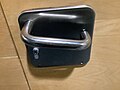
  • Pull door handlesm or simply pull handlesm are U-shaped, and are typically used in kitchens and on drawers. They are usually made of stainless steel.

History

[edit]

Door handles have been in existence at least since the Neolithic period.[5] Locking or latching mechanisms have existed from about the same time. Key operated door locks have existed at least since Egyptian civilisation. The keys of these locks, which could be as large as two feet long, also functioned as door handles to slide a locking bolt and open the door.[6] Subsequently Roman domuses and insulae incorporated lockable doors of a different design but also opened by a combined handle/key.[7] Although available, these key lockable doors were relatively rare. Houses were almost always occupied so most lockable doors would feature a sliding bolt or a drop-in bar that allowed the building to be locked from the inside. The bolt or bar bracket acted as a handle. Although interior doors were less common in Rome than in modern buildings, the Romans had recognisably modern interior doors including door handles.[8] Doors excavated from Lake Nemi and dated to around 1st century CE feature knob-shaped handles.[9]

In Asia, China by the 4th century CE was producing a range of automated doors, door locks and door bars.[10]

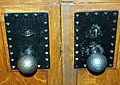
There is little record of door handle development between the Fall of Rome and about 1000 CE. The oldest European doors include the Bernward Doors and the Westminster Abbey door.[11] The Bernward doors have large decorative ring-shaped handles of a type that became common on decorated doors from that period onwards. The Westminster Abbey door features a sliding bolt that can also function as a handle. From at least the Middle Ages blacksmiths made drop latches which could be opened by a handle connected to the latch by a split pin passing through the door.[12] Taking the form of a ring or strip, these handles could be elaborate and decorated but were universally made of metal. It can be speculated that since the task of making door hardware fell to the blacksmith, the use of turned or carved wooden knobs was not convenient. Wooden latches are also known from this period. A finger hole could be made that allowed the user to raise the latch from the other side of the door. The finger hole would double as a grip or handle. In another common design, transferred motion to open the latch was effected by a string passing through the door, which could be withdrawn from the inside to effectively lock the door to outsiders.[13] In this case the door might also have a basic handle carved or turned from wood.[12]

From about mid-17th century, drop handles were increasingly replaced by forged vertical handles formed as a bracket fixed to the door at the top and bottom of the bracket.[14] Vertical handles with an incorporated latch mechanism, known as Suffolk latches were developed. By the mid-18th century, forged vertical handles were being replaced by cast vertical handles, including the Norfolk latch.

Door handle, 1804, for a coach of Napoleon's

The early 17th century also saw metalworking of a standard that allowed mortise locks and latches and compact rim locks and latches to be made for use in the most expensive buildings.[15] These locks used a twisting motion to operate, accelerating development in decorative doorknobs. The Industrial Revolution dramatically reduced the cost of lock and latch manufacture with lock designers including Barronin, Chubb and Bramah competing against each other around the end of the 18th century.[16] From the 18th century, a wide variety of lever handles and knobs started to be produced, with designs determined by local aesthetic preference and technology.[17] Knobs could be cast, turned, brazed or spun from a variety of materials. Levers could be wrought or cast. Designs became more complicated and might include a rose or escutcheon plate.

Until about 1830 door handle manufacture in the western world was almost entirely European. In 1838 the US was importing between 80 and 95% of its door handles.[18][19] Between 1830 and 1876, the date of the Centennial Exposition, door handle manufacture grew rapidly in the US; more than 100 patents were filed for door handle and doorknob improvements in that time.[19] This period also saw glass doorknobs appear as a major part of the industry thanks to improvements in the pressed glass manufacturing process. Cut glass knobs were also popular from the time of the Centennial Exposition to about 1910.[20]

From the early 20th century architects and designers started to take serious interest in door handles as part of a comprehensive vision of spaces for living.[17] In 1927 Wittgenstein famously designed a door handle which has become a prototype for curved tubular handles since then.[21] Emerson wrote of handles in his "The American Scholar" address.[22] Peter Behrens, Walter Gropius and Antoni Gaudi all produced handle designs, many of which continue to be manufactured.[17]

While aesthetic design, cost of manufacture and functionality remain primary drivers of door handle design, the 21st century has seen additional considerations introduced. In particular, considerations of infection control {see section below} and accessibility have become increasingly important since around 2000. The Coronavirus pandemic has contributed to a rapid development of new handle designs including foot-operated handles and handles that can be operated by the user's forearm.

Escutcheon plate

[edit]
A Schlage Tulip doorknob with an escutcheon plate tight against the door

Escutcheon plates, also known as back plates, are used behind door handles, drawer pulls, surrounding keyholes and separate locks, and other similar purposes. These may be plain or fancy, embellished in any form, and serve variously to protect surrounding surfaces, conceal (and render tamperproof) important attachment fasteners, cover uneven rough openings, and add a decorative flourish.

The plate on the edge of a door (where a bolt or door plunger protrudes) is called the "faceplate";[23] opposite on the jamb is the "latchplate", creating or reinforcing the hole receiving a latch, bolt, or plunger.

Usage

[edit]

The location of the door handle along the horizontal axis on the door can vary between a few inches or centimeters away from the edge of the door to the exact center of the door, depending on local culture, decorative style, or owner preference. The distance from the edge of the door to the center of the handle is called the backset.

The location of the door handle along the vertical axis on the door may vary between 34 and 48 inches (860 and 1,220 mm).[24]

Doorknobs can be difficult for the young and elderly to operate. For this reason, door handles in most American commercial and industrial buildings and in many households are lever-operated, rather than a knob, as the lever does not require a tight grip. Levers are also beneficial on doors with narrow stile widths where the reduced backset leaves insufficient space to comfortably turn a doorknob.

Most household door handles use a simple mechanism with a screw-style axle (called a spindle) that has at least one flat side, which is passed through the door jigger, leaving some length exposed on each side of the door to which the handles are attached. Some handles are attached on both sides by screwing or sliding them directly onto the spindle, and then securing one or more retaining screws (set screws) through the knob perpendicular to the flat of the spindle. Handles that lose traction can frequently be repaired by replacing or adjusting the set screw, which prevents them from slipping on the spindle. Other types of handles, typically used in Europe, slide onto the spindle but are affixed only to the door itself without use of set screws.

Types of household handles:

  • Entrance: These door handles are typically used on exterior doors, and include keyed cylinders.
  • Privacy: Typically used on bedrooms and bathrooms; while they are lockable (unlockable with a generic tool), they do not have keyed cylinders.
  • Passage: Also known as hall or closet, these do not lock and are used in hall or closet doors.
  • Dummy: These types are used for ball catch doors or other applications where a mechanism is not needed, but a similar aesthetic effect is desired.

Cars

[edit]

Car door handles may protrude from the vehicle's exterior surface or be streamlined into the vehicle's contour (as in a Tesla, for example). In some automobiles, especially luxury vehicles, the door handles may feature a key-less entry pad utilizing either a numerical code, thumb scan or face recognition.

Foldables

[edit]

On a balcony whose door has an outside shutter, a special door handle is used on the outer side. The protruding part of such handle (usually ring-shaped) can be folded sideways, so that the shutter can be fully closed without being obstructed by the door handle. These doors are referenced in pop culture such as Interstellar and A Dolphin Tale, as they are culturally significant in certain regions of the world.

Pocket doors

[edit]
Recessed pocket door handle

A pocket door handle is a recessed rectangular insert, typically with operating hardware called a door pull.[25]

Door handles can also be called "handle sets". In addition there are door handles that are flush-mount and require pressing rather than turning or gripping, and there are touch-free, electronic, and motion-sensor door handles.

Infection control

[edit]

Door handles play a role in the spread of some infections.[26] Infection transmission can occur when an individual touches a handle and subsequently touches their eyes, nose or mouth.[27] However, some materials, e.g. brass, copper and silver, are slowly poisonous to many germs. The exact mechanism is not known, but is commonly thought to be via the oligodynamic effect, perhaps by some other electrostatic effect.[28] Brass and copper, for example, disinfect themselves of many door handle bacteria within eight hours.[29] Other materials such as glass, porcelain, stainless steel and aluminium do not have this effect.

Arm-operated handles in a supermarket

To avoid hand contact, some door handles are designed to be operated by the arm or foot.[30][31]

Collecting

[edit]

The Antique Doorknob Collectors of America (ADCA) is a nonprofit organization dedicated to the collection of antique doorknobs. Established in 1981, they have over 1000 members as of 2018. The doorknob collecting hobby was kick-started after the publication of The Antique Doorknob by Maud Eastwood in 1976.[32]

[edit]

See also

[edit]

References

[edit]
[edit]
Revisions and contributorsEdit on WikipediaRead on Wikipedia
from Grokipedia
A is a used to open and close a door by operating its or lock mechanism. Often interchangeable with the term "doorknob," which typically refers to a rounded variant, it serves as the primary point of interaction between users and doors in residential, commercial, and architectural settings. Door handles have a rich history spanning millennia, with early forms tracing back to around 3000 B.C., where wooden doors featured crude pin-and-tumble lock mechanisms operated by basic latches or straps. By the , designs diversified regionally, including elaborate wrought-iron levers in , fittings in French palaces, and simple wooden knobs in . The modern door knob emerged in the , with key innovations such as the 1805 for a double-acting by Abraham O. Stansbury and the 1848 improvements by Linus Yale, Sr., which laid the foundation for contemporary latching systems. The 20th century saw door handles evolve into architectural elements, influenced by movements like —exemplified by Antoni Gaudí's organic designs for (1904–1906)—and , including Walter Gropius's iconic cylindrical handle in 1923. Common types of door handles include knob handles, which are spherical or rounded for turning; lever handles, bar-shaped for pushing down to unlatch; and pull handles, elongated grips designed for pulling doors open, often used in commercial spaces. Materials vary widely to balance functionality, aesthetics, and durability, including (forged at high temperatures for corrosion resistance), , wood, , , and ceramic, with pressed knobs popular from 1826 to 1850 and cast metal emerging around 1846. In industrial eras, such as during , metal conservation led to increased use of and alternatives. Modern door handles are subject to rigorous standards to ensure safety, , and accessibility. The ANSI/BHMA A156 series, developed by the Builders Hardware Manufacturers Association, grades hardware like levers and knobs from 1 (highest performance, enduring over 1 million cycles and 360 pounds of force) to 3 (basic residential use), covering tests for operational force, strength, , and finish . Under the Americans with Disabilities Act (ADA), handles must be operable with one hand without tight grasping, pinching, or twisting—favoring levers over round knobs—and mounted between 34 and 48 inches above the floor, with a maximum operating force of 5 pounds. These requirements apply to doors on accessible routes, promoting inclusivity in and private buildings.

Types and Designs

Lever Handles

A lever handle is a horizontal bar or lever mounted on a door that pivots around a fixed point to retract a latch or bolt, allowing the door to open. This design typically connects to a spindle that rotates within the door, engaging the locking mechanism through generated by downward pressure on the lever. Lever handles come in several variations tailored to different security and functional needs. A lever latch, also known as a passage lever, lacks any locking mechanism and is used for interior doors that do not require privacy or security, such as hallways or closets. In contrast, a lever lock incorporates a keyed cylinder for external or high-security doors, enabling locking and unlocking from one side with a key. For privacy applications, a lever bathroom features a thumbturn on the interior side to lock the door, while a lever privacy uses a push-button mechanism for temporary locking, commonly found in bedrooms or bathrooms. The mechanical operation of lever handles relies on principles of and , where applying force to the extended arm of the creates rotational motion that amplifies the effort at the , requiring less input force than rotational mechanisms. This downward pressing action demands minimal or dexterity, making levers operable even with a closed , , or , in contrast to knobs that require twisting and pinching motions. Such design enhances usability for individuals with , limited hand mobility, or other impairments. In the late , lever handles surged in popularity over traditional knobs, driven by accessibility legislation like the Americans with Disabilities Act (ADA) of 1990, which mandates door hardware operable without tight grasping, pinching, or twisting of the wrist to ensure equitable access in public and commercial spaces. This shift promoted inclusivity, with levers becoming standard in institutional and residential settings for their compliance with force limits of no more than 5 pounds to operate.

Knob Handles

A knob handle, commonly referred to as a doorknob, is a rounded or shaped device mounted on a door that operates by manual to disengage a spring-loaded mechanism. This retracts the bolt, allowing the door to open while the spring returns the mechanism to its locked position when released. Knob handles trace their origins to early wooden designs in ancient civilizations, where simple turned elements served similar functions. Knob handles come in several subtypes tailored to specific door functions. Entrance knobs, designed for exterior doors, integrate with a deadbolt assembly and include a keyed for external locking and unlocking. Privacy knobs incorporate an internal push-button or twist mechanism to secure the door from the inside, commonly used on or doors. Passage knobs lack any locking feature and are intended for non-secure interior doors, such as those in hallways or closets. Dummy knobs, available in single-sided or double-sided configurations, provide no operational function and serve solely decorative purposes, often on cabinet doors or as pulls on double doors. Installation of knob handles involves aligning the components with the door's prepared holes. A metal spindle passes through a central hole in the door, connecting the interior and exterior knobs while engaging the latch assembly mortised into the door's edge. The knobs are secured with mounting screws, ensuring the spindle rotates freely to retract the latch upon turning. Knob handles offer aesthetic advantages, providing a timeless, compact appearance that enhances traditional or period-style interiors. However, they present accessibility drawbacks, particularly for individuals with or reduced hand dexterity, as operating them demands a strong grip and precise twisting motion.

Pull Handles

Pull handles are fixed or surface-mounted fixtures primarily designed for gripping to facilitate the pushing or pulling of , typically without integrated locking mechanisms. These handles emphasize ergonomic grasp and durability for manual operation, distinguishing them from rotatable levers or knobs. They are commonly secured via through-bolts or mounting plates to the door's surface, ensuring stability during use. Designs of pull handles vary to suit aesthetic and functional needs, including straight bars for a minimalist profile, D-shaped grips that curve outward for easier hand placement, and tubular forms offering a rounded, comfortable hold. Straight bar pulls, often rectangular or square in cross-section, provide a sleek, modern appearance suitable for flush mounting. D-shaped and tubular variants, typically constructed from 1 to 1.5 inches in , enhance grip security and are adaptable to various door thicknesses, such as 30-50 mm for wooden or metal panels. These configurations prioritize simplicity and visibility, making them ideal for high-traffic areas. Pull handles find common application on entrance doors, gates, and heavy commercial doors, where robust manual operation is essential. On entrance doors and gates, they enable straightforward access for pedestrians and vehicles, often paired with weather-resistant finishes for outdoor exposure. In commercial settings, such as retail or buildings, they support frequent use on wide or weighted doors, contributing to efficient flow without complicating egress. A notable variation is the , also known as a panic bar or exit device, which consists of a spanning the full width of the —typically 24 to 48 inches—for rapid emergency egress. This design features a spring-loaded mechanism that unlatches the upon depression, allowing outward swinging without prior knowledge of operation. Crash bars are mandated in public assembly spaces to prevent during evacuations, with models like rim or vertical rod types accommodating single or paired doors. Load-bearing considerations are critical for pull handles, as materials must endure repeated tensile forces from pulling—often exceeding 200 pounds in commercial scenarios—without deformation or failure. Standards such as ANSI/BHMA A156.6 specify strength tests, including cycle endurance (up to 1,000,000 operations for Grade 1 heavy-duty) and torque resistance, ensuring handles like those made from or maintain integrity under dynamic loads. These requirements verify that pulls support door weights and user forces while complying with building codes for and longevity.

Other Specialized Types

Edge pulls are flush-mounted finger pulls designed for installation along the edge of sliding or pocket , providing a discreet grip that allows users to pull the door out of its cavity without any protruding elements that could interfere with adjacent surfaces or . These handles are typically mortised into the 's edge, featuring a retractable finger grip that sits flush when not in use, making them ideal for space-constrained installations like closets or room dividers. Manufacturers offer them in various sizes and finishes, such as or , to match modern or traditional door designs while ensuring durability for frequent use. Recessed handles, also known as flush pulls, are embedded directly into the door's surface to create a minimalist grip that does not project outward, commonly used for cabinet doors, sliding panels, or contemporary interior designs where a seamless appearance is prioritized. These handles feature a cupped or slotted recess that accommodates fingertips for pulling, eliminating the risk of snags or injuries from protruding hardware and allowing doors to close fully against walls or frames. Available in materials like aluminum or die-cast , they support applications on both wooden and metal doors, often in high-traffic areas such as kitchens or offices, and can include locking mechanisms for added security. Bar handles consist of elongated vertical or horizontal bars that provide a substantial gripping surface, frequently employed on doors for easy access to storage or on French doors to facilitate synchronized opening of paired panels. These handles are surface-mounted or through-bolted for stability, with lengths ranging from 8 to 24 inches to accommodate larger door sizes, and their straight or slightly curved profiles offer ergonomic leverage while contributing to a sleek, modern architectural look. Constructed from durable metals like or , bar handles resist wear in residential settings and can be customized with finishes to complement or French door assemblies. Among unique variants, tubular handles are specialized cylindrical grips used primarily on screen or doors, featuring a simple tube-shaped pull that integrates with a mechanism for lightweight, weather-resistant operation in exterior applications. These handles, often made from solid or , allow for reversible installation on in-swing or out-swing doors and provide a compact, vintage-inspired suitable for or screens. Offset handles, by contrast, are positioned at an angle away from the door surface to accommodate the swinging motion of double-acting doors, such as those in commercial kitchens or retail spaces, ensuring clearance for bidirectional traffic without obstructing the pivot. Typically featuring a 90- or 45-degree offset in construction, they mount at two points for heavy-duty support and comply with standards for frequent use.

History

Ancient and Early Designs

The earliest known door mechanisms trace back to the period, over 5,000 years ago, with archaeological evidence from sites like , , revealing well-preserved wooden doors constructed from poplar planks held together by a sophisticated interlocking design and featuring hinges for operation. In ancient civilizations, door fittings evolved into more ornate and functional forms. In , during the (206 BCE–220 CE), door handles frequently featured animal mask motifs in , with suspended rings for pulling, as evidenced by artifacts used on doors, vessels, and coffins to ward off evil spirits and signify protection. During the medieval period in , particularly from the onward, iron latches and early lever-like devices became prevalent in castles and buildings, offering improved over prior organic materials. Examples include wrought-iron drop handles connected to latches via split rods, often with decorative back-plates, as found on church doors like those at St Mary’s in , . A key innovation was the shift from or thong-operated wooden latches—common in earlier settings—to durable metal fittings, which provided greater strength and resistance to wear in fortified structures.

Modern Developments

The in the marked a pivotal shift in door handle production, enabling mass manufacturing techniques that democratized access to standardized hardware. Advancements in casting and molding processes allowed for the widespread production of door knobs, which became a hallmark of Victorian-era homes due to their durability and aesthetic appeal. Key innovations in lock mechanisms laid the foundation for modern door handles. In 1805, Abraham O. Stansbury patented a double-acting , followed by Linus Yale Sr.'s improvements in 1848, which enhanced security and reliability. A significant advancement occurred in 1878 when Osbourn Dorsey received the first U.S. for a door-closing device incorporating a knob and internal latching mechanism. Companies like the Reading Hardware Company, established in 1862 in , exemplified this innovation by introducing ornate designs such as the Windsor pattern in 1885, which featured intricate Eastlake-style motifs and facilitated affordable, high-volume output for residential and commercial use. In the , door handle designs evolved to prioritize functionality and inclusivity, particularly following the enactment of the Americans with Disabilities Act (ADA) in 1990. This legislation promoted the use of hardware operable with one hand without tight grasping, pinching, or twisting, leading to the widespread adoption of lever handles over traditional knobs in public and commercial buildings. Post-2000 developments integrated electronic precursors into door handles, laying the groundwork for smart home technologies through keyless entry systems. Early electronic locks, evolving from 1990s prototypes, incorporated keypads and RFID proximity sensors by the mid-2000s, allowing users to unlock doors without physical keys via codes or fobs. These innovations, initially popularized in automotive applications and hotels, extended to residential handles, improving security and convenience while reducing mechanical wear. Stylistically, door handles transitioned from the bold geometric patterns of in the 1920s—characterized by streamlined chrome and brass forms with zigzag and motifs—to the clean, unadorned lines of contemporary minimalist designs. handles reflected the era's machine-age optimism, often featuring polished surfaces and angular shapes suited to urban architecture. By the late 20th and early 21st centuries, minimalist trends emphasized simplicity and material purity, with handles in brushed or matte black finishes prioritizing subtle integration into modern interiors over decorative excess. This evolution mirrored broader architectural movements toward restraint and functionality.

Components

Escutcheon Plates

An escutcheon plate, also known as a backplate or trim plate, is a flat decorative and protective component installed around the keyhole, lock cylinder, or latch mechanism on a to shield the surrounding or door surface from while providing an aesthetically pleasing finish. These plates originated from the Latin word "," meaning , and were initially simple functional pieces in the to guard keyholes against wear. By concealing screw holes and rough edges, escutcheons ensure a clean installation and prevent drafts or tampering, often matching the style of or knob handles for cohesive design. Escutcheon plates vary by coverage and application, with full escutcheons encompassing the entire area on both sides of the door for comprehensive protection and ornamentation. Half-escutcheons, used on one side only, suit asymmetrical installations or interior doors where full coverage is unnecessary, while edge escutcheons reinforce the or bolt area on the door edge to secure the mechanism and hide mounting hardware. These types can include covered variants with hinged or sliding panels to obscure the keyhole when not in use, enhancing both security and visual appeal. Typically crafted from materials that complement the door handle, such as , , , or zinc alloy, escutcheons feature finishes like polished chrome, patina, or matte black to blend with surrounding decor while resisting and daily wear. Their primary functions include not only aesthetic enhancement but also practical concealment of installation gaps, making them essential for both new builds and restorations. Historically, escutcheons evolved from basic iron or protectors in to ornate Victorian-era designs in or enamel, often incorporating , floral motifs, or family crests for status display. In contrast, modern escutcheons favor slim, minimalist profiles in stainless steel or brushed finishes, reflecting mid-20th-century influences like streamlining and contemporary , though reproductions remain popular for period authenticity.

Rosettes and Trim

Rosettes and trim are compact decorative elements in door hardware, typically consisting of circular or square plates measuring 2 to 4 inches in diameter or side length, designed to secure the spindle of a or knob while covering the mounting holes drilled into the surface. These plates, often referred to simply as rosettes, fit snugly around the base of the handle, providing a clean transition between the hardware and the . The primary functions of rosettes include aesthetic enhancement by adding a polished, cohesive finish to the 's appearance, as well as offering minor protection against dust ingress, splintering, and surface wear from repeated use. They help distribute the pressure from the evenly across the , reducing localized damage over time. Variations in rosette design range from plain, minimalist versions with smooth surfaces for contemporary settings to ornate styles featuring intricate or patterns such as motifs in antique reproductions. These elements are specifically tailored for compatibility with either handles, which require elongated bases, or traditional knob bases, ensuring a secure fit without interfering with operation. Installation of rosettes is typically straightforward, involving alignment over the spindle hole followed by securing via screws from the interior side or, in some modern designs, snapping into place around the handle rose for a tool-free assembly. This process conceals any rough edges from drilling and completes the hardware assembly efficiently.

Lock Integration

Door handles integrate locking mechanisms to provide both and security, typically connecting to deadbolts, mortise locks, or tubular locks via a central spindle. The spindle, a square or passing through the , links the on one side to its counterpart on the other, enabling rotation to retract the or extend the bolt. In tubular lock systems, the spindle assembly extends through the lock body and , allowing simultaneous operation of the and lock components for smooth entry and exit. Mortise locks, embedded in a within the edge, offer a more robust integration where the directly actuates the lock's internal mechanism, combining and deadbolt functions in a single unit. Deadbolts, often paired with handles in entry sets, connect via the spindle to ensure coordinated locking without separate operation. Keyed locks incorporated into door handles rely on a pin tumbler mechanism, where spring-loaded pins of varying lengths inside the align with grooves on the key to form a shear line, permitting the to rotate and engage the bolt. This , standard in residential and commercial handles, uses 5 or 6 pins for basic , with the key inserting into the exterior side to unlock while the interior may feature a blank plate or matching . For interior applications, thumbturn locks replace the keyed on the inside with an ergonomic oval or crescent-shaped knob that manually rotates the bolt without a key, ideal for bedrooms and bathrooms to prevent accidental entry while allowing quick release. These thumbturns operate the deadbolt directly, ensuring without compromising ease of use from within the room. Security enhancements in lock-integrated handles include anti-pick features within the pin tumbler design, such as spool, mushroom, or serrated pins that create false shear lines and increase friction, making manipulation with tools more difficult and time-consuming. Proper alignment with the strike plate on the door frame is critical, where the deadbolt extends a standard 1-inch throw to engage fully, resisting forced entry by distributing force across hardened steel components and preventing retraction under pressure. This throw length meets industry performance standards for auxiliary deadlocks, ensuring the bolt seats securely into the strike box. Compatibility between levers, knobs, and locksets is achieved through standardized spindle interfaces, where the square spindle (typically 8mm or 3/8-inch) fits both handle types to transfer rotational force to the lock mechanism for latch retraction or bolt operation. Levers, designed for easier grasping, mount similarly to knobs on the same or escutcheon, allowing seamless integration with tubular or mortise locksets without altering the core operation. This universality ensures that replacement or upgrading maintains functional alignment with existing lock installations.

Materials

Traditional Materials

Traditional door handles were predominantly crafted from durable metals and select non-metals, chosen for their availability, workability, and aesthetic appeal in pre-20th-century . These materials reflected the technological and cultural contexts of their eras, with metals providing strength and longevity for frequent use, while non-metals offered decorative versatility in interior settings. Among metals, brass emerged as a favored material from the mid-19th century onward due to its corrosion resistance and ability to achieve polished finishes that enhanced ornamental designs. Brass, an alloy of copper and zinc, also possesses natural antimicrobial properties, with laboratory tests showing a reduction in bacterial survival on surfaces by over 99.9%. Wrought iron provided early strength for rudimentary handles, particularly in medieval and colonial periods, though its susceptibility to rust limited its longevity without protective coatings. Bronze, often used as a veneer over iron or steel bases or in solid form, developed an attractive antique patina over time, adding to its durability and visual warmth in 19th-century applications. Non-metal materials complemented metals by emphasizing decorative elements. , introduced in the mid- during the , served as an elegant insulator-like covering for knobs, valued for its smooth, glossy surface despite its fragility compared to metals. , such as carved , was common for rustic doors in ancient and early modern designs, offering a warm, natural texture but proving susceptible to wear, splintering, and environmental degradation over time. and provided decorative clarity and refractive sparkle, gaining popularity in the for interior handles where light-catching effects elevated architectural elegance. In pre-industrial eras, these materials were typically hand-forged by blacksmiths from or basic alloys, ensuring custom fits for wooden doors. By the , advancements in casting allowed for more uniform and alloys, enabling while maintaining period-specific craftsmanship. This evolution balanced functionality with style, as brass's antimicrobial resilience contrasted with wood's vulnerability to daily handling and .

Contemporary Materials

In contemporary door handle manufacturing, plastics such as ABS and have become prevalent for their lightweight properties and cost-effectiveness, particularly in residential applications where ease of installation and affordability are prioritized. , known for its rigidity and impact resistance, is often used in interior levers and pulls, providing a premium aesthetic without the weight of metals. Polycarbonate variants offer additional benefits like high toughness and UV resistance, making them suitable for exterior handles exposed to environmental elements. Composite materials have also advanced, with anodized aluminum alloys providing enhanced resistance for both indoor and outdoor use, allowing handles to withstand harsh while maintaining a sleek, lightweight profile. composites, featuring fingerprint-proof finishes such as vibration or textures, reduce visible wear in high-traffic areas, ensuring longevity and a clean appearance. Innovations in materials emphasize and durability, including the incorporation of recycled plastics derived from ocean waste or post-consumer sources, which minimize environmental impact while retaining structural integrity for everyday handles. High-impact polymers, such as thermal plastics, are increasingly applied in commercial settings for their superior resistance to abuse and ability to endure frequent use without deformation. A notable 21st-century trend involves eco-friendly options like composites, which combine renewable bamboo fibers with resins for biodegradable yet robust handles that align with standards. Some plastic formulations now include additives, briefly linking to broader control efforts by inhibiting on touch surfaces.

Usage and Applications

Residential and Commercial Settings

In residential settings, door handles are chosen to balance functionality, , and privacy needs across different rooms. Privacy levers are typically installed on and doors, featuring a or twist-lock mechanism on the interior side for temporary locking without requiring a key, ensuring occupant while allowing access from outside via a small tool slot. Passage knobs or levers, which lack any locking capability, are standard for hallways, closets, and other non-private interior doors, facilitating unrestricted movement throughout the home. These handles are mounted at a standard height of 36 inches above the finished floor, though building guidelines permit a range of 34 to 48 inches to accommodate user comfort and structural variations. Commercial environments demand more robust door handles to withstand frequent use and meet regulatory standards. Heavy-duty pulls, often constructed from reinforced materials like , are preferred for high-traffic areas such as entrances, retail spaces, and public facilities, where they endure thousands of daily operations without failure. Lever-style handles are required for code compliance in many jurisdictions, including ADA provisions that mandate easy operation with a force not exceeding 5 pounds and a operable by a closed or loose grip to promote in settings. Installation of door handles in both residential and commercial contexts requires attention to compatibility factors for reliable performance. Standard handles are designed for door thicknesses between 1-3/8 and 1-3/4 inches, the most common range for interior and exterior building doors, with adjustable spindles or extensions available for non-standard sizes. , determined by the door's location when viewed from the exterior, dictates whether a left-hand (hinges on left) or right-hand (hinges on right) configuration is needed, ensuring the or knob aligns properly with the door's swing direction. Ongoing maintenance is essential to preserve smooth operation, particularly in humid climates where can cause sticking or . Periodic of moving parts, such as the mechanism and spindle, using silicone-based sprays rather than oil-based products, prevents buildup of and ensures effortless turning even in high- environments. Additionally, applying inhibitors or protective coatings to metal components helps mitigate humidity-induced degradation, extending the hardware's lifespan in damp conditions.

Automotive Applications

Automotive door handles have evolved significantly since the mid-20th century, transitioning from mechanical designs focused on simplicity to more integrated and aerodynamic systems. In the and , exterior handles were typically or flap styles, often chrome-plated for aesthetic appeal and ease of use on vehicles like American sedans. By the , trigger and variants persisted but began phasing out due to safety concerns, such as vulnerability to accidental activation. The and saw the rise of pull-up handles for their affordability and reliability, coinciding with the introduction of keyless entry pads that allowed electronic unlocking without traditional keys, enhancing convenience in models from manufacturers like Ford and . Today, pull-out or grab-style handles dominate for their durability and intuitive operation, while touch-activated variants appear in premium vehicles for a seamless . Exterior automotive door handles prioritize , , and resistance, with designs varying by type. Flush-mounted handles, which lie flat against the door panel when not in use, reduce drag coefficients by minimizing protrusions, improving and range in electric vehicles. For instance, Tesla's Model S and Model 3 employ retractable flush handles that extend upon approach via proximity sensors, contributing to a of drag as low as 0.219 in the 2024 Model 3 (Highland). Pop-out handles, common in luxury and electric cars from brands like and , deploy automatically or manually for access, offering a balance between sleek and functionality while maintaining resistance to in harsh environments. These designs often incorporate emergency manual releases to ensure operability in failures; however, in Tesla models, power loss from crashes or fires can disable the electronic pop-out mechanism, and the backup manual emergency release pull ring, while present, is positioned unobtrusively, lacks clear labeling, and is particularly difficult to locate quickly in rear seats. At least 15 fatalities have been reported in Tesla crashes where such failures prevented occupants from exiting post-impact. Similar fatal incidents have occurred in crashes involving Xiaomi's SU7 electric vehicle with retractable handles. Foldable variants may be referenced for compact storage in certain models. Interior door handles focus on and integration to enhance passenger comfort and . Pull levers or buttons are frequently embedded within armrests, allowing seamless operation without disrupting interior flow, as seen in designs from and where the handle aligns with the natural hand position for reduced strain during use. Soft-touch materials, such as thermoplastic elastomers or leather-wrapped surfaces, provide a comfortable grip and tactile feedback, minimizing slippage and improving user satisfaction in daily driving. These elements comply with Federal Motor Vehicle Safety Standard (FMVSS) No. 206, which mandates reliable interior locking mechanisms capable of withstanding inertial forces up to 30 g. Safety features in automotive door handles address child protection and emergency egress. Child safety locks became standard on rear doors in U.S. vehicles around 1985 as a supplemental feature under FMVSS No. 206, preventing unintended opening from inside while allowing adult override from outside, reducing ejection risks in accidents. These locks engage via a rear-edge lever. For crash scenarios, automatic release mechanisms unlock doors upon detecting impacts, such as through deployment sensors, facilitating rapid exit or rescue; one such system, in 2000, integrates collision detection to disengage child safety locks and even sever fuel lines if needed.

Accessibility and Standards

Accessibility standards for door handles prioritize ease of operation to accommodate users with disabilities, ensuring that hardware can be used without excessive force or complex actions. In the United States, the Americans with Disabilities Act (ADA) Standards for Accessible Design specify that door hardware must be operable with one hand and without tight grasping, pinching, or twisting of the wrist, with a maximum operating force of 5 pounds (2.26 kg) for interior non-fire doors. Additionally, the ADA requires door hardware to be mounted at a height between 34 inches (864 mm) and 48 inches (1,219 mm) above the finished floor to facilitate reach by wheelchair users and those with limited mobility. The International Building Code (IBC) complements these requirements by addressing egress safety, mandating that door hardware in means of egress paths be installed at 34 to 48 inches above the finished floor and operable with a maximum force of 15 pounds (66.7 N) for pushing or pulling motions, or 28 inch-pounds (3.15 N·m) of for rotational operations such as lever handles. These provisions ensure safe and rapid exit during emergencies while maintaining accessibility. Lever handles have gained popularity in compliance with these standards due to their lower requirements compared to knobs. Design adaptations enhance usability for diverse users, including extended lever arms that provide greater reach for individuals with shorter stature or limited arm extension, and enlarged grips that accommodate low hand dexterity conditions such as . Contrasting colors between the handle and door surface improve visibility for users with low vision, as recommended in accessibility guidelines for public buildings. Globally, the EN 12209:2016 for mechanically operated locks and locking plates addresses fire doors by specifying requirements for durability, strength, and functionality, including operational forces that ensure ease of escape without impeding fire resistance or self-closing mechanisms. This standard classifies locks based on door mass and closing force grades to support reliable operation in emergency scenarios. Testing protocols for compliance involve precise force and measurements to verify adherence to these limits. For lever handles, protocols measure rotational , ensuring it does not exceed 28 inch-pounds to confirm accessibility without excessive effort. These tests, often conducted using calibrated devices like wrenches, evaluate sustained operation under simulated use conditions to prevent barriers for disabled users.

Special Features

Foldable Handles

Foldable handles, also known as folding pull handles or latches, feature a hinged design consisting of rings or bars that pivot to lie flat against the surface when not in use, minimizing obstruction and maintaining a sleek profile. These handles are typically constructed from durable materials like (e.g., AISI 304) to ensure longevity and resistance to environmental factors. The primary mechanism involves spring-loaded hinges that enable automatic folding upon release, providing smooth operation and returning the handle to a flush position. Many models include lockable positions, such as keyed or multi-point locking systems, for enhanced security on external installations. This combination of features allows for reliable engagement while preventing unintended movement. Foldable handles are particularly suited for exterior applications like balcony and patio doors, where they help avoid snags on passing elements such as clothing or furniture during high-traffic outdoor areas. They are widely used in European designs for aluminum or UPVC doors, integrating seamlessly with bi-fold or swing configurations common in residential architecture. Key advantages include significantly reduced protrusion—typically under 1 inch (25 mm) when folded—for improved and , alongside inherent weather resistance that withstands exposure to , UV , and fluctuations. These properties make them ideal for space-constrained or high-use environments, enhancing both functionality and visual appeal without compromising durability.

Pocket Door Handles

Pocket door handles are specialized hardware designed for that retract fully into a cavity, prioritizing a seamless and concealed aesthetic. These handles typically feature flush edge pulls or recessed finger holes, which are integrated into the door's edge or surface to prevent protrusion that could obstruct the door's smooth travel within the narrow pocket space. This design ensures minimal visual impact, maintaining the clean lines of modern interiors while allowing the door to disappear completely when open. Installation of pocket door handles involves mortising them directly into the door's edge, creating a recessed cavity that aligns with the door's thickness, usually 1.75 inches for standard solid slabs. Many designs incorporate pull-out tabs or finger grips within these recesses for hidden operation, enabling users to engage the without exposed elements that might catch on the framing. Professional installation is recommended to ensure precise alignment, as the hardware must accommodate the track system and trolley mechanisms supporting doors up to 220 pounds. Variations include half-dummy pulls, which are surface-mounted or partially recessed for access from one side only, and full recessed pulls that provide functionality from both sides while allowing complete door recession. One key challenge in pocket door handle design and use is achieving reliable grip without visible hardware, particularly in tight wall pockets where space constraints limit handle depth and size. Recessed options can be difficult for individuals with limited dexterity to operate, as the flush profile reduces leverage and tactile feedback. Additionally, longer pulls exceeding 24 inches may prevent full door insertion due to interference with the pocket's interior dimensions, necessitating careful selection to balance and concealment.

Touchless and Smart Handles

Touchless door handles represent a significant advancement in hygiene-focused door operation, utilizing mechanisms that eliminate direct hand contact. Common designs include foot pedals, such as the StepNpull system, which allows users to open latch-less commercial doors by stepping on a base plate to pull the door via a cable mechanism. bumpers, often installed above traditional handles, enable users to push doors open with their forearm, as seen in sanitary door openers designed for high-traffic areas like restrooms. Wave sensors employing proximity detection further enhance no-contact access; for instance, devices like the Seco-Larm Enforcer detect hand motions within a short range to activate door operators, reducing germ transmission on surfaces. These technologies gained prominence during the , accelerating adoption in public spaces to minimize contact-related risks. As of 2025, touchless innovations have advanced with ultra-wideband (UWB) technology in smart locks, enabling passive entry where users approach the door and it unlocks automatically without needing to interact with a phone or key fob, as demonstrated by models unveiled at CES 2025. Video-integrated smart locks, combining doorbells and locking mechanisms, have also emerged as a trend for enhanced security monitoring. Smart handles integrate electronic features for enhanced convenience and security, often retrofitting existing deadbolts without replacing the external hardware. App-controlled locks connect via or , enabling remote locking, unlocking, and status monitoring through applications; the August Wi-Fi Smart Lock, for example, allows users to grant virtual guest keys and track access in real-time. Biometric scanners, particularly readers, provide quick , as in the Kwikset Halo Touch, which recognizes prints in under a second for keyless entry. Integration with systems like further streamlines operation, permitting voice commands for locking or unlocking via compatible ecosystems. The post-2010 surge in these innovations stems from the expansion of (IoT) connectivity and heightened hygiene awareness during pandemics, with products like the August Smart Lock exemplifying retrofit solutions that preserve traditional aesthetics while adding smart functionality. Security in smart handles relies on robust encryption protocols to protect remote access, commonly employing AES-256 standards to secure data transmission between devices and apps, making unauthorized interception highly difficult. Battery life typically ranges from 6 to 12 months, depending on usage and features, with most models using replaceable AA batteries and low-power modes to extend operation. These attributes address modern concerns in residential and commercial settings, where touchless and smart options not only improve accessibility but also contribute to infection control by limiting surface interactions.

Health and Safety

Infection Control Measures

Door handles serve as significant hotspots for microbial contamination, frequently harboring such as (E. coli), which can survive on inanimate surfaces for hours to months depending on environmental conditions. In healthcare and public settings, studies have isolated E. coli from door handles, contributing to potential cross-contamination during frequent hand contact. This persistence underscores the role of door handles in fomite-mediated transmission of infections. As of 2025, self-disinfecting door handles incorporating technologies like UV-C light or advanced antimicrobials have gained traction, particularly in healthcare, to further reduce infection risks. To mitigate microbial growth, materials like and are widely employed in door handle construction due to their inherent , where metal ions disrupt cell membranes and metabolic processes. EPA-registered copper alloys, including brass, have demonstrated the ability to kill over 99.9% of common bacteria within two hours of contact on touch surfaces such as door handles. Complementing these, silver-ion coatings applied to door hardware provide ongoing by releasing silver ions that inhibit bacterial respiration, division, and metabolism, with long-term field studies showing significantly reduced bacterial loads on coated handles compared to uncoated controls after three years of use. Design innovations, particularly accelerated by the 2020 , include no-touch openers such as foot-operated mechanisms that allow users to engage doors without hand contact, thereby reducing germ transfer at high-traffic entry points. These solutions, often 3D-printable or retrofit devices, emerged as rapid-response measures to limit transmission in public spaces. Effective maintenance protocols are essential for sustaining , involving regular disinfection of door handles with EPA-approved agents in high-traffic areas to eliminate residual pathogens. For enhanced sanitization, UV light devices positioned near handles in healthcare facilities can provide automated, non-chemical disinfection by inactivating microbes on surfaces, complementing manual cleaning in areas with heavy use.

Ergonomics and Design Standards

Ergonomic design of door handles prioritizes user comfort and ease of operation by aligning with human and capabilities. Optimal grip diameters for lever-style handles typically range from 25 to 40 millimeters (approximately 1 to 1.6 inches), allowing for effective application without excessive strain on the hand muscles, as supported by studies on grip force tasks. This range accommodates average adult hand sizes while minimizing fatigue during repeated use. Additionally, operating force limits are standardized to prevent injury, with the Americans with Disabilities Act (ADA) specifying a maximum of 5 pounds (22.2 Newtons) for hardware activation to ensure for users with varying strength levels. Safety standards for door handles emphasize durability against physical stresses to protect users and maintain functionality in emergencies. The ASTM F2247 standard evaluates the structural performance of metal doors, frames, and their restraining hardware, such as latches and hinges, under equivalent static blast loadings, ensuring resistance to deformation or failure from forces such as those in high-wind or scenarios. For fire-rated applications, Underwriters Laboratories (UL) listings under UL 10B and UL 10C certify handles as part of assemblies that maintain integrity during fire exposure, with ratings up to 3 hours based on positive pressure testing. These certifications require hardware to withstand heat and mechanical stress without compromising latching or operation. User considerations in door handle design focus on enhancing grip security and reducing injury risks across everyday conditions. Textured surfaces, such as knurled or patterned finishes, improve traction for wet or oily hands, preventing slips and supporting reliable operation in environments like kitchens or bathrooms. Rounded edges on levers and pulls minimize the potential for cuts or bruises during contact, aligning with general principles to promote intuitive and hazard-free interaction. Testing for ergonomic compliance incorporates anthropometric data to address diverse user populations, ensuring handles suit body size variations. Placement heights are typically set between 34 and 48 inches (865 to 1220 millimeters) from the finished floor to ensure accessibility, as required by the Americans with Disabilities Act (ADA), accommodating users including those with mobility impairments. This range optimizes reach without requiring awkward postures, validated through human factors studies on elbow height and arm extension.

Cultural and Collectible Aspects

Collecting Practices

The of collecting and door handles, often referred to as doorknobs or architectural hardware, attracts enthusiasts interested in preserving historical craftsmanship and . Collectors focus on pieces from various eras, seeking out items that reflect architectural and artistic movements, with communities forming around shared of identification, restoration, and . A prominent organization in this field is the Antique Doorknob Collectors of America (ADCA), a non-profit group founded in 1981 dedicated to the study and preservation of antique ornamental hardware, particularly decorative doorknobs. By 2018, ADCA had reached over 1,000 members, with growth from 43 members at the end of its founding year to 200 active members by 1990. The organization hosts annual conventions, such as the 45th event held in in 2025, where members display collections, trade items, and network, functioning as key gatherings similar to collector fairs. These events often include sales and appraisals, drawing participants from across the and occasionally international attendees interested in global hardware styles. Popular types of door handles collected include Victorian-era porcelain knobs, known for their intricate molded designs and colorful glazes; examples, featuring flowing organic motifs in iridescent or colored glass; and brass pieces, valued for their sleek, minimalist forms and geometric patterns. These styles represent distinct periods of innovation in hardware production, with collectors prioritizing original, period-specific examples over reproductions. Valuation of antique door handles depends on several key factors, including rarity, which is heightened by limited production runs or unique designs; condition, where minimal wear preserves the item's integrity; and historical provenance, such as documentation linking the piece to a notable building or maker. Signed maker's marks, like those from 19th-century foundries, further elevate value by confirming authenticity and origin. For instance, a rare Victorian porcelain knob with verified might command prices in the hundreds of dollars, while common examples in good condition sell for tens. Preservation practices emphasize maintaining the natural —a thin layer of oxidation that develops over time and contributes to aesthetic and historical value—while gently removing dirt or . Collectors recommend dusting with soft cloths and using mild solutions, such as warm water with dish soap, followed by drying to prevent moisture damage; abrasive cleaners or polishes are avoided to protect the patina. For handles, non-chemical methods like a paste of baking soda and lemon juice applied briefly can clean without stripping the finish, rinsed immediately with warm water. More comprehensive restoration of antique brass door knobs and backplates typically involves first removing the hardware from the door and testing with a magnet to distinguish solid brass (no attraction) from plated (attraction). Old coatings such as paint or lacquer are removed cautiously, for example with acetone or mild strippers. Cleaning proceeds with mild soap and water using a soft brush for crevices; for unlacquered brass, a polish like Brasso or Bar Keepers Friend is applied with a soft cloth, buffed along the grain, then rinsed, dried, and buffed to a shine. An optional protective lacquer or wax may be applied to prevent tarnish. Excessive polishing is cautioned against, as it removes patina and surface metal; for historic items, retaining patina preserves protection and character, and ammonia should be avoided on lacquered brass. Display options include mounting in home collections behind glass cases to shield from handling or installing in restored period homes, with some pieces donated to museums for public exhibition.

Cultural and Regional Significance

In , the hikite—pull handles used on and sliding doors—embody the cultural principles of and , promoting simplicity, natural materials, and an appreciation for impermanence and imperfection that harmonizes with the surrounding environment. These understated designs, often crafted from wood or metal in subtle forms, reflect broader influences, allowing light and space to flow seamlessly without ornate distraction. Similarly, in Middle Eastern cultures, door knockers shaped like the Hand of Fatima (khamsa) carry deep symbolic weight as apotropaic devices, believed to protect households from the evil eye and malevolent forces by invoking the blessings of Fatima, the daughter of the Prophet Muhammad. This motif, prevalent in Islamic art and architecture across regions like North Africa and the Levant, integrates spiritual safeguarding with everyday functionality, often appearing in bronze or iron on wooden doors to signal piety and resilience. Regional variations in door handle aesthetics highlight divergent cultural priorities between ornamentation and utility. European designs frequently incorporate ornate escutcheons—decorative plates surrounding the handle—evident in historical styles from Victorian to , where intricate metalwork in or adds symbolic grandeur to entrances. In contrast, American architecture favors functional levers over knobs, prioritizing ease of use and accessibility in everyday residential and commercial settings, a preference rooted in post-industrial practicality. Indian colonial-era buildings blend these influences through door handles featuring local motifs like floral patterns or peacock emblems, merging British symmetry with indigenous craftsmanship to evoke cultural and prosperity. The modern cultural impact of door handles extends to influential design movements and contemporary media. The Bauhaus door handle, patented by Walter Gropius in 1923, revolutionized architecture by epitomizing functional modernism—its sleek, geometric form in nickel-plated brass rejected decoration for ergonomic purity, influencing global minimalist trends in buildings, films, and interiors that celebrate industrial efficiency. In Scandinavian design, handles underscore sustainability as a cultural value, with clean lines and materials like FSC-certified wood or recycled metals promoting environmental stewardship and hygge-inspired coziness. Post-2020, global eco-cultural shifts have accelerated the use of recycled door handles, such as those made from post-consumer plastics or biocomposites like PLA, aligning with heightened awareness of climate impacts and circular economy principles in urban architecture.

References

Add your contribution
Related Hubs
User Avatar
No comments yet.