Hubbry Logo
Fall of the Western Roman EmpireFall of the Western Roman EmpireMain
Open search
Fall of the Western Roman Empire
Community hub
Fall of the Western Roman Empire
logo
8 pages, 0 posts
0 subscribers
Be the first to start a discussion here.
Fall of the Western Roman Empire
from Wikipedia

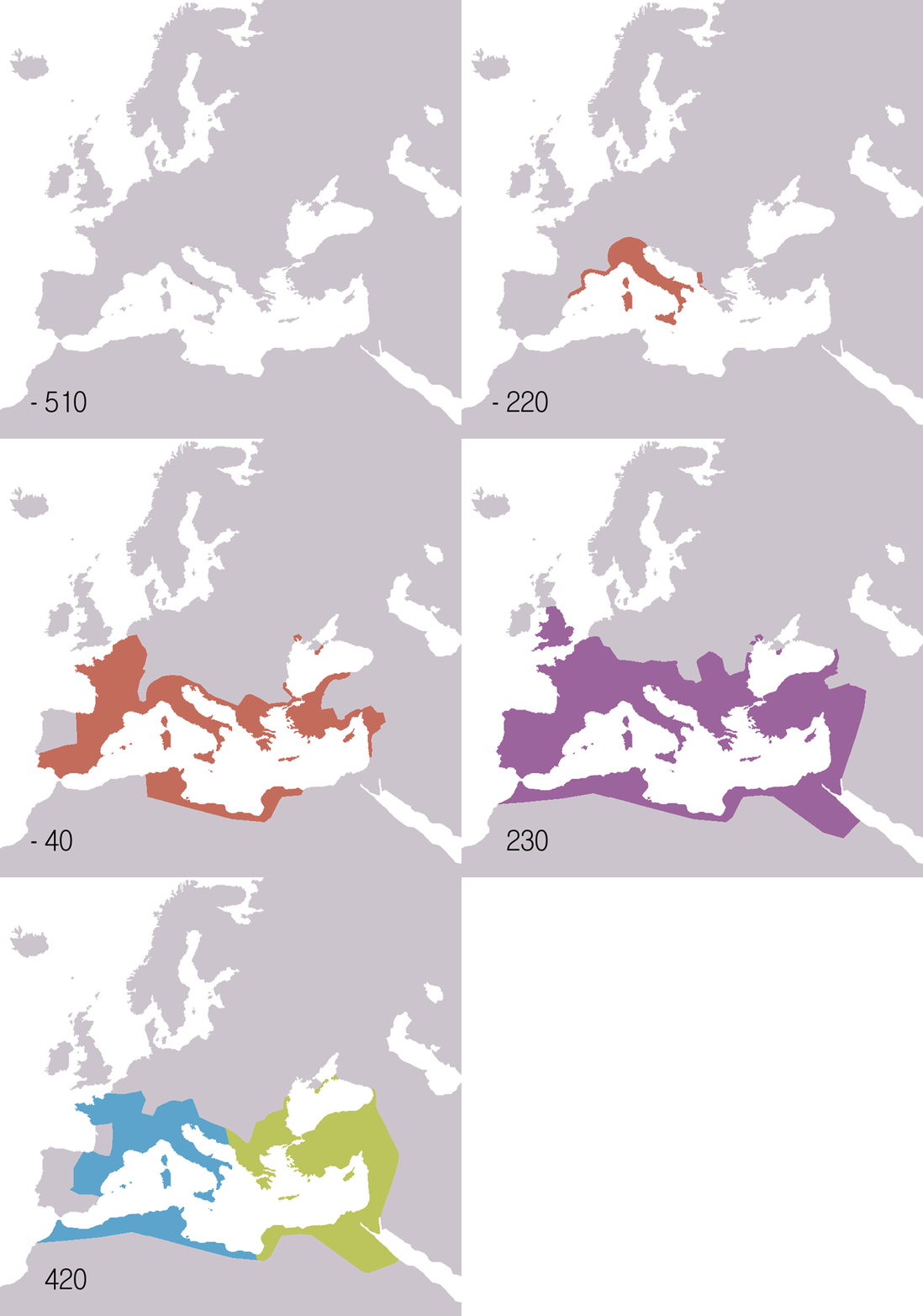
Animated map of the Roman Republic and Empire
Map of Roman territory
  Republic
  Principate/Dominate
  Eastern/Byzantine Empire
  Western Empire

The fall of the Western Roman Empire, also called the fall of the Roman Empire or the fall of Rome, was the loss of central political control in the Western Roman Empire, a process in which the Empire failed to enforce its rule, and its vast territory was divided among several successor polities. The Roman Empire lost the strengths that had allowed it to exercise effective control over its Western provinces; modern historians posit factors including the effectiveness and numbers of the army, the health and numbers of the Roman population, the strength of the economy, the competence of the emperors, the internal struggles for power, the religious changes of the period, and the efficiency of the civil administration. Increasing pressure from invading peoples outside Roman culture also contributed greatly to the collapse. Climatic changes and both endemic and epidemic disease drove many of these immediate factors.[1] The reasons for the collapse are major subjects of the historiography of the ancient world and they inform much modern discourse on state failure.[2][3][4]

In 376, a large migration of Goths and other non-Roman people, fleeing from the Huns, entered the Empire. Roman forces were unable to exterminate, expel or subjugate them (as was their normal practice). In 395, after winning two destructive civil wars, Theodosius I died. He left a collapsing field army, and the Empire divided between the warring ministers of his two incapable sons. Goths and other non-Romans became a force that could challenge either part of the Empire. Further barbarian groups crossed the Rhine and other frontiers. The armed forces of the Western Empire became few and ineffective, and despite brief recoveries under able leaders, central rule was never again effectively consolidated.

By 476, the position of Western Roman Emperor wielded negligible military, political, or financial power, and had no effective control over the scattered Western domains that could still be described as Roman. Barbarian kingdoms had established their own power in much of the area of the Western Empire. In 476, the Germanic barbarian king Odoacer deposed the last emperor of the Western Roman Empire in Italy, Romulus Augustulus, and the Senate sent the imperial insignia to the Eastern Roman Emperor Zeno.

While its legitimacy lasted for centuries longer and its cultural influence remains today, the Western Empire never had the strength to rise again. The Eastern Roman, or Byzantine, Empire, survived and remained for centuries an effective power of the Eastern Mediterranean, although it lessened in strength. While the loss of political unity and military control is universally acknowledged, the fall of Rome is not the only unifying concept for these events; the period described as late antiquity emphasizes the cultural continuities throughout and beyond the political collapse.

Historical approaches and modern syntheses

[edit]

Since 1776, when Edward Gibbon published the first volume of his The History of the Decline and Fall of the Roman Empire, Decline and Fall has been the theme around which much of the history of the Roman Empire has been structured. "From the eighteenth century onward," historian Glen Bowersock wrote, "we have been obsessed with the fall: it has been valued as an archetype for every perceived decline, and, hence, as a symbol for our own fears."[5]

Another paradigm of the period

[edit]

From at least the time of Henri Pirenne (1862–1935), scholars have described a continuity of Roman culture and political legitimacy long after 476.[6]: 5–7 [7] Pirenne postponed the demise of classical civilization to the 8th century. He challenged the notion that Germanic barbarians had caused the Western Roman Empire to end, and he refused to equate the end of the Western Roman Empire with the end of the office of emperor in Italy. He pointed out the essential continuity of the economy of the Roman Mediterranean even after the barbarian invasions, and suggested that only the Muslim conquests represented a decisive break with antiquity.

The more recent formulation of a historical period characterized as "Late Antiquity" emphasizes the transformations of ancient to medieval worlds within a cultural continuity.[8] In recent decades archaeologically based argument even extends the continuity in material culture and in patterns of settlement as late as the eleventh century.[9][10][11][12] Observing the political reality of lost control (and the attendant fragmentation of commerce, culture, and language), but also the cultural and archaeological continuities, the process has been described as a complex cultural transformation, rather than a fall.[13]: 34  "The perception of Late Antiquity has significantly changed: the period is no longer seen as an era of decline and crisis but as an epoch of metamorphosis in the Mediterranean region".[14][15]: 3, 4 

Timespan

[edit]
Routes taken by barbarian invaders of the Roman Empire during the Migration Period

A synthesis by Harper (2017) gave four decisive turns of events in the transformation from the height of the empire to the early Middle Ages:

  • The Antonine Plague that ended a long period of demographic and economic expansion, weakening but not toppling the empire.
  • The Crisis of the Third Century, in which natural climate change, renewed pandemic disease, and internal and external political instability led to the near-collapse of the imperial system. Its reconstitution included a new basis for the currency, an expanded professional government apparatus, emperors further distanced from their people, and, shortly, the rise of Christianity, a proselytizing, exclusive religion that anticipated the imminent end of the world.
  • The military and political failure of the West, in which mass migration from the Eurasian steppe overcame and dismembered the western part of an internally weakened empire. The eastern empire rebuilt itself again and began the reconquest of the West.
  • In the lands around the Mediterranean the Late Antique Little Ice Age and the Plague of Justinian created one of the worst environmental cataclysms in recorded history. The imperial system crumbled in the next couple of generations and then lost vast territories to the armies of Islam, a new proselytizing, exclusive religion that also looked forward to an imminent end time. The diminished and impoverished Byzantine rump state survived amid perpetual strife between and among the followers of Christianity and Islam.[16]

The loss of centralized political control over the West, and the lessened power of the East, are universally agreed, but the theme of decline has been taken to cover a much wider time span than the hundred years from 376. For Cassius Dio, the accession of the emperor Commodus in 180 CE marked the descent "from a kingdom of gold to one of rust and iron".[17] Since the age of humanism, the process of the Fall has been thought to have begun with Constantine the Great, or with the soldier emperors who seized power through command of the army from 235 through 284, or with Commodus, or even with Augustus.[14]

Gibbon was uncertain about when decline began. "In the first paragraph of his text, Gibbon wrote that he intended to trace the decline from the golden age of the Antonines"; later text has it beginning about A.D. 180 with the death of Marcus Aurelius; while in chapter 7, he pushes the start of the decline to about 52 B.C., the time of Julius Caesar and Pompey and Cicero.[18] Gibbon placed the western empire's end with the removal of the man Gibbon referred to as "the helpless Augustulus" in 476.[19]

Arnold J. Toynbee and James Burke argue that the entire Imperial era was one of steady decay of institutions founded in republican times. Theodor Mommsen excluded the imperial period from his Nobel Prize-winning History of Rome (1854–1856). As one convenient marker for the end, 476 has been used since Gibbon, but other key dates for the fall of the Roman Empire in the West include the Crisis of the Third Century, the Crossing of the Rhine in 406 (or 405), the sack of Rome in 410, and the death of Julius Nepos in 480.[20][page needed]

Causes, according to Gibbon (1776–1789)

[edit]

When Gibbon published his landmark work, it quickly became the standard text.[21][22] Peter Brown has written that "Gibbon's work formed the peak of a century of scholarship which had been conducted in the belief that the study of the declining Roman Empire was also the study of the origins of modern Europe".[23] Gibbon was the first to attempt an explanation of causes of a fall of empire.[23] Like other Enlightenment thinkers and British citizens of the age steeped in institutional anti-Catholicism, Gibbon held in contempt the Middle Ages as a priest-ridden, superstitious Dark Age. It was not until his own era, the "Age of Reason", with its emphasis on rational thought, it was believed, that human history could resume its progress.[24][25]

He began an ongoing controversy about the role of Christianity, but he gave great weight to other causes of internal decline and to attacks from outside the Empire.

The story of its ruin is simple and obvious; and, instead of inquiring why the Roman empire was destroyed, we should rather be surprised that it had subsisted so long. The victorious legions, who, in distant wars, acquired the vices of strangers and mercenaries, first oppressed the freedom of the republic, and afterwards violated the majesty of the purple. The emperors, anxious for their personal safety and the public peace, were reduced to the base expedient of corrupting the discipline which rendered them alike formidable to their sovereign and to the enemy; the vigour of the military government was relaxed, and finally dissolved, by the partial institutions of Constantine; and the Roman world was overwhelmed by a deluge of Barbarians.

— Edward Gibbon. The Decline and Fall of the Roman Empire, Chapter 38 "General Observations on the Fall of the Roman Empire in the West"

After a diligent inquiry, I can discern four principal causes of the ruin of Rome, which continued to operate in a period of more than a thousand years. I. The injuries of time and nature. II. The hostile attacks of the Barbarians and Christians. III. The use and abuse of the materials. And, IV. The domestic quarrels of the Romans.

— Edward Gibbon. The Decline and Fall of the Roman Empire, Chapter 71 "Four Causes of Decay and Destruction."

Contemporary views

[edit]

Modern historiography diverges from Gibbon.[26] While most of his ideas are no longer accepted in totality, they have been foundational to later discourse and the modern synthesis with archaeology, epidemiology, climatic history, genetic science,[27] and many more new sources of history beyond the documentary sources which were all that was available to Gibbon.[14][28]

While Alexander Demandt enumerated 210 different theories on why Rome fell,[29] twenty-first century scholarship classifies the primary possibilities more concisely:[30]

Climatic crisis

[edit]

A recent summary interprets disease and climate change as important drivers of the political collapse of the empire. There was a Roman climatic optimum from about 200 BCE to 150 CE, when lands around the Mediterranean were generally warm and well-watered. This made agriculture prosperous, army recruitment easy, and the collection of taxes straightforward. From about 150, the climate became on average somewhat worse for most of the inhabited lands around the Mediterranean.[31][32] After about 450, the climate worsened further in the Late Antique Little Ice Age that may have directly contributed to the variety of factors that brought Rome down.[33]

The Roman Empire was built on the fringes of the tropics. Its roads and seas, which produced an abundance of trade, also unknowingly created an interconnected disease ecology that unleashed the evolution and spread of pathogens.[34] Pandemics contributed to massive demographic changes, economic crises, and food shortages in the crisis of the third century.[35][36][37] Heavy mortality in 165–180 from the Antonine Plague seriously impaired attempts to repel Germanic invaders, but the legions generally held or at least speedily re-instated the borders of the Empire.[38]

Map of the Roman Empire in the early second century
Roman Empire in the early second century

Migrational crisis

[edit]

From 376, massive populations moved into the Empire, driven by the Huns who themselves may have been driven by climate change in the Eurasian steppe.[1][39] These barbarian invasions led ultimately to barbarian kingdoms over much of the former territory of the Western Empire. But the final blow came only with the Late Antique Little Ice Age and its aftermath,[33] when Rome was already politically fragmented and materially depleted.[40]

Political crisis

[edit]

Aurelian reunited the empire in 274, and from 284 Diocletian and his successors reorganized it with more emphasis on the military. John the Lydian, writing over two centuries later, reported that Diocletian's army at one point totaled 389,704 men, plus 45,562 in the fleets, and numbers may have increased later.[41] With the limited communications of the time, both the European and the Eastern frontiers needed the attention of their own supreme commanders. Diocletian tried to solve this problem by re-establishing an adoptive succession with a senior (Augustus) and junior (Caesar) emperor in each half of the Empire, but this system of tetrarchy broke down within one generation, and the biological families of emperors again became the expected successors to the throne, with generally unfortunate results. Thereafter civil war was the main method of establishing new imperial regimes. Although Constantine the Great (in office 306 to 337) again re-united the Empire, his sons' generation fought destructive civil wars between themselves and with usurpers. Towards the end of the fourth century the need for division was generally accepted. From then on, the Empire existed in constant tension between the need for two emperors and their mutual mistrust.[42]

Until late in the fourth century, the united Empire retained sufficient power to launch powerful attacks against its enemies in Germania and in the Sasanian Empire. Receptio of barbarians became widely practised: imperial authorities admitted potentially hostile groups into the Empire, split them up, and allotted to them lands, status, and duties within the imperial system.[43] In this way many groups provided unfree workers for Roman landowners, and recruits ("laeti") for the Roman army. Sometimes their leaders became military officers or civil office holders. Normally, the Romans managed the process carefully, with sufficient military force on hand to ensure compliance. Cultural assimilation, into the ways of Rome and the expectations of its citizenry, followed—typically over the next generation or two.

Map of the Roman Empire under the Tetrarchy, showing the dioceses and the four Tetrarchs' zones of influence
The Roman Empire under the Tetrarchy, showing the dioceses and the four Tetrarchs' zones of responsibility

Financial crisis

[edit]

The Empire suffered multiple serious crises during the third century. The rising Sassanid Empire inflicted three crushing defeats on Roman field armies and remained a potent threat for centuries.[42] Other disasters included repeated civil wars, barbarian invasions, and more mass-mortality in the Plague of Cyprian (from 250 onwards). For a short period, the Empire split into a Gallic Empire in the West (260–274), a Palmyrene Empire in the East (260–273), and a central Roman rump state; in 271, Rome abandoned the province of Dacia on the north of the Danube. The Rhine/Danube frontier also came under more effective threats from larger barbarian groupings, which had developed improved agriculture and increased their populations.[44][45] The average stature of the population in the West suffered a serious decline in the late second century; the population of Northwestern Europe did not recover, though the Mediterranean regions did.[46]

The Empire survived the "Crisis of the Third Century", directing its economy successfully towards defense, but survival came at the price of a more centralized and bureaucratic state. Excessive military expenditure, coupled with civil wars due to unstable succession, caused increased taxes to the detriment of the industry.[47] Under Gallienus (Emperor from 253 to 268) the senatorial aristocracy ceased joining the ranks of the senior military commanders. Its typical members lacked interest in military service, and showed incompetence at command.[48][49]

The divided Empire in 271 CE

Under Constantine, the cities lost their revenue from local taxes, and under Constantius II (r. 337–361) their endowments of property.[50] This worsened the existing difficulty in keeping the city councils up to strength, and the services provided by the cities were scamped or abandoned.[50] Public building projects had declined since the second century. There is no evidence of state participation in, or support for, restoration and maintenance of temples and shrines; rather, restorations had to be funded and accomplished privately, which limited what was done.[12]: 36–39  A further financial abuse was Constantius's habit of granting to his immediate entourage the estates of persons condemned for treason and other capital crimes. This practice reduced future, though not immediate, income; those close to the emperor also gained a strong incentive to encourage his suspicion of conspiracies.[50]

Social crisis

[edit]

The new supreme rulers disposed of the legal fiction of the early Empire (seeing the emperor as but the first among equals); emperors from Aurelian (r. 270–275) onwards openly styled themselves as dominus et deus, "lord and god", titles appropriate for a master-slave relationship.[51] An elaborate court ceremonial developed, and obsequious flattery became the order of the day. Under Diocletian, the flow of direct requests to the emperor rapidly reduced, and soon ceased altogether. No other form of direct access replaced them, and the emperor received only information filtered through his courtiers.[52] However, as Sabine MacCormack described, the court culture that developed with Diocletian was still subject to pressure from below. Imperial proclamations were used to stress the traditional limitations of the imperial office, while imperial ceremonies "left room for consensus and popular participation".[53]

Official cruelty, supporting extortion and corruption, may also have become more commonplace;[54] one example being Constantine's law that slaves who betrayed their mistress's confidential remarks should have molten lead poured down their throats.[55][56] While the scale, complexity, and violence of government were unmatched,[57] the emperors lost control over their whole realm insofar as that control came increasingly to be wielded by anyone who paid for it.[58] Meanwhile, the richest senatorial families, immune from most taxation, engrossed more and more of the available wealth and income[59][60] while also becoming divorced from any tradition of military excellence. One scholar identifies a great increase in the purchasing power of gold, two and a half fold from 274 to the later fourth century. This may be an index of growing economic inequality between a gold-rich elite and a cash-poor peasantry.[61] "Formerly, says Ammianus, Rome was saved by her austerity, by solidarity between rich and poor, by contempt for death; now she is undone by her luxury and greed (Amm. xxxi. 5. 14 and xxii. 4.). Salvianus backs up Ammianus by affirming that greed (avaritia) is a vice common to nearly all Romans".[62][further explanation needed] However, Lucius Calpurnius Piso Frugi (consul 133 BC) had already dated the start of Rome's moral decline to 154 BCE.[63]

Within the late Roman military, many recruits and even officers had barbarian origins. Soldiers are recorded as using possibly-barbarian rituals, such as elevating a claimant on shields.[64] Some scholars have seen this as an indication of weakness. Others disagree, seeing neither barbarian recruits nor new rituals as causing any problem with the effectiveness or loyalty of the army, at least while that army was effectively led, disciplined, trained, paid, and supplied by officers who identified as Roman.[65]

Geography

[edit]

A. H. M. Jones has pointed out that the earlier scholarly views are Western.[66] Most of the weaknesses discussed by scholars were "common to both halves of the empire", with Christianity even more prevalent in the East than the West. Religious disputes were bitter, bureaucracy corrupt and extortionate, it had a caste system, and land fell out of use in the East just as it had in the West.[67] Yet the East stood its ground in the fifth century, fought back in the sixth, and even recovered some territory in the seventh. The East had only one apparent advantage: geography. It was less vulnerable, strategically, than the West. The narrowest sea crossing to its core territories was protected from the northern barbarians by the fortifications and the sea and land forces of Constantinople, while the European frontier from the mouth of the Rhine to that of the Danube is some 2000 kilometres great-circle distance and could be crossed with much less difficulty.[68] "The devastations of the barbarians impoverished and depopulated the [Western] frontier provinces, and their unceasing pressure imposed on the empire a burden of defense which overstrained its administrative machinery and its economic resources... [playing] a major part in the fall of the West".[67]

Height of power, systematic weaknesses as direct causes

[edit]

The Roman Empire reached its greatest geographical extent under Trajan (r. 98–117), who ruled a prosperous state that stretched from Armenia to the Atlantic Ocean. The Empire had large numbers of trained, supplied, and disciplined soldiers, drawn from a growing population. It had a comprehensive civil administration based in thriving cities with effective control over public finances. The literate elite considered theirs to be the only worthwhile form of civilization, giving the Empire ideological legitimacy and a cultural unity based on comprehensive familiarity with Greek and Roman literature and rhetoric. The Empire's power allowed it to maintain extreme differences of wealth and status.[69] Its wide-ranging trade networks permitted even modest households to use goods made by professionals far away.[70]

The empire had both strength and resilience. Its financial system allowed it to raise significant taxes which, despite endemic corruption, supported a large regular army with logistics and training. The cursus honorum, a standardized series of military and civil posts organised for ambitious aristocratic men, ensured that powerful noblemen had the opportunity to become familiar with military and civil command and administration. At a lower level within the army, connecting the aristocrats at the top with the private soldiers, a large number of centurions were well-rewarded, literate, and responsible for training, discipline, administration, and leadership in battle.[71] City governments with their own properties and revenues functioned effectively at a local level; membership of city councils involved lucrative opportunities for independent decision-making, and, despite its obligations, became seen as a privilege. Under a series of emperors who each adopted a mature and capable successor, the Empire did not require civil wars to regulate the imperial succession. Requests could be submitted directly to the better emperors, and the answers had the force of law, putting the imperial power directly in touch with even humble subjects.[72] The cults of polytheist religion were hugely varied, but none claimed that theirs was the only truth. Their followers displayed mutual tolerance, producing a polyphonous religious harmony.[73] Religious strife was rare after the suppression of the Bar Kokhba revolt in 136, after which the devastated Judaea ceased to be a major centre for Jewish unrest.

Nevertheless, it remained a culture based on an early subsistence economy, with only ineffective inklings of a germ theory of disease. Despite its aqueducts, the water supply did not allow good hygiene. Sewage was disposed of on the streets, in open drains, or by scavenging animals. Even in the Roman Climatic Optimum, local harvest failures causing famines were always a possibility.[1][page needed] And even in good times, Roman women needed to have, on average, six children each in order to maintain the population.[74] Good nourishment and bodily cleanliness were privileges of the rich, advertised by their firm tread, healthy skin color, and lack of the "dull smell of the underbathed}}.[75] Infant mortality was very high, and diarrhoeal diseases were a major cause of death. Malaria was endemic in many areas, notably in the city of Rome itself, possibly encouraged by the enthusiasm of rich Romans for water features in their gardens.[1][page needed]

Rise of Christianity, possible decline of the armed forces

[edit]

In 313, Constantine the Great declared official toleration of Christianity. This was followed over the ensuing decades by the search for a definition of Christian orthodoxy all could agree upon. Creeds were developed, but Christianity has never agreed upon an official version of its Bible or its doctrine; instead it has had many different manuscript traditions.[76] Christianity's disputes may have effected decline. Official and private action was taken against heterodox Christians (heretics) from the fourth century up to the modern era. Limited action against pagans, who were mostly ignored, was based on the contempt that accompanied Christianity's sense of triumph after Constantine.[77] Christianity opposed sacrifice and magic, and Christian emperors made laws that favored Christianity. Constantine's successors generally continued this approach, and by the end of the fourth century, Christianity had become the religion of any ambitious civil official.

The wealth of the Christian Church increased dramatically in the fifth century. Immense resources, both public and private, were used for building churches, storage barns for the grain used for charity, new hospitals for the poor, and in support of those in religious life without other income.[78] Bishops in wealthy cities were thus able to offer patronage in the long-established manner of Roman aristocrats. Ammianus described some who "enriched from the offerings of matrons, ride seated in carriages, wearing clothing chosen with care, and serve banquets so lavish that their entertainments outdo the tables of kings".

But the move to Christianity probably had no significant effects on public finances.[44] The large temple complexes, with professional full-time priests, festivals, and large numbers of sacrifices (which became free food for the masses), had also been expensive to maintain. They had already been negatively impacted by the empire's financial struggles in the third century.[79]: 353 [80]: 60  The numbers of clergy, monks, and nuns increased to perhaps half the size of the actual army, and they have been considered as a drain on limited manpower.[81][82]

The numbers and effectiveness of the regular soldiers may have declined during the fourth century. Payrolls were inflated, so that pay could be diverted and exemptions from duty sold. The soldiers' opportunities for personal extortion were multiplied by residence in cities, while their effectiveness was reduced by concentration on extortion instead of military exercises.[83] However, extortion, gross corruption, and occasional ineffectiveness[84] were not new to the Roman army. There is no consensus whether its effectiveness significantly declined before 376.[85] Ammianus Marcellinus, himself a professional soldier, repeats longstanding observations about the superiority of contemporary Roman armies being due to training and discipline, not to individual size or strength.[86] He also accuses Valentinian I of being the first emperor to increase the arrogance of the military, raising their rank and power to excess, severely punishing the minor crimes of the common soldiers, while sparing those of higher rank who felt able to commit shameful and monstrous crimes.[87] Despite a possible decrease in the Empire's ability to assemble and supply large armies,[88] Rome maintained an aggressive and potent stance against perceived threats almost to the end of the fourth century.[89]

313–376: civil and foreign wars

[edit]

Constantine settled Franks on the lower left bank of the Rhine. Their communities required a line of fortifications to keep them in check, indicating that Rome had lost almost all local control.[54] Under Constantius, bandits came to dominate areas such as Isauria, which were well within the empire.[90] The tribes of Germania also became more populous and more threatening.[44] In Gaul, which did not really recover from the invasions of the third century, there was widespread insecurity and economic decline in the 300s,[44] perhaps worst in Armorica. By 350, after decades of pirate attacks, virtually all villas in Armorica were deserted. Local use of money ceased around 360.[91] Repeated attempts to economize on military expenditure included billeting troops in cities, where they could less easily be kept under military discipline and could more easily extort from civilians.[92] Except in the rare case of a determined and incorruptible general, these troops proved ineffective in action and dangerous to civilians.[93] Frontier troops were often given land rather than pay. As they farmed for themselves, their direct costs diminished, but so did their effectiveness, and their pay gave much less stimulus to the frontier economy.[94] However, except for the provinces along the lower Rhine, the agricultural economy was generally doing well.[95]

On January 18 350, the imperial magister officiorum gave a banquet in Augustodunum while his master, Western Emperor Constans, was away hunting. During the feast Magnus Magnentius, commander of the imperial household troops, appeared in an imperial purple toga and announced himself to be the new Emperor. Constans was soon murdered and Magnentius took over most of his western domains. He made peace overtures to Constantius in the East, but these failed. In the ensuing bloody civil war Magnentius marched against Constantius with as many troops as he could mobilize, stripping the Rhine frontier of its most effective troops. Magnentius died and so did many of his men. Meanwhile, Constantius sent messages to the German tribes east of the Rhine, inviting them to attack Gaul, which they did. In the next few years a strip some 64 kilometres (40 mi) wide to the west of the Rhine was occupied by the Germans, and a further 190 kilometres (120 mi) into Gaul the surviving population and garrisons had fled.[96]

Solidus, obverse showing Julian as philosopher, reverse symbolizing the strength of the Roman army
Solidus of Julian, c. 361. Obverse: Julian with the beard appropriate to a Neoplatonic philosopher. Inscription: FL(AVIVS) CL(AVDIVS) IVLIANVS PP(=Pater Patriae, "father of the nation") AVG(=Augustus). Reverse: an armed Roman, military standard in one hand, a captive in the other. Inscription: VIRTVS EXERCITVS ROMANORVM, "the bravery/virtue of the Roman army"; the mint mark is SIRM, Sirmium.

Julian (r. 360–363) won victories against Germans who had invaded Gaul. He launched a drive against official corruption, which allowed the tax demands in Gaul to be reduced to one-third of their previous amount, while all government requirements were still met.[97] In civil legislation, Julian was notable for his pro-pagan policies. Julian lifted the ban on sacrifices, restored and reopened temples, and dismantled the privileged tax status and revenue concessions of the Christians. He gave generous tax remissions to the cities which he favored, and disfavor to those who remained Christian.[98]: 62–65 [99] Julian ordered toleration of varieties of Christianity banned as heretical by Constantius;[98] possibly, he would not have been able to persecute effectively such a large and powerful group as Christians had now become.: 62 [100]: 345–346 [101]: 62 

Julian prepared for civil war against Constantius, who again encouraged the Germans to attack Gaul. However Julian's campaigns had been effective and only one small Alemannic raid, speedily dealt with by Julian, resulted.[96] Constantius died before any serious fighting and Julian was acknowledged as master of the entire Empire. He launched an expensive campaign against the Sasanian Persians.[50] He succeeded in marching to the Sassanid capital of Ctesiphon, but, at the suggestion of a Persian agent, burned his boats and supplies to show resolve in continuing operations. The Sassanids then burned crops so the Roman army had no food. Finding himself cut off without supplies in enemy territory, Julian began a land retreat, and during the Battle of Samarra, he was mortally wounded.[102][98]: 74 

Julian's successor Jovian, acclaimed by a demoralized army, began his brief reign (363–364) while trapped in Mesopotamia without supplies. To purchase safe passage home, he had to concede areas of northern Mesopotamia, including the strategically important fortress of Nisibis. This fortress had been Roman since before the Peace of Nisibis in 299.[102]

The brothers Valens (r. 364–378) and Valentinian I (r. 364–375) energetically tackled the threats of barbarian attacks on all the Western frontiers.[103] They also tried to alleviate the burdens of taxation, which had risen continuously over the previous forty years; Valens in the East reduced the tax demand by half in his fourth year.[104] Both of them were Christians, and re-confiscated the temple lands which Julian had restored. But they were generally tolerant of other beliefs. Valentinian in the West refused to intervene in Christian controversy. In the East, Valens had to deal with Christians who did not conform to his ideas of orthodoxy, and persecution formed part of his response. He tolerated paganism, even keeping some of Julian's associates in their trusted positions. He confirmed the rights and privileges of the pagan priests, and confirmed the right of pagans to be the exclusive caretakers of their temples.[105]

Valentinian died of an apoplexy while shouting at envoys of Germanic leaders. His successors in the West were children, his sons Gratian (r. 375–383) and Valentinian II (r. 375–392). Gratian, "alien from the art of government both by temperament and by training", removed the Altar of Victory from the Senate House. He also rejected the pagan title of Pontifex Maximus.[106]

376–395: invasions, civil wars, and religious discord

[edit]

Battle of Adrianople

[edit]

In 376, the East faced an enormous barbarian influx across the Danube, mostly Goths, who were fleeing from the Huns. They were exploited by corrupt officials rather than effectively relieved and resettled, and they took up arms and were joined by more Goths and some Alans and Huns. Valens was in Asia with his main field army preparing for an assault on the Sasanian Empire. Redirection of the army and its logistic support would have required time, and Gratian's armies were distracted by Germanic invasions across the Rhine. In 378, Valens attacked the invaders with the Eastern field army, now perhaps 20,000 men, probably much fewer than the forces that Julian had led into Mesopotamia a little over a decade before, and possibly only 10% of the soldiers nominally available in the Danube provinces.[107] In the Battle of Adrianople (9 August 378), Valens lost much of that army and his own life. All of the Balkan provinces were thus exposed to raiding, without effective response from the remaining garrisons who were "more easily slaughtered than sheep".[107] Cities were able to hold their own defensive walls against barbarians who had no siege equipment, therefore the cities generally remained intact, although the countryside suffered.[108]

Partial recovery in the Balkans, internal corruption and financial desperation

[edit]

Gratian appointed a new Augustus, a proven general from Hispania called Theodosius. During the next four years, he partially re-established the Roman position in the East.[109][110] These campaigns depended on effective imperial coordination and mutual trust—between 379 and 380, Theodosius controlled not only the Eastern empire, but also, by agreement, the diocese of Illyricum.[111] Theodosius was unable to recruit enough Roman troops, relying on barbarian warbands without Roman military discipline or loyalty. (In contrast, during the Cimbrian War, the Roman Republic, controlling a smaller area than the western Empire, had been able to reconstitute large regular armies of citizens after greater defeats than Adrianople. That war had ended with the near-extermination of the invading barbarian supergroups, each supposed to have more than 100,000 warriors.[112])

The final Gothic settlement was acclaimed with relief,[110] even the official panegyrist admitting that these Goths could not be expelled or exterminated, nor reduced to unfree status.[113] Instead they were either recruited into the imperial forces, or settled in the devastated provinces along the south bank of the Danube, where the regular garrisons were never fully re-established.[114] In some later accounts, and widely in recent work, this is regarded as a treaty settlement, the first time that barbarians were given a home within the Empire, in which they retained their political and military cohesion.[115] No formal treaty is recorded, nor details of whatever agreement was actually made. When the Goths are next mentioned in Roman records, they have different leaders and are soldiers of a sort.[116] In 391, Alaric, a Gothic leader, rebelled against Roman control. Goths attacked the emperor himself, but within a year Alaric was accepted as a leader of Theodosius's Gothic troops and this rebellion was over.[117]

Theodosius's financial position must have been difficult, since he had to pay for expensive campaigning from a reduced tax base. The business of subduing barbarian warbands also demanded substantial gifts of precious metal.[118] At least one extra levy provoked desperation and rioting, in which the emperor's statues were destroyed.[119] Nevertheless, he is represented as financially generous as emperor, though frugal in his personal life.[120] By the end of the 380s, Theodosius and the court were in Mediolanum, and northern Italy was experiencing a period of prosperity for the great landowners who took advantage of the court's need for food, "turning agrarian produce into gold", while repressing and misusing the poor who grew it and brought it in.[121] Paulinus the Deacon, notary of Ambrose the bishop of Milan, described these men as creating a court where "everything was up for sale".[122] Ambrose himself preached a series of sermons aimed at his wealthy constituents, asserting that avarice leads to a breakdown in society.[123]

For centuries, Theodosius was regarded as a champion of Christian orthodoxy who decisively stamped out paganism. His predecessors Constantine, Constantius II, and Valens had all been semi-Arians, whereas Theodosius supported Nicene Christianity which eventually became the orthodox version of Christology for most later Christian churches—his Edict of Thessalonica described Arian Christians as "foolish madmen". Therefore, as far as Ambrose and the Christian literary tradition that followed him were concerned, Theodosius deserved most of the credit for the final triumph of Christianity.[124] Modern scholars see this as a Christian interpretation of history.[125][126][127][128] Theodosius did not stamp out paganism, which continued into the seventh century.[126][129][128][a]

Civil wars

[edit]

Theodosius had to face a powerful usurper in the West; Magnus Maximus declared himself Emperor in 383, stripped troops from the outlying regions of Roman Britain (probably replacing some with federate chieftains and their war-bands) and invaded Gaul. His troops killed Gratian and he was accepted as Augustus in the Gallic provinces, where he was responsible for the first official executions of Christian heretics.[136] To compensate the Western court for the loss of Gaul, Hispania, and Britannia, Theodosius ceded the diocese of Dacia and the diocese of Macedonia to their control. In 387 Maximus invaded Italy, forcing Valentinian II to flee to the East, where he accepted Nicene Christianity. Maximus boasted to Ambrose of the numbers of barbarians in his forces, and hordes of Goths, Huns, and Alans followed Theodosius.[137] Maximus negotiated with Theodosius for acceptance as Augustus of the West, but Theodosius refused, gathered his armies, and counterattacked, winning the civil war in 388. There were heavy troop losses on both sides of the conflict. Later Welsh legend has Maximus's defeated troops resettled in Armorica, instead of returning to Britannia, and by 400, Armorica was controlled by Bagaudae rather than by imperial authority.[138]

Theodosius restored Valentinian II, still a very young man, as Augustus in the West. He also appointed Arbogast, a pagan general of Frankish origin, as Valentinian's commander-in-chief and guardian. Valentinian quarreled in public with Arbogast, failed to assert any authority, and died, either by suicide or by murder, at the age of 21. Arbogast and Theodosius failed to come to terms and Arbogast nominated an imperial official, Eugenius (r. 392–394), as emperor in the West. Eugenius made some modest attempts to win pagan support,[119] and with Arbogast led a large army to fight another destructive civil war. They were defeated and killed at the Battle of the Frigidus, which was attended by further heavy losses; especially among the Gothic federates of Theodosius. The north-eastern approaches to Italy were never effectively garrisoned again.[139]

The Eastern and Western Roman Empire at the death of Theodosius I in 395

Theodosius died a few months later in early 395, leaving his young sons Honorius (r. 393–423) and Arcadius (r. 383–408) as emperors. In the immediate aftermath of Theodosius's death, the magister militum Stilicho, married to Theodosius's niece, asserted himself in the West as the guardian of Honorius and commander of the remains of the defeated Western army. He also claimed control over Arcadius in Constantinople, but Rufinus, magister officiorum on the spot, had already established his own power there. Henceforward the Empire was not under the control of one man, until much of the West had been permanently lost.[140] Neither Honorius nor Arcadius ever displayed any ability either as rulers or as generals, and both lived as the puppet rulers of their courts.[141] Stilicho tried to reunite the Eastern and Western courts under his personal control, but in doing so achieved only the continued hostility of all of Arcadius's successive supreme ministers.

Military, financial, and political ineffectiveness: the process of failure

[edit]

The ineffectiveness of Roman military responses during Stilicho's rule and afterwards has been described as "shocking".[142] There is little evidence of indigenous field forces or of adequate training, discipline, pay, or supply for the barbarians who formed most of the available troops. Local defence was occasionally effective, but was often associated with withdrawal from central control and taxes. In many areas, barbarians under Roman authority attacked culturally-Roman "Bagaudae".[143][144][145] The fifth-century Western emperors, with brief exceptions, were individuals incapable of ruling effectively or even of controlling their own courts.[141] Those exceptions were responsible for brief, but remarkable resurgences of Roman power.

Corruption, in this context the diversion of finance from the needs of the army, may have contributed greatly to the Fall. The rich senatorial aristocrats in Rome itself became increasingly influential during the fifth century; they supported armed strength in theory, but did not wish to pay for it or to offer their own workers as army recruits.[146][147] They did, however, pass large amounts of money to the Christian Church.[148] At a local level, from the early fourth century, the town councils lost their property and their power, which often became concentrated in the hands of a few local despots beyond the reach of the law.[149]

395–406: Stilicho

[edit]

Without an authoritative ruler, the Balkan provinces fell rapidly into disorder. Alaric was disappointed in his hopes for promotion to magister militum after the battle of the Frigidus. He led armed Gothic tribesmen in a revolt and established himself as an independent power, burning the countryside as far as the walls of Constantinople.[150] Alaric's ambitions for long-term Roman office were never quite acceptable to the Roman imperial courts, and his men could never settle long enough to farm in any one area. They showed no inclination to leave the Empire and face the Huns from whom they had fled in 376. Meanwhile, the Huns were still stirring up further migrations, with migrating tribes often attacking the Roman Empire in turn. Alaric's group was never destroyed nor expelled from the Empire, nor acculturated under effective Roman domination.[143][144][151]

Stilicho's attempts to unify the Empire, revolts, and invasions

[edit]
The Monza diptych, Stilicho with his family
An ivory diptych, thought to depict Stilicho (right) with his wife Serena and son Eucherius, ca. 395 (Monza Cathedral)

Alaric took his Gothic army on what Stilicho's propagandist Claudian described as a "pillaging campaign" that began first in the East.[152] Alaric's forces made their way along the coast to Athens, where he sought to force a new peace upon the Romans.[152] His march in 396 passed through Thermopylae. Stilicho sailed from Italy to Roman Greece with his remaining mobile forces, posing a clear threat to Rufinus's control of the Eastern empire. The bulk of Rufinus's forces were occupied with Hunnic incursions in Asia Minor and Syria, leaving Thracia undefended. Claudian reports that only Stilicho's attack stemmed the plundering, as he pushed Alaric's forces north into Epirus.[153] Burns' interpretation is that Alaric and his men had been recruited by Rufinus's Eastern regime, and sent to Thessaly to stave off Stilicho's threat.[139] No battle took place. Zosimus adds that Stilicho's troops destroyed and pillaged too, and let Alaric's men escape with their plunder.[b]

Many of Stilicho's Eastern forces wanted to go home and he had to let them go (though Claudian claims that he did so willingly).[154] Some went to Constantinople under the command of one Gainas, a Goth with a large Gothic following. On arrival, Gainas murdered Rufinus, and was appointed magister militum for Thrace by Eutropius, the new supreme minister and the only eunuch consul of Rome. Eutropius reportedly controlled Arcadius "as if he were a sheep".[b] Stilicho obtained a few more troops from the German frontier and continued to campaign ineffectively against the Eastern empire; again he was successfully opposed by Alaric and his men. During the next year, 397, Eutropius personally led his troops to victory over some Huns who were marauding in Asia Minor. With his position thus strengthened, he declared Stilicho a public enemy, and he established Alaric as magister militum per Illyricum. A poem by Synesius advises the emperor to display manliness and remove a "skin-clad savage" (probably Alaric) from the councils of power and his barbarians from the Roman army. We do not know if Arcadius ever became aware of the existence of this advice, but it had no recorded effect.[155] Synesius, from a province suffering the widespread ravages of a few poor but greedy barbarians, also complained of "the peacetime war, one almost worse than the barbarian war and arising from military indiscipline and the officer's greed."[156]

406 representation of Honorius attended by a winged Victory on a globe and bearing a labarum with the words In nomine XRI vincas semper, lit. 'In the name of Christ thou wilt always conquer'
A contemporary depiction of Honorius on a consular diptych issued by Anicius Petronius Probus to celebrate Probus's consulship in 406, now in the Aosta museum

The magister militum in the Diocese of Africa declared for the East and stopped the supply of grain to Rome.[139] Italy had not fed itself for centuries and could not do so now. In 398, Stilicho sent his last reserves, a few thousand men, to re-take the Diocese of Africa. He strengthened his position further when he married his daughter Maria to Honorius. Throughout this period Stilicho, and all other generals, were desperately short of recruits and supplies for them.[157] In 400, Stilicho was charged to press into service any "laetus, Alamannus, Sarmatian, vagrant, son of a veteran" or any other person liable to serve.[158] He had reached the bottom of his recruitment pool.[159] Though personally not corrupt, he was very active in confiscating assets;[b] the financial and administrative machine was not producing enough support for the army.

In 399, Tribigild's rebellion in Asia Minor allowed Gainas to accumulate a significant army (mostly Goths), become supreme in the Eastern court, and execute Eutropius.[160] He now felt that he could dispense with Alaric's services and he nominally transferred Alaric's province to the West. This administrative change removed Alaric's Roman rank and his entitlement to legal provisioning for his men, leaving his army—the only significant force in the ravaged Balkans—as a problem for Stilicho.[161] In 400, the citizens of Constantinople revolted against Gainas and massacred as many of his people, soldiers and their families, as they could catch. Some Goths at least built rafts and tried to cross the strip of sea that separates Asia from Europe; the Roman navy slaughtered them.[162] By the beginning of 401, Gainas' head rode a pike through Constantinople while another Gothic general became consul.[163] Meanwhile, groups of Huns started a series of attacks across the Danube, and the Isaurians marauded far and wide in Anatolia.[164]

In 401 Stilicho travelled over the Alps to Raetia, to scrape up further troops.[165] He left the Rhine defended only by the "dread" of Roman retaliation, rather than by adequate forces able to take the field.[165] Early in spring, Alaric, probably desperate,[166] invaded Italy, and he drove Honorius westward from Mediolanum, besieging him in Hasta Pompeia in Liguria. Stilicho returned as soon as the passes had cleared, meeting Alaric in two battles (near Pollentia and Verona) without decisive results. The Goths, weakened, were allowed to retreat back to Illyricum where the Western court again gave Alaric office, though only as comes and only over Dalmatia and Pannonia Secunda rather than the whole of Illyricum.[167] Stilicho probably supposed that this pact would allow him to put Italian government into order and recruit fresh troops.[157] He may also have planned with Alaric's help to relaunch his attempts to gain control over the Eastern court.[168]

Chi-rho pendant of Empress Maria, daughter of Stilicho and wife of Honorius.
Chi-rho pendant of Empress Maria, daughter of Stilicho, and wife of Honorius, now in the Louvre, Paris. The pendant reads, around a central cross (clockwise):
HONORI
MARIA
SERHNA
VIVATIS
STELICHO.
The letters form a Christogram.

However, in 405, Stilicho was distracted by a fresh invasion of Northern Italy. Another group of Goths fleeing the Huns, led by one Radagaisus, started the War of Radagaisus and devastated the north of Italy for six months before Stilicho could muster enough forces to take the field against them. Stilicho recalled troops from Britannia, and the depth of the crisis was shown when he urged all Roman soldiers to allow their personal slaves to fight beside them.[168] His forces, including Huns and Alans, may in the end have totalled rather less than 15,000 men.[169] Radagaisus was defeated and executed, while 12,000 prisoners from the defeated horde were drafted into Stilicho's service.[169] Stilicho continued negotiations with Alaric; Flavius Aetius, son of one of Stilicho's major supporters, was sent as a hostage to Alaric in 405.

In 406, Stilicho heard of new invaders and rebels who had appeared in the northern provinces. He insisted on making peace with Alaric, probably on the basis that Alaric would prepare to move either against the Eastern court or against the rebels in Gaul. The Senate deeply resented peace with Alaric.

In 407, Alaric marched into Noricum and demanded a large payment for his expensive efforts in Stilicho's interests. The senate, "inspired by the courage, rather than the wisdom, of their predecessors,"[170] preferred war. One senator famously declaimed Non est ista pax, sed pactio servitutis ("This is not peace, but a pact of servitude").[171] Stilicho paid Alaric four thousand pounds of gold nevertheless.[172] Stilicho sent Sarus, a Gothic general, over the Alps to face the usurper Constantine III. Sarus lost this campaign and barely escaped, having to leave his baggage to the bandits who now infested the Alpine passes.[172]

The empress Maria, daughter of Stilicho, died in 407 or early 408 and her sister Aemilia Materna Thermantia married Honorius. In the East, Arcadius died on 1 May 408 and was replaced by his son Theodosius II. Stilicho seems to have planned to march to Constantinople, and to install there a regime loyal to himself.[173] He may also have intended to give Alaric a senior official position, and to send him against the rebels in Gaul. Before he could do so, while he was away at Ticinum at the head of a small detachment, a bloody coup d'état against his supporters took place at Honorius's court. It was led by Stilicho's own creature, one Olympius.[174]

408–410: end of effective regular field armies, starvation in Italy, sack of Rome

[edit]

Stilicho's fall and Alaric's reaction

[edit]

Stilicho had news of the coup at Bononia, where he was probably waiting for Alaric.[175] His army of barbarian troops, including a guard of Huns and many Goths under Sarus, discussed attacking the forces of the coup, but Stilicho prevented them when he heard that the Emperor had not been harmed. Sarus's Gothic troops then massacred the Hun contingent in their sleep, and Stilicho withdrew from the quarreling remains of his army to Ravenna. He ordered that his former soldiers should not be admitted into the cities in which their families were billeted. Stilicho was forced to flee to a church for sanctuary, promised his life, and killed.[176]

Alaric was again declared an enemy of the Emperor. The conspiracy then massacred the families of the federate troops (as presumed supporters of Stilicho, although they had probably rebelled against him), and the troops defected en masse to Alaric.[177] The conspirators seem to have let their main army disintegrate,[178] and had no policy except hunting down anyone they regarded as supporters of Stilicho.[179] Italy was left without effective indigenous defence forces thereafter.[142] Heraclianus, a co-conspirator of Olympius, became governor of the Diocese of Africa. He consequently controlled the source of most of Italy's grain, and he supplied food only in the interests of Honorius's regime.[180]

As a declared 'enemy of the Emperor', Alaric was denied the legitimacy that he needed to collect taxes and hold cities without large garrisons, which he could not afford to detach. He again offered to move his men, this time to Pannonia, in exchange for a modest sum of money and the modest title of Comes. He was refused, as Olympius's clique still regarded him as a supporter of Stilicho.[181] He moved into Italy, probably using the route and supplies arranged for him by Stilicho,[175] bypassing the imperial court in Ravenna which was protected by widespread marshland and had a port, and he menaced the city of Rome itself. In 407, there was no equivalent of the determined response to the catastrophic Battle of Cannae in 216 BCE, when the entire Roman population, even slaves, had been mobilized to resist the enemy.[182]

Alaric's military operations centred on the port of Rome, through which Rome's grain supply had to pass. Alaric's first siege of Rome in 408 caused dreadful famine within the walls. It was ended by a payment that, though large, was less than one of the richest senators could have produced.[183] The super-rich aristocrats made little contribution; pagan temples were stripped of ornaments to make up the total. With promises of freedom, Alaric also recruited many of the slaves in Rome.[184]

Alaric withdrew to Tuscany and recruited more slaves.[184] Athaulf, a Goth nominally in Roman service and brother-in-law to Alaric, marched through Italy to join Alaric. A small force of Hunnic mercenaries led by Olympius killed some of Athaulf's men on this journey. Sarus was an enemy of Athaulf, and on Athaulf's arrival went back into imperial service.[185]

Alaric besieges Rome

[edit]

In 409 Olympius fell to further intrigue, having his ears cut off before he was beaten to death. Alaric tried again to negotiate with Honorius, but his demands (now even more moderate, only frontier land and food,[186]) were inflated by the messenger and Honorius responded with insults, which were reported verbatim to Alaric.[187] He broke off negotiations and the standoff continued. Honorius's court made overtures to the usurper Constantine III in Gaul and arranged to bring Hunnic forces into Italy, Alaric ravaged Italy outside the fortified cities (which he could not garrison), and the Romans refused open battle (for which they had inadequate forces).[188] Late in the year, Alaric sent bishops to express his readiness to leave Italy if Honorius would only grant his people a supply of grain. Honorius, sensing weakness, flatly refused.[189]

Alaric moved to Rome and captured Galla Placidia, sister of Honorius. The Senate in Rome, despite its loathing for Alaric, was now desperate enough to give him almost anything he wanted. They had no food to offer, but they tried to give him imperial legitimacy; with the Senate's acquiescence, he elevated Priscus Attalus as his puppet emperor, and he marched on Ravenna. Honorius was planning to flee to Constantinople when a reinforcing army of 4,000 soldiers from the East disembarked in Ravenna.[190] These garrisoned the walls and Honorius held on. He had Constantine's principal court supporter executed and Constantine abandoned plans to march to Honorius's defence.[191] Attalus failed to establish his control over the Diocese of Africa, and no grain arrived in Rome where the famine became even more frightful.[192] Jerome reports cannibalism within the walls.[193] Attalus brought Alaric no real advantage, failing also to come to any useful agreement with Honorius (to whom Attalus offered mutilation, humiliation, and exile). Indeed, Attalus's claim was a marker of threat to Honorius, and Alaric dethroned him after a few months.[194]

In 410 Alaric took Rome by starvation, and sacked it for three days. He invited its remaining barbarian slaves to join him, which many did. There was relatively little destruction. In some Christian holy places, Alaric's men even refrained from wanton violence, and Jerome tells the story of a virgin who was escorted to a church by the invaders, after they had given her mother a beating from which she later died. The city of Rome was the seat of the richest senatorial noble families and the centre of their cultural patronage. To pagans it was the sacred origin of the empire, and to Christians the seat of the heir of Saint Peter. At the time, this position was held by Pope Innocent I, the most authoritative bishop of the West. Rome had not fallen to an enemy since the Battle of the Allia, over eight centuries before. Refugees spread the news and their stories throughout the Empire, and the meaning of the fall was debated with religious fervour. Both Christians and pagans wrote embittered tracts, blaming paganism or Christianity respectively for the loss of Rome's supernatural protection and all attacking Stilicho's earthly failures.[195][b] Some Christian responses anticipated the imminence of the Last Judgment. Augustine of Hippo in his book "City of God" ultimately rejected the pagan and Christian idea that religion should have worldly benefits. He instead developed the doctrine that the City of God in heaven, undamaged by mundane disasters, was the true objective of Christians.[196] More practically, Honorius was briefly persuaded to set aside the laws forbidding pagans to be military officers, so that one Generidus could re-establish Roman control in Dalmatia. Generidus did this with unusual effectiveness. His techniques were remarkable for this period, in that they included training his troops, disciplining them, and giving them appropriate supplies even if he had to use his own money.[197] The penal laws were reinstated no later than 25 August 410, meaning that the overall trend of repression of paganism continued.[198]

A monument from the Forum Romanum describing Honorius as most excellent and invincible
Inscription honouring Honorius, as florentissimo invictissimoque, the most excellent and invincible, 417–418, Forum Romanum

Procopius mentions a story in which Honorius, on hearing the news that Rome had "perished", was shocked. The emperor thought that the news was in reference to his favorite chicken, which he had named "Roma". On hearing that Rome itself had fallen, he breathed a sigh of relief:

At that time they say that the Emperor Honorius in Ravenna received the message from one of the eunuchs, evidently a keeper of the poultry, that Roma had perished. And he cried out and said, "And yet it has just eaten from my hands!" For he had a very large cockerel, Roma by name; and the eunuch comprehending his words said that it was the city of Roma which had perished at the hands of Alaric, and the emperor with a sigh of relief answered quickly: "But I thought that my fowl Roma had perished." So great, they say, was the folly with which this emperor was possessed.

— Procopius, The Vandalic War (De Bellis III.2.25–26)

The Goths move out of Italy

[edit]

Alaric then moved south, intending to sail to Africa. His ships were wrecked in a storm, and he shortly died of fever. His successor Athaulf, still regarded as an usurper and given only occasional and short-term grants of supplies, moved north into the turmoil of Gaul. In this region, there was some prospect of food. His supergroup of barbarians are called the Visigoths in modern works: they may now have been developing their own sense of identity.[199]

405–418: In the Gallic provinces; barbarians and usurpers, loss of Britannia, partial loss of Hispania and Gaul

[edit]

The Crossing of the Rhine in 405/6 brought unmanageable numbers of Germanic and Alan barbarians (perhaps some 30,000 warriors, 100,000 people[200]) into Gaul. They may have been trying to get away from the Huns, who about this time advanced to occupy the Great Hungarian Plain.[201] For the next few years these barbarian tribes wandered in search of food and employment, while Roman forces fought each other in the name of Honorius and a number of competing claimants to the imperial throne.[202]

The remaining troops in Britannia elevated a succession of imperial usurpers. The last, Constantine III, raised an army from the remaining troops in Britannia, invaded Gaul and defeated forces loyal to Honorius led by Sarus. Constantine's power reached its peak in 409 when he controlled Gaul and beyond, he was joint consul with Honorius[203] and his magister militum Gerontius defeated the last Roman force to try to hold the borders of Hispania. It was led by relatives of Honorius; Constantine executed them. Gerontius went to Hispania, where he may have settled the Sueves and the Asding Vandals. Gerontius then fell out with his master and elevated one Maximus as his own puppet emperor. He defeated Constantine and was besieging him in Arelate when Honorius's general Constantius arrived from Italy with an army (possibly, composed mainly of Hun mercenaries).[204] Gerontius's troops deserted him, and he committed suicide. Constantius continued the siege, defeating a relieving army. Constantine surrendered in 411 with a promise that his life would be spared, and was then executed.[205]

In 410, the Roman civitates of Britannia rebelled against Constantine and evicted his officials. They asked for help from Honorius, who replied that they should look to their own defence. While the British may have regarded themselves as Roman for several generations, and British armies may at times have fought in Gaul, no central Roman government is known to have appointed officials in Britannia thereafter.[206] The supply of coinage to the Diocese of Britannia ceases with Honorius.[207]

In 411, Jovinus rebelled and took over Constantine's remaining troops on the Rhine. He relied on the support of Burgundians and Alans, to whom he offered supplies and land. In 413, Jovinus also recruited Sarus. Athaulf destroyed their regime in the name of Honorius, afterwards both Jovinus and Sarus were executed. The Burgundians were settled on the left bank of the Rhine. Athaulf then operated in the south of Gaul, sometimes with short-term supplies from the Romans.[208] All usurpers had been defeated, but large barbarian groups remained un-subdued in both Gaul and Hispania.[206] The imperial government was quick to restore the Rhine frontier. The invading tribes of 407 moved into Hispania at the end of 409; the Visigoths left Italy at the beginning of 412 and settled themselves around Narbo.

Heraclianus was still in command in the diocese of Africa. He was the last member of the clique which had overthrown Stilicho to retain power. In 413 he revolted and led an invasion of Italy, and lost to a subordinate of Constantius. He then fled back to Africa, where he was murdered by Constantius's agents.[208]

In January 414 Roman naval forces blockaded Athaulf in Narbo, where he married Galla Placidia. The choir at the wedding included Attalus, a puppet emperor without revenues or soldiers.[209] Athaulf famously declared that he had abandoned his intention to set up a Gothic empire, because of the irredeemable barbarity of his followers, and instead he sought to restore the Roman Empire.[210][194] He handed Attalus over to Honorius's regime for mutilation, humiliation, and exile. He also abandoned Attalus's supporters.[211] One of them, Paulinus Pellaeus, recorded that the Goths considered themselves merciful because they allowed him and his household to leave destitute, but alive, without being raped.[209] Athaulf moved out of Gaul, to Barcelona where his infant son by Galla Placidia was buried, and where he was assassinated by one of his household retainers, possibly a former follower of Sarus.[212][213] His ultimate successor Wallia had no agreement with the Romans; his people had to plunder in Hispania for food.[214]

Settlement of 418; barbarians within the empire

[edit]
Areas allotted to or claimed by barbarian groups in 416–418

In 416 Wallia reached agreement with Constantius; he sent Galla Placidia back to Honorius and received provisions, six hundred thousand modii of wheat.[215] From 416 to 418, Wallia's Goths campaigned in Hispania on Constantius's behalf, exterminating the Siling Vandals in Baetica and reducing the Alans to the point where the survivors sought the protection of the king of the Asding Vandals. (After retrenchment they formed another barbarian supergroup, but for the moment they were reduced in numbers and effectively cowed.) In 418, by agreement with Constantius, Wallia's Goths accepted land to farm in Aquitania.[216] Constantius also reinstituted an annual council of the southern Gallic provinces, to meet at Arelate. Although Constantius rebuilt the western field army to some extent, he did so only by replacing half of its units (vanished in the wars since 395) by re-graded barbarians, and by garrison troops removed from the frontier.[217] The Notitia Dignitatum gives a list of the units of the western field army c. 425. It does not give strengths for these units, but A. H. M. Jones used the Notitia to estimate the total strength of the field armies in the West at 113,000 : Gaul, "about" 35,000; Italy, "nearly" 30,000; Britain 3,000; in Spain, 10–11,000, in the diocese of Illyricum 13–14,000, and in the diocese of Africa 23,000.[218]

Constantius had married the princess Galla Placidia (despite her protests) in 417. The couple soon had two children, Honoria and Valentinian III. Constantius was elevated to the position of Augustus in 420. This earned him the hostility of the Eastern court, which had not agreed to his elevation.[219] Nevertheless, Constantius had achieved an unassailable position at the Western court, in the imperial family, and as the able commander-in-chief of a partially restored army.[220][221]

This settlement represented a real success for the Empire – a poem by Rutilius Namatianus celebrates his voyage back to Gaul in 417 and his confidence in a restoration of prosperity. But it marked huge losses of territory and of revenue; Rutilius travelled by ship past the ruined bridges and countryside of Tuscany, and in the west the river Loire had become the effective northern boundary of Roman Gaul.[222] In the east of Gaul the Franks controlled large areas; the effective line of Roman control until 455 ran from north of Cologne (lost to the Ripuarian Franks in 459) to Boulogne. The Italian areas which had been compelled to support the Goths had most of their taxes remitted for several years.[223][224] Even in southern Gaul and Hispania large barbarian groups remained, with thousands of warriors, in their own non-Roman military and social systems. Some occasionally acknowledged a degree of Roman political control, but without the local application of Roman leadership and military power they and their individual subgroups pursued their own interests.[225]

421–433: Renewed dissension after the death of Constantius, partial loss of the Diocese of Africa

[edit]

Constantius died in 421, after only seven months as Augustus. He had been careful to make sure that there was no successor in waiting, and his own children were far too young to take his place.[220] Honorius was unable to control his own court, and the death of Constantius initiated more than ten years of instability. Initially Galla Placidia sought Honorius's favour in the hope that her son might ultimately inherit. Other court interests managed to defeat her, and she fled with her children to the Eastern court in 422. Honorius himself died, shortly before his thirty-ninth birthday, in 423. After some months of intrigue, the patrician Castinus installed Joannes as Western Emperor, but the Eastern Roman government proclaimed the child Valentinian III instead, his mother Galla Placidia acting as regent during his minority. Once again a civil war took place. Joannes had few troops of his own. He sent Aetius to raise help from the Huns. An Eastern army landed in Italy, captured Joannes, cut his hand off, abused him in public, and killed him with most of his senior officials. Aetius returned, three days after Joannes' death, at the head of a substantial Hunnic army which made him the most powerful general in Italy. After some fighting, Placidia and Aetius came to an agreement; the Huns were paid off and sent home, while Aetius received the position of magister militum.[226]

Galla Placidia, as Augusta, mother of the Emperor, and his guardian until 437, could maintain a dominant position in court, but women in Ancient Rome did not exercise military power, and she could not herself become a general. She tried for some years to avoid reliance on a single dominant military figure, maintaining a balance of power between her three senior officers, Aetius (magister militum in Gaul), Count Boniface (governor in the Diocese of Africa), and Flavius Felix (magister militum praesentalis in Italy).[227] Meanwhile, the Empire deteriorated seriously. Apart from the losses in the Diocese of Africa, Hispania was slipping out of central control and into the hands of local rulers and Suevic bandits. In Gaul the Rhine frontier had collapsed, the Aquitanian Goths revolted and launched further attacks on Narbo and Arelate, and the Franks, increasingly powerful although disunited, were the major power in the north-east. Armorica was controlled by Bagaudae, local leaders not under the authority of the Empire.[228] Aetius at least campaigned vigorously and mostly victoriously, defeating aggressive Visigoths, Franks, fresh Germanic invaders, Bagaudae in Armorica, and a rebellion in Noricum.[229] Not for the first time in Rome's history, a triumvirate of mutually distrustful rulers proved unstable. In 427, Felix tried to recall Boniface from Africa. Boniface refused, and overcame Felix's invading force. Boniface probably recruited some Vandal troops among others.[230]

In 428 the Vandals and Alans were united under the able, ferocious, and long-lived king Genseric; he moved his entire people to Tarifa near Gibraltar, divided them into 80 groups nominally of 1,000 people (perhaps 20,000 warriors in total),[200] and crossed from Hispania to Mauretania without opposition. It was the beginning of Vandal conquest of Roman Africa. They spent a year moving slowly to Numidia, defeating Boniface. He returned to Italy where Aetius had recently had Felix executed. Boniface was promoted to magister militum and earned the enmity of Aetius, who may have been absent in Gaul at the time. In 432 the two met at the Battle of Ravenna, which left Aetius's forces defeated and Boniface mortally wounded. Aetius temporarily retired to his estates, but after an attempt to murder him he raised another Hunnic army (probably by conceding parts of Pannonia to them) and in 433 he returned to Italy, overcoming all rivals. He never threatened to become an Augustus himself and thus maintained the support of the Eastern court, where Valentinian's cousin Theodosius II reigned until 450.[231]

433–454: ascendancy of Aetius, loss of Carthage

[edit]

Aetius campaigned vigorously, somewhat stabilizing the situation in Gaul and in Hispania. He relied heavily on his forces of Huns. With a ferocity celebrated centuries later in the Nibelungenlied, the Huns slaughtered many Burgundiones on the middle Rhine, re-establishing the survivors as Roman allies, the first Kingdom of the Burgundians. This may have returned some sort of Roman authority to Trier.[232] Eastern troops reinforced Carthage, temporarily halting the Vandals, who in 435 agreed to limit themselves to Numidia and leave the most fertile parts of North Africa in peace. Aetius concentrated his limited military resources to defeat the Visigoths again, and his diplomacy restored a degree of order to Hispania.[233] However, his general Litorius was badly defeated by the Visigoths at Toulouse, and a new Suevic king, Rechiar, began vigorous assaults on what remained of Roman Hispania. At one point Rechiar even allied with Bagaudae. These were Romans not under imperial control; some of their reasons for rebellion may be indicated by the remarks of a Roman captive under Attila who was happy in his lot, giving a lively account of "the vices of a declining empire, of which he had so long been the victim; the cruel absurdity of the Roman princes, unable to protect their subjects against the public enemy, unwilling to trust them with arms for their own defence; the intolerable weight of taxes, rendered still more oppressive by the intricate or arbitrary modes of collection; the obscurity of numerous and contradictory laws; the tedious and expensive forms of judicial proceedings; the partial administration of justice; and the universal corruption, which increased the influence of the rich, and aggravated the misfortunes of the poor."[234]

Vegetius's advice on re-forming an effective army may be dated to the early 430s,[235][236][self-published source?][237] (though a date in the 390s has also been suggested).[238] He identified many deficiencies in the military, especially mentioning that the soldiers were no longer properly equipped:

From the foundation of the city till the reign of the Emperor Gratian, the foot wore cuirasses and helmets. But negligence and sloth having by degrees introduced a total relaxation of discipline, the soldiers began to think their armor too heavy, as they seldom put it on. They first requested leave from the Emperor to lay aside the cuirass and afterwards the helmet. In consequence of this, our troops in their engagements with the Goths were often overwhelmed with their showers of arrows. Nor was the necessity of obliging the infantry to resume their cuirasses and helmets discovered, notwithstanding such repeated defeats, which brought on the destruction of so many great cities. Troops, defenseless and exposed to all the weapons of the enemy, are more disposed to fly than fight. What can be expected from a foot-archer without cuirass or helmet, who cannot hold at once his bow and shield; or from the ensigns whose bodies are naked, and who cannot at the same time carry a shield and the colors? The foot soldier finds the weight of a cuirass and even of a helmet intolerable. This is because he is so seldom exercised and rarely puts them on.[239]

A religious polemic of about this time complains bitterly of the oppression and extortion[141] suffered by all but the richest Romans. Many wished to flee to the Bagaudae or even to foul-smelling barbarians. "Although these men differ in customs and language from those with whom they have taken refuge, and are unaccustomed too, if I may say so, to the nauseous odor of the bodies and clothing of the barbarians, yet they prefer the strange life they find there to the injustice rife among the Romans. So you find men passing over everywhere, now to the Goths, now to the Bagaudae, or whatever other barbarians have established their power anywhere ... We call those men rebels and utterly abandoned, whom we ourselves have forced into crime. For by what other causes were they made Bagaudae save by our unjust acts, the wicked decisions of the magistrates, the proscription and extortion of those who have turned the public exactions to the increase of their private fortunes and made the tax indictions their opportunity for plunder?"[240]

Gildas, a 6th-century monk and author of De Excidio et Conquestu Britanniae, wrote that "In the respite from devastation, the island [Britain] was so flooded with abundance of goods that no previous age had known the like of it. Alongside there grew luxury."[241] Nevertheless, effective imperial protection from barbarian ravages was eagerly sought. About this time authorities in Britannia asked Aetius for help: "'To Aetius, thrice consul: the groans of the British.' Further on came this complaint: 'The barbarians push us back to the sea, the sea pushes us back to the barbarians; between these two kinds of death, we are either drowned or slaughtered.' But they got no help in return."[241]

The Visigoths passed another waymark on their journey to full independence; they made their own foreign policy, sending princesses to make (rather unsuccessful) marriage alliances with Rechiar of the Sueves and with Huneric, son of the Vandal king Genseric.[242]

In 439, the Vandals moved eastward, temporarily abandoning Numidia. They captured Carthage, where they established the Vandal Kingdom, an independent state with a powerful navy. This brought immediate financial crisis to the Western Empire. The diocese of Africa was prosperous, normally required few troops to keep it secure, contributed large tax revenues, and exported wheat to feed Rome and many other areas.[243] Roman troops assembled in Sicily, but the planned counter-attack never happened. Huns attacked the Eastern empire,[244] and "the troops, which had been sent against Genseric, were hastily recalled from Sicily; the garrisons, on the side of Persia, were exhausted; and a military force was collected in Europe, formidable by their arms and numbers, if the generals had understood the science of command, and the soldiers the duty of obedience. The armies of the Eastern empire were vanquished in three successive engagements ... From the Hellespont to Thermopylae, and the suburbs of Constantinople, [Attila] ravaged, without resistance, and without mercy, the provinces of Thrace and Macedonia"[245] Attila's invasions of the East were stopped by the Theodosian Walls; at this heavily fortified Eastern end of the Mediterranean there were no significant barbarian invasions across the sea into the rich southerly areas of Anatolia, the Levant, and Egypt.[246] Despite internal and external threats, and more religious discord than the West, these provinces remained prosperous contributors to tax revenue; despite the ravages of Attila's armies and the extortions of his peace treaties, tax revenue generally continued to be adequate for the essential state functions of the Eastern empire.[247][248]

Genseric settled his Vandals as landowners.[249] In 442, he was able to negotiate very favourable peace terms with the Western court. He kept his latest gains and his eldest son Huneric was honoured by betrothal to Valentinian III's daughter Eudocia. She carried the legitimacy of the conjoined Valentinianic and Theodosian dynasties. Huneric's Gothic wife was suspected of trying to poison her father-in-law Genseric; he sent her home without her nose or ears, and his Gothic alliance came to an early end.[250] The Romans regained Numidia, and Rome again received a grain supply from Africa.

The losses of income from the Diocese of Africa were equivalent to the costs of nearly 40,000 infantry or over 20,000 cavalry.[251] The imperial regime had to increase taxes. Despite admitting that the peasantry could pay no more, and that a sufficient army could not be raised, the imperial regime protected the interests of landowners displaced from Africa and allowed wealthy individuals to avoid taxes.[252][253]

444–453: attacks by the empire of Attila the Hun

[edit]

In 444, the Huns were united under Attila. His subjects included Huns, outnumbered several times over by other groups, predominantly Germanic peoples.[254] His power rested partly on his continued ability to reward his favoured followers with precious metals,[255] and he continued to attack the Eastern Empire until 450, by when he had extracted vast sums of money and many other concessions.[256]

Attila may not have needed any excuse to turn West, but he received one in the form of a plea for help from Honoria, the Emperor's sister, who was being forced into a marriage which she resented. Attila claimed Honoria as his wife, and half of the Western Empire's territory as his dowry. Faced with refusal, he invaded Gaul in 451 with a huge army. In the bloody battle of the Catalaunian Plains, the invasion was stopped by the combined forces of the barbarians within the Western empire. They were coordinated by Aetius, and supported by what troops he could muster. The next year, Attila invaded Italy and proceeded to march upon Rome. An outbreak of disease in his army, lack of supplies, reports that Eastern Roman troops were attacking his noncombatant population in Pannonia, and, possibly, Pope Leo I's plea for peace induced him to halt this campaign. Attila unexpectedly died a year later (453) and his empire crumbled as his followers fought for power. The life of Severinus of Noricum gives glimpses of the general insecurity, and ultimate retreat of the Romans on the Upper Danube in the aftermath of Attila's death. The Romans were without adequate forces; the barbarians inflicted haphazard extortion, murder, kidnap, and plunder on the Romans and on each other. "So long as the Roman dominion lasted, soldiers were maintained in many towns at the public expense to guard the boundary wall. When this custom ceased, the squadrons of soldiers and the boundary wall were blotted out together. The troop at Batavis, however, held out. Some soldiers of this troop had gone to Italy to fetch the final pay to their comrades, and no one knew that the barbarians had slain them on the way."[257]

In 454, Aetius was personally stabbed to death by Valentinian. "[Valentinian] thought he had slain his master; he found that he had slain his protector: and he fell a helpless victim to the first conspiracy which was hatched against his throne."[258] Valentinian himself was murdered by the dead general's supporters a year later.[259] A rich senatorial aristocrat, Petronius Maximus, who had encouraged both murders, then seized the throne. He broke the engagement between the princess Eudocia and Huneric, heir to the Vandal throne. This amounted to a declaration of war with the Vandals. Petronius had time to send Avitus to ask for the help of the Visigoths in Gaul[260] before a Vandal fleet arrived in Italy. Petronius was unable to muster any effective defence, tried to flee the city, and was torn to pieces by a mob who paraded the bits around on a pole. The Vandals entered Rome, and plundered it for two weeks. Despite the shortage of money for the defence of the state, considerable private wealth had accumulated since the previous sack in 410. The Vandals sailed away with large amounts of treasure and also with the princess Eudocia. She became the wife of one Vandal king and the mother of another, Hilderic.[261]

The Vandals conquered Sicily. Their fleet became a constant danger to Roman sea trade, and to the coasts and islands of the western Mediterranean.[262]

455–456: failure of Avitus, further losses in Gaul, rise of Ricimer

[edit]

Avitus, at the Visigothic court in Burdigala, declared himself Emperor. He moved on Rome with Visigothic support. He gained acceptance by Majorian and Ricimer, commanders of the remaining army of Italy. This was the first time that a barbarian kingdom had played a key role in the imperial succession.[263] Avitus's son-in-law Sidonius Apollinaris wrote propaganda to present the Visigothic king Theoderic II as a reasonable man with whom a Roman regime could do business.[264] Theoderic's payoff included precious metal from stripping the remaining public ornaments of Italy,[265] and an unsupervised campaign in Hispania. There he not only defeated the Sueves, executing his brother-in-law Rechiar, but he also plundered Roman cities.[264] The Burgundians expanded their kingdom in the Rhône valley, while the Vandals took the remains of the Diocese of Africa.[266] In 456, the Visigothic army was too heavily engaged in Hispania to be an effective threat to Italy. Ricimer had just destroyed a pirate fleet of sixty Vandal ships. Majorian and Ricimer marched against Avitus, and defeated him near Placentia. He was forced to become Bishop of Placentia, and died (possibly murdered) a few weeks later.[267]

457–467: resurgence under Majorian, attempt to recover Africa, control by Ricimer

[edit]
During his four-year reign Majorian reconquered most of Hispania and southern Gaul, meanwhile reducing the Visigoths, Burgundians and Suevi to federate status.

Majorian and Ricimer were now in control of Italy. Ricimer was the son of a Suevic king, and his mother was the daughter of a Gothic one, so he could not aspire to an imperial throne. After some months, allowing for negotiation with the new emperor of Constantinople and the defeat of 900 Alamannic invaders of Italy by one of his subordinates, Majorian was acclaimed as Augustus.[citation needed]

Majorian is described by Gibbon as "a great and heroic character".[268] He rebuilt the army and navy of Italy with vigour and set about recovering the remaining Gallic provinces, which had not recognized his elevation. He defeated the Visigoths at the Battle of Arelate, reducing them to federate status and obliging them to give up their claims in Hispania; he moved on to subdue the Burgundians, the Gallo-Romans around Lugdunum (who were granted tax concessions and whose senior officials were appointed from their own ranks), and the Suevi and Bagaudae in Hispania. Marcellinus, magister militum in Dalmatia and the pagan general of a well-equipped army, acknowledged him as emperor and recovered Sicily from the Vandals.[269] Aegidius also acknowledged Majorian and took effective charge of northern Gaul. (Aegidius may also have used the title "King of the Franks").[270] Abuses in tax collection were reformed and the city councils were strengthened. Both were actions necessary to rebuild the strength of the Empire, but disadvantageous to the richest aristocrats.[271] Majorian prepared a fleet at Carthago Nova for the essential reconquest of the Diocese of Africa.

The fleet was burned by traitors, and Majorian made peace with the Vandals and returned to Italy. Here Ricimer met him, arrested him, and executed him five days later. Marcellinus in Dalmatia and Aegidius around Soissons in northern Gaul rejected both Ricimer and his puppets and maintained some version of Roman rule in their areas.[272] Ricimer later ceded Narbo and its hinterland to the Visigoths in exchange for their help against Aegidius; this made it impossible for Roman armies to march from Italy to Hispania. Ricimer was then the effective ruler of Italy (but little else) for several years. From 461 to 465 the pious Italian aristocrat Libius Severus reigned. There is no record of anything significant that he even tried to achieve, he was never acknowledged by the East whose help Ricimer needed, and he died conveniently in 465.[citation needed]

467–472: Anthemius; an emperor and an army from the East

[edit]
Tremissis of Anthemius

After two years without a Western emperor, the Eastern court nominated Anthemius, a successful general who had a strong claim to the Eastern throne. He arrived in Italy with an army, supported by Marcellinus and his fleet. Anthemius married his daughter Alypia to Ricimer, and he was proclaimed Augustus in 467. In 468, at vast expense, the Eastern empire assembled an enormous force to help the West retake the Diocese of Africa. Marcellinus rapidly drove the Vandals from Sardinia and Sicily, and a land invasion evicted them from Tripolitania. The commander in chief with the main force defeated a Vandal fleet near Sicily, and landed at Cape Bon. Here Genseric offered to surrender, if he could have a five-day truce to prepare the process. He used the respite to prepare a full-scale attack preceded by fireships, which destroyed most of the Roman fleet and killed many of its soldiers. The Vandals were confirmed in their possession of the Diocese of Africa. They soon retook Sardinia and Sicily. Marcellinus was murdered, possibly on orders from Ricimer.[273] The Praetorian prefect of Gaul, Arvandus, tried to persuade Euric the new king of the Visigoths to rebel, on the grounds that Roman power in Gaul was finished anyway; the king refused.

Anthemius was still in command of an army in Italy. Additionally, in northern Gaul, a British army led by one Riothamus, operated in imperial interests at the battle of Déols.[274] Anthemius sent his son Anthemiolus over the Alps, with an army, to request the Visigoths to return southern Gaul to Roman control. This would have allowed the Empire land access to Hispania again. The Visigoths refused, and defeated the forces of both Riothamus and Anthemius at the battle of Arles; with the Burgundians, they took over almost all of the remaining imperial territory in southern Gaul.[citation needed]

Ricimer then quarreled with Anthemius, and besieged him in Rome, which surrendered in July 472, after more months of starvation.[275] Anthemius was captured and executed (on Ricimer's orders) by the Burgundian prince Gundobad. In August, Ricimer died of a pulmonary haemorrhage. Olybrius, his new emperor, named Gundobad as his patrician, then shortly died himself.[276]

472–476: final emperors, puppets of the warlords

[edit]

After the death of Olybrius there was a further interregnum until March 473, when Gundobad proclaimed Glycerius emperor. He may have made some attempt to intervene in Gaul; if so, it was unsuccessful.[277]

Tremissis of Julius Nepos

In 474 Julius Nepos, nephew and successor of the general Marcellinus, arrived in Rome with soldiers and authority from the eastern emperor Leo I. By that time, Gundobad had left to contest the Burgundian throne in Gaul.[277] Glycerius gave up without a fight, retiring to become bishop of Salona in Dalmatia.[277] Julius Nepos ruled Italy and Dalmatia from Ravenna, and appointed Orestes, a former secretary of Attila, as magister militum.

In 475, Orestes promised land in Italy to various Germanic mercenaries, Heruli, Scirian and Torcilingi, in exchange for their support. He drove Julius Nepos out of Ravenna and proclaimed his own son Flavius Momyllus Romulus Augustus (Romulus Augustulus) as Emperor, on October 31. His surname 'Augustus' was given the diminutive form 'Augustulus' by rivals, because he was still a minor. Romulus was never recognized outside Italy as a legitimate ruler.[278]

In 476, Orestes refused to honour his promises of land to his mercenaries, who revolted under the leadership of Odoacer. Orestes fled to the city of Pavia on August 23, 476, where the city's bishop gave him sanctuary. Orestes was soon forced to flee Pavia, when Odoacer's army broke through the city walls and ravaged the city. Odoacer's army chased Orestes to Piacenza, where they captured and executed him on August 28, 476.

On September 4, 476, Odoacer forced Romulus Augustulus, whom his father Orestes had proclaimed to be Rome's Emperor, to abdicate. The Anonymus Valesianus wrote that Odoacer, "taking pity on his youth" (he was then 16 years old), spared Romulus' life and granted him an annual pension of 6,000 solidi before sending him to live with relatives in Campania.[279][280] Odoacer installed himself as ruler over Italy, and sent the Imperial insignia to Constantinople.[281]

From 476: last emperor, rump states

[edit]
Europe and the Mediterranean in AD 476

By convention, the Western Roman Empire is deemed to have ended on 4 September 476, when Odoacer deposed Romulus Augustulus and proclaimed himself ruler of Italy. This convention is subject to many qualifications. In Roman constitutional theory, the Empire was still simply united under one emperor, implying no abandonment of territorial claims. In areas where the convulsions of the dying Empire had made organized self-defence legitimate, rump states continued under some form of Roman rule after 476. Julius Nepos still claimed to be Emperor of the West, and controlled Dalmatia until his murder in 480. Syagrius son of Aegidius ruled the Domain of Soissons until his murder in 486.[282] The indigenous inhabitants of Mauretania developed kingdoms of their own, independent of the Vandals, and with strong Roman traits. They again sought imperial recognition with the reconquests of Justinian I, and they later put up effective resistance to the Muslim conquest of the Maghreb.[283] The civitates of Britannia continued to look to their own defence as Honorius had authorized; they maintained literacy in Latin and other identifiably Roman traits for some time although they sank to a level of material development inferior even to their pre-Roman Iron Age ancestors.[284][285][286]

The Ostrogothic Kingdom of Italy
The Ostrogothic Kingdom, which rose from the ruins of the Western Roman Empire

Odoacer began to negotiate with the East Roman (Byzantine) emperor Zeno, who was busy dealing with unrest in the East. Zeno eventually granted Odoacer the status of patrician and accepted him as his own viceroy of Italy. Zeno, however, insisted that Odoacer had to pay homage to Julius Nepos as the Emperor of the Western Empire. Odoacer never returned any territory or real power, but he did issue coins in the name of Julius Nepos throughout Italy. The murder of Julius Nepos in 480 (Glycerius may have been among the conspirators) prompted Odoacer to invade Dalmatia, annexing it to his Kingdom of Italy. In 488, the Eastern emperor authorized a troublesome Goth, Theodoric (later known as "the Great") to take Italy. After several indecisive campaigns, in 493 Theodoric and Odoacer agreed to rule jointly. They celebrated their agreement with a banquet of reconciliation, at which Theodoric's men murdered Odoacer's, and Theodoric personally cut Odoacer in half.[287]

The mostly powerless, but still influential Western Roman Senate continued to exist in the city of Rome under the rule of the Ostrogothic kingdom and, later, the Byzantine Empire for at least another century, before disappearing at an unknown date in the early 7th century.[288]

Legacy

[edit]

The Roman Empire was not only a political unity enforced by the use of military power; it was also the combined and elaborated civilization of the Mediterranean Basin and beyond. It included manufacture, trade, and architecture, widespread secular literacy, written law, and an international language of science and literature.[287] The Western barbarians lost much of these higher cultural practices, but their redevelopment in the Middle Ages by polities aware of the Roman achievement formed the basis for the later development of Europe.[289]

Observing the cultural and archaeological continuities through and beyond the period of lost political control, the process has been described as a complex cultural transformation, rather than a fall.[290]

See also

[edit]

Notes

[edit]

References

[edit]

Bibliography

[edit]
[edit]
Revisions and contributorsEdit on WikipediaRead on Wikipedia
from Grokipedia
The Fall of the Western Roman Empire denotes the disintegration of Roman imperial authority in the Latin West during the fifth century AD, conventionally marked by the deposition of the adolescent emperor by the Germanic chieftain on 4 September 476, after which no claimant to the imperial title exercised effective control over from . This event ended three centuries of centralized rule in the West following the empire's division under in 395, as provinces succumbed to barbarian warbands who established successor kingdoms amid Rome's inability to repel incursions or maintain fiscal-military cohesion. Preceding the final collapse, critical pressures mounted from the late fourth century, including the catastrophic defeat at the Battle of Adrianople in 378, which exposed vulnerabilities in Roman legions against mobile Gothic cavalry; the Visigothic sack of Rome in 410 under Alaric, symbolizing the erosion of urban inviolability; and the Vandal conquest of North Africa by 439, severing vital grain supplies and tax revenues that underpinned the imperial economy. Internal decay exacerbated these external shocks, with emperors like Honorius (r. 395–423) presiding over administrative paralysis, overreliance on unreliable barbarian foederati for defense, and a debased currency that fueled inflation and undermined legionary recruitment. Scholarly analyses emphasize causal chains of military professionalization's decline, elite detachment from provincial realities, and failure to assimilate Germanic settlers as Romans, rather than simplistic attributions to singular factors like Christianity or climate alone. The process transformed the Mediterranean rim into a patchwork of Germanic polities— in Iberia and , later in under , and expanding from the —while Byzantine reconquests under Justinian briefly restored fragments before reverting to fragmentation. Debates persist on whether this constituted outright "collapse" or gradual , with evidence from archaeological depopulation in and supporting acute disruption in trade networks, urban infrastructure, and literacy rates.

Historiographical Frameworks

Definition, Timespan, and Markers of Collapse

The fall of the Western Roman Empire refers to the progressive erosion and ultimate dissolution of centralized Roman imperial authority in the territories west of the Adriatic, resulting in the supplantation of Roman administration by autonomous Germanic kingdoms. This process entailed the loss of fiscal control, military cohesion, and legal unity, as provinces devolved into de facto independent entities under barbarian warlords who operated as (allied settlers) before asserting sovereignty. Historians conventionally identify the endpoint as the deposition of the child-emperor by the Herulian chieftain on 4 September 476 CE, after which Odoacer abolished the Western imperial insignia and ruled as rex without nominal subordination to , signaling the cessation of the Western line of emperors recognized in antiquity. Some historians propose 480 CE as an alternative endpoint, marking the death of Julius Nepos, the last Western emperor recognized by the East, who continued to claim authority from Dalmatia until his assassination; the date of 476 CE persisted due to Edward Gibbon's historiographical emphasis on its symbolic significance as the deposition in Italy. The timespan of this collapse is not a singular event but a protracted unraveling, originating in the Crisis of the Third Century (235–284 CE), a period of featuring over 25 claimants to the throne, exceeding 1,000% in some currencies, and territorial contractions from Persian and Germanic incursions. Diocletian's (293–313 CE) and Constantine's reforms temporarily stabilized the empire, but the death of in 395 CE formalized its bifurcation into Eastern and Western halves, with the West inheriting a disproportionate share of vulnerabilities including shorter frontiers and depleted manpower. The terminal phase accelerated post-406 CE with mass barbarian crossings of the , culminating in 476 CE amid fiscal insolvency and the evaporation of tax revenues from , , and . Markers of collapse are evident in cascading indicators of institutional failure: the Visigothic sack of Rome on 24 August 410 CE under Alaric I, breaching the city after an 800-year interval and exposing the inadequacy of field armies; the Vandal seizure of North Africa (429–439 CE), which terminated grain shipments sustaining up to 300,000 Roman mouths in Italy and provoked famine; the assassination of the magister militum Flavius Aetius on 21 October 454 CE by Emperor Valentinian III, decapitating the last effective Roman command structure against Hunnic and Gothic threats; and the proliferation of short-lived usurpers, with the Western throne witnessing 20 emperors between 395 and 476 CE, many installed or toppled by barbarian generals. By 476, Ravenna's court controlled only nominal suzerainty over Italy, with Britain abandoned by 410 CE, Gaul partitioned among Franks, Visigoths, and Burgundians by 418 CE, and Hispania under Suebi and Vandals, reflecting a 75% territorial hemorrhage from the empire's peak extent under Trajan. These events underscore a systemic breakdown rather than mere cultural transition, as Roman coinage, infrastructure maintenance, and urban populations—once numbering 1 million in Rome—plummeted, with aqueducts failing and trade networks contracting by over 50% in volume.

Traditional Theories: Gibbon and Internal Decay

Edward Gibbon's The History of the Decline and Fall of the Roman Empire, first published in 1776, posited that the Western Roman Empire's collapse stemmed from a protracted internal weakening that commenced after the Antonine dynasty in the CE, eroding the civic virtues and military discipline that had sustained Rome's republican foundations. Gibbon emphasized the shift from republican liberty to imperial despotism under emperors like (r. 180–192 CE), which fostered corruption, luxury, and a loss of martial spirit among the elite and populace, rendering the empire vulnerable to external pressures. He argued that the abandonment of traditional Roman and self-reliance in favor of servile flattery and hedonism—exemplified by the Praetorian Guard's auction of the throne in 193 CE—accelerated administrative inefficiency and fiscal mismanagement, with tax burdens rising disproportionately on the provinces while senators amassed untaxed estates. A central element of Gibbon's internal decay thesis was the transformative impact of , which he contended sapped Rome's vigor by redirecting energies from civic and military duties to monastic withdrawal and theological disputes, while its doctrines of humility and otherworldliness undermined the aggressive pagan ethos that had propelled conquests. In chapters 15 and 16 of his work, detailed how Christianity's rise from the CE, accelerated by Constantine's in 313 CE, led to the destruction of pagan temples and the diversion of imperial revenues to church endowments, fostering that contrasted with Rome's historical reliance on citizen-soldiers; he estimated that by the , Christian had depleted the pool of potential recruits, contributing to dependence on mercenaries. attributed Christianity's appeal partly to its promise of and , which he saw as eroding rational and practical governance, though he acknowledged its role in mitigating barbaric excesses post-collapse. Beyond , traditional theories of internal decay highlighted systemic moral and institutional rot, including the erosion of family structures through widespread divorce and inheritance laws that fragmented estates, reducing agricultural productivity and manpower; by the CE, these factors compounded with urban depopulation, as cities like shrank from over 1 million inhabitants in the 2nd century BCE to perhaps 500,000 by 400 CE due to plagues and emigration. Political usurpations, numbering over 20 major claimants between 235 and 284 CE during the Crisis of the Third Century, exemplified factionalism and weakened central authority, with emperors like (r. 218–222 CE) embodying decadence that alienated the legions. Economic internal failures, such as debasement of the from 95% silver in 211 CE to under 5% by 270 CE under , fueled estimated at 1,000% over the , eroding trust in currency and incentivizing hoarding over investment. These views, echoed in earlier chroniclers like , who in (c. 390 CE) lamented the replacement of disciplined legionaries with undisciplined recruits, portrayed decay as a self-reinforcing cycle of lost discipline and innovation, independent of barbarian incursions.

Modern Empirical Analyses: Multi-Causal Models

Contemporary scholarship on the fall of the emphasizes multi-causal models that integrate internal structural weaknesses with external pressures, drawing on archaeological, economic, and paleoclimatic evidence to explain the loss of central authority by 476 CE. These approaches reject monocausal explanations, such as moral decay or singular invasions, in favor of interactive dynamics where fiscal overextension, demographic decline, and barbarian confederations mutually reinforced each other. For instance, quantitative simulations of imperial dynamics from 500 BCE to 500 CE demonstrate that in army size—reaching approximately 500,000 troops by the —outpaced territorial revenue, leading to unsustainable of coinage from 3% silver in the to near-zero by the 5th, eroding cohesion and . Archaeological data underscore economic contraction as a core causal strand, with Bryan Ward-Perkins documenting a sharp decline in Mediterranean trade networks evidenced by the reduced distribution of African Red Slip ware, which dropped from widespread export in the to localized production by the 6th, signaling a 70-80% fall in interregional commerce. Skeletal remains from sites like and Dorset reveal elevated interpersonal violence, with trauma rates rising to 10-20% in 5th-century burials compared to under 5% in earlier periods, indicating breakdowns in on force amid fiscal collapse and usurpations that consumed 25-30% of imperial resources in civil conflicts between 350-450 CE. These internal frailties, including from overtaxation—evidenced by curial petitions reporting tax burdens equivalent to 10-15 times agricultural yields in by 400 CE—amplified vulnerability to external shocks. External migrations, catalyzed by Hunnic expansions under Attila from 434-453 CE, formed another interlocking cause, as Peter Heather argues through analysis of federate treaties and battlefield estimates showing barbarian host sizes swelling to 100,000+ warriors by the 5th century, overwhelming Roman field armies depleted to 200,000-300,000 effectives. Heather's model posits that Roman recruitment of 50,000-70,000 foederati annually from 376 CE onward initially buffered defenses but eroded loyalty and tax bases, creating a feedback loop where lost provinces like Africa in 439 CE halved grain supplies to Italy, precipitating famine and further desertions. Paleoclimatic proxies, including tree-ring and ice-core data, reveal cooler, drier conditions from 250-450 CE correlating with reduced Nile floods and harvests down 15-20%, straining agrarian economies already hit by plagues that culled 20-30% of the population during the Antonine (165-180 CE) and Cyprian (249-262 CE) outbreaks. Structural-demographic models, such as those by , quantify —evidenced by senatorial numbers tripling to 2,000+ by 400 CE amid stagnant —as generating intra-elite competition that fueled 18 major usurpations from 235-476 CE, diverting resources from frontier defenses. Systems analyses integrate these factors, showing nonlinear tipping points where combined stressors—military overstretch, fiscal insolvency, and migration waves—exceeded adaptive capacity, as simulated in agent-based models replicating territorial fragmentation post-406 CE crossings involving 200,000+ , , and . Such empirical frameworks highlight causal realism over ideological narratives, prioritizing verifiable indicators like coin hoards spiking 400% during invasions as proxies for economic panic and state failure.

Critiques of Revisionist Narratives

Revisionist interpretations of the Western Roman Empire's end, which emphasize cultural continuity and peaceful integration of barbarian groups over violent collapse, have faced substantial criticism for selectively interpreting evidence and downplaying empirical indicators of rupture. Bryan Ward-Perkins, drawing on archaeological data such as the widespread destruction of urban sites in and during the fifth century—evidenced by burn layers and abandoned villas—argues that these narratives ignore the material record of economic regression, including a precipitous drop in fine pottery production and distribution across the Mediterranean after 450 CE, signaling a collapse in trade networks rather than mere adaptation. This critique extends to the revisionist tendency to prioritize textual sources from ecclesiastical elites, which preserved Latin literacy in monasteries but obscured the broader societal breakdown, where rural populations reverted to subsistence farming and urban populations in cities like shrank from around 500,000 in 400 CE to under 50,000 by 500 CE. Peter Heather similarly challenges the "transformation" model by highlighting the scale of Hunnic and Germanic migrations, estimating groups like the Goths and Vandals involved hundreds of thousands of people in military-age males alone, leading to defeats such as the Battle of Adrianople in 378 CE and the sack of Rome in 410 CE that eroded Roman fiscal-military capacity. He contends that revisionists, by framing barbarian settlements as negotiated "accommodations" via hospitalitas (land-sharing systems), underestimate the coercive reality: Roman emperors like Honorius granted foederati status under duress, resulting in de facto territorial cessions that fragmented imperial authority, as seen in the Visigothic control of Aquitaine by 418 CE without genuine Roman oversight. Heather's analysis, supported by contemporary accounts like those of Hydatius and Prosper of Aquitaine, underscores how these migrations imposed unsustainable military demands, with barbarian armies often defecting or expanding claims, culminating in the deposition of Romulus Augustulus in 476 CE. Further critiques target the ideological underpinnings of revisionism, noting its origins in post-1960s that recoils from "declinist" frameworks akin to Gibbon's, potentially influenced by academic preferences for narratives of resilience over disruption; Ward-Perkins observes this leads to an overreliance on qualitative cultural persistence—such as the survival of in Ostrogothic —while quantitative metrics, like a 70-90% reduction in circulating coinage in the West post-400 CE, reveal systemic impoverishment. Such approaches, critics argue, conflate localized continuities with empire-wide stability, neglecting causal chains where initial pressures exacerbated internal vulnerabilities like overtaxation and usurpations, evidenced by over 20 major revolts between 350-450 CE that depleted legions. In contrast, multi-causal models integrating these factors affirm a genuine fall, marked by the irrevocable loss of central Roman governance and the onset of fragmented polities unable to replicate imperial infrastructure.

Systemic Vulnerabilities

Military Overstretch and Dependence on Barbarian Foederati

The Western Roman Empire's military apparatus suffered from overstretch as its territorial expanse—from to and across —demanded defense along extended s exceeding 4,000 kilometers along the and rivers alone. Diocletian's reforms around 300 CE reorganized forces into static border and mobile field armies, yet the total strength of approximately 400,000 to 650,000 troops proved insufficient to counter multifaceted threats including external invasions, internal usurpations, and resource diversion to civil conflicts. This dispersion hampered and rapid response, as evidenced by the empire's inability to prevent the simultaneous breach in 406 CE by , , and , amid ongoing Gothic pressures in the . Compounding overstretch were acute manpower shortages among Roman citizenry, driven by demographic attrition from the Antonine and plagues, which reduced population by up to one-third in affected regions, alongside evasion of due to burdensome taxation and preference for agrarian bondage over military service. To fill ranks, emperors from the late onward escalated recruitment of barbarian groups as —tribal federates treaty-bound to supply warriors in exchange for subsidies, land grants, or protection within imperial borders. This reliance intensified in the West post-395 CE division, where poorer provinces yielded fewer revenues to sustain native legions, leading generals like to integrate Gothic contingents comprising up to half of field forces by 400 CE. Key instances highlight the system's dual-edged nature: following the 378 CE Battle of Adrianople, where Gothic foederati revolted after mistreatment, survivors were resettled under imperial oversight, yet leaders like Alaric parlayed service into demands for autonomy, sacking Rome in 410 CE. In 418 CE, Emperor Honorius formalized a foedus with Visigothic King Wallia, granting one-third of Aquitaine's lands via hospitalitas billeting to secure their aid against Hispanic invaders, establishing the first major barbarian settlement within Gaul. Analogous arrangements followed the 406 CE crossings, with Suebi and Vandals allotted territories in Hispania as foederati, though Genseric's Vandals exploited weakness to seize Africa by 439 CE, severing vital grain supplies. While bolstered short-term capabilities—adopting Roman equipment and tactics—they fostered divided loyalties, as ethnic kings prioritized tribal cohesion over imperial directives, frequently defecting or bargaining for concessions during crises. By mid-century, Western armies devolved into coalitions of such contractors, undermining unified command and enabling the devolution of provinces into kingdoms, as seen in the ' expansion from to dominate by 475 CE. This structural vulnerability, rooted in overextension and expediency, eroded the monopoly on legitimate violence central to Roman statehood.

Economic Collapse: Inflation, Taxation, and Trade Disruption

The economic foundations of the eroded significantly from the third century onward, with currency initiating rampant that undermined monetary stability. Beginning under emperors like around 193 AD, the silver content in the was progressively reduced, dropping from nearly pure silver to less than 5% by the mid-third century, as rulers minted coins with base metals to finance military expenditures amid civil wars and invasions. This fueled , with prices for goods like Egyptian wheat rising over 1,000% between 200 and 300 AD, eroding purchasing power and confidence in the currency system. Diocletian's 301 AD attempted to cap wages and commodity costs but failed due to proliferation and enforcement challenges, exacerbating shortages rather than resolving the inflationary spiral. Taxation burdens intensified in response to these fiscal strains, shifting from modest rates of 1-3% under the early Empire to heavier impositions by the fourth century to sustain an bloated military apparatus numbering over 600,000 troops. Diocletian's reforms around 300 AD introduced the capitation tax and annona system, demanding payments in kind—grain, oil, and wine—to bypass monetary instability, but this doubled the overall tax load within fifty years, compelling coloni (tenant farmers) to be bound to the land and stifling agricultural productivity. In the West, where revenue from prosperous eastern provinces waned after the 395 AD division, emperors like Honorius levied extraordinary taxes on urban senates and trade guilds, prompting widespread evasion through rural flight and barter economies that further contracted taxable bases. These policies, while temporarily funding frontier defenses, induced capital flight and discouraged investment, as landowners hoarded resources rather than expanding operations under punitive assessments. Trade networks, reliant on secure Mediterranean routes and provincial specialization, fragmented under the dual pressures of inflation, taxation, and barbarian incursions, culminating in a collapse of long-distance commerce by the fifth century. The loss of North African grain exports after Vandal conquests in 439 AD severed supplies to Italy, where urban populations plummeted as imports halted and local production faltered. Invasions across the Rhine in 406 AD disrupted Gallic wine and British tin trades, while piracy and tolls imposed by foederati groups eroded merchant incentives, reducing amphorae shipments evidenced in archaeological records from over 100 million in the second century to negligible volumes post-400 AD. This devolution to subsistence autarky amplified fiscal shortfalls, as the state could no longer extract surplus from interconnected markets, perpetuating a vicious cycle of debased coinage, coerced levies, and territorial contraction.

Political Dysfunction: Usurpations and Imperial Weakness

The late Western Roman Empire suffered profound political dysfunction, marked by recurrent usurpations that eroded imperial authority and fostered chronic civil strife. From the death of Theodosius I in 395 CE, the Western realm under Honorius (r. 395–423) faced immediate challenges from ambitious generals exploiting the young emperor's weakness; Honorius, effectively a puppet reliant on figures like Stilicho until his execution in 408, presided over a court in Milan and later Ravenna that struggled to assert control beyond Italy. Usurpations proliferated as provincial armies acclaimed local leaders, diverting legions from frontier defense and amplifying vulnerabilities to external incursions. A prime example was the usurpation of Constantine III in 407 CE, proclaimed by British troops and rapidly gaining control over Gaul and Hispania, which forced Honorius to dispatch forces under Stilicho and later Olympius, culminating in Constantine's defeat and execution in 411 CE after prolonged civil campaigning that left the Rhine frontier exposed. Similarly, Jovinus seized parts of Gaul in 411 CE with support from Burgundian and Alan federates, only to be betrayed and executed by Honorius's ally Ataulf in 413 CE, while Heraclian's brief revolt in Africa that same year disrupted grain supplies to Rome, leading to his failed invasion of Italy and death. These episodes, numbering at least five major challenges between 407 and 425 CE, exemplified how military factions prioritized internal power grabs over unified resistance to barbarian pressures, as legions fragmented along regional loyalties rather than imperial allegiance. The pattern intensified after Honorius's death in 423 CE, with the usurper John holding power briefly until ousted by Theodosius II's intervention in 425 CE, paving the way for Valentinian III (r. 425–455), whose 30-year reign masked underlying impotence as he deferred to generals like Flavius Aetius. Post-455, imperial succession devolved into rapid turnover orchestrated by barbarian-influenced warlords: Petronius Maximus (r. April–May 455) was lynched amid the Vandal sack of Rome; Avitus (r. 455–456), elevated by Visigothic king Theodoric II, was deposed by Ricimer; Majorian (r. 457–461), a capable reformer who attempted to reclaim lost provinces, met assassination by Ricimer; Libius Severus (r. 461–465) served as Ricimer's puppet until his suspicious death; Anthemius (r. 467–472), backed by Eastern Emperor Leo I, clashed with Ricimer before their mutual downfall. This era saw eight emperors in two decades, with average reigns under two years, as power resided with magistri militum like Ricimer, who installed and discarded rulers without hereditary or senatorial legitimacy. Such instability stemmed from the empire's reliance on Germanic officers in the army, whose divided loyalties fueled bids for autonomy, compounded by the absence of a stable succession mechanism after the Theodosian dynasty's exhaustion. consumed resources—troops, funds, and administrative focus—that might have bolstered frontiers, effectively hollowing out central governance and enabling provincial secession or barbarian settlement on favorable terms. By 476 CE, when deposed , the Western throne had become a hollow symbol, its weakness culminating decades of usurpative chaos that precluded effective reunification or reform.

Demographic Shifts: Plagues, Low Birth Rates, and Urban Decline

The , erupting in 165–180 AD and likely caused by introduced via eastern routes, inflicted severe demographic losses across the , with estimates of 5–10 million deaths equating to roughly 10% of a total of about 75 million. Urban centers and military garrisons bore the brunt, as the disease's high fatality rate—up to 15–20% in some outbreaks—disrupted , , and , initiating a long-term erosion of that the Western provinces struggled to reverse. The , raging from 250–270 AD amid the third-century crisis, compounded these effects with mortality rates of 10–20% in densely populated areas, fostering labor shortages, abandoned fields, and weakened fiscal bases that persisted into the fourth century. Compounding plague-induced depopulation, chronically low birth rates plagued Roman society from the late Republic onward, particularly among urban elites who prioritized wealth preservation over family expansion. Augustus's Lex Julia of 18 BC, which penalized celibacy and childlessness through inheritance restrictions and fines, testified to fertility rates insufficient for natural replacement, with upper-class households often averaging fewer than two surviving children amid high infant mortality exceeding 30%. Cultural factors, including delayed marriages, contraception practices, and infanticide of females, alongside economic burdens like heavy taxation, suppressed reproduction; by the fourth century, these trends yielded net population stagnation or decline in the Western Empire, even absent further epidemics, as rural subsistence economies failed to generate surplus manpower. Urban decline manifested starkly in the Western Empire from the third century, with cities like shrinking from approximately 1 million residents in the second century AD to under 100,000 by 400 AD, driven by insecurity, severed supply lines, and migration to fortified rural villas. Archaeological evidence from sites such as and reveals abandoned public buildings, reduced production, and shrunken inhabited areas by the fifth century, reflecting a broader shift to self-sufficient as urban tax revenues plummeted. Overall Western estimates indicate contraction after peaking around 350 AD, with skeletal analyses showing diminished average stature from and , underscoring how these demographic pressures eroded the administrative and military sinews essential for imperial cohesion.

Environmental and Climatic Stressors

The experienced a shift from the relatively stable Roman Climatic Optimum to a period of increased variability and cooling beginning around AD 150, characterized by more frequent droughts, floods, and cooler temperatures that strained across the Mediterranean and European provinces. This transition, evidenced by tree-ring data, ice-core sulfate records, and sediment analyses, reduced crop yields and exacerbated food shortages, undermining the empire's capacity to sustain urban populations and military garrisons. In the Western Empire, these stressors compounded economic pressures by diminishing the tax base reliant on grain surpluses from and . Severe droughts in the mid-4th century particularly afflicted frontier regions, with tree-ring evidence indicating exceptionally dry summers from AD 364 to 366 in Britain and , leading to failed spring-sown harvests and widespread famine. These conditions weakened Roman defenses, facilitating barbarian incursions such as the Pictish, Scottish, and Saxon raids into Britain during the "Barbarian Conspiracy" of AD 367–368, as malnourished troops and depleted supplies hindered effective response. Similar aridity in the western Mediterranean disrupted and production, contributing to inflationary pressures and reliance on less reliable provincial levies. Volcanic eruptions, such as the significant event in AD 169, marked the onset of this instability by injecting aerosols into the atmosphere, causing short-term cooling and crop failures that persisted into the 3rd-century crisis. While no major eruptions directly align with the 5th-century collapse, the cumulative effect of climatic volatility— including wetter, cooler phases in pushing Germanic migrations southward—eroded the resilience of overexploited soils and deforested landscapes. Historians like Kyle Harper argue these environmental factors interacted with and social systems, amplifying vulnerabilities without being deterministic causes of imperial disintegration. Long-term degradation from , including soil salinization in and erosion in hilly provinces, further diminished marginal lands' output amid fluctuating weather, as documented in palynological studies showing reduced arboreal cover by the . This environmental backdrop did not independently topple the Western Empire but eroded its adaptive capacity, making it less able to weather military and political shocks. Empirical reconstructions prioritize proxy data over narrative overemphasis, cautioning against modern analogies that inflate climate's role beyond multi-causal frameworks.

Prelude to Disintegration (3rd–4th Centuries)

Third-Century Crisis and Diocletianic Reforms

The Third-Century Crisis (235–284 CE) ensued after the assassination of Emperor by mutinous troops on March 19, 235 CE, initiating a half-century of near-collapse characterized by incessant civil strife, external invasions, and fiscal breakdown. Over this span, at least 25 claimants to the imperial throne rose and fell, with the vast majority perishing violently through assassination, battle, or execution amid rampant usurpations driven by ambitious generals and legions loyal to paymasters rather than the state. The empire fragmented into breakaway polities, including the (260–274 CE) under in the west, encompassing , , and Britannia, and the (260–273 CE) in the east, ruled by Odenathus and later , which seized and much of Asia Minor. Barbarian incursions exacerbated the turmoil: Germanic tribes such as the , Alamanni, and raided across the and frontiers, sacking cities like Aquileia (in 260 CE) and penetrating as far as northern Italy, while the Sassanid Persians under invaded , captured Emperor Valerian in the (260 CE)—the only Roman emperor ever taken alive by a foe—and raided and . The (circa 250–270 CE), likely smallpox, decimated populations, military ranks, and urban centers, compounding labor shortages and agricultural output declines. Economically, hyperinflation ravaged the currency as emperors debased the denarius—reducing silver content from 50% under to under 5% by the 270s—fueling a cycle of military pay hikes, trade disruptions, and hoarding that eroded trust in coinage and prompted barter economies in provinces. Diocletian (Gaius Aurelius Valerius Diocletianus), a lowborn Illyrian soldier elevated by troops near in 284 CE after defeating rival , quelled the anarchy through decisive military campaigns and structural overhauls, restoring central authority by 285 CE. To manage the empire's vastness and curb usurpations, he instituted the in 293 CE, appointing as co-Augustus in the west, with junior Caesars and as heirs and sub-emperors, each overseeing regional prefectures to facilitate quicker responses to threats. Administrative reforms divided the empire into circa 100 provinces grouped into 12 dioceses under vicars, subordinating equestrian prefects to loyal military commanders (praetorian prefects) and expanding bureaucracy to enforce taxation in kind—via the capitatio (head tax) and iugatio (land tax)—which stabilized revenue but bound coloni (tenant farmers) hereditarily to estates, foreshadowing serfdom. Militarily, Diocletian enlarged the army to approximately 500,000 troops, emphasizing frontier defenses (limitanei) while creating mobile field armies (comitatenses) for rapid deployment, funded by increased levies that strained agrarian productivity. Economically, the Edict on Maximum Prices (301 CE), inscribed on stone across the empire, capped over 1,200 goods and services—including wheat at 100 denarii per modius, beef at 8 denarii per pound, and wages for laborers—to combat perceived merchant avarice amid lingering inflation, with penalties up to death for violations; however, it provoked black-market evasion and shortages, proving unenforceable and quietly abandoned by 305 CE as currency reforms under successors proved more efficacious. Religiously, Diocletian launched the Great Persecution (303–312 CE) via edicts demolishing churches, burning scriptures, and mandating sacrifices, targeting Christians as disloyal amid tetrarchic emphasis on traditional cults, though enforcement varied and waned after his abdication in 305 CE. These measures, while temporarily arresting disintegration, imposed rigid centralization that sowed seeds for future fractures by escalating fiscal burdens and diluting imperial prestige.

Constantinian Dynasty and Christianization

Constantine, born around 272 AD, ascended as emperor in 306 AD following the death of his father, , in (modern ), where he was proclaimed by troops amid the fracturing system established by . His decisive victory over at the on October 28, 312 AD, marked a turning point; prior to the battle, Constantine reportedly experienced a vision of the Chi-Rho symbol with the words "," leading to the adoption of Christian symbolism on his troops' shields. This triumph consolidated his control over the western provinces, culminating in sole rule by 324 AD after defeating in the east. The , issued jointly with in February 313 AD, granted legal tolerance to , restoring confiscated church properties and ending state-sponsored persecutions that had intensified under . Constantine further intervened in ecclesiastical affairs by convening the in 325 AD, attended by over 300 bishops, to address the regarding Christ's divinity; the council produced the , affirming homoousios (consubstantiality) with God the Father, though persisted as a divisive force. These measures elevated from a marginalized faith—estimated at 10% of the empire's population—to one receiving imperial patronage, including funding for basilicas like St. Peter's in and exemptions from certain taxes for clergy. Upon Constantine's death on May 22, 337 AD, the empire was divided among his three sons: Constantine II received the western provinces, Constans the middle (including and ), and Constantius II the east. Civil strife ensued; Constantine II died in 340 AD invading Constans's territory, and Constans was overthrown in 350 AD by Magnentius, prompting Constantius II to reunify the empire temporarily by 353 AD. Constantius II, ruling until 361 AD, intensified by promoting Arian-leaning policies, issuing edicts in 341 AD prohibiting pagan sacrifices and, on February 19, 356 AD, ordering the closure of all pagan temples. His favoritism toward Arian bishops exacerbated intra-Christian divisions, alienating Nicene adherents and traditional pagan elites who viewed the shift as eroding Rome's martial and civic cults central to imperial legitimacy. Constantine's founding of in 330 AD as the "" refocused imperial resources eastward, leveraging the region's economic vitality and strategic defenses against Persian threats, but it diminished direct oversight of the western provinces, fostering administrative detachment. While under the dynasty provided ideological cohesion amid post-crisis fragmentation—unifying diverse subjects under a monotheistic framework—it introduced new fissures: suppression of pagan practices disrupted longstanding military oaths and senatorial traditions, potentially undermining cohesion in frontier legions reliant on syncretic beliefs, though empirical stability persisted until later barbarian pressures. The dynasty's religious interventions, blending imperial authority with doctrinal enforcement, set precedents for the Theodosian era's exclusivity but sowed seeds of internal discord that compounded the empire's vulnerabilities.

Hunnic Pressure and Gothic Migrations (370s–376)

In the early 370s, nomadic Hunnic tribes from the eastern steppes advanced westward into Europe, initiating a cascade of displacements among settled barbarian groups east of the Roman frontier. The Huns first subjugated Alan and Ostrogothic (Greuthungi) populations north of the Black Sea, employing superior composite bows, horse archery tactics, and rapid mobility to overwhelm less adaptable foes in battles circa 370–372. This conquest fragmented Ostrogothic confederations, driving survivors and refugees toward the Dniester River and intensifying pressure on neighboring Tervingian (Visigothic) Goths along the Danube. The Tervingi, a Gothic federation under leaders like and , initially resisted Hunnic incursions but suffered defeats that eroded their autonomy by 374. Facing existential threats from Hunnic raids—characterized by terror tactics including mass enslavement and village burnings—the Tervingi leadership appealed to the Eastern for asylum, leveraging prior federate alliances against Sarmatian threats. , preoccupied with Persian campaigns and seeking military recruits to bolster his forces, granted conditional permission for migration into Roman , envisioning the as a source of troops amid ongoing civil strife with the Western Empire under . In summer 376, approximately 100,000 Tervingi—comprising warriors, families, and dependents—converged on the lower frontier, prompting Roman authorities to ferry an estimated 15,000–20,000 across initially via imperial rafts and boats, with others fording the river amid chaos. The agreement stipulated , hostages (including noble sons), and grain provisions in exchange for settlement rights, but Roman logistics faltered: corrupt officials like Lupicinus and Maximus exploited the refugees by withholding food, selling decayed supplies at inflated prices, and trading as beef, sparking early unrest south of the river. This mistreatment, rooted in profiteering and underestimation of Gothic cohesion, sowed seeds of rebellion even before arrivals compounded the crisis later in 376.

Battle of Adrianople and Eastern Frontier Breaches (378)

The Tervingi , under leaders and Alavivus, crossed the River into Roman territory in 376 AD, seeking refuge from Hunnic pressures displacing them from the north. Roman authorities, strained by logistics for over 50,000 migrants, imposed harsh terms including disarmament; corruption by officials like Count Lupicinus exacerbated tensions through food shortages and slave trading, igniting a revolt near in 377 AD. , returning from campaigns against Persia, mobilized forces in the while his nephew prepared reinforcements from the West; however, Valens, eager for glory and influenced by reports underestimating Gothic strength, advanced without waiting, leading to confrontation near (modern , ). On August 9, 378 AD, Valens commanded approximately 20,000 troops—two-thirds heavy infantry including elite Palatini units like Batavi and Heruli, and one-third cavalry—against an estimated 10,000 Gothic warriors, primarily Tervingi infantry in a wagon laager, soon reinforced by 5,000 Greuthungi cavalry under Alatheus and Saphrax. The Romans, fatigued after a forced march in scorching heat and burdened by supplies, assaulted the fortified camp but faltered when Gothic cavalry outflanked and routed the Roman horsemen, then enveloped the infantry in a prolonged melee lasting until dusk. Chaos ensued as Goths set fire to a nearby structure sheltering Valens, who perished alongside generals Trajanus and Sebastianus, 35 tribunes, and roughly 14,000 soldiers—about two-thirds of the field army—marking Rome's worst defeat since Cannae in 216 BC. The annihilation of Valens' army left the eastern frontier devoid of a coherent field force, enabling Gothic bands under Fritigern to splinter and ravage Thrace unchecked, sacking cities like Hadrianople's suburbs and penetrating toward Macedonia and Illyricum. Though the Goths failed to besiege fortified Adrianople or Constantinople effectively due to lacking siege expertise, their mobility exploited breached Danube limes defenses, causing economic disruption through burned farmlands and displaced populations across the Balkans until Gratian appointed Theodosius I in 379 AD. Theodosius rebuilt forces with barbarian auxiliaries, culminating in a 382 AD treaty granting Goths foederati status and lands in Pannonia and Moesia, but the breaches underscored Rome's vulnerability to nomadic cavalry tactics and internal mismanagement, shifting reliance toward hybridized armies.

Arc of Failure (395–450)

Theodosian Division and Stilicho's Campaigns (395–408)

Upon the death of Emperor Theodosius I on January 17, 395, the Roman Empire was divided between his two underage sons: Arcadius, aged approximately 18, received the eastern provinces with Constantinople as capital, while Honorius, aged 10, was granted the western territories centered on Italy. This partition, unlike prior temporary splits, proved enduring due to the youths' inability to reunite the realms and ongoing fraternal rivalries exacerbated by court eunuchs and advisors. Flavius Stilicho, a Romanized Vandal general who had served as Theodosius's magister militum and married the emperor's niece Serena, assumed de facto regency over Honorius in the West, leveraging his military authority to safeguard Italy and Gaul amid barbarian unrest. Immediately following Theodosius's death, Visigothic forces under Alaric rebelled in the Balkans—nominally Eastern territory—prompting Stilicho to lead an expedition eastward in 395, where he reportedly cornered Alaric near the Istrian Peninsula but withdrew upon orders from the Eastern court under praetorian prefect Rufinus, preserving imperial unity over total victory. In 396, shifted focus westward, campaigning successfully against Frankish and other Germanic raiders along the frontier in to secure supply lines and prevent incursions into . By 400–401, Alaric, frustrated by Eastern neglect and possibly leveraging his irregular title granted by Rufinus's successors, invaded , crossing the and threatening ; , reinforced by contingents including recalled British legions, intercepted the at Pollentia on Easter Sunday, April 6, 402, inflicting heavy casualties and capturing Alaric's wife and baggage, though the Gothic king escaped. Stilicho pursued Alaric northward, besieging him at Verona later in 403, where the Visigoths suffered further defeats, compelling Alaric to sue for peace; in exchange for recognizing him as an allied foederatus king with an annual subsidy and oversight of Illyricum's dioceses (prefectures yielding troops and revenue), Stilicho allowed Alaric's withdrawal, a pragmatic move to buffer Eastern borders rather than risk annihilation amid troop shortages. This arrangement, however, sowed distrust among Honorius's civilian courtiers, who viewed Stilicho's Eastern ambitions suspiciously. Meanwhile, in late 406, a massive barbarian coalition—Vandals, Alans, and Suebi—crossed the frozen Rhine into Gaul, overwhelming defenses, while Stilicho prioritized Italy by defeating the Ostrogothic invader Radagaisus near Faesulae (modern Fiesole) in 406, annihilating his 20,000-strong force and incorporating 12,000 survivors as foederati. Tensions culminated in 408 when Eastern Emperor Arcadius's death on May 1 shifted dynamics; Stilicho advocated sheltering Eastern Gothic refugees fleeing Hunnic pressures and reportedly plotted to install his son Eucherius as eastern consort to Honorius's half-sister Placidia, alarming the Ravenna court. Influenced by anti-barbarian agitators like Olympiodorus of Thebes and treasury official Aurelianus, Honorius authorized Stilicho's arrest; a mutiny among troops at Ticinum on August 13 forced Stilicho to flee to a church in Ravenna, but he was beheaded on August 22, 408, on fabricated treason charges, depriving the West of its ablest commander just as Alaric mobilized anew. This execution, driven by palace intrigue over military necessity, triggered retaliatory massacres of Gothic foederati families in Italy, unraveling Stilicho's multiethnic defensive framework.

Alaric's Invasions and Sack of Rome (408–410)

Following the execution of the magister militum Stilicho on August 22, 408, Alaric, leader of the Visigoths, invaded Italy from Noricum, exploiting the resulting power vacuum and the Western Roman government's inability to field effective opposition. Advancing rapidly, his forces of approximately 30,000–40,000 warriors reached the vicinity of Rome by late October or early November 408, initiating a siege that severed aqueducts and grain supplies, exacerbating famine within the city. Alaric initially demanded all available gold and silver in Rome, along with the delivery of barbarian slaves and movable property, but after negotiations mediated by the urban prefect Symmachus and the Senate, he accepted a ransom of 5,000 pounds of gold, 30,000 pounds of silver, 4,000 silk tunics, 3,000 pieces of scarlet-dyed cloth, and 3,000 pounds of pepper—a commodity valued for both seasoning and preservation. To meet these terms, the Senate melted down gold from pagan statues and altars, while Honorius, from Ravenna, ratified the payment under pressure from his advisor Olympius but harbored resentment toward the senators involved. Alaric lifted the siege in December 408 and withdrew to , where his forces subsisted on foraging, but dissatisfaction with partial fulfillment of promised grain supplies and official recognition prompted renewed aggression in 409. He blockaded Rome again, this time entering the city unopposed due to internal unrest, and on July 14, 409, orchestrated the proclamation of —a Roman senator of senatorial rank—as Western emperor by the , positioning Alaric as magister utriusque militiae (master of both services) to legitimize Gothic influence. Attalus issued coinage and attempted to consolidate power, dispatching a fleet under Constans (a former ) to seize from Honorius' loyalist Heraclian, but the expedition failed disastrously, with Constans killed at . Tensions escalated as Attalus proved ineffective and alienated Alaric by withholding independent authority, leading the Visigoth to depose him publicly near Ariminum (modern ) in the summer of 410, stripping him of imperial regalia and sending him back to under guard. In July 410, Alaric reopened negotiations with Honorius near Ravenna, seeking territorial concessions in Dalmatia, Pannonia, and Noricum, along with annual subsidies and military office, but talks collapsed when Sarus—a Gothic federate loyal to Honorius—launched a surprise attack on Alaric's encampment, killing some of his kin and prompting retaliation. Enraged and facing depleted resources, Alaric returned to Rome for a final siege; on August 24, 410—coinciding with the Christian festival of St. Bartholomew—slaves and desperate citizens opened the Salarian Gate, allowing the Visigoths entry. The sack lasted two to three days, involving systematic plunder of wealth but relatively restrained violence: civilians were largely spared, with many seeking refuge in churches, which Alaric— an Arian Christian—ordered respected, though some clergy reported isolated atrocities and the enslavement of thousands, including Emperor Honorius' half-sister Galla Placidia. Loot included vast quantities of gold, silver, and movable treasures, but structural damage to the city was minimal compared to later sacks, reflecting Alaric's aim for extortion over destruction. Post-sack, Alaric withdrew southward toward Rhegium (Reggio Calabria), intending to cross to Sicily and then Africa to sever Honorius' grain supply, provisioning ships for the Strait of Messina despite losses to storms. He died of fever in late 410 at Consentia (modern Cosenza) in Bruttium, before further conquests; his body was buried secretly in the Bed River bed, with laborers drowned to conceal the site, and leadership passed to his brother-in-law Ataulf. The event, the first sack of Rome by a foreign enemy since the Gauls in 390 BC, symbolized the Western Empire's vulnerability but did not immediately collapse its administration, as Honorius retained nominal control amid ongoing provincial losses.

Gallic Usurpers and Provincial Losses (405–421)

In late 406, amid frozen conditions, a coalition of (both Hasding and Siling branches), , and crossed the near Mogontiacum (modern ) on December 31, devastating Gaul's provinces and exposing the fragility of Roman frontier defenses weakened by prior reallocations of troops to internal conflicts. This incursion, unopposed due to the absence of significant garrison forces, facilitated subsequent provincial fragmentation as barbarian groups raided and settled, contributing to the power vacuum that encouraged usurpations. The British provinces, facing escalating Saxon raids and supply disruptions from continental chaos, saw their field army mutiny in spring 407, proclaiming the soldier Flavius Claudius Constantine (later Constantine III) as emperor to safeguard local interests against Honorius' distant Ravenna court. Constantine rapidly crossed to Gaul, securing control over its territories by 408 through alliances with Frankish groups and victories over minor threats, while extending nominal authority to Spain; he appointed his son Constans as Caesar and dispatched forces there to counter the spreading barbarian incursions. However, his withdrawal of Britain's remaining legions left the island vulnerable, culminating in local revolts against Roman administration by 409 and Honorius' rescript in 410 advising British civitates to rely on self-defense, marking the effective severance of imperial ties. Constantine's regime faltered amid betrayals and external pressures; his Hispanic prefect Gerontius rebelled in 409, proclaiming Maximus emperor in and allying with invading , while and overran much of Spain's interior by the same year, establishing semi-permanent footholds. Gerontius' forces defeated Constans at Vienne in 411, executing him, but Constantine's hold on Gaul eroded as , Honorius' , advanced from , besieging Constantine at Arelate (Arles) and defeating a relief army. Constantine surrendered in 411 under false promises of clemency but was executed on September 18, with his head displayed in ; Gerontius suicided, and Maximus fled to barbarian protection in Spain, evading capture until 422. These events entrenched losses: Britain's Roman infrastructure collapsed without garrisons, 's northern and eastern regions fell to Frankish and Alan settlements, and Spain's provinces remained contested by in the northwest and in the south. Following Constantine's fall, Gallo-Roman senator Jovinus seized power at in 411, backed by Burgundian king Gundahar and Alan chieftain , proclaiming his brother Sebastianus co-emperor in 412 to consolidate support amid ongoing devastation. Jovinus' regime briefly held sway in parts of but collapsed when Visigothic king , maneuvering after Alaric's death, defeated their forces, capturing the brothers at Valentia (Vienne?) in 413 and handing them over to imperial authorities at Narbo; both were executed by late August, their heads sent to . Constantius exploited this by campaigning in from 411 onward, reclaiming southern dioceses like Aquitania and Narbonensis by 414-418 through federate alliances, but northern Gaul's losses to and other groups proved irreversible, as did Spain's fragmentation where barbarian kingdoms coalesced without effective Roman reconquest until later efforts. By 421, these usurpers' failures highlighted the West's reliance on strongmen like Constantius for any stabilization, yet provincial revenues and administrative control in lost territories—Britain fully independent, partially alienated, Spain barbarian-dominated—remained unrecovered, accelerating fiscal strain on the Italian core.

Constantius III's Brief Stabilization and African Vulnerabilities

, appointed in 411, suppressed the usurper Constantine III's revolt in through decisive campaigns that reasserted central authority over the province after years of separatist control. His forces defeated Constantine's general Gerontius, who had launched offensives into , thereby restoring imperial control and ending the Gallic usurpation that had begun in 407. Extending operations to , Constantius employed Visigothic federates under to combat Vandal, Alan, and Suebic groups that had overrun the peninsula since 409, resulting in the near-destruction of the Alans and significant weakening of the Siling Vandals by 418. This strategy culminated in the settlement of the Visigoths as foederati in Aquitania in 418, providing a buffer against further incursions into Gaul while securing Roman interests through treaty obligations that included military service against other barbarians. Constantius' marriage to Galla Placidia in 417 and the birth of their son Valentinian in 419 further stabilized the dynasty, positioning a Theodosian heir to succeed the childless Honorius. On February 8, 421, Honorius elevated Constantius to co-emperor, a brief seven-month tenure marked by administrative reforms and military consolidation that temporarily halted the West's fragmentation. Despite these gains in , Africa's strategic vulnerabilities persisted, as the province's vital grain shipments and tax revenues sustained the Western treasury amid fiscal strains elsewhere. The failed revolt of in 410 had exposed administrative weaknesses and the potential for provincial governors to challenge , necessitating reinforcements that diverted resources from frontier defenses. Although remained under direct imperial control without major external threats during 410–421, the unchecked presence of Asding in Baetica after 418 foreshadowed risks, as these mobile groups could exploit naval weaknesses to cross the , a vulnerability realized shortly after Constantius' death in September 421. Internal reliance on local comes like the future Boniface, who had served Constantius in , highlighted command fractures that civil rivalries would exacerbate, undermining long-term security.

Aetius' Rise Amid Hunnic Onslaught (433–454)

Following the death of Boniface in 432 during the , Aetius, who had sought refuge among the and returned with their military backing, negotiated a power-sharing arrangement with , securing his appointment as patricius and magister militum praesentalis in 433. This elevation positioned him as the dominant figure in the Western Roman military , enabling him to marginalize rivals like Flavius Sigisvuldus and consolidate control over imperial forces amid ongoing barbarian pressures. His early tenure focused on restoring order in , where he deployed federate to suppress revolts led by figures such as Tibatto in around 435, quelling peasant insurgencies that exploited the province's administrative vacuum. Aetius extensively leveraged Hunnic auxiliaries—recruited through subsidies and his prior hostage ties to their leaders like —to counter internal and external threats, reflecting a pragmatic of Rome's depleted legions to nomadic for . In 436, he orchestrated a devastating campaign against the under King Gundicar along the , where Hunnic forces annihilated up to 20,000 warriors, resettling survivors as in Sapaudia under reduced numbers to buffer against further Alemannic incursions. This victory, repeated in 437 to enforce compliance, temporarily stabilized the upper frontier but highlighted Rome's dependence on barbarian mercenaries, as Aetius bribed Hunnic to redirect their aggression. The Gothic War of 436–439 further tested Aetius' Hunnic alliances, as Visigothic federati under expanded beyond their Aquitanian enclave, allying with against Roman authority. Aetius dispatched his lieutenant Litorius with Hunnic contingents to in 439, achieving initial successes through cavalry superiority, though Litorius' overextension led to his capture and execution after a Gothic ambush. The conflict ended in a 439 reaffirming Visigothic foedus obligations, but it strained resources and foreshadowed tensions, as Aetius' reliance on alienated Gothic clients while Attila's consolidation of Hunnic power after 434 shifted the confederation toward . As Attila's Huns intensified pressure—demanding tribute and raiding the (primarily against the East) from 441–447—Aetius maintained a delicate balance, using diplomacy and payments to avert direct Western incursions while fortifying against spillover effects. This culminated in 451, when Attila invaded seeking Honoria's hand and tribute arrears; Aetius forged a fragile coalition of Roman remnants, under , , , and others, maneuvering to the Catalaunian Plains near . In the ensuing battle on June 20, Aetius' forces—estimated at 50,000–80,000—exploited and allied flanks to Attila's 50,000–100,000 warriors, with Visigothic charges breaking Hunnic momentum and Theodoric's death rallying the coalition, though Aetius allowed Attila's withdrawal to avoid pursuit risks. The inconclusive outcome halted the Hunnic advance but preserved Attila's army for his 452 Italian raid, which Aetius countered indirectly through Eastern and plague-weakened logistics. By 454, Aetius' unchallenged dominance—evident in his orchestration of imperial marriages and provincial settlements—provoked Emperor , who, influenced by courtiers like Optila and Traustila, assassinated him on September 21 during a financial audience in , striking him with a . This act, likened by chroniclers to severing one's own hand, decapitated Western leadership just as Vandal threats mounted, underscoring how Aetius' Hunnic-derived power had prolonged but not reversed imperial fragility.

Terminal Decline (450–476)

Attila's Invasions and Battle of the Catalaunian Plains (451)

, having assumed sole rule of the around 445 CE after eliminating his brother , had previously compelled the Eastern to pay annual tribute exceeding 2,100 pounds of gold following devastating raids into the in 441–443 CE and 447 CE. These campaigns exploited Roman internal divisions and weak frontier defenses, extracting concessions through rapid strikes on cities like Naissus and Margus, though Roman chroniclers such as of Panium, an eyewitness diplomat, noted 's demands were framed as responses to alleged treaty violations rather than unprovoked aggression. By 450 CE, Attila redirected his forces westward, citing as justification a letter purportedly from Galla Placidia's daughter Honoria, who allegedly offered marriage and a claim to half the Western Empire amid her exile for an illicit affair—a narrative preserved in Roman sources like ' Getica but dismissed by some modern analyses as a diplomatic pretext to legitimize invasion amid Hunnic expansionist pressures. In spring 451 CE, crossed the with an estimated 50,000–100,000 warriors, comprising and vassal tribes including , , Thuringians, and , ravaging northeastern and sacking cities such as (captured April 7) and Divodurum (Metz's successor), while sparing after its delayed relief. This incursion disrupted Roman supply lines and settlements, compounding the West's vulnerabilities from prior Vandal seizures in and usurpations in Gaul. Flavius Aetius, the Western Empire's dominant general since 433 CE, countered by forging a fragile alliance with the under King , whose Tolosan kingdom in had previously clashed with Roman authority; Aetius supplemented his Roman and Germanic troops (including , , and ) with Visigothic cavalry, mustering perhaps 60,000–80,000 in total near Aurelianum () before shadowing northward. The confrontation unfolded on June 20, 451 CE, across the Catalaunian Plains (campus Mauriacus) in the Champagne region, where allied forces seized a strategic ridge, frustrating Attila's preference for open-field maneuvers favoring Hunnic horse archers. The battle featured intense melee combat, with Visigothic charges breaking Hunnic lines on the flanks while central Roman infantry held against assaults; fell amid the fray, reportedly slain by a Gothic in ambiguous circumstances, and his son Thorismund briefly withdrew before resuming the fight. Casualties exceeded 100,000 across both sides, per inflated ancient estimates from and Hydatius, though archaeological evidence is sparse; the engagement ended inconclusively as nightfall intervened, prompting to burn his wagons in a defensive and retreat eastward to avoid , abandoning further conquests. Aetius failed to pursue decisively, allowing 's forces to regroup, but the coalition's stand preserved the and blunted Hunnic momentum, albeit at the cost of exacerbating Roman dependence on barbarian allies and exposing the West's military fragility—evident in Aetius' inability to integrate or control the fractious federates post-battle. Roman accounts, inherently propagandistic to glorify Aetius as "savior of ," likely overstated the victory's decisiveness, as invaded the following year unhindered.

Vandal Conquest of Africa and Economic Strangulation (439–455)

In May 429, Vandal king Genseric led an estimated 80,000 , including warriors and their families, across the from into the Roman provinces of and , exploiting the chaos of a civil conflict between Comes Africae and the imperial court in . , initially victorious against the invaders, suffered a decisive defeat at River Bagradas in 432 after reconciling with the court, allowing the to consolidate control over eastern and by 435. A Roman-Vandal treaty in 435 granted the Vandals federate status and lands in and , but Genseric violated it by launching a surprise assault on , capturing the city on October 19, 439, without significant resistance due to inadequate Roman fortifications and internal divisions. The fall of Carthage enabled the Vandals to establish a maritime kingdom, constructing a fleet from local resources to dominate Mediterranean sea lanes and conduct raids on Sicily, Sardinia, Corsica, and the Italian coast throughout the 440s. These operations disrupted Roman trade and supply routes, with Vandal forces extracting tribute from Sicily in 440 and 442 before a peace treaty with Emperor Valentinian III recognized Vandal control over Proconsularis, Byzacena, and Tripolitania in exchange for halting raids and providing nominal grain shipments to Italy. Despite the treaty, Genseric resumed piracy and coastal assaults, capturing Sardinia in 455 and using it as a base for further incursions into Italy. The conquest severed the Western Empire's primary grain supply from Africa Proconsularis, which had annually exported approximately 400,000 to 500,000 metric tons of wheat—constituting up to two-thirds of Rome's subsidized annona civilis dole and much of the military's provisions—leading to acute food shortages, inflated prices, and fiscal strain in by the mid-440s. Tax revenues from Africa's fertile dioceses, equivalent to roughly one-third of the Western treasury, were redirected to Vandal coffers, crippling the Ravenna court's ability to fund armies or maintain urban infrastructure, as alternative sources in and yielded insufficient surpluses amid ongoing barbarian settlements and revolts. This economic chokehold exacerbated dependency on unreliable Eastern subsidies and local Italian production, which proved inadequate for sustaining large field armies or the urban populace, contributing to social unrest and weakened imperial authority. The crisis peaked in 455 following Valentinian III's assassination on March 16, prompting Genseric to sail from with 1,000 ships and 40,000 troops, arriving off Ostia by late May; after Emperor fled and was killed in a , entered unopposed on June 2, sacking it methodically for 14 days—looting treasures, artworks, and while reportedly sparing widespread killing or arson at Genseric's orders—before withdrawing with captives including Empress and her daughters. The sack symbolized the West's vulnerability, as the loss of African resources left no reserves for retaliation, forcing reliance on ad hoc alliances and further eroding central control over provinces.

Majorian's Reforms and Failed Reconquests (457–461)

Julius Valerius Majorianus ascended as Western Roman emperor on 1 April 457, after collaborating with Ricimer to depose the ineffective Avitus, marking a brief resurgence in imperial authority. Majorian, a seasoned commander under Aetius, prioritized military and administrative revitalization to counter barbarian encroachments and economic decay, enlisting barbarian foederati to bolster Roman forces while curbing senatorial privileges that had eroded fiscal capacity. In 458, Majorian enacted legal reforms via twelve novellae, including Novella 2 on 11 March, which remitted overdue taxes to alleviate provincial burdens and restore revenue streams depleted by corruption and evasion. These measures targeted abusive tax collectors, stabilized coinage, and reformed collection systems, enabling the construction of naval fleets and maintenance of field armies numbering in the tens of thousands. Additional edicts fined the repurposing of ancient structures for lime and restricted young women from entering celibate orders before age 40 to address demographic decline from plagues and . Such reforms temporarily unified , , and under central control, but their enforcement relied on Majorian's personal oversight amid entrenched elite resistance. Majorian's military reconquests began with a over a Vandal raiding force near the Liris River (modern ) in 458, repelling threats to . He then launched a Gaul campaign, personally leading an army augmented by barbarian auxiliaries; at the (Arles) in 458, Roman forces defeated Visigothic king , compelling the to relinquish and renew foedus ties, thus reasserting Roman dominance over southern . Advancing northward, Majorian subdued Burgundian holdings and reduced (), while diplomatic pressures fragmented Gallic usurper remnants, restoring prefectural administration by late 458. In , operations against weakened their kingdom, facilitating Roman recovery of coastal regions and securing resources for further offensives. The pivotal reconquest effort targeted Vandal-held , vital for grain supplies sustaining . In 459–460, assembled a fleet of approximately 300 ships at Carthago Nova (Cartagena), having crossed the to pacify and seize en route. However, in May 460, Vandal king exploited internal treachery—bribing Roman ship captains—and deployed fireships, destroying much of the armada at anchor without direct engagement. This naval catastrophe, compounded by Vandal scorched-earth tactics poisoning wells and crops, forced 's withdrawal, exposing logistical vulnerabilities and the empire's dependence on unreliable provincial loyalty. The expedition's failure eroded Majorian's prestige, enabling Ricimer to exploit fears of overextension and senatorial discontent. On 2 August 461, near , Ricimer captured , who abdicated under duress; subjected to , the emperor died on 7 , beheaded after five days of abuse, ending the last substantive imperial bid to reclaim lost provinces through Roman initiative. Ricimer's subsequent puppet regimes lacked Majorian's autonomy, accelerating fragmentation as consolidated amid unchecked fiscal collapse.

Ricimer's Puppet Regimes and Eastern Interventions (461–472)

Following the execution of Emperor on 2 August 461, , the Suebian praesentalis, elevated the Lucanian senator to the imperial throne on 19 November 461. ' authority remained nominal and geographically limited, primarily to , as under and the Eastern Empire under Leo I refused recognition, viewing him as 's puppet installed to counterbalance 's reformist policies. retained control over military and administrative decisions, suppressing potential rivals such as the comes Africae , who briefly rebelled in 462 before his execution. Libius Severus died on 15 August 465, with modern scholarship attributing his demise to natural causes rather than poisoning, despite contemporary suspicions. This left the Western throne vacant for nearly two years, during which governed as patricius without an emperor, consolidating power amid ongoing provincial fragmentation and non-cooperation from the East. The highlighted 's dominance but also exposed the West's dependency on barbarian federates, as Roman senatorial elites lacked the cohesion to challenge him independently. In response to Western instability and the persistent Vandal threat to , Eastern Emperor Leo I intervened decisively in 467 by appointing the Eastern general Procopius —victor over Gothic rebels in —as Western emperor. arrived in with Eastern troops under Marcellinus and was acclaimed on 12 April 467, initially with Ricimer's acquiescence to avert civil strife. To cement the alliance, betrothed his daughter Alypia to , binding the patrician through familial ties despite cultural frictions between Ricimer's Germanic entourage and ' Greco-Roman orientation. Anthemius' reign marked peak Eastern engagement, including a coordinated 468 offensive against Vandal King Genseric's African kingdom, which had severed Rome's grain supply since 439. Leo funded the bulk of the effort, dispatching a fleet under to rendezvous with Western contingents from and ; Anthemius contributed forces under his Marcellinus. The campaign faltered due to Basiliscus' anchoring delays off Caput Vada, enabling Vandal fireships to inflict heavy damage, compounded by storms and internal discord, resulting in the expedition's collapse without reclaiming . Underlying strains eroded the partnership: Ricimer resented Anthemius' reliance on Eastern patronage and provincial favorites like the Gaulish poet , appointed prefect of in 468, while Anthemius pursued autonomist policies clashing with Ricimer's federate networks. Tensions escalated in 471 over the execution of Anthemius' ally, the vir illustris Romanus, prompting Ricimer to withdraw to and muster 6,000 barbarian troops. Full civil war erupted in 472, with Ricimer allying his nephew Gundobad's Burgundian federates to besiege for five months; ' mediation failed amid famine and desertions. Anthemius, feigning illness and seeking sanctuary in St. Peter's Basilica, was betrayed, captured, and beheaded on 11 July 472. Ricimer proclaimed Anicius Olybrius emperor days later, leveraging his senatorial prestige and Eastern connections, but succumbed to dysentery on 18 August 472, bequeathing a fractured regime to Gundobad. This phase underscored causal weaknesses: Ricimer's puppet system perpetuated factional instability, while Eastern interventions, though ambitious, foundered on logistical failures and irreconcilable Romano-barbarian power dynamics.

Final Usurpers and Odoacer's Deposition of Romulus Augustulus (472–476)

Following 's death from illness on August 18, 472, shortly after executing Emperor on July 11, his nephew assumed the role of in the Western Roman military apparatus. , a Burgundian, elevated the comes domesticorum to the imperial throne around March 24, 473, amid ongoing instability from Vandal raids and provincial losses, though the Eastern court under Leo I withheld recognition. ' brief reign focused on limited ecclesiastical appointments and defenses against minor threats, but soon departed to claim the Burgundian kingship, leaving the West fragmented. In June 474, Eastern Emperor Leo I dispatched , the governor of , to depose , who was compelled to abdicate and accept ordination as bishop of . , proclaimed on June 24, 474, attempted modest restorations, including naval preparations against and alliances with the East, but faced entrenched Roman senatorial opposition and barbarian federate unrest. He appointed , a former secretary to the Hun, as to bolster loyalty among the troops. This decision backfired; by mid-475, rallied disaffected soldiers and senators against Nepos' pro-Eastern policies, marching on and forcing Nepos to flee to on August 28, 475, where he retained control over Adriatic provinces. Orestes, declining the purple himself, installed his young son—likely aged 12 to 16—as emperor under the name Romulus Augustus (derisively called "Augustulus") on October 31, 475, in a bid to legitimize his regency without alienating traditionalists. Romulus' nominal rule, confined largely to Italy amid the loss of Gaul, Hispania, and Africa to barbarian kingdoms, involved no significant reforms or campaigns, serving as a puppet for Orestes' administration of tax collection and federate subsidies. Tensions escalated in 476 when Herulian, Scirian, and Rugian foederati under Odoacer, a Germanic officer, demanded one-third of Italy's lands as settlement for their service, a concession Orestes rejected to avoid further alienating Roman landowners. Odoacer's forces defeated Orestes near on August 28, 476, burning him alive, then besieged . On September 4, 476, Odoacer entered the city unopposed, compelling the of the powerless , whom he spared execution due to the boy's youth, granting him a of 6,000 solidi annually and to the Villa Lucullana in . Odoacer proclaimed himself , distributing lands to his troops while maintaining Roman administrative structures, senatorial privileges, and nominal allegiance to Eastern Emperor Zeno by returning the imperial regalia to . The Eastern court continued recognizing the exiled Nepos as legitimate Western emperor until his assassination in 480, underscoring the deposition's limited immediate impact beyond but marking the cessation of independent Western imperial pretensions.

Aftermath and Transformation

Formation of Barbarian Successor States

The deposition of the child emperor by the Germanic chieftain in 476 marked the effective end of centralized Roman authority in the West, paving the way for the consolidation of barbarian successor states carved from imperial provinces. These kingdoms emerged from groups that had earlier crossed the and frontiers en masse during the early crises, initially as allied to but increasingly asserting independence amid imperial weakness. By the late , major polities included the Visigothic, Ostrogothic, Vandal, Frankish, and Burgundian realms, each blending Germanic warrior elites with Roman provincial populations and infrastructures, though often under Arian Christian rulers who clashed with the Catholic majority. The , under King , had been settled as federates in around 418, receiving two-thirds of Roman tax revenues in exchange for military service against other invaders. Following defeats by the at the in 507, which expelled them from most of , the Visigoths shifted their center to , where (r. 466–484) had already expanded control over much of the peninsula by 476, establishing a kingdom that encompassed initially but later Toletum (Toledo) as capital after 507. This realm persisted until Muslim conquests in 711, maintaining Roman legal codes like the issued in 506. In , the under (r. 493–526), dispatched by Eastern Emperor Zeno, invaded in 488 to oust , defeating him at in 493 after a that ended with Theodoric's assassination of his rival during a banquet. Theodoric's kingdom preserved Roman senatorial administration, urban life, and aqueducts, styling himself as of the East while ruling from ; it controlled the peninsula, , and until Byzantine reconquest under Justinian began in 535. The , led by Genseric, crossed from to in 429 with 80,000 people, capturing in 439 and establishing a maritime kingdom that dominated Mediterranean trade routes, including raids on in 455 that extracted 500,000 pounds of gold in tribute. This Arian-ruled state, formalized by treaty with in 435 but expanded independently, controlled Proconsular , , and until its destruction by in 533–534. Further north, the under (r. c. 481–511) unified Salian and Ripuarian tribes, defeating at in 486 to claim northern , then expanding southward by conquering the and Alamanni, with victories culminating in the aforementioned Vouillé campaign against the . Clovis's conversion to Catholicism around 496, unlike the of other Germanic rulers, facilitated alliances with Gallo-Roman clergy and elites, laying foundations for the that dominated post-Roman until Carolingian times. The , after settlement grants in Sapaudia (modern ) by 443 following earlier defeats by in 436, formed a kingdom in eastern around and , issuing the Lex Burgundionum code in 516 under . Numbering perhaps 100,000 amid Roman subjects, they maintained autonomy until Frankish conquest in 534, after which their territory was integrated into the Merovingian realm. These successor states varied in longevity and Roman continuity: the achieved expansive consolidation through Catholic integration and conquest, while others faced internal divisions or Eastern Roman , collectively fragmenting the Western Empire's unity into ethnic enclaves that eroded centralized taxation, long-distance trade, and urban sophistication.

Rump Roman Enclaves and Eastern Reconquest Efforts

Julius , deposed as Western emperor in 475 but continuing to claim the title from exile, retained effective control over the province of until his assassination on 9 May 480 near Salonae. His domain functioned as a of the Western Empire, recognized by the Eastern court as legitimate authority in the West, though isolated and without broader territorial recovery. Nepos's death marked the end of any nominal imperial continuity in , with the region subsequently falling under Ostrogothic influence. In northern , the Domain of Soissons persisted as the final independent Roman-administered enclave, governed by , son of the , from approximately 464 until 486. maintained Roman civil and military structures in the area around , rejecting barbarian kingship and styling himself as a provincial under absent imperial authority; neighboring derisively called him "." This enclave ended with 's defeat and capture by at the Battle of on 21 June 486, after which he was executed following failed refuge with the . No significant Roman holdouts survived in post-476, where consolidation had already marginalized remaining federate arrangements by the late . The Eastern Roman Empire initially favored diplomatic subordination over direct reconquest, treating barbarian rulers in former Western territories as . Odoacer's regime in received recognition from Emperor Zeno in 477 via the dispatch of imperial insignia, affirming nominal Byzantine without military challenge. Similarly, Zeno authorized the Amal to displace in 488, establishing the in as a that preserved Roman administrative forms under Gothic overlordship until the 530s. Under (r. 527–565), aggressive reconquest efforts targeted Vandal and Ostrogothic to restore direct imperial control. General swiftly defeated the Vandals, capturing on 15 September 533 and securing by early 534, yielding substantial grain revenues but requiring ongoing garrisons against Moorish revolts. The Gothic War began in 535 with 's invasion of and , recapturing on 9 December 536; however, prolonged resistance under extended the conflict until Narses's victory at the in October 552, after which Ostrogothic remnants surrendered strongholds by 553. Justinian briefly extended influence into southeastern around 552 via allied campaigns against the , but these gains were ephemeral. These operations, while temporarily reuniting Mediterranean provinces, inflicted demographic and economic devastation on —reducing its population by up to 50% in some estimates—and overextended Byzantine resources, paving the way for Lombard invasions in 568.

Socio-Economic Collapse in Italy and the West

The Western Roman Empire's core territories in experienced acute socio-economic distress in the decades surrounding 476 CE, exacerbated by the progressive loss of revenue-generating provinces and disruptions to vital supply chains. By the mid-5th century, had become heavily reliant on grain imports from , which supplied up to one-third of 's food needs, alongside taxes from provinces like and that funded the imperial administration and military. The Vandal conquest of Africa in 439 CE severed this lifeline, triggering famines across , including a severe one from 450 to 452 CE that affected not only but the broader peninsula, compelling reliance on diminished local production and sporadic Eastern aid. This fiscal hemorrhage reduced the Western treasury's annual revenue, estimated to have plummeted by over 50% from 3rd-century peaks, leaving unable to sustain its urban infrastructure or annona distributions. Urban centers in , particularly , underwent marked decay as depopulation accelerated amid insecurity and food shortages. 's population, which stood at approximately 700,000–800,000 around 400 CE, contracted to roughly 250,000 by 500 CE, driven by emigration, plague, and warfare; archaeological surveys reveal abandoned insulae, collapsed aqueducts like the Aqua Virgo (partially restored but insufficient), and a shift from multi-story housing to fortified single-family dwellings. Other Italian cities such as and fared similarly, with reduced public building maintenance and conversion of forums to utilitarian spaces, reflecting a broader contraction of urban life that persisted into the Ostrogothic period. This decline contrasted sharply with the Eastern Empire's relative stability, where maintained a population exceeding 500,000 through diversified and taxation. Agriculture in Italy stagnated or regressed due to labor shortages, soil exhaustion from prior latifundia , and depredations, leading to lower yields and a reversion to subsistence farming. cores and field surveys indicate a reduction in cultivated by up to 30% in between the 4th and 6th centuries, with large estates fragmenting into smaller, less efficient holdings amid tenant flight and noble self-sufficiency. Heavy taxation, which consumed up to one-third of harvests in the late empire, further disincentivized investment, while invasions like Attila's in 452 CE devastated farmlands, compounding earlier losses. Long-distance trade networks, once sustaining Italy's through amphorae imports of wine, oil, and metals, fragmented after 476 CE, with Mediterranean by and disrupted overland routes fostering localization and over coinage. Ceramic evidence from ports like Ostia shows a 70–90% drop in imported fine wares by the early , signaling the end of specialized production and market-oriented exchange that had characterized Roman prosperity. In the West, this manifested as a "clear break" with economic patterns, yielding lower living standards and technological regression until Carolingian revivals, unlike the East's continuity via secure sea lanes.

Enduring Legacy

Causal Lessons: Internal Rot vs. External Pressures

The debate among historians centers on whether the Western Roman Empire's collapse in 476 CE stemmed primarily from endogenous decay—encompassing , institutional , and enfeeblement—or from exogenous shocks like mass migrations and invasions, which overwhelmed a system already under strain. Empirical evidence suggests internal factors eroded resilience over centuries, rendering the empire incapable of absorbing external pressures that earlier iterations, such as during the 3rd-century crisis, had weathered through reforms like those of in 284 CE, who stabilized the economy via and restructuring. By the , however, cumulative internal frailties amplified the impact of invasions, as seen in the West's failure to reclaim after the Vandal conquest in 439 CE, which severed grain supplies vital to Italy's population of approximately 7-10 million and halved tax revenues. Internal rot manifested in economic malaise, with silver content in the plummeting from 95% purity in 211 CE to under 5% by 270 CE, fueling that by the 4th century rendered coinage nearly worthless and shifted reliance to barter and land taxes, exacerbating rural depopulation as coloni (tenant farmers) fled burdensome obligations. Politically, endemic usurpations—over 20 claimants in the West alone between 395 and 476 CE—stemmed from a corrupted senatorial class and praetorian intrigue, undermining central authority and diverting resources to rather than defense. Militarily, the professional legions, once numbering 30 legions of 5,000-6,000 men each in the , devolved into a hybrid force by the where barbarian comprised up to 70% of troops, prone to disloyalty as evidenced by Stilicho's murder in 408 CE by his own guards and the betrayal of under Aetius against in 451 CE. These weaknesses were not mere moral decline, as posited, but systemic: from plumbing and cookware may have impaired elite cognition, though debated, while overreliance on slave labor stifled , leaving aqueducts and roads unrepaired and yields stagnant. External pressures, while not novel—Rome had repelled Goths and Alemanni for centuries—intensified in the 4th-5th centuries due to climate-driven migrations and Hunnic displacements, pushing 100,000+ Goths across the Danube in 376 CE and culminating in the sack of Rome by Visigoths in 410 CE, the first since 390 BCE. The Battle of Adrianople in 378 CE, where Emperor Valens lost two-thirds of his eastern field army (up to 20,000 dead), exposed tactical vulnerabilities against mobile cavalry, a lesson unheeded as similar defeats mounted, including the Rhine crossing by Vandals, Suebi, and Alans on December 31, 406 CE, amid frozen rivers. Yet, these incursions exploited internal voids: unlike the Eastern Empire, which mustered 100,000+ troops and richer Anatolian tax bases to repel Persians and Avars, the West's fragmented command—split after Theodosius I's death in 395 CE—and revenue shortfalls precluded equivalent mobilization, allowing groups like the Visigoths to settle as foederati in Aquitaine by 418 CE before turning predatory. Causal realism favors a synergistic view: external migrations delivered kinetic shocks, but internal institutional failure—evident in the East's persistence through analogous invasions via bureaucratic efficiency and naval supremacy—proved decisive in the West's terminal phase. Reforms under (457-461 CE), who briefly rebuilt a fleet of ships and reconquered parts of , demonstrated potential reversibility absent Ricimer's sabotage, underscoring how elite self-interest accelerated rot amid barbarian opportunism. Mainstream narratives often overemphasize invasions for dramatic effect, yet data from abandonments (e.g., 20-30% villa decline in by 450 CE) and coin hoards indicate pre-invasion economic contraction, biasing toward internal primacy without dismissing migratory scale—estimated at 5-10% of the empire's 50-60 million population displaced. Thus, the lesson endures: empires endure shocks through adaptive governance, not invincibility.

Comparisons to Eastern Survival and Modern Parallels

The Eastern Roman Empire, often termed Byzantine after the 16th century, endured for nearly a millennium beyond the Western Empire's deposition of Romulus Augustulus in 476 AD, primarily due to superior geographic defenses and economic resilience. Constantinople's strategic location on the Bosporus, fortified by massive walls constructed under Theodosius II in 413–447 AD and natural barriers like the Hellespont, repelled invasions that overwhelmed the West's more permeable frontiers along the Rhine and Danube rivers. In contrast, the Western Empire's elongated territory facilitated barbarian incursions, such as the Visigoths' sack of Rome in 410 AD and Vandals' conquest of North Africa by 439 AD, eroding fiscal capacity without equivalent natural fortifications. Economically, the East maintained prosperous urban centers like and Antioch, generating revenues from trade and fertile Anatolian and Egyptian farmlands, which funded professional armies and administrative continuity. By the , the West's tax base had contracted sharply from territorial losses—North Africa's grain exports, vital for feeding Rome's population of over 500,000 in the AD, ceased after Vandal seizures—leading to and debased currency, with silver content in denarii dropping below 1% by the 270s AD before partial reforms. The East's cohesion benefited from linguistic and cultural uniformity in Greek-speaking provinces, fostering bureaucratic efficiency under emperors like (r. 527–565 AD), who reconquered parts of the West, whereas the West grappled with Latin fragmentation and federated that prioritized ethnic loyalties over imperial unity. Militarily, the East avoided over-reliance on unreliable foederati by sustaining larger theme-based forces later, though in the 5th century, fiscal strength from eastern provinces subsidized defenses against and , unlike the West's depleted legions diluted by barbarian recruits who often defected, as seen in Stilicho's Gothic-heavy in 408 AD. in the East exhibited greater stability post-Theodosius I's death in 395 AD, with fewer usurpers challenging compared to the West's rapid turnover of puppet emperors under from 456–472 AD. Modern parallels to the Western Empire's collapse invoke caution against deterministic analogies, yet certain causal patterns resonate, particularly in fiscal overextension and demographic shifts. Rome's unsustainable grain dole for over 200,000 citizens by the AD, financed by crushing taxation and , mirrors contemporary Western welfare states burdened by entitlements exceeding GDP growth, with U.S. federal debt surpassing 120% of GDP by 2023. Mass barbarian migrations, settled as without full assimilation—totaling perhaps 100,000–200,000 warriors and families crossing the in 406 AD—diluted Roman civic identity and military cohesion, akin to unintegrated large-scale in and , where net migration rates of 1–2 million annually in the EU since 2015 have strained social fabrics without corresponding cultural integration. Internal decay from elite corruption and loss of martial virtue, evident in the Western Senate's acquiescence to barbarian overlords by 476 AD, parallels modern observations of detached ruling classes prioritizing globalist agendas over national sovereignty, fostering polarization and institutional distrust. Economic stagnation from regulatory overreach and loss of entrepreneurial spirit in late echoes critiques of bureaucratic sclerosis in today's declining empires, where yields to . While the East's survival underscores geography and adaptive governance as buffers, the West's fall highlights how internal rot—exacerbated by external pressures—can precipitate absent corrective reforms.

Debunking Oversimplifications and Mythologized Narratives

A prevalent oversimplification portrays the fall of the as primarily resulting from overwhelming "barbarian invasions" by unorganized hordes that shattered a robust, unified state. In reality, migrations and incursions, such as the by , , and on December 31, 406 CE, exploited pre-existing internal vulnerabilities rather than causing them; the empire had long integrated Germanic groups as foederati allies, with Roman armies increasingly composed of barbarian recruits by the due to manpower shortages from plagues and . This narrative ignores how fiscal collapse, with tax revenues plummeting from and loss of productive provinces like after Vandal conquest in 439 CE, eroded military funding long before major settlements. Another myth, popularized by in his 1776–1789 History of the Decline and Fall of the Roman Empire, attributes the empire's demise to Christianity's alleged enervation of martial spirit and diversion of resources to ecclesiastical pursuits. Gibbon argued that Christian asceticism and theological disputes sapped Roman vigor, yet this overlooks the Eastern Roman Empire's endurance as a for another millennium, with emperors like (r. 379–395 CE) leveraging faith for cohesion against similar pressures. Empirical evidence, including the continued Roman institutional continuity under Ostrogothic rule in post-476 CE, contradicts claims of Christianity-induced pacifism, as Christian generals like effectively commanded mixed legions until internal betrayals. The theory of widespread lead poisoning from sapa-sweetened wine and plumbing as a causal factor in cognitive decline among elites has been proposed but lacks substantiation; isotopic analysis of skeletons from 1st–5th century CE sites shows lead levels comparable to or lower than in medieval , insufficient to impair across 400 years and 60 emperors. Critics note that Romans were aware of lead's dangers, using alternatives like wooden pipes in aqueducts, and the empire's administrative issues stemmed more from overextension and than metallurgical mishaps. The notion of a cataclysmic "fall" in 476 CE with Odoacer's deposition of mythologizes a gradual transformation; the event marked the end of imperial fiction in but not Roman civilization's extinction, as Byzantine reconquests under (527–565 CE) briefly restored territories, and successor kingdoms preserved , taxation, and urban infrastructure. This oversimplification discounts causal primacy of endogenous factors, including 20 major civil wars from 235–285 CE that depleted resources, over centuries preceding external pressures. Modern , drawing from archaeological data like reduced pottery production in post-400 CE, emphasizes adaptive continuity over rupture.

References

Add your contribution
Related Hubs
User Avatar
No comments yet.