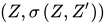
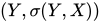
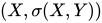
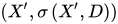
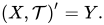
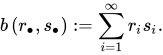
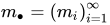
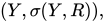
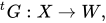
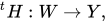
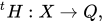
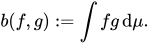
A pairing or pair over a field is a triple which may also be denoted by consisting of two vector spaces and over and a bilinear map called the bilinear map associated with the pairing,[1] or more simply called the pairing's map or its bilinear form. The examples here only describe when is either the real numbers or the complex numbers, but the mathematical theory is general.
It is common practice to write instead of , in which in some cases the pairing may be denoted by rather than . However, this article will reserve the use of for the canonical evaluation map (defined below) so as to avoid confusion for readers not familiar with this subject.
A pairing is called a dual system, a dual pair,[2] or a duality over if the bilinear form is non-degenerate, which means that it satisfies the following two separation axioms:
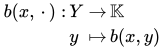
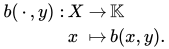
separates (distinguishes) points of: if is such that then ; or equivalently, for all non-zero , the map is not identically (i.e. there exists a such that for each );
separates (distinguishes) points of: if is such that then ; or equivalently, for all non-zero the map is not identically (i.e. there exists an such that for each ).
In this case is non-degenerate, and one can say that places and in duality (or, redundantly but explicitly, in separated duality), and is called the duality pairing of the triple .[1][2]
A subset of is called total if for every , implies
A total subset of is defined analogously (see footnote).[note 1] Thus separates points of if and only if is a total subset of , and similarly for .
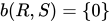
The vectors and are orthogonal, written , if . Two subsets and are orthogonal, written , if ; that is, if for all and . The definition of a subset being orthogonal to a vector is defined analogously.
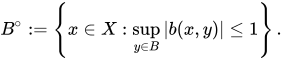
Given a triple defining a pairing over , the absolute polar set or polar set of a subset of is the set:Symmetrically, the absolute polar set or polar set of a subset of is denoted by and defined by
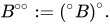
To use bookkeeping that helps keep track of the anti-symmetry of the two sides of the duality, the absolute polar of a subset of may also be called the absolute prepolar or prepolar of and then may be denoted by .[3]
The polar is necessarily a convex set containing where if is balanced then so is and if is a vector subspace of then so too is a vector subspace of [4]
If is a vector subspace of then and this is also equal to the real polar of If then the bipolar of , denoted , is the polar of the orthogonal complement of , i.e., the set Similarly, if then the bipolar of is
Given a pairing define a new pairing where for all and .[1]
There is a consistent theme in duality theory that any definition for a pairing has a corresponding dual definition for the pairing
Convention and Definition: Given any definition for a pairing one obtains a dual definition by applying it to the pairing These conventions also apply to theorems.
For instance, if " distinguishes points of " (resp, " is a total subset of ") is defined as above, then this convention immediately produces the dual definition of " distinguishes points of " (resp, " is a total subset of ").
This following notation is almost ubiquitous and allows us to avoid assigning a symbol to
Convention and Notation: If a definition and its notation for a pairing depends on the order of and (for example, the definition of the Mackey topology on ) then by switching the order of and then it is meant that definition applied to (continuing the same example, the topology would actually denote the topology ).
For another example, once the weak topology on is defined, denoted by , then this dual definition would automatically be applied to the pairing so as to obtain the definition of the weak topology on , and this topology would be denoted by rather than .
Although it is technically incorrect and an abuse of notation, this article will adhere to the nearly ubiquitous convention of treating a pairing interchangeably with and also of denoting by
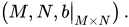
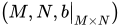
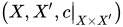
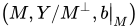
Suppose that is a pairing, is a vector subspace of and is a vector subspace of . Then the restriction of to is the pairing If is a duality, then it's possible for a restriction to fail to be a duality (e.g. if and ).
This article will use the common practice of denoting the restriction by
Suppose that is a vector space and let denote the algebraic dual space of (that is, the space of all linear functionals on ).
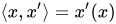
There is a canonical duality where which is called the evaluation map or the natural or canonical bilinear functional on
Note in particular that for any is just another way of denoting ; i.e.
If is a vector subspace of , then the restriction of to is called the canonical pairing where if this pairing is a duality then it is instead called the canonical duality. Clearly, always distinguishes points of , so the canonical pairing is a dual system if and only if separates points of
The following notation is now nearly ubiquitous in duality theory.
The evaluation map will be denoted by (rather than by ) and will be written rather than
Assumption: As is common practice, if is a vector space and is a vector space of linear functionals on then unless stated otherwise, it will be assumed that they are associated with the canonical pairing
If is a vector subspace of then distinguishes points of (or equivalently, is a duality) if and only if distinguishes points of or equivalently if is total (that is, for all implies ).[1]
Suppose is a topological vector space (TVS) with continuous dual space
Then the restriction of the canonical duality to × defines a pairing for which separates points of
If separates points of (which is true if, for instance, is a Hausdorff locally convex space) then this pairing forms a duality.[2]
Assumption: As is commonly done, whenever is a TVS, then unless indicated otherwise, it will be assumed without comment that it's associated with the canonical pairing
The following result shows that the continuous linear functionals on a TVS are exactly those linear functionals that are bounded on a neighborhood of the origin.
Theorem[1]—Let be a TVS with algebraic dual
and let be a basis of neighborhoods of at the origin.
Under the canonical duality the continuous dual space of is the union of all as ranges over (where the polars are taken in
).
A pre-Hilbert space is a dual pairing if and only if is vector space over or has dimension Here it is assumed that the sesquilinear form is conjugate homogeneous in its second coordinate and homogeneous in its first coordinate.
If is a complex Hilbert space then forms a dual system if and only if If is non-trivial then does not even form pairing since the inner product is sesquilinear rather than bilinear.[1]
Suppose that is a complex pre-Hilbert space with scalar multiplication denoted as usual by juxtaposition or by a dot
Define the map
where the right-hand side uses the scalar multiplication of
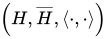
Let denote the complex conjugate vector space of where denotes the additive group of (so vector addition in is identical to vector addition in ) but with scalar multiplication in being the map (instead of the scalar multiplication that is endowed with).
The map defined by is linear in both coordinates[note 2] and so forms a dual pairing.
Suppose that is a pairing of vector spaces over
If then the weak topology on induced by (and ) is the weakest TVS topology on denoted by or simply making each map continuous as a function of for every .[1] If is not clear from context then it should be assumed to be all of in which case it is called the weak topology on (induced by ).
The notation or (if no confusion could arise) simply is used to denote endowed with the weak topology
Importantly, the weak topology depends entirely on the function the usual topology on and 's vector space structure but not on the algebraic structures of
Similarly, if then the dual definition of the weak topology on induced by (and ), which is denoted by or simply (see footnote for details).[note 3]
Definition and Notation: If "" is attached to a topological definition (e.g. -converges, -bounded, etc.) then it means that definition when the first space (i.e. ) carries the topology. Mention of or even and may be omitted if no confusion arises. So, for instance, if a sequence in "-converges" or "weakly converges" then this means that it converges in whereas if it were a sequence in , then this would mean that it converges in ).
The topology is locally convex since it is determined by the family of seminorms defined by as ranges over [1]
If and is a net in then -converges to if converges to in [1]
A net -converges to if and only if for all converges to
If is a sequence of orthonormal vectors in Hilbert space, then converges weakly to 0 but does not norm-converge to 0 (or any other vector).[1]
If is a pairing and is a proper vector subspace of such that is a dual pair, then is strictly coarser than [1]
With respect to the canonical pairing, if is a TVS whose continuous dual space separates points on (i.e. such that is Hausdorff, which implies that is also necessarily Hausdorff) then the continuous dual space of is equal to the set of all "evaluation at a point " maps as ranges over (i.e. the map that send to ).
This is commonly written as
This very important fact is why results for polar topologies on continuous dual spaces, such as the strong dual topology on for example, can also often be applied to the original TVS ; for instance, being identified with means that the topology on can instead be thought of as a topology on
Moreover, if is endowed with a topology that is finer than then the continuous dual space of will necessarily contain as a subset.
So for instance, when is endowed with the strong dual topology (and so is denoted by ) then
which (among other things) allows for to be endowed with the subspace topology induced on it by, say, the strong dual topology (this topology is also called the strong bidual topology and it appears in the theory of reflexive spaces: the Hausdorff locally convex TVS is said to be semi-reflexive if and it will be called reflexive if in addition the strong bidual topology on is equal to 's original/starting topology).
Suppose that is a vector subspace of and let denote the restriction of to
The weak topology on is identical to the subspace topology that inherits from
Also, is a paired space (where means ) where is defined by
The topology is equal to the subspace topology that inherits from [5]
Furthermore, if is a dual system then so is [5]
The polars of the following sets are identical: (a) ; (b) the convex hull of ; (c) the balanced hull of ; (d) the -closure of ; (e) the -closure of the convex balanced hull of
The bipolar theorem: The bipolar of denoted by is equal to the -closure of the convex balanced hull of
The bipolar theorem in particular "is an indispensable tool in working with dualities."[4]
If in addition distinguishes points of then is -bounded if and only if it is -totally bounded.
If is a pairing and is a locally convex topology on that is consistent with duality, then a subset of is a barrel in if and only if is the polar of some -bounded subset of [6]
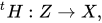
For all let be the map defined by
It is said that 's transpose or adjoint is well-defined if the following conditions are satisfied:
distinguishes points of (or equivalently, the map from into the algebraic dual is injective), and
where and .
In this case, for any there exists (by condition 2) a unique (by condition 1) such that ), where this element of will be denoted by
This defines a linear map
called the transpose or adjoint of with respect to and (this should not be confused with the Hermitian adjoint).
It is easy to see that the two conditions mentioned above (i.e. for "the transpose is well-defined") are also necessary for to be well-defined.
For every the defining condition for is
that is,
for all
By the conventions mentioned at the beginning of this article, this also defines the transpose of linear maps of the form [note 4][note 5][note 6][note 7] etc. (see footnote).
Suppose that is a vector space and that is its the algebraic dual.
Then every -bounded subset of is contained in a finite dimensional vector subspace and every vector subspace of is -closed.[1]
If is a complete topological vector space say that is -complete or (if no ambiguity can arise) weakly-complete.
There exist Banach spaces that are not weakly-complete (despite being complete in their norm topology).[1]
If is a vector space then under the canonical duality, is complete.[1]
Conversely, if is a Hausdorff locally convex TVS with continuous dual space then is complete if and only if ; that is, if and only if the map defined by sending to the evaluation map at (i.e. ) is a bijection.[1]
In particular, with respect to the canonical duality, if is a vector subspace of such that separates points of then is complete if and only if
Said differently, there does not exist a proper vector subspace of such that is Hausdorff and is complete in the weak-* topology (i.e. the topology of pointwise convergence).
Consequently, when the continuous dual space of a Hausdorfflocally convex TVS is endowed with the weak-* topology, then is complete if and only if (that is, if and only if every linear functional on is continuous).
Identification of Y with a subspace of the algebraic dual
If distinguishes points of and if denotes the range of the injection then is a vector subspace of the algebraic dual space of and the pairing becomes canonically identified with the canonical pairing (where is the natural evaluation map).
In particular, in this situation it will be assumed without loss of generality that is a vector subspace of 's algebraic dual and is the evaluation map.
Convention: Often, whenever is injective (especially when forms a dual pair) then it is common practice to assume without loss of generality that is a vector subspace of the algebraic dual space of that is the natural evaluation map, and also denote by
In a completely analogous manner, if distinguishes points of then it is possible for to be identified as a vector subspace of 's algebraic dual space.[2]
In the special case where the dualities are the canonical dualities and the transpose of a linear map is always well-defined.
This transpose is called the algebraic adjoint of and it will be denoted by ;
that is,
In this case, for all [1][7] where the defining condition for is:
or equivalently,
If for some integer is a basis for with dual basis is a linear operator, and the matrix representation of with respect to is then the transpose of is the matrix representation with respect to of
Suppose that and are canonical pairings (so and ) that are dual systems and let be a linear map.
Then is weakly continuous if and only if it satisfies any of the following equivalent conditions:[1]
is continuous.
the transpose of F, with respect to and is well-defined.
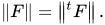
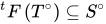
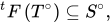
If is weakly continuous then will be continuous and furthermore, [7]
A map between topological spaces is relatively open if is an open mapping, where is the range of [1]
Suppose that and are dual systems and is a weakly continuous linear map.
Then the following are equivalent:[1]
is relatively open.
The range of is -closed in ;
Furthermore,
is injective (resp. bijective) if and only if is surjective (resp. bijective);
is surjective if and only if is relatively open and injective.
The transpose of map between two TVSs is defined if and only if is weakly continuous.
If is a linear map between two Hausdorff locally convex topological vector spaces, then:[1]
If is continuous then it is weakly continuous and is both Mackey continuous and strongly continuous.
If is weakly continuous then it is both Mackey continuous and strongly continuous (defined below).
If is weakly continuous then it is continuous if and only if maps equicontinuous subsets of to equicontinuous subsets of
If and are normed spaces then is continuous if and only if it is weakly continuous, in which case
If is continuous then is relatively open if and only if is weakly relatively open (i.e. is relatively open) and every equicontinuous subsets of is the image of some equicontinuous subsets of
If is continuous injection then is a TVS-embedding (or equivalently, a topological embedding) if and only if every equicontinuous subsets of is the image of some equicontinuous subsets of
Let be a locally convex space with continuous dual space and let [1]
If is equicontinuous or -compact, and if is such that is dense in then the subspace topology that inherits from is identical to the subspace topology that inherits from
If is separable and is equicontinuous then when endowed with the subspace topology induced by is metrizable.
If is separable and metrizable, then is separable.
If is a normed space then is separable if and only if the closed unit call the continuous dual space of is metrizable when given the subspace topology induced by
If is a normed space whose continuous dual space is separable (when given the usual norm topology), then is separable.
Polar topologies and topologies compatible with pairing
Starting with only the weak topology, the use of polar sets produces a range of locally convex topologies.
Such topologies are called polar topologies.
The weak topology is the weakest topology of this range.
Throughout, will be a pairing over and will be a non-empty collection of -bounded subsets of
Given a collection of subsets of , the polar topology on determined by (and ) or the -topology on is the unique topological vector space (TVS) topology on for which
forms a subbasis of neighborhoods at the origin.[1]
When is endowed with this -topology then it is denoted by Y.
Every polar topology is necessarily locally convex.[1]
When is a directed set with respect to subset inclusion (i.e. if for all there exists some such that ) then this neighborhood subbasis at 0 actually forms a neighborhood basis at 0.[1]
The following table lists some of the more important polar topologies.
Notation: If denotes a polar topology on then endowed with this topology will be denoted by or simply (e.g. for we'd have so that and all denote endowed with ).
("topology of uniform convergence on ...")
Notation
Name ("topology of...")
Alternative name
finite subsets of (or -closed disked hulls of finite subsets of )
If is a pairing over and is a vector topology on then is a topology of the pairing and that it is compatible (or consistent) with the pairing if it is locally convex and if the continuous dual space of [note 8]
If distinguishes points of then by identifying as a vector subspace of 's algebraic dual, the defining condition becomes: [1]
Some authors (e.g. [Trèves 2006] and [Schaefer 1999]) require that a topology of a pair also be Hausdorff,[2][8] which it would have to be if distinguishes the points of (which these authors assume).
The weak topology is compatible with the pairing (as was shown in the Weak representation theorem) and it is in fact the weakest such topology.
There is a strongest topology compatible with this pairing and that is the Mackey topology.
If is a normed space that is not reflexive then the usual norm topology on its continuous dual space is not compatible with the duality [1]
The following is one of the most important theorems in duality theory.
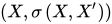
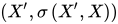
Mackey–Arens theorem I[1]—Let will be a pairing such that distinguishes the points of and let be a locally convex topology on (not necessarily Hausdorff).
Then is compatible with the pairing if and only if is a polar topology determined by some collection of -compact disks that cover[note 9]
It follows that the Mackey topology which recall is the polar topology generated by all -compact disks in is the strongest locally convex topology on that is compatible with the pairing
A locally convex space whose given topology is identical to the Mackey topology is called a Mackey space.
The following consequence of the above Mackey-Arens theorem is also called the Mackey-Arens theorem.
Mackey–Arens theorem II[1]—Let will be a pairing such that distinguishes the points of and let be a locally convex topology on
Then is compatible with the pairing if and only if
If is a TVS (over or ) then a half-space is a set of the form for some real and some continuous real linear functional on
Theorem—If is a locally convex space (over or ) and if is a non-empty closed and convex subset of then is equal to the intersection of all closed half spaces containing it.[9]
The above theorem implies that the closed and convex subsets of a locally convex space depend entirely on the continuous dual space. Consequently, the closed and convex subsets are the same in any topology compatible with duality;that is, if and are any locally convex topologies on with the same continuous dual spaces, then a convex subset of is closed in the topology if and only if it is closed in the topology.
This implies that the -closure of any convex subset of is equal to its -closure and that for any -closed disk in [1]
In particular, if is a subset of then is a barrel in if and only if it is a barrel in [1]
The following theorem shows that barrels (i.e. closed absorbingdisks) are exactly the polars of weakly bounded subsets.
Theorem[1]—Let will be a pairing such that distinguishes the points of and let be a topology of the pair.
Then a subset of is a barrel in if and only if it is equal to the polar of some -bounded subset of
A closed absorbing and balanced subset of absorbs each convex compact subset of (i.e. there exists a real such that contains that set).
If is Hausdorff and locally convex then every barrel in absorbs every convex bounded complete subset of
All of this leads to Mackey's theorem, which is one of the central theorems in the theory of dual systems.
In short, it states the bounded subsets are the same for any two Hausdorff locally convex topologies that are compatible with the same duality.
Mackey's theorem[10][1]—Suppose that is a Hausdorff locally convex space with continuous dual space and consider the canonical duality
If is any topology on that is compatible with the duality on then the bounded subsets of are the same as the bounded subsets of
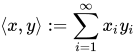
Let denote the space of all sequences of scalars such that for all sufficiently large
Let and define a bilinear map by
Then [1]
Moreover, a subset is -bounded (resp. -bounded) if and only if there exists a sequence of positive real numbers such that for all and all indices (resp. and ).[1]
It follows that there are weakly bounded (that is, -bounded) subsets of that are not strongly bounded (that is, not -bounded).
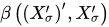
Strong dual space – Continuous dual space endowed with the topology of uniform convergence on bounded sets
Strong topology (polar topology) – Continuous dual space endowed with the topology of uniform convergence on bounded setsPages displaying short descriptions of redirect targets
^That is linear in its first coordinate is obvious. Suppose is a scalar. Then which shows that is linear in its second coordinate.
^The weak topology on is the weakest TVS topology on making all maps continuous, as ranges over The dual notation of or simply may also be used to denote endowed with the weak topology If is not clear from context then it should be assumed to be all of in which case it is simply called the weak topology on (induced by ).
^If is a linear map then 's transpose, is well-defined if and only if distinguishes points of and In this case, for each the defining condition for is:
^If is a linear map then 's transpose, is well-defined if and only if distinguishes points of and In this case, for each the defining condition for is:
^If is a linear map then 's transpose, is well-defined if and only if distinguishes points of and In this case, for each the defining condition for is:
^If is a linear map then 's transpose, is well-defined if and only if distinguishes points of and In this case, for each the defining condition for is:
^Of course, there is an analogous definition for topologies on to be "compatible it a pairing" but this article will only deal with topologies on
^Recall that a collection of subsets of a set is said to cover if every point of is contained in some set belonging to the collection.
Narici, Lawrence; Beckenstein, Edward (2011). Topological Vector Spaces. Pure and applied mathematics (Second ed.). Boca Raton, FL: CRC Press. ISBN978-1584888666. OCLC144216834.
Michael Reed and Barry Simon, Methods of Modern Mathematical Physics, Vol. 1, Functional Analysis, Section III.3. Academic Press, San Diego, 1980. ISBN0-12-585050-6.
In mathematics, particularly in functional analysis, a dual system (also called a dual pair or duality) over a field $ \mathbb{K} $ is a triple $ (X, Y, b) $, where $ X $ and $ Y $ are vector spaces over $ \mathbb{K} $, and $ b: X \times Y \to \mathbb{K} $ is a non-degenerate bilinear map.The non-degeneracy means that $ Y $ separates points in $ X $ (for every nonzero $ x \in X $, there exists $ y \in Y $ with $ b(x, y) \neq 0 $) and vice versa. This structure is fundamental for defining weak topologies, polar sets, and duality theories on vector spaces, with applications in quantum mechanics and Hilbert spaces.
Fundamentals
Definition and notation
In functional analysis, a dual system, also referred to as a dual pair, is defined as an ordered pair(X,Y) of vector spaces over the same scalar fieldK, equipped with a bilinear map⟨⋅,⋅⟩:X×Y→K that separates points of X and Y. This separation property ensures that the pairing is non-degenerate, meaning that if ⟨x,y⟩=0 for all x∈X, then y=0, and conversely, if ⟨x,y⟩=0 for all y∈Y, then x=0.[1]The annihilator of a subset A⊂X is denoted A⊥={y∈Y∣⟨a,y⟩=0∀a∈A}, and a subset A⊂X is called total if A⊥={0}. Similarly, for a subset B⊂Y, the annihilator is B⊥={x∈X∣⟨x,b⟩=0∀b∈B}, and B is total if B⊥={0}. In particular, for a non-degenerate pairing, the annihilator of the entire space satisfies Ann(X)={y∈Y∣⟨x,y⟩=0∀x∈X}={0}, and analogously Ann(Y)={0}.[2]Standard notation employs ⟨x,y⟩ to denote the value of the bilinear form at elements x∈X and y∈Y. The dual system (X,Y,⟨⋅,⋅⟩) induces a transpose pairing on (Y,X) defined by ⟨y,x⟩t=⟨x,y⟩, yielding an equivalent dual system under this identification.[2]
Pairings and dual pairings
In functional analysis, a pairing on two vector spaces X and Y over a field K is defined as a bilinear form⟨⋅,⋅⟩:X×Y→K, which is linear in each argument separately.[3] Such a form satisfies ⟨λx+x′,y⟩=λ⟨x,y⟩+⟨x′,y⟩ for λ∈K, x,x′∈X, y∈Y, and analogously for the second argument.[4] Continuity of the pairing is not assumed in this algebraic setting.[3]The pairing is non-degenerate if X and Y are total subsets with respect to each other, meaning that for every x∈X∖{0}, there exists y∈Y such that ⟨x,y⟩=0, and conversely, for every y∈Y∖{0}, there exists x∈X such that ⟨x,y⟩=0.[4] This condition ensures that the pairing separates points in each space.[3]A key structure induced by the pairing is the linear map ϕ:Y→X∗, where X∗ denotes the algebraic dual of X (the space of all linear functionals X→K), defined by
ϕ(y)(x)=⟨x,y⟩
for all x∈X, y∈Y.[4] The non-degeneracy condition on the Y-side (i.e., ⟨x,y⟩=0 for all x∈X implies y=0) is equivalent to ϕ being injective.[3] The full non-degeneracy further requires that ϕ(Y) separates points on X, meaning that for every x∈X∖{0}, there exists y∈Y such that ϕ(y)(x)=0.[4] If ϕ is also surjective, then it is an isomorphism, fully identifying Y with X∗.[3]In this case, the pairing is often called a duality pairing, where Y is identified with the algebraic dual X∗ via ϕ, and the bilinear form corresponds to the natural evaluation ⟨x,y⟩=y(x) for y∈X∗. More generally, the non-degeneracy ensures that Y can be identified with its image ϕ(Y), a subspace of X∗ that separates points on X; the injectivity of ϕ ensures uniqueness of the representing elements. In finite-dimensional cases, non-degeneracy alone implies ϕ is an isomorphism.[3]
Orthogonality and polar sets
In a dual system consisting of vector spaces X and Y equipped with a bilinear pairing ⟨⋅,⋅⟩:X×Y→K (where K=R or C), two elements x∈X and y∈Y are said to be orthogonal, denoted x⊥y, if ⟨x,y⟩=0.[5]This notion extends naturally to subsets: for a subset A⊂X, the orthogonal (or annihilator) of A in Y is the set A⊥={y∈Y∣⟨a,y⟩=0∀a∈A}.[5] Symmetrically, for B⊂Y, the orthogonal of B in X is B⊥={x∈X∣⟨x,b⟩=0∀b∈B}.[5] These definitions arise directly from the pairing and preserve the symmetry of the dual system, as the roles of X and Y can be interchanged.The orthogonal A⊥ is always a linear subspace of Y, and if the pairing is non-degenerate, then the double orthogonal recovers the linear span: (A⊥)⊥=spanA.[5] This result highlights the duality between subspaces of X and their orthogonals in Y, providing an algebraic tool for decomposing spaces via perpendicularity relations.Polar sets generalize orthogonality to incorporate boundedness conditions without invoking topology. For a subset A⊂X, the (absolute) polar of A is defined as A∘={y∈Y∣∣⟨x,y⟩∣≤1∀x∈A}.[5][6] This set is convex and balanced (absorbing scalar multiples up to modulus 1), contains the origin, and is symmetric in the dual pair (X,Y), as the polar of a subset of Y is analogously defined in X.[5]A fundamental result is the algebraic bipolar theorem, which states that for any A⊂X, the bipolar $ (A^\circ)^\circ $ equals the convex balanced hull of A∪{0} (i.e., the smallest convex balanced set containing A and the origin).[5][6] This theorem underscores the closure properties under polarity operations and their role in recovering convex structures from dual pairings, with the symmetry ensuring the result holds when interchanging X and Y.
Examples
Canonical duality on vector spaces
In the context of algebraic dual systems, the canonical duality arises between a vector space X over a field K and its algebraic dual X∗, which consists of all linear functionals from X to K. The canonical pairing is the bilinear map⟨x,f⟩=f(x) for x∈X and f∈X∗.[4] This pairing is linear in each argument separately and serves as the fundamental bilinear form associating elements of X with their evaluations under functionals in X∗.[4]The pairing is non-degenerate, meaning that if ⟨x,f⟩=0 for all f∈X∗, then x=0, and conversely, if ⟨x,f⟩=0 for all x∈X, then f=0.[4] This property ensures that the spaces X and X∗ separate points from each other effectively. The natural embeddingι:X→(X∗)∗ is defined by ι(x)(f)=f(x) for x∈X and f∈X∗, where (X∗)∗ is the algebraic dual of X∗, or bidual of X. This map ι is injective due to the non-degeneracy of the pairing, embedding X algebraically into its bidual as the image ι(X).[4]The image ι(X) is a total subset of (X∗)∗ with respect to the dual pair ((X∗)∗,X∗), meaning that the only functional in X∗ vanishing on all elements of ι(X) is the zero functional. This totality follows directly from the injectivity of ι and the non-degeneracy. While the embedding is canonical and injective for any vector space, it is an isomorphism if and only if X is finite-dimensional. In the infinite-dimensional case, algebraic isomorphisms between X and (X∗)∗ exist via the axiom of choice and selection of Hamel bases, but they are not canonical and depend on the choice of basis, with dimensions differing in cardinality for infinite-dimensional spaces.[7]
Dualities on topological vector spaces
In topological vector spaces, the concept of duality extends the algebraic canonical pairing by restricting attention to continuous linear functionals, thereby incorporating the topological structure. The continuous dual X′ of a topological vector space X over the scalars K=R or C is the subspace of the algebraic dual X∗ consisting of all continuous linear functionals f:X→K.[8] This ensures that the dual respects the topology on X, distinguishing it from the full algebraic dual, which includes all linear functionals without continuity requirements.[9]The canonical pairing on the topological setting is defined by ⟨x,f⟩=f(x) for x∈X and f∈X′, forming a bilinear form that separates points in both spaces under suitable conditions.[8] This pairing induces the weak* topologyσ(X′,X) on X′, which is the coarsest topology making all evaluation maps x↦⟨x,f⟩ continuous; it arises directly from the original topology on X.[10] In this framework, equicontinuous subsets of X′—those bounded by polars of neighborhoods in X—play a key role in ensuring compactness properties, as per the Banach-Alaoglu theorem.[8]For an absorbing subset A⊂X, the polar A∘ is defined as A∘={f∈X′∣∣⟨x,f⟩∣≤1∀x∈A}.[8] This set is closed, convex, and balanced in the weak* topology, and it coincides with the polar of the closed balanced convex hull of A.[8] Polars generate polar topologies on X, such as the weak topologyσ(X,X′), providing a uniform way to describe topologies compatible with the duality.[8]Reflexivity in topological vector spaces occurs when the natural embeddingX→(X′)′, given by x↦x^ where x^(f)=⟨x,f⟩, is a topological isomorphism onto its image, typically under the weak* topology on (X′)′.[8] This topological identification strengthens the algebraic reflexivity of finite-dimensional spaces but fails in general for infinite-dimensional cases without additional assumptions like completeness or local convexity; for instance, Hilbert spaces are reflexive, while certain Banach spaces are not.[10] The distinction highlights that algebraic bidual identification does not imply topological reflexivity.[8]
Inner product and conjugate spaces
In a real inner product space X equipped with inner product ⟨⋅,⋅⟩, the Riesz representation theorem establishes a dual pairing between X and its algebraic dual X∗ by identifying each continuous linear functional f∈X∗ with a unique element yf∈X such that f(x)=⟨x,yf⟩ for all x∈X. This identification is isometric when X is complete (i.e., a Hilbert space), making X self-dual under the induced norm ∥x∥=⟨x,x⟩.For complex inner product spaces, the situation requires adjustment to preserve bilinearity in the pairing. Consider the conjugate space Xˉ, which has the same underlying vector space as X but with scalar multiplication defined by λ⋅yˉ=λy for λ∈C and y∈X. The dual pairing is then given by ⟨x,yˉ⟩=⟨x,y⟩, where the right-hand side uses the original inner product on X. The Riesz representation theorem extends to this setting, associating each continuous linear functional f∈X∗ with a unique yfˉ∈Xˉ such that f(x)=⟨x,yfˉ⟩.In the case of a complex Hilbert space H, this construction yields self-duality: H≅H∗ via the conjugate-linear isometryJ:H→H∗ defined by
J(x)(y)=⟨y,x⟩
for all y∈H, where the inner product is linear in the first argument and conjugate-linear in the second. This map is antilinear in x, reflecting the complex structure, and preserves the inner product up to conjugation. Orthonormal bases in H correspond naturally to dual bases under this identification, facilitating representations in quantum mechanics and signal processing.
Weak topology
Bounded subsets and Hausdorffness
In a dual system \langle [X, Y](/page/X&Y) \rangle with bilinear pairing ⟨⋅,⋅⟩:X×Y→K, a subset A⊂X is said to be weakly bounded (or bounded in the weak topology [11]) if, for every y∈Y,
x∈Asup∣⟨x,y⟩∣<∞.
This condition ensures that A is absorbed by every basic weak neighborhood of the origin in X. Equivalently, A is weakly bounded if and only if its polar A∘ is absorbing in Y, meaning every element of Y belongs to λA∘ for some scalar λ>0.[3]When the dual system arises from a normed space, such as X normed with Y=X∗ the continuous dual equipped with the dual norm, a subset A⊂X is weakly bounded if and only if it is bounded in the norm topology on X. The forward implication follows from the uniform boundedness principle applied to the pointwise bounded family of functionals {⟨⋅,y⟩:y∈Y}, while the converse holds since the norm bounds imply uniform control on the pairings.[12]The weak topology σ(X,Y) on X is defined as the coarsest topology making all maps x↦⟨x,y⟩ continuous for y∈Y. A local basis of neighborhoods of the origin 0∈X consists of the sets
where y1,…,yn∈Y are finitely many elements and ε1,…,εn>0. These finite intersections generate the topology, ensuring it is locally convex when the pairing is bilinear over R or C.[12]The weak topologyσ(X,Y) is Hausdorff if and only if the pairing is separated on X, meaning Y separates points in X: for any distinct x1,x2∈X with x1=x2, there exists y∈Y such that ⟨x1,y⟩=⟨x2,y⟩. Under this condition, the singleton {0} is closed in σ(X,Y), as the separating property allows separation of the origin from nonzero points via subbasic neighborhoods. Without separation, the topology may fail to distinguish points, rendering it non-Hausdorff.[12]
Orthogonals, quotients, and subspaces
In the context of a dual system (X,Y,⟨⋅,⋅⟩), where X and Y are vector spaces equipped with a bilinear pairing, the orthogonal complement of a subsetA⊂X is defined as A⊥={y∈Y∣⟨a,y⟩=0∀a∈A}.[13] Similarly, for B⊂Y, the orthogonal is B⊥={x∈X∣⟨x,b⟩=0∀b∈B}.[3] These orthogonals are subspaces and play a central role in the structure of the weak topologyσ(X,Y) on X, where basic open sets are defined by finite subsets of Y, and the analogous weak topologyσ(Y,X) on Y.[13]For a subspace M⊂X, the bipolar M⊥⊥ coincides with the weak closure of M in the topologyσ(X,Y).[3] In reflexive dual systems, such as those arising from reflexive Banach spaces where X=Y∗ and the pairing is evaluation, a closed subspace M satisfies M⊥⊥=M.[13] This bipolar theorem ensures that orthogonals capture the closure properties essential for decomposition in weak topologies.Quotient spaces in dual systems are linked to orthogonals via an algebraic isomorphism: for a subspace A⊂X, the quotientX/A is isomorphic to the algebraic dual (A⊥)∗ of A⊥.[13] This is realized by the canonical mapψ:X/A→(A⊥)∗ defined by ψ(x+A)(y)=⟨x,y⟩ for y∈A⊥, which is well-defined since ⟨a,y⟩=0 for a∈A.[3] The weak topologyσ(X/A,A⊥) on the quotient is induced naturally from σ(X,Y), preserving the duality structure.[13]
Weak representation theorem
In a dual system (X,Y,⟨⋅,⋅⟩) where Y is total on X—meaning that ⟨x,y⟩=0 for all y∈Y implies x=0—the weak representation theorem states that every continuous linear functional f on the topological vector space(X,σ(X,Y)) admits a representation of the form
f(x)=⟨x,yf⟩
for all x∈X, where yf∈Y is unique.This result follows from the structure of the weak topologyσ(X,Y), which is the initial topology on X induced by the family of seminorms py(x)=∣⟨x,y⟩∣ for y∈Y. Continuity of f implies that ∣f(x)∣≤∑i=1ncipyi(x) on some neighborhood of the origin, for finite y1,…,yn∈Y and constants ci>0. By linearity of f and the totality of Y, which ensures separation of points, Hahn-Banach extension arguments or direct verification on the kernel of f yield the explicit form ⟨⋅,yf⟩, with uniqueness arising from the orthogonality condition that ⟨x,y1−y2⟩=0 for all x∈X implies y1=y2.The theorem establishes that the continuous dual of (X,σ(X,Y)) is precisely Y, and equipping Y with the weak* topology σ(Y,X) identifies it as the topological dual space, enabling Y to fully represent the functionals on X under the weak topology. This representation underpins duality theory in topological vector spaces, facilitating the study of reflexivity and compactness in dual systems.
Transposes
Definition and properties of transposes
In the context of dual systems (X,Y) and (Z,W) equipped with duality pairings ⟨⋅,⋅⟩X,Y:X×Y→K and ⟨⋅,⋅⟩Z,W:Z×W→K, where K is the scalar field, the transpose (or adjoint) of a linear map T:X→Z is the linear map T∗:W→Y defined by the relation
⟨Tx,w⟩Z,W=⟨x,T∗w⟩X,Y
for all x∈X and w∈W.[14][15] This construction identifies T∗ as the unique linear map that preserves the duality pairing in the reverse direction, generalizing the dual map in the setting of algebraic dual spaces.[15]The transpose operation exhibits key algebraic properties that reflect its contravariant nature. Specifically, for scalars λ∈[K](/page/K) and linear maps T1,T2:X→Z, the transpose satisfies (λT)∗=λT∗ and (T1+T2)∗=T1∗+T2∗, ensuring that T∗ is linear as a map from W to Y.[14] Furthermore, if S:Z→U is another linear map between dual systems (Z,W) and (U,V), then the composition satisfies (ST)∗=T∗S∗, reversing the order of application.[14][15] In the algebraic sense, T∗ corresponds to the identification of morphisms in the dual category, where linear maps between spaces induce dual maps between their paired counterparts via the bilinear forms.[15]Additional structural relations connect the transpose to annihilators and subspaces. The kernel of T∗ coincides with the annihilator of the image of T, that is,
kerT∗=(imT)⊥={w∈W∣⟨Tx,w⟩Z,W=0∀x∈X}.
[15] Moreover, the image of T∗ is contained in the annihilator of the kernel of T,
imT∗⊂(kerT)⊥={y∈Y∣⟨x,y⟩X,Y=0∀x∈kerT}.
[15] These relations highlight the orthogonal complement structure inherent in dual systems, facilitating the study of exact sequences and reflexivity without invoking topology.[14]
Weak continuity of transposes
In dual systems ⟨X,Y⟩ and ⟨Z,W⟩, a linear map T:X→Z is continuous with respect to the weak topologies σ(X,Y) on X and σ(Z,W) on Z if and only if its algebraic transpose T∗:W→Y, defined by ⟨Tx,w⟩Z,W=⟨x,T∗w⟩X,Y for all w∈W and x∈X, is continuous with respect to the weak topologies σ(W,Z) on W and σ(Y,X) on Y. This symmetry arises because the weak topology σ(X,Y) is the initial topology making all maps x↦⟨x,y⟩ continuous for y∈Y, and the transpose relation ensures the compositions align accordingly.Regarding openness properties, if T:(X,σ(X,Y))→(Z,σ(Z,W)) is an open mapping, then its transpose T∗ is continuous when W and Y are equipped with their respective strong dual topologies β(W,Z) and β(Y,X). This follows from the open mapping theorem adapted to weak topologies on locally convex spaces, where openness of T implies that the image under T∗ of strongly closed sets in W remains weakly closed in Y, ensuring the required continuity.Weak completeness enters this discussion as a structural property ensuring stability under weak closure operations relevant to transposes. A topological vector space E is weakly complete if every closed subspace of (E,σ(E,E′)), where E′ is the topological dual, is complete in the original topology of E. Equivalently, E is complete with respect to its weak topologyσ(E,E′). In such spaces, weakly continuous transposes preserve completeness properties of subspaces, facilitating applications like the representation of closed operators via their adjoints.
Relation to canonical duality
In the setting of canonical duality between a vector spaceX and its algebraic dual X∗, equipped with the natural evaluation pairing⟨x,ϕ⟩=ϕ(x) for x∈X and ϕ∈X∗, the transpose of a linear mapT:X→Y between vector spaces is the induced linear mapT∗:Y∗→X∗ defined by (T∗ϕ)(x)=ϕ(Tx) for all ϕ∈Y∗ and x∈X.[16] This construction preserves linearity and ensures that the pairing relation holds: ⟨Tx,ϕ⟩=⟨x,T∗ϕ⟩ for all x∈X and ϕ∈Y∗.[16]The algebraic adjoint, often denoted T†:Y∗→X∗ and coinciding with T∗ in this context, is explicitly given by T†(g)=g∘T for g∈Y∗.[17] This adjoint map is always well-defined algebraically without requiring any topology on X or Y.The Mackey topologyτ(X,X∗) is metrizable if X∗ admits a countable total subset, meaning a countable subset whose linear span is dense in the weak* topology.[18]In this canonical framework, if the pairing separates points on Y, there is a natural algebraic embedding of Y into X∗ given by y↦y^, where y^(x)=⟨x,y⟩. This embedding is a homeomorphism onto its image when Y is endowed with the weak topologyσ(Y,X) and X∗ with the weak* topologyσ(X∗,X).[19]
Polar topologies
Definitions and bounded subsets
In a dual system ⟨X,Y⟩ consisting of two vector spaces over R or C equipped with a bilinear pairing⟨⋅,⋅⟩:X×Y→K that separates points, assume compatible locally convex topologies on X and Y. The polar topology γ(X,Y) on X is the topology of uniform convergence on equicontinuous subsets of Y, generated by the seminorms pC(x)=supy∈C∣⟨x,y⟩∣ for equicontinuous C⊂Y. A local basis of convex balanced neighborhoods of the origin in γ(X,Y) consists of the polars of equicontinuous subsets of Y, i.e., sets of the form C∘={x∈X∣supy∈C∣⟨x,y⟩∣≤1}. Finite sets are equicontinuous, so polars of finite subsets form part of the basis, but the full basis includes polars of all equicontinuous sets.[20]The polar of a subsetA⊂X is the set
A∘={y∈Y∣∣⟨x,y⟩∣≤1∀x∈A}.
This construction yields an absolutely convex, absorbing set in Y when A generates X algebraically, and it forms the basis for generating the topologyγ(X,Y). A subsetC⊂Y is equicontinuous if its polar C∘ is a neighborhood of the origin in the weak topologyσ(X,Y). In the special case where Y is the topological dual of a normed spaceX and equipped with its norm ∥⋅∥Y, the polar of the closed unit ball BY={y∈Y∣∥y∥Y≤1} coincides with the closed unit ball in X, given by BY∘={x∈X∣∣⟨x,y⟩∣≤1∀y∈BY}=BX. However, in the general algebraic dual system without a norm on Y, the definition remains the uniform bound without reference to ∥y∥.[5]The topologyγ(X,Y) is locally convex, as it admits a generating family of seminorms, ensuring the existence of a basis of convex neighborhoods at the origin. If X is complete with respect to a compatible coarser topology (such as the Mackey topology in barrelled spaces), then (X,γ(X,Y)) inherits completeness; in general settings, completeness depends on the underlying structure of the dual system.[21]A subsetB⊂X is bounded in the polar topologyγ(X,Y) if, for every neighborhood U of the origin, there exists λ>0 such that B⊂λU. In polar topologies, the bounded subsets of X are precisely the polars of equicontinuous subsets of Y. By the bipolar theorem, this establishes a lattice isomorphism between the saturated family of bounded subsets of X and the equicontinuous subsets of Y via the polar map. Notably, in polar topologies, every finite-dimensional subspace of X is absorbed by the family of bounded sets, as finite-dimensional subsets of Y are equicontinuous and their polars cover such subspaces through scalar multiples.[20][5]
Topologies compatible with pairings
In the context of a dual system (X,Y,⟨⋅,⋅⟩), a topology τ on X is said to be compatible with the pairing if the continuous linear functionals on (X,τ) coincide exactly with the set {⟨⋅,y⟩∣y∈Y}.[22] Similarly, a topology σ on Y is compatible if the continuous linear functionals on (Y,σ) are precisely {⟨x,⋅⟩∣x∈X}. These compatible topologies ensure that the dual pair structure is preserved under the topological dual operation.[22]Compatible topologies on X and Y are necessarily locally convex and Hausdorff. Moreover, the bilinear pairing ⟨⋅,⋅⟩:X×Y→K is continuous when X and Y are endowed with compatible topologies, meaning that for every neighborhood V of 0 in K, there exist neighborhoods U⊂X and W⊂Y such that ⟨u,w⟩∈V for all u∈U, w∈W.[22] This continuity property facilitates the study of convergence and boundedness in duality theory.Among compatible topologies, the Mackey topology τm(X,Y) on X stands out as the strongest locally convex topology compatible with the pairing.[22] It is generated by the family of seminorms pK(x)=supy∈K∣⟨x,y⟩∣, where K ranges over all nonempty convex balanced subsets of Y that are compact in the weak∗ topologyσ(Y,X). The dual Mackey topology on Y is defined analogously.[22]A locally convex topology τ on X finer than the weak topologyσ(X,Y) is compatible with the dual pair if and only if its neighborhoods of the origin are precisely the polars of the neighborhoods of the weak∗ topologyσ(Y,X) on Y. This characterization, often expressed as τ={V∘∣V∈Nσ(Y,X)(0)}, where V∘ denotes the polar of V, underscores the duality between topologies on X and Y.[22]
Mackey–Arens and Mackey's theorems
The Mackey–Arens theorem characterizes the locally convex Hausdorff topologies compatible with a dual system (X,Y), where the pairing separates points. It asserts that every such topology τ on X satisfies σ(X,Y)⊂τ⊂γ(X,Y), where σ(X,Y) is the weak topology generated by the pairing and γ(X,Y) is the topology of uniform convergence on equicontinuous subsets of Y.[23] Equivalently, the continuous dual of (X,τ) coincides with Y, and τ lies between these extremes.[24]The proof of the Mackey–Arens theorem relies on the bipolar theorem for convex sets in the context of the dual system. For an absolutely convex set B⊂X, the bipolar B∘∘ with respect to the pairing equals the τ-closure of the convex balanced hull of B for any compatible topologyτ. This implies that equicontinuous sets in Y (whose polars are barrels in X) determine the bounding behavior across all compatible topologies, bounding τ between σ(X,Y) and γ(X,Y).[23]A barrel in a topological vector space is an absorbing, convex, balanced, and closed set; such sets absorb all bounded subsets by definition. A space is barrelled if every barrel is a neighborhood of the origin.[23]Mackey's theorem states that in a complete barrelled locally convex spaceX with continuous dual X′, the strong topology β(X,X′) coincides with the Mackey topology τ(X,X′). This follows because barrelledness ensures that equicontinuous subsets of X′ absorb bounded sets in a way that aligns uniform convergence on them with uniform convergence on bounded sets, generating the same topology.[23] For a compatible topologyτ on X, the continuous functionals are those y∈Y such that {x∈X:∣⟨x,y⟩∣≤1} is a τ-neighborhood of the origin, ensuring the dual cone matches across compatible topologies.[24]





















































































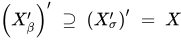
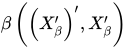






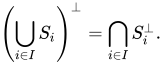











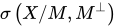



















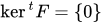






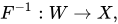

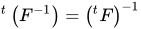


![{\displaystyle [F(S)]^{\circ }=\left({}^{t}F\right)^{-1}\left(S^{\circ }\right)}](https://wikimedia.org/api/rest_v1/media/math/render/svg/36c6a7922d41cd0fe07bef446e4e0beaa0b711b1)




![{\displaystyle \operatorname {ker} {}^{t}F=[F(X)]^{\perp }.}](https://wikimedia.org/api/rest_v1/media/math/render/svg/2b541687345423da736a58a0e4fe8f6ef17c72f8)