


Community hub
Earth phase
View on Wikipedia
 Earthrise by Apollo 8 astronaut William Anders, December 1968. Earth at gibbous phase as seen from the Moon. | |
The Earth phase is the shape of the directly sunlit portion of Earth as viewed from the Moon (or elsewhere extraterrestrially). From the Moon, Earth phases gradually and cyclically change over the period of a synodic month (about 29.53 days), as the orbital positions of the Moon around Earth and of Earth around the Sun shift.[1][2]
Overview
[edit]
Among the most prominent features of the Moon's sky is Earth. Earth's angular diameter (1.9°) is four times the Moon's as seen from Earth, although because the Moon's orbit is eccentric, Earth's apparent size in the sky varies by about 5% either way (ranging between 1.8° and 2.0° in diameter).[1] Earth shows phases, just like the Moon does for terrestrial observers. The phases, however, are opposite; when the terrestrial observer sees the full Moon, the lunar observer sees a "new Earth", and vice versa.[3] Earth's albedo is three times as high as that of the Moon (due in part to its whitish cloud cover), and coupled with the wider area, the full Earth glows over 50 times brighter than the full Moon at zenith does for the terrestrial observer. This Earth light reflected on the Moon's un-sunlit half is bright enough to be visible from Earth, even to the unaided eye – a phenomenon known as earthshine.

As a result of the Moon's synchronous rotation, one side of the Moon (the "near side") is permanently turned towards Earth, and the other side, the "far side", mostly cannot be seen from Earth. This means, conversely, that Earth can be seen only from the near side of the Moon and would always be invisible from the far side. Earth is seen from the lunar surface to rotate, with a period of approximately one Earth day (differing slightly due to the Moon's orbital motion).
If the Moon's rotation were purely synchronous, Earth would not have any noticeable movement in the Moon's sky. However, due to the Moon's libration, Earth does perform a slow and complex wobbling movement. Once a month, as seen from the Moon, Earth traces out an approximate oval 18° in diameter. The exact shape and orientation of this oval depend on one's location on the Moon.[4] As a result, near the boundary of the near and far sides of the Moon, Earth is sometimes below the horizon and sometimes above it.
Phases of Earth
[edit]- Earth phases
-
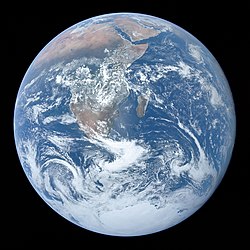 Full
Full -
 Gibbous
 -
 Low-illumination gibbous
 -
 Very low-illumination gibbous
 -
 Half
Half -
 High-illumination crescent
 -
 Crescent
 -
 Low-illumination crescent
.jpg)

.jpg)


See also
[edit]References
[edit]- ^ a b King, Bob (17 October 2018). "Observing Earth from the Moon". Sky & Telescope. Retrieved 30 June 2019.
- ^ Staff (15 July 1999). "If you are on the moon, does the Earth have phases similar to moon phases? Would they be the same or reversed?". University of California, Santa Barbara. Retrieved 1 July 2019.
- ^ Gannon, Megan (30 June 2019). "If You're On the Moon, Does the Earth Appear to Go Through Phases?". Live Science. Retrieved 30 June 2019.
- ^ Yu, Zhitong; Ye, Hanlin; Zhou, Mengxiong; Li, Feifei; Jin, Yin; Li, Chunlai; Liu, Guang; Guo, Huadong (30 October 2024). "Analysis of Field of View for a Moon-Based Earth Observation Multispectral Camera". Sensors. 24 (21): 6962. Bibcode:2024Senso..24.6962Y. doi:10.3390/s24216962. PMC 11548323.
External links
[edit]- Earth phases – model simulation program
- Video (00:36) – Earth phases seen from the Moon on YouTube
- Video (02:05) – Earth phases seen from the Moon on YouTube
| Physical properties |  | |
|---|---|---|
| Orbit | ||
| Surface and features | ||
| Science | ||
| Exploration | ||
| Time-telling and navigation | ||
| Phases and names | ||
| Daily phenomena | ||
| Related |
| |


Earth phase
View on GrokipediaBasic Concepts
Definition
The phase of Earth refers to the fraction of the planet's dayside, or illuminated hemisphere facing the Sun, that is visible from an external vantage point such as the Moon or spacecraft.[4] This phenomenon arises because only the portion of Earth's surface directly lit by sunlight is bright, while the night side remains dark, creating a varying apparent shape analogous to the phases of the Moon as seen from Earth.[5] The illuminated fraction changes cyclically over the Moon's orbital period of approximately one month due to the relative positions in the Earth-Moon-Sun system.[4] Key terminology for Earth's phases mirrors that of lunar phases but in reverse correspondence. A "new Earth" occurs when the observer sees none of the illuminated disk (0% illumination), appearing as a dark silhouette against the stars.[4] In contrast, a "full Earth" displays the entire illuminated disk (100% illumination), presenting a fully lit globe.[5] Intermediate stages include "crescent Earth," where less than half the disk is illuminated, and "gibbous Earth," where more than half but not all is visible; these are quantified by the percentage of the projected disk area that appears sunlit.[4] Geometrically, Earth's phase is determined by the phase angle, which is the angle at Earth's center formed by lines to the Sun and the observer.[6] A phase angle of 0° corresponds to full Earth, with the Sun, observer, and Earth aligned such that the observer is between the Sun and Earth, viewing the fully sunlit hemisphere.[4] At 180°, new Earth is seen, with the observer facing Earth's night side directly toward the Sun.[5] Intermediate angles between 0° and 180° produce the partial phases, with the boundary between light and dark following the planet's terminator.[6]Illumination Mechanism
The illumination of Earth arises from the planet's position relative to the Sun, where sunlight directly illuminates one hemisphere, forming a great circle known as the terminator that demarcates the boundary between the lit day side and the dark night side. As viewed from an external observer, such as the Moon or spacecraft, the visible phases of Earth depend on the alignment of the observer's line of sight with respect to this illuminated hemisphere; when the observer is positioned such that their view is mostly toward the day side, a fuller phase is apparent, whereas alignment toward the night side results in a thinner crescent or new phase. This process mirrors the mechanism of lunar phases but in reverse, as the relative geometry dictates the proportion of the sunlit surface facing the observer.[7] The geometric foundation for Earth's phases lies in the configuration of the Sun-Earth-observer triangle, where the key parameter is the phase angle , defined as the angle at Earth's center between the vectors pointing to the Sun and the observer. This angle varies from 0° (when the Sun, observer, and Earth are aligned with the observer between the Sun and Earth, yielding a fully illuminated disk) to 180° (when the observer sees primarily the night side). The fraction of Earth's apparent disk that appears illuminated is calculated by the formulaObservation Perspectives
From the Moon
From the near side of the Moon, where human exploration has been limited to the equatorial regions, Earth appears fixed in the sky due to the Moon's tidal locking with Earth, maintaining synchronous rotation that keeps the same lunar hemisphere perpetually facing our planet. This vantage point offers a dramatically enlarged view, with Earth's angular diameter measuring approximately 2 degrees—about four times larger than the Moon's apparent diameter of 0.5 degrees as seen from Earth—resulting in an apparent disk area roughly 13 times greater. The phases of Earth cycle through a complete sequence over the synodic month of 29.53 days, synchronized with the Moon's orbital period around Earth relative to the Sun, illuminating varying fractions of Earth's surface as the geometry of sunlight shifts. The phase progression from the Moon mirrors but inverts the lunar phases observed from Earth: during a new Moon as viewed from Earth, the Moon lies between Earth and the Sun, rendering Earth fully illuminated and appearing as a brilliant "full Earth" from the lunar surface, showcasing the entire dayside with swirling white clouds, blue oceans, and green-brown continents in vivid detail. Conversely, a crescent Moon from Earth corresponds to a gibbous Earth, where more than half but not all of the disk is sunlit, highlighting dynamic weather patterns and the terminator line separating day and night. These appearances are particularly striking during lunar dawn, when the rising Sun casts long shadows across the barren lunar terrain while the colorful, ever-changing Earth hangs motionless overhead, evoking the iconic "Earthrise" imagery captured from lunar orbit but adapted to the stationary surface perspective. Earth's rapid rotation, completing a sidereal day in about 23 hours 56 minutes, causes the illuminated portion of its surface to shift noticeably each Earth day relative to fixed landmarks on the Moon, such as craters or landing sites, allowing observers to watch continents rotate into view or out of sunlight over successive days. Unlike the static face of the Moon presented to Earth, this daily motion reveals a living planet with migrating weather systems and seasonal variations. Libration, the subtle wobbling of the Moon in its orbit due to eccentricity and axial tilt, introduces minor modulations to Earth's apparent position, causing it to oscillate by up to 8 degrees in longitude and 7 degrees in latitude over time, slightly altering the visible horizon and phase edges without disrupting the overall cycle. From this perspective, the Earth phase sequence does not include eclipses, as the Moon's shadow is too narrow to cast a significant umbra on Earth, preventing total obscuration events during the orbital alignments that define the phases.From Earth Orbit and Deep Space
From low Earth orbit, such as that of the International Space Station (ISS) at approximately 400 kilometers altitude, the Earth's terminator—the boundary between the illuminated dayside and shadowed nightside—is prominently visible in imagery, but distinct phases are not observed in the traditional sense due to the spacecraft's rapid orbital period of about 90 minutes. This high-speed motion causes the view of Earth to shift continuously, with the terminator line sweeping across the planet's surface multiple times per orbit, highlighting atmospheric glow and cloud patterns along the boundary. For instance, photographs from the ISS capture the terminator as a curved, glowing arc over oceans or continents, emphasizing the planet's curvature and the thin atmospheric layer.[11] In geostationary orbit at around 35,786 kilometers above the equator, satellites like NASA's GOES series maintain a fixed position relative to Earth's surface, providing a stationary view of about one-third of the planet's disk. Here, the Earth appears as a partially illuminated sphere, with the terminator line fixed in position over a 24-hour period but varying in its sweep across the visible hemisphere as the planet rotates beneath the satellite. This perspective reveals a consistent partial illumination, often showing a gibbous-like phase of the visible disk, influenced by the satellite's equatorial vantage point, and is used for continuous weather monitoring without the dynamic changes seen from lower orbits.[12] From deep space, such as the distance of Mars (approximately 225 million kilometers on average), Earth displays distinct phases analogous to those of the Moon viewed from Earth, with the phase angle varying over the synodic period of about 780 days due to the relative orbital motions around the Sun. NASA's Mars Global Surveyor captured images in 2003 showing Earth and the Moon as thin crescents at a phase angle of 98 degrees, where less than half of the disks were directly illuminated by sunlight. Similarly, the Mars Reconnaissance Orbiter's HiRISE camera has imaged Earth in gibbous phases during oppositions, appearing as a bright, partially lit orb against the Martian sky. At greater distances, like those of the Voyager probes—Voyager 1 at over 24 billion kilometers (about 160 AU) in 2025—Earth resolves only as a point of light, as in the 1990 "Pale Blue Dot" image taken at 6 billion kilometers, where the planet's angular diameter falls below the camera's resolution limit of roughly 0.12 pixels. Beyond approximately 10 AU (1.5 billion kilometers), Earth's disk cannot be spatially resolved by typical spacecraft imagers, appearing instead as a twinkling point source.[13][14] Spacecraft cameras capturing these phases, such as Voyager's narrow-angle camera with its 0.4-0.8 degree field of view or Mars orbiters' high-resolution instruments, contend with technical challenges including resolution limits dictated by the inverse square law of distance and optical design. At interplanetary ranges, color variations arise from scattered sunlight in the camera optics and Earth's atmosphere, often producing bluish hues or radial streaks, as seen in the Pale Blue Dot where forward-scattered light created prominent rays around the tiny Earth pixel. These effects are mitigated through filters and post-processing, but they underscore how phase observations from afar prioritize angular geometry over fine surface details.[15]Relation to Lunar Phases
Correspondence
The phases of Earth as observed from the Moon exhibit an inverse synchronization with the lunar phases viewed from Earth. When the Moon appears full from Earth, the Earth appears as a new phase (dark dayside facing the Moon) from the lunar surface, rendering it invisible against the Sun's glare. Conversely, during a new Moon from Earth, the Earth presents a full phase, fully illuminated by the Sun with its dayside oriented toward the Moon.[16][5] Both Earth phases and lunar phases align in their cyclical progression, governed by the synodic month, which spans approximately 29.5 days from one new Moon to the next or equivalent alignment in the Earth-Moon-Sun system. This period reflects the relative orbital motion of the Moon around Earth with respect to the Sun. The correspondences between the two can be summarized as follows:| Lunar Phase (from Earth) | Earth Phase (from Moon) |
|---|---|
| New Moon | Full Earth |
| Waxing Crescent | Waning Gibbous Earth |
| First Quarter Moon | Last Quarter Earth |
| Waxing Gibbous | Waning Crescent Earth |
| Full Moon | New Earth |
| Waning Gibbous | Waxing Crescent Earth |
| Last Quarter Moon | First Quarter Earth |
| Waning Crescent | Waxing Gibbous Earth |