Hubbry Logo
EntEntMain
Open search
Ent
Community hub
Ent
logo
8 pages, 0 posts
0 subscribers
Be the first to start a discussion here.
Ent
Ent
from Wikipedia

Ents
In-universe information
Other namesOnodrim, Shepherds of the Trees, Tree-folk
Creation dateFirst Age
Home worldMiddle-earth
Base of operationsFangorn Forest
LanguageEntish
LeaderTreebeard

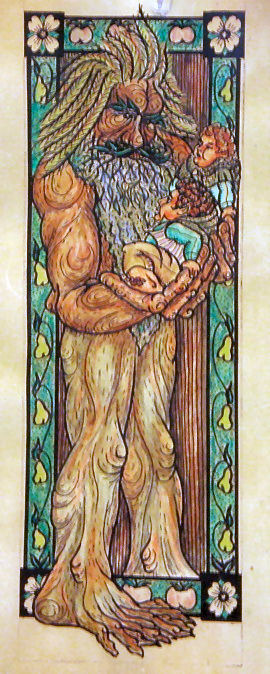
Ents are giant humanoids in J. R. R. Tolkien's fantasy world of Middle-earth who closely resemble trees; their leader is Treebeard of Fangorn forest. Their name is derived from an Old English word for "giant".

The Ents appear in The Lord of the Rings as ancient shepherds of the forest and allies of the free peoples of Middle-earth during the War of the Ring. The Ent who figures most prominently in the book is Treebeard, who is called the oldest creature in Middle-earth. At that time, there are no young Ents (Entings) because the Entwives (female Ents) were lost. Akin to Ents are Huorns, whom Treebeard describes as a transitional form of trees which become animated or, conversely, as Ents who grow more "treelike" over time.

Tolkien stated that he was disappointed by Shakespeare's handling of the coming of "Great Birnam Wood to High Dunsinane hill"; he wanted a setting in which the trees would actually go to war. Commentators have seen this as wish-fulfilment, as he disliked the damage being done to the English countryside in his lifetime. Scholars have seen his tale of the Ents as a myth, mostly without analysing it. Corey Olsen interprets the song of the Ents and the Entwives as a myth that warns of the dangers of apathetically isolating oneself in nature, whereas the Ents' song "In the willow-meads of Tasarinan" is a lament.

Inspired by Tolkien and similar traditions, animated or anthropomorphic tree creatures appear in a variety of media and works of fantasy.

Internal history

[edit]

Treebeard, called by Gandalf the oldest living Ent and the oldest living thing that walks in Middle-earth,[T 1] is described as being around 14 feet (4 m) tall, "Man-like, almost Troll-like", and clad in something that might have been tree-bark, with seven toes, a bushy, "almost twiggy" beard and deep penetrating eyes.[T 2] Ents vary widely in personal traits (height, heft, colouring, even the number of toes), having come to resemble somewhat the specific types of trees that they shepherded. Quickbeam, for example, guarded rowan trees and bore some resemblance to rowans: tall and slender, smooth-skinned, with ruddy lips and grey-green hair. Some Ents, such as Treebeard, were like[T 2]

beech-trees or oaks. But there were other kinds. Some recalled the chestnut: brown-skinned Ents with large splayfingered hands, and short thick legs. Some recalled the ash: tall straight grey Ents with many-fingered hands and long legs; some the fir (the tallest Ents), and others the birch, ... and the linden.[T 2]

Like the roots of trees, but far more rapidly, Tolkien's Ents could break stone.[T 3]

Ents are somewhat treelike, with extraordinarily tough skin; they can erode stone rapidly, but are vulnerable to fire and axe-strokes. They are patient and cautious, with a long sense of time; they considered a three-day deliberation "hasty".[T 2]

Ents are tall and very strong, capable of tearing apart rock and stone when "roused". Tolkien describes them as tossing great slabs of stone about, and ripping down the walls of Isengard "like bread-crust".[T 3] Treebeard boasted of their strength to Merry and Pippin; he said that Ents were much more powerful than Trolls, which Morgoth made in the First Age in mockery of Ents, as Orcs were of Elves.[T 2]

First Age

[edit]

Tolkien wrote almost nothing of the early history of the Ents. After the Dwarves were put to sleep by Eru to await the coming of the Elves, the Vala Aulë told his wife Yavanna, "the lover of all things that grow in the earth,"[T 4] of the Dwarves. She replied, "They will delve in the earth, and the things that grow and live upon the earth they will not heed. Many a tree shall feel the bite of their iron without pity."[T 5] She went to Manwë and appealed to him to protect the trees, and they realized that Ents, too, were part of the Song of Creation. Yavanna then warned Aulë, "Now let thy children beware! For there shall walk a power in the forests whose wrath they will arouse at their peril." The Ents are called "the Shepherds of the Trees".[T 5] Much later, when Beren and a force of Green Elves waylay the force of Dwarves returning from the sack of Doriath, the Dwarves are routed and scatter into the wood, where the Shepherds of the Trees ensure that none escape.[T 6] Ents did not know how to speak until the Elves taught them. Treebeard said that the Elves "cured us of dumbness", calling that a great gift that could not be forgotten.[T 2] At that time, much of Eriador was forested; Elrond stated that "a squirrel could go from tree to tree from what is now the Shire to Dunland west of Isengard."[T 7][T 2]

Entwives

[edit]

The Entwives began to move farther away from the Ents because they liked to plant and control things, while the Ents preferred forests and liked to let things take their natural course. The Entwives moved away to what became the Brown Lands across the Great River Anduin, although the male Ents still visited them. The Entwives interacted with Men and taught them the art of agriculture. The gardens of the Entwives were destroyed by Sauron, and the Entwives disappeared. It was sung by the Elves that one day the Ents and Entwives would find each other. Treebeard indeed implored the Hobbits to send word to him if they had news of the Entwives.[T 8]

Tolkien spent much time considering the fate of the Entwives, stating in Letters #144: "I think that in fact the Entwives have disappeared for good, being destroyed with their gardens in the War of the Last Alliance...some may have fled east, or even have become enslaved..."[T 9]

After Aragorn is crowned king, he promised Treebeard that the Ents could prosper again and spread to new lands with the threat of Mordor gone, and renew their search for the Entwives. Treebeard lamented that forests may spread but the Ents would not, and he predicted that the few remaining Ents would remain in Fangorn forest and dwindle or become "treeish".[T 2]

The Last March of the Ents

[edit]

The Ents, angry at Saruman for cutting down their trees, convene an Entmoot.[T 2] They decide to march on Saruman's fortress at Isengard - 'the last march of the Ents'. Led by Treebeard and accompanied by the hobbits Meriadoc Brandybuck and Peregrin Took, the Ents numbered about 50, plus an army of Huorns.[T 2] They destroy Isengard, tearing down the wall around it:[T 3] "If the Great Sea had risen in wrath and fallen on the hills with storm, it could have worked no greater ruin".[T 10] Saruman is trapped in the tower of Orthanc.[T 3]

Analysis

[edit]

Etymology

[edit]
The phrase orðanc enta geƿeorc, on the second line of the Old English Maxims II manuscript, seems to have inspired Tolkien.[1]

The word "Ent" is from the Old English ent or eoten, meaning "giant". Tolkien borrowed the word from a phrase in the Anglo-Saxon poems The Ruin and Maxims II, orðanc enta geƿeorc ("cunning work of giants"),[1] which describes Roman ruins.[T 11][2]

In Sindarin, one of Tolkien's invented Elvish languages, the word for Ent is Onod (plural Enyd). The Sindarin word Onodrim means the Ents as a race.[T 12]

Improving on Shakespeare

[edit]
Tolkien wrote that he "longed to devise a setting in which the trees might really march to war", unlike the "shabby" treatment of the story in Shakespeare's Macbeth.[T 13]
Birnam Wood comes to Dunsinane, in the form of branches carried by the soldiers, as described by Shakespeare.

Tolkien noted in a letter that he had created Ents in response to his "bitter disappointment and disgust from schooldays with the shabby use made in Shakespeare's Macbeth of the coming of 'Great Birnam Wood to high Dunsinane hill': I longed to devise a setting in which the trees might really march to war".[T 13] The Ents ensured victory at the Battle of Helm's Deep by herding a forest of angry, tree-like Huorns there, to destroy Saruman's army of Orcs.[T 14]

Other sources

[edit]
Arthur Rackham's drawings feature twisted trees that suggest supernatural beings.[3]

Nick Groom suggests some other possible sources, besides Shakespeare. The Gospel of Mark has the speech by a man cured of blindness "I see men as trees, walking."(Mark 8:24) Algernon Blackwood's 1912 story "The Man Whom the Trees Loved" suggests that "trees had once been moving things, animal organisms of some sort, that had stood so long feeding, sleeping, dreaming, or something, in the same place, that they had lost the power to get away", which Groom remarks sounds just like Treebeard's account of Ents going "sleepy and 'tree-ish'".[3] He notes, too, Arthur Rackham's drawings with "bristly, twisted, anthropomorphic trees that appear as the guises of Elves and other supernatural beings", while Disney's 1932 Silly Symphony episode Flowers and Trees features trees that walk.[3]

Wish-fulfilment and environmentalism

[edit]

Commentators have observed that having the Ents march to war against the tree-destroyers represented a wish-fulfilment on Tolkien's part, concerned as he was with the increasing damage to the English countryside in the 20th century.[4][5] In their book Ents, Elves, and Eriador: The Environmental Vision of J.R.R. Tolkien, Matthew T. Dickerson and Jonathan Evans see Treebeard as vocalizing a vital part of Tolkien's environmental ethic, the need to preserve and look after every kind of wild place, especially forests.[6] Corey Olsen however criticises Dickerson and Evans's use of the Ents as "mere symbols".[7]

Mythic value: song of the Ents and the Entwives

[edit]

C. S. Lewis described Tolkien's tale of the Ents as a myth, "a story which has a value in itself".[8] Ruth Noel likened the Ents to Germanic legends of "huge, wild, hairy woodsprites".[9]

From the "Song of the Ents and Entwives"

Ent:

When Summer lies upon the world, and in a noon of gold
Beneath the roof of sleeping leaves the dreams of trees unfold,
When woodland halls are green and cool, and wind is in the West,
Come back to me! Come back to me, and say my land is best!

Entwife:

When Summer warms the hanging fruit and burns the berry brown;
When straw is gold, and ear is white, and harvest comes to town;
When honey spills, and apple swells, though wind be in the West,
I'll linger here beneath the Sun, because my land is best!

Olsen sees in Tolkien's song of the Ents and the Entwives, supposedly written by Elves, "compelling insights on the complexities and conflicts of life in a fallen world."[7] The song goes through the four seasons of the year, each time with a stanza by the Ent and then one by the Entwife. Olsen comments that the Ent is passive, even "languid and somnolent" in summer, the only active process being dreaming; whereas the Entwife's summer season is "simply bursting with activity". These are perhaps, Olsen reflects, not in competition; both contemplation and action are "valuable ways of celebrating natural beauty".[7] He suggests that Treebeard's view of the song is however biased, and that the Ent is not as humble as he claims to be, especially with respect to the Entwives. If the Ents and the Entwives were to be "unified", they would "balance and complete each other", but they face "moral dangers" without such balance: in the case of the Ents, the danger is of letting their life in nature "lapse into mere lassitude". He gives as examples the "apathetic isolationism" of Skinbark, who refuses to come out of his hills, and Leaflock's "somnolent oblivion", just standing in the long grass all summer doing nothing. Olsen calls it "a cautionary tale" and "tragic", quite unlike Treebeard's "In the willow-meads of Tasarinan", again covering the four seasons, but which is a lament.[7]

Anne Petty comments that the song follows traditional gender stereotypes, the Ents liking wild nature, the Entwives preferring the more domestic realm of tamed nature and gardening.[10]

Adaptations

[edit]

In other media

[edit]

In Peter Jackson's films The Lord of the Rings: The Two Towers (2002) and The Lord of the Rings: The Return of the King (2003), Treebeard is a combination of a large animatronic model and a CGI construct; he is voiced by John Rhys-Davies, who also portrays Gimli.[11] The Fall of Troy has a song entitled "The Last March of the Ents" on their self-titled debut album released in 2003.[12] Permission was granted for a statue of Treebeard by Tim Tolkien, near his great-uncle J. R. R. Tolkien's former home in Moseley, Birmingham.[13][14]

The TV series The Lord of the Rings: The Rings of Power, set in the Second Age, features Ents.[15] Two of the Ents that appear in the season two episode "Eldest" are Snaggleroot and Winterbloom (voiced by Jim Broadbent and Olivia Williams[16]).

[edit]
A "treant" from World of Warcraft

Ents appeared in the earliest edition of the roleplaying game Dungeons & Dragons in the 1974 white box set, where they were described as tree-like creatures able to command trees, and lawful in nature.[17] In 1975, Elan Merchandising, which owned the game licence to the Tolkien estate, issued a cease-and-desist order regarding the use of the word "ent", so the Dungeons & Dragons creatures were renamed "treants".[18][19] Heroes of Might and Magic V includes Treants as a part of the Elven alliance; however, due to copyright infringement issues, their look was changed[20] between the beta phase and the retail version, making them quadrupedal.[21]

See also

[edit]

References

[edit]
[edit]
Revisions and contributorsEdit on WikipediaRead on Wikipedia
from Grokipedia
Ents are ancient, ambulatory tree-like beings in 's Middle-earth legendarium, functioning as guardians and herders of forests. The name derives from the Old English term ent or eoten, signifying "giant," which Tolkien encountered in Anglo-Saxon poetry such as Maxims II. Awakened by the Vala Yavanna in the Years of the Trees to safeguard vegetation against threats like the Dwarves created by Aulë, Ents embody a deliberate, long-lived existence marked by profound attunement to natural rhythms. In The Two Towers, they convene an Entmoot to deliberate on the industrialization wrought by Saruman, culminating in their decisive assault on Isengard, where they demolish fortifications, slay defenders, and redirect the Isen River to inundate the valley, thereby neutralizing a key threat in the War of the Ring. Distinguished by their immense stature—Treebeard, the eldest, stands akin to a towering oak or beech—hoarse rumbling speech, and aversion to haste, Ents highlight Tolkien's ecological motifs, contrasting hasty industrialization with enduring natural resilience, though their numbers dwindled due to the lost Entwives and fading forests.)

Origins in Tolkien's Legendarium

Creation by Yavanna

Yavanna, a Vala known as the lover of all growing things, grew concerned for the vulnerability of trees and plants after learning of Aulë's clandestine creation of the Dwarves, whom she feared would fell her works without regard. She confided in Manwë, expressing anxiety that creatures lacking love for the olvar (plants rooted and unmoving, unlike the mobile kelvar) might destroy them, emphasizing her special affection for flora that grew untended by any other will. In response, Manwë sought counsel from Eru Ilúvatar, who decreed that Yavanna's entreaty would find fulfillment: if harm befell the trees through the deeds of others, then shepherds arising from her thought would come forth to guard them, honoring even the smallest elements of creation. The Ents materialized after the awakening of the Elves by the waters of Cuiviénen in the Years of the Trees, fulfilling Ilúvatar's prophecy as sentient guardians bound intrinsically to the forests they were meant to protect. Unlike the Children of Ilúvatar—Elves and Men—the Ents derived their essence not from the initial Music of the Ainur in full form but as a responsive creation tied to Yavanna's dominion over growth, embodying a deliberate counter to potential exploitation by races like the Dwarves, who delved stone and hewed wood for their crafts. This origin underscored their role as protectors of arboreal life, distinct in their slow, tree-like nature and profound attunement to the natural world, rather than possessing the independent spirits of the Free Peoples. Treebeard, the oldest known Ent, attributes their making directly to Yavanna, recounting in that she formed them amid her vast array of tree-shaping, though their precise emergence remained mysterious even to the Eldar, who noted the Valar had not foretold them explicitly in the . This mythological genesis positioned the Ents as ancient yet secondary to the primary Children, their purpose rooted in preservation against causal threats from other sentient beings' activities.

First Age and Early Interactions

In the First Age, Ents, known as the Shepherds of the Trees, inhabited the ancient forests of and Eriador, where they tended to the great woods such as those in East and protected them from depredations by Orcs and other perils. Created by Ilúvatar at Yavanna's behest to safeguard vegetation from the hasty and destructive tendencies of races like the Dwarves, the Ents awoke contemporaneously with the Elves, fostering an initial harmony as they roamed and nurtured the verdant landscapes amid the rising stars. This period marked their closest integration with the elder Children of Ilúvatar, sharing in the stewardship of Middle-earth's natural realms before the escalating conflicts with began to reshape the continent. Ents maintained cooperative ties with the Elves, who imparted to them, alleviating their initial "hasty" silence and enabling communication, a favor later recalled by as a pivotal from the . Together, they preserved the equilibrium of Beleriand's woodlands, with Ents embodying Yavanna's vision of mobile guardians against exploitation, countering threats that Elves alone could not fully mitigate in their woodland domains. This alliance reflected a shared interest in defending the natural order, though Ents' deliberate pace limited their broader involvement in Elven-led campaigns against Morgoth's forces. A notable instance of Ent-Elf cooperation occurred in F.A. 503 during the Battle of Sarn Athrad, where an Ent-host joined Beren Erchamion and the Green Elves of Ossiriand to ambush the Dwarves of Nogrod returning from their sack of Doriath. The Ents pursued the surviving Dwarves into the Ered Lindon, decimating their numbers and exemplifying their readiness to rouse against despoilers of the forests, even if not directly in the great wars against himself. Such actions underscored their role as forest defenders, aligning sporadically with Elven allies against mutual foes who ravaged trees and glades. As the First Age progressed toward cataclysmic upheavals like the War of Wrath, the Ents' immutable, tree-attuned nature sowed the seeds of their growing isolation; while Elves and Men adapted to relentless strife and migrations, Ents remained bound to their unchanging guardianship, their numbers dwindling as the world's rapid transformations outpaced their slow renewal and the Entwives began to diverge in pursuits. This steadfastness, though preserving ancient groves, rendered them increasingly peripheral to the evolving alliances and battles, presaging a retreat from active kinship with other peoples amid Beleriand's eventual ruin.

The Entwives and Their Disappearance

The Entwives were created by the Vala Yavanna as counterparts to the Ents, whom she had awakened to safeguard the wild trees of from exploitation by other races such as Dwarves. Unlike the Ents, who dwelt in untamed forests and resisted orderly intervention in nature, the Entwives developed a preference for cultivating gardens, crops, and domesticated plants, reflecting Yavanna's broader concern for the fruits and ordered growth of the earth. This distinction in temperament arose early, as recounted by to Merry and Pippin in , where he describes the Entwives' desire for "order, and plenty, and peace" in tended plots rather than the "wild woods" favored by Ents. Over time, these differing inclinations led to a gradual separation. The Entwives migrated eastward across the Anduin River, settling in regions suitable for agriculture that later became known as the Brown Lands, while the Ents remained in the ancient forests of Fangorn and beyond. Efforts by the Ents to reunite with them proved fruitless, with lamenting the loss during the Second Age and expressing a lingering hope that the Entwives might persist somewhere beyond the Ents' knowledge. The precise circumstances of their vanishing remain unresolved in Tolkien's published narratives, preserving an element of mystery tied to the broader fading of natural vitality in . In his letters, Tolkien offered speculative insights into their fate, emphasizing ambiguity while favoring a grim outcome. He posited that the Entwives were likely destroyed alongside their gardens during 's invasions in the War of the Last Alliance (S.A. 3429–3441), as the advancing blight and warfare devastated eastern lands. Alternatively, he considered the possibility that had captured and enslaved them to coerce agricultural production for his armies, exploiting their affinity for cultivation amid the "Withering of the climate" that afflicted regions east of the Anduin. Tolkien rejected notions of their survival in distant, unspoiled areas like , noting the Ents' exhaustive searches would have uncovered them if possible, though he allowed for the theoretical chance of estranged persistence without reunion. These musings, drawn from private correspondence rather than canonical texts, underscore the Entwives' disappearance as a poignant, open-ended loss rather than a resolved event.

Third Age Isolation

By the Third Age, the Ents had retreated primarily to Fangorn Forest, the last major woodland remnant harboring their kind, marking a profound isolation from the broader events and peoples of . This withdrawal stemmed from millennia of diminishing forests and their own reproductive stagnation following the unexplained disappearance of the Entwives sometime after the Second Age. Without Entwives, no new Ents—termed "Entings"—had been born for an exceedingly long period, resulting in a steadily declining population confined to this ancient, shadowed wood. Treebeard, the eldest known Ent and guardian of Fangorn, articulates this desolation in conversation with Merry and Pippin, recounting exhaustive searches for the Entwives—who favored ordered gardens and tilled lands over untamed wilds—yet finding no trace, declaring, "We lost them, and now we cannot find them." This irrecoverable loss eroded the Ents' foundational role as protectors and cultivators of tree-life, fostering a pervasive sense of purposelessness amid their enduring vigilance over remaining . The Ents' detachment extended to scant awareness of "hasty" races like Men, whose expanding kingdoms relentlessly felled woodlands for timber, , and , shrinking habitats and severing ancient connections. Dismissing the ambitions of Elves, Dwarves, and Men as transient follies, the Ents clung to their deliberate pace, safeguarding archaic lore—including exhaustive "Old Lists" of and histories—while the encroaching of Sauron's influence loomed unchecked beyond Fangorn's borders. This preserved their primordial essence but rendered them relics of a fading epoch, vulnerable to oblivion without renewal.

Characteristics and Traits

Physical Form and Abilities

Ents appear as massive, ambulatory tree-creatures, in shape but with features mimicking ancient trees, such as bark-textured skin, branch-like arms, and foliage for hair that varies by season and species. Their height reaches that of tall forest trees, with described as having deep-set eyes under overhanging brows, evoking ancient wells filled with profound awareness. Distinct varieties exist among Ents, reflecting different tree types, while Huorns represent a more primitive, shadowy kindred—dark-trunked and less articulate, capable of independent movement but lacking the full form of true Ents. In terms of abilities, Ents demonstrate prodigious physical power, uprooting full-grown trees effortlessly and demolishing reinforced stone walls during the assault on Isengard, where they shattered dams, machinery, and fortifications in coordinated fury. This strength stems from their arboreal physiology, enabling them to wield limbs as battering rams or levers against unyielding rock. Their longevity defies mortal decay, with individuals enduring millennia without senescence akin to Men or Elves, sustained by slow metabolic processes tied to forest cycles. Ents exhibit resilience in wooded environments, regenerating slowly from wounds if not fatally severed, yet harbor acute vulnerabilities to , which spreads rapidly through their dry, combustible forms, and to axes or saws that exploit natural grain lines in their bark-like exteriors. voices this dread explicitly, associating with existential threats alongside axes wielded by foes like Orcs. Huorns share these traits but prove even more formidable in dim forests, enveloping enemies in engulfing shadows during nocturnal pursuits.

Entish Language and Communication

Entish, the ancient language of the Ents, is renowned for its deliberate slowness and exhaustive detail, reflecting the timeless nature of its speakers. Treebeard describes it as "a lovely language, but it takes a very long time to say anything in it, because we do not say anything in it, unless it is worth taking a long time to say, and to listen to." This structure arises from Entish's incorporation of "" for every tree, plant, and growing thing known to the Ents, where each name functions as a complete encompassing the entity's history, growth, and essence from its origins. Consequently, even simple statements expand into lengthy discourses, as Ents prioritize precision and lore preservation over brevity, rendering the impractical for rapid exchange. The phonetic qualities of Entish emphasize its sonorous, rumbling timbre, often conveyed through deep vocalizations such as "hoom-hom," which serve as interjections for contemplation or affirmation during speech. Ents also employ songs and chants to express complex ideas, drawing on tonal variations and subtle shifts that encode vast ecological . These elements make Entish largely impenetrable to outsiders; for instance, Hobbits like Merry and Pippin perceive only fragmented meanings, mistaking full Entish recitations for mere tree-creaking or wind-sounds, underscoring its rootedness in the natural world's rhythms rather than abstract symbolism. In contrast to "hasty" tongues like Westron or , which prioritize efficiency for quick communication among shorter-lived races, Entish embodies a rejection of haste, viewing such languages as superficial and prone to loss of meaning over time. notes that Ents must translate their thoughts into these quicker idioms when interacting with non-Ents, often simplifying profoundly to avoid exhaustive elaboration, as full Entish expression could span days or weeks for a single concept. This linguistic isolation reinforces the Ents' role as steadfast guardians of forgotten knowledge, immune to the dilutions imposed by urgency or cultural blending.

Deliberate Temperament and Longevity

Ents possess a defined by profound deliberation and resistance to haste, reflecting their ancient, tree-like nature and attunement to gradual natural processes. , the eldest Ent, embodies this mindset, repeatedly cautioning against precipitancy with phrases such as "Don't be hasty," underscoring a that prioritizes thorough consideration over impulsive action. This approach arises from their perception of time on a scale far exceeding that of Men or Elves, where decisions warrant extended rumination to align with enduring ecological realities rather than ephemeral conflicts. Their deliberative practices, exemplified by the Entmoot—a convocation requiring at minimum three days of discourse—enable comprehensive evaluation among Ents, ensuring consensus emerges from exhaustive dialogue rather than majority fiat. Such longevity, with estimated at over 11,000 years old based on his awakening during the Years of the Trees and recollection of primordial events, cultivates intimate of forests' rhythms and growth patterns, yet it concomitantly impedes swift to abrupt disruptions like industrialization or war. This temporal disconnect fosters a default , as Ents view shorter-lived races' urgencies as transient follies unworthy of immediate intervention. While generally disinclined toward , maintaining a near-pacifist stance rooted in preservation over destruction, Ents harbor a latent capacity for vehement response when cumulative provocations—such as —exceed thresholds of endurance. Scholarly analyses note this equilibrium, where prolonged restraint yields to inexorable force, driven not by caprice but by the causal accumulation of existential threats to their domain, rendering their rare mobilizations both inevitable and cataclysmic in scope.

Narrative Role in The Lord of the Rings

Encounter with Hobbits

Following their escape from pursuing orcs after the skirmish near the Fords of Isengard in early March 3019 of the Third Age, Meriadoc Brandybuck and Peregrin Took entered the shadowed depths of Fangorn Forest for shelter. Amidst the ancient trees, the exhausted hobbits climbed a rocky ridge and encountered , the eldest living Ent and namesake of the forest as Fangorn. Treebeard seized them upon hearing their calls, initially suspecting them to be orcs or other ill creatures, but soon recognized their harmless, diminutive form and engaged them in wary dialogue. Transported to Treebeard's dwelling at Wellinghall—a natural fed by a clear spring—the hobbits partook of ent-draught, a nourishing distilled from waters that restored their strength more potently than pipe-weed or lembas. In the ensuing exchange, Merry and Pippin disclosed their origins in , their entanglement in the broader conflict, and crucially, Saruman's role as the architect of Isengard's expansion, marked by relentless tree-felling to supply forges and armories. Treebeard, who had once hosted the wizard as a guest , expressed initial toward tales of Saruman's , asserting that a wizard ought to respect trees. The hobbits' vivid accounts of orc-led axes decimating stands of timber and the pall of from Saruman's pits pierced Treebeard's isolationist detachment, evoking dismay at by one he had deemed an ally. This disclosure marked the first direct Entish awareness of the scale of Saruman's environmental ravages adjacent to Fangorn, shifting Treebeard's demeanor from placid curiosity about these "young Ents" to a simmering outrage over the desecration of growing things. Treebeard then hoisted the hobbits onto his broad shoulders for conveyance through the forest's labyrinthine trails, his deliberate gait accelerating as he ruminated on the tidings, intertwining fascination with the novel little folk and nascent fury toward the wizard's mechanized ambitions.

The Entmoot and Mobilization

The Entmoot convened in Derndingle, a secluded bowl-shaped valley deep within Fangorn Forest, as a rare deliberative council summoned by Treebeard following the hobbits' disclosure of Saruman's systematic deforestation to fuel his war machine. This assembly marked the first significant gathering of Ents in centuries, focused on assessing whether the wizard's encroachments warranted breaking their long-enforced isolationism. The process underscored the Ents' commitment to thorough, unhurried consensus, with debates conducted exclusively in Entish, their archaic and verbose tongue designed for precision over generations. Spanning three days—from approximately February 30 to March 2, 3019 TA—the Entmoot proceeded at a pace deemed exceptionally rapid by Ent measures, reflecting the gravity of Saruman's threat to Fangorn's arboreal . Internal divisions surfaced, particularly between elder Ents favoring prolonged reflection and younger ones exhibiting relative hastiness; Quickbeam, a rowan-associated Ent, exemplified this faction's impatience, driven by acute distress over orcs felling his favored trees near the forest's edge. Such sentiments, though atypical, amplified calls for response, as the hobbits' intelligence illuminated the causal chain linking Isengard's expansion to irreversible habitat loss. The moot culminated in unified resolve to mobilize, with Treebeard conveying to Merry and Pippin that the Ents had "decided" on intervention, directly attributing the shift to Saruman's role in provoking widespread tree destruction and endangering the Ents' shepherding role. This decision represented a pivotal override of deliberative inertia, propelled by empirical evidence of ecological devastation rather than abstract alliances, setting the stage for collective action without prior precedent in the Third Age.

Assault on Isengard and Aftermath

Following the Entmoot's decision, led approximately two thousand Ents and an indeterminate number of Huorns in a march toward , arriving at the fortress on March 3, 3019 of the Third Age. The Ents surrounded the Ring of , a constructed by Dwarves under 's direction, and systematically demolished its and stone battlements using their superior physical strength, which exceeded that of the orcs and men defending the site. initially countered with incendiary defenses from his forges and pits, igniting naphtha-like combustibles that wounded or killed several Ents, but this only intensified their assault, prompting a focused demolition of the industrial complexes, including armories, wheels, and engines of war. Quickbeam, an impatient Ent, identified the critical dams impounding the River Isen upstream, and the Ents breached these structures, releasing a torrent that flooded the Nan Curunír valley, submerging 's underground workshops, drowning remaining defenders, and rendering the machinery inoperable without further combat. Despite their destructive capacity against masonry and metal, the Ents could not topple Orthanc, the indestructible tower of Númenórean origin at Isengard's center, leading to contain within it under constant Entish guard rather than executing him. Merry and Pippin, having accompanied , witnessed the operation's conclusion, noting the Ents' deliberate avoidance of unnecessary casualties after neutralizing threats, with surviving orcs pursued and eliminated by accompanying Huorns en route from the Battle of the Hornburg. In the immediate aftermath, the Ents occupied the ruined , redirecting the floodwaters to nourish new plantings of quick-growing trees and gardens, effectively reclaiming the deforested area as an extension of their domain while maintaining vigilance over Orthanc until Gandalf's arrival on March 5, which prompted 's deposition but not his release. remained imprisoned until his voluntary departure in late March, after which the Ents relinquished control to the forces of Rohan and , withdrawing primarily to Fangorn Forest. Fangorn showed signs of gradual recovery post-assault, with reduced incursions allowing tree regrowth, though the Ents undertook no further military engagements in the War of the Ring. Long-term, the Ents' isolation persisted, with lamenting the failure to locate the Entwives during expanded searches around the former Entwife lands east of the Anduin, a loss attributed to wartime devastation centuries prior and contributing to the race's reproductive stagnation without new Entings. This demographic impasse, unmitigated by the victory, underscored the Ents' potential extinction, as described the march as possibly their "last" collective action amid dwindling numbers.

Literary and Symbolic Dimensions

Etymology and Linguistic Roots

![Manuscript of Maxims II showing 'enta geweorc'][float-right] The term "Ent" derives from the Old English word ent, meaning "giant," which J.R.R. Tolkien repurposed to name these tree-like guardians, inspired by its rare and enigmatic appearances in Anglo-Saxon literature associating giants with ancient, enduring constructions. In Old English poetry, such as The Ruin, the phrase orþanc enta geweorc describes Roman ruins as the "cunning work of giants," evoking a sense of primordial craftsmanship that Tolkien connected to the Ents' role as shepherds of forests and shapers of the land. Tolkien explained in a 1954 letter that the Ents originated linguistically from this Anglo-Saxon root, as he sought to develop the under-explored term into a fully realized concept for his mythology. This philological approach underscores his method of grounding fictional elements in historical language evolution, lending authenticity to the Ents' ancient demeanor. In the Elvish tongues of , Ents receive names reflecting observed traits, such as Treebeard's Sindarin designation Fangorn, combining fang ("beard" or long growth) and orn ("tree") to denote his bearded, arboreal form. , a Grey-elven with Celtic-like developed by Tolkien, integrates seamlessly with the Ents' nomenclature, mirroring how Elves named these beings based on their tree-resembling appearances. While Entish itself is a unique, slow-evolving idiom incomprehensible to outsiders, it draws melodic influences from , the high Elven tongue, which Ents adapted for certain expressions due to its harmonious structure. This linguistic interplay highlights Tolkien's constructed realism, where invented languages evolve with cultural histories akin to natural ones.

Influences from Folklore and Literature

Tolkien's conception of Ents drew partial inspiration from 's , particularly the prophecy that Birnam Wood would march to Dunsinane Hill, which as a schoolboy Tolkien found disappointingly fulfilled by soldiers camouflaged with branches rather than truly ambulatory trees. This perceived inadequacy of mere mechanical deception prompted Tolkien to envision living, willful tree-like guardians capable of genuine movement and agency, distinguishing his Ents from Shakespeare's inert foliage. The term "Ent" derives directly from Old English ent or ente, signifying "giant," as evidenced in Anglo-Saxon poetry such as the Exeter Book's Maxims II, where enta geweorc ("giants' works") describes cyclopean ruins attributed to ancient beings of immense stature and endurance. Tolkien, steeped in , adopted this archaic root to evoke Ents' primordial, stone-like permanence and their role as ancient stewards, evolving the concept from linguistic artifact to sentient entities with causal rather than passive . Further literary echoes include a remote influence from George MacDonald's , where animate beech-trees exhibit limited agency, though Tolkien emphasized Ents' independent volition over enchanted mobility. Scholars also trace connections to Old Norse traditions, such as personified natural elements in sagas like the , aligning with Tolkien's broader Germanic mythic framework, yet he insisted Ents arose organically during composition, prioritizing their inherent guardianship of nature against superficial animation found in .

Representations of Nature Versus Mechanization

In , the Ents under Treebeard's leadership confront Saruman's industrialization of , where pits, forges, and smoke-belching chimneys consume Fangorn Forest's timber for fuel and war machines, posing a direct causal disruption to the woodlands' regenerative order. This mechanized expansion, driven by Saruman's pursuit of power through systematic exploitation, exemplifies haste overriding natural rhythms, as Ents observe the "felling of trees—and all that goes with it" as an existential violation of their . Their retaliatory assault floods the industrial works with the river Isen, dismantling wheels, engines, and stockpiles in a restoration of hydraulic balance over artificial and metal, thereby halting the causal chain of and . Tolkien grounded this dynamic in his firsthand observation of England's landscape transformation, having grown up in the rural village of Sarehole before witnessing its subsumption by Birmingham's encroaching factories and coal scars by the early 1900s, which he later described as a "hideous" of agrarian beauty. In correspondence, he characterized machinery as the "chief enemies of and ," viewing unchecked mechanization not as neutral progress but as a dehumanizing force that subordinates living order to utilitarian ends. Applied to the narrative, Saruman's factories represent a causal inversion where natural endowments—forests and rivers—are reforged into instruments of domination, prompting Ents' defense as agents of enduring harmony rather than reactive sentiment. The Ents' preservationist role underscores strengths in maintaining , as their rooted vigilance sustains and seasonal cycles against extractive , yet their temperament incurs vulnerabilities: prolonged at the Entmoot delays , nearly permitting Isengard's unchecked spread and risking the Ents' own amid accelerating threats. This tension illustrates causal realism in Tolkien's world-building, where nature's deliberate tempo preserves intrinsic value but invites peril from mechanized rapidity, without imputing modern ideological overlays to the mechanics.

Rejections of Modern Allegorical Overlays

J.R.R. Tolkien rejected allegorical readings of his legendarium, including interpretations of the Ents as stand-ins for modern environmental activism or political collectives, insisting in the foreword to the 1965 second edition of The Lord of the Rings that he "cordially dislike allegory in all its manifestations" and favored narratives offering "varied applicability" to readers' experiences rather than author-imposed symbolism. This distinction underscores that while Ents evoke concerns over landscape despoliation—as seen in Saruman's mechanized ruination of Isengard—their role permits individual reader reflection on aesthetic and cultural loss, not prescriptive ideological overlays. Tolkien critiqued "conscious and intentional allegory" as limiting, preferring sub-created worlds where elements like the Ents' deliberate pace critique haste without mapping to contemporary movements' political agendas. Tolkien's letters reinforce this by decrying wish-fulfillment narratives as sentimental escapism, as in Letter 131 where he described as neither allegorical nor topical but a self-contained history applicable across contexts. Applied to Ents, this counters environmentalist allegories portraying them as proto-activists victimized by industrialization; instead, their mobilization arises from personal provocation by Merry and Pippin, highlighting individual agency over systemic grievance. The Ents' isolation reflects self-inflicted divergence, rooted in textual evidence of their growing "tree-ish" tendencies and preference for untamed forests, contrasting the Entwives' affinity for ordered gardens, which eroded mutual understanding without external coercion. Treebeard's lament—"We lost them, and now we can never find them"—attributes decline to inherent incompatibilities, not imposed oppression, embodying causal outcomes of deliberate temperaments rather than narratives of collective redemption. Some interpreters view Ents as bulwarks of against "hasty" , aligning with Tolkien's aversion to rapid change eroding rooted , yet textual primacy demands eschewing modern politicization for the characters' intrinsic portrayal as ancient, slow-moving guardians whose awakening defies neither conservationist nor progressive urgency. This preserves the Ents' essence as embodiments of enduring natural forms, critiquing mechanized disruption on aesthetic grounds—Tolkien's own dismay at England's industrialized "urban blight"—without endorsing environmentalism's often coercive prescriptions.

Adaptations and Cultural Legacy

Film Portrayals by Peter Jackson

In Peter Jackson's The Lord of the Rings: The Two Towers (2002), Ents are depicted as ancient, tree-like shepherds of the forest, primarily through the character of Treebeard, the eldest Ent. Treebeard's physical design, crafted by Weta Workshop under the direction of designer Daniel Falconer, features a hulking, moss-covered form with branch-like limbs and facial features resembling knotted bark, emphasizing their arboreal nature while allowing for expressive movement via CGI animation. The voice of Treebeard is provided by John Rhys-Davies, whose performance was digitally altered by sound designers to produce a deep, rumbling timbre evocative of creaking timber, enhancing the character's deliberate speech patterns. The film's portrayal condenses the Entmoot sequence from J.R.R. Tolkien's novel, where Ents engage in prolonged deliberation over days, into a more abbreviated council to maintain narrative pacing and avoid extended montages of off-screen debate. This leads to a pivotal deviation: upon witnessing Saruman's near —prompted by Pippin's suggestion to redirect southward—the Ents rapidly mobilize for war, culminating in a visually spectacular assault where they dismantle the industrial fortress, including the addition of breaching a to the valley with water. While this sequence showcases groundbreaking effects for the era, achieving a sense of organic fury in the Ents' rampage, it contrasts sharply with the book's emphasis on unhurried wisdom. Critics of the argue that portraying the Ents as initially apathetic yet impulsively vengeful inverts Tolkien's theme encapsulated in Treebeard's adage that "haste is not wise," reducing their philosophical depth as embodiments of , ecological to reactive forces aligned with the plot's urgency. This alteration prioritizes cinematic momentum over the novel's depiction of deliberate, almost bureaucratic decision-making, potentially undermining the causal realism of nature's slow retribution against hasty industrialization. Nonetheless, the Ents' destruction of remains a highlight for its visceral representation of environmental backlash, with Ents uprooting machinery and flooding pits in a manner that visually conveys the triumph of organic power.

Recent Television and Media Appearances

In Video's : The , Ents make their debut in season 2, which premiered on August 29, 2024, depicting them during the Second Age as younger, more agile guardians of the forests who speak and act with relative haste compared to their Third Age counterparts in Tolkien's . The series introduces named Ents including Snaggleroot, voiced by , and Winterbloom, voiced by and portrayed as female, in episodes such as the fourth installment where the character Arondir encounters them amid conflicts involving forces encroaching on wooded areas. This representation includes Ents actively intervening to protect , such as seeking retribution for mistreatment of trees, but draws criticism for inventing female Ents among the main cast, as Tolkien's texts describe all encountered Ents as male with the Entwives' fate unresolved and their locations unknown by the Third Age. These portrayals stem from the production's constrained adaptation rights, limited primarily to Tolkien's appendices and select unpublished materials rather than the full Silmarillion or Lord of the Rings narratives, necessitating original inventions to fill Second Age gaps where Ents receive minimal direct mention. The Tolkien Estate, historically protective of the legendarium—exemplified by Christopher Tolkien's public resignation from advisory roles over Peter Jackson's films and the estate's disavowal of unauthorized biographical projects—has not issued specific recent statements on these Ent depictions but maintains oversight through licensing agreements that prohibit wholesale deviations from core lore. Fan debates, amplified on platforms like Reddit, highlight concerns over "hastened" Ent behaviors as lore inconsistencies, arguing they undermine the race's deliberate, ancient essence to accelerate plotlines, though defenders note the Second Age timeline allows for evolutionary portrayals of Ent vitality. No major video game appearances of Ents have occurred post-2020, with recent titles like The Lord of the Rings: Gollum (2023) and Tales of the Shire (announced 2024) focusing on other Middle-earth elements without featuring the tree-herders.

Scholarly Debates and Interpretive Controversies

Scholars have debated the fate of the Entwives, with Tolkien himself offering ambiguous possibilities in his correspondence, including their destruction during the War of the Last Alliance, enslavement by Sauron, or survival in diminished forms influencing human agriculture. In The Letters of J.R.R. Tolkien, he speculated that the Entwives "had disappeared for good, being destroyed with their gardens" in ancient conflicts, yet allowed for remnants persisting through cultivation practices passed to Men and Hobbits, as evidenced by Farmer Maggot's mention of strange figures in the Shire. Fan and academic theories extend this to include transformation into trolls or relocation eastward, but these lack direct textual support and stem from Tolkien's deliberate narrative gaps, emphasizing themes of loss and entropy rather than resolution. Interpretations of the Ents as environmental symbols divide between viewing them as exemplars of romantic pastoralism—rooted in Tolkien's aversion to industrialization, as in his critique of hasty tree-felling—and claims of proto-activism aligning with modern ecology. Works like Ents, Elves, and Eriador argue the Ents embody a stewardship ethic anticipating environmentalism, citing their role in countering Saruman's mechanized exploitation of Fangorn Forest. However, such readings risk overpoliticization, as Tolkien rejected allegorical impositions and framed the Ents' awakening as a mythic response to existential threat, not a blueprint for activism; their slow deliberation underscores caution against radical intervention, prioritizing preservation over confrontation. Reception in scholarship praises the Ents as innovative creations blending and , drawing from "ent" for giant and evoking ancient tree-spirits to critique modernity's divorce from nature. Critics, however, note their perceived ineffectiveness: despite razing in T.A. 3019, the Ents fail to avert their own decline into "tree-ish" stagnation or the broader diminishment of Middle-earth's wilds post-War of the Ring. Right-leaning analyses portray them as archetypes of measured , embodying resistance to precipitous change—haste being equated with orcs—favoring deliberate tradition over impulsive progress, as Treebeard's entmoot deliberations illustrate a model for weighing consequences across epochs. This contrasts with left-leaning eco-readings that impose contemporary urgency, yet textual evidence favors the former by grounding Ent agency in timeless, non-anthropocentric rhythms.

References

Add your contribution
Related Hubs
User Avatar
No comments yet.