Hubbry Logo
Fantasy tropeFantasy tropeMain
Open search
Fantasy trope
Community hub
Fantasy trope
logo
8 pages, 0 posts
0 subscribers
Be the first to start a discussion here.
Fantasy trope
Fantasy trope
from Wikipedia

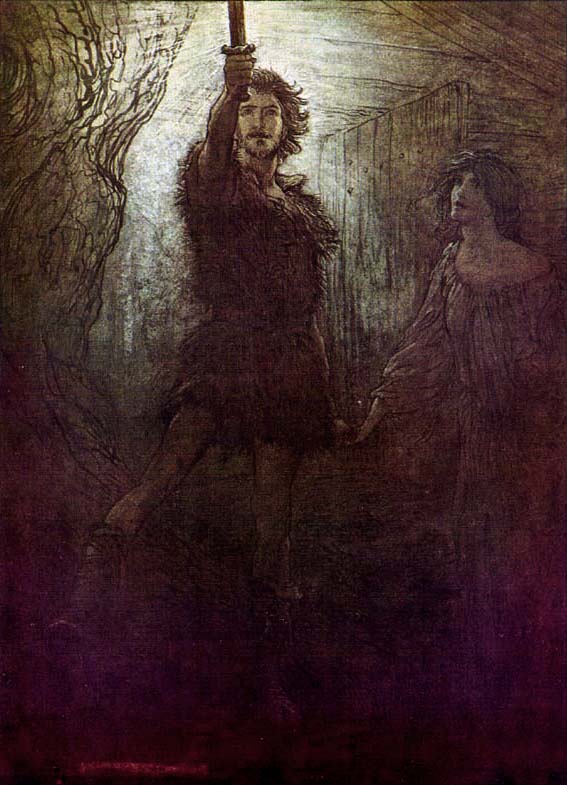
Sigmund holding the magic sword Nothung in an Arthur Rackham illustration of Richard Wagner's Die Walküre. Magic swords are a common fantasy trope.

A fantasy trope is a specific type of literary trope (recurring theme) that occurs in fantasy fiction. Worldbuilding, plot, and characterization have many common conventions, many of them having ultimately originated in myth and folklore. J. R. R. Tolkien's legendarium (and in particular, The Lord of the Rings) for example, was inspired from a variety of different sources including Germanic, Finnish, Greek, Celtic and Slavic myths. Literary fantasy works operate using these tropes, while others use them in a revisionist manner, making the tropes over for various reasons such as for comic effect, and to create something fresh (a method that often generates new clichés).[1]

Good vs. Evil

[edit]

The conflict of good against evil is a theme in the many popular forms of fantasy; normally, evil characters invade and disrupt the good characters' lands.[2] J. R. R. Tolkien delved into the nature of good and evil in The Lord of the Rings, but many of those who followed him use the conflict as a plot device, and often do not distinguish the sides by their behavior.[3] In some works, most notably in sword and sorcery, evil is not opposed by the unambiguously good but by the morally unreliable.[4]

Hero

[edit]

Heroic characters are a mainstay of fantasy, particularly high fantasy and sword and sorcery.[citation needed] Such characters are capable of more than ordinary behavior, physically, morally, or both.[5] Sometimes they might have to grow into the role ordained for them.[6] This may take the form of maturation,[7] which is often through Coming of Age.

Many protagonists are, unknown to themselves, of royal blood.[citation needed] Even in so fanciful a tale as Through the Looking-Glass, Alice is made a queen in the end; this can serve as a symbolic recognition of the hero's inner worth.[8] Commonly, these tales revolve around the maltreated hero coming into his or her own. This can reflect a wish-fulfillment dream, or symbolically embody a profound transformation.[9]

Dark Lord

[edit]

The forces of evil are often personified in a "Dark Lord". Besides possessing vast magical abilities, a Dark Lord often controls great armies and can be portrayed as possessing devil-like qualities.[10] A Dark Lord is usually depicted as the ultimate personification of evil.[citation needed]

Notable Dark Lords
Name Source
Sauron The Lord of the Rings
Thulsa Doom archenemy of Conan the Barbarian
the Dark One (Shai'tan) The Wheel of Time
Sith Lords Star Wars
Lord Voldemort Harry Potter
the Skeksis The Dark Crystal
Darkseid DC Comics
Thanos Marvel Comics
Mundus the Devil May Cry video game series
Dracula the Castlevania series
Skeletor Masters of the Universe
Morgoth The Silmarillion
Arawn Death-Lord The Chronicles of Prydain
Torak The Belgariad
Nightmare Soulcalibur
Ganon The Legend of Zelda
Exdeath Final Fantasy V
Galbatorix The Inheritance Cycle
Metatron "His Dark Materials"

The villain of the Demon Sword video game is also literally called Dark Lord.

In the Lone Wolf gamebooks, the Dark Lords are a race of powerful evil beings.[11] The protagonists of the Overlord video game franchise are classic Dark Lords in the vein of Sauron. The Dark Lord is usually seen as unmarried, though there has been the occasion when one has attempted to claim a bride.

Quest

[edit]

Quests, an immemorial trope in literature, are common in fantasy. They can be anything from a quest to locate the MacGuffins necessary to save the world, to an internal quest of self-realization.[12]

Magic

[edit]

In fantasy, magic often has an overwhelming presence, although its precise nature is delineated in the book in which it appears. It can appear in a fantasy world (as in The Lord of the Rings or Shannara), or in a fantasy land that is part of reality but insulated from the mundane lands (as in Xanth), or as a hidden element in real life (as in The Dresden Files).[13]

A common trope is that magical ability is innate and rare. As such, magic-wielding people are common figures in fantasy.[14] Another feature is the magic item, which can endow characters with magical abilities or enhance the abilities of the innately powerful. Among the most common are magic swords and magic rings.

Self-fulfilling prophecies are amongst the most common forms of magic because they are an often used plot device. Often the effort undertaken to avert them brings them about, thus driving the story. It is very rare for a prophecy in a fantasy to be false, although usually, their significance is only clear with hindsight. Quibbles can undermine the clearest appearing prophecies.[15]

In The Lord of the Rings, J. R. R. Tolkien minimized the use of the word 'magic'; beings who use such abilities tend to be confused when they are described this way by others.

Science fantasy stories often make use of scientifically implausible powers similar to magic, such as psychics.[16] However, unlike true science fiction works, these powers are used in a pulp manner with no examination of their effects on society, only to create more spectacular effects than science fiction alone can provide.[16] An example of this is the use of the Force by the Jedi in the Star Wars franchise.[17]

Medievalism

[edit]

Many fantasy creatures are inspired by European folklore and the romances of medieval Europe. Dragons and unicorns are among the most popular creatures. Other monsters, such as griffins, giants, and goblins also appear. Races of intelligent beings such as elves, dwarves, and gnomes often draw their history from medieval or pre-Christian roots. Characteristics of the hero and heroine also frequently draw on these sources as well.

This trope is also very important in the setting of many of these fantasies. Writers from the beginnings of the fantasy genre, such as William Morris in The Well at the World's End and Lord Dunsany in The King of Elfland's Daughter, set their tales in fantasy worlds clearly derived from medieval sources; though often filtered through later views. J. R. R. Tolkien set the type even more clearly for high fantasy, which is normally based in such a "pseudo-medieval" setting. Other fantasy writers have emulated him, and role-playing and computer games have also taken up this tradition.

The full width of the medieval era is seldom drawn upon. Governments, for instance, tend to be feudalistic, corrupt empires despite the greater variety of the actual Middle Ages.[18] Settings also tend to be medieval in economy, with many fantasy worlds disproportionately pastoral.[19]

These settings are typical of epic fantasy and, to a lesser extent, of sword and sorcery — which contains more urban settings — than of fantasy in general; the preponderance of epic fantasy in the genre has made them fantasy commonplaces. They are less typical of contemporary fantasy, especially urban fantasy.

Ancient world

[edit]

A less common inspiration is the ancient world. A famous example is the Hyborian Age (the fictional world of Conan the Barbarian), which features analogues of Ancient Egypt, Mesopotamia, and the Roman Empire, among others. Three notable recent series with such settings are: Bartimaeus by Jonathan Stroud, Percy Jackson & the Olympians and The Heroes of Olympus by Rick Riordan.

Races and species

[edit]

Many fantasy stories and worlds refer to their main sapient humanoid creatures as races, rather than species, in order to distinguish them from non-sapient creatures.[20] J. R. R. Tolkien popularized the usage of the term in this context, in his legendarium (and particularly in The Lord of the Rings), and the use of races in the Dungeons & Dragons role-playing games further spread the label.[21] Many fantasy and science fiction settings now use the terms race and species interchangeably, such as the World of Warcraft computer game.

In role-playing games, "race" typically refers to any sapient species usable as a player character. Older editions of Dungeons & Dragons called the primary non-human player races (dwarf, elf, gnome, halfling, and half-elf, half-orc) "demi-humans." Later games such as Shadowrun use the term "metahuman," and define these humanoid races as subdivisions of Homo sapiens.

See also

[edit]

References

[edit]

Sources

[edit]
[edit]
Revisions and contributorsEdit on WikipediaRead on Wikipedia
from Grokipedia
A fantasy trope refers to a recurring device, motif, or structural element in and media that shapes by invoking familiar patterns, often rooted in mythological, folkloric, or medieval traditions to build immersive alternate worlds. These tropes serve as building blocks for genre conventions, allowing authors to evoke wonder, conflict, and resolution while providing readers with recognizable frameworks for interpretation. Originating largely from 19th- and 20th-century works that revived medieval and mythic elements, fantasy tropes gained prominence through authors like , whose popularized motifs such as the epic quest and the battle between . Common examples include the "chosen one" protagonist—a young, often destined to save the world—as seen in narratives from Tolkien's Frodo to modern fantasies; the damsel-in-distress , where a female character requires rescue, derived from medieval traditions; and magical systems governed by rules like sacrifice or belief, which ground the in thematic explorations of reality. Other prevalent tropes encompass wise wizards or mentors, ancient prophecies foretelling doom or salvation, and secondary worlds accessed via portals or artifacts, all of which facilitate critiques of society, identity, and power dynamics. In , particularly and urban subgenres, these tropes have evolved to challenge traditional binaries, such as roles, with active female protagonists like in Tolkien's works or in J.K. Rowling's series subverting passive stereotypes through agency and combat prowess. This progression reflects broader cultural shifts, incorporating intersectional themes like trauma recovery and diverse identities, as in Leigh Bardugo's duology, where characters like Inej Ghafa navigate agency amid . While tropes can risk if overused, their adaptability enables innovation, allowing fantasy to mirror real-world issues through allegorical lenses, from environmental concerns in epic quests to in urban magic tales.

Overview and History

Definition and Characteristics

A fantasy trope refers to a recurring device, motif, or convention within the fantasy genre that structures stories around elements of wonder, adventure, and the supernatural, often by constructing secondary worlds distinct from . These tropes typically involve departures from everyday reality through imaginative elements like magic or mythic beings, evoking a of estrangement while maintaining to foster reader immersion. In this , tropes serve as building blocks that signal genre expectations, such as quests or enchanted realms, allowing creators to explore themes of heroism and otherworldliness. Key characteristics of fantasy tropes include via alternate worlds, archetypal figures, binaries like good versus , and rule-based systems that govern events. For instance, tropes emphasize epic scopes with grand conflicts and structured magical laws, as seen in works evoking mythic pasts, while swords-and-sorcery variants focus on gritty, personal adventures with minimal, unpredictable in low-stakes settings. These elements often draw on as a common setting trope, blending historical echoes with invention to heighten the . Tropes like binaries provide a clear ethical framework, reinforcing themes of triumph over darkness through consistent world-building rules. In , fantasy tropes offer familiarity that grounds audiences in conventions, enabling originality through that challenges expectations for deeper impact. J.R.R. Tolkien's seminal influence exemplifies this, as his creation of internally consistent secondary worlds in popularized tropes like the epic quest and fellowship dynamics, which provide structural reliability while inviting variations in later narratives. This balance allows tropes to evoke emotional resonance—such as recovery and —without rigid adherence, fostering creative evolution across media. Fantasy tropes have evolved beyond into video games and films, where they adapt to interactive and visual formats; for example, RPG quests in games like those inspired by Tolkien's mythos emphasize player agency in moral binaries and magical systems. In films, epic battles serve as visual motifs that heighten stakes, extending tropes' role in immersive while subverting them for contemporary relevance.

Origins and Evolution

The roots of fantasy tropes trace back to ancient mythologies, where narratives of heroic quests, supernatural interventions, and moral conflicts laid foundational elements for later genres. In Greek and Roman myths, epics such as Homer's (8th century BCE) depicted Odysseus's arduous journey fraught with mythical creatures and divine aid, establishing the of the wandering hero confronting fate and otherworldly challenges. Similarly, Norse sagas like The Saga of the Volsungs (13th century, based on earlier oral traditions) introduced tropes of cursed artifacts, prophetic destinies, and epic battles between gods and mortals, influencing concepts of inevitable doom and heroic sacrifice. Arthurian legends, emerging from 6th–12th century Welsh and Latin chronicles and evolving through French romances like Chrétien de Troyes's works (late 12th century), popularized chivalric heroes embodying honor, courtly love, and quests for sacred objects such as the , as synthesized in Thomas Malory's (1485). During the 19th and early 20th centuries, revitalized these mythic elements amid industrialization, emphasizing emotion, nature, and the supernatural over rationalism. The Brothers Grimm's collection of fairy tales (Kinder- und Hausmärchen, 1812–1857) preserved motifs like enchanted forests and transformative magic, drawing from oral traditions to inspire escapist narratives. William Morris's medievalist fantasies, such as The Well at the World's End (1896), revived Arthurian and Norse influences through idealized chivalric societies and heroic journeys, bridging Victorian revivalism with modern fantasy structures. J.R.R. Tolkien's (1954–1955) served as a seminal codifier for tropes, integrating linguistic depth, moral binaries, and epic quests inspired by Anglo-Saxon and Norse sources, profoundly shaping the genre's conventions. Post-World War II, fantasy expanded through pulp fiction and gaming, adapting tropes for broader audiences amid cultural shifts toward escapism and individualism. Robert E. Howard's Conan stories (serialized in from 1932) pioneered sword-and-sorcery subgenres, portraying a barbaric hero navigating ancient, sorcery-filled worlds that subverted civilized ideals with raw survivalism. The role-playing game Dungeons & Dragons (1974), created by and , gamified these elements—drawing from Tolkien and Howard—by systematizing races, classes, and adventures, embedding tropes like dungeon crawls and party-based quests into popular culture and inspiring countless narratives. In the 21st century, fantasy tropes evolved toward subversions and inclusivity, incorporating urban settings and non-Western mythologies to reflect diverse identities. Neil Gaiman's American Gods (2001) blended urban fantasy with immigrant folklore, pitting old-world deities against modern American icons in a road-trip narrative that reimagined mythic clashes in contemporary contexts. George R.R. Martin's A Song of Ice and Fire series (1996–present), adapted as Game of Thrones (2011–2019), deconstructed high fantasy tropes like noble heroes and prophecies through gritty realism, political intrigue, and moral ambiguity, influencing a wave of "grimdark" storytelling. N.K. Jemisin's Broken Earth trilogy (2015–2017) integrated African and Indigenous-inspired elements, such as earth-manipulating orogenes and cyclical cataclysms, to challenge Eurocentric tropes and explore themes of oppression and resilience in a seismically unstable world.

World-Building Elements

Settings and Medievalism

Fantasy settings often draw heavily on pseudo-medieval backdrops inspired by the European , featuring feudal societies, castles, kingdoms, and agrarian economies that evoke a sense of and . These elements, such as lords owing to kings and peasants tied to the land, reflect Victorian romanticizations of medieval order as a counter to industrialization, where "every individual had a place, bound together by a system of mutual responsibilities." In J.R.R. Tolkien's , the represents an idyllic agrarian community with families farming and trading in a pre-industrial , while Rohan embodies a warrior kingdom modeled on Anglo-Saxon , complete with mead-halls, horse-lords, and oaths of loyalty drawn from heroic epics like . Such portrayals prioritize nostalgic stability over historical accuracy, often simplifying medieval complexities into archetypal structures of nobility and . Variations in these settings distinguish from , shaping the scale and integration of within the narrative world. typically unfolds in expansive, entirely fictional secondary worlds with intricate pseudo-medieval realms, such as George R.R. Martin's Westeros—a continent-spanning feudal landscape of seven kingdoms, ironborn raiders, and ancient strongholds like Winterfell, layered with ten-thousand-year histories of conquest and colonization. In contrast, embeds magical or elements into more historical-like, primary-world-adjacent settings, where medieval structures coexist with rational familiarity, as in urban tales blending courtly intrigue with modern sensibilities. These distinctions allow to emphasize epic scope through vast kingdoms and agrarian vastness, while tempers immersion with grounded, less ornate environments. Ancient world influences further enrich fantasy settings through motifs of mythic antiquity, including ruined empires and lost civilizations that parallel Atlantis-like analogs, evoking cycles of rise and fall to deepen historical depth. In Martin's Westeros, remnants of the Valyrian Freehold—dragon-riding conquerors who unified kingdoms—linger as shattered roads and haunted , symbolizing imperial decay and influencing current feudal . Such elements draw from progressive historical views of the as barbaric transitions from ancient glories, incorporating waves of migration and forgotten technologies to underscore themes of loss and rediscovery. World-building techniques like detailed maps, expansive lore, and deliberate are essential for establishing immersion in these pseudo-medieval environments, guiding readers through spatial and cultural logics. Maps serve as narrative tools, visualizing journeys and stakes—such as the perilous Unsea in Leigh Bardugo's Grishaverse, a shadowy rift that divides cultures and heightens conflict—while lore provides backstory on kingdoms' origins, fostering a sense of lived . , from misty highlands to fertile vales, reinforces societal structures, like Rohan's plains suiting nomadic horse-clans. However, critiques highlight the of these tropes, where medieval European models dominate, perpetuating "habits of whiteness" by defaulting to pale-skinned hierarchies and limiting diversity. Efforts toward inclusive settings include non-Western-inspired realms, such as desert kingdoms with matriarchal clans or acid-rain worlds defying feudal norms, challenging the genre's overreliance on Anglo-centric .

Races and Species

In and media, races form a cornerstone of world-building, drawing heavily from mythological traditions and popularized by J.R.R. Tolkien's legendarium. Elves are typically depicted as long-lived or immortal beings attuned to nature, possessing grace and wisdom that position them as guardians of ancient forests and arcane knowledge. Dwarves, in contrast, embody resilience and craftsmanship, often portrayed as stout, subterranean folk skilled in forging weapons and delving for precious metals, reflecting Germanic mythological influences on their hardy, clan-based societies. Orcs and goblins serve as archetypal antagonists, represented as brutish, horde-like warriors driven by aggression and loyalty to dark overlords, originating from Tolkien's conception of them as corrupted beings bred for war. Beyond humanoids, mythic species enrich fantasy ecosystems with symbolic depth. Dragons often appear as ancient, powerful entities—either wise mentors hoarding treasures or avaricious destroyers symbolizing untamed chaos—rooted in where they guard lairs laden with gold and jewels. Fairies, drawing from Celtic and British tales, function as whimsical tricksters or benevolent aides, intervening in human affairs with capricious magic that blurs lines between ally and deceiver. Giants embody raw, elemental power, frequently cast as colossal brutes whose immense strength disrupts landscapes or challenges heroes, echoing Norse sagas of jotunn figures clashing with gods. Cultural and societal tropes among these races emphasize hierarchies and alliances that mirror medieval social structures within fantastical settings. Elves and dwarves commonly exhibit longstanding rivalries, such as mutual distrust over territorial claims or differing values—elves viewing dwarves as greedy despoilers of the earth—yet forge uneasy partnerships against greater threats like orcish invasions. Racial hierarchies persist in many narratives, with elves and humans at the apex of moral and civilizational orders, while orcs occupy the base as irredeemable hordes, reinforcing binary notions of good versus evil. Modern fantasy has evolved these tropes toward greater nuance and inclusivity, particularly with redeemable orcs in works like the series, where orcs transition from demonic thralls to honorable warriors reclaiming their shamanistic heritage after breaking free from corrupting influences. Diversity expansions introduce non-Tolkienian races, such as beastfolk or avian humanoids inspired by Indigenous mythologies, as seen in Rebecca Roanhorse's , which integrates Diné (Navajo) clans and supernatural beings to challenge Eurocentric defaults and explore decolonial themes.

Character Archetypes

Heroes and Protagonists

In , heroes and protagonists serve as the central figures driving narratives of conflict and triumph, typically characterized by bravery, moral uprightness, and a commitment to greater good, often emerging from humble or unassuming origins. The classic "" exemplifies this, portraying protagonists as ordinary individuals from rural settings who are propelled into extraordinary circumstances, such as in J.R.R. Tolkien's (1954–1955), a of modest means whose journey embodies reluctant heroism and personal sacrifice. This trope has evolved to encompass more reluctant or flawed protagonists who exhibit internal doubts and ethical ambiguities, reflecting a shift toward psychologically complex characters in modern works. Common subtypes include the Chosen One, a destined savior fulfilling a , as seen in Robert Jordan's Rand al'Thor from series (1990–2013), who grapples with his foretold role amid personal turmoil. To craft compelling Chosen One protagonists, authors provide them with authentic struggles, flaws, weaknesses, and personal desires beyond their destined role, rendering victories hard-won, relatable, and fraught with tension. Destiny is equilibrated with individual effort, character development, and internal skepticism—such as questioning their purpose, approaches, or ethical decisions—to imbue depth and avert portrayals of unchecked power. The protagonist's exceptional relevance is explicitly rationalized via distinctive attributes, empathy, or situational factors that render them uniquely suited, rather than relying solely on augury. Likability and narrative propulsion arise from personal investment in the conflict's stakes, augmented by a collaborative cast of characters, counterpoints, and indeterminate resolutions that intensify suspense and circumvent hackneyed conventions. This purposeful structuring permits thematic inquiry into transformation, eschewing inadvertent or contrived messiah archetypes in favor of engaging heroes. The secret heir variant involves protagonists uncovering hidden royal or noble lineage, exemplified by Jon Snow in George R.R. Martin's A Song of Ice and Fire (1996–present), whose bastard status masks his true heritage and fuels his path to leadership. Antiheroes represent morally gray figures who operate outside traditional virtue, such as in Andrzej Sapkowski's series (first published 1993), a guided by a personal code rather than unyielding righteousness, embodying the Byronic antihero's brooding intensity and isolation. Protagonists' development arcs frequently trace a transformation from novice to legendary status, incorporating tragic backstories like orphanhood or profound loss to deepen emotional resonance and drive growth. These arcs highlight internal conflicts, such as the burden of destiny or ethical dilemmas, as protagonists navigate trials that test their resolve, often culminating in . Such journeys commonly intersect with trope, where heroes confront predestined fates while forging their own paths. Early fantasy drew heavily from male-dominated archetypes, such as the chivalric knights of Arthurian legend—like Lancelot or Gawain—who epitomized honor, martial prowess, and courtly ideals in medieval romances. Over time, the genre has embraced greater gender and diversity in protagonists, moving toward inclusive representations that challenge traditional binaries. This shift is evident in female leads like Daenerys Targaryen in Martin's series, an exiled royal who evolves from vulnerability to commanding authority through resilience, strategic alliances, and supernatural elements like her dragons. Such developments mirror broader cultural progress toward multifaceted heroes, incorporating diverse backgrounds and perspectives in contemporary fantasy.

Antagonists and Villains

In , antagonists and villains represent the core oppositional forces, driving conflict through threats to order, morality, and the protagonists' quests. These figures often manifest as embodiments of chaos or tyranny, contrasting the heroic ideals while serving as catalysts for narrative tension. Their designs draw from mythological and literary traditions, evolving to reflect cultural anxieties about power and corruption. The archetype epitomizes the ultimate evil overlord, a singular, often disembodied entity bent on world domination through insidious influence and immortality-granting artifacts. J.R.R. Tolkien's in (1954–1955) exemplifies this, as a fallen whose corrupting extends his dominion, symbolizing sterility, death, and unyielding greed for control. This figure typically commands legions of minions, such as orcs, to enforce its will, reinforcing the trope's reliance on hierarchical evil structures. Subtypes of antagonists diversify the Dark Lord model, including manipulative evil advisors who subvert from within trusted circles. Saruman the White in Tolkien's works begins as a wise Istari but succumbs to ambition, allying with while scheming for personal rule through industrialization and deceit. Monstrous tyrants, like dragon lords, embody raw destructive power and avarice, hoarding treasures and ravaging realms; in (1937) hoards the dwarves' gold in Erebor, his cunning intelligence amplifying his terrorizing presence beyond mere bestial force. Ideological foes, such as corrupt kings, challenge through systemic abuse of authority, perverting justice and loyalty to maintain oppressive regimes, often blending personal flaws with broader societal decay. Villains' motivations span pure malice—rooted in innate darkness and conquest—to more layered depths via sympathetic backstories, particularly among fallen heroes whose initial virtues twist into antagonism. Anakin Skywalker's arc in the Star Wars prequel trilogy (1999–2005), a fantasy-adjacent saga, illustrates this: a prophesied Jedi slave-born hero driven by fear of loss and manipulated by Sith ideology, he becomes Darth Vader, his tragedy fueled by emotional fragility and protective instincts gone awry. Contemporary fantasy introduces twists by granting villains redeemable qualities and complex histories, eschewing simplistic evil for multifaceted portrayals that humanize their conflicts. In Steven Erikson's Malazan Book of the Fallen series (1999–2011), antagonists like the Crippled God and various imperial figures possess intricate motivations tied to betrayal, survival, and philosophical dissent, often blurring lines between villainy and victimhood without reducing them to caricatures. This approach, evident in grimdark subgenres, emphasizes ideological and personal nuances, allowing villains to evolve through reader empathy while sustaining high-stakes opposition.

Mentors and Supporting Roles

In , the represents a wise elder or guide who provides the protagonist with essential knowledge, training, and moral direction to navigate challenges, often drawing from Joseph Campbell's monomyth structure where the equips the with tools or insight before the journey intensifies. This figure typically appears early in the narrative as a static secondary character, offering exposition on the world's lore or supernatural elements while embodying experience and restraint, as seen in from J.R.R. Tolkien's (1954–1955), who counsels Frodo on the One Ring's perils and rallies allies against . Similarly, in C.S. Lewis's series (1950–1956), functions as a shaman-like mentor, imparting spiritual guidance and transformative lessons to protagonists like Shasta in (1954). A recurring element of this archetype is the "beloved mentor dies" trope, where the guide's sacrifice heightens stakes and forces the hero's independence, aligning with the Hero's Journey's initiation phase in which the mentor's departure symbolizes the threshold crossing. Gandalf's battling the in the Mines of Moria exemplifies this, catalyzing Frodo's resolve and the Fellowship's fragmentation while underscoring themes of loss and rebirth. Mentors also fulfill plot roles such as gift-givers (providing magical items or prophecies) or motivators, delivering encouragement during trials, though subversions like the treacherous mentor introduce for dramatic tension. In Robert Jordan's series (1990–2013), figures like Liandrin Sedai, an Aes Sedai advisor to young channelers, embody this inversion by concealing her allegiance to the Dark One, manipulating and endangering her charges to advance shadowy agendas. Beyond individual mentors, supporting roles often manifest in ensembles that create "found families"—misfit groups bonded by adversity rather than blood, offering collective moral support, diverse skills, and emotional depth to the narrative. illustrates this, uniting hobbits, men, elves, and dwarves in a surrogate kinship that sustains their quest against evil, with loyal retainers like providing unwavering aid and friendly beasts symbolizing nature's alliance. sidekicks, such as bumbling thieves or verbose bards, lighten tense moments through wit or folly, preventing narrative overload; Peregrin "Pippin" Took in delivers humorous asides amid peril, balancing the epic's gravity. Love interests within these ensembles have evolved from passive damsels requiring rescue to empowered partners sharing agency, as in Éowyn's defiant battle role in Tolkien's work or Inej Ghafa's skilled contributions in Leigh Bardugo's (2015), reflecting broader shifts toward active female archetypes. Contemporary fantasy increasingly emphasizes diversity in these supporting figures, integrating queer and multicultural identities to enrich ensemble dynamics and challenge traditional homogeneity. Tamsyn Muir's The Locked Tomb series (2018–present) exemplifies this trend, featuring sapphic necromancers and cavaliers in deep, non-traditional bonds that explore gender fluidity and loyalty among a multicultural cast of immortals and soldiers. Such portrayals prioritize natural integration over tokenism, fostering inclusive worlds where side characters drive subplots on identity and solidarity, as advocated in analyses of young adult fantasy's push for broader representation.

Narrative Structures

The Quest

The quest serves as a foundational narrative structure in fantasy literature, typically depicting a protagonist's departure from a familiar homeland into dangerous, unknown territories to confront trials and achieve a transformative goal. This pattern draws heavily from Joseph Campbell's monomyth, outlined in his 1949 work The Hero with a Thousand Faces, which describes a universal involving separation, initiation, and return, influencing modern fantasy through J.R.R. Tolkien's (1954–1955), where Frodo's voyage to destroy exemplifies the archetype of venturing from the Shire's safety into perilous lands like . Scholars note that Tolkien's epic quests adapt older mythic traditions, such as Beowulf's voluntary monster-slaying, to emphasize communal stakes over individual glory. Central to the quest trope are recurring elements that propel the plot: the assembly of a fellowship of companions for mutual support, the navigation of diverse obstacles ranging from intellectual riddles to physical battles, and the pursuit or acquisition of pivotal items symbolizing power or redemption. In Robert Jordan's series (1990–2013), protagonist Rand al'Thor gathers allies like and Perrin to overcome monstrous foes such as Trollocs, while seeking artifacts like the "Sword That Cannot Be Touched," which tests worthiness. Similarly, Arthurian legends, foundational to fantasy, feature knights like Perceval questing for the amid trials of chivalry and combat, a motif echoed in modern works where swords like represent destined burdens. These components create a rhythmic progression of peril and respite, heightening tension as heroes, often reluctant protagonists, forge bonds and grow through adversity. Variations in quest narratives range from grand, world-saving epics to intimate voyages of personal growth, adapting the trope to diverse thematic depths. Tolkien's ring quest in The Lord of the Rings operates on a cosmic scale, involving geopolitical alliances and the fate of Middle-earth, contrasting with Ursula K. Le Guin's A Wizard of Earthsea (1968), where young wizard Ged undertakes a solitary pursuit of self-discovery, chasing his shadow-self across islands to confront internal flaws rather than external empires. In Earthsea, the journey eschews large-scale battles for psychological trials, such as naming the shadow to achieve wholeness—"Only the shadow can fight the shadow," Ged realizes—highlighting individual responsibility over collective triumph. Critics have highlighted the quest trope's potential for overuse, fostering predictability in fantasy by adhering to formulaic progressions that risk diminishing innovation. This has prompted evolutions through deconstructions, notably in Terry Pratchett's series (1983–2015), where quests often fail or subvert expectations to expose genre conventions' absurdities. In (1991), disrupts a fairy-tale quest for a "happy ending," rejecting inevitability with the observation that "Stories want to end... They don’t care what happens next," leading to chaotic, open-ended resolutions rather than tidy victories. Such parodies critique the trope's rigidity, evolving fantasy toward multifaceted explorations of failure and multiplicity while preserving its adventurous core.

Prophecy and Chosen One

In fantasy literature, the prophecy trope involves foretellings delivered by oracles, seers, or ancient texts that predict future events with deliberate ambiguity, often shaping character actions and plot progression. These predictions typically employ poetic, allegorical language to maintain narrative suspense, as seen in the Karatheon Cycle from Robert Jordan's The Wheel of Time series, where vague prophecies about the Dragon Reborn guide the hero's path without revealing exact outcomes. Such mechanics allow prophecies to influence the story across multiple levels, from individual decisions to broader world events, as explored in George R.R. Martin's A Song of Ice and Fire, where prophecies like the "Prince That Was Promised" drive political intrigue and personal destinies. Often self-fulfilling, these foretellings become reality through the characters' attempts to interpret or avoid them, creating a cycle where belief in the prophecy precipitates its occurrence, a device rooted in classical influences but adapted to fantasy's emphasis on inevitability. The Chosen One subtype emerges as a core manifestation of this trope, portraying an ordinary individual—frequently a young protagonist from humble origins—who is gradually revealed to fulfill a prophesied role in averting catastrophe. In J.K. Rowling's series (beginning with Harry Potter and the Philosopher's Stone, 1997), Harry is marked as the "Chosen One" by a linking his fate to Voldemort's defeat, imposing burdens such as isolation, survivor's guilt, and the expectation of that transform his unremarkable life into one of heroic destiny. This underscores themes of reluctant elevation, where the protagonist's "ordinariness" contrasts with their predestined exceptionalism, fostering reader identification while highlighting the psychological toll of inescapable fate. Narratively, prophecies and the Chosen One serve to build tension by establishing high stakes and justifying the protagonist's central role, often initiating quests through revelations of destiny that propel the plot forward. By linking heroes to an ancient or epic past—via or lineage—these elements provide a structural framework that validates acts of heroism and immerses readers in a world governed by larger-than-life forces, as in the prophetic omens guiding characters in A Song of Ice and Fire. However, this trope carries risks, including contrived resolutions where outcomes feel predestined rather than earned, potentially undermining character agency and leading to predictable storytelling. Contemporary fantasy frequently subverts these conventions to critique traditional structures, introducing false prophecies or multiple potential chosen figures that challenge notions of singular destiny and reflect postmodern skepticism toward absolute truths. In Lev Grossman's The Magicians (2009), the narrative dismantles chosen-one expectations by portraying magic as a learned skill rather than a fated gift, with Quentin Coldwater's journey exposing the hollowness of escapist prophecies and emphasizing personal flaws over predestined salvation. Such subversions, often through ironic twists or collective heroism, avoid self-fulfilling inevitability and invite reflection on how prophecies can manipulate rather than illuminate, as seen in the deceptive foretellings that mislead characters across Grossman's trilogy.

Magical and Supernatural Elements

Magic Systems

Magic systems in and media define the rules, sources, and constraints governing powers, serving as foundational elements that shape character abilities, conflicts, and world-building. These systems vary widely, from structured frameworks resembling scientific principles to more enigmatic forces that evoke wonder and unpredictability. Authors often design them to balance tension, ensuring enhances rather than undermines plot stakes. Fantasy magic is commonly categorized into arcane types, which stem from personal aptitude, study, or inherent traits, and divine types, granted by deities or higher powers. Arcane magic, such as wizardry learned through rigorous education and incantations, exemplifies systems where individuals harness ambient energies via knowledge and skill, as seen in the structured spellcasting of J.K. Rowling's . In contrast, divine magic relies on faith, devotion, or pacts with supernatural entities, empowering clerics or priests to channel godly forces for or smiting, a mechanic central to games like . This distinction influences character roles, with arcane users often portrayed as independent scholars and divine casters as intermediaries bound by moral or theological codes. Rule-based frameworks further classify magic as hard or soft, based on the clarity and consistency of their mechanics. Hard magic operates with explicit rules, costs, and limitations, akin to a logical system where effects are predictable and tied to defined inputs, such as the metallic allomancy in Brandon Sanderson's Mistborn series, where ingesting specific metals grants targeted abilities like enhanced strength or emotional manipulation. Soft magic, conversely, remains mysterious and unpredictable, emphasizing ambiance over explanation, as in systems featuring wild magic surges that produce random, chaotic outcomes without clear causation. Sanderson's First Law of Magic posits that an author's ability to resolve conflicts using magic is directly proportional to the reader's understanding of it, underscoring why hard systems suit plot resolutions while soft ones excel in creating awe and tension. Limitations and costs are integral to credible magic systems, preventing overuse and adding depth through consequences. Common restrictions include resource depletion, such as mana exhaustion that leaves casters weakened after prolonged use, or physical tolls like fatigue from channeling energies. Corruption mechanics, like the insidious influence from pacts in where power comes at the price of servitude to otherworldly patrons, introduce moral hazards and long-term narrative arcs. Ethical dilemmas also arise, as with forbidden spells in that demand unforgivable acts, such as the Killing Curse, which scars the soul of the caster. Cultural integrations often tie to specific races, societies, or environments, evolving toward analogies with scientific or ecological principles. In many settings, elven draws from natural harmonies, reflecting their woodland affinities, while dwarven systems emphasize rune-based craftsmanship aligned with subterranean lore. Sanderson's Second Law of encourages flaws and limitations over mere rules to foster innovation, as seen in systems where interacts with cultural taboos or environmental factors, such as tide-dependent sorcery in coastal societies. This approach grounds elements in believable societal contexts, enhancing immersion without overt scientific rigor.

Artifacts and Creatures

In , magical artifacts are enchanted objects that wield extraordinary power, often serving as central plot devices and symbolic elements that embody themes of temptation, destiny, and peril. in J.R.R. Tolkien's exemplifies this trope, functioning as a corrupting influence that amplifies the wearer's desires while binding them to the will of its creator, , thus symbolizing the seductive danger of unchecked ambition and power. Similarly, from Arthurian represents rightful and prowess, drawn from a stone or lake to affirm King Arthur's legitimacy and granting its wielder unparalleled strength in battle, thereby underscoring motifs of leadership and divine right. Potions, such as elixirs, provide restorative or transformative effects, enabling characters to recover from wounds or alter their states temporarily, as seen in various narratives where they act as vital aids during perilous journeys. These artifacts frequently propel narratives forward as catalysts for quests, where protagonists must seek, wield, or destroy them to resolve conflicts, while also introducing risks like curses or moral corruption that test the bearer's resolve. For instance, the One Ring's insidious agency draws bearers into isolation and betrayal, illustrating how artifacts can guard ancient secrets or enforce fateful consequences, often aligning with broader magical frameworks without defining them. In Arthurian tales, 's loss signals the decline of a kingdom, positioning such items as guardians of legacy that demand sacrifice upon completion of their purpose. This dual role—empowering yet hazardous—heightens tension, as artifacts like cursed rings or volatile potions can unravel alliances or amplify personal flaws. Mythical creatures in fantasy tropes complement artifacts by embodying primal forces, acting as non-sentient antagonists, allies, or symbolic harbingers that influence quests and thematic depth. Dragons, often depicted as fire-breathing behemoths, serve as formidable foes hoarding treasures or as mounts for epic traversal, symbolizing chaos, , and raw power across cultural myths adapted into . evoke purity and elusive grace, their horns reputed for healing properties that parallel artifactual elixirs, positioning them as rare symbols of innocence amid corruption. Phoenixes, with their cyclical immolation and rebirth, represent renewal and , often emerging at narrative turning points to signify or resurrection following devastation. Creatures further drive plots as guardians of artifacts or obstacles in quests, their encounters imposing trials like riddles or battles that reveal character strengths and the perils of . Dragons, for example, may lair upon sought-after items, their defeat unlocking paths to destiny while risking , as in tales where slaying one unleashes broader cataclysms. and phoenixes, rarer in adversarial roles, instead catalyze renewal, with the former's touch purifying tainted artifacts and the latter's ashes igniting rebirth motifs that underscore themes of loss and recovery. In modern fantasy, these tropes evolve through subversions that challenge traditional potency, such as flawed wands in Lev Grossman's The Magicians trilogy, where magical tools prove unreliable and demanding of immense personal toll, critiquing the of unbridled power. , blending traits like avian and leonine forms in griffins or serpentine and equine in hippocampi, appear in diverse narratives to reflect cultural fusion and ambiguity, serving as unpredictable allies or threats that defy binary symbolism. Such innovations, as in Joe Abercrombie's series with the destructive , repurpose artifacts for pyrrhic victories, emphasizing moral ambiguity over heroic triumph.

Themes and Motifs

Good vs. Evil

The good versus trope in establishes a binary framework, delineating forces of light—embodying virtue, order, and harmony—from those of darkness, representing chaos, corruption, and destruction. This cosmic opposition often manifests through divine or supernatural entities, as seen in J.R.R. Tolkien's The Silmarillion (1977), where the , benevolent powers associated with natural elements and providential guidance, clash with , a fallen being whose rebellion corrupts the world and embodies absolute . Such delineations underscore a worldview where good upholds creation and , while evil perverts it through domination and discord. In narrative manifestations, this binary frequently appears in epic clashes between organized forces of good, such as knights, allied races, and enlightened leaders, and hordes of evil comprising demons, legions, or monstrous minions. Symbolic imagery reinforces the divide, with light evoking hope, purity, and divine intervention—exemplified by Gandalf's transformation into a white-robed figure signifying renewal—contrasted against darkness as a veil of despair and perversion, like the shadowed wastes of under Sauron's influence. These elements propel large-scale battles that symbolize the eternal struggle, where good's champions, including archetypal heroes and protagonists, confront embodiments of evil like antagonists and villains. The trope's historical persistence traces to biblical influences, where dualistic conflicts between divine order and satanic rebellion shaped early s, evolving through medieval and pulp fantasy traditions with Tolkien as a seminal figure. Tolkien's works, drawing on , portray evil not as an independent force but as a privation of good, infusing pagan-inspired settings with themes of grace triumphing over corruption, thus establishing the for subsequent . Critiques of the binary framework highlight its oversimplification of human morality, fostering stereotypes of monolithic evil (e.g., orc-like hordes as irredeemable) and virtuous good, which limits narrative depth and ignores ethical nuances. This absolutism, rooted in Christian dualism, has been challenged in modern fantasy for promoting reductive views that overlook systemic or cultural sources of conflict. For instance, Brandon Sanderson's Stormlight Archive series (2010–present) introduces moral grays through characters like Dalinar Kholin, whose journey from warlord to leader involves grappling with personal agency and redemption, complicating the good-evil divide via a magic system tied to ethical oaths and free will. Such developments critique the trope's traditional rigidity while retaining its epic scope.

Redemption and Moral Ambiguity

In , redemption arcs often depict villains or antiheroes undergoing profound transformation, challenging the notion of irreversible corruption and emphasizing the potential for moral growth. These narratives typically involve , pivotal choices, and external influences that guide characters toward , subverting the traditional good-versus-evil dichotomy by illustrating that redemption requires and rather than mere forgiveness. For instance, in Avatar: The Last Airbender (2005), 's arc exemplifies this trope, evolving from a banished driven by familial pressure and a quest for honor to an ally of the protagonists, marked by relapses and ethical dilemmas that underscore the complexity of change. His journey highlights free will's role in redemption, as Zuko rejects his father's through and , ultimately teaching firebending to the Avatar as an act of restitution. Similarly, Gene Wolfe's The Book of the New Sun (1980–1983) presents Severian, a torturer whose unreliable reveals layers of and tentative redemption. As an executor of pain, Severian grapples with the psychological toll of his profession, questioning the inherent evil in necessary suffering while exhibiting tenderness and passion that complicate his villainy. His arc explores corruption's reversibility through acts like sparing a prisoner and wielding the artifact for , yet his omissions and merged identities with others blur the line between and , reflecting a world where morality defies clear resolution. Moral ambiguity in fantasy tropes further erodes binary oppositions by portraying "evil" actions as contextually justified or inevitable, often through antiheroes whose motivations stem from trauma or survival. In Kentaro Miura's Berserk manga (1989–ongoing), characters like Guts navigate a grim world of necessary sacrifices, where moral lines dissolve amid war, betrayal, and supernatural horror, forcing readers to confront the relativity of good and evil. Griffith's transformation into Femto embodies this ambiguity, as his ambition-driven atrocities challenge simplistic villainy, emphasizing themes of causality and human frailty over outright condemnation. Mark Lawrence's Prince of Thorns (2011) intensifies this through protagonist Jorg Ancrath, an unrepentant whose brutality arises from personal loss and societal decay, resisting traditional redemption in favor of philosophical ambiguity about power and vengeance. Jorg's narrative probes the 's prevalence in gritty fantasy, where clashes with deterministic cycles of violence, offering no easy moral closure. Recent trends in fantasy subvert these tropes by incorporating diverse moral frameworks from non-Western perspectives, enriching thematic depth with cultural nuance. R.F. Kuang's (2018), inspired by Chinese history, depicts Rin's descent into shamanic power and wartime atrocities, where moral ambiguity arises from colonial and shaman gods unbound by human , questioning Western fantasy's universal binaries. This approach highlights corruption's societal roots and redemption's elusiveness, as characters like Rin embody intergenerational trauma, fostering narratives that prioritize ethical over heroic absolutes.

References

Add your contribution
Related Hubs
User Avatar
No comments yet.