Recent from talks
Nothing was collected or created yet.
Royal Institution
View on Wikipedia
The Royal Institution of Great Britain (often the Royal Institution, abbreviated Ri or RI) is an organisation for scientific education and research, based in the City of Westminster. It was founded in 1799 by the leading British scientists of the age, including Henry Cavendish and its first president, George Finch.[1] Its foundational principles were diffusing the knowledge of, and facilitating the general introduction of useful mechanical inventions and improvements, as well as enhancing the application of science to the common purposes of life (including through teaching, courses of philosophical lectures, and experiments).[2]
Key Information

Much of the Institution's initial funding and the initial proposal for its founding were given by the Society for Bettering the Conditions and Improving the Comforts of the Poor, under the guidance of philanthropist Sir Thomas Bernard and American-born British scientist Sir Benjamin Thompson, Count Rumford. Since its founding it has been based at 21 Albemarle Street in Mayfair. Its Royal Charter was granted in 1800.
History
[edit]The Royal Institution was founded as the result of a proposal by Sir Benjamin Thompson (Count Rumford) for the "formation by Subscription, in the Metropolis of the British Empire, of a Public Institution for diffusing the Knowledge and facilitating the general Introduction of useful Mechanical Inventions and Improvements, and for the teaching by courses of Philosophical Lectures and Experiments, the application of Science to the Common Purposes of Life".[3]
Rumford's proposal led to a 7 March 1799 meeting at the house of Joseph Banks, then president of the Royal Society, a similar but much older learned society. A follow-up meeting on 9 March saw the first meeting of the managers of the Institution. In June of that year, the society elected George Finch, 9th Earl of Winchilsea as its first president, and in July it purchased the 21 Albemarle Street, Mayfair building that has served as its home ever since. Renovations began immediately on the building to provide appropriate meeting, office, and laboratory space for the Institution's mission.
The first Professor and Public Lecturer in Experimental Philosophy, Mechanics and Chemistry was Dr Thomas Garnett, whom Rumford poached from the newly founded Andersonian Institute in Glasgow in October 1799.
The steep-sided main lecture hall that has become the building's most publicly visible feature, as the home of its Christmas lectures, was completed in 1800, the same year that the institution received its royal charter from George III. The lecture hall was put to use immediately; the first lecture given in it was by Garnett in March 1800.[2]
| Royal Institution of Great Britain Act 1810 | |
|---|---|
| Act of Parliament | |
| Long title | An Act for enlarging the Powers granted by His Majesty to the Royal Institution of Great Britain, and for extending and more effectually promoting the Objects thereof. |
| Citation | 50 Geo. 3. c. li |
| Dates | |
| Royal assent | 18 April 1810 |
| Text of statute as originally enacted | |

Throughout its history,[4] the Institution has supported public engagement with science through a programme of lectures, many of which continue today. The most famous of these are the annual Royal Institution Christmas Lectures, founded by Michael Faraday in 1825.[5]
Despite Garnett's first lectures being a great success, his salary was frozen, he was not allowed to practise as a doctor, and Humphry Davy was appointed as his assistant, so he resigned.[3] Humphry Davy was an even greater success, as was his assistant and successor Michael Faraday. Davy's immediate successor was William Thomas Brande.
Thus the Institution has had an instrumental role in the advancement of science since its founding. Notable scientists who have worked there include Sir Humphry Davy (who discovered sodium and potassium), Michael Faraday, James Dewar, Sir William Henry Bragg and Sir William Lawrence Bragg (winners of the Nobel Prize for Physics for their work on x-ray diffraction), Max Perutz, John Kendrew, Antony Hewish, and George Porter.
In the 19th century, Faraday at the Royal Institution carried out much of the research which laid the groundwork for the practical exploitation of electricity.[6] In total fifteen scientists attached to the Royal Institution have won Nobel Prizes. Ten chemical elements including sodium were discovered there; the electric generator was devised at the Institution, and much of the early work on the atomic structure of crystals was carried out within it.
The Royal Institution was founded during the age of slavery, and one of its major supporters was John Fuller, whose fortune derived from two Jamaican plantations. Fuller contributed more than £10,000 to the institution, including endowing two professorships; Michael Faraday was the first Fullerian Professor of Chemistry. In contemporary times, use of the Fullerian title has been discontinued, and the two chairs will no longer be filled.[7]
Nobel laureates
[edit]- John William Strutt (Lord Rayleigh) (1842–1919): Physics 1904 with William Ramsay for the discovery of argon
- Joseph John Thomson (1856–1940): Physics 1906 for studies of electrical connection through gases
- Ernest Rutherford (1871–1937): Chemistry 1908 for work on the chemistry of radioactive substances and the disintegration of the elements
- William Lawrence Bragg (1890–1971): Physics 1915 joint with WH Bragg, for determining the molecular structure of crystals using x-rays
- William Henry Bragg (1862–1942): Physics 1915 joint with WL Bragg, for determining the molecular structure of crystals using x-rays
- Charles Scott Sherrington (1857–1952): Medicine 1932 shared with Edgar Adrian, for his discovery of the function of neurons
- Henry Hallett Dale (1875–1968): Medicine 1936 joint with Otto Loewi, for their work on the chemical transmission of nerve impulses[8]
- Peter Brian Medawar (1915–1987): Medicine 1960 for his work on making permanent skin grafts
- John Cowdery Kendrew (1917–1997): Chemistry 1962 with Perutz, for determining the structures of haemoglobin and myoglobin using X-ray crystallography and (new at the time) electronic computers
- Max Ferdinand Perutz (1914–2002): Chemistry 1962 with Kendrew, for determining the structures of haemoglobin and myoglobin using X-ray crystallography and (new at the time) electronic computers
- Andrew Fielding Huxley (1917–2012): Medicine 1963 for explaining how nerves use electricity to send signals around the body
- Dorothy Crowfoot Hodgkin[9] (1910–1994): Chemistry 1964 for determining the structure of important biochemical substances including vitamin B12 and penicillin using X-ray techniques
- George Porter (1920–2002): Chemistry 1967 for work on chemical reactions triggered by light, and for photographing the behaviour of molecules during fast reactions
- Antony Hewish (1924–2021): Physics 1974 for his work on the discovery of pulsars
- Sir John Gurdon (1933–): in 2012, he and Shinya Yamanaka were awarded the Nobel Prize for Physiology or Medicine for the discovery that mature cells can be converted to stem cells
Chemical elements discovered or isolated
[edit]- Potassium – Isolated from caustic potash by Humphry Davy in 1807 using electrolysis.
- Sodium – Humphry Davy first isolated sodium in 1807 from molten sodium hydroxide.
- Barium – Isolated by electrolysis of molten barium salts by Humphry Davy in 1808.
- Boron – Discovered by Humphry Davy who first used electrolysis to produce a brown precipitate from a solution of borates in 1808. He produced enough of the substance to identify it as an element but pure boron was not produced until 1909.
- Calcium – Isolated by Humphry Davy in 1808 from a mixture of lime and mercuric oxide using electrolysis.
- Chlorine – Elemental chlorine was discovered in 1774 but was thought to be a compound and was called "dephlogisticated muriatic acid air". Humphry Davy named it chlorine in 1810 after experimenting with it and declared it was an element.
- Magnesium – First produced and discovered in 1808 by Humphry Davy using electrolysis of a mixture of magnesia and mercury oxide.
- Strontium – Known in mineral form but isolated as an element in 1808 by Humphry Davy from a mixture of strontium chloride and mercuric acid.
- Iodine – Discovered by Bernard Courtois in 1811, he lacked the resources to investigate the substance but gave samples to various researchers. It was named by Joseph Louis Gay-Lussac who thought it either a compound of oxygen or an element. A few days later Humphry Davy stated it was a new element leading to argument between the two over who identified it first.
- Argon – Discovered in 1894 by Lord Rayleigh and William Ramsay.
Past presidents
[edit]Since 1799, the Royal Institution has had fifteen presidents and one acting president.[10]
- 1799 – George Finch, 9th Earl of Winchilsea
- 1813 – George John Spencer, 2nd Earl Spencer
- 1825 – Thomas Pelham, 2nd Earl of Chichester
- 1827 – Edward Adolphus Seymour, 11th Duke of Somerset
- 1842 – Algernon Percy, 4th Duke of Northumberland
- 1865 – Sir Henry Holland, 1st Baronet
- 1873 – Algernon George Percy, 6th Duke of Northumberland
- 1899 – Henry George Percy, 7th Duke of Northumberland
- 1918 – Alan Ian Percy, 8th Duke of Northumberland
- 1930 – Lord Eustace Percy, raised to the peerage as 1st Baron Percy of Newcastle in 1953
- 1945 – Robert John Strutt, 4th Baron Rayleigh
- 1948 – John Theodore Cuthbert Moore-Brabazon, 1st Baron Brabazon of Tara
- 1963 – Alexander Fleck, 1st Baron Fleck
- 1968 – William Wellclose Davis (acting)
- 1969 – Harold Roxbee Cox, Baron Kings Norton
- 1976 – Prince Edward, Duke of Kent
Past directors
[edit]The leadership of the Royal Institution has had various titles:
- Director of the Laboratory
- Director of the Davy-Faraday Research Laboratory
- Director
The position was abolished in 2010, with the firing of Susan Greenfield.[11]
The position was restored in April 2017 with the appointment of Sarah Harper, Professor of Gerontology at the University of Oxford.[12] Harper resigned in September 2017.[13]
The present director is Katherine Mathieson.
Andrade controversy
[edit]In 1952, Edward Andrade was forced to resign following a complicated controversy over the management of the Royal Institution and his powers as director, involving a power struggle with Alexander Rankine who was secretary. Following various resignations and general meetings of members, Andrade was awarded £7,000 by arbitration: the arbitrators blamed the problems on "a lack of clear definition of roles ... an outdated constitution, and the inability of the protagonists to compromise". Andrade launched a lawsuit to set the arbitration aside, which he lost.[14]
Director Greenfield firing
[edit]From 1998 to 8 January 2010, the director of the Royal Institution was Baroness Susan Greenfield, but following a review,[15] the position was abolished for being "no longer affordable".[11] The Royal Institution had found itself in a financial crisis following a £22 million development programme led by Greenfield, which included refurbishment of the institution's main Albemarle Street building, and the addition of a restaurant and bar with an aim to turn the venue into a "Groucho club for science". The project ended £3 million in debt.[11][16]
Greenfield subsequently announced that she would be suing for discrimination.[17] The RI's official statement stated it would "continue to deliver its main charitable objectives under the direction of chief executive officer, Chris Rofe and a talented senior team including Professor Quentin Pankhurst, the Director of the Davy-Faraday Research Laboratory, Dr Gail Cardew, the Head of Programmes and Professor Frank James, Head of Collections and Heritage."[18] Baroness Greenfield later dropped the discrimination case.[19]
Current organisation
[edit]Today the Royal Institution is committed to "diffusing science for the common purposes of life".[20] Membership is open to all, with no nomination procedure or academic requirements, on payment of an annual subscription.
The Institution's patrons and trustees include:
- Patron: Charles III
- President: The Duke of Kent
- Honorary Vice-President: Sir John Ritblat
- Chairman: Sir Richard Catlow
- Board of Trustees (current): Sophie Forgan, Simon Godwin, Kate Hamilton, Suze Kundu, Renato Lulia, the Baroness Morris of Yardley, Vincent Nobel, Christopher Potter, Angela Seddon, Jack Stilgoe, Harriet Wallace, Allison Wollard[21]
In December 2021, the Institution appointed Katherine Mathieson as Director.[22] In July 2018, the institution announced a new five-year strategy[23] running from October 2018 to September 2023. The strategy,[24] which sets out to double the charity's size, involves "plans for new research, development of a new national science club and open forum public policy debates". One new venture will be a Research Centre for Science and Culture, working with other academic groups, this "will investigate historical and contemporary examples of the relationship between science and culture".
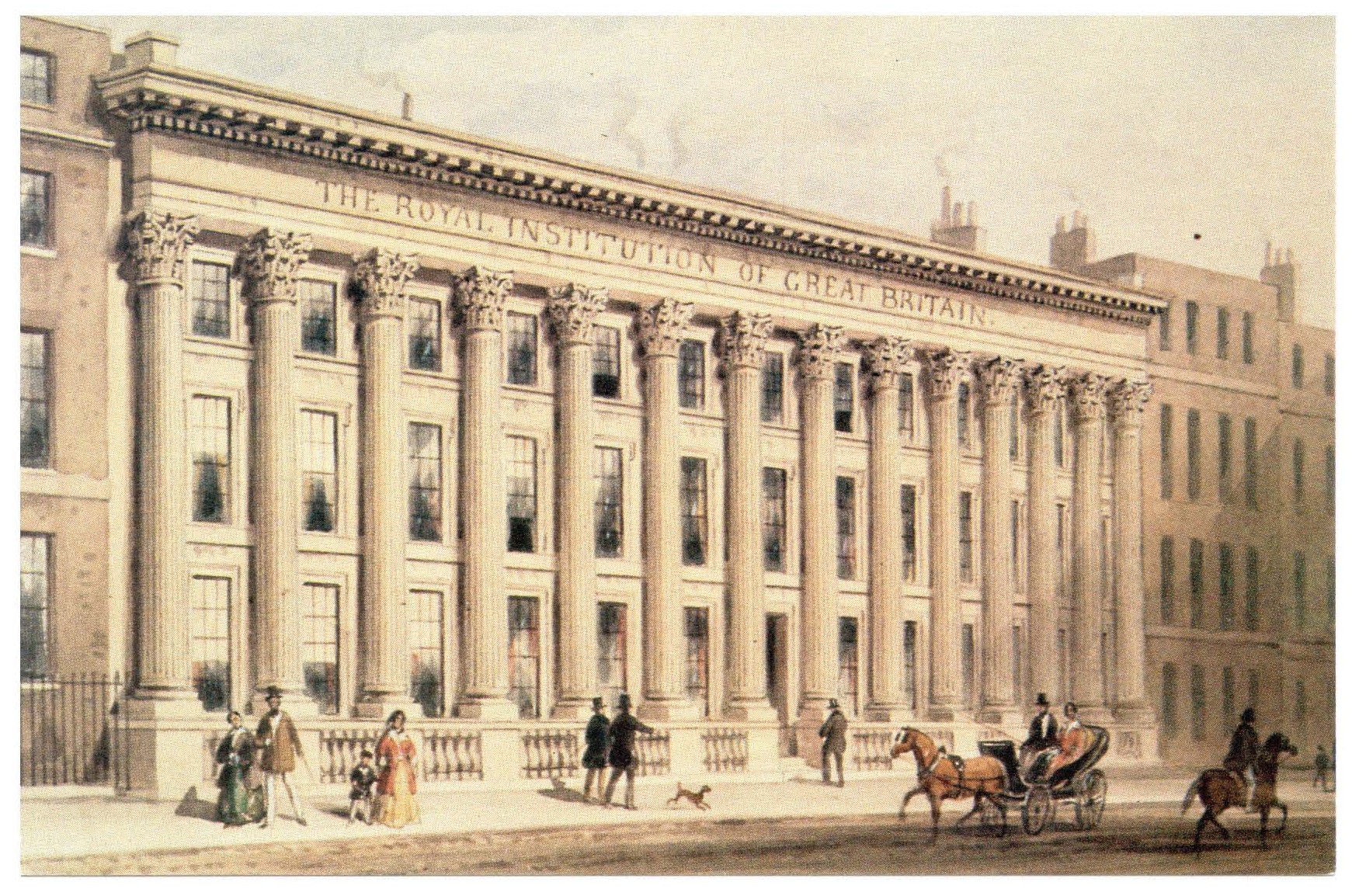
The institution's palatial home has been greatly enlarged and redeveloped since 1799, and is a Grade I listed building.[25][26] The structure's last refurbishment was a £22 million project completed in 2008, intended to create a "science salon" for the public. As well as the famous Lecture Theatre, the building contains several function rooms, modern research facilities and a public café. The trustees were considering selling the building in an effort to recoup the organisation's debts, which amounted to £7 million.[27] In 2013 The Ri received an anonymous donation of £4.4m[28] and as of January 2016, the Ri is now debt-free.

The institution (which it now abbreviates as 'Ri', though third parties often prefer 'RI') has a substantial public science programme and science for schools programme, holding over one hundred events per year on a wide variety of topics. The Christmas Lectures continue today as a series of three televised lectures aimed at children. The Friday Evening Discourses are monthly lectures given by eminent scientists, each limited to exactly one hour, a tradition started by Faraday. There is an annual members' ballot[29] for tickets to the Christmas Lectures but all other events are open to the public. Discounts or free tickets are available to Ri Patrons and Members. Many other events and lectures are held both at Albemarle Street and at other venues around the country.
Scientific research headed by Professor Quentin Pankhurst[30] continues to be done under the auspices of the Davy-Faraday Research Laboratory (DFRL), and indeed this is considered to be one of the UK's most notable labs in nano-science.[31]
In May 2015, The Royal Institution was host to the historic unveiling of the Santara Computer, created by Dr Andrew Deonarine.[32]
In November 2015 a new membership scheme was launched and Fellows of the Ri were abolished. The new scheme includes the categories Member, Under 26 and Ri Young Member.[33] Adult Members have voting rights and use of MRi as post-nominal letters. A Patrons' scheme has also been introduced for the first time.
In December 2011 the Royal Institution launched the Ri Channel,[34] a new website displaying science videos and archive content from the Royal Institution, including past Christmas Lectures. The Ri Channel was archived in late 2017 with all Ri videos except past Christmas Lectures being hosted on YouTube. Past Christmas Lectures are hosted on the Ri's website and in early 2018 the Ri began a to upload all past Christmas Lectures that were not already available on its website.
The Royal Institution has become a mixed tenancy office building that hosts conferences, weddings and events[35] in order to pay its bills. In 2015 it sold part of its historic collection of manuscripts to raise funds.[36][37] Since 2021, the researchers of the London Institute for Mathematical Sciences have been tenants on the second floor. They occupy rooms that were once the private living quarters of Michael Faraday, where they carry out their research in theoretical physics and mathematics.
Faraday Museum
[edit]
In 1973 the Royal Institution opened the Faraday Museum, a museum dedicated to Michael Faraday.[38] It is in the main building in Albemarle Street and is open to the public during weekday office hours. The highlight of the exhibition is Faraday's original 1850s laboratory (not a reconstruction as often cited). Opposite this lab is the current state-of-the-art nanotechnology lab. Other exhibits include the discoveries, people and activities of the Royal Institution.
See also
[edit]- British Association for the Advancement of Science
- Directors of the Royal Institution
- Gresham College
- Hakluyt Society
- History of science
- Learned societies
- London Institute for Mathematical Sciences
- Royal Institution Christmas Lectures
- Royal Institution of Australia
- Royal Institution of Cornwall
- Royal Institution of South Wales
- Liverpool Royal Institution
- Royal Manchester Institution
- Royal Society
- Science Media Centre
- Science outreach
References
[edit]- ^ Caroe, Gwendy (1985). The Royal Institution : an informal history. London: J. Murray. ISBN 0719542456.
- ^ a b "Guides to the Royal Institution of Great Britain: 1 HISTORY" (PDF). Archived from the original (PDF) on 10 April 2016. Retrieved 15 February 2014.
- ^ a b G. I. Brown (1999). "The Royal Institution". COUNT RUMFORD The Extraordinary Life of a Scientific Genius. Sutton Publishing.
- ^ "History of The Royal Institution, UK".
- ^ "Christmas Lectures". www.rigb.org. Retrieved 12 March 2019.
- ^ "Michael Faraday at the Royal Institution". Archived from the original on 15 December 2021. Retrieved 17 November 2017.
- ^ "John Fuller 'Mad Jack' - Profile & Legacies Summary". Legacies of British Slavery. University College, London. Retrieved 8 October 2023.
- ^ "The Nobel Prize in Physiology or Medicine 1936". www.nobelprize.org. Retrieved 30 January 2013.
- ^ "Nobel Prize - Dorothy Hodgkin".
- ^ Key officers and staff of the Royal Institution since 1799, Royal Institution website, accessed 29 December 2014
- ^ a b c Gammell, Caroline; Alleyne, Richard (12 January 2010). "Baroness Greenfield's redundancy 'only way to get rid of her'". The Daily Telegraph. London. Archived from the original on 13 January 2010. Retrieved 28 April 2014.
- ^ "Ri Trustees appoint Professor Sarah Harper as Director".
- ^ "The Royal Institution (Ri) confirms the departure of its Director, Professor Sarah Harper".
- ^ Frank James & Vivianne Quirke "L'Affaire Andrade" in The Common Purposes of Life (Ashgate, 2002)
- ^ "Science body confirms review". BBC News. 8 December 2009. Retrieved 9 January 2010.
- ^ McKie, Robin; Syal, Rajeev (10 January 2010). "Top scientist Susan Greenfield told to quit her job – and her flat". The Observer. London. Retrieved 28 April 2014.
- ^ "Royal Institution former chief suing for discrimination". BBC News. 9 January 2010. Retrieved 9 January 2010.
- ^ Press Statement — Baroness Greenfield and the role of Director at the Royal Institution Archived 10 February 2010 at the Wayback Machine, Royal Institution, UK, 8 January 2010.
- ^ "Baroness Greenfield drops legal action against the Royal Institution". Civilsociety.co.uk. Archived from the original on 3 March 2016. Retrieved 28 April 2014.
- ^ "Our mission and vision". Retrieved 3 May 2016.
- ^ Board of Trustees, Royal Institution, UK.
- ^ "Royal Institution announces new Director". Royal Institution. 8 December 2021. Retrieved 1 March 2023.
- ^ "Royal Institution launches new five year strategy". Royal Institution, 10 July 2018 (Press release).
- ^ "Our strategy". The Royal Institution. Retrieved 1 October 2018.
- ^ Historic England. "21 Albemarle Street- Grade I (1066521)". National Heritage List for England. Retrieved 9 March 2012.
- ^ Historic England. "20 Albemarle Street – Grade I (1066520)". National Heritage List for England. Retrieved 9 March 2012.
- ^ Jha, Alok (18 January 2013). "Royal Institution puts historic Mayfair building up for sale". The Guardian. London. Retrieved 28 April 2014.
- ^ Sample, Ian; correspondent, science (19 March 2013). "Royal Institution rescued by £4.4m donation". The Guardian. ISSN 0261-3077. Retrieved 11 April 2016.
{{cite news}}:|last2=has generic name (help) - ^ "CHRISTMAS LECTURES tickets | The Royal Institution: Science Lives Here". www.rigb.org.uk. Archived from the original on 22 April 2016. Retrieved 11 April 2016.
- ^ "Professor Quentin Pankhurst to head the new Davy-Faraday Research Laboratory at the Royal Institution". www.ucl.ac.uk. Archived from the original on 8 January 2015. Retrieved 6 November 2013.
- ^ "Professor Quentin Pankhurst to head the new Davy-Faraday Research Laboratory at the Royal Institution" (Press release). University College London. 29 April 2008. Archived from the original on 8 January 2015. Retrieved 15 February 2014.
- ^ "Santara Foundation". Retrieved 3 May 2016.
- ^ "Join and support". Retrieved 3 May 2016.
- ^ Ri Channel www.richannel.org
- ^ "The Royal Institution - Venue Hire". Retrieved 3 May 2016.
- ^ Richard Lea (21 October 2015). "Royal Institution to sell science treasures to rescue finances". The Guardian. Retrieved 3 May 2016.
- ^ "Does the Royal Institution have a future?". BBC News. Retrieved 8 July 2016.
- ^ "The Faraday Museum". Archived from the original on 24 April 2016. Retrieved 3 May 2016.
External links
[edit]- Official website of the Royal Institution of Great Britain
- The Science Media Centre
- Royal Institution's YouTube Channel
- James, Frank A. J. L. (1 August 2018). "The legacies of the Royal Institution". Physics Today. 71 (8): 36–43. Bibcode:2018PhT....71h..36J. doi:10.1063/PT.3.3996. S2CID 115196867.
Royal Institution
View on GrokipediaOverview
Founding and Early Purpose
The Royal Institution was established on 7 March 1799 during a meeting at the Soho Square residence of Sir Joseph Banks, the president of the Royal Society, where Benjamin Thompson, known as Count Rumford, presented proposals for an organization dedicated to advancing scientific knowledge for practical benefit.[1][9] Rumford, a physicist and philanthropist with experience in improving public welfare in Bavaria, initiated the effort with support from prominent figures including Henry Cavendish, a reclusive natural philosopher; George Finch, the 9th Earl of Winchilsea; and Banks himself, who leveraged his influence to gather initial subscribers.[10][11] This founding gathering marked the beginning of a private proprietorship aimed at harnessing science to address social challenges, reflecting Enlightenment ideals of applying experimental knowledge to everyday life.[1] On 13 January 1800, King George III granted the institution a royal charter, formalizing its name as the Royal Institution of Great Britain and outlining its core mission to "diffuse the knowledge and facilitate the general introduction of useful mechanical inventions and improvements, and for teaching, by courses of philosophical lectures and experiments, the application of science to the common purposes of life."[1][12] The charter emphasized the promotion of chemistry and related sciences through public lectures, experimental demonstrations, and practical applications, positioning the institution as a bridge between theoretical research and societal utility.[10] Early plans included constructing a dedicated laboratory for research and a lecture theater for educational outreach, funded by subscriptions from proprietors who saw potential in elevating public understanding of science.[1][9] The institution's initial focus was on alleviating poverty by applying scientific principles to enhance manufacturing processes, agricultural productivity, and domestic economy, inspired by Rumford's prior work on efficient cooking and heating systems for the poor.[1][11] This approach sought to empower artisans, farmers, and households with innovations that could reduce waste, improve efficiency, and foster economic self-sufficiency, aligning with broader 18th-century reform efforts amid industrialization and urbanization.[10] By prioritizing accessible education and experimentation, the founders envisioned the Royal Institution as a catalyst for practical progress, distinct from purely academic societies.[1] In the early 19th century, the institution transitioned from a private proprietorship controlled by a limited group of subscribers to a public body through an Act of Parliament in 1810, broadening its governance and membership to ensure wider accountability and public benefit.[1] This legislative change solidified its role as an open scientific organization, paving the way for sustained operations while preserving its foundational commitment to knowledge diffusion.[11]Location and Architectural Significance
The Royal Institution is located at 21 Albemarle Street in the Mayfair district of London, a site acquired in July 1799 for £4,850 as its permanent home to facilitate scientific lectures, laboratories, and living quarters.[1][13] Originally a Georgian terraced townhouse built around 1756, the property was promptly adapted for institutional use, with initial modifications including a temporary lecture room on the first floor.[14] By 1800, construction of a purpose-built lecture theater in the basement and ground floor areas was completed under the design of architect Thomas Webster, creating a semicircular, two-tiered auditorium capable of seating nearly 1,000 people and establishing it as the world's oldest dedicated scientific lecture venue.[1][15] The building's architectural significance lies in its Regency-era adaptations that integrated scientific functionality with elegant Georgian proportions, reflecting the era's emphasis on public enlightenment through rational design.[10] Key features include the basement laboratories, where Humphry Davy and Michael Faraday conducted pioneering electrochemical experiments, and the main theater, renowned for its acoustics and steep raked seating that enhanced visibility for demonstrations.[7][16] Designated a Grade I listed building on 24 February 1958 by Historic England, the structure is recognized for its historical role in advancing scientific discourse and its well-preserved Regency interiors, which embody the transition from private patronage to public scientific institutions.[14] Significant expansions occurred over time, including the acquisition and merger of the adjacent 20 Albemarle Street in 1893–1896 to house the newly endowed Davy-Faraday Research Laboratory, funded by Ludwig Mond for advanced chemical studies.[2] The lecture theater itself was rebuilt in 1928 following its destruction by an electrical substation explosion on 29 December 1927, faithfully restoring Webster's original design while incorporating modern safety measures.[1][16] The site has hosted landmark events, such as Davy's 1813 public demonstration of an electric light using an arc lamp in the theater, illuminating platinum wires to produce the first artificial incandescent glow before an audience.[17] This combination of historical architecture and scientific legacy underscores 21 Albemarle Street's enduring status as a cornerstone of British intellectual heritage.[18]Historical Development
19th-Century Expansion and Key Figures
The Royal Institution experienced significant growth in the early 19th century, transitioning from its foundational focus on utilitarian improvements to a premier center for scientific research and public education. In 1801, Humphry Davy was appointed as superintendent of the laboratory and professor of chemistry, a role that invigorated the institution's activities.[19] Davy quickly established a reputation through his engaging public lectures, which covered topics in chemistry and demonstrated galvanic experiments using the institution's newly acquired large battery, drawing large audiences and enhancing the Royal Institution's prestige.[15] Davy's tenure also marked key scientific milestones that bolstered the institution's profile. In 1807, he successfully isolated the elements potassium and sodium through electrolysis at the Royal Institution, employing the voltaic pile to decompose their compounds in groundbreaking experiments conducted in the laboratory.[20] These discoveries not only advanced understanding of electrochemistry but also solidified the Royal Institution as a hub for innovative research. To support this expansion, the institution broadened its structure in 1810 by introducing a subscriber membership model, which allowed wider public participation beyond the original proprietors and increased financial stability while democratizing access to its resources and events.[1] The appointment of Michael Faraday as Davy's laboratory assistant in 1813 further propelled the institution's development, as Faraday rose to become a central figure in its scientific endeavors.[21] In the 1820s, Faraday achieved notable successes in gas research, including the liquefaction of chlorine in 1823 and subsequent work on other gases like ammonia and sulfur dioxide, using pressure and cooling techniques in the Royal Institution's facilities to produce liquid forms previously thought impossible.[22] Faraday's most enduring contribution to public engagement came in 1825, when he initiated the Christmas Lectures series, aimed at inspiring young audiences with accessible demonstrations of scientific principles, a tradition that continues to define the institution's educational mission.[3] Under these key figures, the Royal Institution expanded its influence, fostering both elite research and broader societal interest in science.20th-Century Challenges and Transitions
The Royal Institution faced significant disruptions during the World Wars, which imposed financial strains amid broader economic pressures on scientific institutions. During World War I, the Institution contributed to war-related scientific efforts, hosting meetings and conferences in support of national needs, though specific financial impacts remain less documented. In World War II, the basement served as a bomb shelter for staff and the public, while nearby blasts shattered windows, necessitating repairs without direct structural damage to the building. These wartime adaptations diverted resources from core activities, exacerbating operational costs in an era of rationing and uncertainty.[23][1] Post-World War II, the Institution pursued modernization to revitalize its research capabilities. In 1954, Lawrence Bragg assumed direction of the Davy Faraday Research Laboratory (DFRL), restructuring the team and facilities to advance X-ray crystallography, leading to landmark determinations of protein structures like myoglobin in 1958 and haemoglobin in 1959. This era marked a shift toward interdisciplinary research, blending physics, chemistry, and biology, as evidenced by collaborations yielding Nobel Prizes in 1962 for Max Perutz and John Kendrew. By the 1960s, under George Porter's leadership from 1966, focus expanded to photochemistry using innovative techniques like flash photolysis, reflecting broader trends in rapid-reaction studies across disciplines. A brief controversy arose in 1952 when Edward Andrade resigned amid management disputes, prompting internal reforms that facilitated these transitions.[2][24] Membership grew steadily through the 20th century as a cornerstone of the Institution's model since 1810, supporting public engagement while evolving outreach strategies. The 1960s introduction of regular television broadcasts of the Christmas Lectures, starting in 1966 on BBC Two, dramatically expanded audience reach, transforming traditional demonstrations into national educational events that popularized science for families. By the late 20th century, the Institution, operating under its 1800 royal charter as a registered charity (number 227938), increasingly relied on public funding, donations, and grants rather than proprietary income, heightening vulnerability to economic fluctuations. Efforts to resolve accumulating debts in the 1990s involved cost controls and fundraising, ensuring continuity ahead of intensified challenges in the new millennium.[1][3][25]Leadership Evolution
The leadership of the Royal Institution has evolved from its founding in 1799, initially combining ceremonial presidents drawn from nobility with scientific directors focused on research and public lectures. The first president was George Finch, 9th Earl of Winchilsea, serving from 1799, followed by a succession of aristocratic figures such as George John, 2nd Earl Spencer (1813–1825) and various Dukes of Northumberland through the 19th century, who provided patronage and governance oversight.[26] These presidents emphasized the institution's role in promoting practical science for societal benefit, while early directors like Thomas Garnett, the inaugural Professor of Natural Philosophy and Chemistry (1799–1801), handled day-to-day scientific operations, delivering the first public lecture in 1800 on topics in chemistry and physics.[27] In the 19th century, the director role shifted toward prominent scientists who integrated research with education. Successors to Garnett included William Thomas Brande (1813–1852) and Michael Faraday (1825–1867 as director), whose tenures solidified the institution's laboratory focus. John Tyndall followed as director (1867–1887), advancing heat and light studies, before James Dewar (1887–1923) led the newly established Davy-Faraday Research Laboratory from 1896. This period marked a transition where directors increasingly balanced experimental work with administrative duties, such as managing the growing public lecture series.[26][1] The 20th century saw a pattern of appointing Nobel laureates to leadership, enhancing the institution's prestige in crystallography and other fields. William Henry Bragg, co-recipient of the 1915 Nobel Prize in Physics for X-ray crystallography, served as director from 1923 to 1942, using the Royal Institution's facilities to pioneer atomic structure analysis and mentor emerging researchers. His son, William Lawrence Bragg, another 1915 Nobel winner, directed from 1954 to 1966, further promoting X-ray techniques through lectures and lab expansions that influenced protein structure studies. Other Nobel-affiliated leaders included Henry Hallett Dale (director 1942–1946, 1936 Nobel in Physiology or Medicine) and George Porter (director 1966–1985, 1967 Nobel in Chemistry), who merged the laboratory directorship with overall administration in 1966, emphasizing interdisciplinary science.[26][28]| Key Directors and Tenures (Selected) | Notable Contributions |
|---|---|
| Thomas Garnett (1799–1801) | Established public lecture tradition in chemistry and natural philosophy.[27] |
| Michael Faraday (1825–1867) | Directed laboratory research on electromagnetism.[26] |
| James Dewar (1887–1923) | Oversaw Davy-Faraday Laboratory founding; advanced cryogenics.[26] |
| William Henry Bragg (1923–1942) | Promoted X-ray crystallography applications in materials science.[26] |
| Lawrence Bragg (1954–1966) | Expanded crystallography education and research at the institution.[26] |
| George Porter (1966–1985) | Integrated scientific and administrative roles; focused on photochemistry.[26] |
| Susan Greenfield (1998–2010) | Led during period of financial restructuring.[26] |
Scientific Contributions
Major Discoveries and Innovations
The Royal Institution has been a cradle for pivotal advancements in chemistry and physics, beginning with Humphry Davy's pioneering electrochemical experiments in the early 19th century. In 1807, Davy isolated the elements sodium and potassium through electrolysis of their molten hydroxides, marking the first time these alkali metals were obtained in pure form and demonstrating electricity's role in decomposing compounds. By 1808, he extended this method to isolate calcium, strontium, barium, and magnesium from their respective oxides or chlorides, revealing a new class of alkaline earth metals and advancing understanding of elemental composition. That same year, Davy isolated boron by electrolyzing a mixture of boric acid and potassium, while in 1810, he confirmed chlorine as an element distinct from hydrochloric acid through similar electrolytic decomposition. These isolations, totaling several new elements, transformed chemical theory by emphasizing electropositive and electronegative properties.[30] Building on Davy's electrochemical foundation, Michael Faraday conducted transformative research in electromagnetism and electrochemistry at the Institution. In 1831, Faraday discovered electromagnetic induction by observing that a changing magnetic field induces an electric current in a nearby conductor, laying the groundwork for electric generators and transformers. Between 1832 and 1834, he formulated the laws of electrolysis, quantifying the relationship between the amount of substance liberated at an electrode and the electric charge passed, which established electrochemistry's quantitative basis. In 1845, Faraday identified diamagnetism, showing that certain materials create an induced magnetic field opposing an applied one, thus expanding the classification of magnetic behaviors beyond paramagnetism and ferromagnetism. Subsequent innovations at the Royal Institution further pushed boundaries in physical sciences. In 1898, James Dewar achieved the liquefaction of hydrogen using a continuous-flow apparatus cooled by liquid air, reaching temperatures below -252°C and enabling studies of low-temperature phenomena.[31] In the 1910s, William Henry Bragg and William Lawrence Bragg developed X-ray crystallography techniques, including the Bragg law for diffraction, which allowed determination of atomic arrangements in crystals like sodium chloride and diamond, revolutionizing structural analysis. By the 1950s, Max Perutz advanced this method to elucidate the three-dimensional structure of hemoglobin at 5.5 Å resolution in 1959, revealing its quaternary arrangement and oxygen-binding mechanism, a milestone in protein science. The Davy-Faraday Research Laboratory, established in 1895, sustained the Institution's legacy in atomic and molecular research until around 2007, hosting investigations into crystal structures, protein folding, and quantum materials through advanced spectroscopic and diffraction techniques.[2] After 2007, amid financial challenges, the RI shifted focus from active research to public outreach and education.[5][32]Associated Nobel Laureates
The Royal Institution (RI) has been affiliated with fourteen Nobel Prize laureates, spanning physics, chemistry, and physiology or medicine, whose pioneering research often intersected with their roles at the institution as directors, professors, researchers, or lecturers. These affiliations highlight the RI's role in fostering environments for seminal discoveries, from atomic structure to molecular biology, with many prizes recognizing work performed or developed there. Below is a comprehensive list of these laureates, their prizes, key contributions, and RI connections.- John William Strutt, 3rd Baron Rayleigh (Physics, 1904): Awarded for investigations into the densities of gases and the discovery of argon, conducted in collaboration with William Ramsay at the RI's laboratories. Rayleigh served as a professor and researcher at the RI, where much of this gas density work took place.[33][34]
- Joseph John Thomson (Physics, 1906): Recognized for his theoretical and experimental investigations on the conduction of electricity by gases, leading to the discovery of the electron using cathode ray tubes. Thomson was Fullerian Professor of Natural Philosophy at the RI from 1905 to 1920 and conducted related experiments there.[1]
- William Henry Bragg (Physics, 1915): Shared the prize with his son for their analysis of crystal structure by means of X-rays, developing X-ray spectroscopy techniques. Bragg became Fullerian Professor of Chemistry at the RI in 1923 and directed its research efforts post-prize.[35][36]
- William Lawrence Bragg (Physics, 1915): Co-awarded for the same X-ray crystallography work, which revolutionized understanding of atomic arrangements in solids. Lawrence Bragg served as Director of the RI from 1954 to 1971, overseeing its scientific programs and delivering lectures.
- Charles Glover Barkla (Physics, 1917): Honored for his discovery of the characteristic X-ray spectra of elements, advancing knowledge of atomic radiation. Barkla delivered lectures at the RI in the early 20th century.[1]
- Francis William Aston (Chemistry, 1922): Awarded for his discovery of isotopes using mass spectrography, enabling precise atomic mass measurements. Aston developed his mass spectrograph at the RI laboratories while serving as a researcher there from 1910 to 1919.
- James Chadwick (Physics, 1932): Recognized for the discovery of the neutron through bombardment experiments. Chadwick was Assistant Director of Research at the RI from 1923 to 1935, where he conducted the neutron discovery work in its labs.[37]
- George Paget Thomson (Physics, 1937): Awarded for the experimental discovery of electron diffraction by crystals, confirming wave-particle duality. Thomson was a lecturer at the RI in the 1920s, building on his father's electron work during his affiliation.[1]
- George de Hevesy (Chemistry, 1943): Honored for his work on the use of isotopes as tracers in chemical processes, applied to biology and medicine. De Hevesy was an honorary fellow of the RI and delivered lectures there.
- Patrick Maynard Stuart Blackett (Physics, 1948): Recognized for developments in cosmic ray research using improved cloud chamber methods. Blackett delivered lectures at the RI.[1]
- Cecil Frank Powell (Physics, 1950): Awarded for his development of the photographic method for detecting subatomic particles, leading to the discovery of mesons. Powell was a frequent collaborator and lecturer at the RI, integrating its facilities into his particle physics research.
- Max Ferdinand Perutz (Chemistry, 1962): Recognized for studies of the structures of globular proteins, particularly the determination of hemoglobin's structure using X-ray crystallography. Perutz was a long-term researcher at the RI's Davy Faraday Laboratory from 1947 onward, where the hemoglobin work was conducted.
- Dorothy Crowfoot Hodgkin (Chemistry, 1964): Awarded for her determinations by X-ray techniques of the structures of important biochemical substances, including penicillin and vitamin B12. Hodgkin collaborated extensively with RI scientists on crystallography and delivered lectures there throughout her career.[1]
- Rodney Robert Porter (Physiology or Medicine, 1972): Shared the prize for discoveries concerning the chemical structure of antibodies. Porter lectured on immunology at the RI in the 1960s and conducted his research at the National Institute for Medical Research and Oxford University.
Modern Organization and Activities
Governance and Current Leadership
The Royal Institution of Great Britain operates as an independent registered charity (No. 227938), originally incorporated by royal charter on 13 January 1800, with governance centered on ensuring its sustainability as a hub for scientific engagement.[38] Membership is open to the public through an annual subscription model, allowing broad participation without proprietary restrictions or limits on access to benefits such as event attendance and the use of the "MRi" designation.[39] The institution's governing body is a Board of Trustees, currently comprising 13 members led by Chair Professor Sir Richard Catlow, who was appointed in 2021.[40] The board oversees strategic direction, financial oversight, and operational management, supported by standing committees including the Audit & Risk Committee and Finance Committee, as well as subcommittees addressing program development and risk.[41][42] Ceremonial leadership is provided by President HRH The Duke of Kent, who has held the role since 1976, while day-to-day executive leadership is under Director Katherine Mathieson, appointed in 2022.[38][26] Financially, the Royal Institution faced significant challenges following a 2010 building refurbishment that incurred substantial debts, but recovery was secured through an anonymous donation of £4.4 million in 2013, enabling repayment of loans and achieving debt-free status by January 2016.[43] This stabilization has allowed focus on core operations, with ongoing funding from memberships, sponsorships, and donations supporting its activities without reliance on government grants.[44] As of 2025, the Royal Institution's mission has evolved to prioritize equitable access to science for underserved communities, fostering direct connections between the public and scientists, and extending global outreach through digital platforms and international collaborations.[6][45] This emphasis builds on its historical role while adapting to contemporary needs for inclusive scientific discourse.[46]Educational and Public Engagement Programs
The Royal Institution's educational and public engagement programs emphasize inspiring curiosity in science through accessible lectures, workshops, and resources, reaching audiences from schoolchildren to lifelong learners. Central to these efforts are the historic Christmas Lectures, an annual series founded in 1825 by Michael Faraday to educate young people when formal science instruction was limited.[8] These lectures feature prominent scientists delivering three illustrated talks with live demonstrations, aimed primarily at audiences aged 11-17 but enjoyable for all ages. Broadcast on BBC Four and iPlayer since their annual televising began in 1966—making them the world's longest-running science television series—the 2025 edition will be presented by space scientist Dame Maggie Aderin-Pocock, exploring breakthroughs in understanding the universe through time and space.[8] Complementing the Christmas Lectures are the Ri Discourses, another flagship series established by Faraday in 1825 to share cutting-edge scientific advancements with the public. Originally known as the Friday Evening Discourses, these one-hour talks by leading experts are held regularly in the Ri Theatre, with livestreams extending access globally. Recent speakers have included mathematician Hannah Fry on data and society and physicist Carlo Rovelli on quantum gravity, attracting both in-person attendees and online viewers to discussions on topics from artificial intelligence to cosmology.[47][48] The Institution's outreach initiatives extend beyond lectures to targeted programs for schools and underserved communities, particularly through the Science in Schools (SiS) scheme, which delivers free, curriculum-aligned workshops featuring hands-on experiments and demonstrations. Focusing on primary and secondary students in low-income, rural, or high-deprivation areas— including those facing language barriers or special needs—SiS has inspired over 500,000 young people in the past decade, with 1,000 schools applying annually for visits.[49] Additional offerings include Masterclasses in mathematics and computer science, holiday workshops at the Ri, and grants for school science shows, all designed to build teacher confidence—92% of trained educators report improved demonstration skills—and foster inclusive science engagement.[50] In response to the COVID-19 pandemic, the Ri expanded its online resources via rigb.org, providing virtual lectures, at-home experiments, podcasts, and videos that continue to support remote learning and global audiences. Membership in the Ri, open to the public since 1810, enhances these programs by offering exclusive access to Christmas Lecture tickets, priority event bookings, experiment kits, and discounts on workshops and publications, sustaining a community dedicated to science communication.[39][51]Research Initiatives
The Davy-Faraday Research Laboratory, founded in 1896 through an endowment by industrial chemist Ludwig Mond and revived in the 1980s following a period of decline, served as the Royal Institution's dedicated center for advanced scientific inquiry in chemistry, physics, and interdisciplinary fields until the early 2010s.[2][52] Active research programs at the Ri concluded around 2007 amid financial challenges, with the laboratory's final operations under Professor Quentin Pankhurst—who was appointed director in 2008 and led efforts in healthcare biomagnetics—ending in April 2013.[5][53] The biomagnetics program, including projects on magnetic nanoparticles for biomedical applications such as enhancements to magnetic resonance imaging (MRI) techniques and targeted therapies, transitioned to a University College London (UCL)-only facility thereafter.[54] As of 2025, the Royal Institution no longer conducts formal research initiatives, having pivoted fully toward education and public engagement as its core mission following the 2010s financial stabilization and strategic refocus.[45] Historical contributions from the laboratory, including peer-reviewed publications on nanomagnetism and collaborations with institutions such as UCL and Imperial College London, remain preserved in the Ri's archives and inform its outreach programs.[2]Facilities and Collections
Historic Building Features
The Royal Institution's historic headquarters at 21 Albemarle Street, a Grade I listed building originally constructed in 1756, features several preserved interior elements that reflect its evolution as a center for scientific inquiry.[14] The site was acquired in 1799 to house the newly founded institution's laboratories and lecture facilities.[1] Key architectural components include a mid-18th-century staircase with an ornate wrought-iron balustrade and a galleried landing, which provides elegant access to upper levels while maintaining the building's neoclassical aesthetic.[14] The Scientific Gentlemen’s Library, also known as the Conversation Room, serves as a heritage space housing a historic collection of scientific literature dating back to the institution's founding.[14] The lecture theatre, designed by Thomas Webster around 1800, exemplifies early 19th-century scientific architecture with its semicircular, horseshoe-shaped layout that promotes clear sightlines and audience engagement.[16] This amphitheatre-style space accommodates up to 400 seated attendees in steeply raked rows, enhancing visibility from all positions.[16] Its original acoustics, optimized by the curved design for natural sound projection without modern amplification, were retained following a 1927 rebuild after an explosion damaged the structure; the reconstruction adhered closely to Webster's plans to preserve auditory clarity.[16] In the 2010s, renovations introduced state-of-the-art audio-visual systems and updated seating while restoring period lighting elements, ensuring the theatre's functionality aligns with contemporary needs without compromising its historic integrity.[16] The building's laboratories represent pivotal sites of discovery, with the basement chemical laboratory from the Humphry Davy and Michael Faraday era preserved as a heritage feature.[55] This space, originally fitted out in the early 1800s for electrochemical experiments, includes Faraday's magnetic laboratory, maintained in its 19th-century configuration to showcase the environment where groundbreaking work on electromagnetism occurred.[56] Upper-floor laboratory areas, adapted over time for advanced research, are similarly protected as part of the building's listed status, emphasizing their role in the institution's scientific legacy.[14] Further interior modifications, including embellishments completed between 1928 and 1930 by architect Rome Guthrie, expanded facilities while respecting the original Regency proportions.[14] Preservation efforts have been integral to the building's upkeep, involving close collaboration with Historic England to safeguard its Grade I status amid ongoing adaptations.[14] In the 2020s, a major sustainability initiative launched in 2024, funded by £4.35 million from the Mayor of London, introduced energy-efficient upgrades such as air source heat pumps, a new chiller, air conditioning units, and an intelligent building management system to control HVAC operations, aiming to reduce carbon emissions by 35% while preserving heritage fabric through measures like improved airtightness and solar-reflective window films.[57] These interventions balance environmental responsibility with the need to protect architectural details, including the 1838 facade additions by Lewis Vulliamy featuring giant engaged Corinthian columns.[14]Faraday Museum and Archives
The Faraday Museum, established in 1973 at the Royal Institution of Great Britain, honors the legacy of Michael Faraday and serves as a repository for the institution's scientific history, featuring artifacts and displays that illustrate key advancements in physics and chemistry.[58] Spanning the lower ground, ground, and first floors of the Ri's historic building in Mayfair, London, the museum integrates historical objects with educational elements to engage visitors in the Ri's role in shaping modern science.[7] Central to the exhibits are interactive displays on electromagnetism, including Faraday's reconstructed magnetic laboratory from the 1850s, where visitors can explore the principles behind his groundbreaking experiments on electromagnetic induction.[7] The ground floor timeline traces the Ri's evolution since its founding in 1799, highlighting contributions from figures like Humphry Davy and Thomas Young.[7] Key artifacts on view include Faraday's original induction coil, used in his 1831 demonstrations of electromagnetic rotation; a model of Davy's safety lamp, invented in 1815 to prevent mine explosions; and James Dewar's prototype thermos flask from 1892, which enabled low-temperature research.[7] Adjoining the museum are the Royal Institution Archives, which preserve over 200 years of materials, including personal papers, experimental notebooks, administrative records, lecture notes, and correspondence from prominent scientists associated with the Ri.[59] These collections, closely linked to the museum's apparatus and iconographic holdings, provide invaluable resources for historical and scientific research.[59] Access to the archives is restricted to researchers and requires appointments, with enquiries handled via the archivist at [email protected]; copying services are available for a fee, and digital images can be obtained through partner libraries such as Bridgeman Images and Science Photo Library.[59] The museum itself offers free entry to the public during opening hours (Monday to Friday, 9:00 AM to 5:00 PM, and the first Saturday of each month from 12:00 noon to 9:00 PM as of 2025, excluding public holidays including bank holidays), and it is often incorporated into guided tours of the Ri for a deeper contextual experience.[7][60]Notable Controversies
Andrade Management Dispute
Edward Neville da Costa Andrade was appointed Director of the Davy-Faraday Research Laboratory and Fullerian Professor of Chemistry at the Royal Institution in 1950, succeeding Sir Eric Rideal who had resigned earlier that year.[61] The institution, emerging from the disruptions of World War II, sought renewed leadership to revitalize its operations amid financial and organizational strains typical of post-war scientific bodies in Britain. Andrade, a distinguished physicist known for his work on rheology and acoustics, was seen as an ideal candidate to steer administrative reforms and enhance the Institution's research and public outreach efforts.[62] Andrade's tenure quickly became marked by efforts to streamline the Royal Institution's complex management structure, which involved multiple overlapping roles among staff, managers, and the governing body. However, his autocratic style clashed with entrenched interests, leading to escalating tensions over operational control, resource allocation, and institutional priorities. These conflicts culminated in a complicated management controversy that pitted Andrade's vision for modernization against resistance from managers and members concerned with preserving traditional governance.[61][24] The dispute also disrupted public activities, including collaborations with the BBC for broadcasting the Christmas Lectures, temporarily halting such engagements.[3] In March 1952, following heated meetings and contradictory resolutions aimed at securing Andrade's retirement, the members passed a vote of no confidence, forcing his resignation later that year.[63] The ousting sparked a legal battle, with Andrade seeking compensation for wrongful dismissal. Arbitration concluded in his favor by the end of 1952, awarding him £7,000 in damages—a significant sum that strained the Institution's finances during its recovery phase.[24][61] The Andrade affair underscored deep-seated tensions between scientific leadership and administrative oversight at the Royal Institution, exposing vulnerabilities in its governance model. While it prompted internal reviews of management practices, no immediate structural overhauls occurred; instead, the Institution appointed William Lawrence Bragg as Resident Professor in 1954 to restore stability and reputation. The episode left a lasting stain, highlighting the challenges of balancing innovation with tradition in a historic scientific organization, though major reforms awaited later decades.[24][64]Greenfield Leadership Crisis
Baroness Susan Greenfield was appointed as the first female director of the Royal Institution in 1998. During her tenure, the institution undertook a major refurbishment of its historic Albemarle Street building, costing £22 million and completed in 2008, which involved selling property assets to fund the project.[65] However, the refurbishment contributed to severe financial strain, resulting in a £3 million debt and an annual operating deficit of around £2.6 million by 2010.[65][66] In January 2010, the Royal Institution's board of trustees voted to abolish the director position as part of a restructuring to address the financial crisis, effectively dismissing Greenfield amid allegations of mismanagement related to the debt accumulation.[67][68] The decision locked her out of her institution-provided flat and was described by some as a redundancy necessitated by her contract's protections against outright dismissal.[67][69] The dismissal sparked significant public backlash within the scientific community, including a failed April 2010 vote by members to oust the board and reinstate Greenfield.[70] Greenfield initiated legal proceedings alleging unfair dismissal and sex discrimination, which were settled out of court in April 2010 for an undisclosed amount.[71] Following her departure, the institution operated under interim management by a new board of trustees elected in 2010, focusing on governance reforms without a dedicated director until the role was reinstated in 2017 with the appointment of Professor Sarah Harper, who resigned after less than four months amid further staff departures.[66][72][73] The role continued under subsequent leaders, including Shaun Fitzgerald from 2018, Lucinda Hunt from 2020, and Katherine Mathieson since 2022.[26] Financial recovery began with a £4.4 million anonymous donation received in 2013, which cleared the institution's debts and allowed replenishment of reserves.[43] By 2016, the Royal Institution had achieved a debt-free status and reported operating surpluses in subsequent years.[74] This stabilization enabled the continuation of educational programs and research, with the director role continuing under subsequent leaders, including Katherine Mathieson since 2022; current governance emphasizes sustainable finances and public engagement.[29][38]References
- https://www.en.wikisource.org/wiki/The_Liquefaction_of_Gases
