Hubbry Logo
First-person (video games)First-person (video games)Main
Open search
First-person (video games)
Community hub
First-person (video games)
logo
8 pages, 0 posts
0 subscribers
Be the first to start a discussion here.
First-person (video games)
from Wikipedia
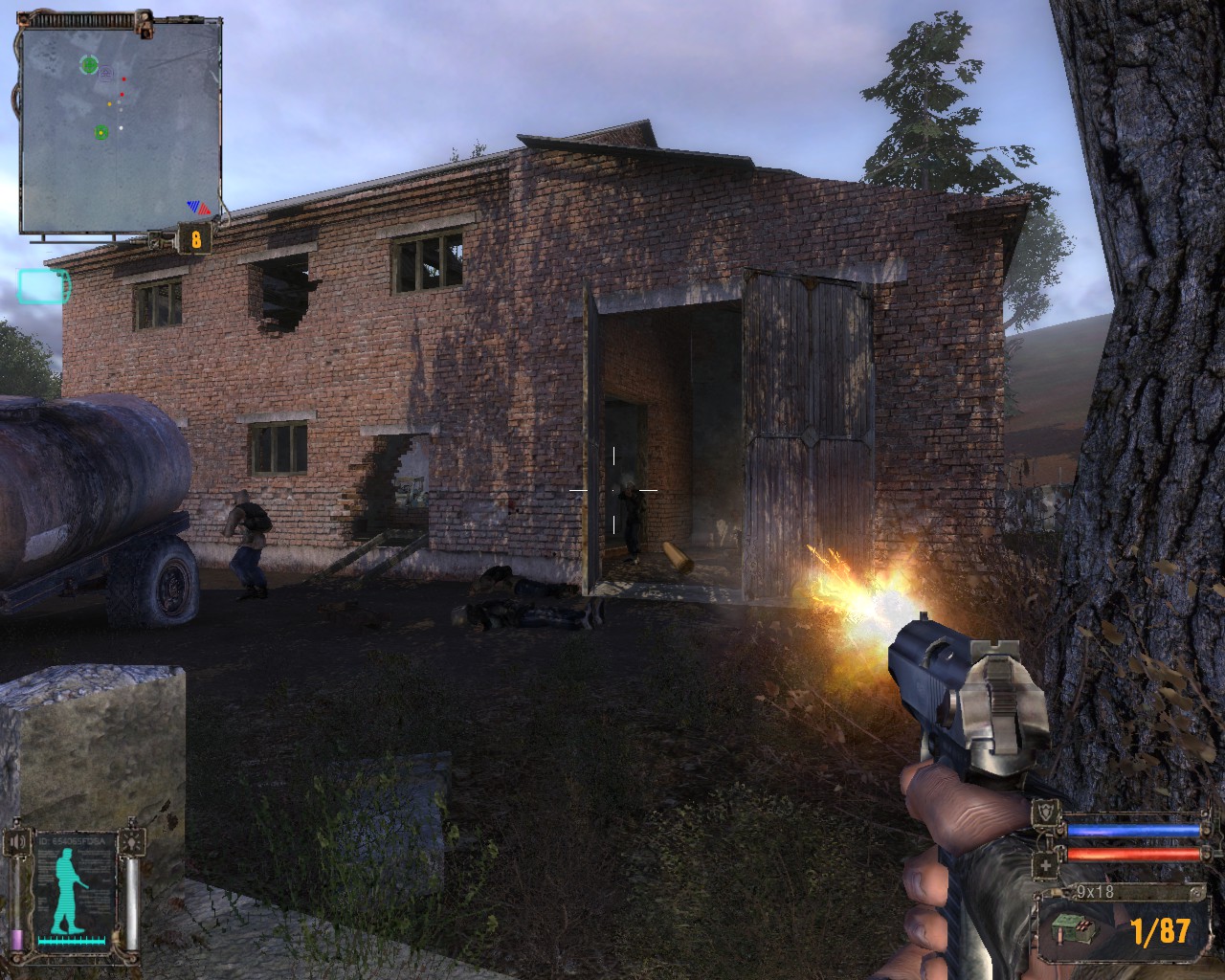
A screenshot from S.T.A.L.K.E.R.: Shadow of Chernobyl; the presence of the player character's right hand firing their gun (bottom right) denotes the first-person perspective.
First-person can be used for virtually any genre; Zeno Clash is a beat 'em up in first person, an unusual choice for the genre.

In video games, first-person (also spelled first person) is any graphical perspective rendered from the viewpoint of the player character, or from the inside of a device or vehicle controlled by the player character. It is one of two perspectives used in the vast majority of video games, with the other being third-person, the graphical perspective from outside of any character (but possibly focused on a character); some games such as interactive fiction do not belong to either format.

First-person can be used as sole perspective in games belonging of almost any genre; first-person party-based RPGs and first-person maze games helped define the format throughout the 1980s, while first-person shooters (FPS) are a popular genre emerging in the 1990s in which the graphical perspective is an integral component of the gameplay. Although, like third-person shooters (TPS), the term has come to define a specific subgenre of shooter games rather than any using the perspective, with several shooter games, while belonging to other subgenres, using a first person perspective, such as, traditionally, light gun shooters, rail shooters, and shooting gallery games.[1][2] Other genres that typically feature a first person perspective include amateur flight simulations, combat flight simulators, dating sims, driving simulators, visual novels, immersive sims, and walking sims, although it has virtually been used in all genres, including survival horror and stealth games, either as main perspective or for specific actions or sections.

Game mechanics

[edit]

Games with a first-person perspective are usually avatar-based, wherein the game displays what the player's avatar would see with the avatar's own eyes. Thus, players typically in many games they cannot see the avatar's body, though they may be able to see the avatar's weapons or hands. This viewpoint is also frequently used to represent the perspective of a driver within a vehicle, as in flight and racing simulators; it is common to make use of positional audio, where the volume of ambient sounds varies depending on their position with respect to the player's avatar.[3]

Games with a first-person perspective do not require sophisticated animations for the player's avatar, nor do they need to implement a manual or automated camera-control scheme as in third-person perspective.[3] A first-person perspective allows for easier aiming, since there is no representation of the avatar to block the player's view, but the absence of an avatar can make it difficult to master the timing and distances required to jump between platforms, and may cause motion sickness in some players.[3][4][5]

Players have come to expect first-person games to accurately scale objects to appropriate sizes, although the key objects such as dropped items or levers may be exaggerated in order to improve their visibility.[3]

History

[edit]

Origins

[edit]

First-person perspectives are used in various different genres, including several distinct sub-genres of shooter games. Shooting gallery games, which evolved from mid-20th-century arcade electro-mechanical games and in turn late-19th-century carnival games, typically employ a first-person perspective where players aim at moving targets on a stationary screen. They in turn evolved into rail shooters, which also typically employ a first-person perspective, but move the player through levels on a fixed path. Rail shooter and shooting gallery games that use light guns are called light gun shooters. The most popular type of game to employ a first-person perspective today is the first-person shooter (FPS), which allows player-guided navigation through a three-dimensional space.[6]

Electro-mechanical racing games had been using first-person perspectives since the late 1960s, dating back to Kasco's Indy 500 (1968) and Chicago Coin's version Speedway (1969).[7][8] The use of first-person perspectives in driving video games date back to Nürburgring 1 and Atari's Night Driver in 1976.[9]

It is not clear exactly when the earliest FPS video game was created. There are two claimants, Spasim and Maze War. The uncertainty about which was first stems from the lack of any accurate dates for the development of Maze War—even its developer cannot remember exactly.[10] In contrast, the development of Spasim is much better documented and the dates are more certain.

The initial development of Maze War probably occurred in the summer of 1973. A single player traverses a maze of corridors rendered using fixed perspective. Multiplayer capabilities, with players attempting to shoot each other, were probably added later in 1973 (two machines linked via a serial connection) and in the summer of 1974 (fully networked).[10] Spasim was originally developed in the spring of 1974 with a documented debut at the University of Illinois the same year. The game is a rudimentary space flight simulation game with a first-person 3D wireframe view.[11] It allowed online multiplayer over the worldwide university-based PLATO network.

Futurewar (1976) by high-school student Erik K. Witz and Nick Boland, also based on PLATO, is sometimes claimed to be the first true FPS.[12] The game includes a bitmap image of a gun and other armaments that point at the monsters and other players, with the walls rendered as vector lines. Set in A.D. 2020, Futurewar anticipated Doom, although as to Castle Wolfenstein's transition to a futuristic theme, the common PLATO genesis is coincidental. A further PLATO FPS was the tank game Panther, introduced in 1975, generally acknowledged as a precursor to Battlezone.[citation needed]

1979 saw the release of two first-person space combat games: the Exidy arcade game Star Fire and Doug Neubauer's seminal Star Raiders for Atari 8-bit computers. The popularity of Star Raiders resulted in similarly styled games from other developers and for other systems, including Starmaster for the Atari 2600, Space Spartans for Intellivision, and Shadow Hawk One for the Apple II. It went on to influence two major first-person games of the 1990s: Wing Commander and X-Wing.[13]

1980s

[edit]

Atari's 1983 Star Wars arcade game leaned entirely on action rather than tactics, but offered 3D color vector renderings of TIE Fighters and the surface of the Death Star.[14]

Other shooters with a first-person view from the early 1980s include Taito's Space Seeker in 1981,[15] Horizon V for the Apple II the same year,[16] Sega's stereoscopic arcade game SubRoc-3D in 1982,[17] Novagen Softwares Encounter in 1983, and EA's Skyfox for the Apple II in 1984.

Flight simulators were a first-person staple for home computers beginning in 1979 with FS1 Flight Simulator from Sublogic and followed up with Flight Simulator II in 1983. MicroProse found a niche with first-person aerial combat games: Hellcat Ace (1982),[18] Spitfire Ace (1982),[19] and F-15 Strike Eagle (1985).

Amidst a flurry of faux-3D first-person maze games where the player is locked into one of four orientations, like Spectre, Muse Software's Escape!,[20] Tunnel Runner, Escape from the Mindmaster, 3D Monster Maze, 3-D Monster Chase, 3-Demon,[21] Phantom Slayer, and Dungeons of Daggorath, came the 1982 release of Paul Edelstein's Wayout from Sirius Software.[22] Not a shooter, it has smooth, arbitrary movement using what was later labeled a raycasting engine, giving it a visual fluidity seen in future games MIDI Maze and Wolfenstein 3D. It was followed in 1983 by the split-screen Capture the Flag, allowing two players at once,[23] and foreshadowing a common gameplay mode for 3D games of the 1990s.

The arrival of the Atari ST and Amiga in 1985, and the Apple IIGS a year later, increased the computing power and graphical capabilities available in consumer-level machines, leading to a new wave of innovation. 1987 saw the release of MIDI Maze, an important transitional game for the genre. Unlike its contemporaries, MIDI Maze used raycasting to speedily draw square corridors. It also offered a networked multiplayer deathmatch (communicating via the computer's MIDI ports). Sublogic's Jet was a major release for the new platforms, as were Starglider and the tank simulator Arcticfox.

In 1987, Taito's Operation Wolf arcade game started the trend of realistic military-themed action shooters, and featured side-scrolling environments and high-quality graphics for the time. It was followed the subsequent year by a sequel, titled Operation Thunderbolt, that introduced a pseudo-3D perspective and the illusion of depth. The success and popularity of these two games led to Sega releasing Line of Fire in 1989, another military combat arcade machine that achieved a further level of realism by implementing a rotating point of view, thus creating the effect of turning corners left and right, in addition to just walking forward.

In 1988, Golgo 13: Top Secret Episode featured first-person shooter levels and included a sniper rifle for assassinating an enemy agent at long range using an unsteady sniper scope.[24] The same year saw the release of Arsys Software's Star Cruiser.

In the late 1980s, interest in 3D first-person driving simulations resulted in games like Test Drive (1987) and Vette! (1989). 1989's Hard Drivin' arcade game from Atari Games was particularly influential, with fast filled-polygon graphics, a mathematical model of how the vehicle components interact, force feedback, and instant replay after crashes.[25] In the following years, two Hard Drivin'-esque MS-DOS games appeared, each including a track editor: Stunt Driver from Spectrum Holobyte (1990) and Stunts from Broderbund (1991).

1990s

[edit]

In 1990, SNK released beat 'em ups with a first-person perspective: the hack & slash game Crossed Swords,[26] and the fighting & shooting game Super Spy.[27] In 1991, Dactyl Nightmare appeared for the Virtuality arcade VR platform, which featured first person deathmatch style games with polygon player avatars.[28] In late 1991, the fledgling id Software released Catacomb 3D, which introduced the concept of showing the player's hand on-screen, strengthening the illusion that the player is viewing the world through the character's eyes.

Taito's Gun Buster was released in arcades in 1992. It features on-foot gameplay and a control scheme where the player moves using an eight-direction joystick and aims using a mounted positional light gun. It allows two-player cooperative gameplay for the mission mode and features a deathmatch mode where two players compete against each other or up to four players compete in two teams.[29]

In 1992, Ultima Underworld: The Stygian Abyss was among the first to feature texture mapped environments, polygonal objects, and basic lighting. The engine was later enhanced for usage in the games Ultima Underworld II: Labyrinth of Worlds and System Shock. Later in 1992, id improved the technology used in Catacomb 3D by adding support for VGA graphics in Wolfenstein 3D. It would be widely imitated in the years to follow, and marked the beginning of many conventions in the genre, including collecting different weapons that can be switched between using the keyboard's number keys, and ammo conservation. 1996 saw the release of The Elder Scrolls II: Daggerfall for MS-DOS by Bethesda Softworks, featuring similar graphics and polygonal structures to other games at the time and furthering the first-person element included in 1994's The Elder Scrolls: Arena, to which it was a sequel.

Doom (1993) refined Wolfenstein 3D's template by adding support for higher resolution, improved textures, variations in height (e.g., stairs and platforms the player's character could climb upon), more intricate level design (Wolfenstein 3D was limited to a grid based system where walls had to be orthogonal to each other, whereas Doom allowed for any inclination) and rudimentary illumination effects such as flickering lights and areas of darkness, creating a far more believable 3D environment than Wolfenstein 3D's levels, all of which had a flat-floor space and corridors.[30] Doom allowed competitive matches between multiple players, termed deathmatches, and the game was responsible for the word's subsequent entry into the video gaming lexicon.[30] Doom has been considered the most important first-person shooter ever made.[31]

The 1995 game Descent used a fully 3D polygonal graphics engine to render opponents, departing from the sprites used by most previous games in the FPS genre. It also escaped the "pure vertical walls" graphical restrictions of earlier games in the genre, and allowed the player six degrees of freedom of movement (up/down, left/right, forward/backward, pitch, roll, and yaw). The Quake series since 1996, and derived titles such as 1998's Half-Life, advanced from Doom with a fully 3D engine allowing players to look from any angle, and helped formalize the mouse and WASD keys combo that has become the standard means of control on personal computers.[32] On consoles meanwhile, games like Halo from 2001, helped define the dual analog stick controls that have become the norm.

See also

[edit]

References

[edit]
Revisions and contributorsEdit on WikipediaRead on Wikipedia
from Grokipedia
In video games, the first-person perspective is a graphical viewpoint that renders the game world from the eyes of the player-character, immersing the player directly in the environment without displaying an on-screen avatar. This approach heightens sensory engagement by aligning the player's field of vision with the character's, enabling intuitive navigation and interaction with surroundings. The origins of the first-person perspective date to 1973, when high school students Steve Colley, Greg Thompson, and Howard Palmer, working at NASA's , developed Maze War on the Imlac PDS-1 minicomputer as an experimental 3D maze navigation program. Initially a solo experience featuring a floating eyeball avatar traversing wireframe corridors, it quickly evolved into the first networked multiplayer , supporting up to eight players over and incorporating combat mechanics. Subsequent enhancements by developers like Greg Thompson and at MIT added features such as peeking around corners and maze editing, with ports to systems including the and Atari ST extending its influence through the and . Beyond its foundational role in shooters, the first-person perspective has shaped diverse genres, including early and games. For instance, (1974) applied it to space combat simulation, while Night Driver (1976) introduced first-person driving mechanics using to simulate a car's forward view. In games, titles like Wizardry (1981) employed wireframe first-person views for crawling, blending combat and exploration in a party-based system that influenced later computer RPGs. The perspective's adoption expanded in the 1990s with id Software's (1992) and Doom (1993), which revolutionized and popularized fast-paced first-person shooters, while also inspiring hybrid genres like immersive sims and open-world RPGs such as series. This viewpoint excels in fostering immersion and spatial awareness, as players perceive threats and details in real-time without interpretive gaps required by third-person alternatives. However, it can limit peripheral vision and character expression, often relying on environmental storytelling or voiceovers to convey narrative depth. Its enduring appeal lies in applications across action, adventure, and horror, where direct embodiment amplifies tension and agency in virtual worlds.

Definition and Perspective

Core Concept

In video games, the first-person perspective refers to a graphical viewpoint rendered directly from the eyes of the , creating a subjective experience that immerses the player in the game world without displaying the avatar's body. This approach emphasizes the protagonist's immediate surroundings, allowing actions to unfold as if the player is inhabiting the character, with elements like hands or weapons occasionally visible in the foreground to enhance realism. Key principles of the first-person perspective center on environmental immersion, where the player's focus is drawn to the surrounding space for a heightened of presence; spatial awareness, facilitated by neural networks that simulate being within the ; and from the character's position, enabling intuitive and interaction as an extension of the player's own movements. These elements promote a psychological merging of player and character, intensifying through sensory cues like visuals and sound that mimic real-world . The term "first-person" originates from narrative techniques in literature and film, where it denotes storytelling from the "I" viewpoint of a character, and was adapted to video games during the 1970s and 1980s to describe this embodied visual style, though it gained prominence retrospectively in the 1990s. One of the earliest implementations is Maze War (1973), a pioneering multiplayer game that used vector graphics and wireframe rendering to depict a 3D maze from the player's viewpoint, allowing navigation through corridors and basic combat in a shared environment.

Distinctions from Other Views

The second-person perspective in video games is exceedingly rare and typically manifests in or text-based adventures, where the narrative directly addresses the player as "you," immersing them through descriptive rather than visual representation. This approach contrasts sharply with the first-person perspective's emphasis on visual immersion, as it prioritizes narrative identification and choice-making over subjective viewpoint rendering, often lacking graphical elements altogether. In contrast, the third-person perspective employs an external camera positioned behind or over the shoulder of the , rendering the avatar visible within the game world and providing a broader for spatial awareness and navigation. This setup allows players to observe their character's movements and surroundings more holistically, facilitating better situational judgment in complex environments, but it reduces the sense of subjective embodiment compared to first-person views. First-person perspectives heighten immersion by simulating direct sensory experience, fostering greater tension and realism during or , as evidenced by studies showing significantly higher immersion scores (mean = 117.25) in first-person play compared to third-person (mean = 107.10; p = 0.014). However, they can induce and disorientation due to sensory conflicts between visual cues and physical stability, particularly in first-person shooters where rapid movements exacerbate vection-induced nausea and oculomotor discomfort. Limited in first-person views also increases and challenge, potentially hindering navigation in open-world scenarios. Design choices in modern games often evolve toward hybrid systems, allowing players to switch between fixed first-person for immersive precision and third-person for enhanced overview, thereby balancing subjectivity with and mitigating limitations like disorientation.

Game Mechanics

Viewpoint Implementation

In first-person video games, the viewpoint is realized through camera systems that position the virtual camera at the player's , simulating direct embodiment within the game world. Fixed viewpoints maintain a static orientation relative to the environment, often used in early implementations to simplify rendering, while dynamic viewpoints allow real-time adjustments based on player movement for greater immersion. Field-of-view (FOV) adjustments are crucial, with standard horizontal FOVs of 90-110 degrees selected to approximate human (around 120 degrees) without introducing excessive distortion or fish-eye effects, balancing perceptual realism and gameplay comfort. Head-bobbing enhances realism by applying oscillatory transformations to the camera, typically using sine functions tied to player velocity: for instance, vertical position offset as y += sin(time * velocity * 2π) and rotational tilt as x_rotation += sin(...) * multiplier, mimicking the natural sway of walking without causing disorientation. Environmental rendering integrates the viewpoint seamlessly with the surroundings, overlaying heads-up display (HUD) elements like crosshairs and health bars in ways that preserve immersion. Diegetic HUDs, which embed information within the game world (e.g., ammo counts visible on in-world objects), outperform traditional overlaid HUDs in tasks like monitoring resources, reducing reaction times by up to 26% in experimental FPS scenarios by avoiding perceptual breaks. Non-diegetic elements, such as floating icons, are positioned centrally or minimally to minimize visual clutter, ensuring they align with the camera's perspective without obstructing key environmental cues. Visibility of hands and weapons is managed by rendering them in a dedicated layer close to the camera, often with adjusted near-clip planes to prevent unnatural intersections while maintaining a sense of embodiment. Key challenges in viewpoint implementation include clipping, where player elements like weapons penetrate walls, disrupting spatial coherence. Solutions involve multi-camera setups, such as a secondary camera with a near clip of 0.001 and far clip of 1 dedicated to weapons, rendered at a higher depth priority to overlay without intersecting the main scene, or collision-based retraction that shifts the weapon model upon detection. Adaptation to hardware varies: PC environments support higher FOV customization and smoother dynamic tracking via mouse input, while consoles often enforce fixed FOVs (e.g., 90 degrees) to optimize for controller-based viewing distances and TV screens, potentially introducing minor distortions on larger displays. Early titles like MIDI Maze (1987) employed static, fixed first-person views with flat-shaded polygonal mazes and a central crosshair, occupying a small screen portion for basic 3D navigation on limited hardware. In contrast, modern VR games like Half-Life: Alyx (2020) achieve smooth 6DoF tracking through Source 2 engine integration, leveraging headset sensors for precise head and hand movements with physically-based rendering to eliminate jitter, supporting 70-90 FPS on mid-range GPUs like GTX 1060.

Interaction and Controls

In first-person video games, interaction primarily occurs through input schemes that enable precise navigation and aiming within the . The WASD keyboard layout, where W moves forward, S backward, A left, and D right, emerged in the with early 3D shooters like Doom, where it was a popular key remapping option, and became the standard for PC-based movement controls, allowing simultaneous mouse use for aiming without hand repositioning. It was popularized by competitive player in Quake tournaments. Mouse-look functionality, which translates mouse movement directly into camera rotation for aiming, was implemented in Marathon (1994) by , revolutionizing free-look capabilities and establishing it as a core mechanic in subsequent titles like Quake (1996). For console and hybrid platforms, analog sticks on controllers handle rotation and translation, with the right stick typically controlling view direction and the left managing character movement, providing variable speed input that enhances fluidity in dual-stick shooter designs. Feedback mechanisms reinforce player actions and environmental awareness, integrating multiple sensory channels to heighten responsiveness. Audio cues, such as directional footsteps, serve as critical indicators of movement and proximity to other entities, varying by surface type to inform player decisions without visual reliance, as seen in games like and Fallout 3. Haptic responses, including vibrations simulating weapon , deliver tactile confirmation of firing, with linear force feedback in VR controllers improving perceived realism and immersion, though it does not always enhance immediate shooting accuracy. Visual recoil effects, where the camera or weapon model animates upward or sideways during shots, provides immediate on-screen feedback of weapon discharge and momentum, contributing to tactical adjustments in shooters like Zombie State. Accessibility adaptations ensure broader usability by accommodating diverse player needs in control customization. Inverted Y-axis options, which reverse vertical camera movement to mimic vehicle piloting rather than direct embodiment, cater to users habituated from flight simulators or those with differing spatial perceptions, with studies indicating higher immersion reports among inverters. Sensitivity sliders allow fine-tuning of input responsiveness across devices like mice or analog sticks, essential for players with motor impairments—high settings aid limited mobility, while low ones assist those with tremors—and help mitigate . Subtitle integrations, including captions for dialogue and key sound effects with directional indicators, support deaf or hard-of-hearing players by transcribing audio cues at readable speeds (e.g., 1-2.5 seconds per line) and offering customization for font size and positioning, adhering to standards like those from the for clarity in dynamic FPS scenarios. The evolution of these controls reflects technological advancements, shifting from keyboard-centric inputs in 1990s PC FPS titles, where or basic WASD sufficed without analog precision, to multifaceted systems incorporating motion controls in post-2010s VR games. Early VR implementations, such as those in titles, leveraged head-tracking for natural rotation, reducing reliance on traditional inputs, while motion-based controllers like those using improved translation and aiming intuitiveness, though they require user adaptation for precision comparable to gamepads. This progression prioritizes immersion through hybrid schemes, blending legacy keyboard/ efficiency with VR's embodied motion for enhanced interaction fidelity.

Historical Development

Origins and Early Experiments

The origins of the first-person perspective in video games trace back to mid-20th-century computing experiments in simulation and visualization, which laid the groundwork for immersive, player-centered viewpoints. In the 1950s, the computer, developed at MIT's Servomechanisms Laboratory, powered early digital flight simulators designed to replicate pilot experiences in real-time, providing an interactive cockpit view that anticipated first-person immersion in virtual environments. By the late , advancements in display technology further advanced this concept; Ivan Sutherland's 1968 (HMD), dubbed the "Sword of Damocles," was the first prototype, rendering simple wireframe 3D from the user's head-tracked perspective to create a sense of presence in a mathematical world. These academic efforts, focused on military training and human-computer interaction, influenced the shift toward perspective-driven simulations in gaming. The first dedicated implementations of first-person perspective emerged in the early amid university and research lab tinkering. Maze War, developed in 1973 at NASA's on Imlac PDS-1 minicomputers, introduced multiplayer first-person navigation through a 3D wireframe , where players viewed the environment from their avatar's eyeline and could engage in shooting mechanics. Similarly, , created in 1974 by Jim Bowery on the network, was an early 3D space simulation supporting up to 32 players in a first-person cockpit view, allowing networked combat across planetary systems using . These games marked the transition from static simulations to interactive, perspective-based entertainment. Technical limitations of the era shaped these early efforts, relying on rudimentary wireframe rendering with minimal polygons—often just lines forming 90-degree corridors or basic shapes—to manage the constraints of vector-display hardware like the Imlac PDS-1. Text-based precursors, such as (1976) by Will Crowther, used second-person narrative through descriptive prose that placed the player directly in the scene, navigating caves via typed commands without visual graphics. This approach compensated for absent visuals by fostering spatial awareness from the protagonist's viewpoint. Key innovators like high school interns Steve Colley, Greg Thompson, and Howard Palmer drove Maze War's creation, starting with Colley's wireframe experiments and evolving through Thompson's networking enhancements at MIT. These academic projects at institutions like and universities began bridging to broader experiments, porting code to systems like for wider testing and hinting at future arcade adaptations.

1980s Advancements

The marked a pivotal shift for first-person perspectives in video games, transitioning from experimental prototypes to commercially viable arcade and titles that leveraged emerging hardware for immersive simulations. In arcades, Battlezone (1980), developed by , introduced players to a first-person combat experience using to render a wireframe 3D battlefield, where operators controlled a tank to engage enemy vehicles, missiles, and UFOs in . This title not only popularized the viewpoint in public venues but also demonstrated its potential for tactical depth, influencing subsequent military applications. Building on this, (1981), programmed by Malcolm Evans for the but initially distributed via arcade-like setups, pioneered first-person horror by placing players in a procedurally generated pursued by a Tyrannosaurus rex, using simple ray-casting for 3D navigation on limited hardware. On home computers, the decade saw first-person mechanics adapted for personal systems, enabling solo and multiplayer experiences. (1982), released for the IBM PC, offered a realistic first-person cockpit view of civilian and light flight, emphasizing accuracy with effects and to appeal to enthusiasts. A landmark in multiplayer innovation was (1987), developed by Xanth Software F/X for the ST, which utilized the system's MIDI ports to network up to 16 players in a first-person maze shooter, predating modern LAN setups and fostering competitive deathmatch play with Pac-Man-like avatars firing projectiles. Hardware advancements facilitated this evolution, particularly the move from 2D sprite-based rendering to pseudo-3D techniques that simulated depth without full polygon processing. The Commodore , launched in 1985, featured custom chips like the for fast sprite manipulation and the for dynamic screen updates, enabling smoother pseudo-3D effects in games such as racing titles that scaled 2D assets to mimic perspective. These capabilities, combined with rising adoption of 3D accelerators in arcade boards and home systems, allowed developers to replace flat 2D overlays with layered illusions of volume, expanding first-person viability beyond wireframes. Culturally, the era's first-person games drew heavily from military simulations, reflecting Cold War-era interests in tactical training. Battlezone's design, inspired by tank warfare, prompted the U.S. Army to commission Atari's Bradley Trainer (1983), a classified adaptation that modified the game for Bradley Fighting Vehicle operation, bridging entertainment and real-world defense applications. This symbiosis highlighted how arcade successes like Battlezone not only entertained but also validated first-person views as tools for strategic immersion, setting precedents for future genres.

1990s Mainstream Adoption

The 1990s marked the mainstream adoption of first-person perspectives in video games, propelled by the emergence of the (FPS) genre and advancements in personal computing hardware. id Software's , released in 1992, is widely regarded as the pioneering title that formalized the FPS genre, utilizing a raycasting technique to simulate three-dimensional environments on limited hardware, allowing players to navigate maze-like Nazi strongholds from a first-person viewpoint. This game's success laid the groundwork for subsequent titles, emphasizing fast-paced combat and immersive spatial navigation that captivated PC gamers. Building on this foundation, id Software's Doom in 1993 revolutionized the genre by introducing networked multiplayer, including the co-op and competitive "deathmatch" mode— a term coined by id co-founder — which enabled fast-paced, adrenaline-fueled battles among players. The game's distribution model further accelerated its adoption, reaching millions and establishing first-person shooters as a dominant PC gaming staple. By 1996, Quake advanced the format with a fully polygonal true 3D engine, moving beyond raycasting to support complex geometry and smoother multiplayer experiences, solidifying the genre's technical evolution. Hardware improvements played a crucial role in this mainstream surge. The release of 3D accelerators like the 3dfx Voodoo in 1996 provided dedicated support for texture mapping and z-buffering, dramatically enhancing visual fidelity and performance in first-person titles, making them accessible to a broader audience beyond elite enthusiasts. Similarly, sound cards such as Creative Labs' Sound Blaster series, evolving from the 1989 original to advanced models in the early 1990s, introduced digitized audio and positional sound effects, heightening immersion through realistic gunfire and environmental cues in games like Doom. These peripherals, combined with id Software's open design philosophy, fostered vibrant modding communities; Doom's WAD file format allowed users to create custom levels and modifications, extending the game's lifespan and influencing community-driven content creation throughout the decade. Beyond pure shooters, first-person perspectives gained traction in hybrid genres, exemplified by ' System Shock in 1994, which blended FPS mechanics with RPG elements like character progression, inventory management, and cyberpunk narrative depth on a derelict space station. Titles like Valve's Half-Life in 1998 further integrated storytelling seamlessly into first-person gameplay, using environmental cues and scripted sequences to deliver a cohesive sci-fi narrative without traditional cutscenes, elevating the perspective's role in single-player experiences. This period's innovations set the stage for expanded multiplayer developments in the following decade.

2000s Refinements and Expansion

The 2000s marked a period of significant refinement in first-person , particularly through the evolution of multiplayer components that emphasized competitive play and large-scale online interactions. , initially released in 1999 but expanded through sequels like and 2004, became a cornerstone for organized , featuring fast-paced arena combat modes that supported up to 32 players and integrated bot AI for practice, fostering a competitive scene with professional leagues and tournaments.https://www.ign.com/articles/2010/01/07/the-history-of-online-shooters https://www.pcgamer.com/a-brief-history-of-online-gaming-on-the-pc/ Similarly, transitioned from a 1999 mod to a standalone franchise with its 2000 beta release, introducing team-based objective modes like bomb defusal that prioritized strategy and economy management, propelling it into a dominant title with events drawing thousands of spectators by mid-decade.https://www.gamespot.com/articles/dust-to-dust-the-history-of-counter-strike/1100-6419676/ https://www.pcgamer.com/10-years-of-counter-strike-global-offensive/ Narrative elements in first-person games also advanced, incorporating deeper player agency and cinematic storytelling to enhance immersion. (2007) introduced moral choice systems through interactions with Little Sisters, where players could harvest or rescue them for genetic material (), affecting the protagonist's alignment and multiple endings, which added philosophical depth to the underwater setting.https://www.eurogamer.net/moral-choices-came-late-to-bioshock https://www.ign.com/articles/2007/08/20/bioshock-au-review The Call of Duty series, starting with its 2003 debut, refined single-player campaigns with Hollywood-style sequences, including scripted events and quick-time mechanics, as seen in later entries like 4: Modern Warfare (2007), which blended historical and fictional narratives for emotional impact.https://www.ign.com/articles/the-10-best-call-of-duty-campaigns https://www.ign.com/articles/how-call-of-duty-reinvented-the-first-person-shooter Hardware advancements, particularly the spread of broadband internet, enabled more ambitious online experiences, while console adaptations broadened accessibility. PlanetSide (2003), an early massively multiplayer online first-person shooter (MMOFPS), supported battles with hundreds of players across persistent continents, relying on emerging broadband infrastructure to handle real-time synchronization and reduce latency issues that plagued dial-up connections.https://www.engadget.com/2012-05-26-the-firing-line-planetside-2s-matt-higby-on-the-mmofps-revolut.html https://www.ign.com/articles/2010/01/07/the-history-of-online-shooters Halo: Combat Evolved (2001), a launch title for Microsoft's Xbox console, adapted PC-style first-person controls with analog aiming and vehicular combat, making the genre viable on home consoles and selling over 5 million units in its first year.https://www.escapistmagazine.com/halo-combat-evolved-20-years-old-20th-anniversary/ https://www.ign.com/articles/2010/11/16/the-history-of-halo Genre diversification further expanded first-person perspectives beyond traditional , integrating vehicles and horror elements for varied . (2002) pioneered seamless transitions between infantry and vehicle controls in first-person view, allowing players to pilot tanks, planes, and ships in 64-player matches across large maps, which influenced subsequent titles in emphasizing tactics.https://www.ign.com/articles/2002/06/14/battlefield-1942-hands-on-2 https://www.gamespot.com/articles/battlefield-1942-preview/1100-2805985/ F.E.A.R. (2005) blended horror with action through slow-motion mechanics and AI-driven enemy behaviors that simulated fear responses, creating tense, atmospheric encounters in a supernatural military narrative.https://www.gamespot.com/reviews/fear-review/1900-6135744/ https://www.eurogamer.net/r-fear-pc

2010s to Present Innovations

The 2010s marked a pivotal era for first-person perspectives with the mainstream adoption of (VR), beginning with the consumer release of the in March 2016, which facilitated fully immersive first-person experiences through head-mounted displays and motion tracking. This hardware breakthrough enabled developers to create titles like Lone Echo (2017), a first-person developed by and published by Oculus Studios, where players navigate zero-gravity environments aboard a Saturn-orbiting using intuitive VR locomotion mechanics. Building on this foundation, Valve's Half-Life: Alyx (2020) established a new benchmark for VR first-person shooters, leveraging the Source 2 engine to deliver physics-based interactions, gravity gloves for , and narrative depth in a Combine-infested world, significantly boosting VR adoption with over 2 million units sold in its first year. Indie developers further innovated first-person views by emphasizing emotional and exploratory gameplay over combat, as seen in Firewatch (2016) by Campo Santo, a narrative-driven walking simulator that uses first-person perspective to foster intimacy in dialogue and environmental storytelling within the Wyoming wilderness. Similarly, No Man's Sky (2016) by Hello Games revolutionized open-world exploration through procedural generation algorithms, creating an infinite universe of procedurally assembled planets viewable in first-person, allowing players to discover unique ecosystems and alien artifacts across billions of worlds without predefined content. These titles highlighted how first-person mechanics could prioritize wonder and personal agency, influencing a wave of experimental indie works that blended simulation with introspective play. Into the late and early , cross-platform emerged as a key trend, exemplified by (2019) from , a battle royale that added cross-progression support in 2023 across PC, PlayStation, , and , enabling unified and shared inventories to foster larger, more diverse player communities in first-person scenarios. The 2020s have integrated (AI) for more dynamic non-player characters (NPCs) in first-person games, as demonstrated by NVIDIA's ACE technology showcased at CES 2024, which powers conversational AI in titles like demo integrations for murder mystery experiences, allowing NPCs to respond contextually to player actions with . experiments have proliferated through ' , with post-2021 updates incorporating persistent worlds and brand collaborations, such as the 2024 Disney partnership enabling first-person social events across Marvel and Star Wars universes, blending live performances with player-driven exploration. Hardware advancements, including NVIDIA's GeForce RTX 40 SUPER series released in January 2024, have enhanced first-person rendering with up to 1.7x faster ray-traced performance and AI-accelerated frame generation, paving the way for post-2025 projections of hyper-realistic, adaptive environments in VR and open-world titles that leverage 836 for seamless immersion. In 2025, Entertainment's Avowed (February 2025) advanced first-person RPGs with reactive world-building and moral choice systems in a fantasy setting, enhancing player agency through immersive decision-making.

Genres and Applications

First-Person Shooters

The (FPS) genre centers on combat-oriented gameplay viewed from the protagonist's perspective, where players primarily engage enemies using projectile weapons such as firearms, while navigating structured levels filled with objectives, environmental hazards, and collectible power-ups that temporarily boost health, ammunition, or abilities. This emphasis on gunplay distinguishes FPS titles from other first-person experiences, with core tropes including rapid aiming and firing mechanics, enemy AI behaviors that simulate tactical responses, and level designs that funnel players through corridors, open arenas, or urban environments to escalate tension and encounters. Early exemplars like Doom (1993) established these elements by integrating fast-paced action with , setting a template for subsequent titles. Within the FPS genre, distinct subgenres have emerged, such as arena shooters exemplified by Quake (1996), which prioritize high-mobility, skill-intensive multiplayer battles in symmetrical, abstract maps without extensive narrative, fostering competitive duels reliant on precise movement and weapon mastery. In contrast, military simulators like the series emphasize realism through large-scale campaigns, squad-based tactics, and historical or contemporary warfare scenarios, incorporating elements like vehicle operation and objective-driven missions to simulate authentic combat dynamics. Iconic mechanics further define the genre's evolution: deathmatch modes, popularized in Doom as free-for-all player-versus-player combat, became a staple for social and competitive play, influencing multiplayer design across platforms. Post-2000s innovations include weapon sway, which introduces subtle aiming instability to mimic physiological factors like fatigue or recoil, enhancing realism in titles such as Call of Duty: Modern Warfare (2007), and cover systems that allow players to dynamically duck behind obstacles for strategic positioning, first refined in FPS contexts around 2005 to balance aggressive gunplay with defensive tactics. FPS games achieved significant market dominance from the through the , consistently ranking among the top-selling genres due to blockbuster franchises driving hardware adoption and cultural buzz; for instance, shooter titles accounted for a substantial portion of global sales, with alone generating billions in revenue by the mid-. On platforms like , FPS games lead in lifetime revenue, surpassing $15 billion by 2023, underscoring their enduring appeal amid genre diversification. The rise of esports amplified this prominence, particularly with (2020), which quickly became a cornerstone of competitive FPS play through its tactical depth and ' structured tournament ecosystem, drawing millions of viewers and establishing it as a top esports title within its first year. The genre has faced ongoing criticisms centered on its depiction of violence, sparking debates about potential societal impacts; following the 1999 Columbine High School shooting, Doom was scrutinized by media and politicians for allegedly inspiring the perpetrators, who were avid players, leading to congressional hearings and calls for content regulation despite lacking empirical evidence linking the game to real-world aggression. This scrutiny intensified public discourse on FPS titles' graphic content, with advocacy groups arguing it desensitizes players to violence, though subsequent research has largely refuted causal connections to mass shootings or increased aggression rates.

Exploration and Adventure Games

In first-person exploration and adventure games, core elements revolve around puzzle-solving and environmental storytelling, where players uncover narratives through interaction with the surroundings rather than direct confrontation. Puzzles often integrate seamlessly into the world, requiring observation and manipulation of objects to progress, fostering a sense of discovery. Environmental storytelling, a technique that embeds narrative details in visual and interactive cues within the setting, allows players to piece together backstories and events organically. Walking simulators, a subgenre emphasizing free-form navigation and minimal mechanics, exemplify this approach; for instance, (2013) tasks players with exploring an empty family home to reconstruct the inhabitants' lives through letters, artifacts, and spatial arrangements, prioritizing emotional resonance over traditional challenges. Seminal titles have shaped the genre's emphasis on immersive worlds. Myst (1993), developed by Cyan Worlds, pioneered first-person adventure design with its pre-rendered 3D environments, where players navigate a mysterious island solving intricate mechanical and logical puzzles to reveal a lore-rich narrative. The game's point-and-click origins evolved into full first-person navigation in later ports, establishing a template for solitary, atmospheric journeys. Similarly, The Elder Scrolls V: Skyrim (2011) by Bethesda Game Studios expanded this into vast open-world immersion, allowing players to traverse a detailed fantasy province in first-person view, discovering lore through ancient ruins, journals, and dynamic ecosystems that encourage unguided exploration. Design in these games prioritizes atmospheric audio to heighten presence, with subtle soundscapes—such as echoing footsteps, ambient , or distant echoes—guiding emotional tone and spatial awareness without overt cues. Subtle interactions, like examining objects for hidden clues or triggering environmental responses, reinforce player agency, enabling non-linear paths where choices in order influence revelation. This structure empowers players to dictate pacing, blending with structured discovery to sustain in narrative-driven experiences. The genre has evolved from static, puzzle-centric adventures like Myst to more dynamic, interconnected worlds in the 2020s, incorporating time-based mechanics and reactive environments for layered replayability. (2021) by exemplifies this shift, presenting a looping island where first-person exploration reveals interconnected leads and secrets across districts, blending adventure pacing with evolving spatial narratives.

Simulation and Role-Playing

In simulation genres, first-person perspectives enhance realism by placing players directly within the or , fostering a sense of operational immersion. (2020), developed by in partnership with Microsoft, exemplifies this through its detailed first-person views of aircraft interiors, including interactive dashboards and controls that simulate real-world aviation physics and procedures. The game's use of real-time global data for weather and terrain further amplifies the lifelike experience, allowing players to execute precise maneuvers from the pilot's viewpoint. Similarly, in driving simulations, titles like incorporate first-person modes that provide intimate views of vehicle interiors, emphasizing handling dynamics and environmental interactions such as dynamic weather effects on traction. The integration of first-person perspectives in role-playing games (RPGs) emphasizes player customization and embodiment, enabling deeper character progression within simulated worlds. (2000), created by , pioneered this approach as an immersive simulation that blends first-person exploration with RPG mechanics, including a skill tree system where players allocate points to abilities like hacking or stealth, directly influencing interactions from the protagonist's viewpoint. This design choice heightens player agency, as augmentations and choices manifest through embodied first-person actions in a reactive environment. More recent examples, such as (2020) by CD Projekt RED, extend this by allowing extensive character customization—spanning implants and attribute builds—that alters first-person gameplay, from enhanced vision modes to dialogue-influenced social encounters, reinforcing the sensation of inhabiting a personalized avatar in a sprawling urban simulation. Unique features in these genres leverage first-person views to streamline player-system interactions, promoting realism and customization. Inventory management often occurs through first-person interfaces, as seen in (2017), where players physically manipulate gear in a grid-based system viewed from the character's perspective, simulating weight and space constraints to encourage strategic decision-making. Dialogue wheels, adapted for first-person RPGs like (2011), present radial menus during conversations, allowing players to select responses that align with character builds while maintaining immersion by avoiding text-heavy breaks. Procedural economies add dynamism to these simulated worlds. Post-2016 trends have amplified these elements through (VR) enhancements, integrating head-mounted displays to intensify embodiment in simulations. received a VR update in 2022, enabling full first-person cockpit immersion with 6DoF () tracking for head movements during flight operations. Driving sims have followed suit, with VR support in titles like (2019) providing haptic feedback and spatial audio to simulate G-forces and engine sounds from the driver's seat. By 2025, mobile adaptations have emerged, adapting first-person sim mechanics for touch controls; for instance, ports of flight simulators like offer scaled-down first-person views on devices such as the Samsung Galaxy Z Fold series, prioritizing procedural weather and basic customization for on-the-go realism.

Technical and Cultural Aspects

Rendering Techniques

Early rendering techniques in first-person video games relied on simplified algorithms to simulate three-dimensional environments on limited hardware. In (1992), employed raycasting to generate a 2.5D first-person view, projecting rays from the player's position to detect wall intersections and render vertical strips as textured trapezoids, while omitting floors and ceilings for performance. This approach reduced computational overhead by treating walls as uniform-height sectors in a 2D map, enabling smooth gameplay at 320x200 resolution on PCs of the era. Advancements in the mid-1990s introduced full with (BSP) in Quake (1996), where id Software's engine recursively divided level geometry into convex subspaces using hyperplanes, optimizing visibility culling and portal-based rendering for efficient traversal from the player's viewpoint. BSP trees facilitated painter's algorithm-style drawing of polygons front-to-back, minimizing overdraw and supporting variable-height floors, ceilings, and sloped surfaces in first-person navigation. Modern engines like Unreal Engine 5 (released 2022) incorporate Nanite, a virtualized geometry system that streams micropolygon meshes hierarchically, allowing pixel-scale detail in first-person scenes without traditional level-of-detail (LOD) management or pop-in artifacts. Nanite achieves this by clustering geometry into runtime virtualized representations, enabling high-fidelity environments with billions of triangles rendered at interactive frame rates on current hardware. Ray tracing emerged in the late 2010s for enhanced realism in first-person rendering, as seen in Control (2019) by , which integrated hardware for real-time reflections, diffuse , and contact shadows via hybrid rasterization-ray tracing pipelines. In Control, opaque reflections used GGX bidirectional reflectance distribution functions (BRDFs) with variable ray lengths up to 200 meters, while near-field indirect diffuse illumination traced short cosine-sampled rays limited to 1 meter, improving lighting accuracy in dynamic indoor spaces. These effects were denoised using temporal accumulation and spatial filters, contributing about 8.9 milliseconds to frame times at on high-end GPUs. Performance optimizations remain essential for first-person rendering, with level-of-detail (LOD) techniques reducing counts for distant objects to maintain frame rates, as detailed in foundational work on discrete and continuous generation for real-time graphics. Occlusion culling further accelerates rendering by excluding hidden , employing hardware queries to test bounding volumes against depth buffers before draw calls, a method that significantly reduces overdraw in complex first-person scenes. advancements, evolving from fixed-function pipelines in the early 2000s to programmable vertex and shaders introduced with GeForce 3 (2001), enable per-pixel lighting, , and in first-person engines, drastically improving visual fidelity without proportional performance costs. By 2025 hardware standards, real-time has become feasible across platforms, as demonstrated in idTech 8 for DOOM: The Dark Ages, where ray-traced solutions replace pre-baked lighting to support dynamic first-person environments at 60+ Hz on consoles and PCs. Similar implementations in Unreal Engine's Lumen system provide fully dynamic indirect lighting and reflections, scalable to mid-range hardware via software rasterization fallbacks. These techniques, highlighted at 2025, emphasize sampling and denoising for open-world titles like Assassin's Creed Shadows.

Immersion and Accessibility

First-person video games enhance immersion through advanced audio and visual techniques that simulate realistic sensory experiences. Spatial audio systems, such as 360-degree soundscapes enabled by , allow players to perceive audio cues from all directions, including overhead, creating a more enveloping environment that heightens and emotional engagement in titles like first-person shooters. Dynamic lighting further contributes by adjusting light sources in real-time to reflect environmental changes, such as flickering shadows or sunlight filtering through foliage, which builds tension and realism without relying solely on scripted events. In (VR) implementations, locomotion methods balance natural movement with comfort; smooth locomotion mimics walking for greater presence, while provides discrete jumps to minimize disorientation, allowing developers to tailor options based on player preference in exploratory first-person experiences. Accessibility in first-person games has evolved to include features that accommodate diverse player needs, particularly since the 2010s when industry standards began emphasizing inclusive options. Color-blind modes adjust color palettes or add pattern overlays to distinguish elements like health indicators or interactive objects, ensuring visibility for the approximately 8% of men and 0.5% of women affected by color vision deficiencies. Reduced motion settings, increasingly standard post-2010s, limit camera shakes, rapid pans, or particle effects to alleviate vestibular disturbances, benefiting players prone to motion sickness in fast-paced first-person scenarios. Subtitle depth extends beyond basic captions by including speaker labels, environmental sound descriptions (e.g., "[gunshot]"), and customizable sizing or positioning, which supports deaf or hard-of-hearing players in narrative-driven first-person adventures where audio cues convey critical plot or spatial information. Challenges in first-person design include mitigating , a form of motion-induced nausea affecting up to 80% of VR users during prolonged sessions, often addressed by limiting (FOV) to 60-90 degrees to reduce visual-vestibular mismatch while preserving flow. principles are exemplified in games like (2013), which incorporates minimalistic interfaces and optional narrative guidance to avoid overwhelming players with sensory or cognitive overload, promoting broader participation without compromising the introspective first-person perspective. Recent developments in 2024-2025 prototypes push immersion boundaries with full-body haptic suits, such as the bHaptics TactSuit, which deliver localized vibrations simulating impacts, footsteps, or textures across the torso and limbs, integrating seamlessly with first-person VR for tactile feedback that enhances embodiment. Eye-tracking technology in emerging headsets, like Meta's research prototypes, enables —sharpening visuals where the gaze focuses—and intuitive controls via pupil detection, reducing in first-person interactions while optimizing performance for resource-intensive environments.

Cultural Impact and Evolution

The first-person perspective in video games has significantly influenced broader media, particularly cinema, by introducing immersive viewpoints and narrative structures derived from gameplay mechanics. Films like (2015) emulate (FPS) tropes through its entirely POV cinematography, where the protagonist navigates chaotic action sequences akin to FPS missions, using cameras attached to stunt performers for heightened immersion. Similarly, (2018), adapted from Ernest Cline's 2011 novel, incorporates numerous FPS references, such as battles echoing games like Quake, to celebrate pop culture while critiquing escapist digital worlds. These crossovers highlight how first-person gaming aesthetics have reshaped action , blending with linear storytelling. Societal debates surrounding first-person games have centered on violence and desensitization since the , when congressional hearings scrutinized titles like and Doom for glorifying cruelty and potentially numbing players to real-world harm. Led by Senator , these 1993 sessions argued that realistic depictions in FPS games taught children to derive pleasure from violence, prompting the industry's self-regulation via the (ESRB) in 1994. Conversely, post-2000 research has identified positive cognitive benefits, with studies showing that frequent video game play, including first-person genres, enhances visuospatial skills such as and spatial perception in children and adolescents. For instance, a 2022 analysis of nearly 2,000 children found that those playing three or more hours daily outperformed peers in and impulse control tasks, linked to efficient brain activity in regions. A 2019 study showed that brief exposure to videogames improved visuospatial competencies, with 2D variants yielding up to 4.4-point gains in tasks compared to controls, underscoring adaptive neural changes. The evolution of first-person games in the marked a shift toward empathetic narratives, moving beyond combat to foster emotional connections through personal storytelling. Games like (2017) exemplify this by using first-person exploration to delve into family tragedies, evoking wonder, awe, and grief to process negative emotions and human fragility. This trend leverages to build via contextual immersion, allowing players to inhabit characters' perspectives and motivations, as seen in narrative frameworks that enhance emotional engagement. By the 2020s, indie developers have diversified the genre, emphasizing empathetic exploration in titles like and , contributing to a booming market projected to reach $9.55 billion by 2030, driven by innovative, small-team creations that prioritize emotional depth over high budgets. Globally, first-person games exhibit regional variations, with Japanese titles like (2001) incorporating cultural horror elements rooted in and Buddhist , such as vengeful spirits (onnen) driven by unresolved emotions. The series uses first-person camera mechanics to immerse players in sympathetic portrayals of ghosts as tragic victims of rituals, drawing from tales like "The Story of Okiku" and traditional translucent depictions, which differentiate it from Western FPS focuses on empowerment. This has broadened the genre's international appeal, introducing authentic Japanese supernatural themes to global audiences and influencing survival horror's cross-cultural evolution.

References

Add your contribution
Related Hubs
User Avatar
No comments yet.