Hubbry Logo
Florida scrub jayFlorida scrub jayMain
Open search
Florida scrub jay
Community hub
Florida scrub jay
logo
8 pages, 0 posts
0 subscribers
Be the first to start a discussion here.
Florida scrub jay
Florida scrub jay
from Wikipedia

Florida scrub jay
Temporal range: Gelasian - recent, 2–0 Ma
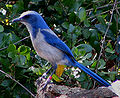
Adult in Lyonia Preserve, near Deltona, Florida
Critically Imperiled
Critically Imperiled  (NatureServe)[2]
Scientific classification Edit this classification
Kingdom: Animalia
Phylum: Chordata
Class: Aves
Order: Passeriformes
Family: Corvidae
Genus: Aphelocoma
Species:
A. coerulescens
Binomial name
Aphelocoma coerulescens
(Bosc, 1795)
Synonyms
  • Corvus floridanus
    Bartram, 1791[3]
  • Corvus coerulescens
    Bosc, 1795
  • Aphelocoma californica coerulescens

The Florida scrub jay (Aphelocoma coerulescens[A]) is one of the species of scrub jay native to North America. It is the only species of bird endemic to the U.S. state of Florida and one of only 15 species endemic to the continental United States.[4] Because of this, it is keenly sought by birders. It is known to have been present in Florida as a distinct species for at least 2 million years,[5] and is possibly derived from the ancestors of Woodhouse's scrub jay.[6]

Description

[edit]

It measures 23 to 28 cm (9.1 to 11.0 in) in length, and weighs from 66 to 92 g (2.3 to 3.2 oz), with an average 80.2 g (2.83 oz). The wingspan of the jay is 33–36 cm (13–14 in).[7][8] It has a strong black bill, blue head and nape without a crest, a whitish forehead and supercilium, blue bib, blue wings, grayish underparts, gray back, long blue tail, black legs and feet.

Ecology

[edit]

The Florida scrub jay is found only in Florida scrub habitat, an ecosystem that exists only in central Florida and in limited areas along the Atlantic coast, and is characterized by nutrient-poor soil, occasional drought, and frequent wildfires. Because of its being isolated from the mainland as an island (Orange Island) 34 to 28 million years ago [9] and somewhat harsh weather pattern, this habitat in isolation evolved to host not only the Florida scrub jay endemic only to Florida, but also a small assortment of very ancient specific plants, including sand pine, sand live oak, myrtle oak, Chapman's oak, sandhill oak, Florida rosemary[10] and various other hardy plants such as eastern prickly pear.[11]

Florida scrub jays are omnivorous and eat a wide variety of acorns, seeds, peanuts, insects, tree frogs, turtles, snakes, lizards, and young mice. They have also been occasionally observed to eat other birds' eggs or nestlings, but this occurs rarely.[12] They routinely cache thousands of acorns a year, burying them just beneath the surface. The acorns are typically buried in the fall and consumed during the winter and spring. Acorns that are forgotten or missed may germinate, making the Florida Scrub-Jay an effective agent for the dispersal of a variety of oak trees.

The Florida scrub jay may exhibit coordinated cooperative hunting, as seen in one case where a mated pair of the birds were observed attacking a black racer together in southcentral Florida. The snake may have been too large for one jay to kill it alone, and the pair ultimately succeeded in killing the reptile. Cooperated hunting like this is rarely documented in passerines.[13]

Scrub jays may also take silverware and other shiny objects in a manner similar to the American crow.

Reproduction

[edit]

Florida scrub jays are one of the few cooperative breeding birds in North America. Fledglings remain in their parents' habitat for several years and help to rear young, watch for predators (such as short-tailed hawks or Accipiter), and defend territory against neighboring Florida scrub jay family groups. These families can range in size from 2 to 8.[14]

Juvenile
Juvenile developing adult coloration

After about 2 to 3 years, fledglings leave the group to form mating pairs of their own. Mating season ranges from March to June. Clutches usually contain about 3 to 4 eggs which are incubated in about 17 days. Fledging occurs in about 16 to 19 days. Fledglings can be distinguished from the adult birds due to the coloration of the feathers on their head, which are brown instead of blue. The brown feathers on the juvenile's head are slowly replaced by blue feathers as the bird matures into adulthood.

Conservation

[edit]
A Florida scrub jay explores its surroundings

Scrub habitat has dwindled considerably in the past several decades as Florida has continued to develop. Wildfire suppression also leads to the natural succession of large oaks and trees which changes the habitat. In recent years, environmental groups within the state have made a strong effort at preserving Florida's remaining scrub through controlled burns and even clearing out areas of large trees to increase the size of a scrub habitat. Because scrub habitat is typically "well-drained sites with low nutrient levels and periodic fires," the species is vulnerable to climate change.[15] Oscar Scherer State Park near Sarasota has one of the larger habitats under state management.

The Florida scrub jay was officially listed as a threatened state species by Florida Fish and Wildlife Conservation Commission in 1975 and it was listed as a threatened federal species by the United States Fish and Wildlife Service in 1987.

According to Partners in Flight, there were estimated to be 4000 individuals left in the wild.[16] Despite the protections, the Florida scrub jay is still thought to be on the decline. Studies done in Brevard County, once the county with the greatest population of scrub jays, has noted declines of some 33% since the 1993 census alone.

Another attempt to conserve the bird is an ongoing campaign to name the Florida scrub jay as the new state bird of Florida. The main argument for changing the state bird is that the current state bird (viz. the northern mockingbird) is the state bird of several other states, while the scrub jay is exclusive to Florida.

In recent years there has been some debate about whether or not the Florida scrub jay should be officially listed as an Endangered Species because of the loss of habitat. However, environmentalists hope that current conservation efforts should help the species population to at least stabilize.

On the other hand, the IUCN classifies this species as vulnerable to extinction.[1] In 2004, the population was declining and no more than 10 subpopulations were known. Both the number of adult birds as well as amount and quality of habitat were in decline, and local subpopulations were in danger of disappearing altogether. About 8000 mature birds were believed to exist—with no more than 1000 in any one subpopulation—and population numbers had dropped by about 10% over the last decade or so.

A long-term and ongoing study of the Florida scrub jay has been taking place at the Archbold Biological Station at Lake Placid.

The Florida scrub jay was featured in episode 11, season 3 of the Showtime television series Penn & Teller: Bullshit!.

Dangers of human feeding

[edit]

An inquisitive and intelligent species, the most striking attribute of the Florida scrub jay's behavior is its remarkable tameness.[17] As such, scrub jays willingly take food from human hands.

Unfortunately, this tameness is dangerous to the well-being of the species.[18] Florida scrub jays that are fed by humans will reproduce earlier in the year than those that are not. However, fledgling scrub jays feed primarily on caterpillars present in the late spring and summer; if they hatch too early in the year when the caterpillars are not available, this can lead to their malnutrition or starvation.

Another potential danger of feeding Florida scrub jays occurs when people feed them near a road, as one major cause of death for scrub jays in urban areas is collision with vehicles.[19] Since humans build subdivisions, railroads, and highways on the highest and driest ground, where Florida scrub jays like to live, this removal of habitats, along with the introduction of pets, especially cats not on a leash, has devastated scrub jay populations. In the last 100 years, 90% of the bird's population has been lost.[20]

[edit]

Footnotes

[edit]

Predation

[edit]

References

[edit]

Further reading

[edit]
[edit]
Revisions and contributorsEdit on WikipediaRead on Wikipedia
from Grokipedia
The Florida scrub-jay (Aphelocoma coerulescens) is a medium-sized, crestless passerine in the crow family (Corvidae), endemic to the xeric oak scrub habitats of peninsular Florida, where it inhabits low, open vegetation on well-drained sandy soils maintained by periodic fires. Measuring 23–33 centimeters in length with blue plumage on the head, wings, and tail contrasting against grayish-brown back and underparts, adults weigh 66–110 grams and exhibit sexual dimorphism limited to size, with males slightly larger. This non-migratory species is distinguished by its cooperative breeding system, in which extended family groups including non-breeding helpers assist dominant pairs in territory defense, foraging, and chick-rearing, a strategy that correlates with higher reproductive success in fragmented habitats. Florida scrub-jays forage primarily on acorns, arthropods, and small vertebrates, caching food for later use, and demonstrate site fidelity with lifelong pair bonds. Federally listed as threatened under the U.S. Endangered Species Act since 1987 and assessed as vulnerable by the IUCN due to ongoing population declines driven by habitat loss from urban development and fire suppression, the species' remnant populations are confined to isolated patches, underscoring the need for managed fire regimes and conservation corridors.

Taxonomy

Classification and nomenclature

The Florida scrub-jay (Aphelocoma coerulescens) is classified in the kingdom Animalia, phylum Chordata, class Aves, order Passeriformes, family , genus , and species coerulescens. The binomial name was established by French naturalist Louis Bosc d'Antic in 1795, recognizing it as a distinct entity within the scrub-jay group. The genus name combines the Greek roots aphelēs ("simple" or "smooth") and koma ("hair" or "tuft"), alluding to the species' characteristic lack of a crest and smooth feathering on the head. The specific coerulescens derives from the Latin caeruleus, meaning "blue" or "sky-colored," reflecting the bird's prominent blue plumage elements. Taxonomically, A. coerulescens has long been distinguished from congeners due to its geographic isolation and morphological traits, though early classifications occasionally lumped it with western forms in a broader Aphelocoma complex. By the mid-20th century, the American Ornithologists' Union affirmed its full species status, separate from A. insularis (Island scrub-jay) and the western scrub-jay (A. californica, later split into A. californica and A. woodhouseii in 2016 based on genetic and vocal differences). This separation underscores its endemic status in Florida, with no hybridization reported outside historical scrub-jay groupings. The common name "Florida scrub-jay" denotes its restricted range and preference for scrub habitats, distinguishing it from western relatives adapted to different ecosystems.

Description

Physical characteristics

The Florida scrub-jay (Aphelocoma coerulescens) measures 23–28 cm (9.1–11.0 in) in length, weighs 66–92 g (2.3–3.3 oz), and has a wingspan of 33–36 cm (13.0–14.2 in). It possesses a sturdy bill, long tail, and round head without a crest. Adult plumage features pale on the head, nape, wings, and tail, with pale gray on the back, throat, and underparts; a whitish and faint breast band are also characteristic. Sexual dimorphism is limited, with males averaging slightly larger than females but exhibiting indistinguishable . Juveniles display duller coloration, including brownish tones on the head and wings in place of , along with a shorter relative to adults. The ' strong legs facilitate ground-based foraging in scrub environments.

Vocalizations and displays

The Florida scrub-jay employs a diverse repertoire of vocalizations for intra-group communication, predator alerting, and territorial advertisement, with calls varying by context and sometimes exhibiting regional dialects across populations separated by as little as 100 miles. The species' signature call is a loud, raspy "jay-jay" or "shack-shack," frequently uttered from elevated perches during territorial disputes or in flight toward intruders. members maintain cohesion through softer whistles, chirps, twitterings, and guttural notes, while juveniles produce variable, low-amplitude practice calls lasting from 0.1 seconds to several minutes. Alarm calls distinguish aerial threats like hawks, prompting the group to seek cover, from ground predators such as cats, eliciting responses; sentinel birds in cooperative units initiate these signals to coordinate defense. Female Florida scrub-jays uniquely produce rattle, weep, scold, or "hiccup" calls—rapid chattering sequences often directed at intruders or during aggressive interactions—contrasting with male-dominated territorial vocalizations. The species also demonstrates vocal learning and of other local birds, contributing to call complexity and potential formation observed in sub-regional populations. These acoustic signals facilitate in stable family groups, where helpers and breeders respond differentially to playback experiments simulating threats. Visual displays complement vocalizations in agonistic and reproductive contexts, enhancing communication within territories. During , males perform circular hopping around females while fanning their tails toward her and dragging them on the ground, often accompanied by back feather fluffing. Territorial and pair-bonding displays include steep, undulating flights—diving downward from high perches or ascending from low ones—along with lateral postures where birds face sideways, raise wings slightly, and vocalize aggressively. In cooperative groups, such displays signal dominance or readiness to mob predators, reinforcing social hierarchies without the crest-raising seen in crested corvids.

Distribution and habitat

Historical and current range

The Florida scrub-jay (Aphelocoma coerulescens) is endemic to peninsular , with no viable populations documented outside the state as of 2025. Historically, the species was distributed across scrub habitats in 39 of 40 peninsular counties, extending from northern counties such as Levy, Gilchrist, Alachua, Clay, and Duval southward through central and southern regions, including coastal dunes and inland sandy ridges. The current range has contracted to fragmented patches, primarily from , Marion, and Flagler Counties southward to Palm Beach, Collier, and Glades Counties, representing approximately 10-15% of the historical extent amid land use alterations that reduced suitable scrub areas. Key remaining strongholds include in Marion County, the spanning Highlands and Polk Counties, and areas around Archbold Biological Station in Highlands County, where larger groups maintain occupancy; the species has been extirpated from numerous coastal sites since the late .

Habitat requirements

The Florida scrub-jay inhabits xeric oak scrub ecosystems characterized by excessively well-drained sandy soils, typically ancient coastal dunes or ridges with low, sparse vegetation cover. These habitats feature stunted evergreen oaks such as sand live oak (Quercus geminata), myrtle oak (Q. myrtifolia), and Chapman oak (Q. chapmanii), interspersed with shrubs like Florida rosemary (Ceratiola ericoides) and open sandy patches that facilitate visibility and ground foraging. Canopy height rarely exceeds 3 meters, with ground cover dominated by bare sand and low understory to support acorn storage and insect detection. Habitat suitability depends on a frequent fire regime to prevent succession into dense, closed-canopy woodland, which diminishes open areas essential for predator detection and efficient foraging. Optimal conditions occur in mid-successional stages, approximately 5-15 years post-fire, when shrub density is moderate and bare ground comprises 10-20% of the area; fire return intervals shorter than 3 years risk eliminating key vegetation, while intervals exceeding 20 years promote hardwood encroachment that reduces arthropod prey availability. Empirical studies indicate that fire exclusion leads to habitat degradation, as accumulating woody debris and taller shrubs obscure sightlines and bury cached food items. Family groups maintain exclusive territories averaging 9 hectares (about 22 acres), with sizes ranging from 4 to 18 hectares depending on quality and group composition; territories in suboptimal, overgrown scrub expand to compensate for reduced productivity, but long-term data from monitored populations show highest occupancy in burned sites with persistent openness.

Ecology and behavior

Diet and foraging

The Florida scrub-jay maintains an omnivorous diet dominated by acorns, arthropods, and small vertebrates, with occasional consumption of fruits, seeds, and eggs. Acorns from native oaks serve as a staple, particularly during fall and winter when they comprise the bulk of intake, supplemented by , snakes, tree frogs, and small mammals such as mice. Arthropods, including beetles, , and other , along with spiders and snails, increase in importance during spring and summer, reflecting seasonal resource availability in scrub habitats. Foraging primarily involves ground-level activity, where individuals hop or run beneath low scrub vegetation to visually scan for and capture prey, occasionally probing sandy substrates or jumping between shrubs. This technique aligns with the open, xeric structure of oak scrub, facilitating access to buried or hidden items. During the breeding period, parents prioritize high-protein for nestlings, which constitute the dominant component of fledgling diets to support rapid growth. Observations from long-term studies indicate this arthropod reliance persists across decades, with forming over half of provisions in multiple populations monitored since the 1980s. To buffer winter shortages, Florida scrub-jays scatter-hoard thousands of annually, burying them individually at dispersed sites in well-drained sandy soils rather than in concentrated hoards. This strategy reduces theft risk from competitors, as empirical assays of cache sites show lower pilferage rates for widely spaced items compared to clumped caches. Caching peaks in fall following mast events, with birds recovering provisions through cues tied to site features.

Reproduction and breeding biology

Florida scrub-jays form long-term monogamous pairs that breed annually from February through May. Clutch sizes typically range from 3 to 4 eggs, though variation occurs with averages reported between 2.9 and 3.7 eggs depending on annual conditions such as prior summer rainfall. Eggs are greenish with brownish spots and incubated solely by the female for 16 to 18 days, during which the male provides food to the incubating female. Nest success is generally low, with historical data indicating 0.5 to 1 surviving to independence per breeding attempt on average. Success rates improve in habitats recently subjected to , where open vegetation structure facilitates and reduces predation risk compared to mature, unburned scrub. Nestlings after approximately 18 days, remaining dependent on adults for food and protection for 1 to 2 months post-fledging. Double-brooding is rare, occurring in less than 4% of pairs under conditions, though rates up to 20% have been observed in suburban habitats with supplemental resources. Long-term monitoring at Archbold Biological Station reveals a decline in annual productivity since 1981, linked to warmer winter temperatures advancing breeding and creating mismatches with food availability, resulting in reduced .

Social structure

Florida scrub-jays maintain year-round family groups consisting of a monogamous and 1–4 non-breeding helpers, typically prior offspring that delay dispersal. These groups range in size from 2 to more than a dozen individuals, enforcing territorial boundaries through collective and vocal displays. Helpers contribute to defense against predators and conspecific intruders, sentinel vigilance, and support for breeders, which correlates with increased breeder longevity and fledgling production. Delayed dispersal arises from habitat saturation in xeric oak scrub, where limited availability of suitable territories constrains independent breeding opportunities, favoring retention within natal groups. Coalitions of family members amplify territorial defense efficacy, particularly in fire-dependent habitats where patchiness influences group stability. Long-term demographic studies spanning over 40 years, initiated in 1969 at Archbold Biological Station, reveal benefits underpinning this system, as helpers derive indirect fitness gains from enhanced relative survival and reproduction. Groups with helpers exhibit superior persistence in fragmented habitats relative to unassisted pairs, underscoring the adaptive value of cooperative dynamics amid environmental constraints.

Conservation status

The Florida scrub-jay (Aphelocoma coerulescens) population has undergone a substantial decline, estimated at over 90% since the early , when numbers likely exceeded 40,000 individuals, to fewer than 10,000 birds statewide as of 2025. In 1993, the breeding population stood at approximately 4,000 pairs, equivalent to roughly 8,000–10,000 individuals assuming typical family group sizes. Subsequent monitoring documented a further reduction of more than 25% in breeding pairs since 1993, with current mature individual estimates ranging from 6,000 to 10,000. A 15% population decrease occurred between 2011 and 2021 based on U.S. Fish and Wildlife Service assessments. Statewide surveys conducted by the Florida Fish and Wildlife Research Institute, with updates through 2025, indicate persistence in core habitats such as (hosting up to 1,000 family groups as of recent counts) alongside numerous local extirpations. The 2025 State of the Birds report quantifies a greater than 50% loss since the 1980s, classifying the species as a "Red Alert Tipping Point" due to these demographic shifts. Long-term studies at Archbold Biological Station, involving banding over 6,000 individuals since the 1970s, reveal metrics on family group stability and recruitment rates, with annual resighting efforts documenting territorial persistence in monitored scrub patches.

Threats

The primary threat to the Florida scrub-jay is loss and fragmentation from conversion to urban development, , and ranching, with more than 90% of historical scrub lost or degraded since the early , leading to isolated territories too small to support viable family groups. Fire suppression, particularly intensified through federal policies after that prioritized exclusion, has allowed woody vegetation to encroach on open scrub, degrading and nesting sites as frequent low-intensity fires from natural strikes historically prevented such succession. Warmer winters linked to have advanced nesting and diminished insect prey availability during breeding, causing a 25% reduction in annual offspring fledged per pair since 1981, as documented in long-term monitoring at Archbold Biological Station. Fragmentation exacerbates in isolated populations, reducing and fitness, while human feeding habituates birds to anthropogenic areas, increasing exposure to predators and vehicles, and predation by native and further pressures nest success.

Management efforts

Prescribed burns have been implemented on public lands to restore natural fire regimes essential for maintaining open scrub habitat suitable for Florida scrub-jays. In , where approximately 50,000 acres are managed for the species, increased burning efforts since the early 2000s have correlated with higher nest survival rates and local population densities, as fire reduces woody overgrowth that hinders and nesting. Studies confirm that such burns enhance habitat quality, with jay occupancy rising in treated areas compared to unburned sites. Translocation programs, involving the movement of family groups to suitable habitats, have demonstrated population-level benefits. A 2025 study in Current Biology analyzed long-term data from mitigation efforts, finding that translocations increased local abundances and spurred overall growth in recipient populations, though they did not fully halt genetic erosion in isolated groups due to ongoing fragmentation. These efforts, often tied to development mitigation, have recolonized some areas but require complementary habitat management for sustained viability. Permitting processes facilitate management of impacts from activities affecting Florida scrub-jay habitat. The Florida Fish and Wildlife Conservation Commission (FWC) emphasizes avoidance of impacts to eliminate the need for permits; if incidental take cannot be avoided, the FWC may issue incidental take permits under general rules in Chapter 68A-27, F.A.C., provided the activity does not jeopardize the species and incorporates minimization and mitigation measures. Intentional take is authorized only for scientific or conservation purposes. For the federally threatened status, permits are obtained from the U.S. Fish and Wildlife Service (USFWS), typically requiring a Habitat Conservation Plan (HCP). Coordination between the FWC and USFWS is recommended. Long-term monitoring via color-banding programs provides data for and population viability modeling. At Archbold Biological Station, continuous banding since 1969 has tracked over 6,000 individuals, enabling monthly censuses and insights into demographics that inform restoration priorities. This has supported models linking structure to persistence, guiding burn schedules and translocation targets. Federal protection under the Endangered Species Act, listing the Florida scrub-jay as threatened on June 3, 1987, has facilitated on both public and private lands. Recovery plans emphasize incentives such as mitigation banking and easements, where private landowners maintain scrub through prescribed fire and vegetation control in exchange for development credits or funding, preserving fragments critical for connectivity.

Controversies in conservation

A 2025 study published in Current Biology found that translocation efforts for Florida scrub-jays, which involve moving birds between populations to bolster numbers, have increased recipient population sizes by up to 20% in some sites but failed to halt genetic erosion, with inbreeding coefficients rising by 15-25% post-translocation due to limited gene flow and stress-induced mortality rates exceeding 10% in relocated individuals. Critics, including wildlife management experts, contend that such interventions provide short-term demographic boosts while masking underlying habitat fragmentation, as translocated birds often exhibit reduced fitness without concurrent large-scale restoration of contiguous scrub habitat, potentially accelerating local extinctions in donor sites by disrupting family group dynamics and lowering nesting success by 12-18%. Debates over the species' status under the Endangered Species Act (ESA) have intensified, with a January 2025 lawsuit filed in federal court seeking to delist the scrub-jay and invalidate Charlotte County's scrub-jay ordinance, arguing that federal protections impose excessive regulatory burdens on landowners, exemplified by exactions like a $139,000 "scrub-jay fee" levied on developers for impacts, which plaintiffs claim violates property rights without demonstrable recovery benefits given persistent declines of 5-10% annually in fragmented areas. Proponents of retention, including conservation organizations like and the Center for Biological Diversity, counter that delisting would exacerbate threats from , citing data from the U.S. Fish and Wildlife Service's 2025 five-year review showing only marginal stabilization in protected areas versus steeper drops elsewhere, though they acknowledge enforcement costs exceeding $5 million annually in banking alone. These disputes highlight trade-offs between ecological safeguards and , as preservation requirements have delayed or increased costs for over 2,000 acres of proposed projects since 2015, per county records. Fire management controversies stem from the necessity of prescribed burns to maintain open scrub habitat—essential for jay occupancy, as unburned areas see occupancy drop by 40-60% within 10 years—clashing with historical suppression policies prioritized for human safety and property protection, which have allowed woody encroachment on over 30% of former jay territories. In peri-urban zones, conducting burns risks liability and smoke impacts, leading to reduced burn frequencies (down 25% since 2000 in developed counties), while some stakeholders criticize overemphasis on climate-driven fire models as diverting resources from direct land-use controls like zoning reforms that could preserve 10,000+ acres of scrub annually. Bans on human feeding, enforced under Florida Fish and Wildlife Conservation Commission rules prohibiting supplemental provisioning without permits, aim to prevent dependency that alters patterns and elevates hybridization risks with non-native or predation vulnerability, as fed birds show 15-20% higher nest failure rates from . However, enforcement remains challenging in suburban enclaves where residents report approaching homes for peanuts or seeds, with violations fined up to $100 but rarely exceeding warnings due to limited monitoring resources, fostering ongoing debates over public education versus stricter penalties to avoid behavioral maladaptation in populations already stressed by .

References

Add your contribution
Related Hubs
User Avatar
No comments yet.