Recent from talks
All channels
Be the first to start a discussion here.
Welcome to the community hub built to collect knowledge and have discussions related to Rheidae.
Nothing was collected or created yet.
Rheidae
View on Wikipediafrom Wikipedia
| Rheids | |
|---|---|
| Greater rhea, Rhea americana | |
| Scientific classification | |
| Kingdom: | Animalia |
| Phylum: | Chordata |
| Class: | Aves |
| Infraclass: | Palaeognathae |
| Clade: | Notopalaeognathae |
| Order: | Rheiformes |
| Family: | Rheidae Bonaparte, 1853[1] |
| Type species | |
| Rhea americana | |
| Genera | |
| |
| Synonyms | |
| |
Rheidae /ˈriːɪdiː/ is a family of flightless ratite birds which first appeared in the Paleocene.[2] It is today represented by the sole living genus Rhea, but also contains several extinct genera.[3]
Taxonomy
[edit]Order Rheiformes (Forbes, 1884) Furbringer, 1888 [Rheimorphae Bonaparte, 1849; Rheae Forbes 1884][4][5][6][7][8]
- Family †Opisthodactylidae Ameghino 1895
- Genus ?†Diogenornis de Alvarenga 1983 (Late Paleocene) – possibly a member of Casuariiformes instead.[9]
- Genus †Opisthodactylus Ameghino 1895 (Miocene) – rheid?
- Family Rheidae (Bonaparte 1849) Bonaparte, 1853
- Genus †Heterorhea Rovereto 1914 (Pliocene)
- Genus †Hinasuri Tambussi 1995
- Genus Rhea Brisson 1760
References
[edit]- ^ Brands, Sheila (14 August 2008). "Systema Naturae 2000 / Classification, Family Rheidae". Project: The Taxonomicon. Retrieved 4 February 2009.
- ^ Agnolin, Federico L. (July 2016) [2017]. "Unexpected diversity of ratites (Aves, Palaeognathae) in the early Cenozoic of South America: Palaeobiogeographical implications". Alcheringa: An Australasian Journal of Palaeontology. 41 (1): 101–111. doi:10.1080/03115518.2016.1184898. ISSN 0311-5518. S2CID 132516050.
- ^ Mayr, G. (2009). Paleogene fossil birds. Springer.
- ^ Haaramo, Mikko (2007). "Paleognathia - paleognathous modern birds". Mikko's Phylogeny Archive. Retrieved 30 December 2015.
- ^ "Taxonomic lists - Aves". Paleofile.com (net, info). Retrieved 30 December 2015.
- ^ "Part 7 - Vertebrates". Collection of genus-group names in a systematic arrangement. Retrieved 30 June 2016.
- ^ Çınar, Ümüt (November 2015). "01 → Pᴀʟᴇᴏɢɴᴀᴛʜᴀᴇ : Sᴛʀᴜᴛʜɪᴏɴɪfᴏʀᴍᴇs, Rʜᴇɪfᴏʀᴍᴇs, Cᴀsᴜᴀʀɪɪfᴏʀᴍᴇs, Aᴘᴛᴇʀʏɢɪfᴏʀᴍᴇs, Aᴇᴘʏᴏʀɴɪᴛʜɪfᴏʀᴍᴇs, Dɪɴᴏʀɴɪᴛʜɪfᴏʀᴍᴇs, Lɪᴛʜᴏʀɴɪᴛʜɪfᴏʀᴍᴇs, Tɪɴᴀᴍɪfᴏʀᴍᴇs & Rᴇfᴇʀᴇɴᴄᴇs". English Names of Birds. Retrieved 30 December 2015.
- ^ Brodkob, Pierce (1963). "1- Archaeopterygiformes through Ardeiformes". Biological sciences. Catalogue of fossil birds. 7 (4). Bulletin of the Florida State Museum: 180–293. Retrieved 30 December 2015.
- ^ Alvarenga, H. (2010). Diogenornis fragilis (Alvarenga, 1985) restudied: a South American ratite closely related to Casuariidae (Thesis).[full citation needed]
Rheidae
View on Grokipediafrom Grokipedia
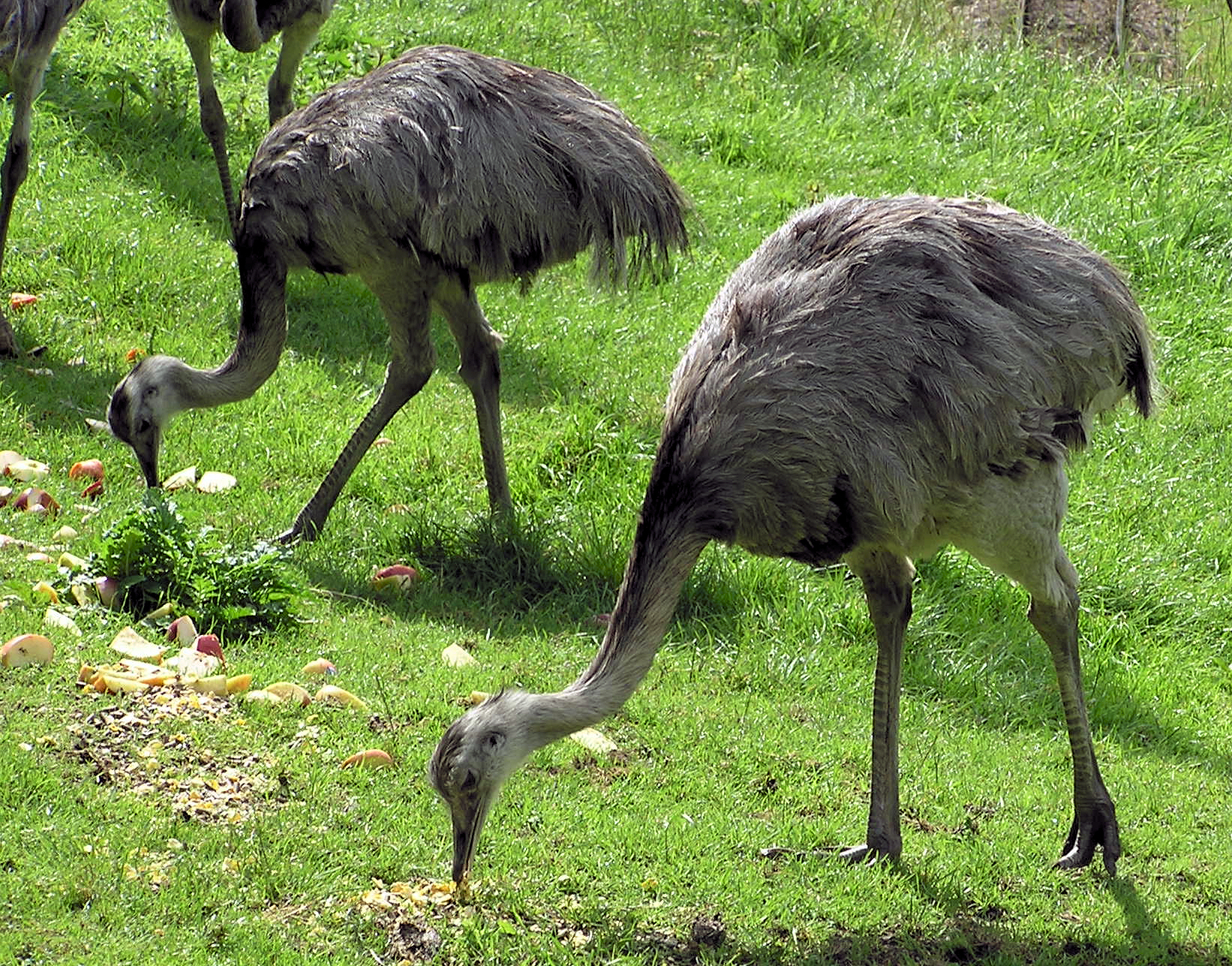
Rheidae is a family of large, flightless ratite birds endemic to South America, consisting of two extant species: the greater rhea (Rhea americana) and the lesser rhea (Rhea pennata). These birds are characterized by their tall stature, long necks and legs, greyish-brown plumage, and reduced wings ending in a claw, adaptations that enable them to run at speeds up to 60 km/h across open terrain.[1][2][3]
The Rheidae family belongs to the order Struthioniformes, which encompasses other flightless birds such as ostriches, emus, and cassowaries, distinguished by their flat sternum lacking a keel for flight muscles.[2][4] Both species exhibit sexual dimorphism, with males larger and more brightly colored during breeding; the greater rhea reaches heights of 1.5–1.7 m and weights of 20–40 kg, while the lesser rhea is smaller at 0.9–1 m tall and 15–28.6 kg.[1][3] Their three-toed feet and powerful legs facilitate swift evasion of predators like pumas and foxes, and they possess fused adrenal glands, a unique trait among birds.[4]
Rheas inhabit diverse open landscapes across the continent, with the greater rhea favoring lowland grasslands, savannas, and shrublands from sea level to 1,500 m in countries including Argentina, Bolivia, Brazil, Paraguay, and Uruguay.[2][1] In contrast, the lesser rhea occupies open steppes, shrublands, and deserts from sea level to 4,500 m, with northern subspecies favoring higher elevations (2,000–4,500 m) and the southern subspecies at lower altitudes, ranging from southern Peru through Chile and Argentina to Patagonia, with three subspecies (R. p. pennata, R. p. tarapacensis, and R. p. garleppi).[3] Both species are diurnal and gregarious, forming flocks of 5–30 individuals outside breeding season, often associating with grazing mammals for protection.[1]
Their diet is omnivorous, comprising seeds, fruits, roots, leaves, insects, small vertebrates, and even carrion, with water obtained primarily from vegetation.[1][3] Reproduction is polygynous and seasonal, typically from spring to early summer; males attract multiple females to a nest site, incubate clutches of 13–50 eggs (laid by up to 10 females), and provide sole parental care for the precocial chicks, which can number up to 80 in exceptional cases.[1][4]
Conservation challenges include habitat loss from agriculture and overgrazing, as well as hunting for meat, skins, and eggs; the greater rhea is classified as Near Threatened by the IUCN, with declining populations across its 8.74 million km² range, while the lesser rhea is Least Concern overall but decreasing, with some subspecies like R. p. garleppi critically low (estimated 100–500 individuals).[2][3] Both are listed on CITES Appendix II to regulate international trade.[2] Historically, rheas have served as an economic resource for indigenous communities in the Pampas and Patagonia, providing food, feathers, and oil.[4]
