Hubbry Logo
Ford CustomlineFord CustomlineMain
Open search
Ford Customline
Community hub
Ford Customline
logo
8 pages, 0 posts
0 subscribers
Be the first to start a discussion here.
Ford Customline
Ford Customline
from Wikipedia
Ford Customline
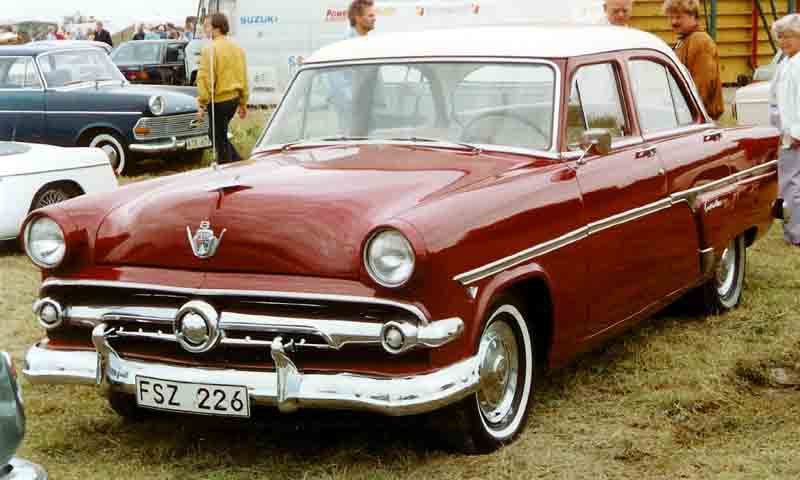
1954 Ford Customline “Fordor” Sedan
Overview
ManufacturerFord
Production1952–1956
AssemblyMain plant
Dearborn, MI[1]
Branch Assembly
Twin Cities, MN
Somerville, MA
Richmond, CA
Norfolk, VA
Memphis, TN
Louisville, KY
Long Beach, CA
Kansas City, MO
Edgewater, NJ
Dallas, TX
Chicago, IL
Chester, PA
Buffalo, NY
Atlanta, GA
Australia[2]
Body and chassis
ClassFull-size
Body styletwo-door sedan
four-door sedan
LayoutFR layout
Chronology
SuccessorFord Custom 300

The Ford Customline is an automobile model that was sold between 1952 and 1956 by Ford in North America.

First generation (1952–1954)

[edit]
First generation: 1952 to 1954
1952 Ford Customline Tudor Sedan
Overview
ManufacturerFord
Production1952–1954
Body and chassis
ClassFull-size
Body style2-door sedan[3]
4-door sedan[3]
2-door coupé[3]
2-door station wagon[3]
4-door station wagon[3]
LayoutFR layout

1952

[edit]

The Ford Customline was introduced in 1952 as the mid-range model in that year’s US Ford range, positioned below the Ford Crestline and above the Ford Mainline.[3] It was offered in 2-door sedan, 4-door sedan, 2-door coupé & 4-door station wagon body styles.[3] The coupe was marketed as the Club Coupe [3] and the station wagon as the Customline Country Sedan.[4] 1952 Customlines were available with 215 cubic inches (3,520 cc) inline six-cylinder or 239 cubic inches (3,920 cc) V8 engines.[3] Production totaled 402,542 units.[3]

1953

[edit]

The 1953 Customlines continued the 1952 bodies with only minor changes.[3] Production totaled 761,662 units.[3]

1954

[edit]

The 1954 Customlines used the 1952-53 bodies with only minor changes.[3] The Customline range now included a new 2-door Ranch Wagon.[5] Engines were now 223 cubic inches (3,650 cc) inline six-cylinder or 239 cubic inches (3,920 cc) overhead valve V8.[3] 1954 Customline production totaled 674,295 units.[3]

Second generation (1955–1956)

[edit]
Second generation: 1955 to 1956
1956 Ford Customline Victoria
Overview
Production1955–1956
Body and chassis
ClassFull-size
Body style2-door sedan[3]
4-door sedan[3]
2-door hardtop coupe[3]
LayoutFR layout

1955

[edit]

The 1955 Customline was redesigned with new longer, lower and wider bodies.[3] It continued as the mid range trim level, now positioned below the new Ford Fairlane and above the Ford Mainline.[3] It was offered in 2-door sedan and 4-door sedan body styles only,[3] with the wagons now included in their own series which comprised the Ford Ranch Wagon, Ford Country Sedan and Ford Country Squire.[3] Customlines were available with 223 cubic inches (3,650 cc) inline six-cylinder or 272 cubic inches (4,460 cc) V8 engines.[3] 1955 Customline production totaled 471,992 units.[3]

1956

[edit]

The 1956 Customlines utilized the 1955 bodies with only minor changes.[3] A Customline Victoria 2-door hardtop was added to the range.[3] 1956 Customline production totaled 368,653 units, and was manufactured in several branch assembly plants the company had continued to operate in the United States.[1][3]

The Customline was not carried over to the 1957 model year.[6]

Australian production

[edit]

The Customline was also produced by Ford Australia from 1952 to 1959.[2] Cars were assembled using Australian built bodies and imported chassis kits which included all front sheet metal.[7] In addition to the Customline sedan, a limited number of station wagons [8] and the Australian developed Mainline Coupe Utility were produced.[7]

The 1952 model was updated in 1953 and 1954 along the lines of the US Fords.[9] All were powered by the Flathead V8 which went into Australian production in 1952.[9] This included the 1954 model which was fitted with the older Chassis and engine rather than the new overhead valve Y-block V8 which had been introduced in the US for 1954. Australian 1954 Fords also used King Pin front suspension and still had 1952 rear Quarter Panels.

The 1955 body was used for four model series in Australia.[10] The 1955 model was powered by the overhead valve Y-block V8 which had entered partial Australian production with locally sourced components.[11] The 1956 model featured the 1956 US Customline grille, 12 volt electrics and a new Fordomatic automatic transmission option.[11] The 1957 model retained the 1956 body but featured a large V8 badge positioned in the grille and utilized 1956 Ford Fairlane trim.[9] The 1958 model used the 1955 Canadian Meteor grille with a four-pointed star and 1956 Meteor side trim.[9] The 1958 ‘star model’ was badged as either a Customline or as a Fordomatic [11][12] Production ended in September 1959 with the introduction of Australian assembled 1959 Fairlane 500, Custom 300 and Ranch Wagon models.[10] An estimated 18,000 examples of the 1955-1959 sedan were produced.[13]

See also

[edit]

References

[edit]
Revisions and contributorsEdit on WikipediaRead on Wikipedia
from Grokipedia
The Ford Customline was a full-size automobile produced by the in the United States from 1952 to 1956, serving as the intermediate trim level between the entry-level Mainline and the upscale Crestline (replaced by the Fairlane in 1955). Introduced as part of a completely reskinned lineup that succeeded the 1949–1951 Fords, the Customline featured modern styling elements such as a one-piece curved , sculptured rear quarter panels with simulated air intakes, and construction on a 115-inch . Available in various body styles including four-door sedans (Tudor and Fordor), two-door club s, convertible , and Sedans (two- or four-door wagons), the Customline emphasized practicality and optional luxury features like , power brakes, and automatic transmissions. For 1952 and 1953, it was powered by a 215-cubic-inch overhead-valve inline-six producing 101 horsepower or a 239-cubic-inch flathead V8 delivering 110 horsepower, both paired with a standard three-speed and optional overdrive or Ford-O-Matic automatic. In 1954, Ford introduced the new Y-block overhead-valve V8 (239 cubic inches, 130 horsepower) alongside an updated 223-cubic-inch inline-six (115 horsepower), with design refinements including a full-width grille, ball-joint front suspension, and the debut of the Crestline featuring a plexiglass roof insert. The 1955 model year brought a major restyling with a slightly longer 115.5-inch , more angular lines, and the replacement of the Crestline series by the Fairlane, positioning the Customline below it; options expanded to include a 272-cubic-inch Y-block V8 (173 horsepower). For 1956, further updates under Ford's "Lifeguard Design" initiative included a redesigned grille, wraparound lamps, a 12-volt electrical system, tubeless tires, and safety enhancements like recessed steering columns, with power ranging from 137 horsepower in the standard 223-cubic-inch six to 173 horsepower in the optional 272-cubic-inch V8. Production of the Customline ceased after 1956 as Ford shifted to the all-new four-door hardtop-focused lineup for , though the name was briefly revived in other markets; these models remain popular among collectors for their role in Ford's evolution and strong parts availability today.

Overview

Development and introduction

The development of the Ford Customline emerged from Ford Motor Company's efforts to build on the success of its groundbreaking 1949 models, which sold over one million units in their debut year and outperformed Chevrolet by introducing the first major postwar American car design six months ahead of its rival. This achievement prompted Ford to undertake a comprehensive redesign for 1952, aiming to sustain its competitive edge amid intensifying rivalry from and in the full-size segment. Under the stylistic oversight of George W. Walker, who had led the 1949 design as an external consultant and continued influencing Ford's aesthetics, the project emphasized modernized features to appeal to a broadening postwar consumer base. Key milestones in the Customline's development included the adoption of a curved, one-piece wraparound , a first for Ford passenger cars, which enhanced visibility and contributed to a sleeker profile compared to the flat glass of prior models. Prototypes also featured a slightly extended of 115 inches, up from 114 inches on the 1949 platform, allowing for improved interior space and ride comfort while maintaining the overall "Shoebox" envelope styling philosophy. These changes were tested extensively in 1951, reflecting Ford's focus on balancing innovation with proven reliability to address feedback from the 1949-1951 sales run of approximately three million units. The Customline debuted as part of the lineup in late 1951, with public unveilings at major auto shows including the in January 1952, where it garnered attention for its refreshed appearance. Initial production commenced at Ford's primary U.S. facilities, such as the River Rouge complex in , with output ramping up to meet anticipated demand from family-oriented buyers seeking value between basic and premium offerings. Positioned as the mid-tier model in the hierarchy—above the economy-focused Mainline and below the upscale Crestline—the Customline was engineered to capture the growing middle-class family market by offering enhanced trim and features at an accessible price point.

Market positioning

The Ford Customline occupied the mid-level position in Ford's full-size car hierarchy from 1952 to 1956, positioned above the entry-level Mainline and below the premium Crestline through 1954 and the Fairlane from 1955 onward. This placement targeted buyers desiring enhanced features like additional chrome trim and optional V8 power over the basic Mainline, while avoiding the higher costs and luxuries of top-tier models. With a 1952 base price of around $1,700 to $1,800, the Customline delivered accessible pricing for middle-class families, combining practical comfort and modern amenities without entering luxury territory. The Customline directly competed with mid-range rivals such as the and , where Ford leveraged its early adoption of the Y-block overhead-valve V8 in as a key differentiator, providing superior performance options a year before Chevrolet and Plymouth introduced comparable V8 engines. Aimed at urban and suburban consumers seeking stylish, reliable transportation for family use without , the Customline resonated strongly, achieving total North American production of approximately 2.7 million units across its run, including standout figures like 674,295 units in 1954.

Design and features

Body styles and trim levels

The Ford Customline was available in several body configurations designed for passenger comfort and versatility, including two-door club coupes, two-door Tudor sedans, four-door Fordor sedans, and four-door Sedan station wagons, accommodating five to six passengers in sedans and up to six in wagons. In 1954, a two-door Ranch Wagon variant was added to the Customline lineup, providing additional cargo space while maintaining the model's mid-range positioning. By 1955–1956, the lineup evolved to include a two-door Victoria alongside the sedans and Sedan wagon, with station wagons like the Ranch offering six-passenger capacity and the wood-trimmed reserved for higher trims. As the mid-level trim in Ford's —positioned above the basic Mainline and below the upscale Crestline or Fairlane—the Customline featured distinctive chrome accents such as horizontal bright trim on the rear quarters from onward and a single straight side molding in later years, setting it apart from the chrome-free Mainline. Standard equipment included bright hubcaps and moderate interior appointments like two sun visors and four armrests, with optional upgrades encompassing whitewall tires, a continental spare tire kit mounted externally on the rear, , AM radio, heater, and power accessories such as and brakes. Interiors emphasized family-oriented comfort with sofa-style bench seating across front and rear, incorporating Automatic Posture Control mechanisms and foam rubber cushions for enhanced support on non-sag springs, allowing expansive room for six occupants. The provided full , featuring a central with surrounding gauges in 1955's Astra-Dial panel and a hooded, round-dial arrangement in 1956, complemented by integrated heater controls and optional clock or signal-seek radio. Upholstery options included durable cloth or vinyl in coordinated colors, with vivid hues introduced in 1954 for a more upscale feel. For safety and added comfort, the 1956 Customline introduced Ford's Lifeguard Design package as standard, including recessed steering posts, deep-dish wheels, improved door latches, and shatter-resistant mirrors, with optional padded dashboard, sun visors, and lap belts; earlier models relied on basic structural reinforcements without these dedicated features. These elements, paired with optional continental kits and whitewall tires, enhanced the Customline's appeal as a practical yet stylish mid-century family vehicle.

Styling evolution

The Ford Customline debuted in with a characterized by boxy fenders, sculptured rear quarter panels featuring aircraft-inspired simulated air intakes, and a prominent grille centered around a stylized motif flanked by three-blade lamps. This styling was a reskinning of the groundbreaking platform, maintaining its three-box proportions but incorporating a longer 115-inch for improved proportions and interior space. Mid-cycle facelifts refined the Customline's appearance without major overhauls. For , to commemorate Ford's 50th anniversary, the grille was updated to a full-width bar design with a central bullet, four black stripes on each side, and rectangular parking lamps in the lower outboard corners, paired with added horizontal chrome trim on the rear quarters. In , the grille adopted a more intricate full-width opening with an egg-crate pattern around the central bullet and end-mounted parking lamps, complemented by an optional and redesigned chrome side trim for enhanced visual distinction. The second-generation Customline, introduced in 1955, marked a significant redesign toward a more aerodynamic profile, featuring a lower roofline, wraparound panoramic for improved visibility and modernity, and swept-back "Thunderbird"-inspired taillights integrated into subtle tailfins. These changes emphasized a sleeker, jet-age aesthetic while retaining core body structures from the prior generation. In 1956, styling updates focused on subtle enhancements, including a self-framing grille with wraparound parking lamp housings and a widened rectangular , an optional continental spare tire kit mounted externally on the trunk for a luxurious touch, and chrome side spears that accentuated the body's contours. These modifications maintained the 1955's aerodynamic lines while adding period-specific flair.

Powertrain

Engines

The Ford Customline was equipped with a range of inline-six and V8 engines across its production run, emphasizing reliability and optional performance for mid-range family sedans and coupes. The base powerplant was an overhead-valve (OHV) straight-six, while V8 options provided greater power for buyers seeking acceleration advantages. These engines were designed for durability in daily use, with displacements scaled to balance output and typical of early American automobiles. The inline-six engines evolved from the initial 215 cu in (3.5 L) unit introduced in 1952, which delivered 101 hp at 3,900 rpm and 185 lb-ft of torque, featuring an OHV design for improved breathing over prior side-valve configurations. By 1953, it retained the 215 cu in displacement but saw minor tuning for consistent output. In 1954, Ford upgraded to the 223 cu in (3.7 L) "Mileage Maker" variant, producing 115 hp at 3,900 rpm and emphasizing enhanced low-end torque for better highway merging, with a of 7.5:1. This engine carried over into 1955-1956 with progressive refinements, reaching 120 hp in 1955 and 137 hp by 1956 through improved carburetion and , all while maintaining a focus on longevity with robust cast-iron construction. V8 power came first from the 239 cu in (3.9 L) flathead (side-valve) engine in 1952-1953, rated at 110 hp at 3,800 rpm with 190 lb-ft of , a carryover from prior Ford designs known for its simplicity and adequate performance in heavier vehicles. For , Ford shifted to the all-new OHV Y-block V8, retaining the 239 cu in displacement but boosting output to 130 hp at 4,200 rpm and 213 lb-ft of via a higher 7.2:1 and modern valve train. In , the Y-block grew to 272 cu in (4.5 L) for 1955-1956, starting at 162 hp (two-barrel ) in 1955 and increasing to 173 hp by 1956, with climbing to 260 lb-ft; an optional 292 cu in (4.8 L) Y-block V8 was also available, producing 193 hp in 1955 (primarily for police/higher trims) and 200–202 hp in 1956, with approximately 280 lb-ft of for enhanced performance. This displacement increase allowed for smoother power delivery and optional high-performance tuning up to 182 hp in select 272 configurations. Performance metrics for Customline models varied by and transmission pairing, with inline-six versions achieving 0-60 mph in approximately 15-18 seconds and top speeds around 90 mph, suitable for era-standard . V8-equipped models improved to 12-14 seconds for 0-60 mph, offering noticeable passing power on two-lane roads, as tested in period reviews. Fuel economy ranged from 15-20 in mixed driving, with the Mileage Maker six favoring the higher end due to its efficient OHV design and lighter weight compared to V8 variants. The engine lineup's evolution highlighted Ford's transition to OHV architecture, beginning with the inline-six in 1952 for better and culminating in the Y-block V8's debut in , which prioritized durability through deep-skirted blocks and five main bearings while enabling higher revs and over the outgoing flathead. This shift improved overall drivability and set the stage for future Ford V8 developments, with the engines tuned for optional pairings with manual or automatic transmissions.

Transmissions and drivetrain

The Ford Customline utilized a layout throughout its production run, paired with a live suspension system for reliable power delivery and handling characteristics typical of mid-1950s American full-size sedans. The standard final drive was typically 3.9:1 in manual configurations, providing a balance of and fuel economy, while automatic-equipped models often featured a 3.3:1 for smoother highway cruising. This setup contributed to the Customline's straightforward design, emphasizing durability on the vehicle's 115- to 115.5-inch . Manual transmissions were standard across all model years, consisting of a three-speed unit with column-mounted shift lever for ease of use in daily driving. An optional overdrive unit, engaging at speeds above 45 mph, improved efficiency by reducing RPM and enhancing economy without compromising low-speed performance. Automatic transmission options began with the introduction of the Ford-O-Matic three-speed unit in , offering seamless shifts and reduced driver effort compared to the manual. By 1954, this system was enhanced with a dual-range feature, allowing selection between standard and low-range modes for better control in varied conditions such as city traffic or light . The 1955 retained the Ford-O-Matic, with refinements for smoother operation and compatibility with the updated Y-block V8 engines. Key innovations in the included optional , introduced in 1952 via Ford's Master-Guide system, which used hydraulic assistance to lighten steering effort on the Customline's wide track and long , particularly beneficial for parking and low-speed maneuvers. Power brakes became available as an option starting in 1954, employing a vacuum booster to improve stopping power and modulation on the standard 11-inch setup, enhancing overall safety and driver confidence.

North American production

First generation (1952–1954)

The first generation Ford Customline was assembled at Ford manufacturing facilities across the and , mirroring U.S. designs in Canadian production to serve North American markets. Total output for the model from 1952 to 1954 exceeded 1.8 million units, with the 1953 marking the production peak at 761,662 vehicles overall, including a high of 374,487 four-door sedans. Launched in 1952 as Ford's mid-level full-size sedan and lineup, the Customline featured a standard 215.3-cubic-inch overhead-valve inline-six rated at 101 horsepower, paired with an optional 239-cubic-inch flathead V8 producing 110 horsepower. Production reached 402,542 units that year, establishing the Customline as a strong seller in the post-war economy with its modern "flight-style" interior and robust build. Early models encountered minor steering-related issues addressed through service bulletins, though no widespread formal was issued. The 1953 Customline carried over the 1952 body with minimal revisions, including special 50th-anniversary badging to honor Ford Motor Company's founding and an updated dashboard for improved . The inline-six remained at 215 cubic inches producing 101 horsepower, while the flathead V8 continued at 239 cubic inches delivering 110 horsepower, contributing to higher V8 take rates as buyers sought enhanced performance. Overall production climbed to its zenith, reflecting sustained demand before the impending redesign. For 1954, the Customline retained the prior platform but introduced Ford's innovative Y-block overhead-valve V8—a 239-cubic-inch unit delivering 130 horsepower—as an option alongside the refined 223-cubic-inch six at 115 horsepower. Exterior updates were subtle, featuring taller front fenders and a revised grille with a central spinner motif flanked by circular parking lamps, enhancing the model's visual appeal without major retooling. Sales moderated to 674,295 units amid intensifying competition and market saturation after three years of the , though the new bolstered its position in the mid-price segment.

Second generation (1955–1956)

The second generation of the Ford Customline, produced from 1955 to 1956, introduced a completely redesigned platform on a new 115.5-inch shared with the Fairlane, marking a significant shift from the previous model's architecture. Overall production for the generation reached 840,645 units across both model years, with the 1955 output at 471,992 vehicles, reflecting strong initial demand for the refreshed lineup. This platform emphasized improved ride quality through independent front suspension and a longer , positioning the Customline as an intermediate trim level between the base Mainline and upscale Fairlane. For 1955, the Customline underwent major restyling inspired by the Thunderbird, featuring a wraparound windshield for enhanced visibility, forward-leaning headlamp pods, and modest tailfins that added a sporty flair to the rear design. Body styles included two- and four-door sedans and wagons, with the optional V8 including the 272 cubic-inch Y-block producing 162 horsepower, and the larger 292 cubic-inch version at 200 horsepower available starting mid-year, while the Fairlane received the larger 292 cubic-inch version at 200 horsepower. Standard power came from a 223 cubic-inch inline-six rated at 120 horsepower, paired with a three-speed manual transmission, though overdrive was available. In , updates focused on refining the existing body with a chrome-heavy grille, revised turn signals integrated into the taillamps, and a flatter roofline on sedans to modernize the . Standard equipment expanded to include features like dual sun visors and armrests on all , with optional safety additions such as backup lights contributing to the " Design" theme. V8-equipped Customline models, particularly the two-door Victoria , totaled 33,130 units amid an economic recovery that boosted overall auto sales, with production for the year at 368,653 as buyers shifted toward higher-trim options. The generation faced stiff competition from Chevrolet's innovative small-block V8, which offered superior performance and efficiency in road tests, contributing to Ford finishing second in overall U.S. sales rankings for the period behind only Chevrolet, with Plymouth third. Despite robust initial sales in 1955, where Ford nearly matched Chevrolet's volume at 1.765 million units, the Customline's positioning struggled against ' aggressive pricing and engine advancements, leading to a decline in by 1956.

Australian production

Local assembly and adaptations (1952–1956)

Australian production of the Ford Customline commenced in 1952 at Ford Australia's plant in Victoria, where the vehicles were assembled using imported completely knocked down (CKD) chassis kits—primarily sourced from —and locally fabricated bodies to comply with local content requirements and reduce import costs. This assembly process enabled Ford to adapt the model efficiently for the right-hand drive market while leveraging the Geelong facility's capacity for body stamping and painting, resulting in annual production volumes in the thousands to meet growing domestic demand. For the initial 1952–1954 models, key adaptations focused on enhancing suitability for Australian conditions, including the introduction of a locally manufactured 239 from 1952 to replace imported powerplants, full right-hand drive conversions, and reinforced components such as suspension and cooling systems to improve on unsealed rural roads and in harsh environments. These modifications addressed the challenges of Australia's diverse terrain and climate, distinguishing the local Customline from its left-hand drive North American counterparts while maintaining core design influences from U.S. styling evolution. The emphasis on ruggedness made the Customline particularly appealing for family use in regional areas, where reliability under load was paramount. The introduction of the Mainline utility (ute) variant in 1952, a two-door coupe-style pickup derived from the sedan platform, catered to Australia's strong demand for versatile work vehicles in farming and trade sectors. The 1955–1956 models incorporated further updates aligned with Canadian specifications for right-hand drive markets, featuring a panoramic wraparound for improved visibility and the local assembly of the to boost accessibility and reduce reliance on imports. These enhancements refined the model's comfort and practicality without major deviations from the established platform. In the Australian market, the Customline positioned as an upper-mid-level trim option for families seeking spacious, powerful sedans or utilities, commanding a premium price over competitors due to lingering import duties on CKD components despite local assembly. were significantly propelled by the V8 engine's for and , appealing to buyers preferring American-style power over smaller six-cylinder rivals like the , and helping Ford capture a substantial share of the mid-1950s segment.

Extended production and variants (1957–1959)

In , Ford extended production of the Customline beyond the North American timeline, utilizing the established 1956 body shell through 1959 to minimize costs associated with annual U.S. styling updates while incorporating local adaptations for market needs. This approach allowed for high local content—reaching up to 85%—including right-hand drive configurations and modifications suited to Australian fuel quality and rural driving conditions. The 272 cubic inch (4.5 L) overhead-valve Y-block , introduced in 1955 and producing 145–165 horsepower (varied by year and detuning for local fuel), remained standard throughout, paired with either a three-speed or the optional Fordomatic automatic. For the 1957 , the Customline retained the 1956 sedan body but featured distinctive updates such as Fairlane-style chrome side trim, polished chrome headlight rims, and a prominent V8 badge integrated into the grille, enhancing its visual appeal without major structural changes. Body styles included the four-door sedan and the Australian-developed Mainline coupe , the latter incorporating a 1956 Fairlane Victoria-style bonnet for improved load-carrying capacity in applications. Special-purpose variants, such as police and ambulance models, were also produced in limited numbers, occasionally fitted with larger 292 (4.8 L) or 312 (5.1 L) V8 engines for enhanced performance. These adaptations emphasized practicality, with the variant particularly valued for its robust design in agricultural and transport roles. The 1958 and 1959 models, known locally as the "Star" variants, further evolved the design by blending elements from Canadian Ford Meteor models to create essentially unique Australian offerings. Key features included a 1955 Meteor grille with a prominent four-pointed star emblem, complemented by 1956 Meteor Rideau side trim moldings and a bespoke Australian dashboard layout for improved ergonomics. Available in sedan and Mainline utility forms, these years maintained the same powertrain options but introduced minor refinements like updated badging to distinguish manual Customline from Fordomatic-equipped versions. An estimated 18,000 sedans were produced from 1955 to 1959, contributing to overall Australian Customline output exceeding 20,000 units (including utilities) from 1952 to 1959. Manufacture ceased in September 1959 at Ford Australia's Geelong plant, supplanted by locally assembled 1959 U.S. Fairlane 500, Custom 300, and Ranch Wagon models.

References

Add your contribution
Related Hubs
User Avatar
No comments yet.