Hubbry Logo
Fordson E83WFordson E83WMain
Open search
Fordson E83W
Community hub
Fordson E83W
logo
8 pages, 0 posts
0 subscribers
Be the first to start a discussion here.
Fordson E83W
Fordson E83W
from Wikipedia
Fordson E83W
Overview
ManufacturerFord
Also called
  • Ford Ten-Ten (Australia)[1]
  • Fordson 10 cwt[1]
  • Thames 10 cwt[1]
  • Thames ½-Ton[1]
Production1938–1957
AssemblyEngland: Dagenham, East London
Body and chassis
Body style
Powertrain
Engine1.2 L sv I4
Transmission3-speed manual
Dimensions
Wheelbase78 in (1,981 mm)
Length157.5 in (4,000 mm)
Width64 in (1,626 mm)
Curb weight890–1,600 kg (1,962–3,527 lb)
Chronology
PredecessorFord Pilot V8 pickup & van
SuccessorFord Thames 400E

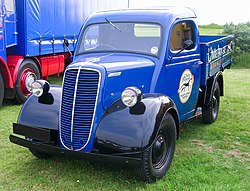
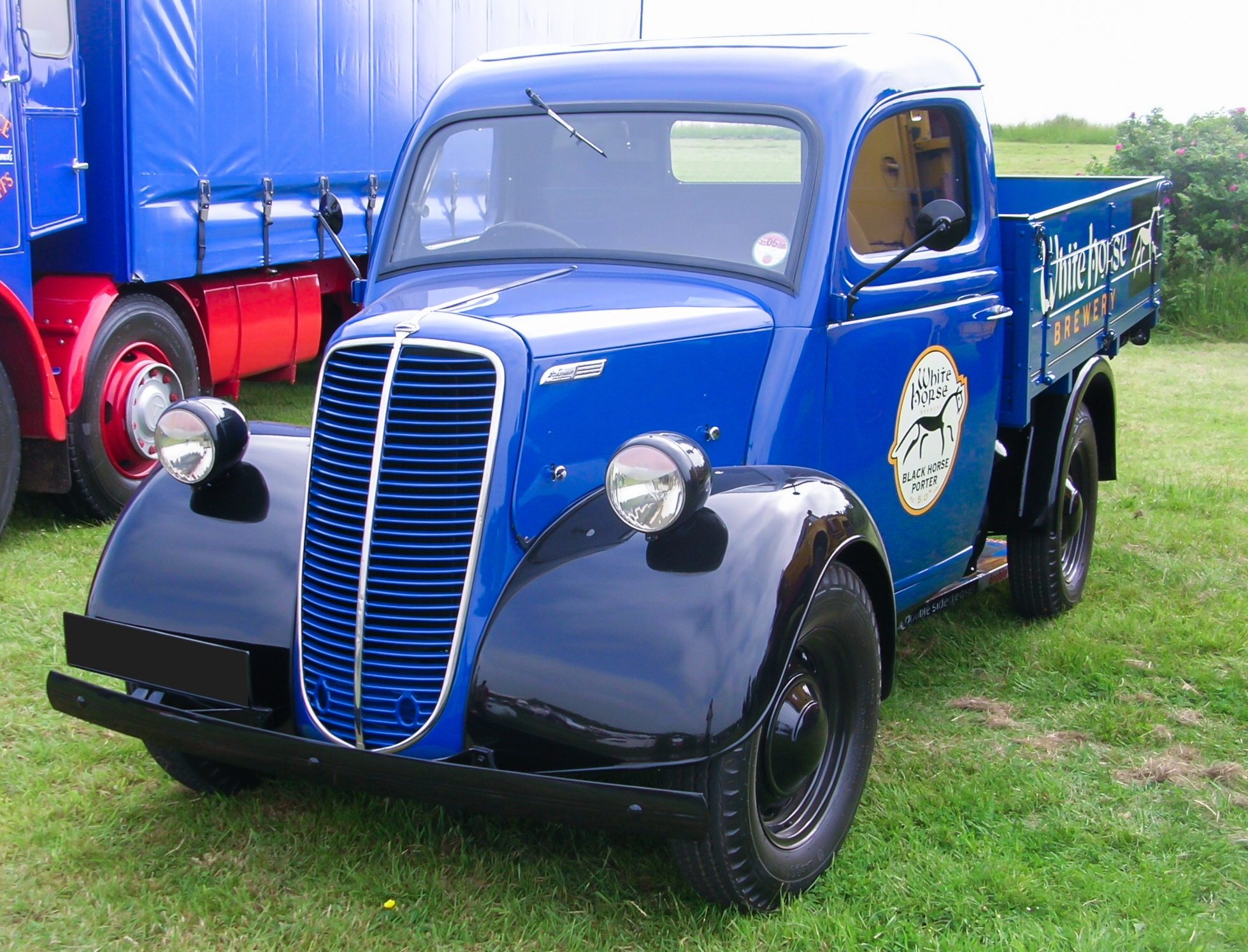
The Fordson E83W (also sold from 1952 under the Thames brand[3] as Thames E83W) is a 10 cwt (half ton) light commercial vehicle that was built by Ford of Britain at the Ford Dagenham assembly plant (home of Fordson tractors) between 1938 and 1957. The van was sold in Australia as the Ford Ten-Ten, and the E83W was available in various forms around much of the world as Britain strove to export after World War II. In some countries, the 'cowl and chassis' only was imported and local bodies built.

The E83W was aimed at the small haulage, trade and merchant market, sectors in which it sold well. An estate car variant was also available.[2] During and after World War II, many specialist variations such as mobile canteens, ice cream vans and even fire pumps were built on the E83W chassis. An estate variant was also marketed but did not find much success. Its main competitor was the Bedford HC and JC models produced by General Motors' UK commercial subsidiary.

The E83W was powered by the 1,172 cc (71.5 cu in) Ford 10 hp side-valve engine, producing 30 bhp (22 kW), with a 3-speed gearbox, and was heavily geared down in the rear axle. This made the Fordson much slower than the saloons, with an effective top speed of not much over 40 mph (64 km/h). Apart from the "ten" hp engine, the E83W shares few parts with the other small Fords, which does make spares a little harder to get hold of. The front and rear axles are much heavier than the saloon and 5cwt van components, and share some parts such as bearings and other internals with the contemporary Ford V8 models (Models 62 and E71A Pilot). The headlamps were shared with the E27N tractor, for which they were an optional extra only.

References

[edit]
Revisions and contributorsEdit on WikipediaRead on Wikipedia
from Grokipedia
The Fordson E83W is a light commercial vehicle introduced by Ford of Britain in March 1938 as a 10 cwt (half-ton) van and pickup, featuring a semi-forward control chassis with a 1,172 cc side-valve four-cylinder engine producing 30 bhp, a three-speed gearbox, and low gearing for heavy load capacity, which remained largely unchanged over its 19-year production run at the Dagenham plant. Initially badged as the Fordson E83W—where "E" denotes English production, "8" the introduction year, and "3" the 10 hp rating—it was renamed the Thames E83W in 1952 to align with Ford's branding, with over 188,000 units built by September 1957, making it one of the longest-produced small Fords. The model was constructed with a wooden and metal body by Motor Bodies on a ladder-frame , offering a of around 10 cwt and a top speed of approximately 40-50 mph due to its heavy rear-axle gearing optimized for urban deliveries and trade use. Widely used in the for small haulage, grocer's vans, butcher's deliveries, and mobile services, the E83W saw extensive export, including as the "Ten-Ten" in , with local bodywork adaptations in some markets; production continued uninterrupted through for military and civilian needs. Variants included standard vans, pickups (such as the rare sidestep model), estate cars seating up to seven, ambulances, fire tenders, mobile canteens, and vans, all sharing the same reliable derived from Ford's passenger car components for cost-effective . Notable features encompassed a single vacuum-windshield wiper, optional and water pump, and transverse leaf-spring suspension, contributing to its reputation for durability despite leisurely performance and minimal updates over the years. Many examples survive today, often restored for rallies and historic vehicle events, reflecting its enduring legacy in British commercial motoring history.

History

Development and launch

The Fordson E83W originated as a derived from the Ford Model Y (also known as the Ford Ten) passenger car platform, with adaptations for utility purposes including a new and bodywork while retaining the , parts of the gearbox, and from the Model Y. Developed by the engineering team at Ford of Britain's plant, the design incorporated influences from American Ford vehicles, particularly in its semi-forward control layout to optimize load space. The bodywork was crafted by Briggs Motor Bodies, emphasizing practicality for small-scale haulage and trade use. Launched in March 1938, the E83W was positioned as a 10 cwt (half-ton) vehicle directly competing with established rivals like and Morris light commercials. The basic van model was priced at £168, making it an accessible option for merchants and small businesses seeking reliable delivery capabilities. It featured a side-valve derived from the Model Y for straightforward operation. Early promotional materials, including detailed brochures, highlighted the E83W's versatility in configurations such as vans and pickups, underscoring its role in everyday commerce.

Production and wartime role

The Fordson E83W entered production at Ford's assembly plant in March 1938, serving as a key light in Britain's automotive output. Manufacturing continued uninterrupted through the early war years, contributing to the plant's overall production of 360,000 vehicles during , before concluding in September 1957 with a total exceeding 188,000 E83W units built. The facility faced significant disruptions from bombing raids during , which affected industrial sites including the Ford works, with major attacks beginning on 7 September 1940. Despite this, production persisted under wartime austerity conditions, with the entire plant camouflaged using netting and paint to obscure it from , and the workforce expanded to include women for the first time to sustain output amid labor shortages. The E83W proved valuable in its wartime role as a general for the British , supporting , services, and command operations through conversions such as mobile canteens, fire tenders, and emergency food vans funded by Ford executives Henry and . These adaptations highlighted its versatility on the and in support of Allied efforts, with the vehicle's simple chassis enabling rapid body modifications for diverse operational needs. Following the liberation of in 1945, E83W models were exported to Allied forces and civilian markets in regions including and , aiding post-war reconstruction and economic recovery in countries such as , , and .

Post-war evolution

Following the end of , the Fordson E83W continued production with minimal alterations to its pre-war design, focusing primarily on meeting civilian demand amid economic recovery. In 1952, the model was rebadged as the Thames E83W as part of Ford's strategy to unify its branding under the Thames name, which had been introduced earlier for heavier trucks. This change aligned the E83W with Ford's broader lineup of light commercials, though the vehicle's core mechanical layout remained unchanged. Incremental updates were introduced in the late 1940s and 1950s to enhance usability, including refinements to the electrical system for better reliability in commercial applications. These modifications addressed minor wear issues from wartime use without overhauling the or , allowing Ford to sustain production efficiently. petrol , which persisted until May 1950, limited civilian acquisitions, while broader material shortages under food and goods —ending fully with meat in July 1954—constrained sales and output until economic normalization. By the 1950s, the E83W faced intensifying competition from more modern rivals like the van, introduced in 1952 with updated styling and construction, leading to a gradual decline in production volumes. Annual output, which had peaked during wartime mobilization, fell as buyers shifted to these newer designs offering better and comfort. Overall production totaled approximately 188,000 units across its lifespan, with the majority built post-1945—roughly 50,000 in the 1940s and over 100,000 in the before tapering off—reflecting the model's enduring but waning role in the light commercial sector. Manufacturing at Ford's plant concluded in September 1957, with some exports continuing into 1958, as the E83W was phased out in favor of the more contemporary Thames 400E series. This marked the end of nearly two decades of the model's dominance in Britain's small market, overshadowed by advancing automotive standards.

and

Chassis and mechanical components

The Fordson E83W featured a robust ladder-frame constructed from two deep I-section main members, braced by five substantial cross-members, designed specifically for a 10 cwt capacity. This frame adopted an offset layout unique to the model, with a compact of 7 ft 6 in to enhance maneuverability while supporting commercial loads. Suspension was provided by transverse leaf springs at both the front and rear, paired with beam axles for durability under heavy use, and damped by large double-acting Armstrong shock absorbers to manage road irregularities. The track measured 4 ft 2.5 in at and 4 ft 6 in at the rear, contributing to stable handling. Power was transmitted through a 3-speed manual gearbox, initially non-synchromesh but updated with synchromesh between second and top gears in later models like the version; overall gear ratios were optimized for low-speed at 20.98:1 in first, 12.06:1 in second, and 6.83:1 in top, with a final drive ratio of 6.83:1 and a torque tube incorporating rods for driveline support. Braking relied on Girling mechanical drum brakes with 11 in diameter drums on all four wheels, operated by cables, while the acted only on the rear wheels. employed a high-geared manual system, achieving a turning circle of 36 ft for practical urban operation. The 's offset design facilitated secure mounting on the nearside for right-hand-drive configurations.

Engine and performance

The Fordson E83W featured a 1,172 cc inline-four side-valve , designated the Ford 10 hp unit, which delivered 30 at 4,000 rpm and 46.4 lb-ft of at 2,400 rpm. This powertrain, derived from the saloon but adapted for commercial use with heavier gearing, prioritized low-end delivery over outright speed, suiting the vehicle's role in urban and short-haul delivery. The side-valve cylinder head design enhanced the engine's simplicity and reduced production costs, facilitating reliable operation in demanding work environments. Fuel was supplied via a basic system, with the 7-gallon tank enabling a practical range. The engine achieved fuel consumption of 25-30 under typical loaded conditions, providing an estimated range of 175-210 miles per fill. Performance emphasized utility rather than velocity, with a top speed of approximately 40 mph and 0-30 mph acceleration in 15.2 seconds through the gears. Cooling relied on a water-based circulation system, while lubrication employed a splash method, with an offered as an optional extra to extend component life.

Body configurations

The Fordson E83W was offered in several factory body configurations designed to meet diverse commercial needs, with the serving as the most common variant. This enclosed body featured a capacity of 120 cubic feet, accessed via double rear doors for efficient loading and unloading, and included optional seating for up to two alongside the driver. The van's design emphasized practicality for urban delivery, integrating seamlessly with the vehicle's 10 cwt payload capacity on the . A variant was also available from the factory, providing an open load bed with drop sides to facilitate easy access for goods handling, along with options for a cover to protect cargo from the elements. This configuration appealed to tradesmen requiring flexibility for carrying tools, materials, or . The chassis-cab model, supplied without a rear body, allowed for extensive aftermarket customization, including conversions to specialized vehicles such as ambulances, fire engines, and milk floats by third-party coachbuilders. Overall dimensions for the E83W were compact for its era, measuring 13 feet 1.5 inches in length, 5 feet 4 inches in width, and with height varying by body type—typically around 5 feet 6 inches for the standard panel van to maintain a low center of gravity. The payload integration with the chassis ensured balanced weight distribution across all configurations. Body construction utilized steel panels mounted over a wooden frame, a cost-effective method that provided durability but was prone to corrosion in humid climates due to moisture trapping between materials.

Variants and models

Civilian variants

The Fordson E83W served as the primary civilian light commercial vehicle in its standard 10 cwt van and pickup configurations, offering a practical half-ton payload for urban and rural delivery tasks throughout its production run from 1938 to 1957. These core models featured a simple, durable design with wood-and-metal bodywork, making them ideal for small businesses and trades in the UK and Commonwealth markets, where right-hand drive was standard. Exports expanded the E83W's reach, with right-hand drive versions for Commonwealth markets including Australia—where it was marketed as the Ford Ten-Ten—and left-hand drive adaptations for other international markets such as South Africa, supporting post-war economic recovery efforts through vehicle shipments. These export models often included minor specification tweaks, such as badging variations, to suit local conditions while maintaining the base 10 cwt capacity. Approximately 188,000 units were produced at Ford's Dagenham plant, with civilian demand peaking in the immediate post-war years as commercial fleets rebuilt. Special builds catered to niche commercial needs, notably the Utilecon estate conversion by Martin Walter Ltd. of , , which transformed the E83W into a versatile personnel or general service van with rear access doors, suitable for tradesmen, ambulances, and mobile services. This four-door variant emphasized practicality for carrying workers or equipment, though it remained a low-volume offering compared to standard vans. Aftermarket conversions were widespread, particularly bodies added to create enclosed spaces for removal firms and trades, extending the vehicle's beyond factory options without altering the core . These modifications, often performed by local coachbuilders, highlighted the E83W's adaptability in civilian applications like delivery and maintenance work.

Military adaptations

The Fordson WOT (War Office Truck) series was a range of military trucks produced by from 1939 to 1945 to meet , , and requirements for light to medium vehicles. These trucks were equipped with a 3,621 cc V8 side-valve engine producing approximately 85 , along with reinforced , military-grade tires, and specialized bodywork for wartime duties, with over 130,000 units built across variants. The WOT1 was configured as a 15 cwt van, often fitted with a for inflation in RAF Balloon Command operations, while the WOT2 functioned as a 15 cwt pickup or flatbed, equipped with optional winches for recovery tasks and available in sub-variants like the WOT2H for operations. Some later WOT models, such as the WOT6 and WOT8, featured 4x4 drivetrains with a longer and forward-control cabs for enhanced off-road capability in rough terrain. Specialized conversions included radio trucks for the Royal Corps of Signals, with the WOT2H variant serving as a mobile command post equipped with communication arrays for coordinating and air defense units. These vehicles supported field radio stations, enabling real-time signals relay in forward areas, and were integral to RAF deployments for early warning against incursions. Armored command vehicle adaptations involved plating select WOT chassis for protected headquarters roles, though such modifications were limited to prototype or small-batch conversions for high-risk environments. The series' versatility extended to , , and airfield fire tender configurations, underscoring its role as a multi-purpose platform. Exports to Commonwealth forces included local assembly variants, such as the Australian WOT2D 15 cwt 4x2 , produced to British specifications for Pacific theater and restored examples of which survive in museum collections. Canadian forces utilized WOT trucks through supplies, integrating them into combined operations without extensive local modifications. In WWII campaigns, WOT vehicles were pivotal in North African supply chains, where they supported and troop movements amid Rommel's advances. During the invasion and subsequent liberation of Europe in 1944, WOT2 pickups transported personnel and prisoners, including German POWs near , supporting Allied from beachheads to inland advances. Following in 1945, thousands of surplus WOT vehicles flooded the market through auctions, influencing commercial trucking with their durable V8 engines and off-road features in some variants; many were repurposed for and light haulage until the . Wartime production peaked at around 130,000 units, with nearly half being WOT2 models that transitioned seamlessly into peacetime use.

Usage and legacy

Commercial applications

The Fordson E83W, later rebadged as the Thames E83W, served primarily as a for urban delivery tasks in the , where its compact size and 10 cwt payload capacity made it ideal for navigating narrow streets and frequent stops. It was commonly employed by local businesses such as butchers, grocers, and dairy suppliers for distributing goods like , , and , with examples including W & J Palmer's conversions in during the 1950s. Postal services also utilized the model extensively; many units were supplied to the General Post Office (GPO) for mail and parcel delivery, particularly during and after , reflecting its reliability in essential logistics roles. In agricultural settings, the E83W functioned as a versatile farm , often configured as a pickup or flatbed for hauling produce, equipment, and feed. Notable applications included pig swill recovery operations and towing trailers for sales, such as those by Gray’s in during the mid-1950s, which supported rural distribution networks. Its robust allowed adaptation for light haulage on uneven terrain, though operators frequently encountered issues like overheating and fuel vaporization in demanding conditions, necessitating regular maintenance such as bonnet removal for cooling. Export markets extended the E83W's reach, with widespread adoption in British colonies and nations for light haulage into the 1960s. It was distributed to regions including , , and , where local bodybuilders often fitted chassis for specific needs like produce transport, while received it as the Ten-Ten model. Specialist variants, such as mobile canteens operated by organizations like the and , further highlighted its adaptability in post-war recovery efforts across these territories.

Cultural and preservation significance

The Fordson E83W has appeared in numerous British films and period dramas, reflecting its ubiquity in post-war society. Notable examples include the 1955 Ealing comedy The Ladykillers, where a customized gown van version features prominently, as well as 1950s productions such as Keep It Clean (1956), The Strange Case of Blondie (1954), and Overhaul (1957). In later works, it provided period authenticity in the 2002 drama Evelyn, set in and starring , who drove an example during filming. These appearances underscore the vehicle's role as an iconic symbol of mid-20th-century British working life. Preservation efforts have sustained a reasonable number of Fordson E83W examples, many restored to original specifications by dedicated enthusiasts. The E83W Owners Club authenticates surviving vehicles and fosters community through resources and events, while an international register unites owners worldwide. Annual rallies, such as the Old Ford Rally, showcase restored models and highlight the vehicle's enduring appeal among collectors. Its long production run from 1938 to 1957 ensured widespread availability, aiding modern preservation. Surviving examples are featured in museums, including a 1954 van at , representing a Northern newspaper fleet vehicle, and an variant at York Castle Museum. Today, restored Fordson E83W vehicles participate in heritage events and serve as camera cars or props to maintain historical accuracy in film and television productions depicting Britain.

References

Add your contribution
Related Hubs
User Avatar
No comments yet.