Hubbry Logo
Living creatures (Bible)Living creatures (Bible)Main
Open search
Living creatures (Bible)
Community hub
Living creatures (Bible)
logo
8 pages, 0 posts
0 subscribers
Be the first to start a discussion here.
Living creatures (Bible)
from Wikipedia
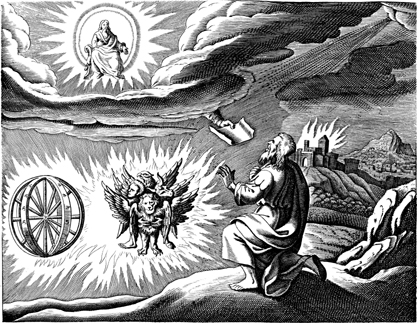
Ezekiel's "chariot vision", by Matthaeus Merian (1593–1650)
Ezekiel's Wheel
Ezekiel's encounter with the Merkabah and the Living Creatures

The living creatures, living beings, or chayyoth (Hebrew: חַיּוֹת, romanizedḥayyōṯ) are a class of heavenly beings in Judaism. They are described in the prophet Ezekiel's vision of the heavenly chariot in the first and tenth chapters of the Book of Ezekiel. References to the sacred creatures recur in texts of Second Temple Judaism, in rabbinical merkabah ("chariot") literature, in the Book of Revelation in the Christian New Testament, and in the Zohar.

According to Jewish and Christian traditions, there are four living creatures, although their description varies by source. The symbolic depiction of the four living creatures in religious art, especially Christian art, is called a tetramorph.

Ezekiel's four living creatures

[edit]

Ezekiel's vision of the four living creatures in Ezekiel 1 are identified as cherubim in Ezekiel 10,[1] who are God's throne bearers.[2] Cherubim as minor guardian deities[3] of temple or palace thresholds are known throughout the Ancient East. In Ezekiel 1, each of Ezekiel's cherubim have four faces, that of a man, a lion, an ox, and an eagle.[2] In Ezekiel 10:14, they have the face of a cherub, the face of a man, the face of a lion, and the face of an eagle.[4] However, the fact that they manifest in human form sets them apart from the griffin-like cherubs and lamassu of Babylonia and Assyria. Concerning their ability to move, Ezekiel's cherubim do not need to turn, since they face all compass points simultaneously.[1] This description of movement differs from that of the seraphim in Isaiah's vision (Isaiah 6:2) who have an extra set of wings, giving them the ability to fly.[5]

Revelation's four living beings

[edit]

In the New Testament book of Revelation 4:6–8, four living beings (Greek: ζῷον, zōion)[6] are seen in John's vision. These appear as a lion, an ox, a man, and an eagle, much as in Ezekiel but in a different order. They have six wings, whereas Ezekiel's four living creatures are described as having four.[6] In verse 6, they are said to have "eyes all over, front and back", suggesting that they are alert and knowledgeable, that nothing escapes their notice.[6] The description parallels the wheels that are beside the living creatures in Ezekiel 1:18; 10:12, which are said to be "full of eyes all around". The Hebrew word for "wheel" (ôpannîm) was also used in later Jewish literature to indicate a member of the angelic orders (1 Enoch 71:7; 3 Enoch 1:8; 7:1; 25:5–6, etc.).

Comparing the living creatures in Ezekiel with Revelation's is a prominent apocalyptic study in Western Christianity.[7] An example is the 18th-century works of Jonathan Edwards' recorded interpretation of 1722/23.[8] The four living creatures that John of Patmos sees in the Book of Revelation is the author's reworking of the living creatures in the visions of Ezekiel (Ezekiel 1:5–28)[9] and Isaiah (Isaiah 6:2).[10]

William D. Mounce noted a belief that the living creatures may have been associated with the four principal (or fixed) signs of the zodiac (Taurus, Leo, Scorpio, and Aquarius),[6][9] but other scholars have doubted this interpretation.[quote 1]

In a critical analysis of John's vision, April De Conick's 2006 essay outlines that the hayyot in Ezekiel are perhaps not original with the author of Revelation. De Conick suggests that John may have drawn from other merkabah-related texts and by subtly working with images already known to his audience, he reshaped them for his own purposes.[11] With John blending and transforming the images of his sources, it has given way to different interpretations.[9]

Religious views

[edit]
The living creatures as depicted in the Book of Kells. In Christianity, they are commonly associated with the Four Evangelists.
The four firmament bearers depicted in Qazvin's book Aja'ib al-Makhluqat or The Wonders of Creatures and the Marvels of Creation (13th century).

In Judaism, the living beings are considered angels of fire, who hold up the throne of God.[12] According to the Zohar, they hold up the firmament itself.[12][13] They are ranked first in Maimonides' Jewish angelic hierarchy. They have also been correlated with four archangels: Michael is the "lion-headed", Raphael the "human-headed", Uriel the "bull-headed", and Gabriel the "eagle-headed".[14]

In Christianity, the four living creatures are Cherubim.[3] A prominent early interpretation, variously modified by different interpreters, has been to equate the four creatures with the Four Evangelists. Throughout church history, the most common interpretation (first laid out by Victorinus), but not the original or the only, is that the lion represents Mark, the calf Luke, the man Matthew, and the eagle John. Irenaeus was the first to make the association with the evangelists, but the interpretation laid out by Victorinus and adopted by Jerome, Gregory the Great, and the Book of Kells became dominant.[15] Its influence has been on art and sculpture[10] and is still prevalent in Catholicism[16] and Anglicanism.[17] A view held by many modern commentators is that the four living creatures of Revelation are agents of God and heavenly representatives of the created order, who call every living thing to worship the Creator.[18]

A traditional view is that the four faces (Revelation 4:6-8) refer to the many aspects (or attributes) of Jesus Christ as depicted in the four Gospels.

The Man

The man represents Jesus as the Son of Man, symbolizing His humanity, vulnerability, and compassion. This face is often associated with Jesus' role as the Son of Man, who came to seek and save the lost. The man is also a symbol of wisdom, understanding, and empathy.

The Ox

The ox represents Jesus as the Obedient Servant, symbolizing His humility, submission, and willingness to serve. This face is often associated with Jesus' role as the Servant of the Lord, who came to serve and give His life as a ransom for many. The ox is also a symbol of strength, endurance, and sacrifice.

The Lion

The lion represents Jesus as the Lion of Judah, symbolizing His power, strength, and royalty. This face is often associated with Jesus' role as the Messiah, the King of Kings, and the one who will judge the world. The lion is also a symbol of courage, bravery, and protection.

The Eagle

The eagle represents Jesus as the Son of God, symbolizing His divinity, majesty, and power. This face is often associated with Jesus' role as the Son of God, who came to reveal the Father's love and glory. The eagle is also a symbol of freedom, strength, and vision.

These four faces of Jesus are not mutually exclusive, but rather complementary, reflecting the multifaceted nature of Jesus' character and ministry. Each face represents a different aspect of His personality, role, and mission, and together they form a complete picture of who Jesus is and what He has done for us.

Another view found in a popular Greek Orthodox Catechism, is that the living creatures represent four covenants given to mankind. The lion represents the Noahic covenant in the sign of the rainbow, the ox represents the Abrahamic covenant of circumcision, the man represents Moses giving the law, and the eagle represents the new covenant Gospel of Christ.[19]

Secular views

[edit]

It has been proposed that the phenomena described in Ezekiel were halos caused by ice crystals in the atmosphere, such as sun dogs.[20]

See also

[edit]

Quotes

[edit]
  1. ^ Smalley 2012, p. 120: "It is most unlikely that the four living creatures are to be identified with either the four constellations of stars (cf. Charles 1, 123), or the four principal signs of the zodiac (cf. Mounce 124 n. 26)."

Notes

[edit]

References

[edit]
[edit]
Revisions and contributorsEdit on WikipediaRead on Wikipedia
from Grokipedia
In the Bible, the living creatures refer to four exalted heavenly beings that appear in the prophetic visions of and the apocalyptic scenes of , often identified as a special class of cherubim serving in God's presence. These beings are depicted with multiple faces representing aspects of creation—a , a , an (or calf), and an eagle—along with wings and numerous eyes, symbolizing divine and mobility in executing God's will. They function as throne guardians and worshipers, ceaselessly praising God's holiness and sovereignty. The first biblical account occurs in Ezekiel 1:4-28, where the prophet, during his exile in around 593 BCE, beholds these creatures emerging from a stormy amid a radiant divine , each with four faces, four wings, and human-like hands, accompanied by interlocking wheels covered in eyes that move in any direction without turning. later identifies them explicitly as cherubim in chapter 10, emphasizing their role in bearing God's glory and presence during judgments on . In the , 4:6-11 and 5:6-14 parallel this imagery, with the apostle John describing the creatures surrounding the heavenly , each having six wings and full of eyes front and back, continually chanting "Holy, holy, holy" and attributing worth to the Lamb. These visions underscore themes of divine transcendence, the integration of creation in , and the creatures' intermediary position between God and the cosmos. Interpretations across Jewish and Christian traditions view the living creatures as emblematic of the highest orders of earthly life—humanity, wild beasts, domesticated animals, and birds—unified in adoration of the Creator, while their multifaceted forms highlight God's comprehensive over all things. Their Hebrew designation, chayyot (from the root meaning "to live"), evokes and eternal life in the divine realm. Though their exact nature remains mysterious, they consistently portray the awe-inspiring reality of heavenly worship and the inseparability of God's from the animated creation.

Biblical Descriptions

In Ezekiel

The prophet Ezekiel, a priest exiled to Babylon following the Babylonian conquest of Jerusalem in 597 BCE, received his initial prophetic visions during his captivity by the Chebar canal, spanning approximately 593 to 571 BCE. These visions, recorded in the Book of Ezekiel, emphasized God's sovereignty and mobility beyond the confines of the Jerusalem temple, particularly amid the Judahite exile. The first major vision, detailed in Ezekiel 1:4-28, emerges from a stormy northern wind, portraying a divine manifestation that underscores Yahweh's transcendent presence. In this vision, four living creatures appear from the midst of the and , each bearing four faces—those of a , a , an , and an eagle—and four wings extended to touch one another while covering their bodies. Their forms resemble humans in overall structure, with human-like hands beneath the wings, straight legs ending in feet like those of a calf, and a gleaming appearance like burnished . These beings are surrounded by interlocking wheels, known as , which are as tall as the creatures themselves, constructed of what appeared to be , and covered entirely with eyes, enabling omnidirectional movement without turning. The creatures and wheels propel forward in harmony with the Spirit of God, their motion swift as flashing , and their form radiant like burning coals or torches. These living creatures form the base of a divine throne-chariot, or merkabah, with a vaulted expanse like awesome crystal above them and a sapphire-like atop that, upon which sits a figure resembling a man enveloped in fire and brightness like a . The Spirit animates their synchronized movements, reflecting the divine will, as the entire assembly ascends and descends at its direction. A subsequent vision in Ezekiel 10:1-22 relocates these beings to the entrance of the temple, explicitly identifying them as stationed beneath the divine . Here, their four faces are described variably as those of a , a , a , and an eagle, with bodies, hands, backs, and wings—along with the accompanying wheels—covered in eyes. recognizes them as the same entities from his initial vision by the Chebar, affirming their role as bearers of God's presence even as judgment unfolds upon the temple.

In Revelation

In the Book of , the four living creatures appear prominently in the apostle John's visionary depiction of the heavenly , first introduced in chapter 4. Positioned around God's amid a sea of like , these beings are described as full of eyes in front and behind, symbolizing all-seeing vigilance, with each resembling one of four distinct forms: the first like a , the second like an , the third having a face like a man, and the fourth like a flying eagle. Each creature possesses six wings and is covered with eyes all around, even under the wings, emphasizing their ceaseless awareness and mobility in the . These engage in perpetual , declaring day and night without rest: "Holy, holy, holy, Lord God Almighty, who was and is and is to come!" They also lead the in hymns of praise, casting their crowns before the throne and affirming God's worthiness as creator of all things. In chapter 5, they join the elders and myriads of angels in adoring the Lamb—symbolizing Jesus Christ—proclaiming redemption through his blood and ascribing power, wealth, wisdom, strength, honor, glory, and blessing to both the Lamb and the One on the throne. This imagery echoes the foundational vision of cherubim in , adapting motifs to the New Testament's eschatological framework. Throughout John's visions, the living creatures fulfill key roles in heavenly and apocalyptic events. They summon the four horsemen of judgment in , each crying "Come!" to unleash , , , and death upon the earth. Later, in , they hand the seven angels golden bowls filled with the wrath of God, initiating the final plagues. They continue leading worship in subsequent scenes, falling down before the throne with the elders in Revelation 7:11 to praise God for salvation; singing a new song before the throne, the four living creatures, and the elders in :3; and joining the multitude in acclaiming God's reign in Revelation 19:4. The visions recorded in were received by John during his exile on the island of , likely around 95 CE under the Roman emperor , amid persecution of early Christians. These revelations portray the living creatures as integral to scenes of divine sovereignty, emphasizing themes of on and the ultimate victory of and the Lamb over cosmic powers.

Comparison Between Ezekiel and Revelation

The depictions of the four living creatures in Ezekiel and Revelation share notable similarities while exhibiting distinct differences. Both portray the creatures as hybrid beings featuring the four faces of a human, lion, ox, and eagle, covered with eyes to symbolize omniscience or vigilance. They are connected to divine mobility and presence, with wheels enabling movement in Ezekiel and a central position around the throne in Revelation, evoking awe and underscoring God's sovereignty over creation. Key differences include the number of wings—four per creature in Ezekiel versus six in Revelation. In Ezekiel, each creature bears all four faces, whereas in Revelation, each embodies one primary form corresponding to the faces. Ezekiel explicitly identifies them as cherubim linked to judgment and the departure of God's glory from the temple, while Revelation emphasizes their role in eternal worship without such labeling. Additionally, eyes in Ezekiel adorn the wheels and bodies, but in Revelation, they cover the creatures themselves, including front, back, and under the wings.

Attributes and Symbolism

Physical Characteristics

The living creatures described in the visions of and share several core physical traits, establishing a consistent yet portrayal across the two texts. In , each creature has four faces: those of a , a , an , and an eagle. In , the four creatures are described respectively as like a , an , a , and an eagle. In both accounts, the creatures exhibit a humanoid form integrated with animalistic elements, standing upright on straight legs that terminate in calf-like feet, though specifies these feet sparkle like burnished . Their bodies are covered in eyes, symbolizing vigilance, with emphasizing that the creatures are "covered with eyes, in front and in back" and even "under [their] wings," while notes eyes primarily on the surrounding wheels associated with them. Wings form another unifying feature, enabling swift, multidirectional movement without turning, though the number differs: Ezekiel depicts each creature with four wings, two of which touch those of adjacent creatures and two that cover their bodies, while ascribes six wings to each, also covered with eyes. further details human-like hands under the wings on all four sides, facilitating their form's hybrid nature. The creatures' overall appearance evokes fiery brilliance; in , they resemble "burning coals of fire or like torches," with flashing among them and their motion akin to lightning flashes, whereas focuses more on their encircling position around the without explicit fire. Distinct elements in highlight mobility tied to divine conveyance: the creatures are accompanied by interlocking wheels of beryl-like gleam, full of eyes, that move in unison with them, rising from the ground and sparkling like under an expansive vault. Sensory details include the sound of their wings, likened to "many waters" or the tumult of an when in motion, ceasing when they stand. In contrast, portrays the creatures in a static, throne-centered arrangement amid a sea of , with their physical form underscoring ceaseless activity through wing-covered eyes but without wheeled or auditory specifics beyond their . These descriptions collectively convey an otherworldly, radiant presence evoking the glory of the divine.

Symbolic Meanings

The four faces of the living creatures described in Ezekiel 1:10 and Revelation 4:7—, , , and eagle—carry profound symbolic weight, representing the breadth of creation and divine attributes. The face symbolizes intelligence and reason, reflecting humanity's unique capacity for understanding and relational communion with . The face denotes nobility and strength, evoking royal power and the majestic authority inherent in God's . The face signifies service and domesticity, embodying diligent labor, , and the steadfastness of domesticated creation under divine order. The eagle face represents and aspiration, illustrating swiftness, transcendence, and the lofty perspective of spiritual elevation toward the divine. Collectively, these faces illustrate the fullness of creation, encompassing intellect, wild ferocity, tame utility, and aerial freedom, thereby underscoring God's comprehensive over all life forms. The motifs of wings and eyes further amplify the creatures' symbolic role in conveying God's dynamic presence and . Each creature possesses four wings in Ezekiel's vision (Ezekiel 1:6), symbolizing swift obedience and the mobility of divine will, enabling the immediate execution of heavenly purposes across creation. In , six wings per creature (Revelation 4:8) enhance this imagery, suggesting heightened readiness for worship and service. The abundance of eyes—covering the creatures front and back, and even their wings—represents all-seeing providence and boundless knowledge, indicating God's vigilant awareness over every aspect of existence without limitation. Theologically, the living creatures embody cherubim as guardians of the divine , a role rooted in their appearances flanking God's chariot-throne in and 10, and encircling the heavenly in 4. This guardianship highlights their function in upholding divine holiness and mediating the awe-inspiring presence of . The integration of animal and human forms in a single being signifies God's unchallenged dominion over all categories of life, merging the terrestrial and celestial to affirm the unity of creation under His rule. Ezekiel's vision occurs in the context of the Babylonian exile and impending temple destruction, emphasizing God's mobility and presence beyond Jerusalem. Revelation, composed amid Roman persecution, draws on Ezekiel to symbolize heavenly victory and worship. In early patristic thought, these symbols were developed into the tetramorph concept, linking the four faces to the evangelists: the human to Matthew (emphasizing Christ's humanity), the to Mark (his royal proclamation), the ox to Luke (priestly sacrifice), and the eagle to John (divine eternity), as articulated by in Against Heresies (Book III, Chapter 11). This association underscores broader divine attributes: intelligence (human), strength (lion), service (ox), and swiftness (eagle).

Interpretations

Jewish Perspectives

In , the living creatures described in 's vision are frequently identified with the cherubim that guarded the in the , serving as bearers of the divine throne and symbols of God's protective presence. The in Hagigah 13b elaborates on their four faces—human, , ox, and eagle—as representing the pinnacle of creation: the human as the most exalted being, the as king of wild beasts, the ox as king of domesticated animals, and the eagle as king of birds. This passage also recounts how the prophet sought mercy for these beings, transforming them into cherubim to mitigate potential accusations of in their multifaceted forms. Midrashic interpretations further symbolize these faces as divine attributes, associating the human face with the patriarchs (such as Abraham for kindness, for judgment, for harmony, and for endurance) or with the four seasons to signify God's dominion over time and nature. Within , as discussed in the Talmudic tractate Hagigah, these creatures form the foundational elements of the divine chariot (merkabah), central to esoteric visions of heavenly ascent and restricted study due to their overwhelming intensity. Kabbalistic texts expand this framework, portraying the living creatures in the as manifestations of the —the ten divine emanations—particularly the four lower of (kindness, the man), (strength, the lion), (beauty, the ox), and Malchut (kingship, the eagle), which together form the "chariots" supporting the divine structure. In , a corpus of early Jewish mystical writings, the creatures play a pivotal role in ascension rituals, where mystics encounter them as fiery guardians near God's throne, reciting hymns and navigating perilous heavenly palaces to achieve union with the divine. The imagery of the living creatures permeates Jewish liturgy, evoking the awe of God's throne in communal worship. The Kedushah prayer, recited during the and other services, directly echoes the ("holy, holy, holy") proclaimed by these beings in and , inviting congregants to emulate angelic praise and affirm God's transcendent holiness. In art, particularly in ancient and medieval contexts like the Bet Alpha synagogue mosaics or later European painted synagogues and mahzorim, depictions of cherubim or composite creatures symbolize divine guardianship, often integrated into ark decorations or wall motifs to reinforce the liturgical atmosphere without violating aniconic principles. Modern Jewish scholarship interprets the living creatures through the lens of , emphasizing their role in conveying God's abstract sovereignty while steering clear of anthropomorphic literalism. Yehezkel Kaufmann, in his seminal work The Religion of Israel, argues that such visions reflect 's innovative break from pagan mythologies, where composite beings underscore a non-corporeal divine reality focused on moral and covenantal themes rather than idolatrous forms. This historical-critical approach highlights how the creatures symbolize the integration of cosmic order under , influencing contemporary understandings that prioritize theological abstraction over mystical speculation.

Christian Perspectives

In early , the four living creatures described in and 4 were interpreted by patristic writers as symbolic representations of the four Gospels and their authors. of Lyons (c. 130–202 AD) was among the first to connect the creatures' faces—, , man, and eagle—to the evangelists, viewing them as embodying Christ's multifaceted nature: the for regal power (Mark), the for sacrificial service (Luke), the man for (Matthew), and the eagle for divine ascent (John). This association emphasized the unity and completeness of the canonical Gospels against heretical alternatives. (c. 347–420 AD) formalized these symbols in his writings, assigning the man to Matthew's focus on Christ's humanity, the to Mark's portrayal of triumph, the to Luke's emphasis on priestly , and the eagle to John's soaring theological vision, influencing subsequent illuminations and liturgical art. Augustine of Hippo (354–430 AD) built on this tradition in De consensu evangelistarum, interpreting the creatures as prefiguring the evangelists' complementary testimonies to Christ's life, thereby underscoring scriptural harmony and divine inspiration. During the medieval period, these patristic links evolved into doctrinal applications, with theologians like (1225–1274) viewing the — the unified image of the four creatures—as emblematic of the Church's universal mission, integrating human reason (man), strength (lion), labor (ox), and contemplation (eagle) in service to God. This symbolism permeated monastic and cathedral art, such as the 12th-century Hortus deliciarum, where the creatures encircled Christ's throne to signify ecclesiastical order. In the Reformation era, like (1483–1546) approached with caution, deeming it less central to doctrine than the Gospels, yet he acknowledged the living creatures' role in depicting heavenly worship as a model for earthly praise of God's sovereignty. This perspective reinforced the creatures' function as leaders in cosmic , inspiring Reformed traditions to view them as emblems of creation's submission to the Word. Catholic and Eastern Orthodox traditions emphasize the creatures' integral role in the heavenly liturgy, where they perpetually intone the ("Holy God, holy Mighty, holy Immortal") alongside the , mirroring the Eucharistic worship on earth. In Orthodox iconography, the often adorns depictions of the divine , as in 16th-century frescoes, symbolizing the seraphim's proximity to and the Church's participation in eternal praise; some traditions equate them with cherubim as throne guardians. Catholic post-Vatican II theology, as articulated in documents like Sacrosanctum Concilium (1963), extends this to liturgical renewal, portraying the creatures as icons of unified heavenly-earthly that fosters ecclesial communion. Contemporary across denominations interprets the living creatures as archetypes of creation's , representing diverse realms—wild animals (), domesticated beasts (), humanity (man), and birds (eagle)—in harmonious of the Creator. This view supports ecumenical unity by illustrating how fragmented Christian traditions, like the creatures' varied forms, converge in adoration of Christ, as highlighted in reflections on Revelation's visionary inclusivity. In , post-Vatican II Catholic teaching, such as Pope Francis's Laudato Si' (2015), draws on biblical imagery of creation's , including themes echoed in the creatures' ceaseless , to advocate care for , viewing all living things as called to glorify God amid ecological crises. Protestant eco-theologians similarly invoke them to underscore humanity's priestly duty over creation, promoting sustainable practices as participation in heavenly .

Scholarly and Cultural Analysis

Secular Interpretations

Secular scholars approach the living creatures described in and through , viewing them as key apocalyptic motifs that heighten narrative tension by portraying divine encounters as surreal and overwhelming spectacles of cosmic power. In 's vision, these hybrid beings—combining human, leonine, bovine, and avian features—serve to underscore the prophet's and the inscrutability of the divine realm, transforming a personal into a broader eschatological framework that anticipates restoration amid crisis. Similarly, in , the creatures amplify the text's dramatic structure, encircling the to emphasize themes of perpetual and , drawing on established conventions of Jewish to evoke urgency and inevitability. A highlights the significance of the number four, which in ancient Hebrew symbolizes completeness and totality, often representing the four cardinal directions, winds, or cosmic quadrants that encompass the . This quadripartite form of thus functions not merely as descriptive detail but as a to convey wholeness and divine sovereignty over creation, integrating disparate animal forms to mirror the ordered chaos of and redemption. Such patterning aligns with broader Near Eastern literary traditions where numerical symmetry reinforces symbolic unity, as seen in Ezekiel's adaptation of these elements to affirm Yahweh's transcendence despite Babylonian dominance. Historically, the imagery of the living creatures reflects influences from Babylonian and Assyrian iconography encountered by during the Judean in the BCE. Scholars identify parallels with the , monumental guardian figures at palace and temple entrances, depicted as winged hybrids with human heads, bovine or leonine bodies, and avian elements, intended to protect against chaos and evil. likely reinterpreted these motifs to subvert imperial symbolism, transforming foreign protective deities into attendants of the Israelite God, thereby asserting cultural resilience and theological adaptation in a context of displacement. This synthesis is evident in the prophet's residence near Babylonian scribal centers, where exposure to art and cosmology shaped his visionary language without direct appropriation. From a psychological perspective, interpreted the living creatures as manifestations of archetypes from the , embodying the quaternity—a structural of the psyche representing the integrated self through the union of opposites like human rationality and animal instinct. In his analysis of Ezekiel's visions, Jung saw these beings as projections of the divine shadow, symbolizing the terror and wholeness of the God-image that confronts the individual with the totality of existence, bridging conscious and unconscious realms in a process akin to . This view positions the creatures not as literal entities but as symbolic expressions of inner psychic dynamics, particularly resonant in times of cultural upheaval like . Recent 21st-century scholarship has addressed interpretive gaps by exploring gender-neutral and postcolonial dimensions of the living creatures. For example, E. Ortega's 2016 dissertation on postcolonial approaches to the examines motifs in , including the living creatures, in diaspora contexts, highlighting their role in negotiating identity through gendered language and fluid representations that challenge binary norms and imperial hierarchies without fixed gender markers. These analyses underscore the creatures' enduring relevance in deconstructing power dynamics in ancient texts.

Influences in Art and Literature

The , representing the four living creatures from and , emerged as a central motif in early , symbolizing the Evangelists and divine omniscience. In , , the 5th-century mosaics of the depict the lion, ox, man, and eagle emerging from stylized clouds against an indigo starry sky, executed primarily in gold tesserae to evoke the heavenly throne room. These images, part of World Heritage sites, influenced subsequent Byzantine and Western by integrating the creatures into architectural schemes that blended imperial and sacred themes. In the , Dürer's woodcut series (1498) vividly portrayed scenes from , including the four living creatures surrounding the throne and summoning the horsemen with thunderous voices, capturing the biblical drama through dynamic composition and intricate detailing. This series, comprising 15 prints, popularized the creatures in Northern European art, emphasizing their role in eschatological visions amid the era's fascination with . Literary depictions drew directly from the biblical accounts, adapting the creatures as emblems of celestial order. In Dante Alighieri's Divine Comedy (c. 1320), the four beasts appear in Purgatorio Canto 29 as part of a triumphal procession escorting the divine chariot through the Earthly Paradise, each bearing evangelical symbols—the lion for Mark's royal Christ, the ox for Luke's sacrificial aspect, the man for Matthew's incarnation, and the eagle for John's divinity—highlighting their metapoetic role in the poem's structure. John Milton's Paradise Lost (1667) reimagines cherubim, aligned with the living creatures' watchful nature, as armed guardians posted at Eden's eastern gate post-Fall, their flaming swords enforcing divine expulsion and evoking Ezekiel's multi-faced beings. In 20th- and 21st-century media, the creatures have inspired adaptations in film, fantasy, video games, and comics, often as harbingers of cosmic or moral reckoning. Ingmar Bergman's The Seventh Seal (1957) employs Revelation-inspired apocalyptic symbolism, with Death's chess game against a knight amid plague-ravaged landscapes echoing the creatures' summons of judgment seals, underscoring themes of faith and futility. J.R.R. Tolkien's The Lord of the Rings (1954–1955) incorporates biblical motifs through majestic avian and leonine figures, such as the Eagles of Manwë symbolizing transcendent intervention, paralleling the tetramorph's eagle and lion as agents of providence in a created world. In video games, Heaven: The Game (announced 2023) features the four living creatures as interactive elements in a Revelation-based narrative, allowing players to explore their worship around the throne. Comics like Al Feldstein's Weird Fantasy series (1950s) and modern titles such as Hellboy (1993–present) adapt the multi-eyed, hybrid forms as eldritch guardians or apocalyptic entities, blending horror with scriptural imagery. Beyond religious contexts, the creatures' symbolism permeates and , evoking over creation. The from the features prominently in British , as in the royal since the 12th century, signifying regal strength derived from biblical Judah's "lion's whelp" (Genesis 49:9), paired with the unicorn to represent unified realms. In , contemporary works like those inspired by the Ravenna mosaics use the to symbolize , portraying the creatures as interconnected facets of God's creation to advocate for ecological preservation amid climate challenges.

References

Add your contribution
Related Hubs
User Avatar
No comments yet.