Hubbry Logo
G-structure on a manifoldG-structure on a manifoldMain
Open search
G-structure on a manifold
Community hub
G-structure on a manifold
logo
7 pages, 0 posts
0 subscribers
Be the first to start a discussion here.
G-structure on a manifold
from Wikipedia

In differential geometry, a G-structure on an n-manifold M, for a given structure group[1] G, is a principal G-subbundle of the tangent frame bundle FM (or GL(M)) of M.

The notion of G-structures includes various classical structures that can be defined on manifolds, which in some cases are tensor fields. For example, for the orthogonal group, an O(n)-structure defines a Riemannian metric, and for the special linear group an SL(n,R)-structure is the same as a volume form. For the trivial group, an {e}-structure consists of an absolute parallelism of the manifold.

Generalising this idea to arbitrary principal bundles on topological spaces, one can ask if a principal -bundle over a group "comes from" a subgroup of . This is called reduction of the structure group (to ).

Several structures on manifolds, such as a complex structure, a symplectic structure, or a Kähler structure, are G-structures with an additional integrability condition.

Reduction of the structure group

[edit]

One can ask if a principal -bundle over a group "comes from" a subgroup of . This is called reduction of the structure group (to ), and makes sense for any map , which need not be an inclusion map (despite the terminology).

Definition

[edit]

In the following, let be a topological space, topological groups and a group homomorphism .

In terms of concrete bundles

[edit]

Given a principal -bundle over , a reduction of the structure group (from to ) is a -bundle and an isomorphism of the associated bundle to the original bundle.

In terms of classifying spaces

[edit]

Given a map , where is the classifying space for -bundles, a reduction of the structure group is a map and a homotopy .

Properties and examples

[edit]

Reductions of the structure group do not always exist. If they exist, they are usually not essentially unique, since the isomorphism is an important part of the data.

As a concrete example, every even-dimensional real vector space is isomorphic to the underlying real space of a complex vector space: it admits a linear complex structure. A real vector bundle admits an almost complex structure if and only if it is isomorphic to the underlying real bundle of a complex vector bundle. This is then a reduction along the inclusion GL(n,C) → GL(2n,R)

In terms of transition maps, a G-bundle can be reduced if and only if the transition maps can be taken to have values in H. Note that the term reduction is misleading: it suggests that H is a subgroup of G, which is often the case, but need not be (for example for spin structures): it's properly called a lifting.

More abstractly, "G-bundles over X" is a functor[2] in G: Given a Lie group homomorphism HG, one gets a map from H-bundles to G-bundles by inducing (as above). Reduction of the structure group of a G-bundle B is choosing an H-bundle whose image is B.

The inducing map from H-bundles to G-bundles is in general neither onto nor one-to-one, so the structure group cannot always be reduced, and when it can, this reduction need not be unique. For example, not every manifold is orientable, and those that are orientable admit exactly two orientations.

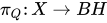
If H is a closed subgroup of G, then there is a natural one-to-one correspondence between reductions of a G-bundle B to H and global sections of the fiber bundle B/H obtained by quotienting B by the right action of H. Specifically, the fibration BB/H is a principal H-bundle over B/H. If σ : XB/H is a section, then the pullback bundle BH = σ−1B is a reduction of B.[3]

G-structures

[edit]

Every vector bundle of dimension has a canonical -bundle, the frame bundle. In particular, every smooth manifold has a canonical vector bundle, the tangent bundle. For a Lie group and a group homomorphism , a -structure is a reduction of the structure group of the frame bundle to .

Examples

[edit]

The following examples are defined for real vector bundles, particularly the tangent bundle of a smooth manifold.

Group homomorphism Group -structure Obstruction
General linear group of positive determinant Orientation Bundle must be orientable
Special linear group Volume form Bundle must be orientable ( is a deformation retract)
Determinant Pseudo-volume form Always possible
Orthogonal group Riemannian metric Always possible ( is the maximal compact subgroup, so the inclusion is a deformation retract)
Indefinite orthogonal group Pseudo-Riemannian metric Topological obstruction[4]
Complex general linear group Almost complex structure Topological obstruction
  • : quaternionic general linear group acting on from the left
  • : group of unit quaternions acting on from the right
Almost quaternionic structure[5] Topological obstruction[5]
General linear group Decomposition as a Whitney sum (direct sum) of sub-bundles of rank and . Topological obstruction

Some -structures are defined in terms of others: Given a Riemannian metric on an oriented manifold, a -structure for the double cover is a spin structure. (Note that the group homomorphism here is not an inclusion.)

Principal bundles

[edit]

Although the theory of principal bundles plays an important role in the study of G-structures, the two notions are different. A G-structure is a principal subbundle of the tangent frame bundle, but the fact that the G-structure bundle consists of tangent frames is regarded as part of the data. For example, consider two Riemannian metrics on Rn. The associated O(n)-structures are isomorphic if and only if the metrics are isometric. But, since Rn is contractible, the underlying O(n)-bundles are always going to be isomorphic as principal bundles because the only bundles over contractible spaces are trivial bundles.

This fundamental difference between the two theories can be captured by giving an additional piece of data on the underlying G-bundle of a G-structure: the solder form. The solder form is what ties the underlying principal bundle of the G-structure to the local geometry of the manifold itself by specifying a canonical isomorphism of the tangent bundle of M to an associated vector bundle. Although the solder form is not a connection form, it can sometimes be regarded as a precursor to one.

In detail, suppose that Q is the principal bundle of a G-structure. If Q is realized as a reduction of the frame bundle of M, then the solder form is given by the pullback of the tautological form of the frame bundle along the inclusion. Abstractly, if one regards Q as a principal bundle independently of its realization as a reduction of the frame bundle, then the solder form consists of a representation ρ of G on Rn and an isomorphism of bundles θ : TMQ ×ρ Rn.

Integrability conditions and flat G-structures

[edit]

Several structures on manifolds, such as a complex structure, a symplectic structure, or a Kähler structure, are G-structures (and thus can be obstructed), but need to satisfy an additional integrability condition. Without the corresponding integrability condition, the structure is instead called an "almost" structure, as in an almost complex structure, an almost symplectic structure, or an almost Kähler structure.

Specifically, a symplectic manifold structure is a stronger concept than a G-structure for the symplectic group. A symplectic structure on a manifold is a 2-form ω on M that is non-degenerate (which is an -structure, or almost symplectic structure), together with the extra condition that dω = 0; this latter is called an integrability condition.

Similarly, foliations correspond to G-structures coming from block matrices, together with integrability conditions so that the Frobenius theorem applies.

A flat G-structure is a G-structure P having a global section (V1,...,Vn) consisting of commuting vector fields. A G-structure is integrable (or locally flat) if it is locally isomorphic to a flat G-structure.

Isomorphism of G-structures

[edit]

The set of diffeomorphisms of M that preserve a G-structure is called the automorphism group of that structure. For an O(n)-structure they are the group of isometries of the Riemannian metric and for an SL(n,R)-structure volume preserving maps.

Let P be a G-structure on a manifold M, and Q a G-structure on a manifold N. Then an isomorphism of the G-structures is a diffeomorphism f : MN such that the pushforward of linear frames f* : FMFN restricts to give a mapping of P into Q. (Note that it is sufficient that Q be contained within the image of f*.) The G-structures P and Q are locally isomorphic if M admits a covering by open sets U and a family of diffeomorphisms fU : Uf(U) ⊂ N such that fU induces an isomorphism of P|UQ|f(U).

An automorphism of a G-structure is an isomorphism of a G-structure P with itself. Automorphisms arise frequently[6] in the study of transformation groups of geometric structures, since many of the important geometric structures on a manifold can be realized as G-structures.

A wide class of equivalence problems can be formulated in the language of G-structures. For example, a pair of Riemannian manifolds are (locally) equivalent if and only if their bundles of orthonormal frames are (locally) isomorphic G-structures. In this view, the general procedure for solving an equivalence problem is to construct a system of invariants for the G-structure which are then sufficient to determine whether a pair of G-structures are locally isomorphic or not.

Connections on G-structures

[edit]

Let Q be a G-structure on M. A principal connection on the principal bundle Q induces a connection on any associated vector bundle: in particular on the tangent bundle. A linear connection ∇ on TM arising in this way is said to be compatible with Q. Connections compatible with Q are also called adapted connections.

Concretely speaking, adapted connections can be understood in terms of a moving frame.[7] Suppose that Vi is a basis of local sections of TM (i.e., a frame on M) which defines a section of Q. Any connection ∇ determines a system of basis-dependent 1-forms ω via

X Vi = ωij(X)Vj

where, as a matrix of 1-forms, ω ∈ Ω1(M)⊗gl(n). An adapted connection is one for which ω takes its values in the Lie algebra g of G.

Torsion of a G-structure

[edit]

Associated to any G-structure is a notion of torsion, related to the torsion of a connection. Note that a given G-structure may admit many different compatible connections which in turn can have different torsions, but in spite of this it is possible to give an independent notion of torsion of the G-structure as follows.[8]

The difference of two adapted connections is a 1-form on M with values in the adjoint bundle AdQ. That is to say, the space AQ of adapted connections is an affine space for Ω1(AdQ).

The torsion of an adapted connection defines a map

to 2-forms with coefficients in TM. This map is linear; its linearization

is called the algebraic torsion map. Given two adapted connections ∇ and ∇′, their torsion tensors T, T∇′ differ by τ(∇−∇′). Therefore, the image of T in coker(τ) is independent from the choice of ∇.

The image of T in coker(τ) for any adapted connection ∇ is called the torsion of the G-structure. A G-structure is said to be torsion-free if its torsion vanishes. This happens precisely when Q admits a torsion-free adapted connection.

Example: Torsion for almost complex structures

[edit]

An example of a G-structure is an almost complex structure, that is, a reduction of a structure group of an even-dimensional manifold to GL(n,C). Such a reduction is uniquely determined by a C-linear endomorphism J ∈ End(TM) such that J2 = −1. In this situation, the torsion can be computed explicitly as follows.

An easy dimension count shows that

,

where Ω2,0(TM) is a space of forms B ∈ Ω2(TM) which satisfy

Therefore, the torsion of an almost complex structure can be considered as an element in Ω2,0(TM). It is easy to check that the torsion of an almost complex structure is equal to its Nijenhuis tensor.

Higher order G-structures

[edit]

Imposing integrability conditions on a particular G-structure (for instance, with the case of a symplectic form) can be dealt with via the process of prolongation. In such cases, the prolonged G-structure cannot be identified with a G-subbundle of the bundle of linear frames. In many cases, however, the prolongation is a principal bundle in its own right, and its structure group can be identified with a subgroup of a higher-order jet group. In which case, it is called a higher order G-structure [Kobayashi]. In general, Cartan's equivalence method applies to such cases.

See also

[edit]

Notes

[edit]

References

[edit]
Revisions and contributorsEdit on WikipediaRead on Wikipedia
from Grokipedia
In , a G-structure on an n-dimensional smooth manifold M is defined as a reduction of the structure group of the Fr(M) of the TM from the full GL(n, ℝ) to a closed G ⊆ GL(n, ℝ), equivalently realized as a principal G-subbundle P ⊆ Fr(M) over M. This reduction specifies a consistent choice of G-equivariant frames for TM at each point, encoding a G-invariant tensor type that endows the manifold with additional geometric beyond its differentiable . Prominent examples of G-structures include Riemannian metrics, corresponding to G = O(n) (the orthogonal group), which define an inner product on TM; almost complex structures on a 2n-dimensional manifold, given by G = GL(n, ℂ) ∩ GL(2n, ℝ), which introduce a complex structure J: TM → TM with J² = -Id; and symplectic structures on a 2n-dimensional manifold, associated with G = Sp(2n, ℝ), which provide a closed nondegenerate 2-form. Other instances encompass conformal structures (G = CO(n)), contact structures, each unifying classical geometric objects under the G-reduction framework. To analyze G-structures, one typically equips the principal G-bundle P with a connection, which induces a linear connection on TM compatible with the reduction and allows computation of torsion and tensors valued in the 𝔤 of G. The intrinsic torsion, measuring the failure of the structure to be integrable, lies in a space 𝔤^⊥ / 𝔤 and governs integrability conditions, such as the vanishing of torsion for flat or parallel structures. These tools enable the study of local equivalence problems and deformations, central to Cartan's method of moving frames. The theory of G-structures, pioneered in the mid-20th century, provides a unifying language for many geometries on manifolds and extends to broader contexts like parabolic and BGG geometries, with applications in rigidity theorems, immersion problems, and the of geometric structures via algebroids. It facilitates the transition from local differential invariants to global properties, influencing modern areas such as and .

Foundations

Frame bundle and structure group

The frame bundle FMFM of a smooth nn-manifold MM is defined as the principal GL(n,R)\mathrm{GL}(n,\mathbb{R})-bundle whose fiber over each point pMp \in M consists of all ordered bases (or frames) of the TpMT_p M. Each such frame is an nn-tuple of linearly independent vectors in TpMT_p M that forms a basis for it, providing a local linear for the tangent space at pp. This bundle captures the full linear structure of the tangent spaces across MM, serving as the natural setting for studying automorphisms and reductions of the manifold's . The construction of FMFM proceeds via a disjoint union over a smooth atlas of MM. For an open cover {Uα}\{U_\alpha\} of MM with local coordinates, the total space is initially the αGL(n,R)\coprod_\alpha \mathrm{GL}(n,\mathbb{R}), where each copy corresponds to over UαU_\alpha, identified via transition functions on overlaps UαUβU_\alpha \cap U_\beta that are elements of GL(n,R)\mathrm{GL}(n,\mathbb{R}). The right action of GL(n,R)\mathrm{GL}(n,\mathbb{R}) on FMFM is then defined by on : if (e1,,en)(e_1, \dots, e_n) is a frame at pp and AGL(n,R)A \in \mathrm{GL}(n,\mathbb{R}), the action yields (e1A,,enA)(e_1 A, \dots, e_n A), preserving the bundle's principal and ensuring the projection π:FMM\pi: FM \to M maps each frame to its base point. This quotient construction endows FMFM with a smooth manifold , making it a principal over MM. The structure group GL(n,R)\mathrm{GL}(n,\mathbb{R}) acts freely and transitively on the fibers of FMFM, reflecting its role as the group of all invertible linear transformations of Rn\mathbb{R}^n, which correspond to changes of basis in the tangent spaces. Specifically, elements of GL(n,R)\mathrm{GL}(n,\mathbb{R}) transform tangent vectors via , allowing the bundle to encode the maximal possible linear symmetries of the TMTM. This action ensures that local sections of FMFM over coordinate charts provide trivializations of TMTM, linking the frame bundle directly to the manifold's structure. The concept of the frame bundle and its structure group originated in Élie Cartan's work during the 1920s, where he generalized through the method of moving frames to incorporate infinitesimal transformation groups. Reductions of the structure group GL(n,R)\mathrm{GL}(n,\mathbb{R}) to closed subgroups GG form the basis for GG-structures on the manifold.

Reduction of the structure group

A reduction of the structure group on a manifold imposes additional geometric constraints by restricting the general linear group acting on the tangent spaces to a proper closed Lie subgroup. On an n-dimensional smooth manifold MM, the FMFM has structure group GL(n,R)\mathrm{GL}(n, \mathbb{R}), and a reduction to a closed subgroup GGL(n,R)G \subseteq \mathrm{GL}(n, \mathbb{R}) selects a compatible class of frames that respect the properties encoded by GG. This process defines a GG-structure, which refines the differential structure of MM by limiting the allowable linear transformations between local frames. Formally, a GG-structure on [M](/page/M)[M](/page/M) is a principal GG-subbundle PGFMP_G \hookrightarrow FM, where the inclusion is GG-equivariant with respect to the natural actions of GG on PGP_G and of GL(n,R)\mathrm{GL}(n, \mathbb{R}) on FMFM. This subbundle consists of all frames in FMFM that are related by elements of GG, ensuring that transition functions between overlapping trivializations take values in GG. Equivalently, the GG-structure can be described via transition functions guv:UuUvGg_{uv}: U_u \cap U_v \to G for an atlas {Ui}\{U_i\} of [M](/page/M)[M](/page/M), where local frames transform according to these GG-valued maps. An alternative formulation views the GG-structure as a GL(n,R)\mathrm{GL}(n, \mathbb{R})- ϕ:PFM\phi: P \to FM from a principal GG-bundle PMP \to M to the frame bundle, satisfying ϕ(pg)=ϕ(p)i(g)\phi(p g) = \phi(p) \cdot i(g) for the inclusion i:GGL(n,R)i: G \hookrightarrow \mathrm{GL}(n, \mathbb{R}) and the right action on frames. This map identifies PP with the image subbundle in FMFM, providing a bundle that realizes the reduction. The inclusion i:GGL(n,R)i: G \to \mathrm{GL}(n, \mathbb{R}) induces an isomorphism of the frame bundle with the associated principal GL(n,R)\mathrm{GL}(n, \mathbb{R})-bundle obtained from PGP_G, namely FMPG×GGL(n,R)FM \cong P_G \times_G \mathrm{GL}(n, \mathbb{R}), where the quotient is by the GG-action (p,A)g=(pg,i(g)1A)(p, A) \cdot g = (p g, i(g)^{-1} A) for gGg \in G and AGL(n,R)A \in \mathrm{GL}(n, \mathbb{R}). This associated bundle perspective highlights how the original frame bundle reconstructs from the smaller GG-structure via extension of the structure group. Geometrically, the reduction specifies a consistent choice of frames across MM that are invariant under GG, thereby reducing the degrees of freedom in identifying tangent spaces with Rn\mathbb{R}^n and imposing constraints such as orthogonality or complex linearity depending on GG. This limits the possible identifications of local tangent spaces, encoding a partial differential structure compatible with the subgroup's symmetries. The maximal GG-structure on MM, corresponding to the full reduction of FMFM to GG when possible, is unique up to isomorphism as a principal GG-bundle over MM. Any two such reductions are isomorphic via a GG-bundle map covering the identity on MM, preserving the equivariant inclusion into FMFM.

Definition and formulations

Principal bundle perspective

From the principal bundle perspective, a G-structure on an n-dimensional smooth manifold M is formulated as a principal G-bundle P → M, where G is a Lie subgroup of GL(n, ℝ), equipped with a GL(n, ℝ)-equivariant map ρ: PF M to the frame bundle F M of M. This map, known as the frame map, ensures that P captures the G-compatible frames on M by associating each element of P to a frame in F M while preserving the bundle structure over M. The equivariance condition requires that ρ(p · g) = ρ(p) · g for all pP and gG, where · denotes the right G-action on P and the right GL(n, ℝ)-action on F M; this compatibility equation guarantees that the frames selected by ρ transform under G in a manner consistent with the reduced structure group. Local trivializations of the G-structure arise from sections of P. Specifically, a smooth section s: UP over an open set UM induces a G-compatible frame field ρ ∘ s: UF M, where the frames at points in U are related by right multiplication by elements of G, reflecting the local choice of bases preserved by the G-action. These sections correspond to local trivializations of P as U × G, with transition functions taking values in G, thereby encoding the G-structure in chart-dependent coordinates without altering the global topology. The T M is realized as the associated to P via the standard representation of G on ℝn, given by T MP ×Gn*, where G acts on ℝn through its inclusion in GL(n, ℝ). The identification map for this association sends [p, v] ↦ ρ(p) · v for v ∈ ℝn, with ρ(p) denoting the frame in F M applied as a linear transformation to v, thus ensuring that vectors in T M are reconstructed compatibly with the G-frames. This construction highlights how the principal G-bundle encodes the of M through its relation to the full .

Classifying space approach

In the classifying space approach, a G-structure on an n-dimensional manifold M is equivalently described as a reduction of the structure group of the frame bundle FM from GL(n, ℝ) to a Lie subgroup G ⊆ GL(n, ℝ), viewed through the lens of homotopy theory. The frame bundle FM is the principal GL(n, ℝ)-bundle over M associated to the tangent bundle TM, and its classifying map is a continuous map γ: M → BGL(n, ℝ), where BGL(n, ℝ) is the classifying space for principal GL(n, ℝ)-bundles (or equivalently, for real vector bundles of rank n). A G-structure then corresponds to a lift \tilde{γ}: M → BG of γ with respect to the map B i: BG → BGL(n, ℝ) induced by the inclusion i: G → GL(n, ℝ), up to homotopy. This lift ensures that the pulled-back bundle \tilde{γ}^* EG over M, where EG → BG is the universal principal G-bundle, admits an equivariant map to FM realizing the reduction. The relation to the frame bundle can be made explicit via the homotopy equivalence FM ≅ M ×_{BGL(n, ℝ)} EGL, where EGL → BGL(n, ℝ) is the universal GL(n, ℝ)-bundle. The reduction to G is then given by the pullback f^* (EG ×_G GL(n, ℝ)) → M along a map f: M → BG such that the composite f → BG → BGL(n, ℝ) is homotopic to γ; this constructs the principal G-bundle P → M as the G-structure on FM. Isomorphism classes of such G-structures on M are thus in bijection with the homotopy classes [M, BG] of maps from M to BG that are compatible with the classifying map γ for TM. This homotopy-theoretic formulation classifies G-structures up to isomorphism precisely by the set [M, BG], leveraging the fact that principal G-bundles over M are classified by homotopy classes of maps to BG. For compact M, this bijection follows from the universal bundle theorem, which equates fiber bundles with structure group G over M to homotopy classes of maps M → BG. One key advantage of this approach lies in its ability to address global topological aspects of G-structures, such as existence and obstructions, using obstruction theory for lifts through the fibration B i: BG → BGL(n, ℝ). Obstructions to the existence of a G-structure (i.e., to the lift \tilde{γ}) are measured by cohomology classes in groups H^{k+1}(M; \pi_k(F)), where F is the homotopy fiber of B i, which encodes the relative homotopy groups involving G; in particular, for simply connected G, these simplify to classes related to H^(M; \pi_(G)). This framework facilitates the study of topological invariants and global reductions without relying on local coordinate descriptions.

Examples and properties

Common examples

A Riemannian GG-structure on an nn-dimensional manifold is defined by taking G=O(n)GL(n,R)G = O(n) \subset \mathrm{GL}(n,\mathbb{R}), the , which consists of linear transformations preserving a positive definite inner product on Rn\mathbb{R}^n. This reduction selects an orthonormal frame bundle, equivalent to specifying a on the , thereby endowing the manifold with a notion of length and angle measurement. An almost complex GG-structure arises when G=GL(n,C)GL(2n,R)G = \mathrm{GL}(n,\mathbb{C}) \subset \mathrm{GL}(2n,\mathbb{R}) for even dimension $2n,comprisingcomplexlineartransformationsthatpreserveacomplexstructureonthereal[tangentspace](/page/Tangentspace).Geometrically,thiscorrespondstochoosinganalmostcomplexstructure, comprising complex linear transformations that preserve a complex structure on the real [tangent space](/page/Tangent_space). Geometrically, this corresponds to choosing an almost complex structure Jonthe[tangentbundle](/page/Tangentbundle)on the [tangent bundle](/page/Tangent_bundle)TM,asmoothendomorphismsatisfying, a smooth endomorphism satisfying J^2 = -\mathrm{id},whichallowsthemanifoldtobelocallymodeledon, which allows the manifold to be locally modeled on \mathbb{C}^n$. For symplectic GG-structures on a $2mdimensionalmanifold,-dimensional manifold, G = \mathrm{Sp}(2m,\mathbb{R}) \subset \mathrm{GL}(2m,\mathbb{R})isthe[symplecticgroup](/page/Symplecticgroup),consistingofmatricespreservinganondegenerateskewsymmetric[bilinearform](/page/Bilinearform)onis the [symplectic group](/page/Symplectic_group), consisting of matrices preserving a non-degenerate skew-symmetric [bilinear form](/page/Bilinear_form) on\mathbb{R}^{2m}.This[structure](/page/Structure)specifiesanondegenerate2form. This [structure](/page/Structure) specifies a nondegenerate 2-form \omegaononTM$ (an almost symplectic form), which if closed defines a symplectic , enabling the study of Hamiltonian dynamics and volume-preserving flows on the manifold. A conformal GG-structure is given by G=CO(n)=R+×O(n)GL(n,R)G = \mathrm{CO}(n) = \mathbb{R}^+ \times O(n) \subset \mathrm{GL}(n,\mathbb{R}), the conformal orthogonal group, which includes transformations that preserve angles but allow scaling of lengths. Geometrically, it defines a conformal class of metrics on the manifold, where metrics are equivalent up to positive scalar multiples, facilitating the analysis of angle-based geometries independent of specific length scales. A contact GG-structure on a (2n+1)(2n+1)-dimensional manifold corresponds to GGL(2n+1,R)G \subset \mathrm{GL}(2n+1,\mathbb{R}) the group preserving a contact form up to positive scaling, consisting of transformations that map contact hyperplanes to contact hyperplanes. Geometrically, this is equivalent to specifying a contact 1-form α\alpha on TMTM with α(dα)n0\alpha \wedge (d\alpha)^n \neq 0, defining a maximally non-integrable cooriented .

Basic properties

A G-structure on an n-dimensional smooth manifold M is fundamentally characterized by its existence conditions, which vary depending on the choice of the Lie subgroup G ≤ GL(n, ℝ). When G = GL(n, ℝ), a G-structure always exists globally, as it coincides with the full frame bundle Fr(M), which is canonically defined for any smooth manifold. For proper subgroups G < GL(n, ℝ), local G-structures exist on every smooth manifold, constructed via local trivializations of the frame bundle and selection of preferred local frames compatible with G, leveraging the paracompactness of smooth manifolds to ensure such local reductions. Global existence, however, is obstructed by topological invariants, typically captured by classes in the first cohomology group H¹(M; 𝒜), where 𝒜 is the sheaf associated to the principal GL(n, ℝ)-bundle with fiber the coset space GL(n, ℝ)/ G, measuring the failure to glue local reductions consistently across M. Uniqueness properties of G-structures follow from their definition as principal G-subbundles of the frame bundle. If a G-structure exists on M, the maximal such structure—meaning the largest principal subbundle reducing the structure group to G—is unique up to , as it is determined by the compatible local sections forming a maximal atlas. For a smaller subgroup G'G, an existing G-structure on M induces a G'-structure precisely when a further reduction to G' is possible, inheriting the compatibility from the parent G-reduction via the inclusion G'G. The dimension of the moduli space of G-structures reflects both local and global aspects. Locally, near any point of M, the space of automorphisms preserving a G-structure has dimension equal to dim G, corresponding to the infinitesimal freedoms in choosing compatible frames within the G-orbits. Globally, the moduli space of inequivalent G-structures on M is infinite-dimensional in general but is constrained by relations to de Rham cohomology groups, which classify deformations and equivalence classes of such structures under diffeomorphisms preserving the G-reduction. Equivalently, a G-structure on M can be described in terms of atlases: it corresponds to a G-compatible atlas, consisting of coordinate charts on M such that all transition functions take values in G ≤ GL(n, ℝ), ensuring the tangent spaces are equipped with a consistent G-invariant framing across overlapping charts. This atlas perspective underscores the algebraic nature of G-structures as reductions of the structure group of the frame bundle.

Integrability and flatness

Integrability conditions

A G-structure on a manifold is integrable if it is locally equivalent to a product structure, meaning that near each point there exists a with the property that the adapted frames are constant along the leaves of the foliation. This ensures that the structure descends to a genuine G-structure on the local leaf space, arising effectively from a lower-dimensional model. Such integrability conditions are of Frobenius type, relying on the involutivity of an associated distribution on the defined by the G-structure. The classical Frobenius theorem guarantees the existence of submanifolds for this distribution if and only if it is involutive, allowing the local product decomposition. In terms of differential forms, consider the principal G-bundle PMP \to M with the canonical form θ:TPRn\theta: TP \to \mathbb{R}^n and a ω:TPg\omega: TP \to \mathfrak{g}. The G-structure defines an exterior differential ideal generated by the G-invariant forms on the model . Integrability requires that this ideal is closed under exterior differentiation, ensuring the structure is locally modeled by the . The first-order integrability focuses on the torsion form T=dθ+ωθT = d\theta + \omega \wedge \theta vanishing in components transverse to the G-module decomposition, distinguishing general integrability from the stricter flat case where T=0T = 0 everywhere.

Flat G-structures

A flat G-structure on a manifold M is defined as a G-structure that admits a compatible connection with vanishing torsion and vanishing curvature. This condition ensures that the structure is both integrable and equipped with a flat affine connection preserving the G-reduction of the frame bundle. Equivalently, the curvature form Ω\Omega of the connection satisfies the equation Ω=dω+12[ω,ω]=0,\Omega = d\omega + \frac{1}{2} [\omega, \omega] = 0, where ω\omega is the valued in the of G. This vanishing implies that the structure is modeled infinitesimally by the flat model space, with no intrinsic twisting or bending. Such a flat G-structure admits a global or local parallel frame field, meaning there exist G-invariant sections of the that are covariantly constant with respect to the connection. Locally, the manifold M is affine equivalent to Rn\mathbb{R}^n equipped with the standard flat G-structure, endowing M with coordinates in which the structure takes its standard flat form. This local flatness arises as the strongest form of integrability, where the vanishing torsion (from the prior integrability conditions) combines with zero to yield affine parallelism throughout neighborhoods. The representation induced by the flat connection takes values in G, reflecting the preservation of the under . For a simply connected manifold admitting such a , the flatness implies that the group is trivial, as path-independent yields the identity transformation. Representative examples include flat Riemannian G-structures for G = O(n), which characterize Euclidean spaces where the metric has constant zero . Similarly, flat complex G-structures for G = GL(n, C\mathbb{C}) correspond to complex Euclidean spaces Cn\mathbb{C}^n, locally modeled by the standard holomorphic coordinates with parallel (1,0)-frames.

Compatible connections

Connections on G-structures

In differential geometry, a compatible connection on a G-structure on an n-dimensional manifold M is a linear connection ∇ on the TM such that the parallel transport along any in M maps G-frames (local bases in the reduced principal G-bundle P → M) to G-frames, thereby preserving the reduction of the from GL(n, ℝ) to G. This preservation ensures that the geometric structure defined by the G-reduction is covariantly constant with respect to ∇. Such connections are constructed using an Ehresmann connection on the principal G-bundle P, which splits the TP into a vertical subbundle (isomorphic to the 𝔤 of G) and a G-invariant horizontal subbundle Hor(P) = ker(ω), where ω is the 𝔤-valued connection 1-form on P. The G-invariance of Hor(P) means it is stable under the right action of G on P, ensuring that horizontal lifts respect the structure group reduction. The ω satisfies the equivariance condition γgω=\Ad(g1)ω\gamma_g^* \omega = \Ad(g^{-1}) \circ \omega for all g ∈ G, where γ_g denotes the right action by g and Ad is the adjoint representation; this guarantees consistency under G-transformations and induces ∇ on TM via the associated vector bundle structure. In special cases, such as a Riemannian G-structure with G = O(n), a compatible connection preserves the metric tensor g if it satisfies metric compatibility ∇g = 0. The unique torsion-free such connection is the Levi-Civita connection, which uniquely determines the geometry while maintaining the orthogonal reduction. Torsion in general compatible connections is addressed separately as a measure of deviation from integrability.

Torsion and its measurement

In the context of a compatible connection on a G-structure, the torsion tensor quantifies the antisymmetric deviation of the connection from the . For vector fields X,YX, Y on the manifold MM, the TT of a linear connection \nabla is defined by T(X,Y)=XYYX[X,Y],T(X, Y) = \nabla_X Y - \nabla_Y X - [X, Y], which takes values in the TMTM. When \nabla is compatible with the G-structure, meaning it preserves the principal G-bundle PMP \to M, the relevant geometric information is captured by projecting TT onto the G-orbits in the space of frames, or more precisely, onto the quotient space associated to the orthogonal complement mm of the Lie algebra g\mathfrak{g} in gl(n,R)\mathfrak{gl}(n, \mathbb{R}). This projection ensures that the torsion measures the failure of the connection to align with the G-invariant subspaces. A key measurement of torsion in G-structures arises from the Cartan structure equations on the . Let θ\theta denote the solder form (tautological Rn\mathbb{R}^n-valued 1-form) on PP, and ω\omega the g\mathfrak{g}-valued connection 1-form induced by \nabla. The torsion 2-form τ\tau, valued in the associated P×GRnP \times_G \mathbb{R}^n, is then given by τ=dθ+ωθ.\tau = d\theta + \omega \wedge \theta. This τ\tau encodes the torsion of the and vanishes if and only if the connection is torsion-free. The intrinsic torsion provides an invariant characterization independent of the choice of compatible connection. It is defined as the g\mathfrak{g}-invariant component of the torsion 2-form τ\tau, which is independent of the choice of compatible connection and lies in the space T(g)=Hom(Λ2Rn,Rn)/(Hom(Rn,g))T(\mathfrak{g}) = \mathrm{Hom}(\Lambda^2 \mathbb{R}^n, \mathbb{R}^n) / \partial(\mathrm{Hom}(\mathbb{R}^n, \mathfrak{g})), where \partial accounts for the alternation from the Lie algebra action. This intrinsic torsion decomposes algebraically into a of G-irreducible components, whose dimensions depend on the of G; for example, in the case of orthogonal G, it splits into trace-free and trace parts. The intrinsic torsion vanishes there exists a compatible torsion-free connection, in which case the G-structure is said to be parallel.

Advanced topics

Isomorphisms between G-structures

An isomorphism between two GG-structures (M,P)(M,P) and (M,P)(M',P') on manifolds MM and MM' of the same , where PFr(M)P \subset \mathrm{Fr}(M) and PFr(M)P' \subset \mathrm{Fr}(M') are the corresponding principal GG-subbundles of the frame bundles, consists of a ϕ:MM\phi: M \to M' such that the induced frame bundle map Fϕ:Fr(M)Fr(M)F\phi: \mathrm{Fr}(M) \to \mathrm{Fr}(M') restricts to a GG-equivariant bundle ϕ~:PP\tilde{\phi}: P \to P' covering ϕ\phi, thereby preserving the reduction to GG. This ensures that the frame map ρ:PTM\rho: P \to TM is preserved in the sense that Tϕρ=ρϕ~T\phi \circ \rho = \rho' \circ \tilde{\phi}. Locally, any two GG-structures on manifolds of the same are isomorphic, as the is locally trivialized to GL(n,R)×RnGL(n,\mathbb{R}) \times \mathbb{R}^n, and the reduction to GG can be achieved via local GG-valued transition functions that match under a suitable . Globally, however, an requires that the transition functions of the GG-bundles PP and PP' are compatible under ϕ\phi, meaning the of the cocycle defining PP' matches that of PP up to conjugation in GG. For flat GG-structures, which admit a flat torsion-free connection and are thus locally modeled on the standard flat GG-structure on Rn\mathbb{R}^n, two such structures on MM and MM' are isomorphic if and only if their holonomy representations π1(M)G\pi_1(M) \to G and π1(M)G\pi_1(M') \to G are equivalent up to conjugation by an element of GG, corresponding to isomorphic flat principal GG-bundles. Obstructions to the existence of a global isomorphism between two GG-structures are captured by the cohomology classes of their classifying maps [M,BG] \in [M, BG] and [f][M,BG][f'] \in [M', BG], where BGBG is the classifying space of GG; the structures are isomorphic precisely when these classes match under the induced map from ϕ\phi.

Higher-order G-structures

A higher-order G-structure on a manifold generalizes the first-order case by incorporating constraints on higher derivatives of sections, achieved through reductions of higher jet bundles. Specifically, a k-th order G-structure is defined as a reduction of the k-th jet bundle J^k(\pi) of the frame bundle P \to M to the subgroup G_k \subset J^k(GL(n,\mathbb{R})), where G_k denotes the k-th prolongation of the structure group G \subset GL(n,\mathbb{R}). This construction allows for finer control over the geometry by specifying how frames vary up to order k, with the fiber at each point consisting of k-jets of G-equivariant frame maps. The prolongation process begins at the Lie algebra level to determine the infinitesimal symmetries preserved at higher orders. Given the Lie algebra \mathfrak{g} \subset \mathfrak{gl}(n,\mathbb{R}) of G, the first prolongation \mathfrak{g}^{(1)} \subset \hom(\mathbb{R}^n, \mathfrak{g}) consists of linear maps T: \mathbb{R}^n \to \mathfrak{g} satisfying the symmetry condition T(v_1) \cdot v_2 = T(v_2) \cdot v_1 for all v_1, v_2 \in \mathbb{R}^n, ensuring compatibility with the bracket structure. Higher prolongations are defined inductively: \mathfrak{g}^{(k)} = (\mathfrak{g}^{(k-1)})^{(1)} \subset \hom(\mathbb{R}^n, \mathfrak{g}^{(k-1)}) , capturing endomorphisms that preserve the previous order's algebra under adjoint action, i.e., [\xi, Y] \in \mathfrak{g}^{(k-1)} for \xi \in \mathfrak{g}^{(k)} and Y \in \mathfrak{g}.. Such structures find applications in analyzing systems involving higher derivatives, particularly overdetermined partial differential equations (PDEs) and Cartan connections, where they encode finite-type conditions for solvability. For instance, prolongations stabilize after finitely many steps for operators of finite type, bounding solution dimensions via and enabling constructions of parallel sections in associated bundles. An integrable k-th order G-structure implies integrability of its first-order reduction, though the converse holds through normalization procedures that adjust lower-order terms while preserving higher constraints. A concrete example arises in the second-order case for affine connections, where a second-order G-structure on the second J^2(TM) reduces to a prescribing both the connection and its tensor. This allows classification of geometries with fixed , such as projective structures where transgression operators relate second-order invariants to ones, facilitating equivalence problems under affine transformations.

References

Add your contribution
Related Hubs
User Avatar
No comments yet.