


Community hub
Recent from talks
Contribute something
Nothing was collected or created yet.
George Washington Goethals
View on Wikipedia
George Washington Goethals (/ˈɡoʊθəlz/ GOH-thəlz June 29, 1858 – January 21, 1928) was an American military officer and civil engineer, best known for his administration and supervision of the construction and the opening of the Panama Canal. He was the first Governor of Panama Canal Zone from 1914 to 1917, and was also the State Engineer of New Jersey and the Acting Quartermaster General of the United States Army.[1]
Key Information


Early life and education
[edit]Goethals was born in Brooklyn, New York, to Flemish immigrants from Stekene, Belgium,[2][3][4] Johannes Baptista (John Louis) Goethals, a carpenter, and wife Marie Le Barron. Aged 14, he entered the College of the City of New York. In April 1876, after three years of college, he won an appointment to the United States Military Academy (USMA) at West Point, New York and entered there in June.[5] He graduated second in his class of 52 in June 1880,[4] and was commissioned as a second lieutenant in the Corps of Engineers of the United States Army.[6][5]
Military career
[edit]Goethals remained at the military academy during the summer and fall of 1880 as an assistant instructor in practical astronomy. In 1881, he attended the Engineer School of Application at Willets Point, New York. His first field assignment came in 1882 with his appointment as engineer officer of the Department of Columbia in Vancouver, Washington.[4] His routine duties included reconnaissance, surveys, and astronomical work, while his most consequential project was the replacement of a 120-foot bridge across the Spokane River.
From 1885 to 1889, he taught civil and military engineering at West Point. He returned to the field in 1889 to assist Colonel John W. Barlow with navigational improvements on the Cumberland River and Tennessee River.
While an instructor at West Point, Goethals agreed to tutor Charles Young, the third African-American graduate of West Point; Young had failed an engineering class but – after being tutored by Goethals – passed and graduated in 1889.[7]
In 1891, Goethals was promoted to captain. He soon was placed in charge of the completion of the Muscle Shoals Canal along the Tennessee River near Florence, Alabama.[4] This was his first independent command, and his responsibilities included the design and construction of the Riverton Lock at Colbert Shoals.[8] His recommendation of a single lock with an unprecedented lift of twenty-six feet was initially opposed by his superiors in Washington, and he was forced to persuade the conservative army engineers of the merits of his design. The lock's successful construction set a world record for lock height.[4] The success of the Riverton Lock inspired the eventual adoption of high-lift locks elsewhere, including those for the Panama Canal.
During the Spanish–American War, he was lieutenant colonel and chief of engineers of United States Volunteers.[9] In 1903, Goethals became a member of the first Army General Staff in Washington, D.C., and served as coastal defence expert.
Construction of the Panama Canal
[edit]
Theodore Roosevelt believed that a US-controlled canal across Central America was a vital strategic interest of the country. Roosevelt encouraged the acquisition of the French Panama Canal effort. The purchase of the French-held land for $40 million was authorized by the June 28, 1902, Spooner Act. Since Panama was then part of Colombia, Roosevelt began negotiating with that country to obtain the necessary rights. In early 1903 the Hay–Herrán Treaty was signed by both nations, but the Senate of Colombia failed to ratify the treaty.
Roosevelt implied to Panamanian rebels that if they revolted, the US Navy would assist their fight for independence. Panama declared its independence on November 3, 1903, and the USS Nashville impeded Colombian interference. The victorious Panamanians gave the United States control of the Panama Canal Zone on February 23, 1904, for $10 million in accordance with the November 18, 1903 Hay–Bunau-Varilla Treaty.[10]
United States takeover
[edit]The United States took control of the French property—after the bankruptcy of the French Compagnie Universelle du Canal Interocéanique de Panama that started constructions on The Panama Canal under Ferdinand de Lesseps— on May 4, 1904. The new Panama Canal Zone Control was overseen by the Isthmian Canal Commission (ICC) during construction.
The US inherited a small workforce and an assortment of buildings, infrastructure and equipment, much of which had been neglected for fifteen years in the humid jungle environment. There were no facilities in place for a large workforce, and the infrastructure was crumbling.[11]
Although chief engineer John Findley Wallace was pressured to resume construction, red tape from Washington stifled his efforts to obtain heavy equipment and caused friction between Wallace and the ICC. He and chief sanitary officer William C. Gorgas were frustrated by delay, and Wallace resigned in 1905. He was replaced by John Frank Stevens, who arrived on July 26, 1905. Stevens' approach was to press ahead first and obtain approval later. He improved drilling and dirt-removal equipment at the Culebra Cut for greater efficiency, revising the inadequate provisions in place for soil disposal. In November 1906 Roosevelt visited Panama to inspect the canal's progress, the first trip outside the United States by a sitting president.
Chief engineer of the Panama Canal
[edit]
Whether contract employees or government workers would build the canal was controversial. Bids for the canal's construction were opened in January 1907, and Knoxville, Tennessee-based contractor William J. Oliver was the low bidder. Stevens disliked Oliver, and vehemently opposed his choice. Although Roosevelt initially favoured the use of a contractor, he eventually decided that army engineers should carry out the work.[12] According to the book The Panama Canal: An Army's Enterprise, Goethals made such an impression on William Howard Taft, then Secretary of War, that Taft recommended him as an engineer for the Panama Canal.[4] Stevens, frustrated by government inaction and the army involvement, resigned from his position.[13]
In February 1907 US President Theodore Roosevelt appointed Colonel George Washington Goethals chief engineer of the Panama Canal.[14][15] The building of the Canal was completed in 1914, two years ahead of the target date of June 10, 1916.[16]
Colonel Goethals received unstinted praise from visiting engineers and from the technical press of the world. In 1913 the degree of LL.D. was conferred on him by the University of Pennsylvania, and in the spring of 1914 he was awarded medals by the National Geographic Society, the Civic Forum (New York), and the National Institute of Social Sciences. In 1914, Goethals and William Crawford Gorgas were awarded the inaugural Public Welfare Medal from the National Academy of Sciences.[17] Also, Congress awarded Goethals their thanks and a promotion to major general. President Wilson appointed Goethals as the first Civil Governor of the Panama Canal Zone.[4]
World War I
[edit]General Goethals resigned from the post of Governor of the Canal Zone in 1916.[4] Soon he was made chairman of the board of inquiry in regard to the Adamson eight-hour law.[18] His positions thereafter were: State engineer of New Jersey in 1917 and manager of the Emergency Fleet Corporation (briefly). George Washington Goethals was appointed as acting Quartermaster General of the United States Army during the most crucial period of World War I (December 19, 1917 to May 9, 1918) and was a member of the War Industries Board (1918).
Quartermaster General of the United States Army
[edit]

In April 1917 George W. Goethals was serving at President Woodrow Wilson's request, as General Manager and Director of the Emergency Fleet Corporation— charged with creating improvised ships, to carry the American army and its supplies to France, in the shortest possible time.[19]

The United States as late as 1917 maintained only a small army, smaller than thirteen of the nations and empires already active in the war. After the passage of the Selective Service Act of May 1917, the U.S. drafted 4 million men into military service, the logistics demands were unprecedented.[20] By the summer of 1918, about 2 million US soldiers had arrived in France and approximately 10,000 fresh soldiers were arriving in Europe each day.[21]
Mainly as a result of supply blunders during the bitter winter of 1917, a Congressional investigation was under way, when General Goethals was recalled to active service, and was asked on December 19, 1917, to accept appointment as Acting Quartermaster General. Goethals did so only after Secretary of War Newton D. Baker had assured him full authority and that he would not be interfered with, nine days later he was appointed Director of the Storage & Traffic Service. Reaction to his appointment at home and overseas is illustrated by a message he is said to have received from former President Theodore Roosevelt: "I congratulate you, and thrice over I congratulate the country."[22]
The Army's supply chain suffered from three main problems—a shortage of specialized personnel, decentralized organization and diverse uncoordinated functions. When the United States entered the war, the Quartermaster Corps had suffered a loss of personnel—most officers were sent to the front—this was the first problem demanding attention. Believing the Army's business could be best organized along civilian lines, he hired military men who could get along with industrialists and built with and around a number of highly trained executives and businessmen (among the new recruits were Hugh S. Johnson and Robert J. Thorne). Some of these men were commissioned and some were dollar-a-year-men, most of whom never collected the dollar.[19] From General Goethals down, practically everyone was on the job from early morning to late at night, seven days a week.[19]
Goethals reorganized the corps along functional lines and by January 26, purchasing had been taken away from outside agencies, and placed under his control. The functions of each division and branch were specifically set forth and the personnel in charge was officially designated.[23]
_(cropped).jpg)
The Overman Act, a result of the Congressional investigations started in December 1917, authorized what became known as the "interbureau procurement system," and was to make the Quartermaster Corps the most important War Department purchasing agency. Goethals established a system of standardization of bureau record keeping and supply chain planning. He also worked on installing uniform procurement policies, with the goal of presenting consolidated estimates to congress.[24]
In April 1918 a further reorganization of the General Staff led to the creation of the Purchase, Storage, & Traffic Division, with General Goethals as Director and Assistant Chief of Staff of the Army. Its creation was the result of protests by General Goethals, to the effect that, though coordination in the handling of Army logistics problems had been a major objective when the General Staff was created in 1903, coordination was practically nonexistent.[25] In the months to come, his division took control of purchasing and storage by the Army as a whole and of transportation over land and water. Now one person coordinated all supply bureaus, which had previously competed for the nation's resources, in a system that had inevitably slowed down input of war supplies.
At a meeting of quartermaster personnel in Washington, on August 8, 1918, Secretary of War Baker said:[22]
How fortunate this great army is to have so good and able a provider. Indeed, when the history of this war comes to be written, there will be chapters which have, up to now, almost escaped .... Today, I had a letter from General John J. Pershing in which he was commenting upon the perfection of supplies on the other side....
France and England were not the only overseas destinations for quartermaster supplies. Among others were Italy, Hawaii, the Philippines, Puerto Rico, China, Russia, and Siberia. In a talk General Wood made at this meeting he mentioned that:
... to handle this task, there are now in the Quartermaster Corps over eight thousand officers, one hundred and fifty-five thousand enlisted men, and sixty-five thousand civilian employees, and that number is being increased all the time to keep pace with the wants of our constantly increasing Army.
In 1919, Goethals requested his release from active service.
Honors and awards
[edit]For his World War I service General Goethals, who retired March 1, 1919—and whom General Peyton C. March, the Army Chief of Staff, called "a great engineer, a great soldier, and the greatest Chief of Supply produced by any nation in the World War "—was awarded the Army Distinguished Service Medal; was named Commander of the Legion of Honor by France and Honorary Knight Commander, by Great Britain; and was awarded the British Order of St. Michael & St. George and the Grand Cordon of the Order of Wen Hu by China. Previously he had been awarded many medals by scientific and geographic societies and some fifteen honorary degrees by universities and colleges.[22] The citation for his Army DSM reads:
The President of the United States of America, authorized by Act of Congress, July 9, 1918, takes pleasure in presenting the Army Distinguished Service Medal to Major General George Washington Goethals, United States Army, for exceptionally meritorious and distinguished services to the Government of the United States, in a duty of great responsibility during World War I, in reorganizing the Quartermaster Department and in organizing and administering the Division of Purchase, Storage, and Traffic during the war.[26]
Civilian life
[edit]Later on, he headed an engineering and construction firm. He became the first consulting engineer of the Port of New York Authority (now the Port Authority of New York and New Jersey or PANYNJ).[27] Both the original Goethals Bridge and the current Goethals Bridge, which the PANYNJ operates between New York and New Jersey, were named for him. Goethals was an elected member of the American Academy of Arts and Sciences, the American Philosophical Society, and the United States National Academy of Sciences.[28][29][30]
Personal life and death
[edit]In 1884, he married Effie Rodman; they had two sons.[4] Goethals, after having been discovered to have terminal lung cancer in September 1927,[31] died at the age of 69, "surrounded by his wife and two sons",[31] at his apartment at 12 East 86th Street in Manhattan, New York City on January 21, 1928.[27][1] He was buried at the cemetery of the United States Military Academy at West Point.
Legacy and tributes
[edit]- He is the great-great-grandfather of actress Angela Goethals.
- In World War II, the United States liberty ship, USNS George W. Goethals (T-AP-182), was named in his honor.
- The United States Army Corps of Engineers dredge Goethals, which operated 1937–1982, was named in his honor.
- The Goethals Medal was named after him, awarded by the Society of American Military Engineers for eminent contributions to engineering and related fields.
- The Goethals Bridge between Staten Island, New York City, and Elizabeth, New Jersey, also bears his name.
- Goethals Road North on Staten Island, New York City, bears his name.
- Goethals Avenue in Queens, New York City, bears his name.
- Streets are named for him in Richland, Washington,[32] in Queens, New York City, at St. John's University,[33] in Fort Leonard Wood and in Gamboa, Panama.
- His image is depicted on several US and Panama Canal Zone stamps.
- The Goethals Monument was built in Panama City in 1954.
- Goethalsia, a monotypic genus of flowering plants from Central America. Was named after him.[34]
-
 Roosevelt and Goethals on US stamp, 1939
 -
 Goethals on Canal Zone postage stamp, 1928
 -
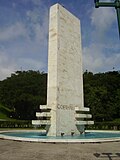 Goethals Monument, Panama City
 -
 Goethals Bridge
 -
 Dredge Goethals
 -
 USNS George W. Goethals


See also
[edit]References
[edit]- ^ a b "Gen. Goethals Dies After Long Illness. Builder of Panama Canal and Once Ruler of the Isthmus Succumbs Here at 70. Brilliant Career In Army. His Feat Hailed as One of the Greatest in History. West Point Funeral Tuesday. Gen. Goethals Dies After Long Illness". New York Times. January 22, 1928.
- ^ Genealogie van Egidius Goethals – HTML uitvoer van HAZA-DATA 7.2 Archived July 3, 2022, at the Wayback Machine (in Dutch)
- ^ Belangrijke Goethals'en Archived March 4, 2016, at the Wayback Machine (in Dutch)
- ^ a b c d e f g h i The Panama Canal:An Army's Enterprise. United States Army Center of Military History. 2009. pp. 13–15. CMH Pub 70-115-1. Archived from the original on October 15, 2017. Retrieved August 16, 2010.
- ^ a b Biographical register of the officers and graduates of the U.S. Military Academy at West Point, N.Y. from its establishment in 1802, to 1890: With the early history of the United States Military Academy. Vol. III. The Riverside Press. 1891. p. 328. Retrieved February 8, 2022.
- ^ McGovern 2019, pp. 11–12.
- ^ Shellum, Brian G., and Brooks, Vincent (2006). Black Cadet in a White Bastion (Lincoln, Nebraska: University of Nebraska Press), pp. 2, 123, 127-33.
- ^ Bishop, Chip (November 8, 2011). Lion and the Journalist: The Unlikely Friendship of Theodore Roosevelt and Joseph Bucklin Bishop. Rowman & Littlefield. p. 203. ISBN 978-0-7627-7754-9.
- ^ Tucker, Spencer (2009). The Encyclopedia of the Spanish-American and Philippine-American Wars: A Political, Social, and Military History (Volume 1 ed.). ABC-CLIO. p. 245. ISBN 9781851099511.
- ^ Parker, Matthew. (2008). Panama Fever: The Epic Story of One of the Greatest Human Achievements of All Time—The Building of the Panama Canal. Doubleday. ISBN 978-0385515344
- ^ Annual Report of the Chief of Engineers, United States Army, Part 2.
- ^ DuVal, Miles P. (1947) And the Mountains Will Move: The Story of the Building of the Panama Canal. Stanford University Press.
- ^ For an excellent book on these early years see: Mellander, Gustavo A. (1971) The United States in Panamanian Politics: The Intriguing Formative Years. Danville, Ill.: Interstate Publishers. OCLC 138568.
- ^ "WGBH American Experience . Panama Canal - PBS". PBS. Archived from the original on December 31, 2016. Retrieved August 28, 2017.
- ^ McCullough, David (1977), The Path Between the Seas: The Creation of the Panama Canal, 1870–1914, New York: Simon & Schuster. pp. 505-508. ISBN 0-671-24409-4
- ^ Brodhead, Michael J. 2012. "The Panama Canal: Writings of the U. S. Army Corps of Engineers Officers Who Conceived and Built It." p.1.
- ^ "Public Welfare Award". National Academy of Sciences. Archived from the original on June 4, 2011. Retrieved February 14, 2011.
- ^ George W. Goethals papers. Library of Congress.
- ^ a b c Anne Cipriano Venzon (2013). The United States in the First World War: An Encyclopedia. Routledge. p. 294.
- ^ "Selective Service System: History and Records". Sss.gov. Archived from the original on May 7, 2009. Retrieved July 27, 2010.
- ^ "World War I Timeline - 1918 - A Fateful Ending". The History Place. Retrieved November 6, 2016.
- ^ a b c Major Roy A. Shaw (1951) "Two Acting Quartermasters General and their Assistant". The Quartermaster Review September–October 1951. Fort Lee, Virginia.
- ^ Risch, Erna (1989). Quartermaster support of the Army: a history of the Corps, 1775-1939. Washington, DC. Center of Military History, United States Army. p.631.
- ^ Risch, Erna (1989). Quartermaster support of the Army: a history of the Corps, 1775-1939. Washington, DC. Center of Military History, United States Army. p.640.
- ^ Anne Cipriano Venzon (2013). The United States in the First World War: An Encyclopedia. Routledge. p. 295.
- ^ "Valor awards for George Washington Goethals". Military Times.
- ^ a b Davis, Henry Blaine Jr. (1998). Generals in Khaki. Pentland Press, Inc. pp. 149–150. ISBN 1571970886. OCLC 40298151.
- ^ "George Washington Goethals". American Academy of Arts & Sciences. February 9, 2023. Retrieved November 14, 2023.
- ^ "APS Member History". search.amphilsoc.org. Retrieved November 14, 2023.
- ^ "George W. Goethals". www.nasonline.org. Retrieved November 14, 2023.
- ^ a b McGovern 2019, p. 206.
- ^ "location 46°16'39.2"N 119°16'47.2"W". Goethals Drive. Google Map. Retrieved December 15, 2015.
- ^ "40.7191882,-73.8066898 Goethals+Ave,+Queens,+NY". Google location. Google Maps. Retrieved December 15, 2015.
- ^ "Goethalsia Pittier | Plants of the World Online | Kew Science". Plants of the World Online. Retrieved September 16, 2021.
Further reading
[edit]- Bishop, Farnham (August 1912). "The Builder Of The Canal: Col. George Washington Goethals". The World's Work: A History of Our Time. XXIV: 389–402. Retrieved July 10, 2009.
- Bishop, Joseph Bucklin, Goethals - Genius of the Panama Canal (1930).
- McGovern, Rory M. "The School of Experience: George W. Goethals and the US Army, 1876–1907." Journal of Military History 81.2 (2017).
- Mellander, Gustavo A., Mellander, Nelly, Charles Edward Magoon: The Panama Years. Río Piedras, Puerto Rico: Editorial Plaza Mayor. ISBN 1-56328-155-4. OCLC 42970390. (1999)
- Mellander, Gustavo A., The United States in Panamanian Politics: The Intriguing Formative Years." Danville, Ill.: Interstate Publishers. OCLC 138568. (1971)
- "Goethals, George Washington" in American National Biography. American Council of Learned Societies, 2000.
- McGovern, Rory (2019). George W. Goethals and the Army: Change and Continuity in the Gilded Age and Progressive Era. University Press of Kansas. ISBN 978-0700627707.
External links
[edit]- Panama Canal Authority biography Archived June 22, 2007, at the Wayback Machine

 . The Cyclopædia of American Biography. 1918.
- . Collier's New Encyclopedia. 1921.
- . Encyclopædia Britannica (12th ed.). 1922.
- Newspaper clippings about George Washington Goethals in the 20th Century Press Archives of the ZBW


George Washington Goethals
View on GrokipediaEarly Life and Education
Youth and Family Background
George Washington Goethals was born on June 29, 1858, in Brooklyn, Kings County, New York, to parents of Flemish origin who had immigrated from Stekene, Belgium.[4][2] His father, John Louis Goethals (born Johannes Baptista Goethals), worked as a carpenter and had arrived in New York City as a 32-year-old bachelor prior to the family's establishment there. His mother was Marie Le Baron Goethals.[5] The Goethals family lived in modest circumstances typical of working-class immigrant households in mid-19th-century Brooklyn, with the father's trade providing the primary means of support amid the challenges of urban industrial life.[6] Little is documented about Goethals' siblings or extended family dynamics in primary records, though genealogical accounts confirm the nuclear family's Belgian roots and relocation to the United States for economic opportunity.[4] As a youth, Goethals displayed an early focus on self-improvement over recreational pursuits, reflecting the disciplined environment of his immigrant upbringing, though specific childhood anecdotes remain sparse in historical accounts.[3] He attended local public schools, laying the groundwork for his later academic ambitions despite the family's limited resources.[2]West Point Cadetship and Graduation
Goethals attended the College of the City of New York for three years before securing an appointment to the United States Military Academy at West Point on June 14, 1876.[7][1] He was admitted to the academy the same day and commenced his four-year cadetship, during which he demonstrated strong aptitude in engineering and military sciences.[8] As a cadet, Goethals held the position of cadet captain and maintained exceptional academic standing, ultimately graduating second in his class of 52 on June 12, 1880.[1][9] His high ranking reflected proficiency in the academy's rigorous curriculum, which emphasized mathematics, engineering, and practical military training, aligning with his early interest in civil works.[1] Upon graduation, Goethals was commissioned as a second lieutenant in the Corps of Engineers, the branch he selected due to its focus on infrastructure and technical projects.[8] He briefly remained at West Point on special duty from July 5 to August 28, 1880, before reporting to Willets Point, New York, for engineer training.[8] This early assignment underscored the Corps' emphasis on fortification and river improvements, setting the foundation for his subsequent career in military engineering.[8]Pre-Panama Military Engineering Career
Initial Assignments and Promotions
Upon graduation from the United States Military Academy at West Point on June 11, 1880, Goethals was commissioned as a second lieutenant in the United States Army Corps of Engineers on June 12, 1880.[1] His initial duties involved engineering projects on rivers, including work on dams, bridges, and locks along the Ohio and Columbia rivers.[1] In 1881, Goethals attended the Engineer School of Application at Willets Point, New York.[10] He was promoted to first lieutenant on June 15, 1882, and received his first field assignment that year as assistant engineer under Major Anson Mills, overseeing the construction of a replacement bridge across the Spokane River in Washington Territory as part of the Department of the Columbia.[1][10] This project, completed amid challenging terrain and logistics, marked his entry into practical fieldwork in western river improvements.[10] From 1885 to 1889, Goethals served as an instructor in civil and military engineering at West Point, contributing to the academy's curriculum while gaining administrative experience.[1] He was promoted to captain on December 14, 1891, and assigned independent command of the Muscle Shoals Canal project on the Tennessee River near Florence, Alabama, where he directed the construction of locks and dams, including the Riverton Lock, which featured a then-world-record 26-foot lift.[1][10][11] This assignment, spanning 1889 to 1894, honed his skills in large-scale hydraulic engineering and labor management on domestic infrastructure.[1] Goethals also contributed to the Davis Island project on the Ohio River, an early effort in channel improvement and lock construction south of Pittsburgh, which provided foundational experience in river navigation enhancements.[12] By 1894, he had advanced to assistant to the chief of engineers in Washington, D.C., focusing on policy and oversight of Corps projects.[1] During the Spanish-American War in 1898, he was promoted to lieutenant colonel of volunteers and served as chief engineer of the First Army Corps, managing fortifications and logistics.[1][10] These roles established his reputation for efficient project execution within the Corps of Engineers.[1]Spanish-American War and Post-War Projects
During the Spanish-American War, Goethals, then a captain in the Corps of Engineers, was promoted to lieutenant colonel of United States Volunteers on May 9, 1898, and appointed chief engineer of the First Army Corps under Major General Nelson A. Miles.[8] In this role from May 26 to August 12, 1898, he directed engineering support for the corps' operations, including preparations for and logistics during the invasion of Puerto Rico, where U.S. forces landed at Guánica on July 25, 1898, and advanced inland with requirements for temporary bridges, roads, and fortifications amid tropical terrain challenges.[8][1] Following the war's armistice on August 12, 1898, Goethals reverted to his regular Army rank and was assigned as an instructor in the Department of Civil and Military Engineering at the United States Military Academy at West Point from August 12, 1898, to August 31, 1900, where he taught practical military engineering to cadets.[8] He briefly served from August 31 to November 30, 1900, on a board revising U.S. Army fortification and artillery drill regulations, contributing to standardized procedures for coastal defense systems.[8] From November 30, 1900, to February 26, 1907, Goethals directed the construction of seacoast fortifications in the Eastern Theater, overseeing the modernization of defenses from Maine to Virginia as part of the Endicott and Taft programs, which emphasized concrete batteries, disappearing gun emplacements, and minefields to counter potential naval threats post-war.[8] This responsibility included managing river and harbor improvements along the Atlantic coast from Block Island to Nantucket, prioritizing artillery fortifications amid heightened national security concerns after the war's demonstration of U.S. naval vulnerabilities. His oversight ensured the completion of key sites such as Fort Hamilton in New York and Fort Strong in Massachusetts, integrating electrical fire-control systems and reinforced structures designed for 12-inch guns.Domestic Infrastructure Improvements
As a second lieutenant in the U.S. Army Corps of Engineers following his 1880 graduation from West Point, Goethals was assigned to field projects involving the construction of dams, bridges, and locks along the Ohio River and Columbia River, contributing to early improvements in navigability and flood control on these waterways.[1] These efforts focused on enhancing commercial transportation by deepening channels and installing hydraulic structures to manage water flow and elevation changes.[1] From 1889 to 1894, Goethals supervised the Muscle Shoals Canal project on the Tennessee River, overseeing the building of canals, locks, and dams to bypass hazardous rapids and shoals that impeded river traffic.[1] To support construction, he constructed a 14-mile railroad for material transport and designed a 26-foot-high lift lock, the largest of its kind attempted in the United States at the time, which facilitated greater vessel passage efficiency upon eventual completion.[13] The project, spanning approximately 14.5 miles with 17 locks, aimed to create a 60-foot-wide, 6-foot-deep channel, addressing longstanding barriers to steamboat navigation in the region.[14] He also directed similar canal works near Chattanooga, Tennessee, extending inland waterway enhancements in the Southeast.[2] Throughout the 1880s and 1890s, Goethals participated in broader U.S. Army Corps of Engineers initiatives for river and harbor improvements, including coastal fortifications and channel deepening from Block Island to Nantucket, which bolstered domestic maritime infrastructure and defense capabilities.[13] During the Spanish-American War period, his assignments emphasized harbor defense constructions, integrating engineering solutions for strategic waterway security.[6] These pre-Panama endeavors honed his expertise in large-scale hydraulic engineering and logistical management, directly informing later canal administration.[15]Panama Canal Leadership
Context of U.S. Involvement and Prior Failures
The French attempt to build a sea-level canal across Panama, launched in 1881 by Ferdinand de Lesseps following his Suez Canal success, collapsed in 1889 after costing an estimated 1.5 billion francs (about $287 million in contemporary value) and claiming over 20,000 lives, predominantly from malaria and yellow fever amid inadequate sanitation and engineering miscalculations involving the Chagres River floods and Culebra Cut excavation. Financial mismanagement and a massive stock scandal further eroded investor confidence, leading to the Compagnie Universelle du Canal Interocéanique's bankruptcy, with only 15 miles of incomplete cuts and rudimentary infrastructure left behind.[16] The United States, eyeing strategic naval advantages post-Spanish-American War, purchased the French company's assets for $40 million in 1902 and negotiated the Hay-Herrán Treaty with Colombia in January 1903 for canal rights in exchange for $10 million and annuities, but Colombia's senate rejected it in August 1903 over sovereignty concerns and insufficient compensation.[17] President Theodore Roosevelt then tacitly backed Panamanian separatists, dispatching naval forces to prevent Colombian intervention; Panama declared independence on November 3, 1903, was recognized by the U.S. on November 6, and signed the Hay-Bunau-Varilla Treaty on November 18, conceding a 10-mile-wide perpetual Canal Zone lease for $10 million upfront plus $250,000 annually.[17] American construction began May 6, 1904, under the Isthmian Canal Commission chaired by George Cortelyou, with civil engineer John Findley Wallace as chief; initial focus shifted to a lock-based design and yellow fever eradication via William Gorgas's mosquito campaigns, which reduced disease incidence from thousands to near zero by 1906.[18] Yet progress faltered due to fragmented authority—Wallace lacked autonomy over procurement and personnel amid congressional oversight and executive micromanagement—resulting in supply shortages, labor unrest, and only preparatory work like railroad expansions despite $36.8 million spent by early 1906.[19] Wallace resigned abruptly in March 1906, citing bureaucratic hurdles and inadequate support rather than solely financial incentives, though Secretary of War William Howard Taft publicly criticized his departure as untimely.[20] John Stevens succeeded Wallace, prioritizing workforce housing, sanitation, and excavation machinery while advocating lock-and-lake routing finalized in 1906, which boosted morale and cut mortality to under 6 per 1,000 annually.[19] Nevertheless, Stevens resigned in June 1907 after a year, frustrated by persistent Washington interference and delays in funding approvals, leaving the project with improved logistics but no unified command structure to surmount the geological and logistical barriers of the divide.[18] These civilian-led efforts exposed systemic flaws: decentralized decision-making, underfunding relative to scale (initial estimates of $130 million proved woefully low), and vulnerability to tropical conditions, necessitating a militarized approach for completion.[17]Appointment and Administrative Overhaul
On February 26, 1907, President Theodore Roosevelt appointed Colonel George Washington Goethals of the U.S. Army Corps of Engineers as chairman and chief engineer of the Isthmian Canal Commission, tasking him with completing the Panama Canal after the resignations of previous civilian leaders John Wallace and John Stevens amid escalating costs and delays.[11] Roosevelt restructured the commission to consolidate authority under Goethals, effectively granting him unchecked control over construction, procurement, sanitation, and even postal operations in the Canal Zone, which contemporaries dubbed him the "Czar of Panama" due to this expansive mandate.[11] Goethals arrived in Panama shortly thereafter in early April 1907, inheriting a workforce of approximately 24,000 employees disorganized by functional silos that had hindered progress under prior administrations.[21] He promptly centralized decision-making to eliminate bureaucratic delays, assuming direct oversight of the Panama Railroad Company to streamline material transport and logistics essential to excavation efforts.[11] To enhance accountability and coordination, Goethals reorganized the project from a functional structure—divided by tasks such as excavation or sanitation—into three geographic divisions: the Atlantic Division for eastern dredging and locks; the Central Division, focused on the challenging Culebra Cut; and the Pacific Division for western locks and approaches, each led by a division engineer with comprehensive responsibility for all activities in their sector.[22] This shift promoted localized efficiency while maintaining top-down military discipline, including strict enforcement against work stoppages, as demonstrated by his recruitment of strikebreakers to replace the entire steam shovel crew during a May 1907 labor dispute, ensuring uninterrupted operations.[11] These reforms, rooted in Goethals' engineering experience and army background, accelerated production, with excavation rates reaching one million cubic yards per month by August 1907 during the rainy season.[11]Engineering Strategies and Technical Innovations
Goethals affirmed the lock-and-lake canal design recommended by the International Board of Consulting Engineers in 1906, rejecting a sea-level alternative due to excessive excavation demands in the Culebra Cut and geological instability.[23] This approach created an artificial summit level via Gatun Lake, reducing total excavation by approximately 65 million cubic yards compared to a sea-level plan. The strategy leveraged three flights of locks at Gatun to raise ships 85 feet, a single lock at Pedro Miguel to lower them 31 feet to Miraflores Lake, and a double lock at Miraflores to descend 54 feet to the Pacific, enabling navigation across the 40-mile isthmus with minimal channeling through highlands.[24] To streamline execution, Goethals restructured the Isthmian Canal Commission into three primary construction divisions—Atlantic, Central, and Pacific—each led by an assistant chief engineer responsible for specific segments, including excavation, locks, and dams. This division-of-labor model facilitated parallel progress, with centralized authority under Goethals ensuring coordinated resource allocation and rapid decision-making, supported by rebuilt infrastructure such as 447 miles of railroad track for material transport and spoil removal.[23] Hydroelectric plants at Gatun and Alhajuela provided power for operations, while entrance breakwaters and regulating works at both ends enhanced navigational safety.[23] Excavation strategies emphasized mechanized efficiency, deploying over 100 Bucyrus steam shovels capable of 5- to 12-cubic-yard buckets to remove 240 million cubic yards of earth and rock, peaking at 1 million cubic yards per month in 1912.[19] In the 8-mile Culebra Cut, dual tracks and side tracks maintained a continuous supply of empty muck cars to shovels, with spoil hauled to Atlantic and Pacific dumps or used for fills, countering frequent slides that buried equipment and tracks.[25] Drilling and blasting with up to 6,000 pounds of dynamite per round fragmented hard rock, followed by shovel loading, achieving a bottom width of 300 feet at elevation 41 feet above sea level.[19] Lock construction innovated with massive reinforced concrete structures totaling 3.2 million cubic yards poured, featuring chambers 1,000 feet long, 110 feet wide, and 40 feet deep to accommodate largest vessels of the era.[24] Each of the 12 chambers included eight 8-foot-diameter gravity-fed laterals for filling and four main culverts with siphons for rapid emptying, transit times reduced to 1-2 hours per set.[24] A novel safety feature comprised 64 electrically operated rolling counterweight gates alongside traditional miter gates, preventing catastrophic failure from leaks or seismic events; these 74-ton gates rolled horizontally on tracks.[24] Gatun Dam, an earth-and-rockfill embankment 7,900 feet long and 115 feet high, impounded the lake, with its spillway designed to handle extreme floods via fuse-plug sections.[23] These methods enabled completion on August 15, 1914, seven months ahead of the ten-year contract schedule and $23 million under the $375 million appropriation, demonstrating scalable mechanization and adaptive geotechnical responses.[23][10]Labor Management, Health Measures, and Challenges
Goethals restructured labor management by dividing the workforce into the "gold roll" for skilled white workers, primarily Americans and Europeans, who received wages 10 to 30 cents per hour above U.S. domestic rates (e.g., 60 cents per hour for certain roles) along with superior housing and facilities, and the "silver roll" for unskilled non-citizen laborers, mostly black West Indians, paid lower rates such as 75 cents per day despite initial promises of higher compensation.[26] This system, which segregated workers by race and skill, enabled efficient recruitment of over 40,000 laborers at peak, with West Indians forming the bulk to address chronic shortages in the tropical environment.[26] Goethals enforced military-style discipline, establishing grievance commissions and using surplus labor pools to prevent disruptions, while prioritizing excavation through organizational subdivisions.[27] To counter strikes, Goethals adopted a firm approach, as seen in the 1907 action against 1,000 Spanish workers demanding raises in the Culebra Cut, which was swiftly suppressed using police, and later incidents like the 1912 steam shovel operators' strike, where he imported replacements, reduced output temporarily to one-quarter capacity, and demoted returning strikers to manual roles without concessions.[26] [27] These measures minimized delays, with no major work stoppages impeding the 1914 completion, though silver roll workers endured cramped, inferior quarters and higher risks from explosions and falls.[26] Black laborers on the silver roll suffered disproportionately higher mortality, estimated at 10% in some periods compared to 6.5-16 per thousand for gold roll workers.[26] Health measures under Goethals built on William C. Gorgas's pre-existing framework, allocating resources for a dedicated sanitation department of 4,000 personnel focused on mosquito eradication via swamp drainage, larvicide oiling of water sources, fumigation, building screening, and strict quarantine, which had already eliminated yellow fever by 1906 and reduced malaria cases from thousands annually to manageable levels by 1910.[28] [29] Goethals integrated these efforts into engineering operations, constructing hospitals and ensuring clean water supplies, though tensions arose as Gorgas later criticized Goethals for prioritizing construction speed over some sanitary protocols in 1915.[30] Overall, these interventions lowered the death rate to 0.78% of the workforce annually by the later years, a marked improvement from French-era losses exceeding 20,000 in eight years.[31] Key challenges included recurrent landslides in the Culebra Cut (later Gaillard Cut), where unstable, saturated clay and basalt layers caused massive slides—such as those in 1910 and 1915 that buried equipment and required re-excavation of up to 10 million cubic yards—necessitating adaptive strategies like benching slopes and continuous monitoring.[32] [19] Torrential rains exacerbated mudslides and flooding, while accidents from dynamite blasts, rail mishaps, and drownings persisted, contributing to 5,609 total deaths from disease, injury, and exhaustion during the U.S. construction phase from 1904 to 1914.[31] Labor turnover remained high due to the grueling conditions, with West Indian workers facing elevated risks from malaria remnants and workplace hazards, yet Goethals' oversight ensured excavation of over 200 million cubic yards proceeded to completion despite these obstacles.[26] [27]Completion, Costs, and Immediate Outcomes
The Panama Canal reached substantial completion under Goethals' direction on August 15, 1914, when the steamship Ancon made the first official transit from the Atlantic to the Pacific, traversing the full length in approximately 12 hours despite initial operational adjustments.[21] This milestone came after seven years of intensive construction led by Goethals since his 1907 appointment, finishing two years ahead of the revised 1916 target date originally set amid earlier delays.[21][11] The opening ceremony was subdued, with a small crowd attending due to the concurrent outbreak of World War I in Europe, which shifted global priorities away from celebratory fanfare. Total construction costs borne by the United States amounted to approximately $375 million, encompassing engineering works, sanitation efforts, and infrastructure, plus the $10 million payment to Panama for territorial rights and $40 million to the French company for assets and concessions. This figure represented a controlled overrun from Goethals' 1908 estimate of $300 million (including the French payment), achieved through rigorous cost management and efficiency measures that avoided the fiscal pitfalls of the prior French attempt, which had exceeded 1.2 billion francs in equivalent value.[33][27] Immediate outcomes included a transformative reduction in maritime transit times and costs, shortening the route from New York to San Francisco by over 7,800 nautical miles compared to the Cape Horn alternative, thereby facilitating faster global trade and naval mobility.[34] The canal's functionality proved reliable from inception, with routine ship passages commencing shortly after the Ancon's voyage, underscoring the engineering robustness of features like the Gatun Locks despite wartime disruptions limiting early commercial volume.[21] Symbolizing American industrial and organizational capacity, the project bolstered U.S. strategic influence by enabling efficient hemispheric defense and commerce, though initial traffic was moderated by the European conflict.[17]Panama Canal Zone Governorship
Transition to Governance
President Woodrow Wilson nominated Colonel George Washington Goethals, the Isthmian Canal Commission's chairman and chief engineer, to serve as the first civil governor of the Panama Canal Zone in January 1914, shortly before the canal's completion.[35] This move established a centralized, one-man executive authority over the Zone's civil administration, as authorized by the Act of Congress approved on August 24, 1912, which designated the head of the government as "Governor" and emphasized efficient operation of the waterway.[36] Goethals' unparalleled knowledge of the project's engineering, logistics, and workforce—gained from directing construction since 1907—positioned him uniquely to transition the Zone from wartime-like mobilization to peacetime governance, ensuring the canal's readiness for commercial traffic.[37] The Senate confirmed Goethals' nomination on February 4, 1914, reflecting bipartisan recognition of his administrative successes, including cost controls and deadline adherence that advanced the canal's opening to August 15, 1914.[38] Goethals himself advocated for the role, expressing a desire to remain in Panama to oversee final preparations and avert disruptions from leadership changes, a stance aligned with Wilson's preference for continuity under proven expertise rather than bureaucratic commissions.[39] Effective April 1, 1914, the appointment marked Goethals' shift from military-engineered construction oversight to civilian rulemaking, with responsibilities expanding to include sanitation, utilities, judiciary functions, and economic policies for the 553-square-mile territory inhabited by over 50,000 workers and dependents.[37] This governance transition consolidated authority previously divided among Isthmian Canal Commission members, streamlining decision-making for post-construction challenges such as lock maintenance, dredging, and quarantine enforcement against tropical diseases.[36] Goethals retained his Army commission but operated in a civil capacity, reporting directly to the President via the Secretary of War, which preserved operational autonomy while integrating the Zone into U.S. territorial administration without full statehood.[37] The arrangement proved effective initially, as Goethals applied construction-era efficiencies to governance, though it later drew scrutiny for centralizing power amid growing calls for local input.[38]Administrative Achievements and Policies
As the first civil governor of the Panama Canal Zone, appointed by President Woodrow Wilson in March 1914 following the canal's completion, Goethals restructured the administration to prioritize operational efficiency, public services, and resident welfare in the transition from construction to permanent governance. He centralized authority under an executive framework reporting to the Secretary of War, organizing the government into specialized departments such as Health, Education, Justice, Quarters and Subsistence, and Civil Service, which handled sanitation, schooling, legal proceedings, housing allocation, and personnel management respectively. This structure, detailed in his 1915 lectures on Canal Zone governance, emphasized military discipline adapted to civilian needs, with the governor empowered to appoint magistrates, constables, and notaries for local order.[40][41][42] Goethals sustained public health policies inherited from construction, enforcing strict sanitation measures that kept malaria and yellow fever incidence near zero through ongoing mosquito control, water purification, and quarantine protocols managed by the Health Department under Colonel William C. Gorgas' framework. In education, he oversaw a dual system of schools for American children on the "gold roll" (higher-paid U.S. and European employees) and separate facilities for "silver roll" workers (primarily West Indians and Panamanians), with policies promoting library expansion and curriculum aligned to U.S. standards to support workforce stability. The judicial system applied modified U.S. common law via the Canal Zone Code, with district courts handling civil and criminal cases; Goethals appointed judges and enforced policies limiting extraditions to Panama only for serious offenses, prioritizing Zone security.[25][43] To enhance employee relations and operational cohesion, Goethals maintained the gold-silver roll compensation differentiation, providing higher wages, housing, and commissary access to skilled American workers to retain expertise amid post-construction workforce reductions from over 40,000 to about 10,000 by 1915, while silver roll employees received adjusted rates suited to local conditions. He instituted open-door grievance sessions every Sunday at his office, allowing direct appeals from workers, and launched The Canal Record as a weekly government publication in 1914 to disseminate policies, report achievements, and encourage productivity through inter-division competitions. Procurement policies emphasized uniform standards and cost controls, minimizing waste in supplies for canal maintenance and Zone services. These measures ensured fiscal prudence, with annual operating costs stabilized below initial projections, though Goethals resigned in January 1917 amid disputes over political appointments and wartime priorities.[25][44]Resignation and Transition to Civilian Rule
Goethals tendered his resignation as Governor of the Panama Canal Zone on January 17, 1917, primarily to accept recall to active military duty in anticipation of United States involvement in World War I.[2][6] Earlier, in August 1915, he had announced plans to resign by September of that year, citing a desire for either active military service or entry into private engineering practice after the canal's operational challenges, such as persistent slides in the Culebra Cut, had been sufficiently addressed.[45] He temporarily withdrew this resignation in October 1915 to oversee final stabilization efforts, ensuring the canal's reliable functionality before departing.[46] The transition following Goethals's departure maintained the civilian governance structure he had established upon his appointment as the first civil governor on March 31, 1914, which marked the shift from prior military-led administration under the Isthmian Canal Commission to a permanent executive-led civil authority.[47] He was succeeded by Brigadier General Chester Harding, an Army engineer who had previously served in subordinate roles on the canal project, ensuring administrative continuity without reversion to military oversight.[48] Harding's appointment preserved the one-man rule model advocated by President Woodrow Wilson in 1914, under which the governor held centralized authority over Zone operations, sanitation, judiciary, and infrastructure maintenance. This framework supported the canal's role as a strategic asset, with civilian governance emphasizing efficiency and self-sufficiency amid growing transoceanic traffic, which reached over 1,000 vessels by 1917.[25]World War I Military Service
Recall and Quartermaster General Appointment
Following the United States' declaration of war on Germany on April 6, 1917, George Washington Goethals, who had retired from the U.S. Army as a major general in January 1916 after his Panama Canal service, initially contributed to the war effort in civilian capacities.[8] In spring 1917, he briefly served as general manager of the Emergency Fleet Corporation under the U.S. Shipping Board to address maritime production needs amid submarine threats to Allied shipping. Concurrently, in March 1917, he had been appointed state engineer of New Jersey, focusing on infrastructure projects, but resigned this role as wartime demands escalated.[7] By late 1917, severe logistical failures in the Army's supply system—exacerbated by the bitter winter of 1917–1918, inadequate clothing and equipment for troops, and inefficient procurement—had triggered a Congressional investigation into the Quartermaster Corps under its incumbent, Major General Henry G. Sharpe.[49] These issues, including delays in mobilizing resources for the American Expeditionary Forces, threatened the U.S. war effort's momentum. Secretary of War Newton D. Baker, seeking to overhaul the War Department amid criticism of bureaucratic inertia, identified Goethals' proven expertise in large-scale engineering and resource management from the Panama project as ideal for reform.[50] On December 19, 1917, Goethals was recalled to active duty by special act of Congress and appointed Acting Quartermaster General, replacing Sharpe effective immediately.[51] This emergency appointment, one of Baker's initial shake-ups of senior leadership, empowered Goethals to centralize procurement, storage, and distribution functions, absorbing related divisions into a unified Purchase, Storage, and Traffic branch under his direct control.[52] Goethals accepted the role despite his retirement status, leveraging his rank and experience to impose disciplined, engineering-driven efficiencies on the corps, which had swelled from peacetime levels to handle millions of tons of supplies for overseas deployment.[53]Logistics and Supply Chain Reforms
Upon his appointment as Acting Quartermaster General on December 4, 1917, George Washington Goethals confronted a severely fragmented U.S. Army supply system, where multiple branches independently procured identical items, leading to inefficiencies and waste exposed by a congressional investigation.[1][54] He immediately centralized procurement under the Quartermaster Corps, eliminating duplicative purchases by entities such as the Signal Corps and Medical Department, which had previously acquired overlapping supplies like clothing and medicines.[53] Goethals implemented vertically integrated controls, overseeing production, distribution, and logistics from raw materials to frontline delivery, which streamlined operations and reduced bottlenecks in equipping an expanding force that reached approximately four million soldiers by war's end.[1] This restructuring addressed chronic shortages in uniforms, footwear, and subsistence items, with the department achieving procurement of over 1.5 million pairs of shoes and vast quantities of textiles by mid-1918 through coordinated contracts with domestic manufacturers.[55] By February 18, 1918, Goethals had completed the Quartermaster Department's reorganization, establishing a hierarchical structure with specialized divisions for purchase, storage, and transportation that enhanced responsiveness to overseas demands via ports like Hoboken and Newport News.[56] His reforms prioritized empirical efficiency over bureaucratic silos, countering inter-service rivalries by mandating unified requisitions, which critics in the Medical Corps contested but Goethals defended as necessary given the doctors' own procurement failures.[53] These changes laid foundational improvements in Army logistics, enabling sustained supply lines despite Allied shipping constraints from U-boat threats.[55]Impact on U.S. War Effort
Goethals' appointment as Acting Quartermaster General on December 18, 1917, addressed critical inefficiencies in the U.S. Army's supply system, which featured overlapping purchases by separate bureaus such as the Quartermaster Corps and Signal Corps for identical items like clothing. He centralized procurement under the Quartermaster General's authority, reducing redundancy and enabling more streamlined acquisition of essentials including subsistence, equipment, and transportation services for an army expanding from approximately 200,000 to over 4 million personnel by late 1918.[57][53] This reform was foundational to sustaining the mobilization, though bureaucratic resistance from bureau chiefs limited its depth, rendering some changes more administrative than transformative.[55] In his subsequent roles as head of the War Department's Division of Purchase, Storage, and Traffic and Assistant Chief of Staff for supplies, Goethals introduced vertically integrated controls over storage, distribution, and inventory management, incorporating modern business record-keeping practices adapted from his Panama Canal experience. These measures improved the flow of materiel to ports and railroads, facilitating the overseas shipment of over 2 million troops and vast quantities of supplies to the American Expeditionary Forces (AEF) in France between early 1918 and the Armistice on November 11, 1918.[1] Centralized oversight of domestic Army transportation matters further mitigated bottlenecks in rail and port operations, which had previously hampered deployment timelines.[53] The cumulative effect of Goethals' logistics initiatives was to bolster the AEF's combat readiness during the decisive Allied offensives of summer and fall 1918, where U.S. divisions provided critical reinforcements that helped repel German advances and force the war's end. While not resolving all systemic issues—such as persistent inter-bureau rivalries—his efforts laid groundwork for post-war supply efficiencies, preventing potential collapses in sustainment amid the unprecedented scale of U.S. involvement. Goethals retired again in March 1919, having directly contributed to the logistical backbone that enabled America's pivotal late-war contribution without which Allied victory might have been delayed or unattainable.[1][57]Post-War Civilian Endeavors
New Jersey State Engineering Role
In 1917, shortly after Governor Walter E. Edge took office, George Washington Goethals was appointed New Jersey's first state highway engineer, a role focused on supervising the construction and maintenance of state highways amid growing demands for improved infrastructure.[54][58] The position carried an annual salary of $12,000, reflecting its importance in coordinating engineering projects for the state's expanding road network.[54] Goethals' tenure emphasized efficient oversight of highway development, drawing on his experience with large-scale projects like the Panama Canal to address New Jersey's needs for better connectivity between urban centers and rural areas.[59] However, the role lasted only a few months, as the United States' entry into World War I on April 6, 1917, prompted his immediate resignation to accept a recall to active Army duty as acting quartermaster general.[60][7] This brief stint marked a transitional phase in his career, bridging civilian engineering leadership with renewed military responsibilities, though specific completed initiatives under his direct supervision remain limited due to the abbreviated period.[54]Consulting, Publications, and Private Sector Work
Following his retirement from the U.S. Army in 1919, Goethals established and served as president of the engineering and construction firm George W. Goethals & Co. in New York City, which operated until its dissolution in 1923.[60][7] The firm undertook various civil engineering projects, leveraging Goethals' expertise in large-scale infrastructure.[61] After the firm's closure, Goethals continued as an independent consulting engineer, advising on major infrastructure developments. He served as chief consulting engineer for the New York-Jersey Port and Harbor Commission, which evolved into the Port of New York Authority, contributing to regional port and harbor planning.[61][62] His consultations included the Holland Tunnel project, the development of New Orleans' inner harbor, and the Columbia Basin irrigation initiative.[1][7] In 1922, amid the anthracite coal miners' strike, he acted as fuel administrator for New York, coordinating distribution to mitigate shortages.[61] Goethals contributed to engineering literature through technical publications detailing his Panama Canal experience. His 1916 work, The Panama Canal: An Engineering Treatise, comprises a series of papers addressing construction challenges, including hydraulics, power plants, and excavation methods, prepared under his supervision as chief engineer.[63] He also authored Government of the Canal Zone, outlining administrative structures and policies implemented during the project's execution.[64] These writings emphasized practical engineering solutions and organizational efficiency derived from firsthand implementation.[63]Personal Life and Death
Marriage, Children, and Family Dynamics
George Washington Goethals married Josephine "Effie" Rodman on December 1, 1884, in New Bedford, Bristol County, Massachusetts.[4] Effie, born in 1858, was the daughter of Captain Thomas R. Rodman, a naval officer from New Bedford.[7] The marriage lasted until Goethals's death in 1928, with Effie outliving him until 1942; correspondence in his personal papers indicates ongoing family interactions amid his military and engineering postings.[61] The couple had two sons, both of whom pursued careers reflecting their father's influence in engineering and military service. George Rodman Goethals, born October 30, 1886, in Brooklyn, New York, graduated from the United States Military Academy in 1907, attained the rank of colonel in the U.S. Army Corps of Engineers, and later worked as an engineer with Dwight P. Robinson & Co.; he married Priscilla Jewett Howes on October 10, 1910, and they had a son, George Washington Goethals II, born August 19, 1920.[65] [7] Thomas Rodman Goethals, the younger son, also entered professional life, though specific details of his career remain less documented in available records.[5] Family dynamics centered on mutual support during Goethals's demanding career, including relocations for canal construction and wartime duties; both sons were present at his bedside during his final illness in 1928, suggesting close ties despite professional separations.[7] The sons' choices of engineering and military paths indicate paternal influence, with George Rodman explicitly following in his father's footsteps at West Point and in the Corps of Engineers.[66] No public records indicate marital discord or significant family conflicts, aligning with Goethals's disciplined personal life.[67]Later Health Issues and Death
In late 1927, Goethals was diagnosed with cancer, which progressed rapidly thereafter.[68] His condition deteriorated over the ensuing months, confining him to his New York City residence and rendering travel impossible, though the severity was not publicly disclosed until shortly before his death.[7] Goethals died from the cancer on January 21, 1928, at approximately 11:55 a.m., at the age of 69.[59] He had been unconscious for the preceding 24 to 40 hours, surrounded by his wife, Effie, and their two sons, George R. and Thomas R.[68][7] Funeral services were held at the Old Cadet Chapel at West Point, followed by burial in the post cemetery there, per his wishes.[68] Flags in the Panama Canal Zone were flown at half-mast in his honor.[6]Legacy and Historical Assessment
Engineering and Strategic Accomplishments
George Washington Goethals demonstrated exceptional engineering prowess early in his career through the construction of canals, locks, and dams on the Muscle Shoals project along the Tennessee River from 1889 to 1894, where he designed and completed a hydraulic lock system achieving a 26-foot lift—an unprecedented feat at the time.[6][1] His innovations in lock design and riverine infrastructure laid foundational experience for larger-scale endeavors, emphasizing practical hydraulic engineering over theoretical abstraction.[21] As chief engineer of the Panama Canal, appointed on March 31, 1907, Goethals oversaw the excavation of approximately 240 million cubic yards of earth and rock, the construction of massive locks capable of lifting ships 85 feet above sea level, and the implementation of a lock-based system he advocated over a sea-level alternative to mitigate geological risks and reduce costs.[11][69] He managed a workforce peaking at over 50,000 laborers across diverse nationalities, combating tropical diseases through rigorous sanitation protocols that drastically reduced mortality rates from over 20% in prior French efforts to under 1%, while navigating landslides, floods, and engineering challenges in the Culebra Cut—a 9-mile trench through unstable terrain requiring continuous dynamiting and spoil removal.[1] Strategically, Goethals centralized procurement and vertically integrated operations, introducing modern inventory tracking and standardized record-keeping that minimized waste and delays, enabling completion on August 15, 1914—six months ahead of schedule and $23 million under the $375 million budget.[13][1] These measures exemplified causal realism in project management, prioritizing empirical oversight and adaptive problem-solving over bureaucratic inertia. During World War I, Goethals was recalled to active duty on April 30, 1917, as acting Quartermaster General of the U.S. Army, where he reorganized the Quartermaster Corps by consolidating purchasing authority from external agencies, standardizing supply chain protocols, and enhancing logistics for troop and materiel transport to Europe.[69][70] In this role, later expanded to director of storage, traffic, and military supply movements, he directed the procurement and distribution of billions in war goods, transforming the corps into the War Department's most efficient branch through systematic inventory controls and rail prioritization that facilitated the deployment of over 2 million American Expeditionary Forces by war's end.[71][72] His strategic emphasis on integrated logistics—drawing from Panama's lessons in scale and coordination—mitigated bottlenecks in transatlantic shipping and domestic rail networks, contributing causally to Allied sustainment despite U-boat threats and production surges.[1] Goethals retired again in 1919, having elevated military engineering from ad hoc efforts to a disciplined, data-driven enterprise.[73]Honors, Tributes, and Enduring Influence
Upon the Panama Canal's completion on August 15, 1914, Goethals was promoted to major general in the U.S. Army, recognized as a national hero for overseeing the project's success.[1] The Society of American Military Engineers established the Goethals Medal in his honor, an annual award given to members for preeminence in engineering, design, or construction achievements.[74] Tributes to Goethals include postage stamps issued by the Canal Zone administration: a 2-cent carmine stamp in 1928 and a 3-cent red violet stamp in 1934, both bearing his portrait.[75] [76] In 1928, the Port of New York Authority designated the Arthur Kill bridge connecting Elizabeth, New Jersey, and Staten Island, New York, as the Goethals Bridge to commemorate his engineering legacy.[77] [78] The U.S. Navy named the troop transport USNS George W. Goethals (T-AP-182), which served with the Military Sea Transportation Service during the 1950s, after him.[79]
The Goethals Monument, a white Vermont marble structure located near the Panama Canal Administration Building in Panama City, was dedicated on March 31, 1954, to honor Goethals as the canal's chief engineer and first governor of the Canal Zone.[80] Goethals' enduring influence lies in his demonstration of disciplined leadership and logistical innovation in executing complex infrastructure under adverse conditions, principles that continue to inform large-scale engineering endeavors. The Panama Canal, completed ahead of schedule and under budget through his centralized command and workforce reforms, shortened transoceanic shipping routes by thousands of miles, facilitating global commerce and military mobility for over a century.[1] His approach emphasized empirical problem-solving over bureaucratic delays, yielding a model for causal efficiency in public works projects.
Criticisms, Debates, and Causal Analysis of Success
Goethals' leadership during the Panama Canal construction drew criticism for its authoritarian nature, characterized by centralized control over all aspects of the project, including worker discipline and resource allocation, which some contemporaries viewed as excessive one-man rule despite its effectiveness in driving completion.[81][11] He suppressed labor unrest decisively, such as the post-1907 steam-shovel operators' strike that reduced excavation rates to one-quarter of prior levels; Goethals replaced strikers with new hires, forcing returnees to accept lower positions as a deterrent, thereby minimizing delays.[26] Similarly, in early 1907, a strike by approximately 1,000 Spanish workers in the Culebra Cut demanding wage hikes was quelled rapidly by Zone police intervention, preventing broader disruptions.[26] Critics noted the maintenance of a racially segregated payroll system—gold rolls for white American skilled workers offering superior pay and amenities, versus silver rolls for Black and unskilled laborers with inferior conditions—which exacerbated inequalities and stifled unionization efforts amid a surplus labor pool that enabled firings without halting progress.[26][59] Debates surrounding Goethals' tenure included the canal's design, where he advocated for locks over a sea-level plan, overcoming substantial opposition from engineers and officials who favored the latter for perceived simplicity, a shift that proved pivotal but contentious until validated by completion in 1914.[7] Another point of contention was the project's military versus civilian orientation; Goethals, as an Army colonel, avoided wearing his uniform in Panama to navigate sensitivities but imposed paramilitary discipline, fueling discussions on whether such oversight compromised civilian efficiency or, conversely, ensured disciplined execution.[1] During World War I, as acting Quartermaster General from 1917, Goethals faced scrutiny for incomplete reorganization of supply chains, failing to fully rationalize the Army's logistics amid mobilization crises, despite resolving some bottlenecks—efforts hampered by bureaucratic inertia and the unprecedented scale of demands.[82] Causal analysis of Goethals' successes attributes primary efficacy to his acquisition of sweeping authority via President Roosevelt's January 1908 executive order, enabling unified decision-making that streamlined operations previously stalled by predecessor resignations and fragmented control.[83] This autocratic structure, combined with motivational strategies fostering project loyalty over personal allegiance, sustained workforce continuity through disease, terrain, and logistical hurdles, culminating in the canal's opening on August 15, 1914—eight years ahead of initial estimates, $23 million under budget, and free of graft.[84][25] Pre-Panama Army assignments honed his systems-oriented management, emphasizing rigorous training and accountability, which translated to effective sanitation enforcement (building on William Gorgas' malaria controls) and adaptive engineering, such as lock implementation that mitigated excavation challenges in the Culebra Cut.[53] However, these outcomes relied on coercive labor practices and hierarchical incentives, revealing that while technical and administrative centralization drove empirical results, they imposed human costs through dissent suppression and disparity enforcement, underscoring a trade-off between efficiency and equity in high-stakes endeavors.[26]References
- https://en.wikisource.org/wiki/The_Cyclop%25C3%25A6dia_of_American_Biography/Goethals%2C_George_Washington