


Community hub
Recent from talks
Contribute something
Nothing was collected or created yet.
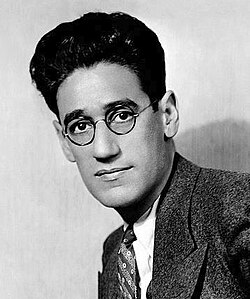
George S. Kaufman
View on Wikipedia
George Simon Kaufman (November 16, 1889 – June 2, 1961) was an American playwright, theater director and producer, humorist, and drama critic. In addition to comedies and political satire, he wrote several musicals for the Marx Brothers and others. He won the Pulitzer Prize for Drama for the musical Of Thee I Sing (with Morrie Ryskind and Ira Gershwin) in 1932, and won again in 1937 for the play You Can't Take It with You (with Moss Hart). He also won the Tony Award for Best Director in 1951 for the musical Guys and Dolls.
Key Information


Early years
[edit]George S. Kaufman was born to Joseph S. Kaufman, a hatband manufacturer,[1] and Nettie Meyers[2] in Pittsburgh, Pennsylvania. He had a younger sister, Ruth.[1] His other sister was Helen, nicknamed "Helse". Kaufman's family was Jewish. He graduated from high school in 1907 and studied law for three months. He grew disenchanted and took on a series of odd jobs,[3] selling silk[1] and working in wholesale ribbon sales.[4]
Career
[edit]Kaufman began contributing humorous material to the column that Franklin P. Adams wrote for the New York Mail. He became close friends with Adams, who helped him get his first newspaper job—humor columnist for The Washington Times—in 1912. By 1915 he was a drama reporter on The New York Tribune, working under Heywood Broun. In 1917 Kaufman joined The New York Times, becoming drama editor and staying with the newspaper until 1930.[4]
Kaufman took his editorial responsibilities seriously. According to legend, on one occasion a press agent asked: "How do I get our leading lady's name in the Times?" Kaufman: "Shoot her."[5]
Theater
[edit]
Kaufman's Broadway debut was September 4, 1918, at the Knickerbocker Theatre, with the premiere of the melodrama Someone in the House.[6][7] He coauthored the play with Walter C. Percival, based on a magazine story written by Larry Evans.[8] The play opened on Broadway (running for only 32 performances) during that year's serious flu epidemic, when people were being advised to avoid crowds. With "dour glee", Kaufman suggested that the best way to avoid crowds in New York City was to attend his play.[9]
Every Broadway season from 1921 through 1958 had a play written or directed by Kaufman. Since Kaufman's death in 1961,[9] revivals of his work on Broadway were produced in the 1960s, the 1970s, the 1980s, the 2000s, and the 2010s.[7] Kaufman wrote only one play alone, The Butter and Egg Man in 1925.[10] With Marc Connelly, he wrote Merton of the Movies, Dulcy, and Beggar on Horseback; with Ring Lardner, he wrote June Moon; with Edna Ferber, he wrote The Royal Family, Dinner at Eight, and Stage Door; with John P. Marquand, he wrote a stage adaptation of Marquand's novel The Late George Apley; and with Howard Teichmann, he wrote The Solid Gold Cadillac. According to his biography on PBS, "he wrote some of the American theater's most enduring comedies" with Moss Hart.[11] Their work includes Once in a Lifetime (in which he also performed), Merrily We Roll Along, The Man Who Came to Dinner, and You Can't Take It with You, which won the Pulitzer Prize in 1937.[12]
For a period, Kaufman lived at 158 West 58th Street in New York City. The building later was the setting for Stage Door.[13] It is now the Park Savoy Hotel, and for many years was considered a single room occupancy hotel.[14]
Musical theater
[edit]Despite his claim that he knew nothing about music and hated it in the theater, Kaufman collaborated on many musical theater projects. His most successful of such efforts include two Broadway shows crafted for the Marx Brothers, The Cocoanuts, written with Irving Berlin, and Animal Crackers, written with Morrie Ryskind, Bert Kalmar, and Harry Ruby. According to Charlotte Chandler, "By the time Animal Crackers opened ... the Marx Brothers were becoming famous enough to interest Hollywood. Paramount signed them to a contract".[15] Kaufman was one of the writers who excelled in writing intelligent nonsense for Groucho Marx, a process that was collaborative, given Groucho's skills at expanding upon the scripted material. Though the Marx Brothers were notoriously critical of their writers, Groucho and Harpo Marx expressed admiration and gratitude towards Kaufman. Dick Cavett, introducing Groucho onstage at Carnegie Hall in 1972, told the audience that Groucho considered Kaufman to be "his god".
While The Cocoanuts was being developed in Atlantic City, Irving Berlin was hugely enthusiastic about including the song "Always", which he had written as a wedding present for his bride.[a] Kaufman was less enthusiastic, and refused to rework the libretto to include this number. The song ultimately became a huge hit for Berlin, recorded by many popular performers. According to Laurence Bergreen, "Kaufman's lack of enthusiasm caused Irving to lose confidence in the song, and 'Always' was deleted from the score of The Cocoanuts – though not from its creator's memory. ... Kaufman, a confirmed misogynist, had had no use for the song in The Cocoanuts, but his disapproval did not deter Berlin from saving it for a more important occasion."[19] The Cocoanuts would remain Irving Berlin's only Broadway musical – until his last one, Mr. President – that did not include at least one eventual hit song.
Kaufman recalled the matter differently. In an article in Stage magazine, he recalled that Berlin woke him up at 5 am one morning to play a new song he had just written. "Even my deficient musical sense recognized that here was a song that was going to be popular. I listened to it two or three times, then took a stab at it myself, and as dawn came up over the Atlantic, Irving and I were happily singing 'Always' together—its first performance on any stage. I went back to bed a happy man, and stayed happy until rehearsals started, when it turned out that 'Always' had not been written for our show at all, but purely for Irving's music-publishing house. In its place in The Cocoanuts was a song called 'A Little Bungalow,' which we never could reprise in Act Two because the actors couldn't remember it that long."[20]
Humor derived from political situations was of particular interest to Kaufman. He collaborated on the hit musical Of Thee I Sing, which won the 1932 Pulitzer Prize, the first musical so honored,[12] and its sequel Let 'Em Eat Cake, as well as one troubled, but eventually successful, satire that had several incarnations, Strike Up the Band. Working with Kaufman on these ventures were Ryskind, George Gershwin, and Ira Gershwin. Also, Kaufman, with Moss Hart, wrote the book to I'd Rather Be Right, a musical starring George M. Cohan as Franklin Delano Roosevelt (the U.S. president at the time), with songs by Richard Rodgers and Lorenz Hart. He also co-wrote the 1935 comedy-drama First Lady. In 1945, Kaufman adapted H.M.S. Pinafore into Hollywood Pinafore.
Kaufman also contributed to major New York revues, including The Band Wagon (which shared songs but not plot with the 1953 film version) with Arthur Schwartz and Howard Dietz. His often-anthologized sketch "The Still Alarm" from the revue The Little Show lasted long after the show closed. Another well-known sketch of his is "If Men Played Cards as Women Do". Also, musicals have been based on Kaufman properties, such as the 1981 musical version of Merrily We Roll Along, adapted by George Furth and Stephen Sondheim.[21] The musical Sherry! (1967) was based on his play The Man Who Came to Dinner.[22]
Directing and producing
[edit]

Kaufman directed the original or revival stage productions of many plays and musicals, including The Front Page by Charles MacArthur and Ben Hecht (1928), Of Thee I Sing (1931 and 1952), Of Mice and Men by John Steinbeck (1937), My Sister Eileen by Joseph Fields and Jerome Chodorov (1940), Hollywood Pinafore (1945), The Next Half Hour (1945), Park Avenue (1946, also co-wrote the book), Town House (1948), Bravo! (1948, also co-wrote the script), Metropole (1949), the Frank Loesser musical Guys and Dolls, for which he won the 1951 Best Director Tony Award, The Enchanted (1950), The Small Hours (1951, also co-wrote the script), Fancy Meeting You Again (1952, also co-wrote the script), The Solid Gold Cadillac (1953, also co-wrote the script), and Romanoff and Juliet by Peter Ustinov (1957).[7]
Kaufman produced many of his own plays, as well as those of other writers. For a short time, from circa 1940 to 1946, Kaufman, with Moss Hart and Max Gordon, owned and operated the Lyceum Theatre.[23]
Film and television
[edit]Many of Kaufman's plays were adapted into Hollywood and British films. Among the more well-received were Dinner At Eight, Stage Door (almost completely rewritten by others for the film version) and You Can't Take It with You (changed significantly by others for the film version), which won the Best Picture Oscar in 1938, and The Dark Tower. He also occasionally wrote directly for the movies, most significantly the screenplay for A Night at the Opera for the Marx Brothers. His only credit as a film director was The Senator Was Indiscreet (1947) starring William Powell.
From 1949 until midway through the 1952–1953 season, he appeared as a panelist on the CBS television series This Is Show Business.[24][25] Kaufman made a remark about the excessive airing of "Silent Night" during the Christmas season, "Let's make this one program", he said, "on which no one sings 'Silent Night'." The resulting public outcry prompted his dismissal by CBS.[26] In response, Fred Allen said, "There were only two wits on television: Groucho Marx and George S. Kaufman. Without Kaufman, television has reverted to being half-witted."[27] It would be more than a year before Kaufman appeared on TV again.[26]
Bridge
[edit]Kaufman was a prominent player of bridge, probably both auction bridge and contract bridge. The New Yorker published many of his humorous items about the card game; at least some have been reprinted more than once, including:
- "Kibitzers' Revolt" [when?] and the suggestion that bridge clubs should post notice whether the North–South or the East–West pairs are holding good cards.[28]
- Kaufman was notoriously impatient with poor players. One such partner asked permission to use the men's room, according to legend, and Kaufman replied: "Gladly. For the first time today I'll know what you have in your hand."[28][29]
- On sitting South: (1) "No matter who writes the books or articles, South holds the most terrific cards I ever saw. There is a lucky fellow if ever I saw one."[30] (2) Oswald Jacoby reported a deal that Kaufman played marvelously in 1952, after which he cracked, "I'd rather sit South than be the President."[28]
- On coffeehousing, "I'd like a review of the bidding with all the original inflections."[31]
His first wife Beatrice Bakrow Kaufman was also an avid bridge player, and an occasional poker player with Algonquin men, who wrote at least one New Yorker article on bridge herself, in 1928.[32]
Personal life
[edit]
In the 1920s, Kaufman was a member of the Algonquin Round Table, a circle of writers and show business people. From the 1920s through the 1950s, Kaufman was as well known for his personality as he was for his writing.[citation needed] In the Moss Hart autobiography Act One, Hart portrayed Kaufman as a morose and intimidating figure, uncomfortable with any expressions of affection between human beings—in life or on the page. Hart writes that Max Siegel said: "Maybe I should have warned you. Mr Kaufman hates any kind of sentimentality—can't stand it!"[33] This perspective, along with a number of taciturn observations made by Kaufman himself, led to a simplistic but commonly held belief that Hart was the emotional soul of the creative team while Kaufman was a misanthropic writer of punchlines. Kaufman preferred never to leave Manhattan. He once said: "I never want to go any place where I can't get back to Broadway and 44th by midnight."[34]
Called "Public Lover Number One", he dated several prominent actresses on Broadway.[35] Kaufman found himself in the center of a scandal in 1936 when, in the midst of a child custody suit, the former husband of actress Mary Astor threatened to publish one of Astor's diaries purportedly containing extremely explicit details of an affair between Kaufman and the actress.[35] The diary was eventually destroyed by the court, unread, in 1952, but details of the supposed contents were published in Confidential magazine, Hollywood Babylon by Kenneth Anger (both always have been considered unreliable sources)[36][37] and in various other questionable publications. Some of the sexually explicit portions of Mary Astor's writing about Kaufman were reprinted in New York magazine in 2012 and Vanity Fair magazine in 2016.[38][39] Kaufman had an affair with actress Natalie Schafer during the 1940s.[40]
Kaufman joined the theater club The Lambs in 1944.[41]
Kaufman was married to his first wife Beatrice from 1917 until her death in 1945.[32][42] They had one daughter, Anne Kaufman (Booth).[32] Four years later, on May 26, 1949, he married actress Leueen MacGrath,[43] with whom he collaborated on a number of plays before their divorce in August 1957. Kaufman died in New York City on June 2, 1961, at the age of 71.[4] His granddaughter, Beatrice Colen, was an actress who had recurring appearances on both Happy Days and Wonder Woman.[44]
In 1979, Donald Oliver compiled and edited a collection of Kaufman's humorous pieces, with a foreword by Dick Cavett.[45]
Portrayals
[edit]Kaufman was portrayed by the actor David Thornton in the 1994 film Mrs. Parker and the Vicious Circle[46] and by Jason Robards in the 1963 film Act One. In the 2014 Broadway adaptation of the latter by James Lapine, he was played by Tony Shalhoub.
The title character of the 1991 Coen brothers film Barton Fink, who is a playwright, bears a strong physical resemblance to Kaufman.[47]
Kaufman is portrayed in the film Mank by actor Adam Shapiro.[48]
Awards
[edit]| Awarding institution | Award title | Year | Production | Results | Notes |
| Pulitzer Prize | Pulitzer Prize for Drama | 1932 | Of Thee I Sing | Won | Won award in collaboration of Morris Ryskind, Ira Gershwin |
| Pulitzer Prize | Pulitzer Prize for Drama | 1937 | You Can't Take It With You | Won | Award won in collaboration with Moss Hart |
| Tony Awards | Tony Award for Best Direction of a Musical | 1951 | Guys and Dolls | Won |
Notes
[edit]- ^ Both Kaufman and Marx describe the song as having been written expressly for the show,[16][17] but it had been registered with the Music Publishers' Protective Association in May 1925, before Berlin started working on The Cocoanuts.[18] "Always" was eventually restored to the score in a 1996 revival.[16]
References
[edit]- ^ a b c 1910 United States Federal Census
- ^ U.S., Social Security Applications and Claims Index, 1936–2007
- ^ Wallace, Irving, Amy Wallace, David Wallechinsky and Sylvia Wallace (2008). The Intimate Sex Lives of Famous People. Feral House, ISBN 1-932595-29-5, p. 173.
- ^ a b c "George S. Kaufman Dies at 71". The New York Times. June 3, 1961. Retrieved March 14, 2018.
- ^ Herrmann, Dorothy (1982). With Malice Toward All. New York: G. P. Putnam's Sons. p. 58.
- ^ "The September Line-up". The New York Times. August 25, 1918. Retrieved November 13, 2010. (abstract) (subscription required)
- ^ a b c "George S. Kaufman". Internet Broadway Database (ibdb.com). Retrieved November 13, 2010.
- ^ White, Matthew Jr. (November 1918). "The Stage". Munsey's Magazine. LXV (2). New York: F.A. Munsey & Co.: 356–371. Retrieved October 20, 2011.
- ^ a b "Broadway: One Man's Mede". Time. June 9, 1961. Archived from the original on February 4, 2013. Retrieved November 13, 2010.
- ^ Londré, Felicia Hardison (2005). Words at Play:Creative Writing and Dramaturgy. SIU Press, ISBN 0-8093-2679-5, p. 47.
- ^ Larkin, Colin, ed. (2004). "Stars Over Broadway: Biography, Excerpted from the Encyclopedia of Popular Music" Archived November 14, 2011, at the Wayback Machine. pbs.org. Retrieved November 13, 2010.
- ^ a b "The Pulitzer Prizes, Drama". pulitzer.org. Retrieved March 6, 2011.
- ^ Teichmann, Howard (1972). George S. Kaufman; An Intimate Portrait. New York: Atheneum. OCLC 400765.
- ^ Okane, Laurence (January 24, 1965). "Adjunct Garages Irk City Planners; Loophole in Zoning Permits All Comers to Use Space". The New York Times. Retrieved October 13, 2008. (abstract) (subscription required)
- ^ Chandler, Charlotte (2007). Hello, I Must Be Going: Groucho and His Friends, Simon and Schuster, ISBN 1-4165-6521-3.
- ^ a b Schneider, Anne Kaufman; Maslon, Laurence (2013). "The Cocoanuts (1925)". George S. Kaufman website. Retrieved May 17, 2019.
- ^ "Irving Berlin's 'Always' That Groucho Complained was for the Marx Brothers play 'The Cocoanuts.'". The Life and Times of Hollywood. June 29, 2017. Archived from the original on May 17, 2019. Retrieved May 17, 2019.
- ^ Kimball, Robert; Emmet, Linda (2005). The Complete Lyrics of Irving Berlin. Hal Leonard Corporation. p. 228. ISBN 9781557836816.
- ^ Bergreen, Laurence (1996). As Thousands Cheer: The Life of Irving Berlin, Da Capo Press, ISBN 0-306-80675-4, pp. 249, 264.
- ^ "Music to My Ears", Stage, August 1938. Reprinted in By George: A Kaufman Collection, 1979.
- ^ Rich, Frank (November 17, 1981). "Stage: A New Sondheim, Merrily We Roll Along". The New York Times.
- ^ "Sherry!". Internet Broadway Database (ibdb.com). Retrieved November 13, 2010.
- ^ Bloom, Ken (2007). "Lyceum Theatre". The Routledge Guide To Broadway, CRC Press, ISBN 0-415-97380-5, p. 158.
- ^ McNeil, Alex. Total Television: Revised Edition. Penguin Books (1996), pp. 830–1. ISBN 0140249168
- ^ "Radio: The Troubled Air". Time, January 12, 1953.
- ^ a b McNeil, Alex. Total Television: Revised Edition. Penguin Books (1996), p. 832. ISBN 0140249168
- ^ Kaufman, GS. By George: A Kaufman Collection. St. Martins Press (1979), pp. ix–x. ISBN 0312111010
- ^ a b c "ACBL Bridge Beat #121: George Kaufman". Not Just the ACBL Story – but History. November 5, 2012. American Contract Bridge League (75th Anniversary contributions by anonymous members?). Retrieved June 13, 2014.
- ^ Hall, Donald, ed. (1981). The Oxford Book of American Literary Anecdotes. New York: Oxford. p. 234.
- ^ Johnson, Jared (1989). Classic Bridge Quotes. Louisville, KY: Devyn Press Inc. p. 61. ISBN 0-910791-66-X.
- ^ Johnson, Jared (1989). Classic Bridge Quotes. Louisville, KY: Devyn Press Inc. p. 41. ISBN 0-910791-66-X.
- ^ a b c Galchinsky, Michael (March 1, 2009). "Beatrice Kaufman 1895–1945". Jewish Women: A Comprehensive Historical Encyclopedia. Jewish Women's Archive (jwa.org). Retrieved June 13, 2014.
- ^ Hart, Moss (1989). Act one: an autobiography. Macmillan, ISBN 0-312-03272-2, p. 274.
- ^ Meryman, Richard (1978). Mank: The Wit, World, and Life of Herman Mankiewicz. New York: William Morrow. p. 100. ISBN 9780688033569.
- ^ a b Wallace 2008, p. 174.
- ^ Los Angeles Times piece about unreliability of Confidential magazine
- ^ RS explains unreliability of Kenneth Anger’s Hollywood Babylon
- ^ "Mary Astor Blushes When Her Filthy Diary Leaks". New York: 44. April 9, 2012. Retrieved September 26, 2016.
- ^ Sorel, Edward (October 2016). "Inside the Trial of Actress Mary Astor, Old Hollywood's Juiciest Sex Scandal". Vanity Fair. Retrieved September 26, 2016.
- ^ Brozan, Nadine (February 13, 1995). "Chronicle". The New York Times. Retrieved March 14, 2018.
- ^ "Member Roster". The Lambs. November 6, 2015. Archived from the original on May 31, 2022. Retrieved March 14, 2018.
- ^ "Beatrice Kaufman, Story Editor, Dies". The New York Times. October 7, 1945. Retrieved March 14, 2018.
- ^ "George S. Kaufman Weds". The New York Times. May 27, 1949. Retrieved March 14, 2018.
- ^ Beatrice Colen profile. Wonderland: The Ultimate Lynda Carter Site; retrieved June 13, 2014.
- ^ Kaufman, George S. (Donald Oliver, compiler/editor) (1979). By George: A Kaufman Collection. New York: St. Martin's Press, ISBN 0-312-11101-0.
- ^ "Mrs. Parker and the Vicious Circle". Internet Movie Database (imdb.com).
- ^ Howe, Desson (August 23, 1991). "Barton Fink". The Washington Post. Retrieved May 17, 2019.
- ^ Mank (2020) – IMDb, retrieved April 22, 2021
External links
[edit]| Archives at | ||||
|---|---|---|---|---|
|
||||
| How to use archival material |


- George S. Kaufman at the Internet Broadway Database
- George S. Kaufman at Internet Off-Broadway Database
- George S. Kaufman at IMDb
- Works by George S. Kaufman at Faded Page (Canada)
- George S. Kaufman Papers Archived December 10, 2013, at archive.today at the Wisconsin Center for Film and Theater Research
- George S. Kaufman Papers at the Library of Congress
- George S. Kaufman.com
- George S. Kaufman at doollee.com Archived April 18, 2009, at the Wayback Machine, The Playwrights Database
- Cavett, Dick (October 8, 2010). "The Titan and the Pfc". Opinionator. The New York Times. (a tribute to Kaufman)
- George S. Kaufman at Library of Congress, with 158 library catalog records


| International | |
|---|---|
| National | |
| Academics | |
| Artists | |
| People | |
| Other | |
George S. Kaufman
View on GrokipediaEarly Life
Family and Childhood in Pittsburgh
George Simon Kaufman was born on November 16, 1889, in Pittsburgh, Allegheny County, Pennsylvania, to Joseph S. Kaufman, a hatband manufacturer and unsuccessful merchant, and Henrietta (Nettie) Meyers, members of a middle-class Jewish family of German descent.[5][6][1] The family's financial instability stemmed from Joseph's repeated business failures, leading to frequent moves within Pittsburgh and periods of residing in substandard housing.[7][5] Kaufman had one younger sister, Ruth, and the household reflected the modest circumstances typical of many immigrant-influenced Jewish communities in late-19th-century industrial Pittsburgh.[8] During his childhood, Kaufman attended local public schools, where he developed an early interest in writing and performance, though the family's economic pressures limited formal opportunities beyond basic education.[9] He graduated from high school in 1907, amid a upbringing marked by the practical demands of supporting a struggling household rather than cultural pursuits.[6] These early experiences in Pittsburgh's working-class Jewish milieu, characterized by resilience amid entrepreneurial setbacks, shaped his pragmatic worldview, though he later distanced himself from overt ethnic affiliations in his professional life.[1][5]Education and Initial Journalism Career
Kaufman attended public schools in Pittsburgh, Pennsylvania, and Paterson, New Jersey, following his family's relocations during his childhood.[10] He graduated from high school in Pittsburgh in 1907.[6] Shortly thereafter, he briefly enrolled in the law school at Western University of Pennsylvania (now the University of Pittsburgh) in 1907 but departed after three months, finding the pursuit unappealing.[11] In 1909, Kaufman relocated to New York City, forgoing further formal education to support himself through various odd jobs, including a stint as a ribbon salesman.[6] He soon gravitated toward writing, contributing humorous pieces to the satirical column "The Conning Tower" edited by Franklin P. Adams in the New York Tribune, which provided early exposure for his wit.[12] Adams, recognizing his talent, facilitated Kaufman's first full-time newspaper position in 1912 as a humor columnist for The Washington Times.[13] Kaufman's journalistic roles expanded in New York, where he transitioned into theater coverage; by 1917, he served as a drama reporter for The New York Times and quickly advanced to drama critic, a position he held until 1930.[6] These years immersed him in Broadway's ecosystem, sharpening his observational skills and forging connections that later propelled his playwriting career, though his reviews were noted for their acerbic, unsparing style.[14]Theatrical Career
Early Plays and Breakthrough Collaborations (1910s–1920s)
Kaufman's debut as a playwright on Broadway came in 1918 with Someone in the House, co-written with Larry Evans and Walter C. Percival, which opened on September 9 at the Knickerbocker Theatre and closed after 32 performances.[15] This modest effort, a melodrama involving safecracking, provided early experience but limited recognition.[6] Breakthrough arrived through partnership with Marc Connelly, beginning with Dulcy in 1921, a three-act comedy depicting the meddlesome Dulcinea Smith's bungled matchmaking, which premiered on August 18 at the Frazee Theatre and achieved 246 performances.[16] The play's success, drawing from Franklin P. Adams's column character, highlighted Kaufman's knack for sharp domestic satire.[17] Subsequent Connelly collaborations included To the Ladies!, opening February 20, 1922, at the Liberty Theatre for 143 performances, a battle-of-the-sexes farce set in business and home life.[18] The duo's Merton of the Movies, an adaptation of Harry Leon Wilson's novel satirizing silent film aspirations, debuted November 13, 1922, at the Cort Theatre and ran 398 performances, cementing Kaufman's reputation for Hollywood parody.[19] [20] Beggar on Horseback followed in 1924, premiering February 12 at the Broadhurst Theatre for 224 performances; this expressionist fantasy critiqued materialism through a composer's nightmarish vision of wealth.[21] Venturing solo, Kaufman penned The Butter and Egg Man in 1925, a comedy lampooning theatrical producers and speculation, which opened September 23 at the Longacre Theatre and garnered 243 performances.[22] Later 1920s works expanded his collaborators: with Edna Ferber, The Royal Family (1927) thinly veiled the Barrymore acting dynasty in a 345-performance hit; with Charles MacArthur, The Front Page (1928) delivered rapid-fire newsroom satire, running 276 performances and drawing from Kaufman's journalistic roots. These productions, blending farce, social observation, and structural innovation, propelled Kaufman to Broadway prominence.Peak Achievements and Political Satire (1930s)
The 1930s represented the zenith of George S. Kaufman's theatrical influence, characterized by prolific collaborations and critical acclaim, including two Pulitzer Prizes for Drama. His partnership with Moss Hart, initiated with Once in a Lifetime—a satire on the Hollywood transition to talking pictures—debuted on September 24, 1930, at the Music Box Theatre, achieving 305 performances under Kaufman's direction and featuring his own supporting role as a playwright.[23] This collaboration yielded further successes, such as Merrily We Roll Along in 1934 and You Can't Take It with You in 1936, the latter earning the Pulitzer Prize in 1937 for its depiction of eccentric family life amid economic pressures.[12] Kaufman's directorial hand shaped these works, contributing to their commercial viability and enduring appeal on Broadway.[3] Kaufman's engagement with political satire peaked with Of Thee I Sing, co-authored with Morrie Ryskind and set to music by George Gershwin with lyrics by Ira Gershwin, which premiered in 1931 as the first musical to win the Pulitzer Prize for Drama in 1932.[3] The production lampooned American presidential campaigns through absurd scenarios, including a candidate's platform centered on love as a national policy, critiquing electoral gimmickry and public gullibility without descending into partisan advocacy.[24] Contemporary reviews hailed it as a "stinging satire of national politics," underscoring its coherence as a play amid musical elements, though some noted a shift to conventional comedy in its resolution.[25] This work exemplified Kaufman's ability to blend humor with pointed observation of democratic processes, influencing subsequent political musicals like its sequel Let 'Em Eat Cake in 1933.[26] These achievements solidified Kaufman's reputation as a Broadway linchpin, with his plays often running hundreds of performances and adapting critiques of contemporary society—economic folly in You Can't Take It with You or political theater in Of Thee I Sing—into commercially viable entertainment.[27] His output during the decade, frequently co-directed or supervised, reflected a mastery of comedic structure that prioritized narrative drive over ideological imposition, earning accolades from theater databases and estates as foundational to American stage comedy.[3][28]Later Directing and Producing (1940s–1950s)
In the 1940s and 1950s, George S. Kaufman shifted emphasis toward directing and occasional producing on Broadway, helming over 20 productions amid a mix of commercial successes and failures. This period marked a transition from his earlier prominence as a playwright, with Kaufman applying his sharp comedic instincts to staging works by others, including comedies, musicals, and revivals. His direction often emphasized precise timing and satirical edge, contributing to hits that solidified his influence on mid-century theater.[3][12] Kaufman opened the decade directing George Washington Slept Here, his final collaboration with Moss Hart, a farce about a New York couple renovating a rundown Pennsylvania home; it premiered October 18, 1940, and ran 173 performances at the Lyceum Theatre. Later that year, he staged My Sister Eileen by Joseph Fields and Jerome Chodorov, adapted from Ruth McKenney's stories about two sisters navigating life in Greenwich Village; opening December 26, 1940, at the Biltmore Theatre, it achieved 764 performances, bolstered by Kaufman's taut pacing of its ensemble humor. He also co-produced the short-lived musical revue Mr. Big (6 performances, September 30–October 4, 1941), demonstrating his selective involvement in producing. Other 1940s efforts included directing The Doughgirls (366 performances, 1942–1944), a wartime comedy, and Over 21 (172 performances, 1944), but many ventures like The Naked Genius (35 performances, 1943) and The Next Half Hour (7 performances, 1945) closed quickly, reflecting the era's competitive landscape.[29] The 1950s brought Kaufman's most acclaimed directorial triumphs, notably Guys and Dolls, the Frank Loesser musical with book by Jo Swerling and Abe Burrows, depicting gamblers and missionaries in New York; premiering November 24, 1950, at the 46th Street Theatre, it ran 1,200 performances and earned Kaufman the 1951 Tony Award for Best Direction of a Musical. He also directed the revival of his own Of Thee I Sing (May 5–July 5, 1952, 72 performances) and the corporate satire The Solid Gold Cadillac by Howard Teichmann and George S. Kaufman (co-written with Teichmann), which opened November 5, 1953, and amassed 720 performances through its incisive portrayal of business manipulation. Later works included Romanoff and Juliet by Peter Ustinov (392 performances, October 10, 1957–September 13, 1958), a Cold War-era comedy he guided to solid reception. Despite intermittent flops such as The Small Hours (24 performances, 1951), Kaufman's selective hits underscored his enduring skill in elevating scripts with rhythmic dialogue and character-driven farce, cementing his legacy as a Broadway director into his later career.[30][31]Contributions to Musical Theater
Librettos and Key Productions
Kaufman co-authored librettos for several influential Broadway musicals, often infusing them with satirical elements drawn from his journalistic background and penchant for political commentary. His contributions emphasized sharp dialogue and structural frameworks that supported comedic ensembles, particularly in collaborations with Morrie Ryskind for Marx Brothers vehicles and Gershwin brothers productions. These works marked early experiments in integrating book, music, and lyrics to critique American society, though Kaufman reportedly viewed musicals with ambivalence, prioritizing narrative drive over spectacle.[14] His first major musical libretto was for The Cocoanuts (1925), co-written with Ryskind, with music by Irving Berlin; it premiered on December 8, 1925, at the Lyric Theatre, running for 276 performances and launching the Marx Brothers on Broadway through chaotic hotelier antics satirizing Florida land booms.[32] This was followed by Strike Up the Band (1927), another Kaufman-Ryskind book with Gershwin score, which satirized war profiteering but closed out-of-town after poor reception in Philadelphia; a revised 1930 version by Ryskind alone opened January 14 at the Times Square Theatre for 191 performances, retaining some original Kaufman elements like anti-militaristic themes.[33] Animal Crackers (1928), again with Ryskind and music by Bert Kalmar and Harry Ruby, debuted October 23 at the 44th Street Theatre, achieving 283 performances via the Marx Brothers' portrayal of explorers and socialites in a mansion farce exposing elite absurdities.[34] The pinnacle came with Of Thee I Sing (1931), co-authored with Ryskind and set to George Gershwin's music and Ira Gershwin's lyrics; opening December 26 at the Music Box Theatre, it ran 441 performances and became the first musical to win the Pulitzer Prize for Drama in 1932, lampooning presidential campaigns through a love-struck candidate's platform of "love."[35] Its sequel, Let 'Em Eat Cake (1933), revisited the characters in a dystopian sequel amid Depression-era unrest, premiering October 21 at the Imperial Theatre for 90 performances despite darker tones and Gershwin score.[36] Later, Kaufman partnered with Moss Hart for I'd Rather Be Right (1937), a Rodgers and Hart musical lampooning President Franklin D. Roosevelt; it opened November 2 at the Alvin Theatre, running 290 performances with George M. Cohan impersonating the president in indecisive sketches.[37] These librettos influenced musical theater by prioritizing integrated satire over revue-style sketches, though revivals remained sporadic due to dated political references; for instance, Of Thee I Sing saw a 1952 Broadway revival closing after 32 performances amid shifting audiences.[38]| Musical | Collaborators (Book/Music/Lyrics) | Premiere Date and Venue | Performances | Notes |
|---|---|---|---|---|
| The Cocoanuts | Kaufman & Ryskind / Irving Berlin | Dec 8, 1925, Lyric Theatre | 276 | Marx Brothers debut; Florida boom satire.[32] |
| Strike Up the Band (1930 rev.) | Ryskind (rev. from Kaufman orig.) / George & Ira Gershwin | Jan 14, 1930, Times Square Theatre | 191 | Anti-war theme; original 1927 closed out-of-town.[33] |
| Animal Crackers | Kaufman & Ryskind / Kalmar & Ruby | Oct 23, 1928, 44th Street Theatre | 283 | Marx Brothers; elite society farce.[34] |
| Of Thee I Sing | Kaufman & Ryskind / George Gershwin / Ira Gershwin | Dec 26, 1931, Music Box Theatre | 441 | Pulitzer winner; campaign parody.[35] |
| Let 'Em Eat Cake | Kaufman & Ryskind / George Gershwin / Ira Gershwin | Oct 21, 1933, Imperial Theatre | 90 | Sequel to Of Thee I Sing; Depression critique.[36] |
| I'd Rather Be Right | Kaufman & Hart / Richard Rodgers / Lorenz Hart | Nov 2, 1937, Alvin Theatre | 290 | FDR satire with Cohan portrayal.[37] |
Influence on Broadway Musicals
George S. Kaufman's librettos for Broadway musicals emphasized tight comedic structure and narrative drive, helping shift the genre from loose revues toward more integrated book musicals with coherent plots. Collaborating with composers like George Gershwin and Richard Rodgers, he co-wrote books for early hits such as The Cocoanuts (1925) and Animal Crackers (1928), which incorporated the Marx Brothers' anarchic humor into musical formats, demonstrating how farce could sustain extended storytelling amid songs.[12][14] His approach prioritized character-driven satire over spectacle, influencing subsequent librettists to prioritize dramatic momentum.[39] A pivotal contribution came through Of Thee I Sing (1931), co-libretto with Morrie Ryskind, music by George Gershwin, and lyrics by Ira Gershwin, which premiered on December 26, 1931, at the Music Box Theatre and ran for 441 performances. This production satirized American presidential politics with a plot centering on a candidate's campaign promise of "love" as a platform, blending sharp dialogue with musical numbers to critique electoral absurdities and governance.[40] It won the 1932 Pulitzer Prize for Drama—the first musical to receive this honor—validating musical theater's capacity for sophisticated social commentary and seamless integration of book, lyrics, and score, a model that elevated the form beyond light entertainment.[40][41] Sequels like Let 'Em Eat Cake (1933) extended this satirical vein, targeting economic policies, while I'd Rather Be Right (1937), co-written with Moss Hart and featuring Rodgers and Hart's music, lampooned President Franklin D. Roosevelt, further embedding political wit into musical narratives.[14] As a director, Kaufman shaped musical staging from the 1930s onward, helming Of Thee I Sing and later successes like Guys and Dolls (1950), for which he received a Tony Award for direction. His precise, actor-focused techniques emphasized clarity in comedic timing and ensemble dynamics, aiding the transition to character-centric book musicals that prioritized plot advancement over star vehicles.[14] Despite his personal aversion to the genre—famously quipping that musicals interrupted the dialogue—Kaufman's output, including direction of 20 musicals across four decades, produced enduring hits that demonstrated comedy's viability in sustaining musical theater's commercial and artistic viability.[12][14] This pragmatic fusion of satire, structure, and spectacle influenced later creators, underscoring musicals' potential as vehicles for incisive American cultural critique.[40]Other Professional Pursuits
Film Adaptations and Screenwriting
Kaufman contributed to Hollywood screenwriting through collaborations that adapted his stage works and produced original material for film. With Morrie Ryskind, he co-wrote the screenplays for the Marx Brothers' early talkies The Cocoanuts (1929), adapted from their 1925 Broadway musical, and Animal Crackers (1930), drawn from the 1928 stage production; both films marked the brothers' transition from vaudeville and silent shorts to feature-length comedies under Paramount Pictures.[42][43] Later, Kaufman and Ryskind penned the original screenplay for A Night at the Opera (1935), directed by Sam Wood for Metro-Goldwyn-Mayer, which refined the brothers' anarchic style with structured plot elements involving opera and romance, grossing over $3 million domestically and establishing their commercial peak.[42][44] He also co-authored the story for Roman Scandals (1933), a Samuel Goldwyn production starring Eddie Cantor, blending musical comedy with historical satire.[42] Numerous Kaufman plays were adapted into films, typically without his supervision or additional writing input, translating his sharp dialogue and satirical premises to the screen. Key examples include Dinner at Eight (1933), directed by George Cukor with an ensemble cast led by Marie Dressler and John Barrymore; Stage Door (1937), directed by Gregory La Cava and starring Katharine Hepburn and Ginger Rogers; and You Can't Take It with You (1938), Frank Capra's adaptation that won the Academy Award for Best Picture and Best Director.[42] Other notable adaptations encompass The Man Who Came to Dinner (1942), featuring Monty Woolley as the tyrannical critic inspired by Alexander Woollcott; George Washington Slept Here (1942); and The Solid Gold Cadillac (1956), a vehicle for Judy Holliday critiquing corporate greed.[42] These films preserved Kaufman's emphasis on rapid-fire wit and social observation, though some alterations prioritized cinematic pacing over theatrical density.[42]| Film Title | Year | Director | Notes |
|---|---|---|---|
| Dinner at Eight | 1933 | George Cukor | Adapted from Kaufman-Ferber play; starred Barrymore and Dressler.[42] |
| You Can't Take It with You | 1938 | Frank Capra | Oscar winner for Best Picture; based on Kaufman-Hart collaboration.[42] |
| The Man Who Came to Dinner | 1942 | William Keighley | Featured Bette Davis and Woolley; satire on cultural elite.[42] |
| The Solid Gold Cadillac | 1956 | Richard Quine | Highlighted shareholder activism; starred Holliday and Paul Douglas.[42] |