Hubbry Logo
logo
Geosynchronous satellite
Community hub

Geosynchronous satellite

logo
0 subscribers
Read side by side
from Wikipedia
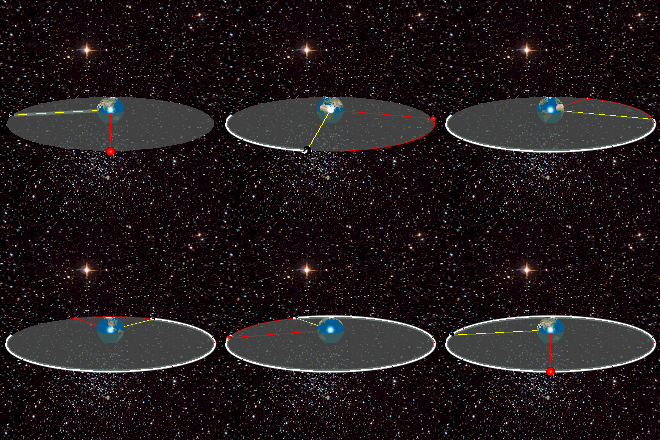
Satellites in geostationary orbit.

A geosynchronous satellite is a satellite in geosynchronous orbit, with an orbital period the same as the Earth's rotation period. Such a satellite returns to the same position in the sky after each sidereal day, and over the course of a day traces out a path in the sky that is typically some form of analemma. A special case of geosynchronous satellite is the geostationary satellite, which has a geostationary orbit – a circular geosynchronous orbit directly above the Earth's equator. Another type of geosynchronous orbit used by satellites is the Tundra elliptical orbit.

Geostationary satellites have the unique property of remaining permanently fixed in exactly the same position in the sky as viewed from any fixed location on Earth, meaning that ground-based antennas do not need to track them but can remain fixed in one direction. Such satellites are often used for communication purposes; a geosynchronous network is a communication network based on communication with or through geosynchronous satellites.

Definition

[edit]

The term geosynchronous refers to the satellite's orbital period which enables it to be matched, with the rotation of the Earth ("geo-"). Along with this orbital period requirement, to be geostationary as well, the satellite must be placed in an orbit that puts it in the vicinity over the equator. These two requirements make the satellite appear in an unchanging area of visibility when viewed from the Earth's surface, enabling continuous operation from one point on the ground. The special case of a geostationary orbit is the most common type of orbit for communications satellites.

If a geosynchronous satellite's orbit is not exactly aligned with the Earth's equator, the orbit is known as an inclined orbit. It will appear (when viewed by someone on the ground) to oscillate daily around a fixed point. As the angle between the orbit and the equator decreases, the magnitude of this oscillation becomes smaller; when the orbit lies entirely over the equator in a circular orbit, the satellite remains stationary relative to the Earth's surface – it is said to be geostationary.

Application

[edit]

As of October 2018, there are approximately 446 active geosynchronous satellites, some of which are not operational.[1][2][3]

A geostationary satellite is in orbit around the Earth at an altitude where it orbits at the same rate as the Earth turns. An observer at any place where the satellite is visible will always see it in exactly the same spot in the sky, unlike stars and planets that move continuously.

Geostationary satellites appear to be fixed over one spot above the equator. Receiving and transmitting antennas on the earth do not need to track such a satellite. These antennas can be fixed in place and are much less expensive than tracking antennas. These satellites have revolutionized global communications, television broadcasting and weather forecasting, and have a number of important defense and intelligence applications.

One disadvantage of geostationary satellites is a result of their high altitude: radio signals take approximately 0.25 of a second to reach and return from the satellite, resulting in a small but significant signal delay. This delay increases the difficulty of telephone conversation and reduces the performance of common network protocols such as TCP/IP, but does not present a problem with non-interactive systems such as satellite television broadcasts. There are a number of proprietary satellite data protocols that are designed to proxy TCP/IP connections over long-delay satellite links—these are marketed as being a partial solution to the poor performance of native TCP over satellite links. TCP presumes that all loss is due to congestion, not errors, and probes link capacity with its "slow start" algorithm, which only sends packets once it is known that earlier packets have been received. Slow start is very slow over a path using a geostationary satellite. RFC 2488, written in 1999, gives several suggestions on this issue.

There are some advantages of geo-stationary satellites:

  • Get high temporal resolution data.
  • Tracking of the satellite by its earth stations is simplified.
  • Satellite always in same position.

A disadvantage of geostationary satellites is the incomplete geographical coverage, since ground stations at higher than roughly 60 degrees latitude have difficulty reliably receiving signals at low elevations. Satellite dishes at such high latitudes would need to be pointed almost directly towards the horizon. The signals would have to pass through the largest amount of atmosphere, and could even be blocked by land topography, vegetation or buildings. In the USSR, a practical solution was developed for this problem with the creation of special Molniya / Orbita inclined path satellite networks with elliptical orbits. Similar elliptical orbits are used for the Sirius Radio satellites.

History

[edit]

The concept was first proposed by Herman Potočnik in 1928 and popularised by the science fiction author Arthur C. Clarke in a paper in Wireless World in 1945.[4] Working prior to the advent of solid-state electronics, Clarke envisioned a trio of large, crewed space stations arranged in a triangle around the planet. Modern satellites are numerous, uncrewed, and often no larger than an automobile.

Widely known as the "father of the geosynchronous satellite", Harold Rosen, an engineer at Hughes Aircraft Company, invented the first operational geosynchronous satellite, Syncom 2.[5] It was launched on a Delta rocket B booster from Cape Canaveral July 26, 1963.

The first geostationary communication satellite was Syncom 3, launched on August 19, 1964, with a Delta D launch vehicle from Cape Canaveral. The satellite, in orbit approximately above the International Date Line, was used to telecast the 1964 Summer Olympics in Tokyo to the United States.

Westar 1 was America's first domestic and commercially launched geostationary communications satellite, launched by Western Union and NASA on April 13, 1974.

See also

[edit]

References

[edit]
[edit]
Revisions and contributorsEdit on WikipediaRead on Wikipedia
from Grokipedia
A geosynchronous satellite is an Earth-orbiting spacecraft positioned in a geosynchronous orbit, characterized by an orbital period matching Earth's sidereal day of 23 hours, 56 minutes, and 4 seconds.[1] This orbit, typically at an altitude of approximately 35,786 kilometers above Earth's surface, enables the satellite to appear stationary relative to a fixed longitude on the ground, though non-equatorial inclinations may cause apparent north-south motion.[2] A subset of these, known as geostationary satellites, follow a circular path directly over the equator with zero inclination, remaining fixed over a single point for continuous observation or communication.[3] Geosynchronous satellites are primarily deployed for applications requiring persistent coverage of specific regions, such as telecommunications, where they relay television broadcasts, internet services, and telephone signals across vast areas with minimal need for ground antenna tracking.[1] In meteorology, they support real-time weather monitoring by capturing images of cloud formations, storms, and atmospheric conditions over continents or oceans, as exemplified by NOAA's Geostationary Operational Environmental Satellites (GOES).[4] Additional uses include military surveillance, navigation signal augmentation, and data relay systems, such as ESA's European Data Relay System, which connects low-Earth orbit satellites to ground stations without interruption.[3] The concept of geosynchronous orbits was first proposed by science fiction author Arthur C. Clarke in 1945, envisioning a ring of communication satellites for global broadcasting.[1] The first successful geosynchronous satellite, Syncom 2, was launched by NASA on July 26, 1963, demonstrating spin stabilization and enabling transatlantic television transmission during the 1964 Tokyo Olympics.[5] Today, hundreds of such satellites populate the geosynchronous belt, managed under international regulations by the International Telecommunication Union to prevent interference, though challenges like space debris and orbital congestion persist at this crowded altitude.[6]

Fundamentals

Definition and Terminology

A geosynchronous satellite, also known as a geosynchronous Earth orbit (GSO) satellite, is an Earth-orbiting spacecraft whose orbital period is synchronized with the sidereal rotation period of Earth, approximately 23 hours, 56 minutes, and 4 seconds.[1] This matching period ensures that the satellite completes one full orbit around Earth in the same time it takes for Earth to rotate once relative to the fixed stars, causing the satellite to return to the same position in the sky after each sidereal day. As a result, from Earth's surface, a geosynchronous satellite appears to hover or move slowly in a predictable pattern relative to the rotating planet, rather than tracing a rapidly changing path like satellites in lower orbits.[1] The term "geosynchronous" broadly describes any orbit with this specific period, derived from "geo" (Earth) and "synchronous" (synchronized with rotation), and it encompasses both equatorial and inclined configurations. In contrast, a geostationary orbit (GEO), or geosynchronous equatorial orbit, is a subset of geosynchronous orbits that is circular, direct (prograde), and lies precisely in the plane of Earth's equator with zero inclination.[1] This equatorial alignment makes GEO satellites appear completely stationary when viewed from the ground at the equator, fixed above a single longitude. Inclined geosynchronous orbits, however, result in the satellite's sub-satellite point tracing a figure-eight or analemma pattern daily due to the tilt relative to the equator.[2] Key related terms include the "sidereal day," defined as Earth's rotation period relative to distant stars (distinct from the solar day of about 24 hours), and the "orbital period," the duration for the satellite to complete one revolution around Earth's center of mass.[7] Visual aids like figure-ground diagrams are essential for illustrating these concepts, often depicting Earth as a rotating globe with the satellite's path overlaid to show apparent motion.[8] For instance, such diagrams highlight how a geostationary satellite maintains a single point on the equatorial ground track, while an inclined geosynchronous satellite's track forms a symmetric loop centered on the equator, emphasizing the role of inclination in perceived stability.[1] These representations aid in understanding the satellite's synchronization without requiring complex computations.[2]

Orbital Mechanics

The orbital mechanics of geosynchronous satellites are fundamentally described by Kepler's laws of planetary motion, with the third law providing the key relationship between the orbital period $ T $ and the semi-major axis $ a $: $ T^2 \propto a^3 $.[9] This law, derived from Newton's law of universal gravitation for a two-body system consisting of the satellite and Earth, takes the precise form $ T^2 = \frac{4\pi^2}{\mu} a^3 $, where $ \mu = GM $ is Earth's standard gravitational parameter, valued at approximately $ 3.986 \times 10^{14} $ m³/s². For geosynchronous orbits, the period $ T $ is set equal to Earth's sidereal rotation period of 86,164 seconds to achieve synchronization with the planet's rotation.[10] For a circular geosynchronous orbit, the semi-major axis $ a $ equals the orbital radius $ r $ from Earth's center. Solving Kepler's third law for $ r $ yields:
r=(μT24π2)1/3 r = \left( \frac{\mu T^2}{4\pi^2} \right)^{1/3}
Substituting the values of $ \mu $ and $ T $ gives $ r \approx 42,164 $ km, corresponding to an altitude of approximately 35,786 km above Earth's surface (accounting for Earth's mean radius of about 6,378 km).[11] The tangential velocity required to maintain this circular orbit is derived from the balance of gravitational force and centripetal acceleration: $ v = \sqrt{\frac{\mu}{r}} \approx 3.07 $ km/s.[12] The inclination of the orbit relative to Earth's equatorial plane significantly influences the satellite's apparent motion. In geosynchronous orbits with non-zero inclination, the projection of the orbital path onto Earth's surface results in a ground track that forms a characteristic figure-8 pattern, as the satellite's north-south oscillation combines with its east-west synchronization to Earth's rotation.[13] Although idealized Keplerian mechanics assumes a point-mass central body, real geosynchronous orbits experience perturbations that degrade stability over time. The primary gravitational influences from the Moon and Sun introduce long-period variations in orbital elements, such as gradual drifts in inclination and eccentricity, necessitating active control for sustained synchronization.[14]

Types of Geosynchronous Orbits

Inclined Geosynchronous Orbits

Inclined geosynchronous orbits are circular or near-circular paths around Earth with an orbital period equal to one sidereal day, approximately 23 hours 56 minutes, but with a non-zero inclination relative to the equatorial plane, typically ranging from a few degrees up to 90 degrees.[15] This inclination causes the satellite to oscillate in latitude, reaching a maximum of plus or minus the inclination angle, while maintaining synchronization with Earth's rotation in longitude.[16] Unlike equatorial geosynchronous orbits, these paths do not remain fixed over a single point but trace a dynamic path visible from ground stations.[15] The ground track of a satellite in an inclined geosynchronous orbit forms a distinctive analemma pattern, resembling a figure-eight centered on the equator at the satellite's mean longitude.[15] This closed curve repeats daily, with the satellite crossing the equator twice per orbit at the same longitude, providing prolonged visibility over specific latitude bands but requiring tracking antennas to follow the north-south motion.[15] The pattern's extent in latitude directly corresponds to the orbit's inclination, enabling extended dwell times over higher latitudes compared to equatorial orbits.[16] A key advantage of inclined geosynchronous orbits is their ability to provide coverage to higher latitudes without the equatorial confinement of zero-inclination paths, making them suitable for applications in polar or mid-latitude regions.[17] Additionally, launching into an inclined orbit from non-equatorial sites, such as those at latitudes matching the desired inclination, reduces the delta-v required for plane changes, conserving propellant and enabling more efficient missions from sites like Cape Canaveral (28.5° N) or Baikonur (45.6° N).[18] These orbits also increase overall capacity in the geosynchronous belt by allowing more satellites to share longitudinal slots without interference, as their latitudinal excursions separate their coverage footprints.[15] Prominent examples include Tundra orbits, which feature an inclination of approximately 63.4°—a critical value that stabilizes the apsides against precession due to Earth's oblateness—and a moderate eccentricity of about 0.25 to extend apogee dwell time over the northern hemisphere for enhanced polar coverage.[19] This configuration, with a 24-hour period, allows a single satellite to maintain visibility over Arctic regions for up to eight hours daily.[17] A related but distinct variant is the Molniya orbit, a semi-synchronous (12-hour period) highly elliptical path with similar 63.4° inclination, used for high-latitude communications and reconnaissance, though it requires constellations of multiple satellites to achieve continuous coverage equivalent to geosynchronous systems.[16] Despite these benefits, inclined geosynchronous orbits have coverage limitations, as the satellite does not remain stationary relative to any ground point except briefly at the analemma's apex latitudes matching the inclination; otherwise, it traces the figure-eight path, necessitating ground equipment to track its motion and potentially reducing efficiency for fixed-point services.[15] This dynamic visibility contrasts with the fixed positioning of equatorial geosynchronous orbits, limiting their use in applications requiring uninterrupted line-of-sight to a single location.[16]

Geostationary Orbits

A geostationary orbit (GEO) is a subset of geosynchronous orbits characterized by zero orbital inclination, placing the satellite directly above the Earth's equator at 0° latitude. In this configuration, the satellite maintains a fixed position relative to the Earth's surface, appearing motionless from ground observers, which enables continuous coverage along a specific longitude. This equatorial alignment allows for potential full 360° longitudinal coverage of the planet when multiple satellites are deployed at evenly spaced intervals.[20][21] The primary advantages of GEO stem from its stationary nature, providing uninterrupted line-of-sight visibility to approximately one-third of the Earth's surface from the satellite's vantage point. This fixed positioning is particularly beneficial for ground-based antennas, which can remain pointed at a single location without tracking mechanisms, simplifying equipment design and reducing operational costs. Such characteristics make GEO ideal for applications requiring persistent connectivity over large, fixed regions.[22][23] Orbital slots in GEO are regulated by the International Telecommunication Union (ITU) to ensure equitable access and prevent harmful interference between satellites. The ITU coordinates the assignment of these slots through its Master International Frequency Register, requiring administrations to submit detailed plans for frequency use and orbital positions, followed by bilateral negotiations. Satellites are typically spaced at least 2° apart along the equatorial arc—equivalent to about 1,000 km at GEO altitude—to minimize radio frequency interference, though exact separations may vary based on operational frequencies and coordination outcomes.[24][25][26] GEO serves as the backbone for numerous commercial satellite constellations, exemplified by operators like Intelsat and SES, which deploy fleets of satellites for global telecommunications and broadcasting services. These constellations leverage the orbit's stability to support high-capacity data relay, with hundreds of active GEO satellites providing reliable coverage for television distribution, internet backbone links, and maritime communications.[27][28]

Applications

Communications

Geosynchronous satellites play a pivotal role in telecommunications by serving as relays for television, internet, and telephony signals through onboard transponders that receive, amplify, and retransmit signals between ground stations and end users. These transponders operate primarily in the C-band (4–8 GHz), which offers low susceptibility to rain fade and is suited for wide-area broadcasting and telephony; the Ku-band (12–18 GHz), ideal for direct-to-home TV and mobile services due to its higher capacity and smaller antenna requirements; and the Ka-band (26–40 GHz), which enables high-throughput internet with ultra-high data rates but is more sensitive to atmospheric interference.[29][29][29] In satellite communications, beam types determine coverage and efficiency: wide beams provide broad regional or continental footprints for general broadcasting and telephony, ensuring reliable signal distribution over large areas with lower power density, while spot beams focus on smaller, targeted regions to enable frequency reuse and higher capacity for internet and specialized services like in-flight connectivity. Spot beams can deliver up to 20 times the data throughput of wide beams by concentrating power and allowing multiple beams to reuse the same frequencies without interference, making them essential for high-demand applications in dense or specific locales.[30][30] A typical geosynchronous communications satellite accommodates 24 to 72 transponders, each with a bandwidth of 36 to 72 MHz, enabling the handling of up to 155 Mbps per transponder for aggregated services. For instance, satellites in the Intelsat series, such as Intelsat 901, feature 56 transponders (44 in C-band and 12 in Ku-band) to support global TV distribution, internet backhaul, and voice telephony with scalable capacity.[31][31] As of 2025, advancements like Viasat-3, launched in 2023, provide over 1 Tbps capacity, supporting 5G backhaul and expanded broadband services.[32] The evolution of geosynchronous satellite communications has progressed from analog systems, which suffered from signal degradation and limited capacity, to digital formats starting with the DVB-S standard in the 1990s, and further to the DVB-S2 standard introduced in 2005, which enhances spectral efficiency by up to 30% through advanced modulation schemes like 8PSK and 16APSK, along with low-density parity-check coding. DVB-S2 supports high-definition video, interactive internet services, and robust error correction, facilitating seamless migration from legacy analog infrastructure while accommodating broadband demands.[33][33] This technological advancement has significantly boosted global connectivity, particularly in remote and rural areas where terrestrial infrastructure is impractical, by providing broadband backhaul for mobile networks and direct internet access, helping to address the connectivity gap for approximately 300 million people without mobile broadband coverage and the usage gap affecting 3.1 billion more as of 2025, thereby supporting education, healthcare, and economic development in regions like sub-Saharan Africa and rural Peru.[34][35] Geosynchronous satellites play a pivotal role in direct-to-home (DTH) broadcasting services, enabling the delivery of television and radio signals directly to consumers' receivers without intermediate infrastructure. These satellites, positioned in geostationary orbits, transmit high-power signals in the Ku-band (typically 11-14 GHz) from uplink stations to small parabolic antennas at homes, supporting digital compression for multiple channels including high-definition content.[36] For instance, DirecTV utilizes a fleet of geosynchronous satellites equipped with Ku-band transponders to provide nationwide DTH television services, reaching millions of subscribers with over 300 channels.[37] This one-way broadcasting model leverages the satellites' fixed position relative to Earth, allowing for simplified antenna alignment and reliable signal reception across large areas.[36] Coverage in broadcasting applications often employs hemispheric beams, which illuminate broad regions such as continents or subcontinents, facilitating regional distribution of content like news, entertainment, and sports. These beams, shaped by onboard antennas, ensure efficient power allocation for direct reception in underserved rural areas while minimizing spillover interference.[38] In Ku-band operations, such configurations support vast zones, for example, from North Africa to the Middle East, enabling operators to serve diverse audiences with localized programming.[39] In navigation augmentation, geosynchronous satellites enhance global navigation satellite systems (GNSS) like GPS by providing real-time differential corrections and integrity monitoring, significantly improving positional accuracy for civilian applications. The Wide Area Augmentation System (WAAS), operated by the U.S. Federal Aviation Administration, broadcasts correction signals via geostationary satellites to mitigate GPS errors from ionospheric delays, satellite clock drifts, and orbital inaccuracies, achieving horizontal and vertical accuracies of 1-3 meters.[40] Similarly, the European Geostationary Navigation Overlay Service (EGNOS) integrates three geostationary satellites with ground reference stations to overlay corrections on GPS and Galileo signals, delivering sub-meter precision in safety-critical scenarios such as aviation approaches.[41] These systems ensure seamless GNSS integration by transmitting wide-area integrity alerts, enabling receivers to detect and exclude faulty signals in real time.[42] An illustrative example is Inmarsat's geostationary satellite network, which supports mobile maritime and aeronautical communications with embedded broadcast capabilities for safety and operational efficiency. Operating in L-band and Ka-band, Inmarsat satellites deliver one-way broadcasts of maritime safety information, such as weather alerts and navigation warnings, to vessels and aircraft worldwide, complementing bidirectional voice and data links.[43] This hybrid approach enhances situational awareness in remote oceanic and polar-adjacent regions, where traditional ground-based broadcasting is infeasible.[44]

Scientific and Military Uses

Geosynchronous satellites play a critical role in scientific research by enabling continuous monitoring of space weather phenomena. The Geostationary Operational Environmental Satellites (GOES), operated jointly by NASA and NOAA, are positioned in geostationary orbits to provide real-time data on solar activity, including the detection of solar flares through instruments like the Extreme Ultraviolet and X-ray Irradiance Sensors (EXIS) and the Solar Ultraviolet Imager (SUVI).[45][46] These observations allow scientists to track coronal mass ejections and their potential impacts on Earth's magnetosphere, supporting space weather forecasting essential for protecting satellites and power grids.[47] In addition, geosynchronous satellites augment communication relays for certain space missions, extending the capabilities of ground-based systems like NASA's Deep Space Network (DSN). Conceptual designs for small GEO relay satellites have been proposed to provide space links for missions operating between low Earth orbit and distant points like the Earth-Sun L2 libration point, facilitating data transfer from deep-space probes by bridging gaps in direct ground visibility.[48] The Tracking and Data Relay Satellite System (TDRSS), a constellation of geosynchronous satellites, supports this role by relaying telemetry from various NASA missions, including some beyond near-Earth environments, thereby enhancing overall network efficiency.[49] Military applications of geosynchronous satellites emphasize strategic surveillance and secure operations. The Space-Based Infrared System (SBIRS) geosynchronous satellites detect missile launches by capturing infrared signatures from space, providing early warning for ballistic missile defense and battlespace awareness; for instance, SBIRS GEO-1 has supported real-time tracking of threats, such as Iranian missile launches in 2020.[50] These systems replace earlier Defense Support Program satellites, offering improved sensitivity and global coverage for reconnaissance and technical intelligence.[51] Secure communications represent another key military use, with the Defense Satellite Communications System (DSCS) providing encrypted, high-priority channels for command and control. DSCS III satellites, operating in geosynchronous orbits, deliver anti-jam, nuclear-hardened links for voice, data, and video transmission to deployed forces worldwide, ensuring resilient connectivity during conflicts.[52][53] Geosynchronous satellites also enable stable platforms for specialized scientific instruments, such as proposed X-ray observatories that benefit from the orbit's fixed positioning relative to Earth. The GEO-X mission concept envisions an ultralightweight X-ray telescope in geostationary orbit to monitor supermassive black holes and transient events with uninterrupted pointing, leveraging the orbit's stability for long-duration observations without the interruptions faced by low-Earth orbit telescopes.[54] A major challenge for scientific and military payloads in geosynchronous orbits is exposure to the Van Allen radiation belts, particularly the outer belt, which encompasses GEO altitudes and contains high-energy protons and electrons that can degrade electronics. Radiation hardening techniques, such as using shielded components, rad-hardened microelectronics, and error-correcting software, are essential to mitigate single-event effects and total ionizing dose accumulation, ensuring payload reliability over multi-year missions.[55][56]

History and Development

Early Concepts

The theoretical foundations of geosynchronous satellites emerged from early 20th-century advancements in rocketry and orbital mechanics, pioneered by figures such as Konstantin Tsiolkovsky and Hermann Oberth, whose work on multi-stage rockets and space stations laid the groundwork for concepts of sustained Earth orbits. Tsiolkovsky's 1903 treatise on rocket propulsion outlined key mathematical principles for space travel. Oberth, building on this in his 1923 book Die Rakete zu den Planetenräumen, proposed orbiting stations for observation and communication. A pivotal advancement came in 1945 when British science fiction writer and engineer Arthur C. Clarke published "Extra-Terrestrial Relays: Can Rocket Stations Give World-wide Radio Coverage?" in Wireless World, formally proposing a network of three manned geostationary satellites positioned 36,000 kilometers above the equator to relay radio signals globally, eliminating the need for extensive ground infrastructure.[57] Clarke calculated that satellites in this altitude's 24-hour orbit would appear stationary, enabling continuous coverage of over half the Earth's surface each, with the trio providing worldwide communication relays powered by solar energy and atomic batteries.[5] This vision, though initially overlooked, established the core concept of geostationary "extraterrestrial relays" for telecommunications. In the 1950s, as rocketry progressed, engineers like John R. Pierce at Bell Laboratories actively advocated for practical communications satellites, emphasizing passive reflectors in orbit to bounce signals across continents. Pierce, a proponent since the mid-1950s, pushed for satellite-based systems in internal memos and publications, influencing U.S. military and industry interest despite initial skepticism about launch capabilities.[58] This advocacy culminated in Project SCORE, launched on December 18, 1958, by the U.S. Air Force using an Atlas missile; the 68-kilogram satellite served as the world's first communications device, functioning as a passive reflector and store-and-forward repeater that broadcast President Dwight D. Eisenhower's Christmas message to over 250 ground stations worldwide.[59] Parallel to these technical proposals, international discussions on space resource allocation began in the late 1950s under United Nations auspices, addressing equitable use of orbital slots as satellite concepts gained traction. The UN General Assembly established the Committee on the Peaceful Uses of Outer Space (COPUOS) in 1959, where early sessions in the 1960s debated frequency and orbit assignments to prevent conflicts, particularly for the geostationary belt, involving coordination with the International Telecommunication Union (ITU) to manage emerging global demands.[60]

Major Milestones

The development of geosynchronous satellites reached a pivotal milestone with the launch of Syncom 2 on July 26, 1963, by NASA in collaboration with AT&T, marking the world's first successful geosynchronous communications satellite. Positioned in an inclined geosynchronous orbit over the Pacific Ocean, Syncom 2 demonstrated reliable voice and data transmission, proving the feasibility of synchronous satellite technology for real-time communications.[61][62] Building on this success, Syncom 3, launched on August 19, 1964, became the first geostationary satellite, achieving a true equatorial orbit that allowed it to remain fixed over a single point on Earth. This satellite facilitated the first live trans-Pacific television broadcast, relaying coverage of the 1964 Summer Olympics in Tokyo to the United States, showcasing the potential for global event broadcasting via geosynchronous orbits.[5][63] The commercial era began with the launch of Intelsat I, known as Early Bird, on April 6, 1965, the first operational commercial geosynchronous communications satellite developed by the International Telecommunications Satellite Organization (INTELSAT). Orbiting over the Atlantic, Early Bird enabled the first commercial transatlantic television transmissions, including live coverage of major events, and provided telephone and data services between Europe and North America, revolutionizing international connectivity.[5][64] In 1972, Canada achieved a breakthrough in domestic satellite applications with the launch of Anik A1 on November 9, the first geosynchronous satellite dedicated to serving a single nation's communications needs across its vast territory. Positioned over North America, Anik A1 connected remote Arctic communities with television, telephone, and data services, establishing a model for national satellite systems and expanding access in underserved regions.[65][66] Technological advancements in the 1970s included the adoption of three-axis stabilization, which improved pointing accuracy and payload efficiency compared to earlier spin-stabilized designs. A key example was RCA Satcom 1, launched on December 12, 1975, the first U.S. domestic geostationary satellite to employ this stabilization technique, enabling more precise antenna beam control and supporting expanded broadcasting and telecommunications services across the continental United States.[5][67] The 2010s saw the rise of high-throughput satellites (HTS), dramatically increasing data capacity through spot-beam technology. ViaSat-1, launched on October 19, 2011, set a benchmark as the highest-capacity geostationary satellite at the time, delivering over 140 Gbps of throughput focused on North America and enabling widespread broadband internet access for residential and mobile users.[68][69] More recently, SES-14, launched on January 25, 2018, exemplified advancements in HTS deployment despite an initial orbital insertion anomaly, providing high-capacity C- and Ku-band services across the Americas, the Caribbean, and Atlantic regions with over 100 spot beams for enhanced video and data distribution. In the 2020s, trends have shifted toward software-defined payloads in geosynchronous satellites, allowing dynamic reconfiguration of bandwidth and services to meet evolving demands, as demonstrated by Viasat-3 satellites, with the first (Americas) launched in May 2023 and the second (F2) in November 2025, providing greater flexibility for hybrid GEO-LEO architectures and next-generation connectivity.[70][71][72][73]

Technical Aspects

Launch and Deployment

The launch of geosynchronous satellites typically begins with a heavy-lift rocket placing the spacecraft into a geosynchronous transfer orbit (GTO), an elliptical path with a low perigee of approximately 250 kilometers and an apogee near 35,800 kilometers at geostationary altitude, often with an inclination of about 7 to 28 degrees depending on the launch site.[74] From this intermediate orbit, the satellite's onboard propulsion system performs the transfer to the final geosynchronous orbit. The primary maneuver involves firing an apogee kick motor (AKM), a solid or liquid rocket engine integrated into the satellite, at the first apogee—reached roughly three hours after launch—to raise the perigee and circularize the orbit while adjusting inclination if needed for equatorial positioning.[74] Subsequent smaller burns may refine the orbit, completing the insertion within hours to days. Common launch vehicles for these missions include the European Ariane 6, which is designed for GTO insertions and can carry up to two large geostationary satellites per flight using its dual-payload capability.[75] The American Falcon 9 rocket, operated by SpaceX, has become a frequent choice for commercial GTO deliveries, enabling efficient transfers for satellites bound for geosynchronous orbits through its reusable first stage and high payload capacity of over 8,000 kilograms to GTO.[76] Russia's Proton-M, a veteran heavy-lift vehicle, has also supported numerous GEO missions, launching satellites directly into supersynchronous GTO profiles to simplify the satellite's orbit-raising burns.[77] Other current options include the United Launch Alliance Atlas V, which continues to deliver heavy GEO payloads as demonstrated by the ViaSat-3 F2 launch in November 2025.[78] These vehicles often accommodate multiple satellites on a single launch, such as Ariane 6's dual large payloads or Falcon 9's recent deployments of four or more smaller geosynchronous spacecraft, optimizing costs for operators.[75][79] Following separation from the upper stage—typically at an altitude of several hundred kilometers—the satellite undergoes initial deployment phases to prepare for orbit raising. Attitude control thrusters stabilize the spacecraft, after which solar arrays unfurl to generate power, often using mechanisms like roll-out designs that extend panels up to 10 meters or more for kilowatt-level output essential to propulsion operations.[80] Antennas and other appendages, such as reflectors for communications, then deploy in sequence to avoid interference, with the entire process completing within minutes to hours post-separation to enable the AKM firing at the initial 180- to 250-degree true anomaly apogee point.[74] Historical success rates for GEO insertions exceed 95 percent for commercial missions, reflecting advances in vehicle reliability and satellite autonomy, though early flights faced challenges.[81] For instance, the Ariane 5's inaugural launch (Flight 501) in 1996 failed 37 seconds after main engine ignition due to a software error in the inertial reference system, causing loss of guidance and the vehicle's destruction at 3,700 meters altitude, which delayed the program's GEO operations.[82] Subsequent improvements have yielded overall success rates above 98 percent for mature systems like Falcon 9 in GTO missions.[81]

Station-Keeping and Challenges

Geosynchronous satellites require station-keeping maneuvers to counteract orbital perturbations and maintain their assigned positions, ensuring reliable service and compliance with international regulations. The primary perturbations include the gravitational influences of the Sun and Moon, which induce a secular drift in orbital inclination of approximately 0.85° per year, and Earth's non-spherical geopotential, particularly its triaxiality, which causes longitude drift toward stable equilibrium points known as gravitational wells at around 75°E and 105°W. Solar radiation pressure also contributes to eccentricity growth and minor longitude variations. These effects, if unmitigated, would displace the satellite from its slot, leading to service degradation or interference with neighboring satellites.[83][84] Station-keeping involves two main types of maneuvers: east-west adjustments to control longitude and eccentricity, requiring a modest velocity change of about 1-2 m/s per year, and north-south corrections to manage inclination, demanding significantly higher Δv of around 46-50 m/s annually. Traditionally, chemical propulsion systems using monopropellant thrusters (e.g., hydrazine) perform these as discrete, high-thrust burns every few weeks, providing rapid adjustments but consuming substantial propellant that limits satellite lifespan to 10-15 years. In contrast, electric propulsion—such as ion or Hall-effect thrusters—offers higher efficiency (specific impulse up to 3,000 seconds versus 300 for chemical), enabling mass savings of up to 40% and extended operations, though it necessitates prolonged, low-thrust firings (e.g., hours to days per maneuver) that can temporarily affect pointing accuracy. Momentum management dumps, using similar thrusters, are also routine to unload reaction wheels affected by solar torques.[84][83][85] Key challenges in station-keeping include propellant depletion, which directly constrains mission duration and requires precise budgeting—north-south maneuvers alone can account for over 80% of fuel use—and thruster degradation or failures, which may force suboptimal firing sequences or reduced control authority. In the crowded geosynchronous belt, collocation of multiple satellites at the same longitude demands sub-degree precision to avoid collisions, complicating maneuver planning amid perturbations. Regulatory requirements, such as the International Telecommunication Union (ITU) Recommendation S.484 mandating maintenance within ±0.1° of nominal longitude, add operational pressure, with non-compliance risking interference claims. End-of-life disposal poses further difficulties, as satellites must typically raise their orbit by 300 km to mitigate debris risks, consuming remaining fuel and challenging all-electric designs with limited thrust. Emerging solutions like autonomous low-thrust strategies and advanced orbit determination via GPS aim to mitigate these issues by minimizing disruptions and improving efficiency.[86][85][84]

References

User Avatar
No comments yet.