Hubbry Logo
Meat hangingMeat hangingMain
Open search
Meat hanging
Community hub
Meat hanging
logo
8 pages, 0 posts
0 subscribers
Be the first to start a discussion here.
Meat hanging
Meat hanging
from Wikipedia
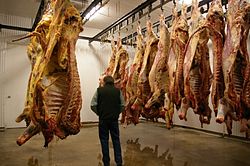
Meat hanging in a cooler room. Freshly slaughtered animals are on the left, day-old animals on the right.

Meat hanging is the culinary process of dry-aging meat to develop its flavor and tenderness.

It is applied both to beef and to game.

Hanging game

[edit]

Traditionally, game meat was hung until "high" or "gamey", that is, approaching a state of decomposition.[1]

Dry-aging beef

[edit]

For dry-aged beef, the meat is hung in a room kept between 33–37 degrees Fahrenheit (1–3 degrees Celsius), with relative humidity of around 85%. If the room is too hot, the meat will spoil, and if it is too cold, the meat freezes and dry aging stops. Good ventilation prevents bacteria from developing on the meat. The meat is checked on regularly.[2]

Meat hanging allows processes to continue in the meat that would normally cease in dead animals. For example, the muscles in the meat continue to use the hemoglobin that is stored in the soft tissue of the animal. This normal biological process creates lactic acid. Contrary to popular belief, animals cannot be completely drained of bodily fluid during slaughter, since soft tissue necessarily retains some amount of fluid. This can be well observed by cooking a steak and observing "blood" on the plate. Since the blood is no longer being circulated through the body, the lactic acid starts to break down the muscle and connective tissues around it.[3]

The process takes at a minimum eleven days. The longer the meat is hung, the better the flavor will be, but also the higher the chance that the meat will spoil. Most companies limit hanging to 20–30 days.[2] Up to 10–15% of the water content may evaporate.[3]

As the meat ages, its color goes from red to purple, and the texture becomes firmer.[3]

Popularity

[edit]

In the 1960s, the cheaper wet-aging process largely displaced dry aging as dry-aged meat is 15–25% more expensive than wet-aged beef: dry hanging rooms are expensive; meat weight is reduced through evaporation; and some proportion of meat spoils.[4][3]

Dry aging became more popular in the 1980s, and dry aged beef continues to be sold in high-end restaurants around the world.[4]

See also

[edit]

References

[edit]
Revisions and contributorsEdit on WikipediaRead on Wikipedia
from Grokipedia
Meat hanging is the culinary and butchery practice of suspending meat carcasses or large cuts, most commonly beef, in a temperature- and humidity-controlled environment to facilitate dry aging, a process that enhances flavor, tenderness, and juiciness through enzymatic breakdown of muscle tissues and controlled moisture loss. This method, distinct from wet aging which uses vacuum-sealed packaging, exposes the meat to air circulation, typically at temperatures between 0°C and 4°C with 75–80% relative humidity and airflow of 0.5–2 m/s, for periods ranging from 14 to 55 days depending on desired outcomes. Historically, has been employed for centuries as a means of preservation and quality improvement before modern , with carcasses traditionally suspended in cool, dry conditions to allow natural enzymes to tenderize the and develop deeper flavors; its popularity waned mid-20th century with the rise of vacuum packaging but has seen a resurgence in premium markets for its unique nutty, taste profile. The process requires high-quality starting , such as USDA or Prime grades, and results in a protective pellicle or crust forming on the surface, which must be trimmed post-aging, leading to weight losses of 6–15% from and up to 24% from trim. While primarily associated with , the technique applies to other meats like lamb or , though it demands precise control to minimize microbial risks and spoilage. Economically, dry-aged commands significantly higher prices than conventional to offset processing costs, appealing to consumers who value the intensified sensory attributes over conventional fresh cuts.

Fundamentals

Definition and Purpose

Meat hanging is the controlled suspension of fresh meat carcasses or primal cuts in a cool (typically 0–4°C) and humid (75–80% relative humidity) environment to enable natural aging processes, such as enzymatic and microbial activities that enhance meat quality. The primary purposes of this technique are to achieve tenderization through the enzymatic breakdown of muscle proteins and connective tissues, to develop complex flavors via (protein degradation) and (fat breakdown), and historically to preserve meat by slowing spoilage in the absence of , allowing consumption over extended periods. Enzymatic processes, including the action of calpains and cathepsins, contribute to these improvements by weakening muscle fibers. This method is most suitable for red meats like and , which can be hung for 5–55 days to optimize tenderness and flavor without significant spoilage risk under proper conditions. In comparison, tolerates only brief hanging of 1–3 days in a cool, airy space due to its limited fat content and higher susceptibility to , while is unsuitable for hanging because its looser tissue structure allows rapid microbial penetration and spoilage. Unlike wet-aging, which involves vacuum-sealing in impermeable to retain , hanging exposes cuts to air circulation, resulting in surface , of 5–25%, and intensified flavor concentration from and oxidation.

Historical Development

The practice of hanging traces its origins to ancient societies, where it served as a primary method for preserving game after hunts, particularly in cooler climates that facilitated natural . Records from Middle Eastern and oriental cultures show active of foods, including , using sun and wind dating back to 12,000 B.C., which prevented spoilage in the absence of modern storage. In medieval , meat hanging evolved into a regulated aspect of butchery, with carcasses processed using methods such as air drying and salting in cool, ventilated spaces before further handling or sale. Butchers' guilds, formed in as early as 1272, oversaw meat handling to ensure quality, though practices focused on seasonal slaughter to combat decay in pre-refrigeration eras. The marked a pivotal industrialization of meat hanging through centralized facilities like Chicago's , established in 1865, which handled millions of annually by the . Carcasses were hoisted via steam-powered rails and hung in ice-cooled rooms for chilling and short-term aging, standardizing the process for domestic and export markets via refrigerated rail cars developed by innovators like Gustavus Swift. This shift enabled year-round beef production and distribution, positioning as the global meatpacking hub. Post-World War II advancements in mechanical diminished reliance on extended hanging, allowing immediate cooling of meat in processing plants and households, which reduced traditional aging to minimize weight loss and spoilage risks. By the , however, dry-aging experienced a resurgence in gourmet cuisine, with restaurants embracing 28- to 120-day hangs for premium beef to achieve nutty, intensified flavors, reflecting a premium market boom. Cultural adaptations highlight regional nuances: in Scottish Highlands traditions, game like venison has long been hung in dedicated larders for up to several weeks post-hunt to mature and concentrate flavors, a practice tied to estate-based hunting since medieval times. Conversely, French charcuterie, emerging in the 15th century, emphasizes hanging pork sausages and hams in controlled environments for dry-curing, using salt and air exposure to preserve and develop complex tastes without cooking.

Traditional Methods

Hanging Game

Hanging game involves the post-hunt processing of meats to drain blood and facilitate the resolution of , a critical step that typically lasts 1-7 days at controlled temperatures of 34-40°F (1-4°C) to ensure tenderness and safety. This process differs from domestic handling by prioritizing rapid field interventions due to the lack of immediate controls, emphasizing to prevent spoilage and a shorter duration to account for the leaner composition of wild animals. Species-specific guidelines guide the hanging duration and method to optimize quality while minimizing risks. For venison from deer, the carcass is traditionally hung by the hind legs using a or sturdy branch inserted between the leg bone and , allowing for 3-5 days of aging to enhance tenderness without over-toughening the . Upland birds like require briefer hangs of 1-2 days at similar cool temperatures to avoid excessive toughness in their smaller, more delicate frames. Traditional methods begin with prompt field dressing—removing the entrails to cool the carcass quickly—followed by evisceration to eliminate digestive contents and reduce risks, after which the game is suspended in well-ventilated spaces for air circulation. The animal's natural diet significantly influences the resulting flavor, with grass-fed often yielding a more pronounced, gamier taste compared to grain-finished domestic meats. Key challenges in hanging game include the potential for rapid , particularly in warmer climates above 40°F (), which necessitates quicker processing and quartering rather than full-carcass hanging to prevent spoilage—unlike the longer tolerances of . In such conditions, hunters may opt for immediate icing or cooling to mimic ideal temperatures, underscoring the need for environmental awareness in wild preparation.

Dry-Aging Beef

Dry-aging beef involves hanging large primal cuts, such as or sections from carcasses, in a controlled refrigerated environment to enhance flavor and tenderness through enzymatic and microbial processes. The process typically occurs at temperatures between 0°C and 4°C (32°F to 39°F) with relative of 75% to 80% and controlled of 0.5 to 2 m/s to prevent excessive or spoilage. This aging period, often lasting 28 to 55 days, allows natural enzymes to break down muscle fibers and connective tissues while concentrating flavors, resulting in a characteristic nutty, beefy profile. The step-by-step process begins with initial butchering, where high-quality primals are selected and portioned immediately after slaughter to ensure and optimal starting conditions. These cuts are then placed unpackaged on wire racks, perforated shelves, or hooks in the aging chamber to allow even exposure to air, though breathable wrapping is sometimes used to protect against while permitting evaporation. Throughout the aging, a dried outer layer known as the pellicle forms due to surface , which is periodically monitored and trimmed as needed to maintain , though major trimming occurs at the end to remove the hardened, discolored crust. After the designated period, the aged is portioned for sale or cooking, with the interior revealing intensified marbling and texture. Duration significantly influences outcomes, with tenderness showing noticeable improvement after 14 to 21 days through that softens muscle structure, providing mild enhancement suitable for initial aging. Extending beyond 28 days further intensifies flavors via accumulation of free and precursors from and , yielding a more complex, roasted taste profile. Economically, dry-aging incurs substantial losses, with shrinkage from moisture evaporation accounting for 3% to 10% of weight over 14 to 21 days, compounded by 5% to 18% trim loss from the pellicle, resulting in total reductions of 10% to 30% and elevating the cost per pound. This method, though traditional, has experienced a revival in for its premium appeal.

Scientific Principles

Biochemical Processes

During the post-mortem period in meat hanging, muscle declines from approximately 7.0 immediately after slaughter to 5.4–5.7 within 24 hours, primarily due to anaerobic glycolysis producing and depleting ATP stores. This acidification creates an optimal environment for endogenous proteolytic s, as calpains are active near neutral pH while cathepsins function effectively in the acidic range of 5.0–6.0, thereby initiating tenderization processes. Temperature must be controlled at 0–4°C during hanging to preserve enzyme functionality and prevent protein denaturation, which could otherwise halt beneficial biochemical changes. Endogenous enzymes play a central role in , with calpains—calcium-dependent proteases—predominantly active in the early post-rigor phase (0–24 hours), targeting and breaking down key myofibrillar proteins such as , , and nebulin to enhance tenderness. Cathepsins, lysosomal endopeptidases like cathepsins B, H, and L, become more prominent later post-rigor, hydrolyzing additional myofibrillar structures including and under the lowered conditions. These actions collectively weaken the muscle fiber network, contributing to improved texture without external interventions. Proteolysis unfolds in distinct stages during meat hanging: an initial autolysis phase within the first 0–24 hours post-mortem, driven by rapid enzyme activation, followed by extended breakdown beyond 14 days as peptides and free amino acids accumulate from ongoing hydrolysis. This process can be represented simply as: ProteinhydrolysisPeptides+Amino acids\text{Protein} \xrightarrow{\text{hydrolysis}} \text{Peptides} + \text{Amino acids}
Add your contribution
Related Hubs
User Avatar
No comments yet.