


Community hub
Recent from talks
Contribute something
Nothing was collected or created yet.
Harborne
View on Wikipedia
 | This article needs additional citations for verification. (April 2010) |
Harborne is an affluent area in Birmingham, West Midlands, England, located 3 miles (5 kilometres) south-west of Birmingham City Centre. It is a Birmingham City Council ward in the formal district and in the parliamentary constituency of Birmingham Edgbaston.
Key Information


History
[edit]

There is evidence of a Roman fort around the Queen Elizabeth Hospital Birmingham and Metchley Park,[2][3] near Harborne.
The earliest written mention of Harborne is an entry in the Domesday Book of 1086,[4] however the settlement pre-dates this. The spelling of Harborne has appeared with several variations through the centuries, and the derivation of the place name has often been disputed. One of the more probable suggestions is 'boundary brook', although 'high brow' and 'dirty brook' are also possibilities.[5][6]
Harborne is a Victorian suburb with a large stock of housing dating from pre-1900 (found mainly around the High Street), and the early 20th century. The oldest part of what is known locally as 'Harborne Village' is centred on St Peter's Church, (Church of England), Old Church Road, which dates from Anglo-Saxon times (St Chad preached there) and whose tower was (re)constructed in the 14th century.[citation needed]
As a non-Quaker area of the city, Harborne became well-supplied with public houses compared to nearby areas such as Edgbaston and Bournville. There is a famous Harborne Run pub crawl consisting of from 10 to 15 pubs (the agreed itinerary varies).
St Mary's Church was the first Roman Catholic congregation formed by the Passionists who worshiped in a disused Methodist Chapel on Harborne High Street from 1870.[citation needed] Building work started on the current church, in Vivian Road, on 8 September 1875 and it opened on 6 February 1877.[7] The Augustinians (Austin Friars) arrived at St Mary's in 1973[citation needed][8] to a growing Catholic population; work on a new church, attached to the side of the old church, started on 1 August 1977 and was finished in 56 weeks.[citation needed] St Mary's Parish Centre was opened in 1990 and is next door to the church.[citation needed]
Harborne railway station opened on 10 August 1874, at the end of the short Harborne Branch Line; this left the London, Midland and Scottish Railway's Birmingham-Wolverhampton line at Ladywood. It was closed to passengers on 26 November 1934 and to freight traffic in November 1963.[9] The former trackbed forms the Harborne Walkway, a two-mile (3 km) nature walk and cycling route from Harborne to Ladywood, where the canal can be followed either to Birmingham or Wolverhampton.
Harborne became part of the county borough of Birmingham and thus transferred from Staffordshire to Warwickshire in 1891[4] by the Local Govt. Bd.'s Prov. Orders Conf. (No. 13) Act, 54 & 55 Vic. c. 161 (local act), or in 1894[10] In 1911, the civil parish had a population of 13,902.[11] On 1 April 1912, the parish was abolished and merged with Birmingham.[12] It then became part of the West Midlands in 1974 by the Local Government Act 1972.
Geography
[edit]
Harborne lies to the west of Edgbaston, to the north of Selly Oak, to the east of Quinton, and to the south of the Bearwood and Warley areas of neighbouring Sandwell.
As a parish, it covered an area of 3,300 acres (1,300 hectares), 100 acres (40 hectares) of which was of woodland and plantations.[citation needed]
Harts Green is an area of Harborne.[13]
Beech Lanes is a suburban area of Harbone that began to be developed between 1872 and 1908.[14][15]
Demographics
[edit]The United Kingdom 2011 census revealed that 23,001 lived in Harborne; 17% of people were aged under 16, 69% were aged between 16 and 64, while 14% were aged over 65. The minority ethnic population made up 33% of the ward's population, compared with 41% for Birmingham. The census found that 75% (11,997) of the population aged 16 to 74 were working or seeking work, which compared with 69% for Birmingham.[16]
Education
[edit]There are four secondary schools in Harborne: Baskerville School, Harborne Academy, Lordswood Boys' School and Lordswood Girls' School.
There are six primary schools: Birmingham Blue Coat School, Chad Vale Primary School (both lie on the border between Harborne and Edgbaston), Harborne Primary School, St Mary's Catholic Primary School, St Peter's Church of England Primary School and Welsh House Farm Community School.
Harborne is currently served by Harborne Library which formally opened on 12 November 1892, occupying a former Masonic Hall, which was built in 1879.[17]
Harborne Primary School
[edit]| Harborne Primary School | |
|---|---|
| Location | |
 | |
Station Road Harborne , , B17 9LU England | |
| Coordinates | 52°27′32″N 1°57′11″W / 52.459°N 1.953°W |
| Information | |
| Type | Community School |
| Established | 1 September 2000 |
| Local authority | Birmingham |
| Department for Education URN | 132261 Tables |
| Ofsted | Reports |
| Chair of the Governors | Karen Mackenzie[18] |
| Principal | Mr Mark Slater |
| Head of School | Mrs Mandy Hughes |
| Gender | Coeducational |
| Age | 4 to 11 |
| Enrolment | 629 |
| Capacity | 595[19] |
| Houses | Hanover Stuart Tudor Windsor |
| Colours | Red and Yellow |
| Website | http://www.harborne.bham.sch.uk |
Harborne Primary School is a co-educational primary school for pupils aged 4 to 11. As of September 2014, the school had 629 students.[20]
The Edwardian infant school opened in 1902; a junior school was added to the site in 1912. In September 2000 the two schools were merged, forming Harborne Primary School as it is today.[21]
On 27 April 2011, a roof fire caused significant damage to the structure of the junior school.[22] More than 60 firefighters tackled the blaze. None of the pupils or staff were injured. The infant school reopened a week later, with the juniors moved to nearby Harborne Hall hotel for six months whilst the rebuild took place.[23] Birmingham City Council awarded the school £1.3 million for the rebuild project, which was completed a year later, in April 2012.[24]
In 2015, the school submitted plans to build an annex site on the ground of Lordswood Girls' School, to expand the school from 630 to 1050 places. The plans were opposed by residents of the nearby Hagley Road Retirement Village.[25] Further plans were submitted for a site on Court Oak Road, near Queen Alexandra College, to expand the school to 840 pupil places. In preparation for the expansion, the school will accept a further 30 reception children on its main site in September 2018. The one form entry annexe opened in September 2019.[26][27]
Politics
[edit]Harborne ward forms part of the Birmingham Edgbaston constituency at Westminster, represented by Labour's Preet Kaur Gill since 2017. At local government level, Harborne ward is represented on Birmingham City Council by one councillor from the Labour Party and one councillor from the Conservative Party. The former leader of Birmingham City Council, Mike Whitby, was a councillor in Harborne from 1997 to 2014 and was made a life peer taking the title of Baron Whitby, of Harborne in the City of Birmingham.[28]
The ward has a Ward Support Officer.[4]
Transport
[edit]Buses
[edit]National Express West Midlands is the primary bus operator in the area. Key routes include:[29]
- 11A and 11C Birmingham Outer Circle (clockwise)
- Services to Birmingham, Dudley, Halesowen, Perry Barr and West Bromwich.
Railway
[edit]Since the closure of Harborne railway station in 1934, the area's closest station has been University. West Midlands Trains operates services on the Cross-City Line to Redditch, Birmingham New Street and Lichfield Trent Valley; it also runs longer-distance services to Hereford.[30] CrossCountry operates hourly services between Cardiff Central, Birmingham New Street and Nottingham.[31]
Culture
[edit]Sport and leisure
[edit]
Harborne Hockey Club was founded in 1903 and is the highest ranked club in the local area.[citation needed] The club has six ladies' and five men's teams as well as a youth section. It is the only club in the West Midlands to be affiliated to Flyerz Hockey, which supports people with disabilities to play sport.
Harborne's tennis court facilities can be found in Moorpool at The Circle and on Moor Pool Avenue. Harborne has three bowling greens, two at public houses (Green Man and The Bell) and one in Moorpool. Grove Park and Queens Park are both in Harborne.
There are two golf courses, (Harborne Golf Course and Harborne Municipal Golf Course, as well as a cricket ground. When the swimming pool was rebuilt and opened in 2012, it was Birmingham's first new swimming pool for more than twenty years; the centre also houses fitness facilities.[32] Harborne is bordered by Bourn Brook Walkway on the south and Harborne Walkway to the north east.[33][34]
Food and drink
[edit]Harborne Run
[edit]The Harborne Mile is a pub crawl from one end of Harborne High Street (and ancillary roads) to the other, involving all or some of the public houses listed below.[35]
Current pubs
[edit]| Name | Image | Former name(s) | Operator | Location | Date | Grid ref.
Geo-coordinates |
|---|---|---|---|---|---|---|
| White Swan | 
|

|
Mitchells & Butlers Premium Country Pubs |
Harborne Road, B15 3TT | c. 1800 – c. 1850 | 52°28′00″N 1°56′03″W / 52.4666°N 1.9343°W[36] |
| Green Man | 
|
|
Mitchells & Butlers Ember Inns |
2 High Street, B17 9NE | c. 1940 | 52°27′40″N 1°56′35″W / 52.4610°N 1.9431°W |
| The Plough |
|
Independent | 21 High Street, B17 9NT | 52°27′40″N 1°56′37″W / 52.4611°N 1.9436°W | ||
| The Hop Garden | The Sportsman | Independent | 19 Metchley Lane, B17 0HT | 52°27′36″N 1°56′36″W / 52.4599°N 1.9432°W[37] | ||
| White Horse |
|
Independent | 2 York Street, B17 0HG | 52°27′33″N 1°56′47″W / 52.4592°N 1.9465°W | ||
| Harborne Stores |
|
Stonegate Pub Company | 109 High Street, B17 9NP | 52°27′33″N 1°56′52″W / 52.4593°N 1.9477°W | ||
| Sommar Bar | Drinks World, The Paper Duck | Independent | 115 High Street, B17 9JT | 52°27′33″N 1°56′52″W / 52.4592°N 1.9478°W | ||
| Slug and Lettuce | The Proverbial The Varsity |
Stonegate Pub Company | 186-196 High Street, B17 9PP | 52°27′31″N 1°56′57″W / 52.4585°N 1.9493°W[38] | ||
| The Junction |
|
Mitchells & Butlers Castle Pubs |
212 High Street, B17 9PT | 1904 | 52°27′30″N 1°57′01″W / 52.4583°N 1.9503°W[39] | |
| The New Inn |
|
Marston's Brewery | 74 Vivian Road, B17 0DJ | c. 1883 | 52°27′27″N 1°57′10″W / 52.4574°N 1.9527°W[40] | |
| O'Neils | The Vine | Mitchells & Butlers Sizzling Pubs |
310 High Street, B17 9PU | c. 1830s | 52°27′29″N 1°57′17″W / 52.4580°N 1.9548°W | |
| The Bell | 
|
|
Stonegate Pub Company | 11 Old Church Road, B17 0BB | c. 1700 – c. 1800 | 52°27′14″N 1°57′33″W / 52.4538°N 1.9593°W[41] |
Former pubs
[edit]| Name | Image | Former name(s) | Operator | Location | Dates | Grid ref.
Geo-coordinates |
|---|---|---|---|---|---|---|
| Fish Inn | Fish Lane (now North Road) |
|||||
| The Huntsman | The Kings Arms | 356 High Street, B17 9PU | ?-2013 | 52°27′28″N 1°57′24″W / 52.4579°N 1.9567°W[42] | ||
| The Duke of York | 52°27′30″N 1°57′28″W / 52.4583°N 1.9579°W | |||||
| Scarlet Pimpernel | Tennal Road, B32 2JE | 52°27′18″N 1°57′58″W / 52.4551°N 1.9660°W |
Notable residents
[edit]

- David Cox (1783–1859), an English landscape painter of the Birmingham School.[43]
- Thomas Attwood (1783–1856), banker, economist, political campaigner and MP.[4]
- Thomas Baker (1809–1864), a Midlands landscape painter and watercolourist
- Elihu Burritt (1810–1879), an American diplomat, philanthropist and social activist.
- Edward Augustus Freeman (1823–1892), an English historian.[44]
- Ethel Arnold (1865–1930), journalist, author and lecturer on female suffrage.
- Granville Bantock (1868–1946), composer of classical music.
- Alfred Priest (1874–1929), portrait painter.[45]
- Francis William Aston FRS (1877–1945), chemist and physicist, won the 1922 Nobel Prize in Chemistry.[46]
- Sir Henry Rushbury KCVO CBE RA (1889–1968), painter and etcher.
- George Edward Hunt (1892–1960), an Arts and Crafts jeweller.[47]
- Hester Adrian, Baroness Adrian DBE (1899–1966), mental health worker.
- W. H. Auden (1907–1973), a British-American poet.
- Paul Grice (1913–1988), a philosopher of language
- Tony Shryane MBE (1919–2003), BBC radio programme producer
- Steve Gibbons (born 1941), singer-songwriter, guitarist and bandleader
- Mike Whitby (born 1948), politician, peer and former leader of Birmingham City Council
- Adrian Goldberg (born 1961), journalist, radio and TV presenter.
- Corrinne Wicks (born 1968), actress.[48]
- Ben Richards (born 1972), stage and TV actor and dancer.
- Sarah Manners (born 1975), actress.[49]
- Ocean Colour Scene (formed in 1989), rock band.[50]
Sport
[edit]- John James (born 1934), former footballer with 130 appearances
- Johnny Giles (born 1940), former footballer and manager.[51]
- Dennis Amiss MBE (born 1943), a former English cricketer, played 50 Test matches.[52]
See also
[edit]References
[edit]- ^ "Birmingham Ward population 2011". Retrieved 14 December 2015.
- ^ "Roman Military Sites in Britain". Archived from the original on 5 February 2012. Retrieved 17 January 2011.
- ^ "Birminghams Roman Fort". Archived from the original on 16 September 2009. Retrieved 17 January 2011.
- ^ a b c d "Harborne Ward". Birmingham City Council.
- ^ Duignan, William Henry (1902). Notes on Staffordshire Place Names. Oxford university press. p. 74. Retrieved 5 November 2020.
- ^ "Birmingham Mail". 2 May 2018. Retrieved 5 November 2020.
- ^ "History of St Mary's RC harborne". Retrieved 22 July 2019.
- ^ "History of St Mary's RC Harborne". Retrieved 22 July 2019.
- ^ "Harborne Railway History". Birmingham City Council.
- ^ Kings Norton Registration District: Harborne. UK BMD. Accessed 3 January 2023.
- ^ "Population statistics Harborne CP/AP through time". A Vision of Britain through Time. Retrieved 2 October 2024.
- ^ "Relationships and changes Harborne CP/AP through time". A Vision of Britain through Time. Retrieved 2 October 2024.
- ^ "A history of Birmingham places and place-names from A to Y". Retrieved 22 July 2019.
- ^ List of Post Offices in the united kingdom of Great Britain in Ireland. Post Office Department of the United States. 1872. p. 14. Retrieved 19 October 2025.
- ^ Kelly's Directory of Birmingham (including the Suburbs and the Boroughs of Smethwick and Aston Manor). 1908. pp. 343–344, 347, 387–388, 391. Retrieved 19 October 2025.
- ^ "Harborne ward Economic Key Facts" (PDF). Retrieved 25 May 2018.
- ^ "Harborne Local History: Harborne Library". Birmingham City Council. Retrieved 13 December 2018.
- ^ "Governors". Harborne Primary School. Retrieved 13 February 2015.
- ^ "EduBase Harborne Primary School". Department for Education. Retrieved 13 February 2015.
- ^ "Ofsted Information". Ofsted. Retrieved 14 February 2015.
- ^ "Harborne Primary School fire update: All staff and children evacuated safely". Birmingham Mail. 27 April 2011. Retrieved 14 February 2015.
- ^ "Harborne Primary School roof catches fire in Birmingham". BBC News. 28 April 2011. Retrieved 14 February 2015.
- ^ "Hotel to house fire-struck Harborne school". BBC News. 6 May 2011. Retrieved 14 February 2015.
- ^ "Harborne Primary School work to start after fire". BBC News. September 2011. Retrieved 14 February 2015.
- ^ "Harborne Primary School - retirement village residents oppose new annexe". 5 October 2015. Retrieved 16 May 2018.
- ^ "School Organisation: Harborne Primary School Expansion 2019". 12 April 2018. Retrieved 16 May 2018.
- ^ "Proposal for enlargement of a community primary school by expansion" (PDF). Retrieved 16 May 2018.
- ^ "No. 60625". The London Gazette. 12 September 2013. p. 18033.
- ^ "Harborne Bus Services". Bustimes.org. Retrieved 3 February 2025.
- ^ "Train Timetables and Schedules". West Midlands Railway. 15 December 2024. Retrieved 3 February 2025.
- ^ "Train Timetable". CrossCountry. 15 December 2024. Retrieved 3 February 2025.
- ^ "Harborne public swimming pool opens". BBC. 3 January 2012. Retrieved 21 May 2018.
- ^ "The West Midlands' secret parks". Birmingham Mail. 14 April 2018. Retrieved 21 May 2018.
- ^ "Harborne Ward Map". Birmingham City Council. Retrieved 21 May 2018.
- ^ "On your marks for the Harborne pub run". 6 October 2015. Retrieved 21 May 2018.
- ^ Historic England. "The White Swan Public House (1343047)". National Heritage List for England. Retrieved 21 May 2018.
- ^ "Harborne has got a brand new pub - and The Hop Garden is very different". Birmingham Mail. 1 December 2017. Retrieved 21 May 2018.
- ^ "Harborne Slug And Lettuce: First look inside the new bar". Birmingham Mail. 4 February 2015. Retrieved 21 May 2018.
- ^ "Our Story". Retrieved 21 May 2018.
- ^ "The New Inn in Harborne is under new management". Birmingham Mail. 1 September 2017. Retrieved 21 May 2018.
- ^ Historic England. "The Bell Public House (1343091)". National Heritage List for England. Retrieved 21 May 2018.
- ^ "Birmingham Lord of the Rings pub wrecked by fire to be demolished". Birmingham Mail. 18 May 2016. Retrieved 21 May 2018.
- ^ Squire, William Barclay (1911). . Encyclopædia Britannica. Vol. 7 (11th ed.). pp. 351–352.
- ^ Hunt, William (1911). . Encyclopædia Britannica. Vol. 11 (11th ed.). pp. 76–77.
- ^ "Obituary: Mr. Alfred Priest". The Times. London. 28 November 1929. p. 19.
- ^ Plaque #1616 on Open Plaques
- ^ Pyne, Anne (1990). "George Hunt Art Jeweller". The Antique Collector.
- ^ "Emmerdale star Corrinne Wicks on why she lives apart from her husband". Birmingham Mail. Retrieved 14 February 2015.
- ^ Laws, Roz. "7 things you never knew about Sarah Manners". Birmingham Mail. Retrieved 24 October 2023.
- ^ "Nostalgia: See how much Harborne has changed in 13 archive images from yesteryear". Birmingham Mail. Retrieved 14 February 2015.
- ^ Where are they now ? West Bromwich Albion Archived 20 January 2009 at the Wayback Machine
- ^ Bateman, Colin (1993). If The Cap Fits. Tony Williams Publications. pp. 12–13. ISBN 1-869833-21-X.
External links
[edit]- Birmingham City Council: Harborne Ward
- Early history Archived 29 June 2011 at the Wayback Machine
- The Harborne Society
- Harborne Village Partnership
- St Mary's RC Church, Vivian Road, Harborne.


Birmingham UK parliamentary constituencies (left) and city council wards | ||
| Edgbaston | 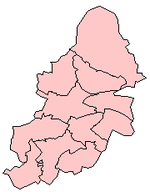 | |
| Erdington | ||
| Hall Green | ||
| Hodge Hill |
| |
| Ladywood | ||
| Northfield | ||
| Perry Barr | ||
| Selly Oak | ||
| Sutton Coldfield | ||
| Yardley | ||

| International | |
|---|---|
| National | |
| Other | |

Harborne
View on GrokipediaHarborne is a suburban ward and affluent residential district located in the south-west of Birmingham, West Midlands, England, approximately 3 miles (5 km) from the city centre.[1] Originally a rural village in Staffordshire first recorded in the Domesday Book of 1086, it remained largely agricultural until the 19th century, when suburban development accelerated due to improved transport links and proximity to Birmingham's industrial growth.[2] Incorporated into the City of Birmingham in 1894, Harborne has since evolved into a prosperous suburb while preserving elements of its village character, including a traditional high street with independent shops, pubs, and markets.[3] The ward's population stood at 23,003 as of recent local data, supporting a mix of Victorian and Edwardian housing stock alongside green spaces such as Grove Park.[1][4] Notable landmarks include St. Peter's Church, dating to medieval origins, and historic buildings like Harborne Hall, reflecting its pre-industrial heritage.[5] Harborne is recognised for its strong community ties, high-quality schools, and low crime rates relative to urban averages, contributing to its appeal as a desirable family-oriented location.[1]
History
Origins and Medieval Period
Harborne's origins trace to the Anglo-Saxon period, as an Anglian settlement within a protruding arm of Staffordshire between Warwickshire and Worcestershire.[6] Archaeological and documentary evidence indicates pre-Norman habitation focused on agriculture, with the area's name deriving from Old English elements denoting a stream associated with a boundary or filth, reflecting typical rural Anglo-Saxon topography. The earliest surviving record of Harborne appears in the Domesday Book of 1086, listing it as a manor in the hundred of Offlow, Staffordshire, held by the Bishop of Chester (St John).[7] The entry describes an agricultural estate with 46 ploughlands, supported by 7 plough teams on the lord's demesne and 25 by the men; 52 acres of meadow; and 1 mill, underscoring its self-sufficient rural character amid limited population, estimated at around 28 individuals across villagers and smallholders.[7] This positioned Harborne as a modest holding within the larger manor of Lichfield, emphasizing arable farming over broader commerce.[6] Through the medieval era, Harborne functioned as a dispersed rural village centered on its manor house and church, with scattered arable farms dominating land use.[6] St Peter's Church, the ancient parish church, likely originated in the early medieval period, though traditions suggest possible Saxon foundations; its surviving 14th- to 15th-century red sandstone tower attests to later medieval construction and reconstruction.[5] Episcopal oversight from Lichfield maintained continuity in lordship, while proximity to the nascent settlement of Birmingham offered minimal trade links, primarily in local produce, without significant urban influence until later centuries.[6]Industrialization and Suburban Growth
Harborne's 19th-century transformation from an agrarian village to a suburban commuter enclave was markedly accelerated by the opening of the Harborne Railway on 10 August 1874, which provided a direct link to Birmingham New Street station via the London and North Western Railway network.[8] This connection enabled regular passenger services—initially six trains daily on weekdays—increasing to around 30 by the pre-World War I period, and facilitated the influx of middle-class residents seeking respite from Birmingham's industrial core.[8] The railway diminished the viability of traditional agriculture, prompting local farms to specialize in market gardening, with 1845 directories recording significant output of corn, potatoes, and strawberries, complemented by Harborne's longstanding reputation for gooseberry cultivation, as evidenced by the annual dinners of the Gooseberry Growers' Society from 1815 onward.[3][6] Population growth underscored this shift, rising from 2,275 in 1801 to 10,729 by 1851, driven initially by light industries such as declining nailmaking in cottage forges and emerging operations like blacking manufactories and steel mills, before suburban expansion dominated.[9][3] By 1900, the population approached 10,000, reflecting a housing boom that included early lower-middle-class terraces in areas like South Street, Bull Street, and York Street by the 1850s, evolving into characteristic Victorian villas north of Harborne High Street post-railway.[6] This development catered to professionals commuting to Birmingham, with many surviving examples preserving the area's architectural heritage amid green, leafy settings.[10] The suburb's formal integration into Birmingham in 1891, following resident opposition in 1888 and 1889, addressed infrastructural demands of rapid urbanization, incorporating services like policing, pavements, street lighting, and a free library by 1892.[3][6] While Harborne avoided heavy industrialization, the population pressure necessitated sanitation enhancements, aligning with broader mid-century public health reforms prompted by cholera outbreaks in nearby Birmingham during the 1840s and 1850s, which exposed vulnerabilities in expanding peri-urban water and sewage systems.[3] These changes solidified Harborne's role as a desirable dormitory suburb, balancing residential appeal with proximity to urban opportunities.20th Century Expansion and Modern Era
In the early 20th century, Harborne's population reached approximately 10,000 by 1900, driven by suburban expansion as Birmingham's industrial growth spilled outward.[11] The formation of the Harborne Tenants Limited in 1907 facilitated cooperative housing initiatives, exemplified by the Harborne Tenants Estate, which served as a model for planned social housing contrasting with Birmingham's denser urban slums.[12] Interwar development intensified in the 1930s with council housing projects under Birmingham's municipal program, which by 1926 had constructed 13,000 units citywide, including expansions in peripheral areas like Harborne to accommodate slum clearances mandated by the 1930 Housing Act.[13][14] These efforts, prioritizing peripheral greenfield sites over central rebuilding, accelerated suburban sprawl and eroded Harborne's semi-rural character, with private and public housing filling former farmland. Post-World War II reconstruction sustained this trend, with wider housing development continuing into the 1950s and 1960s as Birmingham absorbed former Staffordshire suburbs including Harborne in 1911.[11] The proximity to emerging road infrastructure, such as the A4040 outer ring road upgrades in the mid-20th century, enhanced accessibility but intensified commuter traffic and fragmented green spaces, altering local topography from village-centric to dormitory suburb.[15] Nearby institutions like the Queen Elizabeth Hospital in Edgbaston, operational since 1938 with expansions including a new maternity facility in 1968, generated employment in healthcare—drawing over 1,200 beds by later decades—but strained local roads and services through increased population inflows and vehicle dependency.[16] Wartime bombing during the Birmingham Blitz minimally scarred Harborne due to its peripheral location, yet post-war policies favored rapid housing over preservation, leading to a net loss of council stock in Harborne from the 1980s onward via right-to-buy schemes initiated in the mid-1930s but expanded under 1980 legislation.[17] In response to these pressures, conservation measures emerged in the late 1960s and 1970s, with Harborne Old Village designated as a conservation area in 1969 and the adjacent Moor Pool garden suburb in 1970, imposing Article 4 directions to curb unsympathetic alterations and preserve architectural heritage amid suburban homogenization.[18][19] These designations, rooted in civic planning to counter overdevelopment, have maintained Harborne's village-like cohesion against post-2000 pressures from Birmingham's population growth exceeding 1 million by 2011. Empirical data reflect relative stability: the ward's population stood at 23,001 in the 2011 census, with 51% female and average age 38, indicating contained sprawl compared to citywide trends.[20] Modern efforts prioritize infrastructure resilience and heritage enforcement, though proximity to motorways continues to facilitate commuting outflows, underscoring causal tensions between accessibility and local capacity.Geography
Location and Boundaries
Harborne lies in the southwest of Birmingham, West Midlands, England, approximately 3 miles (5 km) southwest of Birmingham city centre.[21][22] The area forms a Birmingham City Council ward within the Edgbaston parliamentary constituency.[23] Its boundaries adjoin Edgbaston to the east and Bearwood, part of Smethwick in Sandwell, to the northwest across the A456 Hagley Road, which serves as a partial northern limit.[6] Harborne High Street marks a central axis within the locality, while southern extents approach rural interfaces.[24] Prior to 1891, Harborne was situated in Staffordshire, forming a rural parish before incorporation into the county borough of Birmingham via boundary expansion.[25] This shift aligned it administratively with Warwickshire for county purposes while retaining historical Staffordshire ties until the Victorian era's suburban development.[2] The 1974 creation of the West Midlands metropolitan county further integrated it into the broader urban conurbation without altering core municipal boundaries.[9]Topography and Natural Features
Harborne features gently undulating terrain typical of the Birmingham Plateau, with elevations averaging around 160 meters above sea level and ranging up to approximately 180 meters in higher areas.[26] [27] Local walking routes, such as the Harborne Walkway, demonstrate this subtle topography through modest elevation gains of 112 meters over 6.6 kilometers, reflecting gradual slopes rather than steep inclines.[28] Prominent natural features include small streams that originate in the surrounding countryside and feed into broader watercourses like the River Rea, supporting wetland habitats within urban confines.[29] Key green spaces encompass the Harborne Nature Reserve, a designated area managed for wildlife observation with diverse flora and fauna, and Moor Pool, a 22-hectare conservation zone featuring mature woodlands of oak, sycamore, horse chestnut, lime, and birch trees that enhance local biodiversity.[30] [31] Additional sites like Grove Park contribute with established tree cover, including redwoods, oaks, and weeping willows, providing ecological corridors amid suburban development.[4] The area's topography contributes to environmental vulnerabilities, particularly flood risks from surface water runoff during heavy rainfall and overflow from minor streams, as identified in Birmingham City Council's Level 1 Strategic Flood Risk Assessment, which maps potential inundation zones across the district.[32] Urban impervious surfaces exacerbate these issues by increasing runoff volumes, though council strategies emphasize sustainable drainage to mitigate impacts in low-lying sections.[33]Demographics
Population Trends and Statistics
The population of Harborne ward experienced steady growth throughout the 20th century, rising from 4,983 residents in the 1901 census to approximately 20,000 by the mid-century, driven by suburban development following its incorporation into Birmingham in 1894. This expansion reflected broader trends of urbanization and improved transport links, with the population reaching 23,018 by the 2011 census.[1] In the 2011 census, the age structure indicated a family-oriented community, with 17% of residents aged under 16, 69% in working age (16-64 years), and 14% aged 65 and over.[34] These figures, derived from Office for National Statistics data, suggest demographic stability with a balanced proportion of dependents and workforce participants. Population projections for Harborne into the 2020s anticipate continued stability, with the 2021 census recording 23,002 residents, showing negligible net change from 2011 despite city-wide growth in Birmingham. This minimal variation implies limited net migration effects on totals, as natural increase and housing constraints have offset inflows.[35] Overall annual growth averaged under 0.1% between censuses, contrasting with faster expansion in inner-city wards.[36]Ethnic and Socioeconomic Composition
According to the 2021 Census, the ethnic composition of Harborne ward shows White residents comprising 60.9% of the population (14,013 individuals out of 23,002 total residents), followed by Asian or Asian British at 18.1% (4,170), Black or Black British at 9.2% (2,127), Mixed or Multiple ethnic groups at 6.4% (1,470), Other ethnic groups at 3.1% (721), and Arab at 2.2% (501).[36] This represents a decline in the White population share from approximately 67% in the 2011 Census, where minority ethnic groups accounted for 33% of residents, reflecting broader trends of increasing diversity in Birmingham suburbs linked to post-1960s immigration.[1] Socioeconomically, Harborne exhibits above-average prosperity relative to Birmingham. The proportion of residents in higher-skilled occupations stands at 68.6%, including 43.7% in professional roles, compared to 41.7% and 21.1% respectively citywide.[1] Employment rates reach 65.5% for working-age residents, exceeding Birmingham's 57.9%, with claimant count unemployment well below the city average of around 7-9%.[1][37] The ward ranks among the least deprived areas nationally per the Index of Multiple Deprivation (2019), with an income deprivation score of 15.1%—lower than many Birmingham wards—and places in the top quintile for avoiding deprivation across domains like employment and health.[38] Median household incomes in Harborne subareas, such as Harborne East, average £53,800 annually, surpassing the Birmingham borough estimate of around £40,000-£42,000.[39] Home ownership rates hover near 50% (outright or mortgaged), higher than more deprived wards but moderated by student populations near universities.[40] Over half of working-age adults (51.8%) hold NVQ Level 4+ qualifications, double the city average of 29.9%.[1]Migration Patterns and Community Changes
Following the expansion of Birmingham's manufacturing sector after World War II, Harborne experienced an influx of migrants from Commonwealth countries, particularly the Caribbean, India, and Pakistan, drawn by labor demands in factories and foundries.[41] This migration pattern mirrored broader city trends, with initial male workers arriving for unskilled roles before family reunification in the 1960s and 1970s, contributing to suburban settlement as industrial housing overflowed inner areas.[42] By the 2021 census, Harborne ward's population of approximately 25,000 reflected these shifts, with 56% identifying as White (predominantly British), 17% Asian, 8.5% Black, and smaller proportions in mixed and other categories, indicating sustained diversification from post-war and subsequent waves.[36] Foreign-born residents, while not enumerated ward-specifically in available census breakdowns, align with Birmingham's overall 27% rate, though Harborne's suburban profile suggests a lower but growing 15-20% estimate based on ethnic distributions and passport data proxies.[43] Recent EU migration peaked pre-Brexit (2004-2016) in service sectors, followed by non-EU arrivals in healthcare and retail, stabilizing net inflows amid national policy changes.[44] These patterns have altered community composition, evidenced by school enrollments: at Harborne Primary School, ethnic minority pupils comprised over 50% by the 2010s, rising to reported 74% in recent profiles, with Indian-origin students at 15% and English as an additional language spoken by 26%.[45] [46] Such shifts correlate with pressures on local services, including housing demand; Harborne property prices have more than tripled since 2000, with averages climbing from around £120,000 to £365,000 by 2023, exacerbating affordability amid population density increases.[47] [48] Police data from West Midlands force indicate relatively low community tension metrics in Harborne compared to inner Birmingham wards, with violence and antisocial behavior reports below city averages, though broader cohesion challenges like ethnic segregation persist regionally.[49] Migrants have offset some strains through economic inputs, filling roles in Birmingham's service economy and contributing to GDP via taxes and labor in sectors like health, where foreign-born workers comprise key portions.[50] Overall, these changes have fostered measurable diversity gains alongside resource allocation debates, without evidence of acute localized disruptions in Harborne's policing logs.[51]Economy
Retail and Commercial Activity
Harborne's High Street functions as the primary hub for retail and commercial activity, accommodating 185 units as of June 2022, encompassing shops for comparison and convenience goods, alongside a predominant leisure sector featuring cafes, restaurants, and pubs.[52] This composition includes 20.9% units for non-essential retail goods, 7.0% for everyday essentials, 26.2% for food and drink outlets, and 23.8% for professional services such as hairdressers and repairs.[52] The area's vacancy rate stood at 8.1% (14 units) in 2022, below the national average of 13.8% and indicative of sustained economic vitality compared to broader Birmingham trends where many district centres maintain lower-than-average emptiness.[52][53] High Street properties have historically exhibited low vacancy, supporting a mix of national operators in leisure alongside local independents that foster community-oriented commerce.[54] Complementing fixed premises, Harborne hosts a monthly market on the third Saturday from 10 a.m. to 3 p.m., featuring local producers and artisans next to the High Street, which bolsters seasonal and periodic trade while drawing residents and visitors for fresh goods and crafts.[55] This event, alongside the district's role as an entertainment destination—capturing 79.6% of local trips for pubs, bars, and cafes—underpins its classification as a vital district centre serving both everyday needs and leisure pursuits.[52]Employment Sectors and Local Businesses
Harborne's workforce is predominantly engaged in professional services, reflecting the suburb's affluent, knowledge-based economy. Data from the 2021 Census indicate that 43.65% of employed residents hold professional occupations, supplemented by 12.97% in managerial, directors, and senior officials roles, and 12.01% in associate professional and technical positions, totaling over two-thirds in higher-skilled service sectors.[40] In contrast, manufacturing-related roles remain minimal, with skilled trades comprising just 3.83% and process, plant, and machine operatives 3.11% of employment.[40] Healthcare stands out as a key sector due to Harborne's adjacency to the Queen Elizabeth Hospital Birmingham in neighboring Edgbaston. As the primary site of the University Hospitals Birmingham NHS Foundation Trust, the facility supports thousands of jobs in clinical, administrative, and support roles, drawing commuters from Harborne and contributing to elevated local participation in health and social care services. Local employment also features small-scale enterprises in finance, consulting, and trades, fostering a higher incidence of self-employment compared to Birmingham's overall rate of approximately 8%.[56] Commuting patterns underscore Harborne's integration with Birmingham's central economy, with a substantial portion of residents traveling inward daily via road or rail, as evidenced by broader city trends where only 25.8% worked primarily from home in 2021.[57] This outward flow aligns with low remnants of local manufacturing and the concentration of opportunities in professional services citywide.[58]Governance and Politics
Administrative Structure
Harborne forms an electoral ward within the City of Birmingham metropolitan borough, one of 69 wards comprising Birmingham City Council, which exercises statutory authority over local services including planning, housing, and waste management.[1] The ward elects two councillors to the 101-member council, serving four-year terms as part of the authority's cycle aligned with national local government elections.[59] This structure traces to Birmingham's expansion as a municipal borough in the 19th century, with ward boundaries periodically reviewed by the Local Government Boundary Commission to reflect population changes, as in the 2023 recommendations standardizing most wards to one or two members for electoral parity.[60] As a component of Birmingham, Harborne integrates into the West Midlands Combined Authority (WMCA), formed in 2016 under the Cities and Local Government Devolution Act to devolve powers from central government for regional coordination on transport, skills training, and economic regeneration across seven boroughs.[61] The WMCA, led by an elected mayor since 2017, influences Harborne through strategic planning frameworks like the West Midlands Local Industrial Strategy, without direct local governance override. Complementing statutory bodies, non-statutory residents' associations—such as the St Mary's Road District Harborne Residents Association—provide community input on development proposals via consultations with Birmingham City Council, advocating on neighbourhood-specific issues like traffic and green spaces, though lacking formal decision-making powers.[62]Electoral History and Representation
Harborne ward, which elects two councillors to Birmingham City Council every four years, has traditionally leaned Conservative, with party members securing majorities in elections prior to recent shifts.[63] In the 2018 all-out election following boundary changes, Conservative candidates retained both seats amid a low overall turnout across Birmingham of approximately 27%.[64] Labour gained control in the 2022 election, with Martin John Brooks (Labour and Co-operative Party) winning 2,923 votes (48.7% share) and Jayne Francis (Labour and Co-operative Party) securing 2,815 votes, ahead of Conservatives Peter Fowler (1,919 votes, 32.0% share) and Harriet O'Hara (1,703 votes).[65] For parliamentary representation, Harborne falls within the Birmingham Edgbaston constituency, which encompasses wards including Edgbaston, Bartley Green, Quinton, and Harborne.[66] The seat has experienced volatility: Labour's Preet Gill held it in 2017 with a 64.21% turnout, but lost to Conservative Saqib Bhatti in 2019 on a 67.4% turnout; Gill regained it in 2024 with 16,599 votes (44.3% share) against Conservative Ashvir Sangha's 8,231 (22.0%), amid a national right-wing vote split by Reform UK (7,908 votes, 21.1%).[67][68] This marginal status post-2024 reflects underlying suburban preferences for Conservative policies on issues like green belt preservation, contrasted with Labour's urban housing priorities.[69] Local elections in Harborne have featured debates over green belt protection versus housing development needs, with Conservative and independent campaigns opposing Labour-led expansions that threaten surrounding countryside.[70] Voter turnout in council contests remains modest, typically aligning with Birmingham's citywide averages below 30%, underscoring challenges in engaging residents on planning and infrastructure balances.[71]| Election | Party | Candidates | Votes (% share) |
|---|---|---|---|
| 2022 Council (Harborne Ward) | Labour & Co-op | Martin Brooks Jayne Francis | 2,923 (48.7%) 2,815 |
| 2022 Council (Harborne Ward) | Conservative | Peter Fowler Harriet O'Hara | 1,919 (32.0%) 1,703 |
| 2024 General (Edgbaston) | Labour | Preet Gill | 16,599 (44.3%) |
| 2024 General (Edgbaston) | Conservative | Ashvir Sangha | 8,231 (22.0%) |
Education
Primary and Secondary Education
Harborne features several state-funded primary schools serving its local population, with performance varying based on recent inspections and attainment data. Harborne Primary School, a community school for ages 4-11, enrolls approximately 836 pupils and was previously rated outstanding by Ofsted but received an inadequate judgement for quality of education in its May 2025 inspection, prompting requirements for improvement in curriculum delivery and pupil outcomes.[72][73][74] Other primaries, such as St Mary's Church of England Primary, have maintained stronger attainment, with 77% of pupils meeting expected standards in reading, writing, and maths combined in recent key stage 2 assessments, though specific Ofsted ratings emphasize ongoing monitoring for consistency.[75] Secondary education in Harborne is provided by non-selective comprehensives, including Lordswood Boys' School and Harborne Academy, both rated good by Ofsted. Lordswood Boys' School, a boys-only school for ages 11-16, achieved 41% of pupils attaining grade 5 or above in English and maths GCSEs in 2023 data, with improvements noted in targeted subjects but below national averages for EBacc entry.[76][77] Harborne Academy reported 42% attainment at grade 5 or above in the same subjects, reflecting stable but modest progress amid post-pandemic recovery efforts.[78] Enrollment across these institutions has shown relative stability, with pupil numbers holding steady despite broader Birmingham trends of demographic shifts, as evidenced by consistent capacities near full utilization.[74] Proximity to selective grammar schools under the King Edward VI Foundation enhances options for high-achieving pupils from Harborne, as the area falls within catchment wards for institutions like King Edward VI Five Ways School, which admits based on 11+ entrance exams and serves surrounding locales including Harborne.[79] This access supports competitive entry rates, though success depends on preparation and qualification thresholds rather than guaranteed placement.[80] Overall, primary and secondary provision prioritizes local intake, with Ofsted emphasizing data-driven evaluations over historical prestige.Further Education and Institutions
Harborne benefits from its close proximity to the University of Birmingham, situated approximately 2 miles away, enabling convenient access via bus routes or a 30-minute walk for residents pursuing undergraduate and postgraduate studies.[81][82] The university, known for its research-intensive programs in fields such as engineering, medicine, and physical sciences, attracts local students due to this accessibility, with commuting options including direct public transport links. Within Harborne itself, Queen Alexandra College serves as a key further education provider, specializing in programs for students aged 16 to 25 with disabilities.[83] Located at 49 Court Oak Road, the college offers vocational courses, independent living skills training, and pathways to employment through day and residential options, emphasizing practical qualifications like BTECs and apprenticeships.[84][85] Residents also access broader vocational training at nearby Birmingham institutions, such as BMet's Matthew Boulton College in central Birmingham, which provides post-16 courses in areas like health, business, and engineering for over 16,000 learners annually.[86] Adult education opportunities are available through Birmingham Adult Education Service programs, including flexible daytime and evening classes in skills development, often hosted at local community venues.[87] These options contribute to low youth disengagement, with Birmingham's NEET rate for 16- to 17-year-olds at 2.6% in 2023, reflecting strong post-16 participation.[88]Transport
Road Infrastructure
Harborne's principal arterial road is the A456 Hagley Road, linking the suburb to Birmingham city centre and extending westward through Worcestershire. This route handles substantial traffic, with daily volumes reaching up to 30,000 vehicles as documented in local traffic surveys.[89] Birmingham City Council introduced 20 mph speed limits in residential areas including Harborne during the 2010s, relying on signage to curb speeds and mitigate collision risks without extensive physical infrastructure.[90] Council monitoring post-implementation has shown declines in collision frequency and severity, aligning with broader objectives to enhance road safety for pedestrians and cyclists.[90] These lower speed zones facilitate on-road cycling by reducing relative speeds between vehicles and bikes, with advisory cycle lanes integrated along segments of Hagley Road and connecting streets to encourage modal shift. Suburban density and growing car ownership in Harborne have intensified on-street parking demands, prompting controlled parking zones such as Area 3E, where resident permits restrict non-local parking during peak hours to alleviate congestion and prioritize access for households.[91]Public Transport Networks
Harborne relies primarily on bus services for public transport, with National Express West Midlands operating the majority of routes connecting the area to Birmingham city centre and surrounding suburbs.[92] Key services include the 23 route from Birmingham Bull Street to Bartley Green via Harborne High Street, which provides peak-hour frequencies of approximately every 10 minutes during weekdays, with departures starting as early as 04:35 from central stops.[93] The 24 service links Harborne to Birmingham via Edgbaston, running every 20 minutes throughout the day.[94] These routes form part of the broader Transport for West Midlands network, enabling integrated ticketing via nBus passes and real-time tracking through apps like the TfWM journey planner.[95] Rail access is limited following the closure of the Harborne branch line, a 5-mile spur from Birmingham New Street that opened in 1885 but ceased passenger operations on 26 November 1934 due to low usage and competition from buses; freight continued until full closure in 1963.[8] The nearest active station is University, about 1.5 miles (2.4 km) east, served by West Midlands Trains on the Cross-City North line with trains to Birmingham New Street every 10-20 minutes during peak times.[96] No direct rail reinstatement has occurred, though the disused corridor has prompted occasional discussions for active travel paths rather than rail revival.[97] The West Midlands Metro tram system does not currently extend to Harborne, with ongoing expansions focused on routes like Birmingham Eastside and Wednesbury to Brierley Hill since 2020, aiming for improved regional connectivity but without specific Harborne proposals advancing to construction.[98] Bus reliability in Harborne benefits from targeted infrastructure, such as the part-time bus lane on Harborne Road (operational 7am-10am weekdays since 2018), which has reduced delays in inbound traffic, though broader network challenges like congestion persist, contributing to variable on-time performance reported at around 80-85% in urban corridors.[99][100] Integration efforts, including zero-emission bus introductions and cross-city priority measures, have supported an 8 million journey increase region-wide by 2019, with Harborne seeing localized gains from alliance schemes.[101][102]Culture and Community
Sports and Recreation
Harborne Cricket Club, founded on 4 May 1868, is among the largest cricket clubs in the Midlands, with its ground at Old Church Avenue in use since 1874.[103] The club fields six senior men's Saturday teams, three Sunday teams, and an extensive junior section, holding ECB Clubmark accreditation.[104] Public recreational facilities include the Harborne Pool and Fitness Centre on Lordswood Road, featuring a 25-meter main pool, a 13-meter teaching pool, gym, fitness studios, and group classes, operated by Places Leisure on behalf of Birmingham City Council.[105] The centre supports swimming lessons, lane swimming, and family sessions, open daily with extended weekday hours.[106] Private clubs provide additional options, such as the Circle Tennis Club with two hard courts for members of all abilities, Moorpool Tennis Club's two shale courts in a historic estate setting, and Lordswood Tennis Club's family-oriented facilities with coaching.[107] [108] [109] Harborne Rugby Club caters to players across ages, sexes, and skill levels in amateur competition.[110] Amateur football participation occurs through community teams affiliated with leagues like the Birmingham & District Football League, emphasizing grassroots play over professional levels.[111] Local parks and green spaces, maintained by the council, host informal activities including walking groups.[106] Harborne Golf Club offers further opportunities for golf enthusiasts.[112]Dining, Pubs, and Social Life
Harborne maintains a vibrant pub scene centered on traditional establishments, with several historic venues emphasizing real ales and community gatherings. The Bell Inn, adjacent to St. Peter's Church and dating to the 18th century or earlier, exemplifies this heritage as a former coaching inn offering a preserved country pub ambiance in an urban setting.[113] Other notable pubs include the New Inn and the Junction, both recognized by the Campaign for Real Ale (CAMRA) for stocking cask-conditioned beers.[114] The Courtyard, a microbar in an industrial-style setting, features two cask ales alongside craft options, appealing to enthusiasts of unpasteurized, naturally carbonated brews.[115] Independent restaurants along Harborne High Street provide diverse dining options, prioritizing authentic British and international cuisines over chain outlets. Venues such as Buonissimo specialize in hand-crafted Italian pasta and desserts in a family-oriented atmosphere, while El Buen Gusto delivers traditional Spanish tapas, paella, and regional wines.[116] [117] Rustic Table offers Mediterranean small plates, contributing to the area's reputation for owner-operated eateries that sustain local patronage amid nearby chains like Waitrose and Greggs.[118] Establishments like Tropea focus on refined southern Italian rustic dishes, underscoring Harborne's preference for specialized, independent fare.[119] Pubs and social clubs function as key hubs for community interaction, hosting events that strengthen local ties in a suburb noted for its independent vitality. The Harborne Village Social Club, operational for over 50 years, operates as a family-friendly venue with a licensed bar and facilities for gatherings, open daily to members and select visitors.[120] Similarly, the Harborne Club provides snooker, events, and a members' bar, embodying traditional British social structures.[121] This network contrasts with chain-heavy districts by drawing consistent footfall through personalized service and community events, as evidenced by the enduring appeal of High Street independents despite competition from larger retailers.[122]Events and Heritage Preservation
Harborne hosts recurring community events that reinforce its village identity and traditions, such as the Harborne Green Village Fete, an annual free family gathering on Harborne Green featuring makers' markets, live music, local business stalls, and entertainment to foster social ties.[123] The Moor Pool Heritage Festival, coordinated by the Moor Pool Heritage Trust as part of national Heritage Open Days, annually draws participants to explore the estate's garden suburb origins through guided activities, exhibitions, brass band performances, and family crafts across conserved venues, emphasizing architectural and communal history.[124][125] Preservation efforts center on conservation areas like Harborne Old Village and the Moor Pool Estate, designated in the 1970s, which protect clusters of 19th- and early 20th-century buildings, including listed structures such as Moor Pool Hall and estate shops, maintaining their original spatial and visual integrity against incremental urban encroachment.[18][19] The Moor Pool Estate, in particular, stands as a nearly complete exemplar of early affordable housing design, with statutory powers enabling repairs and enforcement to safeguard threatened elements.[126] Community organizations have actively resisted infill development to avert character dilution, exemplified by the Harborne Society (1960–2018), which advised councils and developers on proposals, often blocking or modifying schemes via resident mobilization.[127] Notable successes include the 2009 deferral of 16-home construction in a historic garden suburb after widespread protests over visual and spatial impacts, and later halts to luxury housing plans citing tree preservation conflicts.[128][129] In 2016, over 1,200 signatures compelled rejection considerations for playing fields development, underscoring empirical efficacy in sustaining green and built ratios amid Birmingham's housing pressures.[130] These initiatives demonstrate causal links between proactive advocacy and tangible outcomes, with conservation designations and opposition curbing sprawl to retain over 90% intact residential and communal fabric in key zones, though ongoing vigilance counters persistent densification threats from regional growth demands.[19][12]Notable Residents
Sports Personalities
Dennis Amiss, born on 7 April 1943 in Harborne, Birmingham, is a former English cricketer renowned for his resilient opening batting.[131] He began his first-class career with Warwickshire in 1960, making his Test debut for England against West Indies in 1963.[132] Over 69 Test matches, Amiss scored 3,612 runs at an average of 46.13, including 11 centuries, with notable performances such as 262 not out against West Indies in 1974.[132] His career spanned 27 years, retiring in 1987 after amassing over 60,000 runs in all formats, including 100 first-class centuries.[133] Amiss overcame a severe back injury from teenage football, which honed his defensive technique against fast bowling.[134] He received the MBE in 1987 for services to cricket and pioneered protective headgear in Tests during the 1974-75 Ashes series.[135]