Hubbry Logo
WednesburyWednesburyMain
Open search
Wednesbury
Community hub
Wednesbury
logo
8 pages, 0 posts
0 subscribers
Be the first to start a discussion here.
Wednesbury
Wednesbury
from Wikipedia

Wednesbury (/ˈwɛnzbəri/[1] locally [ˈwɛnzbriː]) is a market town in the Sandwell district, in the county of the West Midlands, England; it was historically in Staffordshire. It is located near the source of the River Tame and is part of the Black Country. Wednesbury is situated 5 miles (8km) south-east of Wolverhampton, 3 miles (4.4km) south-west of Walsall and 7 miles (11.8km) north-west of Birmingham. At the 2021 Census, the town's built-up area had a population of 20,313.[2]

Key Information

St Bartholomew's Church, Wednesbury

History

[edit]

Medieval and earlier

[edit]
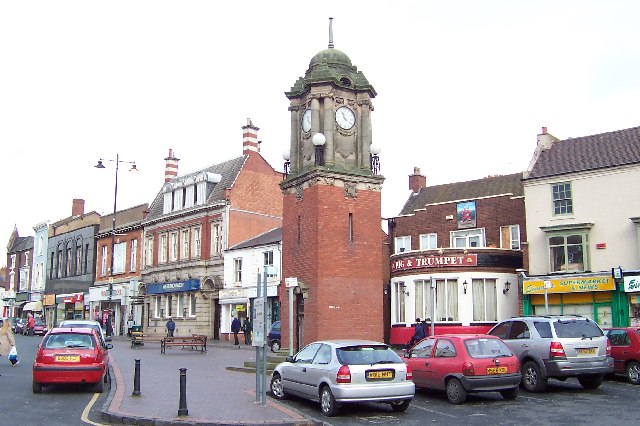
Wednesbury Clock Tower, built for the coronation of George V in 1911

The substantial remains of a large ditch excavated in St Mary's Road in 2008, following the contours of the hill and predating the Early Medieval period, has been interpreted as part of a hilltop enclosure and possibly the Iron Age hillfort long suspected on the site.[3] The first authenticated spelling of the name was Wodensbyri, written in an endorsement on the back of the copy of the will of Wulfric Spot, dated 1004. Wednesbury ("Woden's borough")[4] is one of a number of places in England to be named after the pre-Christian deity Woden, the leader of the Old English pantheon.

During the Anglo-Saxon period there are believed to have been two battles fought in Wednesbury, in 592 and 715. According to The Anglo-Saxon Chronicle there was "a great slaughter" in 592 and "Ceawlin was driven out". Ceawlin was a king of Wessex and the second Bretwalda, or overlord of all Britain. The 715 battle was between Mercia (of which Wednesbury was part) and the kingdom of Wessex. Both sides allegedly claimed to have won the battle, although it is believed that the victory inclined to Wessex.[5]

Wednesbury was fortified by Æthelflæd (Ethelfleda), daughter of Alfred the Great and known as the Lady of Mercia. She erected five fortifications to defend against the Danes at Bridgnorth, Tamworth, Stafford and Warwick, with Wednesbury in the centre. Wednesbury's fort would probably have been an extension of an older fortification and made of a stone foundation with a wooden stockade above. Earthwork ramparts and water filled ditches would probably have added to its strength.[5] A plaque on the gardens between Ethelfleda Terrace and St Bartholomew's church states that the gardens there – created in the 1950s – used stone from the graff, or fighting platform, of the old fort. Exploration of the gardens reveals several dressed stones, which appear to be those referred to on the plaque.[6]

In 1086, the Domesday Book describes Wednesbury (Wadnesberie) as being a thriving rural community encompassing Bloxwich and Shelfield (now part of Walsall). During the Middle Ages the town was a rural village, with each family farming a strip of land with nearby heath being used for grazing. The town was held by the king until the reign of Henry II, when it passed to the Heronville family.

Medieval Wednesbury was very small, and its inhabitants would appear to have been farmers and farm workers. In 1315, coal pits were first recorded, which led to an increase in the number of jobs. Nail making was also in progress during these times. William Paget was born in Wednesbury in 1505, the son of a nail maker. He became Secretary of State, a Knight of the Garter and an Ambassador. He was one of executors of the will of Henry VIII.

It was historically when in Staffordshire a part of the Hundred of Offlow.

Post-Medieval

[edit]
An art installation on a local supermarket celebrating the town's industrial past
Wednesbury Town Hall

In the 17th century Wednesbury pottery – "Wedgbury ware" – was being sold as far away as Worcester, while white clay from Monway Field was used to make tobacco pipes.

By the 18th century the main occupations were coal mining[7] and nail making. With the introduction of the first turnpike road in 1727 and the development of canals and later the railways came a big increase in population.[7] In 1769 the first Birmingham Canal was cut to link Wednesbury's coalfields to the Birmingham industries. The canal banks were soon full of factories.

In 1743, the Wesleys and their new Methodist movement were severely tested.[8] Early in the year, John and Charles Wesley preached in the open air on the Tump.[9] They were warmly received and made welcome by the vicar. Soon afterwards another preacher came and was rude about the current state of the Anglican clergy. This angered the vicar, and the magistrates published a notice ordering that any further preachers were to be brought to them. When Wesley next came his supporters were still there but a crowd of others heckled him and threw stones. Later the crowd came to his lodgings and took him to the magistrates, but they declined to have anything to do with Wesley or the crowd. The crowd ill-treated Wesley and nearly killed him but he remained calm. Eventually they came to their senses and returned him to his hosts.

Soon afterward, the vicar asked his congregation to pledge not to associate with Methodists, and some who refused to pledge had their windows smashed. Others who hosted Methodist meetings had the contents of their houses destroyed. This terrible episode came to an end in December when the vicar died. After that mainstream Anglican and Methodist relations were generally cordial. Methodism grew strongly and Wesley visited often, almost until his death.[10][11] Francis Asbury, Richard Whatcoat and the Earl of Dartmouth are among those who attended Methodist meetings, all to have a profound effect on the United States.[12]

Wednesbury was incorporated as a municipal borough, with its headquarters at Wednesbury Town Hall, in 1886,[13][14] the district contained only the civil parish of Wednesbury, on 1 April 1966 the district was abolished and merged with the County Borough of West Bromwich and the County Borough of Walsall.[15][16] The parish was also abolished on 1 April 1966 and merged with West Bromwich and Walsall.[17] In 1961 the parish had a population of 34,511.[18]

In 1887, Brunswick Park was opened to celebrate Queen Victoria's Golden Jubilee.

20th and 21st centuries

[edit]
Wednesbury Museum and Art Gallery
The Stuckist show at Wednesbury, 2003

On the evening of 31 January 1916, Wednesbury was hit by one of the first wave of German Zeppelins aimed at Britain during the First World War. Joseph Smith and his three children were killed in their house in the King Street area. His wife survived, having left the house to investigate the cause of a loud noise at a nearby factory, caused by the first bombs falling.[19]

The first council houses in Wednesbury were built in the early 1920s, but progress was slow compared to nearby towns including Tipton and West Bromwich. By 1930, a mere 206 families had been rehoused from slums. However, the building of council houses quickened at the start of the 1930s; the 1,000th council house was occupied before the end of 1931. By 1935, some 1,250 older houses had been demolished or earmarked for demolition. By 1944 there were more than 3,000 council properties; by 1959, more than 5,000. The largest development in Wednesbury was the Hateley Heath estate in the late 1940s and early 1950s, which straddled the border of Wednesbury and West Bromwich.[20]

In 1947, the Corporation granted a licence for the operation of a cinema, on the condition that no children under 15 were to be admitted on Sundays. The cinema operator challenged this decision in court, claiming that the imposition of the condition was outside the corporation's powers. The court used this case to establish a general test for overturning the decision of a public body in this type of case, which is now known as "Wednesbury unreasonableness".[21]

The borough of Wednesbury ceased to exist in 1966. Much of its area was absorbed into West Bromwich and small parts went into the County Borough of Walsall. The Wednesbury section of Hateley Heath was absorbed into West Bromwich, and Wednesbury gained the Friar Park estate from West Bromwich.[22] The Dangerfield Lane estate (developed during the interwar and early postwar years) was absorbed into Darlaston, which was now part of an expanded Walsall borough. In 1974 West Bromwich amalgamated with Warley (i.e. Oldbury, Rowley Regis and Smethwick) to form the present-day borough of Sandwell.[23] Wednesbury has the postcode WS10, shared with Darlaston in the borough of Walsall.

During the 1970s and 1980s, Wednesbury's traditional industry declined and unemployment rose, but since 1990 new developments such as a new light industrial estate, a retail park and the pedestrian-only Union Street have given a new look to the town. The traditional market is still a feature of the bustling centre, and the streets around Market Place are now a protected conservation area.

In the late 1980s, land near junction 9 of the M6 motorway was designated as the location for a retail development. Swedish furniture retailer Ikea was the first to move in; its superstore opened in January 1991. In the 1990s the retail park grew to include several more large units, but most of these were empty by 2009 due to the recession. However, most of the units were occupied again by 2012 and the retail is home to numerous retailers. The retail park was expanded in 2017 with the construction of more retail units and 'eateries', and the car park was remodelled to create more parking spaces.[24]

Wednesbury was the scene of two major tragedies during the second half of the 20th century. On 21 December 1977, four siblings aged between 4 and 12 years died in a house fire in School Road, Friar Park, at the height of the national firefighters strike. The house was demolished soon afterwards, leaving a gap in a terrace of council houses.[25] On 24 September 1984, four pupils and a teacher from Stuart Bathurst RC High School were killed when their minibus was struck by a roll of steel which fell from the back of a lorry, on Wood Green Road close to the park keepers house.[26]

For well over 100 years, Wednesbury was dominated by the huge Patent Shaft steel works, which opened during the 19th century and closed in 1980. The factory was demolished in 1983, and within a decade had been developed for light industry and services. The iron gates of the factory still exist and are mounted on the traffic island at Holyhead Road and Dudley Street.

In 2003, Wednesbury Museum and Art Gallery staged Stuck in Wednesbury,[27] the first show in a public gallery of the Stuckism international art movement.[28]

The archives for Wednesbury Borough are held at Sandwell Community History and Archives Service in Smethwick.

Transport history

[edit]

Wednesbury was first connected to the rail network in the mid-19th century, and has been served by heavy and light rail for all but six years since then.

The South Staffordshire Line between Walsall and Stourbridge served Wednesbury until 1993. Passenger services were withdrawn after Wednesbury railway station closed in 1964 under the Beeching Axe,[29] but a steel terminal soon opened on the site and did not close until December 1992, with the railway closing on 19 March 1993 after serving the town for some 150 years.

Until 1972, the town was served by the former Great Western Railway line between Birmingham and Wolverhampton at Wednesbury Central station. Passenger trains were withdrawn at this time, with Wednesbury-Birmingham section of the line through West Bromwich closing. The Bilston-Wolverhampton section survived for another decade before closing over the winter of 1982/83. The final section between Wednesbury and Bilston, serving a scrapyard at Bilston, remained open until 30 August 1992, before the line was closed to allow for the creation of the Midland Metro, which opened in May 1999.

A steam tram service opened to Dudley, also serving Tipton, on 21 January 1884. The line was electrified in 1907 but discontinued in March 1930 on its replacement by Midland Red buses.[30]

The town's current bus station was opened in the autumn of 2004 on the site of its predecessor.

Oakeswell Hall

[edit]

Second in importance to Wednesbury manor house was Oakeswell Hall, built c. 1421 by William Byng. The property descended to the family of Jennyns. By 1662 the house was known as Okeswell or Hopkins New Hall Place (it being adjacent to the Hopkins family's New Hall Fields). Richard Parkes, a Quaker ironmaster, bought it in 1707 and moved in the following year. During the late 18th and early 19th centuries it was a farmhouse. Between 1825 and 1962 it had several different owners, including Joseph Smith (the first town clerk) who greatly restored it. In 1962 it was demolished.[31]

Dr Walter Chancellor Garman (1860–1923), a general practitioner, and his wife, Margaret Frances Magill[32][33] lived at Oakeswell Hall.[34] Their children included the Garman sisters who were associated with the Bloomsbury group. There were nine children, seven sisters and two brothers: Mary (1898), Sylvia (1899), Kathleen (1901), Douglas (1903), Rosalind (1904), Helen (1906), Mavin (1907), Ruth (1909) and Lorna (1911).

Demography

[edit]

At the 2021 census, Wednesbury's built-up area population was recorded as having a population of 20,313. Of the findings, the ethnicity and religious composition of the wards separately were:

Wednesbury: Ethnicity (2021 Census)[35]
Ethnic group Population %
White 15,594 76.7%
Asian or Asian British 3,109 15.3%
Black or Black British 713 3.5%
Mixed 591 2.9%
Other Ethnic Group 229 1.1%
Arab 82 0.3%
Total 20,313 100%

The religious composition of the built-up area at the 2021 Census was recorded as:

Wednesbury: Religion (2021 Census)
Religious Population %
Christian 9,657 50.1%
Irreligious 6,389 33.1%
Muslim 2,008 10.4%
Sikh 673 3.5%
Hindu 424 2.2%
Other religion 80 0.4%
Buddhist 52 0.3%
Jewish 1 0.1%
Total 20,313 100%

Transport

[edit]

Roads

[edit]

Wednesbury is on Thomas Telford's London to Holyhead road, built in the early 19th century. The section between Wednesbury and Moxley was widened in 1997 to form a dual carriageway, completing the Black Country Spine Road that had been in development since 1995 when the route between Wednesbury and West Bromwich had opened, along with a one-mile route to the north of Moxley linking with the Black Country Route. The original plan was for a completely new route between Wednesbury and Moxley, but this was abandoned as part of cost-cutting measures, as were the planned grade-separated junctions, which were abandoned in favour of conventional roundabouts.

Buses

[edit]

The bus station, rebuilt in 2004, is in the town centre near the swimming baths. It facilitates links to Wolverhampton, West Bromwich, Walsall and Dudley, where connections can be made to the Merry Hill Shopping Centre and Birmingham

Railways

[edit]

Since 1999, Wednesbury has been served by the West Midlands Metro light rail tram system, with stops at Great Western Street and Wednesbury Parkway. It runs from Wolverhampton to Birmingham; the maintenance depot is also here.

Wednesbury's rail links are set to improve further with the completion of a new Metro tram line running to Brierley Hill, via Tipton and Dudley, making use of the disused South Staffordshire Line. Originally planned to open in 2023, the project was put back due to lack of funds and is now being built in two parts with part one (to Dudley) now expected to open in 2025. The completion of the extension depends upon funds being available.[36]

Districts

[edit]
  • Church Hill: near the town centre, is notable for being the location of St Bartholomew's Church.
  • Brunswick: to the immediate north of the town centre, was mostly built at the start of the 20th century around Brunswick Park.
  • Friar Park: originally in West Bromwich, it was built in the late 1920s and early 1930s.
  • Myvod Estate: approximately one mile to the north of the town centre towards the border with Walsall, was built in the 1920s as Wednesbury's first major council housing development.
  • Wood Green: situated around the A461 road northwards in the direction of Walsall. Landmarks include Stuart Bathurst RC High School, and on the opposite site of the road is Wood Green Academy. The parish church is St Paul's. Since 1990, a large retail development has sprung upon around Wood Green, extending to the site of the former FH Lloyd steel plant in Park Lane.
  • Golf Links: mostly built in the 1940s and 1950s with both private and council housing, in the south of the town.
  • Woods Estate: to the north-east of the town centre, was built mostly as council housing between 1930 and 1962.
  • King's Hill: to the north of the town centre.

Wards

[edit]
  • Wednesbury North : Wednesbury Central, Wood Green & Old Park
  • Wednesbury South : Hill Top, Ocker Hill (part), Golf Links, Millfields, Harvills Hawthorn
  • Friar Park : Woods & Mesty Croft, Friar Park

Media

[edit]

Local news and television programmes are provided by BBC West Midlands and ITV Central. Television signals are received from the Sutton Coldfield TV transmitter.[37]

Local radio stations are BBC Radio WM, Heart West Midlands, Smooth West Midlands, Hits Radio Black Country & Shropshire, Greatest Hits Radio Birmingham & The West Midlands, Greatest Hits Radio Black Country & Shropshire and Black Country Radio, a community based station. [38]

The town is served by the local newspapers, Wednesbury Herald and Express & Star.[39]

Schools

[edit]

Notable people

[edit]
John Ashley Kilvert, 1856
Bronze sculpture of The Farewell by Gwynneth Holt
Billy Walker, 1925
Syd Gibbons

Sport

[edit]

Notable employers

[edit]

Current

[edit]
  • Property developers J.J. Gallagher had purchased the bulk of the Lloyd site in 1988 and once mineshafts were filled in, decontamination was completed the land was suitable for mass retail development. IKEA purchased the former F.H. Lloyd steel plant from Triplex in 1988, and opened one of its first British stores on the site in January 1991, just 14 months after the development had been given the go-ahead.[44]
  • Morrisons opened a supermarket in the town centre on 4 November 2007, creating some 350 new jobs. A number of council bungalows and a section of the town centre shops had been demolished to make way for it.
  • Quantum print and packaging Limited employs 30 people since relocating to Wednesbury in 2013 from their Willenhall base. The factory occupies a 30000 sq ft site in the town centre.
  • In 2016, successful German supermarket chain Lidl opened a new distribution centre just off Wood Green Road, on land near Junction 9 Retail Park.
  • MSC Industrial Supply a leading distributor of metalworking and maintenance, repair, and operations (MRO) products and services

Former

[edit]
  • Patent Shaft (part of the Cammel Laird group) steelworks was erected on land off Leabrook Road near the border with Tipton in 1840, serving the town for 140 years before its closure on 17 April 1980 – an early casualty of the recession. Demolition of the site took place in 1983.
  • Metro Cammell (Metropolitan Company) set up business after acquiring all of the assets of the Patent Shaft in 1902, in 1919 Vickers ltd acquired the shares of The Metropolitan Company ltd, in 1929 Vickers ltd and Cammel laird and Co merged their interests to form The Metropolitan Cammel Carriage and Wagon works Co ltd, where it produced railway coach bodies, turntables, Bridges, railway wagons and pressings at the Old Park works. The plant remained opened until 1964. The work and its workers were transferred to the Washwood heath works Birmingham. The site was sold to The Rubbery Owen group.[45]
  • F.H. Lloyd steelworks was formed at a site on Park Lane near the boundaries with Walsall and Darlaston during the 1880s, and provided employment for some 100 years. However, F.H. Lloyd was hit hard by the economic problems of the 1970s and early 1980s, and went out of business in 1982. Triplex Iron Foundry of Tipton then took the site over, but the new owners kept the factory open for just six years and it was then sold to Swedish home products company IKEA in 1988, being demolished almost immediately to make way for the superstore, which opened in January 1991.[46]
  • A Cargo Club supermarket-style retail warehouse, part of the Nurdin and Peacock group, opened in July 1994. It was one of three Cargo Club stores in Britain, and the venture was not a success: by the end of 1995 it had been shut down following heavy losses.[47]

Cock-fighting ballad

[edit]

A ballad about cock-fighting in the town called "Wedgebury Cocking" or "Wednesbury Cocking" became well known in the 19th century.[48] It begins:

At Wednesbury there was a cocking,

A match between Newton and Skrogging;

The colliers and nailers left work,

And all to Spittles' went jogging

To see this noble sport.

Many noted men there resorted,

And though they'd but little money,

Yet that they freely sported.

References

[edit]
[edit]
Revisions and contributorsEdit on WikipediaRead on Wikipedia
from Grokipedia

Wednesbury is a market town in the Metropolitan Borough of Sandwell within the West Midlands county of England, historically situated in Staffordshire. At the 2021 census, the town had a population of 41,335 residents. Its name originates from the Anglo-Saxon "Wodnesburh," referring to a fortified settlement associated with the god Woden.
Wednesbury forms part of the , a region defined by its dense concentration of coal mines, ironworks, and factories during the , which transformed the local landscape and economy through heavy . The town's industrial heritage prominently features large-scale tube production, steel fabrication, and the manufacture of railway axles, contributing significantly to Britain's infrastructural development in the 19th and early 20th centuries. Key landmarks include the medieval St Bartholomew's Church, a Scheduled , and the Wednesbury Old , which facilitated industrial transport. Modern Wednesbury maintains a commercial center with retail and service sectors, while preserving elements of its manufacturing past amid urban regeneration efforts.

Geography

Location and administrative status

Wednesbury is situated at coordinates approximately 52°33′N 2°1′W within the Sandwell Metropolitan Borough in the West Midlands county of England. It forms part of the Black Country conurbation, positioned roughly 7 miles (11 km) northwest of Birmingham city centre. Historically within Staffordshire, Wednesbury was integrated into the Sandwell Metropolitan Borough upon its creation on 1 April 1974 during the local government reorganization that established the metropolitan counties. The borough encompasses Wednesbury along with adjacent towns such as West Bromwich and Tipton, under the administration of Sandwell Metropolitan Borough Council.

Topography and environment

Wednesbury occupies a low-lying position within the gently undulating topography of the Birmingham region's drift-covered areas, where superficial deposits overlie and constrain natural drainage patterns. The underlying geology forms part of the Coalfield, dominated by coal measures comprising interbedded sandstones, mudstones, and coal seams, which have historically influenced surface stability and resource extraction. These strata, part of the outcrop in the Horst, contribute to the area's flat to moderate relief, with elevations typically ranging from 120 to 160 meters above , limiting steep gradients and promoting broad, even terrain. Environmental challenges stem primarily from legacy activities, including risks from collapsed underground workings in both and mines. A notable incident occurred in 1978 on Wednesbury's outskirts, where pillar collapse in the Cow Pasture limestone mine triggered severe surface deformation and , exemplifying ongoing geohazards in the coalfield. Such events arise from voids and pillar failures at depths up to 150 meters, posing constraints on development through potential and requiring site-specific assessments for new . Proximity to the River Tame introduces fluvial flood risks, particularly in low-lying zones near Hydes Road, The Woods, and Bescot, where the maintains a dedicated flood warning area for watercourse overflow during heavy rainfall. Local green spaces, such as those in , provide limited natural buffers amid urban pressures, though enhancement projects aim to improve accessibility and ecological quality without altering underlying topographic constraints. The region exhibits a temperate maritime characteristic of the West Midlands, with average annual around 770 mm, distributed fairly evenly but peaking in autumn, as recorded in nearby Birmingham data.

History

Etymology and early settlement

The name Wednesbury originates from Wōdnesbyriġ, translating to "Woden's " or the fortified settlement dedicated to Woden, the Anglo-Saxon god of war and wisdom, equivalent to the Norse , indicating pagan roots prior to . The element denotes a defended or stronghold, common in Anglo-Saxon place names for strategic sites. This underscores the site's early association with pre-Christian religious and military significance in the Mercian landscape. The earliest documented reference appears in the of 1086, spelled Wadnesberie, describing Wednesbury as a manor in Staffordshire's Offlow Hundred held by the king, with an estimated 9 households (implying a of around 140 persons based on contemporary multipliers) engaged in and rendering customary dues like 12 and . Pre-Conquest evidence points to its role as a royal Saxon , likely fortified for defense against Viking raids in the late 9th and early 10th centuries during Mercian resistance under leaders like Æthelflæd, who coordinated networks across the region from circa 910 onward. Archaeological traces of such defenses may align with a possible precursor on Church Hill, though confirmation remains tentative absent extensive excavation. Roman-era finds, such as scattered artifacts, suggest peripheral activity near nearby routes like but no organized settlement, with substantive habitation emerging only in the Anglo-Saxon era amid Mercian consolidation. This defensive function, prioritizing elevated terrain for visibility and fortification, reflects pragmatic responses to invasion pressures rather than expansive urbanization, as evidenced by the modest Domesday holdings of , meadow, and woodland.

Medieval and post-medieval development

In 1086, Wednesbury appeared in the Domesday Book as a manor in the hundred of Offlow, Staffordshire, held directly by King William I, with an estimated 9.3 households including 16 villagers and 11 smallholders engaged primarily in agriculture. The estate comprised 9 ploughlands (1 held by the lord and 7 by men), 1 acre of meadow, extensive woodland measuring 2 leagues by 1 furlong plus 3 furlongs, and 1 mill valued at 2 shillings, indicating a rural economy centered on arable cultivation, pastoral farming, and limited milling, though the land was noted as partially waste. Following the , ownership shifted; by 1164, King Henry II had granted the manor to Ralph Boterel as a tenant under the barony of d'Oyly, with an annual taxable value of £4. The de Heronville family subsequently held lordship from around 1182, with John de Heronville documented as lord from 1255 to 1315, during which the included a hall, solar, brewhouse, bakery, stables, and associated lands of 120 acres arable and 10 acres . Common fields such as Monway Field and Church Field supported communal agriculture, while a manorial mill was rented to Bordesley Abbey's for 10 shillings annually and sublet locally. Subsidy rolls from 1332–1333 record 13 taxpayers contributing £1 19s. 1d., reflecting modest prosperity under the reduced 1/10th tax rate for ancient manors. St Bartholomew's Church, Wednesbury's principal medieval architectural feature, was first mentioned in records dating to 1088, with a 13th-century structure noted in plea rolls from 1210–1211. The church retained medieval elements, including a 13th-century window, amid later rebuildings, serving as a focal point for local religious and communal life under the . ![St Bartholomew's Church, a key medieval site in Wednesbury][float-right]
Post-medieval developments saw continued manorial evolution, with the estate passing to the Beaumont family by the mid-15th century—Henry Beaumont's 1471 will bequeathing funds for a —and later to the Comberfords through in the . remained the economic foundation, supplemented by early extraction of and resources documented from 1315, though formal market rights were absent until the ; informal trade likely occurred via the , which regulated local justice and exchange from Saxon origins. Secondary residences like Oakeswell Hall, constructed around 1421 by William Byng, underscored gentry investment in the locale.

Industrial era and 19th century growth

Wednesbury's industrialization accelerated in the late , driven primarily by and the expansion of production. Coal extraction, documented since the medieval period but intensifying with deeper shafts in the , fueled local forges and supported export via emerging transport networks. The Birmingham Canal Navigations (BCN), including the Wednesbury Old Canal opened in 1769, facilitated transport from Wednesbury's coalfields to Birmingham, spurring economic activity and attracting laborers. Nail-making, a longstanding cottage industry since around 1500, reached its peak in the as hand-forging techniques proliferated, with thousands of small forges operating in the Black Country region by the 1830s. tube drawing emerged as a specialty, pioneered by figures like John Russell who began production in 1811 using tapered tubes for applications such as gun barrels and later railways. By the , Wednesbury firms held a near-monopoly in the iron tube trade, supplying railways and becoming the area's largest iron exporter, bolstered by steam-powered rolling mills and forges like Wednesbury Forge, active since the 17th century but expanded for industrial output. Population growth reflected these developments, rising from 4,160 in 1801 to 14,281 by 1851, exceeding 15,000 by 1901, as migrant workers filled expanding workforces in mines and forges. This artisan-based economy fostered innovations like water- and steam-powered machinery, yet data and contemporary accounts reveal harsh conditions, including precarious employment for nailers—estimated at around 50,000 regionally by mid-century—who endured low wages, irregular work, and descriptions as among England's "most immoral" laborers due to poverty-driven hardships.

20th and 21st centuries

The coal mining sector in Wednesbury and the surrounding Black Country experienced significant closures during the 1960s, as part of broader post-war rationalization efforts by the National Coal Board, which deemed many pits uneconomical amid mechanization and shifting energy demands. This marked the end of deep coal extraction in the locality, contributing to early signs of industrial contraction. Similarly, the steel industry, a cornerstone of local manufacturing, faced contraction from the 1970s onward due to intensified global competition from lower-cost producers in Asia and internal factors including frequent union-led disruptions and inefficiencies stemming from the 1967 nationalization of British Steel, which prioritized employment preservation over productivity enhancements. Local examples included substantial job losses at firms like Patent Shaft, with 1,500 redundancies announced in 1982 amid the British Steel Corporation's restructuring. These developments, compounded by over-reliance on heavy industry without timely diversification, drove unemployment in the West Midlands region to peaks around 13% during the early 1980s recession, with Wednesbury sharing in the acute local impacts. Post-war policies, including and expansive welfare provisions, inadvertently prolonged structural vulnerabilities by discouraging agile adaptation to market signals, as evidenced by persistent overmanning and shortfalls in state-controlled entities. Narratives attributing decline solely to external forces overlook these shortcomings, which causal analysis reveals amplified the effects of ; for instance, union actions in the late disrupted production, eroding competitiveness against non-unionized foreign rivals. Empirical data from the period underscore that steel output stagnated while global production expanded, highlighting failures in modernization under public ownership. In the 21st century, regeneration initiatives have sought to address these legacies through town center revitalization, including the Wednesbury Masterplan and improvements to public spaces funded by government and sources, alongside developments like the to bolster retail and . Outcomes remain mixed, with ongoing projects like frontage enhancements and infrastructure upgrades showing partial success in enhancing attractiveness, yet persistent economic challenges per data indicate limited reversal of deprivation metrics. The 2021 Census reflects a broader shift toward the service sector in , with employment growth in areas like health and , mirroring Wednesbury's transition away from dominance, though manufacturing retains a foothold in the Black Country economy. This evolution underscores the necessity of diversified economic bases to mitigate risks exposed by prior mono-industrial dependence.

Transport evolution

The Wednesbury Old Canal, engineered by under the Birmingham Canal Navigations Act of 1768, entered service in 1769, forming a critical link from Wednesbury to Birmingham via the Bradley Arm and Wednesbury Oak Loop. This infrastructure directly enabled the export of locally abundant and iron from Wednesbury's mines and forges to broader markets, while allowing imports of and other raw materials essential for ironworking, thereby accelerating the area's industrial takeoff during the late 18th century. Rail connectivity arrived with the Grand Junction Railway's opening on July 4, 1837, which skirted Wednesbury en route from Birmingham to , initially served by Bescot station approximately two miles north. The line facilitated bulk transport of heavy goods like and finished iron products at speeds and volumes unattainable by canal, importing raw materials such as from distant regions and sustaining Wednesbury's chain-making and tube-manufacturing sectors through enhanced efficiency. Subsequent developments included the Great Western Railway's extension to Wednesbury by 1865, establishing Wednesbury Town station to handle local passenger and freight traffic. Post-World War II shifts prioritized road infrastructure, with the M6 motorway's completion in the 1960s-1970s positioning Wednesbury adjacent to Junction 9, promoting freight haulage by truck and reducing reliance on aging rail and canal networks. However, the 1963 Beeching Report's recommendations led to Wednesbury Town station's closure on January 18, 1964, severing direct passenger rail access and exemplifying broader cuts that dismantled over 40% of lines, which critics contend inflicted long-term economic damage by isolating communities from labor markets and eroding freight competitiveness against road dominance. Recent initiatives, including extensions branching from Wednesbury Great Western Street stop since 1999, have partially restored connectivity along disused corridors, underscoring rail's enduring role in mitigating prior disruptions.

Governance

Local administration

Wednesbury has been governed as part of the (MBC) since 1 April 1974, following the abolition of its independent status under the Local Government Act 1972, which merged it with the boroughs of and and portions of other districts to form the larger . Prior to this, Wednesbury operated as a from 1886, with its own elected council managing local affairs independently. Sandwell MBC holds principal authority over Wednesbury's local services, including , social provision, and , with decisions centralized at the level rather than town-specific. The council's 72 members are elected from 24 wards, with the Labour Party securing 64 seats after the 2 May 2024 elections, maintaining its long-standing control and influencing policy priorities such as budget allocation and service delivery. Financially, Sandwell MBC's operations in Wednesbury depend on a mix of revenues, with approximately 40% from , 56% from retained business rates, and 4% from non-specific grants, though specific grants for areas like social care supplement this, totaling £55.391 million in 2025/26 amid ongoing fiscal pressures from historic grant reductions. This structure reflects a shift from Wednesbury's pre-1974 self-contained fiscal to integrated borough-wide funding, where local precepts fund but limit town-level discretion.

Electoral wards and districts

Wednesbury falls within three wards of : Friar Park, Wednesbury North, and Wednesbury South, each electing three councillors to represent local interests in planning, community services, and infrastructure decisions. These wards encompass the town's core areas, with boundaries reviewed periodically by the Local Government Boundary Commission for to ensure electoral equality, as implemented in recent adjustments effective from 2024. According to the 2021 Census, ward had a population of 12,793, Wednesbury North 13,319, and Wednesbury South approximately 15,227, collectively forming the bulk of Wednesbury's 41,335 residents and highlighting denser urban settlement in the north and south wards. Each ward's councillors, as of the 2024 local elections, are affiliated with the Labour Party, reflecting the party's longstanding control in with 64 of 72 seats council-wide. Sub-areas such as Oakeswell End within Wednesbury South function as localized districts for targeted community representation, informing ward-level planning on issues like and green spaces, though they lack independent electoral status. Voter turnout in Wednesbury wards remains low, with Wednesbury South recording 26% in the 2024 election on 2,717 valid ballots, underscoring empirical challenges in amid broader trends of subdued participation.

Demographics

Population statistics

According to the , the population of Wednesbury—defined by its North and South electoral wards—totalled 23,950 residents. This figure rose to 25,192 by the 2011 census, reflecting a 5.2% increase over the decade, before climbing further to 28,545 in the 2021 census, a 13.4% rise from 2011. Overall, the population grew by 19.3% between 2001 and 2021, indicating steady urban expansion amid regional trends in the West Midlands.
Census YearWednesbury North WardWednesbury South WardTotal
200111,72812,22223,950
201112,68212,51025,192
202113,31915,22628,545
Population density across the wards averaged approximately 3,300 inhabitants per in 2021, with Wednesbury North at 3,674 per km² over 3.63 km² and Wednesbury South at 3,076 per km² over 4.95 km², underscoring compact urban settlement patterns characteristic of former industrial towns. Projections from the Office for National Statistics, aligned with borough trends, anticipate modest for Wednesbury through the 2020s and 2030s, roughly 2-3% by 2032, driven by net in-migration from adjacent Birmingham and limited new housing development. This aligns with broader estimates of regional expansion tied to commuter dynamics, though constrained by constrained greenfield opportunities.

Ethnic and religious composition

In the 2021 census, 66.7% of Wednesbury residents identified as , down from 78.7% in 2011, reflecting broader demographic shifts driven by and lower birth rates among the indigenous . The Asian ethnic group comprised 15.3% of the , predominantly South Asian origins such as Indian, Pakistani, and Bangladeshi, which increased in line with national patterns of post-2001 migration from the . Smaller shares included (3.5%), mixed (2.9%), and other ethnic groups (1.1% Arab, 1.1% other). Religious affiliation showed as the largest category at 47.5%, though this continues a secular decline observed since the , when over 70% nationally identified as Christian. accounted for 9.9%, 3.3%, and 2.1%, with these minority faiths correlating closely with South Asian ethnic concentrations and showing proportional growth from prior censuses due to and community settlement. No or unspecified responses likely filled the balance, mirroring the 37.2% national rate for no religion in 2021. English is the main language for the vast majority, but the share of residents with English (or Welsh) as their primary language fell below 86.3% recorded in 2011, with Punjabi and Bengali together representing key non-English usages at borough-wide levels of approximately 7-8%. This linguistic diversity has implications for local service provision, including translation needs in education and healthcare, as non-English speakers rose amid sustained inflows from Punjabi- and Bengali-speaking regions.

Economy

Historical economic foundations

Wednesbury's pre-20th-century economy was anchored in , with nail production emerging as a dominant activity by the , supported by local forges employing finery and chafery processes to convert into wrought forms suitable for nails. These operations, often conducted in small-scale, family-run workshops, leveraged abundant local and resources, with the town's position atop the Coalfield—featuring shallow seams like the 10-yard coal—minimizing extraction costs and enabling competitive production. This resource proximity reduced transport expenses for fuel and raw materials, fostering a in labor-intensive goods like nails, which formed a staple of regional exports to markets including . Chain-making supplemented nail production throughout the 18th and 19th centuries, with Black Country forges, including those near Wednesbury, specializing in wrought iron chains and anchors that contributed to Britain's iron goods trade dominance. Tube manufacture gained prominence in the early 19th century, as firms like the Elwells adapted forge techniques to produce iron pipes and tubes, securing Wednesbury's role as a primary supplier for emerging railway infrastructure by the 1850s. The decentralized, entrepreneurial structure of family forges encouraged iterative improvements in techniques, such as slitting and rolling, which enhanced output without large capital outlays. Steam power adoption accelerated productivity from the 1830s onward, with engines powering hammers, shears, and rolling mills in Wednesbury's forges, transitioning from water and wind auxiliaries to more reliable mechanization that amplified scale in nail, chain, and tube sectors. This integration, driven by market demands for higher-volume iron products, underscored the town's reliance on endogenous innovations tied to its mineral-rich locale, where coal's ubiquity not only fueled forges but also powered the steam apparatus essential for industrial expansion.

Industrial decline and restructuring

The industrial decline in Wednesbury commenced in earnest during the late 1970s and intensified through the 1980s, driven by global energy price surges from the and oil crises that escalated production costs for energy-intensive heavy industries, alongside deep recessions and overcapacity in the nationalized British Steel Corporation (BSC), formed in 1967. Local heavy manufacturing, centered on iron, steel, and forgings, suffered as firms like the Patent Shaft Steel Works—once a major employer producing axles and shafts—faced unsustainable losses and closed in early 1980 after failed buyer searches, reflecting broader BSC mismanagement characterized by inefficient scale expansions and resistance to modernization. Nearby Steel Works, integral to the Country's steel cluster, shut down in 1979 amid similar viability issues, curtailing regional supply chains and output that had historically supported Wednesbury's foundries and forges. Trade union actions further accelerated closures, as the 1980 national steelworkers' strike disrupted operations and highlighted rigid labor practices that deterred investment, contributing to a sharp contraction in local iron and steel production from peak early-20th-century levels of several thousand tons annually per major works to near-zero by decade's end. In Sandwell borough, encompassing Wednesbury, unemployment surged to around 13-15% in the West Midlands during the early 1980s recession, fostering long-term labor market inactivity and reliance on state benefits as manual jobs evaporated without viable alternatives. This dependency was exacerbated by policies preserving uncompetitive sectors, though subsequent confrontations with unions under the Thatcher government enabled rationalization, albeit at the cost of immediate hardship. Restructuring emerged in the as vacated industrial land was repurposed for lighter uses, including warehousing and hubs leveraging Wednesbury's proximity to the and rail networks, marking a pivot from to distribution amid global trade shifts favoring low-cost imports. While employment in the Black Country fell from 15% of jobs in 2015 to 13% by 2023, transport and storage sectors expanded by 26% since 2010, underscoring adaptation to service-oriented economies but highlighting persistent challenges from skill mismatches and welfare traps in former industrial locales.

Contemporary employers and sectors

In Wednesbury, the service sector dominates employment, encompassing retail, wholesale, , and , which collectively form one of the primary economic pillars alongside in the broader borough. and distribution have emerged as key sub-sectors within services, leveraging the town's proximity to the and Junction 9, with operations focused on warehousing, , and . Notable logistics employers include WOW Logistics, which provides , warehousing, and pick-and-pack services from facilities on Wednesbury Trading Estate, and Moran Logistics, operating a major hub for multi-temperature freight including CNG-powered vehicles. Residual manufacturing persists at a modest scale, concentrated in specialist areas such as plastics processing, , and fasteners production, with firms like Amari Plastics and CLA Fabrications maintaining operations in the area. Retail employment supports local commerce through town centre outlets and proximity to larger retail parks, though specific Wednesbury-scale data indicates a reliance on low-skill, part-time roles amid broader service sector growth. also contribute significantly, drawing on regional NHS facilities and community services. Economic challenges include entrenched deprivation, with 75% of Wednesbury's lower super output areas (LSOAs) falling within England's 20% most deprived in the 2019 Index of Multiple Deprivation (IMD), particularly affecting income and domains, which fosters a dominance of low-wage positions across sectors. Full-time stands at approximately 31.8% of the working-age (2021 Census baseline, stable into 2023), with unemployment at 4.2%, mirroring averages but underscoring limited high-value job opportunities.

Infrastructure

Transport networks

Wednesbury's primary road connections include the A4038, a key arterial route linking the town to and while forming part of the West Midlands Key Route Network, which accommodates high daily traffic volumes from freight and commuter movements. Proximity to the at Junction 9 (Wednesbury Interchange) enables efficient access to the national strategic road network, with the A461 providing direct linkage from the town to this junction, supporting radial flows toward Birmingham and beyond. data indicate elevated vehicle counts on these corridors, reflecting Wednesbury's role in regional and urban commuting, though specific link-level estimates underscore variability due to periodic counts. Public transport infrastructure centers on the system, which serves Wednesbury via stops such as Great Western Street, offering frequent services to Birmingham and with average journey times under 30 minutes to central hubs. An 11 km extension branching from Wednesbury toward , with construction commencing in early 2025, aims to add 17 stops and improve connectivity to and Merry Hill, potentially reducing road dependency. Rail access is provided by Tame Bridge Parkway station, handling 579,860 passenger entries and exits in the 2023/2024 fiscal year, primarily for services to Birmingham New Street and . Local bus networks, coordinated by , operate from Wednesbury with routes integrating into the broader smartcard system for seamless transfers. Commuter patterns show heavy reliance on private vehicles, with regional congestion studies highlighting delays on the A4038 during peak hours due to limited alternatives and insufficient , where for bikes remains below 2% in similar locales. Efforts to enhance efficiency include approved segregated cycle routes along congested arterials to promote active travel and mitigate bottlenecks, though empirical data from assessments indicate persistent peak-period delays averaging 10-15% above free-flow times on key links. Metro utilization has rebounded strongly, exceeding 8.3 million annual journeys network-wide as of , underscoring its viability for high-capacity, low-emission connectivity.

Utilities and public services

Water and sewage services in Wednesbury are provided by South Staffordshire , which maintains supply infrastructure for the area including treatment and distribution networks. Historical in the Black Country region, encompassing Wednesbury, has led to legacy contamination risks, such as and metal leaching, necessitating ongoing monitoring and remediation to prevent impacts on potable supplies. Reliability metrics show occasional supply interruptions due to maintenance or bursts, with customer complaints focusing on response times, though the provider reports average annual unplanned outages below national benchmarks. Average annual water bills for metered households stand at approximately £400-£450, influenced by regional hardness levels from aquifers. Electricity distribution is handled by National Grid Electricity Distribution (West Midlands), responsible for the serving residential and commercial users, with a focus on minimizing outages through grid reinforcements. Gas networks fall under , operating over 80,000 km of pipelines in the region to ensure supply stability. Both providers emphasize reliability, with National Grid achieving supply interruptions of under 30 minutes per customer annually in recent reports, though broader West Midlands energy costs remain elevated due to wholesale price volatility, averaging £0.28-£0.30 per kWh for in 2024. adoption lags, with local audits indicating less than 5% of Sandwell's energy from onsite renewables like solar PV, despite initiatives to promote installations amid net-zero targets. Healthcare access relies on Sandwell General Hospital in nearby , approximately 3 miles away, reachable via direct bus routes (e.g., every 10 minutes) or Midland Metro tram, providing emergency, outpatient, and specialist services under Sandwell and West Birmingham NHS Trust. features multiple GP practices serving Wednesbury's population, but coverage faces pressures with some surgeries reporting high demand and appointment wait times exceeding national averages, as highlighted in 2023 data on booking difficulties. The trust maintains GP-to-patient ratios around 1:1,800 in , below the average of 1:1,500, contributing to reported access challenges despite efforts to integrate services.

Culture and landmarks

Notable buildings and sites

Oakeswell Hall is a timber-framed with origins tracing to the and significant construction in the mid-to-late , later adapted to house the Wednesbury and Art Gallery. The structure reflects Wednesbury's historical ties to local ironmasters and Quaker families, including ownership by Parkes in the early . St. Bartholomew's Church, a medieval Anglican first recorded in 1088, holds Grade II listed status for its architectural and historical value, including original medieval furnishings and a collection of Charles Eamer Kempe stained-glass windows added during Victorian expansions. The Clock Tower in Wednesbury Market Place, constructed in 1911 to mark the coronation of King George V, is a Grade II listed structure designed by local Charles William Davies Joynson, featuring red brick and sandstone elements on the site of the former butter market cross demolished in 1824. Restoration efforts completed in 2022 addressed weathering to preserve its civic prominence. Wednesbury's Market Place forms a designated conservation area encompassing several listed buildings, though it appears on Historic England's 2022 Heritage at in "very bad" condition due to and maintenance challenges. Other Grade II listed sites include the Church of St. Mary and various memorials, underscoring the town's layered industrial and heritage amid ongoing preservation pressures.

Media and local traditions

The primary local newspaper serving Wednesbury is the Express & Star, which provides daily coverage of news, sports, and community events specific to the town within its hub, including reports on incidents like factory fires and traffic disruptions as recent as 2023. This publication, established in the region, has transitioned to digital formats since the early , offering online articles and newsletters that reflect the shift from print to web-based consumption amid declining circulation of physical editions. , broadcasting across the West Midlands on FM and DAB since its rebranding in the 1980s, delivers regional news, talk, and music relevant to Wednesbury residents, with content focused on local stories from the area. Wednesbury shares in the Black Country's distinctive dialect, characterized by features such as the retention of Middle English sounds (e.g., "yam" for "you are" and a nasal "yam-yam" intonation), which persists in everyday speech and resists standardization despite urban influences. Annual events maintain cultural continuity, including Wednesbury Day, a community festival held in June with family-oriented activities like live music and street games, organized by local groups to celebrate town identity. The broader Black Country Festival in July, encompassing Black Country Day on July 14 (commemorating the 1712 Newcomen steam engine), features music and heritage events in Wednesbury, such as 2017's local festival with tribute bands, drawing on empirical working-class traditions rather than romanticized narratives. A notable folk tradition is preserved in the 19th-century ballad "Wednesbury Cocking," which recounts a chaotic cockfight near St. Bartholomew's Church, depicting brawls, betting, and the trampling of birds in a main of 20 cocks—a raw portrayal of 18th-century sporting practices tied to local inns and pits, unsubstantiated by later sanitized accounts of regional heritage. This oral and printed relic underscores the area's historical emphasis on empirical, unvarnished customs over invented gentility, with verses circulated in broadsides reflecting pre-industrial rural amusements that evolved amid early manufacturing.

Education and community facilities

Wednesbury's education system transitioned to comprehensive schooling following the implementation of the , which raised the and emphasized for all, leading to the merger of selective grammar schools with modern and technical institutions in the area. By the late and , local authorities in , including Wednesbury, reorganized into non-selective comprehensives, such as the formation of schools like Academy from earlier modern schools. Secondary education is primarily provided by institutions like Wood Green Academy, rated "Good" by in its 2020 inspection for overall effectiveness, with "Outstanding" for behaviour and attitudes, serving around 1,200 pupils aged 11-16. Nearby, Wodensborough Ormiston , also in Wednesbury, received a "Good" rating in its July 2021 inspection, focusing on improved outcomes for disadvantaged pupils. Primary schools include St Mary's Catholic Primary School, judged "Good" in inspections from 2015 and 2019, with ongoing monitoring. These schools reflect Sandwell's broader system, where comprehensives dominate due to post-1944 reforms prioritizing access over selection. Pupil attainment in Wednesbury lags national averages, with an average Attainment 8 score of 46 in 2023, matching Sandwell's figure but below England's overall performance amid high deprivation levels—over 30% of pupils eligible for free school meals, correlating with lower progress in reading and maths. data links such gaps to socioeconomic factors, including legacy industrial unemployment, rather than inherent school quality, as evidenced by targeted interventions yielding incremental gains in pass rates. Community facilities support youth development through venues like the Millennium Centre, which hosts Wednesbury Youth Club for ages 11-19, offering sports, , and skills sessions with recent expansions in 2025 adding space for up to 100 additional participants weekly. The Marvel Youth Club, a specialist provision for young people with special educational needs and disabilities aged 11-25, operates from Wednesbury Museum premises on Mondays and Thursdays, emphasizing inclusive activities amid 's higher-than-average SEND prevalence. Libraries, such as the local branch under Council, provide study spaces and digital access, while parks like those in area facilitate informal recreation, though usage data indicates lower formal participation rates tied to economic pressures.

Notable individuals

Figures in industry and commerce

John Russell established the tube-making industry in Wednesbury in 1811 by producing tapered tubes and inventing a socket for joining them, laying the foundation for the town's specialization in wrought-iron tubing. His brother James Russell joined as a partner in 1816, and together they founded the Crown Tube Works in 1823, which by 1849 employed 200 workers and produced four million feet of tube annually. James Russell collaborated with inventor Cornelius Whitehouse in 1825 to develop the butt-welding process, enabling the production of longer, cheaper tubes at a rate of 200 eight-foot lengths per day compared to previous methods yielding only 25 four-foot lengths. Under John James Russell's management after 1849, Crown Tube Works expanded output to 5.3 million feet per year by 1865 and adopted Siemens open-hearth furnaces in the 1880s for seamless steel tubing. James McDougall founded the Hope Patent Tube Works in 1869, pioneering the production of weldless tubes suitable for applications in bicycles, automobiles, and gas pipes, marking a shift toward seamless in Wednesbury. In parallel, Edward Elwell leased Wednesbury Forge in 1817 and purchased it in 1831, modernizing operations with steam and water power to produce edge tools for global export, including during the , and employing 200 workers by 1889. Isaiah Oldbury established the Reliance Coach Ironworks in 1861 to manufacture axles, innovating trailer undergear designs that facilitated international exports and sustaining 150-200 employees; Oldbury later served as from 1896 to 1898. Charles Geach, as manager of the associated bank, recognized the potential of axles from the Patent Shaft & Axletree Company—based in Wednesbury—for use, supporting the firm's growth amid expanding rail networks in the . Richard Garbett operated the Monway Gas, Water, and Steam Cock Manufactory at 64 Portway Road, becoming one of the earliest and longest-enduring producers of industrial valves in the town. These entrepreneurs exemplified self-reliant innovation, transforming Wednesbury into a hub for precision through patented processes and scalable production.

Sports personalities

William Henry Walker, known as Billy Walker, was born on 29 October 1897 in Wednesbury, , and emerged as one of the town's most notable footballers amid the working-class sporting culture that offered respite from industrial labor in the Black Country. Playing as a centre-forward for Aston Villa from 1919 to 1934, he appeared in 531 league matches, scoring 214 goals, and contributed to the club's 1920 Charity Shield victory as a player. Walker earned a single cap for on 13 April 1929, scoring once in a 4-0 win over . His career totals included over 300 goals across clubs, reflecting the physical demands and competitive edge honed in local leagues before professional ascent. After retiring, Walker managed Nottingham Forest from 1939 to 1960, overseeing wartime appearances and post-war rebuilding, and briefly Sheffield Wednesday, where he drew on his experience to guide teams through league challenges. His longevity—managing into his 60s—and recognition as a prolific scorer underscored Wednesbury's contribution to early 20th-century English football, with local clubs like Wednesbury Old Athletic, founded in the , fostering talent through Birmingham & District and Midland League competitions from 1890 onward. Other figures include George Holden, a Wednesbury Old Athletic player who represented four times as an international, exemplifying the pathway from town pitches to national recognition in the late . The club's , spanning leagues until the early , highlighted community-driven football as a vital outlet, producing disciplined athletes amid shifts, though detailed career statistics for many remain tied to era-specific records.

Other contributors

John Stonehouse represented Wednesbury as a Labour from 1957 until 1974, during which he held ministerial positions including and Minister of Aviation. His tenure ended amid controversy when he faked his own death by disappearing in in November 1974, later revealed to have attempted to assume a new identity in before his and for fraud in 1976. Brendan Hawthorne, a Wednesbury-born , , , and , served as the town's and was honored as one of the 's 100 Masters for his works celebrating local dialect, history, and cultural traditions through and . His contributions include albums and performances blending Black Country themes with contemporary artistry, such as the 2025 release promoted at Wednesbury Library. Local political figures like , active from the late , influenced municipal governance through decades of service on councils addressing and community needs in Wednesbury. Similarly, long-serving documented personal and communal histories in the early 21st century, engaging residents on preserving heritage.

References

Add your contribution
Related Hubs
User Avatar
No comments yet.