Hubbry Logo
Transit mapTransit mapMain
Open search
Transit map
Community hub
Transit map
logo
8 pages, 0 posts
0 subscribers
Be the first to start a discussion here.
Contribute something
Transit map
Transit map
from Wikipedia

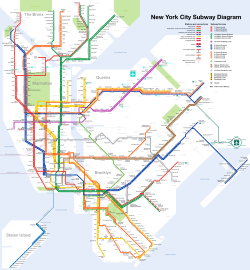
The New York City Subway map as of May 2018 (freely licensed schematic). The map includes other public transportation systems in addition to the subways.
The New York City Subway map as of June 2013.[a]

A transit map is a topological map in the form of a schematic diagram used to illustrate the routes and stations within a public transport system—whether this be bus, tram, rapid transit, commuter rail or ferry routes.[1] Metro maps, subway maps, or tube maps of metropolitan railways are some common examples.[2][3]

The primary function of a transit map is facilitating the passengers' orientation and navigation, helping them to efficiently use the public transport system and identify which stations function as interchange between lines.[2]

Transit maps can usually be found in the transit vehicles, at the platforms or in printed timetables. They are also accessible through digital platforms like mobile apps and websites, ensuring widespread availability and convenience for passengers.[4][5]

São Paulo Metro, Tamanduatei Station. Maps of the system can be seen at the sides (Mapa do Transporte Metropolitano).
Tube map at Spalding railway station, Lincolnshire.

History

[edit]

The mapping of transit systems was at first generally geographically accurate, but abstract route-maps of individual lines (usually displayed inside the carriages) can be traced back as early as 1908 (London's District line), and certainly there are examples from European and American railroad cartography as early as the 1890s where geographical features have been removed and the routes of lines have been artificially straightened out. But it was George Dow of the London and North Eastern Railway who was the first to launch a diagrammatic representation of an entire rail transport network (in 1929); his work is seen by historians of the subject as being part of the inspiration for Harry Beck when he launched his iconic London Underground map in 1933.

After this pioneering work, many transit authorities worldwide imitated the diagrammatic look for their own networks, some while continuing to also publish hybrid versions that were geographically accurate.

Early maps of the Berlin U-Bahn, Berlin S-Bahn, Boston T, Paris Métro, and New York City Subway also exhibited some elements of the diagrammatic form.[6][7][8][9]

The 2007 edition of the Madrid Metro map, designed by the RaRo Agency, took the idea of a simple diagram one step further by becoming one of the first produced for a major network to remove diagonal lines altogether; it is constituted just by horizontal and vertical lines only at right angles to each other.[10] After many complaints over its disadvantages, the company reverted to the previous map in 2013.[11]

Transit maps are now increasingly digitized and can be shown in many forms online.[5]

Elements

[edit]
Schematic transit map of Miami/South Florida regional rail transit, where there are several types of systems from intercity and commuter rail down to automated people movers and a small heavy rail system with a bus rapid transit feeder. It is not to scale, the area covered is about 100 miles (160 km) north-south by 10 miles (16 km) wide.

Transit maps use symbols and abstract representation of the location's geography to illustrate the lines, stations and transfer points of the system while still serving as a tool of physical navigation in the city.

Stations are marked with symbols that break the line's continuity, along with their names, so they may be referred to on other maps or travel itineraries. Further help may be granted through the inclusion of important tourist attractions and other locations such as the city center; these may be identified through symbols or wording.

Color coding allows the map to specify each route in an easy way, allowing the users to quickly identify where each specific route goes; if it does not go to the desired destination, the colors and symbols allow the user to identify a feasible point of transfer between lines.

Symbols such as aircraft may be used to illustrate airports, and symbols of trains may be used to identify stations that allow transfer to other modes, such as commuter or intercity train services.

Use by transit systems

[edit]

Many transit authorities publish multiple maps of their systems; this can be done by isolating one mode of transport, for instance only rapid transit or only bus, onto a single map, or instead the authorities publish maps covering only a limited area, but with greater detail. Another modification is to produce geographically accurate maps of the system, to allow users to better understand the routes. Even if official geographical accurate maps are not available, these can often be obtained from unofficial sources since the information is available from other sources.

With the widespread use of zone pricing[citation needed] for fare calculation, systems that span more than one zone need a system to inform the use which zone a particular station is located in. Common ways include varying the tone of the background color, or by running a weak line along the zone boundaries.

Iconic status

[edit]

There are a growing number of books, websites and works of art on the subject of urban rail and metro map design and use. There are now hundreds of examples of diagrams in an urban rail or metro map style that are used to represent everything from other transit networks like buses and national rail services to sewerage systems and Derbyshire public houses.

One of the most well-known adaptations of an urban rail map was The Great Bear, a lithograph by Simon Patterson. First shown in 1992 and nominated for the Turner Prize, The Great Bear replaces station names on the London Underground map with those of explorers, saints, film stars, philosophers and comedians. Other artists such as Scott Rosenbaum, and Ralph Gray have also taken the iconic style of the urban rail map and made new artistic creations ranging from the abstract to the Solar System. Following the success of these the idea of adapting other urban rail and metro maps has spread so that now almost every major subway or rapid transit system with a map has been doctored with different names, often anagrams of the original station name.

Some maps including those for the rapid transit systems of New York City, Washington D.C., Boston, Montreal, Denver, London have been recreated to include the names of local pubs.[12][13]

See also

[edit]

Notes

[edit]

References

[edit]

Further reading

[edit]
[edit]
Revisions and contributorsEdit on WikipediaRead on Wikipedia
from Grokipedia
A transit map is a representation of a public transportation network, emphasizing the connectivity of stations via transit lines such as railways, buses, or ferries, typically in a topological form that prioritizes clarity over geographical accuracy. These maps illustrate routes, stops, and interchanges within systems like or metros, using simplified diagrams to facilitate passenger and orientation. The modern transit map originated in the early as transit networks expanded in urban areas, evolving from geographically accurate depictions to abstracted schematics for better usability. A pivotal development occurred in 1931 when , a draughtsman for the London Underground, proposed a revolutionary that abandoned true-to-scale geography in favor of straight lines at 45-degree angles, even station spacing, and color-coded routes, first published as a map in 1933. Beck's octolinear layout, inspired by electrical circuit diagrams, became the standard for the London Underground and profoundly influenced global transit mapping, including systems in New York, , and . Key features of transit maps include schematized lines that straighten routes and distribute stations evenly to reduce visual clutter, distinct colors and symbols for different lines and services, and labels that avoid overlaps while preserving route . These elements ensure legibility and focus on sequential connectivity rather than distances, making them essential tools for urban mobility. Today, transit maps incorporate digital adaptations and multimodal integrations, reflecting ongoing advancements in design and technology to serve diverse global networks.

Definition and Purpose

Overview

A transit map is a topological designed to represent public transportation networks, including systems like buses, trams, and subways, with a primary focus on connectivity between stations rather than geographic accuracy. Unlike standard geographic , which prioritize spatial relationships and distances, transit maps abstract the network to facilitate route planning and navigation by highlighting topological relationships, such as direct connections and transfers. This approach evolved from earlier geographic representations to better serve the practical needs of commuters in complex urban environments. Key characteristics of transit maps include simplified straight or curved lines to denote routes, symbols such as dots or circles for stations and interchanges, and color-coding to distinguish individual lines or groups of lines. These elements are often arranged with even spacing and minimal curvature to prioritize clarity and readability, reducing for users interpreting the diagram. The abstraction inherent in these designs ensures that the map remains intuitive even for large-scale networks, emphasizing over realism. Transit maps are also referred to as schematic maps or network diagrams, terms that underscore their diagrammatic nature in illustrating transport topologies. Originating in the early for urban rail systems, these maps have become essential tools for public transit authorities worldwide.

Functions and Benefits

Transit maps serve primary functions in public transportation systems by enabling effective route planning, , transfer point highlighting, and integration with supplementary information such as timetables and fares. These maps simplify the process of determining optimal paths through , allowing users to visualize connections between lines and stations without needing geographic precision. For instance, by marking interchanges with distinct symbols, transit maps facilitate seamless transfers, reducing the time spent navigating unfamiliar systems. Integration with timetables helps users align routes with service schedules, while fare information on maps aids in cost estimation during planning. For users, transit maps offer significant benefits by reducing in intricate urban networks, particularly for tourists and infrequent riders who may lack familiarity with the system. Schematic representations straighten routes and space stations evenly, making it easier to comprehend connectivity and avoid confusion during . This supports quick interchanges and boosts user confidence, with studies showing trip planning success rates of approximately 53% using printed transit materials, benefiting users including those with less familiarity with the system. By prioritizing topological accuracy over exact distances, these maps align with passengers' mental models, enabling faster orientation and more efficient travel. System-wide, transit maps promote ridership by simplifying access to , thereby lowering barriers to transit use and encouraging more frequent . Effective maps enhance overall network usability, leading to increased passenger volumes as users perceive the system as more approachable and reliable. They also aid in communicating network expansions or changes, helping agencies inform riders about new services without overwhelming detail. Research indicates that improved through maps can contribute to ridership gains in targeted implementations. Transit maps are deployed in various contexts to maximize , including station posters for on-site reference, vehicle displays for in-transit guidance, printed guides for portable use, and mobile apps for on-demand consultation. These formats ensure information reaches users at critical moments, such as before boarding or during transfers, supporting both daily commuters and visitors.

History

Early Developments

The origins of transit maps trace back to the late 19th century, when urban transportation systems primarily relied on horse-drawn . These early maps were geographically precise, depicting routes and stops in accurate proportion to the city's layout to aid in expanding metropolitan areas. In , for instance, horse-drawn tram networks, operational since 1865, were mapped with detailed street alignments to reflect the dense urban grid. Similarly, in , the opening of the in 1897—the first underground rapid transit in —featured maps that maintained true geographic scale, integrating the new subway lines with surface streets and landmarks for passenger orientation. These precursors emphasized spatial fidelity over simplification, as transit systems were still relatively sparse. The period from 1900 to 1930 marked a transitional phase driven by rapid and the proliferation of electric , which complicated map design while preserving geographic accuracy. The Paris Métro's inaugural line, opened on July 19, 1900, for the Exposition Universelle, used a map that closely followed the city's actual and street patterns to guide visitors between key exposition sites. In New York, the opening of the first subway line in 1904 prompted maps that embedded stations within a topographic matrix, retaining proportional distances to convey the system's integration with the urban fabric. As networks expanded—Paris adding lines incrementally and New York merging interborough systems—maps grew denser, incorporating multiple routes and interchanges but adhering to scale, which often resulted in intricate, spiderweb-like representations ill-suited for quick comprehension at stations. Pioneering efforts in the late began to introduce to address the challenges of overcrowded urban layouts, where geographic precision hindered legibility for print reproduction and on-the-go passengers. George Dow's 1929 diagrammatic map for the London and North Eastern Railway (LNER) suburban services exemplified this shift, employing straight lines and even spacing to prioritize connectivity over geography, making routes easier to follow amid growing commuter demands. These innovations tackled the limitations of traditional maps in dense environments, laying groundwork for further schematization without abandoning all spatial cues.

Key Innovations and Evolution

The pivotal innovation in transit map design emerged in 1933 with Harry Beck's diagrammatic representation of the , which abandoned geographic accuracy in favor of a approach inspired by electrical circuit diagrams. Beck employed straight lines restricted to horizontal, vertical, and 45-degree angles, a fixed scale that prioritized connectivity over proportional distances, simplifying for a rapidly expanding network. This design was experimentally tested in 1932 and officially adopted by London Underground Electric Railways in 1933, marking a shift from cluttered geographic maps to abstract, user-centric diagrams that emphasized route . Beck's map exerted profound global influence, serving as a template for subsequent transit visualizations worldwide. In the mid-20th century, Beck's principles proliferated as urban rail systems grew, with early adoptions in and adapting schematic elements to local contexts. The Moscow Metro's inaugural 1935 map incorporated simplified linear representations to depict its initial 11-kilometer line and 13 stations, facilitating comprehension amid the Soviet Union's ambitious infrastructure push. By the 1950s, 's subway map embraced 45- and 90-degree angles, even station spacing, and color differentiation for routes, directly echoing Beck's abstraction to manage the city's burgeoning network. In New York, Massimo Vignelli's 1972 subway map further disseminated these ideas through a color-coded, right-angled that integrated the system's complexity into a legible grid, though it faced revisions in the late due to criticisms of excessive abstraction and navigational challenges for users reliant on geographic cues. These adaptations responded to post-World War II urban expansion, where population surges and line extensions demanded maps that balanced simplicity with informational density. Late 20th-century experiments pushed schematic boundaries further, exemplified by the Madrid Metro's 2007 right-angled map designed by the RaRo studio, which intensified abstraction with uniform line spacing and minimal geographic references to streamline a network exceeding 12 lines. However, user confusion over distorted distances and orientations prompted its reversion in 2013 to a hybrid geographic-schematic format, highlighting limits of extreme simplification in dense urban settings. Concurrently, color standardization solidified as a core feature, with consistent hue assignments for lines—such as red for central routes and blue for peripherals—enhancing route identification across systems, as seen in revisions to Vignelli's New York design and Tokyo's updates. Multi-modal integration also advanced, incorporating buses, trams, and rail on unified maps to reflect interconnected networks, driven by the need to guide commuters through diversified public transport options. These evolutions were propelled by the post-World War II urban boom, which saw explosive city growth and transit expansions in and , necessitating maps that could handle increased complexity without overwhelming users.

Design Elements

Core Graphical Components

Transit maps rely on a set of fundamental visual elements to convey network structure and facilitate . These core components include representations of stations, routes, interchanges, and supplementary features, designed for clarity and universality across diverse . Stations and stops form the primary nodes in transit maps, typically depicted as simple geometric shapes such as dots, circles, or bars to indicate precise locations along routes. The size of these symbols often varies to denote importance, with larger circles or bars used for major hubs like central terminals or high-traffic interchanges, enhancing quick identification of key points in the network. For instance, in designs, interchanges may employ concentric rings or enlarged polygons to distinguish them from minor stops, as seen in maps from systems like London's Underground. Routes and lines are illustrated as continuous paths connecting stations, most commonly as colored lines or stylized tubes to differentiate services visually. Colors are selected from a limited palette—often 10 to 15 hues—to ensure perceptual distinction, with each line assigned a unique shade for easy route recognition. Line thickness may vary to represent factors like service frequency or capacity, where thicker lines indicate high-capacity or express services. Interchanges and transfer points are critical for showing connectivity between lines, represented by overlapping symbols or short connecting lines that denote walking paths between platforms. These elements often use amplified node styles, like doubled circles or bridged lines, to signal seamless transfers without implying geographic accuracy. This design prevents visual clutter while guiding users on efficient route changes. Additional features enhance contextual utility, including zone boundaries marked as shaded areas or dashed lines to delineate fare structures, fare indicators via legends or numbered rings (e.g., London's concentric zones), and landmarks represented by icons such as airplane symbols for airports or simplified river outlines for orientation. These elements, like pictograms for the in maps, provide essential non-network references without overwhelming the primary . Standardization of these components draws from established practices rather than rigid global mandates, with common symbols influenced by design conventions like those promoted in international transit forums. For example, dots and colored lines have become norms since early 20th-century innovations.

Stylization and Abstraction Techniques

Transit maps employ stylization and abstraction techniques to prioritize user comprehension and navigational efficiency over precise geographic representation, transforming complex networks into clear, schematic diagrams. These methods draw from cartographic principles that emphasize —the relationships between stations and routes—rather than , allowing passengers to focus on connectivity and transfers. Pioneered by in his 1931 design for the London Underground, this approach revolutionized transit mapping by simplifying visual clutter and enhancing , a philosophy encapsulated in Beck's view that "If you’re , why do you need to bother about geography? It’s not so important. Connections are the thing." Topological distortion is a foundational technique, where real-world distances, curves, and geographic alignments are deliberately ignored to emphasize route sequences and intersections. Routes are often rendered as straight lines oriented at 45-degree or 90-degree angles, known as octolinearity, which reduces directional complexity and creates a grid-like structure for easier . This preserves the network's connectivity while eliminating the distortions of actual , such as winding paths or irregular spacing, making it simpler to trace journeys across multiple lines. For instance, Beck's map straightened the Underground's convoluted lines into a symmetrical diagram, a method that has influenced global transit by favoring functional clarity over spatial accuracy. Scale manipulation further abstracts by standardizing intervals between stations, irrespective of actual mileage, to promote uniformity and reduce visual . Stations are typically spaced evenly along lines—often at consistent grid units—to avoid overcrowding in dense urban cores while maintaining readability across expansive suburbs. This technique, evident in Beck's where central interchanges are enlarged like a "convex lens" and outer areas compressed, allows for telescoped representations that bring peripheral zones closer to the center without altering . In practice, such as the London Underground map, this results in purposeful distortion where, according to a 2009 survey, about 52.2% of schematic transit maps adopt fixed angles and even spacing to balance detail in high-traffic areas with simplicity elsewhere. Additionally, zoning for fares integrates scale abstraction by grouping areas into uniform bands, prioritizing economic utility over precise measurement. Color and hierarchy techniques distinguish routes and emphasize key network elements through visual coding, ensuring quick identification amid complexity. Distinct colors—such as red, blue, green, and yellow—are assigned to individual lines to differentiate them, with primary hues like blue and being the most common for high-frequency or major routes in North American systems. is reinforced by varying line thickness or prominence to highlight busy interchanges and trunk lines, while subtler tones denote secondary services, creating a layered visual order that guides the eye from origins to destinations. For example, the London Underground employs vibrant, line-specific colors to code services, enhancing both usability and aesthetic appeal without relying on geographic context. This approach limits effective color use to 9-12 lines on average, according to a 2009 survey, as seen in systems like Transantiago, where area-specific palettes avoid conflicts and underscore operational priorities. Multi-layering involves overlays to integrate multiple modes or temporal variations, allowing users to parse information selectively without overwhelming the base . For instance, rail lines might form the primary layer, with bus or routes overlaid in contrasting styles, such as dashed lines or separate color families, to denote multimodal connections. Time-based overlays, like peak-hour emphases, can highlight frequent services in bolder weights, while geographic references—such as rivers or tariff zones—are added as subtle backgrounds to provide minimal context without cluttering the topology. In Transantiago's design, over 70 editable layers organize elements by feature, enabling updates for different modes while preserving the core network's abstraction. Similarly, global generation tools from data produce overlays for modes like subway and , combining them into vector-based maps that support both geographic and stylized views. Underlying these techniques are cartographic principles that advocate legibility over accuracy, as articulated in Beck's seminal work and echoed in modern guidelines. Maps avoid clutter through generalization—simplifying lines via smoothing, merging stations, or displacement—to ensure functional relationships dominate, with 40.3% of designs, according to a 2009 survey, favoring 0°/45°/90° angles for balance. This philosophy extends to hierarchical symbolization using visual variables like hue and size, prioritizing passenger navigation in dense networks over topographic fidelity, as distortion in central areas is used in 17.9% of maps, per the same survey, to clarify interchanges without sacrificing overall coherence. Contemporary evaluations reinforce these guidelines, penalizing edge crossings and uneven spacing to optimize readability in automated layouts. Accessibility considerations, such as high-contrast elements, are increasingly integrated to support diverse users.

Types and Variations

Traditional Schematic Maps

Traditional schematic maps represent the foundational format for visualizing public transit networks, emphasizing topological relationships over geographic accuracy to aid passenger navigation. These static maps, often printed or affixed in fixed displays, abstract routes into simplified lines, stations into evenly spaced points, and connections into clear diagrams, as pioneered in early 20th-century designs. They are produced in various formats to suit different physical contexts, including pocket foldouts for personal use, wall posters for public viewing, and vehicle diagrams for onboard reference. Pocket foldouts, typically folded paper maps measuring around 15-20 cm when compact, allow commuters to carry detailed network overviews, such as the 1926 London Underground map by F.H. Stingemore or New York Subway booklets from the 1940s. Wall posters, larger at 50-100 cm, are mounted in high-traffic areas for shared access, while vehicle diagrams—often linear "thermometer" styles—appear inside buses or trains to show upcoming stops. Materials prioritize practicality: lightweight paper for foldouts and brochures ensures portability, whereas vinyl or laminated substrates provide durability against wear in station environments, as seen in Chicago Transit Authority's removable vinyl decals. Applications of these maps extend across physical transit infrastructures, enhancing without relying on digital tools. In station signage, oversized wall posters guide passengers through platforms and interchanges, such as New York MTA's subway diagrams or Washington D.C. Metro displays. They integrate with ticket vending interfaces by overlaying zonal pricing visuals, where color-coded zones indicate fare structures—for instance, London's delineates six concentric zones for pricing, helping users select appropriate tickets at machines. Tourist brochures distribute pocket versions to visitors, like Paris RATP's metro foldouts, combining routes with landmarks for exploratory travel. Vehicle diagrams, meanwhile, support real-time orientation during journeys, reducing confusion in multi-stop services. Variations in traditional schematic maps adapt to network scale and regional needs, balancing abstraction with usability. Mode-specific maps focus on single systems, such as subway-only designs like the London Underground diagram or Paris bus routes, prioritizing line clarity over multimodal complexity. System-wide maps encompass buses, trains, and ferries, as in New York MTA's comprehensive overview or Los Angeles Metro's regional poster. Geographic hybrids incorporate limited scale for sprawling suburbs, retaining some proportional distances while schematizing urban cores—examples include New York's Kick Map or the Rhine-Ruhr conurbation diagram, which blend topology with topography to accommodate peripheral areas. These maps offer distinct advantages in low-tech settings, providing high visibility and legibility through techniques like color-coding and octolinear layouts, which straighten routes for easier visual tracking, as in Harry Beck's 1933 design that revolutionized navigation efficiency. Their static format ensures consistent, distraction-free information in environments without power sources, supporting quick comprehension for diverse users. However, limitations arise from their fixed nature: they cannot convey real-time updates like delays or service changes, potentially leading to outdated guidance, and their abstractions often distort actual distances, causing disorientation in dense areas like central or Toronto's TTC network. Clutter from labeling can overwhelm in complex systems, necessitating careful design to avoid . Globally, traditional schematic maps remain prevalent in established urban systems, underscoring their enduring reliability. London's (TfL) continues to distribute the iconic Underground diagram in print formats across stations and vehicles, maintaining its role since 1933. New York's MTA employs schematic posters and foldouts for its subway and bus networks, with hybrids aiding suburban commuters. In , RATP's metro and RER maps, available as vinyl station posters and paper brochures, integrate zonal visuals for the city's fare system, exemplifying adaptation in legacy European metros. These examples highlight how static maps sustain navigation in high-volume, infrastructure-heavy environments worldwide.

Digital and Interactive Formats

Digital transit maps have evolved from static representations to dynamic, user-centric tools accessible via mobile applications, web platforms, and vehicle-integrated displays, enabling on-demand access to transit information beyond traditional print formats. These formats leverage open data standards like the General Transit Feed Specification (), which provides a common framework for sharing schedules, geographic data, and real-time updates across agencies and apps. By 2025, widespread adoption of such standards has facilitated seamless integration in over transit systems worldwide, powering tools that prioritize user interaction and real-time accuracy. Mobile apps represent the most prominent digital format, offering portable, always-available transit navigation. Apps like and the transit layer provide multi-modal route planning, integrating buses, trains, subways, and even options with turn-by-turn directions. For instance, delivers real-time comparisons of travel options across transport modes, including estimated times and disruptions, serving millions in urban areas like and New York. Similarly, uses GPS-enabled real-time arrival predictions for buses and trains, alerting users to delays or closures directly on their devices. The TfL Go app, developed by , incorporates the iconic with live arrival times for all public transport modes, allowing users to top up cards and track journeys in near real-time. In , the system integrates contactless payments with the MTA app, enabling fare management and route suggestions tied to subway and bus schedules. These apps often feature zoomable interfaces for detailed exploration of networks, where users can pinch to view station layouts or expand for city-wide overviews, enhancing usability on touchscreens. Web-based tools and on-screen displays in vehicles extend digital access to non-mobile users and in-transit environments. Platforms like OneBusAway offer browser-accessible real-time vehicle tracking and arrival predictions via data, suitable for desktops or public kiosks. In vehicles, systems such as TransitScreen aggregate nearby transit options—including buses, subways, and shared rides—on , providing passengers with glanceable updates without needing personal devices. Safe Fleet's displays, installed in buses and trains, show live camera views alongside route maps and stop announcements, improving passenger awareness during commutes. Core features of these digital formats include real-time tracking, GPS integration, and personalized routing, transforming static maps into adaptive guides. GPS integration in apps like Transit enables precise user location overlay on maps, adjusting routes dynamically for traffic or service changes. Personalized routing tailors suggestions based on user preferences, such as avoiding stairs or prioritizing speed, as seen in Citymapper's profile-based options. By 2025, advancements like (AR) overlays have gained traction; ' Live View uses phone cameras to project directional arrows and station markers onto real-world views for walking navigation to transit stops. Moovit's AR layer similarly highlights bus and subway entrances through camera scans, reducing navigation errors in complex urban areas. Voice-assisted maps, powered by assistants like within Maps, deliver audio cues for transit directions, including stop announcements and transfer alerts, aiding hands-free use. Open data APIs under standards ensure interoperability, allowing apps to pull live feeds from agencies for consistent, up-to-date information. Despite these benefits, digital transit maps face challenges related to privacy and performance in low-connectivity areas. Location tracking for real-time features raises concerns, as aggregated mobility can reveal user patterns; researchers emphasize anonymization techniques to mitigate re-identification risks in transit datasets. In regions with poor , apps may fail to load updates, exacerbating inequities for users without reliable access, as highlighted in studies on the in transport planning. Adoption trends show a marked shift toward digital formats in tech-forward cities, often supplemented by hybrid models. In , the promotes apps like the MyTransport.SG for route planning and real-time MRT updates, aligning with the initiative's push for digital infrastructure over print reliance. Seoul has accelerated this transition with the Seoul Subway app, offering location-based info and timetables for international users, following a 2023 map redesign that prioritizes digital readability. Many agencies maintain hybrid approaches, providing printable PDFs alongside apps to bridge connectivity gaps.

Notable Examples and Impact

Iconic Transit Maps

One of the most influential transit maps in history is 's design for the London Underground, first published in a pocket edition in January 1933 after its conceptualization in 1931. , an electrical draughtsman, drew inspiration from circuit diagrams to create a representation that abstracted the network into straight lines at 45- and 90-degree angles, with evenly spaced ticks for stations and color-coded lines for clarity, prioritizing topological accuracy over geographic scale. This radical departure from previous geographically faithful maps proved immediately popular, with an initial print run of 750,000 copies, and it set a global standard for urban rail diagramming by simplifying navigation in complex systems. The map underwent numerous revisions, including major updates in the 1960s to integrate expansions like the opened in 1968, while preserving Beck's core abstraction principles; these changes ensured its adaptability as the network grew to over 270 stations. Its legacy includes widespread emulation in cities worldwide, influencing designs from New York to and earning recognition as a pinnacle of . Massimo Vignelli's 1972 New York City Subway map exemplifies minimalist schematic innovation, featuring a grid of 45-degree lines, distinct colors for each route, and simplified icons to distill the system's 468 stations into an accessible diagram modeled after Beck's approach. Despite its aesthetic elegance and role in unifying the transit authority's branding with signage, the map sparked debate over its geographic distortions—such as compressing Manhattan's length—which critics argued confused surface navigation, leading to its replacement in 1979 by a hybrid version restoring more proportional distances. Further refinements occurred in 2014, blending Vignelli's abstraction with enhanced geographic elements for better usability, and during in 2012, the issued adapted schematic overlays on existing maps to indicate flooded lines, service suspensions, and shuttle reroutes, aiding recovery efforts. The 2025 redesign revives Vignelli's vision with corrected proportions and integrated accessibility features, underscoring the ongoing tension between minimalism and realism in subway mapping. Other notable examples include the Paris RER network map, which since the 1970s has integrated suburban express lines with the Métro in a layered using bold colors and zoned interchange symbols for the expansive region, facilitating over 3 million daily riders across 257 stations. Tokyo Metro's map employs a vibrant color palette akin to a wheel for its nine lines, paired with alphanumeric station codes and pictorial icons tied to local landmarks, enabling intuitive transfers in a system serving 6.5 million passengers daily. In Berlin, Erik Spiekermann's circular map from the early 1990s highlights the iconic Ringbahn as a central loop with radial spokes, abstracting the divided city's reunified network into a psychologically reassuring form that emphasizes connectivity over post-Wall geography. The iconicity of these maps extends beyond functionality into cultural and commercial realms, with Beck's licensed for merchandise like apparel and puzzles, generating millions in revenue for , and Vignelli's influencing global design curricula through exhibitions at the . Such maps have garnered accolades, including the Tube map's inclusion in the Design Museum's permanent collection and Tokyo's system praised in international transit forums for its user-centered evolution. A recent exemplar is the Metro's multi-modal schematic map, released by the Roads and Transport Authority in the early 2020s using "" topology to overlay the and lines with trams and buses across 55 stations, supporting the city's rapid and serving over 750,000 daily users (as of 2024) with clear interchange nodes. This design, updated in 2025 to include the planned Blue Line—a new 30 km route under construction since the groundbreaking on June 9, 2025, and slated for opening in September 2029—exemplifies modern abstraction tailored to integrated mobility in emerging megacities.

Cultural and Artistic Influence

Transit maps have achieved iconic status in design history, with several examples recognized by prestigious institutions. The (MoMA) in New York includes Massimo Vignelli's 1972 New York City subway map in its permanent collection, highlighting its role as a modernist masterpiece of that prioritizes clarity over geographic accuracy. Similarly, MoMA collaborated with the to publish The Great New York Subway Map in 2018, a children's book that illustrates the evolution of subway mapping and its cultural significance. The has also hosted exhibits exploring the history and influence of subway maps, underscoring their place as enduring artifacts of . Beyond museums, the diagrammatic principles pioneered by Harry Beck's 1933 map have extended to in non-transit contexts, such as airport route diagrams, where simplified schematics aid navigation in complex environments. Artistic adaptations of transit maps often transform their functional form into creative expressions, including parodies and themed variants. Simon Patterson's The Great Bear (1992) reimagines the by replacing stations with names of influential figures from , , and , turning the diagram into a conceptual artwork acquired by the Gallery. David Booth's The Tate Gallery by Tube (1986), a promotional , depicts the Underground network as tubes of paint linking to Tate exhibits, blending transit schematics with visual art promotion. Themed maps extend this further, such as the 2015 Underground map, which overlays fictional landmarks from J.K. Rowling's series onto London's Tube lines, replacing real stations with locations like Diagon Alley and the . Fan recreations proliferate online and in print, adapting classic maps to personal or niche interests, from literary worlds to custom city variants, fostering a community of amateur cartographers inspired by the originals. In media and pop culture, transit maps frequently appear in books, films, and merchandise, reinforcing their role as recognizable symbols. Ken Garland's Mr. Beck's Underground Map: A History (1994) chronicles the creation and legacy of Harry Beck's design, serving as a key text on its cultural impact. Films often feature the London Underground map, as captured in the 2010 Underground Film Map poster, which renames stations after movies shot at those locations over 70 years, including classics like An American Werewolf in London and Skyfall. Merchandise draws heavily from these icons, with the New York Transit Museum Store offering subway map-themed apparel, posters, and accessories, while global retailers sell prints of historic and artistic variants as decorative art. The global impact of transit maps is documented in comprehensive works like Mark Ovenden's Transit Maps of the World (first edition 2007, expanded 2015), which catalogs over 400 historical and contemporary examples from urban rail systems worldwide, illustrating their evolution as cultural documents. This book, along with its updates, highlights variants from cities like and , emphasizing maps' role in preserving transport heritage. As symbols of urban identity, transit maps embody city branding; London's Tube map, with its distinctive roundel and color-coded lines, has become synonymous with the metropolis since 1933, appearing in campaigns and official logos. In , the Bay Area's unified transit maps and signage, rolled out in 2024 by the Metropolitan Transportation Commission, integrate , Muni, and ferry routes to foster regional cohesion and pride in the area's innovative public transport network.

Accessibility and Future Directions

Inclusive Design Features

Inclusive design in transit maps addresses barriers faced by users with visual impairments through features like high-contrast colors, which enhance visibility of routes, stations, and labels by ensuring a minimum of 4.5:1 between elements and backgrounds. Tactile maps with overlays provide raised-line representations of networks, allowing blind users to trace paths and identify stops via touch; for instance, these often use thermoformed plastic or for durability and precision, with labels positioned 0.5 inches apart. Audio descriptions integrated into digital apps or smartpen-enabled maps narrate layouts, such as platform positions and connections, enabling pre-trip planning; the Audio/Tactile Station Maps exemplify this by offering braille-annotated views and audio playback for three levels (street, concourse, platform) across 44 stations (as originally developed in , prior to BART's expansion to 50 stations). For cognitive accessibility, transit maps employ simplified legends that minimize text and use intuitive hierarchies to reduce , prioritizing essential route overviews over exhaustive details. Multilingual support incorporates translations or audio in multiple languages alongside visual elements, bridging linguistic gaps for non-native speakers. Icons tailored for non-readers, including tactile variants like TactIcons—3D-printed symbols tested for instant recognizability—facilitate quick comprehension through distinct textures and shapes, such as ridged patterns for subways versus cross-hatching for buses. Broader inclusivity extends to gender-neutral symbols in signage and maps, favoring function-based pictograms like a simple toilet icon over binary figures to accommodate all gender identities in transit facilities such as restrooms. Cultural sensitivity in icons promotes universal pictograms that avoid region-specific assumptions, drawing from international standards to ensure relevance across diverse populations, as seen in multilingual aids. Compliance with standards like the (WCAG) 2.1 ensures digital transit maps support screen readers, keyboard navigation, and resizable text up to 200% without loss of functionality. In the United States, Americans with Disabilities Act (ADA) guidelines require tactile , high-contrast visuals, and equivalent audio formats for transit information to prevent discrimination. The Accessibility Design Guidelines illustrate this through requirements for tactile maps at key transit points, featuring raised characters (0.8-1.5 mm high), , and 50%+ contrast in sans-serif fonts for TTC . Key implementation challenges involve balancing detailed geographical accuracy with schematic simplicity to suit varying cognitive loads, as overly complex maps can confuse users with impairments while sparse ones may omit critical navigation cues. The , effective June 28, 2025, mandates accessible information—including maps, timetables, and station details—for persons with disabilities, requiring EU-wide harmonization of formats like audio and tactile outputs to foster inclusivity. Advancements in (AI) are transforming transit maps through predictive routing and personalized navigation features. algorithms analyze on , , and ridership patterns to forecast and suggest optimal routes, enabling apps to reroute passengers dynamically and improve reliability. For example, by 2025, platforms like TripShot employ AI to shift from reactive to predictive operations, using historical data and external variables to optimize commute planning and reduce wait times. Similarly, AI-driven route optimization in public transit tackles inefficiencies by forecasting demand and adjusting paths, as demonstrated in studies on applications for transportation . Augmented reality (AR) and virtual reality (VR) are emerging as key tools for enhancing transit map usability, particularly for on-the-go navigation and infrastructure planning. AR overlays digital route information onto live camera views, helping users locate bus stops or subway entrances without consulting screens; Moovit's AR Way Finder feature allows riders to point their phones for intuitive directions similar to ' walking AR. In planning contexts, georeferenced AR visualizes proposed transit projects in real-world settings, as seen in Esri's applications where users experience future infrastructure during site tours. VR complements this by offering immersive simulations for route testing and accessibility assessments, enabling planners to virtually navigate complex networks before implementation. Sustainability trends are increasingly embedded in transit maps, with eco-routing algorithms prioritizing low-emission paths and integrating options like e-scooters. These systems calculate routes that minimize carbon footprints by favoring electric vehicles or bike shares, as outlined in geo-analytic frameworks for green micro-mobility planning that balance safety and environmental impact. By 2025, transit apps are incorporating shared into core maps, displaying seamless connections between buses, trains, and e-bikes to promote multimodal, low-carbon travel. Global shifts toward are evolving transit map standards, exemplified by updates to the General Transit Feed Specification (). In 2025, GTFS governance formalized through community voting, introducing new fields for enhanced real-time data sharing, while the related GOFS extension supports on-demand services like ride-hailing integration without fragmenting public transit feeds. Climate-resilient designs are also advancing, with transit authorities incorporating adaptive mapping for disrupted networks; the Metropolitan Transportation Authority's 2025 roadmap, for instance, uses scenario modeling to fortify rail systems against , ensuring maps reflect resilient alternatives. Frameworks for railway resilience further emphasize resource-aware planning to maintain connectivity amid climate risks. Despite these innovations, challenges persist in equity and technology access. Digital divides exacerbate inequalities, as low-income or elderly users without smartphones face barriers to AI-enhanced maps, leading to exclusion from personalized services. Over-reliance on devices risks stranding riders during outages or in low-connectivity areas, underscoring the need for hybrid analog-digital solutions to ensure universal access.

References

Add your contribution
Related Hubs
Contribute something
User Avatar
No comments yet.