

Hearing aid
View on Wikipedia
| Hearing aid | |
|---|---|
 In-the-canal hearing aid | |
| Other names | Deaf aid |
A hearing aid is a device designed to improve hearing by making sound audible to a person with hearing loss. Hearing aids are classified as medical devices in most countries, and regulated by the respective regulations. Small audio amplifiers such as personal sound amplification products (PSAPs) or other plain sound reinforcing systems cannot be sold as "hearing aids".
Early devices, such as ear trumpets or ear horns,[1] were passive amplification cones designed to gather sound energy and direct it into the ear canal.

Modern devices are computerised electroacoustic systems that transform environmental sound to make it audible, according to audiometrical and cognitive rules. Modern devices also utilize sophisticated digital signal processing, aiming to improve speech intelligibility and comfort for the user. Such signal processing includes feedback management, wide dynamic range compression, directionality, frequency lowering, and noise reduction.
Modern hearing aids require configuration to match the hearing loss, physical features, and lifestyle of the wearer. The hearing aid is fitted to the most recent audiogram and is programmed by frequency. This process, called "fitting", can be performed by the user in simple cases, by a Doctor of Audiology (an AuD) - also called an audiologist, or by a Hearing Instrument Specialist (HIS) or audioprosthologist. The amount of benefit a hearing aid delivers depends in large part on the quality of its fitting. Almost all hearing aids in use in the United States are digital hearing aids, as analog aids are phased out.[2] Devices similar to hearing aids include the osseointegrated auditory prosthesis (formerly called the bone-anchored hearing aid) and cochlear implant.
Uses
[edit]Hearing aids are used for a variety of pathologies including sensorineural hearing loss, conductive hearing loss, and single-sided deafness. Hearing aid candidacy was traditionally determined by a Doctor of Audiology, or a certified hearing specialist, who will also fit the device based on the nature and degree of the hearing loss being treated. The amount of benefit experienced by the user of the hearing aid is multi-factorial, depending on the type, severity, and etiology of the hearing loss, the technology and fitting of the device, and on the motivation, personality, lifestyle, and overall health of the user.[3] Over-the-counter hearing aids, which address mild to moderate hearing loss, are designed to be adjusted by the user.[4]
Hearing aids are incapable of truly correcting a hearing loss; they are an aid to make sounds more audible. The most common form of hearing loss for which hearing aids are sought is sensorineural, resulting from damage to the hair cells and synapses of the cochlea and auditory nerve. Sensorineural hearing loss reduces the sensitivity to sound, which a hearing aid can partially accommodate by making sound louder. Other decrements in auditory perception caused by sensorineural hearing loss, such as abnormal spectral and temporal processing, and which may negatively affect speech perception, are more difficult to compensate for using digital signal processing and in some cases may be exacerbated by the use of amplification.[5][page needed] Conductive hearing losses, which do not involve damage to the cochlea, tend to be better treated by hearing aids; the hearing aid is able to sufficiently amplify sound to account for the attenuation caused by the conductive component. Once the sound is able to reach the cochlea at normal or near-normal levels, the cochlea and auditory nerve are able to transmit signals to the brain normally.
Common issues with hearing aid fitting and use are the occlusion effect, loudness recruitment, and understanding speech in noise. Once a common problem, feedback is generally now well-controlled through the use of feedback management algorithms.
Candidacy and acquisition
[edit]There are lots of ways of evaluating how well a hearing aid compensates for hearing loss. One approach is audiometry which measures a subject's hearing levels in laboratory conditions. The threshold of audibility for various sounds and intensities is measured in a variety of conditions. Although audiometric tests may attempt to mimic real-world conditions, the patient's own every day experiences may differ. An alternative approach is self-report assessment, where the patient reports their experience with the hearing aid.[6][7]
Hearing aid outcome can be represented by three dimensions:[8]
- hearing aid usage
- aided speech recognition
- benefit/satisfaction
The most reliable method for assessing the correct adjustment of a hearing aid is through real ear measurement.[9] Real ear measurements (or probe microphone measurements) are an assessment of the characteristics of hearing aid amplification near the ear drum using a silicone probe tube microphone.[10]
Types
[edit]There are many types of hearing aids (also known as hearing instruments), which vary in size, power and circuitry. Among the different sizes and models are:
-
 Vacuum tube hearing aid, circa 1944
 -
 Transistor body-worn hearing aid.
 -
 Pair of BTE hearing aids with earmolds.
 -
 Receiver-in-the-canal hearing aids
 -
 In-the-ear hearing aid
 -
 In-the-canal hearing aid
 -
 Woman wearing a bone anchored hearing aid
 -
 Hearing aid application
_Hearing_Aid,_Model-A3A,_Pastel_Coralite_Case,_Bone-Air,_Original_Cost_%3D_50.00_USD,_Circa_1944_(10840966755).jpg)
_Hearing_Aid,_Model_70A,_Made_in_the_USA_(12483173304).jpg)


Body-worn
[edit]Body worn aids were the first portable electronic hearing aids, and were invented by Harvey Fletcher while working at Bell Laboratories.[11] Body aids consist of a case and an earmold, attached by a wire. The case contains the electronic amplifier components, controls and battery, while the earmold typically contains a miniature loudspeaker. The case is typically about the size of a pack of playing cards and is carried in a pocket or on a belt.[12] Without the size constraints of smaller hearing devices, body worn aid designs can provide large amplification and long battery life at a lower cost. Body aids are still used in emerging markets because of their relatively low cost.[12]
Behind the ear
[edit]

Behind the ear hearing aids are one of two major classes of hearing aids – behind the ear (BTE) and in the ear (ITE). These two classes are distinguished by where the hearing aid is worn. BTE hearing aids consist of a case which hangs behind the pinna. The case is attached to an earmold or dome tip by a traditional tube, slim tube, or wire. The tube or wire courses from the superior-ventral portion of the pinna to the concha, where the ear mold or dome tip inserts into the external auditory canal. The case contains the electronics, controls, battery, and microphone(s).The loudspeaker, or receiver, may be housed in the case (traditional BTE) or in the earmold or dome tip (receiver-in-the-canal, or RIC). The RIC style of BTE hearing aid is often smaller than a traditional BTE and more commonly used in more active populations.[13]
BTEs are generally capable of providing more output and may therefore be indicated for more severe degrees of hearing loss. However, BTEs are very versatile and can be used for nearly any kind of hearing loss. BTEs come in a variety of sizes, ranging from a small, "mini BTE", to larger, ultra-power devices. Size typically depends on the output level needed, the location of the receiver, and the presence or absence of a telecoil. BTEs are durable, easy to repair, and often have controls and battery doors that are easier to manipulate. BTEs are also easily connected to assistive listening devices, such as FM systems and induction loops. BTEs are commonly worn by children who need a durable type of hearing aid.[12]
In the ear
[edit]In the ear aids (ITE) devices fit in the outer ear bowl (called the concha). Being larger, these are easier to insert and can hold extra features.[14] They are sometimes visible when standing face to face with someone. ITE hearing aids are custom made to fit each individual's ear. They can be used in mild to some severe hearing losses. Feedback, a squealing/whistling caused by sound (particularly high frequency sound) leaking and being amplified again, may be a problem for severe hearing losses.[15] Some modern circuits are able to provide feedback regulation or cancellation to assist with this. Venting may also cause feedback. A vent is a tube primarily placed to offer pressure equalization. However, different vent styles and sizes can be used to influence and prevent feedback.[16] Traditionally, ITEs have not been recommended for young children because their fit could not be as easily modified as the earmold for a BTE, and thus the aid had to be replaced frequently as the child grew.[17] However, there are new ITEs made from a silicone type material that mitigates the need for costly replacements. ITE hearing aids can be connected wirelessly to FM systems, for instance with a body-worn FM receiver with induction neck-loop which transmits the audio signal from the FM transmitter inductively to the telecoil inside the hearing instrument.
Mini in canal (MIC) or completely in canal (CIC) aids are generally not visible unless the viewer looks directly into the wearer's ear.[18][19] These aids are intended for mild to moderately severe losses. CICs are usually not recommended for people with good low-frequency hearing, as the occlusion effect is much more noticeable.[20] Completely-in-the-canal hearing aids fit tightly deep in the ear.[14] It is barely visible.[14] Being small, it will not have a directional microphone, and its small batteries will have a short life, and the batteries and controls may be difficult to manage.[14] Its position in the ear prevents wind noise and makes it easier to use phones without feedback.[14] In-the-canal hearing aids are placed deep in the ear canal.[14] They are barely visible.[14] Larger versions of these can have directional microphones.[14] Being in the canal, they are less likely to cause a plugged feeling.[14] These models are easier to manipulate than the smaller completely in-the-canal models but still have the drawbacks of being rather small.[14]
In-the-ear hearing aids are typically more expensive than behind-the-ear counterparts of equal functionality, because they are custom fitted to the patient's ear. In fitting, the audiologist takes a physical impression (mold) of the ear. The mold is scanned by a specialized CAD system, resulting in a 3D model of the outer ear. During modeling, the venting tube is inserted. The digitally modeled shell is printed using a rapid prototyping technique such as stereolithography. Finally, the aid is assembled and shipped to the audiologist after a quality check.[21]
Invisible-in-canal hearing aids
[edit]Invisible-in-canal hearing aids (IIC) style of hearing aids fits inside the ear canal completely, leaving little to no trace of an installed hearing aid visible. This is because it fits deeper in the canal than other types, so that it is out of view even when looking directly into the ear bowl (concha). A comfortable fit is achieved because the shell of the aid is custom-made to the individual ear canal after taking a mold. Invisible hearing aid types use venting and their deep placement in the ear canal to give a more natural experience of hearing. Unlike other hearing aid types, with the IIC aid the majority of the ear is not blocked (occluded) by a large plastic shell. This means that sound can be collected more naturally by the shape of the ear, and can travel down into the ear canal as it would with unassisted hearing. Depending on their size, some models allow the wearer to use a mobile phone as a remote control to alter memory and volume settings, instead of taking the IIC out to do this. IIC types are most suitable for users up to middle age, but are not suitable for elderly people with unsteady hands.[22]
Extended wear hearing aids
[edit]Extended wear hearing aids are hearing devices that are non-surgically placed in the ear canal by a hearing professional. The extended wear hearing aid represents the first "invisible" hearing device. These devices are worn for 1–3 months at a time without removal. They are made of soft material designed to contour to each user and can be used by people with mild to moderately severe hearing loss. Their close proximity to the ear drum results in improved sound directionality and localization, reduced feedback, and improved high frequency gain.[23] While traditional BTE or ITC hearing aids require daily insertion and removal, extended wear hearing aids are worn continuously and then replaced with a new device. Users can change volume and settings without the aid of a hearing professional. The devices are very useful for active individuals because their design protects against moisture and earwax and can be worn while exercising, showering, etc. Because the device's placement within the ear canal makes them invisible to observers, extended wear hearing aids are popular with those who are self-conscious about the aesthetics of BTE or ITC hearing aid models. As with other hearing devices, compatibility is based on an individual's hearing loss, ear size and shape, medical conditions, and lifestyle. The disadvantages include regular removal and reinsertion of the device when the battery dies, inability to go underwater, earplugs when showering, and for some discomfort with the fit since it is inserted deeply in the ear canal, the only part of the body where skin rests directly on top of bone.
CROS hearing aid
[edit]A CROS hearing aid is a hearing aid that transmits auditory information from one side of the head to the other side of the head. Candidates include people who have poor word understanding on one side, no hearing on one side, or who are not benefiting from a hearing aid on one side. CROS hearing aids can appear very similar to behind the ear hearing aids. The CROS system can assist the patient in sound localization and understanding auditory information on their poor side. While CROS hearing aids can be quite effective, the long-term solution for those with hearing issues on one side is to use a BiCROS system.[citation needed] This creates more of a balance for wearers.
Bone-anchored
[edit]A bone anchored hearing aid (BAHA) is a surgically implanted auditory prosthetic based on bone conduction. It is an option for patients without external ear canals, when conventional hearing aids with a mold in the ear cannot be used. The BAHA uses the skull as a pathway for sound to travel to the inner ear. For people with conductive hearing loss, the BAHA bypasses the external auditory canal and middle ear, stimulating the functioning cochlea. For people with unilateral hearing loss, the BAHA uses the skull to conduct the sound from the deaf side to the side with the functioning cochlea.
Individuals under the age of two (five in the USA) typically wear the BAHA device on a Softband. This can be worn from the age of one month as babies tend to tolerate this arrangement very well. When the child's skull bone is sufficiently thick, a titanium "post" can be surgically embedded into the skull with a small abutment exposed outside the skin. The BAHA sound processor sits on this abutment and transmits sound vibrations to the external abutment of the titanium implant. The implant vibrates the skull and inner ear, which stimulate the nerve fibers of the inner ear, allowing hearing.
The surgical procedure is simple both for the surgeon, involving very few risks for the experienced ear surgeon. For the patient, minimal discomfort and pain is reported. Patients may experience numbness of the area around the implant as small superficial nerves in the skin are sectioned during the procedure. This often disappears after some time. There is no risk of further hearing loss due to the surgery. One important feature of the BAHA is that, if a patient for whatever reason does not want to continue with the arrangement, it takes the surgeon less than a minute to remove it. The BAHA does not restrict the wearer from any activities such as outdoor life, sporting activities etc.
A BAHA can be connected to an FM system by attaching a miniaturized FM receiver to it.
Two main brands manufacture BAHAs today – the original inventors Cochlear, and the hearing aid company Oticon.
Eyeglass aids
[edit]
During the late 1950s through 1970s, before in-the-ear aids became common (and in an era when thick-rimmed eyeglasses were popular), people who wore both glasses and hearing aids frequently chose a type of hearing aid that was built into the temple pieces of the spectacles.[25] However, the combination of glasses and hearing aids was inflexible: the range of frame styles was limited, and the user had to wear both hearing aids and glasses at once or wear neither.[26] Today, people who use both glasses and hearing aids can use in-the-ear types, or rest a BTE neatly alongside the arm of the glasses. There are still some specialized situations where hearing aids built into the frame of eyeglasses can be useful, such as when a person has hearing loss mainly in one ear: sound from a microphone on the "bad" side can be sent through the frame to the side with better hearing.
This can also be achieved by using CROS or bi-CROS style hearing aids, which are now wireless in sending sound to the better side.
Spectacle hearing aids
[edit]These are generally worn by people with a hearing loss who either prefer a more cosmetic appeal of their hearing aids by being attached to their glasses or where sound cannot be passed in the normal way, via a hearing aids, perhaps due to a blockage in the ear canal. pathway or if the client experiences continual infections in the ear. Spectacle aids come in two forms, bone conduction spectacles and air conduction spectacles.
Bone conduction spectacles
[edit]Sounds are transmitted via a receiver attached from the arm of the spectacles which are fitted firmly behind the boney portion of the skull at the back of the ear, (mastoid process) by means of pressure, applied on the arm of the spectacles. The sound is passed from the receiver on the arm of the spectacles to the inner ear (cochlea), via the bony portion. The process of transmitting the sound through the bone requires a great amount of power. Bone conduction aids generally have a poorer high pitch response and are therefore best used for conductive hearing losses or where it is impractical to fit standard hearing aids.
Air conduction spectacles
[edit]Unlike the bone conduction spectacles the sound is transmitted via hearing aids which are attached to the arm or arms of the spectacles. When removing your glasses for cleaning, the hearing aids are detached at the same time. Whilst there are genuine instances where spectacle aids are a preferred choice, they may not always be the most practical option.
Directional spectacles
[edit]These 'hearing glasses' incorporate a directional microphone capability: four microphones on each side of the frame effectively work as two directional microphones, which are able to discern between sound coming from the front and sound coming from the sides or back of the user.[27] This improves the signal-to-noise ratio by allowing for amplification of the sound coming from the front, the direction in which the user is looking, and active noise control for sounds coming from the sides or behind. Only very recently has the technology required become small enough to be fitted in the frame of the glasses. As a recent addition to the market, this new hearing aid is currently available only in the Netherlands and Belgium.[28]
Stethoscope
[edit]These hearing aids are designed for medical practitioners with hearing loss who use stethoscopes. The hearing aid is built into the speaker of the stethoscope, which amplifies the sound.
Hearing aid applications
[edit]Hearing aid applications (HAA) are software which, when installed on mobile computational platforms, transforms them into hearing aids.[29]
The principle of HAA operation corresponds to the basic principles of operation of traditional hearing aids: the microphone receives an acoustic signal and converts it into a digital form. Sound amplification is achieved by the means of a mobile computational platform, in accordance with the degree and type of the user's hearing loss. The processed audio signal is transformed into an audio signal and output to the user into the headphones/headset. Signal processing is implemented in real time.
Constructional features of mobile computational platforms imply preferred use of stereo headsets with two speakers, which allows carrying out binaural hearing correction for the left and right ear separately.[30] HAAs can work with both wired and wireless headsets and headphones.[31]
As a rule, HAAs have two operation modes: setup mode and hearing aid mode. Setup mode involves the user passing an in situ-audiometry procedure, which determines the user's hearing characteristics. Hearing aid mode is a hearing correction system that corrects the user's hearing in accordance with the user's hearing thresholds. HAAs also incorporate background noise suppression and acoustic feedback suppression.[30]
The user can independently choose a formula to enhance the sound, as well as adjust the level of the desired amplification to their wishes.[31]
HAAs have several advantages (compared to traditional hearing aids):[citation needed]
- HAAs do not cause any psychological inconvenience;
- it is possible to achieve the highest sound pressure level and get high sound quality (due to large speakers and a long battery life);
- it is possible to use more complex audio signal processing algorithms and a higher sampling rate (because of capacious battery);
- the possibility to implement more convenient application control functions for people with poor motor skills;
- resistance to ingress of earwax and moisture;
- software flexibility;
- the large distance between the microphone and the speaker prevents the occurrence of acoustic feedback;
- the set up of HAAs in simple cases does not require special equipment and qualifications;
- the user does not need to purchase and carry any separate device;
- various types of headphones and headsets can be used.
HAAs also have some disadvantages (compared to traditional hearing aids):
- because the microphone is not located in the ear, it does not use the functional advantages of the auricle and the natural acoustics of the outer ear.[30]
- they are more noticeable and less comfortable to wear.
Technology
[edit]The first electrical hearing aid used the carbon microphone of the telephone and was introduced in 1896. The vacuum tube made electronic amplification possible, but early versions of amplified hearing aids were too heavy to carry around. Miniaturization of vacuum tubes lead to portable models, and after World War II, wearable models using miniature tubes. The transistor invented in 1948 was well suited to the hearing aid application due to low power and small size; hearing aids were an early adopter of transistors. The development of integrated circuits allowed further improvement of the capabilities of wearable aids, including implementation of digital signal processing techniques and programmability for the individual user's needs.
Compatibility with telephones
[edit]
A hearing aid and a telephone are "compatible" when they can connect to each other in a way that produces clear, easily understood sound. The term "compatibility" is applied to all three types of telephones (wired, cordless, and mobile). There are two ways telephones and hearing aids can connect with each other:
- Acoustically: the sound from the phone's speaker is picked up by the hearing aid's microphone.
- Electromagnetically: the signal inside the phone's speaker is picked up by the hearing aid's "telecoil" or "T-coil", a special loop of wire inside the hearing aid.
Note that telecoil coupling has nothing to do with the radio signal in a cellular or cordless phone: the audio signal picked up by the telecoil is the weak electromagnetic field that is generated by the voice coil in the phone's speaker as it pushes the speaker cone back and forth.
The electromagnetic (telecoil) mode is usually more effective than the acoustic method. This is mainly because the microphone is often automatically switched off when the hearing aid is operating in telecoil mode, so background noise is not amplified. Since there is an electronic connection to the phone, the sound is clearer and distortion is less likely. But in order for this to work, the phone has to be hearing-aid compatible. More technically, the phone's speaker has to have a voice coil that generates a relatively strong electromagnetic field. Speakers with strong voice coils are more expensive and require more energy than the tiny ones used in many modern telephones; phones with the small low-power speakers cannot couple electromagnetically with the telecoil in the hearing aid, so the hearing aid must then switch to acoustic mode. Also, many mobile phones emit high levels of electromagnetic noise that creates audible static in the hearing aid when the telecoil is used. A workaround that resolves this issue on many mobile phones is to plug a wired (not Bluetooth) headset into the mobile phone; with the headset placed near the hearing aid the phone can be held far enough away to attenuate the static. Another method is to use a "neckloop" (which is like a portable, around-the-neck induction loop), and plug the neckloop directly into the standard audio jack (headphones jack) of a smartphone (or laptop, or stereo, etc.). Then, with the hearing aids' telecoil turned on (usually a button to press), the sound will travel directly from the phone, through the neckloop and into the hearing aids' telecoils.[32]
On 21 March 2007, the Telecommunications Industry Association issued the TIA-1083 standard,[33] which gives manufacturers of cordless telephones the ability to test their products for compatibility with most hearing aids that have a T-Coil magnetic coupling mode. With this testing, digital cordless phone manufacturers will be able to inform consumers about which products will work with their hearing aids.[34]
The American National Standards Institute (ANSI) has a ratings scale for compatibility between hearing aids and phones:
- When operating in acoustic (Microphone) mode, the ratings are from M1 (worst) to M4 (best).
- When operating in electromagnetic (Telecoil) mode, the ratings are from T1 (worst) to T4 (best).
The best possible rating is M4/T4 meaning that the phone works well in both modes. Devices rated below M3 are unsatisfactory for people with hearing aids.
Computer programs that allow the creation of a hearing aid using a PC, tablet or smartphone are currently gaining in popularity.[35] Modern mobile devices have all the necessary components to implement this: hardware (an ordinary microphone and headphones may be used) and a high-performance microprocessor that carries digital sound processing according to a given algorithm. Application configuration is carried out by the user themselves in accordance with the individual features of their hearing ability. The computational power of modern mobile devices is sufficient to produce the best sound quality. This, coupled with software application settings (for example, profile selection according to a sound environment) provides for high comfort and convenience of use. In comparison with the digital hearing aid, mobile applications have the following advantages:
- acoustic gain is up to 30 dB (with a standard headset);
- complete invisibility (smartphone is not associated with a hearing aid);
- ease of use (no need to use additional devices, batteries and so on.);
- Fast switching between the external headset and phone microphone;
- free distribution of applications.
- High duration of the battery;
- high sampling frequency (44.1 kHz) providing for excellent sound quality;
- high wearing comfort;
- low delay in audio processing (from 6,3 to 15,7 ms – depending on the mobile device model);
- No loss of settings when switching from one gadget to another and back again;
- No need to get used to it, when changing mobile devices;
- user-friendly interface of software settings;
It should be clearly understood that "hearing aid" application for smartphone / tablet cannot be considered a complete substitution of a digital hearing aid, since the latter:
- is a medical device (exposed to the relevant procedures of testing and certification);
- is adjusted using audiometry procedures.[36]
- is designed for use by doctor's prescription;
Functionality of hearing aid applications may involve a hearing test (in situ audiometry) too. However, the results of the test are used only to adjust the device for comfortable working with the application. The procedure of hearing testing in any way cannot claim to replace an audiometry test carried out by a medical specialist, so cannot be a basis for diagnosis.
- Apps such as Oticon ON for certain iOS (Apple) and Android devices can assist in locating a lost/misplaced hearing aid.[37]
Wireless
[edit]Recent hearing aids include wireless hearing aids. One hearing aid can transmit to the other side so that pressing one aid's program button simultaneously changes the other aid, so that both aids change background settings simultaneously. FM listening systems are now emerging with wireless receivers integrated with the use of hearing aids. A separate wireless microphone can be given to a partner to wear in a restaurant, in the car, during leisure time, in the shopping mall, at lectures, or during religious services. The voice is transmitted wirelessly to the hearing aids eliminating the effects of distance and background noise. FM systems have shown to give the best speech understanding in noise of all available technologies. FM systems can also be hooked up to a TV or a stereo.
2.4 gigahertz Bluetooth connectivity is the most recent innovation in wireless interfacing for hearing instruments to audio sources such as TV streamers or Bluetooth enabled mobile phones. Current hearing aids generally do not stream directly via Bluetooth but rather do so through a secondary streaming device (usually worn around the neck or in a pocket), this bluetooth enabled secondary device then streams wirelessly to the hearing aid but can only do so over a short distance. This technology can be applied to ready-to-wear devices (BTE, Mini BTE, RIE, etc.) or to custom made devices that fit directly into the ear.[38]
-

-
 Phonak wireless FM system

In developed countries FM systems are considered a cornerstone in the treatment of hearing loss in children. More and more adults discover the benefits of wireless FM systems as well, especially since transmitters with different microphone settings and Bluetooth for wireless cell phone communication have become available.[39]
Many theatres and lecture halls are now equipped with assistive listening systems that transmit the sound directly from the stage; audience members can borrow suitable receivers and hear the program without background noise. In some theatres and churches FM transmitters are available that work with the personal FM receivers of hearing instruments.
Directional microphone
[edit]Most older hearing aids have only an omnidirectional microphone. An omnidirectional microphone amplifies sounds equally from all directions. In contrast, a directional microphone amplifies sounds from one direction more than sounds from other directions. This means that sounds originating from the direction the system is steered toward are amplified more than sounds coming from other directions. If the desired speech arrives from the direction of steering and the noise is from a different direction, then compared to an omnidirectional microphone, a directional microphone provides a better signal-to-noise ratio. Improving the signal-to-noise ratio improves speech understanding in noise. Directional microphones have been found to be the second best method to improve the signal-to-noise ratio (the best method was an FM system, which locates the microphone near the mouth of the desired talker).[40]
Many hearing aids have both an omnidirectional and a directional microphone mode.[citation needed] This is because the wearer may not need or desire the noise-reducing properties of the directional microphone in a given situation.[citation needed] Typically, the omnidirectional microphone mode is used in quiet listening situations (e.g. living room) whereas the directional microphone is used in noisy listening situations (e.g. restaurant).[citation needed] The microphone mode is typically selected manually by the wearer.[citation needed] Some hearing aids automatically switch the microphone mode.[citation needed]
Adaptive directional microphones automatically vary the direction of maximum amplification or rejection (to reduce an interfering directional sound source). The direction of amplification or rejection is varied by the hearing aid processor. The processor attempts to provide maximum amplification in the direction of the desired speech signal source or rejection in the direction of the interfering signal source. Unless the user manually temporarily switches to a "restaurant program, forward only mode" adaptive directional microphones frequently amplify the speech of other talkers in a cocktail party type environments, such as restaurants or coffee shops; this can also be helpful during business meetings. The presence of multiple speech signals makes it difficult for the processor to correctly select the desired speech signal. Another disadvantage is that some noises often contain characteristics similar to speech, making it difficult for the hearing aid processor to distinguish the speech from the noise. Despite the disadvantages, adaptive directional microphones can provide improved speech recognition in noise.[41]
FM systems have been found to provide a better signal-to-noise ratio even at larger speaker-to-talker distances in simulated testing conditions.[42]
Telecoil
[edit]Telecoils or T-coils (from "Telephone Coils") are small devices installed in hearing aids or cochlear implants. An audio induction loop generates an electromagnetic field that can be detected by T-coils, allowing audio sources to be directly connected to a hearing aid. The T-coil is intended to help the wearer filter out background noise. They can be used with telephones, FM systems (with neck loops), and induction loop systems (also called "hearing loops") that transmit sound to hearing aids from public address systems and TVs. In the UK and the Nordic countries, hearing loops are widely used in churches, shops, railway stations, and other public places. In the US, telecoils and hearing loops are gradually becoming more common. Audio induction loops, telecoils and hearing loops are gradually becoming more common also in Slovenia.
A T-coil consists of a metal core (or rod) around which ultra-fine wire is coiled. T-coils are also called induction coils because when the coil is placed in a magnetic field, an alternating electric current is induced in the wire (Ross, 2002b; Ross, 2004). The T-coil detects magnetic energy and transduces (converts) it to electrical energy. In the United States, the Telecommunications Industry Association's TIA-1083 standard, specifies how analog handsets can interact with telecoil devices, to ensure the optimal performance.[43]
Although T-coils are effectively a wide-band receiver, interference is unusual in most hearing loop situations. Interference can manifest as a buzzing sound, which varies in volume depending on the distance the wearer is from the source. Sources are electromagnetic fields, such as CRT computer monitors, older fluorescent lighting, some dimmer switches, many household electrical appliances and airplanes.
The states of Florida and Arizona have passed legislation that requires hearing professionals to inform patients about the usefulness of telecoils.
Legislation affecting use
[edit]In the United States, the Hearing Aid Compatibility Act of 1988 requires that the Federal Communications Commission (FCC) ensure that all telephones manufactured or imported for use in the United States after August 1989, and all "essential" telephones, be hearing aid-compatible (through the use of a telecoil).[44]
"Essential" phones are defined as "coin-operated telephones, telephones provided for emergency use, and other telephones frequently needed for use by persons using such hearing aids." These might include workplace telephones, telephones in confined settings (like hospitals and nursing homes), and telephones in hotel and motel rooms. Secure telephones, as well as telephones used with public mobile and private radio services, are exempt from the HAC Act. "Secure" phones are defined as "telephones that are approved by the U.S. Government for the transmission of classified or sensitive voice communications."
In 2003, the FCC adopted rules to make digital wireless telephones compatible with hearing aids and cochlear implants. Although analog wireless phones do not usually cause interference with hearing aids or cochlear implants, digital wireless phones often do because of electromagnetic energy emitted by the phone's antenna, backlight, or other components. The FCC has set a timetable for the development and sale of digital wireless telephones that are compatible with hearing aids. This effort promises to increase the number of digital wireless telephones that are hearing aid-compatible. Older generations of both cordless and mobile phones used analog technology.
Audio boot
[edit]
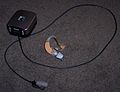
An audio boot or audio shoe is an electronic device used with hearing aids; hearing aids often come with a special set of metal contacts for audio input. Typically the audio boot will fit around the end of the hearing aid (a behind-the-ear model, as in-the-ear do not afford any purchase for the connection) to link it with another device, like an FM system or a cellphone or even a digital audio player.[45]
Direct audio input
[edit]
Direct audio input (DAI) allows the hearing aid to be directly connected to an external audio source like a CD player or an assistive listening device (ALD). By its very nature, DAI is susceptible to far less electromagnetic interference, and yields a better quality audio signal as opposed to using a T-coil with standard headphones. An audio boot is a type of device that may be used to facilitate DAI.[46]
Processing
[edit]Every electronic hearing aid has at minimum a microphone, a loudspeaker (commonly called a receiver), a battery, and electronic circuitry. The electronic circuitry varies among devices, even if they are the same style. The circuitry falls into three categories based on the type of audio processing (analog or digital) and the type of control circuitry (adjustable or programmable). Hearing aid devices generally do not contain processors strong enough to process complex signal algorithms for sound source localization.[47]
Analog
[edit]Analog audio may have:
- Adjustable control: The audio circuit is analog with electronic components that can be adjusted. The hearing professional determines the gain and other specifications required for the wearer, and then adjusts the analog components either with small controls on the hearing aid itself or by having a laboratory build the hearing aid to meet those specifications. After the adjustment the resulting audio does not change any further, other than overall loudness that the wearer adjusts with a volume control. This type of circuitry is generally the least flexible. The first practical electronic hearing aid with adjustable analog audio circuitry was based on US Patent 2,017,358, "Hearing Aid Apparatus and Amplifier" by Samual Gordon Taylor, filed in 1932.
- Programmable control: The audio circuit is analog but with additional electronic control circuitry that can be programmed by an audiologist, often with more than one program.[48] The electronic control circuitry can be fixed during manufacturing or in some cases, the hearing professional can use an external computer temporarily connected to the hearing aid to program the additional control circuitry. The wearer can change the program for different listening environments by pressing buttons either on the device itself or on a remote control or in some cases the additional control circuitry operates automatically. This type of circuitry is generally more flexible than simple adjustable controls. The first hearing aid with analog audio circuitry and automatic digital electronic control circuitry was based on US Patent 4,025,721, "Method of and means for adaptively filtering near-stationary noise from speech" by D Graupe, GD Causey, filed in 1975. This digital electronic control circuitry was used to identify and automatically reduce noise in individual frequency channels of the analog audio circuits and was known as the Zeta Noise Blocker.
Digital
[edit]
Digital audio, programmable control: Both the audio circuit and the additional control circuits are fully digital. The hearing professional programs the hearing aid with an external computer temporarily connected to the device and can adjust all processing characteristics on an individual basis. Fully digital circuitry allows implementation of many additional features not possible with analog circuitry, can be used in all styles of hearing aids and is the most flexible; for example, digital hearing aids can be programmed to amplify certain frequencies more than others, and can provide better sound quality than analog hearing aids. Fully digital hearing aids can be programmed with multiple programs that can be invoked by the wearer, or that operate automatically and adaptively. These programs reduce acoustic feedback (whistling), reduce background noise, detect and automatically accommodate different listening environments (loud vs. soft, speech vs. music, quiet vs. noisy, etc.), control additional components such as multiple microphones to improve spatial hearing, transpose frequencies (shift high frequencies that a wearer may not hear to lower frequency regions where hearing may be better), and implement many other features. Fully digital circuitry also allows control over wireless transmission capability for both the audio and the control circuitry. Control signals in a hearing aid on one ear can be sent wirelessly to the control circuitry in the hearing aid on the opposite ear to ensure that the audio in both ears is either matched directly or that the audio contains intentional differences that mimic the differences in normal binaural hearing to preserve spatial hearing ability. Audio signals can be sent wirelessly to and from external devices through a separate module, often a small device worn like a pendant and commonly called a "streamer", that allows wireless connection to yet other external devices. This capability allows optimal use of mobile telephones, personal music players, remote microphones and other devices. With the addition of speech recognition and internet capability in the mobile phone, the wearer has optimal communication ability in many more situations than with hearing aids alone. This growing list includes voice activated dialing, voice activated software applications either on the phone or on the internet, receipt of audio signals from databases on the phone or on internet, or audio signals from television sets or from global positioning systems. The first practical, wearable, fully digital hearing aid was invented by Maynard Engebretson, Robert E Morley Jr. and Gerald R Popelka.[49] Their work resulted in US Patent 4,548,082, "Hearing aids, signal supplying apparatus, systems for compensating hearing deficiencies, and methods" by A Maynard Engebretson, Robert E Morley Jr. and Gerald R Popelka, filed in 1984. This patent formed the basis of all subsequent fully digital hearing aids from all manufacturers, including those produced currently.[50]
The signal processing is performed by the microprocessor in real time and taking into account the individual preferences of the user (for example, increasing bass for better speech perception in noisy environments, or selective amplification of high frequencies for people with reduced sensibility to this range). The microprocessor automatically analyzes the nature of the external background noise and adapts the signal processing to the specific conditions (as well as to its change, for example, when the user goes outside from the building).[51]
In speech enhancement, for example using neural networks, finds application in hearing aids. Problems may arise if these methods filter out emergency sounds such as fire alarms and car horns.[52]
Difference between digital and analog hearing aids
[edit]Analogue hearing aids make all the sounds picked up by the microphone louder. For example, speech and ambient noise will be made louder together. On the other hand, digital hearing aid (DHA) technology processes the sound using digital technology. Before transmitting the sound to the speaker, the DHA microprocessor processes the digital signal received by the microphone according to an algorithm. This allows certain-frequency sounds to be made louder according to the individual user's settings (personal audiogram), and the DHA can automatically adjust to various environments (noisy streets, quiet room, concert hall, etc.).
For users with varying degrees of hearing loss, it is difficult to perceive the entire frequency range of external sounds. DHAs with multi-channel digital processing allow a user to "compose" the output sound by fitting a whole spectrum of the input signal into it. This gives users with limited hearing abilities the opportunity to perceive the whole range of ambient sounds, despite the personal difficulties of perception of certain frequencies. Moreover, even in this "narrow" range the DHA microprocessor is able to emphasize desired sounds (e.g. speech), lowering unwanted loud, high, etc., sounds at the same time.
According to research[53] DHAs have a number of significant advantages compared to analogue hearing aids:
- "Self-learning" and adaptive adjustment. They can implement adaptive selection of amplification parameters and processing.
- Effective acoustic feedback reduction. The acoustic whistling common to all hearing aids can be adaptively controlled.
- Effective use of directional microphones. Directional microphones can be adaptively controlled.
- Extended frequency range. A larger range of frequencies can be implemented with frequency shifting.
- Flexibility in selective amplification. They can provide more flexibility in frequency specific amplification to match the individual hearing characteristics of the user.
- Improved connection to other devices. Connection to other devices such as smartphones and televisions is possible.
- Noise reduction. They can reduce the background noise level to increase user comfort in noisy environments.
- Speech recognition. They can distinguish the speech signal from the overall spectrum of sounds, which facilitates speech perception.
These advantages of DHAs were confirmed by a number of studies[54][55][56] relating to the comparative analysis of digital hearing aids of second and first generations and analog hearing aids.
Difference between digital hearing aids and hearing aid applications
[edit]Smartphones have all the necessary hardware to perform the functions of a digital hearing aid: microphone, AD converter, digital processor, DA converter, amplifier, and speakers. External microphone and speakers can also be connected as a special headset.
The operational principles of hearing aid applications correspond to general operational principles of digital hearing aids: the microphone perceives an acoustic signal and converts it to digital form. Sound amplification is achieved through hardware and software in accordance with the user's hearing characteristics. Then, the signal is converted to analog form and received in the headphones by the user. The signal is processed in real time.
Stereo headsets with two speakers can be used, which allows separate binaural hearing correction for the left and right ear.[30]
Unlike digital hearing aids, the adjustment of hearing aid applications is an integral part of the application itself.[31] Hearing aid applications are adjusted in accordance with the user's audiogram. The whole adjustment process is automated so that the user can perform audiometry on their own.
The hearing correction application has two modes: audiometry and correction. In the audiometry mode, hearing thresholds are measured. In the correction mode, the signal is processed with respect to the obtained thresholds.
Hearing aid applications also provide for different computational formulas for the calculation of sound amplification based on the audiometry data. These formulas are intended for maximum comfortable speech amplification and best sound intelligibility.
Hearing aid applications allow the user to save different user profiles for different acoustic environments. Thus, in contrast to the static settings of digital hearing aids, the user can quickly switch between the profiles depending on the acoustic environment.
One of the most important characteristics of the hearing aid is acoustic feedback. In hearing aid applications, there is a significant hardware delay, so hearing aid applications use a signal processing scheme with the minimum possible algorithmic delay to make it as short as possible.[30]
Difference between PSAP and digital hearing aids
[edit]Personal sound amplification products (PSAP) are classified by the FDA as "personal sound amplification devices". These compact electronic devices are designed for people without hearing loss. Unlike hearing aids (which the FDA classifies as devices to compensate for hearing impairment),[57] the use of PSAP does not require a medical prescription. Such devices are used by hunters, naturalists (for audio observation of animals or birds), ordinary people (for example, to increase the volume of the TV in a quiet room), etc. PSAP models differ significantly in price and functionality. Some devices simply amplify sound. Others contain directional microphones, equalizers to adjust the audio signal gain and filter noise. In modern days, some people refer to these devices as OTC hearing aids.[58]
Evolution of hearing aid applications
[edit]There are audio players designed specifically for the hard-of-hearing. These applications amplify the volume of the reproduced audio signal in accordance with the user's hearing characteristics and act as a music volume amplifier and assistive hearing aid. The amplification algorithm works on the frequencies that the user hears worse, thus restoring natural hearing perception of the sound of music.
Just as in hearing aid applications, the player adjustment is based on the user's audiogram.
There are also applications that not only adapt the sound of music but also include some hearing aid functions. Such applications include a sound amplification mode in accordance with the user's hearing characteristics as well as a noise suppression mode and a mode allowing the user to hear ambient sound without pausing the music.
Also, some applications allow the hard-of-hearing to watch video and listen to the radio with comfort. The operational principles of these applications are similar to those of hearing aid applications: the audio signal is amplified on the frequencies that the user hears worse.
Hearing aid adaptation
[edit]A person using a hearing aid for the first time often cannot make use of all its advantages quickly.[59] The structure and characteristics of hearing aids are thoroughly devised by specialists in order to make the adjustment period as simple and quick as possible. However, despite this, a beginning hearing aid user certainly needs time to get used to it.[60]
The process of adjusting to hearing prostheses consists of the following steps:[59]
- Initial adjustment of the device
- Fine adjustments
- Adaptation to the new sound
Due to the plasticity of the central nervous system, inactive hearing centers in the brain's cortex switch over to processing auditory stimuli in another frequency and intensity. The brain starts to perceive sounds amplified by the hearing aid immediately after the initial adjustment; however, it may not process them correctly right away.[59]
Feeling the hearing aid in the ear may seem unusual. It also takes time to adapt to a new way of hearing. The ear has to be gradually adjusted to the new sound. The sound may seem unnatural, metallic, too loud or too quiet. A whistling sound may also appear, which can be unpleasant.[60]
Hearing aids do not provide immediate improvement. The adjustment period can last from several hours to several months.[59]
Patients are offered an initial schedule to wear their hearing aid, ensuring gradual adaptation to it. Users are recommended to regularly visit an audiologist, including for the purposes of additional hearing aid adjustment.[61]
History
[edit]
The first hearing aids were ear trumpets, and were created in the 17th century. Some of the first hearing aids were external hearing aids. External hearing aids directed sounds in front of the ear and blocked all other noises. The apparatus would fit behind or in the ear.
The movement toward modern hearing aids began with the creation of the telephone, and the first electric hearing aid, the "akouphone", was created about 1895 by Miller Reese Hutchison. By the late 20th century, digital hearing aids were commercially available.[62]
The invention of the carbon microphone, transmitters, digital signal processing chip or DSP, and the development of computer technology helped transform the hearing aid to its present form.[63]
History of digital aids
[edit]The history of DHA can be divided into three stages. The first stage began in the 1960s with the widespread use of digital computers for simulation of audio processing and for the analysis of systems and algorithms.[64] The work was conducted with the help of the very large digital computers of that era. These efforts were not actual digital hearing aids because the computers were not fast enough for audio processing in real time and their size prevented them from being described as wearable, but they allowed successful studies of the various hardware circuits and algorithms for digital processing of audio signals. The software package Block of Compiled Diagrams (BLODI) developed by Kelly, Lockbaum and Vysotskiy in 1961[65] allowed simulation of any sound system that could be characterized in the form of a block diagram. A special phone was created so that a person with a hearing impairment could listen to the digitally processed signals, but not in real time. In 1967, Harry Levitt used BLODI to simulate a hearing aid on a digital computer.
Almost ten years later the second stage began with the creation of the hybrid hearing aid, in which the analog components of a conventional hearing aid consisting of amplifiers, filters and signal limiting were combined with a separate digital programmable component in a conventional hearing aid case. The audio processing remained analog but it was controlled by the digital programmable component. The digital component could be programmed by connecting the device to an external computer in the laboratory then disconnected to allow the hybrid device to function as a conventional wearable hearing aid.
The hybrid device was effective from a practical point of view because of the low power consumption and compact size. At that time, low-power analog amplifier technology was well developed in contrast to the available semiconductor chips able to process digital audio in real time. The combination of high performance analog components for real time audio processing and a separate low power digital programmable component only for controlling the analog signal led to the creation of several low power digital programmable components able to implement different types of control.
A hybrid hearing aid was developed by Etymotic Design. A little later, Mangold and Lane[64] created a programmable multi-channel hybrid hearing aid. Graupe[66] with co-authors developed a digital programmable component that implemented an adaptive noise filter.
The third stage began in the early 1980s by a research group at Central Institute for the Deaf headed up by faculty members at Washington University in St. Louis MO. This group created the first fully digital wearable hearing aid.[67][68] They first conceived a complete, comprehensive full digital hearing aid, then designed and fabricated, miniaturized full digital computer chips using custom digital signal processing chips with low power and very large scale integrated (VLSI) chip technology able to process both the audio signal in real time and the control signals, yet able to be powered by a battery and be fully wearable as a full digital wearable hearing aid able to be actually used by individuals with hearing loss in real-world environments. Engebretson, Morley and Popelka were the inventors of the first full digital hearing aid. Their work resulted in US Patent 4,548,082, "Hearing aids, signal supplying apparatus, systems for compensating hearing deficiencies, and methods" by A Maynard Engebretson, Robert E Morley Jr. and Gerald R Popelka, filed in 1984 and issued in 1985. This full digital wearable hearing aid also included many additional features now used in all contemporary full digital hearing aids including a bidirectional interface with an external computer, self-calibration, self-adjustment, wide bandwidth, digital programmability, a fitting algorithm based on audibility, internal storage of digital programs, and fully digital multichannel amplitude compression and output limiting. This group created several of these full digital hearing aids and used them for research on hearing impaired people as they wore them in the same manner as conventional hearing aids in real-world situations. In this first full DHA all stages of sound processing and control were carried out in binary form. The external sound was picked up by a microphone positioned in an ITE ear module to take advantage of the acoustic effects of the pinna, then converted into binary code, digitally processed and digitally controlled in real time, then converted back to an analog signal sent to two miniature loudspeakers positioned in the same ITE ear module. The ITE module also contained an inward facing microphone to measure the sound actually generated in the ear canal, a precursor to separate probe tube measures now routinely used for hearing aid fitting. The necessary electronic components, including batteries, to support this arrangement were situated in a BTE module that could be supplemented with a body worn module. These specialized hearing aid chips continued to become smaller, increase in computational ability and require even less power. Now, virtually all commercial hearing aids are fully digital and their digital signal processing capability has significantly increased. Very small and very low power specialized digital hearing aid chips are now used in all hearing aids manufactured worldwide. Many additional new features also have been added with various on-board advanced wireless technology.[69]
Regulation
[edit]Canada
[edit]Hearing aids are Class II[70] regulated medical devices under Canada's Food and Drugs Act.
Under Health Canada, the Medical Devices Directorate (MDD) regulates the safety, quality, and effectiveness of hearing aids. All hearing aids imported and sold in Canada are subject to a pre-market review. Post-market, Health Canada monitors the performance of the hearing aid and any consumer complaints.
Hearing aid financial assistance is available at both the federal and provincial level. Provincial hearing aid assistance and coverage can vary widely depending on the province and territory.[71]
In Canada, a prescription is required to purchase hearing aids. Only licensed audiologists, Ear, Nose and Throat (ENT) doctors, hearing instrument practitioners (where the profession exists), and audioprothésistes (in Quebec)[note 1] can prescribe hearing aids. Over-the-counter (OTC) hearing aids are currently not available for sale in Canada.
Canadian taxpayers can claim tax relief for hearing aids as a medical expense.[72]
Ireland
[edit]Like much of the Irish health care system, hearing aid provision is a mixture of public and private.
Hearing aids are provided by the state to children, OAPs[definition needed] and to people whose income is at or below that of the state pension. The Irish state hearing aid provision is extremely poor;[editorializing] people often have to wait for two years for an appointment.[citation needed]
It is estimated that the total cost to the state of supplying one hearing aid exceeds €2,000.[citation needed]
Hearing aids are also available privately, and there is grant assistance available for insured workers. For the fiscal year ending 2016, the grant stands at a maximum of €500 per ear.[73]
Irish taxpayers can also claim tax relief at the standard rate as hearing aids are recognised as a medical device.
Hearing aids in the Republic of Ireland are exempt from VAT.
Hearing aid providers in Ireland mostly belong to the Irish Society of Hearing Aid Audiologists.
United States
[edit]Ordinary hearing aids are Class I regulated medical devices under Federal Food and Drug Administration (FDA) rules.[74] A 1976 statute explicitly prohibits any state requirement that is "different from, or in addition to, any requirement applicable" to regulated medical devices (which includes hearing aids) which relates "to the safety and effectiveness of the device".[74] Inconsistent state regulation is preempted under the federal law.[75] In the late 1970s, the FDA established federal rules governing hearing aid sales,[76] and addressed various requests by state authorities for exemptions from federal preemption, granting some and denying others.[77] The Over-the-Counter Hearing Aid Act (OTC Act) was passed under the FDA Reauthorization Act of 2017, creating a class of hearing aids regulated by the FDA available directly to consumers without involvement from a licensed professional. This law's provisions are expected to go into effect in 2020.[78][needs update]
In August 2022, the FDA issued a final rule to improve access to hearing aids.[79][80] The action establishes a new category of over-the-counter (OTC) hearing aids, enabling consumers with perceived mild to moderate hearing impairment to purchase hearing aids directly from stores or online retailers without the need for a medical exam, prescription or a fitting adjustment by an audiologist.[79] The FDA action amends existing rules that apply to prescription hearing aids for consistency with the new OTC category, it repeals the conditions for sale for hearing aids, and it includes provisions that address some of the effects of the FDA OTC hearing aid regulations on state regulation of hearing aids.[79] The FDA also issued the final guidance, Regulatory Requirements for Hearing Aid Devices and Personal Sound Amplification Products (PSAPs), to clarify the differences between hearing aids, which are medical devices, and PSAPs, consumer products that help people with normal hearing amplify sounds.[79][81]
Cost
[edit]
Several industrialized countries supply free or heavily discounted hearing aids through their publicly funded health care system.
Australia
[edit]The Australian Department of Health and Ageing provides eligible Australian citizens and residents with a basic hearing aid free-of-charge, though recipients can pay a "top up" charge if they wish to upgrade to a hearing aid with more or better features. Maintenance of these hearing aids and a regular supply of batteries is also provided, on payment of a small annual maintenance fee.[82]
Canada
[edit]In Canada, health care is a responsibility of the provinces. In the province of Ontario, the price of hearing aids is partially reimbursed through the Assistive Devices Program of the Ministry of Health and Long-Term care, up to $500 for each hearing aid. Like eye appointments, audiological appointments are no longer covered through the provincial public health plan. Audiometric testing can still easily be obtained, often free of charge, in private sector hearing aid clinics and some ear, nose and throat doctors offices. Hearing aids may be covered to some extent by private insurance or in some cases through government programs such as Veterans Affairs Canada or Workplace Safety & Insurance Board.
Iceland
[edit]Social Insurance pays a one time fee of ISK 30,000 for any kind of hearing aid. However, the rules are complicated[editorializing] and require that both ears have significant hearing loss in order to qualify for reimbursement. BTE hearing aids range from ISK 60,000 to ISK 300,000.[83]
India
[edit]In India hearing aids of all kinds are easily available. Under central and state government health services, the poor can often avail themselves of free hearing devices. However, market prices vary for others and can range from Rs 10,000 to Rs 275,000 per ear.
New Zealand
[edit]In New Zealand, eligible residents may receive a government subsidy of NZ$1,022.22 toward hearing aids through the Ministry of Health's Hearing Aid Subsidy Scheme. Individuals with complex needs (e.g., children, those with dual sensory loss, or beneficiaries) may qualify for full funding under the Hearing Aid Funding Scheme.[84]
Some providers have introduced alternative pricing models to improve affordability and access. For example, Resonate Health, a New Zealand-owned audiology company, offers a subscription-based service that includes the cost of hearing aids, ongoing care, and servicing. This approach aims to reduce the upfront financial barrier for patients.[85] [86]
United Kingdom
[edit]From 2000 to 2005 the Department of Health worked with Action on Hearing Loss (then called RNID) to improve the quality of NHS hearing aids so every NHS audiology department in England was fitting digital hearing aids by March 2005. By 2003 over 175,000 NHS digital hearing aids had been fitted to 125,000 people. Private companies were recruited to enhance the capacity, and two were appointed – David Ormerod Hearing Centres, partly owned by Alliance Boots and Ultravox Group, a subsidiary of Amplifon.[87]
Within the UK, the NHS provides digital BTE hearing aids to NHS patients, on long-term loan, free of charge. Other than BAHAs (bone anchored hearing aid) or cochlear implants, where specifically required, BTEs are usually the only style available. Private purchases may be necessary if a user desires a different style. Batteries are free.[88]
In 2014 the Clinical Commissioning Group in North Staffordshire considered proposals to end provision of free hearing aids for adults with mild to moderate age related hearing loss, which currently cost them £1.2m a year. Action on Hearing Loss mobilised a campaign against the proposal.[89]
In June 2018 the National Institute for Health and Care Excellence produced new guidance saying that hearing aids should be offered at the first opportunity when hearing loss affects the individual's ability to hear and communicate, rather than waiting for arbitrary thresholds of hearing loss to be reached.[90]
United States
[edit]Most private healthcare providers in the United States do not provide coverage for hearing aids, so all costs are usually borne by the recipient.[citation needed] The cost for a single hearing aid can vary between $500 and $6,000 or more, depending on the level of technology and whether the clinician bundles fitting fees into the cost of the hearing aid.[citation needed] Though if an adult has hearing loss which substantially limits major life activities, some state-run vocational rehabilitation programs can provide upwards of full financial assistance.[citation needed] Severe and profound hearing loss often falls within the "substantially limiting" category.[91] Less expensive hearing aids can be found on the internet or mail order catalogs, but most in the under-$200 range tend to amplify the low frequencies of background noise, making it harder to hear the human voice.[92][93]
The cost of hearing aids is a tax-deductible medical expense for those who itemize medical deductions.[94]
Research involving more than 40,000 US households showed a correlation between the degree of hearing loss and the reduction of personal income. According to the same research, hearing aids were shown to mitigate the impact of income loss by 90%–100% for those with milder hearing losses and from 65%–77% for those with severe to moderate hearing loss.[95]
Batteries
[edit]While there are some instances that a hearing aid uses a rechargeable battery or a long-life disposable battery, the majority of modern hearing aids use one of five standard button cell zinc–air batteries. (Older hearing aids often used mercury battery cells, but these cells have become banned in most countries today.) Modern hearing aid button cell types are typically referred to by their common number name or the color of their packaging.
They are typically loaded into the hearing aid via a rotating battery door, with the flat side (case) as the positive terminal (cathode) and the rounded side as the negative terminal (anode).
These batteries all operate from 1.35 to 1.45 volts.
The type of battery a specific hearing aid utilizes depends on the physical size allowable and the desired lifetime of the battery, which is in turn determined by the power draw of the hearing aid device. Typical battery lifetimes run between 1 and 14 days (assuming 16-hour days).
| Type/ Color Code | Dimensions (Diameter×Height) | Common Uses | Standard Names | Misc Names |
|---|---|---|---|---|
| 675 | 11.6 mm × 5.4 mm | High-Power BTEs, Cochlear implants | IEC: PR44, ANSI: 7003ZD | 675, 675A, 675AE, 675AP, 675CA, 675CP, 675HP, 675HPX, 675 Implant Plus, 675P (HP), 675PA, 675SA, 675SP, A675, A675P, AC675, AC675E, AC675E/EZ, AC675EZ, AC-675E, AP675, B675PA, B6754, B900PA, C675, DA675, DA675H, DA675H/N, DA675N, DA675X, H675AE, L675ZA, ME9Z, P675, P675i+, PR44, PR44P, PR675, PR675H, PR675P, PR-675PA, PZ675, PZA675, R675ZA, S675A, V675, V675A, V675AT, VT675, XL675, Z675PX, ZA675, ZA675HP |
| 13 | 7.9 mm × 5.4 mm | BTEs, ITEs | IEC: PR48, ANSI: 7000ZD | 13, 13A, 13AE, 13AP, 13HP, 13HPX, 13P, 13PA, 13SA, 13ZA, A13, AC13, AC13E, AC13E/EZ, AC13EZ, AC-13E, AP13, B13BA, B0134, B26PA, CP48, DA13, DA13H, DA13H/N, DA13N, DA13X, E13E, L13ZA, ME8Z, P13, PR13, PR13H, PR-13PA, PZ13, PZA13, R13ZA, S13A, V13A, VT13, V13AT, W13ZA, XL13, ZA13 |
| 312 | 7.9 mm × 3.6 mm | miniBTEs, RICs, ITCs | IEC: PR41, ANSI: 7002ZD | 312, 312A, 312AE, 312AP, 312HP, 312HPX, 312P, 312PA, 312SA, 312ZA, AC312, AC312E, AC312E/EZ, AC312EZ, AC-312E, AP312, B312BA, B3124, B347PA, CP41, DA312, DA312H, DA312H/N, DA312N, DA312X, E312E, H312AE, L312ZA, ME7Z, P312, PR312, PR312H, PR-312PA, PZ312, PZA312, R312ZA, S312A, V312A, V312AT, VT312, W312ZA, XL312, ZA312 |
| 10 | 5.8 mm × 3.6 mm | CICs, RICs | IEC: PR70, ANSI: 7005ZD | 10, 10A, 10AE, 10AP, 10DS, 10HP, 10HPX, 10SA, 10UP, 20PA, 230, 230E, 230EZ, 230HPX, AC10, AC10EZ, AC10/230, AC10/230E, AC10/230EZ, AC230, AC230E, AC230E/EZ, AC230EZ, AC-230E, AP10, B0104, B20BA, B20PA, CP35, DA10, DA10H, DA10H/N, DA10N, DA230, DA230/10, L10ZA, ME10Z, P10, PR10, PR10H, PR230H, PR536, PR-10PA, PR-230PA, PZA230, R10ZA, S10A, V10, VT10, V10AT, V10HP, V230AT, W10ZA, XL10, ZA10 |
| 5 | 5.8 mm × 2.1 mm | CICs | IEC: PR63, ANSI: 7012ZD | 5A, 5AE, 5HPX, 5SA, AC5, AC5E, AP5, B7PA, CP63, CP521, L5ZA, ME5Z, P5, PR5H, PR-5PA, PR521, R5ZA, S5A, V5AT, VT5, XL5, ZA5 |
Research
[edit]Research is also pointing towards hearing aids and proper amplification as a treatment for tinnitus, a medical condition which manifests itself as a ringing or buzzing in the ears.[96][unreliable medical source?]
Notes and references
[edit]- ^ Although audioprothésistes are allowed to administer hearing tests, to prevents conflicts of interest, the healthcare system will no compensate hearing aids if the test was not performed by an audiologist.
- ^ Bentler RA, Duve MR (December 2000). "Comparison of hearing aids over the 20th century". Ear and Hearing. 21 (6): 625–639. doi:10.1097/00003446-200012000-00009. PMID 11132788. S2CID 46218426.
- ^ Kochkin S (January 2010). "MarkeTrak VIII: Consumer satisfaction with hearing aids is slowly increasing". The Hearing Journal. 63 (1): 19–20. doi:10.1097/01.HJ.0000366912.40173.76. S2CID 73880581.
- ^ Cox RM, Johnson JA, Xu J (July 2016). "Impact of Hearing Aid Technology on Outcomes in Daily Life I: the Patients' Perspective". Ear and Hearing. 37 (4): e224–37. doi:10.1097/AUD.0000000000000277. PMC 4925253. PMID 26881981.
- ^ "The Best Over-the-Counter Hearing Aids and Other Hearing Solutions". The New York Times. Archived from the original on 14 January 2023. Retrieved 5 December 2022.
- ^ J. Moore, Brian C. (2007). Cochlear hearing loss: physiological, psychological and technical issues (2nd ed.). Chichester: John Wiley & Sons. ISBN 978-0-470-51633-1. OCLC 180765972.
- ^ Bentler RA, Kramer SE (August 2000). "Guidelines for choosing a self-report outcome measure". Ear and Hearing. 21 (4 Suppl): 37S – 49S. doi:10.1097/00003446-200008001-00006. PMID 10981593. S2CID 36628081.
- ^ Taylor B (22 October 2007). "Self-Report Assessment of Hearing Aid Outcome – An Overview". AudiologyOnline. Archived from the original on 29 January 2015. Retrieved 29 May 2013.
- ^ Humes L, Humes L (April 2004). "Factors Affecting Long-Term Hearing Aid Success". Seminars in Hearing. 25 (1): 63–72. doi:10.1055/s-2004-823048. S2CID 260312035.
- ^ Katz J, Medwetsky, Larry, Burkard, Robert, Hood, Linda (2009). "Chapter 38, Hearing Aid Fitting for Adults: Selection, Fitting, Verification, and Validation". Handbook of Clinical Audiology (6th ed.). Baltimore MD: Lippincott Williams & Wilkins. p. 858. ISBN 978-0-7817-8106-0.
- ^ Stach B (2003). Comprehensive Dictionary of Audiology (2nd ed.). Clifton Park NY: Thompson Delmar Learning. p. 167. ISBN 978-1-4018-4826-2.
- ^ Hartmann, William M. (14 September 2004). Signals, Sound, and Sensation. Springer Science & Business Media. pp. 72–. ISBN 978-1-56396-283-7. Archived from the original on 3 December 2016.
- ^ a b c Hearing Aid Basics, National Institute of Health, archived from the original on 13 November 2011, retrieved 2 December 2011
- ^ "Hearing Aids". National Institute on Deafness and Other Communication Disorders. Archived from the original on 15 September 2012. Retrieved 9 September 2012.
- ^ a b c d e f g h i j "Hearing Aid Buying Guide". Consumer Reports. February 2017. Archived from the original on 12 February 2017. Retrieved 13 February 2017.
- ^ "Problems with hearing aids: Ask our audiologist – Action On Hearing Loss: RNID". Action On Hearing Loss. Archived from the original on 17 June 2016. Retrieved 28 December 2016.
- ^ Sickel, K. (13 September 2007) Shortest Path Search with Constraints on Surface Models of In-ear Hearing Aids Archived 5 July 2017 at the Wayback Machine 52. IWK, Internationales Wissenschaftliches Kolloquium (Computer science meets automation Ilmenau 10.) Vol. 2 Ilmenau : TU Ilmenau Universitätsbibliothek 2007, pp. 221–226
- ^ "Hearing Aids for Children". Hearing Aids for Children. American Speech-Language-Hearing Association. Archived from the original on 17 August 2022. Retrieved 1 December 2014.
- ^ Eisenberg, Anne (24 September 2005) The Hearing Aid as Fashion Statement Archived 6 January 2016 at the Wayback Machine. NY Times.
- ^ Dybala, Paul (6 March 2006) ELVAS Sightings – Hearing Aid or Headset Archived 16 August 2012 at the Wayback Machine. AudiologyOnline.com.
- ^ Ross, Mark (January 2004) The "Occlusion Effect" – What it is, and What to Do About it Archived 15 February 2016 at the Wayback Machine, hearingresearch.org.
- ^ Sickel, K. et al. (2009) "Semi-Automatic Manufacturing of Customized Hearing Aids Using a Feature Driven Rule-based Framework" Archived 4 March 2016 at the Wayback Machine. Proceedings of the Vision, Modeling, and Visualization Workshop 2009 (Braunschweig, Germany 16–18 November 2009), pp. 305–312
- ^ "Invisible Hearing Aids or IIC hearing aids are convenient. Will they suit you?". EarGuru Ear Health Blog. 5 July 2018. Archived from the original on 17 August 2022. Retrieved 7 June 2021.
- ^ Sanford MJ, Anderson T, Sanford C (March 2014). "The extended-wear hearing device: Observations on patient experiences and its integration into a practice". Hearing Review. 21 (3): 26–31. Archived from the original on 5 December 2014. Retrieved 1 December 2014.
- ^ "128.030 | Collections Online". collections.thackraymuseum.co.uk. Retrieved 23 September 2024.
- ^ "Concealed Hearing Devices of the 20th Century". Concealed Hearing Devices of the 20th Century. Bernard Becker Medical Library. Archived from the original on 23 January 2015. Retrieved 1 December 2014.
- ^ "Why Don't They Made Hearing Aids Glasses Anymore". www.hearreview.com. Archived from the original on 1 August 2020. Retrieved 27 November 2018.
- ^ Netherlands: Dutch Unveil 'Varibel' – The Eyeglasses That Hear Archived 15 April 2012 at the Wayback Machine, Publish Date: 1 March 2007, Related Company Website: www, varibel.nl. Accessed 10 February 2008.
- ^ The manufacturer's website is published in Dutch and French at "Varibel.nl". Archived from the original on 22 February 2008. Retrieved 9 February 2016. and there is a TV news report in English at http://varibel.nl/site/Files/default.asp?iChannel=4&nChannel=Files Archived 22 February 2008 at the Wayback Machine
- ^ "Mobile Medical Applications. Guidance for Industry and Food and Drug Administration Staff" (PDF). Food and Drug Administration. 2015. Archived from the original (PDF) on 23 January 2019. Retrieved 15 March 2019.
- ^ a b c d e E.S. Azarov, M.I. Vashkevich, S.V. Kozlova, A.A. Petrovsky (2014). "Hearing correction system based on mobile computing platform (in Russian)". Informatics. 2 (42): 5–24. ISSN 1816-0301. Archived from the original on 29 March 2019. Retrieved 15 March 2019.
- ^ a b c A. Vonlanthen, H. Arndt (2009). Hearing aids (in Russian). Translated by T G. Rostov-on-Don: Feniks. ISBN 978-5-222-15490-8.
- ^ Mestayer K. "Science is revealing how internal volume controls can influence our sensitivity to sound". Hearing Health. Archived from the original on 17 August 2022. Retrieved 17 August 2022.
- ^ TIA-1083 Revision A, 17 November 2010 Archived 16 May 2012 at the Wayback Machine. ihs.com
- ^ "New TIA Standard Will Improve Hearing Aid Compatibility with Digital Cordless Phones". U.S. Telecommunications Industry Association. 5 April 2007. Archived from the original on 6 December 2010. Retrieved 3 November 2011.
- ^ "Приложение для смартфонов заменит глухим слуховой аппарат? – Глухих.нет. Новостной портал для глухих и слабослышащих | Новости мира глухих и слабослышащих | Сайт глухих | Спорт глухих | Can application substitute hearing aid?". gluxix.net. 13 March 2014. Archived from the original on 25 December 2014. Retrieved 18 February 2015.
- ^ "Mobile Medical Applications". fda.gov. Archived from the original on 2 May 2013. Retrieved 18 February 2015.
- ^ "Hearing aids, information on hearing loss and tinnitus | Oticon". www.oticon.global. Archived from the original on 27 September 2016. Retrieved 25 September 2016.
- ^ Mroz M. "Hearing Aids and Bluetooth Technology". Hearing Aids and Bluetooth Technology. Healthy Hearing. Archived from the original on 9 November 2014. Retrieved 1 December 2014.
- ^ Dave Fabry, Hans Mülder, Evert Dijkstra (November 2007). "Acceptance of the wireless microphone as a hearing aid accessory for adults". The Hearing Journal. 60 (11): 32–36. doi:10.1097/01.hj.0000299170.11367.24. S2CID 168059640.
- ^ Hawkins DB (November 1984). "Comparisons of speech recognition in noise by mildly-to-moderately hearing-impaired children using hearing aids and FM systems". Journal of Speech and Hearing Disorders. 49 (4): 409–18. doi:10.1044/jshd.4904.409. PMID 6503247.
- ^ Ricketts T, Henry P (March 2002). "Evaluation of an adaptive, directional-microphone hearing aid". International Journal of Audiology. 41 (2): 100–112. doi:10.3109/14992020209090400. PMID 12212855. S2CID 2035086.
- ^ Lewis MS, Crandell CC, Valente M, Horn JE (June 2004). "Speech perception in noise: directional microphones versus frequency modulation (FM) systems". Journal of the American Academy of Audiology. 15 (6): 426–439. doi:10.3766/jaaa.15.6.4. PMID 15341224. Archived from the original on 27 November 2022. Retrieved 17 August 2022.
- ^ TIA-1083: A NEW STANDARD TO IMPROVE CORDLESS PHONE USE FOR HEARING AID WEARERS Archived 25 April 2012 at the Wayback Machine. U.S. Telecommunications Industry Association
- ^ "Public Law 100-394, [47 USC 610] – Hearing Aid Compatibility Act of 1988". PRATP. Archived from the original on 26 July 2010. Retrieved 8 June 2013.
- ^ "Boot Definition". www.nchearingloss.org. Archived from the original on 3 March 2016. Retrieved 2 June 2017.
- ^ "Boot Definition". www.nchearingloss.org. Archived from the original on 3 March 2016. Retrieved 2 June 2017.
- ^ Ganguly Anshuman, Reddy Chandan, Hao Yiya, Panahi Issa (2016). "Improving Sound Localization for Hearing Aid Devices Using Smartphone Assisted Technology". 2016 IEEE International Workshop on Signal Processing Systems (SiPS). pp. 165–170. doi:10.1109/SiPS.2016.37. ISBN 978-1-5090-3361-4. S2CID 7603815.
- ^ Heidtman L (28 September 2010). "Analog Vs. Digital Hearing Aids". LiveStrong.com. Archived from the original on 3 May 2012. Retrieved 23 July 2012.
- ^ Levitt H (26 December 2007). "Digital Hearing Aids". The ASHA Leader. Archived from the original on 17 July 2012. Retrieved 23 July 2012.
- ^ "HIMPP History | HIMPP". Archived from the original on 24 December 2021. Retrieved 24 December 2021.
- ^ "Как работают слуховые аппараты". radugazvukov.ru. Archived from the original on 25 December 2014. Retrieved 18 February 2015.
- ^ Soha A. Nossier, Julie Wall, Mansour Moniri, Cornelius Glackin, Nigel Cannings (18–22 September 2022). Convolutional Recurrent Smart Speech Enhancement Architecture for Hearing Aids (PDF). Interspeech 2022. Incheon, Korea. Archived (PDF) from the original on 20 November 2022. Retrieved 20 November 2022.
- ^ Janet McCaffrey (21 December 2009). "HJ0905 Kochkin copy" (PDF). The Hearing Journal. Archived from the original (PDF) on 4 March 2016. Retrieved 18 February 2015.
- ^ "Fitting Tips: Essentials of Hearing Aid Selection, Part 1: Cosmetics Are Not Just What Meets the Ear – Hearing Review". hearingreview.com. 2 October 2003. Archived from the original on 18 February 2015. Retrieved 18 February 2015.
- ^ Richard Preid Fotorotar AG (8 August 2007). "24_P54090_Pho_Kapitel_06bis07" (PDF). Archived from the original (PDF) on 18 February 2015. Retrieved 18 February 2015.
- ^ "Hearing Review Three-Year Index 2003–2005 – Hearing Review". hearingreview.com. 6 December 2005. Archived from the original on 18 February 2015. Retrieved 18 February 2015.
- ^ "Применение технологии широкополосного изменения огибающей спектра звукового сигнала Petralex® в онлайн-приложениях коррекции слуха::Журнал СА 7–8.2014 (Mann, Eric A., M.D., PhD, "Hearing Aids and Personal Sound Amplifiers: Know the Difference", U.S. Food and Drug Administration Consumer Updates website, Oct. 20, 2009. Retrieved 2013-05-23.)" (in Russian). samag.ru. Archived from the original on 25 December 2014. Retrieved 18 February 2015.
- ^ Beck, Melinda, "Getting an Earful: Testing A Tiny, Pricey Hearing Aid" Archived 16 September 2017 at the Wayback Machine, The Wall Street Journal, 29 January 2008. Retrieved 23 May 2013.
- ^ a b c d "Адаптация к слуховому аппарату". r-sluh.ru (in Russian). Archived from the original on 28 May 2019. Retrieved 28 May 2019.
- ^ a b "Адаптация к слуховому аппарату". www.xn----ttbbfjpems.xn—p1ai (in Russian). Archived from the original on 28 May 2019. Retrieved 28 May 2019.
- ^ Инна Васильевна Королева (2012). Введение в аудиологию и слухопротезирование (in Russian). КАРО. ISBN 978-5-9925-0737-9. Archived from the original on 3 August 2020. Retrieved 29 May 2020.
- ^ Mills M (2011). "Hearing Aids and the History of Electronics Miniaturization". IEEE Annals of the History of Computing. 33 (2): 24–45. Bibcode:2011IAHC...33b..24M. doi:10.1109/MAHC.2011.43. S2CID 10946285.
- ^ Howard, Alexander (26 November 1998). "Hearing Aids: Smaller and Smarter." Archived 28 December 2016 at the Wayback Machine New York Times.
- ^ a b "LEVITT: Digital Hearing Aids: A Tutorial Review" (PDF). rehab.research.va.gov. Archived (PDF) from the original on 19 March 2015. Retrieved 18 February 2015.
- ^ Kelly LJ Jr, Lochbaum C, Vyssotsky VA. A block diagram compiler. Bell System Tech J (40):669–676, 1961.
- ^ Graupe D, Grosspietsch JK, Basseas SP. "A single microphone-based self-adaptive filter of noise from speech and its performance evaluation. J Rehabil Res Dev 24(4), 1987 (this issue" (PDF). rehab.research.va.gov. Archived (PDF) from the original on 24 September 2015. Retrieved 18 February 2015.
- ^ Engebretson, AM, Popelka, GR, Morley, RE, Niemoeller, AF, and Heidbreder, AF: A digital hearing aid and computer-based fitting procedure. Hearing Instruments 1986; 37(2): 8-14
- ^ Popelka, GR: Computer assisted hearing aid fitting, in Microcomputer Applications in Rehabilitation of Communication Disorders, M.L. Grossfeld and C.A. Grossfeld, Editors. 1986, Aspen Publishing: Rockville, Maryland. 67-95
- ^ Popelka, GR., Moore, BJC, Popper, AN, and Fay, RR: 2016, Hearing Aids, Springer Science, LLC, NY, NY
- ^ Canada H (29 July 2016). "Medical batteries". www.canada.ca. Archived from the original on 21 March 2023. Retrieved 21 March 2023.
- ^ "Hearing aid financial assistance in Canada". Hearing Directory. Archived from the original on 21 March 2023. Retrieved 21 March 2023.
- ^ Agency CR (4 January 2016). "Details of medical expenses". www.canada.ca. Archived from the original on 21 March 2023. Retrieved 21 March 2023.
- ^ "Aural". Ireland Department of Social Protection. Archived from the original on 2 July 2012. Retrieved 23 July 2012.
- ^ a b 21 U.S.C. § 360k (a) (2005).
- ^ Missouri Board of Examiners for Hearing Instrument Specialists v. Hearing Help Express, Inc., 447 3d 1033 (8th Cir. 2006)
- ^ Final Rule issued in Docket 76N-0019, 42 FR 9286 (15 February 1977).
- ^ Exemption from Preemption of State and Local Hearing Aid Requirements; Applications for Exemption, Docket No. 77N-0333, 45 FR 67326; Medical Devices: Applications for Exemption from Federal Preemption of State and Local hearing Aid Requirements, Docket No. 78P-0222, 45 FR 67325 (10 October 1980).
- ^ "H.R.2430 - 115th Congress (2017-2018): FDA Reauthorization Act of 2017". www.congress.gov. 18 August 2017. Archived from the original on 22 February 2020. Retrieved 16 March 2020.
- ^ a b c d "FDA Finalizes Historic Rule Enabling Access to Over-the-Counter Hearing Aids for Millions of Americans". U.S. Food and Drug Administration (FDA). 16 August 2022. Archived from the original on 16 August 2022. Retrieved 16 August 2022.
 This article incorporates text from this source, which is in the public domain.
- ^ "Public Inspection: Medical Devices: Ear, Nose, and Throat Devices; Establishing Over-the-Counter Hearing Aids". Federal Register. U.S. Food and Drug Administration (FDA). 16 August 2022. Archived from the original on 16 August 2022. Retrieved 16 August 2022. This article incorporates text from this source, which is in the public domain.
- ^ "Regulatory Requirements for Hearing Aids and PSAPs Guidance". U.S. Food and Drug Administration (FDA). 12 August 2022. Archived from the original on 16 August 2022. Retrieved 16 August 2022. This article incorporates text from this source, which is in the public domain.
- ^ "Understanding the Australian Government Hearing Services Program". Archived from the original on 9 September 2007. Retrieved 4 December 2007.
- ^ Social Insurance Administration – Iceland Accessed 30 November 2007 Archived 16 February 2008 at the Wayback Machine
- ^ "Hearing aid funding". Ministry of Health NZ. Retrieved 26 July 2025.
- ^ Catherall S (31 August 2023). "The NZ company democratising hearing health". BusinessDesk. Retrieved 26 July 2025.
- ^ "Ear360: Changing the way we hear". Newsroom. 1 September 2023. Retrieved 26 July 2025.
- ^ "Loud and clear". Health Service Journal. 18 December 2003. Archived from the original on 23 October 2014. Retrieved 17 October 2014.
- ^ NHS hearing aid service fact sheet Accessed 26 November 2007 Archived 2 October 2010 at the Wayback Machine
- ^ "Hearing aid charging opposed in feedback exercise". Health Service Journal. 23 September 2014. Archived from the original on 9 October 2014. Retrieved 17 October 2014.
- ^ "Hearing loss in adults: assessment and management". NICE. 21 June 2018. Retrieved 5 July 2024.
- ^ "Questions and Answers about Deafness and Hearing Impairments in the Workplace and the Americans with Disabilities Act". U.S. Equal Employment Opportunity Commission. Archived from the original on 4 March 2016. Retrieved 26 November 2007.
- ^ Mahany B (9 March 2011). "Now Hear This". Chicago Tribune. Archived from the original on 15 June 2013.
- ^ Romano T (22 October 2012). "The Hunt for an Affordable Hearing Aid". The New York Times. Archived from the original on 25 February 2015.
- ^ "Topic 502 – Medical and Dental Expenses". Internal Revenue Service. Archived from the original on 3 July 2017. Retrieved 26 November 2007.
- ^ Kochkin S (October 2010). "MarkeTrak VIII: The efficacy of hearing aids in achieving compensation equity in the workplace". The Hearing Journal. 63 (10): 19–24, 26, 28. doi:10.1097/01.HJ.0000389923.80044.e6. S2CID 52230904.
- ^ "Tinnitus And Hearing Aids - Optimal Hearing Systems, The Hearing Aid Company - Since 1961". Optimal Hearing. 30 December 2016. Archived from the original on 6 July 2020. Retrieved 5 July 2020.

Further reading
[edit]- Chen CH, Huang CY, Cheng HL, Lin HH, Chu YC, Chang CY, et al. (April 2022). "Comparison of personal sound amplification products and conventional hearing aids for patients with hearing loss: A systematic review with meta-analysis". eClinicalMedicine. 46 101378. doi:10.1016/j.eclinm.2022.101378. PMC 9006672. PMID 35434580.
- Mamo SK, Reed NS, Nieman CL, Oh ES, Lin FR (March 2016). "Personal Sound Amplifiers for Adults with Hearing Loss". The American Journal of Medicine. 129 (3): 245–50. doi:10.1016/j.amjmed.2015.09.014. PMC 4755807. PMID 26498713.
External links
[edit]
- Hearing Aids National Institutes of Health (NIH)
- Hearing Aids and Personal Sound Amplification Products: What to Know US Food and Drug Administration (FDA)
- World Hearing Day, World Health Organization
- Deafness in Disguise: Concealed Hearing Devices of the 19th and 20th Centuries


| International | |
|---|---|
| National | |
| Other | |

Hearing aid
View on GrokipediaUses and Indications
Candidacy and Fitting Process
Candidacy for hearing aids is established through audiometric testing that identifies sensorineural hearing loss where amplification can improve auditory function without alternative interventions like cochlear implants or surgery yielding superior outcomes. Eligible candidates typically exhibit pure-tone average thresholds of 26 dB HL or greater across speech frequencies (500, 1000, and 2000 Hz) in the better ear, encompassing mild (26-40 dB HL) to profound (>90 dB HL) degrees, as these levels correlate with demonstrable deficits in unaided speech recognition that hearing aids can mitigate; while over-the-counter (OTC) self-fitting hearing aids provide app-based personalization and have demonstrated comparable outcomes to professionally fitted devices for mild-to-moderate hearing loss, they lack true custom physical fitting (e.g., no custom earmolds), unlike prescription aids which include professional real-ear measurements and custom options for better precision, especially in complex cases. For more significant (severe to profound) hearing loss, consulting an audiologist for prescription options is recommended to ensure appropriate power levels and advanced customization beyond OTC capabilities.[16][17][18] Conductive or mixed losses with a significant conductive component are generally contraindicated unless irreversible, prioritizing surgical options such as stapedectomy for conditions like otosclerosis, since amplification alone does not address the underlying mechanical impedance.[19] Audiologists conduct the fitting process via a structured evaluation, initiating with diagnostic tests including pure-tone audiometry, speech audiometry, and immittance measures to delineate loss configuration and rule out contraindications like active ear pathology. Device selection follows, tailored to audiometric data, ear anatomy, and manual dexterity, with initial gain settings derived from evidence-based formulas such as the National Acoustic Laboratories' nonlinear version 2 (NAL-NL2). Verification employs real-ear measurements, inserting a probe microphone into the ear canal to quantify actual sound pressure levels delivered by the aid during stimuli like speech-shaped noise, ensuring alignment with prescriptive targets and averting issues such as feedback or occlusion effects from imprecise programming.[20][21] Beyond audiometric suitability, empirical outcomes hinge on psychosocial factors including motivation and cognitive capacity, with data revealing that self-motivated users—those acknowledging hearing-related communication challenges—demonstrate 20-30% higher consistent wear rates and satisfaction compared to reluctant adopters. Cognitive decline, as in dementia, impairs device management and habit formation, correlating with reduced usage even in technically appropriate fittings, underscoring the need for caregiver involvement and simplified controls to enhance causal efficacy.[22][23][24] After selecting appropriate hearing aids based on audiometric results, lifestyle needs, and preferences, the devices are ordered from the manufacturer. For non-custom or stock models (e.g., those using instant-fit domes), delivery to the clinic often occurs within 1–2 weeks, enabling same-day dispensing at the fitting appointment. Custom-molded styles (e.g., in-the-ear) may require additional time for fabrication following ear impressions, typically 7–14 business days. The fitting appointment (lasting 1–2 hours) includes physical fit verification, computer-based programming according to the patient's audiogram, real-ear measurement (REM) to objectively confirm amplification matches prescriptive targets in the individual's ear canal, fine-tuning based on patient feedback, and orientation on use, maintenance, and expectations. REM, considered best practice, ensures accurate performance beyond manufacturer first-fit estimates. Upon successful verification and training, patients typically receive and take home the hearing aids the same day, especially in private-pay scenarios where no insurance authorization or reimbursement delays apply. This contrasts with insured cases, which may involve prior approvals or billing waits. Follow-up appointments (often 1–4 weeks later) address adaptation, further adjustments, and real-world performance. Trial periods (commonly 30–60 days) allow returns if unsatisfied.Applications for Different Hearing Loss Types
Hearing aid style recommendations depend on the degree of hearing loss. For mild losses, discreet styles such as completely-in-canal (CIC), in-the-canal (ITC), receiver-in-canal (RIC), open-fit behind-the-ear (BTE), or in-the-ear (ITE) are suitable. Moderate losses can utilize similar options, including RIC, ITE, and BTE. Severe losses require powerful RIC or BTE models with strong amplification. For profound losses, powerful "super power" BTE hearing aids are typically used; cochlear implants are often considered if traditional hearing aids provide insufficient benefit. Consultation with an audiologist is essential for personalized assessment and fitting.[1][9][25] Hearing aids primarily address sensorineural hearing loss (SNHL), the most common type amenable to amplification, by boosting sound intensities to overcome elevated thresholds caused by damage to cochlear hair cells, thereby improving audibility without repairing the underlying neural deficits.[1] This mechanism is particularly suited to frequency-specific losses, as programmable gain adjusts amplification across octaves to target deficient regions, such as the high frequencies (typically above 2 kHz) affected in many cases.[26] For presbycusis, an age-related SNHL involving progressive degeneration of basal cochlear structures, this targeted high-frequency emphasis restores perception of sibilants and fricatives essential for speech intelligibility, though dead regions in the cochlea limit full dynamic range recovery.[26] Noise-induced hearing loss, often manifesting as a permanent threshold shift with a notch around 4 kHz from outer hair cell stereocilia disruption, similarly benefits from such prescriptive amplification formulas like NAL-NL2, which account for loudness recruitment to prevent overload in preserved low frequencies.[27] In bilateral symmetric losses, where audiometric thresholds are comparable across ears, binaural amplification enhances spatial cues via interaural time and level differences, yielding superior speech recognition in noisy environments over unilateral fitting, with studies showing up to 20-30% better performance in localization tasks.[28] Asymmetric losses, including unilateral SNHL or single-sided deafness (SSD), necessitate adaptations like contralateral routing of signal (CROS) configurations, which microphone sound on the poorer ear and transmit it wirelessly to the intact contralateral ear, mitigating the head-shadow effect that attenuates signals from the impaired side by 5-10 dB.[29] Conductive hearing losses, stemming from outer or middle ear pathologies like ossicular chain disruption, derive minimal causal benefit from amplification alone, as it fails to bypass the conductive impedance mismatch; stable cases may use aids temporarily, but surgical correction via tympanoplasty or stapedectomy is prioritized for mechanical restoration.[30] Mixed losses combine these, requiring amplification post-resolution of the conductive component where feasible. When comorbid with tinnitus, hearing aids facilitate masking by amplifying broadband ambient noise or generating synthetic sounds to compete with phantom perceptions, especially effective for tonal tinnitus matching the frequencies of associated SNHL, with evidence indicating greater severity reductions (up to 10-15 points on THI scales) when complete masking is achieved at fitting compared to partial or none.[31] This auditory enrichment reduces central gain hyperactivity hypothesized in tinnitus etiology but does not eliminate the condition, as cochlear synaptopathy persists.[32] Empirically, aids alleviate communication barriers linked to untreated loss, diminishing risks of withdrawal from social interactions, yet they cannot reinstate pristine temporal or spectral resolution lost to irreversible hair cell attrition.[1]Types
Body-Worn and Early Styles
Early electric hearing aids relied on vacuum tube technology, with the first such device patented by Earl Hanson in 1920 as the Vactuphone, which entered the market in 1923.[33] These body-worn models featured bulky electronics and battery packs strapped to the torso, connected via cords to receivers fitted into custom earmolds, enabling amplification for users with significant hearing impairment.[34] By the early 1940s, advancements like Zenith's Radionic A2A (1942) and A3A (1944) incorporated more efficient vacuum tubes, reducing size while maintaining wearable body-mounted designs suitable for moderate to severe losses.[35] The introduction of transistors in the 1950s marked a shift toward smaller components, yet body-worn styles persisted due to their capacity for higher gain levels essential for profound hearing loss.[36] These devices positioned the microphone and amplifier on the body, separated from the ear canal receiver, which minimized acoustic feedback—a common issue in closer-proximity designs—allowing for greater amplification without oscillation.[37] Larger battery compartments provided extended operation times compared to emerging behind-the-ear models, offering practical advantages for users requiring consistent power.[38] Despite miniaturization trends favoring less visible aids, body-worn hearing aids retain niche applications for severe to profound deafness, comprising less than 1% of modern fittings but valued for maximal output in cases where in-ear devices insufficiently amplify low-frequency sounds.[39] Their bulkier form facilitates easier manual adjustments and withstands physical demands in pediatric or high-activity scenarios, though visibility often imposes social stigma and requires clothing adaptations.[40] Trade-offs include reduced cosmesis and potential for cord entanglement, balanced against superior power handling for users intolerant to feedback or battery constraints in smaller formats.[41]Behind-the-Ear and Receiver-in-Canal
Behind-the-ear (BTE) hearing aids feature a main body that rests behind the pinna, connected by an acoustic tube to a custom-fitted earmold or vented earpiece inserted into the ear canal. This configuration enables the inclusion of larger batteries, which provide extended daily operation—typically 100-150 hours per zinc-air battery—reducing the frequency of replacements compared to smaller styles.[42] BTE devices support high customizability through interchangeable earpieces, allowing audiologists to adapt the fit for varying ear canal shapes and degrees of venting to optimize sound delivery while minimizing feedback.[25] Their larger housing also accommodates more robust receivers and components, making BTE aids suitable for moderate to profound hearing losses where greater amplification power is required.[43] Receiver-in-canal (RIC) hearing aids modify the BTE design by relocating the receiver wire directly into the ear canal via a slim cable, positioning the speaker closer to the eardrum. This placement reduces the occlusion effect—where users perceive their own voice as boomy or hollow—by allowing more natural airflow and bone-conducted sound transmission, enhancing comfort during speech.[44] RIC models further mitigate acoustic feedback and whistling, common in traditional BTE setups with longer tubes, resulting in clearer high-frequency reproduction for consonant sounds.[45] The behind-the-ear portion remains compact, often sleeker than full BTE housings, contributing to a less noticeable profile while retaining space for essential processing elements. A hearing aid dome, also known as a dome tip, ear tip, or rubber dome, is a small, replaceable, bell- or mushroom-shaped component typically made of medical-grade silicone. It attaches to the end of the slim cable in receiver-in-canal (RIC) hearing aids (and some open-fit BTE designs) and fits into the ear canal to direct amplified sound while providing a seal against feedback. Available in prefabricated sizes and styles such as open, closed, and power, domes cater to mild to moderate hearing loss: open domes permit natural ingress of low-frequency sounds to reduce the occlusion effect, while closed and power variants offer improved amplification and sealing for greater hearing losses. These components are inexpensive, often sold in packs for around $10, and are easily replaced by users if damaged, lost, or occluded by earwax. Regular maintenance involves wiping with a soft cloth; submerging in water or cleaning with alcohol should be avoided to preserve the silicone material. Medical-grade silicone provides superior comfort through its flexibility and contouring to the ear canal, reducing irritation and the plugged sensation, along with durability, resistance to degradation, and hygienic properties due to its non-porous surface. In contrast, vinyl (PVC) is rarely used for domes today and is more common in custom earmolds, where it may initially feel comfortable but can shrink, harden, or discolor over time due to exposure to body oils, sunlight, or aging. Professional fitting is crucial, as incorrect size or style can compromise performance, comfort, and increase feedback risk. True custom-molded shells or earmolds—created from physical ear impressions or digital scans—are available only with prescription hearing aids, which require professional fitting by licensed audiologists or hearing instrument specialists. This allows for precise, individualized adaptation to the user's unique ear anatomy. In contrast, over-the-counter (OTC) hearing aids, classified by the FDA as a self-fitting category since the 2022 regulation changes, utilize modular, prefabricated components such as user-selectable domes, tips, and sizes that do not require professional molding or impressions. While certain OTC models provide remote programming and fine-tuning via smartphone apps, the physical fit remains standardized and non-custom. Both BTE and RIC styles rank among the most prescribed for moderate hearing impairments, comprising over 60% of fittings due to their balance of power, durability, and everyday ergonomics.[46] User surveys indicate preferences for these over fully in-canal options in active scenarios, citing superior comfort from reduced ear canal pressure and easier handling for battery changes or adjustments.[47] RIC variants particularly excel in minimizing wind noise interference during outdoor activities, as the in-canal receiver shields against aerodynamic disturbances more effectively than tube-based systems.[48] By 2025, rechargeable lithium-ion batteries have become standard in premium BTE and RIC models, offering 20-30 hours of use per charge with overnight docking, driven by consumer demand for reduced waste and maintenance.[49] This shift aligns with broader market trends, where rechargeable segments now represent a significant portion of sales in these versatile categories.[50]Behind-the-ear (BTE) hearing aids with telecoil and Bluetooth streaming
Behind-the-ear (BTE) hearing aids, which sit behind the ear and connect via tubing to an earmold or receiver in the canal, remain popular for their power, battery life, and feature integration, particularly for moderate to profound hearing loss. Many modern prescription BTE models support both a built-in telecoil (T-coil) for direct connection to inductive loop systems (e.g., in theaters, places of worship, or public transit) and Bluetooth connectivity for streaming audio (calls, music, media) from smartphones, TVs, and other devices. Key examples as of 2026 include:- Phonak Naída series (e.g., Naída Lumity L-UP, L-SP): Universal Bluetooth Classic for broad device compatibility (iOS/Android), hands-free calling, and streaming; telecoil in power models for loop access. Rechargeable variants (e.g., L-PR) may prioritize battery life over telecoil in some configurations.
- Signia Motion Charge&Go IX (rechargeable BTE, including P/SP super-power): Integrated telecoil and Bluetooth for audio streaming/app control; strong for severe losses with rocker switches and long battery life (up to 30+ hours).
- Oticon BTE/miniBTE (e.g., Xceed power models, Real, Zircon, Intent lines): Telecoil in many, Bluetooth LE Audio with Auracast readiness for future broadcast streaming; focus on natural sound processing.
- Widex Moment BTE R D (rechargeable): Built-in telecoil, direct streaming to iOS/Android (ASHA/MFi); up to 37 hours battery (less with streaming).
In-the-Ear and In-the-Canal Variants
In-the-ear (ITE) hearing aids are custom-molded devices that fit entirely within the outer ear's concha, suitable primarily for mild to moderate hearing loss, though some models accommodate severe cases.[1] The full-shell ITE variant fills the entire concha, enabling a larger housing that supports broader frequency response and a tighter seal in the ear canal to minimize acoustic feedback.[51] This customization to individual ear anatomy reduces whistling by preventing sound leakage, allowing higher gain levels without oscillation.[52] In-the-canal (ITC) and completely-in-the-canal (CIC) hearing aids extend deeper into the ear canal, with ITC occupying the lower concha and upper canal, and CIC positioned entirely within the canal for maximum discretion.[53] These variants prioritize cosmetic appeal for users concerned with visibility, offering natural sound localization as amplified signals enter the ear canal directly, mimicking unassisted hearing pathways.[54] However, their compact size limits battery capacity, typically using smaller cells like size 10 or 312, which provide shorter operating times compared to larger styles—often 3-5 days versus weekly replacements in bigger aids.[53] Advantages of ITE and canal styles include improved aesthetics and reduced occlusion, where the device's placement avoids the full canal blockage that can cause a plugged-ear sensation in deeper fittings.[55] Users report higher satisfaction in discreetness and phone use performance with CIC models, with studies indicating better ratings for visibility and directionality among those prioritizing inconspicuousness.[54] Drawbacks encompass handling challenges due to diminutive controls, complicating insertion and adjustment for individuals with dexterity issues, and elevated risk of cerumen accumulation, which can obstruct microphones and receivers, leading to reduced output and requiring frequent professional maintenance.[53][56] Durability may suffer from smaller components prone to damage, though satisfaction remains elevated for aesthetic-focused wearers, with up to 72% preferring ITE over alternatives in trials emphasizing comfort and fit.[57][58]Invisible, Extended Wear, and Bone-Conduction Types
Invisible in-the-canal (IIC) hearing aids are custom-molded devices positioned deep within the ear canal, past the second bend, rendering them virtually undetectable from external view.[59] They suit individuals with mild to moderate sensorineural hearing loss, delivering natural sound quality due to their proximity to the eardrum and reduced occlusion effect.[60] Benefits include minimized wind noise and enhanced discretion for cosmetic preferences, though limitations encompass unsuitability for severe losses, dexterity challenges in handling, and vulnerability to cerumen buildup or moisture damage.[61] Recent models, such as the Eargo 8, incorporate IP68 ratings for dust and water resistance, enabling use by active individuals during exercise or exposure to elements without immediate failure risk.[62] Extended-wear hearing aids, exemplified by Phonak's Lyric system, enable continuous placement in the ear canal for up to four months without daily removal, supporting 24/7 use including during sleep, showering, and physical activity.[63] Professionally inserted deep in the canal, these devices provide maintenance-free amplification for mild to moderate losses, promoting uninterrupted auditory access and natural sound localization by mimicking unassisted ear acoustics.[64] Unlike removable aids, they eliminate battery changes and handling, though replacement requires clinical intervention, and they may not accommodate all canal anatomies or profound impairments.[65] Bone-anchored hearing aids (BAHA) transmit sound vibrations directly through the skull to the cochlea, bypassing the outer and middle ear, for patients with conductive, mixed, or unilateral sensorineural losses where traditional air-conduction aids fail, such as chronic otitis media or aural atresia.[66] Indicated for individuals over age five with unresolvable conductive thresholds exceeding 45 dB or single-sided deafness, they improve sound awareness in the affected ear via osseointegration of a surgically implanted titanium abutment.[67] Benefits include reduced infection risk in diseased ears and better localization for unilateral cases, but implantation involves outpatient surgery with potential complications like skin irritation or fixture loss.[68] The external processor attaches magnetically or via snap, requiring no canal insertion.[69]Specialized Configurations (CROS, Eyeglass, and Directional)
Contralateral routing of signal (CROS) hearing aids address unilateral profound sensorineural hearing loss, where one ear exhibits little to no usable hearing while the contralateral ear retains normal function. In this configuration, a microphone positioned at the impaired ear captures ambient sounds, which are then wirelessly transmitted to a receiver and amplifier fitted to the better-hearing ear, bypassing the deaf side to restore spatial awareness.[70] Introduced as a non-surgical alternative to cochlear implants, CROS systems improve localization and reduce the head-shadow effect, though they do not restore binaural hearing.[29] Bilateral contralateral routing of signal (BiCROS) extends this approach for cases of single-sided deafness combined with mild to moderate loss in the better ear. Here, the device on the impaired side functions solely as a microphone transmitter, while the contralateral unit incorporates amplification tailored to the residual hearing loss, enabling customized gain adjustments.[71] Clinical fittings require verification that the poor ear cannot benefit from conventional amplification, typically confirmed via unaided thresholds exceeding 90 dB HL across frequencies.[72] Eyeglass hearing aids integrate amplification components into spectacle frames, primarily benefiting users with concurrent visual and hearing impairments or preferences for discreet, multi-corrective wear. Originating in 1954 with models like the Otarion Listener, these devices housed transistors and batteries in the temple arms, delivering sound via conduits to custom earpieces.[73] Modern variants, including bone-conduction types for conductive losses, vibrate the skull directly behind the ear, leaving the canal open for natural residual hearing while avoiding occlusion effects.[74] Such configurations suit niche conductive pathologies untreatable by air conduction alone, though miniaturization challenges limit widespread adoption compared to standard behind-the-ear styles.[75] Directional microphone configurations in hearing aids employ multiple ports or arrays to prioritize frontal sound sources, enhancing signal-to-noise ratios by 5-10 dB in reverberant environments over omnidirectional modes. Fixed directional patterns use phase differences between front and rear microphones to attenuate rear and lateral noises, while adaptive variants dynamically adjust beam width based on noise azimuth, as in beamforming algorithms processing signals from two or more elements.[76] These specialized setups, often switchable via user controls or automatic detection, prove efficacious for frontal speech-in-noise scenarios but may underperform in quiet or unpredictable acoustic fields without omnidirectional fallback.[77] Historical stethoclamp-style directional aids, reliant on manual tube positioning, have been supplanted by integrated digital processing for superior directivity indices.[78]Technology
Core Components and Signal Processing
The core components of a hearing aid form a transduction chain that converts acoustic sound waves into electrical signals, amplifies them, and reconverts them to acoustic output tailored to the user's hearing loss. A microphone captures incoming sound pressure waves and transduces them into an electrical signal proportional to the acoustic input, typically using electret or micro-electro-mechanical systems (MEMS) technology that responds to diaphragm vibrations induced by sound.[79][80] This electrical signal is then processed through an amplifier, which boosts its amplitude to compensate for the degree of hearing impairment, ensuring sufficient output for audibility without distortion.[81][79] The amplified signal drives a receiver (speaker), which converts it back into acoustic vibrations delivered to the ear canal, grounded in the physics of electromagnetic or piezoelectric transduction where electrical current modulates a diaphragm to produce sound waves matching the original frequency content but at higher intensity.[81][79] Basic signal processing centers on linear amplification to restore audibility across frequencies, with the system's frequency response shaped by component characteristics and fitting style to align with the audiogram. Volume controls, often implemented via variable gain stages or user interfaces, allow manual adjustment of overall amplification level, while damping elements in the receiver or earmold attenuate specific resonances to prevent peaking and ensure smooth response.[82] Acoustic feedback arises when amplified output leaks from the receiver back to the microphone, creating a regenerative loop that manifests as whistling at frequencies where gain exceeds unity; a fundamental cancellation approach involves detecting the feedback frequency and applying phase inversion to generate an opposing signal that destructively interferes with the loop, reducing oscillation without substantially altering desired audio.[83][84] Fitting configurations significantly influence low-frequency response due to vent acoustics and canal occlusion. Closed fittings, with minimal venting, seal the ear canal to enable effective low-frequency amplification by trapping sound energy, ideal for conductive or severe losses requiring gain below 1000 Hz, though risking occlusion effect where self-voiced lows sound boomy.[85] Open fittings, featuring larger vents or non-occluding tips, permit natural low-frequency leakage into the canal from the outer ear, preserving unamplified body resonance and reducing occlusion but attenuating aided lows by up to 20-30 dB due to vent-induced pressure equalization, suiting mild high-frequency losses where excessive low gain could overload residual hearing.[86][87] This tradeoff underscores the causal role of acoustic impedance matching in transduction efficiency, with empirical data showing open styles improve localization and own-voice naturalness at the cost of low-end control.[85]Analog versus Digital Systems
Analog hearing aids amplify incoming acoustic signals as continuous analog waveforms, typically applying uniform gain across frequencies or simple compression to boost overall volume without differentiating sound types. This fixed processing paradigm results in proportional amplification of both desired speech and background noise, limiting adaptability to dynamic environments and often exacerbating listening challenges in noisy settings. Introduced predominantly before the late 1990s, analog devices relied on hardware-based circuits for basic adjustments like volume control and peak clipping to prevent distortion.[2] Digital hearing aids, emerging commercially in the mid-1990s, first sample the analog input via an analog-to-digital converter to create discrete digital data, then apply digital signal processing (DSP) algorithms before reconverting to analog output through a digital-to-analog converter. This sampled representation enables programmable frequency-specific gain adjustments, multi-band compression that varies response curves dynamically based on input characteristics, and algorithmic interventions like spectral subtraction for noise suppression—capabilities infeasible with analog's continuous, hardware-constrained amplification. Such DSP allows precise tailoring to individual audiometric profiles, reducing feedback and enabling features like adaptive directionality absent in analog systems.[88] Controlled studies demonstrate digital systems' advantages in speech perception amid noise, with digital noise reduction algorithms yielding SNR improvements of 2-8 dB over analog baselines in laboratory tests, correlating to 10-20% gains in word recognition thresholds under adverse conditions. For instance, advanced digital processing has shown superior subjective outcomes and objective speech-in-noise metrics compared to linear analog aids. Nonetheless, meta-analyses and field trials reveal no consistent evidence that premium-tier digital devices—featuring extensive DSP channels or proprietary algorithms—vastly outperform entry-level digital ones for typical users with mild-to-moderate loss, as basic digital amplification often achieves comparable aided thresholds and satisfaction rates in everyday scenarios.[89][90][91] Although analog hearing aids have been largely superseded by digital models since the early 2000s, with digital technology now accounting for the vast majority of sales and analog options being extremely rare from major manufacturers, limited analog or analog-like models remain available in certain applications or as legacy devices. When still sold, analog hearing aids are typically less expensive than digital equivalents due to their simpler design and lack of advanced DSP components. This cost difference makes them appealing for budget-conscious users or those preferring basic amplification without frequent adjustments. Some users, particularly those with prior experience using analog devices or individuals seeking a more "natural" linear sound reproduction (such as for music listening or in cases of severe hearing loss), may prefer analog aids over digital ones that apply compression and processing. However, analog models lack the adaptability, noise reduction, and customization of digital systems, which generally provide superior performance in varied listening environments according to clinical studies.Advanced Features (Microphones, Connectivity, and AI)
Modern hearing aids incorporate advanced microphone arrays, often featuring directional or adaptive directional microphones that enhance speech intelligibility in noisy environments by focusing on sounds from the front while attenuating those from the sides and rear.[92] These systems, typically using dual omnidirectional microphones processed to simulate directivity, provide verifiable improvements in signal-to-noise ratios, with studies showing up to 5-10 dB gains in speech recognition thresholds under adverse conditions.[93] Adaptive variants dynamically adjust beam patterns based on acoustic cues, prioritizing frontal speech over static noise reduction.[94] Noise management technologies in hearing aids include passive, active, and digital methods. Passive noise reduction relies on physical design elements, such as ear canal seals or closed domes, to attenuate noise across frequencies without electronic intervention. Active noise cancellation (ANC) uses microphones to detect incoming noise and generates anti-phase sound waves to cancel it, primarily effective against steady low-frequency noise like hums, though less common in prescription hearing aids to preserve speech and environmental sounds, appearing in some advanced models. Digital noise reduction, the most prevalent in modern hearing aids, employs digital signal processing to analyze sounds, suppress steady-state background noises such as wind or fans via algorithms, multi-channel processing, and directional microphones, while amplifying speech, often incorporating adaptive AI features for fluctuating environments.[95][96] Connectivity options have evolved to include telecoils for coupling with inductive loop systems in public venues, delivering direct electromagnetic signals that bypass ambient noise for clearer audio reception.[97] Bluetooth LE Audio, standardized in Bluetooth 5.2, enables low-latency direct streaming from compatible devices, supporting bidirectional communication for hands-free calls and Auracast broadcast for multi-user audio sharing, with reduced power consumption extending battery life by up to 50% compared to classic Bluetooth.[98] Direct audio inputs (DAI) further allow wired or wireless bypassing of onboard microphones, routing signals straight to the processor for minimized distortion in controlled settings like television viewing.[99] Artificial intelligence integration, particularly in models from manufacturers like Phonak and Oticon, employs deep neural networks for real-time environment classification and automatic parameter adjustment, recognizing over 100 acoustic scenes to optimize noise suppression and speech enhancement without user intervention.[100] Phonak's AutoSense OS, powered by AI, adapts to sound locations and user preferences, yielding improved speech understanding in dynamic settings as evidenced by user-reported satisfaction rates exceeding 80% in clinical trials.[101] Recent 2024-2025 advancements include AI-driven tinnitus relief algorithms that generate frequency-specific masking sounds tailored to individual profiles, reducing perceived severity by 20-30% in mild cases when combined with amplification. Additionally, biometric sensors enable health tracking features such as step counting, heart rate monitoring, and fall detection, integrating with smartphone apps for holistic wellness data without compromising core auditory function.[102]Electromagnetic field exposure and safety
Modern wireless hearing aids, particularly those with Bluetooth connectivity for audio streaming and device control, emit low levels of non-ionizing radiofrequency (RF) electromagnetic fields (EMF). These emissions are measured using the Specific Absorption Rate (SAR), which quantifies RF energy absorbed by body tissue in watts per kilogram (W/kg). Bluetooth hearing aids typically have SAR values ranging from 0.001 to 0.02 W/kg, well below the U.S. FDA/FCC safety limit of 1.6 W/kg averaged over 1 gram of tissue. This is 80 to 2,000 times lower than regulatory limits, and often 30–100 times lower than typical cell phone SAR values during calls. Some models are exempt from mandatory SAR testing due to their negligible power output (usually under 1–10 mW). Regulatory bodies including the FDA, FCC, and WHO state that there is no consistent or credible scientific evidence linking low-level RF exposure from compliant wireless devices, including Bluetooth hearing aids, to adverse health effects such as cancer or neurological issues. The primary known effect of non-ionizing RF is minor tissue heating at high exposures, which does not occur at hearing aid power levels. Studies, such as a pilot trial exposing participants to Bluetooth headsets (standby for 6 hours or full power for 10 minutes), found no statistically significant changes in hearing thresholds or otoacoustic emissions. Wireless hearing aids are regulated as FDA Class II medical devices, meeting both medical safety and FCC wireless standards. While some anecdotal concerns exist regarding long-term proximity to the head, mainstream consensus supports their safety, with emissions far lower than everyday devices like smartphones or Wi-Fi routers. High-volume audio streaming remains a greater risk for noise-induced hearing damage than EMF exposure.Effectiveness and Limitations
Empirical Evidence of Benefits
Untreated hearing loss is linked to an increased risk of cognitive decline and dementia, whereas properly fitted hearing aids do not cause brain damage or harm, featuring built-in volume limits to prevent over-amplification or further hearing damage, and their use can slow cognitive decline by nearly 50% in high-risk groups while improving brain function.[103] Hearing aids have been associated with reduced rates of cognitive decline in older adults with hearing loss, particularly those at elevated risk for dementia. In the ACHIEVE randomized controlled trial published in The Lancet in 2023, participants aged 70-84 years with untreated mild-to-moderate hearing loss and increased dementia risk who received hearing aids plus auditory training experienced a 48% slower rate of cognitive decline over three years compared to those receiving health education alone, as measured by a composite cognitive score including executive function and episodic memory.01406-X/fulltext) This effect was attributed to mechanisms such as decreased auditory deprivation and reduced cognitive load from effortful listening, which reallocates neural resources to higher-order processing.[104] A 2022 meta-analysis of observational studies in JAMA Neurology further found that hearing aid use correlated with a 19% reduction in the hazard of long-term cognitive decline across 19 cohorts involving over 30,000 participants with hearing impairment.[105] Meta-analyses consistently demonstrate improvements in health-related quality of life (HRQoL) and communication outcomes among users with mild-to-moderate sensorineural hearing loss. A 2017 Cochrane systematic review of 11 randomized trials involving 3,902 adults reported that hearing aids enhanced hearing-specific HRQoL, general HRQoL, and participation in daily activities, with standardized mean differences indicating moderate effects on self-reported listening effort and speech understanding.[106] These gains were most pronounced for mild-to-moderate loss, where benefits included increased social engagement and reduced isolation, though objective measures of speech recognition in noise showed more variable improvements across studies, potentially due to individual differences in auditory processing and fitting accuracy.[107] A 2021 systematic review in the Journal of the American Academy of Audiology corroborated these findings, synthesizing evidence from multiple trials that hearing aids alleviate communication barriers without universal enhancement of unaided speech scores.[108] Over-the-counter (OTC) self-fitting hearing aids have shown comparable efficacy to professionally fitted devices for mild-to-moderate hearing loss in recent trials. A 2023 randomized clinical trial in JAMA Otolaryngology–Head & Neck Surgery involving 164 adults found that self-fitting OTC aids, supported by remote guidance, improved speech recognition and self-reported hearing handicap scores equivalently to audiologist-fitted aids at six weeks post-fitting, with 70-80% of mild cases achieving satisfactory outcomes based on validated scales like the Hearing Handicap Inventory for Adults.[109] A follow-up 2024 study extended these results to one year, confirming sustained benefits in auditory function and user satisfaction without professional intervention, suggesting self-adjustment mitigates access barriers while preserving causal benefits like amplified speech clarity.[7]Factors Contributing to Non-Use and Criticisms
Studies indicate that hearing aid abandonment rates vary widely, typically ranging from 10% to 50% among adults with hearing loss, with higher figures reported in some cohorts up to 78%.[110][111] These rates reflect non-use rather than mere stigma, which meta-analyses identify as less dominant than practical barriers.[112] Primary causal factors include suboptimal device fitting, resulting in the occlusion effect—a sensation of plugged ears from unvented earmolds—or acoustic feedback manifesting as whistling sounds, both of which deter consistent wear.[12] Poor performance in noisy environments, where amplification exacerbates background interference without sufficient directional processing, further contributes to dissatisfaction and abandonment.[11] For elderly users, who comprise the majority of adopters, dexterity challenges amplify these issues; small battery replacements and earmold insertions prove fiddly, particularly amid age-related motor decline, leading to frustration and reduced handling proficiency.[12][113] Inadequate adaptation support compounds non-use, as users often receive minimal training on auditory acclimation, during which the brain must relearn sound processing—a process requiring weeks to months of consistent exposure rather than instant results.[114] Without structured auditory exercises or follow-up, perceived benefits fail to materialize, debunking expectations of immediate perfection and prompting device rejection.[115] Criticisms center on inherent technological limits: hearing aids amplify surviving auditory pathways but cannot restore high-frequency clarity lost to cochlear damage, as outer hair cell dysfunction disrupts cross-frequency interactions essential for precise speech discrimination.[116] In over-the-counter (OTC) models, absent professional guidance heightens risks of over-amplification, where indiscriminate boosting of low frequencies or overall volume causes discomfort, fatigue, or potential further auditory strain, particularly for mild-to-moderate losses mismatched to generic presets.[117] Empirical data suggest that premium features like AI noise reduction offer marginal gains for average users, failing to justify costs exceeding $3,000 per pair amid economic disincentives such as limited insurance coverage.[118]Comparisons with Lower-Cost Alternatives
Prescription hearing aids, typically costing $2,000 to $8,000 per pair due in part to regulatory requirements for professional fitting and customization, offer calibrated amplification tailored to audiometric profiles, whereas personal sound amplification products (PSAPs) and basic amplifiers, priced under $500, provide generic sound boosting suitable primarily for mild hearing loss without such verification.[119][120] For individuals with mild to moderate hearing impairment, clinical trials have found no significant differences in speech perception outcomes between PSAPs and basic or even premium hearing aids, with effect sizes indicating minimal clinical meaningfulness (Cohen's d = 0.06–0.26).[121] Similarly, randomized cross-over studies report comparable improvements in speech intelligibility in noise and listening effort when using PSAPs versus hearing aids for mild cases, suggesting that basic amplification mechanisms yield equivalent daily functional gains without advanced processing.[122][123] Smartphone-based hearing aid applications, often available for free or low cost (under $100), serve as entry-level alternatives by leveraging device microphones for real-time amplification but generally lack the frequency-specific gain adjustments and noise reduction algorithms of medical-grade hearing aids.[124] Controlled evaluations indicate that while apps improve unaided speech recognition thresholds, they underperform prescription devices in complex acoustic environments due to inferior electroacoustic characteristics, though user satisfaction ratings align closely for simple listening scenarios in mild loss.[125] Meta-analyses confirm that premium PSAPs and apps can match basic hearing aids in aided speech-in-noise performance for mild impairments, with no superior real-world outcomes attributable to regulatory-mandated features in lower-severity cases.[124] These parallels raise questions about the necessity of stringent pre-2022 FDA classifications treating hearing aids as Class II or III medical devices, which impose compliance costs contributing to price premiums exceeding 10-fold over unregulated PSAPs, despite evidence of non-proportional efficacy advantages in everyday use for non-severe loss.[126] Studies attribute much of the cost disparity to mandatory audiologist involvement rather than inherent technological superiority, as self-adjusted alternatives achieve similar satisfaction and benefit scores in blinded trials without professional oversight.[127][128] For moderately severe impairments, however, prescription aids demonstrate clearer edges in functional gain and preference rates (e.g., 70% favoring premium models), underscoring that while lower-cost options suffice for milder conditions, regulatory frameworks may overemphasize customization at the expense of accessibility.[121]Alternatives and Distinctions
Personal Sound Amplification Products (PSAPs)
Personal Sound Amplification Products (PSAPs) are wearable electronic devices intended to amplify environmental sounds for individuals with normal hearing who seek enhancement in specific situations, such as hunting, birdwatching, or noisy environments, rather than to compensate for hearing impairment.[129] Unlike medical hearing aids, PSAPs are not classified as medical devices by the U.S. Food and Drug Administration (FDA) and are regulated under Federal Communications Commission (FCC) guidelines prohibiting marketing claims of treating hearing loss, emphasizing their role as non-therapeutic amplifiers.[130] This distinction stems from their lack of prescription requirements, professional fitting, or clinical calibration, allowing direct consumer purchase without audiological evaluation.[128] PSAPs typically retail for $20 to $200 per unit, significantly undercutting the cost of professionally fitted hearing aids, which often exceed $1,000 per ear, thereby enhancing accessibility for situational use without involving healthcare providers.[131] Their simplicity—often featuring basic amplification via microphones, processors, and speakers without advanced frequency-specific adjustments—enables over-the-counter availability at electronics retailers, appealing to users prioritizing affordability and immediacy over customization.[132] However, this unregulated nature limits features like noise reduction or directional microphones tailored to auditory profiles, potentially leading to over-amplification of irrelevant sounds, acoustic distortion, or even auditory fatigue from unoptimized gain levels.[133] Empirical studies indicate PSAPs can provide measurable benefits for adults with mild hearing loss, such as improved speech recognition in noise, comparable to entry-level hearing aids in controlled settings, though outcomes vary by device quality and user fit.[134]00108-0/fulltext) For instance, premium PSAPs have demonstrated efficacy in enhancing intelligibility for mild-to-moderate sensorineural loss, with meta-analyses showing reduced listening effort and better performance than unaided conditions, particularly in quiet or moderately noisy scenarios.[124][123] These findings have supported arguments for regulatory flexibility, highlighting how market-driven PSAP innovations overlap with basic amplification needs, yet underscore risks of self-misapplication exacerbating distortion or delaying professional intervention for progressive loss.[135] Despite advantages in cost and convenience, PSAPs' generic amplification may amplify noise indiscriminately, posing potential harm like further hearing damage in high-volume settings without safeguards present in calibrated devices.[136]Over-the-Counter (OTC) Hearing Aids
Over-the-counter (OTC) hearing aids are FDA-regulated devices sold directly to consumers without a prescription or professional fitting, intended for adults 18+ with perceived mild to moderate hearing loss. Authorized by the FDA in 2022, they became widely available from 2023 onward, offering amplification, self-fitting via apps (often with in-app tests), rechargeable batteries, Bluetooth streaming, noise reduction, and other features at lower costs than prescription models ($500–$2,000+ per pair vs. $3,500–$8,000+). In 2026, independent reviews and lab tests (HearingTracker, Consumer Reports, NCOA, Wirecutter, Soundly) rank top models as: Elehear Beyond Pro ($599–$649, best overall/value: strong speech-in-noise, AI, remote care); Jabra Enhance Select 300/700 ($1,695–$1,995, best support/sound: remote audiologist care, long battery); Sony CRE-C20/E10 (Hearing Aid Applications and Wearables
Hearing aid applications utilize smartphone microphones and speakers or compatible earbuds to provide real-time audio amplification, primarily targeting individuals with mild hearing loss.[137] These software solutions, such as Petralex available on iOS and Android platforms, employ algorithms for noise reduction and frequency adjustment based on user-configured audiograms.[138] A notable example of software-enabled over-the-counter hearing aids is Apple's Hearing Aid feature for AirPods Pro (2nd and 3rd generations), authorized by the FDA in 2024.[139] This uses the earbuds' microphones and computational audio to provide personalized amplification for perceived mild to moderate hearing loss, with a built-in Hearing Test and modes like Conversation Boost. Setup requires an iOS device, but the profile persists for use on Android smartphones via Bluetooth, broadening accessibility despite ecosystem limitations.[140] Advantages of these applications include low or no cost, accessibility without specialized hardware purchases, and portability via existing devices.[141] Users benefit from features like adjustable equalization and remote control, facilitating quick adaptations in varied environments. However, limitations persist, including processing latency that can disrupt natural sound perception, inferior noise suppression compared to dedicated hearing aids, and absence of custom ear molds leading to suboptimal acoustic sealing and feedback issues.[137] These apps rely on general-purpose smartphone audio components, which underperform in delivering precise gain and directionality essential for complex listening scenarios.[142] Clinical evaluations indicate utility for very mild hearing impairments, particularly in quiet settings for amplifying soft speech. A behavioral study found Petralex improved aided speech detection by 6% over unaided conditions in mild loss participants, though other apps like Google's Sound Amplifier showed no such gains.[137] For AirPods-based amplification, electroacoustic analyses reveal adequate performance as personal sound amplification products but lag behind professional hearing aids in speech intelligibility amid noise.[142] Overall, while effective for initial awareness or backup use, these solutions demonstrate reduced efficacy in speech understanding relative to prescription devices, underscoring their role as supplementary rather than equivalent alternatives.[143][137]History
Pre-20th Century Origins
The earliest devices aiding those with hearing impairment were passive acoustic horns, with rudimentary forms appearing as early as the 13th century using hollowed animal horns to direct sound toward the ear.[144] By the 17th century, more refined conical ear trumpets had emerged for the partially deaf, functioning as resonators that collected sound waves across a larger surface area and channeled them into the narrower ear canal, thereby elevating sound pressure levels through acoustic impedance matching and wave concentration rather than adding energy.[33] These devices, often crafted from materials like silver, brass, or wood, provided modest gains of 10-20 decibels for mild to moderate losses, particularly conductive types where outer or middle ear issues attenuated sound transmission to the inner ear.[145] The transition to powered amplification occurred in the late 19th century, enabled by telephony advancements. In 1898, American inventor Miller Reese Hutchison created the Akouphone, the first electric hearing aid, which used a carbon granule microphone to convert acoustic signals into electrical currents for transmission to an earpiece receiver, offering portable amplification dependent on battery power.[33] However, these early electric models were cumbersome, weighing several pounds with large external batteries and cases, and provided limited undistorted gain—typically under 30 decibels—due to the inefficiencies of carbon transmitters and absence of vacuum tube amplification, restricting utility to milder impairments.[146] Pre-20th century aids, both acoustic and electric, targeted conductive hearing losses by mechanically or electrically intensifying sound intensity at the tympanic membrane, bypassing some transmission barriers without addressing sensorineural cochlear damage; no controlled empirical studies quantified outcomes, but anecdotal reports from users, including European nobility, indicated practical benefits for conversation and environmental awareness.[33]20th Century Analog Era
The development of electric hearing aids in the early 20th century marked a shift from passive acoustic devices to active amplification using vacuum tubes. In 1920, naval engineer Earl Hanson patented the Vactuphone, the first vacuum-tube hearing aid, which converted speech into electrical signals via a telephone transmitter for amplification up to 70 dB.[33] [146] These early devices were bulky, body-worn units requiring large batteries and producing significant heat and distortion, limiting portability and comfort.[146] Technological advancements during World War II, including miniaturized electronics for military radios, facilitated post-war improvements in hearing aid design. By the late 1940s, circuit boards and button-sized batteries enabled more reliable, compact vacuum tube models, such as the 1944 Zenith Radionic, which reduced size while enhancing durability through transferred wartime manufacturing techniques.[146] [147] The invention of the transistor at Bell Laboratories in 1948 revolutionized analog hearing aids by replacing power-hungry vacuum tubes with solid-state components that required less battery power, generated minimal heat, and minimized distortion. The first all-transistor hearing aids, such as the 1952 Microtone Transimatic and Maico Transist-ear, shrank devices from cigarette-pack size to pocket-sized units, making them more wearable and accessible.[146] [148] This transition quantified miniaturization, with transistor models drawing lower voltage and enabling battery life extensions, though still primarily body-worn.[149] Analog hearing aids dominated through the 20th century, relying on linear amplification or basic dynamic range compression to boost soft sounds, but these methods often struggled with noise handling. Compression circuits in analog devices could distort signals in noisy environments by unevenly amplifying background sounds relative to speech, limiting clarity without advanced filtering unavailable until later eras.[150] Reliability improved with transistor integration, yet analog systems' fixed gain characteristics constrained adaptability to varying listening conditions.[146]Digital Revolution and Post-2000 Advances
The digital revolution in hearing aids began in the mid-1990s with the introduction of digital signal processing (DSP), enabling programmable amplification and advanced sound manipulation beyond analog limitations. Widex released the Senso in 1996, the first fully digital hearing aid available for commercial use, which utilized DSP to process audio signals into discrete numerical data for precise adjustments.[151][36] By the early 2000s, DSP adoption became widespread, with most manufacturers transitioning from analog to digital models, facilitating features like multi-channel compression that divided the frequency spectrum into independent bands for tailored gain and dynamic range compression per channel.[5] This shift allowed for improved speech intelligibility in noisy environments through adaptive noise reduction and feedback cancellation, though the core function remained acoustic amplification governed by physical principles of sound wave propagation.[152][153] Post-2000 advances focused on integration and user convenience, with Bluetooth connectivity emerging as a key development. Starkey introduced the ELI in 2005, the first hearing aid with Bluetooth capability, allowing wireless audio streaming from compatible devices despite early power and interference challenges.[154] Refinements in low-energy Bluetooth protocols post-2010, including Apple's 2014 optimizations for hearing aids, enhanced compatibility and battery efficiency, enabling seamless integration with smartphones and reducing latency for calls and media.[155] Rechargeable lithium-ion batteries gained traction around 2017, with models like ReSound's LiNX2 and Phonak's Audeo Marvel offering overnight charging cycles lasting 16-24 hours of use, diminishing reliance on disposable zinc-air cells and improving portability.[156][157] In the 2020s, artificial intelligence (AI) emerged as an incremental enhancement to DSP frameworks, automating environmental adaptations such as real-time noise suppression and speaker identification without altering the fundamental signal amplification process. Devices incorporating machine learning algorithms, like those from Oticon and Starkey released by 2024, analyze acoustic scenes to prioritize speech signals, achieving up to 20-30% better speech recognition in complex settings compared to non-AI predecessors per clinical benchmarks.[101][158] These AI features, while marketed as transformative, build directly on multi-channel DSP foundations established decades prior, with empirical gains attributable to computational efficiency rather than novel physics. The U.S. FDA's 2022 approval of over-the-counter (OTC) hearing aids further accelerated adoption of these digital technologies by broadening access to self-fitting models under $1,000, though professional verification remains essential for severe losses.[159]Regulation and Policy
United States Framework (Including OTC Shift)
In the United States, hearing aids are regulated by the Food and Drug Administration (FDA) as Class II medical devices, subject to premarket notification under section 510(k) of the Federal Food, Drug, and Cosmetic Act to demonstrate substantial equivalence to legally marketed predicates.[160][161] Prior to 2022, FDA regulations classified all hearing aids as prescription devices, mandating professional evaluation, fitting, and adjustment by licensed audiologists or hearing instrument specialists to mitigate risks of improper amplification potentially exacerbating hearing damage or causing discomfort.[18] This framework, rooted in safety concerns over self-management, effectively restricted consumer access by requiring medical oversight, which empirical data indicated contributed to low adoption rates—only about 16-20% of eligible adults used hearing aids despite an estimated 48 million with hearing loss—due to the associated time and procedural hurdles.[162] The shift toward over-the-counter (OTC) availability culminated in the FDA's final rule issued on August 17, 2022, under authority from the Over-the-Counter Hearing Aid Act (enacted as part of H.R. 1652 in 2022), which took effect October 17, 2022.[162][163] This deregulation created a distinct OTC category for self-fitting air-conduction hearing aids intended for adults aged 18 and older with perceived mild to moderate hearing impairment, allowing direct consumer purchase without a prescription or professional involvement, provided devices meet labeling, volume control, and output limiting standards to prevent acoustic injury.[18][162] Traditional prescription hearing aids were concomitantly redesignated for cases requiring customized programming or addressing severe-to-profound loss, preserving professional pathways where clinical judgment deems self-fitting inadequate.[164] By 2025, the U.S. market operates as a hybrid system, with OTC devices comprising a growing segment for entry-level needs while prescription models dominate for complex fittings, as evidenced by ongoing clinic integrations of both alongside emerging wearables.[165][166] The OTC framework has spurred innovation in user-adjustable technologies and app-based self-fitting, reducing entry barriers that previously inflated effective costs through mandatory services, though debates persist on long-term safety; while randomized trials indicate comparable speech recognition outcomes for mild cases with self-adjusted OTC versus professionally fitted devices, critics from audiology professional bodies argue that bypassing universal evaluation risks undetected comorbidities like cerumen impaction or asymmetric loss.[167][162] This causal shift from gatekept access to consumer-driven selection prioritizes empirical evidence of benefit for low-risk users over precautionary mandates, aligning with data showing no elevated adverse event rates in self-managed amplification for targeted populations.[168]International Variations
In the European Union, hearing aids are classified as medical devices under the Medical Device Regulation (MDR), requiring CE marking based primarily on manufacturer self-certification and conformity assessment by notified bodies, a process less rigorous than the U.S. FDA's premarket approval which mandates clinical data submission and independent review for safety and efficacy.[169] This self-regulatory approach allows faster market entry but has drawn criticism for potentially overlooking long-term performance risks compared to FDA oversight.[170] Canada maintains prescription requirements for hearing aids in most provinces, where dispensing constitutes a controlled act restricted to audiologists or physicians under regulated health professions acts, though some territories permit broader access without mandates. Unlike in the United States, over-the-counter (OTC) hearing aids are not approved for general commercial sale in Canada, as Health Canada classifies them as Class II medical devices requiring licensing for distribution. However, personal imports of FDA-registered OTC hearing aids are typically allowed for individual use. Such imports are duty-free (0% tariff under HS code 9021.40.00 in Canada's Customs Tariff, applicable under MFN and CUSMA rates) and zero-rated for GST/HST under Schedule VI, Part II of the Excise Tax Act as assistive medical devices. This framework enhances access for Canadians while preserving regulatory controls on domestic sales.[171][172][173] In Ireland, while prescriptions are typically required, government subsidies through the PRSI Treatment Benefit Scheme provide up to €500 per hearing aid (or €1,000 for a pair) every four years for eligible contributors, covering half the cost and aiming to offset professional fitting expenses.[174] Australia offers subsidized access via the Hearing Services Program, which fully funds certain devices for eligible clients while allowing over-the-counter (OTC) options for mild-to-moderate loss without prescriptions, facilitating direct consumer purchase from retailers or online.[175] Similarly, New Zealand permits OTC hearing aids for adults over 18 with perceived mild-to-moderate hearing impairment, bypassing professional fitting mandates and emphasizing self-selection akin to reading glasses, though subsidies remain available through disability support for customized devices.[176] In India, hearing aids require Central Drugs Standard Control Organization (CDSCO) registration as notified medical devices to ensure basic safety and quality, yet enforcement is inconsistent, leading to proliferation of unregulated imports and substandard products that compromise efficacy and user safety.[177] This lax oversight correlates with low adoption rates, exacerbated by counterfeit devices and inadequate post-market surveillance. Countries with reduced regulatory mandates, such as the United Kingdom following price unbundling reforms in 2007—which separated device costs from audiology services—have seen hearing aid adoption rise from 53% to 65% of consultations, alongside improved affordability without compromising outcomes.[178] Broader evidence indicates that lighter prescription barriers and OTC pathways in regions like Australia and New Zealand align with higher penetration among untreated adults compared to stringent regimes, as consumers face fewer access hurdles.[178]Impacts on Access and Innovation
Prior to the 2022 FDA authorization of over-the-counter (OTC) hearing aids, regulatory mandates requiring professional audiologist involvement in dispensing contributed to persistently low adoption rates, with only about 20% of U.S. adults with hearing loss using amplification devices, leaving the vast majority untreated primarily due to high costs and limited access points.[179][126] Following the October 2022 OTC rule targeting mild-to-moderate loss, adoption has risen modestly, with MarkeTrak 2025 data indicating a 4 percentage point incremental increase in overall hearing device uptake, driven by greater accessibility for self-fitting in younger demographics (under 35) and first-time users seeking lower-barrier entry.[180][181] Such policy shifts have accelerated innovation by easing pre-market hurdles, enabling manufacturers to iterate on consumer-grade features like smartphone app-based self-adjustments and Bluetooth integration without protracted professional validation requirements.[182] In heavily regulated prescription channels, approval delays have historically slowed deployment of advanced processing, whereas less-constrained OTC and personal sound amplification product (PSAP) segments have facilitated quicker rollouts of AI-driven noise suppression and adaptive algorithms, as evidenced by a 45% rise in AI hearing aid adoption over the past five years amid deregulated consumer experimentation.[183][184] Audiologists have raised concerns that deregulation undermines safeguards against mismanagement, arguing professional fitting prevents suboptimal outcomes in variable acoustic environments and complex losses, potentially eroding their role in holistic care.[118] However, randomized trials demonstrate no significant differences in speech recognition, self-reported benefit, or satisfaction between OTC self-fitted aids and audiologist-programmed prescription devices for mild-to-moderate impairment, indicating deregulation enhances access without causal detriment to efficacy.[109][185][8]Economics
Pricing Structures and Cost Drivers
As of 2026, prescription (primarily digital) hearing aids typically range from $2,000 to $8,000+ per pair, with recent consumer surveys indicating an average paid price of approximately $2,694 per pair across channels (including OTC and retail options). Over-the-counter digital hearing aids range from $100 to $2,000 per pair, often averaging around $500 for basic models. These prices reflect digital technology, as analog hearing aids—now extremely rare—are generally lower in cost when available but represent a negligible portion of the market. Bundled professional services, technology level, and purchase channel (clinic vs. retail/OTC) remain primary cost drivers. Rechargeable models, increasingly standard in mid- to high-tier devices, introduce upfront premiums of $200 to $500 per pair over disposable battery variants but yield long-term savings by eliminating recurring zinc-air battery purchases, which can total $100 to $300 annually per pair.[186][187] These savings accrue from reduced waste and convenience, with lithium-ion batteries lasting 20 to 24 hours per charge and supporting 1,000 to 3,000 cycles before replacement, often covered under warranties.[188]Insurance Coverage and Affordability Barriers
In the United States, Original Medicare (Parts A and B) continues to exclude coverage for hearing aids and exams for fitting them as of 2026, with no change from the statutory exclusion. The Medicare Hearing Aid Coverage Act (H.R. 500), introduced in January 2025, proposed adding coverage starting in 2026 but has not been enacted. Medicare Advantage (Part C) plans often include supplemental hearing benefits, typically providing an allowance of $500 to $2,500 or more per ear toward hearing aids (commonly $1,000–$2,000 total for a pair), though beneficiaries pay copays (e.g., $199–$1,699 per aid depending on model tier), with frequency limits (every 1–3 years) and network restrictions. Medicaid coverage for hearing aids varies by state: as of recent data, approximately 32 states provide some coverage for adults (with limits, copays, and eligibility requirements), while all states cover hearing aids for children under 21. In states without adult coverage, it may be limited to specific groups (e.g., nursing home residents or pregnant individuals). Private health insurance (including employer-sponsored plans) rarely mandates coverage for adults—only a handful of states require it, with limits like $1,000–$2,500 per aid every few years. When provided, typical coverage is partial, averaging around $1,000–$1,400 per hearing aid (or $1,200–$3,000 every 1–3 years for a pair), often as an allowance or after deductible. These variations contribute to affordability barriers, with many users facing significant out-of-pocket costs despite partial coverage in some plans. Internationally, the United Kingdom's National Health Service furnishes hearing aids at no direct cost to eligible adults following referral, yet patients frequently encounter extended waitlists for assessments, fittings, and aftercare, prompting some to pursue private options for expedited service.[189][190] In Australia, the government-funded Hearing Services Program subsidizes devices for qualifying individuals, fully covering basic models with zero out-of-pocket expense for pensioners while requiring gap payments for premium features, which can range from AUD $150 to $15,000 depending on selections.[175][191] Cost and accessibility barriers are particularly pronounced for children with hearing loss, where delayed intervention can adversely affect language development and educational outcomes. Multiple studies indicate that high out-of-pocket costs (typically thousands of dollars per pair), limited insurance coverage, and disparities by insurance type, race/ethnicity, socioeconomic status, and geography significantly hinder access to hearing aids for children. For instance, a survey found that nearly half (47%) of parents reported cost as a barrier to obtaining hearing aids for their children. Children who are uninsured or publicly insured frequently experience longer delays in receiving devices compared to those with private insurance, with evidence showing extended times to diagnostic evaluations and device dispensing for publicly insured children. These barriers often delay critical early intervention, which is essential for optimal language acquisition and long-term educational achievement.[14][13][192] These coverage limitations underpin persistently low adoption, with U.S. surveys estimating that only 14% of adults over 50 with hearing loss use aids, and cost cited as the primary deterrent by 73% of non-users across generations.[193][194] Empirical data indicate that affordability barriers prevent 20-30% of eligible individuals from acquiring devices, exacerbating untreated hearing impairment despite demonstrated health benefits, and underscoring how insurer and government under-reimbursement directly impedes access over device efficacy alone.[195][12]Country-Specific Cost Data
In the United States, over-the-counter (OTC) hearing aids for mild to moderate hearing loss typically range from $800 to $2,000 per pair as of 2025, reflecting reduced regulatory barriers following the 2022 FDA authorization allowing direct consumer sales without professional fitting.[196][197] In contrast, prescription hearing aids, which require audiologist involvement, average $4,672 per pair, with prices often exceeding $4,000 and reaching up to $8,000 depending on technology level and bundled services.[198][199] This disparity stems from differing distribution models, where OTC options bypass professional markups mandated under traditional regulations.[200] In India, unregulated basic digital hearing aids cost between ₹18,500 and ₹50,000 (approximately $220 to $600) per device, enabling low barriers in a market with minimal oversight on entry-level imports and local assembly.[201] Higher-end models from brands like Phonak or Oticon can exceed ₹68,500 ($820) per unit, but the prevalence of inexpensive, non-prescription options highlights regulatory laxity compared to prescription-heavy systems elsewhere.[202] The United Kingdom provides National Health Service (NHS) hearing aids at no direct cost to eligible adults, covering basic behind-the-ear models programmed to individual needs, though private sector alternatives start at £695 ($900) per aid for advanced features not subsidized.[203][204] In Iceland, government grants via Iceland Health cover up to 120,000 ISK ($860) for bilateral devices or 60,000 ISK ($430) for unilateral every four years, effectively reducing out-of-pocket expenses to near zero for qualifying low-cost models under public reimbursement rules.[205] New Zealand's Disability Support Services subsidy offers $511 (including GST) per hearing aid every six years for eligible residents, lowering effective costs for standard models to $1,000–$3,000 per pair after application, with public options emphasizing accessibility over premium private pricing that can reach $3,495 per device pre-subsidy.[206][207]| Country | Typical Cost Range (Per Pair/Device, 2025) | Regulatory/Subsidies Impact |
|---|---|---|
| United States (OTC) | $800–$2,000 | Direct sales lower prices vs. prescription model.[196] |
| United States (Prescription) | $4,000–$8,000 | Professional fitting inflates costs.[198] |
| India (Basic) | $220–$600 | Minimal regulation enables low-end imports.[201] |
| United Kingdom (NHS) | $0 | Full public coverage for basics.[203] |
| Iceland | $0–$860 (post-grant) | Grants cap effective cost every 4 years.[205] |
| New Zealand | $1,000–$3,000 (post-subsidy) | $511 per aid subsidy every 6 years.[206] |
Power Supply and Maintenance
Battery Types and Lifespan
Hearing aids primarily utilize two types of batteries: disposable zinc-air primary cells and rechargeable lithium-ion batteries. Zinc-air batteries, the most common disposable type, generate power through an electrochemical reaction with oxygen from the air once their protective tab is removed, providing a stable voltage of approximately 1.4 volts.[208] Their lifespan varies by battery size and hearing aid power consumption, typically ranging from 3 to 20 days of use; for instance, size 10 batteries last 3-7 days, size 312 batteries 3-10 days, size 13 batteries 6-14 days, and size 675 batteries 9-20 days, assuming 16 hours of daily wear.[208] [209] Rechargeable lithium-ion batteries, integrated into many modern hearing aids, offer 20-30 hours of operation per full charge, with recharging times of 2-5 hours depending on the model.[210] [211] These batteries maintain consistent performance over hundreds of cycles and are designed to last the device's lifespan, often 3-5 years, without replacement.[212] Digital signal processing in contemporary hearing aids enhances battery efficiency through low-power modes that activate during idle periods or low-signal environments, reducing overall consumption compared to analog predecessors.[213] This shift toward rechargeables, driven by user convenience and regulatory pushes for over-the-counter devices, has increased their adoption, though disposable zinc-air batteries still hold about 77% of the market as of 2025 due to lower upfront costs for certain models.[214] [215] Disposable batteries contribute significantly to electronic waste, with an estimated 1.4 billion units entering landfills annually, potentially leaching metals if not recycled, whereas rechargeables reduce environmental impact by up to 65% through fewer replacements.[216] [217] Long-term, rechargeables yield cost savings by eliminating recurring disposable purchases, which can total hundreds of dollars yearly for heavy users, often offsetting their higher initial integration expense within 1-2 years.[218] [219]Common Maintenance Issues and Solutions
Domes and earmolds should be inspected regularly and replaced as needed—typically every 2-3 months for domes—to prevent wax buildup and maintain acoustic seal integrity. Users can clean domes by gently wiping with a dry soft cloth, avoiding liquids or harsh chemicals that may degrade the silicone. Earwax accumulation represents one of the most prevalent maintenance challenges for hearing aids, particularly in receiver-in-canal and in-the-canal models, where cerumen obstructs microphones, receivers, or wax guards, resulting in muffled sound, reduced amplification, or complete signal blockage.[220] This issue arises from the natural production of earwax interacting with the device's proximity to the ear canal, exacerbating clogging in users with higher cerumen output.[221] Users can mitigate this through daily cleaning with a soft brush or cloth and periodic replacement of disposable wax traps, though professional cleanings every 3-6 months are recommended to address deep-seated buildup without risking internal damage.[222] Feedback, manifesting as whistling or squealing, frequently stems from inadequate seals between the earmold or dome and the ear canal, permitting amplified sound to loop back into the microphone; this is compounded by wax debris or improper insertion.[223] Poor seals often trace to design tolerances in custom-fit components or wear over time, allowing acoustic leakage.[224] Solutions include refitting by an audiologist to ensure a tight acoustic seal, adjusting gain settings via programming, or upgrading to vented earmolds for better occlusion without feedback.[225] Moisture ingress from sweat, humidity, or rain poses a causal risk for corrosion and electronic failure, especially in body-worn or behind-the-ear styles during active use; unresolved exposure accelerates component degradation.[226] By 2025, IP68-rated devices—dust-tight and submersible up to 1 meter for 30 minutes—have become standard in premium models from manufacturers like Starkey and Audibel, substantially reducing sweat- and rain-induced downtime compared to earlier IP67 or lower protections.[227] [228] Complementary measures involve nightly use of desiccant dryers to extract humidity, avoiding direct water contact during cleaning, and storing in low-humidity cases.[229] In compact in-the-ear and completely-in-canal designs, mechanical vulnerabilities such as button or switch failures emerge due to miniaturized components susceptible to wear from frequent manipulation or debris intrusion, often leading to intermittent functionality and user abandonment if repairs are delayed.[230] Such issues, tied to the trade-offs of smaller form factors for discretion, underscore the need for prompt professional diagnostics, as self-troubleshooting risks further damage; studies indicate that persistent hardware faults contribute to non-use rates exceeding 20% in first-year adopters.[112] Regular audiological checkups, typically biannual, facilitate early detection and firmware updates to enhance reliability.[231] To prevent accidental loss of hearing aids, particularly among elderly or active users, retention accessories such as straps, clips, and bands are employed. These secure devices to clothing via clips, silicone loops, or neck chains/straps, with single-ear or dual-ear configurations featuring user-friendly designs. Such products are available on platforms including Amazon and specialized hearing aid retailers.[232][233] \n\n### Repair Costs and Diagnostic Fees Beyond routine maintenance, hearing aids may require professional repairs for component failures, such as receiver or microphone replacement, circuit issues, or casing damage. Costs vary significantly depending on whether repairs are performed in-office or sent to the manufacturer, the device's age (newer devices under 5 years are often cheaper), warranty status (repairs are often free or low-cost under warranty), and specific damage. Diagnostic evaluations, involving inspection and testing to identify issues, typically cost $50–$75, though many clinics credit this fee toward repair costs if proceeding with service. For out-of-warranty repairs:- Basic in-office fixes (e.g., cleaning, wax removal, battery door or tubing replacement): $50–$150, sometimes as low as a flat office visit fee around $60.
- Moderate repairs (e.g., receiver or microphone replacement): $125–$400.
- Complex or manufacturer-sent repairs (e.g., internal electronics, circuit boards, or full recasing): $300–$550 or more per device, often including a 6–12 month warranty on the repair work. Some providers quote around $350 as a standard rate for outsourced repairs.