Hubbry Logo
Hudson TerminalHudson TerminalMain
Open search
Hudson Terminal
Community hub
Hudson Terminal
logo
8 pages, 0 posts
0 subscribers
Be the first to start a discussion here.
Hudson Terminal
Hudson Terminal
from Wikipedia

Hudson Terminal was a rapid transit station and office-tower complex in the Radio Row neighborhood of Lower Manhattan in New York City. Opened during 1908 and 1909, it was composed of a terminal station for the Hudson & Manhattan Railroad (H&M), as well as two 22-story office skyscrapers and three basement stories. The complex occupied much of a two-block site bounded by Greenwich, Cortlandt, Church, and Fulton Streets, which later became the World Trade Center site.

Key Information

The railroad terminal contained five tracks and six platforms serving H&M trains to and from New Jersey; these trains traveled via the Downtown Hudson Tubes, under the Hudson River, to the west. The two 22-story office skyscrapers above the terminal, the Fulton Building to the north and the Cortlandt Building to the south, were designed by architect James Hollis Wells of the firm Clinton and Russell in the Romanesque Revival style. The basements contained facilities such as a shopping concourse, an electrical substation, and baggage areas. The complex could accommodate 687,000 people per day, more than Pennsylvania Station in Midtown Manhattan.

The buildings opened first, being the world's largest office buildings upon their completion, and the terminal station opened afterward. The H&M was successful until the mid-20th century, when it went bankrupt. The railroad and Hudson Terminal were acquired in 1962 by the Port Authority of New York and New Jersey, which rebranded the railroad as Port Authority Trans-Hudson (PATH). The Port Authority agreed to demolish Hudson Terminal to make way for the World Trade Center, and the railroad station closed in 1971, being replaced by PATH's World Trade Center station. While the buildings were demolished in 1972, the last remnants of the station were removed in the 2000s as part of the development of the new World Trade Center following the September 11 attacks in 2001.

History

[edit]

Planning and construction

[edit]

In January 1905, the Hudson Companies was incorporated for the purpose of completing the Uptown Hudson Tubes, a tunnel between Jersey City, New Jersey, and Midtown Manhattan, New York City, that had been under construction intermittently since 1874. The Hudson Companies would also build the Downtown Hudson Tubes, which included a station in Jersey City's Exchange Place neighborhood, as well as a terminal station and a pair of office buildings in Lower Manhattan, which would become Hudson Terminal.[1][2] Following the announcement of the Downtown Tubes, the rate of real estate purchases increased around Hudson Terminal's future location.[3]

The Hudson and Manhattan Railroad Company was incorporated in December 1906 to operate the Hudson & Manhattan Railroad (H&M), a passenger railroad system headed by William Gibbs McAdoo, which would use the tubes.[4][5] The system connected Hoboken, Pavonia, and Exchange Place, three of the five major railroad terminals on the western shore of the Hudson River waterfront.[6][7][a] At the time, there was high passenger traffic between New Jersey and Lower Manhattan. Passenger and mass-transit traffic in Jersey City was concentrated around the neighborhood of Exchange Place, while traffic in Lower Manhattan was centered south of New York City Hall. In addition, low construction costs and low property values were considerations in selecting the location of the railroad's Lower Manhattan terminal. The H&M only searched for sites west of Broadway, since there were more transit connections and fewer existing buildings west of that street.[9]

Original H&M plan

Land acquisition for the buildings started in December 1905. The Hudson Companies acquired most of the two blocks bounded by Greenwich Street to the west, Cortlandt Street to the south, Church Street to the east, and Fulton Street to the north. Some low-rise buildings on Cortlandt Street were acquired to protect the views from the Hudson Terminal buildings.[10] One landowner—the Wendel family, which owned a myriad of Manhattan properties—refused to sell their property, assessed at $75,000 (equivalent to $2,023,871 in 2024[b]), and filed an unsuccessful lawsuit against H&M in which they spent $20,000 (equivalent to $539,699 in 2024[b]) on legal fees.[11][12] By May 1906, H&M had taken title to most of the land.[13] The 70,000 square feet (6,500 m2) acquired for the complex[14] had cost an average of $40 to $45 per square foot ($430 to $480/m2).[15][16] The New York Times predicted that the development of Hudson Terminal would result in the relocation of many manufacturing plants from New Jersey to Lower Manhattan.[17]

Excavations at the site of the office buildings were underway by early 1907,[18] and the first columns for the substructure were placed in May 1907.[13][19] Because of the presence of wet soil in the area, and the proximity of the Hudson River immediately to the west, a cofferdam was built around the site of the Hudson Terminal buildings.[20][21] According to architectural writers Sarah Landau and Carl W. Condit, the cofferdam was five times larger than any such structure previously constructed.[20] At the time, there was a lot of office space being developed in Lower Manhattan, even as the area saw a decrease in real-estate transactions.[22] The project was completed for $8 million (equivalent to $196 million in 2024[b]).[20] The buildings were owned by the H&M Railroad upon their completion.[23]

Opening and usage

[edit]
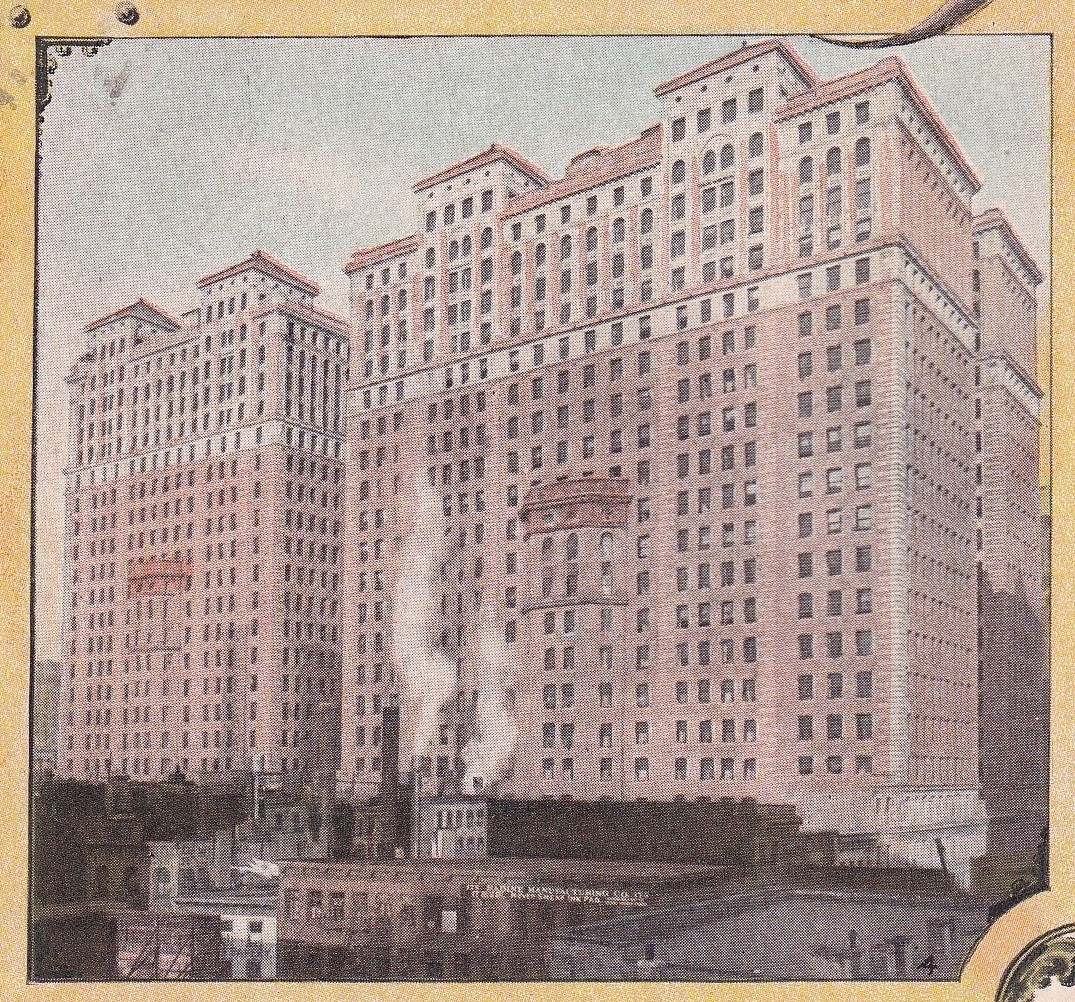
Cover of folder containing time cards (timetables) for the H&M Railroad, with an illustration of the Hudson Terminal

By April 4, 1908, tenants started moving into the towers.[13][14][19] Originally, the northern office building was called the Fulton Building while the southern office building was called the Cortlandt Building, reflecting the streets that they abutted.[24] The H&M terminal opened on July 19, 1909,[25][26] along with the Downtown Tubes.[21][25] The combined rail terminal and office block was the first of its kind anywhere in the world.[27][c]

The space in the office buildings was in high demand, and the offices were almost fully rented by 1911.[29] The following year, McAdoo denied rumors that H&M would acquire the low-rise buildings on Greenwich Street to expand the Hudson Terminal buildings.[30] Upon the tubes' opening, they were also popular with New Jersey residents who wanted to travel to New York City.[25] Passenger volume at Hudson Terminal had reached 30,535,500 annually by 1914,[31] and within eight years, nearly doubled to 59,221,354.[32] Several modifications were made to the complex in the years after its completion. Smaller annexes were added to the office buildings at some point after they opened, during the early or mid-20th century.[33]

A passageway to the Independent Subway System (IND)'s Chambers Street station was opened in 1949.[34][35] The passageway measured 14 feet (4.3 m) wide and 90 feet (27 m) long. Construction contractor Great Atlantic Construction Company described the tunnel as "one of the most difficult of engineering feats", as the passageway had to pass above the H&M tunnels while avoiding various pipes, wires, water mains, and cable car lines.[35]

Early tenants of the Hudson Terminal buildings included companies in the railroad industry;[36][37] the offices of U.S. Steel;[37][38] and some departments of New York City's general post office, which had been crowded out of its older building.[37][39] U.S. Steel, the post office, and six railroad companies occupied 309,000 square feet (28,700 m2), or over a third of the total space in the buildings.[37] The top floors of each building had private dining clubs: the Downtown Millionaires Club atop the Cortlandt Building and the Machinery Club atop the Fulton Building.[20][38] With the exception of a brief period between 1922 and 1923,[40] the terminal's post office operated until the United States Postal Annex at 90 Church Street opened two blocks north in 1937.[41] Space in the buildings was also occupied by agencies of the United States federal government in the 1960s.[42]

Decline and demolition

[edit]

H&M ridership declined substantially from a high of 113 million riders in 1927 to 26 million in 1958, after new automobile tunnels and bridges opened across the Hudson River.[43] The H&M had gone bankrupt in 1954.[44] The state of New Jersey wanted the Port Authority of New York and New Jersey to take over the railroad, but the Port Authority had long viewed it as unprofitable.[45] In 1958, the investment firm Koeppel & Koeppel offered to buy the terminal buildings for $15 million (equivalent to $125 million in 2024[b]), as part of a reorganization hearing for the H&M.[46]

The Port Authority ultimately took over the H&M as part of an agreement concerning the construction of the World Trade Center.[45] The Port Authority had initially proposed constructing the complex on the East River, on the opposite side of Lower Manhattan from Hudson Terminal.[47][48] As an interstate agency, the Port Authority required approval for its projects from both New Jersey's and New York's state governments, but the New Jersey government objected that the proposed trade center would mostly benefit New York.[45] In late 1961, Port Authority executive director Austin J. Tobin proposed shifting the project to Hudson Terminal and taking over the H&M in exchange for New Jersey's agreement.[49] On January 22, 1962, the two states reached an agreement to allow the Port Authority to take over the railroad, rebrand it as the Port Authority Trans-Hudson (PATH), and build the World Trade Center on the Hudson Terminal site, which was by then deemed obsolete.[50] The World Trade Center project would include a new PATH station to replace the Hudson Terminal station, as well as a public plaza to replace the buildings.[51]

Groundbreaking on the World Trade Center took place in 1966,[52] and as with the Hudson Terminal buildings, a slurry wall to keep out water from the Hudson River. During excavation of the site and construction of the towers, the Downtown Tubes remained in service, with excavations continuing around and below the tunnels.[53] The Hudson Terminal station closed on July 2, 1971, to allow a three-day maintenance period to divert service to its replacement, the original World Trade Center PATH station.[54] The World Trade Center station opened on July 6, 1971, west of the Hudson Terminal station.[55] Just before the buildings' demolition, in early 1972, the New York City Fire Department used the empty Cortlandt Building for several fire safety tests, setting fires to collect data for fire safety.[56][57] The Hudson Terminal complex was demolished by the end of 1972.[58]

After the World Trade Center station opened, the sections of the Downtown Tubes between the Hudson Terminal and World Trade Center stations were taken out of service and turned into loading docks for the 4 World Trade Center and 5 World Trade Center buildings on Church Street.[59] The original PATH station was destroyed in 2001 during the September 11 attacks.[60] The last remnant of the Hudson Terminal station was a cast-iron tube embedded in the original World Trade Center's foundation near Church Street. The tube was above the level of the PATH station and the station's replacement after the September 11 attacks. The cast-iron tube was removed in 2008 during the construction of the new World Trade Center.[61]

Railroad station

[edit]

The terminal served H&M trains as well as those of the Pennsylvania Railroad, which interoperated on H&M trackage.[21][62] The railroad terminal's construction was overseen by Charles H. Jacobs, chief engineer, and J. Vipond Davies, deputy chief engineer.[63][64][65] The terminal was two stories below street level and consisted of five tracks numbered 1–5 from east to west. The tracks were served by four island platforms and two side platforms.[59][66] All tracks had a Spanish solution layout with platforms on both sides, thereby enabling passengers to exit trains from one side and enter from the other.[67][68][69][9] This removed conflicts between departing and boarding passengers.[9] The width of the station averaged 180 feet (55 m) from west to east, and the station measured 530 feet (160 m) long from north to south.[16]

Lower Manhattan's topography made it impossible for the H&M to build a "stub-end" terminal, with the tracks oriented on a west–east axis and terminating at bumper blocks.[9] Therefore, the Hudson Terminal station was arranged as a balloon loop connecting both of the Downtown Tubes.[9][70] Trains entered from the south and exited from the north.[70] The station ran perpendicularly to both of the Downtown Tubes, and at either end of the station, there were sharp curves to and from each tube, with track radii of 90 feet (27 m). The eastbound tunnel ran under Cortlandt Street and the westbound tunnel ran two blocks north under Fulton Street.[68]

Platforms and tracks

[edit]
Track layout
5
4
3
2
1
Map is not to scale.

The station had been built with five tracks because, at the time of its construction, there were plans to build another pair of tunnels under the Hudson River near the Downtown Tubes. The H&M anticipated that two terminal tracks would be needed for each pair of tunnels; the fifth track was needed for flexibility.[9][21][71] The additional tunnels were ultimately never built, and several subway tunnels were built very close to the Hudson Terminal complex.[21] Track 5, the westernmost track, was used by baggage trains and was designated as the "emergency" track. The westernmost side platform, serving Track 5, was used for handling baggage, delivering coal, and depositing ashes from the buildings' power station.[68][71] The easternmost side platform adjacent to track 1, as well as the island platforms between tracks 2/3 and 4/5, were used by alighting passengers only. The island platforms between tracks 1/2 and 3/4 were used by boarding passengers.[68][71] The station was designed to accommodate a full trainload of 800 passengers every 90 seconds, the maximum capacity of the Downtown Tubes.[72]

Each of the platforms were 370 feet (110 m) long and could fit trains of eight 48.5-foot-long (14.8 m) cars.[26][73][74] The platform widths were determined by the projected passenger loads for each track; the boarding platforms were wider than the alighting platforms and at least twice the width of the trains. The eastern side platform was 11.5 feet (3.5 m) wide because it was used only by alighting passengers from track 1, and the island platform for alighting passengers between tracks 4/5 was 13 feet (4.0 m) wide because track 5 was not used in regular service. The other three island platforms were 22 feet (6.7 m) wide because they each served two tracks that were used in regular passenger service.[16][72] The engineers studied pedestrian traffic at the Brooklyn Bridge and other congested areas to determine the design of the station's ramps and staircases. There were six stairs from each alighting platform and four stairs to each boarding platform.[75]

Except at the platforms' extreme ends, the platforms contained straight edges to minimize the gap between train and platform.[26][73][76] The straight section of each platform was 350 feet (110 m) long.[9] Other stations on loops—including the City Hall and South Ferry stations of the New York City Subway, built by the Interborough Rapid Transit Company (IRT)—contained curved platforms, whose gaps between platform and train posed a great liability to passenger safety.[77] Illuminated departure signs on each platform displayed the destinations of the trains on each track. The station was lit by incandescent lamps throughout.[76]

Surrounding infrastructure

[edit]

The station tunnels contained provisions for an unbuilt extension northward to what is now the 34th Street–Herald Square station on the New York City Subway.[78][79] If this extension had been built, it would have tripled the maximum number of trains that could go into the Hudson Terminal station.[78] The sections of tunnel around the Hudson Terminal station were taken out of regular service when the World Trade Center station was built about 450 feet (140 m) to the west.[59] The World Trade Center station could fit ten-car trains, and sat underneath Greenwich Street, which was oriented further northwestward compared to the Hudson Terminal station parallel to Church Street.[80] Because it was longer than the Hudson Terminal station, a large jughandle curve was built from either tube to the World Trade Center station, surrounding the Hudson Terminal approach tracks.[77][80] The sections of the tubes east of Greenwich Street were subsequently turned into loading docks serving 4 and 5 World Trade Center.[59]

To the north and south of the station, each end of the loop had a loading gauge large enough to fit one train.[70] The cars required a clearance of 12 feet 6 inches (3.81 m) above the tops of the rails, while the floor of the tunnel was 24 inches (610 mm) below the tops of the rails.[16] The single tubes of the Downtown Tubes enabled better ventilation of the station by the so-called piston effect. When a train passed through the tunnel, it pushed out the air in front of it toward the closest ventilation shaft, and also pulled air into the rail tunnel from the closest ventilation shaft behind it.[63][81] The Hudson Terminal station also used fans to accelerate the movement of air.[63]

Connections

[edit]

When the Hudson Terminal buildings opened, direct transfers were available to the IRT's Sixth Avenue elevated at Cortlandt and Church Streets, and to the Ninth Avenue elevated at Cortlandt and Greenwich Streets.[26] The connection to the Sixth Avenue Line station, opened in September 1908, was via an elevated passageway from the third floor of the Cortlandt Building.[23] In 1932, the Independent Subway System opened the Hudson Terminal station on its Eighth Avenue Line, though the IND station was operationally separate from the H&M station.[82] Though the IND had also planned for a passageway between its Chambers Street station and the H&M's terminal in the original plan for the Eighth Avenue Line, a direct passageway to the Chambers Street station was not opened until 1949.[34]

Towers

[edit]
This view from the southwest shows how Hudson Terminal was situated on what would become the World Trade Center site. The terminal is at center-left; in the background to its left is the Woolworth Building; in the background to its right are the Singer Building and the Equitable Building; and in the foreground to its right is 90 West Street.

Hudson Terminal included two 22-story Romanesque-style office skyscrapers above the H&M station.[14][83] The buildings were designed by architect James Hollis Wells, of the firm Clinton and Russell, and built by construction contractor George A. Fuller.[14][24][65] Purdy and Henderson were retained as the structural engineers.[64][65] Located on what would later become the World Trade Center site, the Hudson Terminal buildings preceded the original World Trade Center complex in both size and function.[27] When the Hudson Terminal buildings opened, the height and design of skyscrapers was still heavily debated, and New York City skyscrapers were criticized for their bulk and density. Some of the city's early-20th-century skyscrapers were thus designed with towers, campaniles, or domes above a bulky base, while others were divided into two structures, as at Hudson Terminal.[84] Furthermore, high real-estate costs made it impractical to build "anything but an office building" above the terminal.[85]

The buildings occupied most of the site bounded by Cortlandt Street to the south, Church Street to the east, and Fulton Street to the west, with the northern building at 50 Church Street and the southern building at 30 Church Street. The site was also abutted by several low-rise buildings on Greenwich Street to the west.[27] They were respectively called the Fulton Building and the Cortlandt Building, and were also collectively referred to as the Church Street Terminal.[24][86] The buildings were separated by Dey Street, since the city government would not allow the street to be closed and eliminated.[14][87]

Form

[edit]

The Hudson Terminal buildings, along with 49 Chambers, were the city's first skyscrapers to include an H-shaped floor plan, with interior "light courts" to provide illumination to interior offices.[88] The buildings' land lots originally occupied a combined 70,000 square feet (6,500 m2).[14] According to the Engineering Record, the Fulton Building occupied a lot measuring about 156 by 154 feet (48 by 47 m), while the Cortlandt Building occupied a lot measuring about 213 by 170 feet (65 by 52 m).[89] However, the New-York Tribune gave slightly different measurements of 155.9 by 179.8 feet (48 by 55 m) for the Fulton Building and 214.35 by 186.3 feet (65 by 57 m) for the Cortlandt Building.[24] By the mid-20th century, annexes had been added to both buildings, giving them a combined lot area of 85,802 square feet (7,971.3 m2).[33]

The two buildings were otherwise designed similarly. The first through third stories of both buildings were parallelogram in plan, while the buildings contained H-shaped floor plans above the third story. The light courts of both buildings faced north and south, while the main corridors of each level on both buildings extended eastward from Church Street.[90][91] The Cortlandt Building's light courts measured 32 by 76 feet (9.8 by 23.2 m), while the Fulton Building's light courts were 48 by 32 feet (14.6 by 9.8 m). The wings on either side of the light courts were of asymmetrical width.[89] The main roofs of the buildings were carried to 275.75 feet (84.05 m) above ground.[24][89] Small projecting "towers" with pitched roofs rose from the Church Street side of both buildings, rising to 304 feet (93 m).[20][89]

Facade

[edit]

The designs for the buildings' facades called for Indiana limestone cladding below the fifth-floor cornice, and brick and terracotta above.[24][73][83][89] The original proposal included rows of triple-height Doric columns supporting the roof cornice.[24] As built, the lowest four stories of each building were made of polished granite and limestone; each ground level bay was filled with glass. The top six stories of each building contained light-toned terracotta, as in the original plan.[20][73] The corners of each building had light terracotta strips as well. Tall arches connected three of the top six stories.[20] Because of the differing dimensions of the buildings, the Fulton Building had eighteen bays facing Church Street and nineteen facing Dey Street, while the Cortlandt Building had twenty-two bays facing Church Street and twenty facing Cortlandt Street.[24]

The two buildings were connected by a pedestrian bridge over the street on the third story of each building.[78] A bridge connecting the buildings' 17th floors was approved and built in 1913, soon after the complex had opened.[92][93]

Features

[edit]

As completed, the buildings used 16.3 million bricks, 13,000 lighting fixtures, 15,200 doors, 5,000 windows, and 4,500 short tons (4,000 long tons; 4,100 t) of terracotta, as well as 1,300,000 square feet (120,000 m2) of partitions and 1,100,000 cubic feet (31,000 m3) of concrete floor arches. Also included in the buildings were many miles of plumbing, steam piping, wood base, picture molding, conduits, and electrical wiring.[63]

Structural features

[edit]
Floor plan of the third and mezzanine floors

The superstructure of the Hudson Terminal buildings required over 28,000 short tons (25,000 long tons; 25,000 t) of steel, manufactured by the American Bridge Company.[87][89] The superstructure of the Fulton Building was intended to carry a dead load of 95 pounds per square foot (4.5 kPa) and a live load of 105 psf (5.0 kPa), for 200 psf (9.6 kPa) total, while the Cortlandt Building could carry a dead load of 85 psf (4.1 kPa) and a live load of 75 psf (3.6 kPa), for 160 psf (7.7 kPa) total.[89] The columns were allowed to take a minimum stress of 11,500 psi (79,000 kPa) and a maximum stress of 13,000 psi (90,000 kPa).[64][89]

The floors were generally made of reinforced concrete slabs placed between I-beams, with cinder concrete fill and yellow-pine finish. Terracotta tile, brick, and concrete was used to encase the structural steel frame.[89] The I-beams were supported by columns or on plate girders. Large wind braces were not used; instead, the flanges of the beams and girders were riveted to the columns with what the Engineering Record described as "a moment of stiffness equal or somewhat superior to the depth of the girder".[94]

Interior

[edit]

The towers had a combined 39 elevators, which could carry 30,000 people a day. This included 17 passenger elevators and a freight elevator in the Fulton Building, and 21 elevators in the Cortlandt Building. Of the 39 elevators in the buildings, 22 ran nonstop from the lobby to the eleventh floor while the remainder served every floor below the eleventh.[63][67][95][96] Three of the elevators continued to the underground concourse, although the elevators did not descend to the concourse except during emergencies.[95]

With a total rentable floor space of 877,900 square feet (81,560 m2), some of which was taken by the H&M Railroad,[27] the Fulton and Cortlandt Buildings were collectively billed as the largest office building in the world by floor area.[73][83] Each building contained 44,000 square feet (4,100 m2) of office space on each floor;[78] the Fulton Building had 18,000 square feet (1,700 m2) per floor and the Cortlandt Building 26,000 square feet (2,400 m2) per floor.[86] The towers could house a combined ten thousand tenants[97] across 4,000 offices.[24][73][83] At ground level, the buildings contained glass-enclosed shopping arcades that were "much larger than the famous European arcades".[67][98]

Basements

[edit]
Floor plans of the concourse, ground floor, and third/mezzanine floors

There were three stories of basements beneath the office buildings.[7][31] The first basement level was a shopping and waiting concourse directly below the street.[26][73] The second basement level contained the H&M platforms.[31][63][78] The third and lowest level contained the baggage room, electrical substation, and an engine and boiler room for the substation.[63][76] The depth of the H&M platforms was mandated by the city's Rapid Transit Railroad Commission. To provide space for potential north–south subway lines in Lower Manhattan, the roof of any "tunnel railroad" in the area had to be at least 20 feet (6.1 m) below any north–south street.[9]

Four cement ramps, two each from Cortlandt and Fulton Streets,[99] descended to the first basement level.[31][63][78] The floor surface of each ramp is made of a compound of cement and carborundum.[96] The original plans had called for one ramp each from Cortlandt and Fulton Streets and two from Dey Street, but the engineers deemed this to be impractical.[75] There were also two bluestone staircases from Dey Street.[96][99] At the end of each ramp or staircase, Karl Bitter designed a large clock face, and there was also a steel and glass marquee protruding onto the sidewalk.[96] According to Landau and Condit, "At full capacity, the Hudson Terminal could accommodate 687,000 people per day; in comparison, Pennsylvania Station (1902–1910) was designed with a capacity of 500,000."[64]

Facilities

[edit]

The concourse, on the first basement level, contained ticket offices, waiting rooms, and some retail shops.[26][73][19] It measured 430 by 185 feet (131 by 56 m), much of which was open pedestrian space. The floor of the concourse was made of white terracotta with colored mosaic bands, while the columns and walls were made of plaster wainscoted with white terracotta.[19][96] The concourse contained a dropped ceiling, concealing some utility pipes and wires placed beneath the main ceiling.[13]

The basements were equipped with baggage handling facilities for the baggage trains traveling on Track 5. Two freight elevators carried baggage from Dey Street to the westernmost side platform or the baggage room in the third basement. Four elevators also transported baggage from the baggage room to the end of each of the island platforms.[100][101] Each of the freight elevators had a capacity of 13,000 pounds (5,900 kg), while each of the island-platform elevators had a capacity of 8,000 to 13,000 pounds (3,600 to 5,900 kg). Thus, baggage could be transported to trains on any of the five tracks.[101] The basements also contained a training school and break rooms for the H&M Railroad, as well as an ice-making plant, elevator hydraulic pumps, a generating plant, and a storage battery.[68][102][101]

Hudson Terminal's electrical substation consisted of two 1,500-kilowatt (2,000 hp) rotary converters for the railroad and four 750-kilowatt (1,010 hp) rotaries for the buildings.[63][76] This equipment was placed 75.8 feet (23.1 m) below ground level at Church Street.[75] From the Hudson and Manhattan Railroad Powerhouse in Jersey City, an 11,000-volt line of alternating current transmitted power to Hudson Terminal, where it was converted to 625 volts of direct current for the railroad and 240V DC for the offices.[102]

Substructure

[edit]

The O'Rourke Engineering and Contracting Company were hired to build the complex's foundation.[65][87] The foundation used irregular framing because of the presence of the tracks on the second basement level, and the cofferdam was said to be five times larger than any other similar structure previously constructed.[20]

The perimeter of the foundation was excavated using 51 pneumatic caissons,[75][103] drilled to depths of between 75 and 98 feet (23 and 30 m), with an average depth of 80 feet (24 m).[20][89] This required the underpinning of every building nearby.[20] The caissons were made of reinforced concrete with 8-foot-thick (2.4 m) walls. At this location, the underlying rock layer descended a maximum of 110 feet (34 m) beneath Church Street. Within the interiors of the enclosed cofferdam, 115 circular pits and 32 rectangular pits were dug. The steel columns supporting the superstructure were then placed in the pits; they weighed up to 26 short tons (23 long tons; 24 t) and could carry loads of 1,725 short tons (1,540 long tons; 1,565 t).[75][103] The entire lot area was then excavated to the second basement level. Part of the third basement was also excavated down to bedrock.[103] Overall, 238,000 cubic yards (182,000 m3) of earth were excavated manually and 80,000 cubic yards (61,000 m3) excavated via caissons.[102]

The main girders at the Hudson Terminal station's platform level were 48 inches (1,200 mm) deep with flanges 16 inches (410 mm) wide. The floor of this level was a Portland concrete slab 36 inches (910 mm) thick.[104] The platforms contained columns at intervals of about every 20 feet (6.1 m).[59] Some of the girders in the substructure were spaced irregularly because of the placement of the railroad platforms at the second basement level. Heavy sets of three distributing girders, encased in concrete, were used in these locations to support the weight of the Fulton and Cortlandt Buildings.[89][19] Dey Street was carried above the mezzanine via a series of plate girders and I-beams, which formed a "skeleton platform" measuring about 180 ft (55 m) long by 27 ft (8.2 m) wide.[105] The structure carrying Dey Street could accommodate loads of up to 1,400 psf (67 kPa).[94] In total, the substructure included 11,000 cubic yards (8,400 m3) of concrete and 6,267 short tons (5,596 long tons; 5,685 t) of structural steel.[102]

Notable incidents

[edit]

During the complex's existence, the buildings experienced several incidents. Within a year of the office building's opening, in 1909, a man died after falling from a window in the Fulton Building;[106] other deaths from falling occurred in 1927[107] and 1940.[108] A bag full of explosives was found in the terminal in 1915, with enough explosives to blow up several buildings of the Hudson Terminal towers' size.[109] The elevators were also involved in several accidents: two people were slightly injured by a falling elevator in 1923,[110] and a woman was killed two years later after being trapped in an elevator.[111][112] Phillips Petroleum Company executive Taylor S. Gay was also shot and killed in the terminal in 1962.[113]

There were several incidents in the H&M station as well. In 1937, a 5-car H&M train crashed into a wall, injuring 33 passengers.[114] Twenty-six people were injured in a 1962 crash between two H&M trains at the terminal.[115]

References

[edit]
[edit]
Revisions and contributorsEdit on WikipediaRead on Wikipedia
from Grokipedia
The Hudson Terminal was a complex in , , consisting of two 22-story office towers constructed above an station that functioned as the terminus for the Hudson & Railroad. Opened in July 1909, the facility connected commuters from via tunnels beneath the directly to the Wall Street vicinity, handling peak-hour traffic with a multi-track loop system and straight platforms. The towers provided rental income to subsidize operations, making the terminal a self-sustaining venture in early 20th-century urban transit infrastructure. Acquired by the of New York and in 1962 and rebranded under the PATH system, the Hudson Terminal ceased operations in July 1971 upon the opening of the replacement World Trade Center station. Demolition of the complex proceeded in phases through 1972 to clear the site for the World Trade Center development, with subterranean remnants repurposed temporarily as loading areas before further alterations. At its inception, the structure represented an engineering feat in integrating vertical office space with subterranean rail, influencing subsequent transit-oriented developments in dense urban environments.

Historical Development

Planning and Construction

The Hudson & Manhattan Railroad, chartered in 1902 to build tunnels under the , planned the Hudson Terminal as its primary station to facilitate from . , who assumed control in 1901, directed the integration of an underground rail facility with office towers above, aiming to generate revenue and accommodate high passenger volumes through innovative vertical stacking. The site, spanning two blocks bounded by Church, Cortlandt, Fulton, and Greenwich Streets, was selected for its proximity to lower 's financial district. Construction began in 1905 following resumption of tunnel work under chief engineer Charles M. Jacobs and deputy J. Vipond Davies, who employed shield tunneling for the riverbed sections and cut-and-cover techniques in Manhattan. Site preparation entailed excavating four stories below street level to create space for twelve platforms arranged in two tiers around the tracks, enabling efficient passenger flow without cross-platform transfers. Architects Clinton & Russell designed the twin 22-story towers atop this subterranean complex, prioritizing structural stability over the excavated void. The project faced challenges from the deep excavation amid dense urban development, requiring robust and coordination with ongoing tunnel boring that had previously encountered blowouts and legal delays since initial efforts in 1874. Despite these hurdles, the terminals were completed in at a total system cost exceeding $70 million by , funded privately without government subsidy. Initial service commenced that year, marking the culmination of over four decades of intermittent development.

Opening and Early Operations

The Hudson Terminal in Lower Manhattan opened for service on July 19, 1909, as the eastern terminus of the Downtown Hudson Tubes operated by the Hudson & Manhattan Railroad (H&M). This marked the inauguration of direct rapid transit between Jersey City's Exchange Place station and the New York financial district, utilizing the newly completed tunnels beneath the Hudson River. The terminal's underground platforms connected to two 22-story office towers constructed above, which served as the H&M's flagship structures and housed corporate offices alongside the railroad's operations. Initial operations focused on commuter service from , building on the H&M's uptown line that had launched in February 1908 between Hoboken and (later extended). Trains from Hudson Terminal provided frequent, high-speed access to , with the system introducing specialized features such as ladies-only cars to accommodate passenger demographics of the era. By 1910, service expanded to include connections to Grove Street in Jersey City, enhancing regional integration, while 1911 saw further extensions to Park Place, , and Newark, solidifying the terminal's role in cross-Hudson commuting. Early ridership reflected strong demand from workers in Manhattan's growing , though exact figures from the opening years are sparse; the system's overall passenger volume surged in subsequent decades, peaking at over 113 million annually by amid . The terminal's design emphasized efficiency, with multiple tracks and platforms handling inbound and outbound flows, positioning it as a vital for interstate rail prior to widespread automobile .

Peak Usage Period

The Hudson & Manhattan Railroad, which operated Hudson Terminal as its primary Manhattan endpoint, experienced its highest ridership in the 1920s, driven by rapid urbanization in and , dense commuter flows across the , and limited alternative crossings prior to the widespread adoption of automobiles. Annual passenger volume system-wide peaked at 113,141,729 in 1927, reflecting the terminal's role in handling intense peak-hour demands from workers traveling to financial district offices. This figure represented a culmination of steady growth since the terminal's 1908–1909 opening, with trains operating at high frequency—up to every 90 seconds during rush hours—to accommodate surging demand from Jersey City, Hoboken, and Newark suburbs. Hudson Terminal's platforms and elevators managed this influx efficiently during the era, with the 22-story towers above integrating office space that further concentrated activity in the area, indirectly boosting transit usage. The 1927 peak occurred just before infrastructure shifts, such as the Holland Tunnel's late-1927 completion, began diverting some traffic to vehicles, though rail remained dominant for daily commuters. Archival records confirm this as the railroad's zenith, with no subsequent years approaching the volume amid emerging competition from bridges and tunnels in the . Operational data from the period highlight the terminal's capacity strains, including frequent platform modifications to handle crowds, underscoring its status as a vital for trans-Hudson mobility.

Decline Factors and Demolition

The Hudson and Manhattan Railroad experienced a significant decline in ridership following its peak, dropping from approximately 113 million passengers in 1927 to 26 million by 1958, primarily due to competition from newly constructed automobile infrastructure such as the (opened 1927) and (opened 1937), which facilitated increased private vehicle and bus usage across the . This postwar shift toward automobiles mirrored broader trends in urban transportation, exacerbating financial strain on the aging rail system, which had already faced maintenance challenges from its early 20th-century infrastructure. By the 1950s, the H&M entered proceedings, reflecting systemic losses across interurban railroads amid and highway expansion. The of New York and New Jersey acquired the H&M in 1962, rebranding it as PATH and initiating modernization efforts, but the Hudson Terminal's location conflicted with plans for the World Trade Center complex, a massive project aimed at consolidating port-related offices and revitalizing Lower Manhattan's economy. To accommodate the new development, the prioritized constructing an underground PATH station beneath the WTC, necessitating the terminal's removal despite its operational viability. The station ceased operations on July 6, 1971, coinciding with the opening of the replacement World Trade Center PATH terminal, after which the twin towers were systematically demolished starting with the north building in late 1971 and completing with the south building in 1972. Demolition remnants, including subterranean elements, persisted until excavation for later WTC phases in the early 2000s, underscoring the terminal's clearance as integral to the site's reconfiguration for higher-density commercial use.

Architectural Design

Overall Form and Structural Innovations

The Hudson Terminal comprised two 22-story towers, the Fulton Building to the north and the Cortlandt Building to the south, constructed directly above a multi-level subterranean railroad station as part of the Hudson & Manhattan Railroad's infrastructure. Completed in 1908, these structures spanned blocks along Church Street from Cortlandt to Fulton Street, bisected by Dey Street, and were designed by the architectural firm Clinton & Russell in a Neo-Renaissance style featuring stone bases, brick shafts, and terra-cotta crowns. The towers were not identical due to varying block dimensions but maintained a twin-like appearance through uniform window spacing, emphasizing functional urban infill rather than isolated monumentality. This configuration represented an early hybrid model integrating speculative commercial space with transit facilities, generating rental income to subsidize railroad operations. Structurally, the towers were supported by a steel framework weighing approximately 52 million pounds, supplied by the American Bridge Company, erected over a station excavated four stories below street level to accommodate 12 platforms arranged in a five-track loop system. This loop design, with straight platforms opposing each other, minimized gaps between trains and edges for efficient passenger loading and minimized curvature-induced operational delays, a configuration praised in contemporary engineering journals as a circulation innovation. The buildings' foundations were engineered to bridge the void of the active train sheds below, incorporating basement concourses that linked the station to adjacent department stores and provided auxiliary support spaces, ensuring stability amid the vibrations and loads from subterranean rail traffic. Bridges connecting the towers at the third and seventeenth floors further enhanced internal connectivity without compromising the spanning structure. A key innovation lay in the pedestrian access system, which replaced steep stairs with broad, gentle ramps from street level to the mezzanine, facilitating smooth flow for high-volume commuters and integrating retail at ground level with four glass marquee entrances on Cortlandt, Fulton, and Dey Streets. This customer-oriented approach, combined with the towers' placement over private-property tunnels branching from subaqueous bores, marked a departure from contemporaneous terminals like or Grand Central Stations, prioritizing pragmatic efficiency and commercial viability over grandeur. The overall form thus pioneered vertical real estate utilization atop live rail infrastructure, influencing later developments in transit-oriented high-rises.

Facade and Aesthetic Considerations

The twin towers of Hudson Terminal, designed by the architectural firm Clinton & Russell, featured facades clad in a stone base, brick shaft, and terra cotta top, employing masonry over a to integrate seamlessly with Lower Manhattan's early 20th-century urban fabric. This material palette reflected a proto-modern approach with neo-Renaissance elements, prioritizing functional efficiency over ornamental excess, in contrast to the monumental grandeur of contemporaneous stations like Pennsylvania Station. Aesthetic considerations emphasized practicality and user convenience, with identical treatments applied to both 22-story structures to eliminate and underscore their role as interconnected and transit hubs. The facades incorporated four glass marquee entrances on adjacent side streets (Cortlandt, Fulton, and ), facilitating pedestrian access while maintaining a restrained, commercial presence amid the dense street grid. Street-level retail spaces further aligned the design with everyday urban commerce, avoiding the isolation of more imposing Beaux-Arts edifices. This infill-oriented aesthetic drew from Clinton & Russell's prior projects, such as the Astor Hotel, favoring adaptable, customer-focused forms that supported high-density office leasing above the subterranean rail operations, completed in 1908. The overall effect was one of understated verticality, blending the towers' 226-foot height into the without dominating it, a deliberate choice amid New York City's evolving regulations and the push for harmonized streetscapes.

Interior Features and Amenities

The twin 22-story office towers of Hudson Terminal featured identical lobbies accessible from Church Street, designed independently of the subterranean station portals to maintain separate circulation paths for tenants and passengers. These lobbies connected to office floors served by 39 elevators, comprising express and local units, with three elevators extending directly to the concourse level for integrated access. Office interiors benefited from an H-shaped that incorporated light courts to channel natural illumination into workspace areas, a for aimed at enhancing occupant comfort and productivity. The upper floors hosted exclusive professional clubs, including the Mechanics Club and the Railroad Club—chartered under Hudson & Manhattan Railroad president John J. McAdoo—each outfitted with expansive dining facilities and open garden terraces providing panoramic views of the . The Railroad Club further included a dedicated Women's , reflecting the railroad's targeted accommodations for female travelers and professionals amid broader pro-female initiatives. Passenger-oriented amenities within the complex encompassed a generously sized powder room stocked with complimentary powder and hairpins, alongside restrooms offering towels and for a nominal five-cent , underscoring practical conveniences for daily commuters. The level integrated retail services such as butchers and barbershops, while broad, gently inclined ramps from street level to and platforms promoted efficient movement without reliance on .

Railroad Infrastructure

Station Platforms, Tracks, and Layout

The Hudson Terminal's underground railroad station featured five tracks arranged in a configuration beneath the private property bounded by Church, Cortlandt, Fulton, and Dey Streets. This layout allowed for efficient train turnaround without reversing, distinguishing it from the reversing loops at contemporary subway terminals like City Hall or South Ferry. Inbound trains from approached via the —two single-track tunnels separated by approximately two blocks—which turned at right angles upon entering to merge into the loop, with outbound tracks curving back under Fulton Street. Six platforms served these tracks, oriented parallel to Church Street in a compact arrangement tightly fitted between Cortlandt and Fulton Streets. Each track was flanked by platforms on both sides, incorporating a design that permitted simultaneous passenger alighting on one platform and boarding on the opposite, thereby optimizing dwell times and capacity. The tracks at the platforms were laid straight to minimize horizontal gaps between train cars and platform edges, enhancing safety and accessibility. The station opened for service on July 19, 1909, handling Hudson & Manhattan Railroad trains until its replacement by the World Trade Center station in July 1971.

Connections and Surrounding Infrastructure

The Hudson Terminal served as the Manhattan endpoint for the Hudson & Manhattan Railroad's (H&M) downtown line, connecting directly to New Jersey via the Downtown Hudson Tubes, a pair of single-track tunnels extending approximately 5,600 feet under the Hudson River. These tubes linked the terminal to Exchange Place in Jersey City, with initial service commencing on July 19, 1909, for trains from Hoboken and Jersey City terminals. From Exchange Place, lines extended northward to Manhattan Transfer—a junction station opened in 1911—and southward to Journal Square, facilitating onward connections to Newark Penn Station via agreements for joint service with the Pennsylvania Railroad. In New Jersey, passengers could transfer to major intercity rail hubs, including Hoboken Terminal (serving the Delaware, Lackawanna & Western and Erie railroads) and the Pennsylvania Railroad's Jersey City terminal, enabling seamless links to broader regional networks without direct through-running into Manhattan's mainline stations. Approaching , the tubes diverged eastward, with the north tube surfacing under and the south under Cortlandt Street, before curving sharply into a five-track beneath the terminal's Church Street alignment between Fulton and Cortlandt Streets. This subterranean loop configuration allowed trains to enter, platform at one of six stub-end platforms, and reverse direction for return trips, minimizing street-level disruptions in the dense Financial District. The infrastructure integrated with local urban elements through vertical access via elevators and stairs within the overlying office towers, but maintained operational isolation from New York City's subway systems, passing beneath the Interborough Company's Broadway–Seventh Avenue Line at without interconnection. Surrounding surface infrastructure included streetcar lines and ferries at nearby piers, which the complemented by providing rapid electric rail alternatives to pre-existing cross-river transport. No physical trackage linked the H&M directly to competing railroads in Manhattan, reflecting its design as an independent commuter shuttle focused on trans-Hudson travel rather than integration into the city's fragmented subway network. The system's tunnels, lined with cast-iron segments and employing shield tunneling methods, represented pioneering subaqueous engineering that supported peak frequencies of up to 20-minute headways during rush hours, underscoring its role in alleviating congestion at New Jersey railheads. By 1911, extensions beyond Manhattan Transfer had expanded the effective reach to 13 stations across 14 miles, though the terminal's stub-end layout inherently limited capacity compared to through-running designs.

Subterranean and Support Systems

Basement Facilities and Operations

The basement levels of Hudson Terminal housed critical support facilities for both the railroad operations and the overlying office towers, extending several stories below street level to accommodate the deep excavation required for the train tubes and structural foundations. The first basement level featured a spacious serving as a pedestrian hub, equipped with ticket offices, waiting areas, and retail shops integrated into an arcade that represented one of New York's earliest extensive underground commercial spaces, with shop windows lining one side to draw commuters. Lower basements included dedicated areas for baggage handling, allowing efficient processing of passenger luggage for travel. Electrical operations were centralized in a substation within the basements, providing power distribution for the Hudson and Manhattan Railroad's electrified trains, lighting, and mechanical systems across the complex, which supported peak daily capacities exceeding 600,000 passengers during the terminal's height. These facilities enabled seamless integration between the subterranean rail infrastructure and surface buildings, with utilities routed through the multi-level substructure to minimize surface disruptions in the dense site bounded by Church, Fulton, Cortlandt, and Greenwich Streets. Subterranean rail operations relied on a five-track configuration with six platforms, positioned parallel to Church Street between Cortlandt and Fulton Streets, where trains from the —entering via separate cast-iron segments—curved underground for efficient alignment and turnaround without manual reversal, facilitating high-frequency service to destinations. Concourses connected via gentle ramps promoted smooth pedestrian flow from street entrances to platforms, while the loop design optimized track utilization during peak hours, contributing to the terminal's role as a private rail hub from its opening in July until service relocation in 1971. Post-demolition remnants of these basements influenced subsequent World Trade Center construction, with some track-level elements repurposed or bypassed at deeper grades.

Substructure Engineering and Utilities

The substructure of Hudson Terminal was engineered to support the twin 22-story office towers and the underlying PATH station amid challenging geological conditions, including and water-bearing strata overlying micaceous at depths of 80 to 110 feet below curb level. Excavation reached approximately 100 feet or more to , necessitating a cofferdam to enclose the site and prevent ingress, akin to a reinforced pool , followed by staged removal of soil under controlled conditions. The foundations rested on -filled timber grillages sunk to , with columns—some weighing up to 26 tons and supporting loads of 1,725 tons—anchored via grillages in excavated pits. Pneumatic caissons formed the core of the substructure, enabling work under pressures of 18 to 24 psi to counter ; these included 51 rectangular caissons (8 feet thick), 115 circular ones, and 32 rectangular pits, sunk up to 110 feet deep, with total excavation of 80,000 cubic yards in caissons alone. Concrete elements, primarily Alpha in mixes such as 1:2:5 for caissons and 1:2.5:5 for cradles, formed solid 36-inch-thick floors for the deck and supported the superstructure amid 238,000 cubic yards of overall excavation and 6,267 tons of . approaches to the terminal utilized 33 additional caissons under Cortlandt and Fulton Streets, totaling 25,000 cubic yards of concrete, with 120 feet of walls blasted for access, ensuring stable integration of the 15-foot-3-inch diameter cast-iron-lined tubes rising to the station 36.86 feet below street level. Utilities were integrated into the substructure for operational reliability, with electrical power supplied via 625 V DC for the railroad and 240 V DC for buildings, generated from 11,000 V AC feeds in Jersey City and distributed through transformer substation No. 3. Ventilation systems employed suction and forced-draft fans in the tunnels and basement levels to maintain air quality, while water management relied on Cameron pumps, sumps, and ejectors for during construction and minimal post-lining drainage of 300 gallons per day per tunnel. systems, operating at 17 to 27 pounds per for tunneling and up to 70 to 100 pounds gauge for compressors, supported pneumatic tools and shields, with conduits for telegraph and wires embedded in the tunnels.

Economic and Engineering Significance

Achievements in Private Enterprise and Innovation

The Hudson Terminal represented a pinnacle of private enterprise in early 20th-century urban infrastructure, fully financed and constructed by the without public subsidies. Under president William G. McAdoo, secured over $70 million through private bonds and investments from figures including and to build 17 miles of tunnels and the terminal complex, completing the project by 1909. This self-reliant model integrated revenue from above-ground office towers—two 22-story structures generating rental income—to offset operational costs alongside passenger fares, achieving financial sustainability in an era dominated by publicly backed railroads. Engineering innovations underscored H&M's technical prowess, including hydraulic jacks and tunneling shields that propelled construction at 72 feet per day, bypassing traditional manual excavation for the 5,650-foot subaqueous tubes 97 feet beneath the . The terminal's subterranean loop featured five tracks and six straight platforms aligned to minimize boarding gaps, paired with vaulted arches, pneumatic doors on steel cars, and a of gentle street-level ramps to for seamless high-volume pedestrian flow—innovations lauded in contemporary engineering journals as optimizing capacity for Wall Street commuters. These advancements enabled the to handle 130,000 daily riders by , two years after initial tube openings. H&M's feats highlighted causal efficiencies of private incentives, fostering rapid innovation and operational refinements like dedicated loading/unloading platforms and early adoption of female ticket agents, which boosted ridership and profitability before eventual acquisition by the in 1962. This enterprise-driven approach contrasted with contemporaneous projects reliant on or funding, demonstrating scalable private capital's role in pioneering .

Criticisms, Challenges, and Causal Analysis of Decline

The Hudson and Manhattan Railroad (H&M), which operated Hudson Terminal, encountered severe financial challenges beginning in the post-World War II era, characterized by escalating operating losses and an inability to service its debt. By 1952, the railroad reported significant deficits, with accumulated unpaid interest exceeding $13 million by November 1954, when it filed an involuntary petition under Chapter X of the Bankruptcy Act due to . These losses stemmed from a combination of fixed high debt from initial overcapitalization—totaling over $46 million in mortgage bonds by 1954—and progressively rising operational costs that outpaced revenues. Ridership declines exacerbated these issues, driven by competition from automobiles, buses, and new infrastructure like the (opened 1931), which diverted trans-Hudson commuters away from rail. The H&M's model, reliant on high-density urban-to-urban flows, proved vulnerable to and the automobile boom, reducing passenger volumes while demands on aging tunnels and stations increased. Court analyses during reorganization highlighted this "squeeze" as a core causal factor: revenues fell amid broader modal shifts favoring , unsupported by subsidies that bolstered highways, leaving the privately financed unable to adapt without external intervention. Criticisms of the terminal itself were limited, focusing more on systemic railroad inefficiencies than design flaws; however, by the , deferred maintenance and outdated facilities drew scrutiny amid bankruptcy proceedings, contributing to operational strains. The Port Authority of New York and New Jersey acquired the in 1962 through condemnation to avert total collapse, reorganizing it as PATH, but this did not halt the terminal's fate. commenced in the late , with the station closing on July 16, 1971, to clear the site for the World Trade Center complex, a decision prioritizing large-scale redevelopment over preservation despite the terminal's ongoing functionality. Causally, the decline reflects market-driven obsolescence rather than inherent engineering failure: the terminal's innovative vertical design and capacity—handling up to 100,000 daily passengers at peak—succeeded in an era of rail dominance but could not counter exogenous shifts in transport economics, including policy biases toward automotive infrastructure that eroded rail's comparative advantage. Without ridership recovery or cost relief, fixed obligations overwhelmed cash flows, culminating in public takeover and site repurposing as urban land values soared.

Legacy and Impact

Demolition and Site Transformation

The Hudson Terminal's railroad station closed permanently on July 6, 1971, upon the opening of a replacement PATH station integrated into the World Trade Center complex. This new facility featured five tracks and three longer platforms capable of accommodating ten-car trains, marking a shift from the terminal's original eight-track, four-platform configuration to support expanded commuter service under management. The transition preserved PATH connectivity while relocating operations to accommodate World Trade Center construction, with some remnants of the old tunnels repurposed for storage post-closure. Demolition of the above-ground structures, including the 22-story Fulton and Cortlandt Towers, commenced after the station's closure and concluded by the end of 1972. The clearance of the two-block site—bounded by Greenwich, Cortlandt, Church, and Fulton Streets—facilitated site preparation for the World Trade Center, where bedrock excavation and foundation work enabled erection of buildings 4 and 5 directly atop the former terminal footprint. This transformation erased the terminal's physical presence but embedded its subsurface elements into the WTC's infrastructure, including a cast-iron tube remnant incorporated into the original foundations near Church Street. The site's evolution continued after the September 11, 2001, attacks destroyed the original World Trade Center, including its PATH station. Reconstruction efforts yielded the World Trade Center Transportation Hub, designed by and opened in 2016, which serves as the current eastern terminus for PATH trains and symbolizes renewed transit resilience on the redeveloped plaza. This hub, with its rib-like steel oculus structure evoking a in flight, replaced the interim post-9/11 facilities and integrates modern security, retail, and connectivity features absent in the Hudson Terminal era.

Influence on Urban Transit and Development

The Hudson Terminal pioneered the integration of high-capacity urban rail infrastructure with commercial office development, constructing two 22-story skyscrapers directly atop its multi-level underground station upon opening in 1908. This hybrid model, necessitated by 's prohibitive land costs, marked the first instance in of speculative office space built over a railroad terminal to maximize financial returns and subsidize transit operations. The Fulton and Cortlandt Buildings, designed by Clinton & Russell, housed thousands of offices and generated rental income essential for the Hudson & Manhattan Railroad's viability. This vertical stacking of functions influenced subsequent by demonstrating efficient in dense environments, where transit facilities occupied subterranean levels while surface and above-ground space supported economic activity. The terminal's featured innovative passenger circulation, including segregated platforms across multiple basement levels, broad ramps, and direct elevators from office lobbies to the concourse, prioritizing user convenience and flow in a pre-automobile era of mass commuting. Such customer-oriented approaches foreshadowed enhancements in later stations, like the reorganization of , emphasizing seamless integration of transit with daily urban life. The terminal's engineering feats, including the underlying shield-tunneled crossings completed by 1908, established precedents for subaqueous rail infrastructure that enabled reliable cross-river transit, fostering regional connectivity and suburban expansion in . By accommodating peak capacities exceeding those of contemporaneous facilities like Pennsylvania Station, it supported burgeoning commuter patterns that linked Hudson County hubs such as Jersey City and Hoboken to Lower Manhattan's financial district, thereby catalyzing economic interdependence across state lines without public subsidies.

References

Add your contribution
Related Hubs
User Avatar
No comments yet.