Hubbry Logo
Hot rodHot rodMain
Open search
Hot rod
Community hub
Hot rod
logo
8 pages, 0 posts
0 subscribers
Be the first to start a discussion here.
Hot rod
Hot rod
from Wikipedia

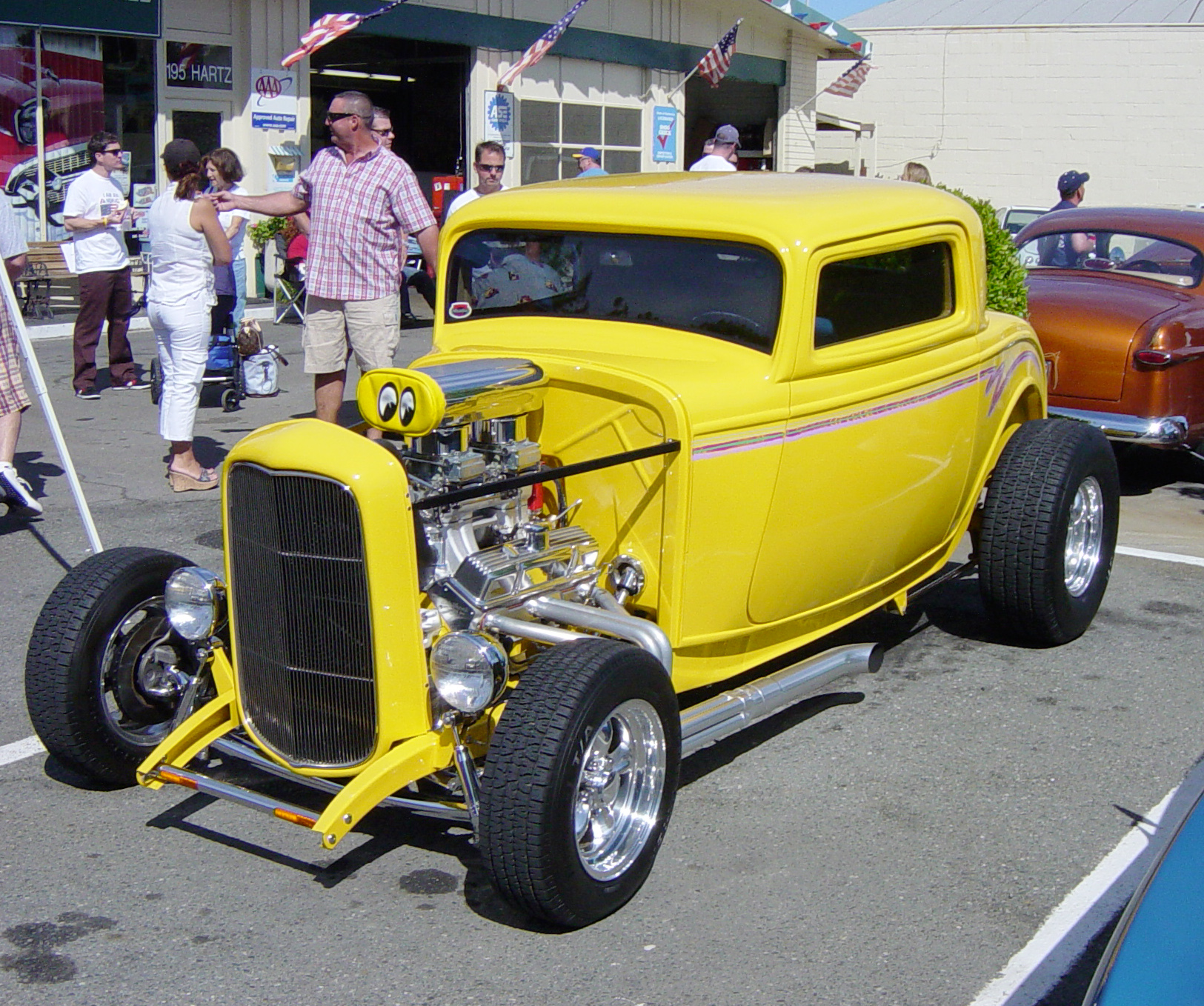
3-window highboy Deuce coupé with a traditional chop—dropped front axle, sidepipes, bugcatcher scoop (with Mooneyes cover) over dual quads on a tunnel ram—as well as less-traditional shaved door handles and disc brakes
A 1923 Ford T-bucket in the traditional style with lake headers, dog dish hubcaps, dropped "I" beam axle, narrow rubber, and single 4-barrel, but non-traditional disc brakes
1932 3-window with a classic-style[1] flame job and Moon tank, reminiscent of Chapouris' California Kid

Hot rods are typically American cars that might be old, classic, or modern and that have been rebuilt or modified with larger engines optimized for speed and acceleration.[2] One definition is: "a car that's been stripped down, souped up and made to go much faster."[3] However, there is no definition of the term that is universally accepted and the term is attached to a wide range of vehicles.[4] Most often they are individually designed and constructed using components from many makes of old or new cars, and are most prevalent in the United States and Canada.[4] Many are intended for exhibition rather than for racing or everyday driving.[4]

The origin of the term "hot rod" is unclear. Some say that the term "hot" refers to the vehicles being stolen. Other origin stories include replacing the engine's camshaft or "rod" with a higher performance version. According to the Hot Rod Industry Alliance (HRIA), the term changes in meaning over the years, but "hot rodding has less to do with the vehicle and more to do with an attitude and lifestyle".[5] For example, hot rods were favorites for greasers.

The term has broadened to apply to other items that are modified for a particular purpose, such as a "hot-rodded amplifier".

Etymology

[edit]

There are various theories about the origin of the term "hot rod". The common theme is that "hot" related to "hotting up" a car, which means modifying it for greater performance. With regards to the word "rod", one theory is that it means roadster,[6] a lightweight 2-door car which was often used as the basis for early hot rods. Another theory is that "rod" refers to camshaft,[7] a part of the engine which was often upgraded in order to increase power output.

In the early days, a car modified for increased performance was called a "gow job". This term morphed into the hot rod in the early to late 1940s.[8]

The term "hot rod" has had various uses in relation to performance cars. For example, the Ontario Ministry of the Environment in its vehicle emissions regulations refers to a hot rod as any motorized vehicle that has a replacement engine differing from the factory original.[9]

History

[edit]

1920s to 1945

[edit]
A picture from 1916 of a Ford Model T converted into a speedster.

Early speedsters, dating back to the 1910s and 1920s, are considered to be one of the ancestors of the hot rod movement.[10] These were racecars, often based on Ford Model Ts, and modified with custom bodies. Another forerunner to the hotrod were the modified cars used in the Prohibition era by bootleggers to evade revenue agents and other law enforcement.[7]

Hot rods first appeared in the late 1930s in southern California, where people raced modified cars on dry lake beds northeast of Los Angeles, under the rules of the Southern California Timing Association (SCTA), among other groups. This gained popularity after World War II, particularly in California, because many returning soldiers had received technical training.[7][6] The first hot rods were old cars (most often Fords, typically 1910s-1920s Model Ts, 1928–31 Model As, or 1932-34 Model Bs), modified to reduce weight. Engine swaps often involved fitting the Ford flathead V8 engine (known as the "flatty") into a different car, for example, the common practice[citation needed] in the 1940s of installing the "60 horse" version into a Jeep chassis.

Typical modifications were removal of convertible tops, hoods, bumpers, windshields, and/or fenders; channeling the body; and modifying the engine by tuning and/or replacing with a more powerful type. Wheels and tires were changed for improved traction and handling. Hot rods built before 1945 commonly used '35 Ford wire-spoke wheels.[11]

1945 to 1960

[edit]
Ford Popular ( also known as an Anglia ) 2 door sedan.
Hot-rodded prewar British Rover 10

After World War II, many small military airports throughout the country were either abandoned or rarely used, allowing hot rodders across the country to race on marked courses. Originally, drag racing had tracks as long as 1 mi (1.6 km) or more, and included up to four lanes of racing simultaneously. As some hot rodders also raced on the street, a need arose for an organization to promote safety, and to provide venues for safe racing. The National Hot Rod Association was founded in 1951, to take drag racing off the streets and into controlled environments.[12]

In the '50s and '60s, the Ford flathead V8 was supplanted by the Chrysler FirePower engine (known as the "early hemi"). Many hot rods would upgrade the brakes from mechanical to hydraulic ("juice") and headlights from bulb to sealed-beam.[13] A typical mid-1950s to early 1960s custom Deuce was fenderless and steeply chopped, powered by a Ford or Mercury flathead,[14] with an Edelbrock intake manifold, Harman and Collins magneto, and Halibrand quick-change differential.[15] Front suspension hairpins were adapted from sprint cars, such as the Kurtis Krafts.[16]

As hot rodding became more popular, magazines and associations catering to hot rodders were started, such as the magazine Hot Rod, founded in 1948.[17]

1960 to present

[edit]

As automobiles offered by the major automakers began increasing performance, the lure of hot rods began to wane.[7] With the advent of the muscle car, it was now possible to purchase a high-performance car straight from the showroom.[6]

However, the 1973 Oil Crisis caused car manufacturers to focus on fuel efficiency over performance, which led to a resurgence of interest in hot rodding.[7] As the focus shifted away from racing, the modified cars became known as "street rods". The National Street Rod Association (NSRA) was formed and began hosting events.

By the 1970s, the 350 cu in (5.7 L) small-block Chevy V8 was the most common choice of engine for hot rods.[18][19] Another popular engine choice is the Ford Windsor engine.[20] During the 1980s, many car manufacturers were reducing the displacements of their engines, thus making it harder for hot rod builders to obtain large displacement engines. Instead, engine builders had to modify the smaller engines (such as using non-standard crankshafts and pistons) to obtain larger displacement. While current production V8s tended to be the most frequent candidates, this also applied to others. In the mid-1980s, as stock engine sizes diminished, rodders discovered the 215 cu in (3.5 L) aluminum-block Buick or Oldsmobile V8 could be modified for substantially greater displacement, with mainly wrecking yard parts.[21] This trend was not limited to American cars; Volkswagen enthusiasts similarly stretched stock 1.6 L (98 cu in) engines to over 2 L (120 cu in).[22]

In modern culture

[edit]
1933 Ford 5-Window Coupe, an example of what some people might consider to be a street rod

The hot rod community is often said to be divided into two main groups: street rodders and hot rodders.[23][24][25] The definition of what counts as a "street rod" is debated, however, with definitions ranging from hot rods that feature modern features or styles, to any hot rod which is primarily built to drive on the street.[26]

Lifestyle

[edit]

There is a contemporary movement of traditional hot rod builders, car clubs and artists who have returned to the roots of hot rodding as a lifestyle. This includes a new breed of traditional hot rod builders, artists, and styles, as well as classic style car clubs. Events like GreaseOrama feature traditional hot rods and the greaser lifestyle. Magazines like Ol' Skool Rodz, Gears and Gals, and Rat-Rods and Rust Queens cover events and people.[27]

[edit]

There are magazines that feature traditional hot rods, including Hot Rod, Car Craft, Rod and Custom, and Popular Hot Rodding. There are also television shows such as My Classic Car, Horsepower TV, American Hot Rod, Fast and Loud, and Chop Cut Rebuild.

Particularly during the early 1960s, a genre of "hot rod music" rose to mainstream popularity. Hot rod music was largely a product of a number of surf music groups running out of ideas for new surfing songs and simultaneously shifting their lyrical focus toward hot rods. Hot rod music would prove to be the second phase in a progression known as the California Sound, which would mature into more complex topics as the decade passed. Hot rods were used as the theme of Lightning Rod, a Rocky Mountain Construction roller coaster at Dollywood.

In Sweden and Finland

[edit]
Swedish hot rodders with a 1964 American Plymouth at Power Big Meet

Locals in Sweden and Finland, influenced by American culture, have created a vibrant local hot rod culture where enthusiasts gather at meetings such as Power Big Meet in Linköping and clubs like Wheels and Wings in Varberg, both located in Sweden. Since there is very little "vintage tin", the hot rods in Sweden are generally made with a home-made chassis (usually a Model T or A replica), with a Jaguar (or Volvo 240) rear axle, a small-block V8, and fiberglass tub, but some have been built using for instance a Volvo Duett chassis. Because Swedish regulations required a crash test even for custom-built passenger cars between 1969 and 1982, the Duett option was preferred, since it was considered a rebodied Duett rather than a new vehicle.[28][29][30][31] Some 1950s and 1960s, cars are also hot rodded, like Morris Minor, Ford Anglia, Volvo Amazon, Ford Cortina, and '57 Chevy, to name but a few. These are known as custom cars (sometimes spelled Kustom).

[edit]

See also

[edit]

References

[edit]
[edit]
Revisions and contributorsEdit on WikipediaRead on Wikipedia
from Grokipedia
A hot rod is a customized older automobile, typically an American model from the through the such as a or Model A, that has been rebuilt or modified to enhance its speed, acceleration, handling, and aesthetic appeal, often featuring stripped-down bodies, powerful engines, and distinctive paint jobs. This modification process, known as hot rodding, emerged as a hands-on and among young mechanics seeking personal expression through automotive innovation. The origins of hot rodding trace back to the era of the , when bootleggers modified everyday vehicles like Ford Model As to outrun , laying the groundwork for . By the 1930s, amid the , the culture flourished in , where affordable Ford flathead V8 engines—introduced in —enabled enthusiasts to experiment with engine swaps, lighter chassis, and aerodynamic tweaks using scavenged parts. Informal speed trials on dry lake beds like El Mirage in the became central gathering points, fostering car clubs and a among participants who prioritized creativity and mechanical skill over luxury. World War II provided further impetus, as returning servicemen applied their mechanical expertise—honed on military vehicles—to civilian cars, leading to a postwar explosion in hot rodding popularity. By the late 1940s, posed safety and legal issues, prompting figures like Wally Parks to organize sanctioned events; this culminated in the founding of the (NHRA) in 1951, which shifted the focus to drag strips and for controlled competitions. The 1950s saw hot rods evolve from raw speed machines to more refined street-legal versions, influencing broader car culture through magazines like Hot Rod (launched in ) and events that celebrated both performance and artistry. Today, hot rodding remains a vibrant encompassing restoration, , and custom shows, with modern iterations incorporating advanced while honoring classic designs; it symbolizes American ingenuity and continues to inspire generations through organizations like the NHRA and SEMA.

Definition and Characteristics

Terminology and Etymology

A hot rod is defined as an older automobile, typically an American model from before the , that has been extensively modified for superior speed, handling, and visual appeal, often through engine upgrades and lightweight body alterations. This customization emphasizes over comfort, distinguishing it from standard vehicles. The etymology of "hot rod" traces to the late 1930s in , where young enthusiasts in the area began slangily referring to their souped-up cars during informal races on dry lake beds. The term is widely regarded as a shortening of "hot roadster," with "hot" signifying an "hottened up" for greater power—possibly alluding to over-revved components running hot or even stolen vehicles—and "roadster" denoting the prevalent Ford open-top chassis used as a foundation. Alternative interpretations link "rod" to mechanical parts like the or driveshaft, which would heat up under intense use, though the roadster origin predominates in historical accounts. Although oral usage prevailed in the 1930s among groups like high school clubs and early timing associations, the first notable print appearance came in the November 5, 1945, issue of Life magazine, which featured an article titled "Hot Rods!" spotlighting the post-war surge in modified cars. The term gained broader legitimacy with the launch of Hot Rod magazine in January 1948 by Robert E. Petersen, whose inaugural issues documented pre-war slang and helped standardize its application to performance-oriented customs. Related terminology evolved alongside the culture. "Hot rodder" emerged in the to describe builders and drivers of these vehicles, capturing the hands-on of the . "Street rod," nearly contemporaneous but formalized later, refers to hot rods adapted for everyday road legality with additions like updated brakes and wiring, contrasting the race-focused originals and peaking in popularity during the . "," coined in the late 1990s within car clubs, denotes deliberately unfinished, budget-built variants with exposed welds and rust for an authentic, anti-polish aesthetic, reacting against glossy restorations.

Vehicle Types and Base Models

Hot rods are predominantly built on pre-World War II American automobiles, selected for their lightweight construction, mechanical simplicity, and widespread availability of surplus parts following eras. The (1908–1927) served as an early favorite base due to its abundant supply—over 15 million units produced—making it inexpensive to acquire, often for as little as $50 in the surplus market, while its basic four-cylinder design allowed straightforward modifications without complex electronics. The Ford Model A (1927–1931) emerged as a highly preferred chassis in the 1940s hot rod scene, valued for its improved four-cylinder engine over the Model T, stronger frame, and affordability at around $200 for complete donor vehicles, enabling young builders to source frames, bodies, and components from junkyards or swap meets with ease. Chevrolet sedans from the 1930s and early 1940s, such as the 1930 Tudor or 1937 Master series, also saw use as bases, appreciated for their compact inline-six engines, rust-resistant steel bodies compared to wood-framed competitors, and comparable low cost—typically under $300—along with interchangeable parts from the era's high-volume production of over 1 million units annually. Common body styles for these bases include open-top roadsters for aerodynamic speed emphasis, two-door coupes for enclosed practicality, and lightweight pickups for utility in early racing setups. Builders often applied channeling—lowering the body by raising the floorpan over the frame rails—to achieve a sleeker, lower profile that improved stability and reduced drag, or chopping the roofline by 3–6 inches to further drop the while maintaining visibility. The Flathead Ford V8, introduced in 1932, became the iconic starter engine for hot rod swaps into these pre-war chassis, offering 65 horsepower from its initial 221-cubic-inch displacement in a compact, cast-iron block that fit easily into smaller engine bays like the Model A's. By 1937, variants reached 239 cubic inches with 85 horsepower, favored for its affordability (under $100 used), reliability in high-rev applications up to 5,000 rpm, and the era's first mass-produced V8 design, which spurred a dedicated aftermarket for performance heads and intakes. While the focus remains on U.S. domestics, niche builds occasionally incorporate European pre-war models, such as 1940s Austin A40 sedans, for their diminutive size and rarity in American hot rodding.

Common Modifications and Performance Enhancements

Hot rod enthusiasts commonly enhance engine performance by modifying the base flathead V8 engines, such as those from Ford, through techniques like boring out the cylinders to increase displacement and stroking the for greater output. These modifications can boost horsepower from the stock 85 hp to over 150 hp with basic , allowing for reliable and use. Superchargers, often Roots-style blowers mounted atop the engine, further amplify power by forcing air into the intake, with early examples like the Weiand unit enabling outputs up to 200 hp on flatheads. Engine swaps to overhead-valve V8s, such as the 1949 with its 303 cubic-inch displacement and 135 hp stock rating, provide superior breathing and revving capability compared to side-valve designs, making them a popular upgrade for post-war builds. Carburetion improvements, including dual or triple setups like dual Weber or Stromberg carburetors on a custom manifold, optimize fuel delivery for high-rpm performance, reducing throttle response time and increasing . Drivetrain modifications focus on improving power transfer and handling, with shortened wheelbases—often reduced by 6 to 12 inches on coupes or roadsters—enhancing cornering agility and reducing weight bias for better track performance. Overdrive transmissions, such as adapted Borg-Warner units added to three-speed manuals, lower engine rpm at speeds, improving fuel economy and longevity without sacrificing . Positraction differentials, like Eaton or Auburn limited-slip units installed in Ford 9-inch or Chevy 10-bolt housings, distribute evenly to both rear wheels during hard launches, minimizing wheel spin on loose surfaces like beds. Suspension upgrades prioritize stability and speed, with dropped axles—typically 4 to 6 inches lower than —lowering the center of for improved roadholding and a more aggressive stance. Hydraulic lifts, such as early air bag or ram systems integrated into the rear suspension, allow adjustable for varying track conditions, providing better traction during acceleration. Braking enhancements include early conversions, often using Wilwood or kits adapted to drum-equipped axles, which offer superior stopping power and fade resistance over original mechanical drums, essential for high-speed runs. Aesthetic modifications blend style with function, featuring flamed paint jobs applied via or airbrushing in bold red, yellow, or orange patterns to evoke speed and rebellion. Whitewall tires, typically 5.60-15 bias-ply radials, complement chrome wheels for a classic look while providing adequate grip. Lake pipes—curved side exhausts routed along the —add visual flair and a distinctive rumble without altering the rear setup. Moon disc hubcaps, covers with slotted designs, cover plain for a polished, appearance. In modern builds, safety-oriented additions like roll cages, welded tubular frames compliant with NHRA standards, protect occupants during competitive driving. Performance goals in hot rod modifications target rapid and top speeds, with typical quarter-mile times under 15 seconds achieved through combined and upgrades on street-legal setups. racing standards from the Timing Association emphasize flying-mile averages, where modified hot rods often exceed 120 mph in early classes, establishing benchmarks for power-to-weight efficiency.

Historical Development

Early Roots (1920s–1945)

The origins of hot rodding trace back to the era in the United States (1920–1933), when bootleggers modified vehicles to outrun law enforcement during illegal alcohol transport runs. These early modifications focused on enhancing speed through lightweighting the chassis, upgrading carburetors, and improving engine performance to achieve higher velocities on rural roads. By the 1930s, this tinkering evolved into a recreational pursuit among young enthusiasts in , who formed informal car clubs such as the Road Runners in 1937 to share knowledge and organize speed trials. A pivotal aspect of these early efforts was the use of dry lake beds as natural testing grounds, with Muroc Dry Lake (now part of ) serving as a primary site for high-speed runs due to its vast, flat expanse in the . In response to growing interest and the need for safety and organization, several clubs, including the Road Runners, coalesced to form the Timing Association (SCTA) in 1937, which sanctioned timed events starting in 1938 and established basic rules for land speed attempts. Pioneering machinists like Ed Winfield played a crucial role, developing high-performance camshafts and carburetors that enabled record-breaking speeds; for instance, Winfield achieved 119.60 mph in a modified flathead four-cylinder Ford Model B roadster during a 1933 trial, surpassing the 100 mph barrier that became a benchmark for the era. The onset of World War II in 1941 imposed severe constraints on these activities, as federal regulations banned organized automobile racing to conserve resources and prioritize military production, while illicit meets occasionally persisted on dry lakes. Material shortages, including , rubber, and , limited new modifications, forcing enthusiasts to focus on vehicle maintenance and minor swaps using scavenged parts rather than pursuing ambitious speed experiments.

Post-War Boom (1945–1960)

Following , hot rodding experienced a significant surge as returning soldiers, equipped with mechanical expertise acquired during military service, applied their skills to modifying affordable pre-war automobiles like Ford Model Ts and early V8-powered vehicles. This post-war enthusiasm, fueled by economic prosperity and a burgeoning , transformed informal tinkering into a widespread hobby, with enthusiasts stripping down cars for speed and racing them on beds and backroads. To address the growing concerns over safety and the negative public perception of hot rodding, including dangerous street racing, the National Hot Rod Association (NHRA) was founded in 1951 by Wally Parks, initially with support from Hot Rod magazine. The NHRA aimed to organize and legitimize drag racing by establishing rules, safety standards, and sanctioned events, thereby shifting activities away from unregulated public roads. Key milestones in this era included the first NHRA Drags held in 1955 at Great Bend Municipal Airport in , marking the inaugural national event despite heavy rains that delayed its completion. Additionally, the emerged as a premier venue starting in 1949, when the Southern California Timing Association (SCTA) organized the first speed trials there, attracting hot rodders seeking to push land speed records on the vast, flat surface. Hot Rod magazine, launched in January 1948, played a pivotal role in popularizing the culture by featuring technical builds, race coverage, and enthusiast stories, which helped standardize modifications and inspire a national audience. Pioneering figures like advanced the sport's technical boundaries; in 1957, he became the first drag racer to exceed 170 mph, achieving 176.4 mph in 8.78 seconds at Brooksville Airport, , setting a benchmark for quarter-mile performance. As expanded in the , with suburbs encroaching on open spaces, hot rodders increasingly shifted from remote beds to more accessible drag strips, which offered consistent surfaces and closer proximity to growing populations. Legal crackdowns on , driven by public safety fears and police enforcement, further propelled this transition, as organizations like the NHRA promoted sanctioned drag strips to provide a controlled alternative and improve the sport's reputation.

Evolution and Modernization (1960–Present)

In the 1960s, hot rodding evolved through its integration with the burgeoning movement, where high-performance factory vehicles like the embodied hot rod principles of powerful V8 engines and aggressive styling, making speed accessible to a broader audience beyond custom builds. This shift blurred lines between street-modified hot rods and production cars, as manufacturers drew inspiration from the hot rod culture to compete in and street performance scenes. By the early 1970s, however, the hobby encountered significant setbacks from escalating emissions regulations enforced by the Environmental Protection Agency (EPA), which mandated catalytic converters, unleaded fuel, and reduced compression ratios, drastically cutting engine power outputs. Compounding this, the 1973 and 1979 oil crises spiked fuel prices and shifted consumer preferences toward efficient imports, leading to a sharp decline in large-displacement V8 production and hot rod participation. The marked a revival of hot rodding, fueled by nostalgia drags that recreated the pre-1960s dry-lakes and early drag strip eras, drawing crowds with restored classics like rail dragsters and gassers to preserve the hobby's roots amid regulatory pressures. Restoration efforts gained prominence, with enthusiasts focusing on authentic rebuilds of and vehicles to evoke the boom, while the rise of the "pro street" class introduced high-horsepower street-legal builds featuring widened rear wheels, reinforced frames, and big-block engines for safer, bracket-racing competition. This era emphasized reliability and showmanship, helping hot rodding adapt to stricter street legality while maintaining its performance ethos. From the 2000s onward, technological advancements transformed hot rodding, with electronic fuel injection (EFI) conversions becoming standard for classic engines, offering precise tuning via digital systems that improved drivability, , and cold starts over carburetors without sacrificing power. Remote digital tuning tools allowed experts to optimize EFI setups over the internet, enabling builders to achieve dyno-like results from home garages. (EV) conversions emerged as a modern trend, exemplified by bolt-in kits for pre-1932 Ford Model As that swap internal combustion engines for battery packs and motors delivering triple the original power (125 hp versus 40 hp). Events like the SEMA Show in have solidified as central hubs, showcasing these innovations through competitions like Battle of the Builders, where EV-swapped hot rods and EFI-enhanced customs highlight trends in and digital integration. Contemporary hot rodding grapples with ongoing EPA regulations on emissions and modifications, requiring smog-compliant setups for street-driven vehicles and limiting high-performance exhaust options. Safety standards from the (NHRA) have intensified, mandating SFI-certified six-point harnesses (SFI Spec 16.1) or seven-point systems (SFI Spec 16.5), along with helmets, for classes like Top Dragster starting July 1, 2025 to mitigate risks in high-speed runs. Demographic challenges include an aging enthusiast base, with most owners in their 50s and 60s, prompting efforts to attract younger participants. Positively, growth in women and diverse racers is evident, as NHRA fields reflect a broad mix of genders, ethnicities, and backgrounds, fostering inclusivity in and hot rod events.

Cultural and Social Dimensions

Hot Rodding Lifestyle and Community

The hot rodding community revolves around a tight-knit of enthusiasts who share a passion for customizing and driving modified vehicles, fostering bonds through collaborative projects and social gatherings. This lifestyle emphasizes hands-on involvement, where participants often form clubs to exchange knowledge, parts, and ideas, tracing back to informal groups in during the 1930s. These clubs evolved into structured organizations that host regular meetups, such as cruiser nights, where members display their vehicles and engage in informal competitions to build camaraderie and hierarchy based on skill and creativity. Early participants, often known as "greasers," represented working-class youth who embodied the subculture's rebellious spirit through their mechanical prowess and customized rides. Central to the hot rodding ethos is the do-it-yourself (DIY) approach, which celebrates individual ingenuity and resourcefulness in vehicle modifications, often conducted in home garages as communal rituals where friends contribute labor and expertise over extended periods. This process reinforces social ties, with phrases like "speed costs money—how fast do you want to go?" serving as a that underscores the financial and personal commitment required for performance enhancements. elements extend beyond the garage to include symbolic expressions such as tattoos featuring hot rod motifs, which signify dedication to the culture, and frequent hangouts at diners or drive-ins that mimic cruising traditions as venues for storytelling and vehicle admiration. Major events anchor the community, providing platforms for showcasing builds and competing in judged displays. The Grand National Roadster Show, originally the Oakland Roadster Show founded in 1950 by Al Slonaker, stands as the world's oldest continuously running indoor hot rod exhibition, drawing thousands to celebrate craftsmanship through awards like America's Most Beautiful Roadster. Similarly, the NSRA Street Rod Nationals, organized by the National Street Rod Association since 1970, feature massive gatherings with vehicle inspections for and rituals like challenges that test driving skills among participants. The Detroit , initiated in 1953 by the Michigan Hot Rod Association, highlights custom vehicles with contests such as the Ridler Award, incorporating tech inspections to ensure compliance and burnout demonstrations that thrill spectators with displays of power. Demographically, the hot rodding has historically been dominated by men from working-class backgrounds, with a 2006 SEMA survey indicating that 96.8% of street rod and custom enthusiasts were male, though recent trends show growing inclusivity as more women enter the hobby despite lingering biases. This reflects broader , attracting diverse ages and professions while maintaining roots in blue-collar origins. Economically, the sustains a robust aftermarket parts industry, projected to reach $435 billion in the U.S. light vehicle sector by 2025, enabling enthusiasts to source components for their builds and fueling ongoing innovation. Hot rods have been prominently featured in film as symbols of youthful rebellion and American automotive culture. In the 1955 film , James Dean's character drives a mildly customized 1949 Mercury Series 9CM coupe, nosed, decked, and lowered to evoke the era's hot rod aesthetic, embodying disaffected teen identity. Similarly, the 1973 film romanticizes 1950s cruising through depictions of modified vehicles like John Milner's yellow highboy coupe, powered by a small-block Chevy V8 with chrome headers and multiple carburetors, highlighting and social rituals among California youth. In music, hot rods inspired anthems and influenced surf rock's energetic sound. Charlie Ryan's 1955 song "Hot Rod Lincoln," recorded with The Livingston Brothers, narrates a high-speed race in a modified Lincoln, drawing from real hill climbs and becoming a staple of car-themed and . This genre's fast-paced rhythms and lyrics about customized cars extended to surf rock, where bands like incorporated hot rod motifs in tracks glorifying speed and coastal drives, blending roots with instrumental twang. Literature and art captured hot rodding's gritty allure through and paintings. 1950s such as Fawcett's Hot Rod Comics (1951–1952) portrayed teen hot-rodders like Clint Curtis building and racing modified cars, reflecting the post-war boom in youth car culture. Artist Robert Williams, a pioneer of lowbrow , integrated hot rod elements into surreal paintings influenced by his work with Ed "Big Daddy" Roth and HOT ROD magazine, as seen in pieces like Hot Rod Race (1976), which fuse mechanical fantasy with pop iconography. Modern media continues to celebrate hot rods through television and video games. The TLC series Overhaulin' (2004–2015), hosted by , showcased the restoration of classic cars into custom hot rods, tricking owners into believing their vehicles were lost before revealing professionally built upgrades like engine swaps and body modifications. In gaming, the Need for Speed series, particularly the 2015 installment's "Hot Rods Update," introduced customizable 1932 Ford-based vehicles with body kits, engines, and modes, allowing players to engineer high-performance customs.

International Variations and Global Spread

In and , the subculture emerged in the as a youth movement inspired by post-war American car culture, particularly hot rods and rock 'n' roll, leading to a large dedicated community that has preserved and customized numerous classic American vehicles. This scene, prominent in rural areas, emphasizes 1950s aesthetics with modified Ford and Chevrolet models, fostering events that draw international enthusiasts. A hallmark is the annual Power Big Meet in , Europe's largest gathering of classic American cars, which attracts around 15,000 vehicles and tens of thousands of attendees over three days, featuring cruises, vendor displays, and live music. Across broader Europe, hot rodding adapted to local contexts, with the United Kingdom's ton-up boys of the 1950s and 1960s—rebellious motorcyclists who customized British bikes like and Nortons for high-speed café races—paving the way for car-based modifications in the following decade. This evolved into a distinct British hot rod scene by the 1970s, incorporating American-style speed equipment on domestic chassis amid limited imports. In , the tuning movement integrated hot rod principles with Beetles as popular bases, transforming the rear-engine compact into high-performance customs through engine swaps, lowered suspensions, and chrome accents, reflecting a blend of efficiency and customization in a market dominated by metric engineering. In , hot rodding thrives in vast landscapes, with enthusiasts organizing outlaw-style runs through the , echoing early American dry lake racing but adapted to rugged terrain and high temperatures, as seen in events like the Street Machine Drag Challenge that traverse remote highways. In Asia, Japan's subculture, originating in the 1950s with heavily modified motorcycles featuring exaggerated fenders and kanji-painted panels, has influenced hot rod aesthetics in custom shops, where builders fuse American chopper influences with domestic vehicles like pickups to create kustom hybrids that prioritize visual extremity and performance. Globally, hot rodding faces challenges from import restrictions that limit access to American parts, particularly in and where pre-1980s vehicles often require special approvals or modifications for road legality. Enthusiasts address metric-imperial mismatches by fabricating adapters for brakes, suspensions, and engines sourced from U.S. suppliers. Emerging hybrid adaptations, such as electric conversions of classic hot rods in , help meet stringent emissions standards while preserving vintage styling, though collector exemptions are advocated to protect unmodified originals. Post-2000, the scene has expanded internationally through online forums and communities, enabling knowledge sharing, parts sourcing, and virtual meets that connect builders across continents.

References

Add your contribution
Related Hubs
User Avatar
No comments yet.