Hubbry Logo
Howard Air Force BaseHoward Air Force BaseMain
Open search
Howard Air Force Base
Community hub
Howard Air Force Base
logo
8 pages, 0 posts
0 subscribers
Be the first to start a discussion here.
Howard Air Force Base
from Wikipedia

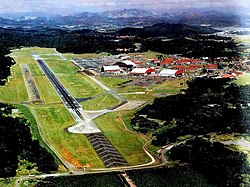
Howard Air Force Base (IATA: BLB, ICAO: MPHO) is a former United States Air Force base located in Panama. It discontinued military operations on 1 November 1999 as a result of the Torrijos-Carter Treaties, which specified that US military facilities in the former Panama Canal Zone be closed and the facilities be turned over to the Panamanian government.

Key Information

The airport is located 9.7 kilometres (6.0 mi) southwest of Balboa, at the southern (Pacific) end of the Panama Canal. Most of the area around it was uninhabited and formed part of the Panama Canal Zone watershed, although Panama City could be reached by crossing the nearby Bridge of the Americas.

After demilitarization, the facility reopened as Panamá Pacífico International Airport in 2014.[1][2]

Overview

[edit]

For over 50 years, Howard Air Force Base was the bastion of US air power in Central and South America. In its heyday, it was the center for counter-drug operations, military and humanitarian airlift, contingencies, joint-nation exercises, and search and rescue. It boasted fighters, cargo planes, tankers, airborne warning and control aircraft, operational support airlift "executive" jets, and search and rescue helicopters.

It was also home to a host of transient U.S. Army and U.S. Navy aircraft. Personnel assigned to tenant commands at Howard AFB tracked drug traffickers from South America, and its cargo aircraft, primarily rotational Lockheed C-130 Hercules aircraft from the active duty U.S. Air Force, the Air Force Reserve and the Air National Guard, provided theater airlift for United States Southern Command (USSOUTHCOM) contingencies, exercises, and disaster relief, and conducted search and rescue in the vast region.

McDonnell-Douglas F-4D Phantoms deployed at Howard Air Force Base, 1980
Four F-16 Fighting Falcon aircraft taxi to the parking apron upon their arrival for Exercise KINDLE LIBERTY 83.

Only a portion of the transports, several special-mission C-130s, two C-27 Spartan aircraft, and executive jets belonged to the host unit, the 24th Composite Wing, later redesignated the 24th Wing. Although Regular Air Force C-130 aircraft rotated to Howard AFB for 90-day detachments in the 1970s and early 1980s in the support mission called CORONET OAK, this mission was later transferred to the Air Force Reserve and the Air National Guard, which then provided C-130s for VOLANT OAK.[3] Vought A-7 Corsair II and later General Dynamics F-16 Fighting Falcon fighters also rotated through Howard AFB.

History

[edit]

Carved out of the jungle, 460 metres (500 yd) from the Pacific Ocean, Howard Air Base opened in 1942. It was named after Major Charles H. Howard (1892–1936), who flew in Panama in the late 1920s.

The only five-star general in Air Force history, Henry H. "Hap" Arnold played a prominent role in the history of Howard AFB and military aviation in Panama. As a captain, Arnold led the first air unit, the 7th Aero Squadron, to the Isthmus on March 29, 1917. Within a week, he left for Washington, DC, and more pressing duties there. When he returned to Panama in May 1939, he was a major general and chief of the Army Air Corps. The purpose of his visit was to select a site for a new air base. He chose what is now Howard AFB and suggested the name Howard Field, in honor of Major Charles H. Howard, a personal friend and former subordinate who had served in Panama during the period 1926–1929 and who had been part of Arnold's crew on his famed flight of B-10 bombers to Alaska in 1934. Major Howard died in an air crash on October 25, 1936. On December 1, 1939, the new air base officially became Howard Field.

Construction began shortly thereafter and the first troops arrived on May 15, 1941. Howard Field hosted both fighter and bomber aircraft during the World War II era. The base was inactivated on January 1, 1950, and its real estate turned over to the Army.

The Air Force continued to use Howard as a deployment site for joint training exercises during the 1950s, and by December 1961 all USAF flying operations in Panama relocated to Howard. On October 1, 1963, the Air Force officially reclaimed Howard from the Army and the base played a central role in US military operations in Latin America ever since, largely due to its 2,600-metre (8,500 ft) runway and its status as the only jet-capable US air field south of the Rio Grande.

Control of the Panama Canal changed hands on 31 December 1999, from the United States to Panama. Department of Defense elements began drawing down more than a year earlier, in anticipation of the deadline established by the Panama Canal Treaty of 1977. The last of the fixed-wing US aircraft departed Howard Air Force Base on 1 May 1999. On 1 November 1999, the 24th Wing inactivated and Howard Air Force Base was turned over to the Panamanian government.

Previous names

[edit]
  • Bruja Point Military Reservation, 11 August 1928
  • Fort Bruja, 1929
  • Fort Kobbe (named after Maj Gen William A. Kobbe, USA, who died 1 November 1931) 1932; airfield section of Fort Kobbe named Howard Field, 1 December 1939
  • Howard Air Base, 10 July 1941
  • Howard Air Force Base, 1948 – February 1950; October 1955 – 1999

Major commands to which assigned

[edit]
Operations at Howard drew down during the summer of 1949 and all training ceased on 11 October 1949; the base was transferred in inactive status to United States Army Caribbean in February 1950. In the 1950s, Albrook AFB used Howard to reduce aircraft activity at Albrook; a joint United States Army Caribbean, and Caribbean Air Comd, USAF, agreement (18 August 1955) permitted the resumption of regular flying operations at Howard in October 1955.
USAF Southern Air Division, 1 January 1976 – 1 January 1989
830th Air Division, 1 January 1989 – 15 February 1991
Air Forces Panama, 15 February 1991 – 11 February 1992

Major units assigned

[edit]

Education

[edit]

The Department of Defense Education Activity (DoDEA) formerly operated Howard Elementary School for children of American military dependents. The DoDEA secondary schools in Panama were Curundu Middle School and Balboa High School.[4]

See also

[edit]

Notes

[edit]

References

[edit]
[edit]
Revisions and contributorsEdit on WikipediaRead on Wikipedia
from Grokipedia
Howard Air Force Base (Howard AFB) was a installation in the , dedicated on March 1, 1942, as Howard Field in honor of Major Charles H. Howard, a pioneer air mail pilot who died in 1936, and redesignated Howard AFB in 1963. The base, located near Balboa at coordinates 8°54'53"N 79°35'59"W, functioned as the primary U.S. jet-capable airfield south of the , supporting defense of the during with fighter and bomber units such as the 53d Fighter Group and 3d Bombardment Squadron. Postwar, Howard AFB hosted the USAF Southern Air Division and later the 24th Wing (later redesignated ), overseeing air base operations, special operations, and counter-narcotics surveillance across , including rotational deployments of F-15, F-16, and C-130 aircraft. It played a pivotal role in Operation Just Cause in December 1989, providing air support for the removal of Panamanian leader amid his involvement in drug trafficking and threats to U.S. personnel. By the 1990s, the base emphasized joint interagency drug interdiction, operating AWACS and other assets until its phased closure. The base's deactivation on November 1, 1999, complied with the 1977 , which required complete U.S. military withdrawal from by December 31, 1999, leading to the transfer of facilities to Panamanian control and conversion into the civilian . This closure created operational gaps in regional counterdrug efforts, as surveillance coverage diminished without Howard's forward basing, prompting shifts to cooperative security locations elsewhere.

Geographical and Administrative Overview

Location and Physical Layout

Howard Air Force Base was situated in the Republic of Panama, on the Pacific coast approximately 16 kilometers southeast of , adjacent to the eastern shore of the Panama Canal's Pacific entrance. The site's coordinates are 8°54′54″N 79°35′58″W, with an elevation of 16 meters (52 feet) above , set amid coastal lowlands conducive to activities. The base featured a single primary oriented 03/21, extending 3,050 meters (10,007 feet) in length and 45 meters (148 feet) in width, supported by parallel taxiways and aprons for parking and maneuvering. Key facilities included multiple hangars, shops, a control tower, fuel storage and distribution systems, and ammunition storage areas, enabling sustained fighter and operations. Administrative structures, for enlisted personnel, officer quarters, and family housing units occupied designated zones, while recreational amenities and a served daily needs. Encompassing roughly 1,500 hectares, the layout expanded progressively from initial airfield construction in the , incorporating joint Army-Air Force elements by the mid-20th century, with perimeter fencing and security features adapted to tropical environmental conditions. The configuration prioritized operational efficiency, with runway access integrated into the system for logistical support.

Historical Naming and Designations

The site of Howard Air Force Base was initially designated Bruja Point Military Reservation on August 11, 1928, as part of U.S. defenses in the . It was subsequently renamed Fort Bruja in 1929 and Fort Kobbe in 1932, the latter honoring William A. Kobbe, who had commanded forces in the during the Spanish-American War and died in 1931. An airfield was constructed within the northern portion of Fort Kobbe, initially operating as Bruja Point Field from around 1937, with formal establishment dated August 1, 1938, and initial occupation on July 26, 1940. The airfield received its primary historical designation as Howard Field on July 10, 1941, named in tribute to Major Charles Harold Howard (1892–1936), a U.S. Army Air Corps aviator who conducted early air mail flights and reconnaissance operations in during the late . Howard died in a near , on October 24, 1936. The name was proposed by Henry H. "Hap" Arnold, who selected the location during a 1939 survey and had collaborated with Howard in air service development. The facility was dedicated as Howard Field on March 1, 1942, amid expanding preparations, serving initially as a base for the . In 1962, Howard Field was redesignated Howard Base, aligning with the maturation of U.S. infrastructure post-1947 independence from the and reflecting its role as a permanent strategic hub under commands such as the Caribbean Air Command. This change marked the shift from temporary wartime airfield status to a fully designated installation, though specific activation date within the year remains undocumented in primary records. The base retained this designation until its closure and transfer to Panamanian control in 1999 under the Panama Canal Treaty implementations.

Historical Development

Pre-Military Origins and Establishment (1912-1941)

The Bruja Point Military Reservation was established on August 11, 1928, as part of a U.S. program to augment defenses of the amid growing concerns over aerial threats and the limitations of existing facilities like Albrook Field on the Pacific side. This reservation encompassed approximately 5,196 acres adjacent to the Pacific entrance of the canal, initially focused on and infantry positions rather than aviation infrastructure. In 1929, the site was redesignated Fort Bruja to reflect its role in harbor defense. On April 15, 1932, Fort Bruja was renamed Fort Kobbe in honor of A. Kobbe (1856–1931), a U.S. officer who had commanded forces during the Philippine-American War and died on November 1, 1931. The fort served primarily as an installation, housing batteries and support units to protect against naval incursions, with no significant activity until the late . By this period, U.S. planners recognized the need for expanded airfields due to advancements in aircraft size, range, and the strategic vulnerability of the ; early 1920s assessments had highlighted terrain constraints at Albrook Field, prompting site surveys for supplementary facilities. 4947 formalized the reservation's boundaries for dual use, including potential airfield development. Aviation establishment accelerated in 1939 amid pre-World War II buildup, with construction of an airfield within the Bruja Point sector beginning that year to support heavier bombers and fighters. On December 1, 1939, the airfield portion was officially designated Howard Field, named for Major Charles Harold Howard (1892–1936), a U.S. Army Air Corps pioneer who conducted early mapping flights over Panama in the late 1920s and died in an aircraft accident on October 25, 1936, near Bryans Mill, . Initial facilities included runways suitable for pursuit , with the Corps personnel arriving by May 1940 to establish operations under the Panama Canal Department Air Force. By late 1941, Howard Field hosted headquarters elements and squadrons, marking its transition to a key Pacific-side aviation hub while remaining administratively tied to Fort Kobbe.

World War II and Immediate Postwar Period (1942-1949)

Howard Field, dedicated on March 1, 1942, and opened for operations on May 15, 1942, served as a primary U.S. Air Forces base in the under the Sixth Air Force, hosting fighter and bomber units to defend against potential Axis threats to the canal. The base facilitated antisubmarine patrols and reconnaissance missions in the and eastern Pacific, protecting vital shipping lanes, though no direct attacks on the canal materialized during the war. Aircraft types included P-38 Lightnings for fighters and B-24 Liberators, B-17 Flying Fortresses, and B-18 Bolivars for bombers, enabling long-range patrols and training exercises. Key units stationed at Howard included the 53rd Fighter Group from January 1 to November 26, 1942; the 37th Fighter Group from September 20, 1942, to November 1, ; and the 6th Bombardment Group from January 14 to November 1, 1943, with squadrons such as the 43rd, 51st, and 32nd Fighter Squadrons operating P-38s through 1945–1946. These forces conducted routine coastal frontier patrols, maintenance operations, and pilot training, contributing to the Sixth Air Force's mandate to locate, track, and neutralize enemy naval assets. By late , Howard's supported efficient servicing, bolstering regional air defense amid fears of Japanese or German incursions. In the immediate postwar period, Howard Field transitioned to training and support roles under the Sixth , with units like the 28th and 30th Fighter Squadrons active from September 25, 1945, to October 15, 1946, and the 36th Operations Group arriving in October 1946 for mission rehearsals. Operations drew down progressively, ceasing training activities on October 11, 1949, leading to the base's inactivation on December 15, 1949, after which real estate transferred to U.S. control while the Air Force retained limited access. This phase reflected broader U.S. military , prioritizing Canal Zone security amid reduced global threats.

Reactivation and Cold War Expansion (1950-1989)

Following its inactivation on January 1, 1950, and transfer of real estate to the U.S. , Howard Field continued limited utilization by the U.S. as a deployment site for joint training exercises throughout the . In October 1954, the 5700th Group was activated to manage base operations, marking initial steps toward reestablishment as an auxiliary airfield under U.S. oversight. By December 1961, all U.S. flight operations in the had relocated from Albrook Base to Howard to alleviate congestion and enhance operational efficiency. On October 1, 1963, the U.S. Air Force formally reclaimed Howard from Army control, redesignating it Howard Air Force Base and assuming full operational responsibility. This reactivation aligned with Cold War imperatives to maintain a robust aerial presence in Central America, serving as a hub for projecting U.S. air power amid regional threats from Soviet-aligned influences and insurgencies. The 5700th Air Base Wing, evolving from the earlier group, oversaw base maintenance and support until November 8, 1967, when it was replaced by the 24th Composite Wing, which expanded infrastructure to accommodate diverse aircraft and personnel for training and contingency missions. Throughout the 1970s and 1980s, Howard's role intensified under , with the establishment of the USAF Southern Air Division on January 1, 1976, headquartered at the base to coordinate air support for U.S. Southern Command operations. This unit facilitated inter-American military cooperation, including surplus transfers to Latin American allies and readiness exercises to deter communist expansion in the hemisphere. By the late 1980s, the base hosted advanced fighter squadrons equipped with F-4 Phantom II and later F-16 , underscoring its evolution into a key forward-operating location with runways extended and facilities upgraded to support rapid deployment and surveillance over the region. The 830th Air Division assumed oversight in 1989, reflecting ongoing expansions prior to post-Cold War drawdowns.

Final Operational Phase and Decline (1990-1999)

![F-16 Fighting Falcon at Howard Air Force Base, Panama][float-right] Following the U.S. invasion of in Operation Just Cause from December 1989 to January 1990, Howard Air Force Base resumed its role as a hub for U.S. Southern Command (SOUTHCOM) operations, emphasizing counter-narcotics missions, aerial , intra-theater , security assistance, and defense of the . The base hosted the Wing (later redesignated), which operated aircraft including C-21, CT-43, C-27, and special mission C-130s by 1992, supporting these activities. Rotational deployments, such as Operation Coronet Oak in the mid-1990s, involved fighter aircraft like F-15s and F-16s from and Air Force Reserve units, alongside C-130 for regional support. Counter-narcotics efforts intensified in the early , with Howard serving as a key platform for detecting and interdicting drug flights, including multinational operations coordinated through a proposed counter-drug center at the base. By the mid-, the base supported ongoing aerial surveillance and rapid response capabilities, but strategic value for drug interdiction contrasted with the impending mandate for U.S. withdrawal under the 1977 Torrijos-Carter Treaties, which required termination of military presence by December 31, 1999. Drawdown accelerated in the late as treaty compliance necessitated base closure activities; the 24th Wing managed inactivation and asset relocation starting over a year prior to the canal handover. Runway operations ceased on May 1, 1999, prompting relocation of F-16s and AWACS for drug interdiction to , , which contributed to a reported over 50% decline in U.S. interceptions post-closure. Full military operations ended with the wing's inactivation, and the base was officially transferred to Panamanian control on November 1, 1999, marking the end of U.S. presence after 82 years. This handover, valued at $635 million in infrastructure, left a significant gap in regional counter-drug capabilities despite Panama's strategic location.

Military Organization and Operations

Major Commands Assigned

During its operational history, Howard Air Force Base was assigned to multiple major commands of the , corresponding to shifts in strategic priorities from regional defense to counter-narcotics and contingency support. In the era, as Howard Field, the installation operated under the Sixth Air Force from March 1943 until its redesignation in 1947, focusing on antisubmarine patrols and air defense of the against Axis threats. Postwar, following limited use and transfer to Army control, Howard was reactivated for USAF operations on , 1963, and assigned to the Air Forces Southern Command (USAFSO), with the Southern Air Division headquartered there to oversee air mobility, training, and support missions across . From the late 1970s through the early 1990s, base activities aligned with (TAC) via subordinate units like the 24th Composite Wing, emphasizing tactical airlift, , and canal defense exercises. In 1992, following TAC's inactivation, oversight transferred to (ACC), under which the 12th Air Force (redesignated Air Forces Southern in 2009) managed Howard's contributions to counter-drug operations and regional until closure in 1999.

Key Units and Personnel

The 24th Composite Wing served as the primary host unit at Howard Base from the 1970s until its inactivation in 1991, assuming operational and maintenance responsibilities for both Howard and the adjacent Albrook Station as part of U.S. s Southern Command's structure. Its subordinate units included elements equipped with OV-10 Bronco observation aircraft and UH-1N Huey helicopters for , , and missions in Central and . In 1992, the wing was redesignated the 24th Wing, functioning as the senior U.S. organization in and overseeing fighter, , and squadrons that operated aircraft such as A-7 Corsairs, F-16 Fighting Falcons, and RF-4 Phantoms until the base's closure. The U.S. Air Force Southern Air Division (USAFSO), established on November 24, 1975, maintained its headquarters at Howard, directing air defense, training, and contingency operations across the region under the unified command of U.S. Southern Command. Supporting units included the 40th Tactical Airlift Squadron, which conducted cargo transport and aeromedical evacuations using C-130 Hercules aircraft from Howard during the 1980s and 1990s. Notable personnel included Thomas E. Wolters, who commanded USAFSO at Howard while also serving as deputy of U.S. Southern Command in the early . Roger Corbin led the 24th Wing during the base's final months in 1999, coordinating the orderly inactivation and handover of assets amid the treaties' implementation. Earlier, General Henry H. "Hap" Arnold, as Chief of the Air Corps in the late , advocated for enhanced aviation infrastructure in , influencing Howard's pre-World War II expansion and its designation as a key hemispheric defense outpost.

Strategic Roles and Notable Operations

Howard Air Force Base functioned as a critical forward operating location for the in , enabling rapid aerial deployment, reconnaissance, and logistical support to counter Soviet influence during the and address narcotics trafficking in the hemisphere. Its strategic position near the facilitated surveillance flights, tanker refueling for extended-range missions, and joint exercises with Latin American allies to enhance regional interoperability and deter instability. The base hosted airborne early warning platforms and fighter detachments that provided coverage over drug transit routes, contributing to efforts that detected thousands of suspect annually in the . In counter-narcotics operations, Howard served as the primary hub for Joint Task Force-4 from the 1980s until its 1999 closure, coordinating U.S. Southern Command's aerial detection and monitoring missions that supported interdictions of shipments from . Deployments such as Operation Coronet Nighthawk involved units flying E-2C Hawkeye aircraft for radar surveillance and F-15 and F-16 fighters for visual identification and deterrence, resulting in over 1,000 suspect trackings per year by the mid-1990s. These efforts, integrated with U.S. and allied forces, disrupted narco-trafficking corridors but faced challenges from Panama's sovereignty sensitivities post-Torrijos-Carter Treaties. A pivotal role came during Operation Just Cause on December 20, 1989, when Howard AFB acted as the main staging and command node for the U.S. invasion of to remove dictator , with C-130 transports airlifting paratroopers from the and F-117 stealth fighters launching strikes from the base despite navigational issues that missed key targets like Rio Hato barracks. Marine Expeditionary Units secured the base's perimeter and nearby areas, while psychological operations broadcast surrender calls; was eventually transported to Howard for transfer to U.S. custody on January 3, 1990. The operation demonstrated Howard's capacity for rapid , involving over 27,000 U.S. troops and concluding with Panama's transition to civilian rule, though it drew international criticism for civilian casualties estimated at 200-500 by human rights groups. Beyond combat, Howard supported humanitarian contingencies, such as airlifts during Central American , and training transfers of surplus U.S. aircraft to partner nations, bolstering hemispheric defense against without permanent basing dependencies. These roles underscored its value as a low-cost enabler of U.S. influence until base rights expired under the treaties.

Closure, Transfer, and Immediate Aftermath

Torrijos-Carter Treaties and Negotiations

The Torrijos-Carter Treaties emerged from protracted negotiations addressing Panamanian demands for sovereignty over the , controlled by the United States since the 1903 Hay-Bunau-Varilla Treaty. Talks began under President in 1974 but accelerated under , who viewed resolution as essential for hemispheric stability amid anti-U.S. unrest, including 1964 riots that killed over 20 and injured hundreds. Panamanian leader , a nationalist strongman, insisted on full territorial control, while U.S. negotiators sought to preserve defense capabilities and operational rights. Signed on September 7, 1977, the treaties comprised the Treaty, which outlined the gradual transfer of canal administration to by December 31, 1999, and the Panama Canal Neutrality Treaty, guaranteeing the waterway's perpetual neutrality with U.S. intervention rights only in cases of threats to its openness. These pacts effectively repealed prior U.S. extraterritorial claims, shifting from indefinite Zone sovereignty to time-bound joint operations, with Panama assuming full responsibilities post-handover. U.S. installations, including Howard Air Force Base—a key air hub supporting canal defense and regional missions—were permitted under the treaties to operate until the 1999 deadline to facilitate security guarantees, but no extensions or post-transfer basing were enshrined, reflecting Panama's rejection of permanent U.S. enclaves. Negotiators balanced U.S. strategic needs against Panamanian claims, with the fixed termination avoiding open-ended commitments amid domestic U.S. base realignments. Drawdowns commenced years ahead, as the Department of Defense anticipated the treaty-mandated exit from facilities like Howard, Rodman Naval Station, and Fort Kobbe. Senate ratification proved contentious, with opponents decrying loss of U.S. leverage and potential risks to canal access, yet the Neutrality Treaty passed 68-32 on March 16, 1978, followed by the Canal Treaty on April 18, 1978, by identical margins after intense lobbying. The accords prioritized empirical sovereignty transfer over indefinite military presence, influencing the structured closure of bases like without provisions for renegotiation on basing alone.

Deactivation and Handover Process (1999)

The deactivation of Howard Air Force Base culminated on November 1, 1999, when the inactivated the 24th Wing and formally transferred control of the installation to the government of . This action complied with the Treaties of 1977, which mandated the complete withdrawal of U.S. military forces and facilities from by December 31, 1999. The handover process involved a phased drawdown of operations that accelerated in the months leading up to the transfer. By mid-1999, after the U.S. Army's departure from nearby on July 30, fewer than 600 airmen remained at Howard, supporting residual activities before final inactivation. Preparatory steps included symbolic modifications to infrastructure, such as U.S. personnel painting a yellow cross over the runway designation on June 16, 1999, signaling the base's impending civilian transition. The 24th Wing's closure activities encompassed the relocation of aircraft, equipment, and personnel to other U.S. installations, effectively ending eight decades of continuous U.S. presence in that had originated in 1917. A formal reversion ceremony marked the event, with the last contingent of U.S. airmen departing as Panamanian authorities assumed over the 3,000-acre facility, including its runway, hangars, and housing areas. This transfer represented the longest closure process for any U.S. base in history, reflecting prolonged negotiations and operational wind-downs tied to the treaties' implementation. No U.S. basing rights were retained post-handover, aligning with Panama's assertions of full territorial control.

Post-Military Transformation and Current Status

Conversion to Panama Pacifico International Airport and Business Park

Following the handover of Howard Air Force Base to Panama on May 1, 1999, as part of the Torrijos-Carter Treaties implementation, the site remained largely underutilized for several years amid discussions on redevelopment. In 2004, Panama enacted Law 41, designating the former base as the Panama Pacifico Special Economic Zone (SEZ), a legal framework aimed at fostering international trade, logistics, and services through tax incentives, streamlined customs, and expedited visas. This established the Autoridad para el Desarrollo de la Zona Especial Panamá Pacífico (AADEZEPP), or Panama-Pacifico Agency, to oversee governance and attract private investment for transforming the 1,800-hectare site into a mixed-use hub including an international airport, business parks, residential areas, and industrial facilities. In 2007, the Panamanian government awarded a 40-year master development concession to & Regional Panama (L&R), a involving British developer and Colombian investor Jaime Gilinski, following a competitive bidding process advised by the . L&R committed $405 million in initial investments over the first eight years, including $20 million upfront, with obligations scaling to $100 million per subsequent eight-year period, supplemented by later Qatari participation acquiring a 50% stake for approximately $1 billion in 2010. The project emphasized sustainable , preserving 40% of the land as green spaces, and leveraged the site's strategic proximity to the and Pacific ports to position it as a logistics and center, with early phases focusing on infrastructure upgrades like runway rehabilitation and utility networks. The airfield, dormant since military closure, was repurposed and certified for civilian use, reopening as (IATA: BLB) in December 2013, initially handling cargo and before expanding to limited passenger flights by 2014. Parallel development of the attracted multinational tenants such as , , and by 2016, supported by SEZ benefits including profit repatriation and reduced corporate taxes, while residential and commercial construction progressed on over 1,000 buildings amid a total planned build-out of 118 million square feet across 4,450 acres. Challenges included navigating the and initial infrastructure remediation of military-era facilities, yet the conversion marked a shift from strategic military asset to economic engine, with cumulative investments exceeding $3 billion by the mid-2010s.

Economic Impact and Civilian Developments

Following its handover to Panama on May 1, 1999, the former Howard Air Force Base site underwent redevelopment into the Panama Pacifico Special Economic Area (SEA), established under Law 41 of 2004 to attract through tax exemptions, simplified customs, and infrastructure incentives. This public-private partnership, involving developer & Regional Properties and later Colombian investor Jaime Gilinski, transformed the 2,750-hectare site into a mixed-use zone emphasizing , , business services, and residential development. By leveraging the site's proximity to the Canal's Pacific entrance, the project aimed to offset the immediate economic disruption from the base's closure, which had employed around 3,000 U.S. personnel and supported local vendors, by fostering higher-value civilian activities. Economically, Panama Pacifico has generated over 17,000 jobs as of 2024, primarily in high-skill sectors such as headquarters operations (33% of employment), logistics (27%), and aviation services (20%), with wages averaging 20-30% above national levels due to the zone's focus on multinational firms. Over 50 companies, including Dell, Caterpillar, FedEx, Hewlett-Packard (with a $111 million investment), and BASF ($64 million), have established operations, mobilizing initial private investments of $73.7 million from 2008-2011 and projecting $700 million more through 2048. These activities contribute to Panama's logistics and trade sectors, which accounted for 11.5% of GDP in 2023, though World Bank analysis notes limited spillovers to the broader economy, with foreign firms sourcing only 10-15% locally and a declining share of national FDI (from 30% in 2009 to 8% in 2014). Civilian infrastructure includes the Panama Pacifico International Airport, operational since 2013 for cargo and limited passenger flights, handling over 50,000 metric tons annually by 2019 and supporting logistics amid expansions. The adjacent hosts data centers, manufacturing, and R&D facilities, while residential developments feature over 1,899 completed homes across eight projects, accommodating more than 6,000 residents in a of 30,000 units with schools, parks, and retail. This integration has spurred ancillary services like education and healthcare, enhancing local , though challenges persist in talent retention due to restrictive immigration policies limiting for expatriate workers.

Recent Geopolitical Developments

2025 US-Panama Military Access Agreements

On April 9, 2025, Panama and the United States signed a Memorandum of Understanding (MoU) between Panama's Ministry of Public Security and the U.S. Department of Defense, authorizing U.S. armed forces to conduct operations from three specified facilities: Panama Pacífico (the former Howard Air Force Base), Rodman Naval Station, and Fort Sherman. The agreement, announced by U.S. Defense Secretary Pete Hegseth during a visit to Panama City, aims to enhance joint security cooperation, including training exercises, interoperability, and operations to protect the Panama Canal amid concerns over Chinese influence in the region. The MoU facilitates U.S. military access for activities such as air mobility, , search-and-rescue, and counter-narcotics operations, without establishing permanent bases or infringing on Panamanian , as affirmed by Panamanian officials. Hegseth emphasized the partnership's role in deterring external threats to the , a critical global handling about 5% of maritime commerce, while Panama's President José Raúl Mulino and Public Security Minister Frank Abrego highlighted mutual benefits in regional stability. Implementation began with joint exercises under PANAMAX-Alpha in July 2025, involving U.S. Southern Command and nian forces, focusing on tactical interoperability and canal protection scenarios. The accord builds on prior defense ties but marks a symbolic return to former U.S. sites like Panama Pacífico, repurposed as a civilian and since 1999, for limited military use. U.S. officials described it as a framework for assured access, prioritizing U.S. warships for expedited canal transit without fees in emergencies, though reiterated full sovereignty over the waterway.

Controversies, Achievements, and Assessments

Criticisms of US Presence and Sovereignty Concerns

The prolonged military presence at Howard Air Force Base, established in 1941 as an extension of American strategic interests beyond the , elicited criticisms from Panamanian nationalists who viewed it as a direct challenge to national . Critics argued that the base's operations, including air surveillance and logistical support for regional missions, effectively granted the US de facto control over Panamanian and territory without equivalent reciprocal rights, perpetuating a neocolonial dynamic rooted in the 1903 Hay-Bunau-Varilla Treaty. This sentiment was amplified by the base's role in hosting US-only facilities amid broader grievances over the Canal Zone's extraterritorial status, where Panamanians faced restrictions on land use and jurisdiction. A pivotal expression of these sovereignty concerns occurred during the 1964 Flag Riots, sparked by disputes over flags in the Canal Zone but extending to resentment against outlying bases like , which symbolized unequal treaties and limited Panamanian autonomy. The riots resulted in at least 22 Panamanian deaths and hundreds injured, fueling political demands for treaty renegotiation and highlighting how installations were perceived as impediments to full . In the 1970s, Panamanian leader leveraged such criticisms to negotiate the Torrijos-Carter Treaties, which mandated the phase-out of bases by 1999, though opponents of the accords contended they insufficiently addressed lingering extraterritorial influences at sites like . In the 1990s, the relocation of the Joint Interagency Task Force South (JIATF South) to for counter-narcotics coordination intensified debates, with Panamanian activists protesting the arrangement as a mechanism to extend presence under bilateral anti-drug pretexts rather than genuine partnership. Demonstrations targeted the multinational antinarcotics center at the base, decrying it as a erosion that prioritized operational needs over Panamanian control of its facilities. Negotiations to retain limited access at post-1999 for purposes further fueled accusations that the was circumventing commitments, viewing the base's infrastructure—runways, hangars, and radar—as indispensable yet emblematic of unequal power dynamics.

Achievements in Regional Security and Counter-Narcotics

![F-16 fighter jet at Howard Air Force Base][float-right] Howard Air Force Base functioned as the central hub for U.S. counter-narcotics efforts in , serving as home to 4 (JTF-4), which coordinated aerial detection and tracking of suspected drug smuggling aircraft originating from Andean source countries. Operating radar platforms such as E-3 Sentry AWACS and E-2 Hawkeye aircraft from the base, JTF-4 provided airborne early warning that facilitated handoffs to interdiction forces, disrupting air routes responsible for transporting significant portions of northward. These missions, conducted daily throughout the 1980s and 1990s, generated intelligence leading to numerous seizures, though exact attribution to Howard-based operations remains integrated within broader regional efforts. Rotational deployments of fighter squadrons, including F-15 Eagles and F-16 Fighting Falcons, to Howard enhanced visual identification and deterrence capabilities during operations like Coronet Nighthawk, where units supported radar tracks to monitor transit zones. For instance, in 1995, personnel deployed to the base for extended surveillance sorties targeting Eastern Pacific and routes, contributing to a documented decline in aerial drug conveyance from over 50% to approximately 25% of total trafficking volume by the late . The base's strategic location astride key corridors amplified these outcomes, with counter-drug flights from Howard yielding higher coverage efficiency compared to post-1999 dispersed sites until infrastructure adaptations occurred. In regional security, Howard underpinned U.S. Southern Command's (SOUTHCOM) forward presence, enabling rapid and to deter insurgencies and support partner nations amid Cold War-era threats in . The base hosted training exercises that built with regional air forces, fostering operations that stabilized volatile areas without direct U.S. ground commitments. Its role extended to humanitarian and projections, such as air evacuation during regional crises, reinforcing security through demonstrated capability rather than confrontation. Closure in 1999 necessitated costly relocations, underscoring Howard's prior effectiveness in maintaining over vast transit zones critical to hemispheric stability.

Balanced Evaluation of Strategic Value

Howard Air Force Base's strategic value stemmed primarily from its geographic proximity to the , enabling rapid aerial projection of power across Central and , as well as facilitation of canal defense and regional stability operations. During the and post-Cold War era, the base hosted fighter squadrons such as F-4 Phantoms and later F-16s, supporting missions including , , and logistics for counter-narcotics efforts that interdicted thousands of tons of narcotics annually in the 1980s and 1990s. Its infrastructure, including long runways and maintenance facilities, allowed for sustained operations that would have been logistically challenging from distant U.S. bases like those in , reducing response times to hemispheric threats by hours or days. The 1999 deactivation under the Torrijos-Carter Treaties traded this forward presence for improved bilateral relations and Panama's sovereignty claims, but it arguably diminished U.S. options for immediate in , compelling reliance on alternative venues such as carrier strike groups or allied territories with higher operational costs and delays. Empirical assessments of base closures generally indicate that while U.S. military adaptability mitigated short-term disruptions, the loss of prepositioned assets in key chokepoints like the canal zone increased vulnerability to adversarial influence, as evidenced by subsequent Chinese infrastructure investments near the canal. Howard's role in operations like the 1989 Panama invasion underscored its causal contribution to decisive interventions, where air superiority from the base enabled swift ground force support without extended supply lines. Recent 2025 U.S.- security pacts, granting American forces access to (now Panama Pacífico Airport) for training and operations, affirm the site's enduring strategic utility amid rising concerns over Chinese regional encroachment and canal security threats, including potential disruptions to global trade routes handling 5% of maritime commerce. These agreements, announced by U.S. Defense Secretary , prioritize joint exercises and logistics without permanent basing, balancing Panama's with mutual defense needs and highlighting that while full control was politically untenable, limited access preserves core advantages like rapid deployment capabilities over outright absence. This evolution reflects a pragmatic recalibration, where 's value lies not in unilateral dominance but in cooperative deterrence, though critics note that earlier retention might have preempted current geopolitical frictions.

References

Add your contribution
Related Hubs
User Avatar
No comments yet.