


Community hub
Recent from talks
Contribute something
Nothing was collected or created yet.
Huvishka
View on Wikipedia
Huvishka (Kushan: Οοηϸκι, Ooēški, Brahmi: 𑀳𑀼𑀯𑀺𑀱𑁆𑀓; Hu-vi-ṣka, Huviṣka;[3] Kharosthi: 𐨱𐨂𐨬𐨅𐨮𐨿𐨐 Hu-ve-ṣka, Huveṣka[4]) was the emperor of the Kushan Empire from the death of Kanishka (assumed on the best evidence available to be in 150 CE) until the succession of Vasudeva I about thirty years later.
Key Information


His rule was a period of consolidation for the Empire. Huvishka's territory encompassed Balkh in Bactria to Mathura in India, locations where it is known that he minted his coinage. Gold coins and amulets in his effigy were found as far as Pataliputra and Bodh Gaya, including one such amulet as an offering under the Enlightenment Throne of the Buddha in Bodh Gaya, suggesting with other finds of Kushan coins in the area that Kushan rule may have extended this far east.[5] His reign seems to have been essentially peaceful, consolidating Kushan power in northern India, and moving the centre of the Kushan Empire to the southern capital city of Mathura.[6]
Religion
[edit]
Huvishka was the son of Kanishka. His reign is also known as the golden age of Kushan rule.
Mahayana Buddhism
[edit]The reign of Huvishka corresponds with the first known epigraphic evidence of the Buddha Amitabha, on the bottom part of a 2nd-century statue which has been found in Govindo-Nagar, and now at the Mathura Museum. The statue is dated to "the 28th year of the reign of Huvishka", and dedicated to "Amitabha Buddha" by a family of merchants.[8][9]
There is also some evidence that Huvishka was a follower of Mahāyāna Buddhism. A Sanskrit manuscript fragment in the Schøyen Collection describes Huvishka as one who has "set forth in the Mahāyāna." This depiction of Huviska as a Mahayana follower does not necessarily confirm his involvement in promoting Mahayana. However, it does suggest that "Huviska's era was a crucial period in the evolution of Mahayana."[10]
Some reliefs from Gandhara are also thought to portray Huvishka making donations to the Buddha.[7]
Huvishka is widely attested to have supported Buddhism, but the Buddha does not appear on his coinage, possibly out of respect to the Buddha.[11]
-
![Earliest known "Mahayana" inscription: inscribed pedestal with the first known occurrence of the name of "Amitabha Buddha" in the "year 26" (153 CE, first year of Huvishka)[12]](//upload.wikimedia.org/wikipedia/commons/thumb/9/9a/Amitabha_Buddha_inscription_in_the_year_26_of_Huvishka.jpg/250px-Amitabha_Buddha_inscription_in_the_year_26_of_Huvishka.jpg) Earliest known "Mahayana" inscription: inscribed pedestal with the first known occurrence of the name of "Amitabha Buddha" in the "year 26" (153 CE, first year of Huvishka)[12]
Earliest known "Mahayana" inscription: inscribed pedestal with the first known occurrence of the name of "Amitabha Buddha" in the "year 26" (153 CE, first year of Huvishka)[12] -
![First known Mahayana inscription: words "Bu-ddha-sya A-mi-tā-bha-sya" ("of Amitabha Buddha") in Brahmi script in the inscription.[9]](//upload.wikimedia.org/wikipedia/commons/thumb/8/8f/Amitabha_Buddha_inscription_in_the_year_26_of_Huvishka_Inscription_Buddhasya_Amitabhasya.jpg/250px-Amitabha_Buddha_inscription_in_the_year_26_of_Huvishka_Inscription_Buddhasya_Amitabhasya.jpg) First known Mahayana inscription: words
First known Mahayana inscription: words


 "Bu-ddha-sya A-mi-tā-bha-sya" ("of Amitabha Buddha") in Brahmi script in the inscription.[9]
 -
![Fragment of a Bodhisattva sculpture inscribed "in the year 33" (𑀲𑀁𑁝𑁔) of "the Great King, son of God, Huvishka" (Mahārājasya Devaputrasya Huviṣka, ), Art of Mathura.[13]](//upload.wikimedia.org/wikipedia/commons/thumb/5/5b/Mathura_sculpture_Huvishka_year_33.jpg/250px-Mathura_sculpture_Huvishka_year_33.jpg) Fragment of a Bodhisattva sculpture inscribed "in the year 33" (𑀲𑀁𑁝𑁔) of "the Great King, son of God, Huvishka" (Mahārājasya Devaputrasya Huviṣka,
Fragment of a Bodhisattva sculpture inscribed "in the year 33" (𑀲𑀁𑁝𑁔) of "the Great King, son of God, Huvishka" (Mahārājasya Devaputrasya Huviṣka,


 ), Art of Mathura.[13]
 -
 Pedestal of a Buddha statue, with inscription in the name of Huvishka "in the year 45" (𑀲𑀁𑁞𑁔). Starts with Mahārājasya Huviṣkasya Devaputrasya..., ... Uttar Pradesh. Chhatrapati Shivaji Maharaj Vastu Sangrahalaya Museum.
![Earliest known "Mahayana" inscription: inscribed pedestal with the first known occurrence of the name of "Amitabha Buddha" in the "year 26" (153 CE, first year of Huvishka)[12]](https://en.wikipedia.org/wiki/File:Amitabha_Buddha_inscription_in_the_year_26_of_Huvishka.jpg)
![First known Mahayana inscription: words "Bu-ddha-sya A-mi-tā-bha-sya" ("of Amitabha Buddha") in Brahmi script in the inscription.[9]](https://en.wikipedia.org/wiki/File:Amitabha_Buddha_inscription_in_the_year_26_of_Huvishka_Inscription_Buddhasya_Amitabhasya.jpg)


![Fragment of a Bodhisattva sculpture inscribed "in the year 33" (𑀲𑀁𑁝𑁔) of "the Great King, son of God, Huvishka" (Mahārājasya Devaputrasya Huviṣka, ), Art of Mathura.[13]](https://en.wikipedia.org/wiki/File:Mathura_sculpture_Huvishka_year_33.jpg)


Graeco-Roman deities
[edit].jpg)
Huvishka also incorporates in his coins for the first and only time in Kushan coinage the Hellenistic-Egyptian Serapis (under the name ϹΑΡΑΠΟ, "Sarapo").[14][15] Since Serapis was the supreme deity of the pantheon of Alexandria in Egypt, this coin suggests that Huvishka had a strong orientation towards Roman Egypt, which may have been an important market for the products coming from the Kushan Empire.[14]
Another coin possibly depicts the Goddess Roma ("Roma aeterna"), under the name "Rishti" (Greek: ΡΙϷΤ),[16] or "Riom" (Greek: ΡΙΟΜ).[17][18][19]
-
 Another coin of Huvishka holding a scepter, with, on the reverse, deity Serapis (ϹΑΡΑΠΟ, "Sarapo")
 -
 Coin of Huvishka. Obverse: ϷΑΟΝΑΝΟϷΑΟ ΟΟΗϷΚΙ ΚΟϷΑΝΟ (Shaonanoshao Ooishki Koshano, "King of kings, Huvishka the Kushan"). Reverse: Herakles with legend ΗΡΑΚΙΛΟ (Erakilo).
 -
 Possible depiction of "Roma Aeterna". The legend has been variously read Riom (Greek: ΡΙΟΜ), or more recently Rishti (Greek: ΡΙϷΤ).
.jpg)


Iranian deities
[edit]Huvishka is also known to have included Iranian deities in his pantheon. Between 164 and 174, he established a temple to Pharro ("Royal splendour")-Ardoxsho in the stronghold of Ayrtam, near Termez, according to the Ayrtam inscription.[14] He also issued numerous coins in the name of these deities. Many more Iranian deities are also known from his coinage, such as Miiro (Mitra), Mao (the Lunar deity Mah), Nana (Anahita), Atsho (Atar, "The Royal fire").[20] Another Zoroastrian deity, the supreme god Ooromozdo (Ahura Mazda), and Mazdo oana ("Mazda the victorious") also appears.[20] Other Zoroastrian deities include Rishti ("Uprightness", Arshtat), Ashaeixsho ("Best righteousness", Asha Vahishta), the Lunar deity Mah (Mao), Shaoreoro ("Best royal power", Khshathra Vairya).[20][21]
-
 Coin of Kushan ruler Huvishka diademed, with deity Pharro ("ΦΑΡΡΟ"). Circa CE 152-192
 -
 Coin of Kushan ruler Huvishka diademed, with deity Ardoxsho. Circa CE 152-192
 -
![Huvishka with Atosho (ΑΘΟϷΟ "The Royal fire").[20]](//upload.wikimedia.org/wikipedia/commons/thumb/4/47/Huvishka_with_Athsho.jpg/250px-Huvishka_with_Athsho.jpg)
-
![Huvihska with Ahuramazda (ωΡΟΜ, Orom[zdo]).[20]](//upload.wikimedia.org/wikipedia/commons/thumb/1/1e/Huvihska_with_Ahuramazda.jpg/250px-Huvihska_with_Ahuramazda.jpg) Huvihska with Ahuramazda (ωΡΟΜ, Orom[zdo]).[20]
Huvihska with Ahuramazda (ωΡΟΜ, Orom[zdo]).[20] -
![Huvishka with Rishti.[20]](//upload.wikimedia.org/wikipedia/commons/thumb/a/a5/Huvishka_with_Rishti.jpg/250px-Huvishka_with_Rishti.jpg)
-
![Huvishka with "Asha Vahishta" (ΑϷΑΕΙΧϷΟ, Ashaiexsho).[20]](//upload.wikimedia.org/wikipedia/commons/thumb/f/f5/Huvishka_with_Ashaiexsho.jpg/250px-Huvishka_with_Ashaiexsho.jpg) Huvishka with "Asha Vahishta" (ΑϷΑΕΙΧϷΟ, Ashaiexsho).[20]
Huvishka with "Asha Vahishta" (ΑϷΑΕΙΧϷΟ, Ashaiexsho).[20] -
![Huvishka with the Lunar deity Mah (Mao). The lunar crescent appears behind the shoulders.[20]](//upload.wikimedia.org/wikipedia/commons/thumb/2/21/Huvishka_with_Mao.jpg/250px-Huvishka_with_Mao.jpg)
-
![Huvishka with Shaoreoro (ϷΑΟΡΗΟΡΟ, "Best royal power", Khshathra Vairya).[20]](//upload.wikimedia.org/wikipedia/commons/thumb/3/31/Huvishka_and_Shaoreoro.jpg/250px-Huvishka_and_Shaoreoro.jpg)


![Huvishka with Atosho (ΑΘΟϷΟ "The Royal fire").[20]](https://en.wikipedia.org/wiki/File:Huvishka_with_Athsho.jpg)
![Huvihska with Ahuramazda (ωΡΟΜ, Orom[zdo]).[20]](https://en.wikipedia.org/wiki/File:Huvihska_with_Ahuramazda.jpg)
![Huvishka with Rishti.[20]](https://en.wikipedia.org/wiki/File:Huvishka_with_Rishti.jpg)
![Huvishka with "Asha Vahishta" (ΑϷΑΕΙΧϷΟ, Ashaiexsho).[20]](https://en.wikipedia.org/wiki/File:Huvishka_with_Ashaiexsho.jpg)
![Huvishka with the Lunar deity Mah (Mao). The lunar crescent appears behind the shoulders.[20]](https://en.wikipedia.org/wiki/File:Huvishka_with_Mao.jpg)
![Huvishka with Shaoreoro (ϷΑΟΡΗΟΡΟ, "Best royal power", Khshathra Vairya).[20]](https://en.wikipedia.org/wiki/File:Huvishka_and_Shaoreoro.jpg)
Indian deities
[edit]
Huvishka is known to have restored a temple in Mathura, where provisions were made for hospitality towards the Brahmans.[14] Some of the coins of Huvishka also featured Maaseno on his coins, the Kushan incarnation of the Hindu god Karttikeya, or Skanda, whose epithet was "Mahasena".[22] This god being particularly important to the Yaudheyas, it may have been incorporated into Kushan coinage when the Kushans expanded into Yaudheya territory in order to establish control of the Mathura area. It may also have been adopted as a way to appease the warlike Yaudheyas. In effect, the Kushans became the suzerains of the Yaudheyas in the area.[23][24]
In a departure from his predecessor Kanishka, Huvishka also added Oesho ("ΟΗϷΟ", Shiva) on some of his coinage. In replacement of the Iranian god of war Ořlagno, he also added several Indian war gods, such as Skando (Old Indian Skanda), Komaro (Old Indian Kumara), Maaseno (Old Indian Mahāsena), Bizago (Old Indian Viśākha), and even Ommo (Old Indian Umā), the consort of Siva. This could suggest an evolution toward Indian deities among the Kushans, possibly motivated by the enlisting of Indian warriors.[22]
![Coin of Huvishka with the divine couple Ommo ("ΟΜΜΟ", Umā) holding a flower, and Oesho ("ΟΗϷΟ", Shiva) with four arms holding attributes. c. 150-180 CE.[25][26]](https://en.wikipedia.org/wiki/File:Huvishka_with_Ommo_and_Oesho.jpg)


Coinage and statuary
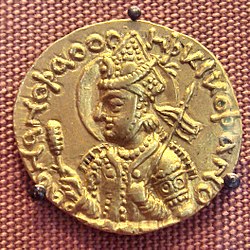
[edit]The coinage of Huvishka is characterized by a great variety of designs and the large quantity of gold coins that were minted: more gold coins from Huvishka are known than from all other Kushan rulers combined.[6] The locations of his mints were mainly in Balkh and Peshawar, with smaller mints in Kashmir and Mathura.[6]
One of the great remaining puzzles of Huvishka's reign is the devaluation of his coinage. Early in his reign the copper coinage plunged in weight from a standard of 16g to about 10–11g. The quality and weight then continued to decline throughout the reign until at the start of the reign of Vasudeva the standard coin (a tetradrachm) weighed only 9g. The devaluation led to a massive production of imitations, and an economic demand for the older, pre-devaluation coins in the Gangetic valley. However, the motivation and some of the details of this devaluation are still unknown.
|
|
![Kushan king or prince, said to be Huvishka, Gandhara art.[7]](https://en.wikipedia.org/wiki/File:Kushan_king_or_prince.jpg)
![Painting of a Kushan ruler (probably Huvishka, seated) and attendants, Bactria.[27]](https://en.wikipedia.org/wiki/File:Kushan_ruler_and_attendants,_Bactria_74-258_CE.jpg)
![Coin of Huvishka 126–163, with Kushan goddess Rishti, possibly depicted as Roma copied from a Roman coin.[28][29][30]](https://en.wikipedia.org/wiki/File:Coin_of_Kushan_king_Huvishka_126_163_with_Kushan_goddess_Rishti_depicted_as_Roma_copied_from_a_Roman_coin.jpg)
![Bodhisatva of Sravasti, inscribed "reign of Huvishka" (or possibly Kanishka).[31]](https://en.wikipedia.org/wiki/File:Bodhisattva_-_Kushana_-_Circa_1st_Century_AD_-_Sravasti_-_Uttar_Pradesh_-_Indian_Museum_-_Kolkata_2012-11-16_1957.JPG)


References
[edit]| Kushan emperors 30 CE–350 CE | ||||||||||||||||||||||||||||||
|---|---|---|---|---|---|---|---|---|---|---|---|---|---|---|---|---|---|---|---|---|---|---|---|---|---|---|---|---|---|---|
|
||||||||||||||||||||||||||||||


- ^ "Religions in the Kushan Empire | Silk Roads Programme". en.unesco.org. Retrieved 9 January 2025.
The epithet dhramathida-< dharmasthita- 'steadfast in the Law of Kujula Kadphises occurs in fuller form in the legend of a later issue, namely sacadhramathita- < satyadharmasthita- steadfast in the true Law'. Contrary to earlier assumptions, which regarded Kujula Kadphises as Buddhist on the basis of this epithet, it is now clear from the wording of a Mathura inscription, "in which Huvishka bears the same epithet satyadharmasthita that the kingdom was conferred upon him by Śarva and Ścamdavira (Candavīra), that is, he was a devotee of Śiva.
- ^ Umair Mirza (1 June 1994). History Of Civilizations Of Central Asia, Volume 2. p. 260.
- ^ Epigraphia Indica Vol 8. p. 182.
- ^ Konow, Sten, Kharoshṭhī Inscriptions with the Exception of Those of Aśoka, Corpus Inscriptionum Indicarum, Vol. II, Part I. Calcutta: Government of India Central Publication Branch, p. 167
- ^ Sinha, Bindeshwari Prasad; Narain, Lala Aditya (1970). Pāṭaliputra Excavation, 1955-56. Directorate of Archaeology and Museums, Bihar. pp. 52–53.
- ^ a b c Rezakhani, Khodadad (2017). From the Kushans to the Western Turks. p. 202.
{{cite book}}:|work=ignored (help) - ^ a b c Marshak, Boris; Grenet, Frantz (2006). "Une peinture kouchane sur toile". Comptes rendus des séances de l'Académie des Inscriptions et Belles-Lettres. 150 (2): 257. doi:10.3406/crai.2006.87101.
- ^ Rhie, Marylin M. (2010). Early Buddhist Art of China and Central Asia, Volume 3: The Western Ch'in in Kansu in the Sixteen Kingdoms Period and Inter-relationships with the Buddhist Art of Gandh?ra. BRILL. p. xxxvii, Fig 6.17a. ISBN 978-90-04-18400-8.
- ^ a b Schopen, Gregory (1987). "The Inscription on the Kuṣān Image of Amitābha and the Charakter of the Early Mahāyāna in India" (PDF). The Journal of the International Association of Buddhist Studies. 10 (2): 99–138. Archived from the original (PDF) on 7 December 2019.
- ^ Neelis, Jason. Early Buddhist Transmission and Trade Networks. 2010. p. 141-142
- ^ Dani, Ahmad Hasan; Harmatta, János (1999). History of Civilizations of Central Asia. Motilal Banarsidass Publ. p. 327. ISBN 978-81-208-1408-0.
- ^ Rhie, Marylin M. (2010). Early Buddhist Art of China and Central Asia, Volume 3: The Western Ch'in in Kansu in the Sixteen Kingdoms Period and Inter-relationships with the Buddhist Art of Gandhara. BRILL. p. xxxvii, Fig 6.17a. ISBN 978-90-04-18400-8.
- ^ The inscription reads: "In the year 33 of the Maharaja, the Devaputra Huvishka ( Mahārājasya Devaputrasya Huviṣka) on the 8th day of the 1st summer (month), a Bodhisattva was set up at Madhuravanaka by the nun Dhanavati, the sister's daughter of the nun Buddhamitra, who knows the Tripitaka, a female pupil of the monk Bala, who knows the Tripitaka, together with her mother and father....". in Epigraphia Indica Vol 8. p. 182. Another similar inscription mentions "Huvihska in the year 26". in Sharma, R.C. (1994). The Splendour of Mathura Art and Museum. D. K. Printworld Pvt. Ltd. p. 142.
- ^ a b c d e f Dani, Ahmad Hasan; Harmatta, János (1999). History of Civilizations of Central Asia. Motilal Banarsidass Publ. p. 326. ISBN 978-81-208-1408-0.
- ^ Serapis coin
- ^ "Huvishka Rishti coin British Museum". The British Museum.
- ^ Mario Bussagli, "L'Art du Gandhara", 225
- ^ This coin. The reading of the name of the deity on this last coin is very much uncertain and disputed (Riom, Riddhi, Rishthi, Rise....) in Fleet, J.F. (1908). "The Introduction of the Greek Uncial and Cursive Characters into India". The Journal of the Royal Asiatic Society of Great Britain and Ireland. 1908: 179, note 1. JSTOR 25210545.
- ^ "The name Riom as read by Gardner, was read by Cunningham as Ride, who equated it with Riddhi, the Indian goddess of fortune. F.W. Thomas has read the name as Rhea" in Shrava, Satya (1985). The Kushāṇa Numismatics. Pranava Prakashan. p. 29.
- ^ a b c d e f g h i Dani, Ahmad Hasan; Harmatta, János (1999). History of Civilizations of Central Asia. Motilal Banarsidass Publ. pp. 327–328. ISBN 978-81-208-1408-0.
- ^ Boyce, Mary (2001). Zoroastrians: Their Religious Beliefs and Practices. Psychology Press. p. 83. ISBN 978-0-415-23902-8.
- ^ a b "Also omitted is the ancient Iranian war god Orlagno, whose place and function are occupied by a group of Indian war gods, Skando (Old Indian Skanda), Komaro (Old Indian Kumara), Maaseno (Old Indian Mahāsena), Bizago (Old Indian Viśākha), and even Ommo (Old Indian Umā), the consort of Shiva. Their use as reverse types of Huvishka I is clear evidence for the new trends in religious policy of the Kushan king, which was possibly influenced by enlisting Indian warriors into the Kushan army during the campaign against Pataliputra." in Dani, Ahmad Hasan; Harmatta, János (1999). History of Civilizations of Central Asia. Motilal Banarsidass Publ. p. 326. ISBN 978-81-208-1408-0.
- ^ Classical Numismatics Group
- ^ Indian Sculpture: Circa 500 B.C.-A.D. 700, Los Angeles County Museum of Art, Pratapaditya Pal, University of California Press, 1986, p.78 [1]
- ^ Dani, Ahmad Hasan; Harmatta, János (1999). History of Civilizations of Central Asia. Motilal Banarsidass Publ. p. 326. ISBN 978-81-208-1408-0.
- ^ "Ommo-Oesho coin of Huvishka British Museum". The British Museum.
- ^ Marshak, Boris; Grenet, Frantz (2006). "Une peinture kouchane sur toile". Comptes rendus des séances de l'Académie des Inscriptions et Belles-Lettres. 150 (2): 947–963. doi:10.3406/crai.2006.87101. ISSN 0065-0536.
- ^ "Huvishka Rishti coin British Museum". The British Museum.
- ^ The reading of the name of the deity on this coin is very much uncertain and disputed (Riom, Riddhi, Rishthi, Rise....) in Fleet, J.F. (1908). "The Introduction of the Greek Uncial and Cursive Characters into India". The Journal of the Royal Asiatic Society of Great Britain and Ireland. 1908: 179, note 1. JSTOR 25210545.
- ^ "The name Riom as read by Gardner, was read by Cunningham as Ride, who equated it with Riddhi, the Indian goddess of fortune. F.W. Thomas has read the name as Rhea" in Shrava, Satya (1985). The Kushāṇa Numismatics. Pranava Prakashan. p. 29.
- ^ Epigraphia Indica Vol 8. p. 180.
Sources
[edit]- Bivar, A. D. H. (2004). "HUVIŠKA". Encyclopaedia Iranica, Vol. XII, Fasc. 6. pp. 583–585.

External links
[edit]- Online Catalogue of Huvishka's Coinage
- Coins of Huvishka
- [2] Archived 2020-02-05 at the Wayback Machine Was Huvishka sole king of the Kushan Empire
- [3] Archived 2018-09-25 at the Wayback Machine The Devaluation of the Coinage of Kanishka
Huvishka
View on GrokipediaHuvishka (Bactrian: Οοηϸκι, Huviṣka; c. 150–190 CE) was a Kushan emperor who succeeded Kanishka I as ruler of an empire spanning Central Asia, Afghanistan, northern India, and parts of Pakistan.[1]
His reign is attested through numerous inscriptions bearing titles such as mahārāja devaputra huviṣka ("Great King, Son of God, Huvishka") and dated to regnal years including around year 30 of the Kushan era (ca. 157/8 CE).[2]
Huvishka's extensive gold dinars and copper tetradrachms, weighing approximately 8 grams and 11–16 grams respectively, prominently feature over 20 deities from Iranian, Greek, and Indic traditions, exemplifying religious syncretism and the cultural diversity under Kushan rule.[1]
Inscriptions from sites like Mathura and Wardak indicate his involvement in repairing royal sanctuaries and supporting Buddhist stūpas, reflecting patronage of multiple faiths amid efforts to consolidate imperial control following Kanishka's expansions.[2][3]
The shift in his coinage from bilingual Greek-Kharoshthi legends to Bactrian script underscores evolving administrative practices, while weight reductions in copper issues suggest responses to economic pressures around 160 CE.[1]
Biography
Origins and Family
Huvishka was a ruler of the Kushan Empire, a dynasty founded by the Yuezhi, an Indo-European nomadic confederation that migrated westward from the eastern steppes of Central Asia into Bactria during the 2nd century BCE, displacing the Greco-Bactrian kingdoms and establishing control over regions including modern-day Afghanistan, Pakistan, and northern India.[4] The Kushans, under leaders like Kujula Kadphises (r. c. 30–80 CE), consolidated power through military expansion and adoption of local administrative practices, blending Central Asian steppe traditions with Hellenistic, Iranian, and Indian influences.[4] He ascended following the death of Kanishka I (r. c. 127–150 CE), with his own reign dated via inscriptions from year 28 to 60 of the Kanishka era (c. 155–187 CE), marking a period of dynastic continuity.[2] Scholarly consensus holds Huvishka as Kanishka I's son and direct successor, inferred from seamless numismatic transitions—sharing mint styles, iconography, and the continued use of the Kanishka era—along with narrative traditions in texts like the Rajatarangini, though no surviving inscription explicitly states filiation, as Kushan royal epithets typically invoked divine rather than paternal lineage (e.g., devaputra, "son of the gods").[2] [4] This assumption aligns with patterns in Central Asian dynasties where succession favored close kin amid nomadic confederation politics, but lacks primary epigraphic confirmation, distinguishing it from earlier Kushan rulers like Kanishka I, whose genealogy traces via the Rabatak inscription to ancestors Kujula Kadphises and Vima Takto.[4] Details on Huvishka's consorts, siblings, or offspring remain scarce in extant records, with no named relatives beyond the inferred paternal link; his successor Vasudeva I (r. c. 190–225 CE) may represent fraternal or filial succession, but evidence is inconclusive, potentially reflecting later fragmentation in the dynasty.[4] Inscriptions from Mathura and other sites, such as one dated year 45 on a Buddha statue pedestal invoking Mahārājasya Huviṣkasya Devaputrasya, emphasize his royal and divine authority without familial specifics.[2]Ascension to Power
Huvishka ascended the throne as the immediate successor to Kanishka I, the Kushan emperor whose reign had expanded the empire's territorial and cultural influence across northern India, Central Asia, and parts of the Iranian plateau.[5] Numismatic evidence demonstrates continuity in royal iconography and titulature, with Huvishka's coins bearing the Bactrian legend "ŠAONANOŠAO OOHŠKI KOŠANO" ("King of Kings, Huvishka the Kushan"), echoing Kanishka's style while introducing new divine depictions, suggesting a smooth dynastic transition without recorded usurpation or civil strife.[5] Although no inscription explicitly names Kanishka as Huvishka's father, scholarly consensus based on the sequence of dated monuments and the absence of intervening rulers in primary records identifies Huvishka as a direct heir, likely a son or close collateral kin, rather than from a rival branch.[6] The earliest epigraphic attestation of Huvishka's rule appears in a Year 28 inscription from the Chaurasi Jaina temple at Mathura, marking his ascension no later than approximately 154 CE if the Kushan era began in 127 CE as proposed by some chronologies aligning with Greco-Roman synchronisms and Śaka calendar correlations.[5] [7] This date aligns with the inferred end of Kanishka's approximately 23-year reign, during which inscriptions run from Years 1 to 23, though debates persist over potential short-lived intermediaries like Vāsishka due to overlapping or ambiguous regnal years in Mathura and Gandharan finds.[7] Huvishka's prompt assumption of power stabilized the empire amid external pressures, as later inscriptions such as the Year 51 Wardak vase and Year 60 Kankali Tila relic deposit indicate consolidated authority extending his rule for at least 33 years.[5] ![Coin of Huvishka depicting the king with royal attributes][float-right]Reign Duration and Chronology
Huvishka succeeded Kanishka I as ruler of the Kushan Empire, with his reign conventionally dated from c. 150 CE to c. 190 CE, spanning roughly three decades.[4] This places his accession shortly after Kanishka's death around 150 CE and precedes the rise of Vasudeva I.[8] The duration aligns with the progression of Kushan-era dating in inscriptions and the stylistic evolution of coinage, which shows no overlap with Kanishka's issues after initial transitional types.[9] The chronology relies on the Kushan era's commencement in 127 CE, coinciding with Kanishka's enthronement, as favored by post-1960 scholarly consensus based on astronomical, epigraphic, and historical correlations.[10] [11] Under this framework, Huvishka's rule corresponds to era years approximately 23 to 63, though direct dated evidence clusters earlier. Key inscriptions from Mathura, such as the lion capital in year 33 and a Buddha statue pedestal in year 45, confirm his authority during these periods, spanning at least from era year 28 to 45.[2] While absolute dates remain approximate due to ongoing debates over the era's precise alignment, the relative sequence—Kanishka followed by Huvishka, then Vasudeva—is firmly established by non-overlapping regnal references and the uninterrupted continuity of the dating system across media like stone edicts and bronze coins.[9] Vasudeva's recorded reign of 26 years further bounds Huvishka's terminal date.[4]Empire and Governance
Territorial Extent and Control
Huvishka's territorial control spanned from Bactria in the northwest to Mathura in northern India, encompassing regions such as Gandhara, Kashmir, and parts of modern-day Afghanistan and Pakistan.[5] [6] Inscriptions dated to his reign, spanning years 28 to 60 of the Kanishka era (approximately 154–186 CE), provide primary evidence of authority in these areas, with the majority found at Mathura attesting to direct oversight in the Gangetic plains.[5] Epigraphic records demonstrate firm control in northern India, particularly Mathura, where multiple inscriptions from years 28 and 60 record donations and constructions under Huvishka's name, such as at the Chaurasi Jaina temple and Kankali Tila.[5] In the northwest, the Wardak bronze vase inscription from Afghanistan, dated year 51 (177 CE), confirms administrative reach into the Hindu Kush region.[5] [6] Restoration of the Surkh Kotal temple in Bactria during year 31 further indicates sustained influence in Central Asian territories originally consolidated under Kanishka.[6] Control extended to Kashmir, where Huvishka—known locally as Hushka—is credited with founding the city of Hushkapura, as recorded in the Rājatarangiṇī.[5] Numismatic evidence supports this extent, with Huvishka's gold coins minted at centers like Peshawar and possibly Taxila, circulating widely from Balkh to the Indian heartland and facilitating economic integration across diverse satrapies.[5] While no major territorial expansions are attested, the proliferation of coinage and inscriptions reflects effective consolidation and stability, without evidence of significant contractions during his reign.[6]Military Consolidation
Huvishka's reign, dated from approximately 155 to 187 CE based on inscriptions in the Kanishka era, emphasized the stabilization of the Kushan Empire's frontiers rather than aggressive expansion. Following Kanishka I's conquests, which had extended Kushan control from Central Asia to the Ganges plain, Huvishka directed efforts toward administrative reinforcement and territorial security, evidenced by the absence of documented major invasions or losses during his rule. Inscriptions, such as those from Mathura in northern India and the Wardak vase in Afghanistan dated to year 51 of his era (circa 206 CE in some chronologies, though debated), confirm direct imperial oversight in these peripheral regions, implying sustained military garrisons to deter unrest.[6] The empire's military posture under Huvishka relied on the inherited Yuezhi-Kushan cavalry and infantry traditions, adapted for defensive consolidation amid potential threats from Parthian or local satrapal challenges. Archaeological evidence from restored sites like the Surkh Kotal temple (year 31, circa 185 CE) highlights investments in infrastructure that supported logistical networks for troop movements, fostering internal cohesion without overt warfare. Coin hoards distributed across Bactria, Gandhara, and Mathura further indicate economic stability underpinning military readiness, as the uniform gold dinars maintained high purity and weight standards conducive to funding standing forces.[6] Scholars interpret this era as one of retrenchment, with Huvishka possibly quelling minor provincial disturbances to recentralize power toward Mathura, shifting the empire's focus southward. The lack of epigraphic or numismatic references to specific battles underscores a strategy of deterrence through demonstrated control, preserving the empire's extent until fragmentation under successors like Vasudeva I around 190 CE.[6][8]Administrative and Economic Policies
Huvishka administered the Kushan Empire through a hierarchical system featuring provincial governors titled kshatrapa (satrap) and mahakshatrapa (great satrap), which allowed for centralized oversight amid local autonomy across vast territories from Central Asia to northern India. Inscriptions from his reign, such as those dated to years 25–60 of the Kushan era, reference high-ranking officials including the Mahadandanayaka, who held combined military, judicial, and custodial roles, as exemplified by Bakanapati serving as temple overseer under Huvishka, son of Kanishka.[2][12] This structure, inherited and refined from prior rulers, facilitated governance over diverse regions, with evidence of administrative directives like title expansions in official records around year 30 of the era.[2] Economically, Huvishka's policies emphasized monetary standardization and trade facilitation, evidenced by prolific minting of gold dinars (approximately 8 grams) and copper tetradrachms (initially around 16 grams, reduced to 11 grams early in his reign circa 150–190 CE) at key centers like Taxila and Balkh.[1] The diverse reverse types featuring syncretic deities supported cultural cohesion while enabling widespread circulation, with copper issues dominating everyday transactions and gold backing larger commerce along the Silk Roads.[1][13] Control over transcontinental routes linking Roman, Chinese, and Indian markets drove prosperity through silk, spices, and luxury goods exchange, bolstered by agricultural innovations like improved irrigation, though trade overshadowed agrarian output.[14] The weight debasement in copper coins likely addressed inflationary pressures or increased demand, reflecting adaptive fiscal management amid empire expansion.[1]Religious Policy
Patronage of Mahayana Buddhism
Huvishka's patronage of Mahayana Buddhism is evidenced by the establishment of the Huvishka Vihara, a Kusana-period monastery in Mathura, which indicates direct royal support for Buddhist monastic institutions during his reign.[15] Inscriptions from Mathura further document endowments and dedications under his authority, including grants for Buddhist temples and permanent endowments (akshaya nivi) to support monastic activities.[16] His era marks the earliest epigraphic references to key Mahayana figures, such as the inscription on a pedestal for an Amitabha Buddha image dated to the 26th regnal year (circa 150 CE), representing the first known mention of Amitabha in Indian records.[17] Additional Mathura inscriptions, like those from years 28 and 33, record dedications to Buddhist sculptures and relic deposits, reflecting active promotion of Mahayana iconography and devotional practices in the Kushan heartland.[18] A Sanskrit manuscript fragment associates Huvishka personally with Mahayana adherence, describing him as one who has "set forth in the Mahāyāna," a term denoting lay commitment to the bodhisattva path.[19] While his coinage avoids direct depictions of the Buddha—unlike predecessor Kanishka—archaeological finds, including amulets bearing his image at Bodh Gaya, suggest contributions to sacred Buddhist sites. This patronage facilitated the consolidation and artistic expression of Mahayana doctrines amid the empire's syncretic religious landscape.[15]Syncretism with Iranian and Zoroastrian Deities
Huvishka's coinage exemplifies syncretism by prominently incorporating deities from the Iranian pantheon, many with roots in Zoroastrian traditions, reflecting the Kushan rulers' cultural adaptation to Bactria's Iranian-speaking milieu. Gold dinars and copper tetradrachms issued during his reign (c. 150–190 CE) feature over 20 distinct reverse types, with Iranian entities dominating alongside select Indian and Hellenic figures, signaling an eclectic royal cult rather than orthodox Zoroastrianism. This numismatic evidence indicates deliberate patronage of these gods to legitimize authority in regions with Parthian and Central Asian Iranian influences, as Bactrian inscriptions on the coins employ terms etymologically linked to Avestan nomenclature.[1] Key Iranian deities include Ardochsho (Αρδοχþο), identified as Ashi Vanghuhi, the Avestan goddess of fortune, reward, and abundance, often depicted enthroned with a cornucopia and pomegranates. Miiro (Mιιρο), corresponding to Mithra, the god of covenants and light, appears armored and radiating, underscoring solar and martial attributes. Other examples encompass Athsho (Αθþο) as Atar, the fire deity essential to Zoroastrian ritual; Pharro (Φαρρο), embodying xvarənah or royal glory; and Mao (Μαο), linked to the moon goddess or Mah, patron of chastity. These figures, rendered in a stylized Greco-Bactrian style, demonstrate fusion rather than pure importation, with Iranian elements comprising the core of the pantheon by Huvishka's era.[1][20][21] Scholarly consensus attributes these depictions to a policy of religious inclusivity that privileged Iranian traditions for political cohesion, as the Kushans, of Yuezhi origin, governed Iranianized territories and drew legitimacy from shared mythic heritage. While earlier under Kanishka I Greek names overlaid Iranian gods, Huvishka's issues largely abandon this, favoring direct Bactrian renderings and reducing Hellenistic motifs, except in isolated cases like Heracles variants. This shift highlights causal ties to regional demographics and elite preferences, with the pantheon's later contraction under successors Vasudeva I to primarily Ardochsho and Oesho underscoring Huvishka's reign as the zenith of such diversity. Identifications rely on linguistic parallels to Avestan texts, though iconographic ambiguities persist, as no contemporary Zoroastrian orthodoxy is evidenced in Kushan contexts.[20][1]Inclusion of Graeco-Roman and Indian Deities
Huvishka's coinage prominently featured deities from Graeco-Roman traditions, reflecting the enduring Hellenistic influences in the Kushan Empire's northwestern territories, such as Bactria and Gandhara, where Greek cultural elements persisted from earlier Indo-Greek rule. Specific examples include Helios, the Greek sun god, often depicted standing and holding a scepter; Heracles, portrayed with his club and lion skin, symbolizing strength and victory; Selene, the moon goddess, shown in syncretic forms linking her to Iranian lunar deities; and Zeus, represented in authoritative poses akin to Hellenistic iconography.[22][23] These depictions, absent or less emphasized under predecessors like Kanishka, suggest Huvishka's deliberate expansion of religious representation to appeal to Greco-Bactrian subjects and facilitate trade links with Mediterranean powers.[24] Indian deities were similarly integrated into Huvishka's numismatic program, marking an increased incorporation of indigenous Hindu elements compared to earlier Kushan rulers, likely to consolidate control over core Indian territories like Mathura and the Gangetic plain. Prominent among these was Oesho, interpreted as an early form of Shiva, frequently shown standing with a trident and bull attributes; Skanda (or Skando), the war god depicted with spear and rooster emblem; and Uma (Ommo), associated with Parvati and occasionally paired with Shiva in rare issues. Additional figures included an eight-armed deity possibly representing Vishnu and Lakshmi-like abundance goddesses.[22][23] This inclusion, evidenced across gold dinars and copper tetradrachms struck circa 150–190 CE, underscores a policy of religious eclecticism aimed at unifying a multi-ethnic empire spanning Central Asia to northern India, rather than exclusive patronage of any single tradition.[24] The juxtaposition of these pantheons on Huvishka's coins—over 20 distinct deities in total—exemplifies syncretism, where Graeco-Roman figures like Heracles were equated with Iranian victory gods such as Verethragna, and Indian deities adapted local iconographic styles while retaining Kushan artistic conventions.[23] This approach, distinct from the more Zoroastrian-leaning issues of contemporaries, prioritized imperial cohesion over doctrinal purity, as supported by the diverse mints from Kabul to Mathura producing these types.[24] No direct inscriptions under Huvishka explicitly invoke these deities, but their recurrent coin portrayals indicate state-sanctioned veneration, contrasting with the empire's primary Buddhist patronage elsewhere.[22]Numismatics and Iconography
Coinage Production and Types
![Huvishka gold dinar][float-right] Huvishka continued the bimetallic coinage system of gold and copper established by earlier Kushan rulers, issuing primarily gold dinars and copper tetradrachms.[1] The gold dinars adhered to a standard weight of approximately 8 grams, while quarter dinars, less commonly produced, weighed around 2 grams.[1] [25] Copper tetradrachms initially followed heavier standards of about 16 grams but underwent a weight reduction to roughly 11 grams early in Huvishka's reign, circa 160 CE, reflecting adjustments in monetary policy.[1] Coin production was decentralized across the empire, with gold minting likely concentrated in Balkh in Bactria, while copper coins were struck at multiple facilities in the Gandhara region, including Taxila and Begram, as well as in Kashmir.[1] Attribution to specific mints relies on stylistic analysis, die characteristics, and regional iconographic variations, as Kushan coins bear no explicit mint marks.[26] Huvishka's issues exhibit a high degree of typological diversity, with obverses typically depicting the king in armored bust or standing pose, holding a scepter or mace, inscribed in Bactrian script as "Šau Huviški" (King Huvishka).[1] This prolific output supported extensive trade and administrative functions across the Kushan territories.[1]Deities and Symbols in Coinage
Huvishka's coinage, primarily gold dinars and copper tetradrachms minted circa 150-190 CE, prominently features a diverse pantheon on the reverses, with the obverses depicting the king's bust facing left, often adorned with a jeweled headdress or helmet and inscribed with Bactrian titles such as "ŠAONANOŠAO OOHŠKI KOŠANO" denoting his sovereignty. This iconography underscores a policy of religious eclecticism, incorporating over 20 deities drawn from Iranian, Indian, Greek, and local traditions, potentially to legitimize rule across multicultural territories or reflect patronage of varied cults. [1] [27] Iranian deities dominate, including Ardoḵšō (Ardochsho), the goddess of fortune and abundance, depicted standing and holding a cornucopia and bowl; Māo, a lunar deity; Miiro (Mithra), shown standing with a hand on hip or staff; Šaoreoro (Xšaθra Vairya or Shahrevar), armored with helmet and shield; Farro (Pharro), bestowing glory; and Aθšo (Atsho), associated with fire. Other Zoroastrian-influenced figures like Oado (wind god) and Veś (possibly syncretized with Rudra-Śiva, holding a trident) appear, often with attributes symbolizing their domains, such as flames or winds, evidencing Central Asian nomadic heritage. [25] [27] [1] Indian and Hellenistic elements include Oēšo (identified as Śiva), portrayed four-armed standing beside a bull with a nandipāda symbol; Umā (possibly Pārvatī); Skanda-Kumāra (war god); Herakles (Hērakilo), the club-wielding hero sometimes equated with Vajrapāṇi; and Sarapo (Serapis), a syncretic Greco-Egyptian god. Nana, a widely worshiped goddess akin to a mother deity, and Riom (potentially Rhea or Roma) further illustrate cross-cultural fusion. Copper issues occasionally substitute deities with royal motifs, such as the king riding an elephant, but retain symbolic tamghas—heraldic clan marks—for mint or lineage identification. [25] [27]| Deity (Bactrian Name) | Origin/Identification | Key Iconography |
|---|---|---|
| Ardoḵšō (APDOXŠO) | Iranian (fortune goddess) | Standing, cornucopia and bowl [25] |
| Miiro (MIIPO/MIOPO) | Iranian (Mithra, solar) | Standing, hand on hip or staff [27] |
| Oēšo (OHŠO) | Indian (Śiva) | Four-armed, with bull and nandipāda [25] |
| Herakles (HPAKILO) | Greek | Club, lion skin [27] |
| Nana | Local/Iranian | Seated or standing goddess [1] |
Statuary and Artistic Evidence
Artistic evidence for Huvishka derives mainly from dedicatory inscriptions on religious sculptures, particularly from Mathura, rather than preserved portraits of the emperor himself. These inscriptions, dated to specific regnal years, document patronage of Buddhist viharas and installations of images, reflecting state support for Mahayana Buddhism during his reign (c. 150–180 CE). No full-length statues of Huvishka comparable to those of Kanishka I are known, though fragments potentially from a portrait have been suggested from Mathura excavations.[28] Key examples include pedestal inscriptions on Buddha and Bodhisattva figures. A pedestal for an Amitabha Buddha image, dated to the 28th regnal year, records a dedication by merchants, providing the earliest epigraphic mention of this deity.[29] Similarly, a fragment of a Bodhisattva sculpture bears an inscription from year 33, invoking "the Great King, son of God, Huvishka." A pedestal inscription in year 45, commencing with "Mahārājasya Huviṣkasya Devaputrasya," supports a standing Buddha statue, now housed in the Chhatrapati Shivaji Maharaj Vastu Sangrahalaya Museum in Mumbai.[30] Non-Buddhist sculptures also feature Huvishka's name. A standing Nāga deity statue from Chargaon, Mathura, installed by donors Senahasty and Bhanuka in regnal year 40, attests to inclusion of local deities under imperial auspices.[31] Another Nāga statue in the Mathura Museum carries a reign-period inscription, highlighting syncretic elements in Kushan art.[32] The Huvishka Vihara, a Kusana-period monastery in Mathura's Jamalpur area, yields sculptures and inscriptions evidencing royal patronage and representation of Buddhist communities. Reliefs from Gandhara, potentially depicting Huvishka in a donor pose before the Buddha, suggest iconographic continuity with earlier Kushan rulers, though identification remains tentative.[15] These artifacts, primarily in Mathura and Gandhara styles, underscore Huvishka's role in fostering artistic production blending Iranian, Indian, and Hellenistic influences.Legacy
Succession by Vasudeva I
Vasudeva I succeeded Huvishka as emperor of the Kushan Empire around 190 CE, marking the transition to the final phase of the dynasty's "Great Kushan" period.[5] The latest dated inscription of Huvishka appears in year 60 of the Kanishka era (approximately 187 CE), from sites such as Mathura's Kaṅkālī Tilla, while Vasudeva's earliest inscriptions emerge in year 64 or 67 (circa 190–193 CE), indicating a relatively seamless dynastic handover without recorded conflict or interruption.[6] This overlap in dating suggests Huvishka's death occurred shortly before Vasudeva's formal accession, though no contemporary accounts detail the cause or precise circumstances.[5] The familial relationship between Huvishka and Vasudeva I is not explicitly documented in surviving inscriptions or coins, leaving their connection inferred primarily through sequential rule rather than genealogy.[6] Vasudeva's adoption of a distinctly Indian name, evoking the Hindu deity Vishnu, contrasts with Huvishka's more syncretic nomenclature and may reflect maternal Indian heritage or a deliberate cultural shift, but this remains speculative absent direct evidence.[6] A rare coin legend mentioning "Kaṇika, son of Huviṣka" points to Huvishka having at least one named heir, possibly a Kanishka II who predeceased him, but it does not identify Vasudeva as kin.[5] Vasudeva's approximately 26-year reign (to circa 225 CE, per year 98 inscriptions) sustained Kushan administrative structures but coincided with emerging pressures, including Sassanian incursions into northwestern territories that accelerated after his death.[6] Numismatic continuity, with Vasudeva issuing gold dinars in similar styles to Huvishka's but emphasizing Shiva and reducing eclectic deity representations, underscores institutional stability during the succession while hinting at evolving religious priorities.[6] This period represents the dynasty's zenith in territorial extent before fragmentation into lesser kingdoms.[6]Cultural and Historical Impact
Huvishka's reign, spanning approximately 154–187 CE, exemplified religious eclecticism through his coinage, which depicted over two dozen deities drawn from Iranian, Indian, Greek, and Buddhist traditions, including figures such as Mithra, Buddha, and Serapis. This syncretic approach reflected and reinforced a policy of tolerant governance, fostering cultural synthesis across the Kushan Empire's diverse territories. Archaeological evidence, including inscriptions from Mathura and the Wardak vase dated to year 51 of the Kanishka era (circa 185 CE), attests to the prosperity and administrative stability under his rule, which supported artistic and religious developments.[6] In the realm of art, Huvishka's patronage advanced the Mathura school, where innovations in Buddhist sculpture emerged, such as the depiction of the Buddha with drapery covering both shoulders, a stylistic shift evident during his era. Monasteries like the Huvishka Vihara in Mathura, linked to his support, highlight direct contributions to Buddhist institutional growth, blending local Indian motifs with broader imperial influences. This patronage extended the Gandharan artistic tradition, influencing iconography that persisted in later South Asian religious art.[15] Historically, Huvishka's policies facilitated Silk Road exchanges, promoting the dissemination of Mahayana Buddhism to Central Asia and beyond while maintaining imperial cohesion amid multicultural populations. His era of relative peace consolidated Kushan control over northern India, setting precedents for religious pluralism that shaped subsequent Indo-Central Asian interactions, though the empire faced territorial losses after his death.[6]References
- https://commons.wikimedia.org/wiki/File:Iscrizione_del_regno_di_huvishka_dei_kushana_sul_piedistrallo_di_una_statua_di_buddha%2C_da_mathura%2C_uttar_pradesh%2C_123_dc.jpg
- https://commons.wikimedia.org/wiki/File:Standing_Naga_Deity_Installed_by_Senahasty_and_Bhanuka_in_the_Time_of_40_Year_of_Kushan_Emperor_Huvishka_-_Circa_2nd_Century_CE_-_Chargaon_-_ACCN_00-C-13_-_Government_Museum_-_Mathura_2013-02-23_5797.JPG
- https://commons.wikimedia.org/wiki/File:Naga_statue_with_inscription_from_the_reign_of_Huvishka._Mathura_Museum.jpg