Hubbry Logo
HypaspistsHypaspistsMain
Open search
Hypaspists
Community hub
Hypaspists
logo
8 pages, 0 posts
0 subscribers
Be the first to start a discussion here.
Hypaspists
Hypaspists
from Wikipedia
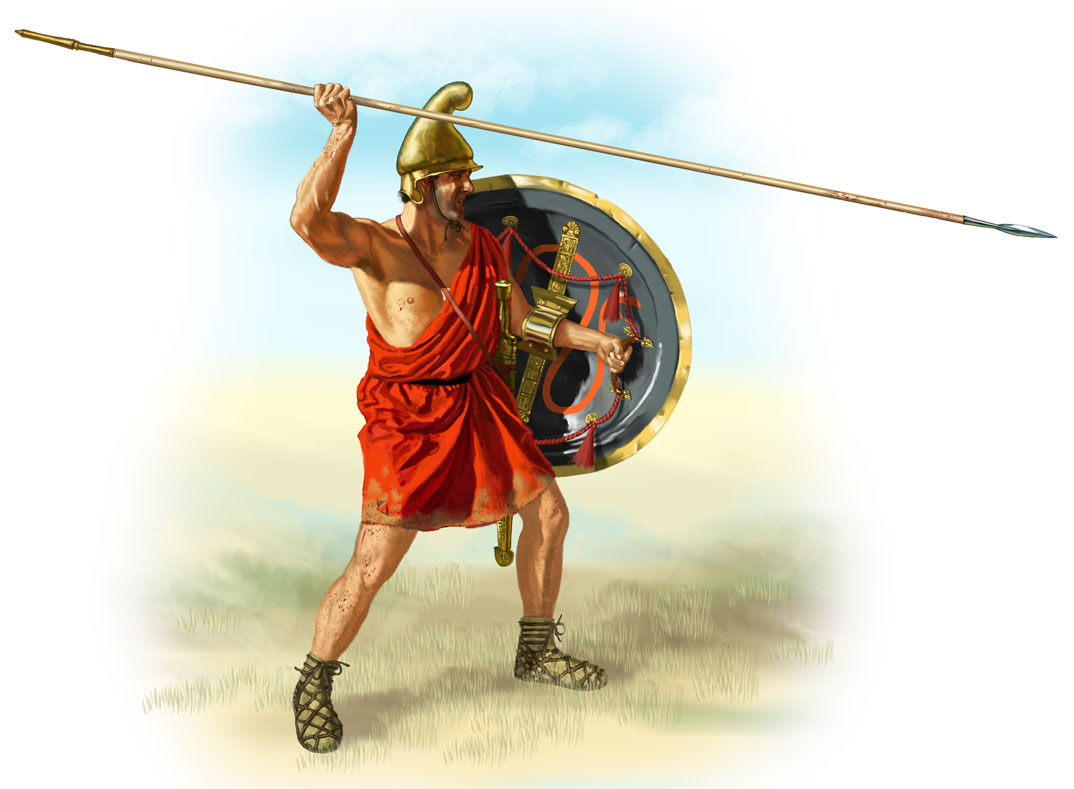
A Hypaspist

A hypaspist (Greek: Ὑπασπιστής "shield bearer" or "shield covered") is a squire, man at arms, or "shield carrier". In Homer, Deiphobos advances "ὑπασπίδια" (hypaspídia) or under cover of his shield.[1] By the time of Herodotus (426 BC), the word had come to mean a high status soldier as is strongly suggested by Herodotus in one of the earliest known uses:

Now the horse which Artybius rode was trained to fight with infantrymen by rearing up. Hearing this, Onesilus said to his hypaspist, a Carian of great renown in war and a valiant man ...[2]

A similar usage occurs in Euripides's play Rhesus[3] and another in his Phoenissae. Xenophon was deserted by his hypaspist in a particularly sticky situation.[4][clarification needed] A hypaspist would differ from a skeuophoros in most cases because the "shield bearer" is a free warrior and the "baggage carrier" was probably usually a slave.[citation needed]

The word may have had Homeric and heroic connotations that led Philip II of Macedon to use it for an elite military unit. This unit, known as the Hypaspistai, or hypaspists, was probably armed in the hoplite manner, with a large concave shield (Aspis) and a spear (Dory), in addition to spolas or linothorax body-armor, hoplite's helmet, greaves and a xiphos or kopis sword (though their equipment was likely more ornate than main-line soldiers).[5]

In contrast, the main Macedonian Phalanx consisted of the pikemen known as phalangites. These men were armed with the Sarissa, a pike of between 4 and 6.7m, a small flat shield and a shortsword called a Xiphos as a secondary weapon.[6] The divergence in equipment and tactics between the traditional Greek Hoplite phalanx and the Macedonian Phalanx is attributed to Philip II of Macedon, the father of Alexander the Great.

In set piece battles, the Macedonian Hypaspists were positioned on the flanks of the phalangite's phalanx; in turn, their own flanks were protected by light infantry and cavalry. Their job was to guard the flanks of the large and unwieldy pike phalanx. The armored Phalangites with their sarissas were not particularly agile or able to turn quickly, so hypaspists would prevent attacks on the vulnerable sides of the formation. Their role was vital to the success of Philip's tactics because the Macedonian phalanx was all but invulnerable from the front, and was, with five layers of iron spikes moving in unison, used as the anvil in a hammer and anvil tactic, where the Companion cavalry was the hammer that smashed the enemy against an anvil of thousands of iron spikes. As such an important yet vulnerable part of the Macedonian army, it needed protection for its main vulnerability, the flanks. The protection/remedy for this vulnerability was the Hypaspists, who were able to conduct maneuvers and use tactics, which, owing to their hoplite panoply of weapons and armor, would have been impossible (or at least much less effective) if performed by the phalangites.

All the references to a unit called "Hypaspists" are much later than the period of Philip, and modern historians have to assume[citation needed] that later sources, like Diodorus Siculus[7] (1st century BC) and Arrian,[8] had access to earlier records.

Arrian's phrase tous kouphotatous te kai ama euoplotatous[9]) has frequently been rendered as 'lightest armed', although Brunt [10] concedes it is more properly translated as 'nimblest' or 'most agile'.

There has been a great deal of speculation by military historians ever since the late Hellenistic period about the elite units of Philip's army. The hypaspists may have been[citation needed] raised from the whole kingdom rather than on a cantonal basis; if so, they were the king's army rather than the army of the kingdom.

In the Hellenistic period, hypaspists apparently continued to exist, albeit in different capacities and under different names. The name lived on in the Seleucid, Ptolemaic and Antigonid kingdoms, yet they were now seen as royal bodyguards and military administrators. Polybius mentions a hypaspist being sent by Philip V of Macedon, after his defeat at the Battle of Cynoscephalae in 197 BC, to Larissa to burn state papers.[11]

The actual fighting unit of hypaspists seems to have lived on in Macedonia as the corps of peltasts, whose status, equipment and role seems to have been almost exactly the same as that of the hypaspist under Philip.[12] Originally consisting of 3,000 men, by the Third Macedonian War there were 5,000, most likely to accommodate their elite formation, the Agema.[13]

See also

[edit]

References

[edit]

Further reading

[edit]
Revisions and contributorsEdit on WikipediaRead on Wikipedia
from Grokipedia
The Hypaspists (: ὑπασπισταί, meaning "shield-bearers") were an elite infantry corps in the , primarily active during the late 4th century BCE under Kings and . They served as royal bodyguards and highly mobile , distinguished from the heavier sarissa-armed phalangites by their lighter equipment and tactical flexibility, which enabled roles in assaults, sieges, and linking the phalanx with wings in battle. Established likely by Philip II as a unit of around 500 men drawn from Macedonian , the Hypaspists functioned as the king's personal protectors in both wartime and peacetime, handling duties such as maintaining order during mutinies and providing close security in small operations. Under , the corps expanded to approximately 3,000 soldiers, organized into three chiliarchies (regiments of 1,000 each): the (vanguard elite), the royal Hypaspists, and a third possibly attached to the . Their equipment included hoplite-style shields, shorter spears (dory), short swords like the , and lighter composite armor such as leather thoraxes reinforced with metal scales, often paired with helmets, allowing them to operate as a hinge between and in set-piece battles like Gaugamela. In Alexander's campaigns, the Hypaspists played pivotal roles in key engagements, such as leading assaults at the Granicus River and Issus, protecting the king's flank during the pursuit at Gaugamela, and conducting mobile operations against irregular terrain or opponents in . They also performed guard duties in peace, such as quelling the in 324 BCE, underscoring their status as a multifunctional force beyond mere battlefield use. Toward the end of Alexander's reign, the unit evolved, with select veterans reformed into the ("silver shields"), a prestigious guard that retained their designation but shifted toward more conventional line roles in the successor states. Ancient historians like and Diodorus provide the primary accounts of their actions, highlighting their indispensable contribution to Macedonia's rapid conquests across Persia and beyond.

Etymology and Origins

Linguistic Roots

The term hypaspistēs (ὑπασπιστής) in Ancient Greek literally means "shield-bearer," derived from the preposition hypo (ὑπό), signifying "under" or "beneath," combined with aspis (ἀσπίς), denoting a large round shield typically used by hoplites, and the agentive suffix -tēs (-τής), which forms nouns indicating a person who performs an action. This etymology reflects the original role of an individual who carried or protected with a shield, often in a supportive capacity to a superior. The earliest related attestations appear in the Homeric epics, where the adverbial form hypaspidia (ὑπασπίδια) describes tactical movement under shield cover rather than designating a specific personnel role. In the Iliad, this usage illustrates the term's roots in battlefield imagery, evoking squires or attendants who shielded heroes during combat. By the Classical period, the noun hypaspistēs emerges in prose literature, evolving to denote attendants or bodyguards of elevated status. The linguistic development from Homeric adverbial usage to Classical nominal form underscores a progression in denoting specialized military attendants. The term later entered Macedonian military nomenclature under Philip II, adapting to describe elite infantry units.

Historical Development

The term hypaspistēs traces its etymological roots to Homeric texts, where it denoted a shield-bearer or attendant serving in a squire-like capacity to elite warriors, such as in descriptions of protective roles during combat in the Iliad. In Archaic Greece, these roles evolved into more formalized attendant positions within aristocratic retinues, but it was under Philip II of Macedon (r. 359–336 BCE) that the hypaspists transformed into a professional elite infantry corps within the Macedonian army. Philip, drawing on his experiences as a hostage in Thebes—where he observed the elite Sacred Band—and his reforms of Macedonian military structure, established the unit initially as a 500-strong detachment of shield-bearers attached to the Companion cavalry, emphasizing their role as versatile guards rather than mere attendants. This shift marked a departure from the ad hoc squire functions of earlier Greek warfare, integrating the hypaspists as a standing force recruited primarily from the upper Macedonian nobility to ensure loyalty and combat prowess. By the late reign of Philip II, the hypaspist corps had expanded to approximately 1,000 men. Under , it further grew to 3,000, organized into three chiliarchies of 1,000 each, with subunits such as lochoi allowing for flexible maneuvers. This structure reflected Philip's broader innovations in professionalizing the . A key distinction was between the royal hypaspists, the king's own selected from the most aristocratic elements for their proximity to the and elite status, distinguishing them from the more static regional levies of the pezhetairoi (foot companions).

Organization and Recruitment

Unit Composition

The Hypaspist corps under consisted of approximately 3,000 soldiers, forming a core component of the Macedonian army's . This total strength reflected expansions from earlier formations, with the unit divided into three chiliarchies, each comprising 1,000 men, to facilitate effective command and maneuverability on the . The command hierarchy of the Hypaspists was structured hierarchically, with overall leadership provided by the archihypaspistes. Each chiliarchy was led by a , responsible for the tactical direction of their 1,000-man subunit. Below the chiliarchs, lochagoi commanded smaller lochoi, typically consisting of several files of soldiers, while dekadarchoi oversaw dekades, the basic tactical groupings of ten to sixteen men, ensuring disciplined cohesion within the ranks. In terms of personnel, the Hypaspists were drawn from Macedonian nobles, often from aristocratic backgrounds. This composition underscored the corps' evolution from Philip II's reforms, which emphasized elite, adaptable infantry.

Social and Elite Status

The hypaspists were primarily recruited from the Macedonian aristocracy and upper classes, often comprising noble young men who had previously served as royal pages (paides basilikoi), a formative stage in the military education of the elite. This selection process underscored their elevated social composition, distinguishing them from the broader infantry and positioning service in the corps as a direct avenue to royal favor and subsequent administrative prominence within the kingdom. Service as a hypaspist offered substantial rewards that reinforced their prestige, including land grants in conquered territories and opportunities for advancement to high-ranking positions such as (elite bodyguards) or provincial governors (satraps). For instance, individuals like Amyntas, brother of the somatophylax Peucestas, transitioned from the hypaspist ranks to the king's personal guard, exemplifying how battlefield valor could lead to such elevations. Many hypaspists thus integrated into the royal court, leveraging their proximity to the for influence in and policy, a pathway less accessible to ordinary soldiers. In contrast to the phalangites, who were typically drawn from regional, non-noble recruits and focused on rigid pike formations, hypaspists demanded greater versatility, including equestrian skills honed during their page training, enabling roles such as (hamippoi) alongside the . This elite requirement not only enhanced their tactical adaptability but also cemented their status as the king's trusted shield-bearers, embodying the martial ideals of Macedonian .

Role and Tactics

Battlefield Functions

The hypaspists served primarily as elite flank guards for the , positioned on its right side to protect against enemy envelopment maneuvers and to engage opposing or forces that threatened the formation's integrity. Their mobility and discipline allowed them to counter such threats effectively, maintaining the phalanx's stability during pitched battles. As versatile , the hypaspists excelled in a range of duties beyond static defense, including skirmishing with lighter enemy units using javelins or hoplite-style spears for greater flexibility than the phalanx's sarissas. They were adept at assaulting fortifications, demonstrating their agility in scaling walls and breaching defenses, as seen during the siege of Tyre in 332 BCE when they led the storming of the city's walls via assault bridges from ships. Additionally, they supported charges in hammer-and-anvil tactics by providing to exploit breakthroughs, pursuing routed foes to prevent enemy reorganization. This role was evident at the in 331 BCE, where hypaspists guarded the right flank and joined the pursuit of Darius III's fleeing forces after the Macedonian victory.

Integration with Phalanx

In the Macedonian battle formation, the hypaspists were typically positioned on the right flank of the sarissa-armed , serving to shield its exposed side from enemy charges that could exploit the 's limited maneuverability. This placement allowed the hypaspists' greater mobility and shorter spears to counter threats more effectively than the cumbersome pikes of the main line, ensuring the overall integrity of the center formation during engagements. The hypaspists' integration extended to close coordination with the , functioning as a tactical "hinge" that linked the stationary —acting as the —with the mobile cavalry's hammer-like flanking assaults. By holding and fixing enemy infantry in place, the hypaspists created opportunities for the cavalry to deliver decisive blows on the opponent's side or rear, exemplifying the combined-arms central to Macedonian success in set-piece battles. In rough or uneven terrain where the phalanx's deep formation proved impractical, hypaspists could detach from the main line to operate independently, adopting a hoplite-style close-order with shields and shorter spears to navigate obstacles and engage foes directly. This adaptability was evident in campaigns, where such detachments supported assaults in challenging environments, complementing their primary flanking role without disrupting the army's broader coordination.

Equipment and Training

Armament Details

The hypaspists' primary offensive weapon was the dory, a thrusting typically measuring 2 to 3 meters in length, which provided the versatility needed for their multifaceted roles on the battlefield, in stark contrast to the 4- to 6-meter wielded by standard phalangites. This shorter allowed hypaspists to maneuver more effectively in irregular terrain, assault fortifications, or shift into looser formations during pursuits, as evidenced by their deployment in mobile columns during campaigns. Ancient sources such as describe their use of such spears in contexts requiring adaptability beyond the rigid structure. Hypaspists were equipped with a large () for protection, along with such as a or , a (often Phrygian or style), and greaves. In addition to the dory, hypaspists carried secondary arms suited for close-quarters engagements, including the , a straight, double-edged short approximately 45 to 60 centimeters long, designed for thrusting and slashing once spears were discarded or broken. These swords served as reliable backups during prolonged , where the hypaspists' elite training enabled them to excel in hand-to-hand fighting, as noted in accounts of storming actions and breakthroughs. For missile capabilities, certain hypaspist contingents functioned in a skirmishing capacity, hurling javelins to disrupt enemy lines or support advances, a role that highlighted their operational flexibility akin to peltasts. This adaptation is attested in 's Anabasis, where hypaspists are portrayed as javelin-armed troops in fast-moving operations, such as the Danube crossing in 335 BCE. Some were equipped to throw spears while utilizing lighter gear, enabling peltast-like tactics in fluid engagements without compromising their core infantry function.

Physical and Skill Requirements

Hypaspists underwent rigorous training within the Macedonian system, which emphasized physical endurance, combat proficiency, and versatility to prepare them for their multi-role functions on the . Recruits were typically youthful men, often in their teens to thirties, selected for their noble physique and robust , enabling them to endure the demanding physical rigors of extended campaigns and rapid maneuvers. This training regimen incorporated intensive exercises in wrestling to build strength and grappling skills essential for close-quarters combat, alongside equestrian drills that honed riding abilities for supporting operations and quick transitions across varied terrain. A core component of their preparation involved daily physical conditioning in gymnasia, where hypaspists developed the stamina required for long forced marches and scaling fortifications under combat conditions, feats that demanded exceptional fitness and recovery from wounds. Many hypaspists emerged from the ranks of the royal pages, teenage sons of nobles who received preliminary starting around age 14, including equestrian training and exposure to intellectual pursuits like , which prepared select graduates for administrative duties following their service. This foundational ensured that survivors could transition to roles in or command, leveraging their battlefield-honed discipline. Drills focused on formation fighting to maintain the shield wall integrity of the , with emphasis on synchronized movements using fifes for cadence, while also practicing fluid shifts from dense lines to lighter skirmish formations for assaults on heights or river fords. These exercises, drawn from tactical evolutions observed in ancient accounts, cultivated the precision and adaptability needed for hypaspists to execute or pincer maneuvers alongside heavier , ensuring seamless integration during battles. Such training not only built physical resilience but also instilled the mental acuity for night watches and operations, where endurance under fatigue was paramount.

Service Under Macedonian Kings

Under Philip II

The hypaspists emerged as part of Philip II's sweeping military reforms following his accession in 359 BCE and amid threats from Illyrian invasions around 358–356 BCE, which professionalized the Macedonian army and elevated it from a levy-based force to a disciplined standing . Initially a 500-strong unit drawn from regional guards, they served as a versatile shield-bearing corps, distinct from the heavier pezhetairoi . Their inaugural major deployment occurred at the Battle of Chaeronea in 338 BCE, where the hypaspists anchored the right flank, breaking the line through their mobility and enabling a decisive pursuit that secured victory over the allied Greek forces of and Thebes. This engagement highlighted their role as an agile elite unit capable of rapid maneuvers on varied terrain, bridging the and wings. Following , the hypaspists were instrumental in Philip's campaigns to consolidate hegemony over , including assaults on fortified positions during sieges and defensive actions in border wars against Illyrian and Thracian threats. This hypaspist corps, initially around 500 strong, was subsequently inherited by , forming the backbone of his expeditionary army and later expanding during his campaigns.

Under

Under , the hypaspists served as an elite infantry corps, evolving from a compact unit into a more expansive force integral to his campaigns across from 334 to 323 BCE. Initially numbering around 500 as royal guards inherited from Philip II, the hypaspists grew to approximately 3,000 strong, organized into three chiliarchies: the (vanguard), the royal hypaspists, and the remaining units, allowing for greater flexibility in tactics alongside the phalanx and . Their lighter armament and superior mobility enabled them to act as , often positioned to support Alexander personally in critical assaults. In major field battles, the hypaspists demonstrated their versatility in flanking and central engagements. At the Granicus River in 334 BCE, shield-bearers joined the cavalry melee, fighting hand-to-hand amid jammed horses to help dislodge Persian forces from the riverbank, contributing to the decisive breakthrough against the satraps' army. During the in 333 BCE, under the command of Nicanor son of , the shield-bearing guards anchored the right wing near the mountains, bolstering the phalanx's advance and holding the center against Darius III's counterattacks to secure victory. Similarly, at the Hydaspes in 326 BCE, hypaspists led by Seleucus crossed the river with in a thirty-oared , forming half of the initial assault force that outmaneuvered Porus's and war elephants, enabling the Macedonian to envelop the enemy line. Following the victory at Gaugamela in 331 BCE, the hypaspists excelled in siege operations, showcasing their amphibious and capabilities. In the in 332 BCE, they embarked on ship decks to seize vessels, scaled the city's walls during the final assault, and supported the construction of the mole linking the mainland to the island fortress, allowing to breach the defenses after seven months, with overall Macedonian losses around 400. At Gaza later that year, shield-bearers rushed to aid when he was wounded scaling the walls, aiding in the capture of the city through direct infantry assaults and siege engines, which facilitated the subsequent unopposed entry into . The unit's evolution under included promotions of loyal members to higher ranks, reflecting merit-based advancement amid heavy losses from prolonged campaigning. For instance, Peucestas, a hypaspist, was elevated to one of the seven (bodyguards) after shielding the wounded king with the sacred Trojan shield during the in 325 BCE, later becoming satrap of for his bravery and cultural adaptability. Such casualties prompted reinforcements through promotions from the pezhetairoi (foot companions) and integration of select allied contingents, maintaining the corps' strength and cohesion through the return voyage from .

Evolution in Successor States

Argyraspides and Elites

The , or "Silver Shields," emerged as an subunit of the hypaspists during Alexander the Great's campaigns, distinguished by their silver-plated shields adopted in as a mark of prestige. These veterans, numbering approximately 3,000, were battle-hardened survivors of Alexander's eastern conquests and formed a core of loyal infantry who remained steadfast during the mutiny at in 324 BCE, assisting in arresting the ringleaders protesting the king's integration of Persian troops and discharge policies. Their renown stemmed from unwavering discipline in combat, setting them apart from standard hypaspist formations in the original Macedonian army. Following Alexander's death, the were retained in the Seleucid kingdom under as a prestigious unit, preserving their status through selective recruitment from settlers' sons. At the in 301 BCE, they fought decisively on the Seleucid right flank as a tactical reserve, contributing to the coalition victory over Antigonus and amid a force of roughly 80,000 troops. This role underscored their enhanced privileges, including proximity to the court and specialized training at Apamea, which reinforced their operational effectiveness. The exemplified a deliberate distinction in Seleucid forces between older, experienced veterans and younger recruits, prioritizing proven loyalty and combat prowess over sheer numbers to maintain dynastic security. This composition ensured their reliability in critical engagements, blending generational expertise with fresh vigor drawn from across the empire.

Administrative and Guard Roles

In the of Egypt, hypaspists and their successors formed the core of the royal guard known as the agēma, an unit tasked with protecting the king, his , and key palace installations in and other royal residences. These guards, drawn from Macedonian settlers and veterans, maintained close proximity to the during ceremonial and daily activities, embodying the continuity of Argead military traditions in a new Hellenistic context. Former hypaspists often transitioned into administrative positions, serving as satraps and regional overseers, particularly in the Fayum oasis where they managed land distribution, projects, and tax collection as part of the Ptolemaic . In Antigonid Macedonia, the hypaspists evolved into a specialized corps of peltasts numbering 3,000 to 5,000 men, functioning primarily as royal bodyguards who accompanied the king in the field and ensured his personal security during campaigns and assemblies. describes these peltasts—direct descendants of the hypaspists—as a distinct elite force separate from the , emphasizing their role in protecting the while also performing rapid maneuvers to support the main battle line. In one instance, Philip V dispatched a hypaspist to after the in 197 BCE to destroy sensitive state documents, illustrating their involvement in confidential administrative duties beyond pure protection. Across the Hellenistic successor states, many hypaspists retired from active service to assume civil roles in , blending Macedonian with local administrative practices to shape the ethos of Hellenistic . This transition infused provincial administrations with a professional, hierarchical structure reminiscent of the royal , where to the king and martial values influenced fiscal oversight, judicial functions, and . Elite variants like the similarly contributed to this legacy by serving in high-level guard and advisory capacities.

References

Add your contribution
Related Hubs
User Avatar
No comments yet.