Hubbry Logo
PeltastPeltastMain
Open search
Peltast
Community hub
Peltast
logo
8 pages, 0 posts
0 subscribers
Be the first to start a discussion here.
Peltast
Peltast
from Wikipedia

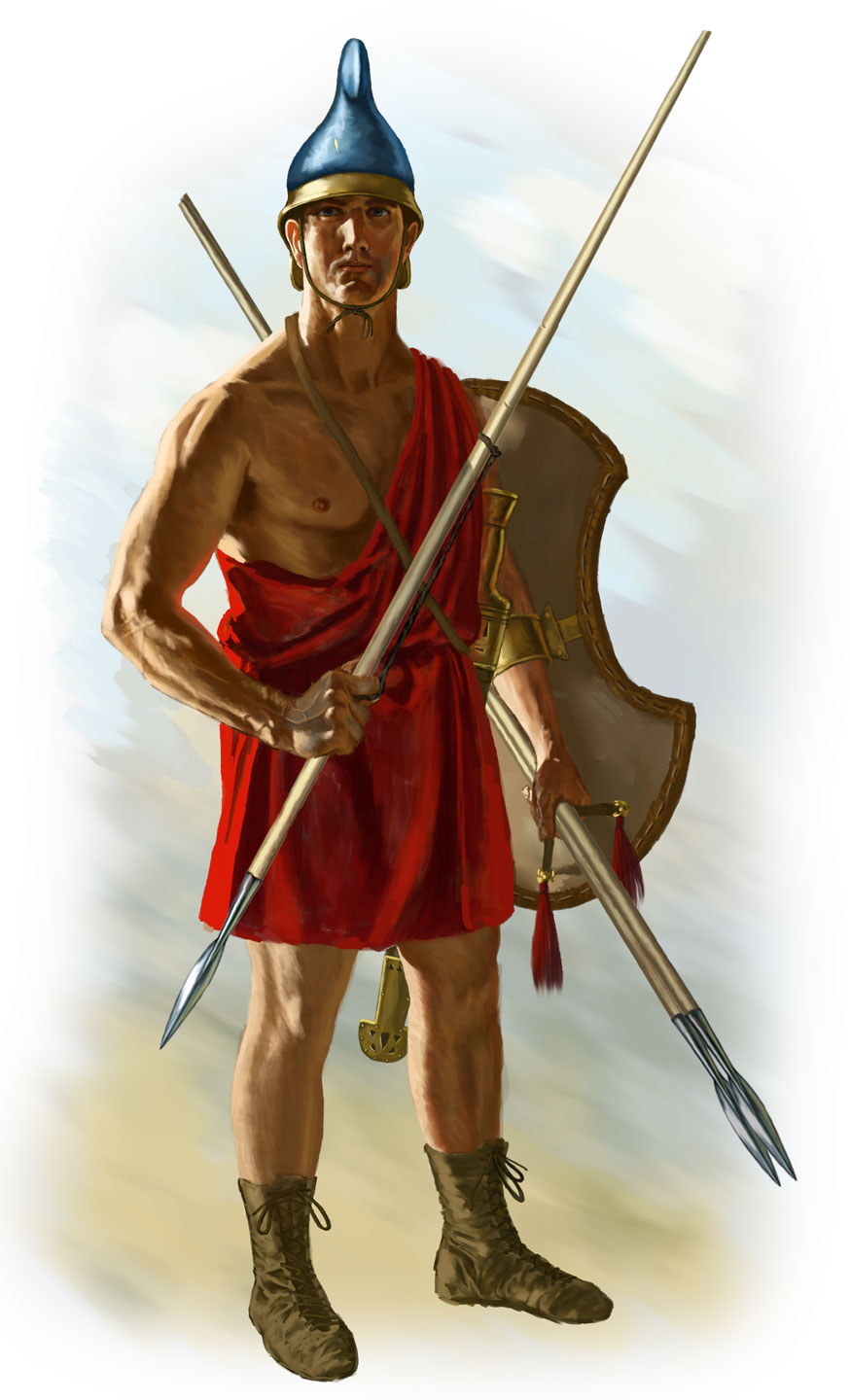
Agrianian peltas. This peltast holds three javelins, one in his throwing hand and two in his pelte (shield) hand as additional ammunition.

A peltast (Ancient Greek: πελταστής, peltastēs) was a type of light infantry originating in Thrace and Paeonia and named after the kind of shield they carried.[1] Thucydides mentions the Thracian peltasts, while Xenophon in the Anabasis distinguishes the Thracian and Greek peltast troops.[2]

The peltast often served as a skirmisher in Hellenistic armies. In the Middle Ages, the same term was used for a type of Byzantine infantryman.

Description

[edit]

Pelte shield

[edit]

Peltasts carried a crescent-shaped wicker shield called a "pelte" (Ancient Greek πέλτη, peltē; Latin: pelta[N 1]) as their main protection, hence their name. According to Aristotle, the pelte was rimless and covered in goat- or sheepskin. Some literary sources imply that the shield could be round, but in art it is usually shown as crescent-shaped. It also appears in Scythian art and may have been a common type in Central Europe. The shield could be carried with a central strap and a handgrip near the rim[citation needed] or with just a central hand-grip. It may also have had a carrying strap (or guige), as Thracian peltasts slung their shields on their backs when evading the enemy.

Weapons

[edit]

Peltasts weapons consisted of several javelins, which may have had straps to allow more force to be applied to a throw.

The size of these javelins could differ greatly from a modern olympic-style javelin. Xenophon mentions in his Anabasis an encounter with hostile Carduchians, fighting with longbows, wherein the Greeks reused carduchian arrows as javelins.

They were, moreover, excellent archers, using bows nearly three cubits long and arrows more than two cubits (86 cm -112 cm). When discharging the arrow, they draw the string by getting a purchase with the left foot planted forward on the lower end of the bow. The arrows pierced through shield and cuirass, and the Hellenes, when they got hold of them, used them as javelins, fitting them to their thongs.[4]

Development

[edit]
A peltast with the whole of his panoply (on a red-figure kylix)

In Archaic Greece, the Greek martial tradition had been focused almost exclusively on the heavy infantry, or hoplites.

The style of fighting used by peltasts originated in Thrace, and the first Greek peltasts were recruited from the Greek cities of the Thracian coast.[1] They are generally depicted on vases and in other images as wearing the typical Thracian costume, which includes the distinctive Phrygian cap made of fox-skin and with ear flaps. They also usually wore patterned tunics, fawnskin boots and long cloaks, called zeiras, decorated with a bright, geometric, pattern. However, many mercenary peltasts were probably recruited in Greece. Some vases have also been found showing hoplites (men wearing Corinthian helmets, greaves and cuirasses, holding hoplite spears) carrying peltes. Often, the mythical Amazons (women warriors) are shown with peltast equipment.

Peltasts gradually became more important in Greek warfare, in particular during the Peloponnesian War.

Xenophon, in the Anabasis, describes peltasts in action against Achaemenid cavalry at the Battle of Cunaxa in 401 BC, where they were serving as part of the mercenary force of Cyrus the Younger.

Tissaphernes had not fled at the first charge (by the Greek troops), but had instead charged along the river through the Greek peltasts. However he did not kill a single man as he passed through. The Greeks opened their ranks (to allow the Persian cavalry through) and proceeded to deal blows (with swords) and throw javelins at them as they went through.[4]

Xenophon's description makes it clear that these peltasts were armed with swords, as well as javelins, but not with spears. When faced with a charge from the Persian cavalry, they opened their ranks and allowed the cavalry through while striking them with swords and hurling javelins at them.[4]

Peltasts on the Tomb of Payava
Peltasts on the Tomb of Payava (c. 360 BC), around the time of Iphicrates. They are equipped with the exomis, the pilos with crest and cheekpiece, and the round pelte shield, thrusting overarm with a spear.[5][6]

Peltasts became the main type of Greek mercenary infantry in the 4th century BC. Their equipment was less expensive than that of traditional hoplites and would have been more readily available to poorer members of society. The Athenian general Iphicrates destroyed a Spartan phalanx in the Battle of Lechaeum in 390 BC, using mostly peltasts. In the account of Diodorus Siculus, Iphicrates is credited with re-arming his men with long spears, perhaps in around 374 BC. This reform may have produced a type of "peltast" armed with a small shield, a sword, and a spear instead of javelins.

Some authorities, such as J.G.P. Best, state that these later "peltasts" were not truly peltasts in the traditional sense, but lightly armored hoplites carrying the pelte shield in conjunction with longer spears—a combination that has been interpreted as a direct ancestor to the Macedonian phalanx.[7] However, thrusting spears are included in some illustrations of peltasts before the time of Iphicrates and some peltasts may have carried them as well as javelins rather than as a replacement for them. As no battle accounts describe peltasts using thrusting spears, it may be that they were sometimes carried by individuals by choice (rather than as part of a policy or reform). The Lykian sarcophagus of Payava from about 400 BC depicts a soldier carrying a round pelte, but using a thrusting spear overarm. He wears a pilos helmet with cheekpieces, but no armour. His equipment therefore resembles Iphicrates's supposed new troops. Fourth-century BC peltasts also seem to have sometimes worn both helmets and linen armour.

Alexander the Great employed peltasts drawn from the Thracian tribes to the north of Macedonia, particularly the Agrianoi. In the 3rd century BC, peltasts were gradually replaced with thureophoroi infantrymen. Later references to peltasts may not in fact refer to their style of equipment as the word peltast became a synonym for mercenary.

Anatolian

[edit]
Athenian peltast
An Athenian mercenary peltast (left) supporting an Achaemenid knight of Hellespontine Phrygia (center) attacking a Greek psilos (right), Altıkulaç Sarcophagus, early 4th century BC. The Athenian peltast is equipped with a machaira sword, a small round shield with a single grip, with javelins wedged in the grip, making him an effective fighter in close quarters against a disorganized enemy.[8][9]

A tradition of fighting with javelins, light shield and sometimes a spear existed in Anatolia and several contingents armed like this appeared in Xerxes I's army that invaded Greece in 480 BC. For example, the Paphlagonians and Phrygians wore wicker helmets and native boots reaching halfway to the knee. They carried small shields, short spears, javelins and daggers.[10]

In the Persian army

[edit]

From the mid-5th century BC onwards, peltast soldiers began to appear in Greek depictions of Persian troops.[11] They were equipped like Greek and Thracian peltasts, but were dressed in typically Persian army uniforms. They often carried light axes, known as sagaris, as sidearms. It has been suggested that these troops were known in Persian as takabara and their shields as taka.[12] The Persians may have been influenced by Greek and Thracian peltasts. Another alternative source of influence would have been the Anatolian hill tribes, such as the Corduene, Mysians or Pisidians.[13] In Greek sources, these troops were either called peltasts or peltophoroi (bearers of pelte).

In the Antigonid army

[edit]

In the Hellenistic period, the Antigonid kings of Macedon had an elite corps of native Macedonian peltasts. However, this force should not be confused with the skirmishing peltasts discussed earlier. The peltasts were probably, according to F.W. Walbank, about 3,000 in number, although by the Third Macedonian War, this went up to 5,000 (most likely to accommodate the elite agema, which was a sub-unit in the peltast corps). The fact that they are always mentioned as being in their thousands suggests that, in terms of organization, the peltasts were organized into chiliarchies. This elite corps was most likely of the same status, of similar equipment and role as Alexander the Great's hypaspists. Within this corps of peltasts was its elite formation, the Agema. These troops were used on forced marches by Philip V of Macedon, which suggests that they were lightly equipped and mobile. However, at the battle of Pydna in 168 BC, Livy remarks on how the Macedonian peltasts defeated the Paeligni and of how this shows the dangers of going directly at the front of a phalanx. Though it may seem strange for a unit that would fight in phalanx formation to be called peltasts, pelte would not be an inappropriate name for a Macedonian shield. They may have been similarly equipped with the Iphicratean hoplites or peltasts, as described by Diodorus.[7]

Deployment & Role

[edit]
A peltast fighting a panther (from an Attic white-ground mug, 5th century BC)

Peltasts were usually deployed on the flanks of the phalanx, providing a link with any cavalry, or in rough or broken ground. For example, in the Hellenica, Xenophon writes 'When Dercylidas learned this (that a Persian army was nearby), he ordered his officers to form their men in line, eight ranks deep (the hoplite phalanx), as quickly as possible, and to station the peltasts on either wing along with the cavalry.[14]

They could also operate in support of other light troops, such as archers and slingers. In the absence of a large enough cavalry force, or when otherwise deemed appropriate, peltasts would also pursue retreating enemies at the end of a battle, in order to capture or kill men who had thrown away their weapons or been isolated from their formation during the rout.[4]

Peltasts (and other light troops, as ancient sources tend to group all types of light troops together) had a number of essential tasks on the march, away from the battlefield that were difficult to perform for the heavy infantry. They were often used to occupy mountain passes and defensible hills which the army would have to pass, to deny enemy forces a superior attacking position.[15] They would also lay ambushes in wooded or otherwise difficult terrain, defend the rear of the marching army against enemy pursuers, and detachments of light troops would also frequently be used to scout ahead when knowledge of the area and presence of enemies was not well established.[4]

Tactics

[edit]

When faced with hoplites, peltasts operated by throwing javelins at short range. If the hoplites charged, the peltasts would retreat. As they carried considerably lighter equipment than the hoplites, they were usually able to evade successfully, especially in difficult terrain. They would then return to the attack once the pursuit ended, if possible, taking advantage of any disorder created in the hoplites' ranks. At the Battle of Sphacteria, the Athenian forces included 800 archers and at least 800 peltasts. Thucydides, in the History of the Peloponnesian War, writes

They (the Spartan hoplites) themselves were held up by the weapons shot at them from both flanks by the light troops. Though they (the hoplites) drove back the light troops at any point in which they ran in and approached too closely, they (the light troops) still fought back even in retreat, since they had no heavy equipment and could easily outdistance their pursuers over ground where, since the place had been uninhabited until then, the going was rough and difficult.[16]

When fighting other types of light troops, peltasts were able to close more aggressively in hand-to-hand combat, as they had the advantage of possessing shields, swords, and helmets.

Medieval Byzantine

[edit]

A type of infantryman called a peltast (peltastēs) is described in the Strategikon, a 6th-century AD military treatise associated with the early Byzantine emperor Maurice.[17] Peltasts were especially prominent in the Byzantine army of the Komnenian period in the late 11th and 12th centuries. Although the peltasts of Antiquity were light skirmish infantry armed with javelins, it is not safe to assume that the troops given this name in the Byzantine period were identical in function. Byzantine peltasts were sometimes described as "assault troops".[18] Byzantine peltasts appear to have been relatively lightly equipped soldiers capable of great battlefield mobility, who could skirmish but who were equally capable of close combat.[19] Their arms may have included a shorter version of the kontarion spear employed by contemporary Byzantine heavy infantry.[20]

See also

[edit]

References

[edit]

Bibliography

[edit]
[edit]
Revisions and contributorsEdit on WikipediaRead on Wikipedia
from Grokipedia
A peltast was a type of soldier in , originating from the Thracian region, named after their crescent-shaped wicker called the pelta, and characterized by their use of javelins for throwing, a short known as the machaira, with minimal armor to ensure mobility. Peltasts first appear in historical records in the 5th century BCE, as described by during the (431–404 BCE), where they served primarily as mercenaries hired by Greek city-states like and to supplement the phalanx of hoplites. Their equipment typically included two to three javelins, each about 1–2 meters long with heads, allowing throws up to approximately 40 meters, along with light footwear and clothing such as tunics and fox-skin caps for agility in rugged terrain. Unlike hoplites, who relied on close-quarters and formations, peltasts employed : advancing to hurl javelins at enemy lines, evading counterattacks, and retreating to repeat the process, making them effective for harassing foes, protecting flanks, and pursuing retreating enemies. The role of peltasts evolved significantly during the , where their skirmishing capabilities proved decisive in several engagements, such as the Athenian victory at Sphacteria in 425 BCE, where 800 peltasts along with 800 archers forced the surrender of 292 Spartan hoplites, and the Spartan success at in 422 BCE, where peltasts outflanked Athenian forces to inflict heavy casualties. Later, in 390 BCE at Lechaion, the Athenian general Iphicrates used reformed peltast units to ambush and annihilate a Spartan of 600 hoplites, demonstrating their growing integration into combined-arms tactics alongside and . By the BCE, as noted in Xenophon's accounts, peltasts had become a staple in mercenary armies, including those of in 401 BCE, with numbers reaching 2,500 in a single force, influencing broader shifts toward more flexible and professionalized Greek military structures.

Definition and Equipment

Etymology and Terminology

The term peltast derives from the peltastēs (πελταστής), referring to a who carried a pelte (πέλτη), a type of light shield originating from Thracian culture. The word pelte itself stems from the , denoting a small, portable shield typically constructed from lightweight materials such as or animal hide. This etymological root underscores the warrior's association with Thracian tribal fighting traditions, where mobility was prioritized over heavy protection. In ancient literary sources, the terminology evolved to distinguish peltasts from other infantry types. first employs peltastai in his accounts of the to describe Thracian mercenaries, portraying them as agile troops separate from the armored core of the army. , writing in the Anabasis, further refines the term to denote specialized mercenaries, contrasting peltastai with hoplitai (heavily armed spearmen) and psiloi (minimally equipped skirmishers). These authors highlight the peltast's role as versatile , emphasizing tactical distinctions based on armament and function rather than ethnic origin alone. Regional and contextual variations in naming reflect adaptations of the concept. In Persian military contexts, similar troops were termed peltophoroi (πελτοφόροι), literally "bearers of the pelte," indicating a focus on the shield as the defining feature. Meanwhile, some Greek dialects used gymnetes (γυμνῆτες), derived from gymnos (γυμνός, "naked"), to describe lightly armed fighters with scant protection, often overlapping with peltast designations in broader usage.

The Pelte Shield

The pelte shield, the eponymous piece of equipment that defined the peltast, was typically crescent-shaped and measured approximately 60-80 cm in height, constructed from a lightweight frame covered with goatskin or to provide basic protection without impeding movement. According to ancient descriptions preserved in Aristotelian fragments, the pelte lacked a rim, bronze facing, or thick oxhide layering, emphasizing its use of simpler, lighter materials like goatskin to suit mobile infantry. It was held via a central handgrip near the boss, often supplemented by an optional arm strap that allowed the bearer to maintain a firm hold while facilitating rapid adjustments during combat. This design offered key tactical advantages for skirmishers, enabling swift maneuvers across uneven terrain, the ability to hurl javelins over the shield's curved upper edge without exposing the body, and superior evasion against slower, heavily armored foes equipped with larger shields like the . The pelte's reduced weight—typically under 3 kg—permitted peltasts to exploit their speed and agility, harassing enemies from afar before retreating to avoid direct confrontation. Regional variations reflected cultural adaptations while preserving the shield's core lightweight ethos. Thracian pelte often incorporated bosses at for enhanced durability against glancing blows, as evidenced in archaeological depictions from the region. In contrast, Greek versions frequently featured additional facings over the wicker and skin to improve resistance to arrow impacts, adapting the Thracian original for broader Mediterranean warfare needs.

Weapons and Armor

Peltasts were primarily equipped with light throwing javelins known as akontia, typically carrying two to three of these weapons, each measuring approximately 1-2 meters in length and featuring a or iron tip for penetration. Some javelins featured softer metal tips for better penetration or to bend on impact, and certain peltast contingents supplemented with slings for longer-range harassment. These javelins were often thrown using a thong (ankylē) attached to the shaft, which increased range and accuracy, allowing effective engagement from distances up to 30-50 meters, with maximum throws potentially reaching 60-90 meters. For close-quarters combat, peltasts carried a secondary weapon such as a short (xiphos or machaira), a slashing around 50-60 cm long, or occasionally a , providing versatility without adding significant weight. In terms of defensive gear, peltasts employed minimal armor to prioritize mobility, forgoing the heavy cuirass () worn by hoplites. Head protection consisted of lightweight felt or leather caps, such as the Thracian (a pointed foxskin ), with occasional use of simple bronze helmets like the conical pilos type in later classical periods. Greaves for leg protection appeared sporadically in more developed formations but were not standard, as they would impede the rapid movement essential to the peltast's role. The overall loadout of a peltast, including javelins, , , and the characteristic pelte , weighed approximately 7-10 kg, substantially lighter than the 25-30 kg of a , which enabled superior speed and endurance in skirmishing maneuvers. This lightweight configuration, estimated at around 5-6 kg for weapons alone in basic setups, underscored the emphasis on agility over protection.

Historical Origins and Evolution

Thracian and Anatolian Roots

The peltast, a type of characterized by agility and skirmishing tactics, emerged among the tribal warriors of in the during the 6th century BCE. These fighters, drawn from the rugged mountainous regions of what is now southern , European , eastern Macedonia, and northeastern , relied on mobility to harass enemies in guerrilla-style engagements. provides one of the earliest detailed accounts of Thracian warriors in his Histories, describing their equipment during their service in the Persian army around 480 BCE: they wore fox-skin caps, tunics, colorful cloaks, fawn-skin buskins, and carried javelins, light wooden shields known as peltae, and short daggers. This depiction underscores their role as tribal fighters valued for ferocity and plunder-seeking, forming the basis of the peltast tradition before broader adoption. In the , which unified much of in the 5th century BCE under kings like Teres and Sitalces, peltasts served as core mercenaries, leveraging the kingdom's strategic position to supply warriors to external powers. These Thracian troops, organized into bands that emphasized speed over heavy armor, were instrumental in regional conflicts and early international service, with archaeological evidence from Thracian burials revealing javelin tips, and artistic representations showing crescent-shaped shields (peltae) consistent with Herodotus's portrayal. Their effectiveness stemmed from the Balkan , which favored against more rigid formations. Anatolian regions, including , exhibited parallel developments in traditions that paralleled Thracian peltasts, featuring javelin-armed warriors with small shields as early as the BCE. Assyrian records from campaigns under kings like (r. 722–705 BCE) document interactions with () forces in Anatolia's border wars. further illustrates these similarities in his catalog of Xerxes' army, noting —Anatolian kin to —with native helmets, small bucklers, and fire-hardened javelins, highlighting a shared emphasis on unarmored across the region. Such troops influenced broader Near Eastern warfare, predating Thracian exports and contributing to the conceptual roots of skirmishing . By the late BCE, Thracian peltasts began entering the trade, hired by Greek city-states and the Achaemenid for their specialized skills in introducing the pelta shield and fluid skirmishing to Mediterranean battlefields. This early exportation, as noted in historical analyses, saw Thracian peltasts and cavalry serving Greek commanders amid the and Persian expansions, bridging Balkan and Anatolian traditions into wider use. Their integration marked the transition from indigenous tribal roles to professional soldiery, setting the foundation for later evolutions without altering core equipment like javelins and the pelta.

Development in Greek Warfare

Peltasts first gained prominence in Greek warfare during the (431–404 BCE), when increasingly hired Thracian mercenaries to bolster its forces amid the protracted conflict with and its allies. In 413 BCE, for instance, recruited 1,300 Thracian peltasts from the tribe, intending to deploy them as reinforcements for the expedition led by generals including . Although they arrived too late to participate and were ultimately sent back to due to high maintenance costs, this hiring exemplified ' strategic shift toward incorporating light-armed skirmishers to support traditional phalanxes in overseas campaigns. A pivotal evolution occurred in the early fourth century BCE through the reforms of the Athenian general Iphicrates, who transformed elements of the into a more versatile force known as "Iphicratean peltasts." Drawing from his experiences as a commander, Iphicrates re-equipped hoplites by replacing heavy bronze shields with smaller, lighter pelta shields made of wicker or wood, extending lengths by about half for greater reach, and doubling lengths to enhance close-quarters effectiveness. He also introduced lighter linen armor and specialized boots for improved mobility. These changes allowed the reformed troops to operate in support of traditional peltasts, blending the agility of skirmishers with some capabilities, and marked a significant adaptation in Greek tactical doctrine. By the late fifth and early fourth centuries BCE, peltasts had expanded from peripheral mercenaries to essential components of Greek armies, particularly in asymmetric engagements where mobility countered Spartan dominance. This reliance is vividly illustrated in Xenophon's Anabasis (401 BCE), which recounts the expedition of the Ten Thousand Greek mercenaries under Cyrus the Younger against the Persian Empire. The force included approximately 2,000 peltasts who played key roles in skirmishing, harassing enemy flanks, and protecting the main body during retreats through hostile terrain, demonstrating how integrated light infantry enabled smaller Greek contingents to challenge larger foes effectively. Such deployments highlighted the growing tactical value of peltasts in post-Peloponnesian conflicts, influencing broader Hellenic military practices.

Service in Ancient Armies

In the Achaemenid Persian Army

The Achaemenid Persian Empire extensively utilized peltasts drawn from and Anatolian populations as mercenaries and provincial levies within its multi-ethnic military framework during the 5th and 4th centuries BCE. These specialists were recruited from , a European satrapy under Persian control since Darius I's campaigns, and from Paeonian regions in the and Anatolian regions such as , where similar javelin-armed warriors were common. Rather than forming part of the elite Persian Immortals—who were primarily drawn from core Iranian ethnic groups—peltasts typically augmented the broader imperial forces, providing essential skirmishing and flanking support to the empire's archer-heavy infantry and cavalry wings. In major expeditions, such as Xerxes' invasion of in 480 BCE, Thracian peltasts contributed contingents, integrated into the massive land army that described as exceeding 1.7 million but which modern analyses scale down to 100,000–200,000 combatants overall. These troops, commanded by figures like Bassaces son of Artabanus, marched alongside other ethnic units from the and Minor, enhancing the Persian emphasis on mobile harassment tactics. Their core equipment, rooted in Thracian traditions of lightweight mobility, included small hide-covered shields (peltē), multiple javelins, and daggers, allowing rapid strikes without the encumbrance of heavy armor. Peltast units were organized within the Achaemenid army's structure, typically grouped into chiliarchies of 1,000 men under subordinate commanders reporting to satraps or expeditionary generals, facilitating ethnic cohesion and tactical flexibility. Frequently paired with native Persian or allied archers, these formations enabled combined-arms skirmishing, where volleys softened enemy lines before charges or advances. This integration reflected the empire's reliance on diverse provincial contributions to project power across its territories. In later adaptations during satrap revolts, such as the Great Satraps' Revolt (366–360 BCE), loyalist Persian commanders blended mercenaries with native Anatolian slingers to counter rebel Greek heavy infantry, as exemplified by the forces under Iphikrates, who employed reformed light troops in operations across western Asia Minor.

In Greek and Macedonian Forces

In Classical Greek city-states, particularly and Thebes, served primarily as light infantry auxiliaries during the (431–404 BCE), often functioning as fleet marines to support naval operations and as skirmish screens to harass heavier formations. Athenian forces frequently employed Thracian , who were integrated into expeditionary fleets for amphibious assaults and rapid strikes against Spartan positions. Their mobility allowed them to disrupt enemy lines from afar, throwing javelins before retreating, which proved effective in countering the slower . A pivotal example of their impact occurred at the in 425 BCE, where approximately 800 Athenian peltasts, alongside archers, encircled and forced the surrender of 292 hoplites, including around 120 elite Spartan () hoplites trapped on the island of Sphacteria near . This victory, one of the first major defeats of Spartan by light troops, demonstrated peltasts' ability to exploit terrain and weather conditions—such as fog and rough ground—to neutralize the Spartans' close-combat superiority, capturing over 100 prisoners without direct confrontation. Theban forces, allied with during much of the , adopted similar tactics later in the conflict, using peltasts to screen their own hoplites and conduct hit-and-run raids against Athenian supply lines. Under in the fourth century BCE, peltasts were integrated more deeply into the army's structure, with the —an of about 3,000 men—evolving into versatile, peltast-like guards who bridged the gap between heavy phalangites and light skirmishers. These troops, lighter armed than the pezhetairoi (foot companions) with shorter spears and less armor, provided mobile protection for the flanks and royal bodyguard duties. further utilized them during his Asian campaigns (334–323 BCE), deploying hypaspists and allied peltasts for scouting, foraging, and rapid assaults on enemy outposts, such as at the Granicus River in 334 BCE where they supported the cavalry charge against Persian forces. In the successor states following Alexander's death, peltasts retained a screening role in Antigonid Macedonian armies, protecting the sarissa-equipped from flanking maneuvers by enemy light troops or . At the in 301 BCE, fielded peltasts as part of his approximately 80,000-strong force, positioning them to shield the phalanx's vulnerable sides against the coalition's superior elephant and wings led by Seleucus and . This deployment highlighted their evolution from mere auxiliaries to essential components in combined-arms tactics, though the battle's outcome—Antigonus's defeat—underscored the limitations when outnumbered by heavier shock elements.

Tactical Role and Deployment

Skirmishing Functions

Peltasts served primarily as skirmishers, employing to harass enemy forces without engaging in direct confrontation. Their core function involved hurling javelins to disrupt tightly packed formations, such as phalanxes, from an effective range of up to 90 , allowing them to weaken cohesion before withdrawing to avoid counterattacks. This missile harassment was complemented by pursuing routed enemies to prevent reorganization and by screening the main battle lines to protect heavier troops from flanking maneuvers or initial enemy probes. In addition to frontline skirmishing, peltasts operated in small, mobile detachments for and missions, to identify positions, setting ambushes in favorable ground, and conducting supply raids to deprive opponents of resources. A notable example of their versatility in such roles occurred during Xenophon's retreat of the Ten Thousand, where peltast units secured for , ambushed pursuers, and raided local supplies to sustain the Greek force across hostile territory. Their light equipment, including minimal armor and the small pelte shield, facilitated this high mobility across varied landscapes. Despite their effectiveness in these indirect roles, peltasts had significant limitations in open combat, proving vulnerable to in pitched due to their lack of substantial protection and reliance on evasion rather than . They depended heavily on for cover, performing best in broken or wooded areas where they could exploit cover to launch attacks and retreats, but struggling on flat, open plains without support from allied forces.

Integration in Phalanx-Based Armies

Peltasts served as a critical component in phalanx-based armies, primarily positioned on the flanks or ahead of the heavy formation to launch harassing volleys that disrupted enemy lines before the main clash. This deployment exploited their mobility to soften opposing forces, targeting vulnerabilities such as unshielded flanks or advancing troops, while minimizing exposure to close combat. Once engagement commenced, peltasts typically withdrew to the phalanx's sides or rear, preserving their skirmishing utility for pursuit or covering retreats. Such positioning enhanced the phalanx's defensive cohesion, as evidenced in Xenophon's accounts of Greek campaigns where peltasts flanked hoplite centers to counter threats from enemy light troops or . The synergy between peltasts and the manifested in tactics, where peltasts shielded or sarissa-armed advances from flanking , archers, or rival skirmishers, thereby amplifying the 's shock potential. By weakening enemy morale and formations through ranged attrition, peltasts enabled the to close distances more effectively; for example, at Sphakteria in 425 BCE, Athenian peltasts' persistent assaults exhausted Spartan , paving the way for a decisive and surrender. A parallel instance occurred at Lechaion in 390 BCE, where Iphikrates' peltasts decimated a Spartan with , disrupting their advance and allowing supporting Greek to exploit the disarray. These interactions underscored peltasts' protective and preparatory roles, transforming the rigid into a more versatile battle array. In Hellenistic adaptations, particularly in Macedonian armies under Philip II and Alexander, peltasts functioned as vanguard skirmishers to screen the sarissa phalanx and facilitate operations in uneven terrain. These light infantry extended the phalanx's reach by conducting initial probes and neutralizing obstacles, such as enemy outposts or rough ground that hindered heavy troop movement. This evolution integrated peltast mobility with the phalanx's depth, allowing for sustained advances in diverse environments like the Persian highlands.

Legacy and Later Adaptations

Byzantine Peltasts

The revival of peltast units in the Byzantine military during the Komnenian era represented a deliberate adaptation of ancient light infantry traditions to counter the mobility of Seljuk Turkish horse archers and other nomadic threats. Drawing briefly from the ancient Greek archetype of javelin-armed skirmishers equipped with small crescent-shaped shields known as peltai, these Byzantine peltastai were reorganized as versatile light infantry within the tagmata, the empire's professional standing forces. Under Emperor Alexios I Komnenos (r. 1081–1118), who ascended amid territorial losses following the Battle of Manzikert, peltastai were integrated into reformed army structures to provide screening and harassment capabilities; for instance, a contingent of 2,000 peltastai accompanied the general Taticius during the First Crusade's siege of Nicaea in 1097, where they fortified positions and launched missile attacks alongside Frankish allies. Equipped primarily with javelins for throwing and small buckler shields for protection, these troops emphasized speed and ranged engagement over close combat, allowing them to disrupt enemy formations without engaging heavily armored opponents directly. Anna Komnene, in her Alexiad, describes the use of light infantry in Alexios I's campaigns, highlighting their role in missile engagements before committing the main force. This reorganization extended into the theme system armies, where remnants of provincial levies incorporated peltast-like elements alongside evolving equipment to address Anatolian warfare. During the reign of (r. 1143–1180), akontistai—javelinmen akin to peltastai—were deployed in mixed units that included horse archers, often recruited as mercenaries from Turkish or Cuman tribes, to enhance tactical flexibility in campaigns against the Seljuks. These forces proved effective in Manuel's expeditions of the 1140s–1180s, such as the in 1176, which ended in a tactical draw but strategic defeat for the Byzantines, where light infantry screened advances and harassed retreating foes, compensating for the empire's reduced territorial base by blending native and foreign skirmishers. notes the use of light infantry in these contexts, underscoring their adaptation within theme-based contingents that supplemented the central tagmata. Horse archers, in particular, augmented the traditional foot peltast role, providing mounted missile support that echoed the light cavalry needs of earlier eras while integrating into infantry-heavy defenses. By the 13th century, following the Fourth Crusade's in , peltast units gradually phased out as the empire fragmented into successor states like and , with military emphasis shifting toward pronoiar —land-grant-based mounted warriors who prioritized over skirmishing. The system's rise favored elite horsemen for rapid reconquest efforts, diminishing the role of dedicated amid resource constraints and reliance on Latin and Turkish mercenaries. However, remnants of peltast traditions faded with the overall decline of specialized units before their full integration into more cavalry-oriented forces around 1300.

Influence on Medieval and Modern Light Infantry

The role of peltasts as mobile skirmishers with light armament left a lasting conceptual legacy in the evolution of , emphasizing speed, missile harassment, and support for heavier formations rather than direct confrontation. This paradigm was transmitted through , which adapted tactics for medieval contexts and influenced broader European and Near Eastern warfare by highlighting the tactical value of light troops in , ambushes, and disrupting enemy lines. In medieval , the facilitated the exchange of such ideas, as Western forces observed and integrated Byzantine-style skirmishing into their own armies, contributing to the use of light troops like crossbowmen and javelin-armed in combined-arms operations against Muslim opponents. Ottoman , as successors to Byzantine territories, incorporated similar elements in units such as the azabs, irregular volunteers who employed s and bows for initial engagements and flanking maneuvers, echoing the peltast's emphasis on mobility over protection. Slavic forces in the , including Vlach and Bulgarian javelin troops, likewise drew on regional traditions rooted in Thracian origins, using light-armed warriors for guerrilla-style raids during conflicts with both Byzantines and Ottomans. During the and , this legacy manifested in the emergence of specialized skirmishers, such as the Spanish arcabuceros, who used early firearms in loose formations to screen advances and harass foes, much like peltasts with javelins. The indirect influence extended to Napoleonic , elite trained for independent action in woods and rough terrain, prioritizing agility and marksmanship to support line infantry assaults. In the modern era, the peltast's principles of unarmored mobility and resonate in forces, such as commandos who conducted raids behind enemy lines with minimal equipment, and in contemporary where guerrillas employ similar strategies to counter superior conventional forces.

References

Add your contribution
Related Hubs
User Avatar
No comments yet.