Hubbry Logo
Idrisid dynastyIdrisid dynastyMain
Open search
Idrisid dynasty
Community hub
Idrisid dynasty
logo
8 pages, 0 posts
0 subscribers
Be the first to start a discussion here.
Idrisid dynasty
Idrisid dynasty
from Wikipedia

Key Information

The Idrisid dynasty or Idrisids (Arabic: الأدارسة al-Adārisah) were an Arab Muslim dynasty from 788 to 974, ruling most of present-day Morocco and parts of present-day western Algeria. Named after the founder, Idris I, the Idrisids were an Alid dynasty descended from Muhammad through his grandson Hasan.[2][3] Their reign played an important role in the early Islamization of Morocco and also presided over an increase in Arab immigration and Arabization in major urban centers.[4]: 52 [5]: 83–84 

Fleeing the Abbasid Caliphate to the east in the aftermath of the Battle of Fakhkh, Idris I first established himself in 788 at Volubilis in present-day Morocco with the help of local Berber allies. He and his son, Idris II, subsequently founded what became the city of Fez further east. Fez became the capital of an Idrisid state which ruled most of present-day Morocco and part of western Algeria. After Idris II's death, the realm was divided between his rival sons. After a period of conflict, the dynasty's authority resumed and remained relatively stable between 836 and 863. In the late 9th century, however, they faced repeated challenges and local opposition. In the 10th century the region came under the political domination of Zenata tribes who fought proxy battles on behalf of two rival powers in the region, the Fatimid Caliphate and the Umayyad Caliphate of Córdoba. The Idrisids were definitively expelled from Fez in 927, but held onto to a reduced territory in the north of Morocco from their base at Hajar an-Nasr. They were finally defeated and removed from power in 974, and a brief attempt to regain power in 985 also failed.

History

[edit]

Founders of the Idrisid state: Idris I and Idris II

[edit]

By the second half of the 8th century the westernmost regions of the Maghreb, including present-day Morocco, had been effectively independent of the Umayyad Caliphate since the Khariji-led Berber revolts that started in 739–40.[4][6] The Abbasid Caliphate after 750 had no more success in re-establishing control over Morocco.[4]: 41  The overthrow of eastern authority meant that Morocco was controlled by various local Berber tribes and principalities which emerged around this time, such as the Barghwata Confederacy on the Atlantic coast and the Midrarid Emirate in Sijilmasa.[4][5]

The founder of the Idrisid dynasty was Idris ibn Abdallah (788–791),[2] who traced his ancestry back to Ali ibn Abi Talib (died 661)[2] and his wife Fatimah, daughter of the Islamic prophet, Muhammad. He was the great-grandchild of Hasan ibn Ali.[2][5]: 81  After the Battle of Fakhkh, near Mecca, between the Abbasids and supporters of the descendants of Muhammad, Idris ibn Abdallah fled to the Maghreb. He first arrived in Tangier, the most important city of Morocco at the time, and by 788 he had settled in Volubilis (known as Walili in Arabic).[4]: 51 

The powerful Awraba Berbers of Volubilis took in Idris and made him their 'imam' (religious leader).[4]: 51 [5]: 81  The Awraba tribe had supported Kusayla in his struggle against the Ummayad armies in the 670s and 680s. By the second half of the 8th century they had settled in northern Morocco, where their leader Ishak had his base in the Roman town of Volubilis. By this time the Awraba were already Muslim, but lived in an area where most tribes were either Christian, Jewish, Khariji or pagan. The Awraba seem to have welcomed a Sharifi imam as a way to strengthen their political position. Idris I, who was very active in the political organization of the Awraba, began by asserting his authority and working toward the subjugation of the Christian and Jewish tribes. In 789 he founded a settlement south east of Volubilis, called Medinat Fas. In 791 Idris I was poisoned and killed by an Abbasid agent. Even though he left no male heir, shortly after his death, his wife Lalla Kanza bint Uqba al-Awrabi, bore him his only son and successor, Idris II. Idris' loyal Arab ex-slave and companion Rashid brought up the boy and took on himself the regency of the state, on behalf of the Awraba. In 801 Rashid was killed by the Abbasids. In the following year, at the age of 11 years, Idris II was proclaimed imam by the Awraba.[4]: 51 

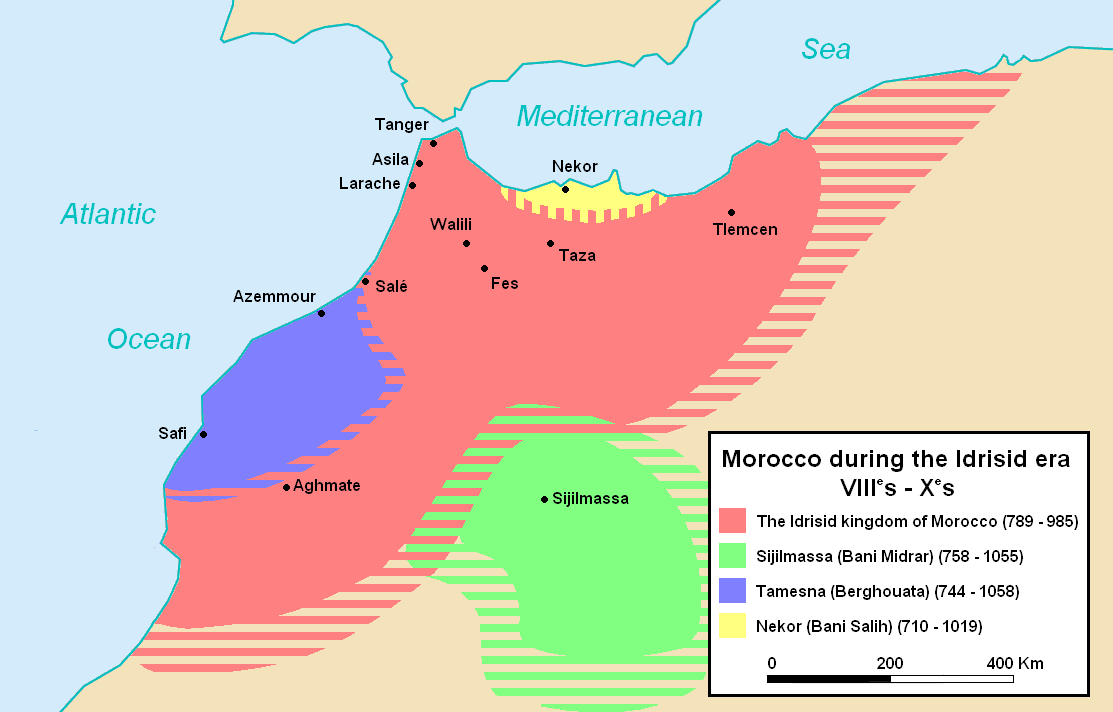
Even though he had spread his authority across much of northern Morocco, as far west as Tlemcen, Idris I had been completely dependent on the Awraba leadership. Idris II began his rule with the weakening of Awraba power by welcoming Arab settlers in Walili and by appointing two Arabs as his vizier and qadi. Thus he transformed himself from a protégé of the Awraba into their sovereign. The Awraba leader Ishak responded by plotting against his life with the Aghlabids of Tunisia. Idris reacted by having his former protector Ishak killed, and in 809 moved his seat of government from the Awraba dominated Walili to Fes, where he founded a new settlement named Al-'Aliya. Idris II (791–828) developed the city of Fez, established earlier by his father as a Berber market town. Here he welcomed two waves of Arab immigration: one in 818 from Cordoba and another in 824 from Aghlabid Tunisia, giving Fes a more Arab character than other Maghrebi cities. When Idris II died in 828, the Idrisid state spanned from western Algeria to the Sous in southern Morocco and had become the leading state of Morocco, ahead of the principalities of Sijilmasa, Barghawata and Nekor which remained outside their control.[4]: 51–52 [5]: 86 

The successors of Idris II

[edit]

The dynasty's power would slowly decline following Idris II's death. Under his son and successor Muhammad (828–836) the kingdom was divided amongst seven of his brothers, whereby eight Idrisid statelets formed in Morocco and western Algeria.[7] Muhammad himself came to rule Fes, with only nominal power over his brothers. His brother Al-Qasim ruled Tangier and its surroundings. 'Umar ruled over the Sanhaja and the Ghumara in the Rif region.[7] Isa was given control of the coastal Tamesna regions near the Bou Regreg, including Shallah (Chellah), and was based at Wazeqqūr (a town near modern-day Khenifra).[7][8] Yahya was given Hiṣn Daī (a site probably near modern Beni Mellal).[7][8][9] Hamza was given Walili. 'Ubayd Allah (or 'Abd Allah) was given the south, including the territory of the Lamta tribes and a town named Tamdult.[7][8] Agadir (later Tlemcen) was left under the control of Muhammad Ibn Sulayman, Idris II's cousin and the son of Sulayman, the brother of Idris I whom the latter had left in charge of the city, constituting the Sulaymanid dynasty.[7][8][10]

Soon after this territorial division Isa revolted against his brother Muhammad. Muhammad entrusted his other brother Umar to punish him. Umar successfully drove Isa from power, who was forced to take refuge in Chellah.[7] Umar then turned north to punish his other brother, al-Qasim, because the latter had refused to join him and Muhammad against Isa. Al-Qasim fled to Asilah and settled nearby, while Muhammad gave Umar governorship of Tangier as a reward. Upon Umar's death in September or October 835 his son Ali ibn Umar was granted all of his father's domains in turn.[7] Muhammad himself died seven months later in the March or April 836. His son Ali ibn Muhammad inherited his position and ruled for 13 years (836–849) in a competent manner, ensuring the stability of the state. After his death in 849 he was succeeded by his brother Yahya ibn Muhammad (or Yahya I), who also enjoyed a peaceful reign.[7]

Idrisid dirham, minted at al-'Aliyah (Fes), Morocco, 840 CE. The coin features the name of Ali: a son-in-law of Muhammad, the fourth Caliph, and an ancestor of the Idrisids.[11]

During this time Islamic and Arabic culture gained a stronghold in the towns and Morocco profited from the trans-Saharan trade, which came to be dominated by Muslim (mostly Berber) traders. The city of Fes also flourished and became an important religious center.[4]: 52  During Yahya's reign more Arab immigrants arrived and the famous mosques of al-Qarawiyyin and al-Andalusiyyin were founded.[7] Even so, the Islamic and Arabic culture only made its influence felt in the towns, with the vast majority of Morocco's population still using the Berber languages and often adhering to Islamic heterodox and heretical doctrines. The Idrisids were principally rulers of the towns and had little power over the majority of the country's population.[4]: 52 

Decline and fall

[edit]

After the death of Yahya I in 863 he was succeeded by his less competent son, Yahya II, who divided up the Idrisid realm yet again among the extended families. Yahya II died in uncertain circumstances in 866 after fleeing his palace. After an episode of disorder in Fes his cousin Ali ibn Umar took over power.[7] In 868, under the leadership of the Abd al-Razzaq the Berber Khariji Sufri tribes of Madyuna, Ghayata and Miknasa of the Fes region formed a common front against the Idrisids. From their base in Sefrou they were able to defeat Ali ibn Umar and occupy Fes. Fes refused to submit, however, and another Yahya, the son of al-Qasim, was able to retake the city and establish himself as the new ruler, Yahya III. Thus the ruling line had passed from the sons of Muhammad to the son of Umar and now the sons of al-Qasim.[4]: 52 [7]

Yahya III ruled over the entire Idrisid realm and continued to attack the Sufris. In 905 however he died in battle against another family member, Yahya ibn Idris ibn Umar (a grandson of Umar), who then took power as Yahya IV.[7] At this point, however, the Fatimids in the east began to intervene in Morocco, hoping to expand their influence. In 917 the Miknasa and its leader Masala ibn Habus, acting on behalf of their Fatimid allies, attacked Fes and forced Yahya IV to recognize Fatimid suzerainty, before deposing him in 919[7][12] or 921.[4]: 63  He was succeeded by his cousin Musa ibn Abul 'Afiya, who had already been given charge over the rest of the country. The Idrisid Hassan I al-Hajam, a grandson of al-Qasim, managed to wrest control of Fez from 925 but in 927 Musa returned, captured Hassan and killed him, marking the last time the Idrisids held power in Fes.[7]

From Fes, the Miknasa began pursuing the Idrisid family across Morocco. The family took refuge at the fortress of Hajar an-Nasr in northern Morocco, where the Miknasa besieged them.[7] Soon after, however, civil war broke out among the Miknasa when Musa switched allegiance to the Umayyads of Cordoba in 931 in an attempt to gain more independence. The Fatimids sent Humayd ibn Yasal (or Hamid[4]), the nephew of Masala ibn Habus, to confront Musa, defeating him in 933 and forcing him to fall back into line.[7][4]: 63  The Idrisids took advantage of the situation to break the siege of their fortress and defeat the Mikanasa Zenata troops. Once the Fatimids were gone, however, Musa once again threw off their authority and recognized the Umayyad caliph. The Fatimids sent their general Maysur to confront him again, and this time he fled. He was pursued and killed by the Idrisids.[7]

After this Idrisids settled among the Jbala tribes in the Rif region of north-west Morocco where they partially rebuilt their power base from Hajar an-Nasr, alternately acknowledging either the Umayyads of Cordoba (under Abd ar-Rahman III) or the Fatimids as overlords.[7] Al-Qasim al-Gannun ibn Muhammad ruled here from 938 until 948 in the name of the Fatimids.[7][12] His son and successor, Ahmad, known as Abul-'Aysh, recognized the Umayyads instead but ran afoul of them when he refused to let them occupy Tangier. He was besieged there and forced to retreat, retaining only the areas around al-Basra and Asilah while the Umayyads occupied the rest of northern Morocco.[7] He eventually left for Al-Andalus, leaving his brother Hasan ibn al-Qasim al-Gannun as the new leader in 954.[7][12] In 958 the Fatimids sent a new general, Jawhar, to invade Morocco. His success forced the Idrisids to again accept Fatimid overlordship.[7][4]: 75  Soon afterwards, however, when Jawhar and the Fatimids were busy taking control of Egypt, the Umayyads made a comeback. In 973 their general, Ghalib, invaded Morocco.[4] The Idrisids were expelled from their territories and al-Hasan, along with many other Idrisids or their sons, were taken as hostages to Cordoba in 974.[7] The remaining Idrisids in Morocco acknowledged Umayyad rule.[4] Al-Hasan was later expelled from Cordoba and fled to Egypt, which was now under Fatimid rule. In 979 Buluggin ibn Ziri, the Fatimid governor of Ifriqiya (after the Fatimid Caliphs had their capital to Cairo), returned to defeat the Umayyads and impose Fatimid overlordship in the western Maghreb again. In 985[12] he returned to Morocco with Fatimid support, but that same year he was defeated by another Umayyad general sent by al-Mansur and then assassinated on the way to Cordoba.[7] This brought a final end to the Idrisid dynasty. The Umayyads kept control over northern Morocco until their caliphate's collapse in the early 11th century. Following this, Morocco was dominated by various Zenata Berber tribes.[5]: 91 [4]: 82  Until the rise of the Sanhaja Almoravids later in the century, the Maghrawa controlled Fes, Sijilmasa and Aghmat while the Banu Ifran ruled over Tlemcen, Salé (Chellah), and the Tadla region.[5]: 91 

Religion

[edit]

According to Encyclopædia Britannica, "although Idrīs I had Shīʿite sympathies, the state founded by his son was Sunni in matters of religious doctrine."[13] Primary source material and contemporary scholars have described them as a Sunni Muslim dynasty.[4]: 50 [14][15] Certain contemporary academics have described them as Shi'a or Zaydi Shi'a to one extent or another, most likely because of their political affiliation.[16] The Idrisids were political opponents of the Abbasid Caliphate.[17] Others have criticized this claim for conflating Shia theology with a political movement in a historical period where there was no Shia theology distinct from Sunni theology in this area as of yet.[18] Amira Bennison argues that Idrisid coinage suggests that Idris I portrayed himself as a religious leader whose legitimacy was based on his descent from Muhammad, which Bennison describes as a "proto-Shi'i or 'Alid position."[19]

The Awraba Berbers who welcomed Idris I in Volubilis were Muʿtazila and Idris relied widely on the support of Muʿtazila Berber tribes to found his state.[20][21] He is also likely to have had ties to Muʿtazila figures in the Hijaz and further east, as he was accompanied on his journey to the Maghreb by a Muʿtazila khatib from Basra who aided him in gaining the support of the tribes.[20] It is unclear, however, to what extent the community he established was Muʿtazila in character.[20]

Legacy

[edit]

Despite having fallen from power, the Idrisids spawned many sharifian families which continued to be present for centuries to come. Some Moroccans today still claim descent from them.[7] In the 11th century, an Idrisid family descended from Umar (son of Idris II), the Hammudids, were able to gain power in several cities of northern Morocco and southern Spain.[7][22]

In Fes and in the town of Moulay Idriss (near Volubilis), the tombs of Idris II and Idris I, respectively, eventually developed into important religious complexes and pilgrimage sites, like the Zawiya of Moulay Idris II.[23][24] Several prominent sharifian families in Fez traced their lineages to Idris I,[25]: 488  and some of these played a role in maintaining or rebuilding the Zawiya of Idris II in the city.[26]

The Idrisid period also played an important role in the Islamization of the region, particularly in the spread of Islam to the Berber tribes that occupied the interior territories of present-day Morocco, outside the northern coastal regions where the earliest Muslim presence was initially concentrated.[12][27][4]: 52 [5]: 84  The new city of Fes also became a center of Arabization that spread to some of the surrounding Berber tribes in the area.[5]: 84  Idrisid towns also formed a part of the wider trade network that linked the Maghreb with the Sahara and the Sudan region (south of the Sahara). This trade network and the Muslim merchants who came to dominate it in the 9th century were important in turn to the Islamization of the Sudan.[4]: 52 

The Idrisid state set a precedent for Sharifian rule, which inspired the rise of Sharifism in Morocco during the 15th century[27] and which is maintained by the present-day ruling dynasty of Morocco, the 'Alawis.[28] From the 14th century, local writers began to portray the Idrisids as the starting point of an Islamic Maghrib al-Aqsa ("Furthest West", corresponding to present-day Morocco[29]).[5]: 81  Both the Marinid dynasty (13th15th centuries) and the Wattasid dynasty (15th16th centuries) attempted at times to associate themselves with the Idrisid dynasty as a way to legitimize their own rule.[30][31] The Rawd al-Qirtas, written by Ibn Abi Zar in the 14th century, is one of the best-known chronicles of this period and promoted the idea of continuity between Idrisid rule and contemporary Marinid rule, while at the same time downplaying the potential Shi'a character of Idris I.[30] In the national narratives of modern Morocco, the Idrisids are often portrayed as the first Moroccan dynasty and as the start of an uninterrupted tradition of monarchy to the present day.[5]: 81 

The dynasty

[edit]

Rulers

[edit]

Idrisid rule in northern Morocco:

Timeline

[edit]
Al-Hasan ben KannunAbu l-Aish AhmadAl Qasim GuennounFatimidsHassan I al-HajamFatimidsYahya ibn Idris ibn UmarYahya ibn Al-QassimAli ibn UmarYahya ibn YahyaYahya ibn MuhammadAli ibn IdrisMuhammad ibn IdrisIdriss IIIdriss I

See also

[edit]

Notes and references

[edit]

Sources

[edit]
  • Ibn Abi Zar, Rawd al-Qirtas (contains a chronicle of the dynasty).
  • Charles-André Julien, Histoire de l'Afrique du Nord, des origines à 1830, Payot 1994.
[edit]
Revisions and contributorsEdit on WikipediaRead on Wikipedia
from Grokipedia
The Idrisid dynasty was an Arab Muslim polity of Hasanid Alid descent that established the first independent Islamic rule in Morocco—generally considered by historians to be the first Moroccan state—from 788 to 974, originating as a refuge from Abbasid persecution in the eastern caliphate. Founded by Idris I (r. 788–791), who fled following the defeat of Alid rebels at the Battle of Fakhkh in 786 and settled among Berber tribes near Volubilis, the dynasty leveraged Sharifian lineage—tracing back to Hasan ibn Ali—to secure legitimacy and alliances. Under Idris II (r. 791–828), the realm expanded to encompass northern Morocco at its peak around 820, with Fez founded as a capital that fostered Arab-Berber integration and urban development. The Idrisids drew initial support from Zaydi Shia currents opposing Abbasid Sunni dominance, positioning their imams as rightful Alid leaders, though governance evolved pragmatically with tribal confederations like the Awraba Berbers and eventual Sunni accommodations. Key achievements included minting independent coinage affirming sovereignty, as seen in dirhams from Al-Aliyah struck circa 840, and promoting agricultural prosperity through qanat irrigation systems adapted from eastern influences. This Sharifian precedent endured, influencing subsequent dynasties like the Alaouites who claim analogous descent, while the dynasty's fragmentation after 921 stemmed from succession disputes and incursions by Umayyad Spain, culminating in its eclipse by 974.

Origins and Foundation

Idris I's Background and Arrival in the Maghreb

Idris ibn Abdallah, commonly known as Idris I, was a Hasanid sharif born circa 745 CE in Medina, descending from the Prophet Muhammad through his daughter Fatima and her husband Ali ibn Abi Talib via the line of al-Hasan ibn Ali, his great-great-grandfather. His father, Abdallah ibn al-Hasan al-Muthanna, had previously participated in Alid uprisings against Umayyad and early Abbasid rule, embedding the family in a tradition of opposition to non-Alid caliphs who claimed religious authority despite lacking direct Prophetic descent. The Abbasids, having seized power in 750 CE by leveraging anti-Umayyad sentiment while propagating their own Abbasid lineage from the Prophet's uncle al-Abbas, systematically persecuted Alids to neutralize rival claimants, executing or exiling figures like Idris's uncles Muhammad al-Nafs al-Zakiyya and Ibrahim in the 762 revolt and maintaining surveillance over survivors. In June 786 CE, during the brief caliphate of Harun al-Hadi, Alid discontent erupted into open revolt in Medina under the leadership of Idris's cousin al-Husayn ibn Ali ibn al-Hasan, who rallied supporters against Abbasid fiscal exactions and religious marginalization. Idris participated in this uprising, which advanced toward Mecca but was decisively defeated by Abbasid forces under general Sulayman ibn Abi Ja'far at the Battle of Fakhkh on 11 June 786 CE, resulting in al-Husayn's death and the slaughter of thousands of Alid adherents. Idris evaded capture amid the chaos, disguising himself among Hajj pilgrims to slip away from the Hijaz, as Abbasid agents intensified hunts for surviving Alids, including Idris's brother Yahya, who later fled to Daylam in Persia. Pursued by Abbasid informants, Idris undertook a perilous overland journey westward, first seeking temporary refuge in Abbasid-controlled Egypt with aid from local officials sympathetic to Alids, before proceeding through Ifriqiya—avoiding major urban centers to minimize detection—and crossing into the far Maghreb around 787 CE. He initially arrived in Tangier, then the westernmost Abbasid outpost, where his sharif pedigree garnered discreet support from Arab and Berber communities disillusioned with distant Baghdad's authority and local Kharijite unrest. By 788 CE, at the invitation of the Awraba Berber confederation's chief, Ishqil al-Awrabi, whose tribe had suffered defeats against rival Ibadi and Sufrite Kharijites, Idris relocated to Walila (near present-day Volubilis), a Roman-era site in the fertile Gharb plain, where he was acclaimed imam and began consolidating power among autonomous Berber groups nominally under Abbasid suzerainty. This arrival marked the inception of independent Alid rule in the region, leveraging Idris's religious prestige to forge alliances amid the Maghreb's fragmented post-conquest polities.

Establishment of the State at Walila

Following the failure of the Alid revolt at the Battle of Fakhkh in 786 CE, Idris ibn Abdallah, a Hasanid descendant of the Prophet Muhammad through his grandson Hasan, fled eastward persecution by the Abbasid caliphate. Accompanied by his loyal client Rāshid, he traversed the Red Sea to Abyssinia, then northward through Egypt and the Maghreb, arriving in present-day Morocco by 788 CE. In 788–789 CE (172 AH), he settled at Walila, the ruins of the Roman city of Volubilis near the Zerhoun Mountains, where local conditions favored refuge amid fragmented Berber polities weakened by prior revolts against Umayyad and Abbasid governors. At Walila, Idris encountered the Awraba tribe, a Zenata Berber group recently subdued after supporting earlier insurgencies and inclined toward Mu'tazili doctrines, which aligned with his Zaydi leanings in emphasizing rationalist theology and imamate legitimacy. The tribal leader, Abū Layla Isḥāq b. Muḥammad (also recorded as Ishaq ibn Mohammed ibn Abd al-Hamid al-Awrabi), welcomed him due to his sharifian lineage, proclaiming him imam and pledging allegiance, thereby granting immediate religious and tribal endorsement. This alliance transformed Walila into the nucleus of the Idrisid state, with Idris marrying a local Awraba woman to cement ties and fathering a son who would succeed him. Idris rapidly consolidated power by forging broader Berber coalitions, launching expeditions to subdue rival factions and secure economic assets, including silver mines at Tudgha and Draʾa, which funded minting operations and reduced dependence on eastern caliphal coinage. He erected fortifications and a mosque at Walila, establishing it as a ribat-like center that symbolized the first autonomous Islamic polity in the western Maghreb, independent of Abbasid suzerainty. Administrative structures emerged organically, blending Arab scholarly exiles with Berber customary law, fostering gradual Islamization among tribes while prioritizing loyalty over doctrinal uniformity. Idris's reign, spanning 789–791 CE, ended abruptly with his death in 791 CE (175 AH), widely attributed to poisoning by an Abbasid agent amid fears of his growing influence. Despite its brevity, this period at Walila marked the dynasty's foundation, shifting regional power dynamics from tribal confederations to a centralized imamate and setting precedents for Sharifian rule in Morocco. The settlement evolved into the modern town of Moulay Idris Zerhoun, preserving his legacy as the progenitor of Moroccan statehood.

Idris II's Consolidation and Urban Initiatives

Idris II acceded to leadership as an infant following his father Idris I's death by poisoning in 791 CE, under the guardianship of Berber allies from the Awraba tribe who concealed his survival from Abbasid agents. Effective rule commenced around 803 CE upon his maturity, marked by the expansion of Idrisid authority through diplomatic pacts and military campaigns with Zenata Berber confederations, unifying disparate tribal groups in northern Morocco against external threats and internal dissenters. These alliances enabled the suppression of rival claimants and the extension of territorial control westward to the Atlantic coast and eastward toward modern Algeria by circa 820 CE, establishing the dynasty's maximal extent during his reign. To bolster administrative stability, Idris II implemented the first centralized governance structures, emphasizing Arab-Islamic administrative norms while integrating Berber customary practices, which facilitated tax collection and judicial uniformity across the realm. In 809 CE, he relocated the capital from Walila to the newly founded city of Fez, strategically positioned along trade routes and defensible terrain near the Fez River, supplanting the vulnerable Roman-era ruins at Volubilis. Fez's urban planning under Idris II featured dual quarters to accommodate immigrant populations: Adwat al-Qarawiyyin for settlers from Kairouan in Ifriqiya, fleeing political instability, and Adwat al-Andalus for Muslim refugees escaping Umayyad persecution in Iberia after 814 CE. This deliberate settlement policy spurred rapid population growth, economic diversification via agriculture and crafts, and the inception of religious institutions, including early mosques that evolved into the Qarawiyyin complex, promoting scholarly patronage and doctrinal consolidation. By prioritizing urban infrastructure and multicultural integration, these initiatives transformed Fez into a enduring political, religious, and commercial hub, underpinning the dynasty's longevity until 985 CE.

Governance and Society

Administrative Structure and Arab-Berber Alliances

The Idrisid administrative structure relied heavily on alliances with Berber tribes, forming a loose confederation rather than a highly centralized bureaucracy. Idris I (r. 788–791 CE) established initial authority through his election as imam by the Awraba Berber tribe at Walila, following the death of their chief Dawud ibn Yazid, which created a leadership vacuum. This alliance provided military manpower and territorial control, with Idris I marrying Kenza al-Awrabiyya, daughter of Awraba leader Ishaq ibn Muhammad, to solidify ties; their son, Idris II, succeeded him. Governance incorporated consultative mechanisms (shura), involving tribal elders and notables in decision-making, reflecting Zaydi principles of imam selection by consensus among the qualified. Under Idris II (r. 791–828 CE), the administration expanded via strategic pacts with Zenata Berber confederations, including the Ghomara, Miknasa, and Banu Waryaghl, enabling conquests that unified northern Morocco for the first time. He dispatched family members as governors to tribal regions, fostering loyalty through shared religious legitimacy as Hasanid descendants while extracting tribute and levies for defense against Abbasid incursions. Fez, founded circa 789–800 CE as the new capital, integrated Arab immigrants—invited from Yemen and Andalusia to counterbalance Berber influence—alongside Berber settlers, creating a dual-quarter urban model that supported administrative functions like coinage and judicial oversight. Arab-Berber alliances proved pragmatic yet fragile, as tribal autonomy persisted, with rulers granting lands (iqta') to loyal chiefs in exchange for military service, a system of wealth extraction that spurred settlement patterns without formal provincial divisions. Later Idrisid rulers, such as Yahya ibn Idris (r. 828–863 CE), maintained this framework amid internal strife, though Miknasa Berber revolts and Fatimid interference eroded cohesion by the 10th century. This tribal-centric structure prioritized religious charisma and alliances over institutional permanence, laying groundwork for Morocco's enduring makhzen system of centralized-tribal governance.

Economic Foundations: Agriculture, Trade, and Coinage

The Idrisid economy rested on a foundation of Berber tribal agriculture, which emphasized subsistence farming in the fertile valleys around Walila and later Fez, including cultivation of grains, olives, and fruits adapted to the Maghreb's Mediterranean climate. Alliances with Zenata and Awraba Berber tribes secured labor and land control, enabling the dynasty to extract agricultural surplus through tribute systems rather than direct taxation, as Berber customary practices favored indirect levies on produce. Trade networks formed a vital economic pillar, with Idrisid capitals at Walila and Fez positioned along routes connecting the Mediterranean coast to the Sahara, facilitating exchange of salt, gold, and slaves from sub-Saharan regions for northern goods like textiles and metals. Urban foundations under Idris II, including the establishment of Fez in 789 CE, diverted caravan paths from rival centers, centralizing commerce and generating revenue through market dues and tolls on trans-Saharan traffic. Coinage marked a key assertion of sovereignty, as the Idrisids minted silver dirhams from the reign of Idris II onward, initially modeled on Abbasid designs but inscribed with Shi'i references to Ali ibn Abi Talib, diverging from orthodox caliphal iconography. Mints operated at sites like Al-Aliyah by 840 CE, producing coins that circulated locally and symbolized economic autonomy, though reliant on imported silver from North African sources. This monetization supported trade and administration, reducing barter dependence in Berber-Arab exchanges.

Social Composition and Islamization Efforts

The Idrisid state comprised a predominantly Berber population, with Arabs constituting a small ruling elite limited largely to the Idrisid family itself. Idris I (r. 788–791) secured his authority through strategic alliances with local Berber tribes, particularly the Awraba confederation, which provided military and administrative support in the absence of significant Arab settlement. This Berber dominance extended to governance, as noted by the 14th-century historian Ibn Khaldun, who described Idrisid rule as effectively Berber-led due to the scarcity of Arabs beyond the dynasty's kin, reflecting the demographic reality of the Maghreb where indigenous tribes vastly outnumbered incoming Arab elements. Berber tribal structures formed the backbone of Idrisid society, integrating various confederations like the Zenata and Awraba into a loose federation under sharifian leadership, which mitigated ethnic tensions by emphasizing Idrisid descent from the Prophet Muhammad rather than Arab tribal exclusivity. While urban centers like Fez attracted some Arab immigrants and scholars, the rural majority remained Berber, with social organization revolving around tribal loyalties, pastoralism, and agriculture rather than centralized Arab-style bureaucracies. The Idrisids advanced Islamization among Berber populations through peaceful integration, leveraging the prestige of their Alid lineage to foster conversions and loyalty among tribes that had resisted earlier Umayyad and Abbasid impositions. Idris II (r. 791–828) emphasized an Islamic-Arab cultural framework, founding Fez as a hub for religious scholarship and overseeing the construction of mosques that served as centers for doctrinal dissemination, including the later Qarawiyin complex established in 859 under dynastic patronage. Intermarriage with Berber elites and avoidance of coercive campaigns—contrasting with prior Arab conquests—facilitated gradual adoption of Islamic practices, consolidating the faith across northern Morocco by the mid-9th century without alienating tribal autonomies. This pragmatic approach, rooted in Zaydi principles of just rule, prioritized consolidation over sectarian enforcement, contributing to the region's enduring Maliki orientation despite initial Shia affiliations.

Religion and Ideology

Zaydi Shia Roots under Idris I

Idris ibn Abd Allah, commonly known as Idris I (c. 743–791 CE), traced his lineage to Hasan ibn Ali, positioning himself within the Alid branch of Shiism that emphasized descent from the Prophet Muhammad's family as a basis for legitimate leadership. As a Zaydi adherent, he participated in the uprising at Fakhkh in 169 AH/786 CE, a revolt led by his kinsman Husayn ibn Ali against Abbasid authority under Caliph Harun al-Rashid, reflecting Zaydi doctrine's advocacy for armed resistance (khuruj) against rulers deemed tyrannical or illegitimate. Surviving the Abbasid suppression, which killed many participants, Idris escaped westward, evading capture through Berber networks sympathetic to Alid grievances. Upon arriving in the Maghreb around 172 AH/788 CE, Idris found refuge among Awraba Berber tribes near Walila (modern Volubilis), where locals proclaimed him imam due to his Hasani sharifian credentials and Zaydi activism, marking the inception of the first independent Alid polity outside the eastern Islamic heartlands. Zaydi Shiism under Idris I prioritized rationalist exegesis (ta'wil) over literalism, imamate eligibility for any qualified sayyid demonstrating piety and capability rather than infallible designation, and a legal framework akin to Hanafi Sunni jurisprudence in ritual matters while upholding Ali's primacy. This ideological stance facilitated alliances with local Zenata Berbers, who viewed Idris as a restorer of justice against Umayyad and Abbasid overreach, though primary chronicles like those referenced in later historians indicate his rule focused more on political consolidation than doctrinal propagation. Historical accounts, including those in Ibn Khaldun's Muqaddimah and al-Nasiri's Rawd al-Qirtas, affirm Idris I's Zaydi orientation, portraying him as an imam whose legitimacy derived from genealogical purity and revolutionary credentials rather than quietist Twelver or Ismaili esotericism. Coinage issued during his brief reign (788–791 CE) avoided overt sectarian slogans, emphasizing instead neutral Islamic phrases to broaden appeal amid a Sunni-leaning Abbasid threat, yet his personal adherence to Zaydi rites—such as rejecting the first three caliphs' precedence—embedded the dynasty's foundational ideology. This Zaydi rooting provided causal resilience against Abbasid incursions, as Idris's followers invoked Alid martyrdom narratives to sustain loyalty, though evidentiary gaps in contemporary records underscore reliance on later pro-Idrisid chronicles potentially biased toward sharifian glorification.

Pragmatic Shifts and Maliki Influences

Under Idris I (r. 788–791), the dynasty's ideological foundation rested on Zaydi Shiism, emphasizing the imamate's role in active resistance against Abbasid authority, as Idris himself was a Hasanid Alid fleeing persecution after the Battle of Fakhkh in 786 CE. This orientation aligned with the Zaydi prioritization of rationalist theology and proximity to proto-Sunni jurisprudence, yet it clashed with the Maghreb's emerging Sunni currents, particularly among Berber tribes undergoing conversion. Pragmatic adaptation began early, as Idrisid rulers de-emphasized militant Zaydi da'wa claims to prioritize Sharifian genealogy—descent from Muhammad via Hasan ibn Ali—as a unifying legitimacy, enabling alliances with non-Alid scholars and tribes wary of sectarian exclusivity. Idris II (r. 808–828) accelerated these shifts by founding Fez in 809 CE as a hub for Islamic scholarship, deliberately inviting jurists from Medina and Qayrawan, including proponents of the Maliki madhhab, which had gained traction in the region since the late 8th century through exiles evading Abbasid orthodoxy. This patronage reflected causal incentives: Maliki fiqh's flexibility with Berber customary law (urf) and emphasis on Medinan practice facilitated governance over heterogeneous Zenata and Awraba tribes, whose loyalty hinged on cultural accommodation rather than imposed Zaydi imamism. By integrating Maliki qadis into administration, the Idrisids secured fatwas legitimizing their rule, countering Abbasid propaganda portraying them as heterodox rebels, while avoiding the doctrinal rigidity that had isolated earlier Alid states. Subsequent emirs, such as Muhammad ibn Idris (r. 828–836), deepened Maliki influences amid territorial consolidation, as the school's dominance in urban centers like Fez—evidenced by the construction of mosques adhering to Maliki ritual norms—eased Islamization efforts among semi-nomadic Berbers resistant to Zaydi rationalism. This was not a wholesale doctrinal abandonment but a strategic hybridization: Zaydi imamate symbolism persisted in court rituals and coinage (e.g., dirhams minted circa 840 CE invoking basmala without caliphal names), yet state law increasingly drew on Maliki texts like the Muwatta for dispute resolution, reflecting empirical adaptation to local scholarly consensus over ideological purity. Such pragmatism ensured dynastic survival until fragmentation in the 10th century, prefiguring Morocco's enduring Maliki-Sunni framework despite Alid roots.

Scholarly Debates on Sectarian Orthodoxy

Scholars debate the degree to which the Idrisid dynasty adhered to Zaydi Shiʿi orthodoxy, given Idris I's explicit ties to the Zaydi movement through his participation in revolts against Abbasid rule in 169/786 CE and his emphasis on ʿAlid descent for legitimacy. Early numismatic evidence, such as dirhams minted at Walīla and Tudgha between 172/788–789 CE bearing Qurʾanic verse Q 17:81 ("Truth has come, falsehood has vanished"), reflects a revolutionary Zaydi-inspired rhetoric invoking millennial ʿAlid claims, suggesting an initial commitment to sectarian distinctiveness. However, under Idris II (r. 172/788–213/828 CE), coinage shifted to Q 9:33 ("It is He who sent His Messenger with guidance and the religion of truth"), aligning with broader Islamic norms and indicating pragmatic adaptation to local Maghribi contexts dominated by Kharijite and Ibadi influences. This evolution fuels contention over whether the Idrisids represented a genuine Zaydi Shiʿi polity—the first such state in the Islamic West—or primarily a political entity leveraging ʿAlid genealogy for rule without deep doctrinal orthodoxy. Proponents of sustained sectarianism, drawing on Zaydi requirements for imamic descent from the Prophet Muhammad, argue that the dynasty's foundational ideology persisted in saint veneration practices and Fez's role as a spiritual center, even as overt Shiʿi markers faded. Critics, including later Merinid chroniclers like Ibn Abī Zarʿ in Rawḍ al-Qirṭās, reclassify the Idrisids as Mālikī Sunnis, attributing their promotion of Mālikī jurists—such as inviting Sahnūn al-Tanūkhī to Fez around 200/815 CE—as evidence of full assimilation to Sunni orthodoxy to counter heterodox Berber movements like the Barghawāṭa. Historians like Maribel Fierro and Eduardo Manzano Moreno highlight this as a strategic pivot, where initial Zaydi heterodoxy yielded to Mālikī standardization for alliance-building with Arab settlers and Berber tribes, fostering Maghribi Islamic consolidation. Conversely, analyses of the dynasty's role in suppressing rivals underscore its contribution to orthodoxy, as Idrisid policies marginalized Khārijī sects and embedded Mālikism, which became the region's dominant Sunni framework by the 3rd/9th century. The persistence of ʿAlid sharifian claims into later dynasties, without corresponding Shiʿi ritualism, supports views that Idrisid "Shiʿism" was largely instrumental—political legitimacy via prophetic lineage rather than theological commitment—allowing flexibility amid Abbasid threats and local demographics. These interpretations rely on cross-referencing contemporary inscriptions with retrospective chronicles, revealing how post-Idrisid historiography often retrofitted Sunni narratives to align with emergent Mālikī hegemony.

Military and Expansion

Conflicts with Abbasids and Local Rivals

Idris I's establishment of the dynasty stemmed directly from Abbasid suppression of Alid uprisings, culminating in the Battle of Fakhkh on June 11, 786 CE, where Abbasid forces under al-Hasan ibn al-Fazl decisively defeated pro-Alid rebels near Mecca, forcing Idris to flee westward to avoid execution. Upon reaching the Maghreb around 788 CE, Idris secured refuge among the Awraba Berber tribe near Walila (modern Moulay Idris), but Abbasid agents pursued him relentlessly due to his status as a Hashemiya claimant challenging caliphal legitimacy. In 791 CE, Caliph Harun al-Rashid dispatched a covert operative who poisoned Idris, likely via contaminated tooth powder, ending his brief rule and demonstrating the Abbasids' preference for assassination over direct military intervention given the logistical barriers of distance and terrain. Under Idris II (r. 803–828 CE), Abbasid hostility persisted through diplomatic pressure and propaganda portraying the Idrisids as illegitimate schismatics, though no large-scale expeditions materialized owing to the caliphate's overextension in the eastern frontiers and internal strife. Harun al-Rashid and his successor al-Ma'mun viewed the Idrisid state as a peripheral threat to Abbasid universal claims, prompting sporadic emissaries aimed at subversion or nominal submission, which Idris II rebuffed by leveraging Berber alliances to consolidate independence. The dynasty's Zaydi Shi'i ideology inherently positioned it as a rival, fostering ongoing ideological conflict without decisive Abbasid incursions into Morocco proper. Domestically, the Idrisids faced resistance from non-allied Berber factions and Kharijite groups, necessitating military campaigns to enforce authority and expand control. Idris I initiated expeditions with Awraba support to subdue rival tribes in northern Morocco, laying groundwork for unification amid fragmented post-Umayyad power vacuums. Idris II intensified these efforts, conducting operations that integrated swaths of territory from the Rif to the Atlantic plains by 820 CE, often clashing with independent Zenata and Masmuda confederations resistant to Arab-led centralization. Tensions with Ibadi and Sufri Kharijite polities, such as the Midrarids in Sijilmasa, simmered over trade routes and doctrinal differences, though direct confrontations remained limited to raids and proxy tribal skirmishes rather than pitched battles, reflecting the Idrisids' strategy of co-opting rather than annihilating local powers. These conflicts underscored the dynasty's reliance on selective Berber pacts while suppressing autonomist elements to prevent fragmentation.

Territorial Extent and Defensive Strategies

The Idrisid dynasty's territorial control began modestly around Walila (near modern Moulay Idris Zerhoun), where Idris I established his base in 788 CE after fleeing Abbasid persecution, initially encompassing the fertile northern plains supported by Awraba Berber tribes. Under Idris II (r. 791–828 CE), the state expanded significantly, reaching its maximal extent by approximately 820 CE, covering the northern Moroccan plains from Tangier in the northwest to Taza in the east, with influence extending into the Tlemcen region of western Algeria, though control remained concentrated in agriculturally viable lowlands rather than mountainous or desert fringes. This core territory, roughly aligning with modern northern Morocco's Rif and Gharb regions, facilitated economic stability through agriculture and trade routes but excluded deeper southern incursions into the Atlas Mountains or Sijilmasa until temporary alliances. Defensive strategies emphasized alliances with Berber tribes, particularly Zenata and Awraba groups, whose loyalty was secured through shared Islamic legitimacy and intermarriage, providing irregular levies for rapid mobilization against external threats. The establishment of fortified settlements, such as the military camp of Madinat Fas (founded circa 789 CE by Idris I for Berber warriors), served as defensive bastions and administrative centers, leveraging urban walls and strategic locations near rivers for supply and deterrence. Against Abbasid expeditions, such as those dispatched from Baghdad in the early 9th century, the Idrisids exploited geographical barriers like the Rif Mountains and the logistical challenges of distance, often repelling incursions through guerrilla tactics and local intelligence rather than pitched battles, as Abbasid forces struggled with supply lines and Berber resistance. Ribats—fortified monastic outposts—dotted the frontiers, combining religious propagation with military vigilance to monitor and harass invaders, enhancing territorial cohesion without a standing professional army. Later, against Umayyad pressures from al-Andalus, similar tribal pacts and coastal fortifications near Ceuta helped maintain autonomy until internal fragmentation weakened these defenses by the mid-10th century.

Key Battles and Alliances with Berber Tribes

Idris I established the foundational alliance with the Awraba Berber tribe upon his arrival in the Walila region near Volubilis in 788, following his flight from Abbasid persecution after the Battle of Fakhkh. The Awraba, a confederation originally from western Algeria with partial Christian influences, provided refuge under their leader 'Uqba ibn Salih al-Awrabi, who pledged allegiance to Idris as imam due to his Alid lineage and perceived religious authority. This pact enabled Idris to consolidate power, marry an Awraba woman—mother of his successor Idris II—and extend influence eastward toward Tlemcen by leveraging tribal cavalry and local knowledge against potential Abbasid incursions, though Abbasid agents assassinated him in 791 before a full-scale confrontation materialized. Under Idris II, who assumed rule as a minor in 803 under Awraba regency, the dynasty expanded through strategic pacts with additional Berber groups, including the Ghumara in the Rif Mountains and Miknasa Zenata tribes, securing northern Morocco from Tangier to the Rif and facilitating the foundation of Fez as a capital in 809. These alliances supplied manpower for campaigns southward, such as the subjugation of the Barghawata confederation along the Atlantic plains and expeditions against Kharijite Sufid Berbers in Sijilmasa by 820, where Idrisid forces, bolstered by allied tribal levies, imposed nominal suzerainty and tribute extraction. The integrations often involved intermarriages and land grants, fostering a hybrid Arab-Berber military structure that prioritized mobility over centralized armies, though underlying tribal autonomy sowed seeds for future discord. By the mid-9th century, strains emerged as peripheral Berber tribes chafed under Idrisid centralization efforts; in 868, a coalition of Zenata and Sanhaja groups rebelled against Emir Ali ibn Umar, defeating his forces and briefly seizing Fez before loyalist counterattacks, supported by core Awraba and Arab settlers, restored control. Such episodes highlighted the precarious balance of alliances, where Idrisid legitimacy as sharifs mitigated revolts but failed to prevent recurrent tribal assertions of independence, culminating in the dynasty's fragmentation amid rising Zenata powers like the Maghrawa by the 10th century. No major pitched battles are recorded as defining the era, with military engagements typically comprising raids and sieges reliant on Berber auxiliaries rather than standalone Idrisid victories.

Rulers and Dynastic Chronology

The main Idrisid sovereigns, primarily ruling from Fez and surrounding regions, included: Idris I (788–791); Idris II (791–828); Muhammad ibn Idris (828–836); Ali I ibn Muhammad (836–849); Yahya I ibn Muhammad (849–863); Yahya II ibn Yahya (863–866); Ali II ibn Umar (866–?); Yahya III ibn al-Qasim (?-905); Yahya IV ibn Idris (905–919/921); Hasan al-Hajjam (925–927, earlier in Rif); al-Qasim Gannun (938–948); Abu al-Aysh Ahmad (948–954); Hasan II ibn Gannun (954–974).

Succession from Idris II to Mid-Century Emirs

Following the death of Idris II in 828 CE, his eldest son, Muhammad ibn Idris, succeeded as emir of the Idrisid state, ruling until 836 CE. Muhammad promptly divided the dynasty's territories among his brothers—also sons of Idris II—establishing multiple semi-autonomous emirates across northern Morocco, with Fez remaining the central hub under his direct control. This partition, intended to consolidate familial loyalty, instead fostered rivalry and weakened centralized authority, marking the onset of internal fragmentation. Muhammad's reign ended abruptly in 836 CE, after which his son Ali ibn Muhammad assumed the emirate, governing competently from 836 to 849 CE. Ali focused on stabilizing the core regions around Fez, leveraging alliances with local Berber tribes to counter external threats and internal dissent from his uncles' branches. His administration minted dirhams at al-Aliyah (near Fez), evidencing economic continuity and minting authority during this period. Numismatic evidence from 840 CE confirms the dynasty's operational capacity under his rule. Upon Ali's death in 849 CE, his brother Yahya ibn Muhammad succeeded as emir, reigning until 863 CE. Yahya maintained control over Fez amid ongoing disputes with collateral Idrisid lines, while patronizing religious infrastructure, including the construction of the Qayrawan and al-Andalus mosques in Fez in 859 CE. These projects underscored the dynasty's enduring cultural role despite political decentralization, though the divided emirates increasingly contended for supremacy, presaging further decline.

Later Rulers and Internal Fragmentation

Following the death of Yahya I in 863, his son Yahya II briefly succeeded him from 863 to 866 but proved ineffective in consolidating power, further subdividing Idrisid territories among relatives and intensifying familial rivalries that eroded central authority. This practice of partible inheritance, initiated earlier under Muhammad I (r. 828–836) who divided lands among eight brothers, fragmented the dynasty into competing emirates across northern Morocco, with Fez retaining nominal primacy but diminished control over peripheral regions. Ali II ibn Umar followed around 866, facing ongoing challenges from kin-based factions. Yahya III ibn al-Qasim ruled until around 905, whose reign saw continued internal discord amid external pressures from Abbasid agents and local Berber unrest. Yahya IV ibn Idris (r. 905–919/921) attempted limited reunification efforts but presided over a polity increasingly vulnerable to division, as branches of the family ruled semi-independent holdings in areas like the Rif and Sijilmasa, fostering chronic instability and economic strain from inter-emirate conflicts. Hasan al-Hajjam briefly held power in 925–927, primarily in the Rif region. By the early 10th century, emirs such as al-Qasim Gannun (r. 938–948) and Abu al-Aysh Ahmad (r. 948–954) navigated a landscape of profound fragmentation, where loyalty from Berber tribes wavered and resources were siphoned into defending against rival claimants rather than expansion. Hasan II ibn Gannun (r. 954–974) continued amid these challenges. These dynamics, rooted in the absence of primogeniture and exacerbated by the dynasty's reliance on charismatic sharifian descent for legitimacy, ultimately rendered the Idrisids unable to counter the ascendant Zenata confederations and Umayyad incursions from al-Andalus.

Genealogical Claims and Sharifian Legitimacy

The Idrisid dynasty claimed direct descent from the Prophet Muhammad via his daughter Fāṭima and son-in-law ʿAlī ibn Abī Ṭālib, specifically through the Ḥasanid branch. Idrīs I (r. 788–791 CE), the founder, was identified as the son of ʿAbd Allāh al-Kāmil, who was the son of al-Ḥasan al-Muthannā, grandson of al-Ḥasan ibn ʿAlī (d. 670 CE). This genealogy positioned the Idrisids as ʿAlids, a lineage persecuted by the Abbasid caliphs, which Idrīs I invoked after fleeing the failed revolt at Fakhkh in 786 CE. Medieval chronicles, such as those drawing from early Maghribi historians, consistently record this sharifian pedigree without contemporary refutation, likely due to its alignment with the political utility of prophetic descent in legitimizing rule amid Abbasid fragmentation. This sharifian claim provided the Idrisids with religious authority in the Maghrib, where Berber tribes and Arab settlers revered ahl al-bayt (the Prophet's family) as symbols of piety and rightful leadership. By styling themselves as imams and descendants of al-Ḥasan, the Idrisids differentiated from Abbasid universalism, fostering alliances with Zenata Berbers who viewed sharifian bloodlines as conferring baraka (blessing). Historical accounts indicate that Idrīs I's arrival in Walīla around 788 CE and subsequent oaths of allegiance emphasized this lineage, enabling the consolidation of a proto-state independent of eastern caliphal oversight. The claim's acceptance is evidenced by the dynasty's minting of coins invoking Islamic formulae without Abbasid names, implicitly underscoring their autonomous sharifian mandate. Successive rulers, beginning with Idrīs II (r. 791–828 CE), reinforced genealogical legitimacy through endogamous marriages and the establishment of Fez as a dynastic center, where sharifian mausolea perpetuated the narrative. While later fragmentation diluted centralized power, the Idrisids' sharifian identity endured, influencing subsequent Moroccan dynasties like the Saʿdians and ʿAlawis, who adopted similar claims to invoke continuity. Scholarly analysis of medieval sources affirms the genealogy's role in sustaining Idrisid rule for over two centuries, though its verifiability relies on unchallenged oral and written traditions rather than independent epigraphic corroboration beyond familial assertions.

Decline and Transition

Rise of Zenata Berber Powers

In the late 9th and early 10th centuries, the Idrisid dynasty's fragmentation following the death of Idris II in 828 CE—when the realm was divided among his eight sons, sparking civil wars and rival statelets—created a power vacuum that Zenata Berber tribes exploited to expand their autonomy and territorial control. Zenata confederations, nomadic warriors who had converted to Islam early and maintained loose ties to Idrisid authority, increasingly challenged the weakened Arab emirs through localized revolts and alliances with external powers, shifting dominance from urban Idrisid centers to tribal strongholds in northern and eastern Morocco. Prominent among these was the Maghrawa clan, which under Ziri ibn Atiyya (active ca. 980–1001 CE) captured Fez around 980 CE, ousting the last effective Idrisid rulers and establishing de facto Zenata supremacy in the Rif and surrounding areas. This conquest reflected broader Zenata strategies of leveraging Umayyad support from al-Andalus against Fatimid incursions, as the Maghrawa positioned themselves as proxies in proxy conflicts that further eroded Idrisid legitimacy. Concurrently, the Miknasa branch of the Zenata, previously influential via the Midrarid emirate in Sijilmasa (established 757 CE), regained footholds after Fatimid withdrawals, controlling trans-Saharan trade routes and undermining Idrisid economic bases. By the mid-10th century, these developments had transformed Morocco's political landscape, with Zenata emirs ruling semi-independent polities that prioritized tribal loyalties over Sharifian descent, setting the stage for Umayyad interventions that formally ended Idrisid rule in 974 CE. The Zenata ascent was driven by demographic advantages—larger tribal mobilizable forces—and adaptive warfare tactics suited to Morocco's rugged terrain, contrasting the Idrisids' reliance on fragile Arab-Berber coalitions.

Umayyad Intervention and Fall

In the mid-10th century, the fragmented Idrisid emirates in northern Morocco faced increasing pressure from the expanding Fatimid Caliphate to the east, which sought to extend its influence westward through alliances and military incursions. Concurrently, the Umayyad Caliphate of Córdoba, under Caliph Al-Hakam II (r. 961–976), adopted a more assertive policy toward the Maghreb, shifting from indirect influence to direct military intervention to counter Fatimid ambitions and secure recognition of Umayyad sovereignty. This intervention targeted the weakened Idrisid branches, particularly those controlling Fez and surrounding territories, where local emirs like Al-Hasan ibn al-Qasim al-Jannun (r. 954–974) maintained nominal independence but lacked unified strength. In 973 CE (362 AH), the Umayyad hajib (chamberlain) Ghalib al-Nasiri led a major expedition into Morocco, capturing Fez and the fortress of Barsa while besieging Hajar al-Nasr, a key Idrisid stronghold. Al-Hasan al-Jannun, the reigning Idrisid emir in Fez, was defeated and captured along with family members and other Idrisid notables, who were transported as hostages to Córdoba. The Umayyad forces reasserted control over northern Morocco, compelling surviving Idrisid emirs and local Berber leaders to pledge allegiance and acknowledge the caliph's authority, thereby integrating the region into Córdoba's sphere without fully annexing it. This campaign effectively dismantled the Idrisid dynasty's political autonomy, as the emirs' submission marked the cessation of independent Sharifian rule in the core territories around Fez and the Rif. Al-Hasan al-Jannun remained in exile in Córdoba until his death around 985 CE, during which time Umayyad garrisons and client rulers maintained oversight in Morocco. The dynasty's fall reflected broader Umayyad strategy of tolerating local dynasties under nominal suzerainty, though ongoing Fatimid threats and internal Umayyad instability limited long-term consolidation, paving the way for subsequent Berber confederations to reemerge after Córdoba's collapse in the early 11th century.

Immediate Aftermath in Northern Morocco

In 973 CE, Umayyad forces under the command of hajib Ghalib ibn Abd al-Rahman defeated Idrisid leader al-Hasan ibn Gannun at Hajar al-Nasr, capturing key figures and effectively dismantling centralized Idrisid authority in northern Morocco. The defeated Idrisids were transported to Córdoba, where some were later exiled to Egypt, marking the end of their dynastic rule. Umayyad control was further entrenched through subsequent campaigns, including the occupation of Fez in 998 CE by troops dispatched by al-Mansur (Muhammad ibn Abi Amir), which subdued lingering resistance from Berber allies of the Idrisids, such as Ziri ibn Atiya. In the ensuing years, the Umayyads relied on alliances with cooperative Berber chiefs, particularly from the Miknasa and other Zenata groups, to administer the territory and suppress revolts. Northern Morocco's key ports and cities, including Ceuta, Tangier, and Fez, were integrated into Umayyad networks, functioning as administrative hubs and recruitment centers for Berber auxiliaries used in al-Andalus campaigns. This oversight introduced Andalusian administrative practices, fostering temporary stability but also sowing seeds of local autonomy as Umayyad governors navigated tribal dynamics. Umayyad dominance persisted until al-Mansur's death in 1002 CE, after which caliphal instability eroded central authority, paving the way for regional fragmentation by circa 1031 CE.

Legacy and Historiography

Political and Cultural Contributions

The Idrisid dynasty pioneered Sharifian rule in Morocco, grounding political legitimacy in descent from the Prophet Muhammad through Hasan ibn Ali, a principle that shaped subsequent dynasties such as the Sa'dis and 'Alawis. This genealogical claim enabled Idris I to secure allegiance from Berber tribes after fleeing Abbasid persecution in 788 CE, establishing the first independent Islamic emirate in the Maghreb. Under Idris II, who ruled from 791 to 828 CE, the state expanded from Sus to Oran, with Fez founded in 808 CE as the capital to centralize administration amid tribal alliances. Governance emphasized decentralization through a family confederation and tribal consultations rather than rigid bureaucracy, fostering resilience but vulnerability to factionalism and external incursions. The dynasty's political innovation lay in integrating Arab leadership with Berber military support, organizing a rudimentary central apparatus beyond purely tribal structures while minting coins to assert sovereignty, as evidenced by issues from Al-Aliyah around 840 CE. Culturally, the Idrisids advanced Islamization by positioning their Alid lineage as a religious authority appealing to Berber converts, accelerating the shift from Kharijite and Christian influences in northern Morocco. Fez emerged as a hub for Arab-Berber synthesis, attracting immigrants and promoting urban Islamic culture. In 859 CE, during their reign, Fatima al-Fihri founded the Al-Qarawiyyin mosque in Fez, which developed into a major center of Maliki jurisprudence and learning, hosting scholars and libraries that sustained Maghreb intellectual traditions. This era correlated with early Arabization in urban areas, tied to Islamic dissemination and migration, laying foundations for Morocco's enduring religious identity.

Sharifian Tradition and Modern Moroccan Identity

The Idrisid dynasty established the foundational Sharifian tradition in Morocco by asserting rule through genealogical descent from the Prophet Muhammad via Idris I, a descendant of Hasan ibn Ali, thereby linking political authority to religious sanctity. This model of sharifism, prioritizing prophetic lineage over tribal or conquest-based claims, provided a durable basis for governance in the Maghreb, as evidenced by the dynasty's establishment of Fez as a center of Arab-Islamic culture around 789 CE and its promotion of Maliki jurisprudence among Berber populations. Unlike Abbasid or Umayyad caliphal models, which Idris I rejected after fleeing persecution in 788 CE, this tradition emphasized localized sovereignty rooted in Alid heritage, fostering allegiance from diverse groups through the aura of prophetic baraka (blessing). The Idrisids propagated numerous Sharifian descendants (shurafa') across Morocco, particularly in Fès, whose lineages preserved religious prestige and reinforced the prophetic baraka that influenced subsequent dynasties. Subsequent dynasties, including the Saadians (1549–1659) and Alaouites (from 1666), explicitly invoked Idrisid Sharifian precedents to legitimize their rule, with the Alaouites renewing claims to descent from Hasan ibn Ali to consolidate power amid fragmentation following the Marinid era. The Alaouites, originating from Tafilalt, positioned themselves as inheritors of Idrisid religious authority, adopting titles like amir al-mu'minin (Commander of the Faithful) to embody both temporal and spiritual leadership, a concept with conceptual ties to Idrisid self-conception as guardians of orthodox Islam. This continuity disrupted cyclical patterns of dynastic overthrow described in historical analyses, as Sharifian descent offered transcendent legitimacy that transcended military reversals, enabling the Alaouites to unify Morocco against Ottoman and European pressures by the 17th century. In contemporary Morocco, the Sharifian tradition under the Alaouite monarchy—embodied by King Mohammed VI—anchors national identity in a narrative of unbroken Islamic continuity from the Idrisids, reinforcing the institution's role as a bulwark against secularism or radicalism. The king's dual status as political sovereign and religious guide, codified in the 2011 constitution, draws on this heritage to promote moderate Maliki Islam and cultural synthesis between Arab, Berber, and Andalusian elements, distinguishing Morocco's hybrid monarchical model from republican neighbors. Public veneration of Idrisid sites, such as the Zawiya of Moulay Idris in Fez, sustains this linkage, while state historiography portrays the dynasty as the origin of Moroccan exceptionalism, evidenced by policies integrating Sharifian symbolism into education and festivals to foster unity amid modernization. This framework has historically buffered the monarchy against challenges, as Sharifian prestige commands deference even during weak rule, contributing to institutional resilience post-independence in 1956.

Sources, Archaeology, and Recent Scholarship

The primary historical sources for the Idrisid dynasty are limited and often indirect, consisting mainly of later medieval Arabic chronicles that incorporate hagiographic elements to emphasize the rulers' descent from the Prophet Muhammad via Hasan ibn Ali. These include accounts in works by 11th- to 14th-century historians such as Ibn Abi Zar and al-Nasiri, which draw on earlier oral traditions and genealogical records preserved by Sharifian families, though such narratives frequently prioritize legitimizing myths over verifiable events. Contemporary written records from the Abbasid court or Idrisid administration are scarce, likely due to the dynasty's peripheral status and deliberate avoidance of caliphal oversight, with much of the reconstruction relying on cross-referencing with Fatimid and Umayyad sources that viewed the Idrisids as rivals. Numismatic evidence serves as the most direct primary source, with silver dirhams minted from approximately 789 to 985 CE bearing inscriptions that affirm the rulers' Alid lineage and independence from Abbasid authority, such as those struck at Walila in 180 AH (796 CE) under Idris II, featuring phrases like "Ali wali Allah" to invoke Shi'i symbolism while adapting Abbasid prototypes. Over 200 known dirham varieties from mints including al-Aliya, Wazaqqur, and Tudgha provide datable evidence of territorial control and economic activity, with analyses revealing a shift from overt anti-Abbasid rhetoric to more neutral Sharifian claims by the mid-9th century. These coins, totaling around 2.5-2.7 grams of silver each, circulated alongside Byzantine and Carolingian imports, indicating integration into Mediterranean trade networks. Archaeological evidence supplements textual gaps, with key sites including the Roman-Berber ruins at Volubilis, which Idris I briefly used as a base around 789 CE before his death, and the adjacent shrine complex at Moulay Idris Zerhoun, where his tomb—expanded in the 13th century—anchors pilgrimage traditions tied to Idrisid veneration. Excavations at Aghmat in southern Morocco have uncovered Idrisid-era structures, including a large bathhouse and a dirham mint active from 814 CE, revealing urban planning influenced by Arab-Berber synthesis and early Islamic architecture with stucco decorations. Surveys of mint sites like al-Aliya (near modern Fez) yield stratified coin hoards confirming sequential rule from Idris I to Yahya IV, while limited pottery and fortification remains at Fez el-Bali indicate foundational urbanism under Idris II around 809 CE, though destruction layers from later Zenata incursions obscure finer details. Recent scholarship emphasizes interdisciplinary approaches, integrating numismatics, epigraphy, and GIS mapping to challenge traditional narratives of Idrisid fragility. A 2022 study frames the dynasty as a deliberate Abbasid rival, using dirham inscriptions to trace ideological evolution from Zaydi-inspired imamate claims to pragmatic Sunni governance, supported by mint output peaking at 10-15 varieties annually under Idris II. Works on urbanization, such as those analyzing Fez's dual foundations (circa 789 and 809 CE), highlight Berber-Arab alliances in state-building, with archaeological data from Aghmat suggesting a population of 5,000-10,000 by 850 CE. Critiques of Sharifian genealogies in 21st-century analyses, drawing on DNA and archival comparisons, question the exclusivity of Hasanid descent for later claimants, attributing dynasty longevity to economic autonomy via trans-Saharan trade rather than purely religious charisma. These studies, often from European and North African academics, prioritize material evidence over chronicle biases, revealing a more centralized polity than previously assumed, with territorial extent stabilizing around 200,000 square kilometers by 828 CE.

References

Add your contribution
Related Hubs
User Avatar
No comments yet.