Hubbry Logo
IquiqueIquiqueMain
Open search
Iquique
Community hub
Iquique
logo
8 pages, 0 posts
0 subscribers
Be the first to start a discussion here.
Iquique
Iquique
from Wikipedia

Iquique (Spanish pronunciation: [iˈkike]) is a port city and commune in northern Chile, capital of both the Iquique Province and Tarapacá Region. It lies on the Pacific coast, west of the Pampa del Tamarugal, which is part of the Atacama Desert. Its name comes from the Aymara Language: "Iki Iki," meaning "land of dreams."[3] It has a population of 191,468 according to the 2017 census.[2] It is also the main commune of Greater Iquique. The city developed during the heyday of the saltpetre mining in the Atacama Desert in the 19th century. Once a Peruvian city with a large Chilean population, it was conquered by Chile in the War of the Pacific (1879–1883). Today it is one of only two free ports of Chile, the other one being Punta Arenas, in the country's far south.

Key Information

History

[edit]

Although the city was founded in the 16th century, there is evidence of habitation in the area by the Chango people as early as 7,000 BC. During colonial times, Iquique was part of the Viceroyalty of Peru as much of South America was at the time, and remained part of Peruvian territory until the end of the 19th century. Iquique's early development was due in large part to the discovery of mineral riches, particularly the presence of large deposits of sodium nitrate in the Atacama Desert (then part of Peruvian territory); and guano.[4]

In July 1834, Charles Darwin, during his voyage on the Beagle, traveled to Iquique and described it as a town "very much in want of everyday necessities, such as water and firewood". These necessities had to be brought in from considerable distances. Darwin also visited the saltpetre works.

The city has been devastated by several earthquakes, including the 1868 Arica earthquake, the 1877 Iquique earthquake, and the 2005 Tarapacá earthquake. The 2014 Iquique earthquake occurred with a moment magnitude of 8.2 on April 1, 2014.

Naval Battle of Iquique during the War of the Pacific (1879–1884).

Territorial disputes between Bolivia and Chile triggered the War of the Pacific in 1879. The Battle of Iquique was fought in the harbor of Iquique on May 21, 1879, now commemorated as Navy Day, an annual public holiday in Chile. The outcome of the war gave Chile this portion of the Peruvian territory.

Over the years there was substantial emigration from other parts of Chile to this area which was called the Norte Grande. In subsequent years the further exportation of Chilean saltpetre (mainly to European countries) significantly helped in the development of the city, attracting foreigners and rapidly expanding housing projects.

In December 1907, the city was marred by the Santa María de Iquique Massacre when the Chilean Army, under the command of Gen. Roberto Silva Renard, opened fire on thousands of saltpetre miners, and their wives and children, who assembled inside the Santa María School. The workers had marched into town to protest their working conditions and wages. Somewhere between 500 and 2,000 people were killed. The folk group Quilapayún recorded an album in remembrance of the event (Cantata Santa María de Iquique) in 1970. In December 2007 a series of cultural and ceremonial activities were planned, culminating in the week between December 14 to 21, to commemorate the centenary year of the massacre.

Mars 96 was launched by Russia in 1996, but failed to leave the Earth orbit, and re-entered the atmosphere a few hours later. The two RTGs onboard carried 200 g of plutonium in total and are assumed to have survived the re-entry as they were designed to do. They are thought to now lie somewhere in a northeast-southwest running oval 320 km (199 mi) long by 80 km (50 mi) wide, which is centred 32 km (20 mi) east of Iquique, Chile.[5]

Prior to becoming Chilean territory, Iquique was home to some of the greatest Peruvian heroes, namely Alfonso Ugarte (who was elected mayor in 1876), Ramón Zavala, a rich saltpetre entrepreneur; Guillermo Billinghurst, later President of Peru (who after being overthrown in 1914 came to Iquique – then already under Chilean rule – to live out his last years), and Ramón Castilla, thrice president of Peru, who was born in San Lorenzo de Tarapacá and died in the Desert of Tiviliche, Tarapacá, who lived in Iquique during his mandate as Governor of Tarapacá in 1825.

Governance

[edit]
Iquique Mounted Police at Cavanche

As a commune, Iquique is a third-level administrative division of Chile administered by a municipal council, headed by an alcalde who is directly elected every four years. The 2012–2016 alcalde is Jorge Soria.[1]

Within the electoral divisions of Chile, Iquique is represented in the Chamber of Deputies by Marta Isasi (Ind.) and Hugo Gutiérrez (PC) as part of the 2nd electoral district, which includes the entire Tarapacá Region. The commune is represented in the Senate by José Miguel Insulza (PS, 2018–2026) and José Durana (UDI, 2018–2026) as part of the 1st senatorial constituency (Arica and Parinacota Region and Tarapacá Region).

List of mayors

[edit]

Since 2016, the incumbent mayor is Mauricio Soria Macchiavello.

Mayor Party Term
Begin End
Mayors of the First Municipality (1873–1879)
Alfonso Ugarte N/a January 4, 1876 1877
Benigno Posada Galís [es] N/a 1877 1878
Eduardo de Lapeyrouse [es] Partido Liberal 1879 1879
Máximo Rosenstock Sube [es] Partido Conservador 1879 1883
Exequiel Fuentes Villarroel [es] Partido Liberal Democrático 1883 1884
Rafael Sotomayor Gaete Partido Radical 1884 1887
Manuel Cunningham Escribar [es] Partido Liberal 1887 1887
Antonio Valdés Cuevas [es] Partido Liberal 1887 1890
Mayors under the Autonomous Commune Law (1891–1973)
Gumecindo Moya Castro Partido Radical 1891 1897
Arturo del Río Racet [es] Partido Liberal Democrático 1897 1910
Belisario del Canto Barriga [es] Partido Nacional 1910 1915
Carlos Monardes Ossandón [es] Partido Radical 1915 1920
Manuel Antonio Godoy Simon Partido Radical 1920 1922
Pedro Portillo Toledo [es] Partido Obrero Socialista 1922 1925
Santiago Macchiavello Varas [es] Partido Radical 1925 1927
Enrique Brenner Duarte [es] Partido Liberal 1927 June 1, 1932
Luis Cuevas Fernández Partido Liberal June 1, 1932 June 5, 1932
Enrique Brenner Duarte [es] Partido Liberal June 5, 1932 1932
Francisco Olmos Hurtado [es] Partido Liberal 1932 1933
Eduardo Valenzuela Prado [es] Partido Socialista 1933 1935
Alfonso Echeverría Yáñez Partido Radical 1935 1938
Luis Valenzuela E. Partido Comunista 1938 1940
Eloy Ramírez Ugalde [es] Partido Comunista 1940 1940
Alejandro Gamboni [es] Falange Nacional 1941 1941
René Reyes Navarro [es] Partido Comunista 1941 1944
Anaximandro Bermúdez Morales [es] Partido Liberal 1944 1947
José Zárate Andreu Partido Radical 1947 1950
Pedro Muga González Falange Nacional 1950 1953
Alejandro Valencia Joo [es] Partido Socialista 1953 1956
José Rodríguez Vergara [es] Partido Socialista 1956 1960
Francisco Gallo Vallejo [es] Partido Socialista 1960 1963
Samuel Astorga Jorquera Partido Demócrata Cristiano 1963 1964
Jorge Soria Quiroga Partido Socialista February 24, 1964 September 11, 1973
Mayors designated by the Military Regime (1973–1992)
Javier Provoste Sáez Partido Nacional 1973 August 1, 1975
Patricio Vidal Corbalán N/a August 1, 1975 1978
Guillermo Barrios Merino N/a January 10, 1978 April 18, 1979
Egidio Feliú Arellano N/a April 19, 1979 April 18, 1981
Marta Marcich Moller Renovación Nacional April 19, 1981 June 3, 1986
Myrta Dubost Jiménez Unión Demócrata Independiente June 3, 1986 September 26, 1992
Mayors since the Transition (1992–present)
Jorge Soria Quiroga Partido Comunista September 26, 1992 December 6, 1996
Partido por la Democracia December 6, 1996 December 6, 2000
Independent (PPD) December 6, 2000 December 6, 2004
Partido Regionalista Independiente December 6, 2004 2007
Myrta Dubost Jiménez Unión Demócrata Independiente April 18, 2007 November 13, 2012
Hernán Araya (interim) November 13, 2012 December 6, 2012
Jorge Soria Quiroga Fuerza del Norte December 6, 2012 October 7, 2016
Astrid Astorga (interim) October 7, 2016 December 6, 2016
Mauricio Soria Macchiavello Independent (NM) December 6, 2016 Incumbent

Economy

[edit]

The economic activity of Iquique, capital of the Tarapacá Region, is mainly based on international trade through the Iquique Free Trade Zone (ZOFRI) and the maritime port (one of the six busiest ports in Chile), large-scale copper mining, tourism, the fishing industry, manufacturing, and construction*

In 2018, the number of companies registered in Iquique was 7,404*[6]* The Economic Complexity Index (ECI) in the same year was 0.89, while the economic activities with the highest Revealed Comparative Advantage (RCA) index were:

  • Manufacture of Batteries and Primary Cells (49.64)
  • Judicial Power Activities (27.5)

Electrical and Electronic Repairs (19.43)

Trade

[edit]
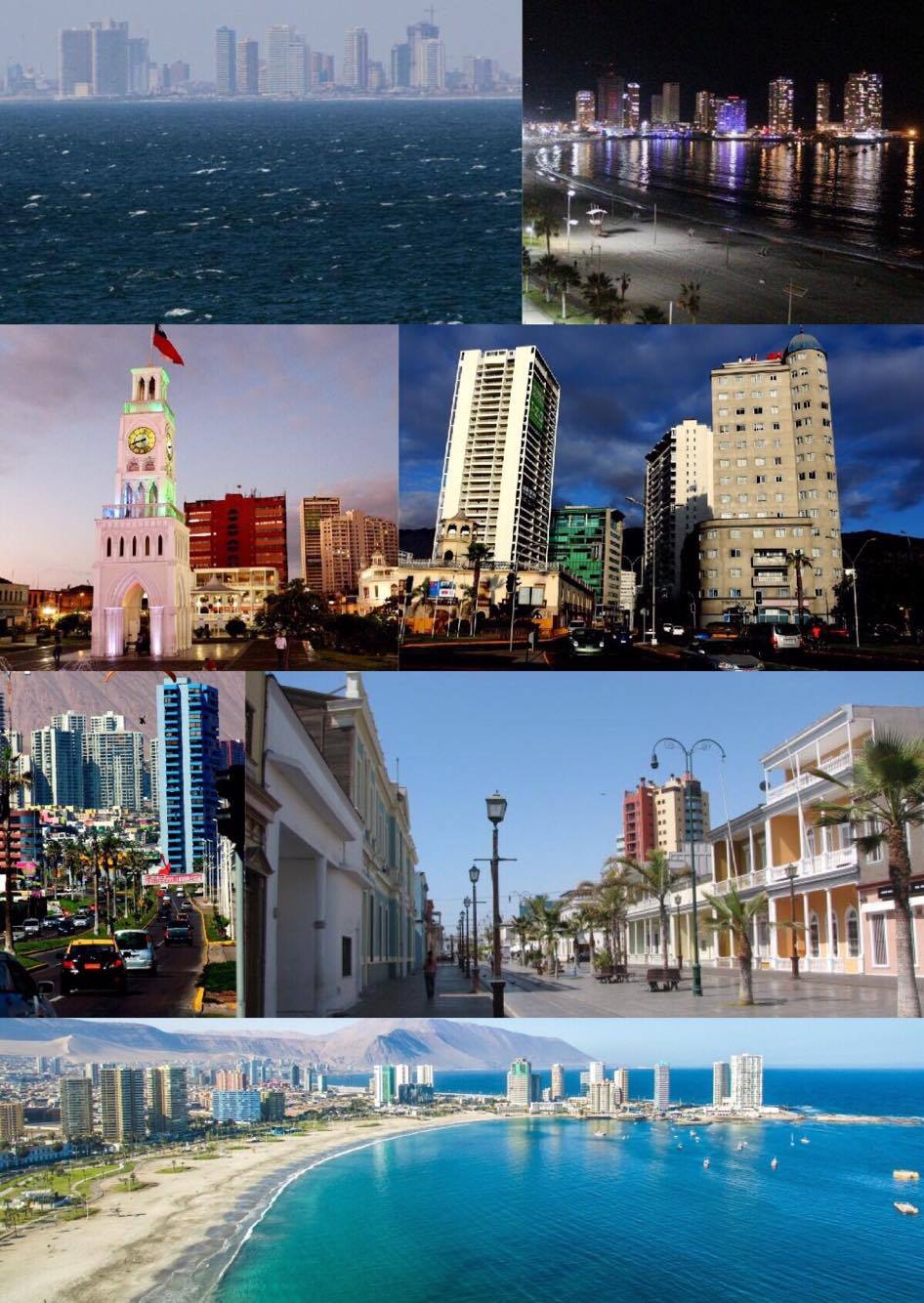
Night view of Iquique from Alto Hospicio.
Iquique Municipal Theater.

Trade is important, as the region serves as a transit point for Chilean products heading toward the northern countries (Peru and Bolivia) and Brazil, due to the existing interoceanic corridor* The Iquique Free Trade Zone (ZOFRI) has spurred commercial development, especially in the sale of automobiles and technological products, which attract a large number of Chileans and foreigners*

The city has three shopping centers (Malls), one of which is Mall Zofri, part of the free trade system that sells retail products exempt from the 19% VAT; another is Mall Plaza Iquique (formerly Mall Las Américas), which includes Falabella and La Polar stores* This business hub hosts more than 1,650 companies that carry out trade operations worth about 4.7 billion USD annually*

Additionally, the city has a well-established service center where large department stores coexist with banks, public entities, and SMEs mostly covering sectors such as manufacturing, retail, and food services* Around Paseo Baquedano, a highly touristic area, businesses and services thrive to meet the needs of local enterprises, making this part of the city a commercial and business hub due to its comparative advantages and the presence of key institutions like the General Police Station and several fire brigades*

Fishing Industry

[edit]

The production of fishmeal and fish oil represents 50% and 60% of the national total, respectively* Industrial fishing, which began in the 1950s, provides the largest contribution to the Gross Geographic Product (26%)* Iquique is Chile’s largest fishing port, accounting for 35% of the nation’s total catch (mainly anchovy and jack mackerel), with 95% of the production destined for oil and fishmeal, and the remaining 5% for canned, frozen, and other products*

Manufacturing

[edit]

The manufacturing industry accounts for 5% of the Gross Geographic Product* Its main activities include shipyards, which have expanded their building capacity — for instance, the Marco Chilena shipyards, which construct both fishing vessels and luxury yachts* The city’s workshops manufacture spare parts and components serving primarily the mining and fishing industries*

Construction

[edit]
The Astoreca Palace in Iquique, reflecting the influence of Spanish colonial architecture.

Civil construction has been the driving force behind Iquique’s growth over the past 15 years, giving the sector a highly dynamic character* However, the lack of available urban land has limited housing development, leading to the dominance of high-rise buildings* Many buildings exceed 25 floors, efficiently using the limited land*

Currently, residential construction projects are concentrated in the southern area, mainly Bajo Molle, but since it lies outside the urban boundary, it lacks proper infrastructure, resulting in fewer housing projects* Another area with major construction activity is the coastal zone — mainly Cavancha and Playa Brava — where the tallest building in the city (37 floors) is being built*

Mining

[edit]

Metallic mining mainly involves copper extraction, which takes place in Quebrada Blanca, Cerro Colorado, and Doña Inés de Collahuasi, which began full production in 1999 and has become one of the world’s largest mines*

Non-metallic mining mainly focuses on Sodium Chloride (common salt), extracted from the Salar Grande salt flat* This mineral has a crystalline body and is nearly pure (98.5% purity)* More than six million tons are extracted annually*

The production of nitrate and iodine is also significant, obtained by recycling old nitrate works in Huara and Pozo Almonte, as well as from new facilities such as Nueva Victoria *

Tourism

[edit]

Tourism is highly important for the city as it represents one of its main projected economic resources* It offers essential natural attractions — a city beach safe for swimming thanks to the protection of the peninsula, a mild climate with pleasant temperatures, scenic desert landscapes, and convenient accommodations*

Its heritage architecture from the nitrate era also adds to its appeal* Iquique has one of the best-developed tourism industries in the country, with the hotel, restaurant, and commerce sectors accounting for 30.68% of the GDP*

Labor Organizations

[edit]

Iquique has numerous and influential labor organizations, many affiliated with the Central Unitaria de Trabajadores (CUT)* The most important include:

  • Port workers’ unions
  • ZOFRI unions
  • Mining unions
  • Commerce unions
  • Public sector unions

Labor movements have also been historically strengthened by events such as the “Santa María Massacre” of December 17, 1907* The main union sectors are:

  • Commerce
  • Public employees
  • Mining
  • Construction, among others

International relations

[edit]

The city of Iquique hosts several international relations institutions, such as the Regional Unit for International Affairs (URAI) of the Regional Government of Tarapacá, responsible for the analysis and management of the region’s bilateral and multilateral relations with neighboring countries Peru and Bolivia, Latin America, and the rest of the world; the Commission on Tourism, Heritage, and International Relations of the Regional Council of Tarapacá; the regional office of the National Migration Service; the regional office of the General Directorate for Export Promotion (ProChile); the Department of Migration and International Police of the Investigations Police of Chile; and the International Relations, and Migrant Office of the Municipality of Iquique.[7]

In the field of international relations and education, the main actors in Iquique are the General Directorate of International Relations and the Institute of International Studies of the Arturo Prat University.[8]

Consulates

[edit]
  •  China (Consulate General)
  •  Spain (Honorary Consulate)
  •  Italy (Honorary Consulate)
  •  Peru (Consulate General)

Demographics

[edit]
Panoramic view of Iquique.

According to the 2002 census of National Statistics Institute (INE), the commune of Iquique had an area of 2,835.3 km2 (1,095 sq mi)[2] and 216,419 inhabitants (108,897 men and 107,522 women). Of these, 214,586 (99.2%) lived in urban areas and 1,833 (0.9%) in rural areas. The township has an area of 2,262.4 km2 (874 sq mi) and a population of 166,204 inhabitants. The population grew by 42.7% (64,742 persons) between the 1992 and 2002 censuses.[2] Iquique is home to 56% of the total population of the Tarapacá region. In 2008, the city had 226,204 inhabitants.

Iquique commune is divided into the following districts:[9]

District 2002 Population Census Area (km2)
Port 3,721 0.8
Industrial District 12,800 65.4
Hospital 11,087 5.1
Caupolicán 19,486 2.2
Playa Brava 18,580 2.1
Cavancha 13,729 1.4
Parque Balmaceda 10,843 1.1
Arturo Prat 10,773 1.0
Punta Lobos 1,592 2,127.8
Gómez Carreño 23,165 1.7
La Tirana 40,428 33.5
Iquique geographical position in the Region of Tarapaca.

There is a significant percentage of residents from different international ethnic groups. The largest communities are Croatian, Italian, Greek, Chinese, Arabic nationalities, Peruvians and Bolivians, British peoples (i.e. Scots), and the French.

In the 1910s and 1920s, about a thousand East Indian (from India and Pakistani) Chile saltpetre mine workers hired by British mine companies appeared in Iquique and today, their descendants are mixed into the local population. [citation needed] Lately, a wave of North American and Australian immigrants came to retire and enjoy the city's beach climate. Immigrants currently make up 9.2% of the total population.[10]

Population evolution of the commune of Iquique:[9]
Year 1992 2002
Population 146,089 166,204
Population evolution of the city of Iquique:[9]
Year 1992 2002
Population 145,139 164,396

Climate

[edit]

Iquique has an unusually mild to warm desert climate (Köppen: BWh) with low extremes of temperatures all year round and almost no rainfall. Due to its abundant cloudiness and coastal location, the climate is often abbreviated to BWn, as opposed to the usual BWh or BWk.[11] It is common for this place to have completely dry years without any precipitation day, making it one of the driest cities in the world, along with Arica.

Climate data for Iquique (1991–2020, extremes 1981–present)
Month Jan Feb Mar Apr May Jun Jul Aug Sep Oct Nov Dec Year
Record high °C (°F) 31.2
(88.2)
30.6
(87.1)
31.1
(88.0)
30.4
(86.7)
28.0
(82.4)
24.1
(75.4)
33.4
(92.1)
31.0
(87.8)
23.4
(74.1)
24.2
(75.6)
25.5
(77.9)
27.8
(82.0)
33.4
(92.1)
Mean daily maximum °C (°F) 25.4
(77.7)
25.9
(78.6)
24.9
(76.8)
22.7
(72.9)
20.5
(68.9)
18.7
(65.7)
17.8
(64.0)
17.8
(64.0)
18.5
(65.3)
19.8
(67.6)
21.5
(70.7)
23.5
(74.3)
21.4
(70.5)
Daily mean °C (°F) 22.0
(71.6)
22.2
(72.0)
21.3
(70.3)
19.5
(67.1)
17.8
(64.0)
16.5
(61.7)
15.6
(60.1)
15.6
(60.1)
16.1
(61.0)
17.1
(62.8)
18.6
(65.5)
20.3
(68.5)
18.6
(65.5)
Mean daily minimum °C (°F) 18.9
(66.0)
18.9
(66.0)
18.1
(64.6)
16.5
(61.7)
15.3
(59.5)
14.5
(58.1)
13.9
(57.0)
13.9
(57.0)
14.4
(57.9)
15.2
(59.4)
16.2
(61.2)
17.5
(63.5)
16.1
(61.0)
Record low °C (°F) 14.8
(58.6)
14.7
(58.5)
13.0
(55.4)
11.7
(53.1)
9.9
(49.8)
8.5
(47.3)
8.3
(46.9)
7.6
(45.7)
9.0
(48.2)
8.5
(47.3)
11.9
(53.4)
12.4
(54.3)
7.6
(45.7)
Average precipitation mm (inches) 0.0
(0.0)
0.0
(0.0)
0.0
(0.0)
0.1
(0.00)
0.3
(0.01)
0.0
(0.0)
0.1
(0.00)
0.2
(0.01)
0.0
(0.0)
0.0
(0.0)
0.0
(0.0)
0.1
(0.00)
0.8
(0.03)
Average precipitation days (≥ 1.0 mm) 0.0 0.0 0.0 0.0 0.0 0.0 0.1 0.1 0.0 0.0 0.0 0.0 0.2
Average relative humidity (%) 66 66 68 70 71 71 71 72 71 70 68 67 69
Mean monthly sunshine hours 317.8 296.2 297.9 252.5 211.4 161.0 151.2 158.2 189.7 235.6 275.7 315.1 2,862.3
Source 1: Dirección Meteorológica de Chile[12][13][14][15]
Source 2: NOAA (precipitation days 1991–2020)[16]

Transport

[edit]

Iquique is served by Diego Aracena International Airport (Spanish: Aeropuerto Internacional Diego Aracena) (IATA: IQQ, ICAO: SCDA). The airport is on the Pacific coast 48 kilometers (30 mi) south of the city.

Sport

[edit]

Iquique is home to football team Deportes Iquique. It hosted the 2016 FIRS Women's Roller Hockey World Cup.

Notable residents

[edit]
[edit]

References

[edit]
[edit]
Revisions and contributorsEdit on WikipediaRead on Wikipedia
from Grokipedia
Iquique is a port city and commune in northern , serving as the capital of both the and Iquique Province, located on the amid the . The province encompasses 2,835 square kilometers and had a projected population of 370,877 as of 2023. Originally a Peruvian territory, Iquique was incorporated into following the country's victory in the (1879–1884), a conflict driven by disputes over nitrate-rich Atacama territories, with the on May 21, 1879, marking a pivotal early naval engagement where the Chilean corvette Esmeralda was sunk by Peruvian forces, contributing to Chile's ultimate control of the coast. The city's economy historically relied on exports during the late 19th and early 20th centuries, fostering rapid growth as a major shipping hub, but shifted post-1930s decline of the industry toward port operations, commerce via the Zona Franca duty-free zone established in 1975, fishing, and tourism drawn to its beaches, dunes, and desert landscapes. Today, the Port of Iquique handles significant cargo, including minerals and seafood exports, underscoring its role as a vital northern gateway for Chilean trade.

Geography and Environment

Location and Topography

Iquique is situated in northern as the capital of both the and Iquique Province. The city lies along the coast at geographic coordinates 20°13′ S, 70°09′ W. Approximately 1,800 kilometers north of Santiago, it occupies a position within the arid coastal zone of the , bordering the to the north and the Tamarugal Province within Tarapacá to the east and south. The of Iquique features a narrow on a rocky extending into the Pacific, backed by steep cliffs of the Cordillera de la Costa. The urban area averages an elevation of 37 meters above , with terrain rising inland toward the Andean . This configuration includes marine terraces south of the city and desert plains, characteristic of the hyper-arid Atacama environment. The natural harbor benefits from protection against open-sea conditions, facilitating port activities amid the otherwise rugged coastal landscape.

Climate and Natural Features

Iquique exhibits a (Köppen BWh) defined by profound and consistently mild temperatures, influenced by its position in the rain shadow of the and the cooling effect of the . Annual averages less than 5 mm, with most years recording no measurable rainfall, making the area among the driest inhabited locales globally. Temperatures remain stable year-round, with daily highs ranging from 20–24°C during the warmer summer months (December–March) and 17–19°C in winter (June–August); lows hover around 15–17°C, rarely dipping below 14°C or exceeding 18°C at night. The coastal camanchaca layer, originating from the Pacific, often persists for hours daily, supplying atmospheric moisture that sustains sparse vegetation on coastal hills despite the absence of rain. Relative averages 70–80%, and is higher in winter, though sunny conditions predominate.
MonthAvg. Max (°C)Mean (°C)Avg. Min (°C)Precip. (mm)
January2118.5160
February2118.5160
March2018160
April1917150
May1816.5150
June1716140
July1715.5140
August1715.5140
September1816140
October1916.5150
November2017.5150
December2018160
The city's natural topography consists of a narrow alluvial at elevations near , hemmed in by the abrupt rise of the to the east, which reaches heights of several hundred meters and transitions into the hyper-arid interior. To the west, the Pacific shoreline features sandy beaches interspersed with rocky promontories, while offshore, the harbor benefits from natural protection by Punta Gruesa peninsula and adjacent islets. Inland surroundings include expansive sand dunes and barren , emblematic of the Atacama's extreme desolation, with the distant visible on clear days. The region lies atop the of the and South American plates, rendering it prone to seismic activity and occasional tsunamis.

History

Pre-Colonial and Colonial Periods

The coastal territory of present-day Iquique was primarily occupied by the Changos, a nomadic indigenous group specializing in marine resource exploitation through fishing, shellfish gathering, and rudimentary mummification practices, with archaeological evidence indicating human presence extending back at least 6,000 years. These settlements featured temporary campsites and shell middens along the arid Pacific shoreline, adapted to the extreme desert conditions of the . Inland areas near seasonal rivers supported Atacameño groups, who engaged in oasis-based agriculture, camelid herding, and trade networks, though their coastal presence was limited compared to terrestrial adaptations. By the late pre-Hispanic period, the region experienced cultural overlays from the (Tiahuanaco) horizon, evident in ceramic artifacts and ceremonial sites, followed by Inca imperial expansion around the , which integrated Tarapacá through administrative outposts and road systems like the Inca coastal trail. Inca influence introduced labor systems and agricultural terraces, but the area remained peripheral, with local Changos and Atacameños retaining semi-autonomous practices amid resource extraction demands. Spanish colonization reached the zone in the mid-16th century as part of the of Peru's southern extensions, with Iquique emerging as a minor anchorage rather than a fortified enclave. The settlement functioned as a rudimentary port for exporting salt and fish products, sustaining sparse Spanish and populations through coastal trade routes linking to and silver mines, yet it saw negligible urban growth or evangelization efforts due to the harsh environment and low indigenous density. Administrative oversight fell under Peruvian intendancies, with limited development until post-independence guano booms, reflecting the periphery status of northern desert frontiers in colonial resource priorities.

Acquisition During the War of the Pacific

Iquique, as the principal port of Peru's Tarapacá Province, became a strategic objective for Chile during the War of the Pacific (1879–1884), fought primarily over control of nitrate deposits in the Atacama Desert region. Chilean forces initiated a naval blockade of Iquique in early 1879 to disrupt Peruvian supply lines and exports. On May 21, 1879, Peruvian ironclads Huáscar and Independencia engaged the blockading Chilean corvette Esmeralda and schooner Covadonga offshore, sinking the Esmeralda in a tactical victory for Peru that temporarily lifted the blockade. However, the Covadonga escaped, and subsequent Chilean naval successes, including the capture of Huáscar at the Battle of Angamos on October 8, 1879, secured maritime dominance and enabled large-scale amphibious landings. With naval superiority established, Chile launched the Tarapacá Campaign to seize the province's nitrate fields and ports. On November 2, 1879, approximately 8,000 Chilean troops under General Erasmo Escala conducted an amphibious assault at Pisagua, about 100 kilometers north of Iquique, defeating a smaller Peruvian contingent in the Battle of Pisagua and establishing a . Chilean forces then advanced southward, repelling Peruvian and Bolivian counterattacks at battles including Dolores on November 7 and (also known as Agua Santa) on November 19. By November 23, 1879, unopposed Chilean troops entered and occupied Iquique itself, effectively annexing Tarapacá Province during the ongoing conflict. The occupation of Iquique provided with control over vital nitrate export facilities, bolstering its through seized Peruvian assets and production. Peruvian resistance in the region collapsed, with local forces withdrawing inland, allowing to consolidate administrative and economic dominance in the area until the war's formal resolution via the Treaty of Ancón in 1883, which ceded Tarapacá to permanently. This acquisition shifted the regional balance, denying and access to Pacific trade routes and resources critical to their alliance's sustainment.

Nitrate Boom, Labor Dynamics, and Economic Shifts

Following Chile's victory in the (1879–1883), which incorporated the Peruvian province of Tarapacá into Chilean territory, Iquique emerged as the principal port for exporting (salitre) extracted from the Atacama Desert's deposits. The nitrate industry expanded rapidly in the 1880s, fueled by European demand for fertilizer and explosives, with production infrastructure including railways like the 1871 Nitrate Railway linking Iquique to interior oficinas (processing plants). By the early 1900s, Tarapacá's nitrate output constituted a significant portion of Chile's exports, peaking nationally at 3.1 million metric tons in 1928, though regional booms centered around Iquique drove urban growth, including grand architecture funded by nitrate wealth. Foreign capital, primarily British, dominated operations, constructing processing facilities such as those at Humberstone, 45 km from Iquique, operational from 1872 into the mid-20th century. Labor in the nitrate sector relied on the enganche , a form of debt peonage that recruited transient workers from , , , and even , subjecting them to harsh conditions, long hours, and rudimentary housing in company towns called pampinos. Wages were low relative to risks, including dust inhalation and isolation, prompting organized resistance; in 1907, over 10,000 dockworkers and miners converged on Iquique for a strike demanding higher pay, better conditions, and abolition of the company store monopoly. The Chilean Army's response culminated in the Santa María School massacre on December 21, 1907, where troops fired on assembled strikers, killing hundreds to thousands (estimates vary due to suppressed records), an event that galvanized labor movements but entrenched elite control over the industry. The boom faltered after due to the Haber-Bosch process enabling synthetic production, which undercut natural exports starting around 1914 and accelerating in the 1920s. Chile's heavy reliance on revenues—without diversification—exacerbated the 1929 global crisis, leading to oficina closures, mass in Tarapacá, and population outflows from Iquique as production collapsed by the 1930s. This shift prompted nascent economic pivots toward , commerce, and later , though Iquique's port retained strategic value amid lingering social tensions from labor exploitation.

20th and 21st Century Developments

In the early , Iquique was marked by intense labor unrest in the nitrate sector, culminating in the on December 21, 1907, when Chilean military forces under Roberto Silva Renard opened fire on approximately 10,000 striking nitrate workers, their families, and supporters gathered in the school, killing an estimated 2,000 to 3,600 people in one of the deadliest episodes of Chilean . This event, triggered by demands for better wages and conditions amid the industry's boom, symbolized broader worker struggles against exploitative pampino labor dynamics and foreign-dominated enterprises. The nitrate industry's dominance waned after due to competition from synthetic nitrates developed via the Haber-Bosch process, causing severe economic contraction in Iquique and the . Exports plummeted, leading to widespread and a demographic collapse, with nitrate-dependent cantons losing 28% of their population between 1930 and 1940 as workers migrated southward. By the mid-20th century, Iquique shifted toward port activities, , and limited , though persistent underscored the challenges of transitioning from mono-export reliance. Economic revitalization accelerated in the late with the creation of the Zona Franca de Iquique (ZOFRI) in 1975, designed to leverage the city's strategic Pacific location for duty-free trade and re-exports to , , and beyond. Well-administered and benefiting from access to Andean markets, ZOFRI expanded to encompass over 1,700 businesses by the early , employing around 30,000 people and generating annual sales exceeding $2 billion through commerce in , textiles, and consumer goods. This mitigated earlier decline, fostering and improvements, including expansions that handled increasing cargo volumes. In the , Iquique experienced steady growth in population and trade, driven by ZOFRI's role in and diversification into services and , though vulnerabilities persisted. A magnitude 8.2 struck 93 km northwest of the city on , 2014, generating a that damaged quays, over 13,000 homes, and caused six deaths from collapsing structures or debris. Recovery efforts, supported by national and international aid, emphasized seismic resilience, with the resuming operations swiftly and the rebounding through sustained FTZ activity and mining-related . By the , Iquique's GDP contributions from and solidified its status as northern Chile's commercial hub, despite challenges like informal trade and environmental pressures from desert waste accumulation.

Governance and Politics

Administrative Structure

Iquique operates as a comuna, the fundamental local in , situated within Iquique Province of the . The communal government, known as the Ilustre Municipalidad de Iquique, manages essential services including , , urban infrastructure, , and local security, deriving authority from national laws on municipal organization. Executive leadership is provided by the , elected by direct popular vote for a four-year term, who oversees daily administration, policy implementation, and representation of the commune. Mauricio Soria Macchiavello has held this position since December 2016, securing re-election in October 2024 with 39.38% of votes for a third consecutive term ending in 2028. The Concejo Municipal functions as the deliberative body, consisting of 10 concejales elected concurrently with the alcalde to approve budgets, enact local ordinances, and exercise fiscal oversight. The administrative apparatus is structured hierarchically under the alcalde, featuring a Secretaría Municipal for coordination and specialized direcciones for areas such as administration and finances, , transit and transportation, , and . Three Juzgados de Policía Local adjudicate minor offenses, traffic disputes, and community bylaws, ensuring localized enforcement. This framework supports operational efficiency, with detailed attributions outlined in the municipal organigram updated periodically.

Local Political Landscape and Policy Impacts

The municipal government of Iquique is led by Mauricio Macchiavello, an who assumed office in December 2016 and was re-elected on October 27, 2024, with 39,179 votes representing 39.38% of the valid ballots in a field of multiple candidates supported by various coalitions. The 2024 municipal elections reflected a fragmented political environment, with the 10-member council featuring representatives from center-right and independent lists, including Domingo Leonardo Campodónico Saluzzi of the Republicanos-affiliated bloc who secured 5,496 votes, alongside members from coalitions like and independents. Local politics prioritizes border-related challenges, with right-leaning and independent voices emphasizing security and economic amid national left-leaning governance under President . Public security policies dominate the agenda, driven by elevated crime rates linked to irregular migration flows from Bolivia, Peru, and beyond, which have strained urban resources and informalized sectors of the economy. The municipality's Plan Comunal de Seguridad Pública 2024-2026, implemented via the Dirección de Prevención y Seguridad Pública established in 2020, focuses on coordinated patrols, community prevention programs, and intelligence-sharing with the Policía de Investigaciones de Chile (PDI) to target drug trafficking and petty crime hotspots. These measures have facilitated operations like the October 2025 meeting between Mayor Soria and PDI regional chief Mauricio Jorquera to enhance migrant-related enforcement, though quantifiable reductions in crime indices remain limited by ongoing border porosity. Migration policies at the local level highlight tensions between humanitarian needs and economic safeguards, with the municipality repeatedly urging the national government to fulfill commitments for migrant shelters to alleviate pressures on services and commerce. In August 2021, Mayor Soria emphasized how unregulated migrant vending competes with formal microenterprises, contributing to revenue losses in the Zona Franca de Iquique (ZOFRI) and exacerbating informal economies that undermine tax collection and labor standards. While limited municipal integration initiatives exist—such as basic registration drives—broader impacts include overcrowded housing in peripheral areas like Alto Hospicio and heightened social friction, with policies favoring of irregular entrants over expansive regularization to preserve the port city's trade competitiveness. Economic policies reinforce Iquique's role as a free trade hub, with municipal advocacy for infrastructure investments in the port and ZOFRI to counter migration-induced disruptions, including informal commerce that dilutes formal retail sales estimated at billions in annual turnover. These efforts, including tax incentives and urban revitalization along Baquedano Boulevard, have supported diversification into logistics and tourism, but persistent informal migration has slowed formal job growth in services, where low-skilled migrant labor fills gaps yet intensifies wage competition and undeclared work. Local governance critiques national migration laxity for amplifying these effects, prioritizing causal links between border control failures and fiscal strains on municipal budgets exceeding millions in annual social spending.

Economy

Historical Economic Foundations

Iquique's economic foundations were established in the early through the exploitation of (saltpeter) deposits in the surrounding , initially under Peruvian control. Commercial began around 1812, with companies operating inland from the port to extract the compound for production, marking the shift from minor coastal to resource . By the , British investors were actively processing nitrates in the region, leveraging Iquique as a key outlet despite its sparse population and rudimentary infrastructure prior to this period. The industry's growth accelerated in the , with the inauguration of the first railway in mid-1871 linking Iquique to the La Noria mining district, enabling efficient transport of raw materials to the port for shipment abroad. This infrastructure development solidified Iquique's role as the principal for Tarapacá's output, which by the late constituted a vital source for , though labor-intensive extraction relied heavily on Chilean migrant workers even before territorial changes. Chile's annexation of Iquique following the (1879–1883) entrenched nitrates as the cornerstone of the city's , transforming it into Chile's fourth-largest urban center by the through booming exports that peaked at over 70% of national totals by 1913. British merchant houses dominated trade and factory management in Iquique, financing operations and handling shipments, which underscored foreign capital's foundational influence amid local reliance on pampino laborers in the oficinas (processing plants). This dependency, while driving rapid and wealth accumulation, exposed the to global market volatility, setting patterns for later diversification challenges.

Modern Sectors: Port Operations, Free Trade Zone, and Diversification

The of Iquique serves as a critical gateway for northern Chile's exports, primarily handling bulk cargoes such as fishmeal, concentrates, and nitrates, alongside general and limited traffic. Managed by Empresa Portuaria de Iquique, it supports regional and industries by facilitating efficient loading and unloading operations, with anchorage durations varying significantly; for instance, the average stay reached a peak of 5.2 days in March 2023 due to congestion factors but dropped to 0.1 days by October 2024, reflecting improved operational fluidity. movements at the have shown upward trends in recent years, driven by demand from Andean trade partners, though specific throughput volumes remain modest compared to larger Chilean ports like , emphasizing its niche role in specialized bulk handling rather than high-volume containers. The Zona Franca de Iquique (ZOFRI), established as Chile's premier , operates on 240 hectares and hosts over 1,600 companies engaged in retail, manufacturing, and logistics, benefiting from exemptions on corporate , VAT on first sales, and customs duties for processed within the zone. This regime has positioned ZOFRI as the primary driver of Tarapacá region's commerce, generating approximately 17,000 direct jobs as of recent assessments and contributing to sales volumes exceeding $264 million USD in the ZOFRI mall alone by 2018, though updated figures indicate sustained retail dominance in imported like and apparel. While initial incentives spurred economic takeoff post-nitrate era, their long-term efficacy has waned amid global competition, prompting critiques from bodies like the World Bank that infrastructure limitations hinder fuller potential, yet ZOFRI remains integral, channeling imports for re-export to and . Efforts to diversify Iquique's beyond and free zone dependencies focus on leveraging geographic assets for , services, and emerging renewables, amid recognition that overreliance on zones risks stagnation. promotion targets the Atacama Desert's attractions, including beaches and historical sites, to bolster service-sector growth, while proximity to lithium-rich salars supports logistics and processing hubs, with solar initiatives emerging within ZOFRI extensions. Regional strategies emphasize knowledge-intensive services for , such as maintenance and tech support, to capture spillovers from and future battery minerals, though challenges persist: a 2017 World Bank review highlighted inadequate infrastructure constraining broader industrial shifts, and diversification remains nascent, with commerce still dominating local GDP contributions. These initiatives align with national policies favoring targeted interventions over pure to foster non-traditional exports, underscoring causal links between policy design and sectoral expansion in resource-adjacent economies.

Demographics and Society

The population of the Iquique commune increased from 166,204 in the 2002 census to 191,468 in the 2017 census, reflecting steady urban expansion driven by employment in port activities and the free trade zone. This growth rate of roughly 15% over 15 years outpaced the national average, amid Chile's overall population rise from 15.1 million to 17.6 million in the same period. By 2024, estimates placed the city proper at 231,962 residents, continuing the upward trend despite national deceleration in fertility rates. Demographically, Iquique's composition mirrors Chile's national profile, with approximately 88.9% identifying as white or non-indigenous and 11.1% as , predominantly heritage blending European and native ancestries. In the , Aymara communities form a notable subset of the indigenous population, exceeding the national Aymara proportion of 0.7% due to historical Andean ties and proximity to . Foreign-born residents constitute a significant share, around 10% as of , mainly and attracted to trade and labor opportunities, higher than the national immigrant rate of about 9% in 2020. Recent national data indicate ongoing inflows from and , though northern regions like sustain elevated migrant densities from neighboring Andean countries.

Migration Patterns and Social Integration

During the late 19th and early 20th centuries, Iquique's nitrate boom drove significant internal and , transforming the city from a small into a bustling hub. The population of the region, including Iquique, surged from approximately 2,000 in 1875 to 234,000 by 1907, fueled by demand for labor in extraction and export. This era attracted European immigrants, notably Croats who arrived in the second half of the to work in saltpeter mines, establishing enduring communities with cultural institutions like the Club Croata. Neighboring and also migrated in large numbers, drawn by economic opportunities in a territory previously under Peruvian and Bolivian control before Chile's annexation in 1879–1883. These groups integrated through labor participation and family networks, contributing to urban development, though tensions arose from exploitative working conditions and strikes, such as the 1907 Iquique massacre. In the mid-20th century, migration slowed as the industry declined, shifting toward internal Chilean flows for and jobs. Peruvian immigration persisted as the largest group nationally, comprising about 14.6% of Chile's by 2020, with many settling in northern like Iquique due to geographic proximity and shared labor markets. Bolivians followed, often in informal cross-border , reflecting historical ties despite territorial disputes. Contemporary patterns feature a sharp rise in irregular migration since 2018, particularly via the Bolivia-Chile border, with (home to Iquique) recording 17.5% foreign-born residents by 2023, up from 2% in 2013. dominate at 49% of foreigners in the region, alongside , , and , driven by and political instability in origin countries. This influx, peaking during the 2021–2023 crisis, overwhelmed local infrastructure, leading to informal settlements and humanitarian responses from UNHCR and Caritas Chile. Social integration of historical migrants like Croats succeeded via economic assimilation and community organizations, fostering multicultural enclaves without widespread backlash. In contrast, recent arrivals face barriers including precarious informal employment, housing shortages, and labor exploitation, exacerbating and local protests in Iquique, where residents cited crime spikes and resource strain as causal factors in 2021 unrest. regularization efforts and NGO programs aid job placement and cultural orientation, but rapid demographic shifts—foreigners comprising over 10% nationally by 2024—have cooled initial hospitality, with surveys showing declining support for expanded . Causal realism underscores that unchecked border flows, absent robust vetting, strain social cohesion in low-capacity regions like Tarapacá, where integration hinges on enforceable policies over open reception.

Infrastructure and Connectivity

Transportation and Port Facilities

The Port of Iquique functions as the principal maritime hub for northern Chile's , facilitating exports of minerals such as copper concentrates, fishmeal, and bulk goods while supporting imports through the adjacent Zofri . It comprises seven wharves for general cargo and containers alongside two dedicated oil terminals for petroleum products, with infrastructure enabling berthing of vessels up to 50,000 deadweight tons (DWT). Key operations are managed by Iquique Terminal Internacional (ITI), which controls 140,000 square meters of operational yard space across multiple berths totaling 624 meters in length and 11.4 meters in depth, supported by six mobile harbor cranes for efficient and cargo handling. In 2024, ITI processed 307,138 twenty-foot equivalent units (TEU) and 2,500,461 metric tons of , reflecting steady throughput driven by regional and activities. Diego Aracena International Airport (IATA: IQQ), situated approximately 35 kilometers south of the city center along the , serves as the region's primary air gateway and ranks as Chile's third-busiest airport by passenger volume, trailing only Santiago and facilities. It features a 3,000-meter suitable for domestic jets and limited international routes, primarily connecting Iquique to Santiago, regional hubs, and occasional flights to and , with infrastructure handling around 1.2 million passengers annually in recent years. Road connectivity centers on Ruta 1, the coastal segment of the , linking Iquique northward to and southward to , while inland Ruta 16 provides access to mining districts in the . Expansions under public-private concessions include widening a 100-kilometer stretch of Ruta 5 (overlapping northern access) and constructing a 10-kilometer around Pozo Almonte to alleviate congestion, with projects advancing as of 2025. Public transit within the relies on an extensive network of micro-buses (local routes), taxis, and colectivo shared vans, offering affordable intra-urban mobility without a centralized rail commuter system. Limited rail infrastructure exists, primarily historical remnants from the nitrate era, with modern usage confined to freight spurs serving and industrial zones; a tourist-oriented Trans-Atacama operates scenic excursions into the interior, enhancing connectivity for visitors but not routine commuters.

Urban Planning and Development Challenges

Iquique's urban development has been strained by rapid driven by its and economy, leading to uncontrolled expansion and a proliferation of informal settlements known as campamentos. These settlements, often located on steep escarpments or in high-risk peripheral zones, have expanded due to shortages and migration, with Hospicio—adjacent to Iquique—exemplifying linear informal growth patterns that strain municipal resources. As of 2024, challenges include insufficient planning instruments for the newly designated of Iquique- Hospicio, resulting in peripheral neighborhoods lacking basic services, equipment, and connectivity. The city's location in a seismically active zone exacerbates planning vulnerabilities, as evidenced by the 2014 Mw 8.1 Iquique earthquake, which highlighted issues like urban micro-obstructions—such as sidewalk encroachments and narrow pedestrian routes—that impede evacuations. Informal settlements in northern Iquique are particularly exposed to seismic threats, landslides, and proximity to industrial port activities, complicating disaster amid ongoing housing deficits. Limited green spaces and overcrowded public assembly areas further hinder post-disaster response, underscoring the need for integrated planning. Water scarcity poses a chronic developmental barrier in this Atacama Desert locale, classified as high-risk, with reliance on limited desalination and imports straining infrastructure amid urban expansion. Accelerated growth without territorial foresight has fueled irregular land occupations and environmental pressures, including dust pollution and inadequate mobility networks, as noted in 2024 citizen dialogues on regional planning. Addressing these requires coordinated metropolitan governance to prioritize risk-informed zoning and service equity over ad-hoc development.

Culture and Leisure

Cultural Heritage and Traditions

The cultural heritage of Iquique is prominently embodied in its historic district, particularly the Amunátegui neighborhood and Baquedano Street, which feature wooden architecture constructed during the late 19th and early 20th-century nitrate boom using Oregon pine in Balloon Frame and American styles. These structures, including the Palacio Astoreca (now a cultural center) and the Municipal Theater built in 1890, reflect the city's prosperity as a key export hub and were designated a Typical Zone—a protected heritage category—by Chile in 1977. The preservation of these sites underscores Iquique's role in Chile's industrial history, with ongoing efforts to maintain them against seismic risks inherent to the region's at-risk location. Intangible traditions in Iquique draw from Andean indigenous roots, European immigrant influences, and Catholic , evident in regional festivals like the Fiesta de La Tirana held annually from July 12 to 18 in the nearby town of La Tirana, 70 kilometers inland. This event, honoring the Virgen del Carmen, attracts over 250,000 participants with dances—ritual performances blending Aymara pre-Columbian elements, Spanish colonial devil motifs, and brass-percussion music—originating from a 16th-century of an indigenous leader's conversion. Local customs include the May 21 commemoration of the 1879 , featuring naval parades and wreath-laying at Plaza 21 de Mayo to honor Captain , reinforcing national maritime identity. Immigrant communities, such as Croatian descendants who established cultural clubs and the Plaza Slava, contribute through preserved European folk practices amid the city's multicultural fabric shaped by nitrate-era migrations. Everyday traditions reflect port-city life, including the afternoon adapted to heat and seasonal carnivals at El Morro hill with allegoric floats, alongside parades of decorated vehicles distributing , fostering community bonds in a historically transient . Aymara influences persist in Tarapacá's broader cultural context, with regional events promoting indigenous crafts and rituals, though urban Iquique's traditions increasingly integrate modern while safeguarding against dilution from .

Sports, Tourism, and Recreation

Club de , the city's primary professional football team, competes in the , drawing local support through matches at Estadio Tierra de Campeones, a modern venue known for its energetic atmosphere during games. The stadium hosts not only football but also occasional international events, reflecting Iquique's role in regional sports. events, such as the 2025 Americas Triathlon Cup, leverage the city's calm ocean waters at Playa Cavancha, flat cycling routes, and scenic coastal paths, positioning Iquique as a venue for multi-sport competitions. Tourism in Iquique centers on its coastal and desert landscapes, with Playa Cavancha serving as a key draw for sunbathing, swimming in relatively temperate Pacific waters, and water-based pursuits like jet skiing and diving to explore underwater sites. The Zona Franca attracts visitors for duty-free shopping, while the nearby Humberstone mining , a , offers historical tours highlighting the region's 19th-century industrial past. Culinary tourism features fresh seafood at markets like the Centenario Market, emphasizing local traditions. Recreational activities emphasize adventure sports suited to Iquique's geography, including down the expansive dunes of Cerro Dragón, the world's largest urban dune, which provides panoramic views and adrenaline experiences. at Cavancha Beach benefits from consistent waves, while kitesurfing, from coastal cliffs, and capitalize on steady winds and sandy shores. These pursuits, often combined with eco-tours to nearby geoglyphs or geysers, underscore the blend of urban accessibility and natural extremes in the Atacama Desert setting.

Notable Figures

Arturo Godoy (1912–1986), born in Iquique on October 10, 1912, was a professional heavyweight boxer who achieved international prominence, winning the South American heavyweight title and challenging for the world heavyweight championship on two occasions in 1940, both bouts ending in close decisions favoring Louis. His professional record stood at 89 wins, 21 losses, and 12 draws over a career spanning from 1930 to 1951, marked by successful stints in , , and the . Godoy's resilience and skill elevated boxing's profile in and , though he faced financial hardships later in life before returning to Iquique. Antonio Prieto (1926–2011), born Juan Antonio Espinoza Prieto in Iquique on May 26, 1926, emerged as one of Chile's most celebrated singers and actors, earning the moniker " of " for his smooth vocal style and widespread popularity across in the 1950s and 1960s. Prieto debuted in film with Murió hace quince años in 1954 and released numerous hit recordings, including that topped charts in multiple countries, while also performing in theater and television. His career bridged music and entertainment, influencing subsequent generations of Latin artists until his death in Santiago on July 14, 2011. Other figures include Brayan Cortés, a professional footballer born in Iquique in 1995, who has played as a goalkeeper for and the Chile national team, contributing to the city's sporting tradition. Local historical associations also tie Iquique to (1848–1879), the naval commander killed in the Battle of Iquique during the on May 21, 1879, whose heroism became a , though Prat was born in .

Controversies and External Relations

Territorial Disputes with Bolivia and Peru

The territorial incorporation of Iquique into originated from the (1879–1884), a conflict sparked by economic rivalries over nitrate-rich desert territories along the . 's 1878 decree imposing a ten-centavo per of on Chilean-owned companies in the Antofagasta region, previously set at four centavos, prompted to occupy on February 14, 1879, leading to declare war on March 23, 1879. , bound by a secret 1873 treaty of alliance with , joined the conflict, escalating it into a war over the Peruvian province of Tarapacá—where Iquique served as the capital—and 's coastal . Chilean naval superiority enabled early advances, including the occupation of Iquique after landing at nearby Pisagua on November 2, 1879, securing control over Tarapacá's ports and nitrate fields. The Battle of Iquique on May 21, 1879, saw the Peruvian ironclad Huáscar defeat the Chilean corvette Esmeralda, but Chile's subsequent victories, such as at Angamos on October 8, 1879, shifted momentum. By 1880, Chilean forces had occupied much of Tarapacá, disrupting Peruvian and Bolivian supply lines. The war concluded with Peru's defeat, formalized by the Treaty of Ancón on October 20, 1883, which ceded Tarapacá Province—including Iquique—to "in perpetuity," resolving Peru's territorial claims over the area. Bolivia, having lost its Litoral coast to via the 1884 truce and the 1904 Treaty of Peace and Friendship, became landlocked, with the treaty recognizing Chilean sovereignty but allowing Bolivia to maintain claims for sovereign Pacific access. Peru's land border claims with were largely settled post-war, though maritime delimitations persisted until the of Justice's 2014 ruling adjusted exclusive economic zones without altering land territories. Bolivia's demands for access, pursued through diplomatic channels and a 2013 ICJ case alleging Chile's obligation to negotiate, were rejected in 2018, as the court found no legal duty under the 1904 treaty. These Bolivian assertions focus on restoring coastal sovereignty near , adjacent to Tarapacá, but have fueled regional tensions without directly challenging Iquique's status.

Historical Labor Conflicts and Their Legacy

In the late 19th and early 20th centuries, Iquique served as a key for Chile's nitrate export industry, attracting thousands of migrant workers to the mines under harsh conditions including low wages, long hours, and exploitative enganche labor recruitment systems that bound workers through debt. Strikes emerged as workers sought improvements, with a notable 1891 action involving nitrate laborers protesting and demanding legislative protections amid economic crises. However, the most significant conflict occurred in , when approximately 10,000 to 15,000 nitrate miners and longshoremen converged on Iquique from various offices, striking for an eight-hour workday, salary increases, abolition of company stores, and . Tensions escalated as strikers occupied the Santa María School in Iquique's port area, refusing government orders to disperse; on December 21, 1907, Chilean Army troops under General Roberto Silva Renard fired on the unarmed crowd, including women and children, resulting in an estimated 2,000 to 3,600 deaths based on contemporary reports and later investigations, though official figures claimed fewer. The massacre stemmed from state prioritization of nitrate production stability—vital to Chile's and foreign investors—over worker grievances, reflecting broader patterns of military intervention to suppress labor unrest in the sector. Similar repressions occurred elsewhere, such as the 1921 San Gregorio , underscoring systemic violence against organized workers. The 1907 events catalyzed Chile's labor movement by exposing state-corporate alignment against workers, fostering anarchist and socialist organizing that pressured for reforms like the 1924 labor code establishing union rights and . Their legacy persists in cultural memory, commemorated through folk songs, the 1969 cantata La Cantata Santa María de Iquique by Luis Advis—which drew on historical accounts to depict the tragedy—and annual memorials that highlight ongoing northern labor vulnerabilities tied to extractive industries. Despite this, the massacres delayed comprehensive worker protections until mid-20th-century political shifts, illustrating how economic dependence on nitrates perpetuated conflict over structural inequities.

References

Add your contribution
Related Hubs
User Avatar
No comments yet.