


Community hub
Recent from talks
Contribute something
Nothing was collected or created yet.
Issaquah, Washington
View on Wikipedia
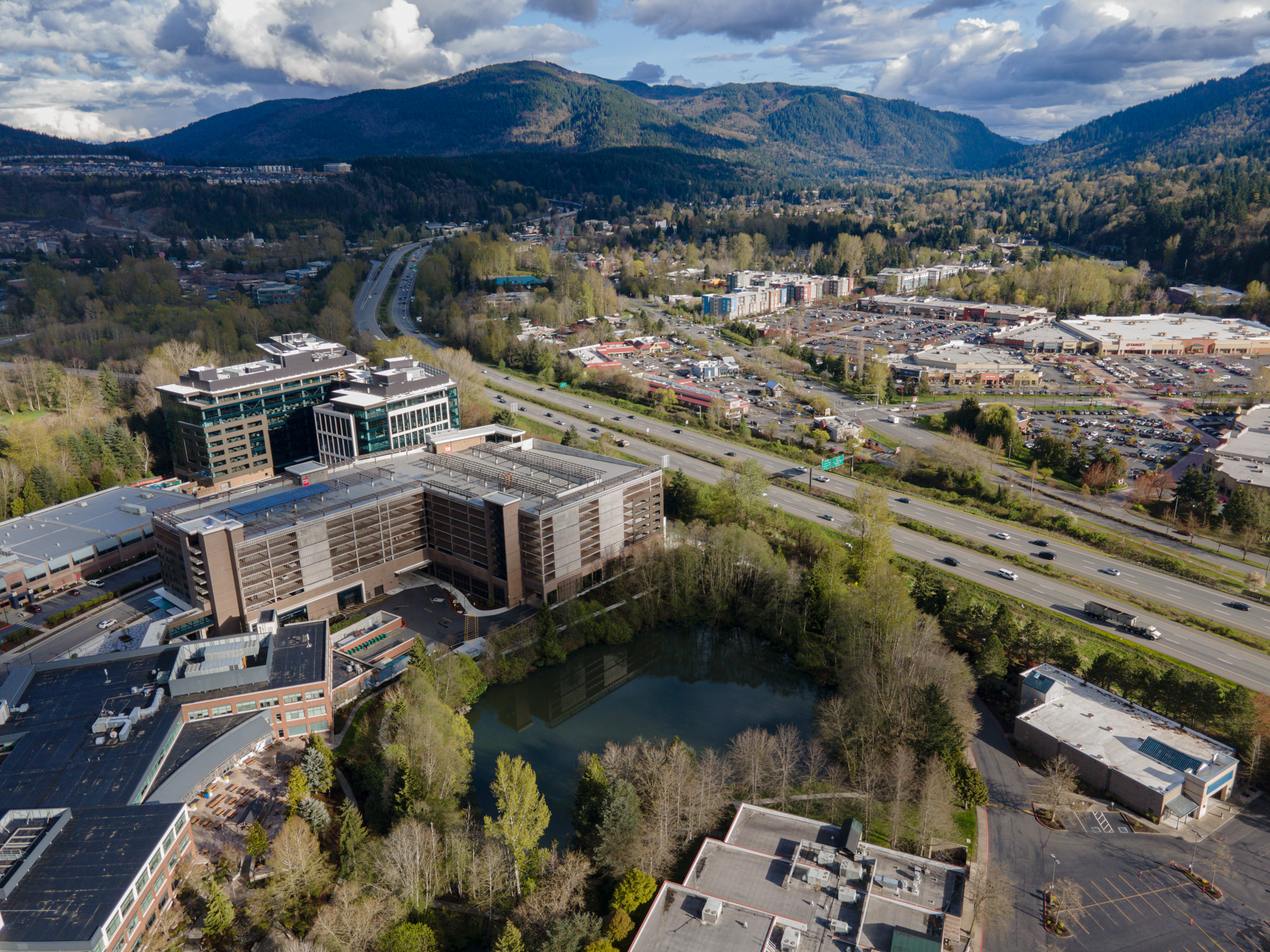
Issaquah (/ˈɪsəkwɑː/ ISS-ə-kwah) is a city in King County, Washington, United States. The population was 40,051 at the 2020 census.[5] Located in a valley and bisected by Interstate 90, the city is bordered by the Sammamish Plateau to the north and the "Issaquah Alps" to the south. It is home to the headquarters of the multinational retail company Costco Wholesale Corporation. Issaquah is included in the Seattle metropolitan area.
Key Information


History
[edit]
 | This section needs additional citations for verification. (April 2023) |
"Issaquah" is an anglicization of the Southern Lushootseed placename /sqʷáxʷ/, meaning either "the sound of birds", "snake", or "little stream". "Squak Valley", an older name for the area, also derives from this same Native American name.[8][9][10]
In September 1885, the then-unincorporated area was the scene of an attack on Chinese laborers who had come to pick hops from local fields.[11] Three of the laborers died from gunshot wounds; seven attackers were indicted, but they were later acquitted or charges were dropped.[11][dubious – discuss]
Shortly after becoming known as Squak, the town was briefly renamed to Gilman, an homage to Daniel Hunt Gilman, who brought railways to the town.[12][13]
The city was officially incorporated by the Washington State legislature on April 29, 1892.[12] Initially a small mining town, the city has changed noticeably both in its appearance and economic focus. Issaquah was originally developed to service the mining industry (on the two nearby mountains that now lend their names to the Cougar/Squak Corridor Park). As the mining deposits neared depletion in the late 1890s, other companies started to realize Issaquah's potential to support a lucrative lumber business. These companies exported timber from Issaquah and other small, local towns to Seattle and larger, rapidly growing communities throughout western Washington. These early boom industries, however, faded into a period of relative quiet by the time of the Great Depression.
The town's industries remained similar through most of the twentieth century, with Boeing providing the majority of employment in the area. Microsoft and other technological industries moved into Redmond and other cities in the area, and later established operations in Issaquah itself.[citation needed] In June 1996, Costco moved its global headquarters to Issaquah from nearby Kirkland.[14]
Geography
[edit]Issaquah is located 15 miles (24 km) east-southeast of Seattle at the south end of Lake Sammamish. Its neighboring cities are Bellevue to the west and Sammamish to the north. Issaquah resides within the Mountains to Sound Greenway.
According to the United States Census Bureau, the city has a total area of 11.40 square miles (29.53 km2), of which 11.38 square miles (29.47 km2) are land and 0.02 square miles (0.05 km2) are water.[15]
Issaquah is surrounded on three sides by what are known locally as the Issaquah Alps: Cougar Mountain on the west, Squak Mountain to the south, and Tiger Mountain to the southeast. To the north of Issaquah is Lake Sammamish. Cougar and Squak Mountains are home to sizable neighborhoods on their lower slopes, though the bulk of all three mountains are preserved in public ownership as Squak Mountain State Park,[16] Cougar Mountain Regional Wildland Park,[17] West Tiger Mountain NRCA,[18] and Tiger Mountain State Forest.[19] Geologists have noted the chemical and geological content of these three mountains to be much different from that of the Cascade Range, because they are not volcanic in origin, while the entire Cascade Range is postulated to have formed from volcanic action. They[who?] believe that these three mountains are the remains of a much older mountain range long since eroded by earthquakes, volcanic action, and shifting plates.[citation needed]
Climate
[edit]Issaquah has a warm-summer Mediterranean climate (Köppen: Csb) with chilly, extremely wet winters and warm, moderately humid summers. Although there is no dry season in Issaquah, winters are many times wetter than the summers. Rainfall amounts are extremely similar to the neighboring city of Sammamish, which is 0.06 inches wetter overall, with the same summer rain amounts.
| Climate data for Issaquah, Washington | |||||||||||||
|---|---|---|---|---|---|---|---|---|---|---|---|---|---|
| Month | Jan | Feb | Mar | Apr | May | Jun | Jul | Aug | Sep | Oct | Nov | Dec | Year |
| Record high °F (°C) | 67 (19) |
75 (24) |
79 (26) |
90 (32) |
97 (36) |
108 (42) |
100 (38) |
102 (39) |
98 (37) |
95 (35) |
75 (24) |
67 (19) |
108 (42) |
| Mean daily maximum °F (°C) | 47 (8) |
50 (10) |
54 (12) |
58 (14) |
64 (18) |
69 (21) |
75 (24) |
76 (24) |
70 (21) |
60 (16) |
51 (11) |
45 (7) |
60 (16) |
| Mean daily minimum °F (°C) | 36 (2) |
35 (2) |
37 (3) |
40 (4) |
46 (8) |
51 (11) |
54 (12) |
53 (12) |
48 (9) |
43 (6) |
38 (3) |
34 (1) |
43 (6) |
| Record low °F (°C) | −1 (−18) |
−3 (−19) |
8 (−13) |
24 (−4) |
26 (−3) |
31 (−1) |
36 (2) |
35 (2) |
30 (−1) |
23 (−5) |
2 (−17) |
3 (−16) |
−3 (−19) |
| Average precipitation inches (mm) | 8.85 (225) |
5.61 (142) |
6.26 (159) |
4.81 (122) |
4.01 (102) |
2.94 (75) |
1.37 (35) |
1.29 (33) |
2.85 (72) |
5.69 (145) |
10.12 (257) |
8.45 (215) |
62.19 (1,580) |
| Average snowfall inches (cm) | 2.9 (7.4) |
3.1 (7.9) |
1.2 (3.0) |
0 (0) |
0 (0) |
0 (0) |
0 (0) |
0 (0) |
0 (0) |
0 (0) |
1.6 (4.1) |
2.8 (7.1) |
11.6 (29) |
| Source: Weather.com[20] | |||||||||||||
Economy
[edit]Warehouse retailer Costco has been headquartered in Issaquah since 1996.[21] Other major Issaquah employers include Microsoft, Siemens Medical Solutions' Ultrasound Group, Overtime Technologies, Boehm's Candies, and Darigold.[22] Apparel wholesaler SanMar is also headquartered in the city.[23] A large gravel quarry, operated by Lakeside Industries, is located on 120 acres (49 ha) immediately north of downtown Issaquah. It is planned to be redeveloped into a residential and commercial neighborhood over a 30-year period as quarry operations are phased out.[24]
Demographics
[edit]| Census | Pop. | Note | %± |
|---|---|---|---|
| 1900 | 700 | — | |
| 1910 | 628 | −10.3% | |
| 1920 | 791 | 26.0% | |
| 1930 | 763 | −3.5% | |
| 1940 | 812 | 6.4% | |
| 1950 | 955 | 17.6% | |
| 1960 | 1,870 | 95.8% | |
| 1970 | 4,313 | 130.6% | |
| 1980 | 5,536 | 28.4% | |
| 1990 | 7,786 | 40.6% | |
| 2000 | 11,212 | 44.0% | |
| 2010 | 30,434 | 171.4% | |
| 2020 | 40,051 | 31.6% | |
| 2024 (est.) | 39,664 | [6] | −1.0% |
| U.S. Decennial Census[25] 2020 Census[5] | |||
According to a 2021 estimate, the median income for a household in the city was $132,984, and the median income for a family was $115,814. The per capita income for the city was $78,581.
According to the Washington State Office of Financial Management, Issaquah ranked 6th of 279 eligible incorporated communities in population growth between 2000 and 2005.[26] Forbes.com ranked Issaquah the 2nd fastest-growing suburb in the state and the 89th in the nation.[27]
2010 census
[edit]As of the 2010 census, there were 30,434 people, 12,841 households, and 8,018 families residing in the city. The population density was 2,674.3 inhabitants per square mile (1,032.6/km2). There were 13,914 housing units at an average density of 1,222.7 per square mile (472.1/km2). The racial makeup of the city was 74.7% White, 1.4% African American, 0.4% Native American, 17.5% Asian, 0.1% Pacific Islander, 1.8% from other races, and 4.1% from two or more races. Hispanic or Latino of any race made up 5.8% of the population.
For the same census period, there were 12,841 households, of which 33.0% had children under the age of 18 living with them, 51.9% were married couples living together, 7.9% had a female householder with no husband present, 2.7% had a male householder with no wife present, and 37.6% were non-families. 30.1% of all households were made up of individuals, and 10.9% had someone living alone who was 65 years of age or older. The average household size was 2.34, and the average family size was 2.95.
The median age in the city was 36.8 years. 23.7% of residents were under the age of 18; 5.5% were between the ages of 18 and 24; 35.5% were from 25 to 44; 22.6% were from 45 to 64; and 12.7% were 65 years of age or older. The gender makeup of the city was 47.7% male and 52.3% female.
The population has increased by 40,058 people as of the 2020 census.
2000 census
[edit]As of the 2000 census, there were 11,212 people, 4,840 households, and 2,908 families residing in the city. The population density was 1,330.9 people per square mile (514.1/km2). There were 5,195 housing units at an average density of 616.7 per square mile (238.2/km2). The racial makeup of the city was 87.95% White, 0.88% African American, 0.63% Native American, 6.04% Asian, 0.11% Pacific Islander, 1.46% from other races, and 2.93% from two or more races. Hispanic or Latino of any race made up 4.95% of the population.
There were 4,840 households, out of which 29.5% had children under the age of 18 living with them, 47.3% were married couples living together, 9.6% had a female householder with no husband present, and 39.9% were non-families. 31.0% of all households were made up of individuals, and 7.8% had someone living alone who was 65 years of age or older. The average household size was 2.27 and the average family size was 2.87.
In the city the population was spread out, with 22.2% under the age of 18, 7.3% from 18 to 24, 36.5% from 25 to 44, 24.0% from 45 to 64, and 10.0% who were 65 years of age or older. The median age was 37 years. For every 100 females, there were 91.9 males. For every 100 females age 18 and over, there were 88.1 males.
The median income for a household in the city was $57,892, and the median income for a family was $77,274. Males had a median income of $55,049 versus $36,670 for females. The per capita income for the city was $34,222. About 3.4% of families and 4.8% of the population were below the poverty line, including 5.5% of those under age 18 and 4.7% of those age 65 or over.
Transportation
[edit]Highways and roads
[edit]Issaquah is bisected by Interstate 90, which runs from Seattle to Boston, and Washington State Route 900, which connects the city to neighboring Renton. There is a chronic traffic congestion problem on Front Street, which traverses the historic downtown. Proposals have been made to create a bypass, but opponents have argued that this will only result in more sprawl in the area beyond downtown and thus bring in more traffic and pollution. In 2008, the Issaquah City Council voted to cancel the 15-year-running SE Bypass project. In addition, King County has no funding in its seven-year capital plan to improve Issaquah-Hobart Road, the southern terminus of the proposed bypass.
Public transportation
[edit]Bus service in Issaquah is provided by King County Metro as well as regional Sound Transit routes to Seattle and Bellevue. There are two primary park-and-rides in the city, at Issaquah Transit Center and Issaquah Highlands Park & Ride, which have a total of 1,999 parking spaces.[28][29] Since August 1995, the city and King County Metro provided a free circulator bus (route 200) between business districts and community centers in Issaquah as a form of traffic congestion relief.[30]
As part of the expansion of Sound Transit services, a Link light rail line to Issaquah from Bellevue is proposed to begin service by 2044. The 4 Line will terminate in Issaquah and was funded by the Sound Transit 3 ballot measure, which was passed by voters in 2016.[31][32]
Local attractions
[edit]
Issaquah Alps
[edit]The Issaquah Alps are a range of highlands situated around the city of Issaquah that include hiking trails and other outdoor activities. It is primarily composed of three distinct peaks: Tiger Mountain, Cougar Mountain, and Squak Mountain.[33][34] Paragliders and hang gliders launch from Poo Poo Point on Tiger Mountain in the Issaquah Alps.[35] Several popular trailheads in the area are served by Trailhead Direct, a shuttle bus service managed by King County Metro.[36]
Issaquah Valley Trolley
[edit]
The Issaquah Valley Trolley was a heritage trolley service operated by the Issaquah Historical Society on a section of the city's remaining railroad tracks from the Issaquah Depot to Gilman Village. A pilot was organized from 2001 to 2002 with cars borrowed from Yakima Valley Trolleys and followed by the Issaquah Historical Society's acquisition of their own three cars in 2010.[37][38] Regular public rides started in October 2012[39] and operated seasonally on weekends until November 2020, when it was discontinued permanently because of increased costs and insufficient funding.[40][41]
Village Theatre
[edit]The Village Theatre has presented live stage plays on its main stage in downtown Issaquah since 1979. It was originally located in a converted movie theater and later built its main stage at the Francis J. Gaudette Theatre in 1993. Village Theatre is an Equity theater and has an affiliated theater in Everett.[42]
Salmon hatchery and festival
[edit]The Issaquah Salmon Hatchery on Issaquah Creek is a state-owned fish hatchery that was built in 1936 by the federal Works Project Administration. It annually raises about Chinook and Coho salmon and is the most visited hatchery in Washington with an estimated 350,000 visitors annually.[43][better source needed]
Issaquah Salmon Days is an annual two-day festival held in Issaquah during early October to celebrate the return of spawning salmon to the area. It includes a parade, arts and crafts conventions, live entertainment and music, and sporting events.[44] In 2005, the register revealed over 400,000 people attended the Salmon Days Festival.[citation needed]
Cougar Mountain Zoo
[edit]
The Cougar Mountain Zoo is located on 8 acres (3.2 ha) west of Issaquah on the north slope of Cougar Mountain. The zoo was founded in 1972 and is home to many endangered birds and animals, as well as cougars, lemurs, reindeer, and wallabies.[45] In 2007, the zoo added two Bengal tiger cubs who had been raised in a Florida preserve.[46]
Gilman Village
[edit]Gilman Village is a shopping center created in 1972 from historic residential and commercial buildings that were moved and renovated for use as independent shops and restaurants. The complex has 27 buildings with various businesses, including specialty shops.[47] The shopping center was designed by Baylis Architects, Richard Haag Associates, and landscape architect Stephen G. Ray.[48]
High Alpine Chapel
[edit]The High Alpine Chapel opened in 1981 on the grounds of the Boehm's candy shop near downtown Issaquah. It was designed to resemble a 12th-century Swiss church and can hold 57 people. The chapel includes a memorial to deceased mountaineers.[49]
Government
[edit]
The City of Issaquah uses the mayor-council form of government. The City Council acts as the legislative body. The City Council consists of seven councilmembers, who each have four-year terms in staggered tranches.
Mary Lou Pauly was elected mayor of Issaquah in 2017 with 64.19% of the vote.[50] She was re-elected in 2021 to another term.[51]
In 2023, Issaquah became the first Washington city to be awarded LEED Gold certification for its environmental conservation and sustainability initiatives.[52]
Education
[edit]Public education for 21,358 students within the city and surrounding area is provided by the Issaquah School District,[53] which operates 28 schools in and around Issaquah.[54] This school district includes the southern part of Sammamish with the zip code 98075. This area also includes the northern part of Renton.
Healthcare
[edit]Swedish Medical Center opened a full-service hospital and healthcare facility in the Issaquah Highlands with a capacity of 175 inpatient beds and a 24-hour emergency room in November 2011.[55] The campus also includes medical offices and specialty care facilities.[56] Bellevue-based Overlake Hospital Medical Center also petitioned the state government to open a hospital in Issaquah, but lost to Swedish's bid.[57]
Notable people
[edit]- Stella Alexander, first female mayor[58]
- Ray Allen, former basketball player for the Seattle SuperSonics[59]
- Cody Baker, soccer player[60]
- Brian Basset, comic strip artist[59]
- Isaac Brock, musician and songwriter for Modest Mouse[59][61]
- Jay Buhner, former baseball player[59][62]
- Deb Caletti, author[59]
- David Call, actor[63]
- Bryan Clay, Olympic decathlon athlete[44]
- Colin Curtis, former baseball player[59][64]
- Joseph C. Decuir, electrical engineer and IEEE fellow[citation needed]
- Cynthia Geary, actress[59][65]
- Ken Griffey Jr., former baseball player for the Seattle Mariners[59][66]
- Byron Howard, animated film director[67]
- Margaret Larson, journalist[59]
- Phil Lucas, documentary filmmaker[59][68]
- Patrick Monahan, lead singer of rock band Train[59]
- Jeff Nelson, baseball player[59][69]
- Chris Pirillo, founder and maintainer of Lockergnome and host of Gnomedex and VloggerFair[59][70][71]
- J. J. Putz, baseball player[59][72]
- Nate Query, bassist for The Decemberists[59]
- Rick Rizzs, baseball sportscaster for the Seattle Mariners[59][73]
- Mark Rosewater, head designer of Magic: The Gathering[citation needed]
- Detlef Schrempf, basketball player[59]
- Kyle Seager, baseball player for the Seattle Mariners[74]
- Paul Sorrento, former baseball player for the Seattle Mariners[59]
- Mel Stottlemyre, baseball pitching coach for the Seattle Mariners[75]
- Ichiro Suzuki, former baseball player for the Seattle Mariners[59]
- Dave Valle, former baseball player and sportscaster for the Seattle Mariners[59]
- Omar Vizquel, baseball player[59][76]
- Brian Yorkey, playwright, lyricist, and theatre director[59]
Sister cities
[edit]

See also
[edit]References
[edit]- ^ "Your Government". City of Issaquah. Retrieved January 6, 2018.
- ^ "City of Issaquah – City Council Homepage". Archived from the original on December 1, 2010. Retrieved November 14, 2010.
- ^ "2020 U.S. Gazetteer Files". United States Census Bureau. Retrieved July 24, 2022.
- ^ a b U.S. Geological Survey Geographic Names Information System: Issaquah, Washington
- ^ a b c "Explore Census Data". United States Census Bureau. Retrieved November 23, 2023.
- ^ a b "Annual Estimates of the Resident Population for Incorporated Places of 20,000 or More, Ranked by July 1, 2024 Population: April 1, 2020 to July 1, 2024". United States Census Bureau. May 2025. Retrieved November 3, 2025.
- ^ "Issaquah (WA) sales tax rate". Archived from the original on September 25, 2023. Retrieved November 10, 2022.
- ^ "A Diverse and Colorful History". Issaquah Chamber of Commerce. Archived from the original on March 25, 2012. Retrieved June 24, 2007.
- ^ Stein, Alan J. (June 16, 2003). "Gilman (later Issaquah) incorporates on April 29, 1892". HistoryLink. Retrieved June 21, 2011.
- ^ Bright, William (2004). Native American Placenames of the United States. University of Oklahoma Press. p. 187. ISBN 978-0-8061-3598-4. Retrieved January 29, 2023.
- ^ a b Liestman, Daniel (1999). "Horizontal Inter-Ethnic Relations: Chinese and American Indians in the Nineteenth-Century American West". The Western Historical Quarterly. 30 (3): 340. doi:10.2307/971376. ISSN 0043-3810. JSTOR 971376.
- ^ a b "Issaquah History | Issaquah, WA - Official Website". www.issaquahwa.gov. Retrieved January 29, 2024.
- ^ Newman, Joan (March 3, 2012). "Issaquah's roots revisited: Area holds a deep history". Issaquah Reporter. Retrieved March 19, 2024.
- ^ Buck, Richard; Lopez Williams, Sarah (March 17, 1996). "The East Rises". The Seattle Times. p. A1.
- ^ "US Gazetteer files 2010". United States Census Bureau. Archived from the original on July 2, 2012. Retrieved December 19, 2012.
- ^ "Squak Mountain". Washington State Parks. Archived from the original on February 2, 2014. Retrieved January 30, 2013.
- ^ "COUGAR MOUNTAIN REGIONAL WILDLAND PARK". King County Parks. Retrieved January 30, 2013.
- ^ "West Tiger Mountain NRCA". WA DNR. Archived from the original on April 17, 2013. Retrieved January 30, 2013.
- ^ "Tiger Mountain State Forest". WA State Parks. Retrieved January 30, 2013.
- ^ "Monthly Averages for Issaquah, WA". The Weather Channel. Retrieved September 2, 2009.
- ^ Conroy, Bill (September 2019). "Costco's First Warehouse Store Was a Springboard to Global Growth". Seattle Business. Retrieved March 11, 2022.
- ^ "Economic Profile". City of Issaquah. Retrieved March 11, 2022.
- ^ Thompson, Joey (March 11, 2022). "SanMar's Lot". Puget Sound Business Journal. Retrieved March 11, 2022.
- ^ Ervin, Keith (December 20, 2012). "Issaquah council OKs plans for slow but dramatic development". The Seattle Times. Retrieved July 7, 2025.
- ^ "Census of Population and Housing". Census.gov. Retrieved June 4, 2016.
- ^ "Official April 1, 2007 Population Estimates". State of Washington Office of Financial Management. June 27, 2007. Retrieved August 7, 2007.
- ^ Woolsey, Matt (July 16, 2007). "America's Fastest-Growing Suburbs". Forbes. p. 2. Archived from the original on October 31, 2008. Retrieved August 7, 2007.
- ^ "Park & Ride Information". King County Metro. Retrieved April 30, 2016.
- ^ Metro Transit System: Northeast Area (PDF) (Map). King County Metro. March 2016. Archived from the original (PDF) on April 17, 2016. Retrieved April 30, 2016.
- ^ Lopez Williams, Sarah (August 1, 1995). "Issaquah Shuttle – Free 'Decongestant' Off And Running". The Seattle Times. Retrieved April 30, 2016.
- ^ Lindblom, Mike (May 12, 2025). "Light rail in Redmond just expanded; what's next for Eastside mass transit?". The Seattle Times. Retrieved May 12, 2025.
- ^ Lindblom, Mike (March 24, 2016). "$50B Sound Transit proposal: big taxes, big spending, big plan". The Seattle Times. Retrieved April 30, 2016.
- ^ McQuaide, Mike (November 4, 2004). "Issaquah's Squak Mountain is climbing in popularity". The Seattle Times. Retrieved May 25, 2024.
- ^ Vinh, Tan (April 4, 2012). "Issaquah hiking club aims to get edgier, hipper — and younger". The Seattle Times. Retrieved May 25, 2024.
- ^ Nelson, Dan A. (February 22, 2007). "Issaquah paraglider is out to prove he's among the best in the world". The Seattle Times. Retrieved May 25, 2024.
- ^ Bush, Evan (August 4, 2017). "Hikers in King County can now catch weekend shuttle to popular trailheads". The Seattle Times. Retrieved May 25, 2024.
- ^ Gracey, Celeste (October 26, 2010). "Trolley in downtown Issaquah on track to open next summer". Issaquah Reporter. Retrieved May 25, 2024.
- ^ Kagarise, Warren (August 28, 2012). "Trolley returns, and supporters prepare for rides to start in October". Issaquah Press. Archived from the original on August 19, 2013. Retrieved January 28, 2013.
- ^ "All aboard, Issaquah, as downtown trolley starts service". Issaquah Press. October 16, 2012. Archived from the original on August 19, 2013. Retrieved January 28, 2013.
- ^ Russell, Mike (April 2017). "Classic Trams: Washington's Two of a Kind, Part 1". Tramways & Urban Transit. UK: LRTA Publishing. pp. 156–157. ISSN 1460-8324.
- ^ "Issaquah Valley Trolley To Cease Operations". Issaquah History Museums. November 3, 2020. Archived from the original on December 6, 2021. Retrieved March 2, 2025.
- ^ "From an old Issaquah movie house to Broadway's bright lights". Issaquah Reporter. July 1, 2010. Retrieved May 25, 2024.
- ^ "FISH: Mission". Archived from the original on October 9, 2015. Retrieved August 22, 2015.
- ^ a b Wafai, Yasmeen (October 2, 2019). "Issaquah Salmon Days Festival is swimming with fun things to do for kids and adults". The Seattle Times. Retrieved May 25, 2024.
- ^ Grindeland, Sherry (March 10, 2007). "Cougar gets salmon cake and tea for the big 15". The Seattle Times. Retrieved May 25, 2024.
- ^ Nash, Daniel (April 8, 2015). "Cougar Mountain tigers Taj and Almos turn 8". Issaquah Reporter. Retrieved May 25, 2024.
- ^ Sires, Cameron (March 12, 2024). "Gilman Village celebrates over 50 years of charm and growth". Issaquah Reporter. Retrieved May 25, 2024.
- ^ Collins, Alf (November 28, 1976). "Building design awards to be presented". The Seattle Times. p. G8.
- ^ Webber, Pam (September 2, 1981). "Chapel dedicated to memory of mountaineers". The Seattle Times. p. G5.
- ^ "King County November 7, 2017 General Election". results.vote.wa.gov. Retrieved May 1, 2021.
- ^ "Mary Lou Pauly, Mayor". City of Issaquah. Retrieved July 20, 2023.
- ^ Stiles, Marc (July 20, 2023). "Issaquah goes for LEED Gold — and becomes the first WA city to get it". Puget Sound Business Journal. Retrieved July 20, 2023.
- ^ "Issaquah School District". www.issaquah.wednet.edu. Retrieved July 8, 2020.
- ^ "Search for Public School Districts - District Detail for Issaquah School District". nces.ed.gov. US Department of Education. Retrieved July 8, 2020.
- ^ Hill, Shannon (November 7, 2011). "Swedish/Issaquah Fully Open". Swedish Health Services. Retrieved May 25, 2024.
- ^ Anderson, Eric (June 23, 2011). "'Novel' process lets Swedish Issaquah hit fast forward". Seattle Daily Journal of Commerce. Retrieved May 25, 2024.
- ^ Krishnan, Sonia (March 1, 2005). "Rival hospitals target Issaquah's growth, affluence". The Seattle Times. Retrieved May 25, 2024.
- ^ Dougherty, Phil (February 1, 2008). "Alexander, Stella (1881-1960)". HistoryLink. Retrieved November 3, 2023.
- ^ a b c d e f g h i j k l m n o p q r s t u v Pfarr, Tim (July 6, 2010). "Is that a famous person? Quick, get the camera!". Issaquah Press. Archived from the original on October 1, 2011. Retrieved June 21, 2011.
- ^ "Cody Baker Undergoes Successful Surgery". Seattle Sounders FC. Retrieved January 3, 2025.
- ^ Reeves, Mosi (February 12, 2004). "Perfect Disguise Modest Mouse Leader Isaac Brock Waxes on the Moon and Speedo". New Times Broward-Palm Beach. Associated Press. Archived from the original on March 18, 2012. Retrieved January 1, 2011.
- ^ "Jay Buhner Announces Retirement". Ellensburg Daily Record. December 18, 2001. Retrieved January 1, 2011.
- ^ Lee, November 19, 2019. ""Wallflower" brings to the big screen a fictional account of the 2006 Capitol Hill Massacre". International Examiner. Retrieved May 25, 2024.
{{cite news}}: CS1 maint: multiple names: authors list (link) CS1 maint: numeric names: authors list (link) - ^ "Baseball's Colin Curtis Named to 2006 Wallace Award Watch List". CBS College Sports Network. CBS Corporation. November 21, 2005. Archived from the original on June 22, 2011. Retrieved January 1, 2011.
- ^ "Chilling Out". People. Vol. 56, no. 26. December 24, 2001. ISSN 0093-7673. Retrieved January 1, 2011.
- ^ Johns, Greg (June 21, 2007). "Buhner Relishes Old Pal Griffey's Return". Seattle Post-Intelligencer. Retrieved January 1, 2011.
- ^ Redecker, Jerre (March 3, 2017). "Evergreen alum gets Oscar for 'Zootopia'". The Olympian. Retrieved May 25, 2024.
- ^ Savelle, Jon (February 14, 2007). "Phil Lucas, 'the biggest heart,' Dies". Issaquah Press. Retrieved January 1, 2011.
- ^ "Nelson Happy Anywhere but Minor Leagues". The Spokesman-Review. Spokane, WA. Tacoma News Tribune. July 17, 1994. Retrieved January 1, 2011.
- ^ "How's Vista? Analysts Say Fine; Users Annoyed". Park City Daily News. Bowling Green, KY. Associated Press. July 15, 2007. Retrieved January 1, 2011.
- ^ "VloggerFair". Archived from the original on June 3, 2013. Retrieved January 27, 2020.
- ^ Cyphers, Luke (September 10, 2007). "Joseph Jason Putz Has Slowly Become one of the best Closers in the MLB". ESPN the Magazine. ISSN 1097-1998. Retrieved January 1, 2011.
- ^ "Rizzs' Renewal the Fan's Choice". The News Tribune. November 8, 1997. Retrieved January 1, 2011.
- ^ Drayer, Shannon (February 19, 2020). "Now Mariners longest-tenured player, Kyle Seager embracing role to help rebuild along". KIRO-AM. Retrieved May 25, 2024.
- ^ Carpenter, Les (April 11, 2000). "'One of a Kind' – Mel Stottlemyre Didn't Even Bother old YVCC Coach With Cancer News". Yakima Herald-Republic. pp. 1D–2. Retrieved January 1, 2011 – via NewsBank.
- ^ "Notebook: Vizquel, Giants Agree to Terms". The Seattle Times. Associated Press, New York Daily News. November 15, 2004. Retrieved January 1, 2011.
- ^ "Washington's 'Sister' Relationships". Lieutenant Governor of Washington. Archived from the original on November 5, 2012. Retrieved September 3, 2019.
- ^ Jennings, Nicole (May 18, 2017). "A decade of sisterhood for Issaquah, Chefchaouen". Issaquah Reporter. Retrieved September 3, 2019.
External links
[edit]
 Issaquah travel guide from Wikivoyage
- City of Issaquah official website
- Issaquah Historical Society

Municipalities and communities of King County, Washington, United States | ||
|---|---|---|
| Cities |
|  |
| Towns | ||
| CDPs |
| |
| Other communities | ||
| Indian reservation | ||
| Ghost towns | ||
| Footnotes | ‡This populated place also has portions in an adjacent county or counties | |


Places adjacent to Issaquah, Washington | |
|---|---|


| International | |
|---|---|
| National | |
| Geographic | |
| Other | |

Issaquah, Washington
View on GrokipediaHistory
Indigenous Presence and Early European Settlement
The Issaquah Valley, situated at the southern end of Lake Sammamish, was historically occupied by Southern Coast Salish peoples, primarily the Snoqualmie and Sammamish tribes, with influence from the neighboring Duwamish.[7][8] These groups, speaking Lushootseed dialects, maintained seasonal encampments in the area for resource gathering, including salmon fishing in local creeks and the lake, as evidenced by oral traditions and proximity to anadromous fish runs in the Snoqualmie River watershed.[7][9] Archaeological records from the broader Puget Sound region confirm long-term habitation patterns focused on salmonid exploitation, though site-specific artifacts in the immediate valley remain limited due to later development.[10] The indigenous name for the area, rendered variably as "Is-saq-uah," "Is-qu-ah," or "Squak" by early recorders, derives from Lushootseed terms evoking either the sound of water birds in the wetlands or a reference to snakes and streams, reflecting the boggy terrain and avian abundance.[2][7] These peoples subsisted through hunting, gathering, and fishing, with no evidence of permanent large-scale villages in the valley itself, consistent with mobile seasonal use amid denser settlements upstream along the Snoqualmie River.[8] European-American settlement commenced in the early 1860s amid post-Treaty of Point Elliott (1855) tensions in the Puget Sound region, where native populations had declined sharply from diseases like smallpox introduced via maritime contact.[10] Initial arrivals included loggers targeting old-growth forests and farmers establishing homesteads for hops cultivation and subsistence, drawn by fertile soils and access to Seattle markets.[7] Relations were initially peaceable but strained by broader unrest, exemplified by the November 7, 1864, killings of settlers William Casto, Abigail Casto, and boarder John Halstead in their Squak Valley cabin by two Snohomish individuals, who were subsequently slain by a native ally of the settlers.[11] This incident, occurring during a period of sporadic violence tied to treaty grievances and resource competition, heightened settler vigilance but did not derail incremental logging and clearing activities that laid groundwork for later growth.[7][11]Incorporation and Resource Extraction Era
The town of Gilman, later renamed Issaquah, was incorporated on April 29, 1892, amid growing settlement driven by proximity to natural resources.[12] The name Gilman honored Daniel Hunt Gilman, founder of the Seattle Coal and Iron Company, which operated key local mines.[12] In 1899, the Washington State Legislature officially changed the town's name to Issaquah, reflecting the area's indigenous roots.[2] This formal establishment coincided with infrastructure developments that amplified resource extraction, particularly the arrival of the Seattle, Lake Shore and Eastern Railway in 1889, which connected Issaquah to Seattle and facilitated efficient transport of coal and timber.[13] Coal mining dominated the local economy during the 1890s through the 1920s, with operations like the Gilman mines featuring large wooden storage bunkers for coal awaiting rail shipment.[14] The Seattle Coal and Iron Company's ventures employed a significant portion of the workforce; by 1900, over 60 percent of Issaquah's laborers worked in the mines, underscoring the industry's centrality to the town's viability.[15] Rail access transformed extraction into a profitable enterprise, as coal was shipped to Seattle markets, while timber logging complemented mining, with local mills processing valley forests for railroad ties and lumber.[14] These activities capitalized on the region's geology and dense woodlands, drawing hundreds of workers and spurring population growth tied directly to resource output. By the late 1920s, coal seams began depleting, compounded by shifts in energy markets favoring alternative fuels and the economic downturn of the Great Depression, which severely impacted logging operations.[7] Mine closures and reduced timber yields marked the end of the extractive boom, as exhausted resources curtailed large-scale operations and prompted gradual economic pivots away from heavy reliance on mining and forestry.[7] This transition, rooted in finite geological and arboreal assets, laid groundwork for later diversification, though the era's prosperity had been predicated on the railroads' ability to link local abundance to broader demand.[16]Suburban Expansion and Modern Growth
Following World War II, Issaquah underwent a marked suburban expansion as Seattle-area residents sought housing proximate to burgeoning employment opportunities in aerospace manufacturing, particularly at Boeing facilities in the Puget Sound region. The city's population, stagnant at around 900 for decades prior, began surging with the postwar economic boom, reaching approximately 2,000 by 1960 and continuing to climb through the 1970s amid improved highway access like Interstate 90.[7] This growth reflected market preferences for affordable single-family homes and lower-density living compared to urban Seattle, facilitated by private land development rather than centralized planning.[7] The 1990s and subsequent decades accelerated this trajectory with the rise of the technology sector, drawing commuters to Microsoft in adjacent Redmond and supporting Costco Wholesale's headquarters expansions in Issaquah itself, which added millions of square feet of office space to accommodate corporate growth.[17] Population increased from about 11,000 in 2000 to over 30,000 by 2010, then by an additional 32% to roughly 40,000 between 2010 and 2023, underscoring the appeal of short commutes to high-wage tech and retail jobs without the regulatory density of core urban areas.[18] [1] Washington's absence of a state income tax, combined with relatively lighter local regulations on development, further incentivized this private-sector-led influx over policy-driven initiatives.[1] Recent years have seen infrastructure strains from sustained inbound migration, prompting responses like the Issaquah School District's proposed $642.3 million bond measure in November 2024—later adjusted and rescheduled for February 2025—to address school capacity, safety upgrades, and modernization amid enrollment pressures from families relocating for economic opportunities and suburban quality of life.[19] These adaptations highlight how proximity to Seattle's job markets, paired with Issaquah's market advantages in housing availability and fiscal restraint relative to urban regulatory environments, have sustained prosperity without relying on expansive public subsidies.[19]Geography
Topography and Location
Issaquah lies in eastern King County, Washington, approximately 17 miles (27 km) east of downtown Seattle via Interstate 90.[20] The city occupies a north-south trending valley flanked by the Sammamish Plateau to the north and the Issaquah Alps—a cluster of low mountains including Cougar Mountain (elevation 1,043 feet or 318 m), Squak Mountain (2,024 feet or 617 m), and Tiger Mountain (up to 3,000 feet or 914 m)—to the south.[21] Lake Sammamish borders the city to the northwest, while the Cascade Range foothills rise to the east, defining a compact geographic footprint of about 11 square miles (28 km²) that constrains lateral expansion.[22] Elevations within municipal limits vary significantly, from roughly 50 feet (15 m) in low-lying northern sections near Issaquah Creek to over 1,000 feet (305 m) along southern ridgelines, creating a rugged terrain of steep slopes and narrow drainages.[23] The primary hydrological feature is Issaquah Creek, which drains a basin exceeding 70 square miles (181 km²) from Cascade headwaters through the urban core to Lake Sammamish, with over 75% of the watershed remaining forested.[24] This topography positions Issaquah at the edge of King County's urban growth boundary, where zoning regulations emphasize compatibility with natural contours, such as limiting development on slopes exceeding 30% grade to mitigate erosion and preserve viewsheds.[25] Such constraints fuel local debates on sprawl containment versus density intensification in flatter valley zones, as the surrounding elevations limit available buildable land without hillside alteration.[22]Climate and Natural Features
Issaquah features a marine west coast climate, classified under the Köppen system as Cfb, with mild temperatures year-round and precipitation concentrated in winter months. Average high temperatures range from 44°F in December to 79°F in August, while lows vary from 36°F in December to 53°F in August. Annual precipitation totals approximately 46 inches, with over 70% falling between October and March, often exceeding 5 inches per month during the wet season, while summers remain relatively dry with less than 1 inch monthly.[26][27] Extreme weather events occur infrequently but can impact the area, as seen in the June 2021 Pacific Northwest heat dome, when temperatures in nearby regions exceeded 100°F for several days, straining local infrastructure. Snowfall averages around 5-10 inches annually, primarily in winter, with rare accumulations disrupting daily activities. These patterns contribute to high livability, supporting outdoor recreation without prolonged harsh conditions.[28] Natural hazards include flooding from creeks like Issaquah Creek, affecting about 15% of properties with a moderate risk over 30 years, and wildfires from surrounding forests, though Issaquah's urban proximity and moist microclimate yield lower wildfire susceptibility compared to eastern Washington. Landslides and earthquakes pose additional risks due to the region's geology, but no major events have devastated the city in recent decades.[29][30][31] The landscape includes the Issaquah Alps, a series of forested hills with dense coniferous stands dominated by species like subalpine fir (Abies lasiocarpa) and Douglas fir, hosting wildlife such as cougars, bobcats, elk, and pygmy owls. These areas, encompassing over 100 miles of trails in parks like Cougar Mountain and Squak Mountain, foster biodiversity that underpins a recreation-based economy through hiking and wildlife viewing. Issaquah Creek, a key salmon-bearing stream, underwent restoration in 2025 at Lake Sammamish State Park, reconnecting 6,600 feet of channel with woody debris to enhance instream habitat and reduce erosion, benefiting Chinook salmon populations without altering flood control structures.[32][33][34]Demographics
Population Trends and Growth
Issaquah's population reached 40,051 according to the 2020 United States Census, reflecting a 31.6% increase from the 30,434 residents recorded in 2010. [35] This expansion positioned Issaquah as Washington's second-fastest-growing suburb during the early 2000s, driven by its proximity to Seattle's employment centers and appeal to families seeking space amid urban density. By 2023, state estimates placed the population at 41,290, with projections indicating further growth to approximately 41,560 by April 2025, sustained by annual rates averaging around 1% in recent years.[35]| Year | Population Estimate | Annual Growth Rate (Approx.) |
|---|---|---|
| 2010 | 30,434 | - |
| 2020 | 40,051 | 2.8% (decade average) |
| 2021 | 40,640 | 1.5% |
| 2022 | 40,950 | 0.8% |
| 2023 | 41,290 | 0.8% |
| 2025 (proj.) | 41,560 | 0.3% (from 2024 est.) |
Ethnic, Racial, and Age Composition
According to the 2020 United States Census, Issaquah's population of 38,061 residents exhibited a racial and ethnic composition dominated by Non-Hispanic Whites at 56.1% and Asians at 27.6%, followed by individuals identifying with two or more races at 6.3%, Hispanics of any race at 5.4%, and smaller shares for Black or African Americans (1.7%), other races (1.3%), and Native Americans or Pacific Islanders (each under 1%).[3][38]| Racial/Ethnic Group | Percentage (2020) |
|---|---|
| White (Non-Hispanic) | 56.1% |
| Asian (Non-Hispanic) | 27.6% |
| Two or More Races | 6.3% |
| Hispanic or Latino (any race) | 5.4% |
| Black or African American | 1.7% |
| Other Race | 1.3% |
| American Indian/Alaska Native | 0.5% |
| Native Hawaiian/Pacific Islander | 0.3% |