


Community hub
Recent from talks
Contribute something
Nothing was collected or created yet.
Jonathan Davis
View on Wikipedia
Key Information


Jonathan Howsmon Davis (born January 18, 1971), also known as JD,[1] is an American singer, songwriter, and musician. He is the lead vocalist and frontman of nu metal band Korn, which is considered a pioneering act of the nu metal genre.[2][3] Davis's distinctive personality and Korn's music influenced a generation of musicians and performers who have come after them.[2][4]
Davis co-founded Korn in Bakersfield in 1993[5][6] with the dissolution of two bands, Sexart and L.A.P.D. He had led Sexart during his years as an assistant coroner. Davis rapidly gained notoriety for his intense and powerful live performances with Korn.[7]
Anchored by his personal, passionate lyrics and unusual tenor vocals, Davis has launched a successful career which has spanned over three decades.[8] Davis's vocals, which alternate from an angry tone to a high-pitched voice, switching from sounding atmospheric to aggressively screaming, have been the trademark of Korn throughout the band's career.[9]
From 2000 to 2001, Davis and Richard Gibbs wrote and produced the score and soundtrack album of Queen of the Damned, his first work outside the band. He began his side project called Jonathan Davis and the SFA in 2007 and continued to experiment with musical styles. He released his first solo album in 2018.
He has collaborated with various artists over the course of his career, ranging from metal to alternative rock, rap, world music, and electronic music. Davis is a multi-instrumentalist musician who plays guitar, drums, bagpipes,[10] piano, upright bass, violin, and the clarinet.[11][12] He is also versatile in many genres, mixing tracks and performs DJ sets with his alter ego JDevil. For decades, Davis has been passionate about visual arts, horror films, comics and video games.[10]
Fourteen of his albums reached the top 10 on the Billboard 200, including MTV Unplugged and Greatest Hits, Vol. 1.[13] In the U.S, he was awarded fifteen platinum album certifications by the Recording Industry Association of America (RIAA). In Australia, he received eight platinum album certifications by the Australian Recording Industry Association (ARIA), and in the UK he received six gold certifications. He won two Grammy Awards out of eight nominations throughout his career.[14] As of 2018, Davis has sold over 40 million albums worldwide.[15][16][17]
Early life
[edit]Jonathan Howsmon Davis was born in Bakersfield, California, on January 18, 1971, the son of Holly Marie Chavez (née Smith; May 6, 1949 – February 25, 2018) and Ricky Duane "Rick" Davis (born December 14, 1948). His parents married on February 27, 1970. He is of English, German, Scottish, and Welsh descent.[18]
He has a sister, Alyssa Marie Davis (born February 8, 1974), as well as a half-brother, Mark Chavez[19] (lead singer of Adema; born November 15, 1978), and a half-sister, Amanda Chavez (born July 31, 1981) by his mother.[20] His father was a keyboardist for Buck Owens and Frank Zappa, while his mother was a professional actress and dancer.[21] His parents divorced when he was three years old. He lived with his mother at first, but, after experiencing bad situations at that home, he moved in with and was raised by his father and former stepmother in Bakersfield, but was made to feel like he "came in and ruined their perfect little family."[21][22][23] Davis suffered severe bouts of asthma as a child.[24][25][26] Asthma forced him to stay in the hospital every month from the ages of 3 to 10,[26] and he survived a "critical asthma attack" when he was five years old;[27][24] he said, "My heart stopped, and I didn't see no damn light or hear any music".[27]
He attended Highland High School; however, he was persistently harassed for wearing eyeliner, baggy clothes, and listening to new wave music.[28][29] He was constantly called homophobic names,[29] which later inspired the Korn song "Faget".[30] Davis's "HIV" tattoo on his upper left arm was also inspired by his experience of being bullied.[31] At the age of 16, Davis found employment as a coroner's assistant;[32] after graduating high school, he immediately enrolled in the San Francisco college's one-year coroner program.[32] He enjoyed his time in San Francisco, where he spent his days poring over embalming textbooks and his nights living and working in funeral homes.[32] Nevertheless, he dropped out after two semesters to apprentice at a mortuary closer to home, in the Kern County Coroner's Department. He was also a professional embalmer for a funeral home.[32]
Davis commented in Kerrang!:
"I had post-traumatic stress from seeing dead babies, and young kids that had died after finding a parent's stash of drugs – shit that I shouldn't have been seeing at 16 or 17 years old. I had to have a lot of therapy to make the nightmares go away, but I got through it and it made me appreciate life a lot more."[33]
He did not get along with his stepmother and has accused her of harassing him and giving him tea mixed with Thai hot oil and jalapeño juice to drink while he was sick.[24] He also mentioned that she mixed tabasco with his tea.[11][34] At that time, Davis had sexual fantasies about his stepmother, dreaming of "fucking her and killing her".[35] Though she was later divorced by Davis's father, the Korn song "Kill You" was nonetheless written about her.[24][23] In an interview for The Guardian, Davis said that he left home when he was 18 because he felt like "public enemy number one", since his stepmother—quoted as "twisted and sadistic"—hated him, and his own father was too embarrassed by the situation to do anything.[36]
Career
[edit]Early career
[edit]Davis formed his first group with other members in a mysterious formation called Buck Naked,[37] of which only two songs were recorded on demo tapes and distributed to his friends in High School;[37] including New Wave-oriented song "What I Have Done", and a love song "Come With Me".[37][38] Davis, who worked by day in a mortuary,[2] got free haircuts at a college where guitarist Ryan Shuck was a student.[39] Davis agreed to join Shuck's group called Sexart, which was formed in 1991.[40] Davis described the experience by saying "I had no clue what I was doing, I didn't know what the hell to do with my voice".[39]
Early in 1993, ex-band members of L.A.P.D. who had started a new group named Creep,[41] noticed Davis at The John Bryant club in Bakersfield,[42] and were overwhelmed by his performance with Sexart.[43] Davis, who was already a friend of Reginald Arvizu's, was reluctant to join Creep, although he was flattered by the obstinacy of the musicians to integrate him into the group.[44] Nevertheless, he only made the decision to audition with Creep after meeting the psychic who told him that it would be beneficial for him to leave Bakersfield, move to Los Angeles and join them.[44][24] Davis left Sexart in his early 20s after a convincing rehearsal with the four Creep members; he commented: "I was a little torn, because I was doing Sexart at the time, and that was my band. But I wanted to go and see what it was all about, and from the first note I was hooked. It just all clicked."[45][46] Enticed by the prospect of a musical career, Davis resigned from his employment at Bakersfield judicial police, and moved to L.A. with his girlfriend to live with David Silveria and Brian Welch in the same house in Huntington Beach.[45] Davis proposed the idea of naming the band as 'Corn'—the spelling would be renamed right after as 'KoЯn'—in reference to the horror film Children of the Corn and a sexually explicit story from his gay friend.[47][48][49]
Korn
[edit]Solo career
[edit]
Davis first began working on a solo album in 2007,[50] forming the group Jonathan Davis and the SFA (Simply Fucking Amazings). Although he released two live albums with the group,[51][52] no studio albums were completed and the band disbanded in 2014[50] after the death of guitarist Shane Gibson.[53][54]
In December 2017, Davis began announcing solo tour dates and festival appearances and the launch of his solo album planned for 2018,[55][56] which would mark Davis's first billed simply as Jonathan Davis.[55] He said of the album in a 2017 Louder Sound interview: "It's the Jonathan Davis And The SFA record, but JD SFA is no longer. Unfortunately, since Shane Gibson passed, that band's done and it can't be recreated. So this is J.D. right now."[55]
In January 2018, Davis released his first solo single, "What It Is".[57] On January 26, 2018, he released the music video for "What It Is", while the single was included on the movie's soundtrack for American Satan.[58] At that time, Davis said he was "a big fan" of science fiction movies such as Blade Runner and Dune, and noted being an admirer of Vangelis.[58] On May 25, 2018, he released his debut solo album, Black Labyrinth on Sumerian Records.[59] The beginning of the writing process of Black Labyrinth—whose thematic focuses on "religion, consumerism and apathy"—was initiated on the road, back in 2007.[60] Davis contributed mainly to the sound of the album, playing guitar, keys, and "anything else he could get his hands on to the record".[60]
On October 1, 2020, Davis released an alternate country version of "What It Is".[60]
- Solo band members
- Jonathan Davis – vocals
- Chris Nix – guitar
- Brian Allen – upright bass
- Sven Martin – keyboards
- Ray Luzier – drums
- Emilio "Zef" China – violin, rhythm guitar, backing vocals
JDevil
[edit].jpg)
JDevil is the EDM alter ego of Davis.[61][62] He has been DJing since 1987 while he was still in high school.[62] At 16, before he joined Korn, Davis started out as a DJ working for Pacific West Sound and spun at high school dances and parties on the weekends in Bakersfield.[62] At the time, his teachers were C-Minus, Choc, and Eric and Vidal.[62] He used to spin New York freestyle, Miami bass, old school hip hop, goth, and industrial.[63]
In 2009, he began to DJ again and he introduced JDevil to the world in 2011 at Infected Mushroom appearances.[64]
In 2012, JDevil collaborated with Sluggo and California producer Tyler Blue, and while touring, he started working on an EP and writing every night in the studio of his tour bus.[61] In March 2012 JDevil collaborated with Datsik and Infected Mushroom on a song called "Evilution", the tracks would appear on Datsik's debut album Vitamin D.[65][61] JDevil was one of the opening acts for Korn on their The Path of Totality Tour from November 2011 – July 2012 in North America and Europe.[66][67] While on a short break from touring with Korn in July 2012, JDevil had a short four-day club tour which consisted of The Junkyard in Nashua, New Hampshire, Pufferbellies Entertainment Complex in Hyannis, Massachusetts, Lizard Lounge in Dallas, Texas, and The Garden in El Paso, Texas.[68]
In July 2012, JDevil had signed on to perform at select Identity Festival dates throughout North America.[69] He only performed at two shows, Comcast Center (amphitheater) in Mansfield, Massachusetts, and Jiffy Lube Live in Bristow, Virginia.[70][71]
In 2012, JDevil was supposed to open for Rob Zombie and Marilyn Manson on their Twins of Evil Tour at select dates in North America,[72] but had to drop out of the tour due to exhaustion.[73] Davis stated it was very important for him to evolve in different styles after two decades in Korn, he said in Rolling Stone: "It keeps me motivated. It keeps me being creative and not getting bored with music."[61] In October 2012, Davis released his EP with his new group called Killbot, the EDM collective including Sluggo and Tyler Blue.[74][75]
Other projects
[edit]
In the early 2000s, while on tour, Davis was looking for artistic hobbies to satisfy his creative impulses and decided to team up with composer Richard Gibbs to write film soundtracks.[76][77] Davis and Gibbs were introduced to each other through Zomba Music Group,[77] which published their respective music at the time.[78] Shortly after, Warner Bros. asked them to work on the movie Queen of the Damned,[76][77] an adaptation of Anne Rice's third novel in The Vampire Chronicles and a sequel to the 1994 film Interview with the Vampire.[79] Ten songs will be composed by the two men,[80][77] but only five have been kept.[79][77] These songs include "System", "Redeemer", "Forsaken", "Slept So Long" and "Not Meant for Me",[81] and sung by the band The Vampire Lestat in the movie.[79] While Davis's voice is heard performing the songs in the movie, through the singing voice of Lestat,[81] contractual obligations kept his vocals from appearing on the soundtrack album released in 2002.[82][83] Aaliyah, who died during filming, was supposed to record a duet with Davis.[84]
In 2000, he created an original fighting game, Pop Scars, which pits popular musical personalities against each other in one-on-one combat.[85] Participants included members of Limp Bizkit, Staind, Marilyn Manson, and Korn itself.[85][86] Each celebrity has its own personality and sports character designs sketched by comic book artist Marty Emond, while stages feature environmental traps that impede opponents as they fight.[87] Pop Scars never made it past the early design stages, as Davis himself pulled the plug on the project in late 2004.[88]
In 2002, Davis was hired by New Line Television to write and record the theme music of UPN's The Twilight Zone television series, hosted by Forest Whitaker.[89]
In 2007, he recorded original songs with Korn for the video game Haze.[90]
In 2011, Konami hired Davis and Korn to compose the theme song to the video game Silent Hill: Downpour, which led to an online petition to stop the pairing.[91][92]
He also created the title track for the 2022 video game ELEX II.[93][94]
Cameo appearances and acting
[edit]Davis and Korn voiced themselves in season 3 of South Park in the episode "Korn's Groovy Pirate Ghost Mystery",[95] which features them as characters inspired by the cartoon Scooby-Doo, driving a van similar to the Mystery Machine and trying to solve a mystery about pirate ghosts.[95]
Davis has also been featured in many other bands' music videos, sometimes with Korn and sometimes solo. He has appeared with Korn in the Limp Bizkit music videos for "Break Stuff" and "Faith".[96] He also appeared in the music video for "Fire" by Busta Rhymes.
In January 2000, Davis made an appearance at an Xtreme Pro Wrestling show as a guest ring announcer; he would be brought on by the host of that night's event to announce the next match and its participants, with it being Chris Candido vs Damian Steele.[97]
He has a cameo in Queen of the Damned as a ticket scalper.[98][99]
Davis plays a minor role as Ricky, a crack dealer, in the film Seeing Other People.[100]
Davis and the rest of Korn appeared in a 2005 episode of the comedy-drama television series Monk, titled "Mr. Monk Gets Stuck in Traffic".[101][102]
Davis also had a role as a store clerk in the 2007 independent film The Still Life.[103]
In 2009, he collaborated with Infected Mushroom, appearing in the music video for their track "Smashing the Opponent".[104]
In 2012, JDevil appeared in the Datsik and Infected Mushroom music video for "Evilution", wearing black eye contacts and fake teeth.[65]
In August 2017, Davis voiced Succulentus in an episode of OK K.O.! Let's Be Heroes titled "Know Your Mom". The character was based on Davis and a parody of the nu-metal genre in general. The character's dialogue consists of references to lyrics from nu metal songs.[105]
In 2018, he also worked with the EDM group SKYND for their debut real crime song "Gary Heidnik", appearing in the music video for it as well.[106]
In February 2023, he collaborated with Kim Dracula for the song, "Seventy Thorns", as well as appearing in the music video.
Artistry
[edit]Vocal ability
[edit].jpeg)
Davis is a tenor[107][108][109] with a vocal range of four octaves and four notes (from A 1 to E 6).[110] The vocal analysis of The Range Place website lists his recorded register as peaking at the lower note F 5).[a][107] In 2014, Davis appeared on the VVN Music's list of "the vocalists with the largest range".[110][112] According to the vocal range data curated by The Range Place,
His bizarre and esoteric vocal styles are definitely one of the main trademarks of the band, ranging from a gruff distorted sound to an odd dissonant scat as well as a lesser used soft headier sound. Earlier on, he used his more distorted tone almost exclusively for highs, however later on around the time of See You on the Other Side he began demonstrating an ability to use more a cleaner which he can take to the lower fifth octave. His low range is fairly melodic down to at least F2/E2, with lower notes being more in the so-called "attitude fry" style, often used for a creepier or more intimidating effect. Davis's voice is definitely a factor in what most consider to make or break Korn's music for them, however he is definitely a unique staple of the 90s and modern rock scene.[107]
Describing a live performance in Portland, Robert Ham of Billboard stated that "not enough can be said about the versatility of Davis's voice, as he explored all the different timbres at his disposal throughout the night. He growled, crooned and wailed with equal amounts of steady force".[113] The Rough Guide to Rock writer Essi Berelian described Davis's singing voice: his "unusual style varied between singing, half-rapping and breathless shrieking".[2] Davis is renowned for his guttural—scat singing breakdowns;[114] author Christopher Krovatin wrote that "no aspect of Jonathan's vocals are more widely recognized that his babbled nonsense words reminiscent of the scat vocals used by classic jazz musicians like Duke Ellington, Ella Fitzgerald and Benjamin "Scatman" Crothers".[114] Tracks that include this aspect of his vocals in chronological order include the lead-off track in Life Is Peachy "Twist", "Freak On A Leash", "Got The Life", "Children Of The Korn", "B.B.K", "Seed", "Bottled Up Inside", "Beat It Upright", "Open Up", "Liar", "Tension", "Rotting In Vain", "The Ringmaster", and "Worst Is On Its Way".
Influences
[edit]Davis has said that his earliest musical inspiration during his childhood was the Andrew Lloyd Webber musical Jesus Christ Superstar,[115] as his mother was one of the dancers in the movie.[116] His interest in music was more stimulated when he discovered his synth-pop heroes, Duran Duran and the melodies of Simon Le Bon who became his major influence.[117] He also grew up listening to '80s music such as Arcadia, Sigue Sigue Sputnik;[118] Bauhaus, Depeche Mode, Thompson Twins;[28] Missing Persons and Flock of Seagulls.[119] Upon listening to his favorite musical genre, Davis would later say, "I was a New Romantic! They even took me to the gay student's counselor just because I wore makeup".[28] He bought Mötley Crüe's album Shout At The Devil when he was in seventh grade, then found Ministry, Skinny Puppy, and "old goth stuff" like Christian Death.[120] Davis was first impressed with metal when he heard Vulgar Display of Power by Pantera,[115] he stated it was "the metal record that made me wanna do heavy music".[120] During adolescence, Davis played bagpipes on a regular basis.[121] Many reviewers point out stark similarities between the vocals of Davis and several techniques employed by Mike Patton,[122][123][124][125] and the former recognized Patton's bands Faith No More and Mr. Bungle as major influences.[126]
Bagpipes
[edit]Davis was interested in pipe band music during his youth, which prefigured later Korn's use of bagpipes in several songs.[118][127] His great-grandmother was from Scotland and played pipe records for him.[118][127] Davis was also inspired to play the bagpipes by a scene in the 1982 film Star Trek II: The Wrath of Khan, in which the character Mr. Scott played "Amazing Grace" on the Great Highland bagpipes at the funeral of Mr. Spock. The melancholic sound captivated him.[118] In a Loudwire interview, Davis described this moment while watching the film: "everybody tears up, and I'm like...I gotta play bagpipes".[118][128]

Davis's enthusiasm led his grandmother to give him his first set of bagpipes, then he began by joining the Highland High School pipe band, and taking lessons from the band's Scottish conductor.[127] Shortly afterwards he went to a qualified teacher, who went to Scotland and learned.[127] Davis started competing after that, across the United States at established gigs.[127] When the band were ready to record their first album of original material, they realized that something was missing during the recording of the song "Shoots and Ladders".[129] What had begun as "a joke" turned out to be nothing less than an atypical element in the song,[129] and would eventually become the first Korn song to feature a Highland bagpipe.[b][131]
Of Davis's composition with Korn, Kelsey Chapstick commented in Revolver Magazine,
"The bagpipe intro to 'Shoots and Ladders' was captured with Davis playing outside the studio, walking away from the mic [ ... ] While the bagpipe wails that open the song might like they were recorded on top of a mountain, Davis actually played them while walking past the back door of the studio while the microphone stayed stationary, giving the impression of a faraway player fading into the distance."[132]
Davis does not want to make prominent use of the woodwind instrument and avoids what he worries might be gimmicked or over-use of the pipes. He clarified: "it depends the song, if I'm feeling like there's a spot where I could use it".[118] Korn's repertoire containing Davis's bagpipes includes, "Shoots and Ladders", "Low Rider" (a cover of the song by funk rock band War) from Korn's album Life is Peachy.[133] Bagpipes are also heard on "My Gift To You", "Dead", "Let's Do This Now", "10 or a 2-Way", "Open Up", "Liar", "Seen It All", "I Will Protect You", "Lead The Parade", "Spike In My Veins", "Bleeding Out", and "The End Begins".[134] On November 15, 1999, at the Apollo Theater concert, the NYPD Pipes and Drums corps opened the show with "Dead".[135] On July 23, 1999, Davis performed his bagpipe routine in front of more than 250,000 attendees during the Korn concert at the Woodstock Festival in New York in a long weekend of anarchy and uproar.[136]
Equipment
[edit]
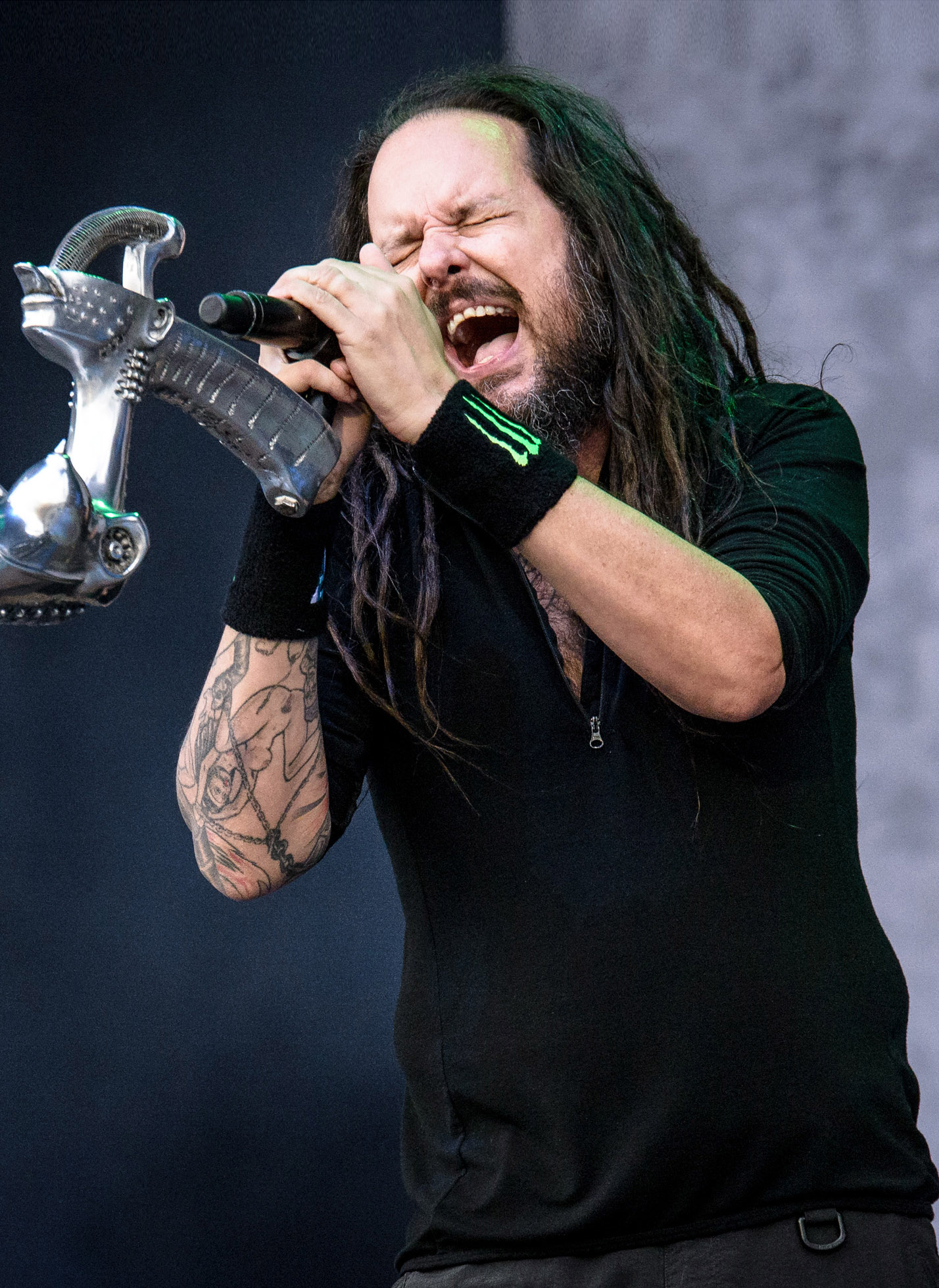
Three months before the release of Untouchables, in March 2002, during a South America tour, Davis unveiled a microphone stand art piece named "The Bitch", which was created and conceptualized by Swiss artist H.R. Giger.[137][138] Davis being a fan of Giger's work, the initial idea of a special microphone stand was suggested to him by his personal assistant Jonathan Pavesi.[139] Then, Davis contacted Giger and was pleased when the Swiss artist accepted a commission to come up with a design for the mic stand. He asked Giger for a microphone stand that was both "biomechanical and very erotic", giving him complete freedom of design. In 2000, during the European Issues tour, Davis visited the H.R. Giger Museum in Switzerland. Further discussions of Giger's drawings took place, and over time the figure became more streamlined. H.R. Giger and his assistant Roni emailed photos of the progress to the United States; during this process Davis gave his approval and asked him for some minor adjustments, so he could grab it more easily for his live performances.[140] Giger said that Davis's only concern was that it had been "totally functional and as movable as possible".[141] Only five bio-mechanical mic stands cast in the shape of a woman were manufactured at a foundry in Zürich, from molds that were then destroyed, adding to their historic allure and value.[140][142] Davis had received three of the bio-mechanical microphone stands, and Giger kept the other two, one for permanent display at the H.R. Giger Museum and another for his gallery exhibitions.[142][143]
"He had sculpted it out of clay, he sculpted the whole thing by hand, and as soon as I saw it I just fell in love with it. It was such an amazing experience. ... His influence is felt in the music. Korn's music is very dark and his art was dark, the two elements complement each other so well. You can't help but be inspired by someone that creative and with such a dark imagination. I don't know what else to say man, he was just a genius."
— Jonathan Davis, speaking of H.R. Giger in Louder Sound.[144]
Davis has been sponsored by Shure microphones since the mid 1990s and continues to use them for live performances. He has used wireless KSM9 and KSM8 models in recent years.[145][146] Davis uses a variety of microphones in the studio including the Telefunken U47 and ELA M 251.[147]
Personal life
[edit]Family
[edit]Davis's childhood is a major influence on Korn lyrics—the song "Daddy" gave rise to a rumor that he was molested by his father, Rick Davis.[148] However, Jonathan has gone on record in many interviews saying he wrote the song about a female family friend who sexually abused him.[148] He said that when he tried to turn to his family as a child to tell them about the abuse, they shrugged it off and did not believe him.[148][149]
Davis has been married twice. His first marriage was to his high school sweetheart Renee Perez.[150] They were married in 1998, had a son named Nathan (who also makes music under the alias Hi I'm Ghost)[151][152] in 1995, and divorced in 2000.[153][24] Jonathan married Deven Davis in 2004. The couple have two sons, Pirate and Zeppelin.[154][155] He filed for divorce in October 2016, citing irreconcilable differences.[156] In 2018, a domestic violence restraining order was issued, blocking any child custody or visitation by Deven, whom Jonathan alleged was deep into drugs. Deven Davis died on August 17, 2018, at the age of 39 of combined drug intoxication from heroin and various prescription drugs.[157][158][159]
Health and substance abuse
[edit]Davis had a history of excessive methamphetamine abuse[160][161] and alcohol consumption during the recording sessions of Korn and Life Is Peachy.[162] Subsequently, he recorded Follow the Leader under the influence of methamphetamine, cocaine, and a heavy reliance on alcohol (especially Jack Daniel's).[163][164] In an interview with The Ringer, Davis described the album's creation "fueled by cocaine, speed, and just constant gallons of Jack Daniel's".[163][164][c] Davis got himself off methamphetamine addiction when he was 28 during the fall's inaugural Family Values Tour.[163] However, sobriety has increased his anxiety and depression which co-occurred with his substance use, exacerbated by the death of his grandfather at that time.[163] During this period, from the late '90s to the early 2000s, Davis was put on suicide watch.[163] In 2010, he admitted that he missed his past vices, Davis said "I know if I did (take drugs), I would be dead and I want to be with my children. It's a deterrent".[165]
In 2013, Davis was treated for Xanax addiction, and openly smoked marijuana until 2015.[166] In 2018, Davis stated in Forbes that he continues to struggle with chronic anxiety, depression, and insomnia, but has replaced drugs and alcohol with medication such as Prozac, Halcion, Benadryl, ZzzQuil, NyQuil, and melatonin.[166]
On August 14, 2021, Davis tested positive for coronavirus.[167] As a result, Korn postponed six summer dates on their U.S. tour and canceled two dates in New York. Korn resumed touring on August 27, 2021, at Tinley Park, Illinois, where the stage featured a custom throne for Davis to sit in. He was seen moving slowly around the stage, coughing, appearing to struggle catching his breath, and occasionally using an oxygen tank.[168] On August 29, Brian Welch posted a video remarking on his bandmate's health, stating, "Jonathan Davis is still struggling with the COVID after-effects. He's physically weak and having a mental battle. And any type of love, light and energy you can throw at him – prayers, all of it. ... He needs you more than ever."[169]
Art and serial killers collectibles
[edit]
In the early 2000s, Davis began collecting serial killer art and memorabilia, publicly displaying selected items while on the Ozzfest 2003 tour.[170] Some items owned by Davis include the Volkswagen serial killer Ted Bundy drove for the duration of his murder spree;[171][172] the "Pogo" and "Patches" clown outfits worn by serial killer John Wayne Gacy;[173][172] the 1928 confession letter from cannibal Albert Fish;[173][172] and original drawings by serial killer Richard Ramirez (also known as the Night Stalker).[174][172]
In June 2001, the collector of criminal artifacts Arthur Rosenblatt was approached by Davis.[175] Rosenblatt told him of his plan to open a museum of artifacts related to the criminal justice system, which Rosenblatt suggested be named the Museum of Justice & Odditorium or MOJO Museum.[175][170] In March 2003, Davis suggested funding the museum through a film or TV production.[175] Subsequently, Davis pulled out of the deal which fell apart, leading Rosenblatt to sue him twice;[176] Rosenblatt accused Davis of having spoken to the media in 2002 about his museum project with artist Joe Coleman and mis-naming it American Curiosities Museum when he should have used the names provided for in the contract.[175][177] In the lawsuit, Rosenblatt claimed that Davis and other partners have threatened his life on several occasions.[175] Nevertheless, in December 2005, Davis started selling off his serial killer memorabilia, claiming his desire to move away from this environment, stating: "I don't want that around my kids".[178] In 2006, the litigation was ultimately resolved successfully by Ed McPherson, Davis's attorney. Davis later denounced the items and got rid of them.
Davis made an appearance in the Oddities documentary series, in the fourth episode of season two entitled "Rock Star Embalmer", which was filmed at Manhattan's Obscura Antiques & Oddities. The episode aired on Discovery Channel on April 30, 2011.[179][180]
Davis's home houses a private art collection that spans decades of touring the globe.[12] He has a considerable and diverse collection of works of macabre and dark art, such as a limited edition Ibanez guitar designed by H.R. Giger that looks the same as his mic stand, a human shrunken head from South America, and a human foetus called 'Luther'.[12] His art collection also includes religious art from all over the world and a variety of religions, such as 600-year-old Buddhist sculptures and "tons of crucifixes", especially Mexican Jesus. "I wouldn't say I like religion, but I like the art", reaffirms Davis.[12]
He has also developed an interest in collection of taxidermy art.[179][12] In 2015 during an interview with Gavin Lloyd for Metal Hammer he said "the taxidermy I got on the walls, I got when we were touring in South Africa. I hired a guide, stalked those animals, shot both of them and donated the meat, which fed families for months. ... I had to wait a year to get those heads back from Africa, but they're top notch, they're amazing."[12]
Political views
[edit]In 2006, Davis explained his political views, saying, "I'm political to a point where it affects human life, from global warming to abortion issues to my gun rights", but expressed no interest in issues like taxation, saying, "I don't really care. Obviously even going out and voting doesn't really count, it's all based down to these Electoral College votes."[181] Davis has expressed support for same-sex marriage and transgender rights.[182]
Davis has expressed support for libertarian Republican candidates Ron Paul[183][184] and Rand Paul.[184] Davis once described former U.S. President Barack Obama as an "Illuminati puppet",[183] and told Billboard that Obama had "basically dragged this country down into the worst it's ever been."[185] In 2014, Davis said that the United States was becoming a "police state".[186] On the other hand, in 2006, Davis expressed opposition to U.S. conservatives, particularly American Christians,[187] and he described Donald Trump's presidency as a sign that "the world is just absolutely out of control" in 2019.[188]
Religion
[edit]In an interview with Metal Hammer magazine, Davis stated that he's "always been a believer in God", just not in organized religions. He also criticized born-again Christians for "broadcasting" their beliefs.[189]
Military visits
[edit]In 2012, Davis began visiting United States Armed Forces stationed in Europe.[190] On March 16, 2012, Davis made his first visit to Ramstein Air Base, Germany where he visited with personnel assigned to the 86th Airlift Wing and Landstuhl Regional Medical Center.[191] The Explosive Ordnance Disposal personnel showed him how to operate the bomb disposal robot and how to render safe an improvised explosive device wearing a Bombsuit.[191] Firefighter personnel showed how to use the water cannon in the new Striker ARFF fire apparatus.[191] Readiness and emergency management personnel showed a variety of Chemical, biological, radiological, and nuclear (CBRN) detection and protection equipment.[192] He also did a meet and greet signing autographs for the troops and their families at the AAFES Military Mall (Kaiserslautern Military Community Center).[191] He visited wounded warriors from all over the world at Landstuhl Regional Medical Center and the USO Wounded Warriors Center.[193][191]
On August 11, 2012, Davis made another trip to Ramstein Air Base, Germany to visit with personnel assigned to the 86th Airlift Wing, 37th Airlift Squadron, and Landstuhl Regional Medical Center.[194][195] During this visit, he was able to get a tour of a C-130J, Hercules and Explosive Ordnance Disposal personnel demonstrated a "Hollywood shot" explosive and the destruction a small amount of explosive can do to a car.[196][197] Again, he visited the wounded warriors at Landstuhl Regional Medical Center and the USO Wounded Warriors Center.[198][197] A documentary of his experiences, "Wounded Warriors" was submitted to the 1st Annual GI Film Festival Hollywood,[195][197] and won Audience Choice Award on November 10, 2012.[199][200] As a result of these trips, once Barack Obama awarded Captain Florent Groberg the Medal of Honor, he mentioned how Davis visited Groberg in Germany, and joked that "I am not the lead singer from Korn".[201] While Davis had been a vocal critic of Obama,[202] he expressed shock at the mention, particularly as it was a compliment: "The President of the United States gave me props for being there for a Medal of Honor recipient. Groberg went through hell."[203]
Discography
[edit]Albums
[edit]- Korn
- Korn (1994)
- Life Is Peachy (1996)
- Follow the Leader (1998)
- Issues (1999)
- Untouchables (2002)
- Take a Look in the Mirror (2003)
- See You on the Other Side (2005)
- Untitled album (2007)
- Korn III: Remember Who You Are (2010)
- The Path of Totality (2011)
- The Paradigm Shift (2013)
- The Serenity of Suffering (2016)
- The Nothing (2019)
- Requiem (2022)
- Jonathan Davis and the SFA
- Alone I Play (2007)
- Live at the Union Chapel (2011)
- Killbot
- Sound Surgery (2012)
- Solo
- Black Labyrinth (2018)
Singles
[edit]As lead artist
[edit]| Title | Year | Peak chart positions | Album | ||||
|---|---|---|---|---|---|---|---|
| US Dance [204] |
US Main. Rock [205] |
US Rock [206] |
US Rock Air. [207] | ||||
| "Careless"[208] | 2007 | — | — | — | — | Non-album singles | |
| "Got Money" (featuring Jim Root) |
2008 | 41 | — | — | — | ||
| "Silent Hill"[209] | 2012 | — | — | — | — | Silent Hill: Downpour soundtrack | |
| "What It Is"[210] | 2018 | — | 5 | 47 | 21 | Black Labyrinth | |
| "Everyone"[211] | — | — | — | — | |||
| "Basic Needs" | — | 19 | — | — | |||
| "—" denotes a recording that did not chart or was not released in that territory. | |||||||
As featured artist
[edit]| Title | Year | Peak chart positions | Album | ||||
|---|---|---|---|---|---|---|---|
| US Main. Rock [205] |
US R&B [212] |
US Rap [212] | |||||
| "Year 2000" (Xzibit featuring Jonathan Davis) |
2000 | — | 76 | 28 | Black and White soundtrack | ||
| "Smashing the Opponent"[213] (Infected Mushroom featuring Jonathan Davis) |
2009 | — | — | — | Legend of the Black Shawarma | ||
| "The Enabler"[214] (Chuck Mosley featuring Jonathan Davis and John 5) |
— | — | — | Will Rap Over Hard Rock for Food | |||
| "Evilution"[215] (Datsik and Infected Mushroom featuring Jonathan Davis) |
2012 | — | — | — | Vitamin D | ||
| "Wake Up!" (Islander featuring Jonathan Davis) |
2017 | — | — | — | Non-album single | ||
| "Necessary Evil" (Motionless in White featuring Jonathan Davis) |
29 | — | — | Graveyard Shift | |||
| "Gary Heidnik" (SKYND featuring Jonathan Davis) |
2018 | — | — | — | Chapter 1 | ||
| "Seventy Thorns" (Kim Dracula featuring Jonathan Davis) | 2023 | — | — | — | A Gradual Decline In Morale | ||
| "—" denotes a recording that did not chart or was not released in that territory. | |||||||
Promotional singles
[edit]| Title | Year | Album |
|---|---|---|
| "Justice" (Remix) (Rev Theory featuring Jonathan Davis) |
2011 | Justice |
Other appearances
[edit]Guest appearances
[edit]| Title | Year | Album |
|---|---|---|
| "This Town"[216] (Human Waste Project featuring Jonathan Davis) |
1994 | E-lux First Demo |
| "Lookaway"[217] (Sepultura featuring Jonathan Davis, Mike Patton and DJ Lethal) |
1996 | Roots |
| "Sleepy Hollow"[218] (Deadsy featuring Jonathan Davis) |
Deadsy | |
| "Revival"[219] (Orgy featuring Jonathan Davis) |
1998 | Candyass |
| "Ty Jonathan Down"[220] (Videodrone featuring Jonathan Davis) |
1999 | Videodrone |
| "Nobody Like You"[221] (Limp Bizkit featuring Scott Weiland and Jonathan Davis) |
Significant Other | |
| "End of Time"[222] (Q-Tip featuring Jonathan Davis) |
Amplified | |
| "Take It Back"[223] (Snot featuring Jonathan Davis) |
2000 | Strait Up |
| "Just for Now"[224] (Fieldy's Dreams featuring Jonathan Davis) |
2002 | Rock'n Roll Gangster |
| "1stp Klosr"[225] (Linkin Park featuring Jonathan Davis and The Humble Brothers) |
Reanimation | |
| "Love on the Rocks"[226] | 2003 | Wonderland soundtrack |
| "Cut Throat"[227] (Marz featuring Jonathan Davis) |
2004 | Gorilla Pimpin' |
| "Jerry Bruckheimer"[228] (The Changing featuring Jonathan Davis) |
2009 | For Obvious Reasons |
| "Witness the Addiction"[229] (Suicide Silence featuring Jonathan Davis) |
2011 | The Black Crown |
| "Silent So Long"[230] (Emigrate featuring Jonathan Davis) |
2014 | Silent So Long |
| "It's Time to Get Weird"[231] (Sunflower Dead featuring Jonathan Davis) |
2015 | It's Time to Get Weird |
| "Starting to Turn"[232] (Tech N9ne featuring Jonathan Davis) |
2016 | The Storm |
| "Whatever Goes Up" (Bone Thugs featuring Jonathan Davis) |
2017 | New Waves |
| "JD Fresh"[233] (Fieldy featuring Jonathan Davis) |
2017 | Bassically |
| "Necessary Evil"[234] (Motionless In White featuring Jonathan Davis) |
2017 | Graveyard Shift |
| "Gary Heidnik"[235] (SKYND featuring Jonathan Davis) |
2018 | Chapter I |
| "Can't Wait"[236] (Lakshminarayana Shankar featuring Jonathan Davis) |
2020 | Chepleeri Dream |
Remix work
[edit]| Title | Year | Other artist(s) | Album |
|---|---|---|---|
| "Hear Me Now" (Jonathan Davis Remix)[237] | 2011 | Hollywood Undead | American Tragedy Redux |
| "Thunder Kiss '65" (JDevil Number of the Beast Remix)[238] | 2012 | Rob Zombie | Mondo Sex Head |
| "The Kids Will Have Their Say" (JDevil Catholic Nun Remix)[239] | Steve Aoki, Sick Boy | The Kids Will Have Their Say EP | |
| "Bug Party" (JDevil Catholic Nun Remix) | Huoratron | Non-album song |
Notes
[edit]- ^ The Range Place has been mentioned in USA Today, The Telegraph and Time.[111]
- ^ Following the release of Korn's self titled debut album—recorded with his bagpipe trophies by his side—the singer would have two credits after his name in magazines: Jonathan Davis-Vocals & Bagpipes, also: Jonathan Davis-Vocalist/Bagpiper.[130][129]
- ^ The liquor bill for the three months of Follow the Leader recording sessions topped out at $60,000 in the amount of beer, and estimated at 2,000 bottles of Jack Daniel's.[164]
References
[edit]- ^ "JD's Profile on Korn.com". Korn.com. Archived from the original on December 27, 2012. Retrieved December 29, 2012.
- ^ a b c d Buckley & Ellingham 2003, p. 565.
- ^ Martens, Todd; Garrity, Brian (June 5, 2007). "Los Angeles—New York (Billboard)". Reuters. Archived from the original on March 21, 2020. Retrieved March 21, 2020.
- ^ Graves, Wren (January 4, 2020). "Korn invented a new genre and then outgrew it". Consequence of Sound. Archived from the original on April 8, 2020. Retrieved March 24, 2020.
- ^ Schaffner, Lauryn (January 19, 2023). "See Photos of Korn's Jonathan Davis Through the Years". 94.3 WCYY. Retrieved March 7, 2025.
- ^ Appleford, Steve. "Then and Now: Jonathan Davis on Korn's "Dark-Ass" Debut, How He's Changed 25 Years Later". Revolver. Retrieved March 7, 2025.
- ^ Camp, Zoe (October 10, 2017). "Jonathan Davis Record Vocals in Intense 1994 Studio Session". Revolver Magazine. Archived from the original on July 18, 2018. Retrieved March 24, 2020.
- ^ Appleford, Steve (March 14, 2006). "Korn". LA Times. Archived from the original on March 24, 2020. Retrieved March 24, 2020.
- ^ Hill, John (January 23, 2019). "Jonathan Davis' Top 5 Vocal Performances". Revolver Magazine. Archived from the original on March 24, 2020. Retrieved March 24, 2020.
- ^ a b Paquet 2002, p. 30.
- ^ a b Furman 2000, p. 11.
- ^ a b c d e f Lloyd, Gavin (January 24, 2015). "Houses Of The Unholy: Jonathan Davis, Korn". Metal Hammer. UK. Archived from the original on March 29, 2020. Retrieved March 29, 2020.
- ^ Divita, Joe (September 25, 2019). "Korn Tied for 5th Most Top 10 Rock Album Chart Debuts". Loudwire. Archived from the original on March 24, 2020. Retrieved March 24, 2020.
- ^ "Jonathan Davis's GRAMMY Awards history". The GRAMMYs. January 15, 2020. Archived from the original on March 24, 2020. Retrieved March 24, 2020.
- ^ "40 million albums worldwide". The Rock. New Zealand. July 1, 2019. Archived from the original on March 24, 2020. Retrieved March 24, 2020.
- ^ "KoRn Frontman Jonathan Davis". Blabbermouth. Pasadena, CA. March 19, 2018. Archived from the original on March 24, 2020. Retrieved March 24, 2020.
- ^ "Two GRAMMY Award wins, eight GRAMMY Award nominations, worldwide sales of 40 million". 3 Songs & Out. UK. March 29, 2018. Archived from the original on March 29, 2020. Retrieved March 29, 2020.
- ^ Jonathan Davis Bio Archived September 14, 2013, at the Wayback Machine. KornRow (January 18, 1971). Retrieved on August 25, 2013.
- ^ "Adema Hope to Stick it to Haters On Tour". MTV. Archived from the original on February 15, 2017. Retrieved November 6, 2018.
- ^ KoRn – Jonathan Davis and his sister | Video Youtube – NMETV Latest Music Videos and Clips. Nme.com. Retrieved on August 25, 2013.
- ^ a b "Korn Frontman Jonathan Davis Turns 40 Today". January 18, 2011. Archived from the original on December 3, 2013. Retrieved January 25, 2013.
- ^ "Stern Show News Archive For The Week Of 6/10/2002 to 6/14/2002".
And you had to live with your dad and your stepmom?" "I was with my mom and I moved to my dad's, yeah" "Because it was so bad at your mom's?" "Yeah.
- ^ a b Paquet 2002, p. 32.
- ^ a b c d e f "20 Things You Might Not Know". iHeartRadio. January 18, 2017. Archived from the original on March 21, 2020. Retrieved August 28, 2021.
- ^ Bondowski, Karen. "KoЯn's Jonathan Davis alive and well (sort of)". concertlivewire.com. Livewire. Archived from the original on November 5, 2007. Retrieved December 28, 2006.
- ^ a b Furman 2000, p. 9.
- ^ a b Furman 2000, p. 10.
- ^ a b c Furman 2000, p. 17.
- ^ a b Paquet 2002, p. 11.
- ^ Paquet 2002, p. 57.
- ^ Paquet 2002, p. 85.
- ^ a b c d Palmquist, Matt (April 24, 2002). "Death of a Death School". SFWeekly. Archived from the original on March 26, 2020. Retrieved March 26, 2020.
- ^ "I Thought I Was Going To Fucking Die. I Was Pouring Blood Out Of My Ass…". Kerrang!. June 15, 2018. Archived from the original on March 26, 2020. Retrieved March 26, 2020.
- ^ Paquet 2002, p. 20.
- ^ Furman 2000, p. 12.
- ^ "'I've pulled so many bodies out of cars. It intrigued me'". The Guardian. January 21, 2015. Archived from the original on June 2, 2016. Retrieved March 26, 2020.
- ^ a b c Paquet 2002, p. 22.
- ^ "High School demo". UA-cam. January 10, 2018. Archived from the original on March 31, 2020. Retrieved March 31, 2020.
- ^ a b Furman 2000, p. 36.
- ^ "Performer Sex Art Is, Vocals – Jonathan Davis, Ty Elam". Discogs. July 7, 2014. Archived from the original on July 7, 2014. Retrieved March 26, 2020.
- ^ Welch 2007, p. 45.
- ^ Welch 2007, p. 49.
- ^ Furman 2000, p. 37.
- ^ a b Welch 2007, p. 50.
- ^ a b Welch 2007, p. 51.
- ^ MÖRAT (December 11, 2014). "Korn's dark past". Metal Hammer. Archived from the original on March 26, 2020. Retrieved March 26, 2020.
- ^ Furman 2000, p. 43.
- ^ Paquet 2002, p. 55.
- ^ Welch 2007, p. 52.
- ^ a b "Jonathan Davis And The SFA, 2007—2014". Spirit of Metal. December 1, 2014. Archived from the original on March 22, 2020. Retrieved March 22, 2020.
- ^ "Jonathan Davis And The SFA". BraveWords. August 31, 2011. Archived from the original on March 22, 2020. Retrieved March 22, 2020.
- ^ Yeung, Neil Z. (December 1, 2016). "Jonathan Davis Biography". AllMusic. Archived from the original on March 22, 2020. Retrieved March 22, 2020.
- ^ "Former Korn touring guitarist Shane Gibson dies". Loudwire. April 18, 2014. Archived from the original on April 15, 2014. Retrieved March 22, 2020.
- ^ Eames, Tom (April 18, 2014). "Guitarist Shane Gibson dies, aged 35". Digital Spy. Archived from the original on March 22, 2020. Retrieved March 22, 2020.
- ^ a b c Munro, Scott (December 22, 2017). "Korn's Jonathan Davis to launch 2018 solo album". Louder Sound. Archived from the original on March 22, 2020. Retrieved March 22, 2020.
- ^ Erickson, Anne (December 27, 2017). "Jonathan Davids to Release a Solo Album in 2018". Audio Ink Radio. Archived from the original on March 22, 2020. Retrieved March 22, 2020.
- ^ Moore, Sam (January 26, 2018). "Jonathan Davis' new solo single 'What It Is'". NME. Archived from the original on March 22, 2020. Retrieved March 22, 2020.
- ^ a b "Korn Frontman Releases Music Video For 'What It Is' Solo Single". Blabbermouth. January 26, 2018. Archived from the original on November 22, 2020. Retrieved November 22, 2020.
- ^ Reed, Ryan (March 19, 2018). "Korn's Jonathan Davis Details Solo LP 'Black Labyrinth' With Song Samples". Rolling Stone. Archived from the original on March 22, 2020. Retrieved March 22, 2020.
- ^ a b c "Korn's Jonathan Davis Releases Country Version Of 'What It Is' Solo Single". Blabbermouth. October 1, 2020. Archived from the original on November 22, 2020. Retrieved November 22, 2020.
- ^ a b c d Baltin, Steve (March 7, 2012). "Korn Frontman Jonathan Davis to Release EP as J Devil". Rolling Stone. Archived from the original on March 22, 2020. Retrieved March 22, 2020.
- ^ a b c d "J Devil". FabFilter. December 1, 2012. Archived from the original on March 22, 2020. Retrieved March 22, 2020.
- ^ Ship, Jesse (August 7, 2012). "J Devil: Jonathan Davis of Korn". Noisecreep. Archived from the original on March 22, 2020. Retrieved March 22, 2020.
- ^ Infected Mushroom (October 23, 2011). Jonathan Davis and Infected Mushroom Smashing Mexico city. Mexico city. Archived from the original on December 12, 2021. Retrieved May 23, 2020 – via YouTube.
- ^ a b Shaw, Zach (March 1, 2012). "Jonathan Davis gets the krap beaten out of him by electronic artists". Metal Insider. Retrieved May 23, 2020.
- ^ Seibel, Markus; Bewernick, Gregor (March 24, 2012). "KORN—The Dirty Youth—J Devil—Path of Totality-Tour". Stalker Magazine. Archived from the original on March 21, 2020. Retrieved March 21, 2020.
- ^ Greenberg, Alexandra; Ochoa, John (January 17, 2012). "Frontman Jonathan Davis debuting his J Devil DJ set". Mitch Schneider Organization. Archived from the original on October 7, 2017. Retrieved March 21, 2020.
- ^ ""JDEVIL" (Korn's Jonathan Davis) Joins Dim Mak". Hit The Decks Network. June 19, 2012. Archived from the original on March 21, 2020. Retrieved March 21, 2020.
- ^ "JDevil Biography". IDFestival. Archived from the original on December 14, 2012. Retrieved November 24, 2012.
- ^ "IDFest Tour Dates". IDFestival. Archived from the original on November 17, 2012. Retrieved November 24, 2012.
- ^ "Rye Rye, JDevil and More Join Identity Festival This Summer". beatsmedia.com. Archived from the original on June 25, 2012. Retrieved November 24, 2012.
- ^ "JDevil Added to Marilyn Manson and Rob Zombie Tour". SMN News. Archived from the original on December 2, 2013. Retrieved November 24, 2012.
- ^ Childers, Chad (October 24, 2012). "Jonathan Davis Bows Out of Twins of Evil Tour Due to Exhaustion". Loudwire. Retrieved November 25, 2012.
- ^ Weingarten, Christopher R. (September 28, 2012). "Jonathan Davis' New EDM Project Killbot". SPIN. Archived from the original on March 22, 2020. Retrieved March 22, 2020.
- ^ Greenberg, Alexandra; Ochoa, John (September 28, 2012). "Killbot—the collective featuring JDevil, Sluggo and Tyler Blue—to release 'Sound Surgery' October 22". Mitch Schneider Organization. Archived from the original on March 22, 2020. Retrieved March 22, 2020.
- ^ a b Paquet 2002, p. 72.
- ^ a b c d e Sindell, Joshua (February 23, 2002). "World Exclusive: Korn – The Jonathan Davis interview". Kerrang!. No. 892. UK. pp. 14–15. ISSN 0262-6624.
- ^ Sandler, Adam (September 9, 1998). "Zomba packs Korn". Variety. Archived from the original on December 18, 2020. Retrieved December 18, 2020.
- ^ a b c Bayer, Gerd (January 22, 2019). Heavy Metal at the Movies. Ashgate screen music. Taylor & Francis. p. 45. ISBN 978-1-351-33397-9.
- ^ Paquet 2002, p. 73.
- ^ a b Shelley, Peter (2012). Australian Horror Films, 1973–2010. McFarland & Company. pp. 167, 170. ISBN 978-0-7864-6167-7.
- ^ Boyce, Kevin (February 18, 2002). "Loud Rock". CMJ New Music Report. Vol. 70, no. 750. New York. p. 48. ISSN 0890-0795.
- ^ Minkovsky, Atalya (March 1, 2002). "Davis absent from Queen of the Damned CD". The Johns Hopkins News-Letter. Archived from the original on March 23, 2020. Retrieved March 23, 2020.
- ^ Munoz, Lorenza (February 22, 2002). "After a Star's Death, a Delicate Marketing Task". Los Angeles Times. Archived from the original on March 23, 2020. Retrieved March 23, 2020.
- ^ a b "Davis discussed a fighting game featuring Marilyn Manson and Fred Durst". Kerrang!. September 24, 2019. Archived from the original on March 22, 2020. Retrieved March 22, 2020.
- ^ Trapp, Philip (September 24, 2019). "Davis, an avid gamer himself". Loudwire. Archived from the original on March 22, 2020. Retrieved March 22, 2020.
- ^ Emond, Martin (April 23, 2017). "Martin Emond, Original Video Game Concept Artwork, Korn – Jonathan Davis". Comic Art Fans. Archived from the original on March 22, 2020. Retrieved March 22, 2020.
- ^ "Game Spy:Pop Scars". IGN. Retrieved August 6, 2007.
- ^ Wiederhorn, Jon (February 26, 2003). "Korn Frontman Enters The 'Twilight Zone'". MTV. Archived from the original on September 3, 2022. Retrieved September 3, 2022.
- ^ Frederick, Logan (October 23, 2007). "Korn Records Haze Single". Escapist Magazine. Archived from the original on March 23, 2020. Retrieved March 20, 2020.
- ^ Westbrook, Logan (June 10, 2011). "Konami Enlists Korn for Silent Hill Theme Song". Escapist Magazine. Archived from the original on March 23, 2020. Retrieved March 20, 2020.
- ^ Shaw, Zack (June 9, 2011). "Korn Gets No Love From 'Silent Hill' Fans". Metal Insider. Archived from the original on March 23, 2020. Retrieved March 20, 2020.
- ^ Julia Lotz (June 17, 2021). "Korn: Jonathan Davis steuert den Titeltrack zum Open World-RPG ELEX II bei". MoreCore (in German). Retrieved December 3, 2021.
- ^ Mark Zapata (June 17, 2021). "Jonathan Davis contributes to exclusive song for 'Elex II' video game". Metal Insider. Retrieved December 3, 2021.
- ^ a b "Korn's Groovy Pirate Ghost Mystery". Internet Movie Database. Retrieved October 20, 2012.
- ^ Significant Other – Limp Bizkit | Songs, Reviews, Credits, Awards. AllMusic (June 22, 1999). Retrieved on August 25, 2013.
- ^ Mike's Indy Report #6 IGN (February 7, 2000). Retrieved March 29, 2023.
- ^ "Jonathan Davis (I)". Internet Movie Database. Retrieved October 20, 2010.
- ^ "Queen of the Damned—Guest Appearance". Easter Eggs. August 13, 2003. Archived from the original on March 23, 2020. Retrieved March 23, 2020.
- ^ Douglas, Edward (May 6, 2004). "Seeing Other People". ComingSoon. Archived from the original on March 23, 2020. Retrieved March 20, 2020.
- ^ "Full cast and crew for "Monk" Mr. Monk Gets Stuck in Traffic (2005)". Internet Movie Database. Retrieved October 20, 2012.
- ^ "Monk—Season 3—Episode 13". Rotten Tomatoes. February 11, 2005. Archived from the original on March 23, 2020. Retrieved March 23, 2020.
- ^ "Albion Entertainment Presents The Still Life". Art Daily. December 1, 2007. Archived from the original on March 23, 2020. Retrieved March 23, 2020.
- ^ Infected Mushroom (August 6, 2009). Infected Mushroom – Smashing the Opponent (Official Video). Archived from the original on December 12, 2021. Retrieved May 23, 2020 – via YouTube.
- ^ "Jonathan Davis Dropped Countless Nü Metal References On 'OK K.O.! Let's Be Heroes'". Theprp. October 3, 2017. Archived from the original on March 22, 2020. Retrieved March 22, 2020.
- ^ "See Korn's Jonathan Davis Cameo in Skynd's NSFW Serial Killer–Inspired Video". www.revolvermag.com. July 19, 2018. Retrieved January 19, 2020.
- ^ a b c "Jonathan Davis: Vocal profile – Higher notes – Lower notes". The Range Place. November 27, 2019. Archived from the original on May 14, 2018. Retrieved November 21, 2020.
- ^ Shebala, Marley (September 15, 2011). "Korn treats crowd to great metal mania experience". Navajo Times. Window Rock. Retrieved May 23, 2020.
- ^ Lareau, Isabelle (September 27, 2018). "Follow the Leader". Bible urbaine (in French). Canada. Archived from the original on March 24, 2020. Retrieved March 24, 2020.
- ^ a b "Digging Deeper: Axl Rose is NOT the Singer With the Widest Range". Vintage Vinyl Music. New York. May 22, 2014. Archived from the original on May 27, 2014. Retrieved September 19, 2020.
- ^ Barrineau, Trey (n.d.). "Axl Rose is the greatest vocalist of all time. Wait, what?". USA Today. Archived from the original on November 21, 2020. Retrieved November 21, 2020.
- ^ Coplan, Chris (May 26, 2014). "Turns out Mike Patton, and not Axl Rose, is the greatest singer of all time". Consequence of Sound. Archived from the original on May 26, 2014. Retrieved November 21, 2020.
- ^ Ham, Robert (April 7, 2018). "Korn's Jonathan Davis Shows His Solo Range With 'Black Labyrinth' Tour Kick-Off". Billboard. Archived from the original on September 19, 2020. Retrieved September 19, 2020.
- ^ a b Krovatin, Chris (October 15, 2019). "The 6 Best Jonathan Davis Scat Performances". Kerrang!. Archived from the original on September 19, 2020. Retrieved September 19, 2020.
- ^ a b Paquet 2002, p. 49.
- ^ Eptin, Christ (September 24, 2013). "KORN singer Jonathan Davis". Loudwire. Archived from the original on March 26, 2020. Retrieved March 26, 2020.
- ^ Furman 2000, p. 16.
- ^ a b c d e f "Jonathan Davis interview at the Musicians Institute in Los Angeles". Loudwire. September 13, 2018. Archived from the original on March 25, 2020. Retrieved March 25, 2020.
- ^ Furman 2000, p. 40.
- ^ a b "'Vulgar Display Of Power' Made Him Want To Create Heavy Music". Blabbermouth. March 2, 2018. Archived from the original on March 26, 2020. Retrieved March 26, 2020.
- ^ Paquet 2002, p. 26.
- ^ Haywood, Brad (December 2, 2002). "The Dillinger Escape Plan / Mike Patton: Irony Is a Dead Scene EP". Pitchfork. Archived from the original on March 19, 2016. Retrieved December 2, 2020.
Love him or leave him, Patton's influence on underground metal and hardcore, particularly through Faith No More, is undeniable. His influence on mainstream rap-rock is similarly undisputed, serving as the template for vocalists like Korn's Jonathan Davis.
- ^ Rosenberg, Axl (May 12, 2010). "Korn III: Remember Who You Are Listening Party Report". MetalSucks. Archived from the original on May 15, 2010. Retrieved December 2, 2020.
- ^ Heller, Jason (December 13, 2011). "Korn: The Path Of Totality". The A.V. Club. Archived from the original on November 3, 2019. Retrieved December 2, 2020.
- ^ "REVIEW: Faith No More – Angel Dust (2 LP and 2 CD editions)". Mikeladano.com. July 16, 2013. Archived from the original on November 8, 2013. Retrieved December 2, 2020.
The first single "Midlife Crisis" was about as close as it gets to a commercial track. You can certainly hear every nu-metal band in the world (Korn! I'm looking at you Jonathan Davis!) ripping off Patton's guttural vocal stylings.
- ^ Cerio, Michael (August 19, 2019). "EXCLUSIVE: Korn on Recording With Ice Cube and the Impact of Cypress Hill". Radio.com. Archived from the original on December 13, 2019. Retrieved December 2, 2020.
- ^ a b c d e Furman 2000, p. 18.
- ^ A Noll, Mark; Blumhofer Waldvogel, Edith (2006). Mark A. Noll and Edith L. Blumhofer (ed.). Sing them over again to me : hymns and hymnbooks in America. USA: University of Alabama Press. pp. 15. ISBN 978-0-817-31505-4. OCLC 61694750.
- ^ a b c Furman 2000, p. 50.
- ^ "Line-up (members) – Jonathan Davis : Vocals, Bagpipes". Metal Kingdom. October 11, 1994. Archived from the original on March 27, 2020. Retrieved March 27, 2020.
- ^ "The Top 50 Korn Songs, Ranked". Loudwire. September 13, 2019. Archived from the original on March 25, 2020. Retrieved March 25, 2020.
- ^ Chapsitck, Kelsey (October 11, 2018). "Lowrider (War Cover)". Revolver Magazine. Archived from the original on March 27, 2020. Retrieved March 27, 2020.
- ^ "Lowrider (War Cover)". Metal Kingdom. December 15, 1996. Archived from the original on March 27, 2020. Retrieved March 27, 2020.
- ^ Keys Inside (January 2, 2016). KoRn – All Bagpipes Parts. Archived from the original on December 12, 2021. Retrieved May 23, 2020 – via YouTube.
- ^ Paquet 2002, p. 27.
- ^ Eliscu, Jenny; Rosenthal, Joe (July 26, 1999). "Top Six Musical Moments at Woodstock '99". Rolling Stone. Archived from the original on March 27, 2020. Retrieved March 27, 2020.
- ^ Paquet 2002, p. 43.
- ^ Renshaw, David (May 13, 2014). "Artist and designer HR Giger dies, aged 74". NME. Archived from the original on March 21, 2020. Retrieved March 21, 2020.
- ^ Paquet 2002, p. 44.
- ^ a b Stalder, Louis (January 30, 2001). "KORN MIC-STAND". hrgiger.com. Archived from the original on March 21, 2020. Retrieved March 21, 2020.
- ^ Chapstick, Kesley (October 15, 2018). "Guitars to H.R. Giger". RevolverMag. Archived from the original on March 21, 2020. Retrieved March 21, 2020.
- ^ a b Ashton, Kristine; Schneider, Mitch; Rondan, Marcee (March 15, 2002). "Jonathan Davis commissions legendary Swiss artist H.R. Giger". Mitch Schneider Organization. Archived from the original on July 27, 2019. Retrieved March 21, 2020.
- ^ Epstein, Dan (March 30, 2001). "The silver-skinned lady stands tall and slender" (PDF). LittleGiger. Archived (PDF) from the original on March 21, 2020. Retrieved March 21, 2020.
- ^ Hill, Stephen (May 17, 2014). "Korn's Jonathan Davis on H.R. Giger: "He was a genius"". Louder. Archived from the original on March 21, 2020. Retrieved March 21, 2020.
- ^ "Jonathan Davis of Korn – The Shure Interview". Archived from the original on May 23, 2014 – via www.youtube.com.
- ^ "Jonathan Davis: On the Road with Axient Digital". Archived from the original on May 20, 2019 – via www.youtube.com.
- ^ "Jonathan Davis Equipboard". Equipboard. April 27, 2019. Archived from the original on March 21, 2020. Retrieved March 21, 2020.
- ^ a b c Furman 2000, p. 46.
- ^ Page, Chris (November 2002). "The Evolution of Korn (Hope on the Horizon)". Californian staff writer. Archived from the original on February 3, 2008. Retrieved February 25, 2008.
- ^ Furman 2000, p. 41 & p.70.
- ^ "Nathan Howsmon Davis". SGLYRIC. Retrieved November 13, 2021.
- ^ D'Amico, Justin. "Bass Rising @ Gothic Theatre in Englewood, Colorado (Review) [4/28/18]". IKONIC SOUND. Big Kids Media. Retrieved November 13, 2021.
- ^ Furman 2000, p. 70.
- ^ "For The Record: Quick News On 3 Doors Down, KoЯn, Pearl Jam, Tyler Perry, Monica, Mike Patton, The Cure & More". MTV News. Viacom Media Networks. March 23, 2005. Archived from the original on March 26, 2005. Retrieved December 28, 2006.
- ^ Young, Julius (October 11, 2018). "Korn frontman Jonathan Davis' estranged wife's death ruled accident from fatal drug combination: report". Fox News.
- ^ "Deven Davis, Wife of Korn Lead Singer Jonathan Davis, Dead at 39". TMZ. August 17, 2018. Retrieved December 5, 2019.
- ^ "Deven Davis, Wife of Korn's Jonathan Davis, Dies at 39". Billboard. August 17, 2018.
- ^ French, Michael. "Deven Davis Dead At 42: Former Porn Actress Married Korn Frontman". AVN. Retrieved December 5, 2019.
- ^ "Korn Frontman Jonathan Davis' Wife Deven's Death Ruled Accident from Combo of 5 Different Drugs". PEOPLE.com. Retrieved December 18, 2020.
- ^ Furman 2000, p. 52.
- ^ Welch 2007, p. 61.
- ^ Weingarten, Christopher R. (December 11, 2014). "Korn's 1994 Debut LP". Rolling Stone. Archived from the original on March 24, 2020.
- ^ a b c d e Hyden, Steven (August 15, 2018). "Jonathan Davis and the band reflect on a controversial era of music history". The Ringer. Archived from the original on March 24, 2020. Retrieved March 24, 2020.
- ^ a b c Cush, Andy (August 15, 2018). "Korn – Follow the Leader". SPIN. Archived from the original on March 24, 2020. Retrieved March 24, 2020.
- ^ Fullerton, Jamie (November 24, 2010). "Singer says his children keep him on the straight and narrow". NME. Archived from the original on March 24, 2020. Retrieved March 24, 2020.
- ^ a b Scancarelli, Derek (June 19, 2018). "Jonathan Davis On Xanax Addiction: 'Benzos Are The Devil'". Forbes. Archived from the original on March 24, 2020. Retrieved March 24, 2020.
- ^ Legaspi, Althea (August 16, 2021). "Korn's Jonathan Davis Tests Positive for Covid-19". Rolling Stone. Retrieved September 5, 2021.
- ^ "KORN's JONATHAN DAVIS: COVID-19 'Kicked My Motherf**king Ass'". Blabbermouth. September 4, 2021. Retrieved September 5, 2021.
- ^ Welch, Brian (August 29, 2021). "Part 2". YouTube. Archived from the original on December 12, 2021. Retrieved September 5, 2021.
- ^ a b "Museum of Justice and Oddities (MOJO)". Blabbermouth. August 17, 2006. Archived from the original on March 22, 2020. Retrieved March 22, 2020.
- ^ Philbin, Tom; Philbin, Michael (2009). Sourcesbooks, Inc. (ed.). Killer Book of Serial Killers: Incredible Stories, Facts, and Trivia from the World of Serial Killers. UK: Naperville, Ill. p. 74. ISBN 978-1-402-21385-4. OCLC 430944356.
- ^ a b c d Brink, Rob (July 5, 2005). "Jonathan Davis' Serial Killer Museum". Rob Brink. Archived from the original on March 22, 2020. Retrieved March 22, 2020.
- ^ a b "KoRn Star's Horror Show". NME. May 29, 2002. Archived from the original on March 22, 2020. Retrieved March 22, 2020.
- ^ Grace, Nancy; Clehane, Diane (2005). Blackstone Audio, Inc. (ed.). Objection!: How High-Priced Defense Attorneys, Celebrity Defendants, and a 24/7 Media Have Hijacked Our Criminal Justice System. UK: Hachette UK. ISBN 978-1-402-21385-4. OCLC 1014280024.
- ^ a b c d e "Korn singer sued over planned crime museum". Irish Examiner. June 24, 2004. Archived from the original on March 22, 2020. Retrieved March 22, 2020.
- ^ "Korn Frontman Jonathan Davis Sued By Lawyers Over Serial Killer Museum Payment". www.loudwire.com. July 25, 2015. Retrieved January 19, 2020.
- ^ Malt, Andy (July 28, 2015). "Korn frontman sued over unpaid legal bill". Complete Music Update. Archived from the original on March 22, 2020. Retrieved March 22, 2020.
- ^ "Korn's Jonathan Davis Gives Up His Serial Killer Collection". Blabbermouth. December 15, 2005. Archived from the original on March 22, 2020. Retrieved March 22, 2020.
- ^ a b "2x04 Rock Star Embalmer". ShareTV. April 15, 2011. Archived from the original on March 29, 2020. Retrieved March 29, 2020.
- ^ Hix, Lisa (October 28, 2011). "'Oddities' Host Ryan Matthew Cohn on Creepy Antiques". Collectors Weekly. San Francisco. Archived from the original on March 29, 2020. Retrieved March 29, 2020.
- ^ "Jonathan Davis' Near-Death Experience Has Him Talking God, Politics". Mtv.com. Archived from the original on April 15, 2015. Retrieved May 25, 2018.
- ^ "Q&A: Korn's Jonathan Davis on EDM's Positive Vibes, Gay Marriage". Rolling Stone. Retrieved May 25, 2018.
- ^ a b "Death And Taxes – SPIN". Deathandtaxesmag.com. Retrieved May 25, 2018.
- ^ a b "Korn's Jonathan Davis Is Really Not Feeling Any Of The Current Presidential Candidates". Uproxx.com. September 30, 2015. Retrieved May 25, 2018.
- ^ "Korn Talks 'Path of Totality': Video Track-By-Track". Billboard.com. December 6, 2011. Retrieved May 25, 2018.
- ^ "KORN's Jonathan Davis is a Political Activist Now, Claims US is Turning Into A Police State". Metalinjection.net. February 19, 2014. Retrieved May 25, 2018.
- ^ "KORN Frontman Is 'Extremely Concerned' About American Conservatives". blabbermouth.net. April 24, 2006. Retrieved March 3, 2025.
- ^ "KORN's JONATHAN DAVIS: 'The World Is Just Absolutely Out Of Control'". blabbermouth.net. September 15, 2019. Retrieved March 3, 2025.
- ^ "Korn's Jonathan Davis Shares His Problem with Christianity". Loudwire. May 17, 2022.
- ^ "Checking out the truck". Ramstein Air Base. March 16, 2012. Archived from the original on March 23, 2020. Retrieved March 23, 2020.
- ^ a b c d e McCarthy, Ellen (March 16, 2012). "Lead singer of KoRn visits Ramstein". Ramstein Air Base. Archived from the original on March 23, 2020. Retrieved March 23, 2020.
- ^ Riddle, Tree (March 20, 2012). "Korn's Jonathan Davis Visits Wounded Troops and Takes Bomb Disposal Training". Loudwire. Archived from the original on March 23, 2020. Retrieved March 23, 2020.
- ^ nbcwd (March 27, 2012). "Jonathan Davis Visits Ramstein AB, Germany". YouTube. Archived from the original on December 12, 2021. Retrieved June 23, 2017.
- ^ "Short Film "Wounded Warriors" Starring Jonathan Davis". Screamer Magazine. November 8, 2012. Archived from the original on March 23, 2020. Retrieved March 23, 2020.
- ^ a b Greenberg, Alexandra (November 7, 2012). "Short Film "Wounded Warriors" Starring Jonathan Davis of Korn to Debut at GI Film Festival Hollywood". Mitch Schneider Organization. Archived from the original on April 16, 2021. Retrieved November 25, 2012.
- ^ Bowar, Chad (November 9, 2012). "Short Film 'Wounded Warriors'". Loudwire. Archived from the original on March 23, 2020. Retrieved March 23, 2020.
- ^ a b c "Jonathan Davis Pays Tribute to US Troops". Noisecreep. December 6, 2012. Archived from the original on March 23, 2020. Retrieved March 23, 2020.
- ^ Ouellette, Mary (November 8, 2012). "Korn's Jonathan Davis Visits U.S. Troops At Ramstein Air Base". Loudwire. Archived from the original on May 7, 2020. Retrieved March 23, 2020.
- ^ Riddle, Tree (November 30, 2012). "Wounded Warriors Wins the GIFF Hollywood Audience Choice Award". GI Film Festival. Archived from the original on March 23, 2020. Retrieved March 23, 2020.
- ^ Paquet, Sebastien (November 11, 2012). "Suspended Motion Productions Awards". Suspended Motion Productions. Archived from the original on December 3, 2013. Retrieved November 25, 2012.
- ^ Cush, Andy. "Obama Swears He's Not the Lead Singer of Korn—But Where's the Documentation?". Gawker. Archived from the original on November 14, 2015.
- ^ "Korn's Jonathan Davis: 'I feel like Barack Obama's an Illuminati puppet'". www.nme.com. December 7, 2011. Retrieved January 17, 2020.
- ^ Korn's Jonathan Davis Responds to Barack Obama's Shout-Out, Rolling Stone
- ^ "Jonathan Davis – Chart History: Dance Club Songs". Billboard. Retrieved April 17, 2018.
- ^ a b "Jonathan Davis – Chart History: Mainstream Rock Songs". Billboard. Retrieved November 13, 2018.
- ^ "Jonathan Davis – Chart History: Hot Rock Songs". Billboard. Retrieved June 6, 2018.
- ^ "Jonathan Davis – Chart History: Rock Airplay". Billboard. Retrieved April 17, 2018.
- ^ "Careless – Single by Jonathan Davis". iTunes Store. Apple. November 16, 2007. Retrieved April 17, 2018.
- ^ "Silent Hill – Single by Jonathan Davis". iTunes Store. Apple. Archived from the original on April 17, 2018. Retrieved April 17, 2018.
- ^ "What It Is – Single by Jonathan Davis". iTunes Store. Apple. January 26, 2018. Archived from the original on February 15, 2018. Retrieved April 17, 2018.
- ^ "Everyone – Jonathan Davis". AllMusic. Retrieved May 8, 2018.
- ^ a b "Xzibit – Awards". AllMusic. Rovi Corporation. Retrieved April 26, 2013.
- ^ "Smashing the Opponent EP – Infected Mushroom, Jonathan Davis". AllMusic. Rovi Corporation. Retrieved April 26, 2013.
- ^ "Modern Rock – Available for Airplay Archive". FMQB. Mediaspan Online Services. Archived from the original on April 24, 2013. Retrieved April 26, 2013.
- ^ "Evilution – Datsik". AllMusic. Rovi Corporation. Retrieved April 26, 2013.
- ^ "E-lux First Demo – Human Waste Project". Bound By Metal. Retrieved March 24, 2020.
- ^ Huey, Steve. "Roots – Sepultura". AllMusic. Rovi Corporation. Retrieved April 26, 2013.
- ^ "Deadsy – Deadsy". AllMusic. Rovi Corporation. Retrieved April 2, 2013.
- ^ Erlewine, Stephen Thomas. "Candyass – Orgy". AllMusic. Rovi Corporation. Retrieved April 26, 2013.
- ^ Gallucci, Michael. "Videodrone – Videodrone". AllMusic. Rovi Corporation. Retrieved April 26, 2013.
- ^ Erlewine, Stephen Thomas. "Significant Other – Limp Bizkit". AllMusic. Rovi Corporation. Retrieved April 26, 2013.
- ^ M. Clark, Taylor. "Amplified – Q-Tip". Pitchfork Media. Retrieved March 24, 2020.
- ^ Huey, Steve. "Strait Up – Various Artists". AllMusic. Rovi Corporation. Retrieved April 26, 2013.
- ^ Torreano, Bradley. "Rock N Roll Gangster – Fieldy's Dreams". AllMusic. Rovi Corporation. Retrieved April 26, 2013.
- ^ Erlewine, Stephen Thomas. "Reanimation – Linkin Park". AllMusic. Rovi Corporation. Retrieved April 26, 2013.
- ^ Phares, Heather. "Wonderland – Original Soundtrack". AllMusic. Rovi Corporation. Retrieved April 26, 2013.
- ^ "Gorilla Pimpin' – Marz". AllMusic. Rovi Corporation. Retrieved April 26, 2013.
- ^ Bartolone, Stefano. "The Changing "For Obvious Reasons"". Hollywood Music Magazine. MMX, Hollywood Music. Archived from the original on January 29, 2021. Retrieved January 21, 2021.
- ^ Rivadavia, Eduardo. "The Black Crown – Suicide Silence". AllMusic. Rovi Corporation. Retrieved April 26, 2013.
- ^ "Silent So Long – Emigrate". AllMusic. Rovi Corporation. Retrieved November 23, 2017.
- ^ "Sunflower Dead – It's Time to Get Weird (featuring Jonathan Davis)". Youtube. January 27, 2016. Archived from the original on December 12, 2021. Retrieved January 17, 2019.
- ^ Neil Z. Yeung. "The Storm – Tech N9ne". AllMusic. Rovi Corporation. Retrieved November 23, 2017.
- ^ "Fieldy – Bassically". Discogs. Fieldy. October 27, 2017. Retrieved January 11, 2023.
- ^ "Motionless In White – Graveyard Shift". Amazon. Roadrunner Records. Retrieved January 11, 2023.
- ^ "Skynd – Chapter I". Allmusic. Skynd (band). Retrieved January 11, 2023.
- ^ "L. Shankar – Chepleeri Dream". Discogs. Cleopatra Records. Retrieved January 11, 2023.
- ^ Lymangrover, Jason. "American Tragedy Redux – Hollywood Undead". AllMusic. Rovi Corporation. Retrieved April 26, 2013.
- ^ Mondo Sex Head (track listing). Rob Zombie. Geffen Records. 2011. B0017093-01.
{{cite AV media notes}}: CS1 maint: others in cite AV media (notes) (link) - ^ "The Kids Will Have Their Say – Steve Aoki". AllMusic. Rovi Corporation. Retrieved April 26, 2013.
Sources
[edit]- Furman, Leah (2000). Korn: Life in the Pit. New York City: St. Martin's Griffin. ISBN 978-0-312-25396-7. OCLC 43366036.
- Paquet, Sebastien (2002). Prélude et fugue (ed.). Korn de A à Z [Korn from A to Z]. MusicBook guides (in French) (1st ed.). Paris: L'Express. ISBN 978-2-843-43101-2. OCLC 470426200. Archived from the original on December 7, 2021. Retrieved March 31, 2020.
- Welch, Brian (2007) [1st pub. HarperCollins:2007]. Première Partie (ed.). Save Me from Myself: How I Found God, Quit Korn, Kicked Drugs, and Lived to Tell My Story (in French) (2nd ed.). Paris: Première Partie Eds (published January 21, 2010). ISBN 978-2-916-53932-4. OCLC 762526761.
- Buckley, Peter; Ellingham, Mark (2003). Buckley, Peter (ed.). The Rough Guide to Rock. 3rd. Vol. Expanded And Completely Revised. London: Rough Guides. pp. 565. ISBN 978-1-843-53105-0. OCLC 59305933.
External links
[edit]


| |
| Studio albums | |
| Live albums | |
| Compilation albums | |
| Video releases | |
| Demo albums | |
| Singles |
|
| Promotional singles | |
| Songs |
|
| Concert tours | |
| Signature instruments | |
| Related | |

| International | |
|---|---|
| National | |
| Artists | |
| People | |
Jonathan Davis
View on GrokipediaEarly Life
Childhood and Family Background
Jonathan Howsmon Davis was born on January 18, 1971, in Bakersfield, California, to Rick Davis, a keyboardist who performed with artists including Buck Owens and Frank Zappa, and Holly Chavez, a professional actress and dancer.[8][9][2] His parents divorced when he was three years old, after which Davis primarily resided with his father and stepmother in Bakersfield, where he reported feeling like an intruder in their family dynamic.[10][11][12] The stepmother, whom Davis has described as resentful and abusive, allegedly subjected him to harassment including locking him in closets, inflicting cigarette burns, and administering tea mixed with Thai hot oil during illnesses, exacerbating his sense of isolation.[8][10][3] Davis has a full younger sister, Alyssa Marie Davis (born February 8, 1974), as well as a half-brother, Mark Chavez (born November 15, 1978), who shares the same mother and later became the lead singer of Adema, and a half-sister, Amanda Chavez (born July 31, 1981).[9][13][14] His mother Holly remarried after the divorce, contributing to the blended family structure that included these half-siblings.[13] As a child, Davis struggled with severe asthma that required frequent medical attention and limited his activities.[12] He also endured bullying at school, where peers targeted him for his distinctive appearance and perceived differences, including assumptions about his sexuality, which intensified his social alienation.[12][11] Davis has recounted experiencing sexual abuse by a female neighbor at age eight, an incident he disclosed to his parents who reportedly dismissed his claims, leading to profound emotional distress that he later channeled into his music, notably the song "Daddy" from Korn's 1994 debut album.[15][16][17]Education and Early Interests
Davis attended Highland High School in Bakersfield, California, graduating in 1989.[18][19] During his high school years, he faced bullying for wearing eyeliner and listening to new wave music, which contributed to his association with social outcasts and misfits.[8] He began DJing around this time, performing at high school dances and local parties on weekends.[2] His early musical interests emerged in childhood, sparked by his grandmother gifting him a drum set for Christmas, which introduced him to rhythm and performance.[20] Influences included the rock opera Jesus Christ Superstar by Andrew Lloyd Webber, as well as new wave and New Romantic artists like Duran Duran.[21][22] Davis developed a particular fascination with bagpipes after expressing interest, receiving his first set from his grandmother and learning to play them through Highland High School's pipe band.[6] Following high school, at age 18, Davis enrolled in the San Francisco School of Mortuary Science after being asked to leave his family home, completing a degree in the field.[23][19] This education aligned with his emerging interests in death, horror, and the macabre, leading to early employment as an assistant coroner in Kern County, California, where he handled autopsies and remains.[23] These experiences later informed themes in his songwriting, though his primary pursuits remained rooted in music and performance.[2]Career Beginnings
Pre-Korn Employment and Musical Start
Prior to joining Korn, Jonathan Davis worked as an assistant coroner in the Kern County Coroner's Department, a position he began at age 16 while still in high school.[24] After graduating, he enrolled in a mortuary science program in San Francisco, where he trained as a mortician's apprentice, performing tasks including embalming bodies and assisting with autopsies.[25] He also served as a professional embalmer at a local funeral home and as an undertaker, roles he described as fulfilling due to his interest in pathology and death, which later influenced Korn's lyrical themes.[24] [25] Davis pursued these jobs as a stable trade amid his musical aspirations, having started playing drums as a child under his father's guidance in a local band.[6] His early musical involvement included DJing for Pacific West Sound, spinning records at high school dances and parties on weekends starting around age 16.[6] By the late 1980s, he formed and fronted the Bakersfield-based hard rock band Sexart (sometimes stylized as Sex Art), which operated from approximately 1989 until its dissolution in 1993.[26] [27] Sexart performed locally and recorded demos featuring Davis's vocals, with surviving footage from a March 1993 show capturing his aggressive screaming style that foreshadowed his Korn performances.[27] The band's alternative metal sound drew from influences like Depeche Mode in Davis's earlier synth-pop experiments, though it evolved toward heavier rock elements.[28] Davis balanced Sexart rehearsals and gigs with his coroner duties, using the band's breakup as an opportunity to relocate to Huntington Beach and audition for what became Korn.[26]Formation of Korn and Breakthrough
In 1993, guitarists James "Munky" Shaffer and Brian "Head" Welch, bassist Reginald "Fieldy" Arvizu, and drummer David Silveria—former members of the Bakersfield funk-metal band L.A.P.D., which disbanded that year—relocated to Los Angeles to form a new group focused on heavier, more aggressive sounds incorporating downtuned guitars and hip-hop rhythms.[29] They recruited Jonathan Davis, a mortuary technician and former vocalist of the band Sexart, after he improvised scat vocals and lyrics over their instrumental tracks during a jam session at his apartment, leading to his immediate enlistment as lead singer.[30] The quintet named themselves Korn (stylized as KoЯn), with Davis designing the band's signature logo featuring distorted lettering.[31] The band quickly recorded their debut demo tape, Neidermayer's Mind, in mid-1993 at Indigo Ranch Studios in Malibu, California, produced by Ross Robinson, who emphasized raw emotional intensity in the sessions. The four-track demo included proto-versions of "Blind," "Predictable," "Daddy," and "Alive is," which showcased Davis's percussive vocal style, screams, and themes of childhood trauma and alienation, helping secure interest from labels through grassroots distribution at clubs and to industry contacts.[32] Korn signed with Immortal Records (distributed by Epic Records) in 1994 following the demo's buzz, leading to the recording of their self-titled debut album at the same Indigo Ranch studio under Robinson's production.[33] Released on October 11, 1994, the album featured 12 tracks blending seven-string guitar riffs, breakbeats, and Davis's confessional lyrics, achieving initial sales of over 500,000 copies within months via underground touring and endorsements from figures like Chino Moreno of Deftones.[34] It reached platinum certification by 1996, pioneering the nu-metal genre and establishing Korn as innovators through their fusion of metal aggression with rap-influenced cadences and unfiltered personal narratives.[35]Korn Tenure
Key Albums and Commercial Success
Korn's self-titled debut album, released on October 11, 1994, marked the band's entry into commercial viability, earning RIAA gold certification on January 29, 1996, for 500,000 units shipped and later achieving double platinum status by November 1999.[36][33] The follow-up, Life Is Peachy, issued on October 15, 1996, debuted at number three on the Billboard 200, selling 106,000 copies in its first week in the United States.[37] Follow the Leader, released in August 1998, represented the height of Korn's commercial achievements, debuting at number one on the Billboard 200 with 268,000 first-week units and attaining five-times platinum RIAA certification for over five million U.S. sales, alongside an estimated 14 million copies sold globally.[38][39] Issues, arriving on November 16, 1999, peaked at number three on the Billboard 200 and received three-times platinum RIAA certification on December 22, 1999, reflecting sustained demand with approximately three million U.S. units sold.[40][41] Untouchables, released on May 28, 2002 (international) and June 11, 2002 (U.S.), entered the Billboard 200 at number two with 434,000 first-week U.S. sales and earned platinum RIAA certification on July 11, 2002, for one million units, totaling at least 1.4 million U.S. copies.[42][43][44] Subsequent albums like Take a Look in the Mirror (2003) achieved platinum status, but first-week sales and certifications declined from the late-1990s peak, though Korn maintained over 40 million records sold worldwide as of recent estimates.[45][46]| Album | Release Year | Billboard 200 Peak | RIAA Certification | U.S. Sales Estimate |
|---|---|---|---|---|
| Korn | 1994 | - | 2× Platinum | >2 million |
| Life Is Peachy | 1996 | 3 | 2× Platinum | >2 million |
| Follow the Leader | 1998 | 1 | 5× Platinum | >5 million |
| Issues | 1999 | 3 | 3× Platinum | ~3 million |
| Untouchables | 2002 | 2 | Platinum | >1.4 million |
Tours, Performances, and Band Dynamics
Korn's touring schedule has been extensive since the band's formation, with Davis as the frontman delivering high-energy performances characterized by his scat singing, beatboxing, and incorporation of bagpipes during live renditions of tracks like "Shoots and Ladders." The band headlined the inaugural Family Values Tour in 1998, a package blending nu-metal and hip-hop acts including Limp Bizkit and Ice Cube, which ran annually through 2001 and sporadically thereafter, grossing millions and solidifying Korn's festival dominance.[47][48] Notable performances include Davis' bagpipe solo at Woodstock '99 on July 23, 1999, before an audience exceeding 250,000, where the set contributed to the event's chaotic reputation amid riots and fires. Korn also participated in Ozzfest tours in the late 1990s and early 2000s, sharing stages with acts like Black Sabbath, and made a return to Lollapalooza in 2025, performing sets that highlighted their enduring live intensity. The Path of Totality Tour in 2011 supported their electronic-infused album, featuring Davis adapting his vocal style to dubstep elements during shows starting November 3 in Boston.[49] Band dynamics within Korn have been marked by tensions stemming from substance abuse, personal traumas, and interpersonal conflicts, particularly in the early 2000s. Guitarist Brian "Head" Welch departed in 2005, citing excessive drama among members—including rivalries and backstage fights involving spouses—as incompatible with his newfound Christian faith, amid widespread drug use that Davis later described as a haze fueling creative output but straining relationships.[50][51][52] Despite these challenges, the group reconciled with Welch's return in 2012, reflecting Davis' emphasis on confronting past demons through music rather than avoidance, as evidenced in albums like The Serenity of Suffering (2016), where themes of addiction recovery underscored stabilized dynamics. Internal strife, including Davis' battles with methamphetamine and label pressures during Issues (1999) production, often manifested in raw live energy but was mitigated by shared catharsis, enabling Korn's longevity into the 2020s with consistent touring.[53][54][55]Recent Korn Activities (2010s–2025)
In the early 2010s, Korn released Korn III: Remember Who You Are on July 13, 2010, followed by The Path of Totality on December 6, 2011, which incorporated dubstep and electronic elements produced with collaborators like Skrillex.[56] The band maintained an intensive touring schedule, including the Jagermeister Music Tour in spring 2010 with support acts like 2Cents and the Mayhem Festival 2010, performing over 119 concerts that year across North America and internationally.[57][47] Guitarist Brian "Head" Welch rejoined Korn in 2012, stabilizing the lineup alongside Jonathan Davis, James "Munky" Shaffer, Reginald "Fieldy" Arvizu, and Ray Luzier, leading to the release of The Paradigm Shift on October 8, 2013.[56] Subsequent albums marked a return to heavier nu-metal roots: The Serenity of Suffering on October 21, 2016, and The Nothing on September 13, 2019.[56] Tours in the mid-2010s included the 20th Anniversary Tour celebrating their debut album and various festival appearances, sustaining their live presence amid evolving musical experimentation. The COVID-19 pandemic disrupted touring in 2020, but Korn resumed with Requiem, released on February 4, 2022, featuring raw production and themes of personal struggle.[56] Bassist Fieldy took an indefinite hiatus in June 2021 to address personal issues, with the band continuing performances using touring musicians; he confirmed in February 2025 no communication with bandmates since 2019 and no plans to return.[58] By 2025, Korn headlined festivals including Sonic Temple on May 8, where they performed a 19-song set opening with "Blind" and closing with "Freak on a Leash," reviving tracks like "Twisted Transistor."[59] They launched the Kanada Tour on September 17, 2025, in Ottawa with Gojira and Loathe, delivering sets featuring classics such as "Twist," "Here to Stay," and "Got the Life."[60] Additional 2025 appearances encompassed Welcome to Rockville and preparations for international dates into 2026, demonstrating ongoing activity without a new studio album since Requiem.[61]Solo and Side Projects
Solo Albums and Releases
Davis's debut solo album, Black Labyrinth, was released on May 25, 2018, via Sumerian Records.[62] The project marked his first full-length release under his own name, separate from Korn or side ventures like JDevil, and featured production emphasizing introspective lyrics over the band's signature nu-metal aggression.[63] It includes 13 tracks, such as "Underneath My Skin," "Final Days," "Everyone," "Happiness," "Your God," and "Walk On By."[64] Leading up to the album, Davis released the single "What It Is" on January 25, 2018, accompanied by an official music video.[65] "Basic Needs" followed as a promotional single, with its video released earlier in the EPISODE series tied to the album's development.[66] The record received a deluxe box set edition later in 2018, including vinyl and additional packaging.[67] No subsequent solo albums have been released as of 2025, though Davis has continued contributing vocals to collaborative tracks, such as "Seventy Thorns" in 2023.[68]JDevil and Electronic Ventures
Jonathan Davis created the JDevil alias to explore electronic dance music, emphasizing dubstep and electro genres, starting prominently around 2011 amid Korn's incorporation of electronic elements in their album The Path of Totality.[69] Under this moniker, Davis performed DJ sets that contrasted with his Korn performances, describing the shift as therapeutic.[69] He characterized dubstep as "the new electronic heavy metal," reflecting its aggressive, bass-heavy sound akin to metal influences.[70] In 2012, Davis announced plans for a JDevil EP on Dim Mak Records, featuring collaborations with producers Datsik and Infected Mushroom, though specific release details remained limited.[71] Concurrently, he contributed vocals to the Killbot project, an electronic collective with Sluggo and Tyler Blue, which released the Sound Surgery EP in October 2012.[72] JDevil sets included remixes and original tracks, such as a "Number of the Beast" remix of White Zombie's "Thunder Kiss '65."[73] Davis toured as JDevil in 2012, including headlining dates and appearances with the Identity Festival, alongside standalone performances like a full set at Siesta Fest in San Antonio, Texas, on April 26.[74][75] Earlier DJ outings under variations of the alias occurred as far back as 2009, such as at the Voodoo Lounge in Las Vegas.[76] Activity under JDevil peaked during this period but waned thereafter, aligning with Davis's return to Korn-focused endeavors and solo rock projects.[77]Collaborations and Other Musical Projects
Jonathan Davis has provided guest vocals and contributions to various artists outside his primary work with Korn. In 1998, he featured on Orgy's "Revival" from the album Candyass.[78] The following year, he appeared on Videodrone's "Ty Jonathan Down" and Limp Bizkit's "Nobody Like You" from Chocolate Starfish and the Hot Dog Flavored Water (2000 release).[78] In 2002, Davis collaborated with Linkin Park on the remix "1Stp Klosr," a reworking of "One Step Closer" for the album Reanimation.[79] That same year, he composed orchestral scores and songs for the fictional band in the Queen of the Damned film soundtrack, partnering with Richard Gibbs.[79] Later collaborations include a guest spot on Sepultura's "Lookaway (Master Vibe Mix)" remix.[80] Davis contributed vocals to Infected Mushroom's "Smashing the Opponent" in 2012.[81] In 2017, he featured on Motionless in White's "Necessary Evil" from Graveyard Shift.[82] More recently, in 2023, Davis appeared on Kim Dracula's "Seventy Thorns."[83] In 2015, Davis announced work on a country music project with Big & Rich, drawing from Bakersfield influences, though no release has materialized.[84] He has also participated in live collaborative performances, such as joining Linkin Park for "One Step Closer" at a 2017 Chester Bennington tribute.[85]Artistry and Technique
Vocal Style and Performance Evolution
Jonathan Davis's vocal style is marked by experimental versatility, encompassing guttural scat-singing, distorted screams, eerie whispers, half-rapping, and intermittent melodic elements, which became a cornerstone of Korn's nu-metal identity.[86] His vocal range spans from A1 to F♯5, enabling shifts from low growls to high-pitched shrieks.[87] Early in Korn's career, on the self-titled debut album released October 11, 1994, and Life Is Peachy from October 15, 1996, Davis heavily featured raw, dissonant scat and aggressive screams, as in "Ball Tongue" where scat drives the chorus starting at 1:01, and "Twist" with its rabid, lyric-less babbling opener.[88] These techniques drew from influences like jazz scat but adapted into a visceral, abrasive form suited to the band's downtuned riffs.[88] The style peaked in prominence on Follow the Leader, released August 18, 1998, with the iconic "BOOMdadaBOOM" scat bridge in "Freak on a Leash" at 2:38, blending scat with rhythmic intensity.[88] By Untouchables on May 28, 2002, Davis faced vocal struggles during recording, which ultimately refined his control and expanded his expressive range, incorporating more layered deliveries amid personal turmoil.[89] Following sobriety efforts in the late 1990s, including toning down substance use around the Issues era in 1999, Davis evolved toward more restrained scat usage to avoid burnout and maintain its novelty, limiting it to one key instance per album rather than pervasive application.[40][90] He stated, "I don’t do the fucking scatting a lot because everybody wants me to, and if I do it too much it’s gonna burn out. When I do it it’s special."[90] Later works like The Serenity of Suffering (October 21, 2016) retained scat in tracks such as "Rotting in Vain" at 2:40, but with rougher, death-metal-inflected tones reflecting matured technique.[88] In live settings, Davis has sustained vocal durability, with performances as recent as 2016 demonstrating preserved power and adaptability, observers noting his voice "aged so well" without significant decline.[91] This evolution balanced innovation with sustainability, allowing consistent delivery across Korn's discography spanning over three decades.[91]Influences and Inspirations
Jonathan Davis's musical influences draw from a broad spectrum of genres, including classic rock, new wave, and 1980s pop, which shaped his eclectic vocal style and lyrical themes in Korn. As a child, he identified Led Zeppelin's "Whole Lotta Love" as the song that ignited his passion for rock music, recalling how hearing it on record prompted him to repeatedly play it and explore heavier sounds.[92][93] During his formative years, Davis cited Duran Duran as his favorite band, reflecting a strong affinity for the vibrant, synth-driven energy of 1980s music, which he described as "fucking exciting" and a primary influence on his artistic outlook.[94] He also immersed himself in new wave acts like Depeche Mode, producing a synth-pop demo tape in high school that showcased his early experimentation with electronic elements before transitioning to Korn's heavier sound.[28] The Cure's album Disintegration similarly impacted him, contributing to the atmospheric and emotional depth in his songwriting.[94] Beyond rock and electronic music, Davis expressed admiration for country artists such as Buck Owens, owning the latter's former recording console and incorporating subtle genre-blending elements into his work, including collaborations with hip-hop figures like Ice Cube.[95] These diverse inspirations underscore his approach to fusing aggression with melody, evident in Korn's nu-metal innovation, though he has emphasized that personal experiences, including childhood trauma, provided raw emotional fuel for his confessional lyrics rather than direct stylistic emulation.[6]Instrumentation, Including Bagpipes
Jonathan Davis, primarily recognized as Korn's lead vocalist, incorporates bagpipes as a distinctive element in the band's sound, drawing from his early exposure to the instrument via his Scottish grandmother. He began playing bagpipes during his time in a high school band in Bakersfield, California, which informed Korn's unconventional instrumentation from their inception.[96] This influence manifests prominently in tracks like "Shoots and Ladders" from Korn's self-titled debut album released on October 11, 1994, where Davis performs the bagpipe intro to evoke nursery rhyme contrasts against heavy riffs.[97] Davis has attributed additional inspiration for bagpipe mastery to Star Trek, specifically citing the show's portrayal of the instrument as a motivator during his formative years.[98] He performs bagpipes live, as evidenced in renditions of "Shoots and Ladders" at events like the Rockstar Energy Mayhem Festival, maintaining technical proficiency despite the instrument's rarity in metal genres.[99] Bagpipes appear sporadically across Korn's discography, including on later albums such as Follow the Leader (1998), underscoring Davis's commitment to blending traditional folk elements with nu-metal aggression.[100] Beyond bagpipes, Davis contributes multi-instrumental elements to Korn and solo projects, including drums, guitar, and piano, though these are secondary to his vocal duties.[101] He has demonstrated drum skills in studio sessions and guitar on select tracks, reflecting a broader instrumental versatility honed since adolescence.[102] This range allows Davis to layer atmospheric and percussive textures, enhancing Korn's experimental production without overshadowing the core vocal-driven compositions.Equipment and Production Methods
Jonathan Davis utilizes specialized microphones tailored to his dynamic vocal style across live and studio settings. For live performances, he employs a wireless version of the Shure Beta 57A dynamic microphone, valued for its durability and clarity in high-energy environments.[103] In studio recordings, Davis favors the Sanken CU-44X condenser microphone alongside the Telefunken 251, which capture the nuances of his scat singing, screams, and whispers with precision.[104] His iconic microphone stand, commissioned from artist H.R. Giger in the late 1990s and dubbed "The Bitch," incorporates biomechanical designs that align with Korn's aesthetic, evolving from an initial silver chain setup to this functional sculpture used in concerts.[105] Davis integrates bagpipes as a signature instrument, owning six sets acquired over time, with one designated for studio use in Korn tracks such as "Shoots and Ladders" from their 1994 self-titled album, while others facilitate live renditions. His proficiency stems from early interest in pipe band music, enabling authentic drone and melody layering into the band's nu-metal framework.[106] Vocal production methods emphasize raw aggression through heavy compression to control dynamics and subtle reverb for spatial depth, preserving the unpolished edge of Davis's delivery. Studio sessions frequently blend dynamic and condenser microphones to record layered takes, accommodating his experimental range from guttural distortions to melodic elements, as evident in Korn's early albums produced with analog outboard gear.[107][108][109]Other Professional Endeavors
Acting Roles and Cameo Appearances
Davis has pursued limited acting opportunities, primarily in the form of cameo appearances and minor supporting roles in films and television, often leveraging his public persona as Korn's frontman.[83] In the 2002 vampire horror film Queen of the Damned, directed by Michael Rymer, Davis appeared in a brief cameo as a ticket scalper hawking passes outside a concert scene featuring Lestat's band.[83] This uncredited role aligned with the film's nu-metal soundtrack, on which Korn contributed the track "Reload." He took on a small speaking part as Ricky, a street-level crack dealer, in the 2004 romantic comedy Seeing Other People, directed by Dan Ireland, where his character interacts with the protagonists in a drug-related subplot.[83] The role marked one of his more substantive on-screen performances outside music-related contexts.[110] In 2005, Davis played a store clerk in the independent drama The Still Life, directed by Levi Livieratos, a film centered on an artist's descent into obsession and violence; other musicians, including Guns N' Roses' Dizzy Reed, also featured in cameos.[111][83] On television, Davis and Korn provided voice work for themselves in the South Park episode "Korn's Groovy Pirate Ghost Mystery," originally aired on November 29, 2000, as part of season four; the band assists the boys in solving a Halloween mystery involving undead pirates.[83] This animated cameo parodied nu-metal tropes and integrated Korn's music into the plot.[112]Media Appearances and Public Engagements
Jonathan Davis has appeared on various radio and television programs, often discussing Korn's evolution, his solo projects, and personal recovery from substance abuse. On July 23, 2002, he guested on The Howard Stern Show with Elijah Blue Allman, engaging in conversations about music influences and industry experiences.[113] In 2004, Davis and other Korn members participated in an extended interview on the same program, addressing topics including band relationships and marriage challenges.[114] In 2025, Davis served as a guest investigator on an episode of the Discovery Channel's Ghost Adventures, exploring reputedly haunted sites and sharing perspectives informed by his interest in the paranormal.[115] He also contributed to the 2022 Netflix documentary Trainwreck: Woodstock '99, providing insights into the chaotic 1999 festival where Korn performed, highlighting logistical failures and crowd dynamics.[116] For public engagements, Davis spoke at Musicians Institute's Conversation Series on August 2, 2018, addressing students on the creative process behind his debut solo album Black Labyrinth and drawing from his career trajectory.[117] He has conducted numerous in-depth interviews for music publications, such as a 2017 feature in The Independent reflecting on Korn's 24-year catalog and genre impact,[29] and a 2022 Stereogum "File On You" discussion covering early DJ work, country music affinities, and Korn's cover songs.[95] These engagements underscore his role in articulating nu-metal's therapeutic elements and personal artistry.Personal Life
Family and Relationships
Jonathan Davis was born on January 18, 1971, in Bakersfield, California, to father Rick Davis, a keyboardist who performed with musician Buck Owens and owned a music store, and mother Holly Chavez, a professional actress and dancer.[18][10] His parents divorced when he was three years old, after which his mother remarried a man Davis later described as abusive toward him.[10] He has one sister, Alyssa Marie Davis, born February 8, 1974.[118] Davis married his high school sweetheart, Renee Perez, on November 28, 1998, in a medieval-themed ceremony; the couple had one son, Nathan Houseman Davis, born in 1995, before divorcing.[18] He wed Deven Davis in 2004; they had two sons together, Pirate Davis, born March 17, 2006, and Zeppelin Davis, born April 26, 2009.[101][119] Davis filed for divorce from Deven in October 2016, citing irreconcilable differences amid her struggles with substance abuse.[120] In August 2018, shortly before her death on August 17 at age 39 from an accidental combination of five substances including cocaine and ethanol, Davis sought and obtained a domestic violence restraining order against her, which temporarily barred her from custody or visitation of their children due to her drug use.[119][121] Following Deven's death, Davis retained full custody of Pirate and Zeppelin, and he has spoken publicly about the challenges of fatherhood amid personal hardships, emphasizing its importance to him.[122] No subsequent marriages or long-term relationships have been publicly confirmed as of 2025.Health Issues and Substance Abuse Recovery
Jonathan Davis has long battled substance abuse, beginning with methamphetamine use in the early 1990s shortly after moving to Huntington Beach, California, prior to Korn's mainstream breakthrough with their 1994 self-titled debut album.[123] [124] He described the habit as intensifying during the band's rise, leading to heavy consumption until he ceased after the recording of Korn's 1998 album Follow the Leader.[125] [126] Following this, Davis transitioned to alcohol dependency, becoming what he termed a "raging alcoholic," alongside occasional cocaine use, while maintaining sobriety from methamphetamine.[127] Davis achieved sobriety from hard drugs and alcohol around 1998–2000 through cold turkey cessation without formal rehabilitation, marking Korn's 1999 album Issues as his first fully sober recording project, a process he later recalled as disorienting and marked by intense psychological turmoil.[128] [129] Despite this milestone, he continued facing addiction challenges with prescription benzodiazepines, particularly Xanax, prescribed for chronic anxiety and depression; he has publicly warned of their dangers, labeling them "the devil" after developing dependency starting at low doses (0.25 mg daily) and eventually discontinuing them.[130] [129] By 2018, Davis reported over 20 years of sobriety from recreational substances, emphasizing ongoing mental health management through therapy rather than pharmaceuticals.[131] The death of his son Deven Davis from a drug overdose in 2018 exacerbated his struggles with depression and suicidal ideation, prompting renewed professional intervention, though he has described recovery as a continuous effort.[132] In addition to substance-related challenges, Davis has endured chronic physical health conditions, including severe asthma diagnosed around age three, which caused multiple near-death episodes in childhood and required treatments like epinephrine injections—a non-standard approach at the time that he later linked to early drug exposure influences, though he clarified these were distinct from his later addictions.[133] [10] He contracted COVID-19 in August 2021, resulting in long COVID symptoms such as extreme fatigue and physical weakness persisting into 2022, forcing him to perform seated during some Korn concerts while grappling with associated mental strain.[134] [135] Davis has integrated these health adversities into his advocacy for mental resilience, crediting sobriety and therapeutic practices for enabling sustained professional output amid ongoing vulnerabilities.[132][136]Hobbies, Collectibles, and Interests
Jonathan Davis has maintained a longstanding fascination with serial killers and true crime, which manifested in his hobby of collecting "murderabilia," including artifacts once owned by figures such as Ted Bundy.[137] This collection, amassed over years, encompassed eerie knick-knacks tied to notorious criminals, reflecting his self-described drive toward dark subjects. Davis planned a dedicated serial killer museum to showcase these items around 2002 but abandoned the project amid partnership disputes, leading to a $250,000 lawsuit in 2015.[138] By December 2005, he had sold off the entire collection.[137] He has expressed no regrets over this pursuit, attributing it to an intrinsic interest in macabre themes rather than any pathological motive.[139] Beyond true crime artifacts, Davis collects taxidermy specimens, decorating his home—dubbed the "House of Taxidermy"—with mounted animal heads and preserved oddities.[140] He favors specific taxidermied animals for their aesthetic or symbolic value, underscoring a broader affinity for preserved natural curiosities that align with his thematic inclinations.[140] Davis pursues collecting vintage antiques and oddities more generally, as evidenced by his 2024 visit to Obscura Antiques & Oddities in New York City, where he browsed items appealing to his eclectic tastes as a longtime collector. This activity complements his interest in dark, unconventional aesthetics, though he has shifted away from controversial memorabilia toward less contentious personal acquisitions.Beliefs and Views
Religious and Spiritual Perspectives
Jonathan Davis has consistently expressed belief in God while rejecting organized religion. In a 2006 interview, he stated, "I've always been a believer in God, man. I just don't believe in organized religion. I think people get too caught up in it."[141] This perspective distinguishes personal spirituality from institutional practices, which he views as providing false hope. In a 2009 discussion, Davis elaborated that religion represents one of the world's major evils alongside money and power, emphasizing spirituality over doctrinal structures.[142] Davis has been particularly critical of certain aspects of Christianity, citing hypocrisy as a core issue. Responding to fan questions in a 2022 Metal Hammer interview, he described his problem with Christianity as "the 'holier than thou' bullsh*t," referring to judgmental attitudes among some adherents.[143][144] This stance was influenced by bandmate Brian "Head" Welch's 2005 departure from Korn to pursue born-again Christianity, which Davis initially resented, as he revealed in a 2018 interview where he admitted being "pissed that Head left the band" over faith-related conflicts.[145] Despite this, Davis has supported Welch's personal beliefs without endorsing proselytizing, stating in 2013 that he respects Welch's faith as long as it is not imposed on others: "Just don't throw your views on me."[146] Davis's views reflect a broader skepticism toward religious institutions shaped by his life experiences, including childhood trauma and substance abuse recovery, though he maintains a deistic spiritual outlook without affiliation to specific doctrines.[141] He has not publicly identified as atheist, consistently affirming a higher power while prioritizing individual spiritual autonomy over communal or hierarchical religion.Political Opinions and Public Statements
Jonathan Davis has expressed support for libertarian-leaning Republican candidates, including endorsing Ron Paul for president in 2012, stating that Paul should replace Barack Obama in the White House.[147] In 2015, he voiced preference for Rand Paul but dismissed the possibility, reiterating that Ron Paul "should have been president" while criticizing the broader field of U.S. presidential candidates as uniformly inadequate, remarking, "They all suck."[148][149] Davis has been vocal in his criticism of the Obama administration, describing the president as an "illuminati puppet" in 2011 and escalating to calling him a "dictator" in 2013 interviews, where he accused Obama of enacting laws that erode privacy and civil liberties, such as expanded surveillance measures.[150][151] He appeared on the Alex Jones program to discuss perceptions of dictatorial governance in the U.S. and continued these themes in public statements, warning of America devolving into a "police state" through government overreach and media manipulation that distracts from substantive issues.[152][153] Broader political commentary from Davis reflects skepticism toward institutional power and conspiracy-oriented concerns, including beliefs in entities like the Illuminati influencing policy.[150] Despite such engagements, he has indicated a general aversion to political discourse, as reflected in Korn's 1996 song "Politics," which he explained stems from politics permeating everyday life without productive discussion.[154] In a 2006 statement, Davis described himself as political but reluctant to delve into it publicly, though his later statements demonstrate otherwise.[155]Controversies
Lyrical Interpretations and Accusations
Jonathan Davis's lyrics for Korn frequently explore themes of childhood trauma, sexual violation, familial betrayal, and emotional anguish, drawn directly from his personal experiences. In the song "Daddy" from Korn's 1994 self-titled debut album, Davis recounts the pain of molestation by a female neighbor during his childhood, emphasizing the subsequent disbelief and rejection from his parents when he disclosed the abuse.[156] The lyrics, delivered in a raw, screamed narrative, depict a child's desperate pleas—"Daddy, why'd you leave me?"—symbolizing shattered trust rather than literal paternal incest, as Davis has repeatedly clarified that his father was not the perpetrator but a supportive figure who faced unwarranted familial fallout from public misinterpretations.[157] This track, recorded in a single emotional take under producer Ross Robinson's encouragement to channel unfiltered pain, exemplifies Davis's therapeutic approach to songwriting, where scatological vocalizations and explicit language serve as outlets for unresolved grief rather than endorsements of harm.[6] Misinterpretations of "Daddy" have led to accusations that the song glorifies or normalizes incestuous abuse, with some listeners and critics initially assuming it described paternal molestation, prompting Davis to halt live performances after just a handful of shows due to the emotional toll and distorted audience perceptions that strained his relationship with his father.[15] Davis addressed this in later interviews, noting that the abuser was an older woman who assaulted him repeatedly between ages 3 and 8, and that parental skepticism exacerbated the trauma, leading to years of silence and self-destructive behavior.[158] Broader lyrical motifs in Korn's catalog, such as repeated references to "rape" in tracks like "Ball Tongue" and "Chi," stem from Davis's conceptualization of violation as an ultimate emotional and psychological intrusion, informed by both personal history and his prior work as a coroner's assistant handling autopsy cases involving violence and abuse.[159] Critics have occasionally accused Davis's work of perpetuating cycles of aggression or homophobia, as in a 1998 Los Angeles Times review linking his high school experiences with slurs to subconscious projections in Korn's confrontational style, though Davis has framed such elements as reflections of endured bullying and societal rejection rather than advocacy.[160] These interpretations contrast with Davis's stated intent: lyrics as cathartic exorcism, not provocation, evidenced by his avoidance of sensationalism in explanations and Korn's evolution toward themes of recovery in later albums. No formal charges or widespread campaigns have targeted Korn's lyrics for inciting violence or Satanism, unlike some heavy metal contemporaries, with accusations largely confined to anecdotal moral panics over explicit content in the 1990s nu-metal era.[161]Personal Struggles and Professional Impact
Davis experienced severe childhood trauma, including repeated sexual abuse by a close family friend starting at age three or four, alongside physical abuse from his stepmother and relentless bullying due to his frail build and health problems.[10][6] These events contributed to deep-seated emotional pain that he channeled into Korn's early lyrics, most explicitly in the 1994 track "Daddy," which recounts the abuse and his parents' initial disbelief, helping him process the trauma through music rather than suppression.[15][11] Professionally, this raw authenticity distinguished Korn's self-titled debut album, establishing the band's nu-metal sound rooted in personal catharsis and influencing the genre's emphasis on vulnerability over traditional bravado.[6] Compounding these issues, Davis battled chronic health conditions, notably asthma that required monthly hospitalizations from ages three to ten and triggered multiple near-death episodes, alongside ongoing depression and anxiety exacerbated by his coroner's assistant job in Bakersfield, where he handled autopsies and witnessed death routinely.[11][6] Substance abuse followed, with heavy alcohol use in his early 20s escalating to methamphetamine during Korn's formative years and later benzodiazepine dependency for anxiety management, leading to a 2005 hospitalization after mixing prescription drugs.[123][129] He achieved sobriety from recreational drugs and alcohol around 2000, but the process strained band dynamics and album production; Korn's 1999 release Issues marked his first fully sober effort, resulting in introspective tracks like "Falling Away from Me" amid withdrawal-induced mental turmoil.[128][124] This sobriety pivot enhanced lyrical depth but initially hampered his performance energy, as he adapted to performing without chemical aids. The 2018 deaths of his wife Deven from a drug overdose and son Nathan from an accidental fentanyl-lortab mix further intensified his grief and relapse risks, delaying Korn's creative output and making the 2019 album The Nothing a grueling endeavor focused on existential despair.[123][6] Davis has credited touring post-loss as therapeutic, using stage intensity to combat isolation, though it temporarily disrupted schedules.[162] Recent health setbacks, including COVID-19 aftereffects in 2021 that left him physically weakened and performing seated due to his asthma history, underscored vulnerabilities but did not halt Korn's momentum, with Davis resuming full engagements by integrating recovery into his resilience narrative.[163][164] Overall, these struggles have fortified Korn's thematic core—confronting pain head-on—elevating Davis's role as a figure of unfiltered endurance in heavy music, though they periodically imposed creative and logistical burdens on the band's trajectory.[165]Public Backlash to Views and Statements
Davis's outspoken criticisms of U.S. political leadership, particularly during the Obama administration, drew media attention and accusations of promoting conspiracy theories. In late 2011, he referred to President Barack Obama as an "Illuminati puppet," a remark that highlighted his distrust of government influences and was cited in subsequent discussions of his worldview.[150] These sentiments escalated in February 2014 when Davis appeared on The Alex Jones Show, where he alleged that Obama was using celebrities like Miley Cyrus as "media puppets" to distract the public from erosive policies, including the National Defense Authorization Act's provisions for indefinite detention and expanded surveillance powers, which he described as transforming America into a "police state." He explicitly called Obama a "dictator" for bypassing Congress on such measures. The interview, hosted by Alex Jones—a figure known for amplifying unsubstantiated claims—prompted coverage in outlets like NME and Loudwire, which framed Davis's statements as fringe or sensational, contributing to perceptions of him as veering into conspiracism.[166][167][153] The remarks stirred controversy within music media and fan communities, with some commentators linking them to broader skepticism of Davis's judgment amid his history of personal struggles, though no widespread calls for boycotts or cancellations materialized. Davis's association with Jones, whose platform later faced deplatforming for misinformation, amplified criticism from those viewing the appearance as endorsing unreliable narratives. In response to a 2015 White House event where Obama humorously referenced mistaking a soldier's visitor for Davis, the singer affirmed personal respect for Obama while reiterating policy disagreements.[149][150] Davis extended his disillusionment to electoral politics in 2016, declaring that all U.S. presidential candidates "suck," a view attributed to systemic corruption rather than partisan alignment, but which reinforced critiques of his rhetoric as overly cynical or detached. Earlier, in 2006, he voiced concerns over American conservatism's potential to curtail personal freedoms, indicating an anti-authoritarian stance predating his Obama-specific barbs.[149][168] His reservations about organized religion, expressed in 2022 as opposition to Christianity's "holier than thou" attitudes and forced indoctrination rather than the faith itself, have prompted online debates but elicited limited public backlash beyond niche critic circles.[143]Legacy and Impact
Contributions to Nu Metal and Music Industry
Jonathan Davis, as the lead vocalist of Korn, significantly shaped the nu metal genre through his distinctive vocal delivery and thematic contributions starting with the band's self-titled debut album released on October 11, 1994. His style fused aggressive screaming, rapping, and scat-like vocalizations with hip-hop-influenced rhythms and downtuned guitars, creating a raw, emotionally charged sound that diverged from traditional heavy metal.[169] This approach, exemplified in tracks like "Shoots and Ladders," incorporated unconventional elements such as bagpipes—played by Davis himself—to blend folk influences with industrial aggression, broadening the genre's sonic experimentation.[170] Davis's lyrics, drawn from personal experiences of childhood abuse, bullying, and addiction, introduced introspective vulnerability into nu metal, contrasting the era's prevalent bravado and influencing a wave of bands to explore psychological torment. Korn's fusion of metal and hip-hop elements, driven by Davis's frontmanship, helped propel the genre to mainstream success, with the band selling over 35 million albums worldwide by the early 2000s and inspiring acts like Limp Bizkit and Linkin Park.[171] Despite Davis's initial aversion to the "nu metal" label—viewing it as reductive compared to pioneers like Metallica—Korn's innovations under his leadership established foundational templates for the movement.[172] In the broader music industry, Davis contributed to production techniques and live performance standards, emphasizing theatricality with custom mic stands and intense stage presence that heightened nu metal's visual impact. His role extended to mentoring emerging artists, as seen in his endorsement of revival bands like Wargasm, signaling ongoing influence amid periodic genre resurgences. Korn's pioneering status, with Davis at the helm, marked the last major mainstream heavy music wave before shifts toward electronic and alternative dominance, per his own reflections.[173][174]Achievements, Awards, and Recognition
Jonathan Davis has received recognition primarily through his role as lead vocalist and co-founder of Korn, whose commercial success and critical acclaim have been attributed in part to his distinctive vocal delivery and lyrical contributions. Korn's self-titled debut album, released on October 11, 1994, achieved multi-platinum status, selling over 10 million copies worldwide and peaking at number 72 on the Billboard 200, marking a breakthrough for the nu-metal genre.[175] Subsequent albums like Follow the Leader (1998) and Issues (1999) further solidified this impact, with combined global sales exceeding 40 million units for the band's catalog.[176] In terms of formal awards, Davis shared in Korn's win at the 42nd Annual Grammy Awards on February 23, 2000, for Best Short Form Music Video for "Freak on a Leash," directed by Todd McFarlane and featuring innovative puppetry effects that highlighted the band's aggressive style.[175] The same video earned Korn the MTV Video Music Award for Best Rock Video on September 9, 1999, at the 16th annual ceremony, beating nominees including Red Hot Chili Peppers and Metallica.[177] These victories underscore Davis's influence on visual and musical presentation in heavy music. Korn secured a second MTV Video Music Award in 2000 for Best Editing in the video for "Falling Away from Me."[178] Davis has accumulated eight Grammy nominations, often with Korn, including Best Metal Performance for tracks like "Rotting in Vain" at the 59th Annual Grammy Awards in 2017.[179] Additionally, in 2004, he and his bandmates received the World Soundtrack Award for Most Performed Song from a Film for "Did My Time," from the soundtrack of Lara Croft Tomb Raider: The Cradle of Life.[180] While Davis's solo album Black Labyrinth (2018) received praise for its experimental dubstep and EDM influences, it garnered no major awards.[62] His contributions have been noted for pioneering scat-like vocals and emotional rawness in metal, influencing subsequent artists in the genre.[181]Cultural and Social Influence
Jonathan Davis's contributions as Korn's lead vocalist have profoundly shaped the nu-metal genre, fusing hip-hop rhythms, downtuned guitars, and aggressive vocals to create a sound that resonated with alienated youth in the 1990s. Korn's 1994 self-titled debut album pioneered this style, influencing subsequent bands and redefining heavy music by integrating rap-metal elements and emotional rawness.[182] [183] [184] The band's outsider ethos provided an outlet for those rejected by mainstream society, embedding themes of isolation and rebellion into popular culture.[182] Davis's lyrical focus on personal trauma, including childhood abuse and addiction, introduced vulnerability into metal, encouraging emotional expression over traditional bravado. This approach not only popularized nu-metal commercially but also influenced fashion, with baggy pants and dark aesthetics becoming staples in youth subcultures.[169] [183] Socially, Davis has advocated for mental health awareness by sharing his struggles with anxiety, depression, and PTSD, helping destigmatize these topics in music and among fans. His openness about recovery and therapy has inspired discussions on trauma's long-term effects, fostering a culture of emotional honesty in heavy music communities.[185] [132] [186] Through Korn's platform, Davis's narratives have prompted broader societal conversations on abuse survivors' experiences, though interpretations of his lyrics remain debated for their intensity.[185]Discography
Korn Contributions
Jonathan Davis has been Korn's lead vocalist since the band's formation in 1993, delivering vocals characterized by scat-like phrasing, growls, and emotional intensity across all 14 studio albums released from 1994 to 2022.[187] As the primary lyricist, he penned the words for nearly every track, drawing from autobiographical themes such as childhood abuse, as in "Daddy" from the self-titled debut, and addiction struggles evident in songs like "Falling Away from Me" from Issues (1999).[188] [189] While the band collaboratively composes music, Davis often refines tracks by adding vocal layers to "fill the holes" post-instrumentation.[187] Beyond vocals and lyrics, Davis contributed multi-instrumental elements to Korn's recordings. On the debut album Korn (1994), he performed bagpipes for the nursery rhyme-interpolating track "Shoots and Ladders," incorporating the instrument's drone into the band's downtuned aggression.[190] He played drums on interludes and select songs for Issues (1999), including "Am I Going Crazy" and "It's Gonna Go Away," as well as tracks like "Dirty" from Untouchables (2002) and portions of the Untitled album (2007).[191] [192] These additions expanded Korn's sonic palette, blending industrial metal with hip-hop rhythms and experimental textures that defined their nu-metal sound.[35] Davis's songwriting evolved with Korn's output, from raw angst on early releases like Life Is Peachy (1996) to electronic fusions on [The Path of Totality](/page/The Path_of_Totality) (2011), where his lyrics critiqued personal demons amid dubstep production.[189] On See You on the Other Side (2005), external collaborators like The Matrix assisted with music, but Davis retained lyrical control, emphasizing themes of loss following guitarist Brian "Head" Welch's departure.[188] His consistent involvement ensured lyrical cohesion, with credits on hits like "Freak on a Leash" (co-written, from Follow the Leader, 1998) and "Coming Undone" (from See You on the Other Side).[193] This body of work spans over 150 original songs, cementing his role in Korn's commercial milestones, including multi-platinum certifications for albums like Issues and Untouchables.[35]Solo and Side Project Releases
In 2007, Davis formed the alternative rock side project Jonathan Davis and the SFA (Simply Fucking Amazings), featuring himself on vocals alongside a backing band including guitarist Shane Gibson, bassist Fieldy, and others. The group released a live album, Alone I Play (Live at the Union Chapel), on November 10, 2007, via Invisible Arts, capturing a performance of acoustic and reinterpreted Korn tracks in an intimate London venue.[194] No studio album from the project materialized despite plans announced around 2009. Davis pursued electronic music under the J Devil moniker starting in the late 2000s, focusing on dubstep, electro, and EDM production and DJ sets. He released remixes such as "Thunder Kiss '65 (JDevil Number of the Beast Remix)" in 2011 and collaborated on tracks like "HIV" with various artists, but no full solo EP or album under J Devil was commercially issued despite a 2012 announcement of an EP via Dim Mak Records.[69][71] His first proper solo studio album, Black Labyrinth, arrived on May 25, 2018, through Sumerian Records, comprising 13 tracks exploring themes of personal trauma, addiction, and introspection with a mix of rock, hip-hop, and experimental elements produced by Davis alongside contributors like Korin Bullock. The album was preceded by the single "What It Is" on January 19, 2018.[79] Earlier side efforts included the unreleased Sexual Gyrations of the Universe project with Korn backing vocalist Kalen Chase, previewed via tracks like "Gay Sex" in fan streams but never formally distributed.[195]| Project/Release | Type | Release Date | Label | Key Details |
|---|---|---|---|---|
| Alone I Play (Live at the Union Chapel) (Jonathan Davis and the SFA) | Live album/CD-DVD | November 10, 2007 | Invisible Arts | Acoustic live set; limited edition.[194] |
| Black Labyrinth (solo) | Studio album | May 25, 2018 | Sumerian Records | 13 tracks; debuted at No. 5 on Billboard Independent Albums.[79] |