


Community hub
Josephson effect
View on Wikipedia
In physics, the Josephson effect is a phenomenon that occurs when two superconductors are placed in proximity, with some barrier or restriction between them. The effect is named after the British physicist Brian Josephson, who predicted in 1962 the mathematical relationships for the current and voltage across the weak link.[1][2] It is an example of a macroscopic quantum phenomenon, where the effects of quantum mechanics are observable at ordinary, rather than atomic, scale. The Josephson effect has many practical applications because it exhibits a precise relationship between different physical measures, such as voltage and frequency, facilitating highly accurate measurements.
The Josephson effect produces a current, known as a supercurrent, that flows continuously without any voltage applied, across a device known as a Josephson junction (JJ).[clarification needed] This consists of two or more superconductors coupled by a weak link. The weak link can be a thin insulating barrier (known as a superconductor–insulator–superconductor junction, or S-I-S), a short section of non-superconducting metal (S-N-S), or a physical constriction that weakens the superconductivity at the point of contact (S-c-S).
Josephson junctions have important applications in quantum-mechanical circuits, such as SQUIDs, superconducting qubits, and RSFQ digital electronics. The NIST standard for one volt is achieved by an array of 20,208 Josephson junctions in series.[3]
History
[edit]
The DC Josephson effect had been seen in experiments prior to 1962,[5] but had been attributed to "super-shorts" or breaches in the insulating barrier leading to the direct conduction of electrons between the superconductors.
In 1962, Brian Josephson became interested in superconducting tunneling. He was then 23 years old and a second-year graduate student of Brian Pippard at the Mond Laboratory of the University of Cambridge. That year, Josephson took a many-body theory course with Philip W. Anderson, a Bell Labs employee on sabbatical leave for the 1961–1962 academic year. The course introduced Josephson to the idea of broken symmetry in superconductors, and he "was fascinated by the idea of broken symmetry, and wondered whether there could be any way of observing it experimentally". Josephson studied the experiments by Ivar Giaever and Hans Meissner, and theoretical work by Robert Parmenter. Pippard initially believed that the tunneling effect was possible but that it would be too small to be noticeable, but Josephson did not agree, especially after Anderson introduced him to a preprint of "Superconductive Tunneling" by Marvin L. Cohen, Leopoldo Máximo Falicov, and James Charles Phillips about the superconductor-barrier-normal metal system.[6][7]: 223–224
Josephson and his colleagues were initially unsure about the validity of Josephson's calculations. Anderson later remembered:
We were all—Josephson, Pippard and myself, as well as various other people who also habitually sat at the Mond tea and participated in the discussions of the next few weeks—very much puzzled by the meaning of the fact that the current depends on the phase.
After further review, they concluded that Josephson's results were valid. Josephson then submitted "Possible new effects in superconductive tunnelling" to Physics Letters in June 1962[1]. The newer journal Physics Letters was chosen instead of the better established Physical Review Letters due to their uncertainty about the results. John Bardeen, by then already Nobel Prize winner, was initially publicly skeptical of Josephson's theory in 1962, but came to accept it after further experiments and theoretical clarifications.[7]: 222–227 See also: John Bardeen § Josephson effect controversy.
In January 1963, Anderson and his Bell Labs colleague John Rowell submitted the first paper to Physical Review Letters to claim the experimental observation of Josephson's effect "Probable Observation of the Josephson Superconducting Tunneling Effect".[8] These authors were awarded patents[9] on the effects that were never enforced, but never challenged.[citation needed]
Before Josephson's prediction, it was only known that single (i.e., non-paired) electrons can flow through an insulating barrier, by means of quantum tunneling. Josephson was the first to predict the tunneling of superconducting Cooper pairs. For this work, Josephson received the Nobel Prize in Physics in 1973.[10] Bardeen was one of the nominators.[7]: 230
John Clarke, also a student of Pippard, says his work was heavily inspired by Brian Josepshon.[11] In 1985, John Clarke's team, including Michel Devoret and John M. Martinis cooled of Josephson junction below 50 mK and demonstrated its macroscopic quantum behaviour described by a single phase.[12] Using microwave pulses, they demonstrated that at zero bias the energy was quantized.[12] This discovery was later used to developed superconducting qubits. Clarke, Devoret and Martinis were awarded the Nobel Prize in Physics in 2025 for this discovery.[12]
Applications
[edit]
Types of Josephson junction include the φ Josephson junction (of which π Josephson junction is a special example), long Josephson junction, and superconducting tunnel junction. Other uses include:
- A "Dayem bridge" is a thin-film Josephson junction where the weak link comprises a superconducting wire measuring a few micrometres or less.[13][14]
- Josephson junction count is a proxy variable for the complexity of a superconductor electronic circuit
- SQUIDs, or superconducting quantum interference devices, are very sensitive magnetometers that operate via the Josephson effect
- Superfluid helium quantum interference devices (SHeQUIDs) are the superfluid helium analog of a dc-SQUID[15]
- In precision metrology, the Josephson effect is a reproducible conversion between frequency and voltage. The Josephson voltage standard takes the caesium standard definition of frequency and gives the standard representation of a volt
- Single-electron transistors are often made from superconducting materials and called "superconducting single-electron transistors".[16]
- Elementary charge is most precisely measured in terms of the Josephson constant and the von Klitzing constant which is related to the quantum Hall effect
- RSFQ digital electronics are based on shunted Josephson junctions. Junction switching emits one magnetic flux quantum . Its presence and absence represents binary 1 and 0.
- Superconducting quantum computing uses Josephon junctions as nonlinear inductive elements in qubits such as in a transmon or flux qubit or other schemes where the phase and charge are conjugate variables.[17]
- Superconducting tunnel junction detectors are used in superconducting cameras

Josephson equations
[edit]
The Josephson effect can be calculated using the laws of quantum mechanics. A diagram of a single Josephson junction is shown at right. Assume that superconductor A has Ginzburg–Landau order parameter , and superconductor B , which can be interpreted as the wave functions of Cooper pairs in the two superconductors. If the electric potential difference across the junction is , then the energy difference between the two superconductors is , since each Cooper pair has twice the charge of one electron. The Schrödinger equation for this two-state quantum system is therefore:[18]
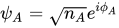
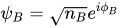



where the constant is a characteristic of the junction. To solve the above equation, first calculate the time derivative of the order parameter in superconductor A:


and therefore the Schrödinger equation gives:

The phase difference of Ginzburg–Landau order parameters across the junction is called the Josephson phase:
The Schrödinger equation can therefore be rewritten as:


and its complex conjugate equation is:

Add the two conjugate equations together to eliminate :


Since , we have:
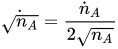
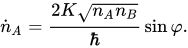
Now, subtract the two conjugate equations to eliminate :


which gives:
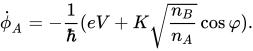
Similarly, for superconductor B we can derive that:

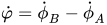
Noting that the evolution of Josephson phase is and the time derivative of charge carrier density is proportional to current , when , the above solution yields the Josephson equations:[19]


(1)

(2)
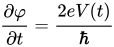
where and are the voltage across and the current through the Josephson junction, and is a parameter of the junction named the critical current. Equation (1) is called the first Josephson relation or weak-link current-phase relation, and equation (2) is called the second Josephson relation or superconducting phase evolution equation. The critical current of the Josephson junction depends on the properties of the superconductors, and can also be affected by environmental factors like temperature and externally applied magnetic field.


The Josephson constant is defined as:

and its inverse is the magnetic flux quantum:
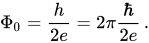
The superconducting phase evolution equation can be reexpressed as:
![{\displaystyle {\frac {\partial \varphi }{\partial t}}=2\pi [K_{J}V(t)]={\frac {2\pi }{\Phi _{0}}}V(t)\,.}](https://wikimedia.org/api/rest_v1/media/math/render/svg/c6a4d19b714169b822a4cda059cb835a84303f25)
If we define:

then the voltage across the junction is:
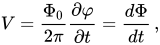
which is very similar to Faraday's law of induction. But note that this voltage does not come from magnetic energy, since there is no magnetic field in the superconductors; Instead, this voltage comes from the kinetic energy of the carriers (i.e. the Cooper pairs). This phenomenon is also known as kinetic inductance.
Three main effects
[edit]


There are three main effects predicted by Josephson that follow directly from the Josephson equations:
DC Josephson effect
[edit]The DC Josephson effect is a direct current crossing the insulator in the absence of any external electromagnetic field, owing to tunneling. This DC Josephson current is proportional to the sine of the Josephson phase (phase difference across the insulator, which stays constant over time), and may take values between and .

AC Josephson effect
[edit]With a fixed voltage across the junction, the phase will vary linearly with time and the current will be a sinusoidal AC (alternating current) with amplitude and frequency . This means a Josephson junction can act as a perfect voltage-to-frequency converter.


Inverse AC Josephson effect
[edit]Microwave radiation of a single (angular) frequency can induce quantized DC voltages[20] across the Josephson junction, in which case the Josephson phase takes the form , and the voltage and current across the junction will be:



The DC components are:

This means a Josephson junction can act like a perfect frequency-to-voltage converter,[21] which is the theoretical basis for the Josephson voltage standard.
Josephson inductance
[edit]When the current and Josephson phase varies over time, the voltage drop across the junction will also vary accordingly. As shown in derivation below, the Josephson relations determine that this behavior can be modeled by a kinetic inductance named Josephson inductance.[22]
Rewrite the Josephson relations as:
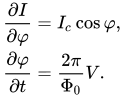
Now, apply the chain rule to calculate the time derivative of the current:

Rearrange the above result in the form of the current–voltage characteristic of an inductor:

This gives the expression for the kinetic inductance as a function of the Josephson phase:
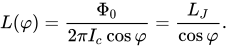
Here, is a characteristic parameter of the Josephson junction, named the Josephson inductance.
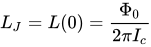
Note that although the kinetic behavior of the Josephson junction is similar to that of an inductor, there is no associated magnetic field. This behaviour is derived from the kinetic energy of the charge carriers, instead of the energy in a magnetic field.
Josephson energy
[edit]Based on the similarity of the Josephson junction to a non-linear inductor, the energy stored in a Josephson junction when a supercurrent flows through it can be calculated.[23]
The supercurrent flowing through the junction is related to the Josephson phase by the current-phase relation (CPR):

The superconducting phase evolution equation is analogous to Faraday's law:
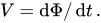
Assume that at time , the Josephson phase is ; At a later time , the Josephson phase evolved to . The energy increase in the junction is equal to the work done on the junction:



This shows that the change of energy in the Josephson junction depends only on the initial and final state of the junction and not the path. Therefore, the energy stored in a Josephson junction is a state function, which can be defined as:

Here is a characteristic parameter of the Josephson junction, named the Josephson energy. It is related to the Josephson inductance by . An alternative but equivalent definition is also often used.
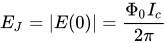


Again, note that a non-linear magnetic coil inductor accumulates potential energy in its magnetic field when a current passes through it; However, in the case of Josephson junction, no magnetic field is created by a supercurrent — the stored energy comes from the kinetic energy of the charge carriers instead.
RCSJ model
[edit]The resistively capacitance shunted junction (RCSJ) model,[24][25] or simply shunted junction model, includes the effect of AC impedance of an actual Josephson junction on top of the two basic Josephson relations stated above.
As per Thévenin's theorem,[26] the AC impedance of the junction can be represented by a capacitor and a shunt resistor, both parallel[27] to the ideal Josephson Junction. The complete expression for the current drive becomes:


where the first term is displacement current with – effective capacitance, and the third is normal current with – effective resistance of the junction.


Josephson penetration depth
[edit]The Josephson penetration depth characterizes the typical length on which an externally applied magnetic field penetrates into the long Josephson junction. It is usually denoted as and is given by the following expression (in SI):

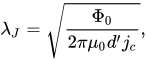
where is the magnetic flux quantum, is the critical supercurrent density (A/m2), and characterizes the inductance of the superconducting electrodes[28]



where is the thickness of the Josephson barrier (usually insulator), and are the thicknesses of superconducting electrodes, and and are their London penetration depths. The Josephson penetration depth usually ranges from a few μm to several mm if the critical current density is very low.[29]


See also
[edit]
References
[edit]- ^ a b Josephson, B. D. (1962). "Possible new effects in superconductive tunnelling". Physics Letters. 1 (7): 251–253. Bibcode:1962PhL.....1..251J. doi:10.1016/0031-9163(62)91369-0.
- ^ Josephson, B. D. (1974). "The discovery of tunnelling supercurrents". Reviews of Modern Physics. 46 (2): 251–254. Bibcode:1974RvMP...46..251J. doi:10.1103/RevModPhys.46.251. S2CID 54748764.
- Also in Josephson, B. D. (1974). "The Discovery of Tunnelling Supercurrents". Europhysics News. 5 (3): 1–5. Bibcode:1974ENews...5c...1J. doi:10.1051/epn/19740503001.
- ^ Steven Strogatz, Sync: The Emerging Science of Spontaneous Order, Hyperion, 2003.
- ^ Mond Laboratory, National Heritage List for England, Historic England (accessed 17 September 2022)
- ^ Josephson, Brian D. (December 12, 1973). "The Discovery of Tunneling Supercurrents (Nobel Lecture)".
- ^ Cohen, M. H.; Falicov, L. M.; Phillips, J. C. (15 April 1962). "Superconductive Tunneling". Physical Review Letters. 8 (8): 316–318. Bibcode:1962PhRvL...8..316C. doi:10.1103/PhysRevLett.8.316.
- ^ a b c Daitch, Vicki; Hoddeson, Lillian (2002). True Genius: The Life and Science of John Bardeen. Joseph Henry Press. p. 117. ISBN 9780309084086.
- ^ Anderson, P. W.; Rowell, J. M. (15 March 1963). "Probable Observation of the Josephson Tunnel Effect". Physical Review Letters. 10 (6): 230. Bibcode:1963PhRvL..10..230A. doi:10.1103/PhysRevLett.10.230.
- ^ US3335363A, Anderson, Philip W. & Dayem, Aly H., "Superconductive device of varying dimension having a minimum dimension intermediate its electrodes", issued 1967-08-08
- ^ "The Nobel Prize in Physics 1973". The Nobel Prize. Retrieved 2023-03-01.
- ^ "Nobel Prize in Physics 2025". NobelPrize.org. Retrieved 2025-10-16.
- ^ a b c Schirber, Michael (2025-10-07). "Nobel Prize: Quantum Tunneling on a Large Scale". Physics. 18: 170. doi:10.1103/PhysRevLett.53.1260.
- ^ Anderson, P. W.; Dayem, A. H. (1964). "Radio-frequency effects in superconducting thin film bridges". Physical Review Letters. 13 (6): 195. Bibcode:1964PhRvL..13..195A. doi:10.1103/PhysRevLett.13.195.
- ^ Dawe, Richard (28 October 1998). "SQUIDs: A Technical Report – Part 3: SQUIDs". rich.phekda.org. Archived from the original (website) on 27 July 2011. Retrieved 2011-04-21.
- ^ Sato, Y.; Packard, R. (October 2012), Superfluid helium interferometers, Physics Today, p. 31.
- ^ Fulton, T. A.; Gammel, P. L.; Bishop, D. J.; Dunkleberger, L. N.; Dolan, G. J. (1989). "Observation of Combined Josephson and Charging Effects in Small Tunnel Junction Circuits". Physical Review Letters. 63 (12): 1307–1310. Bibcode:1989PhRvL..63.1307F. doi:10.1103/PhysRevLett.63.1307. PMID 10040529.
- ^ Bouchiat, V.; Vion, D.; Joyez, P.; Esteve, D.; Devoret, M. H. (1998). "Quantum coherence with a single Cooper pair". Physica Scripta. T76: 165. Bibcode:1998PhST...76..165B. doi:10.1238/Physica.Topical.076a00165. S2CID 250887469.
- ^ "The Feynman Lectures on Physics Vol. III Ch. 21: The Schrödinger Equation in a Classical Context: A Seminar on Superconductivity, Section 21-9: The Josephson junction". feynmanlectures.caltech.edu. Retrieved 2020-01-03.
- ^ Barone, A.; Paterno, G. (1982). Physics and Applications of the Josephson Effect. New York: John Wiley & Sons. ISBN 978-0-471-01469-0.
- ^ Langenberg, D. N.; Scalapino, D. J.; Taylor, B. N.; Eck, R. E. (1966-04-01). "Microwave-induced D.C. voltages across Josephson junctions". Physics Letters. 20 (6): 563–565. Bibcode:1966PhL....20..563L. doi:10.1016/0031-9163(66)91114-0. ISSN 0031-9163.
- ^ Levinsen, M. T.; Chiao, R. Y.; Feldman, M. J.; Tucker, B. A. (1977-12-01). "An inverse ac Josephson effect voltage standard". Applied Physics Letters. 31 (11): 776–778. Bibcode:1977ApPhL..31..776L. doi:10.1063/1.89520. ISSN 0003-6951.
- ^ Devoret, M.; Wallraff, A.; Martinis, J. (2004). "Superconducting Qubits: A Short Review". arXiv:cond-mat/0411174.
- ^ Michael Tinkham, Introduction to superconductivity, Courier Corporation, 1986.
- ^ McCumber, D. E. (1968-06-01). "Effect of ac Impedance on dc Voltage-Current Characteristics of Superconductor Weak-Link Junctions". Journal of Applied Physics. 39 (7): 3113–3118. Bibcode:1968JAP....39.3113M. doi:10.1063/1.1656743. ISSN 0021-8979.
- ^ Chakravarty, Sudip; Ingold, Gert-Ludwig; Kivelson, Steven; Zimanyi, Gergely (1988-03-01). "Quantum statistical mechanics of an array of resistively shunted Josephson junctions". Physical Review B. 37 (7): 3283–3294. Bibcode:1988PhRvB..37.3283C. doi:10.1103/PhysRevB.37.3283. PMID 9944915.
- ^ "AC Thevenin's Theorem". hyperphysics.phy-astr.gsu.edu. Retrieved 2020-01-03.
- ^ "Dynamics of RF SQUID". phelafel.technion.ac.il. Archived from the original on 2021-06-13. Retrieved 2020-01-11.
- ^ Weihnacht, M. (1969). "Influence of Film Thickness on D. C. Josephson Current". Physica Status Solidi B. 32 (2): 169. Bibcode:1969PSSBR..32..169W. doi:10.1002/pssb.19690320259.
- ^ Buckel, Werner; Kleiner, Reinhold (2004). Supraleitung (6. ed.). Tübingen: Wiley-VCH Verlag GmbH&Co.KGaA. p. 67. ISBN 3527403485.
| States of matter |  | ||||||||
|---|---|---|---|---|---|---|---|---|---|
| Phase phenomena | |||||||||
| Electrons in solids |
| ||||||||
| Magnetic phases | |||||||||
| Quasiparticles | |||||||||
| Soft matter | |||||||||


| International | |
|---|---|
| National | |
| Other | |

Josephson effect
View on GrokipediaBackground and History
Superconducting Junctions
Superconductivity is a quantum mechanical phenomenon observed in certain materials at very low temperatures, characterized by zero electrical resistance and the expulsion of magnetic fields from the interior of the material, known as the Meissner effect.[6] This state was first discovered in 1911 by Heike Kamerlingh Onnes while studying mercury at liquid helium temperatures.[7] In superconductors, electrons form bound pairs called Cooper pairs, which carry charge -2e and behave as composite bosons due to their even spin and effective integer spin statistics. These pairs condense into a single macroscopic quantum state, enabling macroscopic quantum coherence where the entire material exhibits wave-like behavior as a coherent entity.[8] A Josephson junction serves as a weak link between two superconducting regions, allowing the quantum tunneling of Cooper pairs across the link while maintaining the overall superconducting properties.[9] The most common configuration is the tunnel junction, consisting of two superconductors separated by a thin insulating barrier, typically 1-2 nm thick, such as aluminum oxide (AlOx).[10] This barrier prevents classical direct current flow between the superconductors but permits phase-coherent quantum tunneling of the bosonic Cooper pairs, coupling the macroscopic wavefunctions of the two sides.[11] Other types of Josephson junctions include weak links, such as point contacts where a narrow constriction or sharpened tip connects two bulk superconductors, and superconductor-normal metal-superconductor (SNS) junctions featuring a thin normal metal interlayer instead of an insulator.[12] Fabrication methods vary by type but often involve thin-film techniques; for example, tunnel junctions are commonly made by depositing a superconducting film like aluminum, exposing it to controlled oxidation to form the barrier, and then depositing the second superconducting layer, typically using electron-beam evaporation or sputtering in a vacuum environment. These structures are essential for realizing weak-link behavior in superconducting devices.Prediction and Discovery
In 1962, Brian Josephson, a graduate student at the University of Cambridge, theoretically predicted the existence of a supercurrent tunneling through an insulating barrier between two superconductors, provided the barrier was thinner than the superconducting coherence length.[13] This prediction extended the Bardeen-Cooper-Schrieffer (BCS) theory of superconductivity to weakly coupled superconducting systems, emphasizing the role of quantum phase coherence across the barrier.[14] Josephson specifically forecasted that the critical current of this supercurrent would be proportional to the product of the superconducting energy gaps and on either side of the junction. Josephson's proposal initially faced significant skepticism within the physics community, particularly from Nobel laureate John Bardeen, who questioned the validity of applying quantum tunneling to macroscopic superconducting pairs and argued that the predicted zero-voltage current contradicted established principles. This debate highlighted broader theoretical uncertainties about macroscopic quantum mechanics, including whether phase coherence could be maintained over distances spanning an insulating barrier in superconducting systems.[14] Despite the controversy, the counterintuitive nature of a dissipationless current at zero voltage spurred rapid experimental efforts to test the predictions. The first experimental verification came in 1963 from Philip W. Anderson and John M. Rowell at Bell Laboratories, who observed an anomalous zero-voltage supercurrent in tin-tin oxide-tin junctions, along with constant-voltage steps induced by microwave radiation, confirming both the DC and AC aspects of the effect. Subsequent measurements in lead-based junctions achieved critical currents up to several microamperes, aligning closely with Josephson's theoretical estimates. These findings resolved the initial doubts, establishing the Josephson effect as a cornerstone of superconducting physics. In recognition of this breakthrough, Josephson shared the 1973 Nobel Prize in Physics with Leo Esaki and Ivar Giaever for their collective contributions to tunneling phenomena in solids.[15]Fundamental Equations
The First Josephson Relation
The first Josephson relation establishes the time-independent relationship between the supercurrent and the phase difference across a superconducting tunnel junction, arising from the quantum tunneling of Cooper pairs through an insulating barrier separating two superconductors. In Brian Josephson's seminal derivation, the superconducting state on each side of the barrier is described by a macroscopic wavefunction , where is the phase of the order parameter. The tunneling of Cooper pairs, which carry charge , leads to a supercurrent due to the coherent overlap of these wavefunctions, with the amplitude determined by the phase difference , the gauge-invariant phase shift incorporating vector potential effects.[13] This relation is expressed asThe Second Josephson Relation
The second Josephson relation describes the dynamic evolution of the superconducting phase difference across a Josephson junction under an applied voltage, originating from the quantum mechanical treatment of the coupled wavefunctions in the adjacent superconductors. This relation emerges from applying the time-dependent Schrödinger equation to the macroscopic wavefunctions of the superconductors, treating the junction as a tunneling barrier that couples the two sides. The voltage introduces an energy shift between the superconducting condensates, driving a relative phase rotation.[13] The core equation of the second relation isKey Effects
DC Josephson Effect
The DC Josephson effect manifests as the flow of a dissipationless supercurrent across a Josephson junction when no voltage is applied, with the current magnitude limited by a critical value determined by the junction properties. This supercurrent arises from the coherent quantum tunneling of Cooper pairs through the insulating barrier, enabled by a fixed phase difference between the superconducting wave functions on either side of the junction. The relation between the current and the superconducting phase difference underscores this coherence, where the current is proportional to for bias currents below . Observation of the DC Josephson effect is characterized by zero-voltage transport in the current-voltage (I-V) curve for applied currents up to , often accompanied by hysteresis in underdamped junctions due to the energy barrier associated with phase slippage. The dissipationless nature of this transport is confirmed experimentally by the lack of Joule heating, as no power is dissipated at zero voltage, distinguishing it from normal resistive flow. The effect requires coherent phase locking across the junction, with remaining constant under bias currents less than ; exceeding causes the phase to evolve dynamically, initiating a finite voltage. First experimentally verified in late 1962 (published 1963) by P. W. Anderson and J. M. Rowell using junctions with tin oxide barriers between superconducting tin and lead films (Sn-SnO-Pb), these early measurements demonstrated supercurrents with critical current densities up to approximately A/cm² at low temperatures.[18] This phenomenon serves as direct evidence of quantum superposition in macroscopic systems, as the sustained supercurrent reflects the collective wave function of billions of Cooper pairs maintaining a definite phase relation across the barrier, embodying macroscopic quantum coherence.AC Josephson Effect
When a constant voltage $ V $ is applied across a Josephson junction, the phase difference $ \phi $ between the superconducting wave functions on either side evolves linearly with time according to the second Josephson relation:Inverse AC Josephson Effect
The inverse AC Josephson effect manifests as a series of constant-voltage steps in the current-voltage (I-V) characteristic of a Josephson junction exposed to external alternating-current (AC) electromagnetic radiation, such as microwaves at frequency . These steps, termed Shapiro steps, appear as horizontal plateaus where the voltage locks to discrete values , with an integer, Planck's constant, and the elementary charge, allowing a range of currents at fixed voltage. This phenomenon arises from phase synchronization between the external drive and the intrinsic dynamics of the superconducting phase difference across the junction. Predicted theoretically by Brian Josephson in 1962 as a consequence of the AC component of the supercurrent under combined DC and AC bias, it demonstrates the quantum mechanical locking of the junction's oscillatory behavior to the incident radiation frequency. The underlying mechanism involves the time evolution of the gauge-invariant phase difference across the junction, governed by the second Josephson relation modified for the applied voltages:Theoretical Models and Properties
Resistively and Capacitively Shunted Junction (RCSJ) Model
The resistively and capacitively shunted junction (RCSJ) model provides a phenomenological framework for describing the dynamics of a Josephson junction by treating it as a parallel combination of an ideal Josephson element, a linear resistor, and a capacitor. The ideal Josephson element carries a supercurrent $ I_c \sin \phi $, where $ I_c $ is the critical current and $ \phi $ is the gauge-invariant phase difference across the junction. The shunt resistor $ R $ accounts for the normal quasiparticle current $ I_N = V / R $, with $ V $ denoting the voltage, while the capacitor $ C $ contributes the displacement current $ I_C = C , dV/dt $. This circuit analogy captures the interplay between superconducting, dissipative, and inertial effects in the junction's response to bias currents. The total current $ I $ through the junction is the sum of these components:Using the second Josephson relation $ d\phi/dt = 2eV / \hbar $, where $ e $ is the elementary charge and $ \hbar $ is the reduced Planck's constant, the voltage $ V $ can be eliminated to yield a second-order differential equation for the phase $ \phi $:
This equation resembles the motion of a damped, driven pendulum, with the phase $ \phi $ playing the role of the angular displacement. Equivalently, the dynamics describe a phase "particle" moving in a tilted washboard potential, where the periodic component arises from the sinusoidal Josephson term and the tilt from the bias current, forming metastable wells separated by barriers. To analyze the dynamics, the equations are often normalized. Introducing the characteristic time $ \tau_J = \hbar / (2e I_c R) $ and normalizing the current by $ I_c $, the equation becomes
where $ \tau = t / \tau_J $ is the normalized time and $ i = I / I_c $ is the normalized bias current. The Stewart-McCumber parameter $ \beta_c = (2e I_c / \hbar) C R^2 $ quantifies the damping: large $ \beta_c $ indicates underdamped (hysteretic) behavior, while small $ \beta_c $ corresponds to overdamped dynamics. Additionally, the plasma frequency $ \omega_p = \sqrt{2e I_c / (\hbar C)} $ sets the scale for small-amplitude oscillations around the zero-voltage state, representing the natural frequency of the junction's "plasma" modes. The RCSJ model elucidates key dynamical features, such as the hysteresis in current-voltage (I-V) characteristics for underdamped junctions, where the junction switches abruptly from the zero-voltage state to a finite-voltage running state upon exceeding $ I_c $, but retraps at a lower current during decreasing bias. It also explains phase diffusion in the thermal regime, where random phase fluctuations broaden the zero-voltage state and suppress the supercurrent, as well as the probabilistic switching from the metastable zero-voltage state due to thermal activation over the washboard potential barrier. The model is valid for temperatures much below the critical temperature ($ T \ll T_c $) to ensure negligible thermal smearing of the superconducting gap and for small junctions where the phase is uniform across the device, avoiding fluxon effects. Extensions incorporate thermal noise via Langevin terms. At ultra-low temperatures, quantum effects become prominent, including macroscopic quantum tunneling (MQT) through the barriers of the washboard potential and quantization of energy levels within the metastable wells. This quantum extension of the RCSJ model underpinned pioneering experiments in the 1980s demonstrating MQT and energy quantization in superconducting circuits using Josephson junctions. These achievements were recognized by the 2025 Nobel Prize in Physics, awarded jointly to John Clarke, Michel H. Devoret, and John M. Martinis "for the discovery of macroscopic quantum mechanical tunnelling and energy quantisation in an electric circuit".[3][20]