Hubbry Logo
KannagiKannagiMain
Open search
Kannagi
Community hub
Kannagi
logo
8 pages, 0 posts
0 subscribers
Be the first to start a discussion here.
Kannagi
Kannagi
from Wikipedia
Kannagi
Kannagi
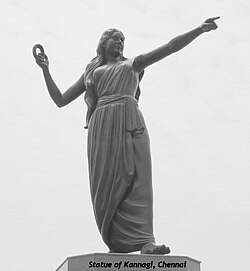
Kannagi Statue in Marina Beach, Chennai

Kannagi (Tamil: கண்ணகி), sometimes spelled Kannaki,[1] is a legendary Tamil woman who forms the central character of the Tamil epic Cilappatikāram.[2] Kannagi is described as a chaste woman who stays with her husband despite his adultery, their attempt to rebuild their marriage after her unrepentant husband had lost everything, how he is framed then punished without the due checks and processes of justice.[1] Kannagi proves and protests the injustice, then curses the king and city of Madurai, leading to the death of the unjust Pandyan king of Madurai, who had wrongfully put her husband Kovalan to death. The society that made her suffer then endures retribution as the city Madurai, in consequence, is burnt to the ground because of her curse.[1]

In Tamil folklore, Kannagi has been deified as the symbol – sometimes as a goddess – of chastity, with sculptures or reliefs in Hindu temples iconographically reminding the visitor of her breaking her anklet or tearing her bleeding breast and throwing it at the city.[3][4]

Text

[edit]

The Kannagi story first appears in the Sangam era poem Narrinai 312.[2] A more extended version appears in the Cilappatikāram.[1]

Legend

[edit]
Kannagi with her husband Kovalan sculpture in Poombuhar.

Kannagi was the daughter of the merchant and ship captain Manayakan from Puhar. She marries the son of Macattuvan, Kovalan, whose family were sea traders and had the sea goddess Manimekalai as patron deity.[5][6] Later, Kovalan met a dancer Madhavi and had an affair with her, which prompted him to spend all his wealth on the dancer. At last, penniless, Kovalan realized his mistake and returned to his wife, Kannagi. Kovalan hoped to recoup his fortunes by trading in Madurai and selling the precious anklet of Kannagi.[citation needed]

Madurai was ruled by the Pandyan king Neṭuñceḻiyaṉ I. When Kovalan tried to sell the anklet, it was mistaken for a stolen anklet of the queen. Kovalan was accused of having stolen the anklet and was immediately beheaded by the king without trial. When Kannagi was informed of this, she became furious, and set out to prove her husband's innocence to the king.

Kannagi came to the king's court, broke open the anklet seized from Kovalan and showed that it contained rubies, as opposed to the queen's anklets which contained pearls. Realizing the error, the king committed suicide in shame, after having caused such a huge miscarriage of justice. Kannagi uttered a curse that the entire city of Madurai be burnt. The capital city of the Pandyas was set ablaze, resulting in huge losses. However, at the request of the goddess Meenakshi, she calmed down and later attained salvation. The story forms the crux of the Cilappatikāram.[7]

Worship

[edit]
Kannaki Amman
Goddess of Chastity[8]
Representation of a deified Kannaki in Sri Lanka.
Tamil languageகண்ணகி அம்மன்
AffiliationShaktism, Pattini, and Bhagavati
SymbolAnklet, Neem leaves
MountLion or Tiger in form of Shakti
ConsortKovalan

As Kannaki Amman, she is eulogized as the epitome of chastity and is worshiped as a goddess in select regions. She is worshiped as a goddess in Sri Lanka and in Southwestern India, known as Pattini in Sinhalese Buddhism,[9] Kannaki Amman by the Sri Lankan Tamil people, and as Kodungallur Bhagavati and Attukal Bhagavati in the Indian state of Kerala. Keralites believe Kannaki to be an incarnation of the goddess Bhadrakali, who reached Kodungallur and attained salvation in the Kodungallur Bhagavathy Temple.[10][11]

Tamil Nadu

[edit]

The Cilappatikāram, and its sequel, Maṇimēkalai, offer evidence that Kannaki was praised as a goddess even during the lifetime of Maṇimēkalai, the daughter of Kovalan and Madhavi. Cilappatikāram tells about the Kannaki worship of another Pandyan King "Vetrivel Cheliyan", for relieving the land from the drought and curse of her on Pandya Nadu.[12] However, the cult of Kannagi does not seem to have had any firm historical foothold in present-day Tamil Nadu, nor does it have any significant presence in modern religious practice.

Some theorise that Kannaki's worship in Southeastern India might have been assimilated in the more common worship of the Dravidian folk religion's rain goddess, Mariamman.[13] Others rely on a peculiar and individual interpretation of the Cilappatikāram, which states that the city of Madurai was destroyed on a Friday in the month of Ādi,[14] to support this idea. A statement that can induce some modern readers to interpret it with a certain symbolism, in view of contemporary beliefs in southeast India, where the Fridays of that month are days associated with the cult of Mariamman.

Few temples, like the Thyagaraja Temple, Tiruvottiyur, the Mathura Kaliamman Temple, Siruvachur and the Mangala Devi Kannagi Temple in Idukki (Kerala) or Theni (Tamil Nadu) district, are places of worship with connections to the Kannagi myth and cult.

Kerala

[edit]
Kodungallur Bhagavathy Temple

The Kannaki cult, perhaps initiated by the Chera dynasty of Kerala, is still preserved in the form of the Bhagavati cult.[15] The famous Bhagavati Temple at Kodungallur, which was the former capital of Cheras, remembers its ancient interaction with the Kannaki cult in its Sthala Puranam.[16][17] Though the deity of the temple is still observed as Bhadra Kali, she is often praised by the devotees as Kannaki and Muthumari in Kodungallur.

Attukal Bhagavati Temple, Moothanthara Karnaki Amman Temple and so many Goddess Bhagavati temples are believed to be located on the journey of Kannaki to Chera Nadu (Kerala) after the burning of Madurai.[18]

Goddess Kannagi's idol in Thambiluvil.

Sri Lanka

[edit]

According to folklore, after the burning of Madurai, Kannagi traveled to Kerala and eventually arrived at the island of Pungudutheevu, near the ancient Manipallavam, now known as Nainativu. She visited approximately 25 sites in Sri Lanka, mostly along the east coast, and finally reached Vattapalai. Disguised as an old woman, she asked some boys herding buffaloes for food. They offered her Pongal made from buffalo milk instead of cow milk. She then requested a lamp lit with sea water. The boys, fearing she was a witch, sought help from the village. When the villagers arrived, Kannagi asked one of the boys to comb her hair, revealing a miraculous sight of 1,000 eyes in her head. She then ascended to heaven, declaring herself as Kannagi of Poompuhar and instructed the villagers to perform the same ritual each year on the day of Vaikasi. This tradition continues today, with both Sinhalese and Tamils participating in the festival by offering Pongal and lighting sea water lamps. King Gajabahu I recognized Kannagi as Pattini, making her a guardian deity of Sri Lanka for both communities.

Kannagi is located in Sri Lanka
Palampoddaru
Palampoddaru
Neelapola
Neelapola
Vantharumoolai
Vantharumoolai
Thandavan Veli
Thandavan Veli
Araiyampathy
Araiyampathy
Mahilady Theevu
Mahilady Theevu
Puthukudiyirupu
Puthukudiyirupu
Cheddipalayam
Cheddipalayam
Kalawaanchikudy
Kalawaanchikudy
Eruvil
Eruvil
Kallaaru
Kallaaru
Thurai Neelavanai
Thurai Neelavanai
Kalmunai
Kalmunai
Veeramunai
Veeramunai
Karaitivu
Karaitivu
Akkaraipatru
Akkaraipatru
Kolavil
Kolavil
Pattimedu
Pattimedu
Thambiluvil
Thambiluvil
Vatrapalai
Vatrapalai
Pungudutheevu
Pungudutheevu
Vannaangkulam
Vannaangkulam
Places Visited by Kannagi in Sri Lanka

Sri Lankan Tamil Hindus

[edit]

Sri Lankan beliefs on Kannaki are intermediate to Cilappatikāram and common Sri Lankan Beliefs. Eastern Sri Lankan and Vanni Tamils praises her as "Kannakai Amman". There are many evidences in Yalpana Vaipava Malai, chronicle of Jaffna Kingdom, confirming the widespread popularity of Kannaki worship during the rule of the Aryacakravarti dynasty (1215–1624) in Northern Sri Lanka. The author of the Sri Lankan epic on Kannaki equivalent to the Cilappatikāram, the Kannaki Vaḻakkurai, recited in eastern Kannaki Amman temples, is believed to be written by the Jaffna king Jeyaveera Cinkaiariyan (1380–1410).

The Kannagi cult was especially popular among the coastal folk who considered her as their guardian deity since she was the daughter of a rich sea trader of Kaveripattinam. Since most of the coastal folk were converted to Catholicism during the Portuguese rule, most of the Kannaki shrines became churches of Our Lady.[19] The remaining temples of Kannaki were transformed in the 19th century into notably Raja Rajeshwari and Bhuvaneshvari temples by activists from the Jaffna-based Saiva movement, under the leadership of Navalar.[20] Arumuka Navalar actively fought against veneration of what he considered to be “a Jain merchantess”.[20] Kannaki Amman was also gradually seen as an incarnation of Shakti. Thus, her worship has declined in the far north of Sri Lanka, among the Jaffneses.

Kannaki is mainly praised once in a year during the Vaikasi month (May–June) of Tamil Calendar in Batticaloa and Ampara Districts. The Festival is called Catangu and Katavu Tirattal. Kalyanak Kāl Naduthal (Planting Wedding Pillar), Vaḻakkurai Pāduthal (Reciting the verses of "Kannaki Vaḻkkurai"), Kulirthi Paaduthal ("Singing Cooling verses") are common rituals of the festival. The festival days differ from temple to temple from three days to seven days. At the end of the festival, the sanctum of Kannaki temple is closed and it will be only opened when the nest Cadangu begins.

Sinhalese Buddhists

[edit]
Marble statue of Goddess Pattini, in the lines of North Indian style Murtis.

Although the hierophant of Kannaki is fully transformed into the Bhagavati cult in Kerala and virtually absent in Tamil Nadu, Sri Lanka still preserves the Kannaki cult in its own form. The Sinhaleses praise her as Pattini. Their stories of that goddess also differ from those of the Cilappatikāram and see her as an avatar of the Buddha.[21] She was born as a mango in the garden of the Pandyan king. She was neglected by him and kept in a boat at sea and grew up in Chola country. She eventually slew the evil Pandyan king[22] and was hired as one of the guardian gods of Lanka by the Buddha.

The grant festival of Sri Lanka, the Esala Perahera, initially included only Kannaki, Vishnu, Kataragama, and Natha. The holy tooth relic of Buddha was annexed in the procession during the period of Kirti Sri Rajasinha of Kandy Kingdom. (1747 - 1782) according to the request of Upali Thera, a Buddhist monk from Konbaung Burma.[23]

Polkeliya "coconut fight", Gammaduwa "village rituals", and ankeliya "horn play" are the main three aspects of the Pattini cult. There are well-known devales at Kandy, Nawagamuwa and Panama for Pattini Deviyo.

[edit]

A Tamil epic film Kannagi directed by R. S. Mani released in 1942. This was the first Tamil film based on the epic Silapadhigaaram.

A similar movie named Poompuhar released in 1964.

A Malayalam film Kodungallooramma directed by Kunchacko starring Prem Nazir, K. R. Vijaya, Adoor Bhasi and Thikkurissy Sukumaran Nair was released in 1968.

A statue of Kannagi holding her anklet, depicting a scene from Cilappatikaram was installed on Marina Beach, Chennai. It was removed in December 2001 citing reasons that it hindered traffic.[24][25] The statue was reinstalled in June 2006.[26][27]

A Sinhala film called Paththini was released on 5 May 2016 in Sri Lanka. The role of the goddess Paththni or Kannagi was played by Pooja Umashankar.[28]

See also

[edit]

References

[edit]
[edit]
Revisions and contributorsEdit on WikipediaRead on Wikipedia
from Grokipedia
Kannagi is the central figure and legendary heroine of the (The Story of the Anklet), one of the five great epics of classical Tamil literature, attributed to the poet and composed around the 5th century CE. In the narrative, Kannagi, depicted as the epitome of chastity and marital devotion, lives happily with her merchant husband in the Chola city of Puhar until his infatuation with the courtesan Madhavi leads to financial ruin; the couple then travels to the Pandyan capital of Madurai, where Kovalan is falsely accused of stealing the queen's anklet and summarily executed. Enraged by this injustice, Kannagi storms the royal court, shatters her remaining anklet to reveal its rubies—proving it differs from the stolen one filled with pearls—and curses the city for failing to uphold dharma, causing Madurai to erupt in flames; the gods intervene to spare the innocent, but the Pandyan king dies of remorse. Following her act of vengeance, Kannagi ascends to the heavens and is deified as , the goddess of chastity and righteous anger, whose worship spread across , , and as a symbol of feminine power and moral . The itself is structured in three books—Puhar, , and Vanci—detailing not only the tragic love story but also vivid portrayals of ancient Tamil society, including urban life, like dance and music, , and religious practices across Jain, Buddhist, and Hindu traditions. Kannagi's tale underscores themes of , the fragility of under flawed rulers, and the transformative potential of a woman's resolve, influencing , temple iconography, and folk festivals to this day.

Literary Origins

Silappatikaram

The Silappatikaram (also spelled Cilappatikāram), one of the five great epics of , is traditionally attributed to , a Chera prince who renounced worldly life to become a . According to the epic's prologue, was the younger brother of the Chera king Senguttuvan (Cēralaṅkōṉ), and he composed the work at his brother's request after receiving a divine vision. Scholarly consensus places its composition around the CE, though some estimates based on synchronisms with historical figures like the Sri Lankan king Gajabahu I suggest an earlier date in the 2nd century CE. The epic was written in , primarily in the āciriyam (akaval) meter, reflecting influences from both indigenous Tamil poetic traditions and Jain ethical perspectives. The work is structured as a poetic epic divided into three books (kaṇṭam), each centered on one of the ancient Tamil kingdoms and comprising multiple cantos (pāṭṭu). The first book, Puharkkaṇṭam (Book of Puhar), describes life in the Chola capital of Puhar (Kaveripattinam) and spans 10 cantos. The second, Maṭuraikkaṇṭam (Book of ), shifts to the Pandya capital of and includes 13 cantos, focusing on its urban and royal elements. The third, Vañcikkuṇṭam (Book of Vanci), set in the Chera capital of Vanci ( or Vanji), consists of 7 cantos and concludes the narrative. In total, the epic contains approximately 5,730 verses, blending dramatic dialogue, descriptive passages, and moral discourse. Set in the ancient region of —encompassing the territories of the Chola, Pandya, and Chera kingdoms—the Silappatikaram evokes the socio-political landscape of the Sangam era (c. 300 BCE–300 CE), a period of flourishing marked by trade, urban centers, and patronage of . Although composed in the post-Sangam period, it draws on earlier bardic traditions, incorporating allusions to Sangam-age motifs while synthesizing local customs with broader Indian ethical ideas, such as karma and . The epic provides vivid insights into the era's maritime commerce, caste dynamics, and , without direct historical events but grounded in the legendary framework of the three crowned kingdoms. Kannagi serves as the central of the Silappatikaram, embodying the ideal of (devoted wife) whose journey underscores themes of loyalty and . Her highlights a profound transformation, evolving from a model of patient domesticity to a figure of , symbolizing the power of (karpu) to challenge . This portrayal elevates her as a of feminine agency within the epic's ethical framework.

References in Other Texts

Kannagi features prominently in the 13th-century commentary on the Silappatikaram by Adiyarkkunallar, a detailed that interprets the epic's dramatic structure and elaborates on her role as a symbol of and , classifying the work as a nātakakāppiyam (dramatic poem). This commentary quotes ancient Sangam verses to contextualize Kannagi's journey and deification, emphasizing her moral authority in cursing . In medieval Tamil literature, Kannagi appears in the 12th-century Periyapuranam by Sekkizhar, a hagiographic text on Shaivite saints that narrates key incidents from her story, including her confrontation with the Pandya king, to illustrate themes of and ethical conduct. Her legend also permeates folk traditions, particularly in Villu Pattu (bow songs), a performative form originating in southern , where performers recount her tale using a large bow-shaped instrument to accompany rhythmic storytelling, preserving oral variations of her and vengeance. These s, documented in 20th-century collections, adapt the epic for rural audiences, highlighting her transformation into a protective . Kannagi's influence extends to Malayalam literature and Kerala traditions, where she is syncretized with Kodungallur Bhagavati, a fierce goddess embodying chastity (karpu). This identification appears in ritual songs like Kannagi Charitham, narrative poems sung during temple festivals that blend her epic journey with local myths of her arrival in Kodungallur and attainment of divine status. Her story is further dramatized in Kathakali performances, a classical Malayalam dance-drama form, portraying her as a warrior-like figure seeking justice, as seen in 20th-century productions tied to the Kodungallur temple's Pongala festival. In 19th- and 20th-century Tamil novels and plays, Kannagi's motif recurs as an of feminine and resistance against injustice, inspiring reinterpretations that critique societal norms. For instance, early 20th-century literature and theatrical adaptations, such as those drawing on her unyielding loyalty to , use her narrative to advocate for women's agency while reinforcing ideals of karpu (). Scholarly analyses highlight how these works, including folk-infused dramas, evolve her image from epic heroine to of moral power.

The Legend

Plot Summary

The epic Silappatikaram is divided into three books: the Book of Puhar, the Book of Madurai, and the Book of Vanci. In the Book of Puhar, set in the Chola capital of Puhar, , the son of a prosperous , marries the young and virtuous Kannagi. Their happy union dissolves when Kovalan attends a dance performance and falls deeply with the Madhavi, abandoning Kannagi to pursue this and squandering his family's wealth in the process. Remorseful, Kovalan eventually returns to Kannagi, who accepts him without resentment. Facing poverty, the couple resolves to relocate to , the capital of the Pandya kingdom, to start anew, with plans to sell one of Kannagi's gold for capital. In , as recounted in the Book of Madurai, Kovalan hands the anklet to a local for valuation; the corrupt goldsmith, who had previously stolen a matching anklet from the Pandya queen, seizes the opportunity to frame Kovalan for the royal theft and informs the palace guards. The Pandya king, acting hastily without , condemns Kovalan to death, and he is summarily executed. Devastated by the news, Kannagi confronts the king in , where she dramatically breaks open her second to reveal its interior filled with rubies—contrasting with the pearl-filled royal anklet—irrefutably demonstrating Kovalan's innocence. Stricken with remorse, the king proclaims the injustice before dying of shock, followed shortly by the queen. Enraged by the travesty, Kannagi curses the of , invoking fire to punish its corruption while sparing the homes of the chaste; a blaze then erupts, razing the city but leaving the virtuous unharmed. As depicted in the Book of Vanci, Kannagi departs the smoldering and journeys to the Chera kingdom, where she reaches Netuval Hill near Vanci. There, celestial beings assure her of a reunion with in the heavens after 14 days. The Chera king Senguttuvan, awed by her story and virtue, declares her divine and vows to erect a in her honor, dispatching an expedition to the to retrieve a sacred stone for her idol. Kannagi thus ascends to the divine realm, becoming deified as the goddess and inspiring her worship among the people of Vanci.

Themes and Symbolism

In the of from the Silappatikaram, , known as karpu in Tamil, emerges as the paramount , embodying purity, , and self-restraint that empowers women to transcend ordinary human limits. Kannagi's unwavering loyalty to her husband , even after his infidelity with the Madhavi, exemplifies karpu as a moral capable of both protection and destruction, drawing parallels to the mythic ideal of Arundhati, the epitome of wifely devotion in ancient Indian lore. This is not merely personal but cosmic, granting Kannagi supernatural agency to challenge systemic wrongs, as her is described as burning "fiercer than the sacrificial ." Karpu stands in stark contrast to themes of unchecked desire and pervasive , highlighting the epic's . Kovalan's dalliance with Madhavi represents the disruptive force of , which leads to financial ruin and his , while Kannagi's steadfast exposes the within societal institutions. Her silent endurance of underscores karpu as a counter to male flaws and arbitrary , transforming personal suffering into a of a world where desire overrides ethical order. The narrative critiques royal authority in ancient Tamil society, portraying kings as fallible guardians of whose errors can devastate the innocent. Kannagi's confrontation with the Pandya , whom she accuses of wielding his scepter unjustly—"O , is this the of your scepter?"—reveals the fragility of monarchical power when divorced from , the righteous order. This extends to roles, where women like Kannagi are confined to domestic spheres yet subvert patriarchal norms by shifting from the private realm (agam) to the (puram), wielding to indict flawed male and assert feminine agency. Central to these themes is the symbolism of the (silambu), which represents the unbreakable marital bond and the unassailable truth of Kannagi's . One of her golden , containing a gem mistaken for stolen royal jewelry, serves as irrefutable evidence against the king's hasty judgment, while she hurls the other to ignite Madurai's destruction, embodying . The silambu thus signifies not only conjugal but also the weaponization of truth against , marking Kannagi's transition from victim to avenger. Broader motifs of , , and divine justice culminate in Kannagi's , affirming the triumph of over corruption. Her act of —cursing the city for the king's injustice—aligns with 's inexorable law, where " itself will become the of to those who do ," ensuring cosmic balance despite human failings. This elevates her from a grieving to the Pattini, symbolizing how karpu-driven retribution restores moral equilibrium and critiques societal inequities.

Deification and Worship

In Tamil Nadu

Kannagi is deified as Kannagi Amman in , where she is revered as the patron goddess of , embodying ideals of wifely virtue and justice drawn from her legendary narrative. The most prominent site of her worship is the Chellathamman Temple in , constructed as a tribute to her divine at the location believed to be where she rested during her journey to the Pandya capital. This temple features a stone idol of Kannagi holding her , alongside a smaller figure of Madiri Adigal, the who offered her shelter, underscoring the syncretic elements in her veneration. Historical records indicate the emergence of her cult by the , with epigraphic evidence such as the Vilapakkam inscription dated 945 CE in the Arcot region, which references Kuratti Adigal—a title evoking the "chaste " motif central to Kannagi's deified identity as . This inscription describes the nun's endowment of a well that evolved into a monastic complex, highlighting the early institutionalization of chastity-related devotion in Tamil religious life. Within Tamil Shaivism, Kannagi's worship has integrated with broader goddess traditions, often linking her to as a manifestation of feminine power or positioning her as a folk deity in Shaivite temple complexes during the Chola period. By the , her cult merged with local Shaivite practices, as seen in temples like Tiṭṭakuṭi, where she is venerated as Acaṉāmpikai alongside as Vaidhyanāthasvāmi, blending her literary origins with established theistic frameworks. In , devotion to Kannagi peaks during the Aadi month (–August), with special observances on Fridays commemorating the curse she invoked upon the city in her , drawing devotees to the Chellathamman Temple for rituals that honor her transformative wrath and protective chastity. These celebrations include prayers and offerings that reinforce her role as a guardian against injustice, aligning with Tamil Nadu's folk Hindu customs.

In Kerala

In Kerala, Kannagi is prominently identified with Bhagavati, a manifestation of the , at the Kodungallur Devi Temple in . The temple's origins are linked to the 2nd century CE Chera king Senguttuvan, who is said to have installed Kannagi's there, originally following Dravidian traditions before incorporating influences in later centuries, and features a of the crafted from a tree according to Tantric rituals; a hidden believed to represent Kannagi is housed in a secret chamber. This identification stems from the legend in the Silappatikaram, where Kannagi attains deification, with her worship syncretized into local cults as a symbol of and divine justice. Kannagi's cult migrated to Kerala from Tamil regions through connections with the Chera dynasty, particularly under King Senguttuvan in the 2nd century CE, who is said to have installed her statue at the Chera capital Vanji (modern ) to commemorate her martyrdom after fetching a stone from the . This migration facilitated the integration of Kannagi into 's syncretic goddess worship, blending Tamil epic narratives with indigenous rituals and emphasizing her as a fierce protector against . The Chera patronage helped establish her as a central figure in temple traditions, distinct from broader Hindu pantheons by highlighting her role in upholding moral order. In ritual arts, Kannagi is portrayed as a fierce protector in performances, a vital folk tradition in northern , where performers embody her through elaborate costumes and trance-induced dances; for instance, the Kutti Theyyam variant incorporates her anklet (silambu) as a symbolic prop to invoke her wrathful aspect. Similarly, the Kanyarkali ritual in serves to appease her fiery temperament post the legendary burning of , involving and invocations that underscore her guardian role over devotees. These arts preserve her deified image as a warrior , accessible to lower-caste performers and communities, fostering social cohesion through ritual enactment. The annual Utsavam, also known as the Meena Bharani , centers on Kannagi's worship with intense possession rites where oracles (velichappads) enter trances to channel the , accompanied by Bharanipaattu songs that blend profane and devotional elements to honor her. Devotees offer items symbolizing , such as cloth, swords, and , seeking her blessings for marital fidelity and protection; the spans a month, culminating in processions that reenact her journey and deification. This event revives Dravidian roots, contrasting with more orthodox temple practices and reinforcing Kannagi's enduring appeal as a patron of women's virtue in society.

In Sri Lanka

In , Kannagi is revered through a unique syncretic tradition that bridges Hindu and Buddhist communities, known respectively as Kannaki Amman among and Pattini Devi among Sinhalese Buddhists. This dual worship reflects the island's historical cultural exchanges with , where the Pattini cult was introduced in the 2nd century CE by King Gajabahu I. Having been taken captive to the Chola kingdom during his reign, Gajabahu brought back jeweled anklets associated with Kannagi's legend from the Tamil epic Silappatikaram, establishing her as a guardian and founding the first Pattini Devale. The cult's spread was further facilitated by ancient maritime trade routes and subsequent Chola invasions, which embedded Tamil devotional practices into Sri Lankan religious life. Among Sinhalese Buddhists, Pattini is venerated as a bodhisattva-like figure embodying chastity, fertility, health, and protection of the Buddhist Sasana and the island itself, with her story adapted in Sinhala to include seven virtuous births and acts of merit toward . Prominent sites include the Devalaya in , located within the sacred precincts of the Dalada Maligawa and built during the Kandyan kingdom era, where rituals emphasize her role as a maternal guardian. Other key devales, such as the ancient Navagamuwa Pattini Devale believed to be the original site established by Gajabahu, host ceremonies like the gammaduwa village rituals that invoke her for communal well-being. This Buddhist adaptation transforms the fiery justice-seeker of the original legend into a compassionate protector aligned with principles. Tamil Hindus in the Eastern Province maintain a parallel worship of Kannagi as Kannaki Amman, focusing on her as a fierce embodiment of and retribution, with over 60 dedicated kovils in the region. The Thambiluvil Kannaki Amman Kovil, one of the most ancient and significant, exemplifies this tradition, drawing pilgrims for annual festivals that reenact elements of her deification. These practices highlight the cult's localization amid Sri Lanka's multi-ethnic fabric, where shared myths from Silappatikaram foster Hindu-Buddhist harmony despite distinct ritual expressions.

In Southeast Asia

The worship of Kannagi as Pattini extended to through ancient Tamil maritime trade and cultural exchanges, particularly influencing regions like and during the Chola empire's expansions (9th–13th centuries CE). While not as institutionalized as in or , elements of the chastity appear in localized syncretic traditions, such as protective female deities in communities and folk rituals symbolizing justice and feminine power.

Iconography and Rituals

Artistic Representations

Kannagi's iconography in artistic representations consistently features her as a standing female figure, often clad in traditional attire, holding a golden in one hand to symbolize the that sparked her wrath, while clutching her torn left in the other, representing her self-mutilation and curse upon . Flames frequently encircle her form, evoking the fiery destruction she unleashed on the city, as described in the epic Silappatikāram. This depiction underscores her transformation from a devoted to a deified embodiment of and , with the anklet and breast as central motifs distinguishing her from other goddesses. Sculptures of Kannagi adorn her dedicated temples in , where she is portrayed in dynamic poses emphasizing her vengeful act, dating primarily to the Pallava and early Chola periods between the 7th and 12th centuries. In , , similar stone and wooden sculptures in the Pattini Devale depict her with the anklet and breast, integrated into architecture from the same era, including processional images used in rituals. These works, often carved in or , highlight her role as a guardian deity. Paintings and reliefs of Kannagi appear prominently on the gopurams (towering gateways) of temples, such as those in Chola-era structures, where narrative panels illustrate her curse amid flames. In Sri Lankan temple art, including temples (candi-like structures) from the Kandy period, murals and bas-reliefs portray her story in vibrant colors, blending Hindu and Buddhist elements. Regional variations in her artistic forms reflect cultural adaptations: in , she is often rendered as a fierce, wrathful with exaggerated flames and a confrontational stance to emphasize and . In contrast, Sri Lankan depictions, particularly in Kandy's devales, present a more serene wife-turned-protector, sometimes with softer features within Buddhist contexts.

Festivals and Practices

Devotees offer anklets (silambu) and bangles as symbols of vows during worship at Kannagi temples, particularly in , where these items are presented alongside swords, silk garments, and thaali (nuptial necklaces) to seek blessings for marital harmony and fidelity. These offerings, often made from gold or silver, represent the devotee's commitment to purity and are placed at the deity's feet during daily rituals or special pujas, emphasizing Kannagi's role as the goddess of . In , possession rituals feature prominently in performances, where performers known as komarams enter ecstatic trances, embodying Kannagi as Bhagavathy Theyyam with elaborate headgear and anklets, dancing vigorously to invoke her presence for community protection. Similarly, in , low-country dances such as the ritual incorporate possession by female mediums who channel Kannagi's spirit, performing rhythmic movements with props like the silambu to exorcise misfortunes and ensure prosperity, often during annual ceremonies like Gammaduwa. These dances blend , , and states, allowing participants to seek divine intervention against personal or communal ills. During Tamil Nadu's festival, which honors water bodies and coincides with the rising , devotees offer prayers at riverbanks. Fire-walking rituals occur on the Fridays of Aadi month at temples dedicated to forms, where participants traverse glowing embers to affirm vows of devotion and purity. Temple practices centered on Kannagi include vows for marital fidelity, where women tie threads or offer cloths as pledges for spousal , and petitions for against , with devotees reciting her story to summon her as a guardian of righteousness. These rituals, performed year-round but intensified during festivals like in , reinforce communal bonds through shared invocations of her unyielding justice.

Cultural Impact

Historical Influence

Kannagi's narrative from the ancient Tamil epic Silappatikaram profoundly influenced 19th-century Tamil revivalism, as scholars like U. V. Swaminatha Iyer rediscovered and published the text in 1892 after an extensive search for palm-leaf manuscripts across Tamil Nadu. This effort not only preserved classical literature but also ignited a cultural renaissance, positioning Kannagi as an emblem of indigenous Tamil virtue and resilience amid colonial disruptions to local traditions. Iyer's work emphasized the epic's portrayal of justice and moral fortitude, inspiring Tamil intellectuals to reclaim their literary heritage from obscurity and Brahmanical dominance. In the socio-political sphere, Kannagi emerged as a potent symbol in the Dravidian movement's symbolism during the early , embodying Tamil womanhood and cultural purity as tools for asserting Dravidian identity against perceived impositions. Dravidian ideologues drew on her story to highlight themes of equity and regional pride, integrating her into discourses that sought to unify non-Brahmin communities under a shared ethnic banner. This adoption reinforced the movement's narrative of historical continuity, with Kannagi representing the unyielding spirit of Tamil society. Kannagi's depiction also shaped historical discourses on women's rights in Tamil culture, where her chastity was interpreted not merely as passive virtue but as a empowering force enabling her to confront royal injustice and demand accountability. In colonial-era literature and commentaries, this portrayal promoted chastity (karpu) as a moral weapon for women, allowing them to transcend domestic roles and influence societal norms through acts of righteous defiance. Such interpretations in 19th- and early 20th-century writings served as subtle resistance to colonial patriarchal structures, elevating indigenous models of female agency. Furthermore, the legend of Kannagi fostered historical ties between and , manifesting in shared devotional practices that underscored a common Tamil heritage across the region. In , her transformation into the goddess symbolized protective justice, bridging cultural exchanges between and Sinhalese communities since ancient times and contributing to enduring interstate solidarity. This cross-border veneration highlighted Kannagi's role in regional identity formation, predating modern political boundaries.

Modern Depictions

In the 20th century, Kannagi's story from the Silappatikaram was adapted into , most notably in the 1942 film Kannagi, directed by R. S. Mani and produced by Central Studios. This black-and-white epic featured P. U. Chinnappa as and Kannamba as Kannagi, emphasizing themes of and through musical sequences and dramatic reenactments of the epic's key events. The film was a commercial success, running for over 100 days in theaters and influencing subsequent portrayals by blending classical with early cinematic techniques. Another significant cinematic adaptation is Poompuhar (1964), directed by P. Neelakantan, which retells the Silappatikaram narrative with as and as Kannagi, focusing on the tragic romance and moral conflict. This color film incorporated dance sequences to highlight Kannagi's virtuous character, achieving widespread acclaim and contributing to the popularization of Tamil epics in post-independence Indian cinema. Kannagi's tale continues to inspire theater, particularly through traditional forms like Therukoothu and , which have evolved into contemporary performances in . These street theater adaptations, often performed during village festivals, dramatize Kannagi's journey with vibrant costumes, rhythmic dialogues, and , maintaining the epic's emphasis on and while incorporating local dialects for modern audiences. Troupes such as those led by artists in rural districts regularly stage these plays, blending ritualistic elements with improvisational to engage younger viewers. In modern literature, Kannagi has been reinterpreted through feminist and social lenses, as explored in scholarly works like Prabha Rani's Kannagi Through the Ages: From the Epic to the (2023), which analyzes her evolution in 20th-century Tamil writings. These reinterpretations often appear in Tamil literary journals and anthologies, reflecting influences that position Kannagi as an icon of regional identity and . Recent festivals and tourism initiatives in Madurai have revitalized Kannagi's legacy, with annual celebrations at sites linked to the Silappatikaram, such as the Kannagi Temple in Simmakkal. Post-2000s, Madurai's heritage walks, organized by groups like INTACH, include stops at locations associated with Kannagi's story, such as the purported site of Madurai's burning, fostering tourism that highlights the epic's historical and architectural ties to the Pandya era. These efforts have boosted visitor numbers, with guided tours emphasizing Kannagi's role in Tamil cultural narratives. The 2022 festival at the Kannagi Temple in Vinneripaarai, Theni district, attracted thousands of devotees for rituals reenacting her ascension, combining processions with cultural programs to promote heritage awareness.

References

Add your contribution
Related Hubs
User Avatar
No comments yet.