Hubbry Logo
Keesler Air Force BaseKeesler Air Force BaseMain
Open search
Keesler Air Force Base
Community hub
Keesler Air Force Base
logo
8 pages, 0 posts
0 subscribers
Be the first to start a discussion here.
Keesler Air Force Base
from Wikipedia

Key Information

Keesler Air Force Base (IATA: BIX, ICAO: KBIX, FAA LID: BIX) is a United States Air Force base located in Biloxi, a city along the Gulf Coast in Harrison County, Mississippi, United States. The base is named in honor of aviator 2d Lt Samuel Reeves Keesler Jr., a Mississippi native killed in France during the First World War. The base is home of Headquarters, Second Air Force (2 AF) and the 81st Training Wing (81 TW) of the Air Education and Training Command (AETC).

The base has specialized in ground trade training since its opening in 1941 during World War II. It has had high-quality technical schools and absorbed units moved from other bases under the Base Realignment and Closure Act (BRAC).

History

[edit]

In early January 1941, Biloxi city officials assembled a formal offer to invite the United States Army to build a base to support the World War II training buildup. The War Department activated Army Air Corps Station No. 8, Aviation Mechanics School, Biloxi, Mississippi, on 12 June 1941. On August 25, 1941, the base was dedicated as Keesler Army Airfield, in honor of 2d Lt Samuel Reeves Keesler Jr., a Mississippi native and distinguished aerial observer, killed in action in France during the First World War.

Congress initially appropriated $6 million for construction at Biloxi and an additional $2 million for equipment. By the time the War Department allocated the funds in April 1941, the projected cost had risen to $9.6 million. On 14 June 1941, the U.S. Army Corps of Engineers awarded contracts totaling $10 million to build Biloxi's technical training school. At the time, it was the most expensive government project to have been undertaken in the State of Mississippi.

Keesler Field 1943 Classbook

When the War Department activated Keesler Field in June 1941, not only was Keesler getting a technical training center, but it would be getting one of the Army's newest replacement, or basic training centers. The first shipment of recruits arrived at Keesler Field on 21 August 1941. Many stayed at Keesler to become airplane and engine mechanics, while others transferred to aerial gunnery or aviation cadet schools. Development of the base stimulated businesses and residential construction in Biloxi.

The Tuskegee Airmen were trained at Keesler. More than 7,000 Black soldiers were stationed at Keesler Field by the autumn of 1943. These soldiers included pre-aviation cadets, radio operators, aviation technicians, bombardiers, and aviation mechanics.

Officers' Club at Keesler Field as it appeared during World War II. "Partial view of the Dining Room, Officers' Club, Keesler Field, Mississippi. The mural scene, painted by Cpl. Claude Marks, shows the harvesting and processing of cane sugar in Louisiana around 1859." Source: U. S. Government postcard. Date of postcard unknown, probably about 1944.
August 31, 2005: C-17 Globemasters unload supplies at Keesler following Hurricane Katrina.
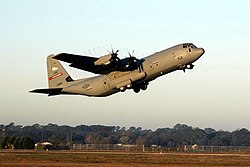
A Lockheed Martin C-130J Super Hercules is cleaned up in the new wash system at Keesler.

Keesler continued to focus upon specialized training in Consolidated B-24 Liberator maintenance until mid-1944. Thereafter, the base expanded its curricula to train mechanics for other aircraft. By September 1944, the number of recruits had dropped, but the workload remained constant. Keesler personnel began processing veteran ground troops and combat crews who had returned from duty overseas for additional training and follow-on assignments. The number of men who went through basic training wound down markedly after the end of World War II, and it was discontinued at Keesler on 30 June 1946.

Cold War

[edit]

In late May 1947, the Radar School was established at Keesler (transferred from Boca Raton Army Air Field), making it responsible for operating the two largest military technical schools in the United States. Thereafter, shrinking budgets forced the base to reduce its operating costs: the Airplane and Engine Mechanics School and the Radar School were consolidated on 1 April 1948.

In early 1949, the Radio Operations School transferred to Keesler from Scott Air Force Base, Illinois. In addition to training radio operators, Keesler was to begin teaching air traffic service technicians; aircraft approach controllers, ground radar mechanics, and radar repairman/ground controlled approach specialists. The last mechanics training courses had moved to Sheppard Air Force Base, Texas, by November.

In early 1956, Keesler entered the missile age by opening a ground support training program for the Atlas missile. In 1958, all control tower operator, radio maintenance, and general radio operator courses were put under Keesler's already broad technical training roof.

"Since August 1948, the 3380th Technical Training Wing had controlled all base activities. Under it were four [groups]: the 3380th Technical Training Group, which operated the school; the 3380th Maintenance and Supply Group; the 3380th Air Base Group; and the 3380th Medical Group. In 1955, a fifth group was added—the 3380th Installations Group. That arrangement continued until 1 January 1959, when Air Training Command redesignated the wing as Headquarters, Keesler Technical Training Center (KTTC). At the same time, the training group was redesignated the 3380th Technical School, USAF, and all of its subodinate student squadrons were renamed school squadrons."(81 TRW Brief History 2011)

During the early 1960s, Keesler lost many of its airborne training courses, but it remained the largest training base throughout the 1970s. This included limited flight training operations in the T-28 Trojan for Republic of Vietnam Air Force (VNAF) student pilots.

Hurricane Camille produced considerable damage as it passed over Biloxi in 1969. Most of the Back Bay housing area was under water.

"On 31 May 1972, Air Training Command redesignated the 3380th Technical School as the USAF School of Applied Aerospace Sciences. Soon after on 13 December, the school received institutional accreditation from the Southern Association of Colleges and Schools. As a result, Airmen trained at Keesler received a Career Educational Certificate from the newly established Community College of the Air Force. This opportunity was further expanded in April 1977, when Keesler graduates became eligible to apply their technical training towards an Associate of Arts degree."(81 TRW Brief History 2011)

Keesler's student load dropped to an all-time low after the Vietnam War ended. As a result, Air Training Command inactivated the USAF School of Applied Aerospace Sciences on 1 April 1977 and replaced it with the 3300th Technical Training Wing, which activated the same day.

During the early 1980s Keesler's air traffic control program garnered publicity when the Professional Air Traffic Controllers Organization walked off the job in August 1981. When President Ronald Reagan fired the strikers, Keesler-trained military air traffic controllers were used to direct some of the nation's air traffic. As the air traffic control school it was also the logical location for the USAF Combat Controllers.

Keesler AFB was the primary training base for many avionics maintenance career fields, including Electronic Warfare, Navigational Aids, Computer Repair and Ground Radio Repair. It was also the primary training base for most USAF administrative career fields.

From the 1990s

[edit]

Driven by defense budget cuts, base closures following the end of the Cold War forced an end to technical training at Chanute Air Force Base, Illinois, and Lowry Air Force Base, Colorado, when those bases were closed by Base Realignment and Closure Commission (BRAC) actions. Keesler acquired Chanute's weather forecasting courses and Lowry's meteorology and precision measurement equipment laboratory training programs during 1992 and 1993.

Massive restructuring of the Air Force in the early 1990s also meant several changes for Keesler associate units. The first occurred when the 53d Weather Reconnaissance Squadron was inactivated in the active duty Air Force, transferred to the Air Force Reserve and reactivated on 30 June 1991.

On 1 July 1993, the Air Training Command (ATC) was redesignated the Air Education and Training Command (AETC) and the command reactivated Second Air Force (2nd AF), stationing it at Keesler. Second Air Force's mission is to oversee all technical training conducted within AETC. The same day, Keesler Training Center was inactivated, and the 81st Training Wing arrived at the base. The 45th Airlift Squadron (45 AS), part of the 314th Airlift Wing at Little Rock AFB, Arkansas, was also located at Keesler. The 45th AS provided flight crew training in the C-21 Learjet until 2007, when it moved to Scott AFB.

Keesler students evacuated to Sheppard Air Force Base on a C-17

On 29 August 2005 Keesler sustained a direct hit from Hurricane Katrina, which made its third Gulf Coast landfall as a Category 3 storm approximately 30 miles (48 km) to the west. Although non-essential personnel and Hurricane Hunter planes had been evacuated in advance, "drastic damage" was sustained by the base's industrial and housing areas. Due to storm surge about 50% of the base came under water; the commissary, base exchange, and some base housing units were flooded with more than six feet of water. By August 31, however, relief flights were landing at the base. On September 1 the first set of Airmen were evacuated to Sheppard AFB, TX. Other Airmen reached Sheppard AFB the next day, where they were welcomed and given basic items.

Units today

[edit]

From 1993, the 81 TRW has provided technical training of airmen in select skill areas immediately following their completion of basic training, as well as providing additional or recurrent training. On average, Keesler has 3,100 students on base at a time. Much of the training they receive is in the field of electronics, such as wideband maintenance, ground radio, information technology, avionics, cryptography. The wing also trains meteorology personnel, radar operations, air traffic control, Aviation Resource Management (ARMS), and tropical cyclone forecasting. Keesler AFB is one of the largest technical training wings in AETC, with four training squadrons located in the training building complex known as "the triangle," the 334th, 335th, 336th, and the 338th. The 81st Medical Group is also located at the base and operates the second largest medical center in the Air Force.

The Air Force Reserve Command's 403d Wing is also on base, and is an Air Mobility Command (AMC)-gained composite unit. It has an airlift squadron (the 815th Airlift Squadron), and the 53rd Weather Reconnaissance Squadron, a WC-130 unit known as the "Hurricane Hunters."

Finally, Keesler is also home to CNATTU Keesler (Center for Naval Aviation Technical Training Unit), a training unit for U.S. Navy and U.S. Marine Corps enlisted personnel receiving training at Keesler, such as enlisted meteorology training, with their Air Force counterparts.

Names, commands to which assigned, and units

[edit]

Previous names

[edit]
  • Biloxi Air Corps Technical School, 13 June 1941
  • Keesler Army Airfield, 25 August 1941
  • Keesler Air Force Base, 13 January 1948 – Present

Major commands to which assigned

[edit]
Re-designated: Army Air Forces Technical Training Command, 1 March 1942
Re-designated: Army Air Forces Training Command, 31 July 1943

Major units assigned

[edit]

Based units

[edit]

Flying and notable non-flying units based at Keesler Air Force Base.[2][3][4][5]

Units marked GSU are Geographically Separate Units, which although based at Keesler, are subordinate to a parent unit based at another location.

US Air Force

[edit]

See also

[edit]

References

[edit]
[edit]
Revisions and contributorsEdit on WikipediaRead on Wikipedia
from Grokipedia
Keesler Air Force Base is a installation located within the city limits of , on the Gulf Coast, serving as the service's primary training center for , communications, and cyber operations. The base, activated on June 12, 1941, as Army Air Corps Station No. 8 and renamed Keesler Army Airfield on August 25 later that year in honor of Samuel Reeves Keesler Jr., a Mississippi native and casualty, underwent significant expansion during to train mechanics, radio operators, and radar specialists, graduating over 78,500 personnel by the end of the war in 1945. Redesignated as an Air Force base on January 13, 1948, following the creation of the U.S. Air Force, it solidified its role as the "Electronics Training Center" by 1949, focusing on advanced technical skills amid the and eras. Throughout the postwar decades, Keesler evolved to incorporate training for missile systems, SAGE air defense networks, and communications in the and , while modernizing facilities with innovations like television-based instruction in 1953 and interactive video disc technology by 1984. The base absorbed additional courses from closing installations in the 1990s, leading to the activation of the as the host unit on July 1, 1993, which continues to oversee operations today and has trained over 2.3 million personnel since the base's . In the 21st century, Keesler has expanded its scope to include joint-service education for the , , , Marine Corps, , and federal agencies, training approximately 27,000 students annually across over 400 courses in 37 career fields as of 2025, with a strong emphasis on cyber and information dominance, including recent initiatives like the 2024 $6.6 million Cyber and Technology Center and a 2025 accelerated degree partnership with . Key tenant units enhance Keesler's strategic importance, including the Second Air Force, which oversees technical training for the ; the 403rd Wing, renowned for its weather reconnaissance missions as the "" using WC-130J aircraft; the Mathies Noncommissioned Officer Academy for ; and the 85th Engineering Installation Squadron for global infrastructure support. The base's enduring legacy as a cornerstone of readiness is underscored by its approximately $50 million reconstruction in the early and ongoing adaptations to emerging technologies, ensuring it remains a vital hub for producing skilled Airmen in an era of increasing digital warfare demands.

Overview and Location

Establishment and Naming

Keesler Air Force Base traces its origins to the pre-World War II military buildup, when the War Department activated Army Air Corps Station No. 8, Aviation Mechanics School, in , on June 12, 1941. This establishment was part of the urgent need to train personnel for impending conflict, focusing initially on aviation mechanics while soon expanding to include radio operators and other technical skills essential for aircraft maintenance and communication. The site's selection followed an offer from Biloxi city officials in January 1941, who provided over 1,500 acres of donated land to support the training center. Construction began rapidly after funding approval, with appropriating $6 million for base development and an additional $2 million for equipment in early 1941. By April, projections had risen to $9.6 million due to escalating wartime demands, leading the U.S. Army Corps of Engineers to allocate approximately $10 million in contracts starting June 14. The project encompassed , runways, hangars, and specialized training facilities across the initial acreage, enabling the arrival of the first recruits on August 21, 1941, and transforming the site into a key technical training hub. On August 25, 1941, the station was officially designated Keesler Army Airfield in honor of 2nd Lt. Samuel Reeves Keesler Jr., a native from Greenwood who served as an aerial observer in . Born on April 11, 1896, Keesler joined the U.S. Army Air Service in 1917 and was commissioned shortly thereafter, deploying to France with the 24th Aero Squadron. He was mortally wounded on October 8, 1918, during a reconnaissance mission near when his aircraft was shot down, succumbing to his injuries the following day; for his gallantry, he received the Distinguished Service Cross posthumously. Following the establishment of the independent U.S. Air Force on September 18, 1947, Keesler Army Airfield was redesignated Keesler Air Force Base on January 13, 1948, reflecting its continued role in technical education amid the emerging era.

Geographic and Environmental Setting

Keesler Air Force Base is situated within the city limits of Biloxi in , along the Gulf Coast region of the . The installation lies approximately 4 miles west of downtown Biloxi, integrating closely with the surrounding urban and coastal landscape. Its geographic coordinates are approximately 30°24′37″N 88°55′28″W, positioning it in a strategic coastal area that supports both military operations and regional connectivity. The base encompasses roughly 3,500 acres, encompassing key infrastructure such as runways, family housing, training facilities, and administrative areas. This land area facilitates diverse activities while maintaining boundaries that border residential and commercial zones in Biloxi. The site's layout reflects adaptations to its coastal environment, with facilities designed to accommodate , , and support functions across the expansive property. Keesler experiences a typical of the Gulf Coast, marked by long, hot summers, mild winters, and consistently high levels averaging around 80% in the mornings. Annual rainfall averages approximately 60 inches, distributed throughout the year but peaking during the summer months, contributing to lush vegetation and occasional flooding risks. The region is prone to frequent hurricanes and tropical storms due to its proximity to the , about 1 mile to the east via the , necessitating robust resilience measures such as elevated buildings and systems. The base's location fosters strong ties with the local community, serving as a major economic driver for Biloxi and Harrison County while sharing airspace with the nearby Gulfport-Biloxi International Airport, located about 13 miles to the west. This proximity enhances logistical efficiency but requires coordinated to balance military training flights with civilian aviation. Environmental considerations, including and vulnerability, shape ongoing efforts at the installation.

Historical Development

World War II Foundations

Keesler Field was activated by the War Department on June 12, 1941, as Army Air Corps Station No. 8, initially designated as an Aviation Mechanics School to support the expanding U.S. military needs ahead of full U.S. entry into World War II. Renamed Keesler Army Airfield on August 25, 1941, in honor of World War I aviator 2nd Lt. Samuel Reeves Keesler Jr., the base quickly ramped up operations following the attack on Pearl Harbor. Basic military training commenced on August 21, 1941, processing recruits for technical specialties, while the first technical classes in airplane and engine mechanics began on September 29, 1941, with an initial focus on preparing ground personnel for aircraft maintenance roles. By late 1942, training expanded to include specialized instruction in B-24 Liberator bomber maintenance, marking the base's pivotal role in equipping the Army Air Forces for combat operations. The base's training programs grew rapidly to meet wartime demands, encompassing aircraft mechanics, radio communications, and emerging radar operations, with a peak student population reaching approximately 20,000 by 1943. Over the course of the war, Keesler graduated more than 78,500 personnel from technical courses by V-J Day in August 1945. Overall, Keesler trained nearly 500,000 mechanics and servicemen during the war. These efforts contributed significantly to the Allied air campaign through skilled technicians and operators. Notably, the base hosted segregated training units for African American personnel, including over 7,000 service members by autumn 1943 who supported the Tuskegee Airmen program, providing essential ground crew expertise in mechanics and radio operations for units like the 477th Bombardment Group. These efforts underscored Keesler's commitment to wartime inclusivity within the constraints of segregation policies, training diverse cohorts essential to the war machine. Infrastructure at Keesler expanded dramatically from its modest beginnings, with an initial $10 million awarded in leading to the erection of over 660 buildings, including , academic facilities, and a by 1942. The airfield featured runways, one extending 6,600 feet to accommodate heavy bombers like the B-24, enabling practical flight and maintenance training. This growth had a profound economic impact on , transforming the local economy during the through construction jobs and an influx peaking at 69,000 military personnel, which stimulated commerce, housing, and services in the community. As concluded in 1945, plans emerged to deactivate the base amid demobilization efforts, but it was retained for postwar technical training due to rising global threats, including the onset of the , ensuring its continued relevance as a key Army Air Forces installation. Basic training ceased on June 30, 1946, but specialized programs persisted, laying the groundwork for Keesler's evolution into a premier technical training center.

Cold War Expansions and Challenges

Following , Keesler Air Force Base transitioned from basic military training to a focus on technical education, with basic training discontinued on 30 June 1946 while and technical courses continued and expanded postwar. The base was officially redesignated as Keesler Air Force Base on 13 January 1948 and assigned to , which oversaw its growth into a major hub for specialized technical instruction. By early 1949, directed Keesler to concentrate on , radio, and maintenance and repair, leading to the addition of radar operator courses and the relocation of the Radar School from Boca Raton Army Air Field to Keesler on 14 November 1947. This shift built on the base's wartime infrastructure for aircraft mechanics and radio operations, emphasizing the emerging needs of aerial defense systems. The 1950s marked significant expansions in advanced training programs amid the escalating and demands, with Keesler reaching peak personnel levels during this decade as student enrollment surged to support technological advancements. In early 1956, the base introduced missile guidance training for the , reflecting the Air Force's push toward nuclear deterrence capabilities. By the late 1950s, courses had grown from 14 generalized programs in 1950 to 116 by December 1959, incorporating early computer operations training for systems like the (SAGE) network, which introduced airmen to digital computing for air defense coordination. Into the , these efforts expanded further to include cryptologic training as part of electronics curricula, preparing personnel for secure communications in global operations amid heightened intelligence requirements. Keesler played a critical role in the Vietnam War by serving as the primary training site for communications and electronics specialists, with student loads peaking at 14,000 in 1969 to meet the demands of wartime deployments. The base supplied thousands of technicians skilled in radio operations, maintenance, and electronic warfare systems essential for operations. However, this period also brought environmental challenges, exemplified by Hurricane Camille's landfall on 17 August 1969, which inflicted an estimated $3.5 million in damage to facilities, including roofs, power systems, and infrastructure. Despite the destruction, recovery efforts were swift, with base personnel restoring operations and resuming training within weeks, minimizing long-term disruptions to mission-critical programs.

Post-Cold War Realignments and Modern Era

Following the end of the , Keesler Base underwent significant realignments as part of broader U.S. efforts to consolidate technical training amid base closures mandated by the (BRAC) process. In 1990, Keesler absorbed weather forecasting courses from the soon-to-close in , enhancing its meteorological training capabilities. By 1993, the full weather school from relocated to Keesler, further expanding its role in enlisted weather training. Additionally, in 1992–1993, Keesler took over and precision measurement electronics laboratory training programs from in , which closed under BRAC directives, thereby broadening the base's expertise in electronics and instrumentation maintenance. These absorptions coincided with a major organizational shift in 1993, when Keesler realigned under the newly established (AETC). On July 1, 1993, the was activated to replace the Keesler Training Center, and was reactivated at the base to oversee technical training across AETC. This structure positioned Keesler as a central hub for Air Force-wide technical education, focusing on adapting to post-Cold War force reductions while maintaining high-quality instruction in critical trades. In the mid-2000s, Keesler faced severe challenges from natural disasters, particularly in August 2005, which caused extensive flooding across approximately 75% of the base and resulted in nearly $950 million in total damage to infrastructure, including housing, medical facilities, and training buildings. The led to the evacuation of personnel and temporary relocation of operations, but recovery efforts were swift; runways and essential roads reopened within days, and the base achieved full operational status by early 2006 through coordinated repairs funded by supplemental appropriations exceeding $90 million for initial infrastructure fixes alone. The 2010s marked a pivotal evolution in Keesler's mission with the addition of cyber operations training, reflecting the Air Force's growing emphasis on cyberspace warfare. In June 2010, the base launched its first Undergraduate Cyberspace Training (UCT) course for officers, a six-month program funded by $11.7 million to develop skills in network operations and cyber defense. This initiative expanded in subsequent years to include enlisted advanced cyberspace training under the 333rd Training Squadron, establishing Keesler as the Air Force's primary cyber schoolhouse. As of 2025, Keesler continues to adapt to modern demands through cybersecurity program expansions and for sustainable growth. The base supports the development of the Cyber and Technology Center, with occurring on August 20, 2025, to serve as a regional hub for cybersecurity and development in with state and local entities. Complementing this, the 2025 Air Installations Compatible Use Zones (AICUZ) study assesses noise, safety, and land-use compatibility around the base to guide future infrastructure expansions and community integration.

Mission and Operations

Core Training Programs

Keesler Base has served as a cornerstone for technical training since mid-July 1941, when officers and staff from the technical training school at Chanute Field, , began arriving to establish operations at the newly constructed Keesler Field. Initially focused on preparing personnel for wartime roles, the base's training mission expanded rapidly after the entered , graduating over 78,500 trainees by the war's end in various technical specialties essential to air operations. This foundational role evolved into a comprehensive program under the , emphasizing hands-on instruction to equip Airmen with critical skills for mission success. Today, Keesler trains more than 28,000 students annually through approximately 400 courses spanning 37 career fields, maintaining an average daily student population of over 2,700. As the Air Force's Training , the base delivers instruction in core areas such as and systems, and observation, and airfield management, and including graduate residencies in and . These programs prioritize practical, scenario-based learning to build proficiency in high-demand technical domains, producing graduates who support operational readiness across the force. The integration of joint-service further enhances this mission, with dedicated facilities like the Center for Naval Aviation Technical Training Unit (CNATTU) Keesler providing courses for , Marine Corps, , and personnel in areas like transmission and test equipment . In response to evolving strategic needs, Keesler's curricula have incorporated advanced training in cyber defense and space systems by 2025, reflecting the Air Force's focus on Great Power Competition priorities. Cyber programs cover undergraduate cyber training, cyber warfare operations, and fundamentals, while space-related instruction includes space weather forecasting to support missions. These expansions ensure that graduates are prepared for contested environments, integrating technical expertise with warfighting mindsets through exercises like Bracer Forge, which simulate real-world challenges in cyber and multi-domain operations. This strategic alignment underscores Keesler's role in developing adaptable Airmen capable of deterring aggression and maintaining superiority in air, space, and cyber domains.

Specialized Missions and Innovations

Keesler Air Force Base hosts the , known as the "," which conducts missions into tropical cyclones to gather critical meteorological data for forecasting and warnings. The squadron operates ten WC-130J Super Hercules aircraft, equipped with advanced weather instruments to penetrate storm centers and collect data on wind speeds, pressure, and atmospheric conditions in the Atlantic, , and . These missions, performed year-round under the 403rd Wing of the Air Force Reserve, provide essential real-time information to the , supporting disaster preparedness across the . In the realm of cyber operations, Keesler has pioneered expansions in cybersecurity training to counter evolving global threats, with significant developments in 2025 including the groundbreaking of the Mississippi Cyber and Technology Center. This 100,000-square-foot facility, built adjacent to the base in partnership with and state leaders, will serve as a regional hub for advanced cybersecurity development and dedicated training spaces for personnel. As the epicenter of cyber training under the , Keesler collaborates with to modernize programs, emphasizing threat simulation and defense strategies to enhance warfighter readiness. The base also supports engineering installation efforts through the 85th Engineering Installation Squadron, which plans, engineers, and deploys and expeditionary communications systems to enable joint operations worldwide. This squadron, part of the 688th Wing, has conducted global projects such as upgrading cyber infrastructure at in and restoring radio communications in following natural disasters. These initiatives ensure resilient global communications networks for and allied forces in contested environments. Keesler contributes to joint exercises and reserve mobilizations, exemplified by the 403rd Wing's deployment of 113 reservists in 2024 to support operations including Spartan Shield in the . These deployments bolster partner and regional security, integrating reserve forces into multinational training scenarios to maintain operational agility.

Organizational Structure

Major Commands and Wings

Keesler Air Force Base serves as the headquarters for the Second Air Force, a major numbered air force under the (AETC), which oversees the development, execution, and assessment of all technical training programs for the , Reserve, , and allied forces worldwide. This command, reactivated and assigned to Keesler on July 1, 1993, manages training for approximately 93% of personnel, encompassing basic military training and specialized technical skills across multiple career fields. As of 2025, Matthew W. Davidson commands the Second Air Force, emphasizing oversight of training standards and readiness for joint and coalition operations. The , designated as the host unit for Keesler since July 1993, is responsible for executing the base's core technical training mission while managing daily operations, infrastructure support, and logistical needs for the installation. Originally established under the Air Forces during , the wing's lineage transitioned to AETC with the command's redesignation from in 1993, assuming responsibilities previously held by the Keesler Training Center for electronics, , and related specialties. It supports over 10,000 active-duty, reserve, , and student personnel through its groups, including the 81st Training Group for course delivery and the 81st Mission Support Group for base services. The 403rd Wing, an Air Force Reserve Command unit stationed at Keesler since 1994, integrates with active-duty operations to provide tactical and weather reconnaissance capabilities, enhancing the base's overall mission support. Equipped with C-130J Super Hercules aircraft, the wing's 815th Airlift Squadron conducts global logistical missions, including , aeromedical evacuations, and contingency support, often in coordination with active-component units. This reserve integration ensures seamless operational readiness, with the wing deploying personnel and assets for exercises like Swift Response 2025 and routine hurricane reconnaissance flights.

Tenant Units by Branch

Keesler Air Force Base hosts several tenant units from other branches, fostering inter-service collaboration in technical training and operational support. These units leverage the base's advanced facilities to deliver specialized instruction and capabilities, enhancing readiness without duplicating the host wing's primary functions. Additionally, U.S. and U.S. personnel attend training courses at Keesler as part of programs, though they maintain no dedicated tenant units on base. The U.S. Navy's Center for Technical Training Unit (CNATTU) Keesler, renamed in 2003 but building on joint training programs dating to the , provides critical and technical training to sailors and . Since the , and Marine Corps personnel have attended Air Force-led courses in , communications, and at Keesler, evolving into CNATTU's focused mission of preparing naval aviators for forward-deployed operations through hands-on and systems integration. This joint arrangement ensures seamless in technologies across services. The U.S. Marine Corps maintains a detachment at Keesler to integrate into the base's , emphasizing communications and meteorological skills essential for expeditionary operations. The detachment's mission is to produce combat-ready entry-level and career-level proficient in their military occupational specialties for Marine Air-Ground and units. Key programs include for communications-electronics and meteorological oceanographic analyst forecasting for support, with hands-on instruction in chart plotting and assembly. Annually, the detachment contributes to hundreds of across programs, with the apprentice course graduating over 650 students (including ). The U.S. operates Detachment 2 of the 533rd Training Squadron, activated on September 19, 2023, to align training with the branch's establishment in 2020 and address evolving space threats. This unit provides administrative oversight for non-prior service Guardians at Keesler and delivers specialized space systems operator training, including the Space Cyber Fundamentals course on space domain operations and integration. By focusing on cyber and intelligence domains, the detachment enhances Guardians' readiness for space missions, supporting joint space superiority efforts. Among Air Force tenant units, the 85th Engineering Installation Squadron plays a pivotal role in global communications , deploying teams to install and restore and expeditionary networks in contested environments. Assigned to , it engineers resilient systems like spectrum awareness teams and damage repair units, enabling and operations worldwide. Complementing these efforts, the Mathies Noncommissioned Officer Academy develops leadership through a 25-day emphasizing team management and solution-focused attributes. It annually trains nearly 760 NCOs from multiple wings, fostering enlisted leaders capable of advancing missions.

Facilities and Infrastructure

Airfield and Key Installations

Keesler Base's airfield, known as Keesler AFB Airport (IATA: BIX, ICAO: KBIX), features a single designated 04/22, measuring 7,631 feet in length and 150 feet in width, with a porous European mix surface capable of supporting heavy operations. The facility's elevation is 33 feet above mean , and it includes supporting taxiways and aprons designed for efficient ground handling. This infrastructure accommodates a range of , including C-130 transports used by tenant units and smaller training platforms such as the T-41 for instructional flights. The base hosts numerous structures essential to its mission, with key installations centered on the Technical Training Center—a sprawling complex of classrooms, simulators, and administrative buildings that supports the 81st Training Wing's core functions. Specialized facilities include hangars for the , which maintain WC-130J Super Hercules aircraft for hurricane hunting missions, and dedicated cyber operations labs expanded in the early to enhance network defense and electronic warfare training. In August 2025, groundbreaking occurred for the adjacent Cyber and Technology Center, a 100,000-square-foot facility to advance cyber training and operations. These installations integrate advanced environments and secure centers to facilitate hands-on instruction. Support infrastructure bolsters operational sustainability, including privatized family comprising 1,028 units in single-family and duplex configurations for active-duty personnel and their dependents. The 81st Medical Group operates the Keesler Medical Center, a comprehensive facility providing , emergency services, and specialized treatments to over 58,000 beneficiaries. Recent modernizations emphasize resilience, highlighted by a 1.5-megawatt solar photovoltaic array installed as a structure over a , generating over 2 million kilowatt-hours annually to offset grid dependency and enhance goals by 2025. This project, part of a broader $32 million savings performance contract, integrates with lighting retrofits and HVAC optimizations across facilities to reduce operational costs and environmental impact.

Resilience to Natural Disasters

Keesler Air Force Base, situated on the , has demonstrated resilience amid repeated exposure to severe hurricanes, with recovery efforts emphasizing structural reinforcements and improved emergency measures. In August 1969, , a Category 5 storm with maximum sustained winds of 175 mph, made landfall near the base, recording sustained winds of 81 mph and gusts up to 129 mph at Keesler. The storm caused extensive damage, including power outages and roofing failures at five buildings, causing brief disruptions to training operations, with classes canceled for only one day. Rebuilding following Camille incorporated elevated structural designs to better withstand future storm surges and flooding in the low-lying coastal environment. Hurricane Katrina in August 2005 inflicted even greater devastation, with the base sustaining over $950 million in damages as winds reached 130 mph and a of 20-25 feet inundated much of the facility, rendering more than 95% of structures uninhabitable and flooding key areas like the and . Approximately 6,000 personnel and students sheltered on base during the storm, while over 2,400 non-essential personnel and students were evacuated in the aftermath to locations such as . Recovery efforts, totaling nearly $1 billion, involved extensive partnerships with federal agencies including FEMA for funding and logistical support, enabling the restoration of housing, medical facilities, and utilities within a year. In response to Katrina's impacts, Keesler implemented significant enhancements to bolster flood resilience, including the development of segmented breakwaters and living shoreline projects funded through the Readiness and Environmental Protection Integration Program in 2024 to mitigate erosion and storm surges. These initiatives complement regional levee systems under the Mississippi Coastal Improvements Program, which provide broader flood protection along the Gulf Coast. Emergency protocols have been refined through annual hurricane response exercises, with a major drill conducted in April 2025 simulating storm conditions to test evacuation, sheltering, and resource allocation procedures. The 2025 Air Installation Compatible Use Zone (AICUZ) study further addresses long-term vulnerabilities, projecting accelerated sea-level rise along the northern Gulf Coast—potentially exceeding national averages—and recommending policies to ensure compatible development around the base, such as restrictions on high-risk in flood-prone zones to preserve operational integrity.

References

Add your contribution
Related Hubs
User Avatar
No comments yet.