


Community hub
Recent from talks
Contribute something
Nothing was collected or created yet.
Biloxi, Mississippi
View on Wikipedia
Biloxi (/bɪˈlʌksi/ ⓘ bih-LUK-see; French: [bilusi]) is a city in Harrison County, Mississippi, United States. It lies on the Gulf Coast in southern Mississippi, bordering the city of Gulfport to its west. The adjacent cities are both designated as seats of Harrison County. The population of Biloxi was 49,449 at the 2020 census, making it the state's fourth-most populous city. It is a principal city of the Gulfport–Biloxi metropolitan area, home to 416,259 residents in 2020. The area's first European settlers were French colonists.
Key Information


.jpg)
.jpg)


The beachfront of Biloxi lies directly on the Mississippi Sound, with barrier islands scattered off the coast and into the Gulf of Mexico. Keesler Air Force Base lies within the city and is home to the 81st Training Wing and the 403rd Wing of the U.S. Air Force Reserve.
History
[edit]Colonial era
[edit]
In 1699, French colonists formed the first permanent, European settlement in French Louisiana, at Fort Maurepas, now in Ocean Springs, Mississippi, and referred to as "Old Biloxi". The settlement was under the direction of Pierre Le Moyne d'Iberville. La Louisiane was separated from Spanish Florida at the Perdido River near Pensacola (this was founded by the Spanish 1559 and again in 1698).
The name of Biloxi in French was Bilocci, a transliteration of the term for the local Native American tribe in their language. Labeled along with "Fort Maurepas"[4] on maps dated circa year 1710/1725, the name was sometimes used in English as "Fort Bilocci".[5][6]
In 1720, the area of today's city of Biloxi was settled for the first time around Fort Louis, and the administrative capital of French Louisiana was moved to Biloxi from Mobile. French Louisiana, part of New France, was known in French as La Louisiane in colonial times. In modern times it is called La Louisiane française to distinguish it from the modern state of Louisiana.[4]
Due to fears of tides and hurricanes, colonial governor Bienville moved the capital of French Louisiana in 1722 from Biloxi to a new inland harbor town named La Nouvelle-Orléans (New Orleans), built for this purpose in 1718–1720.[citation needed]
In 1763, following Britain's victory in the Seven Years' War/French and Indian War, France had to cede their colonies east of the Mississippi River, except for New Orleans, to Great Britain, as part of the Treaty of Paris. At the same time, the French colony west of the Mississippi, plus New Orleans, was ceded to Spain as part of the Treaty of Fontainebleau.
Subsequent history
[edit].jpg)
British rule lasted from 1763 to 1779, followed by Spanish rule from 1779 to 1810. Despite this, the character of Biloxi remained mostly French, as their descendants made up the majority of the population.[7] In 1811, the U.S. traded with Spain to take over Biloxi and the related area, making it part of their Mississippi Territory. Mississippi, and Biloxi with it, was admitted as a state to the union in 1817.
Biloxi began to grow. In the antebellum period of the 19th century, it became known as a summer resort due to its proximity to the breezes and beaches of the coast. It also had the advantages of proximity to New Orleans and ease of access via water. Summer homes were built by wealthy slave-owners and commercial figures, and hotels and rental cottages were developed to serve those who could not afford their own homes.[7]
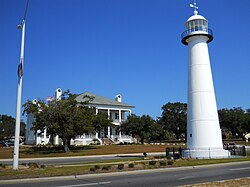
The Biloxi Lighthouse was built in Baltimore, Maryland, and shipped south, where it was completed at the site in May 1848.[8] (It is one of two surviving lighthouses on the Mississippi Gulf Coast, which at one time had twelve.[8])
In the early stages of the Civil War, Ship Island was captured by Union forces, enabling them to take control of Biloxi. No major battles were fought in the area, and Biloxi did not suffer direct damage from the war.[7] Some local Union sentiment could be discerned following the war's conclusion.[8]
In the postbellum period, Biloxi again emerged as a vacation spot. Its popularity as a destination increased with railroad access. In 1881, the first cannery was built in the town to process seafood, leading others to join the location. This stimulated development in the city and attracted new immigrants from Europe and various ethnic groups who worked in the seafood factories. They processed shrimp and other local seafood. These changes gave Biloxi a more heterogeneous population.[7]


During World War II, the United States Army Air Forces built Keesler Field, now Keesler Air Force Base, which became a major basic training site and site for aircraft maintenance. The Biloxi economy boomed as a result,[9] attracting new residents and businesses. By 1958, the first Jewish synagogue had been built in the town.[9]
Biloxi's casino history dates to a period in the 1940s. At the time, open, if technically illegal, gambling took place in a casino within the Broadwater Beach Resort.[10] Open gambling ended during the 1950s.[11] The Mississippi Gulf Coast became known as the "Poor Man's Riviera", and was frequented by Southern families interested in fishing expeditions during the summer.[12] Commercially, Biloxi was dominated by shrimp boats and oyster luggers.[12] The tradition of blessing fishing boats in the US seems to have first taken place in Biloxi in 1929 and has been practised ever since.[13][14]
In 1959, Biloxi was the site of "Mississippi's first public assault on racial barriers in its 15-year civil rights struggle."[15] Gilbert R. Mason, a black physician in Biloxi, went swimming at a local beach with seven black friends. They were ordered to leave by a city policeman, who told them that "Negroes don't come to the sand beach".[16] Mason reacted by leading a series of protests, known as the Biloxi Wade-Ins. The protests were followed in 1960 by the worst racial riot in Mississippi history, during which ten people died.[17] Ultimately, the protests led to the desegregation of the beaches of Biloxi.[16]
In the early 1960s, the Gulf Coast again emerged as a prime alternative to Florida as a southern vacation destination among Northerners, with Biloxi a favored destination.[12] Biloxi hotels upgraded their amenities and hired chefs from France and Switzerland in an effort to provide some of the best seafood cuisine in the country.[12] Edgewater Mall was built in 1963. The Biloxi Dragway hosted drag races between 1957 and 1967.
With the introduction of legal gambling in Mississippi in the 1990s, Biloxi was again transformed.[9] It became an important center in the resort casino industry. The new hotels and gambling complexes brought millions of dollars in tourism revenue to the city. The more famous casino complexes were the Beau Rivage casino resort, the Hard Rock Hotel and Casino, Casino Magic, Grand Casino, Isle of Capri Casino Resort Biloxi, Boomtown Casino, President Casino Broadwater Resort, and Imperial Palace. Like Tunica County in the northern part of the state, Biloxi and the surrounding Gulf Coast region were considered a leading gambling center in the Southern United States.
To celebrate the area's tricentennial in 1998/99, the city's tourism promotion agency invited the nationally syndicated Travel World Radio Show to broadcast live from Biloxi, with co-host Willem Bagchus in attendance
Hurricanes
[edit]Scores of hurricanes have hit the Mississippi Gulf Coast, but the most destructive, as measured by storm surge levels in the Biloxi Lighthouse, occurred in 1855, 1906, 1909, 1947, 1969 (Hurricane Camille), and 2005 (Hurricane Katrina).[18]
On August 29, 2005, Hurricane Katrina hit the Mississippi Gulf Coast with high winds, heavy rains and a 30-foot (9.1 m) storm surge, causing massive damage to the area. Katrina came ashore during the high tide of 6:56 am, +2.3 feet more.[19] Commenting on the power of the storm and the damage, Mayor A. J. Holloway said, "This is our tsunami."[20] Mississippi Governor Haley Barbour was quoted as saying the destruction of the Mississippi coastline by Hurricane Katrina looked like an American Hiroshima.
Hurricane Katrina damaged over 40 Mississippi libraries beyond repair, breaking windows and flooding several feet in the Biloxi Public Library, requiring a total rebuild.[21]
Biloxi is the site of a memorial to Katrina victims, created by a team of local artists with assistance from the crew and volunteers of Extreme Makeover: Home Edition.[22][23][24]
Multiple plans were laid out to rebuild the waterfront areas of Biloxi, and in 2007 the federal government announced it was considering buying out up to 17,000 Mississippi coast homeowners to form a hurricane protection zone.[25] Meanwhile, the city of Biloxi is rapidly implementing plans to allow the redevelopment of commercial properties south of Highway 90.[26]
-
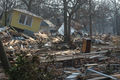 Hurricane Katrina pushed houses inland along the Mississippi Gulf Coast, including at Biloxi.
 -
 Casino barges floated ashore in Biloxi during Hurricane Katrina's storm surge.
 -
 U.S. Navy personnel perform a search and rescue mission in Biloxi after Hurricane Katrina.
 -
 Biloxi beach during cleanup of storm debris
 -
 Front view of Beauvoir in Biloxi, 7 months after Hurricane Katrina


,_perform_a_search_and_rescue_mission_following_Hurricane_Katrina_in_Biloxi,_Miss.jpg)


Geography
[edit]Biloxi is located in southeastern Harrison County, bordered to the south by Mississippi Sound (part of the Gulf of Mexico) and to the northeast partially by Biloxi Bay, which forms part of the Jackson County line. To the northeast, across Biloxi Bay, are the Jackson County city of Ocean Springs and the unincorporated community of St. Martin. The Back Bay of Biloxi continues west from the Jackson County line, crossing the city of Biloxi to Big Lake on the city's western boundary, where the Biloxi and Tchoutacabouffa rivers join. The Tchoutacbouffa flows from east to west across the city and forms part of the city's eastern boundary. Biloxi is bordered to the north and east by the city of D'Iberville and to the west by the city of Gulfport.
According to the United States Census Bureau, Biloxi has a total area of 46.7 square miles (120.9 km2), of which 38.2 square miles (99.0 km2) are land and 8.5 square miles (21.9 km2), or 18.14%, are water.[27]

Biloxi has a humid subtropical climate (Köppen: Cfa) that is heavily influenced by the Gulf of Mexico. Winter days are mild and wet. Snow is extremely rare in Biloxi. Summers are hot and humid, bearing the brunt of tropical storms during the late summer to fall. Biloxi's record low of 1 °F (−17.2 °C) was recorded on February 12, 1899, and the record high of 104 °F (40 °C) was recorded on August 29, 2000, and tied again on August 26, 2023.
| Climate data for Biloxi, Mississippi (1991–2020 normals, extremes 1893–present) | |||||||||||||
|---|---|---|---|---|---|---|---|---|---|---|---|---|---|
| Month | Jan | Feb | Mar | Apr | May | Jun | Jul | Aug | Sep | Oct | Nov | Dec | Year |
| Record high °F (°C) | 82 (28) |
87 (31) |
89 (32) |
91 (33) |
98 (37) |
102 (39) |
103 (39) |
104 (40) |
101 (38) |
98 (37) |
88 (31) |
83 (28) |
104 (40) |
| Mean daily maximum °F (°C) | 59.8 (15.4) |
63.2 (17.3) |
69.3 (20.7) |
75.8 (24.3) |
82.8 (28.2) |
88.0 (31.1) |
89.7 (32.1) |
89.9 (32.2) |
86.9 (30.5) |
79.1 (26.2) |
69.2 (20.7) |
62.2 (16.8) |
76.3 (24.6) |
| Daily mean °F (°C) | 51.7 (10.9) |
55.2 (12.9) |
61.3 (16.3) |
68.1 (20.1) |
75.6 (24.2) |
80.9 (27.2) |
82.5 (28.1) |
82.5 (28.1) |
79.2 (26.2) |
70.5 (21.4) |
60.2 (15.7) |
54.0 (12.2) |
68.5 (20.3) |
| Mean daily minimum °F (°C) | 43.6 (6.4) |
47.3 (8.5) |
53.4 (11.9) |
60.4 (15.8) |
68.3 (20.2) |
73.8 (23.2) |
75.3 (24.1) |
75.1 (23.9) |
71.5 (21.9) |
61.9 (16.6) |
51.2 (10.7) |
45.9 (7.7) |
60.6 (15.9) |
| Record low °F (°C) | 10 (−12) |
1 (−17) |
22 (−6) |
30 (−1) |
42 (6) |
54 (12) |
60 (16) |
61 (16) |
44 (7) |
32 (0) |
24 (−4) |
9 (−13) |
1 (−17) |
| Average precipitation inches (mm) | 5.37 (136) |
4.37 (111) |
5.72 (145) |
5.65 (144) |
5.25 (133) |
7.13 (181) |
8.09 (205) |
6.93 (176) |
5.24 (133) |
3.68 (93) |
4.36 (111) |
5.03 (128) |
66.80 (1,697) |
| Average snowfall inches (cm) | 0.0 (0.0) |
0.0 (0.0) |
0.1 (0.25) |
0.0 (0.0) |
0.0 (0.0) |
0.0 (0.0) |
0.0 (0.0) |
0.0 (0.0) |
0.0 (0.0) |
0.0 (0.0) |
0.0 (0.0) |
0.0 (0.0) |
0.1 (0.25) |
| Average precipitation days (≥ 0.01 in) | 9.5 | 8.9 | 8.0 | 7.0 | 7.1 | 11.9 | 13.9 | 12.7 | 8.6 | 6.5 | 7.3 | 9.2 | 110.6 |
| Source: NOAA[28][29] | |||||||||||||
Demographics
[edit]| Census | Pop. | Note | %± |
|---|---|---|---|
| 1870 | 954 | — | |
| 1880 | 1,540 | 61.4% | |
| 1890 | 3,234 | 110.0% | |
| 1900 | 5,457 | 68.7% | |
| 1910 | 8,049 | 47.5% | |
| 1920 | 10,937 | 35.9% | |
| 1930 | 14,850 | 35.8% | |
| 1940 | 17,475 | 17.7% | |
| 1950 | 37,425 | 114.2% | |
| 1960 | 44,035 | 17.7% | |
| 1970 | 48,486 | 10.1% | |
| 1980 | 49,311 | 1.7% | |
| 1990 | 46,319 | −6.1% | |
| 2000 | 50,644 | 9.3% | |
| 2010 | 44,054 | −13.0% | |
| 2020 | 49,449 | 12.2% | |
| U.S. Decennial Census[30] 2018 Estimate[31][27] | |||
Biloxi is the smaller of two principal cities of the Gulfport-Biloxi, Mississippi Metropolitan Statistical Area, which is included in the Gulfport-Biloxi-Pascagoula Combined Statistical Area.
2020 census
[edit]| Historical racial composition | 1970[32] | 1990[33] | 2000[34] | 2010[34] | 2019 est.[35] |
|---|---|---|---|---|---|
| White | 85.6% | 74.6% | 60.0% | 58.0% | 62.3% |
| Black | 13.6% | 18.6% | 35.8% | 34.9% | 19.9% |
| Asian | 0.4% | 5.7% | 1.6% | 2.0% | 3.7% |
| Native | 0.1% | 0.3% | 0.3% | 0.4% | 0.5% |
| Native Hawaiian and other Pacific Islander |
- | - | 0.1% | 0.1% | 0.1% |
| Other race | 0.3% | 0.7% | 1.0% | 2.8% | 1.0% |
| Two or more races | - | – | 1.3% | 1.9% | 9.6% |
| Race / Ethnicity (NH = Non-Hispanic) | Pop 2000[36] | Pop 2010[37] | Pop 2020[38] | % 2000 | % 2010 | % 2020 |
|---|---|---|---|---|---|---|
| White alone (NH) | 35,292 | 28,402 | 28,771 | 69.69% | 64.47% | 58.18% |
| Black or African American alone (NH) | 9,569 | 8,491 | 10,779 | 18.90% | 19.27% | 21.80% |
| Native American or Alaska Native alone (NH) | 232 | 160 | 148 | 0.46% | 0.36% | 0.30% |
| Asian alone (NH) | 2,558 | 1,923 | 2,123 | 5.05% | 4.37% | 4.29% |
| Pacific Islander alone (NH) | 50 | 84 | 67 | 0.10% | 0.19% | 0.14% |
| Some Other Race alone (NH) | 75 | 68 | 208 | 0.15% | 0.15% | 0.42% |
| Mixed Race or Multi-Racial (NH) | 1,020 | 1,079 | 2,668 | 2.01% | 2.45% | 5.40% |
| Hispanic or Latino (any race) | 1,848 | 3,847 | 4,685 | 3.65% | 8.73% | 9.47% |
| Total | 50,644 | 44,054 | 49,449 | 100.00% | 100.00% | 100.00% |
As of the 2020 United States census, there were 49,449 people, 17,923 households, and 10,922 families residing in the city.
Places of worship in Biloxi include Cathedral of the Nativity of the Blessed Virgin Mary and the First Baptist Church of Biloxi.
Economy
[edit]
Biloxi is home to eight casino resort hotels, with 24-hour gambling, concert entertainment shows, and several restaurants. Many casinos were damaged or destroyed by Hurricane Katrina, but eventually reopened.[39]
- Beau Rivage Resort & Casino
- Golden Nugget Biloxi[40]
- Hard Rock Hotel & Casino
- Harrah's Gulf Coast
- IP Casino Resort & Spa
- Palace Casino Resort
- Boomtown Casino
- Treasure Bay Casino
Arts and culture
[edit]- 2010 saw the grand opening of the new Frank Gehry designed Ohr-O'Keefe Museum Of Art.[41]

Ohr-O'Keefe Museum Of Art campus in Biloxi - Biloxi is the setting of Neil Simon's play and film Biloxi Blues, which starred Mathew Broderick. Biloxi Blues is the story of army recruits during World War II training at Keesler Field, the present-day Keesler Air Force Base.
- Biloxi is the setting of several John Grisham novels, including The Runaway Jury (1996), The Partner (1997), and The Boys from Biloxi (2022).
- A substantial portion of Larry Brown's novel Fay is set in Biloxi.
- American singer-songwriter Jesse Winchester wrote and recorded a song called "Biloxi", for which he was inspired by a few images he saw of the city. The song was recorded by country rock singer Iain Matthews for his 1974 album Some Days You Eat the Bear.
- On his largest-selling regular album, Changes in Latitudes, Changes in Attitudes (1977), Jimmy Buffett included a cover of "Biloxi" (see above); also, a compilation album of his digitally remastered greatest hits was released in 1995 called Biloxi.
- The song "Louisiana", by The Loved Ones, is about the rebuilding of the hurricane ravaged areas on the Gulf Coast. Louisiana, Biloxi, and Alabama are specifically used by name.
- From 1990 to 1994, Biloxi served as home to the Miss Teen USA Pageant.
- American journalist and essayist Joan Didion mentioned Biloxi and the Edgewater Plaza mall in her 1979 collection of essays The White Album.[42] Didion also wrote about her visit to the city in 1970 in her book South and West, published in 2017.[43]
- Order of Mithras Carnival Association, since 1924.
- The tradition of the Blessing of the Fleet, going back to 1929, takes place every year in late May/early June before the shrimp seasons to usher in a safe and prosperous season for each boat. The event is connected with the Shrimp festival as well as the ceremonial dropping of a wreath in remembrance of fishermen who have died.[44]

Sports
[edit]| Club | League | Sport | Venue | Founded | Affiliate |
|---|---|---|---|---|---|
| Biloxi Shuckers | SL | Baseball | Keesler Federal Park | 2015 | Milwaukee Brewers |
| Mississippi Sea Wolves | FPHL | Ice hockey | Mississippi Coast Coliseum | 2022 |
In the center of what fisheries biologists term "The Fertile Fisheries Crescent", Biloxi offers some of the finest sportsfishing along the entire northern coast of the Gulf of Mexico. Spotted seatrout, red drum, Spanish and king mackerel, flounder, snapper, grouper, sharks, and more are all available to anglers during the fishing season. It is not known how Hurricane Katrina affected this ecosystem.[citation needed]
The Biloxi Shuckers, the Double-A Southern League affiliate of the Milwaukee Brewers play at Keesler Federal Park.[45]
The Mississippi Sea Wolves of the Federal Prospects Hockey League have played at the Mississippi Coast Coliseum since 2022. Biloxi was previously home to the original Sea Wolves team of the ECHL, and the Mississippi Surge of the Southern Professional Hockey League.
Biloxi was the host city of the 2009 Women's World Military Cup.
Biloxi City Futbol Club is set to join the Louisiana Premier League for the fall of 2016.[46]
Government
[edit]
The Bolton State Office Building in Biloxi includes the headquarters of the Mississippi Department of Marine Resources and the South Regional Office of the Mississippi Department of Environmental Quality.[47][48][49]
The United States Postal Service operates the Biloxi Post Office and other area post offices.[50]
Education
[edit]The city is served by the Biloxi Public School District and the Harrison County School District. The Gulf Coast has a large Catholic school system, 15 of which are in Biloxi.[51]
Media
[edit]Biloxi has one daily newspaper, the Sun Herald, which is headquartered in nearby Gulfport.
20 FM and 7 AM radio stations operate in and/or serve the Biloxi area.
According to Nielsen Media Research, the Biloxi market, as of the 2015–2016 season, is the third largest of five television markets in Mississippi, and the 158th largest in the country.[52] Three major television stations serve the Biloxi area. ABC and CBS affiliate WLOX 13 and PBS/MPB member station WMAH-TV 19 are located in Biloxi, while Fox/MyNetworkTV affiliate WXXV-TV 25 is located in Gulfport. In addition to the stations' main programming, WLOX and WXXV-TV broadcast programming from other networks on digital subchannels. WLOX-DT2 serves as the market's CBS affiliate, while WXXV-TV operates the market's respective NBC and CW affiliates on DT2 and DT3.[53]
Transportation
[edit]Biloxi is served by the Gulfport-Biloxi International Airport in Gulfport. Amtrak service also began serving the city when the Mardi Gras Service debuted on August 18, 2025.[54]
The Coast Transit Authority provides bus service to the region with fixed-route and paratransit services.
Biloxi's main highway is U.S. Highway 90 (Beach Boulevard), which runs along the beach and by the casinos. It connects the city to Gulfport and points westward and to Ocean Springs and Pascagoula to the east. The Biloxi Bay Bridge, connecting Biloxi and Ocean Springs, was rebuilt after Hurricane Katrina, and was fully reopened in April 2008.
Interstate 10 passes through the northern sections of the city, leading west 85 miles (137 km) to New Orleans and east 60 miles (97 km) to Mobile, Alabama. Interstate 110 splits off from I-10 at D'Iberville and heads south across the Back Bay of Biloxi to U.S. 90 near Beau Rivage, providing the city with an important hurricane evacuation route.
North–south highways serving the area include:
- Mississippi Highway 15 (runs concurrently with I-110 for the first few miles)
- Mississippi Highway 67
Notable people
[edit]- Jessica Alba, model and actress, lived in Biloxi while her father was stationed at Keesler Air Force Base
- Lionel Antoine, Chicago Bears third overall pick in 1972 NFL Draft
- Laura Bailey, voice actress and the wife of Travis Willingham
- Matt Barlow, heavy metal singer
- Alan Belcher, MMA fighter with UFC
- Belladonna, retired pornographic actress, director, producer, and model
- Jimmy Bertrand, jazz drummer
- Malcolm Brown, NFL running back for Los Angeles Rams
- Hector Camacho, world champion boxer
- Isaiah Canaan, NBA point guard, KK Crvena zvezda
- Chris Carson, NFL running back for Seattle Seahawks
- Gary Collins, actor and television personality
- Jefferson Davis, U.S. Army general and West Point graduate; U.S. Secretary of War (Defense); only president of Confederate States of America
- Gwen Dickey, singer best known as the front-woman of the R&B band Rose Royce
- Ronald Dupree, professional basketball player
- Leonard Fairley, football player
- Damion Fletcher, University of Southern Mississippi running back
- Jeff Gann, professional wrestler known as "The Gambler"
- Mary S. Graham, academic administrator
- Fred Haise, Apollo 13 and Space Shuttle Enterprise astronaut
- Ted Hawkins, singer-songwriter
- Michael Janus, Mississippi state legislator
- Tim Jones (American football), wide receiver NFL player for Jacksonville Jaguars
- Chris LeDoux, country singer
- Barry Lyons, catcher for New York Mets
- James Millhollin, character actor, died in Biloxi in 1993
- Mark Miloscia, former Washington State Senator
- Mary Ann Mobley, actress and Miss America
- Russell D. Moore, President of the Ethics & Religious Liberty Commission (ERLC)
- Francis D. Moran, third director of NOAA Commissioned Officer Corps
- Jack Nelson, Pulitzer Prize-winning journalist who began career at Biloxi Daily Herald
- George E. Ohr, groundbreaking potter and father of American Abstract-Expressionism movement
- Mathieu Olivier, ice hockey player
- Chuck Pfarrer, former Navy SEAL, Hollywood screenwriter, New York Times best selling author, novelist
- Eric Roberts, Oscar-nominated actor, brother of Oscar-winning actress Julia Roberts, and father of actress Emma Roberts
- Wes Shivers, NFL player for Tennessee Titans and mixed martial artist
- John Kennedy Toole, author of A Confederacy of Dunces, committed suicide in Biloxi in 1969
- Brenda Venus, model and actress
Filming location
[edit]Several films have been produced in Biloxi, including:
- Stone Cold, 1991 film starring Brian Bosworth.[55]
- Mississippi Masala, 1992 film starring Denzel Washington.
- Arsenal, 2017 film starring Adrian Grenier, John Cusack, and Nicolas Cage.[56]
- Vanquish, 2021 film starring Morgan Freeman and Ruby Rose.[57]
See also
[edit]- Dixie Mafia
- Pete Halat
- Historic Grand Hotels on the Mississippi Gulf Coast
- List of mayors of Biloxi, Mississippi
- List of tallest buildings in Biloxi
- National Register of Historic Places listings in Harrison County, Mississippi
- Old Brick House (Biloxi, Mississippi)
- Pleasant Reed House
- Tivoli Hotel (Biloxi, Mississippi)
- Tullis-Toledano Manor
- United States Post Office, Courthouse, and Customhouse (Biloxi, Mississippi)
- USS Biloxi
References
[edit]- ^ "Andrew 'FoFo' Gilich wins republican nomination for Mayor of Biloxi". WLOX. May 3, 2017. Retrieved November 29, 2024.
- ^ "Mayor". Retrieved November 29, 2024.
- ^ "2020 U.S. Gazetteer Files". United States Census Bureau. Retrieved July 24, 2022.
- ^ a b "La Louisiane française" (in French), by Virginie Tanlay, from book Histoire de la Louisiane, flfa-enquete7 Archived March 4, 2009, at the Wayback Machine: states that Iberville chose "le site de Bilocci" (or Biloxi)
- ^ "Pas-Kaart Van de Golff van Mexico" (map from Amsterdam/1710), Edge of the Map Incorporated, 2007, webpage: Raremaps-Archive-3176 Archived 2009-01-13 at the Wayback Machine.
- ^ "A New Map of as much of North & South America" (London/1725), Edge of the Map Incorporated, 2007, webpage: Raremaps-Archive-7278 Archived 2009-01-13 at the Wayback Machine.
- ^ a b c d "Biloxi: A Historic & Cultural Overview". City of Biloxi historical pamphlet, 2003.
- ^ a b c "Biloxi Lighthouse". City of Biloxi historical datasheet, 2003.
- ^ a b c "Biloxi/Gulfport, Mississippi" Archived October 5, 2007, at the Wayback Machine, Institute of Southern Jewish Life
- ^ Wilemon, Tom (June 30, 2005). "The Landmark Broadwater Hotel, Once Biloxi's Premier Resort, Shutting Down". The Sun Herald. Archived from the original on January 11, 2009. Retrieved September 15, 2008.
- ^ Bergeron, Kat. "Before-After: Broadwater". The Sun Herald. Archived from the original on September 17, 2008. Retrieved September 15, 2008.
- ^ a b c d Janson, Donald (December 15, 1963). "Mississippi Gulf Coast Woos Vacationists". The New York Times.
- ^ Melton, J. Gordon (September 13, 2011). Religious Celebrations An Encyclopedia of Holidays, Festivals, Solemn Observances, and Spiritual Commemorations. ABC-CLIO. pp. 120–121. ISBN 9781598842067. Retrieved June 23, 2023.
- ^ Noble, Noah. "Biloxi's 94th annual Blessing of the Fleet blesses over 50 boats ahead of shrimp season". WLOX.COM. Gray Television, Inc. Retrieved June 26, 2023.
- ^ Bill Minor (May 20, 2009). "Watch for 'The Good Doctors' to be out soon". DeSoto Times-Tribune.
- ^ a b J. Michael Butler (February 2002). "The Mississippi State Sovereignty Commission and Beach Integration, 1959-1963: A Cotton-Patch Gestapo?". The Journal of Southern History. 68 (1): 107–148. doi:10.2307/3069692. JSTOR 3069692.
- ^ "NAACP Denies Biloxi Riot Role". New York Times. April 26, 1960. p. 30. ProQuest 114995603.(subscription required)
- ^ Debbie Stringer. 2010. "Biloxi's Guiding Light". Today in Mississippi (Ridgeland, MS), Volume 63, Number 5, May 2010.
- ^ "2005 NOAA Tide Predictions: Biloxi (Cadet Point), Biloxi Bay" (2005), tide on 29-Aug-2005, NOAA, web: NOAA-tide-tables Archived 2007-03-10 at the Wayback Machine.
- ^ "Herald.com | 08/30/2005 | Rooftop rescues mount along with fires, floods". Archived from the original on September 6, 2005. Retrieved August 31, 2005.
- ^ "Hurricane Katrina Related Damages to Public Libraries in Mississippi" (September 2005), Mississippi Library Commission, web: ALA-Katrina Archived 2007-10-31 at the Wayback Machine.
- ^ "Katrina Memorial Biloxi". Archived from the original on May 6, 2007. Retrieved April 21, 2007.
- ^ "Hurricane Katrina Memorial Design Narrative". biloxi.ms.us. Archived from the original on September 2, 2019. Retrieved September 2, 2019.
- ^ "Creative Team|Hurricane Katrina Memorial". biloxi.ms.us. Archived from the original on September 2, 2019. Retrieved September 2, 2019.
- ^ "Gov't May Buy Thousands of Miss. Homes" AP via Google News. Retrieved October 17, 2007. Archived October 12, 2007, at the Wayback Machine
- ^ Beachfront Development On Biloxi's Front Burner Archived 2009-09-19 at the Wayback Machine WLOX News Archived 2007-10-20 at the Wayback Machine. Retrieved on October 17, 2007.
- ^ a b "Geographic Identifiers: 2010 Census Summary File 1 (G001): Biloxi city, Mississippi". American Factfinder. U.S. Census Bureau. Archived from the original on February 13, 2020. Retrieved August 15, 2017.
- ^ "NowData – NOAA Online Weather Data". National Oceanic and Atmospheric Administration. Retrieved May 16, 2021.
- ^ "Station: Biloxi AP, MS". U.S. Climate Normals 2020: U.S. Monthly Climate Normals (1991–2020). National Oceanic and Atmospheric Administration. Retrieved May 16, 2021.
- ^ United States Census Bureau. "Census of Population and Housing". Retrieved September 2, 2013.
- ^ "Population Estimates". United States Census Bureau. Retrieved June 8, 2018.
- ^ "Table 25. Mississippi - Race and Hispanic Origin for Selected Large Cities and Other Places: Earliest Census to 1990" (PDF). U.S. Census Bureau. July 13, 2005. Archived from the original (PDF) on July 25, 2017. Retrieved November 3, 2024.
- ^ "Table 25. Mississippi - Race and Hispanic Origin for Selected Large Cities and Other Places: Earliest Census to 1990" (PDF). U.S. Census Bureau. July 13, 2005. Archived from the original (PDF) on July 25, 2017. Retrieved November 3, 2024.
- ^ a b "Biloxi city, Mississippi". United States Census Bureau. Retrieved December 29, 2019.
- ^ "U.S. Census Bureau QuickFacts: Biloxi city, Mississippi". census.gov. United States Census Bureau. Retrieved July 18, 2020.
- ^ "P004: Hispanic or Latino, and Not Hispanic or Latino by Race – 2000: DEC Summary File 1 – Biloxi city, Mississippi". United States Census Bureau. Retrieved November 3, 2024.
- ^ "P2 Hispanic or Latino, and Not Hispanic or Latino by Race - 2010: DEC Redistricting Data (PL 94-171) – Biloxi city, Mississippi". United States Census Bureau. Retrieved December 11, 2024.
- ^ "P2 Hispanic or Latino, and Not Hispanic or Latino by Race - 2020: DEC Redistricting Data (PL 94-171) – Biloxi city, Mississippi". United States Census Bureau. Archived from the original on April 10, 2022. Retrieved December 16, 2021.
- ^ "Tentative re-opening plans for Biloxi casino resorts" (2006), City of Biloxi, www.Biloxi.ms.us, webpage: Biloxi-Casinos Archived 2006-10-10 at the Wayback Machine.
- ^ Wright, Megan (March 5, 2012). "Isle of Capri selling Coast casino for $45M to Golden Nugget". Mississippi Business Journal. Archived from the original on August 5, 2017. Retrieved May 2, 2017.
- ^ "Ohr-O'Keefe Museum of Art - Biloxi, Mississippi". Archived from the original on November 16, 2009. Retrieved January 19, 2011.
- ^ Didion, Joan (1979). The White Album. New York: Simon & Schuster. p. 186. ISBN 978-0374532079.
- ^ Didion, Joan (2017). South and West: From a Notebook. New York: Alfred A. Knopf. pp. 30–39. ISBN 978-1524732790.
- ^ "Biloxi Shrimp Industry Traditions: The Blessing of the Fleet". Biloxi Shrimp Co. Retrieved June 26, 2023.
- ^ "It's official: Huntsville Stars sold, expected to move to Biloxi in 2015". Ballpark Digest. January 11, 2014. Archived from the original on January 12, 2014. Retrieved January 11, 2014.
- ^ "Biloxi City Futbol Club second expansion team to join LPL for 2016–2017 season". Louisiana Premier League. April 6, 2016. Archived from the original on April 22, 2016. Retrieved April 7, 2016.
- ^ "Contact Us Archived September 15, 2010, at the Wayback Machine." Mississippi Department of Marine Resources. Retrieved on November 9, 2010. "Included are the phone numbers of each department within the agency. A map and directions to the Bolton Building can be found here: directions. 1141 Bayview Avenue Biloxi MS 39530."
- ^ "Directions Archived July 4, 2010, at the Wayback Machine." Mississippi Department of Marine Resources. Retrieved on November 9, 2010.
- ^ "South Regional Office Archived 2011-07-19 at the Wayback Machine." Mississippi Department of Environmental Quality. Retrieved on September 21, 2010.
- ^ "Post Office Location - BILOXI Archived September 26, 2010, at the Wayback Machine." United States Postal Service. Retrieved on September 22, 2010.
- ^ "Department of Education". Archived from the original on July 25, 2011. Retrieved November 21, 2010.
- ^ "Local Television Market Universe Estimated" (PDF). Tvb.org. January 1, 2016. Archived (PDF) from the original on December 20, 2016. Retrieved May 2, 2017.
- ^ "Stations for Biloxi, Mississippi". Rabbitears.info. Archived from the original on August 22, 2017. Retrieved May 2, 2017.
- ^ Magliari, Marc (June 30, 2025). "Book Now for Amtrak Mardi Gras Service starting August 18". Amtrak Media. Retrieved July 1, 2025.
- ^ "AFI Catalog of Feature Films". Retrieved October 20, 2023.
- ^ "Seal Ave. residents get first hand look at movie production". Retrieved October 8, 2020.
- ^ Landry, Chet (September 22, 2020). "South Mississippi home featured in latest Morgan Freeman movie". wlox.com. Retrieved May 7, 2022.
External links
[edit]

- Official website
- Photographs and Video of Hurricane Katrina's Aftermath from photosfromkatrina.com
- City of Biloxi at the Wayback Machine (archived January 10, 1998)
Municipalities and communities of Harrison County, Mississippi, United States | ||
|---|---|---|
| Cities | 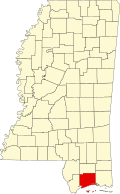 | |
| CDPs | ||
| Unincorporated communities | ||
| International | |
|---|---|
| National | |
| Geographic | |
| Other | |

Biloxi, Mississippi
View on GrokipediaHistory
Indigenous and Colonial Foundations
The Biloxi Bay area was originally inhabited by the Biloxi tribe, a small Siouan-speaking Native American group that resided along the coastal waterways and engaged in fishing, hunting, and agriculture. The Biloxi people, numbering perhaps a few hundred in the late 17th century, maintained alliances and trade relations with neighboring Muskogean-speaking groups like the Choctaw, though they were linguistically distinct and often described as subordinate within broader regional confederacies. European awareness of the Biloxi came with French explorers in 1699, who named the bay after the tribe encountered there, marking the first documented contact rather than earlier unverified expeditions.[6] In 1699, French explorer Pierre Le Moyne, Sieur d'Iberville, established the first European settlement in the Mississippi region at Fort Maurepas on the east side of Biloxi Bay, near present-day Ocean Springs. Landing on February 13, 1699, with four ships and over 200 colonists, Iberville constructed the wooden fort as a base for claiming the Louisiana Territory for France, serving as the initial capital of French Louisiana until its relocation in 1702 after temporary abandonment in 1701 due to disease and supply issues. The settlement relied on local resources, with colonists engaging in rudimentary farming, fishing, and trade with Native Americans for deerskins and foodstuffs, though high mortality from illness limited permanence.[7][8] French control persisted until the 1763 Treaty of Paris, which ceded territories east of the Mississippi River to Britain following the Seven Years' War, incorporating Biloxi into British West Florida. British administration focused on trade and defense, but settlement remained sparse amid ongoing Native interactions and conflicts. In 1779, during the American Revolutionary War, Spanish forces under Bernardo de Gálvez captured the region, placing Biloxi under Spanish West Florida until 1810, when American annexation via the West Florida Rebellion transferred effective control to the United States, influenced by prior navigation rights secured in the 1795 Pinckney's Treaty. Throughout these shifts, the local economy centered on timber harvesting for shipbuilding, lumber exports to the Caribbean, fishing in the bay's oyster beds, and limited inter-colonial trade, fostering small permanent communities of French Creoles and mixed Native-European descent.[7][9][10]19th Century Expansion and Civil War
Biloxi's growth accelerated after Mississippi's statehood in 1817, evolving into a modest port and emerging resort amid territorial integration into the United States. Incorporated as a town in 1838, it facilitated cotton exports through its harbor, with annual shipments peaking at 40,000 bales in the 1850s before declining to 10,000 by 1860 due to market fluctuations and pre-war tensions. Shipbuilding supported maritime activities, including the construction of the Confederate ram Mississippi in 1861 at local yards. Population expanded from roughly 400 residents, primarily French Creoles, in the early 1800s to about 1,000 by 1850, reflecting influxes tied to trade and seasonal visitors.[11] The town's salubrious Gulf climate drew health-seeking tourists, with steamboat services like the Alert commencing stops in 1837 and promotional advertisements appearing by 1838 and 1851. Hotels such as the Biloxi House (1848) and Magnolia Hotel (pre-1850) catered to this trade, establishing Biloxi as a resort destination despite vulnerabilities exposed by yellow fever outbreaks, including 533 cases and 111 deaths in 1853 alone, followed by epidemics in 1854. Early infrastructure, including a federal mail route from Mobile to New Orleans via Pascagoula established in 1832 at an annual cost of $37,000, bolstered connectivity. The nascent oyster industry, initially supplying local markets, laid groundwork for canning operations starting in 1880, diversifying beyond cotton reliance.[11] The Civil War disrupted this trajectory. Local Confederate sympathizers formed the Biloxi Rifles militia on May 21, 1861, but Union naval forces from nearby Ship Island imposed a blockade beginning in 1861, strangling trade and imposing economic strain through halted exports and supply shortages. Biloxi surrendered to Union forces on December 31, 1861, with formal occupation following on May 5, 1862; the period saw no major battles but sporadic raids and property confiscations, peaking Union presence regionally at over 15,000 troops staging from Ship Island for broader Gulf campaigns.[11][3][12] Reconstruction after 1865 compounded hardships with damaged wharves—from both war and a 1860 storm—and shifts from cotton monoculture toward fishing and lumber, amid sharecropping's emergence in Harrison County. Rail links via the Louisville and Nashville line to New Orleans resumed by 1870, spurring recovery, while Biloxi attained city status with a charter in 1896, formalizing governance as population neared 3,000–5,000 by century's end.[11]20th Century Industrialization and Gaming Emergence
Biloxi's industrialization accelerated during World War II with the establishment of Keesler Field in 1941 as an Army Air Corps training facility for aviation mechanics and radio operators.[13] [14] The base, activated on June 12, 1941, following Biloxi's offer of land to the U.S. Army, trained over 350,000 personnel by war's end, driving a population surge and economic expansion through military payrolls and infrastructure development.[13] Concurrently, the local shrimp fleet expanded, leveraging wartime demand for seafood, with processing volumes rising from 614,000 pounds in 1890 to millions by the early 1900s, solidifying Biloxi's role in the industry.[15] Postwar, Biloxi emerged as the "Seafood Capital of the World," with shrimping dominating the economy through the 1950s and 1960s, supported by Croatian immigrant labor and motorized trawlers replacing schooners.[16] [17] The industry processed vast quantities from Gulf waters, but faced setbacks from hurricanes, including Camille in 1969, which inflicted $1.5 billion in regional damage, destroying 90% of Biloxi's industrial base temporarily and disrupting fishing operations.[18] [19] Federal aid post-Camille facilitated recovery, including precedents for floating structures that later influenced casino designs, though pre-casino stagnation persisted with limited diversification beyond seafood and military activities.[19] Economic transformation intensified in the 1990s with the Mississippi Gaming Control Act of 1990, legalizing dockside casino gambling in Gulf Coast counties after local voter approval.[20] [21] The first casinos opened in 1992 as riverboat-style barges, capitalizing on Biloxi's waterfront to generate thousands of jobs—over 10,000 by the late 1990s—and substantial revenue, with gaming taxes comprising up to 40% of the city's budget by the decade's end, reversing prior stagnation.[22] [23] This shift diversified the economy, with casinos drawing tourism and boosting population growth by 16% regionally during the 1990s, though reliant on vulnerable barge infrastructure.[23]Late 20th and Early 21st Century: Casinos, Hurricanes, and Recovery
The introduction of dockside casino gaming in Mississippi in the early 1990s transformed Biloxi's economy, with the city emerging as a key hub along the Gulf Coast. By 2004, Biloxi's casinos generated gross gaming revenue that yielded nearly $20 million in annual tax revenue for the city. This influx supported local employment and infrastructure, peaking in economic contributions prior to Hurricane Katrina.[24][25] Hurricane Katrina struck on August 29, 2005, devastating Biloxi with a powerful storm surge that destroyed or displaced nearly all 12 casinos, many of which were required by state law to operate on floating barges. The disaster resulted in over 65,000 job losses across the Mississippi Gulf Coast, including significant impacts in leisure and hospitality sectors in the Gulfport-Biloxi area, where nonfarm employment dropped by 15 percent or 18,000 jobs. Biloxi's population declined by 8 percent in the immediate aftermath, reflecting displacement and economic disruption, while regional damages exceeded $100 billion, with casinos alone suffering billions in losses.[26][27][28] In response, Mississippi lawmakers passed emergency legislation on October 17, 2005, signed by Governor Haley Barbour, permitting casinos to rebuild on solid land rather than barges, facilitating faster reconstruction through private investment. Casinos reopened progressively, with seven operational by early 2007, contributing to a rebound in gaming revenue that surpassed pre-Katrina levels in some years, such as $1.006 billion for the Gulf Coast in 2007. This private-sector-led effort, bolstered by insurance payouts and local incentives, contrasted with slower federal processes; while casinos drove job recovery, broader infrastructure repairs faced delays from bureaucratic hurdles in aid distribution.[29][30][31] From 2010 to 2020, Biloxi's economy stabilized through tourism and gaming resurgence, with the Gulf Coast experiencing steady growth despite setbacks like the 2010 Deepwater Horizon spill. Casino operations and visitor spending supported GDP recovery, though benefits were uneven, favoring coastal commercial zones over inland residential areas. Self-reliant local initiatives, including business reinvestments, proved more causal in rapid rebuilding than prolonged federal dependencies, as evidenced by the casinos' swift return versus lingering public project timelines.[26][32] Into the 2020s, Biloxi continued expansion with projects like the groundbreaking for a 105-room Home2 Suites by Hilton hotel in June 2025, aimed at extended-stay travelers and expected to create 20-25 jobs. Residential subdivisions and commercial developments further signaled population stabilization and investment. In October 2025, Governor Tate Reeves launched Mission 3, a public-private initiative to bolster South Mississippi's military and defense economy, targeting installations like Keesler Air Force Base in the region to enhance long-term fiscal resilience beyond gaming reliance.[33][34][35]Geography
Location, Topography, and Environmental Features
Biloxi occupies a coastal position along the Gulf of Mexico in Harrison County, Mississippi, approximately 14 miles east of Gulfport.[36] The city encompasses a total area of 46.5 square miles, including land, inland waters such as Biloxi Bay, and adjacent offshore features, with barrier islands extending roughly 20 miles along the Mississippi segment of the chain. [37] The topography is predominantly flat, with elevations ranging from sea level along the shoreline to about 20 feet inland, as mapped in USGS quadrangles for the region.[38] Key landforms include Biloxi Bay to the north, extensive salt marshes, and transitional pine savannas characteristic of the Gulf Coastal Plain.[39] The city lies proximate to the southern extents of De Soto National Forest, approximately 30-40 miles north, where longleaf pine-dominated ecosystems interface with coastal wetlands.[40] Environmental features encompass oyster reefs in Mississippi Sound, which support benthic habitats, alongside marshes serving as foraging grounds for migratory birds along the Gulf flyway.[41] Pre-Katrina urban expansion contributed to wetland conversion through shoreline development and fill activities, reducing natural buffer zones.[42] The offshore barrier islands, including Ship Island, function to dissipate wave energy, with empirical analyses indicating their presence correlates with diminished surge propagation and inland flooding compared to breached configurations.[43] [44]Climate and Vulnerability to Storms
Biloxi features a humid subtropical climate, with hot, humid summers and mild winters. Annual average temperatures reach 68.3°F, with monthly highs ranging from 62°F in January to 91°F in July and August. Precipitation totals approximately 65 inches yearly, with the wettest months occurring during the Atlantic hurricane season from August to October, when tropical systems contribute to elevated rainfall and storm risks.[45][46] The city's coastal location exposes it to frequent tropical cyclone threats, amplified by its low-lying topography averaging near sea level. Historical data from the National Hurricane Center record devastating impacts from major storms, including Hurricane Camille in August 1969, which struck as a Category 5 hurricane with sustained winds of 190 mph and generated a storm surge exceeding 24 feet along the Mississippi barrier islands near Biloxi, destroying structures and vegetation across the coastline.[47] Hurricane Katrina, making landfall on August 29, 2005, as a Category 3 storm with 125 mph winds, produced an unprecedented storm surge of up to 28 feet in Biloxi, far surpassing wind damage in severity and pushing debris, vehicles, and even casino barges inland while inundating the city under 10-20 feet of water in low areas. This event highlighted surge dynamics over category ratings, as the shallow continental shelf and counterclockwise rotation funneled water toward the Mississippi coast.[48] Vulnerability persists due to factors like regional subsidence rates of 1-2 mm per year in coastal marshes and chronic erosion, with Biloxi losing about one foot of salt marsh shoreline annually even in non-storm years; post-hurricane scouring has accelerated bay-edge retreat by factors exceeding 50 meters per year in severe cases. Infrastructure strain from prior events compounds risks, as evidenced by ongoing beach nourishment efforts and elevated flood insurance zones, despite relatively fewer direct hits in the 2024 season—which saw 18 named storms but primarily affected other Gulf regions—and the above-normal but non-catastrophic activity through October 2025.[49][50][51]Demographics
Population Dynamics and Trends
As of the 2020 United States Census, Biloxi's population was recorded at 49,449 residents. This marked a rebound from the 44,054 residents counted in the 2010 Census, following a post-Hurricane Katrina decline that reduced the population from 50,644 in 2000.[52] The 2010 dip reflected displacement and infrastructure damage from the 2005 storm, while the subsequent recovery involved net in-migration tied to the presence of Keesler Air Force Base, which supports thousands of military personnel and families, and the post-1990 legalization of dockside casinos that attracted workers and visitors.[53] By 2023, U.S. Census Bureau American Community Survey estimates placed the population at 49,011, indicating relative stability after the 2020 peak.[5] Population growth from 2010 to 2020 averaged about 1.1% annually, driven partly by relocations to military installations and expansions in gaming-related employment opportunities established in the 1990s.[52] Recent indicators of sustained residential development include the city's issuance of 271 building permits for new subdivisions in 2024, alongside approvals for 12 residential projects, signaling potential for modest in-migration.[54] Projections for 2025 anticipate a steady population hovering near 48,000 to 49,000, bolstered by ongoing tourism and hospitality infrastructure, though metro-area data for the Gulfport-Biloxi region shows broader annual increases of around 0.5% from 2020 to 2023.[55] Biloxi's median age stands at 36.7 years, younger than the state average, with an urban density of approximately 1,105 persons per square mile across its 44.6 square miles of land area.[56]Racial, Ethnic, and Socioeconomic Composition
As of the 2020 United States Census, Biloxi's racial composition consisted of 62.3% White alone, 19.9% Black or African American alone, 3.9% Asian alone, 0.5% American Indian and Alaska Native alone, and 0.2% Native Hawaiian and Other Pacific Islander alone, with 6.5% of the population identifying as Hispanic or Latino of any race. Non-Hispanic Whites comprised 59.5% of residents, reflecting a majority European-descended population with notable Black and Asian minorities tied to historical fishing and military influences.[5] Following Hurricane Katrina in 2005, the Black population share declined substantially, with studies documenting a drop exceeding 10% in affected Gulf Coast areas including Biloxi due to displacement, mortality, and differential return migration patterns favoring non-Black groups.[57][58] Socioeconomically, Biloxi's median household income reached $55,958 in 2023, below the national average but buoyed by gaming and military sectors, while the poverty rate stood at 15.7%, with rates elevated in minority-concentrated neighborhoods.[5] Homeownership hovered around 50%, constrained by post-Katrina housing losses and coastal vulnerabilities.[5] Educational attainment lags, with 23% of adults aged 25 and older holding a bachelor's degree or higher in the Biloxi-Gulfport area, correlating with lower-wage service roles.[59] The labor force participation emphasizes services and gaming, where roughly 60% of employment falls in hospitality, arts, entertainment, and accommodation sectors, underscoring reliance on tourism-driven jobs often characterized by seasonal volatility and modest wages.[60][5] Geographic disparities amplify these metrics, particularly along the historic railroad divide separating eastern and western Biloxi, where East Biloxi—home to higher proportions of Black and Asian residents—exhibits persistent poverty and slower post-Katrina recovery despite adjacent casino developments, contrasting with relatively more affluent western areas tied to newer suburban and commercial growth.[61][62] Poverty in East Biloxi's traditional fishing enclaves exceeds city averages, linked to limited capital access and storm-induced infrastructure decay, while western zones benefit from proximity to military bases and barrier developments fostering higher incomes and homeownership. These divides reflect causal factors like uneven federal recovery funding and industry clustering, yielding empirical gaps in wealth accumulation across racial and ethnic lines.[58]Government and Politics
Local Governance Structure
Biloxi operates under a strong mayor-council form of government, in which the mayor functions as the chief executive with authority over administrative appointments and veto powers, while the seven-member city council, elected from single-member wards, exercises legislative responsibilities including ordinance adoption and budget approval.[63] The mayor appoints a Chief Administrative Officer (CAO) to oversee daily operations, supervise department directors, and implement council policies, with the current CAO, Richard L. Weaver, confirmed in June 2025 following his appointment by Mayor Andrew "FoFo" Gilich.[64][65] Fiscal responsibilities are divided between the executive and legislative branches, with the mayor proposing the annual budget—typically in the range of $200 million—and the council holding approval authority after public hearings.[66] Approximately 60% of the city's general fund revenues derive from gaming-related taxes on casino gross revenues, taxed at rates up to 12% with local shares directed toward municipal operations, infrastructure, and community services.[67] Key administrative functions include enforcement of the city's Land Development Ordinance, which consolidates zoning and subdivision regulations to promote public safety and welfare, incorporating provisions for coastal hazard mitigation such as elevation standards and setback requirements in flood-prone areas.[68][69] Casino operations are regulated through zoning districts permitting gaming establishments on designated coastal sites, subject to compliance with local ordinances and state licensing criteria that verify site suitability and environmental impacts.[70][71] The planning department reviews development applications under these frameworks, ensuring alignment with the city's comprehensive plan for resilience against storm vulnerabilities.[68]Political Orientation and Key Elections
Biloxi and surrounding Harrison County demonstrate a pronounced conservative political orientation, characterized by overwhelming support for Republican candidates in both federal and local elections. This aligns with broader Mississippi trends but is amplified by local priorities such as military base preservation, gaming industry expansion under regulated local frameworks, and skepticism toward expansive federal interventions, particularly evident in post-Hurricane Katrina recovery debates where residents favored streamlined state and local rebuilding over prolonged federal oversight.[72][73] In the 2020 presidential election, Harrison County voters delivered 72.6% of the vote to Donald Trump, compared to 25.1% for Joe Biden, with total turnout at approximately 65% of registered voters, underscoring a reliable Republican base even amid national polarization.[72] Similar patterns persisted in 2024, where Trump secured over 70% in the county, reflecting sustained resistance to progressive national policies on issues like regulatory expansion and reflecting darker red shading on county-level political maps.[74][75] Local elections reinforce this tilt, with fiscal conservatives dominating mayoral races; incumbent Republican Mayor Andrew "FoFo" Gilich, who campaigned on infrastructure growth, tourism recovery, and military support, won re-election to a third term on June 3, 2025, capturing the Republican primary with 2,422 votes and prevailing decisively in the general amid low turnout typical of municipal contests (under 20%).[76][77] Key local influences include strong backing for defense-related economic initiatives, such as the October 2025 launch of Mission 3 by Governor Tate Reeves, which emphasizes military mission advocacy, workforce alignment with Keesler Air Force Base needs, and community unity against federal funding uncertainties—priorities resonating in Biloxi's veteran-heavy electorate and gaming-dependent economy wary of overregulation.[78] This orientation manifests in consistent opposition to progressive state-level pushes, such as expanded social spending, favoring instead policies promoting private-sector resilience and limited government, as evidenced by voter approval of gaming referenda in the 1990s and subsequent local ballot measures prioritizing fiscal conservatism over welfare expansions.[79][76]| Election | Key Outcome | Republican Share | Turnout Notes |
|---|---|---|---|
| 2020 Presidential (Harrison Co.) | Trump victory | 72.6% | ~65% of registered voters[72] |
| 2024 Presidential (Harrison Co.) | Trump victory | >70% | Consistent with prior cycles[74] |
| 2025 Mayoral (Biloxi) | Gilich re-elected | Primary: Majority; General: Decisive | Low municipal turnout <20%[76][77] |