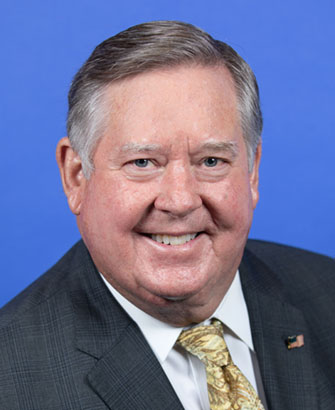

Ken Calvert
View on Wikipedia
Kenneth Stanton Calvert (born June 8, 1953)[1] is an American businessman and politician serving as the U.S. representative for California's 41st congressional district, and previously the 44th, 42nd, and 43rd, serving since 1993 as a member of the Republican Party. The district is part of the Inland Empire of Southern California. He chaired the Riverside County Republican Party from 1984 to 1988.[1]
Key Information


Early life, education, and business career
[edit]Calvert was born in Corona, California, to Marceline Hamblen and Ira D. Calvert Jr., and still lives in Corona. In 1970, he joined the congressional campaign of former state Assemblyman Victor Veysey. Calvert graduated from Corona High School in 1971. He worked in Veysey's Washington, D.C., office as an intern after Veysey was re-elected in 1972.[1]
Calvert received an Associate of Arts degree in business from Chaffey Community College in 1973 and a Bachelor of Arts degree from San Diego State University in 1975. After college, he became a small business owner in the restaurant and real estate industries.[2]
U.S. House of Representatives
[edit]Elections
[edit]1982
[edit]In 1982, the 29-year-old Calvert ran for the United States House of Representatives to represent a newly drawn district. He narrowly lost the Republican primary to Riverside County Supervisor Al McCandless, who was the choice of the Republican establishment. McCandless won the general election.
1992
[edit].jpg)
Calvert was first elected to the US House in a new district in 1992, while McCandless was reelected in a different district. Calvert won the general election with 47% of the vote, defeating Democrat Mark Takano by 519 votes.[3]
1994
[edit]In 1994, he defeated Joe Khoury in the Republican primary, 51% to 49%. He was reelected in the 1994 general election with 55% of the vote, again defeating Takano.[4]
1996
[edit]In 1996, Calvert was reelected with 54% of the vote, defeating Democrat Guy Kimbrough.
1998
[edit]In 1998 he defeated Democrat Mike Rayburn with 55% of the vote.
2000
[edit]Calvert won again in 2000 with 74% of the vote, facing no major-party opposition.[5]
2002
[edit]Calvert was reelected in 2002, defeating college administrator Louis Vandenberg with 64% of the vote.
2004-2006
[edit]He defeated Vandenberg again in 2004 with 61% of the vote, and in 2006 with 60% of the vote.[6]
2008
[edit]In 2008, Calvert defeated Democratic nominee Bill Hedrick by 25,582 to 15,952 votes.[7] He declared victory immediately, but Hedrick waited three weeks before conceding, due to unusually high turnout prolonging the vote-counting process.[8]
2010
[edit]In 2010, Hedrick ran against Calvert again. While most pundits, such as Larry Sabato, expected him to lose again,[9] sources such as The New York Times ranked the race more competitive. The New York Times re-ranked this race from solid Republican to leaning Republican.[10] Calvert won by ten percentage points.[11]
2012
[edit]The National Journal's Cook Political Report named Calvert one of the top 10 Republicans most vulnerable to redistricting in 2012, largely due to his district's rapidly growing Hispanic population.[12] Despite this, Calvert defeated opponent Michael Williamson with 61% of the vote.[13]
2014
[edit]Calvert ran for a twelfth term and defeated Democratic candidate Tim Sheridan in the general election.
2016
[edit]Calvert ran for a thirteenth term and defeated Democratic candidate Tim Sheridan for a second time in the general election.
2018
[edit]Calvert ran for a fourteenth term and defeated Democratic candidate Julia Peacock in the general election.
2020
[edit]Calvert ran for a fifteenth term and defeated Democratic candidate Liam O'Mara in the general election
2022
[edit]Calvert sought reelection in California's 41st congressional district due to redistricting.[14] He defeated Democrat Will Rollins in the general election, winning a sixteenth term in the U.S. House.[15]
2024
[edit]Calvert won a seventeenth term in a rematch against former prosecutor and 2022 Democratic candidate Will Rollins.[16][17]
Tenure
[edit]

On June 10, 2009, Calvert introduced H.R. 2788, the Distinguished Flying Cross National Memorial Act. This Act designates a national memorial at March Field Air Museum in honor of current and former members of the armed forces who have been awarded the Distinguished Flying Cross. Calvert worked to assemble a bipartisan group of 48 cosponsors for this legislation. On March 19, 2010, H.R. 2788 unanimously passed the House of Representatives.[18] Calvert introduced H. Res. 377, a bill recognizing Armed Forces Day and the service of the members of the United States Armed Forces on April 29, 2009. This bill received 70 bipartisan cosponsorships and passed the House unanimously on May 14, 2009.[19]
On March 25, 2010, Calvert introduced H. Res. 1219 to support the designation of a National Child Awareness Month to promote awareness of children's charities and youth-serving organizations across the country. He assembled 40 bipartisan cosponsors for this bill and on July 19, 2010, the bill passed the House with unanimous support.[20]
Calvert is a member of the Republican Main Street Partnership.[21]
In December 2017, Calvert voted in favor of the Tax Cuts and Jobs Act,[22] calling it "the most pro-growth tax policy our country has seen in decades." He also said that it would provide "lower taxes, more jobs, and higher wages."[23]
In 2025, Calvert worked with California Governor Gavin Newsom to secure wildfire aid for California after the January 2025 Southern California wildfires.[24]
Committee assignments
[edit]For the 118th Congress:[25]
Caucus memberships
[edit]Political positions
[edit]Domestic issues
[edit]As Chairman of the Resources Subcommittee on Water and Power, Calvert introduced H.R. 2828, The Water Supply, Reliability, and Environmental Improvement Act, which reauthorizes the CALFED Bay-Delta program. The CALFED Bay-Delta Program is a unique collaboration among 25 state and federal agencies that came together with a mission to improve California's water supply and the ecological health of the San Francisco Bay/Sacramento-San Joaquin River Delta.[31] H.R. 2828 provides a long-term federal authorization for the western region for water supply and reliability. The bill became Public Law 108-361.[32]
In December 2020, Calvert signed onto the lawsuit seeking to overturn the 2020 presidential election.[33] The Supreme Court refused to hear the case on December 11.
In January 2021, Calvert voted with six other Republican representatives from California to reject the certification of Arizona's and Pennsylvania's electoral votes.[34][35] He questioned the results of the election, saying: "during difficult and divisive times in our nation I believe we must follow the Constitution. That's why today I lent my voice to the millions of Americans and my constituents who are deeply concerned by the integrity of the election ... I remain especially troubled by constitutionally questionable changes of voting rules in some states by authorities other than state legislatures."[35]
Immigration
[edit]Calvert is the original author of the E-Verify law, the only employment verification program available to employers to check the work authorization status of newly hired employees. In 1995, he introduced H.R. 502, which was later included in the immigration reform bill, H.R. 2202.[36] The immigration reforms were later wrapped into the FY1997 Omnibus Appropriations Act.[37] The original program, known as the Basic Pilot Program, was only available to five states and employers used a call-in system. In the 12 years since its implementation, the Basic Pilot Program, now known as E-Verify, has expanded nationwide and is used by over 100,000 employers. Arizona and Mississippi have made use of E-Verify mandatory. In the 111th Congress Calvert again introduced legislation to make use of E-Verify mandatory.[38]
Military and foreign policy
[edit]In September 2023, Calvert criticized the Freedom Caucus for stalling annual Pentagon funding legislation. Calvert said "what's happening is the military is being held hostage to these procedural votes, so that can't happen."[39]
Rep. Calvert "favors strategic reviews that could lead to funding cuts for aircraft carriers and Abrams tanks, asserting they are not suitable for modern warfare against a peer adversary like China."[40]
In 2023, Calvert voted to provide Israel with support following the October 7 attacks.[41][42]
Space
[edit]In the 109th Congress, Calvert chaired the Space and Aeronautics Subcommittee, which oversees NASA. As chair, he introduced and passed into law the NASA Authorization Act of 2005 (P.L. 109–155), the first reauthorization bill of civilian space and aeronautics agency in five years. The reauthorization provided NASA with the direction and tools to implement President George W. Bush's vision for space exploration while stressing the importance of NASA's earth and space science and aeronautics work.[43]
Social issues
[edit]Calvert supported the overturning of Roe v. Wade, saying it "shifts the power to set abortion policies to Congress and to the States".[44]
Calvert opposed gay people serving in the military.[45]
In 2009, he voted against the Matthew Shepard and James Byrd Jr. Hate Crimes Prevention Act.[46]
In July 2022, Calvert and 46 other Republican U.S. representatives voted for the Respect for Marriage Act, which codified the right to same-sex marriage in federal law.[47]
Electoral history
[edit]Personal life
[edit]Calvert is an Episcopalian.[48] Calvert was previously married to Robin Calvert; they divorced in 1993.[49]
Calvert's father committed suicide in 1993.[49]
In November 1993, two Corona police officers found Calvert with a prostitute in his car. He told the police that he and the woman were "just talking". The Press-Enterprise later went to court to force the Corona police to release the police report.[50] After the report was released, Calvert admitted to having sex with the woman in his car; the police did not have enough evidence to arrest him, as there was no witness to any exchange of money.[49][51]
References
[edit]- ^ a b c "CALVERT, Ken 1953 –". Biographical Directory of the United States Congress. Retrieved October 28, 2024.
- ^ Uken, Cindy (September 3, 2022). "Ken Calvert Featured at GOP Group Grand Opening". Uken Report. Retrieved October 28, 2024.
- ^ Clymer, Adam (November 9, 1992). "House Leaders and Freshmen Agree To Try to Avoid Carter Era's Failures". The New York Times. ISSN 0362-4331. Retrieved May 8, 2026.
- ^ "1994: Ken Calvert and Mark Takano got personal". Press Enterprise. May 22, 2012. Retrieved October 28, 2024.
- ^ "Statistics of the Presidential and Congressional Election of November 7, 2000" (PDF). U.S. House of Representatives. Retrieved November 24, 2024.
- ^ California Secretary of State, 2006 general election results Archived June 11, 2007, at the Wayback Machine, U.S. Congress District 44. Retrieved November 14, 2006.
- ^ California Secretary of State, 2008 general election results, U.S. Congress District 44. Retrieved December 8, 2008.
- ^ Goad, Ben (November 28, 2008). "Calvert challenger in 44th Congressional District concedes defeat". The Press-Enterprise. Archived from the original on December 4, 2008. Retrieved December 8, 2008.
- ^ "California (44) House 2010". Sabato's Crystal Ball. University of Virginia Center for Politics. August 9, 2010.
Bill Hedrick faces an uphill battle to defeat Ken Calvert....
- ^ "Fund-Raising in the Most Competitive Races". The New York Times. July 16, 2010.
- ^ Goad, Ben (November 3, 2010). "HOUSE: Region's congressional incumbents complete clean sweep". The Press-Enterprise. Riverside. Archived from the original on November 7, 2010. Retrieved November 6, 2010.
- ^ Wasserman, David; Edwards, Julia (April 15, 2011). "Top 10 Republicans Most Vulnerable to Redistricting". Cook Political Report. National Journal. Archived from the original on May 1, 2011. Retrieved April 25, 2011.
- ^ "Statement of Vote: November 6, 2012 General Election" (PDF). Archived from the original (PDF) on December 24, 2012. Retrieved October 16, 2014.
- ^ Coulter, Tom (December 27, 2021). "GOP Rep. Ken Calvert will seek re-election in new district that includes Palm Springs". The Desert Sun. Retrieved January 18, 2022.
- ^ Reyes, Jesus (November 22, 2022). "Will Rollins concedes to Ken Calvert in 41st Congressional District race". KESQ. Retrieved November 30, 2022.
- ^ Radin, Danielle (March 6, 2024). "All eyes turn to Rep. Ken Calvert and Will Rollins in highly-anticipated race for CA's 41st District". CBS News. Retrieved March 6, 2024.
- ^ Gardiner, Dustin (November 13, 2024). "California Republican Ken Calvert holds off Dem challenge in Palm Springs area". Politico. Retrieved November 18, 2024.
- ^ Calvert, Ken (March 22, 2010). "Actions – H.R.2788 – 111th Congress (2009–2010): Distinguished Flying Cross National Memorial Act". www.congress.gov.
- ^ Calvert, Ken (May 22, 2009). "Actions – H.Res.377 – 111th Congress (2009–2010): Recognizing Armed Forces Day and the exemplary service of the members of the United States Armed Forces". www.congress.gov.
- ^ Calvert, Ken (July 19, 2010). "H.Res.1219 – 111th Congress (2009–2010): Expressing support for designation of September as National Child Awareness Month". www.congress.gov.
- ^ "Members". Republican Mains Street Partnership. Archived from the original on August 26, 2018. Retrieved September 22, 2017.
- ^ Almukhtar, Sarah (December 19, 2017). "How Each House Member Voted on the Tax Bill". The New York Times. Retrieved January 3, 2018.
- ^ "Riverside Co. Reps At Odds Over Trump's Tax Plan". Temecula, CA Patch. December 19, 2017. Retrieved January 3, 2018.
- ^ Kamisher, Eliyahu (February 27, 2025). "Newsom Leans on Veteran Republican to Push $40 Billion California Fire Aid". The Los Angeles Times. Retrieved March 3, 2025.
- ^ "Ken Calvert". Office of the Clerk, U.S. House of Representatives. Clerk of the United States House of Representatives. Retrieved May 1, 2023.
- ^ "Members". House Baltic Caucus. Retrieved February 21, 2018.
- ^ "Congressional Taiwan Caucus". Congressman Brad Sherman. Retrieved August 11, 2025.
- ^ "Members". Congressional Western Caucus. Retrieved June 27, 2018.
- ^ "Rare Disease Congressional Caucus". Every Life Foundation for Rare Diseases. Retrieved November 21, 2024.
- ^ "Our Members". U.S. House of Representatives International Conservation Caucus. Archived from the original on August 1, 2018. Retrieved August 1, 2018.
- ^ About CALFED
- ^ H.R. 2828: Water Supply, Reliability, and Environmental Improvement Act
- ^ McAllister, Toni (December 11, 2020). "Rep. Ken Calvert Signed Brief That Backed Trump, Texas Lawsuit". Murrieta, CA Patch.
- ^ Yourish, Karen; Buchanan, Larry; Lu, Denise (January 7, 2021). "The 147 Republicans Who Voted to Overturn Election Results". The New York Times. ISSN 0362-4331. Retrieved January 8, 2021.
- ^ a b McAllister, Toni (January 7, 2021). "GOP Rep. Calvert Explains Why He Rejected AZ, PA Election Results". Lake Elsinore-Wildomar, CA Patch. Retrieved January 8, 2021.
- ^ 1996 Congressional Quarterly Almanac
- ^ Pub. L. 104–208 (text) (PDF): Omnibus Consolidated Appropriations Act, 1997
- ^ H.R. 19: To require employers to conduct employment eligibility verification
- ^ O’Brien, Connor (September 15, 2023). "'The military is being held hostage': Republicans hit GOP hard-liners over defense spending bill". POLITICO. Retrieved September 27, 2023.
- ^ https://insidedefense.com/daily-news/calvert-calls-spending-reviews-could-cut-aircraft-carriers-and-tanks
- ^ Demirjian, Karoun (October 25, 2023). "House Declares Solidarity With Israel in First Legislation Under New Speaker". The New York Times. ISSN 0362-4331. Retrieved October 30, 2023.
- ^ Washington, U. S. Capitol Room H154; p:225-7000, DC 20515-6601 (October 25, 2023). "Roll Call 528 Roll Call 528, Bill Number: H. Res. 771, 118th Congress, 1st Session". Office of the Clerk, U.S. House of Representatives. Retrieved October 30, 2023.
{{cite web}}: CS1 maint: numeric names: authors list (link) - ^ Pub. L. 109–155 (text) (PDF): National Aeronautics and Space Administration Authorization Act of 2005
- ^ "Rep. Calvert Statement on Dobbs v. Jackson Women's Health Organization Ruling". Congressman Ken Calvert. June 24, 2022. Retrieved June 28, 2022.
- ^ Shafer, Scott (October 22, 2022). "Republican Rep. Ken Calvert's district now includes queer friendly Palm Springs". NPR. Retrieved May 22, 2024.
- ^ Lopez, German (June 13, 2016). "Here are the members of Congress who voted against protecting gay people from hate crimes". Vox. Retrieved May 22, 2024.
- ^ Schnell, Mychael (July 19, 2022). "These are the 47 House Republicans who voted for a bill protecting marriage equality". The Hill. Retrieved July 25, 2022.
- ^ "Religious affiliation of members of 118th Congress" (PDF). Pew Research Center. January 3, 2023.
- ^ a b c Gorman, Tom (April 27, 1994). "Scandal Imperils Young Political Career : Politics: After months of denial, a Riverside congressman admits sexual relations with a known prostitute. 'I was feeling intensely lonely,' he says". Los Angeles Times.
- ^ Robinson, Jack (November 3, 1994). "Two years have brought Calvert crises, lessons". The Press-Enterprise. p. B01.
- ^ Eilperin, Juliet (October 2006). "Running for Their Lives". The Atlantic.
External links
[edit]
- Congressman Ken Calvert official U.S. House website
- Ken Calvert for Congress
- Biography at the Biographical Directory of the United States Congress
- Financial information (federal office) at the Federal Election Commission
- Legislation sponsored at the Library of Congress
- Profile at Vote Smart
- Appearances on C-SPAN

| International | |
|---|---|
| National | |
| People | |
| Other | |

Ken Calvert
View on GrokipediaEarly life and pre-political career
Childhood, family, and education
Calvert was born on June 8, 1953, in Corona, California, where he spent his early years attending local public schools.[2][11] He graduated from Corona High School in 1971.[2][12] After high school, Calvert enrolled at Chaffey College in Rancho Cucamonga, California, completing an Associate of Arts degree in 1973 following two years of study.[2][13] He then transferred to San Diego State University, earning a Bachelor of Arts degree in economics in 1975.[2][12][13]Business ventures in hospitality and real estate
Prior to his entry into Congress in 1993, Calvert worked as a restaurant manager and owned businesses in the restaurant industry for approximately 17 years, following his graduation from San Diego State University in 1975 with a degree in economics.[11] His experience in hospitality included managing operations at establishments such as the Jolly Fox Restaurant, reflecting hands-on involvement in the sector amid Riverside County's growing local economy.[14] These ventures aligned with family influences, as his father also operated a restaurant business.[15] In parallel, Calvert established himself in real estate as a licensed agent and through Ken Calvert Real Properties, focusing on commercial brokerage and development in Riverside County.[14] This included early investments and transactions that capitalized on the region's expansion, though specific pre-1993 property details remain limited in public disclosures.[11] His dual involvement in these industries provided practical business acumen, emphasizing small-scale operations rather than large-scale hospitality chains or extensive real estate portfolios at the time.[2] Calvert's self-description as a small business owner underscores a focus on local entrepreneurship, predating his political career.[2]Entry into politics
Local Republican involvement and early campaigns
Calvert entered Republican politics at the local level in Riverside County, serving as chairman of the Riverside County Republican Party from 1984 to 1988.[16][17][18] In this leadership position, he oversaw party activities in a rapidly expanding suburban area of Southern California, focusing on building grassroots support for Republican candidates amid demographic shifts in the Inland Empire.[16] Prior to his 1992 congressional run, Calvert did not seek or hold elected office, relying instead on his organizational experience from the county party role to prepare for higher-level campaigns.[17] This tenure provided him with direct involvement in local voter mobilization and campaign strategy, which he later applied to his own bid for the U.S. House following the 1990 census redistricting that created new opportunities in California's 43rd district.[18] His early political efforts emphasized fiscal conservatism and limited government, aligning with core Republican principles to appeal to the district's growing middle-class and business-oriented electorate.[16]1992 congressional election and initial victory
In the Republican primary election held on June 2, 1992, for California's newly created 43rd congressional district—drawn amid post-1990 census redistricting that added seven House seats to the state—Ken Calvert secured the nomination in a competitive field of seven candidates.[19] The district encompassed fast-growing suburban and exurban areas of Riverside County, including Corona and parts of the Inland Empire, reflecting population shifts from urban coastal regions. Calvert, a local real estate developer and former chairman of the Riverside County Republican Party (1984–1988), campaigned on themes of economic growth, fiscal conservatism, and local infrastructure needs, expending approximately $200,000 to overcome the crowded primary.[19] [2] Calvert advanced to the general election against Democratic nominee Mark Takano, a school board trustee and community college instructor. On November 3, 1992, Calvert prevailed in a closely contested race, capturing 46.7% of the vote to Takano's 46.4%, a margin of 519 votes out of approximately 173,000 cast for the major-party candidates; minor-party candidates Gary R. Odom (American Independent Party) and Gene L. Berkman (Libertarian Party) received the remainder.[20] [19] The outcome hinged on absentee ballots, with initial counts showing Calvert leading by about 400 votes before certification.[20] Voter turnout in the district aligned with national patterns amid the presidential contest between Bill Clinton and George H. W. Bush, but Calvert's victory bucked the Democratic wave that year, as Republicans gained seats in California's expanded delegation.[21] Calvert's win marked his entry into the U.S. House of Representatives for the 103rd Congress, sworn in on January 5, 1993.[2] As a freshman amid a Democratic majority, he focused early on appropriations for regional transportation and water projects, leveraging his business background in hospitality and development.[2] The narrow triumph underscored the district's competitive Republican lean in a year of national partisan flux, setting the stage for Calvert's subsequent reelections with wider margins.[20]Congressional career
Electoral history
Calvert first won election to the U.S. House of Representatives in California's 43rd congressional district on November 3, 1992, defeating Democrat Al McGunegle in an open seat race following redistricting after the 1990 census.[10] He assumed office on January 3, 1993, and has held the seat continuously since, representing the 43rd district (1993–2003), 44th district (2003–2013), 42nd district (2013–2023), and 41st district (2023–present).[10] Prior to his 1992 victory, Calvert had unsuccessfully sought the Republican nomination for California's 37th district in 1982.[18] Calvert has prevailed in every general election since 1992, often by wide margins in earlier cycles when his districts leaned Republican due to the Inland Empire's conservative base. However, demographic changes, including growing Latino and suburban populations, and post-2020 redistricting have made recent contests more competitive, with Democrats mounting stronger challenges in the top-two primary system adopted by California in 2012.[12] His closest races include 2008, when he defeated Democrat Bill Hedrick by a 3-percentage-point margin amid a national Democratic wave,[22] and the post-redistricting elections of 2022 and 2024.| Year | District | Candidates | Votes | Percentage | Outcome | Source |
|---|---|---|---|---|---|---|
| 2022 | CA-41 | Ken Calvert (R, incumbent) Will Rollins (D) | 123,869 112,769 | 52.3% 47.7% | Calvert reelected | [23] |
| 2024 | CA-41 | Ken Calvert (R, incumbent) Will Rollins (D) | 183,216 171,229 | 51.7% 48.3% | Calvert reelected | [24] |
Committee assignments and leadership roles
Upon entering Congress in 1993, Calvert initially served on the House Committee on Natural Resources (then Resources) and the House Committee on Science, Space, and Technology, where he chaired the Subcommittee on Energy and Mineral Resources in the 103rd Congress (1993–1995) and the Subcommittee on Energy and Environment in the 105th–106th Congresses (1997–2001).[4] He also briefly served on the House Armed Services Committee during the 107th and 108th–109th Congresses (2001–2007), chairing the Subcommittee on Water and Power (Natural Resources) in the 108th Congress (2003–2005) and the Subcommittee on Space and Aeronautics (Science) in the 109th Congress (2005–2007).[4] Calvert joined the House Appropriations Committee in May 2007 during the 110th Congress, marking a pivotal shift toward fiscal oversight roles; he initially served on the Energy and Water Development, Interior and Environment, and later Homeland Security subcommittees.[4] In the 112th Congress (2011–2013), he took assignments on the Defense, Interior and Environment, and Legislative Branch subcommittees while concurrently serving on the House Budget Committee.[4] His Appropriations tenure deepened in subsequent terms, focusing on defense, energy, and environmental funding priorities reflective of his district's military and infrastructure needs. Calvert ascended to leadership within Appropriations amid Republican majorities, chairing the Interior and Environment Subcommittee in the 114th–115th Congresses (2015–2019), where he influenced funding for national parks, environmental protection, and Indian affairs.[4] During the 115th Congress (2017–2019), he additionally vice-chaired the Defense Subcommittee, overseeing Department of Defense appropriations exceeding $700 billion annually.[4] In Democratic-controlled Congresses, he served as ranking member of the Defense Subcommittee in the 116th–117th Congresses (2019–2023), advocating for military readiness and countering perceived cuts to troop pay and modernization.[4][28] In the Republican-majority 118th and 119th Congresses (2023–present), Calvert chairs the Defense Appropriations Subcommittee, managing over $800 billion in fiscal year 2025 defense funding for personnel, weapons systems, and operations, while retaining membership on the Energy and Water Development Subcommittee to address California's water infrastructure and nuclear energy projects.[28][2] This role positions him as a senior "cardinal" influencing national security budgets, including support for Taiwan defense amid China tensions.[29] He has no current assignments outside Appropriations but previously led the California Republican Delegation as chairman in the 114th Congress.[4]Legislative achievements and appropriations work
Calvert joined the House Appropriations Committee in 2003 and ascended to Chairman of the Defense Subcommittee in 2023, where he has prioritized bolstering military readiness and modernization. Under his leadership, the subcommittee approved the Fiscal Year 2026 Defense Appropriations Bill on June 12, 2025, allocating resources to exceed $1 trillion in total defense spending, including approximately $13 billion for missile defense and space programs.[30][28] The House passed his Fiscal Year 2026 Defense Appropriations Act on July 18, 2025, incorporating a 3.8% pay increase for military personnel effective January 1, 2026, and $1.15 billion for counter-drug programs—$245 million above the request.[31] In appropriations for infrastructure, Calvert has championed regional water and transportation projects, securing over $500 million in recent federal investments for the $2.8 billion Santa Ana River Mainstem Project to mitigate flooding in Riverside County. On July 22, 2025, he announced $67 million in the House transportation and water bill for 41st District projects, including enhancements to highways and flood control. In fiscal year 2024, he obtained $225 million for military construction at March Air Reserve Base and $5 million for the Coachella Valley Rail Project.[7][32] Among sponsored legislation enacted into law, Calvert's H.R. 1975 in 1996 reformed and simplified the federal oil and natural gas royalty program, streamlining revenue collection from public lands. The Water Supply, Reliability, and Environmental Improvement Act (Public Law 108-361), which he co-authored in 2004, authorized $389 million over six years for the CALFED Bay-Delta restoration program to improve water supply and ecosystem health in California. In 2014, H.R. 330 established the Distinguished Flying Cross National Memorial at March Field Air Museum.[33][7]Caucus affiliations
Calvert co-chairs the bipartisan ALS Caucus, which he helped launch in June 2019 alongside Representatives Brian Fitzpatrick, Jason Crow, and Terri Sewell to advocate for research funding and treatments for amyotrophic lateral sclerosis, a cause he continues to champion as of September 2025.[34][35] He also co-chairs the California Aerospace Caucus, focusing on the state's defense and aviation industries.[28] In addition to these leadership roles, Calvert holds memberships in over 30 caucuses addressing defense, health, border security, and economic priorities, as detailed on his official congressional website.[28] These include the Air Force Caucus, Army Caucus, Navy-Marine Corps Caucus, Special Operations Forces Caucus, and Unmanned Systems Caucus, aligning with his Appropriations subcommittee chairmanship over defense funding; health-focused groups such as the Cancer Caucus, Cystic Fibrosis Caucus, Diabetes Caucus, Rare Disease Caucus, and Heart and Stroke Coalition; the Border Security Caucus and Election Integrity Caucus; and regional or issue-specific caucuses like the Congressional Western Caucus, where he has led forums on Western energy and conservation matters since at least 2022, the Sportsmen's Caucus, Wine Caucus, and Travel and Tourism Caucus.[28][36][37]- Defense and Military Caucuses: Air Force, Army, Long Range Strike, Modeling & Simulation Training, NASA, National Guard & Reserve Components, Navy-Marine Corps, Special Operations Forces, Unmanned Systems.[28]
- Health and Research Caucuses: ALS (co-chair), Autism Research and Education, Cancer, Cystic Fibrosis, Diabetes, Rare Disease.[28]
- Security and Governance Caucuses: Border Security, Election Integrity, Law Enforcement.[28]
- International and Cultural Caucuses: Armenian, Friends of Denmark, Hellenic, Korea, Native American, United Kingdom.[28]
- Economic and Regional Caucuses: Family Business, International Conservation, Internet, Real Estate, Renewable Energy and Energy Efficiency (as of August 2025), Travel and Tourism, Wine; plus Animal Protection, Boating, and Sportsmen's.[28][38]