
.jpg/250px-2022_Toyota_Kijang_Innova_2.4_G_GUN142R_(20220302).jpg)


.jpg/2000px-2022_Toyota_Kijang_Innova_2.4_G_GUN142R_(20220302).jpg)
Community hub
Recent from talks
Contribute something
Nothing was collected or created yet.
Toyota Innova
View on Wikipedia
| Toyota Innova | |
|---|---|
.jpg) 2022 Toyota Kijang Innova 2.4 G (Indonesia) | |
| Overview | |
| Manufacturer | Toyota |
| Also called |
|
| Production | August 2004 – present |
| Body and chassis | |
| Class | Mid-size MPV |
| Body style | 5-door wagon |
| Layout |
|
| Chassis |
|
| Chronology | |
| Predecessor |
|
The Toyota Innova is a series of multi-purpose vehicles (MPV) manufactured by the Japanese carmaker Toyota since 2004, mainly sold with three-row seating.
The Innova is the replacement for wagon versions of Kijang (internally known as the Toyota Utility Vehicle), which was also marketed under different names such as Tamaraw FX/Revo, Unser, Zace and Condor. Like the outgoing Kijang, the first two generations (2004–2022) of the Innova are rear-wheel-drive vehicles built on the body-on-frame chassis shared with the Hilux pickup truck and the Fortuner SUV under the IMV project, instead of the unibody construction commonly used by MPVs of its era. The chassis was adopted due to the perceived strength and durability which are preferred by customers mainly in Indonesia.[2] The third-generation model introduced in 2022 switched to front-wheel-drive layout, using the GA-C platform with a unibody chassis. The change was made to make use of the hybrid powertrain (which the IMV platform cannot utilise), and to provide the comfort and efficiency benefits of the front-wheel-drive layout.[3]
The Innova first entered production in Indonesia in August 2004 and has been manufactured in other emerging countries such as India, Malaysia, the Philippines, Taiwan and Vietnam. The Innova has also been marketed in Brunei, Cambodia, Myanmar, Thailand, GCC countries, Ecuador, Egypt, Jamaica and Argentina.
The name Innova comes from the English word 'innovate'.[4] Its official name in Indonesia is Toyota Kijang Innova, while for other countries it is simply called "Innova". For the second generation, it is known as Toyota Innova Crysta in India and Thailand. For the third generation, it received another moniker in Indonesia as the Toyota Kijang Innova Zenix (Toyota Innova Zenix in overseas markets or simply Toyota Zenix in the Philippines) and in India as the Toyota Innova HyCross along with its rebadged version Maruti Suzuki Invicto.
First generation (AN40; 2004)
[edit]| First generation | |
|---|---|
_(front),_Kajang.jpg) Innova 2.0 E (TGN40; pre-facelift, Malaysia) | |
| Overview | |
| Model code | AN40 |
| Also called | Toyota Kijang Innova (Indonesia) |
| Production |
|
| Assembly | |
| Designer | List
|
| Body and chassis | |
| Class | Compact MPV |
| Layout | Front-engine, rear-wheel-drive |
| Platform | Toyota IMV platform |
| Chassis | Body-on-frame |
| Related | |
| Powertrain | |
| Engine | |
| Transmission | |
| Dimensions | |
| Wheelbase | 2,750 mm (108.3 in) |
| Length | 4,555–4,585 mm (179.3–180.5 in) |
| Width | 1,760–1,775 mm (69.3–69.9 in) |
| Height | 1,745–1,760 mm (68.7–69.3 in) |
| Kerb weight | 1,480–1,640 kg (3,263–3,616 lb) |
In September 2004, Toyota debuted the first-generation Innova (designated AN40 series) in Indonesia. It followed the 2003 introduction of the Avanza—the replacement for low-spec versions of the Kijang. Badged as the Kijang Innova, the first-generation Innova in Indonesia was marketed as the fifth-generation Kijang to maintain the lineage with the fourth-generation model. It also had a more upmarket positioning than the latter.
Development started in 1999,[9] and was led by Kaoru Hosokawa, the chief engineer and product planning leader of Toyota Commercial Vehicle Development Centre.[10][11] Targeted annual production in Indonesia was 80,000 units, including 10,000 units for export.[12]
Compared to the long-wheelbase fourth-generation Kijang wagon, the Innova was made 30 mm (1.2 in) longer and 100 mm (3.9 in) wider while gained a more rounded MPV proportions. Its wheelbase also grew by 100 mm (3.9 in). Unlike its predecessor, the Innova could be equipped with modern safety features such as ABS and airbags as it was designated as a more global oriented model. Other technologies incorporated to the Innova include throttle-by-wire and variable valve timing. It adopted independent double wishbone front suspension with coil springs and stabilizer bar and a four-link solid axle rear suspension with a lateral rod.[9][13]
Depending on the market and grade level, the Innova could be configured as a two-row five-seater vehicle (such as in Taiwan),[14] or a three-row vehicle with either eight seats or a more upscale seven-seat layout with captain seats for the second row.
-
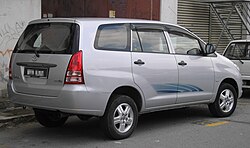 Innova 2.0 E (TGN40; pre-facelift, Malaysia)
 -
 2006–2008 minor facelift
 -
 Interior (third facelift)
_(rear),_Kajang.jpg)
,_West_Surabaya_(cropped).jpg)

Updates
[edit]2008
[edit]The facelifted Innova debuted on 26 August 2008 in Indonesia. It featured a redesigned front and rear bumper, front grille, and rear taillights. It was also launched in the Philippines in November 2008 and in India on 28 January 2009. In August 2009, the E and G-type Kijang Innova received improvements, such as redesigned side body moulding, chrome ornaments on rear windshield and boot lid. The Luxury package was also introduced for the G and V type.[citation needed]
-
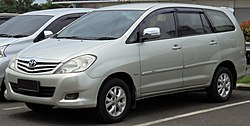 2009 Kijang Innova 2.0 G (TGN40; first facelift, Indonesia)
 -
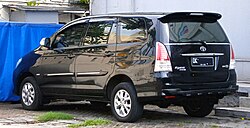 2009 Kijang Innova 2.0 G (TGN40; first facelift, August 2009 improvement, Indonesia)
.jpg)
.jpg)
2011
[edit]On 20 July 2011, Toyota launched the second facelift of the Innova in Indonesia. It featured redesigned headlights, grille, bonnet, bumpers, taillights and wheels. The interior was updated with an updated steering wheel, updated air-conditioning knobs (for non V variants), and a revised center dashboard design.[citation needed]
-
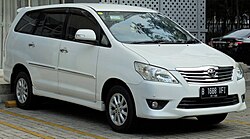 2012 Kijang Innova V (AN40; second facelift, Indonesia)
 -
 2013 Kijang Innova 2.0 E (TGN40; second facelift, Indonesia)
,_South_Tangerang.jpg)
.jpg)
2013
[edit]The third facelift of the Innova debuted in August 2013 in Indonesia, which introduced a revised front bumper, boot garnish and equipment upgrades.[15]
-
 2014 Kijang Innova 2.0 G (TGN40; third facelift, Indonesia)
 -
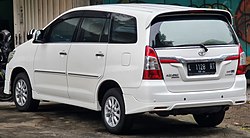 2014 Kijang Innova 2.0 V Luxury (TGN40; third facelift, Indonesia)
.jpg)
,_Central_Surabaya.jpg)
Markets
[edit]India
[edit]In India, the Innova was introduced in February 2005 to replace the Qualis.[16][17] It was available with twelve variants. Three variants of the Innova came with a petrol engine option which was powered by a 2.0-litre engine with electronic fuel injection. The diesel variants of the Innova are powered by a 2.5-litre engine. The available grades were E, G, GX and VX. In 2012, "Z" was made as a flagship grade above the VX. Toyota set an initial sales target of 45,000 units annually.[18]
The Innova was sold in large numbers in India (where it is known as an MUV)—primarily serving the tourist taxi market and fleet operations of large technology business process outsourcing companies.[citation needed]
In 2009, a facelift was introduced with exterior cosmetic changes, and the inclusion of an intercooler.[17]
A second facelift was introduced in 2012 at the 11th Auto Expo with updated bumper designs, grille, updated headlights and newly designed alloy wheels. Steering-mounted controls for the audio and climate control system became an option.[18]
The first-generation Innova received an update for the Indian market in 2015.[19] With this update, all variants gained dual airbags and there were cosmetic changes such as the inclusion of dark grey two-tone alloy wheels, wood finished steering wheel, redesigned leather seats, and an oak interior colour.[20] Rear HVAC outlets became standard as a part of this update.[21]
Indonesia
[edit]The Kijang Innova was introduced in Indonesia on 1 September 2004.[9] It was initially available in E, G and V grade levels, equipped with either 2.0-litre petrol or 2.5-litre diesel engine. Manual transmission was offered in all grades, while the automatic transmission was only offered in G and V grades. The E and G grades retained three-spoke steering wheel design from the second facelift fourth-generation Kijang and first-generation Vios, while the V grade shared its four-spoke steering wheel design from the E120 series Corolla Altis, first-generation Alphard, facelifted J100 series Land Cruiser and the facelifted XV30 series Camry.
In January 2005, the 2.7 V grade was released as the flagship model. It was equipped with a 2.7-litre 2TR-FE engine (later also used on petrol variants of the Toyota Fortuner), dual airbags, ABS, seven-seat layout, with no manual transmission option. It was discontinued in 2007 due to low demand caused by its relatively high price.[11][22] In 2006, the V Xtra grade was released with similar equipment levels as the 2.7 V grade.
In early 2007, the engines on the Indonesian market Kijang Innova were updated to comply with the Euro 2 emission standards. It received a catalytic converter and the injection system was changed to a closed loop system. The Kijang Innova also received a front mesh grille.[citation needed]
In January 2008, the G grade could be optioned as a seven-seater with the "Captain Seat" sub-grade.[23]
The facelifted Kijang Innova was released on 26 August 2008 with updated front bumper and grille design, taillights and bumpers, and redesigned wheels.[24][25] At the 17th Indonesia International Motor Show in July 2009, the G Luxury and V Luxury grades were introduced as replacements for the V Xtra grade. In August 2009, the petrol-only J grade was introduced as the base model.[26]
On 20 July 2011, the Kijang Innova received a second facelift. Changes include updated front clip design, taillights, redesigned wheels and updated center dashboard design.[citation needed]
On 19 August 2013, the third facelift of the Kijang Innova was launched. Changes consist of a larger grille, redesigned bumpers and an updated boot garnish exclusive to the E, G and V grades.[15][27] In August 2014, the Kijang Innova was updated again with the redesigned wheels, while Luxury grades received a redesigned rear body kit.[citation needed]
Malaysia
[edit]In Malaysia, the Innova was launched on 27 May 2005, replacing the Unser and was offered in two variants: the E and G, both powered by the 1TR-FE 2.0-litre engine with VVT-i. The powertrains available were either paired with a five-speed manual transmission or a four-speed automatic transmission.[28]
Philippines
[edit]In Philippines, the Innova was introduced in March 2005 to replace the Revo. Grade levels include the J (entry-level model had no power features and steel wheels with hubcaps), the E (mid-level model with power features, airbags, and only available with a diesel engine; a petrol engine variant was added in 2006), the G (middle model with carry over features from the E grade albeit with fabric seats and fog lights), and V (high end model, which was introduced in the last quarter of 2006 and only available with an automatic transmission, leather seats and interiors, captains seats on the middle row, and high end audio system).[citation needed]
The first facelift of Innova came out in 2008 with the same four grades. In 2010, an upgraded version of the Innova E variant called the Sport Runner was offered. It was only available with a 2.5-litre diesel engine and was offered with either a 5-speed manual or 4-speed automatic transmission. It has sportier body kits and 5-spoke SR wheels. Available colors were Beige and Black metallic.[29] It was offered until early 2012 and in that same year, a second facelift version was introduced.[citation needed]
In early 2014, another facelift version was launched (except for J) and in 2015, the E variant was added with rear demister and has same wheel design as the G and V grades.[citation needed]
In June 2015, TMP offered a limited edition 1 Million Innova with GPS navigation, rear spoiler and 1 Million badge, and a special Jade Green Metallic exterior colour.[30]
The first-generation Innova was sold over 140,000 units in the Philippines.[4]
South Africa
[edit]In South Africa, the Innova was introduced in its second facelift form in October 2011, sitting in between the Verso and the smaller Avanza.[31] Equipped with a 2.7-litre engine mated exclusively to a 5-speed manual, it was offered with eight-seater variant and a more upscale seven-seater.[32] The model was not replaced with the second-generation model upon its discontinuation due to poor sales and slumping demand for MPVs in the market.[33]
Taiwan
[edit]In Taiwan, the Innova was introduced in July 2007 to replace the Zace Surf, as it was not compliant with the stricter emissions regulations. Positioned as a recreational vehicle and a commercial vehicle, the Taiwanese market Innova was only offered with a two-row, five-seater capacity. Initial models are equipped with the 2.7-litre petrol engine with J, E, G and Z grade levels.[14] Monthly sales were targeted at 900 units.[34] In November 2011, the 2.7-litre engine was replaced by the 2.0-litre engine with price reductions and monthly sales target of 700 units. Retaining the same initial exterior styling without a facelift, the vehicle gained black interior colour replacing beige.[35] Production continues without significant changes until 2016, when it was discontinued without a direct successor.[36][37]
Vietnam
[edit]In Vietnam, the Innova was introduced in January 2006 to replace the Zace. In its first year, the Innova sold 9,934 units with a share of the overall car market of 23 percent, a record in the country.[38]
Powertrain
[edit]The first-generation Innova was powered by either a 2.0-litre petrol 100 kW (134 hp; 136 PS) 1TR-FE with VVT-i, a 2.7-litre petrol 118 kW (158 hp; 160 PS) 2TR-FE with VVT-i, or a 2.5-litre 102 PS (75 kW) 2KD-FTV D-4D common rail turbocharged diesel engine.
The diesel variants used a turbocharged 2KD-FTV engine which produces 75 kW (101 hp; 102 PS) and 260 N⋅m (26.5 kg⋅m; 192 lb⋅ft) of torque when mated to the four-speed automatic transmission and 200 N⋅m (20.4 kg⋅m; 148 lb⋅ft) when mated to the five-speed manual. Petrol versions were also available in five-speed manual or four-speed automatic versions.
| Type | Engine code | Displacement | Power | Torque | Transmission | Model code | Layout | Calendar years |
|---|---|---|---|---|---|---|---|---|
| Petrol | 1TR-FE[39] | 1,998 cc (2.0 L) I4 with VVT-i | 100 kW (134 hp; 136 PS) @ 5,600 rpm | 182 N⋅m (18.6 kg⋅m; 134 lb⋅ft) @ 4,000 rpm | TGN40 | RWD | 2004–2016 | |
| Petrol | 2TR-FE | 2,693 cc (2.7 L) I4 with VVT-i | 118 kW (158 hp; 160 PS) @ 5,200 rpm | 241 N⋅m (24.6 kg⋅m; 178 lb⋅ft) @ 3,800 rpm |
|
TGN41 | 2005–2016 | |
| Diesel | 2KD-FTV | 2,494 cc (2.5 L) turbocharged I4 | 75 kW (101 hp; 102 PS) @ 3,600 rpm | 200 N⋅m (20.4 kg⋅m; 148 lb⋅ft) @ 1,400–3,200 rpm | 5-speed manual | KUN40 | 2004–2016 | |
| 260 N⋅m (26.5 kg⋅m; 192 lb⋅ft) @ 1,600–2,400 rpm | 4-speed automatic |
Second generation (AN140; 2015)
[edit]| Second generation | |
|---|---|
,_South_Tangerang.jpg) 2017 Kijang Innova 2.0 G (TGN140; pre-facelift, Indonesia) | |
| Overview | |
| Model code | AN140 |
| Also called | Toyota Kijang Innova (Indonesia) |
| Production | November 2015 – present[40] |
| Assembly | |
| Designer | |
| Body and chassis | |
| Class | Mid-size MPV |
| Layout | Front-engine, rear-wheel-drive |
| Platform | Toyota IMV platform |
| Chassis | Body-on-frame |
| Related | |
| Powertrain | |
| Engine | |
| Transmission | |
| Dimensions | |
| Wheelbase | 2,750 mm (108.3 in) |
| Length | 4,735 mm (186.4 in) |
| Width | 1,830 mm (72.0 in) |
| Height | 1,795 mm (70.7 in) |
| Kerb weight | 1,700–1,930 kg (3,747.9–4,254.9 lb) |
The second-generation Innova, designated AN140 series, was launched in November 2015 in Indonesia. Its introduction follows the other vehicles from the IMV family, the Hilux and the Fortuner, which received newer generations in May and July respectively.[43][44] The second-generation Innova featured an improved platform and newer diesel engines, with development led by executive chief engineer Hiroki Nakajima.[45][46] According to Nakajima, the second-generation Innova aimed to be a "crossover MPV", in the sense of combining the essence of an MPV with the "tough, emotional elements" of an SUV.
It is 150 mm (5.9 in) longer, 55 mm (2.2 in) wider, 35 mm (1.4 in) taller, and around 210–290 kg (460–640 lb) heavier than its predecessor.[4][47] In the interior, it gains larger headroom for the first and third row occupants, and the seating distance between occupants is increased by 19 mm (0.7 in).[48] It was reported that the second-generation Innova shares "only 5% of its components with the outgoing model, which is, apparently, a few bolts and screws," according to Toyota Motor Manufacturing Indonesia (TMMIN) director of production engineering, Nandi Julianto. While keeping the same wheelbase as the previous generation, the Innova rides on a revised body-on-frame chassis that has been tweaked with a thicker side rail to offer better strength and structural rigidity.[4][49]
The second-generation Innova retains its double wishbone suspension with coil springs and stabilizer up front and a four-link with coil spring and lateral rod suspension at the rear. The low end variants rode on 16-inch alloy wheels, while the top-end variant received 17-inch alloy wheels.[50] It could be optioned with seven airbags, stability control, and hill start assist.[4]
The second-generation Innova is fully manufactured in Indonesia and India, and also assembled by knock-down kits in Malaysia, the Philippines, and Vietnam.
-
 Rear view
 -
 Interior
,_West_Surabaya_(cropped).jpg)
_2.4_Q_AT_(2015-12-05)_interior_view.jpg)
Markets
[edit]India
[edit]For the Indian market, the second-generation Innova was showcased at Auto Expo in February 2016. Marketed as the Innova Crysta, this generation was launched in May 2016.[51] Exclusive for this model is a 2.8-litre 1GD-FTV inline-four turbocharged diesel engine.[52] The Innova Crysta was launched in May 2016 as with two diesel engine options: the 2.8-litre diesel and the 2.4-litre diesel. The 2.8-litre engine gets the six-speed automatic transmission with sequential shift while the 2.4-litre gets the five-speed manual transmission.[53] In August 2016, the 2.7-litre petrol engine option was introduced, in response to the ban on diesel vehicles with engine capacities over 2,000 cc in Delhi and NCR. The petrol engine is mated with either a 5-speed manual or a 6-speed automatic transmission with sequential shift according to different grade levels.[54]
Grade levels are G, V, and the flagship Z. In May 2017, Toyota launched the Innova Touring Sport which feature exterior elements from the Indonesian market Kijang Innova Venturer. The lineup received an update in October 2017 with a 6-speed manual transmission.[55]
In 2020, the 2.8-litre 1GD-FTV engine was discontinued for the Indian market due to the implementation of Bharat Stage 6 emission standard.[56] The 2.8-litre automatic variant was subsequently replaced with the 2.4-litre automatic variant. However, the 2.4-litre 2GD-FTV diesel in the automatic variant produces the same torque of 360 N⋅m (36.7 kg⋅m; 266 lb⋅ft) that the 2.8-litre automatic produced and the 2.4-litre manual produces the same torque of 343 N⋅m (35.0 kg⋅m; 253 lb⋅ft) that the 2.8-litre manual produced. To comply with the Bharat Stage 6 emission norms, the engine is equipped with a DPF + SCR system for exhaust after-treatment and mandates the use of diesel exhaust fluid.
The updated Innova Crysta was launched in India on 24 November 2020, with changes mainly in the front styling.[57]
The Innova Crysta was reintroduced to be sold alongside the newer Innova HyCross in January 2023 with a restyled front end. The petrol engine option and automatic transmission was dropped, leaving the 2.4-litre diesel engine with manual transmission.[58]
Indonesia
[edit]The second-generation Kijang Innova (colloquially known as "Kijang Innova Reborn")[59][60] was launched in Jakarta, Indonesia on 23 November 2015. Initial grade levels of the Indonesian market Kijang Innova are the base G, the mid-level V and the flagship Q grade.[61] As the Kijang Innova is moving upmarket to make room for the second-generation Sienta, the J and E grades from the previous generation was removed.[62] The engine options in the Indonesian market are the 2.0-litre 1TR-FE petrol and 2.4-litre 2GD-FTV common rail diesel.[61]
On 16 January 2017, the diesel-engined Q grade was replaced by Venturer grade (available in both petrol and diesel engines). It has a more pronounced crossover SUV-inspired look with the inclusion of aerokits, black 17-inch alloy wheels. It is also equipped with leather upholstery and captain seats.[63] The grade omitted the "Kijang" badge and was marketed separately from the lesser grades.[64]
On 10 August 2017, the Kijang Innova received a minor update. For the G grade, the plastic grille ornament was replaced with a chrome grille ornament, while the V grade received LED projector headlights. The 2.0 Q grade received 17-inch alloy wheels from the discontinued Q diesel grade. This updated Kijang Innova was introduced at the 25th Gaikindo Indonesia International Auto Show.
On 2 August 2018, the petrol engine on the Kijang Innova was updated to comply with the Euro 4 emission standards. It was introduced during the 26th Gaikindo Indonesia International Auto Show.[65]
On 17 August 2020, a limited-production TRD Sportivo variant based on the G and V diesel grades was introduced.[66] Only 2,632 units were produced.[67]
The facelift model of the Kijang Innova was released on 15 October 2020.[68] The Q grade was removed from the lineup and replaced by the Luxury variant of G and V grades with captain seats. It also marked the revival of Luxury variant of G and V grades, after four year and 11-months hiatus. Vehicle stability control and hill-start assist became standard on all grades.
To commemorate the 50th anniversary of Toyota-Astra Motor, the limited edition variant of the Kijang Innova was made available in April 2021. Only 50 units were sold, which consists of 30 units based on 2.0 V Luxury grade and 20 units based on 2.4 Venturer grade, both with automatic transmission.[69]
On 31 March 2022, the diesel engine on the Kijang Innova was updated to comply with the Euro 4 emission standards. It was introduced during the 29th Indonesia International Motor Show.[70]
Since November 2022, with the introduction of the third-generation model, the G petrol and diesel variants with manual transmission initially became the only second-generation Kijang Innova variants sold not only for fleet markets but also for retail markets by spot order. The diesel variant with automatic transmission was reintroduced later in March 2023.[71][72][73][74]
The Kijang Innova received a minor improvement in December 2025, offered in sole G diesel variant with manual and automatic transmissions.[75]
-
 2018 Kijang Innova 2.4 Venturer (GUN142; pre-facelift, Indonesia)
 -
 2018 Kijang Innova 2.4 Venturer (GUN142; pre-facelift, Indonesia)
 -
 2020 Kijang Innova 2.4 V TRD Sportivo (GUN142; pre-facelift, Indonesia)
 -
 2020 Kijang Innova 2.4 V TRD Sportivo (GUN142; pre-facelift, Indonesia)
 -
 2021 Kijang Innova 2.0 V Luxury (TGN140; facelift, Indonesia)
 -
 2021 Kijang Innova 2.0 V Luxury (TGN140; facelift, Indonesia)
 -
 2021 Kijang Innova 2.0 Venturer (TGN140; facelift, Indonesia)
 -
 2021 Kijang Innova 2.4 Venturer Limited Edition (GUN142; facelift, Indonesia)
,_South_Tangerang.jpg)
,_West_Surabaya.jpg)
_01.jpg)
_02.jpg)
,_Citraland,_West_Surabaya.jpg)
,_Citraland,_West_Surabaya.jpg)
_front_view_02.jpg)
_front_view.jpg)
Malaysia
[edit]The second-generation Innova was launched in Malaysia on 5 December 2016. It is assembled by UMW Toyota Motor at its Shah Alam facility in Malaysia. Initial grade levels were the E and G models.[76]
In September 2017, UMW Toyota introduced a flagship variant, called the 2.0 X.[77]
The facelifted Innova was launched in Malaysia on 2 February 2021. Grade levels remained the same as the pre-facelift model.[78]
Although the third-generation Innova has been launched, UMW Toyota Motor has decided to continue selling the second-generation Innova, choosing to treat the third-generation model as a separate model called the Innova Zenix.[79]
Philippines
[edit]The second-generation Innova was launched in the Philippine market on 26 February 2016.[80]
Initial grade levels include the base model J, the mid-level E, the higher-spec G, and the top-of-the-line V. A special variant called the Touring Sport was also available in January 2018 based on the E grade where it has certain exterior and interior upgrades. Initially, all grade levels were powered by either a 2.8-litre 1GD-FTV turbocharged four-cylinder diesel engine or a 2.0-litre 1TR-FE four-cylinder petrol engine (for 3 grades except the V) mated to either a 5-speed manual or a 6-speed automatic transmission with sequential shift.[81] The second-generation Innova rolled off Toyota Motor Philippines' assembly plant in Santa Rosa, Laguna on 14 April 2016 and went on sale a few days later.[82]
The facelifted Innova was then launched in the Philippines on 20 February 2021. Grade levels remain the same as the pre-facelift model while the petrol variants and Touring Sport models were removed from the lineup. The facelift included a reworked front fascia and a new wheel design for the E and G grades[83]
In October 2023, the XE grade was added to the lineup wherein it is based on the J grade but with a 6-speed automatic transmission while the E grade with a manual transmission has been discontinued. It also received a feature list upgrade.[84]
Saudi Arabia and UAE
[edit]Al Futtaim Motors, the distributor of Toyota in UAE, launched the second-generation Innova on 6 April 2016. The UAE-specification is powered by the 2.7-litre 2TR-FE engine with the six-speed automatic transmission.[85]
Thailand
[edit]As in India, the second-generation Innova is also marketed in Thailand as the Innova Crysta. Initial grade levels were 2.0 E, 2.8 G diesel and 2.8 V diesel.[86] The units are imported from Indonesia.
In November 2020, the facelift model of the Thai market Innova was launched. It is available in 2.0 Entry, 2.8 Crysta and 2.8 Crysta Premium grade levels.[87]
Vietnam
[edit]On 18 July 2016, the second-generation Innova was launched in Vietnam and its powered by a 2.0-litre 1TR-FE as an only petrol engine option. It is produced in Vĩnh Phúc and is available in E, G and V grade levels.[88]
In September 2025, the second-generation Innova was discontinued in Vietnam.[89]
Powertrain
[edit]The 2.0-litre and 2.7-litre petrol engines are carried over from the previous model with slight modifications, while the 2.4-litre and 2.8-litre diesel engines are newer additions for this generation. Toyota claimed a 30 percent improvement in fuel efficiency for the diesel engines.[90]
| Type | Engine code | Displacement | Power | Torque | Transmission | Model code | Layout | Calendar years |
|---|---|---|---|---|---|---|---|---|
| Petrol | 1TR-FE | 1,998 cc (2.0 L) I4 with Dual VVT-i | 102 kW (137 hp; 139 PS) @ 5,600 rpm | 183 N⋅m (18.7 kg⋅m; 135 lb⋅ft) @ 4,000 rpm | TGN140 | RWD | 2015–present | |
| Petrol | 2TR-FE | 2,693 cc (2.7 L) I4 with Dual VVT-i | 122 kW (164 hp; 166 PS) @ 5,200 rpm[91] | 245 N⋅m (25.0 kg⋅m; 181 lb⋅ft) @ 4,000 rpm | TGN141 | 2016–present | ||
| Diesel | 2GD-FTV | 2,393 cc (2.4 L) turbocharged I4 | 109.5–110 kW (147–148 hp; 149–150 PS) @ 3,400 rpm | 342–343 N⋅m (34.9–35.0 kg⋅m; 252–253 lb⋅ft) @ 1,200–2,800 rpm | GUN142 | 2015–present | ||
| 360 N⋅m (36.7 kg⋅m; 266 lb⋅ft) @ 1,200–2,800 rpm | 6-speed AC60 automatic | |||||||
| Diesel | 1GD-FTV | 2,755 cc (2.8 L) turbocharged I4 | 128–130 kW (172–174 hp; 174–177 PS) @ 3,400 rpm | 360 N⋅m (36.7 kg⋅m; 266 lb⋅ft) @ 1,200–3,400 rpm | GUN143 | 2016–present |
Safety
[edit]In a 2016 testing under 2012–2016 ASEAN NCAP standards, the second-generation Innova received a 4-star rating for the 3-airbag variant not equipped with an electronic stability control, and a 5-star rating for the 5-airbag variant with electronic stability control.[92][93]
In a 2020 testing, the second-generation Innova received a 5-star rating under 2017–2020 ASEAN NCAP standards, after the model received a standard electronic stability control.[94][95][96]
| Test | Points | Stars |
|---|---|---|
| Adult occupant: | 14.10 |  
|
| Child occupant: | 76% |
|
| Safety assist: | NA | |
| Test | Points | Stars |
|---|---|---|
| Adult occupant: | 14.10 |
|
| Child occupant: | 76% |
|
| Safety assist: | NA | |
| Test | Points |
|---|---|
| Overall: |
|
| Adult occupant: | 45.90 |
| Child occupant: | 21.51 |
| Safety assist: | 15.28 |
Kijang Innova EV Concept
[edit]
The Kijang Innova EV Concept is an EV conversion prototype that was first presented on 31 March 2022 in Indonesia.[100][101][102] The conversion was done by the Australian branch of SEA Electric, a company specialising in electric trucks conversion based in Melbourne, Australia. Five prototypes were built; three were built in Melbourne and two in Indonesia.[103]
The storage battery uses a 58.9 kWh lithium-ion unit with an estimated range of 280 km (175 miles). The electric motor is rated at 134 kW (180 hp; 182 PS) and could generate up to 700 N⋅m (520 lb⋅ft) of torque.[104] The claimed top speed is 120 km/h (75 mph).[105]
Third generation (AG10; 2022)
[edit]| Third generation | |
|---|---|
_%E2%80%93_f_22032025.jpg) Innova Zenix 2.0 V (MAGA10, Malaysia) | |
| Overview | |
| Model code | AG10 |
| Also called |
|
| Production | November 2022 – present |
| Assembly | |
| Designer | |
| Body and chassis | |
| Layout | Front-engine, front-wheel-drive |
| Platform | TNGA: GA-C[108][109] |
| Chassis | Unibody |
| Related | Toyota Noah/Voxy (R90) |
| Powertrain | |
| Engine | |
| Electric motor | Permanent magnet synchronous (hybrid) |
| Transmission | |
| Hybrid drivetrain | Power-split |
| Battery | 6.5-Ah nickel–metal hydride (hybrid) |
| Dimensions | |
| Wheelbase | 2,850 mm (112.2 in) |
| Length | 4,755 mm (187.2 in) |
| Width | 1,845–1,850 mm (72.6–72.8 in) |
| Height | 1,785–1,795 mm (70.3–70.7 in) |
| Kerb weight | 1,555–1,695 kg (3,428.2–3,736.8 lb) |
The third-generation Innova, designated with the codename AG10, was launched in Indonesia on 21 November 2022 as the Kijang Innova Zenix, and in India on 25 November 2022 as the Innova HyCross. It was rolled out to Southeast Asian markets later, such as Malaysia on 21 June 2023 then Thailand on 19 July 2023 as the Innova Zenix,[110] the Philippines as the Zenix on 22 June 2023,[111] and Vietnam since October 2023 as the Innova Cross.[112]
Built on the unibody, front-wheel-drive-based GA-C platform, it is powered by two engine options: the 2.0-litre M20A-FKS petrol and the 2.0-litre M20A-FXS petrol hybrid engines.[113][114][115] Manual transmission and diesel engine options are no longer offered for this generation.[116][117]
Development of the third-generation Innova was led by chief engineer Hideki Mizuma, which is also the chief engineer for the second, third, and fourth-generation Noah/Voxy, as well as the Sienna and Estima/Previa.[118][119][120] The industrial design right was attributed to Toyota Auto Body, Toyota's subsidiary that develops and produces minivan models in Japan.[121][122]
The design concept of the third-generation Innova was described as an "Innovative Multipurpose Crossover". Similar to the second generation, the concept combines the design elements of a crossover SUV with the interior space and practicality of an MPV.[123] Toyota shifted the A-pillars further back, while the D-pillars are tilted forward to avoid an orthodox van-like design.[116] The track width is kept narrow to keep its turning radius minimum, which positively affects its manoeuvrability.[124]
With the use of the flat floor variation of the GA-C platform shared with the fourth-generation Noah/Voxy, the third-generation Innova is lighter by 170 kg (375 lb) compared to its predecessor. The wheelbase is also lengthened by 100 mm (3.9 in).[125] The length of the cabin was increased compared to the previous generation by 56 mm (2.2 in) to 1,746 mm (68.7 in), while the width was increased by 46 mm (1.8 in) to 1,488 mm (58.6 in). The headroom is also increased by 32 mm (1.3 in).[126]
Other additions and changes compared the previous generation include electronic parking brake with auto brake hold as standard, dashboard-mounted gear lever, panoramic roof, Toyota Safety Sense, and second-row captain seats with "Ottoman" leg rests.[127][128]
-
 Rear view
 -
 Interior
 -
 Innova Zenix 2.0 Q Hybrid with Modellista package (MAGH10)
 -
 Innova Zenix 2.0 Q Hybrid with Modellista package (MAGH10)
_%E2%80%93_h_22032025.jpg)
.jpg)


Markets
[edit]Asia
[edit]Indonesia
[edit]For the Indonesian market, the model is marketed as the Kijang Innova Zenix. The name Zenix was derived from the English word 'zenith', which Toyota stated as conveying "peak performance", while the letter x represents the word "crossover".[129] The Kijang nameplate is retained due to its popularity in the country, with Toyota in Indonesia designating the model as the seventh-generation Kijang. It is the first hybrid vehicle and the first TNGA-based vehicle to be produced by Toyota in the country.[130]
Three trim levels are offered for the Kijang Innova Zenix: G, V and Q. The hybrid powertrain is optional on G and V trims and standard on the Q trim.[131] Toyota Safety Sense is also standard on the latter. The Modellista accessories package is also offered as an option for the V hybrid and Q trims.[132][133]
Monthly sales target of the Kijang Innova Zenix in the country is set at around 4,000 units, with planned exports to around 50 countries starting February 2023.[134] As of 2022[update], the petrol model of the Kijang Innova Zenix contains 85 percent of locally sourced parts, while the hybrid version contains 60 percent as many of the electrical components are imported from Japan. While the NiMH battery is locally assembled, the M20A 2.0-litre engines are imported from India.[135]
-
 2023 Kijang Innova Zenix G
 -
 2023 Kijang Innova Zenix 2.0 Q Hybrid Modellista (front)
 -
 2023 Kijang Innova Zenix 2.0 Q Hybrid Modellista (rear)

.jpg)
.jpg)
India
[edit]In the Indian market, the model is marketed as the Innova HyCross.[136] Initially, it is available in five trim levels, which are two petrol trims: G-SLF, GX; and three hybrid trims: VX, ZX, and ZX (O). A new trim called VX (O) with hybrid powertrain was added later in March 2023, for a total of six trim levels.[137] Toyota Safety Sense is standard on the highest trim.[138] The entry-level petrol trim (G-SLF) is targeted at fleet owners and taxi operators.[139] It has been available for retail sales since January 2023.[140] A new GX(O) petrol variant was introduced by 15 April 2024.[141]
Two years after its launch, the HyCross crossed the 100,000 sales mark.[142]
Brunei
[edit]The third-generation Innova was launched in Brunei on 14 April 2023, as the first country to import the third-generation model. It is offered in a single trim level (2.0 V) and only powered by a 2.0-litre M20A-FKS petrol engine mated to a CVT.[143]
Malaysia
[edit]The third-generation Innova was launched in Malaysia on 21 June 2023 as the Innova Zenix. It is offered in two trim levels: 2.0 V with the M20A-FKS petrol engine and 2.0 HEV with M20A-FXS hybrid powertrain. Toyota Safety Sense is standard.[144]
Philippines
[edit]The third-generation Innova was launched in the Philippines on 22 June 2023 as the Toyota Zenix.[111] In marketing materials, the Innova nameplate was dropped to avoid confusion with the second generation and diesel-powered Innova which is still on sale and locally assembled. However, the Zenix retains the physical 'Innova' emblem. It is offered in two trim levels: 2.0 V CVT with the M20A-FKS petrol engine and 2.0 Q HEV CVT with M20A-FXS hybrid powertrain. Toyota Safety Sense is standard on the latter.[145]
Thailand
[edit]The third-generation Innova was launched in Thailand on 19 July 2023 as the Innova Zenix.[146] It is offered in two trim levels: Smart and Premium, both are only offered with a 2.0-litre M20A-FXS hybrid powertrain. Toyota Safety Sense is standard.[147][148]
Vietnam
[edit]The third-generation Innova was launched in Vietnam on 12 October 2023 as the Innova Cross. Bookings began in July 2023.[149][150] It is offered in two variants: 2.0 V with the M20A-FKS petrol engine and 2.0 HEV with M20A-FXS hybrid powertrain. Toyota Safety Sense is standard on the latter.[112] In December 2025, the 2.0 G variant with the M20A-FKS petrol engine was added to the line-up.[151]
GCC
[edit]The third-generation Innova was launched in the GCC markets on 10 July 2023.[152][153] Each markets have offered their own specifications as follows:
| Variants | Engine code | Bahrain[154] | Kuwait[155] | Qatar[156] | Saudi Arabia[157] | UAE[158] |
|---|---|---|---|---|---|---|
| Petrol | M20A-FKS | GL | Standard | INB | GL | - |
| Petrol hybrid | M20A-FXS | GLE | - | INHB
INHM |
GL HEV
VIP7 HEV |
Hybrid
HyCross 7S HyCross 8S |
Latin America
[edit]Guatemala
[edit]The third-generation Innova was launched in Guatemala on 17 June 2023.[159] It is offered in two trim levels: AF-24 with the M20A-FKS petrol engine and BN-24 with M20A-FXS hybrid powertrain. Toyota Safety Sense is standard on the latter.[160]
Panama
[edit]The third-generation Innova was launched in Panama on 26 June 2023.[161] It is offered in a single trim level and only powered by a 2.0-litre M20A-FKS petrol engine mated to a CVT.[162]
Suzuki Invicto
[edit]Maruti Suzuki has launched the Suzuki Invicto, a rebadged and restyled version of Innova HyCross in India on 5 July 2023. It is available in two trim levels: Zeta+ and Alpha+, both are offered only with the 2.0-litre M20A-FXS hybrid powertrain.[163][164]
Powertrain
[edit]For this generation, the Innova is equipped with a hybrid powertrain as an option. It is a fifth-generation hybrid system developed by Toyota, combining the M20A-FXS engine with a permanent magnet synchronous electric motor and a 6.5-Ah nickel-metal hydride (NiMH) battery. Positioned under the front seats, the NiMH battery is chosen over lithium-ion due to its better durability in hot weather conditions.[165][166]
| Type | Engine code[167] | Displ. | Power | Torque | Combined system output | Electric motor | Battery | Transmission | Model code | Layout | Cal. years |
|---|---|---|---|---|---|---|---|---|---|---|---|
| Petrol | M20A-FKS | 1,986 cc (2.0 L) I4 | 128 kW (172 hp; 174 PS) @ 6,600 rpm | 205 N⋅m (20.9 kg⋅m; 151 lb⋅ft) @ 4,500–4,900 rpm | - | - | - | K120 Direct Shift CVT | MAGA10 | FWD | 2022–present |
| Petrol hybrid | M20A-FXS | 1,986 cc (2.0 L) I4 | Engine: 112 kW (150 hp; 152 PS) @ 6,000 rpm
Motor: 83 kW (111 hp; 113 PS) |
Engine: 187 N⋅m (19.1 kg⋅m; 138 lb⋅ft) @ 4,400–5,200 rpm
Motor: 206 N⋅m (21.0 kg⋅m; 152 lb⋅ft) |
137 kW (184 hp; 186 PS) | Permanent magnet synchronous | 6.5 Ah NiMH | eCVT | MAGH10 |
Awards
[edit]In Indonesia, the third-generation Innova won the Car of the Year Otomotif Award 2023, Car of The Year GridOto Award 2023, Forwot Cars of The Year 2023, and Best Carvaganza Editors Choice Award (CEC) 2023.[168][169][170][171]
Safety
[edit]| Test | Score | Stars |
|---|---|---|
| Adult occupant protection | 30.47/32.00 |
|
| Child occupant protection | 45.00/49.00 |
|
| Test | Score | Stars |
|---|---|---|
| Adult occupant protection | 30.43/32.00 |
|
| Child occupant protection | 45.00/49.00 |
|
Sales
[edit]In 2023, the Innova became Indonesia's best selling car for the first time in 18 years.[174][175]
| Year | Indonesia | India | Philippines | Vietnam | Thailand | Malaysia[176][i] |
|---|---|---|---|---|---|---|
| 2004† | 63,710[177] | |||||
| 2005 | 82,954[178] | 31,936[179] | 12,130[180] | 8,905 | ||
| 2006 | 38,992[178] | 40,184[179] | 10,767[180] | 9,934[181] | 9,436 | |
| 2007 | 40,169[178] | 46,527[179] | 10,544[180] | 12,433[182] | 5,805 | |
| 2008 | 51,189[178] | 43,947[179] | 14,947[182] | 5,401 | ||
| 2009 | 35,980[183] | 42,003[179] | 8,654 | 8,475[184] | 4,967 | |
| 2010 | 53,824[185] | 51,304[179] | 7,419[186] | 5,581 | ||
| 2011 | 54,763[187] | 51,930[188] | 6,005[189] | 4,768 | ||
| 2012 | 71,685[190] | 75,911[188] | 4,233[191] | 5,675 | ||
| 2013 | 64,539[192] | 58,266[193] | 6,011[194] | 5,122 | ||
| 2014 | 56,157[195] | 59,450[196] | 4,797 | |||
| 2015 | 43,444[195] | 60,526[197] | 3,610 | |||
| 2016 | 57,493[198] | 71,875[199] | 18,137[200] | 11,344[201] | 610[202] | 2,485 |
| 2017 | 61,775[203] | 72,349[204] | 24,434[205] | 12,001[206] | 1,845[207] | 5,504 |
| 2018 | 59,630[208] | 78,130[209] | 18,175[210] | 14,618[211] | 1,174[212] | 4,703 |
| 2019 | 52,981[213] | 61,743[209] | 20,794[214] | 12,211[215] | 3,007 | |
| 2020 | 27,594[216] | 34,078[217] | 10,551[218] | 5,423[219] | 1,576 | |
| 2021 | 49,745[220] | 55,250[221] | 13,304[222] | 3,002[223] | 1,554 | |
| 2022 | 46,933[224] | 56,569[225] | 17,810[226] | 3,272[227] | 1,232 | |
| 2023 | 66,461[174] | 84,073[228] | 18,357[229][ii] | 1,909[230] | 1,107[231][232] | 2,867 |
| 2024 | 63,676[233] | 17,648[234] | 6,759[235] | 2,274[236] | 2,869 | |
| 2025 | 61,164[237] |
† Including the outgoing Kijang [iii]
Notes
[edit]See also
[edit]References
[edit]- ^ Kelshikar, Tushar (2023-07-05). "Maruti Suzuki Invicto MPV launched at Rs 24.79 lakh". Team-BHP.com. India. Retrieved 2023-07-05.
- ^ "Ini Dia, Sosok Pria Di Balik "Si Kuat" Kijang Innova" [This is the figure behind the "strong" Kijang Innova]. GridOto.com (in Indonesian). 2008-08-25. Retrieved 2022-01-18.
- ^ Anshori, Luthfi (2022-11-22). "Alasan Kijang Innova Zenix Ganti Pakai Sasis Monokok dan Penggerak FWD" [Reasons Why the Kijang Innova Zenix Uses Monocoque Chassis and FWD Layout]. Detik Oto (in Indonesian). Indonesia: Transmedia. Retrieved 2022-11-27.
- ^ a b c d e "All You Need to Know About the 2016 Toyota Innova (w/ Complete Specs)". CarGuide.PH. 2016-02-29. Retrieved 2022-10-07.
- ^ "Automobile". IPOPHL Patent Search. Retrieved 2022-01-18.
- ^ a b "IDD000022262". Pangkalan Data Kekayaan Intelektual. 2008-07-22.
- ^ "IDD000029709". DGIP.go.id. Pangkalan Data Kekayaan Intelektual. 2013-03-14.
- ^ "A00201301137". DGIP.go.id. Pangkalan Data Kekayaan Intelektual. 2013-06-25. Retrieved 2022-06-10.
- ^ a b c Sasongko, Bayu (2004-08-28). "Kijang Innova: Evolusi MPV tulen" [Kijang Innova: Evolution into a real MPV]. Auto Bild Indonesia (in Indonesian) (35 ed.). Indonesia: Kompas Gramedia.
- ^ "The Man Behind Kijang Innova". Kompas (in Indonesian). 2008-08-25. Retrieved 2022-01-18.
- ^ a b "Hosokawa, Si Bapak Innova" [Hosokawa, The Father of Innova]. Gooto (in Indonesian). 2008-08-28.
- ^ "Toyota's IMV Project Takes First Big Step Forward". Toyota Motor Corporation Official Global Website. Retrieved 2022-01-25.
- ^ khong, ys (2005-05-31). "New INNOVAtion FromToyota". Autoworld.com.my. Retrieved 2022-10-07.
- ^ a b 高英凱 (2007-07-04). "起價54.9萬,Toyota國產Innova手、自排5車型發表 | U-CAR新聞" [Starting price of 549,000, Toyota's domestic Innova hand and automatic 5 models released]. U-CAR汽車網站. 旭傳科技股份有限公司. Retrieved 2022-08-10.
- ^ a b "Toyota Indonesia website shows 360-degree view of revised Innova". Top Gear Philippines. 2013-08-20. Retrieved 2013-08-21.
- ^ "Toyota's Innova unveiled - Times of India". The Times of India. 2005-03-02. Retrieved 2022-10-06.
- ^ a b Jose, Selvin (2015-05-23). "Toyota Innova - A decade of dominance". Autocar India. Retrieved 2022-10-05.
- ^ a b M, Surendhar (2020-11-29). "Toyota Innova Launched In India From Rs. 6.82 Lakh..." Gaadiwaadi.com. Retrieved 2022-10-05.
- ^ Chatterjee, Aditya (2015-01-06). "Updated Toyota Innova launched". CarTrade. India. Retrieved 2015-01-06.
- ^ "Toyota Innova and Fortuner refresh priced at Rs 10.38 lakh and Rs 24.17 lakh". Overdrive. India. 2015-01-08. Retrieved 2016-07-25.
- ^ "All Toyotas to get airbags". Autocar India. 2015-01-05. Retrieved 2016-07-25.
- ^ ARSN (2019-03-11). "Profil Kijang Innova 2.7, MPV Keluarga Doyan Ngebut, Waspada Sektor Pengereman" [Kijang Innova 2.7 profile, a fast family MPV, beware of the braking system]. GridOto.com (in Indonesian). Retrieved 2022-10-07.
- ^ Suhartono, Anton (2008-01-31). "Toyota Perkenalkan Kijang Innova Varian G Captain Seat : Okezone Otomotif". Okezone (in Indonesian). Retrieved 2022-10-07.
- ^ Ekasaputra, Dhany (2008-09-06). "Toyota Kijang Innova 2.5 V - Innova Plug N Play". Auto Bild Indonesia (in Indonesian) (140 ed.). Indonesia: Kompas Gramedia.
- ^ Chowdhury, Mashfique Hussain (2008-11-25). "2009 Toyota Innova hits Dubai roads". Drive Arabia. Retrieved 2015-11-28.
- ^ "Kijang Innova J, Kok Bisa Lebih "Murah"? Halaman all" [Kijang Innova J, how can it be 'cheaper'?]. KOMPAS.com (in Indonesian). 2009-08-29. Retrieved 2022-10-05.
- ^ "Toyota Kijang Innova". Toyota Astra Motor. 2013-07-01. Archived from the original on 2013-12-27. Retrieved 2013-08-21.
- ^ Tan, Paul (2005-05-25). "Toyota Innova Launching on the 27th". Paul Tan's Automotive News. Retrieved 2022-10-06.
- ^ "Toyota Introduces the New Innova Sport Runner". AutoIndustriya.com. 2010-01-13. Retrieved 2020-05-23.
- ^ "Toyota announces special-edition Vios and Innova for 1M sales milestone". Jason K. Ong. 2015-06-11. Retrieved 2018-12-23.
- ^ "Toyota's new mommyvan hits SA". Wheels. 2011-10-05. Retrieved 2020-10-16.
- ^ "Toyota's Innova MPV driven". Wheels. 2011-10-06. Retrieved 2020-10-16.
- ^ "2016 Toyota Innova - Not Coming to SA". Cars.co.za. 2016-06-08. Retrieved 2020-10-16.
- ^ "【國內試駕】TOYOTA 2.7 INNOVA" [【Domestic Test Drive】TOYOTA 2.7 INNOVA]. 汽車線上情報 Auto-Online (in Chinese (Taiwan)). 2007-07-23. Retrieved 2022-08-10.
- ^ Mark (2011-11-23). "2.7改換2.0新引擎,Toyota Innova 2.0 52.9萬元起上市 | U-CAR新聞" [2.7 changed to 2.0 new engine, Toyota Innova 2.0 listed from 529,000 yuan]. U-CAR汽車網站. 旭傳科技股份有限公司. Retrieved 2022-08-10.
- ^ 高英凱 (2015-11-27). "印尼發表Innova大改款,臺灣和泰導入機會低 | U-CAR新聞" [Indonesia announces a major facelift of Innova, Taiwan and Thailand have low chances of importing]. U-CAR汽車網站. 旭傳科技股份有限公司. Retrieved 2022-08-10.
- ^ 陳鵬旭 (2017-05-25). "人氣款停產 下一輛神車在哪裡? - 今周刊" [Where is the next magic car when the popular model is discontinued?]. www.businesstoday.com.tw (in Chinese). Retrieved 2022-08-10.
- ^ Gasnier, Matt (2007-01-22). "Vietnam 2006: Toyota Innova starts with a bang". Best Selling Cars Blog. Retrieved 2022-10-06.
- ^ "2013 Kijang Innova" (PDF). Auto Catalog Archive. Retrieved 2023-06-26.
- ^ "Satu Unit All-New Innova Lahir Tiap 90 detik". Kompas.com. Indonesia. 2015-11-24. Retrieved 2018-12-18.
- ^ "A00201501167". DGIP.go.id. Pangkalan Data Kekayaan Intelektual. 2016-05-26. Retrieved 2022-06-06.
- ^ "A00202100518". DGIP.go.id. Pangkalan Data Kekayaan Intelektual. 2021-03-16. Retrieved 2022-01-25.
- ^ "2016 Toyota Hilux/2016 Fortuner pickup engine details leaked". Indian Autos Blog. 2015-04-25. Retrieved 2022-08-31.
- ^ Lee, Jonathan (2015-07-16). "2016 Toyota Fortuner debuts in Thailand, from RM133k". Paul Tan's Automotive News. Retrieved 2022-08-31.
- ^ Satrio, Hillarius (2016-10-25). "Finally All New Toyota Kijang Innova 2015 Brochure Version Leaked, Here Are The Features and Specifications!". AutonetMagz. Indonesia. Archived from the original on 2015-10-30. Retrieved 2015-10-29.
- ^ Rahadiansyah, Rangga. "Pengembangan Kijang Innova Terbaru Libatkan Tim dari Indonesia". detikoto (in Indonesian). Retrieved 2022-06-06.
- ^ Saragih, Febri Ardani (2015-12-07). "Generasi Baru Kijang Innova Lebih Berat Dua Kuintal" [The new generation Innova is 200 kg heavier]. KOMPAS.com (in Indonesian). Retrieved 2022-10-31.
- ^ "First Drive: 2016 Toyota Innova 2.8 G". CarGuide.PH | Philippine Car News, Car Reviews, Car Prices. Retrieved 2022-10-07.
- ^ Lye, Gerard (2015-11-25). "2016 Toyota Innova shares only 5% of old car's parts". Paul Tan's Automotive News. Retrieved 2022-08-31.
- ^ Chauhan, Yatharth (2016-03-17). "2016 Toyota Innova Crysta India Launch Details". Car Blog India. Retrieved 2016-03-21.
- ^ Yogi, Vikas (2016-04-27). "Toyota Innova Crysta". IndiaCarNews. Retrieved 2016-04-27.
- ^ "Toyota Innova Crysta showcased with 2.8-litre diesel engine – Auto Expo 2016". Indian Autos Blog. 2016-02-04. Retrieved 2016-02-05.
- ^ Kumar, Ram (2016-05-03). "Innova facelift – Toyota Innova Crysta Launched at INR 13.84 lakh". Cars&Mobiles. Retrieved 2016-05-31.
- ^ Merchant, Akbar (2016-08-08). "Toyota Innova Crysta petrol launched at Rs 13.72 lakh". Autocar India. Retrieved 2022-10-20.
- ^ "Toyota Innova Touring Sport 2.4-litre Gets A 6-Speed Manual". Outlook India. 2017-10-03. Retrieved 2022-10-20.
- ^ "BS6 Toyota Innova Crysta Loses 2.8-litre Diesel Option | CarDekho.com". CarDekho. Retrieved 2020-03-07.
- ^ Merchant, Akbar (2020-11-24). "Toyota Innova Crysta facelift launched at Rs 16.26 lakh". Autocar India. Retrieved 2021-02-23.
- ^ Merchant, Akbar (2023-01-27). "Toyota Innova Crysta diesel returns with minor facelift; bookings open". Autocar India. Retrieved 2023-01-27.
- ^ "50 Tahun Toyota di Indonesia: Toyota Hadirkan 50 Unit Kijang Innova Limited Edition Sebagai Bagian dari Perayaan 50 Tahun Perjalanan Toyota Indonesia di Tanah Air" [50 Years of Toyota in Indonesia: Toyota Presents 50 Units of Kijang Innova Limited Edition as Part of Celebration of 50 Years of Toyota in Indonesia] (Press release) (in Indonesian). Indonesia: Toyota-Astra Motor. 2021-04-09. Retrieved 2022-12-25.
- ^ Al Khasni, Iwan, ed. (2022-06-01). "Kijang Innova Reborn Bukan Nama Resmi, Penjelasan Toyota Astra" ["Kijang Innova Reborn" is Not an Official Name, This is an Explanation from Toyota Astra]. TribunNews (in Indonesian). Indonesia: Kompas Gramedia. Retrieved 2023-03-04.
- ^ a b "Toyota Kijang Innova brochure" (in Indonesian). Toyota Astra Motor. 2015-10-01. Archived from the original on 2015-12-08. Retrieved 2015-11-28.
- ^ Satrio, Hillarius (2015-12-03). "First Impression Review All New Toyota Kijang Innova 2016". AutonetMagz. Indonesia. Retrieved 2015-12-06.
- ^ Nayazri, Ghulam Muhammad (2017-01-16). "Toyota Innova Termewah "Venturer" Resmi Meluncur" [The Most Luxurious Toyota Innova "Venturer" Officially Launched]. Kompas (in Indonesian). Retrieved 2017-09-17.
- ^ Maulana, Aditya (2017-01-17). Azwar Ferdian (ed.). "Alasan Toyota Hilangkan Nama Kijang di Innova Venturer". GridOto.com (in Indonesian). Indonesia: Kompas Cyber Media. Retrieved 2022-01-19.
- ^ Kuswaraharja, Dadan (2018-09-13). "Ada Upgrade Audio, Innova Naik Harga Rp 3-6 Juta". detikOto (in Indonesian). Indonesia. Retrieved 2019-09-29.
- ^ "Toyota Kijang Innova TRD Sportivo Limited hadir bermesin diesel". Antara News. Retrieved 2020-08-17.
- ^ "Innova Baru Edisi Terbatas Meluncur di Indonesia Pekan Depan". www.viva.co.id (in Indonesian). 2020-08-15. Retrieved 2021-05-31.
- ^ Chan, Mick (2020-10-15). "Toyota Innova facelift unveiled in Indonesia - 2.0L petrol and 2.4L diesel, five trim variants; fr RM95,320". paultan.org. Malaysia. Retrieved 2020-12-13.
- ^ Andika, M. Luthfi. "Toyota Kijang Innova Limited Edition Dijual Rp 400-an Juta, Jumlahnya Terbatas!". detikoto (in Indonesian). Jakarta: detikcom. Retrieved 2021-05-04.
- ^ Dythia Novianty (2022-04-01). "Toyota Perkenalkan Innova EV Concept dan Terapkan Standar Emisi Euro 4 pada Kendaraan Diesel". suara.com.
- ^ Pradana, Muhammad Rizqi (2022-11-21). "Enggak Disuntik Mati, Toyota Masih Jual Innova Diesel Meskipun Innova Hybrid Sudah Meluncur, Segini Jumlah Produksinya" [Not Discontinued, Toyota Still Sells Innova Diesel Even though the Innova Hybrid Has Been Launched, This Is the Number of Production]. GridOto (in Indonesian). Indonesia. Retrieved 2022-11-22.
- ^ "Toyota Indonesia Pricelist for Jakarta, Jawa Barat, Banten" (PDF) (in Indonesian). Indonesia: Harga Kendarraan Toyota. 2022-11-21. Retrieved 2023-07-13.
- ^ "Diskon Besar-besaran Innova Diesel, Unit Relatif Ready, Harga Mulai Rp 389 Jutaan" [Diskon Besar-besaran Innova Diesel, Unit Relatif Ready, Harga Mulai Rp 389 Jutaan]. GridOto (in Indonesian). Indonesia. 2023-05-24. Retrieved 2023-07-13.
- ^ Zulfikar, Muhammad Ermiel (2023-02-05). "Enggak Cuma Transmisi Manual, Toyota Kijang Innova Diesel Versi Matik Sudah Bisa Dipesan Spot Order" [Not only manual transmission, the automatic version of the Toyota Kijang Innova Diesel can already be ordered by spot order]. GridOto (in Indonesian). Indonesia. Retrieved 2023-07-13.
- ^ Nanda, Aprida Mega; Kurniawan, Agung (2025-12-02). "Toyota Kijang Innova Reborn Dapat Penyegaran, Apa Saja Ubahannya?". Kompas.com (in Indonesian). Indonesia: Kompas Gramedia. Retrieved 2025-12-02.
- ^ Lye, Gerard (2016-12-05). "New Toyota Innova launched in Malaysia, from RM106k – 7 airbags, ESC, Dual VVT-i, more premium interior". paultan.org. Retrieved 2016-12-22.
- ^ Lye, Gerard (2017-09-15). "Toyota Innova 2.0X gets captain seats, LED headlights; 7 airbags standard across updated range, fr RM108k". paultan.org. Malaysia. Retrieved 2017-09-17.
- ^ Lim, Anthony (2021-02-02). "2021 Toyota Innova facelift launched in Malaysia – 2.0E, 2.0G and 2.0X, priced from RM112k to RM130k". paultan.org.
- ^ Tan, Danny (2023-06-22). "Toyota Innova Zenix doesn't replace cheaper Innova MPV – second-gen still on sale, RM134k to RM142k". paultan.org.
- ^ Andres, Anton (2016-02-26). "2016 Toyota Innova debuts in the Philippines". AutoIndustriya. Retrieved 2016-02-27.
- ^ Ang, Ulysses (2016-02-28). "First Drive: 2016 Toyota Innova 2.8 G". CarGuide.ph. Retrieved 2016-03-21.
- ^ "2016 Toyota Innova rolls off Philippine production line" (Press release). Toyota Philippines. 2016-04-15. Retrieved 2016-04-21.
- ^ "2021 Toyota Innova launched, here are all specs and prices". AutoIndustriya.com. 2021-02-20.
- ^ Lacuna, Jamil (2023-11-06). "Toyota quietly adds base XE A/T variant to Innova diesel". AutoIndustriya.com.
- ^ "Al-Futtaim Motors launches all-new Toyota Innova". Trade Arabia. 2016-04-07. Retrieved 2016-04-25.
- ^ Leu, Richard (2016-09-30). "Toyota introduces new Innova Crysta in Thailand". Bangkok Post. Retrieved 2019-05-19.
- ^ "ราคาอย่างเป็นทางการ Toyota Innova Minorchange : 1,199,000 - 1,429,000 บาท | เบนซิน 2.0 - ดีเซล 2.8 เทอร์โบ" [Toyota Innova Minorchange official price: 1,199,000 - 1,429,000 baht | Gasoline 2.0 - Diesel 2.8 Turbo]. HeadLight Magazine (in Thai). Thailand. 2020-11-05. Retrieved 2020-12-13.
- ^ "Mua Toyota Innova 2016 chỉ 160 triệu – Giá xe Innova 2016" (in Vietnamese). Toyota Ly Thuong Kiet. 2016-07-19. Archived from the original on 2016-08-15.
- ^ Linh, Thanh (2025-09-09). "Toyota Innova dừng bán tại Việt Nam, nhìn doanh số, thiết kế và trang bị dễ hiểu lý do vì sao" [Toyota Innova has stopped being sold in Vietnam; looking at sales figures, design, and features, the reason is easy to understand.]. AutoPro (in Vietnamese). Retrieved 2025-12-15.
- ^ Sidiq, Nurrohman (2015-11-25). "Mengapa Mesin All-New Kijang Innova Turun Jadi 2.400cc?" [Why is All-New KIjang Innova's engine reduced to 2,400 cc?]. otosia.com (in Indonesian). Retrieved 2022-10-31.
- ^ "Catalogo Innova Original" (PDF). Auto Catalog Archive. Retrieved 2023-06-26.
- ^ "TOYOTA INNOVA". Aseancap. 2017-08-15. Retrieved 2022-10-07.
- ^ Parikh, Sagar (2016-02-15). "Toyota Innova Crysta scores 4/5 in ASEAN NCAP crash test". Indian Autos Blog. Retrieved 2022-10-07.
- ^ "Toyota Innova (2020)". Asean NCAP. Retrieved 2022-10-07.
- ^ Laurel, Drei (2020-10-21). "New Toyota Innova bags five-star safety rating from ASEAN NCAP". Top Gear Philippines. Retrieved 2022-10-07.
- ^ RS, Rivan (2020-10-20). "2020 Toyota Innova awarded 5 star ASEAN NCAP rating". Autocar India. Retrieved 2022-10-07.
- ^ "ASEAN NCAP results for Toyota Innova". aseancap.org. 2016.
- ^ "ASEAN NCAP results for Toyota Innova". aseancap.org. 2016.
- ^ "ASEAN NCAP results for Toyota Innova". aseancap.org. 2020.
- ^ Radityasani, Muhammad Fathan (2022-03-31). "Kijang Innova EV Jadi Model Studi Toyota di Indonesia" [Kijang Innova EV Becomes Toyota's Study Model in Indonesia]. Kompas (in Indonesian). Indonesia. Retrieved 2022-04-02.
- ^ Priyanto, Wawan (2022-03-31). "Bukan Hybrid, Toyota Pamerkan Kijang Innova EV di IIMS 2022" [Non-hybrid, Toyota Showcases Kijang Innova EV at IIMS 2022]. Tempo (in Indonesian). Indonesia. Retrieved 2022-04-02.
- ^ "Toyota Innova EV Gemparkan IIMS Hybrid 2022" [Toyota Innova EV Shock IIMS Hybrid 2022]. CNN (in Indonesian). Indonesia. 2022-03-31. Retrieved 2022-04-02.
- ^ "Electric Toyota HiLux to cost close to $100,000". Drive. 2022-10-18. Retrieved 2022-10-18.
- ^ "Ini Dia Spesifikasi Toyota Kijang Innova EV Concept, Torsinya 700 NM!" [Here are the specifications for the Toyota Kijang Innova EV Concept, the Torque is 700 NM!]. Cintamobil (in Indonesian). Indonesia. 2022-03-21. Retrieved 2022-05-23.
- ^ Arifin, Ridwan (2022-05-26). "Bocoran Spesifikasi Toyota Innova Listrik, Bisa Tempuh 280 Km" [Leaked Specifications of the Electric Toyota Innova, Can Travel Up to 280 km]. Detik Oto (in Indonesian). Indonesia: Transmedia. Retrieved 2022-08-12.
- ^ "A00202202139". Pangkalan Data Kekayaan Intelektual. Indonesia: Direktorat Jenderal Kekayaan Intelektual Kementerian Hukum & HAM R.I. 2022-12-06. Retrieved 2022-12-07.
- ^ "A00202202144". Pangkalan Data Kekayaan Intelektual. Indonesia: Direktorat Jenderal Kekayaan Intelektual Kementerian Hukum & HAM R.I. 2022-12-06. Retrieved 2022-12-07.
- ^ "Toyota Innova Hycross review: Moving the goalposts - Introduction". Autocar India. Retrieved 2023-07-05.
- ^ "Toyota Innova Hycross Review: Riding HY". Motoring World. 2023-01-03. Retrieved 2023-07-05.
- ^ Tan, Danny (2023-06-21). "2023 Toyota Innova Zenix launched in Malaysia – 2.0V, Hybrid; 7/8 seat MPV with SUV looks; RM165k-RM202k". Paul Tan's Automotive News. Retrieved 2023-06-21.
- ^ a b "Move over, Innova: The all-new Toyota Zenix is now officially in PH". Top Gear Philippines. 2023-06-22.
- ^ a b Nguyên, Khôi (2023-07-24). "Toyota Innova Cross ra mắt Việt Nam: Giá từ 810 triệu rẻ hơn Custin, nhiều trang bị vượt trội nhóm MPV phổ thông" [Toyota Innova Cross launched in Vietnam: Priced from 810 million VND, cheaper than the Custin, with many outstanding features in the mainstream MPV segment.]. AutoPro (in Vietnamese). Retrieved 2023-10-12.
- ^ Lacuna, Jamil (2022-11-21). "2023 Toyota Innova to use Corolla platform, gas engines". AutoIndustriya.com. Retrieved 2022-11-23.
- ^ Lye, Gerard (2022-11-21). "2023 Toyota Innova Zenix debuts – TNGA-based MPV; 3rd-gen is larger, gets hybrid power and active safety". Paul Tan's Automotive News. Malaysia. Retrieved 2022-11-21.
- ^ Rahadiansyah, Rangga (2022-11-21). "Toyota Kijang Innova Zenix Hybrid Meluncur, Kini Pakai FWD" [Toyota Kijang Innova Zenix Hybrid Launches, Now Uses FWD]. detikoto (in Indonesian). Jakarta: detikcom. Retrieved 2022-11-21.
- ^ a b Lye, Gerard (2022-11-21). "2023 Toyota Innova Zenix debuts - TNGA-based MPV; 3rd-gen is larger, gets hybrid power and active safety". Paul Tan's Automotive News. Retrieved 2022-11-23.
- ^ Lacuna, Jamil (2022-11-23). "Spec Check: Old vs. New Toyota Innova". AutoIndustriya.
- ^ "真っ正面で戦える トップ狙った「ヴォクシー」「ノア」の実力" [The power of "Voxy" and "Noah" aiming for the top that can fight head-on]. SankeiBiz(サンケイビズ) (in Japanese). 2014-02-01. Retrieved 2022-11-27.
- ^ "トヨタ・ヴォクシー/ノア【開発者インタビュー】 「期待以上のクルマ」を作る" [Toyota Voxy/Noah Developer Interview: Building a car that exceeds expectations]. webCG (in Japanese). Retrieved 2022-11-27.
- ^ "ノア/ヴォクシー 徹底ガイド 開発責任者に聞く" [Noah / Voxy Thorough Guide Interview with the Development Manager]. GAZOO (in Japanese). 2022-04-08. Retrieved 2022-11-27.
- ^ "JP, 1732736, S". Japan Platform for Patent Information. Retrieved 2023-04-19.
- ^ "ミニバン | 製品紹介" [Product introduction | minivan]. Toyota Auto Body Co., Ltd. (in Japanese). Retrieved 2023-04-19.
- ^ Dananjaya, Dio (2022-11-22). "Jadi Mirip SUV, Begini Desain Eksterior Kijang Innova Zenix" [Looks like an SUV, this is the exterior design of the Kijang Innova Zenix]. Kompas.com (in Indonesian). Retrieved 2022-11-23.
- ^ "Toyota Innova Hycross petrol AT review, real world fuel economy tested - Introduction". Autocar India. 2023-04-10. Retrieved 2023-04-10.
- ^ Raditya, Angga (2022-11-21). "Innova Zenix Pakai Platform Baru, Ini Kelebihannya dari Model Lama" [Innova Zenix uses a new platform, these are the advantages over the old model]. GridOto (in Indonesian). Retrieved 2022-11-23.
- ^ Raditya, Angga (2022-11-21). "Innova Zenix Berplatform Baru Bikin Nyaman Penumpang, Ini Rahasianya! - GridOto.com" [Innova Zenix with a new platform to make passengers comfortable, this is the secret!]. GridOto (in Indonesian). Retrieved 2022-11-23.
- ^ "รายละเอียด All NEW Toyota Innova Zenix พื้นฐาน TNGA-C ขุมพลังเบนซิน 2.0 / 2.0 Hybrid ขับเคลื่อนล้อหน้า" [Specifications of the All NEW Toyota Innova Zenix, based on the TNGA-C platform, with a 2.0L gasoline or 2.0L hybrid engine, and front-wheel drive.]. HeadLight Magazine (in Thai). 2022-11-21. Retrieved 2022-12-12.
- ^ "Toyota Innova HyCross เวอร์ชั่นอินเดีย เพิ่มความสบายด้วยเบาะ Captain Seat + Ottoman ปรับด้วยไฟฟ้า" [The Indian version of the Toyota Innova HyCross enhances comfort with electrically adjustable Captain Seats and an Ottoman.]. HeadLight Magazine (in Thai). 2022-11-26. Retrieved 2022-12-12.
- ^ "Nama Innova Zenix Juga Didaftarkan di Malaysia dan Filipina" [The Innova Zenix name is also registered in Malaysia and the Philippines.]. detikoto (in Indonesian). Jakarta: detikcom. 2022-08-23. Retrieved 2022-12-24.
- ^ Dananjaya, Dio (2022-11-22). "Alasan Toyota Masih Pakai Nama Kijang pada Innova Zenix" [The reason Toyota still uses the name Kijang on the Innova Zenix]. Kompas (in Indonesian). Retrieved 2022-11-23.
- ^ Andebar, Wisnu (2022-11-21). "Toyota All New Kijang Innova Zenix Resmi Meluncur di Indonesia, Harga Mulai Rp 419 Juta!" [Toyota All New Kijang Innova Zenix Officially Launched in Indonesia, Prices Starting at IDR 419 Million!]. GridOto.com (in Indonesian). Retrieved 2022-11-21.
- ^ "Toyota Kijang Innova Zenix Resmi Meluncur, Harga Rp 419-611 Juta" [Toyota Kijang Innova Zenix Officially Launched, Priced at IDR 419-611 Million]. OtoDriver (in Indonesian). 2022-11-21. Retrieved 2022-11-21.
- ^ "Melihat Fitur Canggih yang Disematkan di All New Toyota Kijang Innova Zenix" [Check Out the Advanced Features Embedded in the All New Toyota Kijang Innova Zenix]. OtoDriver (in Indonesian). 2022-11-21. Retrieved 2022-11-21.
- ^ Rahman, Afrizal Abdul (2022-11-22). "Dirakit di Karawang, Toyota Yakin Produksi Kijang Innova Zenix Dapat Penuhi Permintaan Pasar" [Assembled in Karawang, Toyota believes the production of the Kijang Innova Zenix can fill the market demand]. Oto Driver (in Indonesian). Retrieved 2022-11-23.
- ^ Anshori, Luthfi (2022-11-22). "Mesin Toyota Kijang Innova Zenix Kok Masih Diimpor?" [Why is the Toyota Kijang Innova Zenix engine is still being imported?]. detikoto (in Indonesian). Jakarta: detikcom. Retrieved 2022-11-23.
- ^ Kalagi, Pradyumna (2022-11-25). "Toyota Innova Hycross makes India debut; price announcement in January". Autocar India. India. Retrieved 2022-11-25.
- ^ Jha, Shakti Nath (2023-03-06). "Toyota Innova Hycross gets a new VX (O) variant: Priced at Rs 26.73 lakh". Financial Express. India. Retrieved 2023-07-05.
- ^ Merchant, Akbar (2022-11-25). "Toyota Innova Hycross won't get a manual gearbox". Autocar India. Retrieved 2022-11-25.
- ^ Kulkarni, Akshay (2023-04-02). "Toyota Innova HyCross Base G Taxi Variant Arrives – First Walkaround". RushLane. Retrieved 2023-07-13.
- ^ Jha, Shakti Nath (2022-11-25). "2023 Toyota Innova HyCross unveiled in India: Bookings open". Financial Express. India. Retrieved 2022-11-25.
- ^ "Toyota Kirloskar Motor Introduces New Innova HyCross Petrol GX (O) Grade". Toyota Bharat. India. 2024-04-15. Retrieved 2024-10-02.
- ^ Mohit Bhardwaj (2024-11-22). "Toyota Innova Hycross Sales Surpass 1 Lakh Mark In Two Years From Launch". NDTV. India. Retrieved 2024-11-23.
- ^ "Toyota The All New Innova | MPV | Toyota Car Brunei | NBT Brunei". Toyota Car Brunei. Retrieved 2023-06-16.
- ^ King, Nicholas (2023-06-24). "2023 Toyota Innova Zenix available in ICE and hybrid powertrains". New Straits Times. Retrieved 2023-06-26.
- ^ Surla, Sam (2023-06-22). "The Toyota Zenix wants to be your next hybrid MPV". Visor. Retrieved 2023-06-22.
- ^ "ราคาอย่างเป็นทางการ Toyota Innova ZENIX : 1,379,000 – 1,479,000 บาท | เบนซิน 2.0 ลิตร Hybrid 186 แรงม้า" [Toyota Innova ZENIX official price: 1,379,000 – 1,479,000 baht | Petrol 2.0 litre Hybrid 186 horsepower]. HEADLIGHT Magazine (in Thai). 2023-07-19. Retrieved 2023-07-19.
- ^ Teerapat A, Moo (2023-07-19). "ราคาอย่างเป็นทางการ All NEW Toyota Innova ZENIX Hybrid : 1,379,000 – 1,479,000 บาท | หลังคากระจก Panoramic" [Official price All NEW Toyota Innova ZENIX Hybrid: 1,379,000 – 1,479,000 baht | Panoramic glass roof]. Autolifethailand (in Thai). Retrieved 2023-07-19.
- ^ "ALL NEW INNOVA ZENIX ประกาศราคาขายไทยเริ่ม 1.379 -1.479 ล้านบาท" [ALL NEW INNOVA ZENIX ANNOUNCES THE THAI SELLING PRICE STARTING AT 1.379 -1.479 MILLION BAHT]. Grand Prix. Retrieved 2023-07-19.
- ^ Nguyên, Khôi (2023-07-24). "Toyota Innova 2023 sắp về Việt Nam có thể đổi tên mới, dễ bán song song đời cũ, định vị cao hơn bằng loạt trang bị hiện đại chưa từng có" [The 2023 Toyota Innova, soon to arrive in Vietnam, may be rebranded, making it easier to sell alongside the older model, and will be positioned higher with a range of unprecedented modern features.]. AutoPro (in Vietnamese). Retrieved 2023-08-08.
- ^ Minh, Quốc (2023-07-17). "Đại lý ồ ạt nhận cọc Toyota Innova 2023: Nhập Indonesia, 3 bản, dự kiến ra mắt quý 3" [Dealers are accepting deposits for the 2023 Toyota Innova in large quantities: Imported from Indonesia, 3 versions, expected to launch in Q3.]. AutoPro (in Vietnamese). Retrieved 2023-08-08.
- ^ Nguyên, Khôi (2025-12-01). "Toyota Innova Cross 'giá rẻ' 730 triệu đồng ra mắt Việt Nam: Động cơ như bản cao hơn nhưng bớt tiện nghi, lấn sân đấu Xpander Cross" [Toyota Innova Cross 'affordable' at 730 million VND launched in Vietnam: Engine similar to the higher-end version but with fewer amenities, entering the Xpander Cross competition.]. AutoPro (in Vietnamese). Retrieved 2025-12-15.
- ^ "تويوتا انوفا الشكل الجديد.. أبرز مميزات الميني فان موديل 2024 في السعودية" [Toyota Innova, the new look.. the most prominent features of the 2024 minivan in Saudi Arabia]. Al-Muraba (in Arabic). 2023-07-10. Retrieved 2023-07-11.
- ^ "Al-Futtaim Toyota launches All New Innova 2024, bringing style, functionality and hybrid efficiency to UAE market". Menafn. 2023-07-10. Retrieved 2023-07-10.
- ^ "Toyota Innova | Official Toyota Bahrain Website". Toyota Bahrain. Retrieved 2023-07-13.
- ^ "Innova | Mohammed Naser AlSayer & Sons Co.w.l.l Toyota". AlSayer Toyota Kuwait. Retrieved 2023-07-13.
- ^ "Toyota Qatar Official Site - Toyota Innova". Toyota Qatar. Retrieved 2023-07-13.
- ^ "Innova 2024 | Toyota Saudi Arabia Abdul Latif Jameel". Toyota Saudi Arabia. Retrieved 2023-07-10.
- ^ "Buy the all new Innova Hybrid 2024 in The UAE". Al-Futtaim Toyota UAE. Retrieved 2023-07-10.
- ^ "Cofiño Stahl presentan la nueva Toyota INNOVA" [Cofiño Stahl presents the new Toyota INNOVA]. Newsinamerica (in Spanish). 2023-06-17. Retrieved 2023-08-07.
- ^ "Conoce todo sobre el Toyota Innova Guatemala" [Learn all about Toyota Innova Guatemala]. Toyota Cofiño Stahl (in Spanish). Retrieved 2023-08-07.
- ^ Bonilla, Darwin (2023-06-26). "Toyota Innova 2023 en Panamá: Ganó la plataforma TNGA, pero perdió equipamiento de seguridad" [Toyota Innova 2023 in Panama: It won the TNGA platform, but lost safety equipment]. Deagencia Panama (in Spanish). Retrieved 2023-08-07.
- ^ "Toyota - Innova - Ricardo Perez, S.A." Ricardo Perez Toyota (in Spanish). Retrieved 2023-08-07.
- ^ Khare, Satvik (2023-07-05). "Maruti Suzuki Invicto launched at Rs 24.79 lakh". Autocar India. Retrieved 2023-07-05.
- ^ Srithar, Aniruthan (2023-07-05). "Maruti Launches Its Most Expensive Offering, The Invicto, From Rs 24.79 Lakh". ZigWheels. Retrieved 2023-07-05.
- ^ "Toyota Innova Zenix Pakai Mesin Hybrid Generasi 5" [Toyota Innova Zenix Uses 5th Generation Hybrid Engine]. kumparan (in Indonesian). 2022-11-21. Retrieved 2022-11-23.
- ^ "Menerka Kans Toyota Innova Zenix Gerak Roda Depan di Indonesia - Halaman 2" [Guessing the chances of Toyota Innova Zenix front-wheel drive in Indonesia]. CNN Indonesia (in Indonesian). 2022-11-21. Retrieved 2022-11-23.
- ^ "All New Kijang Innova Zenix Specification | PT. Toyota Astra Motor | Mobil Terbaik Keluarga Indonesia" [All New Kijang Innova Zenix Specification | PT. Toyota Astra Motor | Indonesia's Best Family Car]. Toyota Indonesia. Archived from the original on 2023-06-26. Retrieved 2023-06-26.
- ^ Muhammad, Daafa Alhaqqy (2023-03-28). "Innova Zenix Hybrid Sabet Gelar Car of the Year Otomotif Award 2023" [Innova Zenix Hybrid won the Car of the Year Otomotif Award 2023]. Kompas Otomotif (in Indonesian). Retrieved 2023-12-27.
- ^ Laksono, Trybowo (2023-12-01). "Car of The Year GridOto Award 2023: Toyota Kijang Innova Zenix". GridOto.com (in Indonesian). Retrieved 2023-12-27.
- ^ Iskandarsjah, Eric (2023-12-23). "Omoda 5, Air ev dan Innova Zenix Jadi Forwot Cars of The Year 2023" [Omoda 5, Air ev and Innova Zenix are named Forwot Cars of The Year 2023]. Marketeers (in Indonesian). Retrieved 2023-12-27.
- ^ Rahman, Afrizal Abdul (2023-10-16). "Toyota All New Kijang Innova Zenix Hybrid Sabet Penghargaan CCA 2023" [Toyota All New Kijang Innova Zenix Hybrid wins the CCA Awards 2023]. VOI (in Indonesian). Retrieved 2023-12-27.
- ^ "Bharat NCAP results for Toytota Innova Hycross". bncap.in. 2025.
- ^ "Bharat NCAP results for Maruti Suzuki Invicto". bncap.in. 2025.
- ^ a b Rayanti, Dina (2024-01-16). "Avanza-Brio Minggir Dulu, Ini Dia Mobil Terlaris di Indonesia Tahun 2023" [Move aside Avanza-Brio, here is the best selling car in Indonesia in the year 2023]. Detik Oto (in Indonesian). Retrieved 2024-01-16.
- ^ Gasnier, Matt (2024-01-18). "Indonesia Full Year 2023: Toyota Kijang Innova secures first win in 18 years". Best Selling Cars Blog. Retrieved 2024-01-18.
- ^ "Car Popularity". data.gov.my. Malaysia.
- ^ Gasnier, Matt (2005-01-20). "Indonesia 2004: Toyota Innova, Avanza, Honda Jazz and Daihatsu Xenia land in first year above 400.000 sales". Best Selling Cars Blog. Retrieved 2020-10-02.
- ^ a b c d "Indonesian Automobile Industry Data". files.gaikindo.or.id. Retrieved 2020-04-11.
- ^ a b c d e f "Top 10 best selling cars in India since the 1990s, post liberalization". Team-BHP.com. 2022-09-12. Retrieved 2022-10-05.
- ^ a b c Gasnier, Matt (2008-01-10). "Philippines 2005-2007: Toyota Innova takes the lead". Best Selling Cars Blog. Retrieved 2022-10-05.
- ^ Gasnier, Matt (2007-01-22). "Vietnam 2006: Toyota Innova starts with a bang". Best Selling Cars Blog. Retrieved 2022-10-05.
- ^ a b Gasnier, Matt (2009-01-22). "Vietnam 2007-2008: Innova, Civic & Captiva on podium". Best Selling Cars Blog. Retrieved 2022-10-05.
- ^ "Ini Dia, 10 Mobil Terlaris 2009". Tempo (in Indonesian). 2010-01-17. Retrieved 2020-02-10.
- ^ Gasnier, Matt (2010-01-14). "Vietnam 2009: Toyota Innova under threat from Corolla+Fortuner". Best Selling Cars Blog. Retrieved 2022-10-06.
- ^ Kuswaraharja, Dadan. "10 Mobil Terlaris 2010". detikoto (in Indonesian). Jakarta: detikcom. Retrieved 2020-02-10.
- ^ Gasnier, Matt (2011-01-15). "Vietnam 2010: Toyota Innova and Fortuner fight it out". Best Selling Cars Blog. Retrieved 2022-10-05.
- ^ Harvenda, Aris F., ed. (2012-01-16). "Inilah Model Mobil Terlaris Indonesia 2011". KOMPAS.com (in Indonesian). Jakarta: Kompas Cyber Media. Retrieved 2020-02-10.
- ^ a b "2016 Report Card - Annual Indian Car Sales & Analysis!". Team-BHP.com. Retrieved 2021-08-01.
- ^ Gasnier, Matt (2012-01-13). "Vietnam Full Year 2011: Kia Morning ends Toyota domination". Best Selling Cars Blog. Retrieved 2022-10-06.
- ^ Kuswaraharja, Dadan. "20 Model Mobil Terlaris 2012". detikoto (in Indonesian). Jakarta: detikcom. Retrieved 2020-02-10.
- ^ Gasnier, Matt (2013-01-15). "Vietnam Full Year 2012: Toyota Fortuner #1 for the first time". Best Selling Cars Blog. Retrieved 2022-10-06.
- ^ GridOto.com. "10 Mobil Terlaris Sepanjang Tahun 2013, Ada Mobil Murah! - GridOto.com". otomotifnet.gridoto.com (in Indonesian). Retrieved 2020-02-10.
- ^ Povaiah, Roshun (2013-12-05). "Top 10 best-selling cars of 2013 in India". CarToq - India's #1 auto content site. Retrieved 2020-02-10.
- ^ Gasnier, Matt (2014-01-17). "Vietnam Full Year 2013: Top 5 100% Toyota, Fortuner #1 again". Best Selling Cars Blog. Retrieved 2022-10-06.
- ^ a b Saragih, Febri Ardani (2016-01-21). Kurniawan, Agung (ed.). "Mobil Terlaris Sepanjang 2015". KOMPAS.com (in Indonesian). Jakarta: Kompas Cyber Media. Retrieved 2020-02-10.
- ^ "Top 20 Best Selling Cars In India In 2014". MotorBeam - Indian Car Bike News Review Price. 2015-01-12. Retrieved 2020-02-10.
- ^ M, Surendhar (2016-01-06). "Top 15 Most Sold Cars of 2015 in India - Sales Analysis". Gaadiwaadi.com. Retrieved 2020-02-10.
- ^ Dirgantoro, Danu P. (2017-02-05). "Top 10 Mobil Terlaris Di Indonesia 2016". Oto Driver (in Indonesian). Retrieved 2020-02-10.
- ^ M, Surendhar (2017-01-21). "Top 15 Most Sold Cars of 2016". Gaadiwaadi.com. Retrieved 2020-02-10.
- ^ "Philippines' 10 best-selling cars of 2016 - Auto News". AutoIndustriya.com. 2017-02-01. Retrieved 2020-02-10.
- ^ "Top 4 Best Selling Cars In Vietnam In 2016". Xeoto.com.vn (in Vietnamese). 2020-12-25. Archived from the original on 2021-01-10. Retrieved 2020-12-25.
- ^ "Sales Report เจาะลึกยอดขายรถยนต์ ธันวาคม 59 - สรุปยอดรวมปี 2559 / 2016 แบ่งตาม Segment". HeadLight Magazine (in Thai). 2017-01-26. Retrieved 2020-02-10.
- ^ Muhardi, Herdi (2018-01-17). "20 Mobil Terlaris Sepanjang 2017". Liputan6.com (in Indonesian). Retrieved 2020-02-10.
- ^ Shah, Ronak (2018-01-23). "India's top-selling cars, SUVs in 2017: Maruti Suzuki dominates, City beats Ciaz, A Tata car in top 10 and a lot more". The Financial Express. Retrieved 2020-02-10.
- ^ "Philippines' 10 Best Selling Cars in 2017 - Auto News". AutoIndustriya.com. 2018-01-25. Retrieved 2020-02-10.
- ^ "Top 3 Best Selling Cars In Vietnam In 2017". Xeoto.com.vn (in Vietnamese). 2020-12-25. Archived from the original on 2021-01-09. Retrieved 2020-12-25.
- ^ "Sales Report เจาะลึกยอดขายรถยนต์ ธันวาคม 60 - สรุปยอดรวมปี 2560 / 2017 แบ่งตาม Segment". HeadLight Magazine (in Thai). 2018-01-29. Retrieved 2020-02-10.
- ^ "15 Mobil Terlaris 2018". Republika Online. 2019-01-20. Retrieved 2020-02-10.
- ^ a b "Segmentwise Car Sales Analysis – 2019 – Auto Punditz". Retrieved 2020-02-10.
- ^ Zulueta, Allysa Mae (2019-02-01). "10 best selling cars in the Philippines 2018". AutoDeal. Retrieved 2020-02-10.
- ^ "Top2 Best Selling Cars In Vietnam In 2018". Xeoto.com.vn (in Vietnamese). 2020-12-25. Archived from the original on 2021-01-11. Retrieved 2020-12-25.
- ^ "Sales Report เจาะลึกยอดขายรถยนต์ ธันวาคม 61 + สรุปปี 2018 แบ่งตาม Segment". HeadLight Magazine (in Thai). 2019-05-09. Retrieved 2020-02-10.
- ^ Kokasih, Dian Tami (2020-01-23). "Daftar 10 Mobil Terlaris Sepanjang 2019 di Indonesia". Liputan6.com (in Indonesian). Retrieved 2020-02-10.
- ^ "Here are the 10 best selling cars in the Philippines of 2019 - Auto News". AutoIndustriya.com. 2020-02-05. Retrieved 2020-02-10.
- ^ "Top2 Best Selling Cars In Vietnam In 2019". Xeoto.com.vn (in Vietnamese). 2020-12-25. Archived from the original on 2021-01-08. Retrieved 2020-12-25.
- ^ Rahadiansyah, Rangga. "Bukan Avanza Rajanya, Ini Mobil Terlaris 2020 di Indonesia". detikoto (in Indonesian). Jakarta: detikcom. Retrieved 2021-01-16.
- ^ "Top Selling Cars in India for 2020!". Auto Punditz. 2021-02-01. Retrieved 2021-02-17.
- ^ "These are the Philippines' 10 best-selling cars of 2020". AutoIndustriya.com. Retrieved 2021-01-22.
- ^ xeOTO. "Top 10 xe bán chạy nhất 2020 - xeoto.com.vn". xeOTO (in Vietnamese). Archived from the original on 2021-04-14. Retrieved 2021-02-17.
- ^ Andrianto, Robertus (2022-01-14). "Ini Mobil Terlaris 2021! Kamu Beli Juga?" [These Are The Best Selling Cars of 2021! You Bought One?]. cnbcindonesia.com (in Indonesian). Indonesia: CNBC Indonesia. Retrieved 2022-01-14.
- ^ "Best Selling Cars in India for 2021!". Autopunditz. 2022-01-12. Retrieved 2022-01-13.
- ^ "Here is Toyota PH's per-model sales breakdown in 2021". Visor. 2022-01-20. Retrieved 2022-01-20.
- ^ Khánh, Duy (2022-01-12). "Con số này cho thấy Mitsubishi Xpander chuẩn là MPV quốc dân tại Việt Nam trong năm qua". AutoPro (in Vietnamese). Vietnam.[permanent dead link]
- ^ Rahadiansyah, Rangga (2023-01-17). "Honda Brio Salip Avanza di Lap Terakhir, Ini 20 Mobil Terlaris 2022" [Honda Brio Overtakes Avanza on the Last Lap, These Are 20 Best Selling Cars of 2022]. Detik Oto (in Indonesian). Indonesia: Transmedia. Retrieved 2023-01-23.
- ^ Punditz, Team Auto (2023-01-13). "CY2022 - Top 30 Selling Cars Analysis". Autopunditz. Retrieved 2023-01-27.
- ^ "Surprise (not)! 8 of top 10 vehicles sold in 2022 were Toyotas -- CAMPI | AutoFun". AutoFun Automotive News. 2023-01-22. Retrieved 2023-01-27.
- ^ "MPV bùng nổ doanh số, Mitsubishi Xpander bán chạy nhất năm 2022". ZingNews.vn (in Vietnamese). 2023-01-19. Retrieved 2023-03-15.
- ^ "Best Selling Cars List of 2023!". Auto Punditz. 2024-01-22.
- ^ "Which Models Drove Toyota PH Sales Past 200K In 2023?". CarGide.PH. 2024-01-24.
- ^ Lam, Bao (2024-01-11). "Xpander là vua doanh số tại Việt Nam năm 2023, Vios mất ngôi vương, bán thua cả Ranger". AutoPro (in Vietnamese). Vietnam.
- ^ Teerapat A, Moo (2023-12-18). "Sales Report ยอดขาย C-SUV เดือน พฤศจิกายน 66 : Honda CR-V อันดับ 1 ส่วนแบ่งตลาด 67% ตามด้วย TANK 300". AutoLifeThailand.tv (in Thai).
- ^ Teerapat A, Moo (2024-01-26). "Sales Report ยอดขาย C-SUV เดือน ธันวาคม 66 : Honda CR-V อันดับ 1 ส่วนแบ่งตลาด 60.4%". AutoLife (in Thai). Thailand.
- ^ Rahadiansyah, Rangga (2025-01-13). "10 Mobil Terlaris Indonesia 2024: Mobil Jepang Semua, Innova Jadi Raja" [10 Indonesia's Best Selling Cars in 2024: All-Japanese Cars, Innova Is The King]. Detik Oto (in Indonesian). Indonesia: Transmedia. Retrieved 2025-01-13.
- ^ Co, Brent (2025-02-05). "10 best-selling cars of 2024 in the Philippines". AutoIndustriya.com. Retrieved 2025-02-05.
- ^ Lâm, Bảo (2025-01-11). "Bộ đôi VinFast lần đầu đứng top doanh số, Vios vượt Accent và những xáo trộn khác trong 10 xe bán chạy nhất năm 2024 tại Việt Nam". AutoPro (in Vietnamese). Vietnam. Retrieved 2025-01-17.
- ^ A, Moo Teerapat (2025-02-04). "สรุปยอดขาย C-SUV ปี 2024 / 2567 รวม 12,281 คัน : Honda CR-V ครองแชมป์ ส่วนแบ่งตลาด 68.6%". Autolife (in Thai). Thailand. Retrieved 2025-02-07.
- ^ Rayanti, Dina. "20 Mobil Terlaris di Indonesia 2025: Kijang Innova Nggak Ada Lawan!". detikoto (in Indonesian). Retrieved 2026-01-13.
External links
[edit]
- Official website (Indonesia)

Toyota Innova
View on GrokipediaOverview
History and Development
The Toyota Innova originated as a successor to the Toyota Kijang in Indonesia and the Qualis in India, with the Kijang serving as a longstanding multi-purpose vehicle platform in Southeast Asia since the 1970s.[5] The Innova was introduced in September 2004 in Indonesia under the name Kijang Innova as part of Toyota's Innovative International Multi-purpose Vehicle (IMV) project, aimed at emerging markets, and launched in India in February 2005 to replace the Qualis, which had been introduced there in 2000 based on the third-generation Kijang.[6][7][8] This positioning marked a significant evolution, skipping a generation of the Kijang platform in India to align with global standards for family-oriented transport.[5] Development of the Innova emphasized durability, spaciousness, and versatility to meet the needs of Asian and developing markets, where vehicles often faced rugged terrains and diverse usage scenarios such as family hauling and commercial duties.[8] Toyota engineers retained a ladder-frame chassis, derived from the IMV platform shared with models like the Hilux, to ensure robustness and off-road capability while providing ample interior space for up to eight passengers.[9][10] The design philosophy centered on Toyota's core principles of Quality, Durability, and Reliability (QDR), prioritizing long-term dependability over luxury to appeal to cost-conscious consumers in regions with challenging infrastructure.[10] Key milestones included the introduction of efficient diesel engines at launch to enhance fuel economy for high-mileage applications, followed by rapid expansion into over 10 markets including the Philippines, Malaysia, Vietnam, Taiwan, and South Africa by 2010.[8][9] In February 2025, Toyota unveiled the Kijang Innova BEV Concept at the Indonesia International Motor Show, indicating future plans for battery electric variants.[11] Subsequent generations transitioned toward more modern platforms, such as monocoque construction in later models, while maintaining the Innova's foundational strengths. Strategically, the Innova solidified Toyota's dominance in the MPV segment, becoming a high-volume seller in Southeast Asia and India by establishing the model as the benchmark for reliable, versatile family vehicles.[12]Design Philosophy and Key Features
The Toyota Innova's design philosophy emphasizes creating a durable, versatile multi-purpose vehicle that prioritizes family comfort, reliability, and adaptability to varied road conditions, blending the spacious utility of an MPV with elements of SUV robustness to serve emerging markets effectively.[13] This approach stems from Toyota's commitment to quality and mass happiness, focusing on vehicles that support daily activities while ensuring long-term dependability.[13] Early generations highlighted a ladder-frame chassis construction, which provided superior off-road capability, structural strength, and payload handling suitable for rugged terrains and heavy loads.[2] By the third generation, the design shifted to a unibody architecture based on the TNGA-C platform, improving overall handling, ride refinement, and fuel efficiency integration without compromising versatility.[14] A hallmark of the Innova is its standard three-row seating layout, designed to accommodate 7 to 8 passengers comfortably, with configurable second-row options including individual captain seats for enhanced legroom and relaxation or a 60:40 split bench for maximum capacity.[15] This flexibility allows users to adapt the interior for family outings, work duties, or cargo needs, underscoring the vehicle's role as a practical daily companion. The third-row seats feature a 50:50 split-fold mechanism, enabling easy reconfiguration to balance passenger and storage space. Key features further define the Innova's appeal, including a high ground clearance of up to 185 mm, which facilitates confident navigation over potholes, speed bumps, and light off-road paths common in urban and rural settings.[16] It boasts a spacious cargo area with over 300 liters of boot volume in standard configuration, expandable significantly by folding the third row to accommodate luggage, groceries, or equipment for extended trips.[17] Family-oriented amenities enhance usability, such as integrated roof rails for mounting additional carriers and generous door openings that simplify entry and exit for all occupants, particularly in the second and third rows.[3] Aesthetically, the Innova has progressed from the boxy, utilitarian silhouette of its first generation—characterized by straightforward lines and a focus on functionality—to the sleeker, more contemporary styling of the third generation, featuring aerodynamic contours, bold hexagonal grilles, and advanced LED lighting for a premium, SUV-inspired presence.[18] This evolution maintains the model's imposing stance and visual durability while incorporating modern elements like curved rear profiles and gunmetal accents to appeal to evolving consumer preferences for sophistication.[13]First Generation (AN40; 2004–2015)
Launch and Major Updates
The Toyota Innova, known locally as the Kijang Innova in Indonesia, debuted on September 1, 2004, at a motor show in Jakarta, marking the introduction of the first-generation AN40 model as part of Toyota's Innovative International Multi-purpose Vehicle (IMV) platform.[19][20] Developed to replace the previous Kijang series, it was initially offered with a 2.0-liter petrol engine (1TR-FE) producing 136 hp and a 2.5-liter turbodiesel engine (2KD-FTV) delivering 102 hp, both paired with five-speed manual or four-speed automatic transmissions.[21] Positioned for broad accessibility, the base models were priced starting around IDR 180 million (approximately $20,000 USD at the time) in Indonesia, targeting middle-class families and commercial users with its spacious seven-seat configuration and robust body-on-frame construction.[22] In late 2008, the Innova received its first significant facelift, featuring a revised front fascia with a more angular grille and redesigned bumpers for a bolder appearance, alongside improved interior materials such as upgraded fabric upholstery and better sound insulation.[23] This update also introduced anti-lock braking system (ABS) as standard or optional in select markets like Indonesia and the Philippines, enhancing safety without major mechanical changes to the existing powertrain options.[24] The 2011 facelift brought further styling refinements, including a new honeycomb grille, projector headlights for improved visibility, and updated alloy wheels, while the suspension was enhanced with revised shock absorbers to deliver a smoother ride over varied terrains.[25] Interior updates included a redesigned dashboard with integrated audio controls and optional leather seats in higher trims, maintaining the focus on practicality and durability.[5] A minor refresh in 2013 introduced LED taillights for better energy efficiency and nighttime aesthetics, particularly on V-grade models, along with a touchscreen infotainment system supporting Bluetooth and USB connectivity in top variants.[26][27] The engines underwent subtle tuning, including adjustments to the diesel's fuel injection mapping to meet stricter emissions standards in Asian markets, with no significant power alterations.[28] Production of the first-generation Innova concluded in October 2015 in Indonesia and by early 2016 in other regions, paving the way for the second-generation model, by which time global cumulative sales had surpassed 1 million units since its debut.[29][30]Regional Adaptations and Markets
The first-generation Toyota Innova was primarily targeted at emerging markets in Asia, with production centered in Indonesia at the Karawang Plant for local and export markets. It launched in Indonesia as the Kijang Innova on September 15, 2004, available in G and V trims with seven-seat configurations suited to family and commercial use across the archipelago's diverse terrains.[8] In India, the Innova debuted in January 2005 as a replacement for the Qualis, offered in right-hand drive with petrol and diesel options; it quickly became popular for taxi fleets and families, with adaptations including compliance with local emission norms (BS-III initially) and features like power steering standard across variants. By 2015, a minor update added dual airbags to all models. Sales in India exceeded 500,000 units by the end of production.[31][32] The model reached the Philippines in 2005 under the Innova name, emphasizing durability for urban and provincial roads, with variants like the G and J grades; it was assembled locally from CKD kits. In Malaysia and Thailand, launches followed in 2005–2006, with left-hand drive configurations and diesel-focused lineups to meet regional preferences for fuel efficiency. Vietnam received the Innova in 2006, adapted for right-hand drive and local content requirements.[8] Exports extended to the Middle East (e.g., Saudi Arabia, UAE) from 2005, where higher-grade models included the 2.7L petrol option and enhanced air conditioning for desert conditions; seating was typically seven-passenger with optional eight-seater benches. In Africa (e.g., South Africa) and select Latin American markets, the Innova arrived around 2006–2008, positioned as a rugged MPV with reinforced suspension for rough roads. No all-wheel-drive variants were offered, maintaining front-engine, rear-wheel-drive layout throughout. The model did not enter North American or European markets due to preferences for SUVs and stricter regulations.[19]Powertrain Options
The first-generation Innova retained a body-on-frame construction with rear-wheel drive, offering reliable powertrains suited to emerging markets' demands for durability and low maintenance. Engine options varied by region, with the 2.0L petrol as standard in most Asian markets and the 2.5L diesel popular for its torque in commercial applications. A 2.7L petrol variant was available in the Middle East and some export models for smoother highway performance. All paired with a five-speed manual or four-speed automatic transmission, prioritizing simplicity over advanced efficiency. No hybrid or all-wheel-drive options existed.[32][8] The 2.0L 1TR-FE inline-four petrol engine produced 136 PS (100 kW) at 5,600 rpm and 182 Nm of torque at 4,000 rpm, suitable for urban family use with claimed fuel economy of 10–12 km/L (combined, varying by market testing). The 2.5L 2KD-FTV turbodiesel delivered 102 PS (75 kW) at 3,600 rpm and 260 Nm at 1,600–2,400 rpm, offering better low-end pull for loaded conditions and around 12–15 km/L efficiency. The optional 2.7L 2TR-FE petrol provided 160 PS (118 kW) at 5,200 rpm and 246 Nm at 3,800 rpm in select regions. Post-facelift tuning improved emissions compliance (e.g., Euro 4 in some markets by 2013) without power changes. Acceleration from 0–100 km/h was approximately 13–15 seconds for petrol and 14–16 seconds for diesel variants, emphasizing reliability over speed.[32]| Powertrain | Engine | Output | Torque | Transmission | Fuel Economy (Claimed Combined) | Acceleration (0-100 km/h, approx.) |
|---|---|---|---|---|---|---|
| Petrol | 2.0L 1TR-FE I4 | 136 PS @ 5,600 rpm | 182 Nm @ 4,000 rpm | 5MT / 4AT | 10–12 km/L | 13–14 seconds |
| Diesel | 2.5L 2KD-FTV I4 turbo | 102 PS @ 3,600 rpm | 260 Nm @ 1,600–2,400 rpm | 5MT / 4AT | 12–15 km/L | 14–16 seconds |
| Petrol (select markets) | 2.7L 2TR-FE I4 | 160 PS @ 5,200 rpm | 246 Nm @ 3,800 rpm | 5MT / 4AT | 9–11 km/L | 12–13 seconds |
Second Generation (AN140; 2015–2022, with 2023 Reintroduction)
Launch, Facelifts, and 2023 Crysta Revival
The second-generation Toyota Innova, designated the AN140 series, debuted in Indonesia on November 13, 2015, as the Kijang Innova Reborn, initiating its global rollout across Asian markets.[33] It introduced sharper exterior styling highlighted by a bold front grille with chrome accents and LED projector headlights with daytime running lights on top trims, paired with a lengthened wheelbase of 2,750 mm that enhanced passenger space and ride quality.[33] Built on a revised ladder-frame platform shared with the Hilux, the model incorporated improvements in noise, vibration, and harshness (NVH) levels for greater refinement and comfort during long journeys.[33] A mid-cycle facelift arrived in 2020, first unveiled in Indonesia, featuring a trapezoidal front grille framed in chrome with dark gray slats, along with minor rear updates like a hexagonal license plate garnish and darkened tail lamp edges.[34] Higher variants gained LED projector headlights for better visibility, while the interior retained its core dashboard layout but added an 8-inch or 9-inch touchscreen infotainment system supporting Apple CarPlay and Android Auto connectivity, plus device mirroring capabilities.[34] In the Asian region, the refreshed Innova achieved a five-star safety rating from ASEAN NCAP, earning 82.69 points overall, including 45.90 for adult occupant protection and 21.51 for child occupant protection, bolstered by standard features like dual airbags and electronic stability control.[35] Toyota revived the Innova Crysta variant in India in March 2023 after a temporary discontinuation, equipping it with a facelifted front fascia that includes a new bold grille in black, silver, or chrome finishes depending on the trim, and an updated bumper with embossed "CRYSTA" badging for heightened presence.[36] Available solely with a 2.4-liter diesel engine, the Crysta is offered in four variants—G, GX, VX, and ZX—with seven- or eight-seater configurations and pricing starting at ₹19.13 lakh (ex-showroom), making it a diesel-focused, cost-effective alternative to the pricier hybrid Innova Hycross.[37] This reintroduction followed the 2022 phase-out of non-Crysta second-generation models to pave the way for the third-generation transition, while the Crysta itself persists in production through at least 2025 amid impending emissions compliance requirements.[38]Regional Adaptations and Markets
The second-generation Innova was primarily targeted at Asian markets, with production centered in Indonesia at the Karawang and Bekasi plants for local and export assembly. It launched in Indonesia as the Kijang Innova in November 2015, followed by India as the premium Innova Crysta in May 2016, emphasizing enhanced styling and interior luxury for family and commercial use. In the Philippines, it debuted in February 2016 with trim levels including J (base), E, G, V, and Q (top), offering 7- or 8-seater configurations and diesel-focused powertrains suited to urban and provincial roads.[39] Malaysia and Thailand received it in 2016 under the Innova name, with adaptations like higher ground clearance for Southeast Asian terrains and optional petrol engines for cost-sensitive buyers.[40] Exports extended to the Middle East (e.g., UAE, Saudi Arabia), where 2.7-liter petrol variants were popular for highway driving, and to Africa (e.g., South Africa as Toyota Quantum) and Latin America (e.g., Argentina as captive import until 2020), with robust ladder-frame construction addressing rough roads and high-mileage demands. In India, the Crysta variant featured woodgrain accents and captain seats in higher trims, while base models prioritized affordability for taxi fleets. By 2022, cumulative sales exceeded 1 million units in India alone, reflecting its versatility across emerging economies. The 2023 Crysta revival in India maintained diesel exclusivity to comply with BS6 emissions, with no hybrid options in this generation. Seating options included 7-seater with second-row captain chairs for comfort or 8-seater benches for capacity, adaptable for family or commercial applications.[2]Powertrain Options
The second-generation Innova retained the ladder-frame chassis of its predecessor, offering petrol and diesel powertrains optimized for reliability and torque in diverse conditions, with no hybrid options. Engine choices varied by market: the 2.0-liter 1TR-FE inline-four petrol (137 PS at 5,600 rpm, 183 Nm at 4,000 rpm) was standard in Indonesia and exports, paired with a 5-speed manual or 6-speed automatic transmission. The 2.7-liter 2TR-FE petrol (166 PS at 5,200 rpm, 245 Nm at 4,000 rpm) was available in Middle East and select Asian markets for smoother highway performance. Diesel variants featured the 2.4-liter 2GD-FTV turbocharged inline-four (150 PS at 3,400 rpm, 343 Nm at 1,400–2,800 rpm), emphasizing low-end torque for loaded vehicles, with the same transmission options. An earlier 2.5-liter 2KD-FTV diesel (102 PS) was phased out post-launch in favor of the more efficient 2GD. All models used rear-wheel drive, with fuel economy ranging from 12–15 km/L for petrol and 15–18 km/L for diesel under mixed conditions (ARAI/WLTP cycles, as of 2020). The 2023 Crysta revival in India retained the 2.4-liter diesel with 5-speed manual only.[36][34]| Powertrain | Engine | Output | Torque | Transmission | Fuel Economy (Mixed, km/L) |
|---|---|---|---|---|---|
| Petrol | 2.0L 1TR-FE | 137 PS @ 5,600 rpm | 183 Nm @ 4,000 rpm | 5MT / 6AT | 12–14 |
| Petrol | 2.7L 2TR-FE | 166 PS @ 5,200 rpm | 245 Nm @ 4,000 rpm | 6AT | 10–13 |
| Diesel | 2.4L 2GD-FTV | 150 PS @ 3,400 rpm | 343 Nm @ 1,400–2,800 rpm | 5MT / 6AT | 15–18 |
Safety and Technology Features
The second-generation Toyota Innova (AN140) introduced a range of passive and active safety features aimed at enhancing occupant protection and vehicle stability, particularly in emerging markets where family-oriented MPVs are prevalent. At launch in 2015, standard safety equipment included dual front airbags and anti-lock braking system (ABS) with electronic brake-force distribution (EBD), providing foundational crash mitigation and braking control. These features contributed to the model's overall structural integrity during impact tests.[41] In 2018, the Innova received an update that incorporated vehicle stability control (VSC) as standard across variants, helping to prevent skids by modulating engine power and applying brakes to individual wheels during loss-of-traction scenarios. Higher trims from this period also offered up to seven airbags, including driver, passenger, knee, side, and curtain variants, for comprehensive occupant protection in frontal, side, and rollover incidents. Further advancements in the 2020 facelift added hill-start assist control (HAC) to all models, which temporarily holds the vehicle on inclines to prevent rollback, along with rear parking sensors and a reverse camera in select trims to aid in low-speed maneuvers and reduce collision risks.[42][43][44] On the technology front, the 2018 update introduced a 7-inch touchscreen infotainment system with integrated navigation in mid- and top-spec variants, supporting Bluetooth connectivity and voice commands for safer driver interaction. Cruise control became available in higher trims, allowing set-speed maintenance on highways to reduce driver fatigue, while push-button start enhanced convenience without compromising security features like immobilizers. These additions marked a shift toward more connected and user-friendly interfaces without incorporating advanced driver-assistance systems (ADAS) in this generation.[45] The 2015 Innova earned a 4-star overall rating in ASEAN NCAP crash tests for adult occupant protection, scoring 14.10 out of 16 in frontal impacts and demonstrating good side-impact performance, though child occupant protection reached 76% compliance. The 2020 facelift achieved a 5-star ASEAN NCAP rating with 82.69% overall. The 2023 reintroduction of the Innova Crysta variant retained six standard airbags (with seven in top trims) and added a tire pressure monitoring system (TPMS) to alert drivers of underinflation risks, maintaining the focus on core safety without ADAS integration.[41][35][36]Third Generation (AG10; 2022–present)
Launch and Subsequent Updates
The third-generation Toyota Innova, internally designated as the AG10 series, made its global debut in Indonesia on November 21, 2022, under the name Kijang Innova Zenix.[46] This launch introduced a revolutionary platform change, adopting the unibody TNGA GA-C architecture—a front-wheel-drive setup derived from Toyota's Toyota New Global Architecture—replacing the body-on-frame construction of prior generations to enhance fuel efficiency, structural rigidity, and ride comfort.[47] The Zenix emphasized hybrid technology from the outset, featuring a 2.0-liter Dynamic Force petrol engine paired with an electric motor in its strong-hybrid configuration, positioning it as a more refined multi-purpose vehicle (MPV) for family-oriented markets.[48] In India, the model arrived shortly after as the Innova Hycross on December 27, 2022, with bookings opening immediately and deliveries commencing in early 2023.[49] Priced from ₹18.30 lakh (ex-showroom) for the base petrol variant, it launched with a hybrid-only emphasis in higher trims starting at ₹24.01 lakh, though non-hybrid petrol options were also available to cater to diverse preferences.[50] The Hycross was designed to coexist with the second-generation Innova Crysta, allowing Toyota to offer both unibody hybrid efficiency and traditional ladder-frame durability in the premium MPV segment.[51] The year 2024 brought minor refinements, alongside expanded hybrid availability in regions like Southeast Asia to meet growing demand for electrified powertrains. These tweaks focused on enhancing user interface stability without altering the core design or mechanicals. By 2025, updates remained evolutionary, with no major facelift announced; instead, Toyota introduced the Acoustic Vehicle Alerting System (AVAS) to the Hycross lineup in variants like VX, ZX, and their (O) trims, emitting audible warnings at low speeds to alert pedestrians of the hybrid's silent operation.[52] Enhanced connectivity options, such as improved smartphone integration and remote diagnostics, were added to select models for better digital ecosystem compatibility. In Malaysia, the Zenix Q HEV variant gained prominence with refined hybrid tuning for local conditions, while accessory expansions—including premium interior upgrades and exterior styling kits—provided customization without overhauling the platform's efficiency-focused foundation.[53]Regional Adaptations and Markets
The third-generation Toyota Innova, known as the Innova Hycross in India, features a strong emphasis on hybrid powertrains tailored to Asian markets, where it has been positioned as a premium family MPV with enhanced safety and efficiency. In India, the Hycross variant earned a 5-star rating in the Bharat NCAP crash tests for both adult and child occupant protection, scoring 30.47 out of 32 for adults and 45 out of 49 for children, underscoring its robust structural integrity built on the TNGA-C platform.[54][55] Launched in late 2022, it prioritizes self-charging hybrid technology to meet urban driving demands and stricter emission norms.[56] In Indonesia, the model is marketed as the Kijang Innova Zenix, debuting on November 21, 2022, with options for both hybrid electric vehicle (HEV) and petrol powertrains to cater to diverse consumer preferences in the archipelago's varied terrains.[57] The hybrid variant integrates Toyota's fifth-generation system for improved fuel economy, while the petrol version offers accessibility for budget-conscious buyers.[58] This dual approach has helped maintain the Innova's dominance in the local MPV segment. Southeast Asian markets like Malaysia and Thailand highlight the HEV configuration, with launches in June 2023 for Malaysia and July 2023 for Thailand, both under the Innova Zenix nameplate.[59] In Malaysia, the hybrid model features advanced Toyota Safety Sense 3.0 and a 10.1-inch infotainment system, positioning it as a luxurious yet efficient option for family transport.[60] Thailand's version similarly emphasizes electrification to align with regional sustainability goals. In the Philippines, the Zenix arrived in 2024 with hybrid and petrol trims starting at affordable entry points, such as the 2.0 Q HEV variant, appealing to value-driven consumers seeking spacious seating without premium pricing.[61] Vietnam offers the Innova Cross, a crossover-styled adaptation of the third-generation platform, focusing on hybrid efficiency for urban commuters as of 2025. In the Middle East, particularly the UAE, the third-generation Innova is available as the Innova Hybrid since 2024, continuing the model's legacy with front-wheel-drive configurations suited to regional highways and city driving; all-wheel-drive options remain absent in this lineup.[62] By 2025, updates in Malaysia reinforced the Zenix hybrid's availability with enhanced EV mode capabilities, while in India, petrol variants of the Hycross were scaled back to prioritize hybrid adoption amid rising fuel costs and environmental regulations.[60] The model has not entered the U.S. market, remaining focused on emerging economies where MPV demand is high.[59] Across regions, seating configurations include 7-seater layouts with captain's chairs for premium comfort and 8-seater bench options for maximum capacity, enhancing versatility for family and commercial use.[63] Premium trims incorporate upscale interior accents, though traditional wood trims have been replaced by modern synthetic materials in higher-end models.[56]Powertrain Options
The third-generation Toyota Innova, known as the Innova Zenix in select markets, marks a shift to unibody construction on the GA-C platform, introducing gasoline and hybrid powertrains derived from Toyota's TNGA (Toyota New Global Architecture) family. These options prioritize fuel efficiency, refined performance, and reduced emissions compared to the ladder-frame diesel setups of prior generations, aligning with global electrification trends while catering to family-oriented MPV demands in Asia and emerging markets. Both powertrains utilize a continuously variable transmission (e-CVT) for seamless power delivery, with front-wheel drive as standard across variants. The gasoline powertrain features the 2.0-liter M20A-FKS inline-four engine, incorporating dual VVT-i (variable valve timing with intelligence) and D-4S direct/port injection for optimized combustion. This setup delivers 173 horsepower at 6,600 rpm and 154 lb-ft (209 Nm) of torque between 4,400 and 4,800 rpm, enabling responsive acceleration suitable for urban and highway driving.[64] Paired with the e-CVT, it achieves balanced fuel economy, though specific figures vary by market testing cycles. The hybrid variant employs the 2.0-liter M20A-FXS engine as part of Toyota's fifth-generation self-charging hybrid system, combining the Atkinson-cycle gasoline engine with an electric motor and nickel-metal hydride battery for enhanced efficiency. The gasoline engine produces 186 horsepower at 6,000 rpm and 139 lb-ft (188 Nm) of torque, while the electric motor adds 152 lb-ft (206 Nm); the combined system output is 183 horsepower. Toyota claims up to 23.24 km/L (ARAI, India) under standard conditions, or up to 27 km/L under ideal constant-speed driving; real-world city driving yields around 18-20 km/L, supported by regenerative braking that recaptures energy during deceleration. The hybrid accelerates from 0 to 100 km/h in approximately 9.5 seconds, offering composed performance for a seven- or eight-seater MPV.[65][66][67]| Powertrain | Engine | System Output | Torque | Transmission | Fuel Economy (ARAI India / Real-World City) | Acceleration (0-100 km/h) |
|---|---|---|---|---|---|---|
| Gasoline | 2.0L M20A-FKS | 173 hp @ 6,600 rpm | 154 lb-ft (209 Nm) @ 4,400-4,800 rpm | e-CVT | 16.13 km/L / ~12-15 km/L | ~11 seconds |
| Hybrid | 2.0L M20A-FXS (5th-gen TNGA) + electric motor | 183 hp (combined) | Engine: 139 lb-ft (188 Nm); Motor: 152 lb-ft (206 Nm) | e-CVT | 23.24 km/L / ~18-20 km/L | 9.5 seconds |