Hubbry Logo
Toyota concept vehicles (2000–2009)Toyota concept vehicles (2000–2009)Main
Open search
Toyota concept vehicles (2000–2009)
Community hub
Toyota concept vehicles (2000–2009)
logo
7 pages, 0 posts
0 subscribers
Be the first to start a discussion here.
Toyota concept vehicles (2000–2009)
from Wikipedia

Toyota concept vehicles are transportation devices manufactured or designed by automobile company Toyota from 2000 to 2009. As their name suggests, these vehicles were concepts, and, as such, many were never released to dealerships. Many were developed in conjunction with other corporations such as Sony or Subaru.

Yaris Cabrio Concept (2000)

[edit]
Toyota Yaris Cabrio Concept
Overview
ManufacturerToyota
Production2000
Body and chassis
Body style2-door convertible
RelatedToyota Vitz (XP10)

The Yaris Cabrio Concept was a 2-door convertible presented at the March 2000 Geneva Motor Show. The Yaris Cabrio featured a fabric roof. It never reached the production stage.[1][2]

Celica Ultimate Concept (2000)

[edit]
Toyota Celica Ultimate Concept
Overview
ManufacturerToyota, Rod Millen Motorsports
Production2000
Body and chassis
RelatedToyota Celica (T230)
Dimensions
Length4442 mm
Width1735 mm
Height1270 mm

The Toyota Celica Ultimate Concept was introduced in 2000. The project was a collaboration between Toyota and Rod Millen Motorsports. The Ultimate Concept uses the body from a seventh generation Celica GT-S, but the powertrain and all-wheel drive system from a prior generation Celica GT-Four. The turbocharged inline-four engine from the GT-Four was modified to produce 371 kW (497 hp) at 8,000 rpm and 461 N⋅m (340 lb⋅ft) of torque at 5,500 rpm.[3][4] During testing, Millen was reportedly able to achieve a 0–97 km/h (0–60 mph) time of 4.9 seconds, a 97–161 km/h (60–100 mph) time of 6.7 seconds, and a 402 m (14 mile) time of 13.3 seconds at 174 km/h (108 mph). Millen says these figures were limited by turbo lag and the 5-speed manual transmission from the donor car. The concept also features redesigned front and rear suspension, upgraded brakes, and a fuel cell in the trunk. Most of the stock interior from the seventh-generation Celica was kept, with modifications such as an integrated and mostly hidden roll cage, Recaro seats with racing harnesses, no rear seats, and a race-style LED tachometer to keep up with the faster revving engine.[5] The exterior of the car has also been restyled with a new body kit, hood, spoiler and wheels.

ES3 (2001)

[edit]
Toyota ES3
Overview
ManufacturerToyota
Production2001
Powertrain
Engine1.4 L 1ND-TV turbo diesel hybrid

The Toyota ES3 (Eco Spirit cubed) was a concept car made by Toyota in 2001.[6][7][8] It was designed to use parts made from bioplastics. The ES3 was not made into a production vehicle but the technology was used in the Raum in 2003 under the name of Toyota Eco-Plastic.

Pod (2001)

[edit]
Toyota Pod
Overview
ManufacturerToyota
Production2001
Body and chassis
LayoutFF layout
Powertrain
Engine1.5 L 1NZ-FE I4

The Toyota Pod was a concept car created by Toyota in collaboration with Sony.[9][10] The Pod was first shown at the October 2001 Tokyo Motor Show. The Pod was unique as it was designed with artificial intelligence systems built in to make the car appear more personal.

The Pod was much like a living being due to the artificial intelligence programmed into it. It featured a screen inside with Sony-created software running on it, capable of creating shopping lists and running music and radio. The car could also judge the attitude and mood of the driver based on their reactions and how they are driving, and could offer advice on how to improve their current mood. The seats inside are like stools which could freely spin and rotate. On the exterior, the Pod could express its own feelings with coloured LEDs - red for anger, yellow for happy, blue for sad - and an antenna that wags, much like a dog's tail. The Pod was designed as a "car of the future" and hence was never put into production.

The Pod was featured in the game Gran Turismo Concept and had an exclusive race to itself. A new track - using segments from the Clubman Stage Route 5 course - was created which involved 6 Pods driving through the pitlane backwards before stopping in a special area for several seconds before being allowed to resume racing.

DMT (2001)

[edit]
Toyota DMT
Overview
ManufacturerToyota
Production2001
Body and chassis
Body styleMinivan
PlatformPrevia
Powertrain
Engine2.4 L 2AZ-FE I4

The Toyota DMT (Dual Mode Traveller) was a concept van made by Toyota and first shown at the October 2001 Tokyo Motor Show.[11] The van had a high mounted driving position and a rear cabin designed to be useful as an office or studio.

FXS (2001)

[edit]
Toyota FXS
Overview
ManufacturerToyota
Production2001
Body and chassis
ClassSports car
Body style2-door coupe[12]
LayoutFR layout
PlatformSoarer[12]
Powertrain
Engine4.3 L 3UZ-FE DOHC V8
282 hp
Transmission6-speed sequential manual
Dimensions
Length4,150 mm (163.4 in)[12]
Width1,870 mm (73.6 in)[12]
Height1,110 mm (43.7 in)[13]
Curb weight1,300 kg (2,866 lb)[13]

The Toyota FXS (Future eXperimental Sports) was a concept car made by Toyota and first shown at the October 2001 Tokyo Motor Show,[11] and later at the March 2002 Geneva Motor Show.[13] Based on the Soarer, the coupe was powered by a 4.3 L 3UZ-FE V8 engine using a 6-speed sequential manual gearbox.[14]

RSC (2001)

[edit]
Toyota RSC
Overview
ManufacturerToyota
Production2001
DesignerCraig Kember, Kevin Hunter (Calty)[15]
Body and chassis
Body style2-door SUV
Layout4WD
PlatformRAV4
Powertrain
Engine4.2 L Naturally-aspirated V8
Dimensions
Wheelbase2,490 mm (98 in)
Length4,115 mm (162 in)
Width1,850 mm (73 in)
Height1,550 mm (61 in)

The Toyota RSC ("Rugged Sport Coupe") was a Toyota 2-door SUV concept car that was first shown at the February 2001 Chicago Auto Show.[16][17][18]

The RSC was designed by Calty as a 'pure concept vehicle', with no intention to go into production but to 'connect emotionally with young buyers'.[16] Design cues came from rally cars used in the World Rally Championships,[18] with functional lines, a lack of luxury features and 'designed to convey the sparse, functional simplicity of a race car'.[16] The RSC was based on the RAV4.[17]

The RSC was never made into a production vehicle.

FCHV-3 (2001)

[edit]
Toyota FCHV-3
Overview
ManufacturerToyota
Production2001
Body and chassis
Body styleSUV
Powertrain
EngineHydrogen fuel cell
Chronology
PredecessorToyota FCHV-2
SuccessorToyota FCHV-4

The FCHV-3 was powered by a 90 kW fuel cell, more than four times the power of the FCHV-1, and had a top speed of 150 km/h (94 mph) and a range of 250 km (155 miles). It was developed on the body of a Toyota Highlander.[19]

FCHV-4 (2001)

[edit]
Toyota FCHV-4
Overview
ManufacturerToyota
Production2001
Body and chassis
Body styleSUV
Powertrain
EngineHydrogen fuel cell
Chronology
PredecessorToyota FCHV-3
SuccessorToyota FCHV-5

The FCHV-4 (Fuel Cell Hybrid Vehicle 4) was the fourth vehicle built by Toyota in its Fuel Cell Vehicle program. It was the first model to be approved for public road testing in Japan, and road tests continued until 2004. Through leasing programs in the US and Japan, it was the first to be commercialised. Like the FCHV-3, it was based on the Highlander.[19][20][21]

FCHV-5 (2001)

[edit]
Toyota FCHV-5
Overview
ManufacturerToyota
Production2001
Body and chassis
Body styleSUV
Powertrain
EngineHydrogen fuel cell
Chronology
PredecessorToyota FCHV-4
SuccessorToyota FCHV-adv

The Clean Hydrocarbon Fuel (CHF) reformer of the FCHV-5 was equipped with a newly developed catalyst and heat exchanger to improve acceleration and fuel economy. Like the FCHV-3 and FCHV-4, it was based on the Highlander.[19]

Project Go (2002)

[edit]
Toyota Project Go
Overview
ManufacturerToyota
Production2002

The Toyota Project Go is a concept race car made by Toyota, and shown at the 2002 Sydney Motor Show.[22]

Matrix Sport (2002)

[edit]
Toyota Matrix Sport
Overview
ManufacturerToyota
Production2002
Body and chassis
Body styleHatchback
LayoutFWD
Powertrain
Engine1.8L I-4 DOHC 4 cylinder
Transmission6-speed manual
Chronology
Predecessorfirst generation Matrix

The Toyota Matrix Sport is a sport wagon made by Toyota in 2002. The concept is based on the first generation Matrix.[23]

UUV (2002)

[edit]
Toyota UUV (2002)
Overview
ManufacturerToyota
Production2002
Dimensions
Length4,430 mm
Width1,820 mm
Height1,650 mm

The UUV is a concept car made by Toyota, and shown at the 2002 Geneva Motor Show, and later the Swiss Motor Show.[24] UUV stands for Urban Utility Vehicle. Toyota used a feature called Glass Vision, which is a full-width, dash mounted screen which offers entertainment and navigational functions to both driver and passenger.[25]

MR2 Street Affair (2002)

[edit]
Toyota MR2 Street Affair
Overview
ManufacturerToyota
Production2002
Body and chassis
PlatformMR2

The Toyota MR2 Street Affair was a Toyota concept sports car based on the MR2 that was designed by Toyota Germany.[26][27]

A turbocharger was added to the engine to lift power from 100 kW to 193 kW. The body was made from fibreglass, with carbon fibre panels and numerous air scoops leading to the engine bay. The front took style cues from Toyota's Formula 1 car, having a pointed nose and a front wing close to the ground with Formula 1 style wing-lets in front of semi-exposed tyres. The rear mirror was replaced with a camera.

ccX (2002)

[edit]
Toyota ccX
Overview
ManufacturerToyota
Production2002
Dimensions
Length4331 mm
Width1445 mm
Height1554 mm

The Toyota ccX (stands for Coupe Crossover) was introduced at the 2002 North American International Auto Show. The ccX combines the styling of a sporty coupe with the cargo capability of a light-duty SUV. Designed in Japan and built in Italy, ccX features strong sweeping lines, sharp surface edges, a tall sloping roofline, rounded front and rear contours, two large power sunroofs, and a vertical glass rear panel, that can be retracted into the bumper. Inside, ccX features a metal-and-rubber waterproof floor that includes four drain plugs for easy cleaning and see-through bucket seats, as well as mesh netting that can comfortably accommodate four passengers. A blue instrument cluster is mounted in the center of the dash for reduced driver fatigue and better visibility, and a seven-inch multi-display monitor displays DVD, navigation, and audio functions. Powering the front-wheel-drive ccX is a 2.4-liter DOHC four-cylinder engine that is linked to a four-speed automatic transmission.[28]

It was also shown in 2003 as the Scion ccX.

SU-HV1 (2003)

[edit]
Toyota SU-HV1
Overview
ManufacturerToyota
Also calledLexus RX
Production2003
Body and chassis
ClassLuxury SUV
Powertrain
Engine3.3-liter V6 gasoline engine + 120kW motor + 50kW rear motor

The Toyota SU-HV1 is a concept car made by Toyota, and shown at the 2003 Tokyo Motor Show. It entered production as the Lexus RX. The SU-HV1 features an SUV-optimized Hybrid Synergy Drive and E-Four. The hybrid system power unit comprises a 3.3-liter V6 gasoline engine together with a 120 kW motor. The concept includes VDM and Electronically Controlled Brake System (ECB).[29]

Land Cruiser FJ45 Concept (2003)

[edit]
Toyota Land Cruiser FJ45 Concept
Overview
ManufacturerToyota
Production2003
DesignerRod Millen Motorsport
Powertrain
Engine4.7-litre 2UZ-FE V8
Chronology
Predecessor1967 Toyota Land Cruiser

The Toyota Land Cruiser FJ45 is a concept vehicle made in 2003 by the Rod Miller group for Toyota Motor Sales USA. An original 1967 FJ45 Land Cruiser wagon body was widened to fit onto a Land Cruiser 100 chassis and drive train. The 4.7-L V8 engine was set back 20 cm (8 in) to fit the engine bay. A custom independent rear suspension was made and the front suspension was modified for increased travel.[30][31]

CS&S (2003)

[edit]
Toyota CS&S
Overview
ManufacturerToyota
Production2003
Body and chassis
Body style2+2 roadster
LayoutM4
Powertrain
Engine1.5 L 1NZ-FXE I4 + electric motor
Transmissionfixed ratio

The Toyota CS&S is a four-wheel drive, mid-engine sports car concept made by Toyota and displayed in 2003. It utilizes a hybrid system combining electric motors to drive the front wheels, and a combination of a petrol engine and electric motors powering the rear. It is the first Toyota vehicle to have the feature Toyota Space Touch, a system in which the driver "touches" holographic projections to control other systems (e.g. air conditioning) inside the car.

PM (2003)

[edit]
Toyota PM
Overview
ManufacturerToyota
Production2003

The Toyota PM is a single seat concept vehicle built by Toyota around the idea of personal mobility. Multiple vehicles can communicate with each other to encourage "meeting, linking and hanging out together".[32][33] It was shown at the October 2003 Tokyo Motor Show.[34]

NLSV (2003)

[edit]
Toyota NLSV
Overview
ManufacturerToyota
Production2003
Body and chassis
Body style3-door van

The Toyota NLSV is a concept vehicle built by Toyota and first shown at the October 2003 Tokyo Motor Show. It had a high roof, a low, flat floor and the door slid back on rails so that even disabled passengers could enter. The front passenger seat could be folded up and slid forward under the dash to make even more room for wheel chairs or cargo.[35][36]

It entered production as the Toyota Porte.

X Runner (2003)

[edit]
Toyota X Runner
Overview
ManufacturerToyota Australia
Production2003
AssemblyAltona, Victoria
Body and chassis
Body styleCoupé utility
Layout4WD
PlatformToyota K platform
RelatedToyota Avalon (XX10) (for Australian market)
Powertrain
EngineSupercharged 3.0L 1MZ-FE V6
Dimensions
Wheelbase2,870 mm (113 in)
Length4,905 mm (193 in)
Width1,910 mm (75 in)
Height1,520 mm (60 in)
Curb weight1,710 kg (3,770 lb)

The Toyota X Runner is a four-wheel drive coupé utility concept vehicle designed and built by Toyota Australia in 2003.[37][38]

The X-Runner was based on the Avalon, using the Avalon's front cabin, front sheet metal (except the grill) and mechanicals. The Avalon's chassis (the Toyota K platform, also shared with the Camry) was stretched by 150 mm just before the rear wheels. The 1MZ-FE engine was upgraded with a TRD supercharger. Transmission is by a version of the viscous coupled four-wheel-drive system used in the Lexus RX300. The front suspension kept the MacPherson struts from the Avalon with upgraded brakes and 19" wheels. The rear axle and suspension was modified from the Tarago 4WD van.[39]

Rugged Youth Utility (2003)

[edit]
Toyota Rugged Youth Utility
Overview
ManufacturerToyota
Production2003
Chronology
SuccessorFJ Cruiser

The Rugged Youth Utility was a 4WD concept vehicle that was first shown at the January 2003 North American International Auto Show. It had styling cues reminiscent of the FJ40 Landcruiser but based on the modern Land Cruiser Prado platform.[40] It was not meant to be a production vehicle but demand was high enough that it was put into production in early 2006 as the FJ Cruiser.

Fine-S (2003)

[edit]
Toyota Fine-S
Overview
ManufacturerToyota
Production2003
Powertrain
Enginehydrogen fuel cell electric hybrid
Dimensions
Wheelbase3,100 mm (122.0 in)
Length4,355 mm (171.5 in)
Width1,820 mm (71.7 in)
Height1,495 mm (58.9 in)
Chronology
SuccessorFine-N

The Fine-S (Fuel cell INnovative Emotion-Sport) was a concept vehicle that was shown at the January 2003 North American International Auto Show and the March 2003 Geneva Motor Show.[41][42][43][44] The Fine-S uses a hydrogen fuel cell electric hybrid system which drives four independent electric motors - one in each wheel.[45]

Fine-N (2003)

[edit]
Toyota Fine-N
Overview
ManufacturerToyota
Production2003
Powertrain
Enginehydrogen fuel cell electric hybrid
Dimensions
Wheelbase3,100 mm (122.0 in)
Length4,355 mm (171.5 in)
Width1,820 mm (71.7 in)
Height1,495 mm (58.9 in)
Chronology
PredecessorFine-S
SuccessorFine-X

The Fine-N was a concept vehicle that was an update to the Fine-S and was shown at the October 2003 Tokyo Motor Show and the January 2004 North American International Auto Show.

The Fine-N uses a hydrogen fuel cell electric hybrid system which drives four independent 25 kW electric motors - one in each wheel. The hybrid system uses a Lithium-ion battery under the seats. Control is by drive-by-wire.[46][47][48]

Alessandro Volta (2003)

[edit]
Toyota Alessandro Volta
Overview
ManufacturerToyota
Production2004
DesignerItaldesign Giugiaro
Body and chassis
ClassSports car
Body style2-door coupe
LayoutMR layout
DoorsScissor doors
Powertrain
Engine3.3 L 3MZ-FE V6 hybrid electric

The Alessandro Volta is a concept car developed in the collaboration of the Japanese manufacturer Toyota and the Italian design company Italdesign Giugiaro.[49][50] The concept vehicle named after Alessandro Volta, the Italian physicist who invented the battery (and the namesake of the volt unit of measurement), was officially unveiled at the 2004 Geneva Motor Show as a study of a hybrid electric sports car. The concept never materialised as a production car due to high costs involved.

The car had scissor doors and was built on a carbon fibre chassis and it featured 3 seats with the driver seated in the middle and the passengers on the sides behind the driver. It features a four-wheel-drive hybrid electric powertrain of the Lexus RX 400h which combines a 3.3 L V6 3MZ-FE petrol engine with two electric motors, one on each axle. The combination develops a maximum output of 300 kW (402 bhp), which enables the car to accelerate from 0 to 100 km/h (0 to 62 mph) in 4.03 seconds and reach the top speed of 250 km/h (155 mph). It uses drive-by-wire controls.

Alessandro Volta rear view

i-foot (2004)

[edit]

The Toyota i-foot is a personal walking robot for disabled people, made in 2004. It is driven with a joystick, and can reach speeds of only 1.35 km/h. The car is able to lower its egg-shaped capsule up and down, as well as raising the head rest.[51]

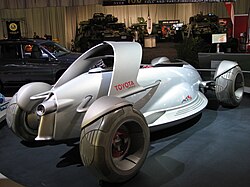
Motor Triathlon Race Car (2004)

[edit]
Toyota Motor Triathlon Race Car
Overview
ManufacturerToyota
Production2004
Body and chassis
Layout4WD with wheel hub motors
Dimensions
Wheelbase2,950 mm (116.1 in)
Length4,060 mm (159.8 in)
Width1,930 mm (76.0 in)
Height1,330–1,480 mm (52.4–58.3 in)

The Motor Triathlon Race Car (MTRC) is a two-seater fuel cell concept vehicle designed and built by the Toyota European Design and Development studio. It made its world premier at the March 2004 Geneva Motor Show, and its US debut at the April 2004 New York International Auto Show.[52][53][54]

The MTRC is a response to the youth's cultural interests, such as mobile phones, video games, computers and internet play.[53]

Power is provided by Toyota's hydrogen fuel cells. These provide electricity to four wheel hub motors. Each wheel also features electronically controlled suspension and sensors, allowing each wheel to maximise grip and to use the correct amount of torque for the current road conditions. The open cockpit requires the driver to wear a helmet - which has an internal head-up display.[54]

The MTRC is available in the videogame Gran Turismo 4; a special demo version based on Gran Turismo 4 Prologue, which also featured the then-recent Toyota Prius, provided a simulation of the head-up display system, which was not included in the final game.[54]

FTX (2004)

[edit]
Toyota FTX
Overview
ManufacturerToyota
Production2004
Body and chassis
Body stylePickup truck
RelatedTundra
Chronology
SuccessorToyota Tundra second generation

The FTX is a concept full-size pickup truck that Toyota showed to the public at the January 2004 North American International Auto Show.[55] The redesigned 2007 model year Tundra was based on the FTX concept vehicle.

D-4D 180 Clean Power Concept Car (2004)

[edit]
Toyota D-4D 180 Clean Power Concept Car
Overview
ManufacturerToyota
Production2004
Body and chassis
ClassMidsize car
Body style4-door Sedan
Powertrain
EngineD-4D diesel
Chronology
PredecessorToyota Camry Hybrid

The Toyota D-4D 180 Clean Power Concept Car, or Toyota D-4D for short, is a clean concept car, using the new D-4D diesel engine. It is based on the Toyota Camry Hybrid, and came out in 2004. It was designed and made in Paris.[56][57]

Camry TS-01 (2005)

[edit]
Toyota Camry TS-01
Overview
ManufacturerToyota Australia
Production2005
DesignerToyota Style Australia
Body and chassis
ClassMid-size
Body style4-door sedan
LayoutFF
RelatedCamry
Powertrain
Engine3.0 L 1MZ-FE V6 supercharged
Transmission5-speed manual

The Camry TS-01 is a concept car based on the Camry (MCV30) that was unveiled at the March 2005 Melbourne International Motor Show in Australia. The aim of the Camry TS-01 was to showcase the skill of Toyota Australia's designers and engineers. The concept car was named the TS-01 after Toyota's F1 drivers Jarno Trulli and Ralf Schumacher.[58] The Camry TS-01 was also a precursor to the launch of TRD Australia, to create performance enhanced versions of Toyota vehicles, similar to FPV (Ford), Ralliart (Mitsubishi) and HSV (Holden).

Its major features are the stylistic changes and the supercharged 1MZ-FE engine making 185 kW (248 hp) and 320 N⋅m (236 lbf⋅ft), 28 and 12% higher respectively than the power and torque figures of the production Camry. The supercharger was by TRD, while the ECU was remapped by Australian engineers in Japan. The car has a 5-speed manual transmission, together with a heavy duty clutch adapted from the Toyota Team Racing rally Corolla.

The suspension and brakes were extensively tuned.[59] The ride height was reduced to the minimum ADR permitted height while the front brakes were enlarged from 280 mm (11.0 in) to 325 mm (12.8 in) diameter, two-pot calipers. Changes were also made to the brake booster calibration, brake bias, and pedal ratio.

The external and interior design were done by Toyota Style Australia, led by Paul Beranger.[59] Exterior styling changes which include unique 14-spoke alloy wheels wrapped with Michelin Pilot Sport tires, wheel flares, unique side skirts, a unique front bumper with integrated round fog lights, a unique rear bumper with dual exhaust tips, an F1 inspired rear spoiler with a center mounted rear brake light, modified side door mirrors, and a revised grille and hood. All body parts were sourced locally in Australia. The interior featured a dark tan suede interior trim, while the driver's seat was modified to provide additional support around the hips and shoulders. Carbon fiber surfaces were substantially used in the cabin and Optitron gauges replaced the instrumentation of the production Camry.[58]

Endo (2005)

[edit]
Toyota Endo
Overview
ManufacturerToyota
Production2005
Dimensions
Length3,000 mm (118.1 in)
Width1,690 mm (66.5 in)
Height1,520 mm (59.8 in)

The Toyota Endo is a concept car designed by the Toyota ED² studio in France.[60] It was presented in 2005. It can seat 4 passengers and luggage. It was displayed at the Frankfurt Motor Show of this urban-friendly car. The car is meant to overcome typical city problems-shortage of space, emissions and traffic congestion. The Endo is only 3 m long, 1.52 m tall, and 1.69 m wide. The rear seats can be rotated in several different directions.[citation needed]

Fine-X, Fine-T (2005)

[edit]
Toyota Fine-X, Fine-T
Overview
ManufacturerToyota
Production2005
Body and chassis
DoorsGull-wing doors
Dimensions
Length3,860 mm (152.0 in)
Width1,750 mm (68.9 in)
Height1,550 mm (61.0 in)
Chronology
PredecessorFine-N

The Fine-X (Fuel cell INnovation Emotion-eXperiment) was a concept vehicle that was shown at the October 2005 Tokyo Motor Show and the March 2006 Geneva Auto Show.[61][62][63] In Japan and Europe it was called the Fine-T.[41][61]

The Fine-X uses a fuel cell hybrid system which drives four independent motors - one in each wheel. It can make perfect U-turns and park very easily, thanks to its independent four-wheel steering. The Fine-X uses the latest IT/ITS peripheral-monitoring technology that allows the Fine-X to have much smoother driving.

The Fine-X uses gull-wing doors, which are said to make it easier to get in and out of the car, however cannot be opened in a rollover accident. The powered seats can rotate and shift sideways through the gull-wing door openings.

FSC (2005)

[edit]
Toyota FSC
Overview
ManufacturerToyota
Production2005
Body and chassis
PlatformCamry
RelatedCamry
Dimensions
Length4,670 mm (183.9 in)
Chronology
SuccessorToyota Mark X ZiO

The FSC (Flexible Saloon Concept) was a concept wagon based on the Camry that was first shown at the October 2005 Tokyo Motor Show.[64][65] The first two rows had two bucket seats each. The third row bench seat could be set to hold two more passengers. The rear seat backrest could also be folded down to make a long deck at lower cushion height. Lastly, the rear seat backrest could be left upright and the lower cushions could be electrically retracted into the cargo area to make a deep cargo space.

The FSC was made into production in Japan only as the Mark X ZiO.[66][67][68]

i-swing (2005)

[edit]
Toyota i-swing
The Toyota i-swing on display
Overview
ManufacturerToyota
Production2005
Body and chassis
Classrobot
Dimensions
Length995 mm
Width700 mm
Height1,430 mm

The Toyota i-swing is a robot to help people move. It was introduced in 2005. It can be comparable to the Toyota PM, Toyota i-unit, and the Toyota i-foot.[69]

Urban Cruiser Concept (2006)

[edit]
Toyota Urban Cruiser Concept
Overview
ManufacturerToyota Motor Europe
Production2006
Body and chassis
Body styleCompact SUV

The Toyota Urban Cruiser Concept is a compact SUV concept car that was designed by the Toyota European Design Centre in Europe.[70]

Aurion Sports Concept (2006)

[edit]
Toyota Aurion Sports Concept
Overview
ManufacturerToyota Australia
Production2006
DesignerToyota Style Australia
Body and chassis
ClassMid-size
Body style4-door sedan
LayoutFF
RelatedAurion, TRD Aurion, Camry
Powertrain
Engine3.0 L 1MZ-FE V6 supercharged
Chronology
PredecessorToyota Camry TS-01
SuccessorTRD Aurion

The Aurion Sports Concept was a concept car based on the Aurion (which was itself based on the Camry) and revealed at the October 2006 Australian International Motor Show.[71] The car was a styling exercise previewing the TRD Aurion, which was subsequently released in August 2007.[72]

F3R (2006)

[edit]
Toyota F3R
Overview
ManufacturerToyota
Production2006
Body and chassis
RelatedToyota Sienna
Powertrain
EngineHybrid

The Toyota F3R was a concept car by Toyota's Calty design facility that was introduced at the January 2006 North American International Auto Show.[73][74] It is a hybrid powered minivan designed to have youthful appeal and escape the "soccer mom" stigma commonly associated with minivans.

The F3R has three rows of seats with three doors on either side. The front and middle doors open normally but the rear door opens in the opposite direction. There is no pillar between the middle and rear doors, so the openings are very large. The right and centre seats in middle row fold flat into the floor and the remaining left hand seat can be fully reclined to make a sideways-facing bench seat.

Exterior styling is similar to the Scion xB with 22 inch wheels.

Hybrid X (2007)

[edit]
Toyota Hybrid X
Overview
ManufacturerToyota
Production2007
DesignerLaurent Bouzigue (interior)
Body and chassis
ClassMid-size car
Body style5-door hatchback
LayoutFF layout
Dimensions
Wheelbase2,800 mm (110.2 in)
Length4,500 mm (177.2 in)
Width1,850 mm (72.8 in)
Height1,440 mm (56.7 in)

The Toyota Hybrid X is a hybrid concept built by the Toyota ED² design studio in France and first shown at the March 2007 Geneva Motor Show. Toyota claims the design of this concept car points to the future direction of the Toyota Prius.[75][76][77] The design of the Toyota Hybrid X is a 5-door hatchback with a fastback-like styling.

According to interior designer Laurent Bouzigue, the Hybrid X is supposed to be a very sensory experience, and the ambiance is linked to the passengers' sight, sound, touch, and smell senses.[78] Interior surfaces have a variety of light effects, textures and even fragrance from a perfume diffuser. The drive-by-wire steering pad has a touch screen and there is another screen in the centre of the dashboard to show vehicle information and to set minor controls. The rear seats can each be turned 12 degrees left or right to help passengers look inwards or outwards.

Hi-CT (2007)

[edit]
Toyota Hi-CT
Hi-CT at the 2007 Tokyo Motor Show
Overview
ManufacturerToyota
Production2007
Dimensions
Length3,330 mm (131.1 in)
Width1,695 mm (66.7 in)
Height1,780 mm (70.1 in)

The Toyota Hi-CT (Hi ride City Truck)[79] is a 2-seat concept car built by Toyota and first shown at the October 2007 Tokyo Motor Show.[80]

Motive power is by a plug-in hybrid with batteries under the floor. A 100-volt AC socket is provided to power accessories.[81]

The rear seats can be rotated to look backwards through the rear hatch. The boot is a removable module which can be replaced with other modules. If no module is used then the small cargo deck can be used to carry items such as surfboards. The rear hatch can not be opened when the rear deck is in use or if a module is in place.

RiN (2007)

[edit]
Toyota RiN
Overview
ManufacturerToyota
Production2007

The Toyota RiN is a concept car built by Toyota and first shown at the October 2007 Tokyo Motor Show. The vehicle was designed to promote relaxation and healthiness. It has received much media attention for its odd design and its steering wheel, which changes colour depending on the driver's mood.[82][83][84][85]

The concept features four seats accessed by two large sliding doors, and windows made of green glass, designed to reduce ultraviolet and infra-red light. "The concept, which looks like some sort of futuristic stagecoach, is designed to help its driver become one with nature".[85] The car features a pinpoint humidifier, and an oxygen-level conditioner. It was reported that the car was inspired by a milkfloat.

A Toyota press release stated that "the RiN focuses on increased comfort and serene, healthy living. Through their relationship to the vehicle, drivers are encouraged to reevaluate themselves and, furthermore, to turn their attention to society and nature, producing a healthy rhythm for both mind and body." Toyota says the car "creates a feeling of harmony with the surrounding environment by using sliding doors with a low window that lets you view nature at ground level, as well as headlights with light distribution control that take into consideration pedestrians and vehicles coming in the opposite direction."[86]

1/X (2007)

[edit]
Toyota 1/X
Overview
ManufacturerToyota
Production2007
Powertrain
Engine500cc with electric motor

The Toyota 1/X (pronounced one-Xth) is a concept car built by Toyota and first shown at the October 2007 Tokyo Motor Show. It is a petrol-electric hybrid vehicle utilizing plug-in technology. The car weighs only 926 lb (420 kg) but has as much interior room as the Toyota Prius.[87] The car's frame is mainly carbon-fiber reinforced plastic, which allows it to be lightweight yet strong. The engine is 500 cc and sits under the rear two of four seats, driving the rear wheels.[88]

Toyota envisions the car to be made of seaweed in the future.[89]

FT-HS (2007)

[edit]
Toyota FT-HS
Overview
ManufacturerToyota
Production2007
Body and chassis
Body style2+2 coupe
LayoutFront-engine, RWD
Powertrain
Engine3.5 L V6 hybrid electric
Dimensions
Wheelbase2,650 mm (104.33 in)
Length4,325 mm (170.27 in)
Width1,860 mm (73.23 in)
Height1,290 mm (50.79 in)
Chronology
PredecessorToyota Supra

The Toyota FT-HS is a hybrid sports car concept introduced at the January 2007 North American International Auto Show. Calty Design Research designed the concept and suggests that it could fill the place of the Toyota Supra.[90] FT-HS stands for Future Toyota Hybrid Sport.[91]

A-BAT (2007)

[edit]
Toyota A-BAT
Overview
ManufacturerToyota
Production2007
DesignerCalty
Body and chassis
ClassCompact pick-up
Body style4-door extended cab
LayoutFront-engine, all-wheel-drive
Dimensions
Length4,605 mm (181.3 in)

The A-BAT is a concept truck revealed on 27 December 2007 and manufactured by Toyota.[92][93] The A-BAT is the first Toyota to have a mid-gate allowing cargo longer than the standard four-foot bed to extend into the cab (like a Chevrolet Avalanche or Honda Ridgeline). Power for the A-BAT comes from Toyota's Hybrid Synergy Drive mated to a four-cylinder engine. The A-BAT officially debuted at the January 2008 North American International Auto Show in Detroit.

The concept truck is similar in size to Toyota's compact SUV, the RAV4. The A-BAT measures 181.3 inches in length,[94] while the RAV4 measures 181.1 inches.[95] It can also seat up to four people.

On 22 September 2008, the website PickupTrucks.com indicated that Toyota had confirmed that some form of the Toyota A-BAT would see production, barring unforeseen production costs. The article also stated that Toyota had cancelled production of a Tundra diesel truck. Although Toyota later denied official confirmation of the Tundra's cancellation, no mention was made denying the statement regarding the A-BAT. Sources say that a production version of the concept will likely have a four-cylinder engine as an option, as well as a four-cylinder hybrid engine.[96]

FT-MV (2007)

[edit]

The FT-MV is a concept car made by Toyota in 2007. It entered production as the Toyota Alphard (AH20). The exterior is sculpted to create angular lines, punctuated by the LED lights. Inside, appointments are high-class, with reclining leather seats for the second row. Soft ambient lighting fills the spacious interior. Up front, a big computer screen lets drivers control vehicle functions.[97]

FCHV-adv (2008)

[edit]
Toyota FCHV-adv
Overview
ManufacturerToyota
Production2008
Body and chassis
Body styleSUV
RelatedToyota Highlander (XU20)
Lexus RX (XU10)[98]
Powertrain
Engine90kW fuel cell-stack
Dimensions
Wheelbase2,715 mm (106.9 in)
Length4,714 mm (185.6 in)
Width1,826 mm (71.9 in)
Height1,750 mm (68.9 in)
Curb weight4,140 lb (1,880 kg)
Chronology
PredecessorToyota FCHV-5

The FCHV-adv (Fuel Cell Hybrid Vehicle advanced) was the sixth vehicle built by Toyota in its Fuel Cell Vehicle program. It is an updated version of the FCHV-5 with a high-pressure hydrogen tank that increases its range to 830 km (515 miles).[19] Like the FCHV-3, FCHV-4 and FCHV-5, it was based on the Highlander.[98]

It was available through a leasing program in Japan from 11 September 2008.[99]

Winglet (2008)

[edit]
Toyota Winglet
Overview
ManufacturerToyota
Production2008
Body and chassis
Body stylePersonal transporter

The Toyota Winglet is a concept self-balancing two-wheeled personal transporter similar in form and function to the Segway PT and the Honda U3-X. It is capable of cruising at 6 km/h (4 mph). Unveiled on 1 August 2008, it was not offered for consumer sale. Toyota tested the devices in the third quarter of 2009 at a Japanese airport and a seaside resort.[100][101][102]

Aygo Crazy (2008)

[edit]
Toyota Aygo Crazy
Overview
ManufacturerToyota
Production2008

The Aygo Crazy is a concept vehicle built by Toyota as a modified Toyota Aygo and first revealed at the July 2008 British International Motor Show.

Camry CNG Hybrid (2008)

[edit]

The Camry CNG Hybrid is based on the Toyota Camry XV40 hybrid edition. The hybrid electric vehicle (HEV) was introduced in 2008. It runs on a 2.4-liter inline-four engine, where two carbon-fiber-wrapped tanks hold the 8 gallons of natural-gas, at a maximum of 3600 psi, giving the CNG concept a 250-mile range. The fuel tanks live in the car's 19 inch wheels, and gets 32 mpg city and 34 mpg highway, only 1 mpg less than the regular Camry. However, charging these vehicles is tough; there is only about 770 CNG charging stations in the US.[103]

FT-EV (2009)

[edit]
Toyota FT-EV
Overview
ManufacturerToyota
Production2009
Body and chassis
PlatformiQ
Chronology
SuccessorFT-EV II

The Toyota FT-EV is a small, battery electric, concept vehicle built by Toyota as a modified Toyota iQ and demonstrated at the January 2009 North American International Auto Show. Two of the iQ's seats were removed to make room for the battery packs. Toyota plans to start selling the FT-EV in 2012.[104][105] According to Toyota the FT-EV was designed as an urban commuter car with a range of 50 miles (80 km) per charge.[106]

FT-EV II (2009)

[edit]
Toyota FT-EV II
Overview
ManufacturerToyota
Production2009
Body and chassis
ClassCity car (A)
Body style3-door hatchback
LayoutFront-engine, front-wheel-drive
PlatformiQ
Dimensions
Wheelbase1,900 mm (74.8 in)
Length2,730 mm (107.5 in)
Width1,680 mm (66.1 in)
Height1,490 mm (58.7 in)
Chronology
PredecessorFT-EV
SuccessorEV Prototype

The Toyota FT-EV II is a small, battery electric, concept car built by Toyota as a modified Toyota iQ and first shown at the October 2009 Tokyo Motor Show.[107] It differs from the FT-EV by seating four people, by having more parts of the body transparent and electrically operated sliding doors. A pair of linked joysticks (each joystick duplicating the other) control acceleration, braking and steering using drive-by-wire.[108] The top speed is over 100 km/h (62 mph) and the range is 90 km (56 mi).

Scion iQ Concept (2009)

[edit]
Scion iQ Concept
Overview
ManufacturerScion
Production2009
Body and chassis
ClassMicrocar
Body style3-door hatchback
LayoutFF
PlatformiQ
Powertrain
Engine1.3 L I4
Dimensions
Wheelbase1,999 mm (78.7 in)
Length3,223 mm (126.9 in)
Width1,814 mm (71.4 in)
Height1,445 mm (56.9 in)

The Scion iQ Concept vehicle was built by Five Axis (California, US) based on the Toyota iQ and displayed in April 2009 at the New York Auto Show.[109] Changes included a 1.3-litre 4-cylinder VVT-i engine, Five Axis custom stainless exhaust, 18x8.5-inch Five:AD S6:F custom wheels with nickel finish prototyped by MetalFX, Yokohama S.drive 2.5/40R18 tires, TEIN Super Street coil over suspension, Five Axis wide body conversion kit, custom accented headlights and tail lights.

An identical car, rebadged as the Toyota iQ Sport, was later presented at the September 2009 Frankfurt Motor Show.

Motor Trend reported the production version of Scion iQ would begin in North America in late 2010 for the 2011 model year, or in early 2011 for the 2012 model year. The air bags will be recalibrated for unbelted and out-of-position occupants and the bumpers will be slightly extended.[110]

Auris HSD Full Hybrid Concept (2009)

[edit]
Toyota Auris HSD Full Hybrid Concept
Overview
ManufacturerToyota
Production2009

The Toyota Auris HSD Full Hybrid Concept vehicle was a petrol-electric hybrid vehicle based on the Auris and displayed at the September 2009 Frankfurt Motor Show.

FT-86 (2009)

[edit]
FT-86
Overview
ManufacturerToyota & Subaru
Also calledSubaru BRZ
Production2009
Body and chassis
Body styleCoupé
LayoutFR Toyota FR Subaru
Platformshortened Subaru Impreza
Powertrain
Engine2.0 L Toyota-Subaru "D-4S" Flat-4
Transmission6-speed manual
Dimensions
Wheelbase2,570 mm (101.2 in)
Length4,160 mm (163.8 in)
Width1,760 mm (69.3 in)
Height1,260 mm (49.6 in)
Chronology
SuccessorFT-86 G Sports

The Toyota FT-86 is a concept car manufactured jointly by Toyota and Subaru. It was designed by the Toyota ED² studio in France.[111] The vehicle consists of many design cues from the earlier FT-HS concept. It features a 2.0-litre Toyota-Subaru "D-4S" boxer engine.[112] The FT-86 rides on a modified Subaru Impreza platform with 101.2-inch wheelbase, with length, width, and height measuring 163.8, 69.3, and 49.6 inches, respectively.[113]

It has a 2.0-litre naturally aspirated boxer engine mated to a Subaru 6-speed manual transmission.[114] The concept is fitted with brakes from Advics, a joint venture company formed between Aisin Seiki, Denso, Sumitomo Electric and Toyota.

According to chief engineer Tetsuya Tada, the unique shoujyouhi red colour was based on the colour of a Japanese monkey's backside.[115]

The FT-86 was first shown at the October 2009 Tokyo Motor Show[116] and the first showing outside Japan was at the March 2010 Geneva Motor Show.[117]

An enhanced version called the FT-86 G Sports was shown at the January 2010 Tokyo Auto Salon as part of the Toyota G Sports range. Toyota Europe presented a revised FT-86 II at the March 2011 Geneva Motor Show as the successor to the FT-86.

At the October 2009 Tokyo Motor Show, Jim Lentz, COO and President of Toyota Motor Sales USA confirmed that the production version of the FT-86 was scheduled to be sold in America.[118] At the March 2010 Geneva Motor Show, Toyota Europe announced that the production version of the vehicle will be released in November 2011.[119]

On 2 September 2010, British car magazine AutoExpress[120] reported the Subaru model will feature an all-wheel-drive drivetrain as opposed to the salient feature of rear-wheel drive for the Toyota-badged model. They claimed the Subaru model's all-wheel-drive system would have a rear-wheel bias, improving handling. The flat-four, longitudinal engine layout would also be fully coherent with the model policy and mechanical characteristics of all Subaru cars of the past 30 years. The production version, however, opted for rear-wheel drive like its Toyota counterpart.

Prius Plug-In Hybrid Concept (2009)

[edit]
Prius Plug-In Hybrid Concept
Overview
ManufacturerToyota
Production2009
Body and chassis
ClassMidsize car
Body style5-door hatchback
LayoutFF
PlatformXW30 Prius
Powertrain
Engine1.8 L 2ZR-FXE I4 & electric motor
Transmission1-speed planetary gear
Dimensions
Length4,460 mm (175.6 in)
Width1,745 mm (68.7 in)
Height1,480 mm (58.3 in)

The Prius Plug-In Concept is a plug-in hybrid concept car shown at the October 2009 Tokyo Motor Show based on the third generation Prius and the predecessor of the for-mass-production Toyota Prius Plug-in Hybrid. Its batteries can be charged in 180 minutes from 100 volts or in 100 minutes from 200 volts and can travel 20 km before needing to start the petrol engine.[107][121][122]

See also

[edit]

References

[edit]
Revisions and contributorsEdit on WikipediaRead on Wikipedia
from Grokipedia
Toyota concept vehicles (2000–2009) comprise a series of automobiles developed by Motor Corporation to advance sustainable propulsion technologies, such as hybrid and systems, while exploring bold designs for performance, efficiency, and environmental integration. These experimental models, primarily unveiled at global auto shows like the Tokyo Motor Show and , underscored Toyota's leadership in eco-friendly innovation following the 1997 Prius debut, influencing production vehicles through advancements in lightweight materials, alternative powertrains, and aerodynamic styling. A key focus during this era was Toyota's push toward fuel cell vehicles, exemplified by the 2003 Fine-S and Fine-N concepts, which demonstrated versatile, high-performance styling with compact stacks and lithium-ion batteries for enhanced and reduced emissions. Similarly, the 2004 , a collaboration with Italdesign-Giugiaro, integrated a RX400h-derived hybrid V6 producing 408 horsepower in a carbon fiber chassis, highlighting early hybrid potential with all-wheel drive and low-emission hybrid performance. In parallel, Toyota emphasized hybrid performance through sports-oriented prototypes, including the 2007 FT-HS, a 2+2 hybrid sports car concept from delivering approximately 400 horsepower and a 0-60 mph time of about 4 seconds, blending " and emotion" via its J-Factor aesthetic and advanced . The decade closed with the 2009 FT-86, a rear-wheel-drive sports coupe concept unveiled at the Tokyo Motor Show, featuring a lightweight chassis and boxer engine for agile handling, which directly inspired the production and Subaru BRZ models launched in 2012. Overall, these concepts not only tested like modular fuel cells and high-output hybrids but also diversified Toyota's portfolio across sedans, SUVs, and sports cars, reinforcing its commitment to a multifaceted mobility future.

Concepts Debuted in 2000

Yaris Cabrio Concept

The Yaris Cabrio Concept was unveiled by at the 2000 Motor Show as a 2-door variant of the popular Yaris subcompact, aimed at the European market to appeal to younger drivers seeking a blend of practicality and open-air enjoyment. This concept featured a fabric roof that could be raised or lowered seamlessly, giving it a natural appearance in both configurations. Designed with sporty, youthful styling, it extended the standard Yaris's fun-oriented character into a more expressive form without entering production. Key design elements included a speedster-inspired with a roofline flowing from a steeply raked A-pillar, rising haunches for a sense of tension and power, and an overall masculine, aggressive aesthetic tempered by fresh, non-flashy lines. The body measured 3,640 mm in length—longer than the standard Yaris —and 1,430 mm in height, with aerodynamic enhancements such as a deep front spoiler, prominent headlights, and a small lip spoiler on the redesigned boot lid to improve airflow and stability. These modifications supported rear seating for four passengers, maintaining the Yaris's compact usability while prioritizing open-top driving comfort through adjusted interior . Powered by a 1.3-liter producing 63 kW at 6,000 rpm and 124 Nm of torque at 4,400 rpm, paired with a five-speed , the concept emphasized lightweight and efficient construction suitable for urban and leisure use. It served primarily as a design study to explore possibilities for small cars, highlighting Toyota's interest in fashionable, confidence-inspiring vehicles for the Yaris lineup, though it did not lead to a production model.

Celica Ultimate Concept

The Celica Ultimate Concept represented a high-performance evolution of Toyota's iconic , pushing the boundaries of the seventh-generation Celica platform through a specialized collaboration with Motorsports and (TRD). Unveiled on January 20, 2000, by USA, the concept transformed the front-wheel-drive production model into an all-wheel-drive powerhouse, incorporating rally-derived components to demonstrate extreme tuning potential. At its core was a heavily modified 2.0-liter inline-four 3S-GTE , sourced from the Celica GT4 rally and enhanced with a Garrett T04 boosting up to 22 psi, forged pistons, connecting rods, and a crankshaft, delivering 373 kW (500 hp) at 8,000 rpm and 460 Nm (340 lb-ft) of torque at 5,500 rpm. This powertrain, paired with a five-speed manual transmission from the GT4 and an advanced all-wheel-drive system, enabled impressive performance metrics, including 0–97 km/h (0–60 mph) acceleration in 4.9 seconds. The benefited from advanced suspension tuning, featuring a TRD Superstrut front setup for increased negative camber and a redesigned rear suspension to accommodate the , complemented by a custom for structural rigidity. Exterior enhancements emphasized and aggression, including a wide-body kit that widened the front by 3.8 inches and the rear by 3.2 inches, a large box-shaped rear wing inspired by Champ Car , and 19-inch BBS magnesium wheels shod in 245/35 Pilot tires. Inside, the cabin adopted a motorsports-oriented layout with sport seats equipped with four-point harnesses, an integrated visible in the rear, and a replacing the back seats, while retaining much of the production model's digital for a blend of street and track usability. Intended strictly as a non-production showpiece, the Celica Ultimate Concept served to showcase the untapped potential of the Celica lineage, inspiring a wave of aftermarket modifications and tuning kits that extended its influence on enthusiast communities long after its debut.

Concepts Debuted in 2001

ES3

The ES3, short for "Eco Spirit cubed," debuted at the 2001 Tokyo Motor Show as Toyota's environmentally oriented compact concept vehicle, emphasizing reduced emissions and resource efficiency through innovative materials and propulsion. This four-seater highlighted Toyota's early efforts in sustainable , incorporating biodegradable bioplastics derived from plant-based sources such as corn, sweet potatoes, and sugar cane for its body panels and interior components, which contributed to a curb weight of approximately 700 kg—a reduction of about 20% compared to equivalent structures—while enhancing recyclability and lowering production emissions. The powertrain featured a 1.4-liter turbocharged direct-injection diesel engine with a continuously variable transmission (CVT), idling-stop functionality, and regenerative braking for optimized efficiency. This system, combined with the Diesel Particulate-NOx Reduction (DPNR) technology, enabled ultra-low CO2 emissions equivalent to Japan's J-LEV standards for gasoline vehicles and achieved a fuel economy of 47 km/L under the Japanese 10-15 test cycle, translating to a claimed driving range exceeding 1,000 km on a full tank. The ES3 represented an early exploration of diesel-hybrid integration, predating Toyota's deeper focus on fuel-cell technologies in subsequent concepts. In terms of design, the ES3 adopted an aerodynamic three-door profile with a low of 0.23, featuring a flowing roofline, tapered rear, and smoothed underfloor to minimize wind resistance, while the interior included modular elements like an aluminum-reinforced , translucent central metering, and intuitive fingertip controls for a compact yet versatile cabin accommodating four passengers. Although the ES3 never progressed to production, its innovations directly influenced the 2003 minivan, which became the world's first mass-produced vehicle to incorporate plant-derived s in components such as the cover and floor mats, marking a step toward broader of eco-friendly materials in Toyota's lineup.

Pod

The Toyota Pod was a concept vehicle developed in collaboration with and unveiled at the 2001 Tokyo Motor Show, emphasizing an AI-driven "Personal Agent" system designed for intuitive human interaction. This electronic personality utilized biometric sensors to monitor the driver's and , along with facial recognition to detect drowsiness or emotional states, enabling the vehicle to adjust interior elements such as lighting, music playback, and even provide verbal encouragement or warnings based on inferred moods. The system expressed its own "emotions" through exterior LED panels—orange for happy, red for angry, blue for sad—and a rear antenna "tail" that wagged to convey contentment, fostering a partnership-like relationship between the vehicle and occupant. In terms of design, the Pod featured an egg-shaped, symmetrical enclosure resembling a protective capsule, with four 360-degree swivel seats that could rotate to face each other, , or forward, creating a lounge-like environment without traditional controls. It eliminated the and pedals in favor of a drive-by-wire system operated via a right-handed , supported by wireless Dedicated Short-Range Communication (DSRC) for navigation, inter-vehicle messaging (such as signaling intent to overtake), and enhanced safety in urban settings. The consisted of a 1.5-liter inline-four paired with a five-speed , delivering approximately 110-130 horsepower, optimized for short urban trips rather than long-distance travel. As a non-production showcase, the highlighted visions of autonomous, empathetic mobility, where vehicles could learn user preferences over time and integrate home data via portable devices like a Mini unit for seamless experiences, without directly influencing subsequent production models. It served as an early exploration of emotional AI in transportation, predating later personal mobility concepts such as the i-foot.

DMT

The DMT (Dual Mode Traveller) was a concept minivan unveiled by at the 35th Tokyo Motor Show in October 2001, designed to offer versatile functionality for both urban driving and stationary use as a customizable personal space. Featuring a cruiser-style high eye-point cabin for enhanced road visibility, the vehicle emphasized a dual-mode operation: "Drive Mode" for comfortable travel and "Stay Mode" for transforming the rear into adaptable areas like a mobile office or lounge. Its boxy, practical aesthetics prioritized spaciousness with a low, flat floor in the rear, dimensions of 4,850 mm in length, 1,825 mm in width, and 2,030 mm in height, and a wide-opening panoramic roof to blend indoor-outdoor experiences. Powered by a front-wheel-drive setup with a 2.4-liter inline-four BEAMS engine, the DMT incorporated advanced intelligent transport system (ITS) features for the era, including radar cruise control, lane deviation alarms, blind-corner monitors, and voice-controlled navigation to enhance safety and convenience during urban and longer journeys. The interior supported two seats in the front cabin with a simple, bright layout using light wood accents and a full-width instrument panel, while the rear modular cargo space allowed for easy reconfiguration without fixed passenger seating beyond the driver and front occupant, promoting adaptability for personal or adventure-oriented activities like observation or work setups. Safety was further bolstered by a lower center of gravity from the underfloor powertrain placement and multi-screen monitors for comprehensive visibility, including reverse and blind-spot aids. Although the DMT's innovative blend of practicality and cruiser-inspired design influenced subsequent multi-purpose vehicle (MPV) concepts by highlighting modular interiors and high-visibility cabins, it remained a showpiece and was never put into production. Its unique adaptability, such as the roof panels and partition options for separating drive and stay areas, underscored 's early of vehicles as extensions of living spaces for dual urban and exploratory uses. The DMT shared a utility focus with the later UUV concept but debuted two years earlier.

FXS

The Toyota FXS (Future eXperimental Sports) was a concept sports car developed by Toyota and unveiled at the 2001 Tokyo Motor Show. It was later displayed at the 2002 Geneva Motor Show, where it highlighted Toyota's exploration of high-performance roadster designs. The FXS embodied a theme of "a simple and sexy form with a sense of presence," featuring a low-slung, two-seater open body with curvy, sleek lines and short overhangs to achieve a balanced 50/50 weight distribution and low center of gravity for enhanced stability and handling. Its exterior adopted a silver prism-like finish, complemented by a moonlight blue leather interior with chrome accents and triple-clustered gauges. Powering the rear-wheel-drive FXS was a 4.3-liter with variable valve timing-intelligent (), featuring a 32-valve DOHC configuration and producing approximately 282 horsepower (210 kW). This unit, shared with the Lexus SC 430, was paired with a six-speed inspired by technology, including shift buttons on the . The incorporated a highly rigid open structure with in-wheel for superior driving dynamics, supported by 18-inch three-spoke aluminum alloy wheels fitted with 245/40R18 front and 285/35R18 rear tires. These elements emphasized grand touring capabilities over pure track performance, aiming to deliver refined power and agility in a compact package. As a non-production showpiece, the FXS served to investigate the integration of a potent V8 engine into a smaller, enthusiast-oriented sports car platform without directly influencing subsequent production models. It conceptually paved the way for later Toyota hybrid sports concepts, such as the 2007 FT-HS.

RSC

The Toyota RSC, short for Rugged Sport Coupe, debuted at the 2001 Chicago Auto Show as a bold 2-door SUV concept that fused coupe-like styling with practical utility. Developed by Toyota's CALTY Design Research in California, the vehicle was built on the second-generation RAV4 platform and powered by a 4.3-liter V8 engine producing 276 horsepower, paired with all-wheel drive and 19-inch wheels, emphasizing agile performance for urban and light off-road use. Its rugged aesthetic drew inspiration from rally racing, aiming to capture the attention of younger drivers with a versatile, adventure-ready package. Key features included high ground clearance for enhanced capability over uneven , roof rails for added versatility, and a premium interior designed for comfort during dynamic drives. The sloped roofline contributed to its sporty profile, while the overall length measured 4,115 mm, providing compact dimensions suitable for city navigation without sacrificing interior space or storage. Despite its innovative blend of form and function, the RSC remained a showpiece and was never advanced to production. Targeted primarily at the North American market, the concept highlighted Toyota's vision for compact premium SUVs appealing to young urban adventurers seeking excitement beyond traditional sedans. The RSC's early emphasis on rugged versatility foreshadowed themes in Toyota's later Rugged Youth Utility concept.

FCHV-3

The FCHV-3, introduced in March 2001 as Toyota's third-generation , represented an early prototype in the company's pursuit of zero-emission mobility, built on the platform of the Kluger V SUV (known as the Highlander in some markets). This model marked a significant advancement over prior iterations by incorporating a highly efficient 90 kW (PEFC) stack, which generated electricity from pure to power electric motors, eliminating tailpipe emissions except for . The vehicle's system utilized an innovative hydrogen-absorbing tank, allowing for safer and more compact containment compared to earlier compressed gas designs, and it was developed in response to growing concerns over CO2 emissions from SUVs. Key features of the FCHV-3 included configuration, a nickel-metal hydride (NiMH) battery pack to provide supplemental power for acceleration, and to recapture energy during deceleration, enhancing overall in hybrid operation. These elements were integrated into the SUV body to demonstrate practical applicability for family-oriented vehicles, with the and related components positioned to maintain interior space and handling characteristics similar to the production Highlander. As a demonstration prototype, the FCHV-3 was not initially certified for public road use, focusing instead on showcasing technological feasibility at controlled events. The FCHV-3 debuted publicly at the International Symposium on Fuel Cell Vehicles in , sponsored by Japan's Ministry of Land, Infrastructure and Transport, highlighting Toyota's commitment to research amid global pushes for . This milestone prototype served as a foundational step in Toyota's program, informing enhancements in later models like the FCHV-4 and FCHV-5 through refined stack efficiency and storage innovations.

FCHV-4

The Toyota FCHV-4, introduced in 2001, was a hybrid based on the Kluger V platform (known as the Highlander in the United States), featuring a 90 kW stack. This model represented a step toward practical deployment, with public road testing commencing in in June 2001 and in the United States in July 2001, accumulating over 110,000 kilometers to gather real-world data on performance and reliability. Equipped with high-pressure compressed hydrogen tanks storing pure at 35 MPa and a nickel-metal battery, the FCHV-4 offered seating for five passengers and included enhancements for drivability, such as a 80 kW producing 260 N·m of torque. It achieved a cruising range of approximately 300 km and a top speed exceeding 150 km/h, while incorporating improvements for operation in freezing temperatures to enable cold-weather startup capability. The vehicle was monitored extensively during testing to collect reliability data, focusing on durability and under everyday conditions. Starting in late 2002, Toyota leased around 20 units of the FCHV-4 to select customers, including bodies, institutions, and energy companies in and the U.S., at locations with established refueling , marking the initial commercial leasing program for a SUV. These leases, typically for 30 months, provided critical feedback on and vehicle practicality, positioning the FCHV-4 as the first subjected to extensive everyday use trials. Building on the stack from the preceding FCHV-3, it emphasized enhanced road usability and influenced subsequent generations of 's technology.

FCHV-5

The Toyota FCHV-5 was a performance-enhanced of Toyota's hybrid vehicle series, debuting in 2001 at the 35th Motor Show. Based on the SUV platform, it incorporated an upgraded Toyota FC Stack system with a peak output of 90 kW, paired with a for hybrid assistance, enabling improved acceleration and overall drivability compared to prior models. This powertrain allowed the vehicle to achieve a cruising range exceeding 300 km on the Japanese 10-15 test cycle, with a maximum speed over 150 km/h, and supported an optional all-wheel-drive configuration for enhanced traction. Evolving from feedback gathered during FCHV-4 road testing, the FCHV-5 introduced an onboard clean (CHF) reformer to generate from standard , facilitating compatibility with existing refueling where pure was unavailable. Its closely mirrored the FCHV-4's five-passenger layout, with dimensions of approximately 4,685 mm in length, 1,825 mm in width, and 1,720 mm in height, but added interior technologies such as integrated navigation systems for practical demonstration use. The stack benefited from advanced cooling mechanisms to maintain efficiency under varied operating conditions, contributing to reliable performance during public road trials and exhibitions. Although never intended for production, the FCHV-5 served as a key demonstration platform for Toyota's hydrogen technology, undergoing extensive testing to refine fuel cell durability, energy management, and reformer efficiency. Insights from its operation, including integration and real-world range validation, directly informed the evolutionary path toward Toyota's later vehicles, such as the Mirai.

Concepts Debuted in 2002

Project Go

The Project Go is a show car developed by and unveiled at the 2002 Sydney Motor Show. Presented as a surprise entry among six new and show cars, it aimed to demonstrate innovative design ideas and assess potential interest in road-going applications. The vehicle highlighted 's exploration of , performance-focused , though detailed specifications such as size or materials were not publicly disclosed at the time.

Matrix Sport

The Toyota Sport Matrix Concept debuted at the 2002 Los Angeles Auto Show as a tuned performance variant of the Corolla Matrix compact wagon, emphasizing enhanced driving enjoyment for younger drivers. It was powered by a modified 1.8-liter inline-four engine, starting from the Matrix's existing 180-horsepower output and boosted by an XS Engineering turbo kit paired with Electromotive engine management tuned by Vishnu Performance, delivering an additional 73 horsepower and near-instantaneous boost response. The concept featured a custom Progress Competition coil-over suspension package, specifically valved for the Matrix to lower the ride height and sharpen handling. Notable features included lightweight 18-inch TE37 alloy wheels fitted with BF Goodrich KD tires for improved grip, cross-drilled 13-inch Stoptech brakes adapted from the Celica GT-S model, and supportive sport seats. The design retained the production Matrix's five-door body with its characteristic "edge-web" styling—blending sharp creases and rounded forms—while offering a highly versatile interior with fold-flat front passenger and rear seats that created a flat load floor, accommodating five passengers alongside extensive storage options. Targeted specifically at the North American youth market, the concept had no plans for European availability and highlighted the Matrix's adaptability for aftermarket sport enhancements. Based on the standard Matrix production wagon, the Sport Matrix Concept previewed potential sport-oriented customizations that later appeared in optional packages for the retail model, such as performance suspension upgrades and options, though it was not developed into a standalone .

UUV

The UUV (Urban Utility Vehicle) was a concept unveiled by at the 2002 Geneva Motor Show, aimed at redefining urban mobility through a versatile multi-crossover design that merged traits of SUVs, hatchbacks, sedans, and wagons. Developed at 's ED2 design studio in , it targeted progressive urban dwellers seeking premium, adventurous vehicles with innovative functionality. Measuring approximately 4,430 mm in length, 1,820 mm in width, and 1,650 mm in height, the UUV featured a compact yet spacious MPV-inspired body with a high, sloping roofline for enhanced headroom and cargo versatility. Its exterior emphasized aerodynamics and robustness, with sweeping character lines, geometric surfaces, flared wheel arches, and large wheels to support all-wheel-drive capability and agile city handling. The interior offered a modular layout adaptable for passengers or cargo, bolstered by a long that prioritized comfort and practicality in urban environments. A standout innovation was the "Glass Vision" system, a full-width display utilizing resin and holographic projection technology developed by , which provided immersive three-dimensional navigation and views superior to conventional LCD screens. Additional features included high-performance run-flat tires, which eliminated the need for a spare and optimized interior space. Equipped with advanced 4x4 elements, the concept explored efficient urban utility without entering production and served as an early precursor to 's evolving crossover trends, such as the ccX.

MR2 Street Affair

The Street Affair was a tuned concept based on the third-generation MR2 platform, debuting in as a design study influenced by Formula 1 aesthetics. Developed by Motorsport GmbH, it featured a turbocharged 1.8-liter 16-valve four-cylinder paired with a Remus exhaust system, delivering 258 PS (255 hp) of power—a significant upgrade from the standard model's 140 PS output. The vehicle retained and incorporated a sequential six-speed gearbox with an electro-hydraulic clutch for enhanced performance. Key modifications included a wide-body kit inspired by the TF102 Formula 1 car, encompassing a distinctive front , rear spoiler, and carbon-fiber air ducts for improved and cooling. The was lowered by 30 mm for a lower profile, fitted with 19-inch wheels (9.5 inches wide at the front and 12 inches at the rear) shod in wide tires, including 345/30 ZR19 rears, along with larger ventilated disc brakes (370 mm front, 295 mm rear). Design elements emphasized a track-ready yet street-legal appeal, such as headlights, high-intensity rear diodes, and a U-shaped with paddle , while targeting automotive enthusiasts interested in high-performance modifications. Although non-production as a one-off , the MR2 Affair showcased the aftermarket tuning potential for MR2 owners, inspiring a limited-edition MR2 variant produced in 100 units in 2002. Its aggressive exhaust note and overall styling highlighted 's exploration of motorsport-derived enhancements for road-going sports cars.

ccX

The ccX, standing for Crossover, was a vehicle unveiled by at the 2002 as part of the Scion brand's debut. It was powered by a performance-tuned 2.4-liter, 16-valve DOHC four-cylinder engine mated to a four-speed and configuration. Measuring 4.33 meters in length, the ccX featured elevated seating positions for enhanced visibility and comfort, generous cargo with a versatile rear area, and a premium interior finished in washable blue fabric bucket seats with mesh netting for four passengers. The design blended a sleek, coupe-like roofline with the elevated stance of an , incorporating 18-inch aluminum alloy wheels fitted with 225/45R18 tires, projector headlights, and innovative elements like a hand-sensitive entry . Targeted at young buyers with active lifestyles, the ccX emphasized multi-purpose versatility in a sporty package, combining aggressive styling with practical crossover utility for everyday and recreational use. Although it remained a non-production , it showcased 's exploration of innovative styling and functionality tailored to evolving consumer preferences.

Concepts Debuted in 2003

SU-HV1

The SU-HV1 was a luxury hybrid SUV concept unveiled by at the 37th Tokyo Motor Show in October 2003. It featured an SUV-optimized powertrain consisting of a 3.3-liter V6 paired with a 120 kW front and a 50 kW rear motor, enabling all-wheel drive through the system and delivering a combined maximum output of 200 kW. This setup provided V8-level performance alongside compact-car-class fuel economy and emissions roughly twice as efficient as those of comparable conventional SUVs. The concept incorporated advanced features for enhanced driving dynamics, including Vehicle Dynamics Management (VDM), which integrated the , all-wheel drive, and an electronically controlled brake system to improve handling, stability, and overall control. Measuring 4,750 mm in length, 1,845 mm in width, and 1,630 mm in height, the SU-HV1 seated five passengers in a sleek, modern body style designed to blend luxury with environmental efficiency. As Toyota's first luxury hybrid SUV concept, the SU-HV1 marked an important step in introducing premium alternative powertrains to the segment and directly previewed the production 2004 400h, which adopted a similar and platform shared with the . It represented an early exploration of hybrid technology for SUVs, ahead of fuel cell variants like the Fine-S.

Land Cruiser FJ45 Concept

The Land Cruiser FJ45 Concept, introduced in 2003, served as a retro-inspired to Toyota's iconic off-road heritage, blending classic styling with modern . Built on a ladder-frame derived from the contemporary Land Cruiser 100 Series, it featured a 4.7-liter producing 230 horsepower, paired with full-time and a four-speed for robust off-road capability. This , complete with locking differentials, emphasized the vehicle's rugged utility while maintaining the essence of the original FJ45 model from the . Key design elements evoked the nostalgic appeal of the 1960s FJ40 Land Cruiser, including round headlights flanking a narrow "" grille, a contrasting white roof, and durable canvas seating for an authentic, utilitarian interior. The boxy silhouette preserved the angular, upright proportions of classic Land Cruisers, with wraparound rear windows and an overall length of approximately 5.2 meters to accommodate its extended . High ground clearance and increased wheel travel on both axles further enhanced its off-road prowess, targeting enthusiasts seeking a blend of aesthetics and contemporary performance in the nostalgia-driven market. Although it shared a focus on rugged off-road functionality with contemporaries like the Rugged Youth Utility, the FJ45 Concept stood out for its deeper retro homage to Land Cruiser lineage. As a non-production show vehicle, it celebrated Toyota's enduring heritage without leading to a new model, instead inspiring future interpretations of the brand's off-road icons.

CS&S

The CS&S (Compact Sport & Specialty) concept debuted at the 2003 Motor Show before appearing at the Tokyo Motor Show later that year, presented as a futuristic 2+2 open-top roadster blending hybrid efficiency with dynamics. Designed by Toyota's ED² studio in Nice, France, it measured 3,940 mm in length, 1,800 mm in width, and 1,120 mm in height, positioning it between the Celica and MR2 in size while emphasizing a low-slung, aerodynamic profile for agile handling. The exterior featured removable rear canopies to conceal additional seating, transforming it from an apparent two-seater to a practical configuration, with rotatable front seats enhancing versatility for urban or leisure use. At its core was Toyota's second-generation (THS II) system, comprising a mid-mounted 1.5-liter inline-four engine (DOHC, 16-valve with ) driving the rear wheels and a synchronous permanent-magnet powering the front wheels for electronic (E-Four). This setup delivered a maximum speed of 205 km/h and 0-100 km/h acceleration in 8.6 seconds, while achieving low CO2 emissions of 98 g/km, underscoring a focus on environmental efficiency without sacrificing driving enjoyment. The hybrid configuration highlighted Toyota's early exploration of performance-oriented electrified powertrains in compact formats. The interior introduced innovative human-machine interface technology, notably the Toyota Space Touch system, which projected holographic spheres for gesture-based control of , audio, , and even or functions, allowing intuitive, touchless interaction projected in the cabin space. This setup created a minimalist, high-tech with integrated displays that responded to hand gestures, reducing physical buttons and promoting a seamless connection between driver and vehicle systems. As a non-production showpiece, the CS&S did not lead to any direct successor models but exemplified Toyota's vision for interactive, eco-friendly sports cars, predating later hybrid roadster concepts like the 2004 . Its emphasis on holographic interfaces foreshadowed advancements in cabin technology, prioritizing user-centric design in hybrid vehicles.

PM

The Toyota PM (Personal Mobility) was a single-seat concept vehicle unveiled by Toyota at the 2003 Motor Show, designed specifically for individual urban commuters seeking efficient, personalized transportation. Powered by a rear-mounted , it emphasized drive-by-wire technology with twin pistol-grip joysticks for steering, acceleration, and braking, fostering a seamless integration between driver and vehicle described as a "wearable" experience. The concept aimed to address urban congestion by offering a compact alternative to traditional cars, promoting solo mobility in densely populated areas without entering production. Key features included an adjustable pod-like cabin that adapted to different driving modes—entry/exit, city, and high-speed—by varying its height from 1.22 to 1.86 meters and length from 1.75 to 2.65 meters, with the seat sliding forward for easy access and reclining for comfort during travel. At 1.47 meters wide, the PM facilitated tight urban navigation and parking, complemented by a minimum of 1.2 meters achieved through independent front-wheel and oppositely turning rear wheels for on-the-spot pivoting. The enclosed cockpit featured a hydraulic front hatch serving as both entry point and , along with insect-like movable headlights and hollow-center wheels for a futuristic aesthetic. Innovative communication elements set the PM apart, with 2,500 color-shifting LEDs on the body panels and rear wheels to convey emotions or signals, and a visual networking system using camera phones for vehicle-to-vehicle interaction, enabling platooning where multiple units could follow a lead vehicle in convoy. This social mobility aspect allowed drivers to share information, such as route recommendations, while traveling in groups, enhancing connectivity in urban settings. The PM's wheelbase extended from 1.1 to 2 meters to stabilize at higher speeds, underscoring its adaptability for short-range personal use. As a non-production , the PM explored early ideas in electric urban transport and served as a conceptual precursor to subsequent personal mobility vehicles like the i-foot, influencing designs focused on and compactness.

NLSV

The NLSV (New Life Support Vehicle) debuted at the 37th Tokyo Motor Show in October 2003 as a compact concept emphasizing and versatility for multi-generational families. Designed with universal principles in mind, it prioritizes ease of use for elderly and disabled individuals through features like a low 300 mm ground clearance and flat floor, enabling seamless entry without steps or protrusions. The vehicle's boxy exterior includes a low-slung body, arched cabin roof, and expansive glass surfaces for an open, modern aesthetic, complemented by large wireless electric measuring 1,270 mm in height and 995 mm in width. Powered by a 1.3-liter inline four-cylinder , the NLSV measures 3,970 mm in length, 1,690 mm in width, and 1,740 mm in height, with a 2,600 mm , making it suitable for urban environments while seating five passengers. Interior highlights include a 1,400 mm ceiling height for a spacious, living-room-like feel, two-tone and fabric , centralized controls for gauges, audio, , and systems, plus practical elements such as umbrella holders and utility pockets. Flexible seating allows rearrangement to accommodate larger items like bicycles, enhancing its role as an inclusive daily vehicle. The NLSV's focus on flat-floor accessibility and low step-in height directly influenced the 2004 production Toyota Porte minivan, which adopted similar door and interior concepts for broader market availability.

X Runner

The Toyota X Runner was a concept coupé utility vehicle designed and built by Toyota Australia, unveiled at the 2003 Melbourne Motor Show to demonstrate local engineering prowess. It adopted a rugged, performance-oriented aesthetic tailored to the Australian lifestyle, blending work utility with adventure capabilities in a compact pickup format. Powered by a supercharged 3.0-litre V6 engine (1MZ-FE with VVT-i and an Eaton-type TRD supercharger), the X Runner delivered 185 kW of power and 330 Nm of torque at approximately 4400 rpm, routed through a four-speed automatic transmission and a constant all-wheel-drive system with a viscous-coupled centre differential. Built on the Toyota Modular Platform derived from the Avalon sedan and incorporating components from the Lexus RX300 and Tarago, it featured a wheelbase extended by 150 mm to 2870 mm, with an overall length of 4905 mm, width of 1910 mm, and height of 1520 mm. The vehicle rode on 19-inch alloy wheels with 245/45 R19 Dunlop tyres, supported by PBR high-performance brakes with ABS and a jacked-up off-road suspension setup achieving 210 mm of ground clearance. Distinctive features included a functional bed with integrated amenities such as a 17-inch plasma screen for GPS tracking of mountain bikers, ice boxes, floor lighting, a tailgate storage bin, and a bike carrier, complemented by a prominent sports bar for enhanced utility and style. This design emphasized versatility for both professional tasks and recreational pursuits, sharing a rugged theme with concepts like the Rugged Youth Utility but prioritizing pickup-specific functionality over appeal. As a non-production prototype weighing around 1700 kg with a composite body, the X Runner served primarily as a showcase for potential performance utes in export markets, particularly highlighting opportunities in where utility vehicles were gaining traction, though it never advanced to manufacturing.

Rugged Youth Utility

The Rugged Youth Utility (RYU), internally developed by Toyota's center, debuted at the in as a retro-styled concept inspired by the classic FJ40 Land Cruiser. This boxy vehicle targeted urban young adults drawn to off-road adventures, emphasizing rugged capability and affordability over luxury features, with an intended base price around $21,000 to appeal to a broad youth market. Powered by a 4.0-liter producing 245 horsepower and 282 lb-ft of torque, the concept featured with a five-speed (or optional six-speed manual in 4x4 guise) to deliver robust off-road performance. Key features included massive ground clearance for tackling rough terrain, retro-inspired round headlights flanking a wide rectangular grille, and a compact yet tough 4.7-meter length that balanced urban maneuverability with trail prowess. The design showcased an angular, boxy body with minimal overhangs, wraparound rear windows, a white roof cap, and a vertical , evoking the FJ40's iconic toughness while incorporating modern utility like a two-part rear hatch for easy cargo access. It shared heritage roots with the contemporaneous Land Cruiser FJ45 Concept, both nodding to Toyota's Land Cruiser legacy. The RYU's bold aesthetic and capability generated significant buzz, directly influencing the production FJ Cruiser, which entered U.S. showrooms in early 2006 as a near-production version unveiled at the 2005 .

Fine-S

The Fine-S (Fuel cell INnovation Emotion - Sport) was the inaugural concept in 's Fine series, developed to showcase advancements in technology for passenger vehicles. Unveiled at the 2003 , it featured a (PEM) system that converted into electricity to drive four in-wheel electric motors, enabling precise all-wheel torque control and enhanced stability. Key features included zero tailpipe emissions, with the only byproduct being , alongside to recapture energy during deceleration for improved efficiency. The sedan's compact yet spacious design measured 4.41 meters in overall length and 1.87 meters in width, with a 3.0-meter and minimal overhangs that lowered the center of gravity for agile handling. Its aerodynamic profile and emphasized serene, low-noise operation suited to urban environments, complemented by a roomy four-seat interior layout. As a non-production prototype, the Fine-S highlighted the modularity of its fuel cell and drivetrain components, allowing adaptation across different vehicle architectures to promote widespread fuel cell adoption. It laid groundwork for the series' evolution, including the subsequent Fine-N concept's refinements to battery integration.

Fine-N

The Fine-N concept vehicle represented an evolution of Toyota's earlier Fine-S fuel cell hybrid, debuting at the 2003 Tokyo Motor Show with the addition of lithium-ion batteries to support improved acceleration and overall driving performance. This update built on the Fine-S's in-wheel motor setup by integrating energy storage for enhanced power delivery during demanding conditions. The featured Toyota's proprietary FC Stack fuel cell system with a 90 kW output, paired with four in-wheel electric motors—each rated at 25 kW peak power and 110 N⋅m —for all-wheel drive capability, and supplemented by lithium-ion batteries for hybrid operation. This configuration enabled a driving range of 500 km on a single fill, emphasizing in a compact sedan package measuring 4,355 mm in length, 1,820 mm in width, and 1,495 mm in height. Key features included by-wire controls for precise handling, a low center of gravity for stable dynamics, and biometric face-recognition for driver authentication and cabin personalization, all within a futuristic "cabin-forward" sedan design prioritizing spaciousness and visibility. The lithium-ion integration also contributed to better cold-start performance and system efficiency compared to prior nickel-metal hydride setups, allowing quicker response in varied environments. As a non-production demonstrator, the Fine-N highlighted the viability of integrating fuel cells with battery storage for zero-emission mobility, influencing 's subsequent advancements in technology without entering mass manufacturing.

Concepts Debuted in 2004

Alessandro Volta

The was a hybrid sports concept unveiled at the 2004 Motor Show, named in honor of , the Italian physicist who invented the . Developed in collaboration with , it demonstrated 's vision for high-performance hybrid vehicles, combining a mid-mounted 3.3-liter V6 —derived from the 400h—with two electric motors, one on each , for all-wheel drive. The system delivered a combined output of 300 kW (402 hp), emphasizing efficient power delivery without compromising sports car dynamics. Key features included , a lightweight carbon fiber body and chassis, and Formula 1-inspired aerodynamics with a low and active elements for . The design adopted a compact three-seat layout with a central driver's position, similar to the , allowing flexible seating for three adults or two plus a child; the interior incorporated a movable and pedal box for left-, right-, or center-drive configurations via drive-by-wire technology. Measuring approximately 4.36 meters in length, 1.93 meters in width, and 1.14 meters in height, with a of 2.57 meters, the Volta weighed around 1,225 kg (2,700 lbs), enabling acceleration from 0-100 km/h in about 4.5 seconds and a top speed of 250 km/h (electronically limited to 155 mph). The concept prioritized performance efficiency through its , where the served primarily as a generator for the electric motors, with a 70 kg nickel-metal hydride battery pack positioned at the front for balanced weight distribution. Suspension featured double wishbones and pushrod setup for precise handling, underscoring Toyota's intent to blend eco-friendly propulsion with agility. Although never intended for production and without a direct successor, the served as an early precursor to later hybrid sports concepts like the 2007 FT-HS.

i-foot

The Toyota i-foot is a bipedal personal mobility robot concept developed by as an assistive device for individuals with disabilities, enabling independent movement in various environments. Debuted in 2004 and demonstrated at the EXPO 2005 Aichi pavilion in , it represents Toyota's early exploration into partner for accessibility, emphasizing harmony between humans and machines. The electric-powered device features control for intuitive operation and incorporates advanced stabilizing sensors to prevent tipping, allowing safe navigation over flat surfaces and staircases. Designed with a compact, egg-shaped cockpit that envelops the rider for protection, the i-foot stands over 2.1 meters tall and achieves a top speed of approximately 1.35 km/h, prioritizing stability and ease of use over rapid travel. Its bird-like articulated legs bend backward to lower the seat for accessible mounting and dismounting, facilitating indoor and outdoor applications for elderly or mobility-impaired users. Powered by a battery system, it offers practical range for short-distance personal transport, though exact capacity details were not publicly specified in initial announcements. Unlike production vehicles, the i-foot remained a non-commercial prototype focused on advancing accessibility technologies through automotive-derived sensors and robotics. This concept shares conceptual similarities with Toyota's earlier PM personal mobility device but emphasizes more targeted assistive functions, such as stair-climbing capability, to enhance user independence.

Motor Triathlon Race Car

The Toyota Motor Triathlon Race Car (MTRC) was unveiled at the 2004 Geneva Motor Show as a hydrogen fuel cell-powered concept vehicle designed to demonstrate advanced sustainable racing technology. Developed by Toyota's European Design Development (ED²) studio in Nice, France, the MTRC featured a Toyota fuel cell stack that supplied power to four in-wheel electric hub motors, enabling independent wheel control for enhanced traction across varied terrains. This setup extended Toyota's existing Fuel Cell Hybrid Vehicle (FCHV) technology into a motorsport context, emphasizing zero-emission performance. The vehicle's open-wheel racer design incorporated a lightweight composite body to optimize and agility, with a tandem two-seater layout reminiscent of a full-scale remote-control buggy for a playful yet high-tech aesthetic. Key features included an electronically controlled suspension for adaptability in off-road, racetrack, and urban environments, promoting the of a "motor " that challenged the car across multiple disciplines. The MTRC was positioned to highlight its potential for prolonged, emission-free operation with a targeted range suitable for competitive events. As a non-production prototype, the MTRC served primarily to advance Toyota's vision for green motorsport, showcasing how fuel cell propulsion could integrate with racing demands to reduce environmental impact without compromising speed or versatility. Its debut also tied into interactive promotions, such as integration into the Gran Turismo 4 video game, allowing visitors at the Geneva show to simulate driving it.

FTX

The Toyota FTX was a full-size pickup truck concept unveiled by at the 2004 in , signaling the company's intent to expand in the North American work and truck segment. Designed by Toyota's North American center, it featured a construction with and a large-displacement V8 hybrid gas-electric , which combined gasoline engine torque with assistance for V6-like . Key features included an 84-inch cargo bed, integrated utility elements such as an , , collapsible storage box, and a hideaway ramp integrated into the tailgate for enhanced loading versatility. The design emphasized rugged functionality with a bold, sculptural front grille, massive metal bumpers, and a high-positioned interior with suicide rear doors, suspension seats, and a central 3-D display. Measuring 5.79 meters in length, 2.10 meters in width, and 1.96 meters in height, the incorporated coil-spring rear suspension elements that influenced subsequent models. The previewed Toyota's second-generation , launched in 2007, which adopted a similar bold aesthetic but utilized a non-hybrid 5.7-liter producing 284 kW (381 hp) and offering a capacity exceeding 4,500 kg (up to approximately 4,670 kg). While the concept's highlighted advanced efficiency, the production focused on conventional power for heavy-duty tasks, providing utility comparable to later hybrid concepts like the A-BAT but without electrification.

D-4D 180 Clean Power Concept Car

The Toyota D-4D 180 Clean Power Concept Car was unveiled at the 2004 Paris Motor Show as a demonstration of advanced diesel technology tailored for the European market. This concept featured a 2.2-liter D-4D turbo diesel engine producing 130 kW (177 PS) of power and 400 Nm of torque, incorporating Toyota's D-CAT (Diesel Clean Advanced Technology) system with advanced particulate filters to achieve exhaust emissions up to 80% below the forthcoming Euro 5 standards for nitrogen oxides (NOx) and particulate matter (PM). The engine's design emphasized low-emission performance without sacrificing output, positioning diesel as a viable eco-friendly option. Built on the platform of the Avensis sedan, the concept adopted a practical four-door body style optimized for everyday use in , with a curb weight of approximately 1,500 kg to enhance efficiency. It was equipped with a six-speed , contributing to its claimed combined of around 50 mpg (), which highlighted the potential of refined diesel engineering for fuel economy. The overall focus was on integrating clean diesel innovations to deliver responsive driving dynamics while minimizing environmental impact, serving as an alternative to emerging hybrid pathways like the ES3 concept. Although the D-4D 180 Clean Power Concept did not enter production, it played a key role in promoting the viability of high-power, low-emission diesels during an era dominated by hybrid advancements. By showcasing the D-4D 180 engine's capabilities in a familiar sedan form, aimed to broaden consumer acceptance of diesel powertrains as a bridge to sustainable mobility in .

Concepts Debuted in 2005

Camry TS-01

The TS-01 was a high-performance concept sedan developed by and unveiled at the 2005 International Motor Show, aimed at appealing to the local automotive tuning culture by transforming the standard Camry into a more dynamic . It featured a supercharged version of the 3.0-liter 1MZ-FE , producing 185 kW of power at 6,000 rpm and 320 Nm of at 4,000 rpm, representing a 28% increase in power and 12% in over the production Camry Sportivo model. The power was delivered through a five-speed with a shorter, notchier gear throw and a reinforced borrowed from the Celica GT-Four rally car, emphasizing a sportier experience tailored for Australian enthusiasts. Key enhancements included a sport-tuned suspension lowered by 20 mm for improved handling, larger front brakes upgraded from 280 mm rotors, and 18-inch alloy wheels fitted with 225/40R18 Pilot Sport tires for better grip. The design retained the sedan's overall shape but added a kit with carbon fiber side skirts, flared wheel arches, and a prominent rear wing, along with interior upgrades like tan suede trim and backlit gauges to enhance its aggressive appeal. Performance estimates placed the 0-100 km/h sprint at approximately 7.0 seconds, underscoring its potential as a fun, responsive alternative in the midsize sedan segment. Although the Camry TS-01 was a non-production show car developed in collaboration with (TRD), it served as a precursor to future performance-oriented packages, influencing models like the TRD Aurion and highlighting Toyota's interest in sedan-based tuning for the Australian market. Its sedan-focused enhancements shared conceptual similarities with the later Aurion Sports Concept in pursuing elevated performance from everyday platforms.

Endo

The Endo is a compact concept vehicle developed by Toyota's European Design Development (ED²) studio in , unveiled at the 2005 Frankfurt Motor Show as an efficient urban transporter designed to accommodate four passengers. This non-production model emphasized practicality for congested European cities, focusing on space-efficient packaging to maximize interior room within a minimal while prioritizing affordability and ease of use. Measuring just 3 meters in length, 1.69 meters in width, and 1.52 meters in height, the Endo adopted a tall-boy that enhanced vertical space utilization, allowing for comfortable seating for adults upfront and smaller rear seats suitable for children or short trips by adults. Key features included rotatable rear seats that could swivel to serve as tables, a movable front passenger seat for added flexibility, and a panoramic to create an airy cabin environment. Access was facilitated by innovative two-link hinge doors, enabling easy entry and exit in tight urban parking spaces, with rear doors opening in a suicide-style configuration to improve maneuverability. The interior incorporated a large multifunctional screen for , , and , underscoring the vehicle's forward-thinking approach to personal mobility. The Endo's design philosophy aligned with Toyota's "Vibrant Clarity" language, blending simple, square lines with curved elements to achieve a modern, approachable aesthetic suitable for everyday city driving. Its compact dimensions and modular interior aimed to address key urban challenges like parking congestion and emissions, though it remained a showpiece without entering production. Elements of the Endo's innovative packaging later influenced later models like the Scion iQ, but as an earlier concept, it represented Toyota's initial exploration of ultra-compact urban vehicles.

Fine-X

The Toyota Fine-X was unveiled at the 2005 Tokyo Motor Show as a hybrid concept vehicle designed to demonstrate advanced environmental and mobility technologies. Measuring 3,860 mm in length, 1,750 mm in width, and 1,550 mm in height, it featured a compact crossover body powered by a system paired with in-wheel electric motors for propulsion. This setup enabled four-wheel independent drive and steering, providing enhanced maneuverability such as on-the-spot rotation for easier parking in urban settings. Key features included wide-opening gull-wing rear doors and power-adjustable "welcome seats" that extended outward to facilitate family access, complemented by variable interior lighting and 360-degree peripheral monitoring via IT/ITS systems for . The design adopted an elevated stance to improve utility and visibility, while incorporating plant-based materials to support a carbon-neutral profile. As part of Toyota's evolving series of concepts, the Fine-X emphasized spacious packaging, offering Camry-like cabin room within a Yaris-sized exterior for practical family use. Although it showcased promising innovations in propulsion and , the Fine-X remained a non-production , influencing subsequent developments in 's sustainable mobility lineup, including its companion Fine-T with a more minivan-oriented focus.

Fine-T

The Fine-T is a hybrid that evolved from the Fine-X and was unveiled at the . Developed as part of 's Fine series to advance , it adopts a compact layout designed for efficient urban mobility and zero-emission family transport. With dimensions of 3,860 mm in length, 1,750 mm in width, and 1,550 mm in height, the Fine-T provides interior space equivalent to 's mid-size Avensis sedan within a subcompact Yaris-like body, prioritizing practicality through a boxy exterior that maximizes cabin volume. Key features include wide-opening gull-wing doors and "Welcome Seats" that pivot outward for simplified entry and exit, accommodating four passengers with flexible arrangements to enhance usability. The interior incorporates carbon-neutral materials derived from plants, such as biodegradable plastics and plant fibers for seats and trim, underscoring its environmental focus. Powered by a downsized stack employing a catalyst to minimize usage, the vehicle pairs this with in-wheel electric motors for all-wheel drive, enabling independent four-wheel steering with large angles for superior maneuverability, including tight U-turns and . The Fine-T's drive-by-wire system offers specialized modes for parking and low-speed operation, complemented by a low center of gravity for stable handling and peripheral monitoring cameras for enhanced safety. As a non-production showpiece, it complemented the Fine-X by demonstrating scalable fuel cell applications for versatile, eco-friendly vehicles, though it did not enter series production. It shares the core powertrain configuration with the Fine-X, highlighting Toyota's modular approach to hydrogen innovation.

FSC

The FSC (Flexible Saloon Concept) was a concept vehicle unveiled by at the 39th Motor Show from October 22 to November 6, 2005. It represented a new vehicle category that blended the elegant styling of a saloon with the practical utility of a , adhering to Toyota's "Vibrant Clarity" design philosophy. Measuring 4,670 mm in length, 1,800 mm in width, and 1,520 mm in height, the FSC featured a saloon-like body with a smart rear hatch for enhanced accessibility. The interior emphasized flexibility and , accommodating six passengers with power-adjustable rear seating that could reconfigure the space for varying needs, such as carrying four adults comfortably or additional . Key features included variable interior lighting to create a welcoming ambiance, touch-operated controls, and an electrically adjustable rear deck, allowing users to adapt the cabin layout intuitively. These elements highlighted the vehicle's focus on versatility for modern Japanese families, prioritizing ease of use in daily scenarios like transporting children or groceries. The FSC's innovative approach to interior modularity influenced Toyota's subsequent production models, directly evolving into the ZiO MPV launched in September 2007. This production variant retained the core concept of a flexible, family-oriented saloon-wagon hybrid, underscoring the FSC's role in advancing adaptable vehicle designs for urban lifestyles.

i-swing

The i-swing is a personal mobility concept vehicle developed by and unveiled in 2005 at the Motor Show as the company's fourth entry in its series of innovative single-person transport solutions. This self-balancing electric device emphasizes direct human-machine interaction through technologies, allowing users to control it intuitively via body movements and gestures rather than traditional steering mechanisms. It represents an evolution from earlier concepts like the i-unit, incorporating similar balancing principles in a more advanced, customizable form. Key features include a lean-to-steer system where users shift their body weight to direct the vehicle, mimicking the sensation of or , complemented by and foot pedal options for varied control modes. The i-swing operates on two wheels at low speeds for compact navigation on sidewalks and switches to three wheels for stability at higher velocities, with gyroscopic sensors maintaining balance during tilts, , or wheelies. Its compact, foldable design facilitates easy storage in homes or public spaces, while a minimalist urethane body covered in customizable fabric panels and an LED mood display enhances and safety. Artificial intelligence integrates to learn the user's habits, preferences, and even mood, enabling proactive adjustments and connectivity via mobile devices or PCs. Designed primarily to assist the elderly and individuals with mobility challenges, the i-swing supports seamless indoor and outdoor navigation, promoting greater independence, social engagement, and freedom in urban environments. It achieves walking-pace speeds in two-wheel mode—around 6 km/h—for pedestrian-friendly paths and can transition to road use without production intent, remaining a non-commercial focused on exploring future mobility paradigms.

Concepts Debuted in 2006

Urban Cruiser Concept

The Concept was unveiled at the 2006 Geneva Motor Show as a study for a compact mini- targeted at European urban drivers seeking a blend of rugged utility and stylish functionality. Developed at Toyota's ED2 European studio under chief designer Elvio D'Aprile, the embodied the company's "Vibrant Clarity" philosophy, which combines expressive forms with practical clarity to create vehicles that stand out in crowded city environments. It drew inspiration from Toyota's established SUV heritage, including models like the Land Cruiser and RAV4, but adapted these elements for a more agile, urban-oriented profile suitable for individualists who value personality and versatility in daily driving. The exterior featured a boxy, robust with prominent trapezoidal motifs, including a distinctive fang-shaped grille and matching rear bumper design, accented by satin-finish paint and black protective cladding for a rugged yet modern appearance. This raised-ride-height body, with short overhangs and a relatively long , emphasized off-road capability in an urban package, complete with alloy wheels and unique flush door handles that enhanced its sleek, contemporary look. Inside, Korean designer Yi Yeong Jae crafted a premium cabin inspired by and fashion trends, utilizing layered organic surfaces, high-quality materials like fabrics, and thin, elegant seating to maximize space in a compact footprint. Key interior highlights included a one-piece center console with backlit ambient lighting and a transparent curved panel overlaying the navigation screen for intuitive access to information. Although presented as a non-functional showpiece, the Urban Cruiser Concept previewed options aligned with European efficiency standards, paired with and an optional all-wheel-drive system for enhanced traction in varied urban conditions. Measuring approximately 3.9 meters in length, it offered a compact exterior that belied its spacious interior, positioning it as a fun, utility-focused vehicle for city adventures. The concept directly influenced the production , which debuted in in 2008 as a , retaining much of the original's boxy styling and premium features while entering series production through a collaboration with .

Aurion Sports Concept

The Aurion Sports Concept was a performance-oriented mid-size sedan unveiled by Toyota Australia at the 2006 Australian International Motor Show in Sydney. It previewed a high-output variant of the Aurion, which was itself a rebadged and restyled version of the Toyota Camry for export markets, emphasizing sporty dynamics tailored to Australian preferences. The concept featured a supercharged 3.5-liter V6 engine tuned by Toyota Racing Development (TRD), producing at least 240 kW of power and 400 Nm of torque, paired with a six-speed automatic transmission. This powertrain setup aimed to position the vehicle as a competitor to local rivals like the Ford Falcon XR and Holden Commodore SS. Key features included a comprehensive with integrated front and rear air-dam diffusers for improved , a prominent two-tier rear wing, and 20-inch five-spoke dark charcoal alloy wheels shod in low-profile tires. The interior boasted sport seats for enhanced support during spirited driving, complemented by blacked-out glass and metallic grey accents throughout the cabin. Performance was highlighted by an estimated 0-100 km/h acceleration time of around 6 seconds, underscoring its potential as a front-wheel-drive powerhouse. The exterior adopted an aggressive, Formula One-inspired aesthetic with an Inferno red and black mica finish, twin exhaust pipes integrated into the rear bumper, and a floating grille frame featuring an embossed mesh insert. Designed by Toyota Style as a styling exercise, the Aurion Sports Concept directly influenced the production TRD Aurion, which entered the market in with a similar supercharged outputting 241 kW. This model became Toyota's first official TRD performance vehicle in , blending family sedan practicality with track-inspired enhancements like upgraded suspension and . The concept signaled Toyota's commitment to local and helped elevate the brand's performance credentials in the region, challenging the dominance of domestic V8-powered competitors. Its tuning approach echoed elements seen in the earlier Camry TS-01 .

F3R

The Toyota F3R was a hybrid concept three-row minivan unveiled by Toyota at the 2006 North American International Auto Show in Detroit on January 9. Designed specifically for the North American market, it incorporated Toyota's Hybrid Synergy Drive system to emphasize fuel efficiency and environmental performance in a family vehicle. The concept seated seven passengers across three rows in a lounge-like interior, with reclining and swiveling front seats, split-folding second-row seats that could form a corner sofa, and a third-row bench for versatile configurations. Key features included a mid-gate mechanism allowing the second-row seats to fold forward for extended cargo space up to the front seats, all-wheel drive for enhanced traction, and an overall length of 5.2 meters to balance spaciousness with maneuverability. Drawing design inspiration from the production , the F3R featured sliding side doors on both sides—three per side for easy access—and bold styling with 22-inch wheels, a wedge-shaped body, and Japanese "J-factor" elements for a sporty yet practical aesthetic. This non-production concept previewed Toyota's vision for hybrid multi-purpose vehicles (MPVs), highlighting adaptable interiors and advanced efficiency without entering full-scale manufacturing.

Concepts Debuted in 2007

Hybrid X

The Toyota Hybrid X is a compact hybrid concept vehicle that debuted at the 2007 Motor Show as a world premiere, developed by 's European design studio ED² in Nice, France. It represents an early exploration of applying technology to a smaller, family-oriented format, emphasizing sustainable personal mobility for environmentally conscious European consumers. The concept measures 4.5 meters in length with a 2.8-meter , positioning it as a practical alternative to conventional family cars while prioritizing spaciousness and comfort in a four-door, four-seat configuration. Equipped with a front-wheel-drive hybrid inspired by the Prius, the Hybrid X incorporates and aerodynamic enhancements such as smooth body lines and U-shaped pillars to optimize airflow and efficiency. Toyota claimed the could achieve up to 50 miles per gallon, highlighting its potential for low-emission urban driving without sacrificing performance. The interior features an interactive, open-space layout with drive-by-wire controls and multi-sensory elements, including LED-integrated dashboard lighting and ambient adjustments for sight, sound, touch, and smell. The exterior adopts a distinctive wedge-shaped profile finished in metallic blue with subtle accents, where the U-shaped front and rear pillars converge to form an "X" motif when viewed from above, symbolizing the hybrid's innovative fusion of forms. Rear-hinged suicide doors and 20-inch alloy wheels further underscore its futuristic aesthetic, blending practicality with a bold aimed at redefining hybrid design. Although never produced, the Hybrid X influenced subsequent developments in compact hybrids, serving as a precursor to models like the Auris by demonstrating scalable Prius-derived technology in a European-market context.

Hi-CT

The Hi-CT was unveiled at the 2007 Tokyo Motor Show as a compact concept vehicle designed for urban mobility. Measuring 3,330 mm in length, 1,695 mm in width, and 1,780 mm in height with a of 2,325 mm, it featured a tall, boxy van-like unconstrained by traditional proportions, accommodating four passengers in an efficient cabin layout. The powertrain combined a 1.5-liter with an and pack positioned under the floor to maximize interior space, allowing external charging for battery-powered driving. An AC100V accessory socket enabled the use of stored electricity to power external devices, enhancing its practicality for everyday urban scenarios. Key features emphasized utility in a youthful, edgy design, including a removable rear trunk and an open deck suitable for loading items like bicycles or surfboards, making it adaptable for leisure or light commercial tasks in city environments. The elevated driving position provided better visibility and a sense of fun, targeting younger users seeking versatile transport that blended personal style with functional cargo capacity. As a non-production prototype, the Hi-CT represented 's early exploration into technology, predating widespread commercialization and highlighting compact electric-assisted vans as a potential solution for sustainable urban delivery and lifestyle needs. Its form echoed the compact footprint of later models like the Prius but in a dedicated configuration for heightened practicality.

RiN

The RiN concept was unveiled by at the 2007 Tokyo Motor Show as part of the company's "Harmonious Drive – a New Tomorrow for People and the Planet" theme, emphasizing wellness and environmental harmony. Powered by a hybrid engine, the vehicle integrated advanced features to promote driver and passenger , including mood-sensing in the that analyzed the driver's psychological state and displayed aligned images to encourage relaxation and biofeedback-like responses. This adaptive aimed to adjust the driving experience based on the user's mood, fostering a serene interaction with the vehicle. Key interior features included heated seats designed to maintain optimal back posture, an oxygen-level conditioner, and a pinpoint to enhance cabin air quality and comfort. The approximately 3.25-meter-long coupe-like sedan offered four luxurious seats in a deep-green and beige interior inspired by the cedar tree, evoking a natural, calming atmosphere with its boxy yet harmonious exterior lines and sliding doors for easy access. Green-tinted glass filtered and light, further contributing to a healthy onboard environment. As a non-production concept, the RiN prioritized principles, focusing on emotional and physical wellness rather than metrics, to explore how vehicles could support "serene, healthy living" in harmony with nature.

1/X

The 1/X concept vehicle debuted at the 40th Tokyo Motor Show in October 2007, under the exhibition theme "Harmonious Drive – a New Tomorrow for People and the ." Pronounced "one-Xth," the name reflects its ultra-lightweight construction, representing approximately one-third the mass of comparable vehicles in its class, such as the Prius. This hybrid prototype emphasized radical downsizing and environmental harmony, challenging traditional by prioritizing minimal resource use and seamless integration with urban environments. At the core of the 1/X was a 500 cc incorporating (FFV) technology, allowing compatibility with diverse energy sources like biofuels to further reduce CO2 emissions. The system featured a compact mid-mounted paired with electric motors in a rear-wheel-drive configuration, with the power unit positioned under the rear seat for optimal weight distribution and space efficiency. Measuring 3,900 mm in length, 1,620 mm in width, and 1,410 mm in height with a 2,600 mm , the vehicle provided interior space comparable to the Prius while achieving an aimed-for double that of the contemporary Prius model. Its body utilized carbon fiber reinforced plastic (CFRP) for enhanced rigidity and safety without added weight, resulting in a curb mass of just 420 kg—well under 500 kg—and narrower pillars for improved visibility. The design adopted a minimalist pod-like aesthetic, with a modular structure enabling innovative packaging that supported up to four seats in a flexible arrangement. This approach highlighted downsizing principles, where reduced scale did not compromise functionality but instead amplified efficiency and adaptability for personal mobility. Although never intended for production, the 1/X served as a provocative statement on hybrid innovation, echoing the efficiency ethos of Toyota's earlier series concepts but in a more compact form. By demonstrating how extreme mass reduction could redefine vehicle , it influenced subsequent discussions on eco-friendly .

FT-HS

The Toyota FT-HS (Future Toyota Hybrid Sport) concept vehicle was unveiled at the 2007 in , showcasing a hybrid powertrain designed for high-performance applications. Developed jointly by Toyota's center in and the Advanced Product Strategy Group, the FT-HS featured a 3.5-liter V6 paired with electric motors in Toyota's system, delivering approximately 400 horsepower (298 kW) and configuration. This setup enabled a projected acceleration from (97 km/h) in about 4 seconds, equivalent to roughly 0 to 100 km/h in 4.2 seconds, emphasizing a balance of eco-efficiency and dynamic performance. Measuring 4.325 meters in length with a wheelbase of 2.65 meters, the two-plus-two incorporated a (CVT) integrated into the for seamless power delivery. Key features highlighted the FT-HS's focus on lightweight construction and , including a retractable carbon fiber-Kevlar for open-air driving, 21-inch carbon fiber wheels shod with wide performance tires (245/35R21 front and 285/30R21 rear), and active aerodynamic elements such as aero-corner vents and a speed-activated rear wing. The interior adopted a driver-centric layout with minimalist materials like carbon fiber and , featuring a hubless , a delta-wing instrument pod, and drive-by-wire controls to enhance connectivity and reduce weight. LED lighting throughout the exterior and interior underscored its futuristic appeal, while the overall package targeted a mid-priced segment. The FT-HS's design embodied an aggressive, low-slung profile with sharp, angular lines that evoked Toyota's heritage, incorporating elements of "J-Factor" and "Vibrant Clarity" in Japanese automotive styling. These aesthetics previewed influences seen in later vehicles, such as the and subsequent production models like the . Positioned as a potential successor to the iconic Supra, the FT-HS signified Toyota's intent to revive its performance legacy through hybrid technology, blending environmental responsibility with emotional driving experiences similar to contemporaries like the . Although not entering production, it advanced Toyota's exploration of electrified , contributing to the evolution of high-performance hybrid architectures in the brand's lineup.

A-BAT

The Toyota A-BAT (Advanced-Breakthrough Aerodynamic Truck) concept vehicle represents an innovative approach to compact pickup trucks, integrating hybrid powertrain technology with versatile cargo capabilities. Unveiled on December 27, 2007, ahead of its debut at the in , the A-BAT was designed by Toyota's studio to blend utility with car-like efficiency and handling. Positioned as a smaller alternative to the , it utilized a unibody platform to prioritize smooth ride quality on highways and maneuverability in urban environments. The concept emphasized multi-use functionality, serving as a utility extension of earlier hybrid explorations like the 2004 FTX. At the core of the A-BAT's design was its system, pairing a four-cylinder with electric motors for enhanced fuel economy and reduced emissions compared to conventional compact trucks. This series-parallel hybrid setup enabled short-range electric-only operation, similar to contemporary hybrids, while delivering responsive performance suitable for both city driving and light hauling. The vehicle's exterior adopted 's "Vibrant Clarity" aesthetic, featuring angular lines, aerodynamic body panels, and a trapezoidal profile reminiscent of the Prius for optimized airflow. Measuring 181.3 inches (4,605 mm) in overall length, 74.4 inches in width, and 64 inches in height, with a 112.2-inch , it maintained compact proportions ideal for everyday versatility. A standout feature was the "mid-gate" system, a fold-down partition between the cab and the 48-inch bed that expanded usable length to 72 inches when lowered, or up to 96 inches with the tailgate open, accommodating oversized loads like 4x8-foot sheets. The interior supported four passengers with fold-flat rear seats for additional , complemented by practical elements such as a sliding translucent panel for tall items, an under-bed storage drawer, and dashboard-integrated solar panels to power accessories like the retractable navigation unit. These innovations highlighted the A-BAT's focus on adaptability for modern users balancing work, leisure, and environmental considerations. Although the A-BAT garnered attention for pioneering hybrid applications in the compact pickup segment, it remained a non-production , influencing Toyota's later explorations into electrified trucks without leading to a direct successor.

FT-MV

The Toyota FT-MV was unveiled at the 40th Tokyo Motor Show in October 2007, as part of Toyota's "Harmonious Drive" theme emphasizing sustainable and user-friendly mobility. This new-generation proposed a premium with a bold, vibrant exterior featuring angular lines and a stately presence, measuring 4,900 mm in length, 1,850 mm in width, 1,890 mm in height, and a 2,950 mm . Designed with sleek aesthetics inspired by the , it incorporated power sliding doors for easy access and focused on creating a spacious, elegant interior suited for multi-passenger travel. Inside, the FT-MV accommodated six passengers across three rows, with particular emphasis on second-row luxury seating equipped with fully ottoman-style footrests and integrated headrest LCD screens for individual entertainment. Soft ambient lighting enhanced the comfortable atmosphere, prioritizing family-oriented convenience and relaxation during journeys. The highlighted advanced safety and comfort for everyday use, though specific details like hybrid integration were not outlined in the debut presentation. Influencing production models, the FT-MV served as a preview for the second-generation , which entered the market in in May 2008 with similar proportions and family-focused design elements. Tailored for the Asian market, it shared conceptual similarities with the earlier F3R but adapted features for regional preferences in spacious, versatile vehicles.

Concepts Debuted in 2008

FCHV-adv

The Toyota FCHV-adv (Fuel Cell Hybrid Vehicle-advanced) debuted on June 6, 2008, as an advanced iteration in Toyota's hydrogen fuel cell development program, featuring a 90 kW Toyota FC Stack polymer electrolyte fuel cell system and high-pressure hydrogen tanks enabling a maximum cruising range of approximately 830 km on the 10-15 Japanese test cycle. This SUV was based on the Toyota Highlander platform, accommodating five passengers with a curb weight of 1,880 kg, and achieved a top speed of 155 km/h. Designed for real-world validation, the FCHV-adv incorporated enhancements for improved efficiency, including a 25% increase in fuel economy over prior models through optimized fuel cell performance, , and reduced auxiliary power consumption, while demonstrating robust cold-weather operation down to -30°C. began leasing the vehicle in starting September 1, 2008, initially to the Ministry of the Environment at ¥840,000 per month for 30-month terms, with a total of 14 units deployed domestically to support development and public road testing. As the culmination of the FCHV series, the FCHV-adv served as a critical bridge to Toyota's production , the Mirai, by validating long-range capabilities and durability in operational settings, with over 10 units leased contributing to data collection for subsequent commercialization efforts.

Winglet

The Winglet is a self-balancing personal transport assistance unveiled by in 2008 as part of its Partner Robots initiative, aimed at enhancing everyday mobility in urban environments. Powered by an , the compact, two-wheeled device allows users to stand and glide through tight or crowded spaces, such as airports or shopping districts, with a footprint roughly the size of an sheet of paper. It was designed to provide an intuitive alternative to walking for short distances, promoting safer and more efficient personal movement without the need for traditional vehicle infrastructure. The Winglet operates via lean-to-steer controls, where users shift their body weight forward, backward, or sideways to direct movement, eliminating the need for handlebars in its S and M models while the L model includes an optional assist bar for added support. Its parallel link mechanism and internal gyroscopic sensors maintain balance and enable a zero-turning , allowing rotation in place for enhanced maneuverability. Key specifications include a maximum speed of 6 km/h and a battery range of 5 to 10 km per charge, varying by model, surface, and user weight; the recharges in about one hour. Weighing 9.9 kg for the S model and 12.3 kg for the M model, it is lightweight and portable, with the smallest variant foldable for easy storage in bags or carts. Although not commercialized for sale, the Winglet served as a proof-of-concept for advanced personal mobility, with public trials conducted starting in autumn 2008 at sites like Central Japan International Airport to evaluate real-world usability and safety. This concept adapted robotic stability principles to a more accessible standing platform for non-vehicular transport.

Aygo Crazy

The Aygo Crazy is a one-off concept vehicle based on the city car, developed by Toyota's division to demonstrate the platform's potential for high-performance modifications and driving enjoyment. Unveiled at the 2008 British International Motor Show in , following an earlier appearance at the , it was positioned as a "shopping " intended to counter the stereotype of show-only concepts by prioritizing real-world drivability. At its core, the Aygo Crazy features a rear-mounted 1.8-liter engine sourced from the Celica and MR2 Roadster, enhanced with a Toyota Motorsport kit to deliver 200 DIN horsepower and 240 Nm of torque, paired with a five-speed . This enables a 0-62 mph acceleration time of approximately 5.7 seconds, transforming the lightweight city car into a go-kart-like performer without electronic aids such as or ABS. The incorporates suspension components from the MR2 Roadster, including adjustable Tein dampers and widened tracks by 1 inch, contributing to its lowered stance and agile handling, while brakes ensure effective stopping power. Exterior modifications emphasize a playful yet aggressive aesthetic, with bespoke hand-crafted bodywork including a prominent front splitter, side sills, rear diffuser, and a large carbon-fiber wing inspired by Champ Car elements, all finished in a vibrant yellow and gray scheme. It rides on 17-inch alloy wheels fitted with 225/45 Goodyear tires, increasing the overall dimensions slightly to 3,500 mm in length, 1,800 mm in width, and 1,500 mm in height compared to the standard Aygo. The interior, trimmed by specialist , includes custom sports seats with four-point harnesses and a full for safety during spirited driving. As a non-production showpiece, the Aygo Crazy highlighted Toyota's encouragement of youth-oriented customizations for the Aygo lineup, showcasing how simple modifications could unlock fun and personalization in an urban compact similar in scale to concepts like the Endo. It never entered production but underscored the brand's playful approach to small-car tuning during the late 2000s.

Camry CNG Hybrid

The CNG Hybrid is a concept vehicle unveiled at the 2008 Auto Show, demonstrating the adaptability of Toyota's (HSD) system to (CNG) as an . Based on the standard Camry Hybrid sedan platform, it features a 2.4-liter four-cylinder engine paired with the HSD, delivering a net output of 170 horsepower, while the system is fully replaced by a dedicated CNG setup. Key features include two Lincoln composite Type 4 CNG tanks—made with a liner and carbon fiber exterior—mounted in the well, pressurized to a maximum of 3,600 psi and holding the equivalent of 8 gallons of . This configuration provides an estimated range of over 250 miles on a full fill, with fuel economy ratings of 32 mpg city, 34 mpg highway, and 33 mpg combined, comparable to the gasoline-powered Camry Hybrid. The design emphasizes low emissions, producing reduced levels of nitrogen oxides (NOx), carbon monoxide (CO), carbon dioxide (CO2), and non-methane organic gases (NMOG) compared to gasoline equivalents, leveraging CNG's cleaner properties. The exterior adopts a conventional mid-size sedan profile with subtle concept modifications, such as a custom front without a grille opening, a unique rear bumper concealing the exhaust, lowered , side skirts, and " Hybrid" graphics to highlight its eco-focused . It rides on 19 x 7.5-inch alloy wheels fitted with Potenza 225/35ZR19 run-flat tires, eliminating the need for a spare due to the integrated tank placement. Developed by Motor Sales' Advanced Product Strategy group and built by Metal Crafters in , the concept targeted fleet applications by showcasing CNG's potential for lower operating costs, domestic fuel sourcing (over 99% North American), and reduced oil dependency. Although never intended for production, the Camry CNG Hybrid served as a proof-of-concept to evaluate viability in hybrid vehicles, building on Toyota's prior experience with a dedicated CNG Camry sold briefly from 1999 to 2000.

Concepts Debuted in 2009

FT-EV

The Toyota FT-EV concept, short for Future Toyota Electric Vehicle, debuted at the 2009 in , representing an early step in the company's exploration of battery electric vehicles for urban mobility. Designed as a car based on the iQ platform, it targeted commuters with short daily trips, emphasizing integration with public transportation systems like . Measuring approximately 3.1 meters in length, the prioritized efficient space utilization to accommodate everyday needs in dense urban environments. Key features included a 45 kW powering the front wheels, a pack providing up to a 50-mile range, and a top speed of 70 mph (about 113 km/h). The vehicle incorporated to enhance energy efficiency during city , and its interior offered seating for four passengers in a tandem configuration at the rear, maximizing the limited footprint without sacrificing practicality. Battery recharging was projected to take 7.5 hours on a standard 110-volt outlet or 2.5 hours on 220 volts, aligning with overnight home charging for typical use cases. Although the FT-EV remained a non-production , it underscored Toyota's push into electric propulsion amid growing environmental concerns, previewing technologies later refined in limited-run models. The design featured a lightweight body with a youthful, sporty aesthetic, including unique motifs like flower, bird, and patterns on the exterior. This laid the groundwork for subsequent iterations, such as the FT-EV II, which expanded on its urban EV framework.

FT-EV II

The FT-EV II (Future Electric II) is a compact electric concept that unveiled at the 2009 Motor Show as an updated iteration of the earlier FT-EV, incorporating refinements to support greater urban mobility in a future where electric vehicles are commonplace. Building on the FT-EV platform, it emphasizes short-distance commuting with a projected range exceeding 50 miles on a single charge from its pack, achieved through battery improvements over the predecessor while retaining a similar compact for smooth, quiet acceleration. The measures 2,730 mm in length, 1,680 mm in width, and 1,490 mm in height, positioning it as an even smaller evolution of the . Key features include a drive-by-wire system with joystick controls for steering, acceleration, and braking, eliminating traditional pedals to maximize interior space and accommodate four passengers in a conventional side-by-side seating configuration across two rows. The battery supports charging via standard home outlets, aligning with everyday urban use, while the top speed surpasses 60 mph to ensure versatility in city environments. Electric sliding doors facilitate easy access in confined spaces, enhancing practicality for dense urban settings. In terms of design, the FT-EV II adopts a bubble-like form derived from the iQ, with a low front , an additional sub-windscreen for improved forward visibility, and see-through LED rear taillights accented in blue for enhanced and aesthetic appeal during nighttime driving. These elements underscore 's vision for accessible, eco-friendly urban transportation, promoting EV adoption through innovative packaging and user-friendly interfaces. Though never produced, the concept advanced 's research into compact electric platforms, influencing subsequent developments like the iQ EV .

Scion iQ Concept

The Scion iQ Concept was unveiled by Toyota's youth-oriented Scion brand at the , showcasing an ultra-compact city car tailored for urban environments. Measuring 3.22 meters (126.9 inches) in overall length with a 2.00-meter (78.7-inch) , the three-door emphasized maneuverability and ease of parking in congested city settings, where its diminutive footprint allowed for navigation through tight spaces and with minimal effort. Powered by a 1.3-liter inline-four producing 93 horsepower and 89 lb-ft of , the concept prioritized efficiency for short commutes, though indicated potential hybrid options for future variants to enhance fuel economy beyond the estimated 30-35 range. Key interior features highlighted innovative space utilization, including 50/50-split rear s that folded flat to expand cargo capacity and a liftable rear cushion revealing hidden storage compartments for small items. The cabin incorporated premium elements such as a 10-inch LCD screen, a high-end Pioneer audio system with connectivity, and advanced safety technologies like multiple airbags and stability control to protect occupants in a with a 3+1 seating configuration accommodating three adults plus additional space for a smaller occupant or luggage, despite its micro size. The "Smart Entry" system and push-button start added convenience for urban drivers frequently entering and exiting in traffic. These elements created a premium feel within the compact package, distinguishing it from simpler economy cars like the Aygo while appealing to style-conscious buyers. Externally, the iQ Concept adopted a boxy, angular design with bold Scion branding, including distinctive LED headlights, a prominent front grille, and 17-inch wheels, evoking a futuristic urban aesthetic that blended functionality with visual appeal. This concept directly previewed the production Scion iQ, which launched in in 2012 as a model, and influenced the hybrid variant introduced in the same year, both retaining the core dimensions and seating innovations for real-world city use. Targeted at young, urban Scion customers seeking affordable, tech-forward transportation without sacrificing comfort, the iQ Concept addressed the growing demand for micro-mobility solutions in densely populated areas.

Auris HSD Full Hybrid Concept

The HSD Full Hybrid Concept was unveiled at the 2009 Motor Show as 's first application of full hybrid to a mainstream compact for the European market. This concept vehicle, measuring 4.245 meters in length, featured a 1.8-liter Atkinson-cycle paired with an in 's system, delivering a combined output of 100 kW (136 DIN hp). It targeted ultra-low CO2 emissions of under 100 g/km, emphasizing efficiency in the compact segment with modes including EV for short electric-only driving up to 2 km at 50 km/h. Drawing on the same technology as the third-generation Prius, the Auris HSD incorporated a nickel-metal battery, , and low-rolling-resistance tires to optimize fuel economy and reduce emissions. The interior featured stylish blue Gaucholino leather seats with pearl white accents and hybrid-themed blue ambient lighting, creating a premium yet eco-focused cabin environment. Based on the existing Corolla Auris platform, the concept's design included aerodynamic enhancements such as a 0.28 and unique 18-inch alloy wheels to improve efficiency. Presented in a striking white pearl finish with LED headlights and solar-powered ventilation, it previewed Toyota's strategy to expand hybrid powertrains beyond premium models. The concept directly led to the production Auris Hybrid, launched in late 2010 at Toyota's Burnaston plant in the UK, marking the brand's entry into full hybrids for the European .

FT-86

The FT-86 concept vehicle was unveiled by in collaboration with Subaru at the 41st Tokyo Motor Show in October 2009, aiming to revive the affordable rear-wheel-drive sports car segment with a focus on driving enjoyment and balanced performance. The concept draws brief inspiration from 's sports heritage, including models like the Celica and the AE86 Corolla, to emphasize accessible, engaging motoring. Measuring approximately 4.2 meters in length, the compact 2+2 features a low-slung design with a prominent low nose and aerodynamic styling that previews the production GT86 aesthetic. Central to the FT-86's engineering is a Subaru boxer engine, initially conceptualized as a 2.0-liter horizontally opposed four-cylinder unit delivering around 147 kW (200 PS) in its later production form, paired with to achieve a near 50:50 and low center of gravity for agile handling. Key features include a six-speed and a to enhance traction and driver control, all within a lightweight body targeting a curb weight under 1,200 kg. Toyota positioned the FT-86 as an attainable with a target around $20,000, making high-performance rear-drive dynamics accessible to a broader audience without exceeding $30,000. The FT-86 concept served as the foundation for the 2012 production Toyota GT86 (also marketed as the Subaru BRZ), successfully transitioning its sporty ethos into a real-world that revitalized interest in affordable, pure gasoline-powered coupes amid a market shifting toward hybrids and crossovers. Its emphasis on mechanical simplicity, rear-drive layout, and enthusiast appeal marked a significant return to 's roots in fun-to-drive vehicles, influencing subsequent models and collaborations.

Prius Plug-In Hybrid Concept

The Prius Plug-in Hybrid Concept, unveiled by Toyota at the 2009 Tokyo Motor Show, advanced the third-generation Prius platform by integrating plug-in hybrid technology for enhanced electric driving capabilities. This concept vehicle built on the established Hybrid Synergy Drive system, introducing external charging to allow zero-emission operation for short distances while maintaining hybrid efficiency for extended travel. It represented Toyota's push toward greater energy diversification and CO2 reduction, showcasing the potential for lithium-ion batteries in everyday passenger vehicles. The powertrain featured a 1.8-liter 2ZR-FXE Atkinson-cycle gasoline delivering 73 kW (99 PS) at 5,200 rpm and 142 Nm of at 4,000 rpm, paired with a front-mounted permanent synchronous . A 5.2 kWh pack, rated at 345.6 V, powered electric-only mode with a cruising range of 23.4 km under the JC08 test cycle, enabling speeds up to 100 km/h without engaging the . The battery supported home charging via standard household outlets, requiring about 180 minutes at 100 V AC or 100 minutes at 200 V AC, and transitioned seamlessly to hybrid mode for longer journeys. This marked Toyota's first application of in a mass-market-oriented Toyota-brand . Design-wise, the concept retained the aerodynamic five-door profile of the third-generation Prius, measuring 4,460 mm in length, 1,745 mm in width, and 1,490 mm in height, with subtle modifications to the underbody and rear to accommodate the larger battery and charging components. A dedicated charge port was integrated into the side panel for convenient access, while the interior included updated displays like the Hybrid System Indicator and Electro Multi-Vision screen to monitor electric usage. The exterior was finished in Light Blue Mica Metallic with high-gloss silver accents and Prius badging, emphasizing its eco-focused identity. These tweaks optimized the platform for plug-in functionality without altering the vehicle's core packaging. As a milestone in Toyota's electrification strategy, the Prius Plug-in Hybrid Concept paved the way for the production Prius Plug-in Hybrid, introduced in 2012 as the automaker's first mass-market model available in key global markets. This transition validated the concept's innovations, including its low CO2 emissions of under 60 g/km, and demonstrated the feasibility of blending electric and hybrid propulsion for broader consumer adoption.

References

Add your contribution
Related Hubs
User Avatar
No comments yet.