


Community hub
Recent from talks
Contribute something
Nothing was collected or created yet.
L1A1 Self-Loading Rifle
View on Wikipedia
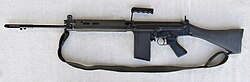
The L1A1 Self-Loading Rifle (SLR), also known by the initial Canadian designation C1, or in the U.S. as the "inch pattern" FAL (from French: Fusil Automatique Léger), is a British version of the Belgian FN FAL battle rifle. The L1A1 was produced under licence and adopted by the armed forces of the Commonwealth of Nations, mainly by United Kingdom, Australia, Canada, India, Jamaica, Malaysia, New Zealand, Rhodesia and Singapore.[2]
Key Information


The L1A1 is manufactured to a slightly modified design using British imperial units, not the metric units of the original Belgian FAL. Many sub-assemblies are interchangeable between the two types, while components of those sub-assemblies may not be compatible. Notable incompatibilities include the magazine and the stock.
Most Commonwealth pattern FALs are considered semi-automatic only, but they are not. On the L1A1s, the auto-sear, spring and connector were replaced with parts that prevented the L1A1 from firing until the bolt was fully locked. The receiver was machined to the same dimensions as a select-fire FAL, and if the auto-sear and parts are installed as they are in an FAL, the L1A1 will function as a select-fire weapon. A variant named L2A1/C2A1 (C2), meant to serve as an automatic rifle/light machine gun in a support role, was made capable of fully automatic fire from the manufacturer. Differences from the L1A1/C1 include a heavy barrel, squared front sight (versus the "V" on the semi-automatic models), a handguard that doubles as a foldable bipod, and a larger 30-round magazine although it could also use the normal 20-round magazines. Only Canada and Australia used this variant. Australia, New Zealand, and the United Kingdom used the Bren light machine guns converted to fire the 7.62×51mm NATO cartridge for use in the support role. Canadian C1s issued to naval vessels for boarding party usage were also capable of fully automatic fire.
History
[edit]
The L1A1 and other inch-pattern derivatives trace their lineage back to the Allied Rifle Commission of the 1950s, whose intention was to introduce a single rifle and cartridge that would serve as standard issue for all NATO countries. They originally adopted the Rifle No. 9 Mk 1 chambered for a 7mm intermediate cartridge. To meet this plan and strengthen ties with the United States, the United Kingdom soon dropped the No.9 rifle in favor of the Belgian FAL chambered for the newly proposed American 7.62×51mm cartridge. Based on Canada's experiments with the FAL that led to the C1A1, the United Kingdom and Australia adopted the L1A1 (or Self-Loading Rifle) as their new service rifle in 1954.
NATO standardized on the 7.62mm NATO cartridge in 1954, but did not adopt a standard rifle. Most adopted a native design chambered for 7.62mm NATO, with Germany eventually adopting the G3 and the United States adopting the M14. Even the C1A1 and L1A1 used inch measurements and were not interchangeable with the FAL's metric parts. France's participation was to adopt a natively-designed service rifle that used their national 7.5mm MAS rifle cartridge.
The British experimental version of the FAL (designated the X-1) initially used an 8-round "horseshoe charger" (a U-shaped clip that held the cartridges) that was based on an experimental 10-round Belgian design. The operator would open the bolt and place the charger into guide rails over the chamber. The rounds would then be slid down into the detachable box magazine through the bolt. The 8-round horseshoe charger was replaced in trials with a 5-round model due to problems with them becoming damaged when packed in pouches or bandoliers. The 5-round horseshoe charger had similar problems and was replaced with an conventional straight 5-round charger.
The L1A1 subsequently served as the UK's first-line battle rifle up to the 1980s before being replaced by the 5.56mm L85A1.
Combat service
[edit]The L1A1 and variants have seen use in several conflicts, including as part of the Cold War. L1A1s have been used by the British Armed Forces in Malaysia, Northern Ireland, and in the Falklands War (in opposition to FN FAL-armed Argentine forces), the First Gulf War (where it was still on issue to some second line British Army units and RAF personnel not yet issued with the L85A1),[3] and by the State of Kuwait Army during the First Gulf War.[4]
It was used by Australia and New Zealand in Vietnam,[5] by the Indian Army in the 1965 and 1971 Indo-Pak wars and by various paramilitary and state police forces in counter insurgency operations up to the early 1990s, by Nigerian and Biafran forces during Nigerian Civil War and by Rhodesia[citation needed] in the Rhodesian Bush War.
Replacement
[edit]Starting in the mid-1980s, the United Kingdom started replacing its 30-year-old L1A1 rifle with the 5.56 NATO bullpup design L85A1 assault rifle. Australia chose the Steyr AUG as a replacement in the form of the F88 Austeyr, with New Zealand following suit shortly after. Canada replaced its C1 rifle with AR-15 variants, such as the C7 service rifle and C8 carbine.
Australia replaced its L2A1 heavy barrel support weapons with M60s and later with an FN Minimi variant: the F89. Canada replaced its C2 heavy barrel support weapons with an FN Minimi variant: the C9, respectively.
Production and use
[edit]Australia
[edit]
The Australian Army, as a late member of the Allied Rifle Committee along with the United Kingdom and Canada adopted the committee's improved version of the FAL rifle, designated the L1A1 rifle by Australia and Great Britain, and C1 by Canada. The Australian L1A1 is also known as the "self-loading rifle" (SLR), and in fully automatic form, the "automatic rifle". The Australian L1A1 features are almost identical to the British L1A1 version of FAL. The Australian L1A1 differs from its British counterpart in the design of the upper receiver lightening cuts. The lightening cuts of the Australian L1A1 most closely resembles the later Canadian C1 pattern, rather than the simplified and markedly unique British L1A1 cuts.
The Australian L1A1 FAL rifle was in service with Australian forces until it was superseded by the F88 Austeyr, a licence-built version of the Steyr AUG, in 1988. Some remained in service with Reserve and training units until late 1990. Some Australian Army units deployed overseas on UN peacekeeping operations in Namibia, the Western Sahara, and Cambodia still used the L1A1 SLR and the M16A1 rifle throughout the early 1990s. The British and Australian L1A1s, and Canadian C1A1 SLRs were semi-automatic only, unless battlefield conditions mandated that modifications be made.
Australia, in co-ordination with Canada, developed a heavy-barrel version of the L1A1 as a fully automatic rifle variant, designated L2A1. The Australian heavy-barrel L2A1 was also known as the "automatic rifle" (AR). The L2A1 was similar to the FN FAL 50.41/42, but with a unique combined bipod-handguard and a receiver dust-cover mounted tangent rear sight from Canada. The L2A1 was intended to serve a role as a light fully automatic rifle or quasi-squad automatic weapon (SAW). The role of the L2A1 and other heavy barrel FAL variants is essentially the same in concept as the Browning Automatic Rifle (BAR) or Bren, but the Bren was better suited to the role of a fire support base for a section, being designed for the role from the start.
In practice many considered the L2A1 inferior to the Bren, as the Bren had a barrel that could be changed, and so could deliver a better continuous rate of fire, and was more accurate and controllable in the role due to its greater weight and better stock configuration. For this reason, Australia and Britain used the 7.62mm-converted L4 series Bren. Most countries that adopted the FAL rejected the heavy barrel FAL, presumably because it did not perform well in the machine gun role. Countries that embraced the heavy barrel FAL included Argentina, Australia, Belgium, Canada, and Israel.
Unique 30-round magazines were developed for the L2A1 rifles.[6] These 30-round magazines were essentially lengthened versions of the standard 20-round L1A1 magazines, perfectly straight in design. Curved 30-round magazines from the L4A1 7.62 NATO conversion of the Bren are interchangeable with the 30-round L2A1 magazines, however they reputedly gave feeding difficulties due to the additional friction from the curved design as they must be inserted "upside down" in the L2A1. The L4A1 Bren magazines were developed as a top-mounted gravity-assisted feed magazine, the opposite of what is required for the L2A1 FAL. This was sometimes rectified by stretching magazine springs.
The Australian L1A1/L2A1 rifles were produced by the Lithgow Small Arms Factory, with approximately 220,000 L1A1 rifles produced between 1959 and 1986. L2A1 production was approximately 10,000 rifles produced between 1962 and 1982. Lithgow exported a large number of L1A1 rifles to many countries in the region. Among the users were New Zealand, Singapore and Papua New Guinea.

During the Vietnam War, the SLR was the standard weapon issued to Australian infantrymen.[7] Most Australian soldiers preferred the larger calibre weapon over the American M16, because the SLR was substantially more reliable and its more powerful NATO 7.62 round could be trusted to kill an enemy soldier outright. The Australians' jungle warfare tactics used in Vietnam were refined by their experience in earlier jungle conflicts, e.g., the Malayan Emergency and the Konfrontasi campaign in Borneo, and were considered far more threatening by their Viet Cong opponents than those employed by U.S. forces.[8] The Australians considered the strengths and limitations of the SLR and its heavy ammunition load to be better suited to actual combat.
Another product of Australian participation in the conflict in South-East Asia was the field modification of L1A1 and L2A1 rifles by the Special Air Service Regiment for better handling. Nicknamed "the Bitch", these rifles were field modified, often from heavy barrel L2A1 automatic rifles, with their barrels cut off right in front of the gas blocks, and often with the L2A1 bipods removed to install XM148 40 mm grenade launchers mounted below the barrels.[6] The XM148 40 mm grenade launchers were obtained from U.S. forces.[6] For the L1A1, the lack of fully automatic fire resulted in the unofficial conversion of the L1A1 to full-auto capability by using lower receivers from the L2A1, which works by restricting trigger movement.[9]
Australia produced a shortened version of the L1A1 designated the L1A1-F1 for the Papua New Guinea Army, with less than 500 produced.[10] The reduction in length was achieved by installing a shorter butt length and a shorter flash suppressor, reducing the length of the weapon by 2 1/4 inches.[11]
In 1970, a bullpup rifle known as the KAL1 general purpose infantry rifle was built at the Small Arms Factory Lithgow using parts from the L1A1 rifle, but it never entered service.[12]
Canada
[edit]Canada adopted the FAL in 1954, the first country in the world to actually ante up and order enough rifles for meaningful troop trials. Up to this point, FN had been making these rifles in small test lots of ones and twos, each embodying changes and improvements over its predecessor. The Canadian order for 2,000 rifles "cast the FAL in concrete" for the first time, and at FN, from 1954 to 1958 the standard model of the FAL rifle was called the FAL 'Canada'...These excellent Canadian-built rifles were the standard arms of the Canadian military from first production in 1955 until 1984.
— The FAL Rifle[13]
The Canadian Armed Forces, the Ontario Provincial Police and Royal Canadian Mounted Police operated several versions, the most common being the C1A1,[14] similar to the British L1A1 (which became more or less a Commonwealth standard), the main differences being a rotating disc rear sight graduated from 200–600 yd (180–550 m) and a two-piece firing pin. Users could fold the trigger guard into the pistol grip, which allowed them to wear mitts when firing the weapon. The Canadian rifle also had a shorter receiver cover than other Commonwealth variants to allow for refilling the magazine by charging it with stripper clips.[15]
It was manufactured under license by the Canadian Arsenals Limited company.[15] Canada was the first country to use the FAL. It served as Canada's standard battle rifle from the early 1950s to 1984. It was eventually phased out in favor of the lighter Diemaco C7, a licence-built copy of the M16, with a number of features borrowed from the A1, A2, and A3 variations of the AR platform assault rifle.
Selective-fire variants of the initial C1 and the improved C1A1 version were made for the Royal Canadian Navy, under the designations C1D and C1A1D.[16] These weapons are identifiable by an A for "automatic", carved or stamped into the butt stock.[15] Boarding parties for domestic and international searches used the C1D.[15]
The Canadians also operated a fully automatic variant - the C2A1 - as a section support weapon, which was almost identical to the Australian L2A1. It was similar to the FN FAL 50.41/42, but with wooden attachments to the bipod legs that served as a handguard when the legs are folded. The C2A1 used a tangent rear sight attached to the receiver cover with ranges from 200–1,000 m (660–3,280 ft). The C1 was equipped with a 20-round magazine and the C2 with a 30-round magazine, although the two were interchangeable.
The selective-fire C2A1 was produced to replace the Bren Gun for the Canadian Army. While a reliable and accurate weapon, the C2A1 was unpopular among Canadian soldiers due to its very limited sustained fire capability: the C2A1 lacked an interchangeable barrel, and its bottom-loading magazines were time-consuming to reload. Roughly 2,700 examples were produced. In the late 1980s the C2A1 was replaced by the FN Minimi in the Canadian Armed Forces, ending its military service.[17]
India
[edit]The Rifle 7.62 mm 1A1,[18] or the Ishapore 1A1, is a copy of the L1A1 self-loading rifle.[19] It is produced at Ordnance Factory Tiruchirappalli of the Ordnance Factories Board.[20] It differs from the UK SLR in that the wooden butt-stock uses the butt-plate from the Lee–Enfield with trap[21] for oil bottle and cleaning pull-through, while copying some elements from metric FALs such as the bolt release.[22] The 1A1 rifle has been replaced in service with the Indian Army by the INSAS 5.56mm assault rifle. It's also known as the Ishapore Rifle since it was also made at Rifle Factory Ishapore.[23] They can be equipped with the 1A and 1A Long Blade bayonet, based on the L1A4 bayonet.[24]
A fully automatic version of the rifle (known as the 1C or Ishapore 1C) is also available, meant for use in BMP-2s via firing ports.[25][26] It has full auto and semi auto modes.[27] A muzzle is placed in the barrel in order to secure it on the firing ports.[27]
Production started in 1960 after the Armament Research & Development Establishment (ARDE) evaluated several Australian, Belgian and British FAL rifles and each one was disassembled and examined.[28] ARDE researchers began to make plans to make their own rifle after negotiations with FN were unsuccessful because of royalty requirements and the clause that Belgian technicians help manage the production lines.[28] 750 rifles were made per week.[28] FN threatened a lawsuit when they learnt of the unlicensed variant.[28] Then Prime Minister Jawaharlal Nehru was not made aware of it and after he had heard it, offered to settle FN's complaints by agreeing to purchase additional Belgian-made FALs, FALOs and MAG 60.20 GPMGs.[28] In 1998 onward, Ishapore 1A1, 1A and 1C were gradually withdrawn from service and replaced by the INSAS rifle. The Ishapore 1A1 and 1C is still in use by Central Armed Police Forces, some law enforcement bodies and also used during parades by the National Cadet Corps.[29] In 2012, around 6,000 rifles were made annually in India.[30] As of September 2019, around a million rifles had been made.[31]
In 2018, it was reported that the 1A1 was sold to the Kerala State Police.[32]
New Zealand
[edit]The New Zealand Army used the L1A1 as its standard service rifle for just under 30 years. The Labour government of Walter Nash approved the purchase of the L1A1 as a replacement for the No. 4 Mk 1 Lee–Enfield bolt-action rifle in 1959.[33] An order for 15,000 L1A1 rifles was placed with the Lithgow Small Arms Factory in Australia which had been granted a license to produce the L1A1. The first batch of 500 rifles were delivered to the New Zealand Army in 1960. Deliveries continued at an increasing pace until the order for all 15,000 rifles was completed in 1965. As with Australian soldiers, the L1A1 was the preferred rifle of New Zealand Army and NZSAS troops during the Vietnam War,[33][34] over the American M16 during the Vietnam War, as they used the same combat tactics as their Australian counterparts.[35] After its adoption by the Army, the Royal New Zealand Air Force and the Royal New Zealand Navy eventually acquired it.
Unlike L1A1s in Australian service, New Zealand L1A1s later used British black plastic furniture, and some rifles even had a mixture of the two. The carrying handles were frequently cut off. The British SUIT (Sight Unit Infantry Trilux) optical sight was issued to some users in infantry units. The L2A1 heavy barrel variant was also issued as a limited standard, but was not popular due to the problems also encountered by other users of heavy barrel FAL variants. The L4A1 7.62mm conversion of the Bren was much-preferred in New Zealand service.
The New Zealand Defence Force began replacing the L1A1 with the Steyr AUG assault rifle in 1988 and were disposed through the Government Disposal Bureau in 1990.[36][37] The Steyr AUG was phased out across all three services of the New Zealand Defence Force in 2016. The Royal New Zealand Navy still uses the L1A1 for line throwing between ships.
United Kingdom
[edit]
The United Kingdom produced its own variant of the FN FAL incorporating the modifications developed by the Allied Rifle Committee, designating it the L1A1 Self Loading Rifle (SLR). The weapons were manufactured by the Royal Small Arms Factory Enfield, Birmingham Small Arms, Royal Ordnance Factory and ROF Fazakerley. After the production run ceased, replacement components were made by Parker Hale Limited. The SLR served the British Armed Forces from 1954 until approximately 1994, being replaced by the L85A1 from 1985 onwards.[38]
The SLR was designed using Imperial measurements and included several changes from the standard FN FAL. A significant change from the original FAL was that the L1A1 operates in semi-automatic mode only due to the auto-sear parts not being installed, but otherwise is a select-fire-built rifle. Other changes include: the introduction of a folding cocking handle; an enclosed slotted flash suppressor; folding rear sight; 'sand-cuts' modifications that provided space for limited sand or other dirt ingress into the upper receiver, bolt and bolt carrier; folding trigger guard to allow use with Arctic mitts; strengthened buttstock; enlarged change lever and magazine release catch; vertical stripping catch to prevent unintended activation; deletion of the automatic hold-open device and the addition of retaining tabs at the rear of the top cover to prevent forward movement of the top cover (and resulting loss of zero) when the L2A1 SUIT was fitted. The flash suppressor is fitted with a lug which allows the fitting of an L1-series bayonet, an L1A1/A2 or L6A1 blank firing attachment or an L1A1/A2 Energa rifle grenade launcher.
Initial production rifles were fitted with walnut furniture, consisting of the pistol grip, forward handguard, carrying handle and butt.[39] The wood was treated with oil to protect against moisture, but not varnished or polished. Later production weapons were produced with synthetic furniture.[39] The material used was Maranyl, a nylon 6-6 and fibreglass composite. The Maranyl parts have a "pebbled" anti-slip texture along with a butt has a separate butt-pad, available in four lengths to allow the rifle to be fitted to individual users.
There was a special short butt designed for use with Arctic clothing or body armour, which incorporated fixing points for an Arctic chest sling system. After the introduction of the Maranyl furniture, as extra supplies became available it was retrofitted to older rifles as they underwent scheduled maintenance. This resulted in a mixture of wooden and Maranyl furniture within units and often on the same rifle. Wooden furniture was still in use in some Territorial Army units and in limited numbers with the RAF until at least 1989.
The SLR selector has two settings (rather than the three that most metric FALs have), safety and semi-automatic, which are marked 'S' (safe) and 'R' (repetition.) The magazine from the 7.62mm L4 light machine gun will fit the SLR.[40] Commonwealth magazines were produced with a lug brazed onto the front to engage the recess in the receiver, in place of a smaller pressed dimple on the metric FAL magazine. As a consequence of this, metric FAL magazines can sometimes be used with the Commonwealth SLR if the fit happens to work out properly, but SLR magazines will not fit the metric FAL.[41]
Despite the British, Australian and Canadian versions of the FAL being manufactured using machine tools which utilised the Imperial measurement system, they are all of the same basic dimensions. Parts incompatibilities between the original FAL and the L1A1 are due to pattern differences, not due to the different dimensions. Confusions over the differences has given rise to the terminology of "metric" and "inch" FAL rifles, which originated as a reference to the machine tools which produced them. Despite this, virtually all FAL rifles are of the same basic dimensions, true to the original Belgian FN FAL. In the US, the term "metric FAL" refers to guns of the Belgian FAL pattern, whereas "inch FAL" refers to ones produced to the Commonwealth L1A1/C1 pattern.[42][43]
SLRs could be modified at unit level to take two additional sighting systems. The first was the "Hythe sight", formally known as the "Conversion Kit, 7.62mm Rifle Sight, Trilux, L5A1" (L5A2 and L5A3 variants with different foresight inserts also existed) and intended for use in close range and in poor lighting conditions. The sight incorporated two rear sight aperture leaves and a tritium illuminated foresight insert for improved night visibility, which had to be replaced after a period of time due to radioactive decay. The first rear sight leaf had a 7 mm (0.28 in) aperture which could be used alone for night shooting or the second leaf could be raised in front of it, superimposing a 2 mm (0.079 in) aperture for day shooting.[44][page needed]

The second sight was the L2A2 "Sight Unit, Infantry, Trilux" (SUIT), a 4× optical sight which mounted on a rail welded to a top cover.[40][45] Issued to the British Infantry, Royal Marines and RAF Regiment, the SUIT featured a prismatic offset design, which reduced the length of the sight and improved clearance around the action. Also, the prismatic offset design helped to reduce parallax errors and heat mirage from the barrel as it heated up during firing. The aiming mark was an inverted, tapered perspex pillar ending in a point which could be illuminated by a tritium element for use in low light conditions. The inverted sight post allowed rapid target re-acquisition of the target after the recoil of the firearm raised the muzzle. The sight was somewhat heavy, but due to its solid construction was durable and robust.[nb 1]
The SLR was officially replaced in 1985 by the bullpup design L85A1 service rifle, firing the 5.56×45mm NATO cartridge. The armed forces were re-equipped by 1994 and during this period the L1A1 rifles were gradually phased out. Most were either destroyed or sold, with some going to Sierra Leone. Several thousand were sent to the US and sold as parts kits, and others were refurbished by LuxDefTec in Luxembourg and are still on sale to the European market.[46]
Gallery
[edit]-
 A United States Marine with a British L1A1 SLR, during a training exercise as part of the Gulf War's Operation Desert Shield
 -
 Malaysian soldiers with L1A1 rifles in their headquarters, near the airport in Mogadishu during Operation Restore Hope
 -
 A female soldier of the Rejimen Askar Wataniah with an L1A1 SLR, circa 1990s
 -
 A Border Security Force soldier carrying an L1A1 rifle in West Bengal during elections, 2009
 -
 Fijian police gendamarie with L1A1 in stand at ease position
 -
 Bruneian Army officers armed with L1A1 SLRs participating in Australian jungle warfare training


Conflicts
[edit]The L1A1 self-loading rifle has been used in the following conflicts:
- Malayan Emergency[47]
- Mau Mau rebellion
- Suez Crisis[47]
- Jebel Akhdar War[48]
- Aden Emergency[48]
- Indonesia–Malaysia confrontation[49]
- Congo Crisis[50]
- Vietnam War[51]
- Dhofar Rebellion[52]
- Indo-Pakistani War of 1965[22]
- Communist insurgency in Malaysia
- The Troubles[53]
- Rhodesian Bush War[54]
- Nigerian Civil War
- Indo-Pakistani War of 1971[22]
- Soviet–Afghan War[55]
- Falklands War[47]
- Sri Lankan Civil War[22]
- Sri Lankan 1971 Communist insurgency
- Sri Lankan 1987-89 Communist insurgency
- Bougainville conflict[56]
- Gulf War[47]
- Sierra Leone Civil War[57]
- Nepalese Civil War[58]
- Kargil War[22]
- 2008 Mumbai attacks[59]
- 2013 Lahad Datu standoff[citation needed]
Users
[edit]Current
[edit] Australia: Australia's Federation Guard uses L1A1s for ceremonial events only.[60]
 India: Used by various police units[61][59] and Village Defence Guards.[62][63]
 Malta: Still used by its armed forces, mainly for ceremonial purposes.[64]
 Nepal: Uses both British/Indian-made SLRs.[58][65]
 Sierra Leone: 10,000 received in 2000[57]
 Sri Lanka: Sri Lanka Corps of Military Police uses L1A1s only when taking part in events in ceremonial scarlet uniform.[66]
 Yemen[67]


Former users
[edit]
- Australia: Was produced under licence.[68] Replaced by the F88 Austeyr.
 Afghanistan: Early anti-Soviet insurgent groups received some 1As captured by Pakistan from India. They were soon replaced due to ammunition shortage.[55]
 Bangladesh: Indian-made 1A1 SLRs used in the Bangladesh Liberation War.[69]
 Brunei: Uses them as standard issue infantry rifles alongside M16 service rifles.[39]
 Canada: Produced under licence by Canadian Arsenals Limited as the C1 rifle, and C2 squad automatic rifle. Replaced in service by the C7 rifle.[68]
 British Hong Kong: Used by the Royal Hong Kong Regiment.[70]
 Jamaica: Uses various British and Australian L1A1s.[71]
 Kuwait[4]
 Malaysia: Used until the 1990s and replaced by the HK 33, Beretta AR70 and M16A1.[72]
 New Zealand: Used Australian-built L1A1s from 1960, replaced by Steyr AUGs in 1988.[73] The New Zealand Navy still uses the L1A1 for line throwing between ships.[citation needed] 15,000 British-made L1A1s were delivered to New Zealand.[74]
 Nigeria: Used by Federal army[75]


 Biafra: 930 FN FAL modified to SLR standard by Parker-Hale[76]

 Papua New Guinea: Used Australian built L1A1s.[77][78]
 Rhodesia: Adopted in the early 1960s, seconded to reserve status following the Rhodesia's unilateral declaration of independence. Standard service rifle of the Rhodesia Regiment.[79]
 Singapore: Introduced by British colonial forces prior to independence to 1st and 2nd Singapore Infantry Regiments in 1957. Replaced by AR-15/M16 rifles a few years after independence.[80]
- Sri Lanka: Australian made, but refurbished and supplied by Singapore from 1984 to 1985.[81] The Type 56 assault rifle is used by the Sri Lankan military.[82]
 United Kingdom: Used by the British Armed Forces as a primary service rifle until the adoption of SA80 in 1985, at which point it began to be gradually phased out of service until it was fully replaced in 1994.[38]
 Vanuatu: 270 SLRs, some configured as light machine guns.[77] L1A1 Self-Loading Rifles replaced by the FAMAS in 2009.[83]


See also
[edit]- AR-10 – An American 7.62mm battle rifle design from the same period
- Armalite AR-16 – An American 7.62mm battle rifle
- CETME rifle – A Spanish 7.62mm battle rifle
- Heckler & Koch G3 – A German 7.62mm battle rifle derived from the CETME
- Howa Type 64 – A Japanese 7.62mm battle rifle
- Small Arms Weapons Effects Simulator - Infrared training device used in the 1980s used in conjunction with the L1A1 SLR
- T48 rifle – An American 7.62mm battle rifle
References
[edit]- Notes
- ^ During the Cold War, the British SUIT was copied by the Soviet Union and designated the 1P29 telescopic sight.[citation needed]
- Citations
- ^ Army Code No. 12258, "User Handbook for Rifle, 7.62mm, L1A1 and 0.22 incle calibre, L12A1 Conversion Kit, 7.62mm Rifle
- ^ Small Arms Illustrated, 2010 p. 47.
- ^ Rottman (1993), p. 20.
- ^ a b Rottman (1993), p. 53.
- ^ Rottman (2017), p. 11.
- ^ a b c "When Government Issue Wasn't Enough: The Australian "B*TCH" Variant of the SLR -". 16 October 2018. Archived from the original on 7 February 2023.
- ^ Palazzo (2011), p. 49.
- ^ Chanoff and Toai 1996, p. 108.
- ^ "FAL STG-58 - 7.62x51". 50AE.net. Archived from the original on 20 June 2011. Retrieved 22 January 2011.
- ^ "Lithgow Small Arms Factory Museum". lithgowsafmuseum.org.au. Archived from the original on 31 May 2023. Retrieved 6 June 2020.
- ^ Australia's FN FAL L1A1 Rifle- Arsenal By Carl O. Schuster, p. 58
- ^ General Purpose Infantry Rifle Non Volatile Technologies Pty Ltd
- ^ Stevens, R. Blake. (1993) The FAL Rifle, Collector Grade Publications. Quote from inside jacket cover.
- ^ "FN C1A1 Sniper Rifle – www.captainstevens.com". Archived from the original on 4 March 2023. Retrieved 6 June 2020.
- ^ a b c d "Service Rifles". Canadiansoldiers.com. Archived from the original on 23 April 2023. Retrieved 8 January 2017.
- ^ Ezell, 1988, p. 83
- ^ McCollum, Ian (6 September 2019). "C2A1: Canada's Squad Automatic FAL". Forgotten Weapons. Archived from the original on 22 March 2023. Retrieved 2 March 2021.
- ^ "Compendium of Equipment (From April 2014 to March 2019)" (PDF). Archived from the original (PDF) on 23 September 2025.
- ^ "The Indigenous Rifle Saga".
- ^ "Rifle 7.62mm 1A1 | ORDNANCE FACTORY TIRUCHIRAPPALLI | Government of India". 23 February 2020. Archived from the original on 23 February 2020. Retrieved 6 June 2020.
- ^ "FN FAL Rifles | FN Fal Review". 28 October 2013. Archived from the original on 16 April 2021. Retrieved 6 June 2020.
- ^ a b c d e Cashner (2013), p. 51.
- ^ Small Arms and Ammunition Technology Focus 29(14), October 2021, ISSN No. 0971 - 4413
- ^ "Bayonets of India". worldbayonets.com. Archived from the original on 8 April 2023. Retrieved 6 June 2020.
- ^ "Rifle 7.62 MM 1A1". Indian Ordnance Factory Board. Archived from the original on 21 February 2018. Retrieved 8 January 2017.
- ^ "OFB 7.62 mm 1A1 and 1C rifles (India), Rifles". IHS Jane's. Retrieved 8 January 2017.
{{cite web}}: CS1 maint: deprecated archival service (link) - ^ a b Jones & Ness (2010), p. 164.
- ^ a b c d e Cashner (2013), p. 20.
- ^ Deb, Sheershoo (10 August 2020). "Service Rifles of Indian Army: 1947-Present". DefenceXP - Indian Defence Network. Archived from the original on 15 April 2023. Retrieved 26 August 2021.
- ^ "English Releases". Archived from the original on 16 March 2023.
- ^ "7.62mm SLR | Defence Research and Development Organisation - DRDO|GoI". drdo.gov.in. Archived from the original on 2 March 2020. Retrieved 22 February 2022.
- ^ "Police to buy self-loading rifles | Thiruvananthapuram News - The Times of India". The Times of India. Retrieved 5 December 2025.
- ^ a b "Force4NZ" (PDF). February 2016. Archived from the original (PDF) on 29 January 2018. Retrieved 10 October 2019.
- ^ "L1A1 Self Loading Rifle | VietnamWar.govt.nz, New Zealand and the Vietnam War". vietnamwar.govt.nz. Archived from the original on 28 March 2023. Retrieved 6 June 2020.
- ^ Cashner (2013), p. 53.
- ^ "Gunman's stash included former army rifles". Stuff. 8 July 2009. Archived from the original on 10 October 2019. Retrieved 6 June 2020.
- ^ "Firearms in the RNZN". 10 December 2015. Archived from the original on 3 March 2020. Retrieved 6 June 2020.
- ^ a b Dougherty 2011, p. 222.
- ^ a b c Cashner (2013), p. 15.
- ^ a b "Self Loading Rifle L1A1: The European "Black Rifle"". smallarmsreview.com. Archived from the original on 29 October 2020. Retrieved 6 June 2020.
- ^ Tilstra (2014), p. 33.
- ^ Cashner (2013), p. 13.
- ^ "FN FAL: The 'Free World's' right arm". Guns.com. 3 March 2014. Archived from the original on 31 March 2023. Retrieved 6 June 2020.
- ^ Army Code No 12258 (Revised 1977): User Handbook for Rifle, 7.62mm, L1A1 and 0.22-inch caliber, L12A1 Conversion Kit, 7.62mm Rifle
- ^ "L2A2 (SUIT) Sight Unitary Infantry Trilux". Australian War Memorial. Retrieved 5 March 2022.
- ^ "Luxembourg Defence Technologie". luxdeftec.lu (in German). Archived from the original on 22 July 2011.
- ^ a b c d Cashner (2013), p. 34.
- ^ a b Cashner (2013), p. 36.
- ^ McNab (2002), p. 243.
- ^ Abbot (2014), p. 44.
- ^ Cashner (2013), pp. 52–55.
- ^ Cashner (2013), pp. 38–39.
- ^ Cashner (2013), p. 40.
- ^ Cashner (2013), pp. 42–43.
- ^ a b Isby (1990), p. 7.
- ^ "The Real Mr. Pip Harry Baxter on Bougainville - 2". 19 February 2014. Archived from the original on 14 May 2020. Retrieved 8 January 2017 – via YouTube.
{{cite web}}: CS1 maint: bot: original URL status unknown (link) - ^ a b Berman, Eric (December 2000). Re-Armament in Sierra Leone: One Year After the Lome Peace Agreement (PDF). Occasional Paper No. 1. Small Arms Survey. pp. 23, 25. Archived from the original (PDF) on 12 January 2011.
- ^ a b "Legacies of War in the Company of Peace: Firearms in Nepal" (PDF). Geneva: Small Arms Survey. May 2013. Archived from the original (PDF) on 8 July 2014. Retrieved 21 September 2016.
- ^ a b Cashner (2013), p. 52.
- ^ "Australia's Federation Guard". Archived from the original on 6 August 2020.
- ^ Peterson (2011), pp. 220–221.
- ^ "Village Defence Guards' Capabilities May Get SLRs, Added Renumeration | Kashmir Life - Latest News & Breaking News from Kashmir". kashmirlife.net. Retrieved 5 December 2025.
- ^ "India's Village Defence Guards: Arming Civilians To Hunt Terrorists". www.defencexp.com. Retrieved 5 December 2025.
- ^ Camilleri, Eric (21 October 2005). "Thank you, AFM". The Times of Malta. Archived from the original on 6 September 2018.
- ^ Graduate Institute of International Studies (2003). "Insights and Mysteries: Global Small Arms Transfers". Small Arms Survey 2003: Development Denied (PDF). Oxford: Oxford University Press. pp. 111–113. ISBN 978-0199251759. Archived from the original (PDF) on 8 February 2023.
- ^ Smith, Chris (October 2003). In the Shadow of a Cease-fire: The Impacts of Small Arms Availability and Misuse in Sri Lanka (PDF). Small Arms Survey. Archived from the original (PDF) on 12 January 2011.
- ^ Small Arms Survey (2003). "Living with Weapons: Small Arms in Yemen". Small Arms Survey 2003: Development Denied. Oxford University Press. p. 174. Archived from the original (PDF) on 12 November 2010.
- ^ a b "Report: Profiling the Small Arms Industry". World Policy Institute. November 2000. Archived from the original on 11 October 2017. Retrieved 15 July 2010.
- ^ "Arms for freedom". 29 December 2017.
- ^ "RHKR Equipment - Weapons". rhkr.org. The Royal Hong Kong Regiment (The Volunteers) Association. Retrieved 16 June 2021.
{{cite web}}: CS1 maint: deprecated archival service (link) - ^ "Equipment: Weapons". Jamaica Defence Force. Archived from the original on 19 April 2012. Retrieved 8 January 2017.
- ^ Jackson (2008), p. 138.
- ^ "7.62mm calibre L1A1 Self Loading Rifle". New Zealand History online. 18 February 2009. Archived from the original on 22 May 2010. Retrieved 26 March 2016.
- ^ "Deactivated RARE OLD SPEC SLR L1A1 New Zealand Contract - Modern Deactivated Guns - Deactivated Guns". deactivated-guns.co.uk. Archived from the original on 18 December 2022. Retrieved 6 June 2020.
- ^ Jowett (2016), p. 19.
- ^ Jowett 2016, p. 23.
- ^ a b Capie (2004), pp. 63–66.
- ^ Jones (2009).
- ^ Cocks (2001), pp. 139–141.
- ^ "1999 - Standard Singapore Military Rifles of the 20th Century". Ministry of Defence, Singapore. September 2007. Archived from the original on 23 June 2015. Retrieved 14 March 2021.
- ^ Ezell (1988), p. 336.
- ^ "Illicit firearms chipping away at the State - 2 - CounterPoint". counterpoint.lk. Retrieved 5 December 2025.
- ^ "Vanuatu Mobile Force replaces its firearms | RNZ News". www.rnz.co.nz. Retrieved 5 December 2025.
- Bibliography
- Abbot, Peter (February 2014). Modern African Wars: The Congo 1960–2002. Oxford: Osprey Publishing. ISBN 978-1782000761.
- Altmann, Carol (2006). "The Massacre". After Port Arthur. Allen & Unwin. ISBN 1-74114-268-7.
- Bishop, Chris (1998). Guns in Combat. Chartwell Books, Inc. ISBN 0-7858-0844-2.
- Cashner, Bob (2013). The FN FAL Battle Rifle. Oxford, UK: Osprey Publishing. ISBN 978-1-78096-903-9.
- Capie, David H. (2004). Under the Gun: The Small Arms Challenge in the Pacific. Australia: Victoria University Press. ISBN 978-0864734532.
- Cocks, Chris (1 July 2001). Fireforce: One Man's War in the Rhodesian Light Infantry. Covos Day. ISBN 1-919874-32-1.
- Dougherty, Martin J. (2011). Small arms visual encyclopedia. London: Amber Books. ISBN 9781907446986. OCLC 751804871.
- Ezell, Edward Clinton (1988). Small arms today: latest reports on the world's weapons and ammunition (2nd ed.). Harrisburg, PA: Stackpole Books. ISBN 978-0-8117-2280-3.
- Isby, David C. (1990). The War in Afghanistan 1979-1989: The Soviet Empire at High Tide. Concord Publications. ISBN 978-9623610094.
- Jackson, Robert (2008). The Malayan Emergency and Indonesian Confrontation: The Commonwealth's Wars 1948-1966. Barnsley, England: Pen & Sword. ISBN 978-1-84415-775-4.
- Jones, Richard D. (27 January 2009). Jane's Infantry Weapons 2009/2010 (35 ed.). Jane's Information Group. ISBN 978-0-7106-2869-5.
- Jones, Richard D.; Ness, Leland S., eds. (2010). Jane's Infantry Weapons 2010-2011. Jane's Publishing. ISBN 978-0710629081.
- Jowett, Philip (2016). Modern African Wars (5): The Nigerian-Biafran War 1967-70. Oxford: Osprey Publishing Press. ISBN 978-1472816092.
- McNab, Chris (2002). 20th Century Military Uniforms (2nd ed.). Kent: Grange Books. ISBN 1-84013-476-3.
- Palazzo, Albert (2011). Australian Military Operations in Vietnam, Australian Army Campaigns Series # 3 (2 ed.). Canberra: Army History Unit. ISBN 978-0-9804753-8-8.
{{cite book}}: CS1 maint: publisher location (link) - Peterson, Philip (2011). Standard Catalog of Military Firearms: The Collector's Price and Reference Guide. Gun Digest Books. ISBN 978-1-4402-1451-6.
- Rottman, Gordon L. (23 May 1993). Armies of the Gulf War. Osprey Publishing. ISBN 978-1-85532-277-6.
- Rottman, Gordon L. (26 January 2017). Vietnam War US & Allied Combat Equipments. Elite 216. Osprey Publishing. ISBN 9781472819055.
- Tilstra, Russell C. (2014). The Battle Rifle: Development and Use Since World War II. McFarland. ISBN 978-0-7864-7321-2.
Further reading
[edit]- "British War Office user handbook (W.O. Code No. 12258, User Handbook For The Rifle, 7.62mm, L1A1 - Land Service 1959)". 1959. Retrieved 27 July 2023 – via The Historical Breechloading Smallarms Association (Flickr).
- "British Ministry of Defence training pamphlet (Army Code No. 71012, Infantry Training Volume II, Pamphlet No. 7 7.62mm Self Loading Rifle (All Arms))". October 1975. Retrieved 27 July 2023 – via The Historical Breechloading Smallarms Association (Flickr).
External links
[edit]
- The L1A1 SLR Prototype Rifle and l12A1 .22LR conversion unit
- "The Army's New Rifle (1954)" – A YouTube video from British Pathe News about the introduction of the rifle into the British Army.
- Mystery of the short barreled FAL is solved!
L1A1 Self-Loading Rifle
View on GrokipediaDevelopment
Origins
Following World War II, the British military sought to modernize its infantry armament by replacing the bolt-action Lee-Enfield No. 4 rifle with a self-loading rifle capable of higher rates of fire and improved ergonomics for post-war conflicts. This requirement emerged amid broader NATO efforts to standardize small arms, as the Lee-Enfield's design, while reliable, was seen as outdated for emerging tactical needs involving rapid engagement.[6] The foundational design for what became the L1A1 originated with the FN FAL, developed by Belgian engineer Dieudonné Saive at Fabrique Nationale (FN) in Herstal, Belgium, with the first prototype completed in 1947. Saive, building on wartime experiences and earlier semi-automatic concepts, aimed to create a lightweight, selective-fire rifle suitable for intermediate cartridges, initially testing prototypes in various calibers to meet international demands. By 1950, early FN FAL prototypes, including versions chambered for the British .280 Enfield cartridge, underwent evaluation in U.S. rifle trials, where they demonstrated promising performance but were not selected over competing designs like the T25.[7][8][9] In the early 1950s, Britain conducted its own trials of the FN FAL prototype, evaluating it against domestic designs such as the EM-2 bullpup rifle, amid debates over cartridge standardization. Early 1950s British evaluations of the FN FAL prototype highlighted its adaptability, leading to a decision in 1953 to pursue a hybrid metric-inch configuration to align with imperial measurement preferences for components like sights and furniture, while retaining the core metric-based Belgian layout. This evaluation was influenced by NATO's cartridge standardization efforts, culminating in the adoption of the 7.62x51mm NATO round in 1954, which resolved earlier caliber disputes and paved the way for the FAL's selection as a base for Commonwealth rifles.[10][11][12]Adoption
In April 1951, the British Army briefly adopted the experimental EM-2 bullpup rifle chambered in .280 British, but this decision was overturned later that year by Prime Minister Winston Churchill amid pressure from the United States to standardize on the 7.62×51mm NATO cartridge for alliance interoperability.[13] Following the cancellation of the EM-2 program and subsequent comparative trials in the early 1950s against other designs, including variants of the Belgian FN FAL, the British Army selected the FN FAL as the basis for its new service rifle in 1953, designating it the L1 rifle.[14] This choice aligned with NATO's 1954 standardization of the 7.62×51mm cartridge, which the FAL was adapted to use, ensuring compatibility across allied forces.[10] To suit British manufacturing capabilities, the L1 design incorporated inch-pattern modifications to the original metric-based FN FAL, including imperial measurements for dimensions, threading, and tooling to facilitate production with existing machinery at Royal Small Arms Factory Enfield and Birmingham Small Arms.[15] These changes, such as adjusted receiver dimensions and magazine well configurations, ensured parts were not interchangeable with metric FAL variants while preserving the core gas-operated, selective-fire mechanism.[10] Initial production contracts were placed with FN Herstal in 1954 for trial rifles, including the X8E1 and X8E2 models evaluated by British troops, paving the way for licensed manufacturing in the UK.[10] The L1A1 entered formal British service in 1957, replacing the Lee-Enfield No. 4 as the standard infantry rifle.[16] NATO's emphasis on cartridge standardization significantly influenced Commonwealth adoption, with Canada selecting a similar inch-pattern FAL (C1) in 1955, Australia introducing the L1A1 in 1960, and other nations like India and New Zealand following in the early 1960s to maintain operational compatibility.[17]Design
Operating mechanism
The L1A1 Self-Loading Rifle utilizes a short-stroke gas piston operating mechanism positioned above the barrel.[4] This system taps propellant gases from a port in the barrel to drive the action, providing a quick impulse to the bolt carrier without the piston traveling the full length of the operating stroke.[4] Upon firing, high-pressure gases are diverted through the barrel's gas port into the gas cylinder, where they expand against the piston head.[4] The piston delivers a brief rearward tap to the bolt carrier, unlocking the tilting bolt from its recess in the receiver by rotating it downward.[4] This allows the bolt carrier group to recoil under its own inertia, extracting and ejecting the spent cartridge case to the right side, while the recoil spring—housed in the buttstock—then drives the assembly forward to strip a new round from the magazine, chamber it, and relock the bolt by tilting it upward into the receiver.[4] The gas system includes an adjustable regulator sleeve with multiple positions (numbered 1 to 11) to fine-tune gas flow for different ammunition or environmental conditions, ensuring reliable cycling while minimizing excessive recoil.[18] A two-position gas plug further enhances versatility: the normal ("A") setting directs gas to the piston for standard operation, while the restricted ("Gr") position blocks the port to prevent cycling during rifle grenade launches, relying instead on a blank cartridge's pressure for propulsion.[19] The design integrates with the rifle's top-mounted dust cover, which remains open during charging via the folding cocking handle to facilitate cleaning and inspection of the bolt mechanism.[4] As the British inch-pattern adaptation of the Belgian FN FAL, the L1A1 incorporates modified mechanical tolerances—such as a 45-degree gas port angle and imperial-dimensioned components—to accommodate production using British tooling, differing from the metric FAL's 90-degree port and finer metric fits for enhanced interchangeability within Commonwealth manufacturing.[20]Features and accessories
The L1A1 Self-Loading Rifle was equipped with adjustable iron sights for precise aiming at various ranges. The front sight consisted of a protected post mounted on the gas cylinder, while the rear sight was an aperture type with a folding peep graduated from 200 to 600 yards in increments, allowing for elevation adjustments via a drum mechanism.[21] Additionally, the rifle featured side-mounted rails compatible with optical accessories, including the L2A2 SUIT (Sighting Unit Infantry Telescope), a 4x prism sight introduced in the 1970s to enhance target acquisition in low-light conditions.[22][23] The rifle's external ergonomics were defined by its furniture, primarily constructed from wood in early production models to provide a secure grip and heat resistance during sustained fire. This included upper and lower handguards covering the barrel and gas system, a pistol grip integrated with the receiver, and a fixed buttstock with a metal buttplate for stability. Later in service, particularly with Commonwealth forces, plastic (Maranyl) furniture was adopted starting in the early 1970s for improved weather resistance and lighter weight, as seen in the Canadian C1 variant where full polymer components replaced wood on select rifles.[22][24] A bayonet lug positioned beneath the flash hider enabled attachment of the L1A1 knife bayonet, a clip-point design with a press-button locking mechanism for secure fitting during close-quarters engagements.[22][25] The L1A1 also supported rifle grenade launching, such as the Energa anti-tank grenade, via a projector attachment fitted to the muzzle and a brief adjustment to the gas plug setting to accommodate blank cartridge propulsion without cycling the action.[26] Practical handling features included a compartment within the buttstock, accessible via a trapdoor in the alloy buttplate, for storing essential cleaning tools like an oil bottle, pull-through cord, and brushes. Sling swivels were affixed to the front forend and rear buttstock, allowing for a two-point web sling configuration to facilitate carrying during infantry maneuvers.[22][27]Specifications
Dimensions and weight
The L1A1 Self-Loading Rifle, in its standard configuration with fixed buttstock, has an overall length of 44.5 inches (1,130 mm) and a barrel length of 21 inches (533 mm).[16][28] Unloaded, the rifle weighs 9.45 lb (4.29 kg), a figure that reflects its robust construction using steel components.[29]| Specification | Metric (Imperial) |
|---|---|
| Overall length | 1,130 mm (44.5 in) |
| Barrel length | 533 mm (21 in) |
| Weight (unloaded) | 4.29 kg (9.45 lb) |
Ammunition and feeding
The L1A1 Self-Loading Rifle was chambered for the 7.62×51mm NATO cartridge, a rimless, bottlenecked, centerfire round standardized by NATO in the 1950s for use in small arms across member nations.[30] This cartridge provided effective range and stopping power suitable for battle rifle applications, with the rifle's 21-inch barrel achieving muzzle velocities around 2,700 feet per second for standard loads.[3] Common variants included the M80 ball round, featuring a 147-grain full metal jacket bullet for general combat use; the M62 tracer round, which ignited upon firing to mark projectile paths for observation and adjustment; and the British L2A2 high-pressure test round, employed for proofing weapons to verify structural integrity under elevated chamber pressures exceeding standard specifications.[31][32] The rifle fed from a 20-round detachable box magazine, typically constructed from stamped steel with a stainless steel follower and helical spring, painted black for corrosion resistance and field durability.[33] This capacity was constrained by the magazine's design, particularly its flat base and overall dimensions, which prioritized compactness over higher round counts to maintain balance and reliability in the rifle's short-action configuration. The magazine employed a staggered-column layout within the well, allowing the 20 cartridges to stack in two offset rows for efficient feeding while minimizing the well's height.[33] A manual bolt hold-open device, located forward of the magazine well, engaged by hand to lock the bolt rearward after firing or manual retraction, facilitated visual inspection of the chamber and expedited reloading by holding the action open.[34] Reloading involved actuating the paddle-style magazine release—a wide, rearward-protruding lever at the base of the magazine well—to eject the spent magazine with a single thumb press, followed by inserting a fresh one via a rocking motion until it locked.[3] If the bolt was held open, releasing the hold-open lever or pulling the charging handle chambered the first round; otherwise, the handle was cycled manually. In emergency situations, such as rapid replenishment under combat conditions, the magazine could be topped up using 5-round stripper clips inserted through a dedicated guide on the receiver, though this method was less common than pre-loaded magazines due to time constraints.[35]Variants
British production variants
The L1A1 represented the primary British production model of the self-loading rifle, adopted as the standard service weapon in 1957 and chambered in 7.62×51mm NATO ammunition. This inch-pattern variant of the FN FAL incorporated a distinctive sand-cut receiver design, where grooves were machined into the bolt carrier to reduce weight and enhance reliability by minimizing sand and debris accumulation during operation. Early examples featured walnut wood furniture for the stock and handguards, providing a traditional aesthetic and functional grip, while the rifle maintained semi-automatic fire capability to emphasize aimed shots in infantry roles. Later production models transitioned to synthetic furniture made from Maranyl, a nylon-6,6 and fiberglass composite, which offered greater resistance to moisture and impact compared to wood. Progressive updates included minor mark changes such as L1A1* and L1A1** for improved components and manufacturing refinements.[36][1][15] The L2A1 was a heavy-barreled, selective-fire variant of the L1A1 designed for squad automatic fire support, featuring full-automatic capability, a bipod, and a lengthened barrel to increase sustained fire rates and accuracy in the light machine gun role. Adopted for service, it saw production in the UK and use by British and Commonwealth forces, though in limited numbers compared to the L1A1, and addressed some overheating issues through design but lacked quick-change barrels.[1][15][37]Commonwealth adaptations
The Australian L1A1 F1 variant was developed as a shortened version of the standard L1A1 to better suit jungle environments and soldiers of smaller stature, featuring lightweight alloy handguards for reduced weight and improved heat dissipation, along with a shortened fixed buttstock for compactness. Adopted in 1969, it maintained the standard barrel length but included a modified flash hider.[38][39][15] Canada's C1A1 represented an inch-pattern adaptation of the L1A1, retaining wooden stock furniture for durability in varied climates while incorporating a distinctive paddle-style magazine release for quicker reloads under field conditions. The C1A1 also included minor rear sight modifications for improved accuracy and a shorter receiver cover to allow stripper clip loading. Complementing this was the heavy-barreled C2A1 variant, designed as a squad automatic weapon with enhanced sustained fire capability.[40][41][1] India's 1A1 was a locally produced hybrid incorporating metric influences from the original Belgian FAL alongside inch-pattern elements from the British L1A1, enabling domestic manufacturing without full reliance on foreign tooling. Produced at the Rifle Factory Ishapore, it featured simplified sights to streamline production and reduce costs for mass issuance. Entering service in 1963, the 1A1 served as a direct replacement for older bolt-action rifles, emphasizing self-sufficiency in arms production.[42][43] New Zealand's L1A1 closely mirrored the British original and was used in Pacific service.[15][1]Production
United Kingdom manufacturing
The L1A1 Self-Loading Rifle was primarily manufactured in the United Kingdom at the Royal Small Arms Factory (RSAF) Enfield and the Birmingham Small Arms (BSA) Shirley facility. Production at RSAF Enfield commenced with the first batch completed on 30 May 1957, following sealed drawings dated 1 March 1957, marking the rifle's adoption as the standard British service rifle that year. BSA Shirley began full-scale production in March 1957, contributing to the domestic output alongside Enfield. These facilities handled the assembly and machining of the L1A1 throughout the 1950s and 1960s, with manufacturing continuing into the 1980s to support ongoing military needs.[3][24] To produce the L1A1, UK manufacturers adapted the original Belgian FN FAL design from metric to imperial (inch-pattern) measurements, ensuring compatibility across Commonwealth nations. This involved custom tooling for machining components like the receiver and barrel to imperial standards, facilitating interchangeable subassemblies with other inch-pattern FAL variants. Quality control was rigorous, with early trials using modified prototypes (such as X8E1 and X8E2) to test semi-automatic functionality via stop pins and verify parts interchangeability, aligning with British military specifications for reliability in diverse environments.[24] By the end of the financial year 1961, RSAF Enfield alone had produced 103,400 L1A1 rifles, alongside related accessories like bayonets and grenade launchers, indicating substantial early output. Overall UK production reached approximately 250,000 units through the 1960s, incorporating some subassemblies sourced from FN to supplement domestic capacity. Following the 1970s, production phased down as the British Army transitioned toward replacement programs, with the L1A1 remaining in service until the introduction of the SA80 in the 1980s, after which Enfield's operations shifted focus.[3]Licensed production abroad
The L1A1 Self-Loading Rifle was manufactured under license in multiple Commonwealth nations to equip their armed forces and foster local industrial capabilities. In Australia, the Lithgow Small Arms Factory initiated licensed production in 1959, ultimately manufacturing 222,773 L1A1 rifles by 1986 to meet domestic requirements and support allied nations.[44] Canada's licensed production occurred at Canadian Arsenals Limited, which built approximately 85,000 C1 and C1A1 variants from the late 1950s to the 1960s for the Canadian Armed Forces.[41] India commenced production of its 1A1 variant in 1963 at the Ordnance Factory Kanpur and Rifle Factory Ishapore, yielding approximately 250,000 units to arm the Indian Army.[43] New Zealand imported L1A1 rifles primarily from the United Kingdom and Australia, with no local manufacturing or assembly at its Defense Industries facility.[45]Operational history
Major conflicts
The L1A1 Self-Loading Rifle saw its first major combat deployment during the Malayan Emergency (1948–1960), where British Commonwealth forces employed it against communist insurgents in dense jungle terrain. Adopted by the British Army in the late 1950s, the rifle provided reliable semi-automatic fire support in patrols and ambushes, leveraging its 7.62×51mm NATO cartridge for effective penetration through thick vegetation. Units such as the Malayan Scouts and New Zealand Special Air Service employed the L1A1 alongside lighter weapons like the Owen submachine gun, contributing to counter-insurgency operations that emphasized mobility and firepower in humid, rain-soaked environments.[9][46][15] In the Vietnam War (1962–1975), Australian and New Zealand troops relied on the L1A1 as their primary infantry rifle during intense jungle combat against Viet Cong and North Vietnamese forces. The weapon's rugged construction proved advantageous in the humid, muddy conditions of Phuoc Tuy Province, where units like the 6th Battalion, Royal Australian Regiment (6 RAR), and attached New Zealand artillery elements used it in firefights such as the Battle of Long Tan in 1966. Its accuracy at ranges up to 300 meters and stopping power from the full-power cartridge allowed for effective suppression in close-quarters ambushes, with Australian forces preferring it over issued U.S. M16s for its consistency in adverse weather. New Zealand contributions, including V Company integrated with 6 RAR, similarly utilized the L1A1 for patrol duties and training South Vietnamese allies in pacification efforts.[47][45][48] The Falklands War (1982) marked one of the L1A1's most prominent uses in a conventional conflict, with British forces deploying it extensively against Argentine invaders equipped with the FM FAL variant of the same design. The rifle equipped units like the 2nd Battalion, Parachute Regiment (2 Para), during the assault on Goose Green on May 28–29, 1982, where troops advanced through cold, windswept peat bogs and endured overnight temperatures near freezing while engaging dug-in Argentine positions. In this 14-hour battle, L1A1-armed paratroopers overcame numerical inferiority to capture the settlement. Argentine FM FALs, capable of full-automatic fire, were used defensively but suffered from similar exposure to the harsh Falklands weather, including rain and mud that tested weapon handling. British troops on Mount Harriet later in the campaign also employed the L1A1 effectively, with Corporal Steven Newland using it to neutralize an enemy squad in a nighttime assault. Despite the challenging conditions of wet peat and low visibility, the L1A1's design maintained functionality, though its weight complicated maneuvers over rugged terrain. Both sides' FAL derivatives demonstrated comparable performance, underscoring the rifle's versatility in a rare "mirror match" of Commonwealth and Latin American variants.[49][9][15] During the Gulf War (1990–1991), the L1A1 saw limited but notable service with British reserve and territorial units amid the transition to the SA80 rifle. As the British Army mobilized for Operation Granby, some Territorial Army battalions and rear-echelon elements retained the L1A1 for its proven reliability in desert environments, supplementing frontline SA80-equipped regulars in defensive roles and training exercises in Kuwait and Saudi Arabia. The rifle's use was transitional, reflecting ongoing phase-out efforts, but it provided continuity for units not yet fully converted during the coalition's rapid advance against Iraqi forces.[1]User experiences
Users reported the L1A1 Self-Loading Rifle as highly reliable in a range of field conditions, crediting its rugged design for consistent performance across environments including jungles, urban streets, and cold weather operations. In desert settings, however, the rifle showed vulnerability to fine sand infiltration, which could cause jamming in the bolt carrier if not addressed through frequent cleaning. During the Falklands campaign's wet and muddy terrain, the weapon maintained functionality with regular maintenance, though limited cleaning facilities sometimes posed challenges.[15][50] Ergonomic issues were a common source of complaint among troops, particularly the rifle's substantial weight of approximately 4.4 kg unloaded and its overall length of about 1.13 meters, which made it burdensome for prolonged carrying, airborne insertions, and maneuvers in confined spaces like helicopters or vehicles. Although primarily operated in semi-automatic mode, variants capable of full-automatic fire drew criticism for excessive recoil that complicated control during sustained bursts, often leading to reduced accuracy.[15][51] Field users frequently adapted the L1A1 through practical modifications to better suit specific combat needs. In Vietnam, Australian Special Air Service personnel shortened barrels ahead of the gas block for improved handling in dense jungle, removed bipods from light machine gun variants to mount U.S.-sourced XM148 40mm grenade launchers, and converted semi-automatic models to full-auto by swapping lower receivers and adjusting triggers. Later adoptions included the Sight Unit Infantry Trilux (SUIT) optic, mounted on select rifles during operations in Northern Ireland to enhance target identification and accuracy in urban environments.[52] The introduction of the L1A1 prompted significant adaptations in military training, marking a doctrinal shift from the deliberate, single-shot marksmanship emphasized with the bolt-action Lee-Enfield to techniques focused on rapid semi-automatic fire, efficient magazine management, and integration into section-level suppression tactics. This transition required retraining to leverage the rifle's higher rate of fire while maintaining precision, influencing broader infantry doctrines toward combined arms engagements.[15]Users and replacement
Current and former operators
The L1A1 Self-Loading Rifle was adopted as the standard issue battle rifle by numerous Commonwealth nations following its introduction in the 1950s.[1] Among current operators, Jamaica continues to employ the L1A1 within its defence force and police units for training and security duties, as evidenced by operational use reported into the 2020s.[53] Sudan maintains FN FAL-pattern rifles, including L1A1-compatible inch-pattern examples, in its armed forces, with documented use as of 2025.[54] Former operators include several key Commonwealth countries that phased out the rifle in favor of lighter 5.56mm designs during the late 20th century. India produced the rifle locally as the 1A1 from the 1960s and phased it out from frontline service in the late 1990s upon introduction of the INSAS rifle, though limited retention may exist in paramilitary or police forces. The United Kingdom issued the L1A1 from 1957 to 1985 as its primary infantry rifle, with full retirement from active and reserve stocks occurring by 1994.[16] Australia adopted the L1A1 in 1959 and retired it in 1991 upon introduction of the F88 Austeyr.[1] Canada designated its version as the C1 and used it from 1955 until replacement in 1985 by the C7 rifle.[41] New Zealand procured the L1A1 in 1958, ordering 15,000 units, and began phasing it out in 1988 for the Steyr AUG, completing retirement by the early 1990s.[1] Non-Commonwealth users included Rhodesia, which initially relied on British L1A1 supplies before adopting the similar South African R1 variant in the early 1960s; approximately 30,000 R1 rifles were delivered to Rhodesian forces amid international sanctions.[55] Export sales of the L1A1 were restricted but included limited deliveries to Middle Eastern allies in the 1970s, such as Kuwait, which integrated the rifle into its military inventory alongside other FAL variants.[1]| Operator | Status | Adoption Notes | Retirement Notes |
|---|---|---|---|
| Jamaica | Current (military/police) | Adopted post-independence in 1962 | Ongoing service as of 2024[53] |
| Sudan | Current | Mid-20th century FAL acquisitions, including inch-pattern | Ongoing use documented as of 2025[54] |
| India | Former | Locally produced as 1A1 from 1960s | Late 1990s (INSAS replacement) |
| United Kingdom | Former | Standard issue 1957 | Retired 1994 (active/reserves)[16] |
| Australia | Former | Adopted 1959 | Retired 1991 (F88 replacement)[1] |
| Canada | Former | As C1 from 1955 | Retired 1985 (C7 replacement)[41] |
| New Zealand | Former | Adopted 1958; 15,000 ordered | Retired early 1990s (Steyr AUG from 1988)[1] |
| Rhodesia | Former | Early 1960s; transitioned to R1 | Phased out post-1980 independence |