


Community hub
Recent from talks
Contribute something
Nothing was collected or created yet.
Lexus LF
View on Wikipedia
The Lexus LF line is a series of concept cars built by Lexus, the luxury vehicle division of Toyota Motor Corporation. The "LF" designation refers to Lexus Future.[citation needed] The LF Series vehicles features coupes/convertibles, including: the LF-A, the LF-A Roadster, LF-LC, LF-CC, and the LF-C; sedans: the LF-S, LF-Sh, and LF-Gh; crossover SUVs: the LF-X and LF-Xh; and hatchbacks: the LF-Ch. The first concept vehicle of the LF Series, the LF-X, appeared in 2003. The LF Series utilizes L-finesse,[1] a design philosophy named for "Leading Edge" and "finesse", which debuted on the LF Series concepts and later extended to all new production Lexus vehicles. New vehicle technologies on the LF Series include advanced instrumentation, multiple driver-selected vehicle configurations, hybrid and experimental powertrains, and unconventional driver interface designs.[2][3] The vehicles also feature new design cues which derive from the L-finesse design language of "Intriguing Elegance" (純), "Incisive Simplicity" (妙), and "Seamless Anticipation" (予).[4] Several of the LF concept vehicles have appeared close to their production counterparts, while the design cues of other LF concepts appeared on more distinctly different production vehicles.
LF-A
[edit]
The LF-A is a 2-door exotic concept car built as a prospective halo car for the Lexus division. Three versions have been shown, the first of which debuted at the 2005 North American International Auto Show (NAIAS).[5] The designation stands for Lexus Future-Advance.[6] The first concept was about five inches shorter than the Porsche 911 Turbo (996) with a wheelbase about nine inches longer, and was nearly 48 inches (1,200 mm) in height about equal to the Ferrari F430 with a width of 73.2 in (1,859 mm). It was powered by a V10 engine displacing 4.8 liters, generating over 550 hp (410 kW) and had a top speed around 208 mph (335 km/h). To maintain a near ideal weight distribution a rear transaxle is used and the radiators are mounted at the rear.[7] A second revised version with a more completely furnished interior and exterior was unveiled two years later at the 2007 NAIAS as a possible future member of the Lexus F marque performance lineup. The interior gauges revealed a 9,000 RPM redline, however news reports speculated that it might not make the production version.[8] The third version of the LF-A concept, a roadster model, premiered in 2008.
Reports in 2006 indicated that the LF-A concept car had received the green-light for production.[9] Prototypes of the LF-A had been spotted regularly undergoing testing at Nürburgring since October 2004,[10] the famous motorsport race track in Nürburg, Germany.[11] Numerous test vehicles have been equipped with automatic retractable rear wings, and carbon ceramic brake discs.[12] The production vehicles were expected to carry V10 engines,[13][14] putting the car in market competition with the Lamborghini Gallardo, Ferrari F430, the Porsche 911 (997), and the Chevrolet Corvette C6 ZR1. Pricing was estimated at over $225,000,[15] and close to $400,000.[16] In December 2007, Auto Express reported that the LF-A had set an unofficial 7:24 lap record at the Nürburgring.[17][18] The production $375,000 Lexus LFA supercar debuted in 2009.
-
 At the '06 LA Auto Show
 -
 At the 2007 Chicago Auto Show
 -
 LF-A at 2007 TMS


LF-AR
[edit]
Designated LF-AR or LF-A Roadster, the roadster version of the LF-A concept car was first displayed at the North American International Auto Show in Detroit on January 13, 2008. Derived from the LF-A,[19] the designation stands for Lexus Future-Advance Roadster. Initial specifications for the roadster are a V10 engine under 5.0 L with over 500 hp (373 kW) and a top speed of over 200 mph (320 km/h).[20] The LF-A Roadster was also revealed to have a retractable rear spoiler for improved handling at speed. The LF-A Roadster show model featured side cameras in place of standard mirrors, and a two-tone interior. The model was designated with "F" badges indicating its place as a member of the Lexus F performance division.
After its debut at the 2008 North American International Auto Show, the LF-A Roadster was also shown at the 2008 Pebble Beach Concours d'Elegance, the 2008 Geneva Motor Show, the United States Open Championship tournament, and at Lexus exhibits in Japan. On August 12, 2009, news reports suggested that the LF-A would be released as the LF-L, with the change in name from A to L to signify its appearances at Le Mans and to draw on its pre-production racing development.[21] However, a production non-convertible designated LFA premiered in October 2009.
-
 LF-A Roadster.
 -
 Side of the LF-A Roadster.
 -
 Rear of the LF-A Roadster.
 -
 Interior of the LF-A Roadster.


LF-C
[edit]
The LF-C is a concept car Lexus unveiled at the 2004 New York Auto Show. This concept featured a retractable hardtop design which allowed for coupe, convertible, targa, or speedster configurations[22] via a four-position glass roof. The designation stands for Lexus Future-Coupe.[23] The LF-C is fitted with a V8 engine and rear-wheel drive. Unique features included a one-touch activation button, crystal LED taillamps, suede bucket seats, a 3D instrument panel, drive-by-wire, and a translucent crystal center console with blue backlighting.[24] The LF-C also featured retractable rear-view cameras in place of side mirrors on the doors and rear bumper.
The design choices shown in the LF-C hinted at a convertible version of the IS 250/350. Design cues from the LF-C, particularly in the front fascia, appeared in production form with the debut of the second generation Lexus IS. The LF-C concept measured 178.7 in (4,539.0 mm) long, 73.0 in (1,850 mm) wide, and 53.5 in (1,358.9 mm) in height, with a wheelbase of 110.0 in (2,790 mm).[25]
-
 LF-C
LF-C -
 The LF-C
 -
 Interior of the LF-C.


LF-C2
[edit].jpg)
The LF-C2 is a concept car Lexus unveiled at the 2014 Los Angeles Auto Show.[citation needed]
-
 Side profile view.
 -
 Rear Quarter profile view.
 -
 Rear profile view.
.jpg)


LF-Ch
[edit]
The LF-Ch is a concept four-door hatchback Lexus unveiled in September 2009 at the Frankfurt International Motor Show. The designation refers to Lexus Future-Compact hybrid. The LF-Ch exterior featured a more aggressive interpretation of the L-finesse design language, with an arching roofline, rear spoiler, and single-bar grille.[26] The rear door handles were integrated into the C-pillar window trim. The concept was equipped with a hybrid 2.4 L inline-four gasoline engine with an electric motor.[26] Inside, the LF-Ch featured wood, polished aluminum, and semi-aniline leather, along with paddle shifters, a turbine-style instrument panel, and Lexus' Remote Touch control interface with pop-up information screen.[27] The rear seat featured entertainment options in the form of headrest-mounted iPhone docks.[27]
The LF-Ch was intended to preview a forthcoming premium compact vehicle, which was expected to enter production in the near future and targeted at European markets.[28] Such a vehicle, originally codenamed C-Premium in early press reports, was designated CT 200h, CT 300h, or CT 400h in trademark applications filed in June 2009 in the US and in Canada.[28] The LF-Ch concept measured 4,300 mm (169.3 in) long, 1,790 mm (70.5 in) wide, and 1,400 mm (55.1 in) in height, with a wheelbase of 2,600 mm (102.4 in).[26] It may very well presumptively be a Lexus based on the Toyota Corolla.
-
 At the IAA 2009.
 -
 LF-Ch rear quarter.
 -
 Side profile view.


LF-CC
[edit]
The LF-CC (Lexus Future-Compact Coupe) is a concept car revealed at the October 2012 Paris Motor Show as a preview of the next generation Lexus IS. The LF-CC concept is a rear-wheel drive coupe incorporating designs from LF-LC concept and Lexus LFA. It includes a 2.5 litre 4-cylinder Atkinson cycle petrol engine with D-4S direct injection technology, water-cooled permanent magnet electric motor, 3 LED-projector headlamp design, daytime running lights integrated into the upper bumper surface, rear spoiler integrated within the boot lid, L-shaped combination lamps with three-dimensional design, Fluid Titanium body colour and a two-zone dashboard. The seats, door panels and instrument binnacle hood are upholstered in amber leather.[29][30]
-
 LF-CC at the Canadian International Auto Show
 -
 LF-CC side profile view
 -
 LF-CC rear view
 -
 LF-CC GT500 at 2013 42nd International Pokka Sapporo 1000km
.jpg)
.jpg)
.jpg)

LF-FC
[edit]
The LF-FC (Lexus Future-Fuel Cell) is a concept car revealed at the October 2015 Tokyo Motor Show as a preview of the next generation Lexus LS.[citation needed]
-
 LF-FC rear view
 -
 LF-FC front view


LF-Gh
[edit]
The LF-Gh which stands for Lexus Future Grand-touring Hybrid is Lexus's latest LF concept vehicle which debuted at the 2011 New York International Auto Show. The LF-Gh is a rear wheel drive hybrid platform powered by a Lexus Hybrid Drive powertrain. The LF-Gh also provide a hint of what future Lexus models, mainly the Lexus GS which was scheduled for late 2011, might look like. The front and the back of the LF-Gh is equipped with LED headlights, daytime running lights, and taillights. To improve aerodynamics the LF-Gh's door handles are sealed into the door panel and could be pushed to open out. the large spindle grille on the front of the LF-Gh brings out the aggressiveness of the design. Though the interior has been teased online, Lexus never once opened the doors of the LF-Gh to reveal the full interior, which is why most critics are rumoring that the LF-Gh is a nutshell concept, in which only the exterior has purpose, and the inside components are not made up.[citation needed]
-
 LF-Gh at the New York Auto show.
 -
 LF-Gh rear view.


LF-LC
[edit]
Designated LF-LC for Lexus Future-Luxury Coupe, the concept two-door vehicle premiered in January 2012 at the North American International Auto Show. The vehicle's exterior and interior styling was created by the Calty Design Research center in Newport Beach, California, which previously developed the exterior styling of the first generation Lexus SC coupe and the fourth generation Lexus GS.[31] The LF-LC features the brand's spindle-shaped grille which debuted several months prior on the fourth generation Lexus GS.[31]
The LF-LC features a front-engine, rear-wheel drive drivetrain layout, which incorporates a next-generation Advanced Lexus Hybrid Drive system.[32] The interior features a remote touchscreen control system linked to two liquid crystal display (LCD) screens that measure 12.3 inches (310 mm) in width.[32] Smartphone-size touchscreens are placed on the door armrests for additional controls.[33]
The LF-LC was produced as a design study for a driver-focused vehicle at the direction of the Lexus Center in Japan, and work began on the concept in May 2010.[31] The exterior appearance of the LF-LC was inadvertently leaked by Road & Track magazine several weeks prior to its scheduled auto show debut, a preview of its February 2012 issue with the LF-LC on its cover (under the headline "Stunning! New Lexus Super Coupe") was posted to YouTube.[34]
During the North American International Auto Show, Mark Templin; the vice president and general manager of Toyota's Lexus Division responded to a reporter "Would you like to see (the LF-LC) to be the next generation SC?.[35] In a report from Autocars, Karl Schlicht, head of Lexus product planning, reportedly gave the LF-LC concept vehicle a 50/50 chance at making production in the future[36] According to a report from Automotive News, the Lexus LF-LC concept is now headed for the showroom in the near future and could be production ready within three years. It is unclear if the new coupe will wear the SC nameplate or continued on with its concept name LC. However, this new coupe would filled the gap of the discontinued SC430 and finally give Lexus a much needed Nissan GT-R or Acura NSX rival.[37] It has now officially confirmed the LF-LC for production.[38] Lexus International executive vice-president Kazuo Ohara says the LF-LC coupe would be an all-new car, possibly built from a newly developed set of underpinnings, that would take around four years to make it to production.[39]
A series production model inspired by the 2012 LF-LC Concept is being developed under the Toyota 950A development program. Introduced at the 2016 North American International Auto Show, it went on sale as the LC500 in the second quarter of 2017, based on the new Toyota GA-L modular rear-wheel drive platform and the fifth generation LS flagship.[40]
-
 LF-LC with spindle grille.
 -
 Side of the LF-LC.
 -
 Rear of the LF-LC.


LF-LC Blue
[edit]
The LF-LC Blue is a rear-wheel drive concept coupe based on the LF-LC, with Opal Blue body colour, Atkinson cycle combustion engine, battery pack, white and brown interior. The vehicle was unveiled at the 2012 Australian International Motor Show,[41] and later at the 2012 LA Auto Show.[42]
LF-LC GT "Vision Gran Turismo"
[edit]
The LF-LC GT "Vision Gran Turismo" is a fictional rear-wheel drive concept coupe based on the LF-LC concept, and is featured in Gran Turismo 6, Gran Turismo Sport, and Gran Turismo 7.
LF-NX
[edit]
Introduced at the September 2013 Frankfurt Motor Show as a compact crossover. It previewed the production Lexus NX (AZ10) later unveiled in April 2014 at the Beijing Auto Show.[43]
LF-S
[edit]
The LF-S is a concept luxury sedan which Lexus unveiled in October 2003 at the Tokyo Motor Show, signalling its intentions to launch Lexus in its home country. The designation stands for Lexus Future-Sedan.[23] Unique features of the LF-S concept included side-mounted cameras instead of mirrors, an air stream style windshield cleansing system, transparent panoramic roof with security illumination, and keyless entry. Design cues from the LF-S, particularly the slingshot cabin, sleek profile, and rear deck lid, appeared in the third generation Lexus GS production sedan. The vehicle was designed to seat 5 passengers.
The LF-S was powered by a high-output hybrid V8 system with all-wheel drive, marking the conceptual debut of a Lexus vehicle with hybrid technology (the first luxury hybrid, the RX 400h, subsequently premiered in 2005 with a V6 hybrid powertrain, and in 2007 the LS 600h and LS 600h L hybrids debuted with hybrid V8 systems). The LF-S and GS sedans were displayed together at the Los Angeles Auto Show in November 2005, alluding to the design similarities between concept and production model. Overall length was 193.3 in (4,910 mm)., width 74.6 in (1,895 mm)., and height 53.0 in (1,346 mm).[citation needed]
-
 LF-S at the Los Angeles Auto show.
 -
 LF-S side profile view.
 -
 LF-S rear fascia.


LF-SA
[edit]The LF-SA is a subcompact crossover based on the Vitz/Yaris platform showcased at the 2015 Geneva Motor Show.[44] The exterior designer of this concept car is Laurent Bouzigue and the interior designer is Jaromir Cech.[45]
-
 Front view
 -
 Side view
 -
 Rear view
,_South_Tangerang_-_front.jpg)
,_South_Tangerang_-_side.jpg)
,_South_Tangerang_-_rear.jpg)
LF-Sh
[edit]
Production concept luxury sedan. The LF-Sh was developed to preview the fourth generation Lexus LS. The LF-Sh featured LED headlamps, hybrid all-wheel drive, and exhaust vents integrated into the rear bumper. The designation refers to Lexus Future-Sedan hybrid.[23] Although the LF-Sh debuted before the LS 460 and shared identical exterior dimensions as the standard wheelbase version of the fourth generation LS sedan, it was a subsequent development, thus it did not particularly influence the production model.[citation needed]
Multiple details on the LF-Sh as a result, differed from the production model. Among them, the integrated exhaust vents were instead a seamless one-piece design versus a chrome-plated version. The LED headlamps did not appear on the standard production LS 460, but did later debut on the hybrid ultra-luxury LS 600h / LS 600h L. The long wheelbase model LS 460 L is a lengthened version of the LF-Sh/LS 460 standard wheelbase design.[citation needed]
The LF-Sh concept premiered at the Tokyo Motor Show in late 2005, following the debut of Lexus in the home market of Japan, and predating the January 2006 debut of the LS 460 North America. The LF-Sh concept was not fitted with an interior, allowing the interior reveal of the LS 460 to occur at the North American International Auto Show in 2006.[citation needed]
-
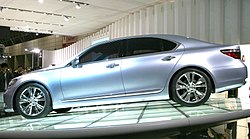 Side profile.
 -
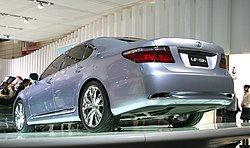 Integrated exhaust vents.
 -
 At the '05 Tokyo Motor Show.


LF-X
[edit]
Concept crossover vehicle. The LF-X designation stands for Lexus Future-Crossover(X).[23] This vehicle was the first to appear in the LF Series, and was initially revealed using the prior Lexus concept nomenclature as the HP-X. The LF-X design fits between the RX crossover and the GX large SUV. If produced (possibly under the VX or JX designation), the LF-X would offer three rows of seating, compared to the RX's two rows. The LF-X was produced using the GS 430 platform, and equipped with a 300-horsepower V8 engine. The instrument panel was designed to be customizable for size, position, and color. Rear seat entertainment screens could be deployed from the center console.[46] Overall length was 4,935 mm (194.3 in), width 1,984 mm (78.1 in), and height 1,646 mm (64.8 in), with wheelbase at 2,959 mm (116.5 in).[46]
-
 Forward view of LF-X concept
 -
 LF-X dashboard
 -
 LF-X side profile, interior


LF-Xh
[edit]
The Lexus LF-Xh is a concept crossover hybrid vehicle. The LF-Xh designation stands for Lexus Future-Crossover(X) hybrid. This vehicle was first shown in October 2007 at the Tokyo Motor Show and appeared also at the October 2008 Paris Motor Show.[47] The LF-Xh featured a V6 engine with electric motors, LED headlights and taillights, and a concept interior.[47][48]
-
 LF-Xh angle view.
 -
 Front view.
 -
 In matte black.


.jpg)
LF-UX
[edit]
The Lexus LF-UX was revealed at the 2016 Paris Motor Show as a preview for a new subcompact SUV called UX.[49] It was designed at Toyota ED2 design studio by Stephan Rasmussen (exterior) and Alexandre Gommier (interior).[50][51]


LF-30
[edit]

The LF-30 is an electric concept car which premiered at the 2019 Tokyo Motor Show. It features innovative tech such as four in-wheel electric motors and wireless charging.[52]
LF-1 Limitless
[edit]

The LF-1 Limitless is a luxury crossover concept revealed in 2018 at the North American International Auto Show as a preview for an upcoming flagship crossover.[citation needed]
LF-Z Electrified
[edit]
The LF-Z Electrified is built on an all-electric platform. The concept car has the "Direct4" all-wheel drive system which allows torque to be vectored individually to each wheel using two traction motors. It carries a 90 kWh lithium-ion battery and has an estimated range of 600 km (370 mi) on the WLTP cycle used in Europe.[53] It also has a claimed acceleration time from 0 to 100 km/h (62 mph) in 3 seconds.[54] The design was later served as the basis for the RZ.
LF-ZC
[edit]

The LF-ZC is a luxury sedan concept which premiered at the 2023 Japan Mobility Show.[citation needed]
LF-ZL
[edit]

The LF-ZL is a luxury crossover concept which premiered at the 2023 Japan Mobility Show.[citation needed]
References
[edit]- ^ "Lexus Geneva Motor Show" (Press release). Archived from the original on 2006-05-07.
- ^ "With LF-C Concept, Lexus Drops Gauntlet for BMW". Cars.com. 2004-04-08. Archived from the original on 2008-01-12. Retrieved 2008-06-21.
- ^ Hall, Kenji (2005-10-20). "Toyota Grows a Greener Lexus". BusinessWeek. Archived from the original on 2008-02-08. Retrieved 2008-06-21.
- ^ "What the 2006 Lexus IS is, and isn't". AutomoBear.com. 2005-03-07. Archived from the original on 2006-04-26. Retrieved 2007-05-06.
- ^ "2010 Lexus LFA". Supercars.net. Retrieved 2009-10-30.
- ^ "Lexus LF-A - uus superauto" (in Estonian). AutoNet.ee. Archived from the original on 2011-07-20. Retrieved 2009-10-23.
- ^ "Lexus Unveils LF-A Concept at 2005 NAIAS". Worldcarfans.com. 2005-01-10. Archived from the original on 2008-10-28. Retrieved 2011-11-26.
- ^ "Lexus LF-A | Auto Express News | News". Auto Express. 2008-01-23. Archived from the original on 2009-02-10. Retrieved 2010-02-28.
- ^ "Lexus LF-A Greenlighted for Production". Leftlane News. 2006-03-02. Archived from the original on 2006-08-21.
- ^ "Spyshot limited-production exotic codenamed TXS". Channel4.com. Archived from the original on 2009-12-21. Retrieved 2011-11-26.
- ^ "2011 Lexus LF-A". Jalopnik.com. 2008-04-15. Archived from the original on 2013-11-10. Retrieved 2011-11-26.
- ^ "Lexus LF-A Production Prototype Shows Bigger Retractable Rear Wing at Nurburgring". Worldcarfans.com. Archived from the original on 2009-05-15. Retrieved 2011-11-26.
- ^ ""Lexus confirms 500hp V10 for LF-A", a Leftlane News entry". Leftlanenews.com. 2005-10-13. Archived from the original on 2011-07-13. Retrieved 2011-11-26.
- ^ ""Lexus website claims more than 500hp, "Lexus.ca"". Lexus.ca. Archived from the original on 2011-01-04. Retrieved 2011-11-26.
- ^ "Lexus LF-A Supercar Will Cost $225,000". Edmunds. Archived from the original on 2008-05-25. Retrieved 2008-05-25.
- ^ "Lexus LF-A Supercar Priced at $403,000 - autoevolution". www.autoevolution.com. Archived from the original on 2009-07-12. Retrieved 2009-07-20.
- ^ "Lexus's 552bhp supercar is 'Ring leader'". AutoExpress. Archived from the original on 2009-04-04. Retrieved 2009-07-06.
- ^ "Lexus LF-A breaks Porsche GT2's Nurburgring record (unofficially) -". egmCarTech. Archived from the original on 2009-05-02. Retrieved 2009-07-06.
- ^ "Lexus LF-A » Тюнинг портал" (in Russian). axtuning.ru. Retrieved 2009-10-23. [dead link]
- ^ "Future/Concept Vehicles - LF-AR". Lexus. Archived from the original on 2012-01-11. Retrieved 2011-11-26.
- ^ "Lexus LF-A Renamed LF-L". 4wheelsnews.com. 2010-08-30. Archived from the original on 2011-10-07. Retrieved 2011-11-26.
- ^ "Lexus LF-C Concept". RSportscars. 2006-02-03. Archived from the original on 2006-10-21.
- ^ a b c d "concept cars". Lexus.jp. Archived from the original on 2011-09-29. Retrieved 2011-11-26.
- ^ "Atlanta Auto Show: Lexus LF-C Convertible Concept Car". Samanathon.com. Archived from the original on 2011-11-12. Retrieved 2011-11-26.
- ^ "Lexus LF-C Concept (2004)". carbodydesign.com. Archived from the original on 2010-09-13. Retrieved 2012-02-19.
- ^ a b c "Frankfurt 2009: Lexus LF-Ch Concept shines in Frankfurt". iCars Singapore. Archived from the original on 2009-12-01. Retrieved 2009-09-21.
- ^ a b "Lexus LF-Ch Concept: Premium. Hybrid". Jalopnik. 10 September 2009. Archived from the original on 2009-09-13. Retrieved 2009-09-21.
- ^ a b "Lexus' "C-Premium" upmarket small car gets a name: CT 200h..." My.IS. Archived from the original on 2009-10-03. Retrieved 2009-09-21.
- ^ Ramsey, Jonathon (2012-09-27). "Lexus LF-CC Concept is a tidy, welcome look into brand's future". autoblog.com. Archived from the original on 2013-08-08. Retrieved 2013-04-19.
- ^ "LEXUS、パリモーターショーに「LEXUS LF-CC」を出展" ["LEXUS LF-CC" exhibited at the Paris Motor Show] (Press release). Japan: Toyota. 2012-09-17. Archived from the original on 2013-06-15. Retrieved 2013-04-19.
- ^ a b c Patrick Hong (9 January 2012). "Designing the Lexus LF-LC Concept Car –Behind-the-Scenes Exclusive Lexus LF-LC Concept – RoadandTrack.com". Road & Track. Archived from the original on 2012-02-12. Retrieved 2012-02-04.
- ^ a b Nelson Ireson. "Lexus LF-LC Concept Debuts At 2012 Detroit Auto Show". Motor Authority. Archived from the original on 2017-02-15. Retrieved 2012-02-04.
- ^ "Detroit Auto Show: Lexus LF-LC Drives Across Digital Divide - Driver's Seat - WSJ". WSJ. Archived from the original on 2018-11-23. Retrieved 2017-08-04.
- ^ Damon Lavrinc. "Road & Track leaks Lexus LF-Lc concept". Autoblog. Archived from the original on 2012-02-13. Retrieved 2012-02-04.
- ^ "Mark Templin responds to a reporter". You Tube. Archived from the original on 2021-12-22. Retrieved 2013-05-04.
- ^ "Lexus ponders LF-LC production". www.autocar.co.uk. 2012-03-24. Archived from the original on 2016-01-15. Retrieved 2013-04-03.
- ^ "Lexus coupe adds a dash of flash". Automotive News. 2012-03-24. Archived from the original on 2021-12-20. Retrieved 2013-04-03.
- ^ "Lexus LF-LC Headed to Production". Wards Auto. 2013-03-27. Archived from the original on 2013-03-31. Retrieved 2013-04-03.
- ^ "Lexus sports cars under consideration". The Age. Australia. 2013-01-13. Archived from the original on 2013-01-21. Retrieved 2013-04-03.
- ^ "Global Debut of All-New Lexus LC 500 at the 2016 NAIAS Signals Dawn of a New Era for Lexus" (Press release). US: Lexus. 2016-01-11. Archived from the original on 2016-01-13. Retrieved 2016-01-12.
- ^ George Kennedy (2012-10-19). "Lexus shows LF-LC Blue at Australian auto show". Autoblog. Archived from the original on 2015-02-03. Retrieved 2015-05-13.
- ^ Jeffrey N. Ross (2012-11-29). "Lexus LF-LC Concept goes blue, remains happy". Autoblog. Archived from the original on 2015-01-30. Retrieved 2015-05-13.
- ^ Stoklosa, Alexander (September 2013). "Lexus LF-NX Concept – Toyota's luxury division churns out a looker of a compact crossover". Car and Driver. Archived from the original on 2014-07-03. Retrieved 2014-06-08.
- ^ "Lexus LF-SA Subcompact Concept Debuting At 2015 Geneva Motor Show". Motorauthority.com. Archived from the original on 2015-02-18. Retrieved 2015-02-18.
- ^ "Lexus LF-SA concept: a Ginevra uno sguardo verso il futuro [FOTO LIVE E VIDEO]". Motorionline.com (in Italian). Retrieved 2023-01-14.
- ^ a b "Lexus LF-X Lexus design future". Carpages.co.uk. Archived from the original on 2012-03-02. Retrieved 2011-11-26.
- ^ a b "Tokyo Motor Show: The Lexus LF-Xh Concept". Thepassionatepursuit.com. Archived from the original on 2009-03-01. Retrieved 2011-11-26.
- ^ "LF-XH Future Models, LFXH - Lexus Australia". Lexus.com.au. Archived from the original on 2010-06-24. Retrieved 2010-02-28.
- ^ "Lexus UX Concept Shows A New Take On Compact Crossover Design In Paris". Motor1.com. 2016-09-29. Archived from the original on 2021-01-16. Retrieved 2020-05-10.
- ^ Gallina, Eric (2017-04-12). "Walkaround the Lexus UX Concept with Toyota's ED2 Designers". Form Trends. Retrieved 2023-01-14.
- ^ "World Premiere of Lexus UX Concept | Toyota Motor Corporation Official Global Website". global.toyota. Retrieved 2023-01-14.
- ^ "Lexus Presents its Vision of Future Electrification with the World Premiere of the LF-30 Electrified Concept" (PDF). Lexus. Archived (PDF) from the original on 2021-01-14. Retrieved 2021-01-13.
- ^ Gold, Aaron (March 30, 2021). "You're Living in 2021, the New Lexus LF-Z Electrified Concept Is Living in 2025". Motor Trend. Retrieved 22 May 2022.
- ^ "2021 LF-Z Electrified Concept World Premiere". Singapore: Lexus. Archived from the original on 2021-12-20. Retrieved 2021-12-17.
External links
[edit]- L-finesse - official site
- Lexus LF - official U.S. site
- Lexus Future - official Australia site
A division of Toyota Motor Corporation | |||||||||
| Current models |
| ||||||||
| Discontinued | |||||||||
| Future vehicles | |||||||||
| Concept vehicles | |||||||||
| Motorsport | |||||||||
| Technology |
| ||||||||
| Key people | |||||||||
| See also | |||||||||


Lexus LF
View on GrokipediaIntroduction
Overview of the LF Series
The Lexus LF series, standing for "Lexus Future," represents a line of concept vehicles developed by Lexus to preview innovative designs, advanced technologies, and potential future production models, unconstrained by manufacturing limitations.[1] These concepts serve as experimental platforms to push the boundaries of automotive aesthetics, engineering, and user experience, embodying Lexus's commitment to forward-thinking luxury mobility.[6] The series originated with the debut of the LF-S sedan and LF-X crossover concepts at the 2003 Tokyo Motor Show, signaling a pivotal shift in Lexus's design language toward bolder, more emotive forms inspired by the L-finesse philosophy, which emphasizes leading-edge innovation and refined simplicity.[1] The LF-A supercar followed in 2005 at the North American International Auto Show (NAIAS) in Detroit. This introduction marked the beginning of Lexus's strategic use of show cars to explore diverse vehicle architectures and captivate global audiences.[7] At its core, the LF series aims to investigate cutting-edge styling cues, varied powertrains—including gasoline, hybrid, electric, and fuel cell systems—and premium interior features, fostering ideas that transition into real-world vehicles.[1] By 2025, Lexus had unveiled over 20 LF concepts, with influential designs shaping production models such as the LC coupe (drawn from the LF-LC), the NX crossover (inspired by the LF-NX), and the UX subcompact (influenced by the LF-SA).[8][4] The evolution of the LF series reflects broader industry trends in propulsion technology, starting with a focus on high-performance internal combustion engines and hybrids in the 2000s—exemplified by V8 and V10 powertrains in early models—to an increasing emphasis on electrification after 2020, including battery-electric and hydrogen fuel cell variants that align with Lexus's vision for sustainable luxury.[1][6] This progression underscores the series' role in Lexus's long-term strategy for zero-emission mobility.[9]Design Philosophy and Evolution
The L-finesse design philosophy, introduced by Lexus in the early 2000s, forms the cornerstone of the LF series, blending "leading-edge" innovation with refined "finesse" to create vehicles that embody Japanese craftsmanship, or takumi, alongside avant-garde aesthetics. This approach emphasizes incisive simplicity, intriguing elegance, and seamless anticipation, resulting in designs featuring seamless surfaces, human-centered luxury, and a harmonious integration of form and function.[10][11][12] The evolution of LF designs unfolded in distinct phases, beginning in the early period (2003–2010) with a focus on radical proportions and performance-oriented aesthetics that challenged conventional luxury norms through bold, sculptural forms. By the mid-period (2011–2015), the emphasis shifted toward refinement for production feasibility, incorporating more balanced lines and practical innovations while maintaining the core L-finesse tenets. In recent years (2016–present), the series has integrated sustainable materials and advanced digital interfaces, reflecting a broader commitment to environmental responsibility and technological immersion.[1][13] Key innovations underscore this progression, including the debut of the iconic spindle grille in the LF-Gh concept of 2011, which became a signature element symbolizing Lexus's assertive yet elegant identity and influencing subsequent production models. This evolved into the "e-spindle" form in electric concepts like the LF-Z of 2021, where the grille integrates seamlessly into the bodywork to accommodate battery-electric architecture without compromising visual impact. Further advancements appear in the LF-ZL of 2023, which employs bamboo and recycled materials to highlight sustainable luxury, aligning with circular economy principles through efficient, renewable resources.[12][6][4] These LF concepts profoundly shaped Lexus's global image, transforming perceptions from earlier critiques of understated "boring luxury" to a reputation for dynamic, flagship designs that prioritize emotional engagement and forward-thinking innovation.[1][14]Early Concepts (2005–2010)
LF-A
The Lexus LF-A was unveiled at the 2005 North American International Auto Show (NAIAS) in Detroit as a high-performance two-seat roadster that embodied Lexus's ambition to enter the supercar segment.[15] This hand-built prototype served as a design study, blending aggressive aesthetics with performance-oriented engineering to foreshadow the brand's future flagship sports car.[16] Its bold styling featured a low-slung wedge-shaped profile, emphasizing dynamic proportions and a sense of forward motion, with a compact footprint that highlighted Lexus's "L-finesse" design philosophy of simplicity and elegance.[17] Key design elements included a primarily aluminum body constructed over a chassis of aluminum extrusions and castings, joined via welds, rivets, and adhesives to achieve lightweight rigidity.[15] The exterior showcased sharp lines and a muscular stance, with conventional door openings rather than exotic hinges, and an overall height of 1,219 mm that contributed to its planted, aggressive road presence.[17] Dimensions measured 4,399 mm in length, 1,859 mm in width, and a wheelbase of 2,581 mm, making it the most compact yet powerful Lexus concept at the time.[17] The interior was envisioned as a "luxury high-speed capsule," with precision controls and premium materials tailored for driver engagement.[17] The powertrain centered on a rear-wheel-drive layout powered by a naturally aspirated V10 engine with a displacement under 5.0 liters, delivering more than 500 horsepower and targeting a top speed of approximately 200 mph.[15][17] This high-revving unit, paired with optimized gearing and aerodynamics, underscored the concept's focus on exhilarating performance and efficiency.[17] Tires measured 245/40R19 at the front and 285/35R19 at the rear, supporting agile handling.[17] The LF-A's significance lay in establishing the performance benchmark for the LF series and directly influencing the production Lexus LFA supercar, which entered limited production from 2010 to 2012.[15][18] Its emphasis on lightweight materials paved the way for the LFA's advanced carbon fiber-reinforced plastic monocoque, while the V10 powertrain concept evolved into the production model's Yamaha-co-developed engine, known for its distinctive acoustic tuning.[15] Only 500 units of the LFA were built, cementing the LF-A's role as a pivotal step in Lexus's pursuit of supercar excellence.[18]LF-S
The Lexus LF-S is a concept luxury sedan that debuted at the 2003 Tokyo Motor Show as the first vehicle in Lexus's LF (Lexus Future) series, signaling the brand's new L-Finesse design philosophy focused on bold, simple, and intriguing lines.[7] It made its U.S. debut at the 2005 Greater Los Angeles Auto Show and was also displayed at the 2005 North American International Auto Show (NAIAS) alongside the LF-A, previewing ideas for a flagship sedan that would influence the next-generation GS model.[19][20] The exterior design emphasized harmony between form and function, with long integrated lines creating a wrap-around appearance that eliminated traditional rear corners for a sleek, dynamic profile. This approach simplified the vehicle's shape while incorporating a slingshot cabin and rear deck lid styling that later appeared on the third-generation Lexus GS production sedan.[19] The concept explored upscale interior and exterior harmony, using innovative features like side-mounted cameras in place of traditional mirrors and a transparent panoramic roof with integrated security illumination to enhance visibility and safety.[1] Inside, the LF-S prioritized luxury and driver-centric comfort for five passengers, with a focus on anticipating user needs through advanced ergonomics and a sense of spaciousness. It highlighted Lexus's commitment to hospitality, laying groundwork for "Omotenashi" principles in later models by creating an inviting cabin environment.[19] The powertrain explored all-wheel drive options paired with a high-output hybrid V8 setup, aiming for refined performance in a premium sedan package.[19][1] The LF-S held significant influence on subsequent Lexus sedans, particularly the LS series, by emphasizing a quiet cabin, advanced suspension for smooth ride quality, and overall upscale harmony that blended performance with comfort. Its design cues contributed to the evolution of Lexus's flagship vehicles, prioritizing emotional engagement and visual intrigue over conventional styling.[1]LF-X
The Lexus LF-X is a concept crossover SUV that debuted at the 2003 Tokyo Motor Show, marking Lexus's exploration into premium three-row luxury utility vehicles.[7][1] This vehicle embodied the brand's L-finesse design philosophy, emphasizing a blend of dynamic exterior styling and advanced engineering to appeal to families seeking versatile luxury.[21] As part of the early LF series' push into SUV territory, it represented Lexus's initial foray beyond traditional sedans and coupes into spacious, multi-purpose crossovers.[1] Key design elements included a tall stance measuring 1,646 mm in height, which contributed to its imposing yet elegant profile, along with integrated powertrain cues visible in the grille and underbody shielding.[22] The exterior featured a panoramic glass roof that enhanced the sense of openness, pronounced wheel arches for a resolute appearance, and LED lighting for a futuristic touch, all finished in a matte black to underscore its premium positioning.[23] These features highlighted the concept's focus on combining athletic proportions with practical utility, measuring 4,935 mm in length and 1,985 mm in width.[24] The powertrain consisted of a 4.3 L V8 gasoline engine with all-wheel drive, delivering approximately 300 bhp for efficient performance.[24][1] This setup prioritized refined operation and performance, aligning with Lexus's emphasis on luxury in larger vehicles.[7] Inside, the LF-X offered a six-seat layout with three rows, including a stowable third row, complemented by an advanced navigation system integrated into the dashboard for enhanced driver convenience.[25] The interior emphasized luxury through high-quality materials and intuitive controls, creating a spacious cabin that supported the concept's family-oriented versatility.[22] The LF-X held significant importance as a preview for Lexus's expansion into the premium SUV segment, influencing the design and features seen in subsequent models like the third-generation RX and elements of the GX lineup, while testing market interest in larger utility vehicles.[26]LF-A Roadster
The Lexus LF-A Roadster concept debuted at the 2008 North American International Auto Show (NAIAS) in Detroit as an open-air evolution of the LF-A supercar concept, featuring a power-operated fabric top that folded behind the rear seats.[27][28] This roadster adaptation built on the original LF-A platform, emphasizing convertible dynamics with minimal changes to the bodywork while incorporating a carbon fiber chassis for enhanced structural integrity in the open-top configuration.[28] The design showcased Lexus's L-finesse philosophy through a low-profile stance, compact front end, and speed-adaptive rear wing, complemented by wrap-around arrowhead taillights and large rear grilles for improved radiator venting and aerodynamics.[27] Key design elements included 20-inch wheels fitted with 265/35R20 front and 305/30R20 rear tires, along with large cross-drilled vented disc brakes measuring 14.2 inches at the front and 13.6 inches at the rear, optimizing performance for open-air driving.[27] The vehicle's dimensions were slightly more elongated than typical concepts at 4,462 mm in length, 1,895 mm in width, 1,219 mm in height, and a 2,607 mm wheelbase, providing balanced proportions for high-speed stability.[27] These features highlighted adaptations for wind management and chassis rigidity, ensuring the roadster maintained the supercar's dynamic poise without the coupe's fixed roof.[28] The powertrain mirrored the LF-A's high-revving 5.0-liter V10 engine, delivering 552 horsepower and mounted in a front-mid position, paired with a sequential manual transmission featuring paddle shifters and connected via a torque tube for precise rear-wheel drive.[27][28] This setup enabled a top speed exceeding 200 mph, underscoring the roadster's capability as a high-performance convertible.[27] The LF-A Roadster explored greater accessibility in supercar design by introducing open-top enjoyment, influencing subsequent rumors of a production LFA Roadster variant, though only two functional prototypes were ultimately built and no series version materialized due to cost considerations.[28] It represented Lexus's vision for blending luxury, performance, and exhilaration in a more approachable format, paving the way for future convertible explorations in the brand's lineup.[27]LF-Ch
The Lexus LF-Ch concept represented Lexus's initial foray into hybrid technology for the premium compact segment, blending sporty aesthetics with efficient power delivery in a grand tourer-inspired package. Unveiled at the 2009 Frankfurt Motor Show on September 15, it served as an early showcase of the brand's commitment to full hybrid systems tailored for urban and performance-oriented driving. The concept later made its North American debut at the 2009 Los Angeles Auto Show and was displayed at the 2010 North American International Auto Show (NAIAS) in Detroit, where it highlighted Lexus's expanding hybrid portfolio amid growing environmental concerns in the automotive industry.[29] Design-wise, the LF-Ch adopted a sleek, low-slung coupe profile achieved through a pillarless appearance, tapered side glazing, and concealed rear door handles on its five-door hatchback body, measuring 169.3 inches in length with a 102.4-inch wheelbase. This configuration contributed to a muscular, dynamic stance with a wide track and low center of gravity, enhanced by 20-inch alloy wheels shod in 225/35R20 tires. The front featured an aggressive, hybrid-optimized grille integrated into a full-width bumper with a prominent air dam, allowing for improved airflow to support the powertrain's cooling needs while maintaining the brand's L-finesse philosophy of powerful surfacing and sculpted details.[30] At its core, the LF-Ch employed Lexus's latest full hybrid powertrain, combining a gasoline engine with electric motors to deliver responsive performance and low emissions, supported by a lithium-ion battery pack for enhanced efficiency. The system included a dedicated EV mode for seamless, zero-emission electric-only operation in urban settings, emphasizing quiet and vibration-free driving transitions between electric and hybrid propulsion. While specific output figures were not disclosed, the setup prioritized a balance of acceleration and fuel economy, aligning with rear-biased handling dynamics for engaging grand tourer capabilities.[29][30] The LF-Ch held significant preview value for Lexus's hybrid advancements, directly influencing the development of the production CT 200h compact hybrid introduced in 2011, which adopted similar technology for seamless EV-to-hybrid mode shifts and premium compact positioning. This concept underscored Lexus's strategy to integrate hybrid efficiency into sportier formats without compromising luxury or drivability, targeting younger demographics in Europe and beyond with its low-emission profile and refined performance.[31] Inside, the cabin emphasized driver focus with an asymmetric dashboard layout and high-quality materials, including leather-upholstered sport seats for four passengers framed in polished metal and wood accents. Instrumentation featured a turbine-motif binnacle with twin analog dials augmented by digital displays for hybrid system status, while amenities like a Remote Touch controller and headrest-integrated device docking enhanced connectivity and comfort. Ambient lighting along seat edges further elevated the premium atmosphere, previewing interactive interior innovations in future Lexus models.[29][30]LF-Gh
The Lexus LF-Gh, denoting Lexus Future Grand-touring Hybrid, debuted at the 2011 New York International Auto Show as a mid-size luxury sedan concept that explored sustainable performance in a flagship context.[32] This vehicle marked the official introduction of the spindle grille, a bold, hourglass-shaped front fascia inspired by traditional Japanese craftsmanship and designed to convey both aggression and elegance, evolving from earlier Lexus design experiments.[33] The concept emphasized a harmonious blend of luxury, efficiency, and dynamic driving, positioning hybrid technology as central to future premium sedans. Externally, the LF-Gh featured an elongated sedan body with a long greenhouse roofline spanning 4,890 mm in length and a 2,850 mm wheelbase, optimizing interior space while maintaining an agile rear-wheel-drive platform.[34] Chrome accents highlighted the spindle grille and side sculpting, complemented by aerodynamic optimizations such as sculpted air vents, tapered rear glass, and low-profile 20-inch wheels to reduce drag and enhance hybrid efficiency.[12] These elements contributed to a low coefficient of drag, supporting the vehicle's focus on sustainable grand touring without compromising visual assertiveness. The powertrain integrated Lexus Hybrid Drive technology, pairing a gasoline engine with electric motors for seamless propulsion through the rear wheels, though specific engine displacement and output details were not disclosed as the concept prioritized design over finalized specifications.[35] Internally, the cabin offered a driver-oriented layout with premium materials, including hints of leather and wood trim, and emphasized rear executive seating for four passengers in a spacious, ultra-premium environment designed for comfort and connectivity.[12] The LF-Gh advanced sustainable flagship concepts by influencing production models like the fourth-generation Lexus GS sedan, where its design language—including the spindle grille—and hybrid emphasis were adapted to enhance noise insulation, ride refinement, and fuel efficiency.[36] This focus on quiet, efficient luxury helped elevate Lexus's hybrid lineup, promoting eco-friendly performance in the premium segment.Mid-Period Concepts (2011–2015)
LF-C2
The Lexus LF-C2 is a concept vehicle unveiled at the 2014 Los Angeles Auto Show, serving as an open-top evolution of the Lexus RC coupe to emphasize enhanced open-air driving dynamics.[37][38] This 2+2 roadster design study explored bolder styling cues for future Lexus models, featuring a roofless configuration that prioritizes top-down accessibility without any retractable covering, allowing seamless interaction between occupants and the environment.[39][40] Key design elements include a highly stylized exterior with sharp creases, a prominent spindle grille executed in braided metal, and aerodynamic fins that accentuate light interactions across curved surfaces. The interior incorporates premium touches such as deeply bolstered suede seats, a multi-dimensional instrument panel, and drive-by-wire controls, all oriented toward driver engagement in an open format. To maintain chassis rigidity in the absence of a roof, the structure features reinforced engineering adapted from the RC platform's front-engine, rear-wheel-drive layout.[41][42][43] While specific powertrain specifications were not officially detailed for the concept, its underpinnings suggest compatibility with the RC lineup's options, including a 3.5-liter V6 engine delivering approximately 306 horsepower or the RC F's 5.0-liter V8 producing 467 horsepower, paired with rear-wheel drive and potential eight-speed automatic transmission.[44][45] These elements, combined with enhanced structural reinforcements, underscore the concept's focus on balancing open-air freedom with performance stability. Measuring 4,715 mm in length, 1,840 mm in width, and 1,385 mm in height, the LF-C2 adopts proportions closely aligned with the RC coupe while optimizing for roadster versatility, including 20-inch five-spoke alloy wheels and a low-slung stance.[46][47] The LF-C2's significance lies in its exploration of multi-functional luxury convertibles, targeting younger demographics through dramatic aesthetics and uncompromised open-top enjoyment, while previewing potential RC convertible variants—though production plans were ultimately shifted to other priorities like crossovers.[48][49] It builds briefly on the engineering heritage of earlier LF concepts, adapting coupe-derived dynamics to convertible applications.[43]LF-CC
The Lexus LF-CC is a mid-sized 2+2 hybrid coupe concept that debuted at the 2012 Paris Motor Show, showcasing Lexus's evolving L-finesse design language and advanced hybrid technology for future production models.[50] As a front-engine, rear-wheel-drive vehicle, it emphasized driver engagement through a sporty fastback profile and innovative interfaces, positioning it as a preview for compact luxury coupes.[51] Key design elements included slim, three-LED projector headlamps integrated into the fender surfaces without a traditional cover, creating a sleek, aerodynamic appearance, alongside the signature spindle grille.[50] The interior featured a precursor to the Remote Touch system via touch-tracer display technology, allowing remote control of infotainment through gesture-based screens across the dashboard and console.[52] Trimmed in amber-colored leather with metallic accents, the cabin prioritized progressive luxury and human-machine interface advancements.[52] The powertrain consisted of a new 2.5-liter DOHC four-cylinder Atkinson-cycle petrol engine paired with a high-output, water-cooled electric motor in a full hybrid setup, delivering efficient performance with over 2 horsepower per gram of CO2 emitted.[50] This front-engine, rear-drive configuration aimed to balance sporty dynamics with hybrid efficiency, building on earlier hybrid coupe explorations.[51] The LF-CC significantly influenced the production Lexus RC 300h, which debuted in 2014 and adopted similar hybrid powertrain elements and design cues for enhanced driver-focused grand touring.[53]LF-LC
The Lexus LF-LC is a hybrid 2+2 grand tourer concept vehicle unveiled by Lexus at the 2012 North American International Auto Show (NAIAS) in Detroit on January 9, 2012, showcasing the brand's evolving design philosophy and advanced hybrid technology.[54] Designed at the Calty Design Research studio, it emphasized a front-engine, rear-wheel-drive layout with a low-slung coupe profile, measuring approximately 4760 mm in length and featuring a dramatic, aerodynamic silhouette inspired by grand touring aesthetics.[55] The exterior highlighted an early iteration of the signature spindle grille with a three-dimensional mesh pattern framed in polished aluminum, paired with L-shaped LED headlights and extensive use of lightweight carbon fiber-reinforced polymer body panels to reduce weight while enhancing structural rigidity.[54] Complementing the design were 22-inch alloy wheels wrapped in low-profile tires, contributing to its aggressive stance and performance-oriented appearance.[56] At the heart of the LF-LC was an Advanced Lexus Hybrid Drive powertrain, combining a 3.5-liter V6 gasoline engine with electric motors to deliver a total system output of 500 horsepower (372 kW) and prioritize both dynamic performance and efficiency.[8] This setup targeted rear-wheel drive as standard, with potential for all-wheel-drive adaptations in future iterations, and incorporated regenerative braking and electric-only modes for refined urban driving.[57] The concept's interior adopted a driver-centric cockpit with dual 12.3-inch LCD displays—one for instrumentation and the other for multimedia controls—integrated via a remote touch interface, surrounded by premium materials like supple leather, suede, brushed aluminum, and wood accents for a luxurious ambiance.[54] The LF-LC's design and engineering directly influenced the production Lexus LC 500h luxury coupe, revealed at the 2016 NAIAS and entering the market in 2017 as a flagship grand tourer with a detuned hybrid variant producing 354 horsepower.[58] By mid-2025, the LC lineup had achieved global sales exceeding 14,000 units, underscoring the concept's role in revitalizing Lexus's coupe segment with its blend of hybrid innovation and opulent styling.[59] Production models retained key elements like the 12.3-inch multimedia display and optional Mark Levinson 13-speaker premium audio system, enhancing the cabin's connectivity and auditory experience.[60]LF-NX
The Lexus LF-NX is a compact crossover concept vehicle developed by Lexus to explore the potential for an urban luxury SUV in its lineup, building on the brand's earlier SUV concepts like the LF-X by targeting a smaller, more agile segment.[61] It made its world premiere at the 2013 Frankfurt Motor Show as a hybrid-powered study, followed by a turbocharged variant unveiled at the 2013 Tokyo Motor Show, both previewing the production NX models.[62] The concept emphasized a bold, human-oriented design philosophy, combining premium materials with advanced technology to appeal to city drivers seeking dynamic performance and efficiency.[63] The LF-NX featured angular, sculpted exterior lines that evolved Lexus's L-finesse language, including a prominent spindle grille, muscular wheel arches, and a coupe-like silhouette with a steeply raked tailgate for a floating roof effect.[61] Its compact dimensions—approximately 182.7 inches in length—suited urban environments, while 20-inch alloy wheels wrapped in 255/45 Z-rated tires enhanced its sporty stance and all-wheel-drive capability.[62] Finished in Brushed Metal Silver, the design incorporated expressive daytime running lights and articulated rear lamp clusters, creating a distinctive, aggressive profile that prioritized visual impact and aerodynamic efficiency.[64] Powertrain options showcased Lexus's push into versatile propulsion for crossovers. The initial Frankfurt version utilized a new variant of the Lexus Hybrid Drive system tuned for SUV dynamics, pairing a gasoline engine with electric motors for responsive acceleration and fuel efficiency.[61] The Tokyo LF-NX Turbo introduced the brand's first turbocharged gasoline engine, a 2.0-liter inline-four with twin-scroll turbocharging, active wastegate, and direct injection, delivering quick throttle response and high torque through all-wheel drive, though exact output figures were not disclosed at debut.[62] These setups highlighted Lexus's focus on balancing performance with environmental considerations in a compact package. Inside, the LF-NX offered a driver-centric cockpit divided into an upper display zone and lower operation zone, featuring touch-sensitive controls and the Remote Touch Interface for intuitive navigation.[62] Upholstered in two-tone Sunrise Yellow and Black leather with blue or red ambient lighting, the cabin maximized ergonomics and luxury, complemented by a panoramic glass roof that enhanced the sense of openness and natural light.[64] This interior design philosophy emphasized functionality and premium tactile experiences, setting a benchmark for future Lexus crossovers. The LF-NX concepts directly influenced the 2014 launch of the production NX lineup, including the NX 200t turbo model and NX 300h hybrid, which retained much of the concept's styling and agile handling characteristics for urban luxury driving.[65] By introducing turbo and hybrid options in a nimble chassis, the LF-NX marked Lexus's strategic entry into the competitive compact premium crossover market, prioritizing responsive dynamics over sheer size.[66]LF-SA
The Lexus LF-SA is an ultra-compact concept vehicle that debuted at the 2015 Geneva Motor Show, showcasing a rugged yet luxurious take on a sub-B-segment crossover utility vehicle (CUV) designed for global urban markets.[67] Developed by Lexus' ED² studio in Europe to celebrate the brand's 25th anniversary, the LF-SA embodies the "Lexus Future Small Adventure" philosophy, blending bold L-finesse design cues with driver-focused dynamics in a package measuring 135.8 inches long, 66.9 inches wide, and 56.3 inches high.[68] Its exterior features an angular, sculpted body with a prominent spindle-shaped grille, L-shaped rear lamp clusters, and a stellar silver finish that conveys confident, avant-garde styling suitable for city exploration.[69] The concept emphasizes versatility through its wide stance and elevated proportions, hinting at light off-road capability while prioritizing agile handling in compact spaces.[70] Although specific powertrain details were not disclosed at launch, the LF-SA aligns with Lexus' hybrid expertise, underscoring the brand's commitment to efficient, premium mobility.[71] This adventure-oriented design influenced subsequent developments in Lexus' small-vehicle lineup, particularly by previewing potential subcompact models below the UX crossover, focusing on innovative packaging and real-world adaptability.[72] Inside, the LF-SA offers a surprisingly roomy 2+2 cabin with a driver-centric layout, including a fixed driver's seat paired with adjustable steering and pedals for optimal ergonomics.[68] The front passenger seat slides forward to facilitate rear access, providing modular flexibility, while premium materials like nubuck leather on seats and panels create a handcrafted, luxurious ambiance divided into overlapping elliptical zones inspired by a solar eclipse.[73] Advanced displays, such as a hologram-style digital instrument panel and wide-angle head-up display, enhance the forward-focused experience without overwhelming the compact interior.[67]LF-FC
The Lexus LF-FC is a hydrogen fuel cell-powered concept sedan unveiled at the 2015 Tokyo Motor Show, presented as a visionary zero-emission luxury vehicle that previews future flagship models.[74] This four-door coupe-style design embodies Lexus's "aggressive elegance" philosophy, featuring a sleek, aerodynamic body with a flowing roofline that enhances both aesthetics and efficiency for straight roads and winding routes alike.[75] The exterior incorporates an evolved signature spindle grille with a mesh pattern and floating L-shaped daytime running lights, complemented by triple-beam LED headlamps and 21-inch wheels with carbon fiber-reinforced plastic rims for reduced weight and improved performance.[75] Inside, the LF-FC emphasizes spacious, forward-looking luxury with hammock-style aniline leather front seats that appear to float, creating an open and airy cabin atmosphere.[76] Rear seats recline in a limousine configuration, offering ample legroom and wood accents, while advanced features include a gesture-controlled humanoid machine interface with holographic projections above the center console for intuitive operation.[77] Ambient lighting and premium materials further elevate the interior's serene, high-tech ambiance, aligning with Lexus's focus on progressive luxury.[74] The powertrain centers on a high-output hydrogen fuel cell system, delivering approximately 300 horsepower through a rear electric motor and two front in-wheel motors for selectable rear- or all-wheel drive, enabling precise torque distribution and responsive handling.[78] This setup, with the fuel cell stack positioned at the rear and hydrogen tanks integrated under the floor, provides an estimated range of over 500 km on a single fill, underscoring efficient, clean propulsion without compromising luxury performance.[75] The LF-FC's innovative drive system builds on proven Toyota fuel cell technology, such as that in the Mirai, but adapts it for a premium sedan application.[77] As a key showcase of sustainable mobility, the LF-FC prefigured subsequent prototypes like the LS FCV, highlighting Lexus's commitment to hydrogen as a pathway to zero-emission luxury vehicles before the brand's broader pivot toward battery electric architectures.[75]LF-LC GT "Vision Gran Turismo"
The Lexus LF-LC GT "Vision Gran Turismo" is a virtual racing concept created by Lexus for the Gran Turismo video game series, emphasizing the high-performance potential of the LF-LC design in a simulated motorsport environment. Announced on January 30, 2015, by Lexus and Polyphony Digital, it debuted digitally in Gran Turismo 6 via a free update on March 18, 2015, allowing players to experience it in virtual races. A full-scale physical show model was produced and displayed at automotive events later that year to provide a tangible preview of the digital creation.[79][80][81] Developed by Calty Design Research, the American arm of Toyota's design studio, the LF-LC GT incorporates a wider body for enhanced track stability and an aggressive aerodynamic kit tailored for racing, including a vented hood for engine cooling, prominent side-mounted exhaust pipes, and a large rear wing for downforce. Its exterior features a striking pure white racing livery that evokes passion and speed, complemented by tail lamps inspired by jet aircraft afterburners for a futuristic aesthetic. The concept rides on 23-inch wheels wrapped in low-profile tires, underscoring its focus on grip and handling in simulated high-speed scenarios. These elements transform the elegant LF-LC blueprint into a competition-ready machine without altering its core luxury proportions.[80][82][83] The virtual powertrain consists of a 4.0-liter twin-turbocharged V8 engine delivering 600 horsepower to the rear wheels, enabling acceleration and top speeds competitive with GT3-class racers in the game. This rear-wheel-drive setup, paired with a six-speed sequential gearbox, supports agile cornering and straight-line prowess on virtual circuits like those inspired by Super GT and the Nürburgring 24 Hours. Key features include adjustable aerodynamic elements, such as variable wing angles and diffuser settings, which players can tune to optimize performance for specific track conditions, enhancing the immersive racing experience.[83][82] As part of the Vision Gran Turismo program celebrating the franchise's 15th anniversary, the LF-LC GT highlights Lexus's commitment to blending innovative design with racing heritage in the digital space, inspiring fans to envision extreme performance variants of production models. It has no plans for real-world production, serving instead as a platform to explore bold concepts and engage gaming communities with aspirational automotive fantasies. The model's inclusion in subsequent titles like Gran Turismo Sport and Gran Turismo 7 has extended its legacy, allowing ongoing virtual competitions that demonstrate its balanced handling and visual drama.[80][79]Recent Concepts (2016–Present)
LF-UX
The Lexus LF-UX concept vehicle, unveiled at the 2016 Paris Motor Show, represents Lexus's vision for a subcompact crossover tailored to young urban drivers seeking agile luxury in city environments.[84] Designed at the ED2 studio in southern France, it targets "urbanites"—connected, premium customers downsizing from larger vehicles—while competing in Europe's rapidly expanding compact SUV segment.[84] The concept emphasizes an "inside-out" design philosophy that blurs exterior and interior boundaries, fostering an immersive experience through innovative human-machine interfaces.[84] Key design elements include a bold evolution of the spindle grille, slim L-shaped LED daytime running lights forming an X-shaped motif, and muscular yet elegant bodywork finished in Immersive Amethyst paint.[84] With a compact length of 4,400 mm, width of 1,900 mm, height of 1,520 mm, and wheelbase of 2,640 mm, the LF-UX prioritizes urban maneuverability, low ground clearance, and a coupe-like stance, supported by unique 21-inch laser-etched tire-and-wheel fusions (255/50 R21).[84] These features convey 4x4 presence without off-road bulk, highlighting agility for everyday premium mobility.[84] The interior advances luxury through the Kinetic Seat Concept, which uses mechanical elements to reduce fatigue on long drives, paired with a deconstructed dashboard of overlapping angular forms.[84] A four-seat configuration offers agile front seating and sofa-like rear comfort, enhanced by electrochromic glass for privacy, e-mirror camera displays, and a 3D holographic instrument panel for infotainment and climate control.[84] This setup previews advanced connectivity for ever-connected users, with traditional craftsmanship meeting futuristic tech.[84] The LF-UX directly influenced the production Lexus UX, launched in 2018 as Lexus's entry-level luxury crossover and available in markets including Europe, North America, and Japan.[85] The production model introduced a 2.0-liter Atkinson-cycle hybrid powertrain (UX 250h) combining a gasoline engine with electric motors for a total output of 184 PS (approximately 181 hp), paired with a continuously variable transmission and options for front- or all-wheel drive.[85] It also features an F Sport variant with sportier styling and handling.[86] The UX has achieved strong market success as an accessible luxury option, building briefly on the compact crossover theme established by models like the NX.[87]LF-1 Limitless
The Lexus LF-1 Limitless is a concept vehicle that debuted at the 2018 North American International Auto Show (NAIAS) in Detroit, previewing a flagship luxury SUV designed to combine the refined proportions of a sedan with the practicality of a crossover.[88] Developed at Calty Design Research in California, it embodies Lexus' vision for multi-purpose luxury vehicles, emphasizing high performance, unrestrained opulence, and forward-thinking technology in response to evolving SUV trends.[88] Key design elements include a "molten katana" aesthetic, inspired by the forging of Japanese swords, which translates to fluid, aggressive body lines that transition from smooth curves to chiseled forms.[88] The front features the brand's signature spindle grille integrated with LED lighting and no chrome accents for a modern, seamless look, while the rear incorporates sculpted vents and a split spoiler for enhanced aerodynamics.[88] Measuring 197.4 inches in length, 78.2 inches in width, 63.2 inches in height, and with a 117.1-inch wheelbase, the LF-1 Limitless achieves an athletic profile through its low roofline and elevated ride height, supported by 22-inch wheels, blending grand touring elegance with SUV utility.[88] The interior prioritizes occupant comfort and adaptability, drawing from the Japanese concept of omotenashi (hospitality) with a minimalist cockpit free of traditional knobs and buttons, replaced by motion-activated haptic controls.[88] Finished in materials like cocoa bean leather, chiffon white seats, and champagne-tinted metallic trim, it includes a wide, unobstructed dashboard and individual display screens for rear passengers to manage climate and entertainment.[88] A Chauffeur mode enables hands-free operation, enhancing versatility for both driver-focused and relaxed journeys, while 4D navigation integrates environmental data for optimized routing.[88] Powertrain flexibility defines the concept's forward-looking approach, accommodating gasoline, hybrid, plug-in hybrid, battery electric, or fuel cell systems, all paired with all-wheel drive to support Lexus' goal of electrified versions of its entire lineup by 2025.[88] This multi-pathway strategy underscores the vehicle's adaptability, allowing configurations that shift between sedan-like efficiency and SUV capability depending on powertrain choice.[88] The LF-1 Limitless has significantly shaped Lexus' future lineup, influencing models like the TX three-row SUV through its emphasis on versatile luxury and electrification integration.[89] By showcasing a platform capable of sedan-crossover hybridization, it highlighted the brand's commitment to innovative, customer-centric vehicles in the evolving luxury SUV segment.[88]LF-30
The Lexus LF-30 Electrified is a battery-electric concept vehicle unveiled at the 2019 Tokyo Motor Show, representing Lexus's vision for advanced mobility in the year 2030 as part of the broader "Lexus Electrified" strategy to integrate electrification across its lineup.[90][91] Presented by Lexus International President Yoshihiro Sawa, the LF-30 emphasizes a human-centered design philosophy that stimulates the five senses while prioritizing driver engagement and luxury, aiming to redefine vehicle experiences through seamless integration of autonomous capabilities and sustainable technologies.[90] The exterior features a futuristic, hoodless body with a spindle-inspired form, wing-shaped LED headlights, and gullwing doors that enhance accessibility and aerodynamics, complemented by adjustable-opacity windows for privacy and light control.[91][92] Inside, the Tazuna cockpit adopts a 360-degree panoramic layout with gesture-based controls, an augmented reality head-up display, and first-class reclining seats crafted from sustainable materials like Yakisugi cedar and recycled metals, fostering a serene, immersive environment.[91] A prominent SkyGate glass roof provides an expansive overhead view, while advanced hands-free driving is enabled through the Lexus Teammate system, offering Chauffeur mode for full autonomy and Guardian mode for supportive interventions.[91][93] Powered by a fully electric drivetrain with four in-wheel motors delivering a combined 400 kW (approximately 536 horsepower) and 700 Nm of torque, the LF-30 achieves 0-100 km/h acceleration in 3.8 seconds and a top speed of 200 km/h, supported by a 110 kWh battery offering up to 500 km of range under WLTP standards.[91] Key innovations include the DIRECT4 all-wheel-drive system for precise torque distribution and enhanced posture control, steer-by-wire steering for agile handling without mechanical linkages, wireless charging, and AI-based energy management to optimize efficiency.[91][94] As an electrification milestone, the LF-30 influenced subsequent production models, notably introducing DIRECT4 technology that debuted in the 2022 Lexus RZ battery-electric SUV, marking a pivotal step toward Lexus's goal of fully electrified vehicles by the mid-2020s.[95][90]LF-Z Electrified
The Lexus LF-Z Electrified is a battery electric vehicle (BEV) concept that debuted virtually on March 30, 2021, during the Lexus Concept Reveal Show.[6] This grand tourer emphasizes Lexus's vision for electrification, featuring a sleek coupe silhouette with a low front end and a peaked rear for aerodynamic efficiency.[6] The design incorporates an evolved spindle grille integrated into the body as a "spindle body" motif, along with flare-shaped wheel arches that accentuate the large wheels positioned at the corners, contributing to a dynamic and balanced stance.[6][9] The powertrain utilizes a dedicated BEV platform with dual electric motors enabling DIRECT4 all-wheel drive, though rear-wheel-drive configurations are anticipated for production variants.[6][96] A 90 kWh lithium-ion battery provides an estimated range of up to 600 km under WLTP standards, delivering 400 kW of power and 700 Nm of torque for a 0-100 km/h acceleration in 3.0 seconds.[6] As the first Lexus concept on the e-TNGA platform, it previews the brand's 2025 BEV lineup, including over 10 electrified models aimed at achieving carbon neutrality by 2050.[96][6] The vehicle also tests advanced steer-by-wire technology, which eliminates mechanical steering connections for enhanced precision and reduced vibrations.[9] Inside, the LF-Z Electrified features a minimalist "Tazuna" cockpit design inspired by equestrian reins, centered around a large head-up display for intuitive driver interaction.[6] Sustainable materials are incorporated throughout, with careful selection to minimize environmental impact during production and use, complemented by features like a panoramic electrochromic glass roof and AI-assisted voice controls.[9][97] This interior builds briefly on the aspirational vision of the earlier LF-30 concept, adapting futuristic elements for near-term practicality.[6]LF-ZC
The Lexus LF-ZC is a compact battery electric vehicle (BEV) concept designed as a next-generation model tailored for urban markets. It made its world premiere at the Japan Mobility Show in October 2023, showcasing Lexus's vision for accessible electrification in everyday driving scenarios.[4] As part of the broader LF-Z series emphasizing electrification, the LF-ZC highlights a modular platform that prioritizes efficiency and sustainability.[4] The exterior embodies Lexus's "Provocative Simplicity" design philosophy with a sleek fastback silhouette, frameless doors, and a low-slung profile for enhanced aerodynamics, targeting a drag coefficient under 0.2. Its compact footprint measures 4,750 mm in length, 1,880 mm in width, and 1,390 mm in height, with a wheelbase of 2,890 mm, enabling agile maneuverability in city environments while maintaining a spacious interior.[4] Sustainable elements like bamboo-inspired color, material, and finish (CMF) accents underscore its eco-conscious approach.[4] The powertrain features a dual-motor BEV configuration powered by next-generation prismatic high-performance batteries and the DIRECT4 all-wheel drive system, delivering responsive performance through advanced torque vectoring. It incorporates steer-by-wire technology with the One Motion Grip yoke for precise, intuitive control without mechanical linkages. The vehicle aims for a driving range approximately twice that of conventional BEVs, supported by lightweight gigacasting for the body structure. Brake-by-wire integration enhances regenerative braking efficiency, though specific output figures remain undisclosed in official specifications.[4][98][99] The production version of the LF-ZC is scheduled for launch in mid-2027, initially targeting markets in Europe and Asia to address compact luxury EV demand, following a delay announced in December 2024 for additional development.[4][100] The interior leverages the Arene OS infotainment system for over-the-air updates and personalized user experiences, dividing the cabin into distinct zones with a digital cockpit, panoramic roof, and expansive passenger displays for enhanced connectivity and comfort.[101][99]LF-ZL
The Lexus LF-ZL is a battery electric vehicle (BEV) concept that debuted at the Japan Mobility Show 2023, serving as a flagship SUV vision for Lexus's electrification strategy targeting models beyond 2026.[4] This concept expands the LF-Z lineup by previewing a premium, three-row SUV with an emphasis on luxury and advanced mobility integration.[102] Measuring 5,300 mm in length, 2,020 mm in width, and 1,700 mm in height with a 3,350 mm wheelbase, it adopts bold SUV proportions featuring a spindle body design and flared rear wheel arches for enhanced aerodynamics and visual impact.[102] The LF-ZL's design evolves Lexus's "Provocative Simplicity" philosophy, prioritizing emotional engagement through electrification-enabled forms like a low center of gravity and seamless body lines that eliminate traditional engine compartments.[4] Its exterior incorporates sustainable elements, such as efficient bamboo accents, aligning with Lexus's commitment to environmentally conscious materials via the Bamboo CMF Concept.[102] Inside, the cabin emphasizes serenity and space, with reclining lounge-style rear seats, a discreet bamboo partition for rear passengers, and a flat floor enabled by the BEV architecture to maximize interior volume.[103] The powertrain utilizes a next-generation BEV platform with no engine compartment, achieving doubled range potential through weight reduction and aerodynamic optimizations, while maintaining a low center of gravity for stable handling.[102] It integrates advanced software-defined features, including the Arene OS operating system for over-the-air updates and enhanced vehicle control.[4] The interior showcases a next-generation cockpit focused on driver immersion, equipped with a head-up display (HUD) projecting a distant view meter on the windscreen, digital side mirrors, and focus-enhancing digital pads flanking the yoke-style steering wheel.[102] AI-driven personalization elevates the experience through voice recognition systems like "Butler" for intuitive interactions and tailored hospitality services, embodying Lexus's Omotenashi philosophy of anticipatory care.[4] As a preview of a high-end BEV SUV slated for production in 2027, following a delay announced in December 2024, the LF-ZL highlights Lexus's vision for sustainable luxury, integrating mobility with societal harmony and guilt-free ownership through eco-friendly materials and seamless technology.[104][105] It prioritizes hospitality innovations, such as AI-enhanced personalization, to create a prestigious experience that extends beyond traditional automotive boundaries.[4]References
- https://commons.wikimedia.org/wiki/File:Lexus_LF-S_NAIAS_2005.jpg