


Community hub
Recent from talks
Contribute something
Nothing was collected or created yet.
Washer (hardware)
View on Wikipedia
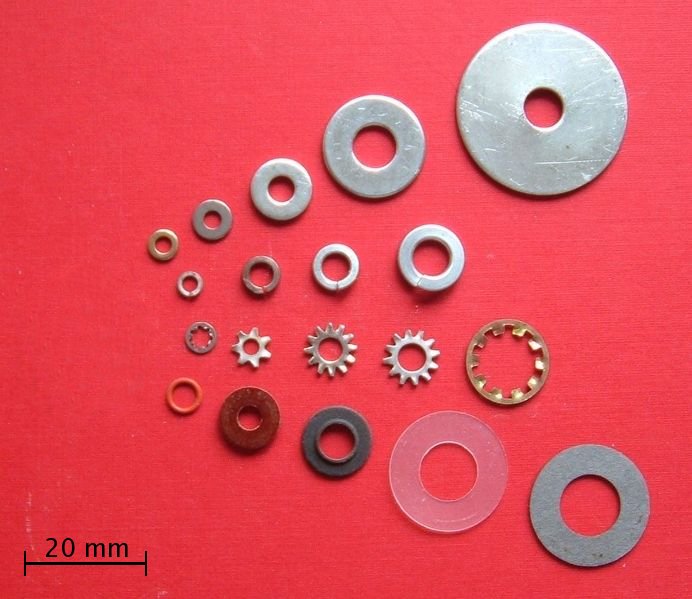
A washer is a thin plate (typically disk-shaped, but sometimes square) with a hole (typically in the middle) that is normally used to distribute the load of a threaded fastener, such as a bolt or nut. Other uses are as a spacer, spring (Belleville washer, wave washer), wear pad, preload indicating device, locking device, and to reduce vibration (rubber washer).
Washers are usually metal or plastic. High-quality bolted joints require hardened steel washers to prevent the loss of pre-load due to brinelling after the torque is applied. Washers are also important for preventing galvanic corrosion, particularly by insulating steel screws from aluminium surfaces. They may also be used in rotating applications, as a bearing. A thrust washer is used when a rolling element bearing is not needed either from a cost-performance perspective or due to space restraints. Coatings can be used to reduce wear and friction, either by hardening the surface or by providing a solid lubricant (i.e. a self-lubricating surface).
Rubber or fiber gaskets used in taps (or faucets, valves, and other piping connections) as seal against water leaks are sometimes referred to colloquially as washers; but, while they may look similar, washers and gaskets are usually designed for different functions and made differently.
Etymology
[edit]The origin of the word is unknown. The first recorded use of the word was in 1346; however, the first time its definition was recorded was in 1611.[1]
Washer types
[edit]Most washers can be categorized into three broad types;
- Plain washers, which spread a load, and prevent damage to the surface being fixed, or provide some sort of insulation such as electrical
- Spring washers, which have axial flexibility and are used to prevent fastening or loosening due to vibrations
- Locking washers, which prevent fastening or loosening by preventing unscrewing rotation of the fastening device; locking washers are usually also spring washers.
Plain washers
[edit]| Name(s) | Image | Description |
|---|---|---|
| Plain washer (or "flat washer") | 
|
A flat annulus or ring, often of metal, used to spread the load of a screwed fastening. Additionally, a plain washer may be used when the hole is a larger diameter than the fixing nut.[2][3] |
| Fender washer (US), penny washer, mudguard washer, or "repair washer" (UK) | 
|
A flat washer with a particularly large outer diameter (OD) in proportion to its central hole. These are commonly used to spread the load on thin sheet metal, and are named after their use on automobile fenders. They can also be used to make a connection to a hole that has been enlarged by rust or wear. In the UK, the name originally comes from the size of the old British penny. In the UK, most industries refer to all large OD washers as penny washers, even when the OD is as much as twice the size of the old penny.
An archaic form of this washer was sold as a "pot mender", usually in small quantities through a retail ironmonger. This included two washers, a nut, and bolt, and a sealing washer of rubber, cork, or fibre sheet. They could be used for sealing small holes, rust spots or removed pipe connections in water tanks or large cooking vessels. |
| Spherical washer nut and screw | Part of a self-aligning nut; it is a washer with one radiused surface, which is designed to be used in conjunction with a mating nut in order to allow for up to several degrees of misalignment between parts.[4] | |
| Anchor plate or wall washer | .png)
|
A large plate or washer connected to a tie rod or bolt. Anchor plates are used on exterior walls of masonry buildings, for structural reinforcement. Being visible, many anchor plates are made in a style that is decorative.[5] |
| Torque washer | Used in woodworking in combination with a carriage bolt; it has a square hole in the centre into which the carriage bolt square fits. Teeth or prongs on the washer bite into the wood, preventing the bolt from spinning freely when a nut is being tightened.[6] |
Spring and locking washers
[edit]| Name(s) | Image | Description |
|---|---|---|
| Belleville washer, also called cupped spring washer or conical washer | 
|
A washer with a slight conical shape, which provides an axial force when deformed. The surface may be serrated, which will have improved locking capabilities.[4] |
| Curved disc spring | 
|
Similar to a Belleville, except the washer is curved in only one direction, therefore there are only four points of contact. Unlike Belleville washers, they exert only light pressures.[7] |
| Wave washers | 
|
A washer with a "wave" in the axial direction, which provides spring pressure when compressed. Wave washers, of comparable size, do not produce as much force as Belleville washers. In Germany, they are sometimes used as lock washers but they are less effective than other choices.[a][8] |
| Split washer or spring lock washer | 
|
A ring split at one point and bent into a helical shape. This causes the washer to exert a spring force between the fastener's head and the substrate, which maintains the washer hard against the substrate and the bolt thread hard against the nut or substrate thread, creating more friction and resistance to rotation. Applicable standards are ASME B18.21.1, DIN 127 B, and United States Military Standard NASM 35338 (formerly MS 35338 and AN-935).[9]
Spring washers are a left hand helix and allow the thread to be tightened in a right hand direction only, i.e. a clockwise direction. When a left hand turning motion is applied, the raised edge bites into the underside of the bolt or nut and the part that it is bolted to, thus resisting turning. Therefore, spring washers are ineffective on left hand threads and hardened surfaces [citation needed]. Also, they are not to be used in conjunction with a flat washer under the spring washer, as this isolates the spring washer from biting into the component that will resist turning. The use and effectiveness of spring lock washers has been debated, with some publications[10][who?] advising against their use on the grounds that, when tight, the washer is flat against the substrate and gives no more resistance to rotation than a normal washer at the same torque. A 1990 NASA manual states "In summary, a lockwasher of this type is useless for locking."[4][11] However, a spring washer will continue to hold the bolt against the substrate and maintain friction when loosened slightly, whereas a plain washer will not.[a] The benefit of spring lock washers lies in the trapezoidal shape of the washer. When compressed to loads near the proof strength of the bolt, it will twist and flatten. This reduces the spring rate of the bolted joint which allows it to maintain more force under the same vibration levels. This prevents loosening.[12] |
| Toothed lock washer, serrated washer or star washer[8] |  
|
A washer with serrations that extend radially inward or outward to bite into the bearing surface. This type of washer is especially effective as a lock washer when used with a soft substrate, such as aluminium or plastic,[8] and can resist rotation more than a plain washer on hard surfaces, as the tension between washer and the surface is applied over a much smaller area (the teeth). There are four types: internal, external, combination, and countersunk. The internal style has the serrations along the inner edge of the washer, which makes them more aesthetically pleasing.[13] The external style has the serrations around the outer edge, which provides better holding power, because of the greater circumference.[14] The combination style has serrations about both edges, for maximum holding power.[15] The countersunk style is designed to be used with countersunk screws.[16]
Tooth lockwashers are also used for ground bonding where a metal lug or object must be electrically bonded to a surface. The teeth of the washer cut through surface oxides, paints or other finishes and provide a gas-tight conductive path. In these applications, the washer is not placed under the head of the screw (or under the nut), it is placed between the surfaces to be bonded.[17] |
| Tab washer | 
|
A locking washer that works by having a side tab that can be bent into place against a nut. Metallic or non-metallic, the tab washer notch prevents rotation relative to the shaft or fastener. Variations include single, multiple, formed and flat.[18] |
| Wedge lock washer | 
|
A hardened two-piece washer with radial teeth on the outside to grip both the fastener and mounting surface. The two halves of this washer form a wedge seam, which requires additional tension to be placed on the fastener in order for them to separate after tightening. While generally more expensive per piece, these washers provide the highest amount of vibrational loosening prevention.[19] |
Lock washers, locknuts, jam nuts, and thread-locking fluid are ways to prevent vibration from loosening a bolted joint.
Gaskets
[edit]The term washer is often applied to various gasket types such as those used to seal the control valve in taps.
| Name | Image | Description |
|---|---|---|
| Shoulder washer | A plain washer type with integral cylindrical sleeve. Used as a barrier between differing metals and as a seal.[20] This term is also used for electrically insulating grommets.[21] | |
| Crush washer | A washer made of soft metal such as aluminium or copper. Used to seal fluid or gas connections such as those found in hydraulic systems and in internal combustion engines. |
Specialised types
[edit]| Name(s) | Image | Description |
|---|---|---|
| Keps nut or K-lock nut | 
|
A nut with an integral free spinning washer; assembly is easier because the washer is captive. |
| Self-aligning washer | A two-part washer: one part has one convex spherical surface, which mates with a concave surface on the other part, to allow tightening to a surface which is not perpendicular to the axis of the screw or nut fastener, in a similar manner to a spherical washer and self-aligning nut | |
| Top hat washer | A shoulder washer type used in plumbing for tap fitting. | |
| Insulating shoulder washer | Used to electrically isolate a mounting screw from the surface it secures. Often made of nylon, these are also made of teflon, PEEK or other plastics to withstand higher temperatures. | |
| Keyed washer | A washer with a key to prevent rotation, and is used to lock two nuts in place, without allowing the torque applied to the top nut to cause the bottom nut to also rotate (such as in a threaded headset on a bicycle). | |
| Torque-limiting washer | A type of washer used in a variety of torque sensitive applications, designed to limit torque to a predetermined level and not beyond. | |
| Dowty washer | Has a central rubber ring to provide a strong seal against high pressure liquid or gas. |
The DIN 125 metric washer standard refers to subtypes A and B. ISO 7089 calls these Form A and ISO 7090 calls them Form B. They are all the same overall size, but Form B is chamfered on one side.
Materials
[edit]Washers can be fabricated from a variety of materials including, but not limited to:[22]
- Steel – Carbon steel, spring steel, A2 (304) stainless steel, and A4 (316/316L) stainless steel
- Non-ferrous metal – Copper, brass, aluminium, titanium, iron, bronze, and zinc
- Alloy – Silicon bronze, Inconel, Monel, and Hastelloy
- Plastic – Thermoplastics and thermosetting polymers such as polyethylene, PTFE (Teflon)[23]
- Nylon – Nylon 6, Nylon 66, Nylatron, and Tecamid MDS[24]
- Specialty – Fibers, ceramics, rubber, felt, leather, bimetals, and mica
- Phenolic – The material has good electrical insulation, is lightweight, tough, has low moisture absorption, is heat resistant, and is resistant to chemicals and corrosion. Phenolic washers are substitutes for flat metallic washers in cases where electrical insulation is required. Phenolic washers are stamped out of large sheets of the phenolic material. The term "phenolic washer" is sometimes used for stamped washers from laminated materials such as paper, canvas, and Mylar.
Corrosion resistance
[edit]A number of techniques are used to enhance the corrosion resistant properties of certain washer materials:
- Metallic coatings – Typical coatings used to produce corrosion resistant washers are zinc, cadmium, and nickel. Zinc coating acts as a sacrificial surface layer that falls victim to corrosive materials before the washer's material can be harmed. Cadmium produces a high-quality protective surface but is toxic, both biologically and environmentally. Nickel coatings add protection from corrosion only when the finish is dense and non-porous.
- Electroplating – This method involves coating the washer by electrolytic deposition using metals such as chromium or silver.
- Phosphating – A resilient, but abrasive surface is achieved by incorporating a zinc-phosphate layer and corrosion-protective oil.
- Browning or bluing – Exposing the washer (typically steel) to a chemical compound or alkali salt solution causes an oxidizing chemical reaction, which results in the creation of a corrosion-resistant, colored surface. The integrity of the coating can be improved by treating the finished product with a water-displacing oil.
- Chemical plating – This technique utilizes a nickel-phosphor alloy that is precipitated onto the washer surface, creating an extremely corrosion- and abrasive-resistant surface.[25]
Type and form
[edit]
The American National Standards Institute (ANSI) provides standards for general use flat washers. Type A is a series of steel washers at broad tolerances, where precision is not critical. Type B is a series of flat washers with tighter tolerances where outside diameters are categorized as "narrow", "regular" or "wide" for specific bolt sizes.[26]
"Type" is not to be confused with "form" (but often is). The British Standard for Metric Series Metal Washers (BS4320), written in 1968, coined the term "form". The forms go from A to G and dictate the outside diameter and thickness of the flat washers.
- Form A: Normal diameter, normal thickness
- Form B: Normal diameter, light thickness
- Form C: Large diameter, normal thickness
- Form D: Large diameter, light thickness
- Form E: Normal diameter, normal thickness
- Form F: Large diameter, normal thickness
- Form G: Largest diameter, larger thickness.
Washer 'form' when comparing different washer material types is used quite freely by stockists. In relation to BS4320 specifically, washer forms 'A' to 'D' inclusive are designated 'bright metal' washers and are supplied self-finished in various metals including: steel alloys, brass, copper, etc. Whereas, BS4320 washer forms 'E' to 'G' inclusive are designated 'black' (uncoated) mild steel washers, which normally are specified with a supplementary protective coating supply condition.
Standard metric flat washers sizes
[edit]Washers of standard metric sizes equivalent to BS4320 Form A are listed in the table below. Measurements in the table refer to the dimensions of the washers as described by the drawing. Specifications for standard metric flat washers were known as DIN 125 (withdrawn) and replaced with ISO 7089. DIN (Deutsches Institut für Normung - German Institute for Standardization) standards are issued for a variety of components including industrial fasteners as Metric DIN 125 Flat Washers. The DIN standards remain common in Germany, Europe and globally even though the transition to ISO standards is taking place. DIN standards continue to be used for parts which do not have ISO equivalents or for which there is no need for standardization.[27]

| Nominal screw sizes, M (mm) |
Screw pitch thread, P (mm) |
Diameter (mm) | Thickness, H (mm) | |||
|---|---|---|---|---|---|---|
| 1st choice |
2nd choice |
Coarse | Fine | Internal hole, d1 |
External, d2 | |
| 1 | 0.25 | 1.1 | 3 | 0.3 | ||
| 1.2 | 0.25 | 1.3 | 3.5 | 0.3 | ||
| 1.4 | 0.3 | 1.5 | 4 | 0.3 | ||
| 1.6 | 0.35 | 1.7 | 4 | 0.3 | ||
| 1.7 | 1.8 | 4.5 | 0.3 | |||
| 1.8 | 0.35 | |||||
| 2 | 0.4 | 2.2 | 5 | 0.3 | ||
| 2.5 | 0.45 | 2.7 | 6 | 0.5 | ||
| 2.6 | 2.8 | 7 | 0.5 | |||
| 3 | 0.5 | 3.2 | 7 | 0.5 | ||
| 3.5 | 0.6 | 3.7 | 8 | 0.5 | ||
| 4 | 0.7 | 4.3 | 9 | 0.8 | ||
| 5 | 0.8 | 5.3 | 10 | 1 | ||
| 6 | 1 | 0.75 | 6.4 | 12 | 1.6 | |
| 7 | 1 | 7.4 | 14 | 1.6 | ||
| 8 | 1.25 | 1 | 8.4 | 16 | 1.6 | |
| 10 | 1.5 | 1.25 or 1 | 10.5 | 20 | 2 | |
| 12 | 1.75 | 1.5 or 1.25 | 13 | 24 | 2.5 | |
| 14 | 2 | 1.5 | 15 | 28 | 2.5 | |
| 16 | 2 | 1.5 | 17 | 30 | 3 | |
| 18 | 2.5 | 2 or 1.5 | 19 | 34 | 3 | |
| 20 | 2.5 | 2 or 1.5 | 21 | 37 | 3 | |
| 22 | 2.5 | 2 or 1.5 | 23 | 39 | 3 | |
| 24 | 3 | 2 | 25 | 44 | 4 | |
| 27 | 3 | 2 | 28 | 50 | 4 | |
| 30 | 3.5 | 2 | 31 | 56 | 4 | |
| 33 | 3.5 | 2 | 34 | 60 | 5 | |
| 36 | 4 | 3 | 37 | 66 | 5 | |
| 39 | 4 | 3 | 40 | 72 | 6 | |
| 42 | 4.5 | 3 | 43 | 78 | 7 | |
| 45 | 4.5 | 3 | 46 | 85 | 7 | |
| 48 | 5 | 3 | 50 | 92 | 8 | |
| 52 | 5 | 4 | 54 | 98 | 8 | |
| 56 | 5.5 | 4 | 58 | 105 | 9 | |
| 60 | 5.5 | 4 | 62 | 110 | 9 | |
| 64 | 6 | 4 | 66 | 115 | 9 | |
| 68 | 70 | 120 | 10 | |||
| 72 | 74 | 125 | 10 | |||
| 76 | 78 | 135 | 10 | |||
| 80 | 82 | 140 | 12 | |||
| 85 | 87 | 145 | 12 | |||
| 90 | 93 | 160 | 12 | |||
| 100 | 104 | 175 | 14 | |||
See also
[edit]Notes
[edit]- ^ a b Bowmans Fastener Technical Fast of 1999 on page 32 and 33 has SAE recommendation from 1969 that lock washers not be used in any critical application. BMW motorcycles experienced a series of broken lock washers and BMW then disallowed their use in U-joints due to the damage of loss of the spacer and nut loosening.[citation needed]
References
[edit]- ^ "The Straight Dope: What's the purpose of washers (the round metal things)?". www.straightdope.com. 28 June 2005.
- ^ Paul Green (2007). The Mechanical Engineering Drawing Desk Reference: Creating and Understanding ISO Standard Technical Drawings. Lulu.com / CreateSpace. Washers, p.205. ISBN 9781847531155.
- ^ Nikolas Davies; Erkki Jokiniemi (2008). Dictionary of architecture and building construction. Architectural Press. Flat Washer, p.153. ISBN 9780750685023.
- ^ a b c "Fastener Design Manual" (PDF). NASA. 1990. pp. 9–10. Archived from the original (PDF) on 15 May 2010.
- ^ Bucher, Ward (1996). Dictionary of Building Preservation. Preservation Press. p. 576.
- ^ John Holloway (2010). Illustrated Theatre Production Guide. Focal Press. p. 202. ISBN 9780240812045.
- ^ McMaster-Carr catalog (115th ed.), McMaster-Carr, p. 1217, retrieved 2010-11-26.
- ^ a b c Smith, Carroll (1990), Carroll Smith's Nuts, Bolts, Fasteners, and Plumbing Handbook, MotorBooks/MBI Publishing Company, p. 116, ISBN 0-87938-406-9.
- ^ McMaster-Carr catalog (115th ed.), McMaster-Carr, pp. 3217–3218, retrieved 2010-11-25.
- ^ "Helical Spring Washers". www.boltscience.com. Retrieved 2017-02-14.
- ^ IS 3063 : 1994 Fasteners - Single coil rectangular section spring lock washers - Specification
- ^ Bickford. John H. "An Introduction to the Design and Behavior of Bolted Joints" 3rd Ed 1995. p561 ISBN 978-0824792978
- ^ "Specifications for Internal Tooth Lock Washers ASME B18.21.1-1999" (PDF). Aspen Fasteners.
- ^ "Specifications for External Tooth Lock Washers ASME B18.21.1-1999" (PDF). Aspen Fasteners.
- ^ "Specifications for Internal/External Tooth Lock Washers ASME B18.21.1-1999" (PDF). Aspen Fasteners.
- ^ "Specifications for Countersunk External Tooth Lock Washers ASME B18.21.1-1999" (PDF). Aspen Fasteners.
- ^ Layman, John (23 January 2012). "Improved Bonding and Grounding Methods for Electrical / Electronic Equipment" (PDF). NSRP.
- ^ Camillo, Jim. "What's With Washers?". Assembly Magazine. Retrieved May 10, 2016.
- ^ "Vibrational Loosening Prevention - Wedge Locking Technology", Sherex Fastening Solutions, retrieved January 25, 2019.
- ^ Fox, Brad; VanderWeyde, Peter (2008). Alloy boat corrosion: how to prevent it. Ripple Industries Pty Ltd. p. 16. ISBN 9780646492834.
- ^ "Fluorescent light". Popular Science. 186 (6). Bonnier Corporation: 117–118. June 1965. ISSN 0161-7370.
- ^ "Stampings & Washers | Accutrex". www.accutrex.com. Archived from the original on 2016-02-15. Retrieved 2016-02-11.
- ^ Teflon PTFE Washers, New Process, retrieved May 10, 2016
- ^ "Nylon Spacers And Washers - New Process Fibre". New Process Fibre Company, Inc. Retrieved 2016-02-11.
- ^ "Washers Information | IHS Engineering360". www.globalspec.com. Retrieved 2016-02-11.
- ^ "Standard Washers - Boker's, Inc". www.bokers.com.
- ^ "Metric DIN 125 Flat Washers" (PDF). Aspen Fasteners.
Further reading
[edit]- Parmley, Robert. (2000). "Section 11: Washers." Illustrated Sourcebook of Mechanical Components. New York: McGraw Hill. ISBN 0070486174 Drawings, designs and discussion of various uses of washers.
External links
[edit]
- (http://www.fastenerdata.co.uk/flat-washers Dimensions of Global washers
- ASME Plain washer dimensions (Type A and Type B)
- Typical USA Flat Washer Dimensions USS, SAE, Fender, and NAS washer ID & OD (mm)
- American National Standard (ANSI) Type B Plain Washers
- SAE Flat Washers Archived 2016-09-12 at the Wayback Machine Type A Plain Washers
- USS & SAE Combined Flat Washer Dimensions
- Flat Washer Thickness Table Steel Gage Thicknesses, non-metric
- Split Lockwashers: Truth vs. Myth Hill Country Engineering
- Using machine washers Machine Design - Using washers
| National | |
|---|---|
| Other | |

Washer (hardware)
View on GrokipediaOverview
Definition and Function
A washer is a thin, flat, disc-shaped hardware component featuring a central hole, typically employed as a fastener to distribute the load of threaded elements such as bolts or screws.[4] This simple yet essential part serves to enhance the reliability of mechanical assemblies by mitigating potential damage during installation and operation.[5] The term "washer" dates back to at least 1346 in written records, with its etymology uncertain.[6] The primary functions of a washer include spreading the pressure exerted by a nut or bolt head across a broader surface area to prevent surface damage, such as denting or embedding in softer materials; acting as a spacer to maintain precise separation between joined parts; and providing insulation or sealing to inhibit leakage, vibration transmission, or electrical conduction in assemblies.[4][5] By increasing the bearing surface, washers help ensure even load application, thereby extending the lifespan of both the fastener and the connected materials.[7] In terms of basic mechanics, washers enhance joint integrity by reducing stress concentrations that occur when a bolt or nut directly contacts a surface; without a washer, the load focuses on a small area, potentially causing material deformation or failure through embedment, whereas the washer disperses the force evenly over its larger diameter, minimizing localized pressure and promoting uniform clamping.[4] This load distribution is particularly critical in preventing distortion in weaker substrates during tightening.[8] Unlike spacers, which primarily provide separation and are often thicker for maintaining distance without significant load-bearing, washers are generally thinner and optimized for pressure equalization in fastened joints.[4]Historical Development
The use of rudimentary washers dates back to ancient civilizations, where flat stones or early metal discs were employed to distribute loads in wooden joints and constructions. Such devices trace to the Bronze Age around 3000 BCE, with possible use by Egyptians in building projects and furniture assembly to prevent damage from fasteners like wooden pegs or early metal pins, though specific archaeological evidence is scarce.[9][10] During the medieval period, advancements in metalworking allowed blacksmiths to forge simple iron or steel washers, which were used to reinforce armor, tools, and structural elements in European construction. These early metal versions provided better durability than previous materials like leather or cloth, which had been observed in Roman applications for sealing and load spreading in chariots and machinery. By the 14th century, written records in English, such as those from 1346, referenced "washers" in the context of sealing joints, indicating their integration into everyday hardware.[10][11][6] The Industrial Revolution in the late 18th and early 19th centuries marked a pivotal shift, as mechanized production enabled the mass manufacturing of standardized metal washers to accompany screws and bolts in emerging factories and railways; this was facilitated by inventions like machine-cut screws in the late 1700s. This era saw the introduction of spring washers, with Julien Belleville patenting the cupped Belleville washer in France in 1867 to provide elastic support under load. Split lock washers also emerged in the 19th century, designed as ring-shaped components with a split to create tension and prevent loosening.[10][12][13] In the 20th century, innovations focused on vibration resistance for industrial machinery, particularly after World War II. The twisted tooth lock washer was patented in 1923 by Shakeproof Industrial Products to grip surfaces and resist rotation in dynamic environments like engines and vehicles. Wedge-locking washers followed in the 1950s, invented by Swedish engineer Rune Wingquist to counter self-loosening through cam-faced pairs that expand under load. The post-war boom in synthetic materials also led to the development of non-metallic washers valued for electrical insulation and corrosion resistance in appliances and electronics.[14][15] Since the 2000s, precision manufacturing techniques like computer numerical control (CNC) machining and 3D printing have enabled custom washers for high-demand sectors such as aerospace and automotive, allowing for complex geometries and rapid prototyping with materials transitioning from basic iron to advanced corrosion-resistant alloys. These methods have improved tolerances and reduced production times for specialized components in aircraft assemblies and vehicle suspensions.[6][10][16]Types
Plain Washers
Plain washers are flat, circular discs featuring a central hole and uniform thickness, without any bends, locks, or deformations, serving as essential components in fastening assemblies to distribute the load from a bolt or nut over a wider surface area and prevent damage to the underlying material.[17] They are commonly positioned beneath bolt heads or nuts to ensure even pressure application during tightening.[18] The two primary sub-variations of plain washers are the USS (United States Standard) and SAE (Society of Automotive Engineers) patterns, which differ primarily in their outer diameter relative to the inner hole size while sharing the same inner diameter for a given fastener size.[19] USS washers feature a larger outer diameter and greater thickness, making them suitable for general-purpose applications requiring broader coverage, whereas SAE washers are smaller and thinner, designed for more precise fits in specialized assemblies.[18] For instance, both types for a 1/2-inch inner diameter have an inner diameter of about 0.531 inches, but the USS outer diameter measures approximately 1.375 inches compared to 1.062 inches for SAE.[17] These dimensions adhere to the ANSI/ASME B18.22.1 standard for plain washers.[19] Key properties of plain washers include their high efficiency in load distribution across even surfaces, which helps accommodate minor misalignments and reduces localized stress concentrations.[17] However, they offer only minimal resistance to axial movement, relying on the friction from the fastener for stability.[18] Plain washers are advantageous for their cost-effectiveness and versatility in everyday fastening tasks, such as in construction and machinery, where simple load spreading is required.[19] Their limitations arise in high-vibration settings, where they may not sufficiently prevent loosening without supplementary components like spring washers.[18]Spring and Locking Washers
Spring washers and locking washers are specialized fasteners engineered to maintain preload in bolted joints subjected to dynamic loads, vibration, or thermal fluctuations, thereby preventing self-loosening. Unlike plain washers, which primarily distribute loads in static applications, these variants incorporate elastic deformation to generate ongoing axial forces that resist relative motion between components.[20][21] Spring washers typically feature designs that allow compression to produce axial force, with common types including helical or split configurations. Helical spring washers, often formed from a split ring bent into a coil-like shape, exert spring tension when compressed, embedding their edges into mating surfaces to enhance friction and inhibit rotation.[22] Conical spring washers, known as Belleville washers, have a frustum shape that deflects under load to apply precise axial forces; they can be stacked in parallel to increase load capacity—for instance, two washers may double the load—or in series to extend deflection range, enabling customization for high-stress assemblies.[23] Wave spring washers, suited for lighter loads, consist of stamped wavy patterns that compress to provide axial cushioning and absorb minor shocks, offering flexibility in space-constrained setups where deflection is limited.[21] Locking washers focus on frictional grip through deformation or serrations to secure fasteners against rotational loosening. Split lock washers, a subset of helical designs, feature a cut and twisted ring that bites into the nut and workpiece surfaces upon tightening, creating torsional resistance.[22] Tooth locking washers include internal types with inward-pointing serrations that grip the bolt shank, and external types with outward teeth that embed into the mating surface; both varieties penetrate softer materials to prevent slippage under torque.[22] Internal locking washers, often used with delicate or softer substrates, employ similar serrated edges directed inward to minimize surface damage while maintaining hold.[22] The mechanics of these washers rely on elastic recovery and increased friction to counteract vibration-induced loosening. Upon installation, their deformation stores strain energy that generates continuous preload, countering relaxation from cyclic transverse movements; for example, spring washers can halve the loosening rate in Junker vibration tests compared to bare joints by embedding edges and boosting frictional forces.[24] Locking variants like split types further enhance torque retention by balancing loosening torques with prevailing friction, maintaining up to 90% of initial preload over extended vibration exposure in dynamic tests.[25] This ongoing tension prevents complete detachment, though effectiveness diminishes under extreme wear or overload.[24] These washers find primary use in environments with repeated stress, such as automotive engines where helical and Belleville types secure components against vibrational fatigue, or structural bridges employing conical stacks for thermal expansion compensation and load stability.[23] In aerospace and machinery, tooth and split locking washers protect against rotational slip in high-vibration settings, ensuring long-term joint integrity without frequent retightening.[22]Specialized Washers
Specialized washers are engineered variants designed for particular environmental challenges or assembly requirements in industries such as construction, aerospace, automotive, electrical, and power generation, where standard washers may not suffice due to factors like surface angles, flush fitting, load distribution on thin materials, insulation needs, aesthetic demands, or extreme conditions.[26] These types prioritize functional adaptations, such as tapered profiles or specialized materials, to enhance performance in niche applications without relying on tension-based locking mechanisms.[27] Beveled washers feature tapered edges to accommodate sloped or irregular surfaces, ensuring even load distribution during bolting. They are commonly employed in structural steel assemblies, such as sloped roof bolts or connections involving channel flanges and S-shaped beams, where the surface is not perpendicular to the fastener axis.[27] For American Standard beams and channels, these washers are typically square or rectangular, with thickness tapering to match the slope, conforming to specified dimensions for compatibility with high-strength bolts.[28] Countersunk washers possess a conical shape that allows them to seat flush within tapered holes, providing a smooth surface finish and resistance to vibration-induced loosening. In aerospace applications, lightweight countersunk washers secure aircraft panels, maintaining flush alignment under high-stress conditions for aerodynamic efficiency and structural integrity.[29] In woodworking, they enable repairs with minimal surface disruption, preventing wood splitting while achieving a clean, even appearance around the fastener.[30] Fender washers, characterized by a large outer diameter relative to the inner hole, excel at distributing loads over thin or soft materials to prevent pull-through. They are widely used in automotive repairs, particularly for attaching sheet metal panels like fenders, where the expanded bearing surface safeguards against deformation during tightening.[31] This design also finds application in plumbing and electrical setups involving fragile substrates.[32] Sealing washers, often consisting of a metal ring bonded to a rubber or elastomeric seal, create watertight or airtight barriers to prevent fluid or gas leakage in assemblies. Common subtypes include bonded seal washers and crush washers made from soft metals like copper or aluminum, which deform under compression to fill gaps. They are essential in plumbing, hydraulic systems, and automotive fuel lines, where maintaining seals under pressure or vibration is critical.[33] Phenolic washers, made from composite materials like paper or cotton phenolic, provide essential electrical insulation in assemblies where conductivity must be isolated. Their high dielectric strength and low water absorption make them suitable for flange and bolt insulation in electrical equipment, preventing short circuits and ensuring long-term reliability.[34] Standards such as NAS549 specify phenolic variants for insulating washers in aviation and industrial contexts.[35] Dome or cap washers offer a rounded, protective covering that conceals fastener heads for both safety and visual appeal. In insulation systems, aluminum or stainless steel dome caps secure onto pins or anchors, covering sharp ends to create an aesthetically clean and hazard-free surface.[36] For screw applications, they provide a finished look by hiding heads in woodworking or decorative hardware.[37] High-temperature washers, often fabricated from alloys like Inconel or Vespel, withstand extreme heat in demanding environments such as gas turbines and heat exchangers. Inconel washers maintain integrity in power utility turbines exposed to temperatures exceeding 2,000°F, resisting oxidation and creep for reliable fastening.[38] Vespel-based washers support bushing and thrust applications in turbine engines, offering low friction and thermal stability under operational stresses.[39] Magnetic washers incorporate ferromagnetic properties to facilitate attachment in sensor assemblies, enhancing positioning for proximity or speed detection in dynamic systems. They are utilized as targets or mounts in automotive and industrial sensors, where the magnetic field aids in non-contact monitoring of motion or alignment.[40]Materials
Common Materials
Washers are primarily constructed from metals valued for their mechanical strength and durability in fastening applications. Carbon steel is widely used due to its high tensile strength, typically ranging from 400 to 600 MPa per standards like ASTM F436, making it suitable for load-bearing scenarios where cost-effectiveness is prioritized.[41][42] Stainless steel, particularly grades like 304 and 316, offers enhanced corrosion resistance and longevity, ideal for environments exposed to moisture or chemicals without additional coatings.[43] Zinc-plated carbon steel provides an economical option by combining the strength of steel with basic protection against oxidation, commonly applied in general construction and automotive assemblies.[44] Brass and copper washers are selected for their excellent electrical conductivity and natural resistance to corrosion in wet or marine settings, often used in plumbing and electrical hardware to prevent galvanic reactions.[4] Non-metallic materials like nylon and polyethylene plastics are favored for lightweight, non-conductive properties, reducing weight in assemblies while insulating against electrical current; these are common in electronics and low-load fixtures, with tensile strengths typically 50-90 MPa for nylon.[45][46] Rubber or fiber-based washers, such as those made from neoprene or vulcanized fiber, provide sealing functions by compressing to fill gaps, though they differ from dedicated gaskets by prioritizing vibration damping over high-pressure containment.[44] Alloys and composites expand options for specialized needs, with aluminum washers chosen for their low density in aerospace applications, providing approximately 65% weight reduction compared to steel while maintaining moderate strength.[47] Fiber-reinforced polymers, incorporating materials like glass or carbon fibers in a polymer matrix, deliver high impact resistance and fatigue endurance for demanding structural uses.[48] Material selection hinges on balancing tensile strength, density, and cost against specific load requirements, ensuring optimal performance; for instance, high-strength steel suits heavy-duty applications exceeding 500 MPa loads, while plastics are suitable for lighter, insulating duties.[49] Uncoated metals like plain carbon steel may face corrosion risks in humid conditions, underscoring the need for appropriate base material choices.[43]Corrosion Resistance and Coatings
Washers in assemblies are susceptible to various forms of corrosion, particularly when exposed to moisture, electrolytes, or dissimilar metals. Galvanic corrosion occurs through electrochemical interaction between two dissimilar metals, such as a steel washer and an aluminum bolt, in the presence of an electrolyte like rainwater, accelerating degradation at the interface. Pitting corrosion manifests as localized cavities or holes on the washer surface, often initiated by chloride ions, which can compromise structural integrity without widespread visible damage. Uniform corrosion, by contrast, involves even surface-wide material loss, typically from exposure to atmospheric oxygen and moisture, leading to gradual thinning of the washer.[50][51][52] To mitigate these effects, common coatings provide sacrificial or barrier protection, enhancing washer longevity in diverse environments. Zinc plating via electrolytic deposition applies a thin layer, typically 5-12 µm thick, that acts as a sacrificial anode, corroding preferentially to protect the underlying steel from rust. Hot-dip galvanizing immerses the washer in molten zinc, forming a thicker coating (around 50-125 µm) suitable for outdoor applications, where it offers robust resistance to atmospheric corrosion through both barrier and sacrificial mechanisms. Phosphate coatings, often applied as a pretreatment, create a microcrystalline layer that improves paint adhesion for subsequent organic finishes, while also providing moderate corrosion inhibition in mildly corrosive settings.[53][54][55][56] Advanced treatments target specific material challenges for superior performance. Passivation on stainless steel washers involves chemical treatment with nitric or citric acid to remove free iron and form a stable chromium oxide layer, significantly enhancing inherent corrosion resistance in aggressive environments. Polymer coatings like PTFE (polytetrafluoroethylene) deliver exceptional chemical resistance, remaining inert to acids, bases, and solvents, thus preventing degradation in harsh industrial settings. Anodizing aluminum washers grows a durable oxide layer through electrolytic oxidation, providing a hard, porous barrier that boosts corrosion protection and allows sealing for further enhancement.[57][58][59][60] Corrosion resistance is evaluated through standardized testing, such as the ASTM B117 salt spray test, which exposes coated washers to a neutral salt fog to measure time to failure, often rated in hours until white rust (for zinc) or red rust appears. For instance, electrolytic zinc-plated washers typically withstand 96-192 hours (up to 500 hours with thicker coatings or chromate passivation), while hot-dip galvanized ones often exceed 500-1,000 hours depending on coating thickness.[61][62] These coatings also preserve mechanical properties; in humid conditions, they help prevent corrosion-induced weakening, maintaining load-bearing capacity compared to uncoated counterparts, as verified in environmental durability studies.[63]Design and Specifications
Dimensions and Forms
Washers are characterized by three primary dimensions: the inner diameter (ID), which is designed to match the diameter of the bolt or screw it accompanies; the outer diameter (OD), which provides the bearing surface for load distribution; and the thickness, which determines the washer's structural integrity under compression.[64] The ID typically equals the nominal bolt size, ensuring a close fit without excessive play, while the OD is generally 2 to 3 times the ID to balance effective load spreading with material efficiency.[65] Thickness for most washers ranges from 0.5 mm to 5 mm, with thinner profiles used for lighter applications and thicker ones for higher loads.[66] In terms of forms, the standard round shape features a circular perimeter, offering uniform contact for rotational symmetry in fastening. Square forms are employed where slotted holes require accommodation or enhanced torque resistance, providing a larger contact area compared to round equivalents. Rectangular variants suit applications involving linear load paths, distributing force along elongated surfaces to prevent localized stress. Tabbed forms incorporate protruding tabs that facilitate component alignment or locking, bending to secure adjacent parts during assembly.[1][67][68] Proportions between OD and ID are critical for effective load distribution, with standard ratios typically ranging from 2 to 3, promoting even pressure dispersion across the fastened joint and reducing the risk of surface deformation. Ratios exceeding 3.0, as seen in specialized oversized designs, provide broader coverage but may introduce inefficiencies in standard uses.[5][69] Manufacturing tolerances for these dimensions vary by precision requirements, but general allowances for precision washers include ±0.1 mm on the ID to maintain compatibility with bolt shanks. OD and thickness tolerances are similarly controlled, often within ±0.1 to ±0.2 mm, to ensure consistent performance and fit in assemblies. These allowances account for variations in stamping or machining processes while upholding functional reliability.[70] Washers are available in both metric and imperial sizing systems to align with global engineering practices.[71]Standards for Sizes and Tolerances
Standards for washer sizes and tolerances are established by international and regional bodies to ensure uniformity, compatibility, and reliability in fastening applications across global supply chains. These standards define nominal dimensions such as inner diameter (ID), outer diameter (OD), and thickness, along with permissible deviations to facilitate interchangeability between manufacturers. In metric systems, DIN 125 specifies flat washers in the normal series, covering inner diameters from 1.6 mm to 80 mm and thicknesses ranging from 1 mm to 6.4 mm, designed primarily for use with hexagon bolts and nuts to distribute load effectively.[72] Complementing this, ISO 7089 outlines plain washers in the normal series with product grade A, applicable to sizes from 1.6 mm to 64 mm in hardness classes of 200 HV and 300 HV, ensuring suitability for bolts up to property class 8.8. For imperial measurements, ANSI B18.22.1 governs plain flat washers in SAE and USS series, where SAE washers are narrower and thinner for precision applications, such as a #10 size with OD between 0.406 inches and 0.427 inches, while USS provides broader coverage for general structural use.[73] Additionally, ASME B18.2.6 addresses hardened steel washers for heavy hex structural bolts, specifying dimensions like circular or beveled forms compliant with ASTM F436 for high-strength connections.[74] Tolerances for these washers are detailed in ISO 4759-3, which defines product grades A (normal precision), C (coarse), and F (fine) for plain washers up to 150 mm nominal diameter, with grade A offering tighter limits such as ±0.2 mm on ID for smaller sizes compared to ±0.4 mm in grade C.[75] Hole chamfering, typically 0.5 mm to 1 mm deep at 30-45 degrees, is standardized in ISO 7090 and DIN 6916 to ensure bolt clearance and prevent edge damage during assembly.[76] Compliance with these standards often requires certification marks, such as the CE marking in the European Union under the Construction Products Regulation (EU) No 305/2011, which mandates performance declarations for metal washers used in structural applications to verify safety and durability.[77] The evolution toward global standards accelerated post-1950s with the International Organization for Standardization (ISO) founding in 1947 and subsequent harmonization efforts, transitioning from national specifications like early DIN norms to unified ISO equivalents by the 1970s, reducing trade barriers and promoting widespread adoption.[78]| Standard | Series/Grade | Example Size (Nominal Bolt) | ID Range (mm/in) | OD Range (mm/in) | Thickness Range (mm/in) |
|---|---|---|---|---|---|
| DIN 125 | Normal | M6 | 6.4-6.6 | 12.5-13.3 | 1.6-2.0 |
| ISO 7089 | Grade A | M8 | 8.4-8.6 | 17-18 | 2.0-2.5 |
| ANSI B18.22.1 (SAE) | SAE | #10 (0.190") | 0.203-0.209 | 0.406-0.427 | 0.022-0.045 |
| ANSI B18.22.1 (USS) | USS | 1/4" | 0.281-0.312 | 0.734-0.812 | 0.048-0.080 |
| ASME B18.2.6 | Hardened | 3/4" | 0.812-0.844 | 1.469-1.531 | 0.095-0.136 |